Distributed Branching Random Walks and Their Applications

Abstract
In recent years, the explosion of big data and analytics has necessitated distributed storage and processing with several compute nodes (e.g., multiple datacenters). These nodes collaboratively perform parallel computation, where the data is typically partitioned across these nodes to ensure scalability, redundancy and load-balancing. But the nodes may not always be co-located; in many cases, they are part of a larger communication network. Since those nodes only need to communicate among themselves, a key challenge is to design efficient routes catered to that subnetwork.
In this work, we initiate the study of distributed sampling and routing problems for subnetworks in any well-connected network. Given any network with mixing time , consider the canonical problem of permutation routing [Ghaffari, Kuhn and Su, PODC 2017] that aims to minimize both congestion and dilation of the routes, where the demands (i.e., set of source-terminal pairs) are such that each node sends or receives number of messages proportional to its degree. We show that the permutation routing problem, when demands are restricted to any subset (i.e., subnetwork), can be solved in rounds (where hides polylogarithmic factors of ). This means that the running time depends subpolynomially on the subnetwork size (i.e., not on the entire network size). The ability to solve permutation routing efficiently immediately implies that a large class of parallel algorithms can be simulated efficiently on the subnetwork.
As a prerequisite to constructing efficient routes, we design and analyze distributed branching random walks that distribute tokens started by the nodes in the subnetwork. At a high-level, these algorithms operate by always moving each token according to a (lazy) simple random walk, but also branching a token into multiple tokens at some specified intervals; ultimately, if a node starts a branching walk, with its id in a token, then by the end of execution, several tokens with its id would be randomly distributed among the nodes. As these random walks can be started by many nodes, a crucial challenge is to ensure low-congestion, which is a primary focus of this paper.
Keywords and phrases:
Distributed Graph Algorithms, Random Walks, Permutation RoutingCopyright and License:
![[Uncaptioned image]](x1.png) © Vijeth Aradhya, Seth Gilbert, and Thorsten Götte; licensed under Creative Commons License CC-BY 4.0
© Vijeth Aradhya, Seth Gilbert, and Thorsten Götte; licensed under Creative Commons License CC-BY 4.0
2012 ACM Subject Classification:
Theory of computation Distributed algorithms ; Theory of computation Random walks and Markov chains ; Networks Packet schedulingFunding:
V. Aradhya and S. Gilbert acknowledge the support by Singapore MOE Tier 2 grant MOE-T2EP20122-0014. T. Götte acknowledges the support by DFG grant 491453517.Editors:
Silvia Bonomi, Letterio Galletta, Etienne Rivière, and Valerio SchiavoniSeries and Publisher:
 Leibniz International Proceedings in Informatics, Schloss Dagstuhl – Leibniz-Zentrum für Informatik
1 Introduction
When designing distributed algorithms, we typically develop solutions for an entire network. For example, we might want to identify a maximal independent set (MIS) for the graph (e.g., [28]), find an MST for the graph (e.g., [60]), compute all-pairs shortest paths (e.g., [42]), or solve a load balancing problem (e.g., [25]).
In practice, however, the “entire network” is gigantic, and the application we are designing likely wants to solve the problem only on a subnetwork. For example, we might need an MIS only for a specific subgraph – an easy problem, since finding an MIS depends only on the local neighborhood. Or we might want to find an MST connecting a subset of the nodes – i.e., we want a Steiner tree; over the last several years, there has been significant progress in distributed algorithms for Steiner tree approximation [50, 65].
For many other (non-local) problems, it remains open (to date) how easy or hard they are to solve on subgraphs. In this paper, we focus on two fundamental problems – sampling and routing. Solving these problems provides a framework for easily adapting existing algorithms designed for a graph to run efficiently on a subgraph of : by (effectively) building on overlay allowing nodes in the relevant subset to communicate efficiently, we can easily simulate global algorithms on a subgraph.
In more detail, imagine you are given some graph representing the network, and some subset of the nodes are identified as participants. The subgraph induced by is not necessarily connected (without using edges from the larger graph). Thus to solve problems for the nodes in , we need to design algorithms that operate in the larger graph – but that are ideally more efficient than simply solving the problem on the entire graph. We focus on networks with limited bandwidth – i.e., communication is governed by the CONGEST model [61]. And we assume the graph is reasonably well-connected, i.e., has a given mixing time .
We consider two key problems: (i) random sampling, where every node in (simultaneously) retrieves a random sample of node identifiers from the set ; and (ii) permutation routing, where nodes in discover efficient (low congestion, low dilation) routes between pairs of nodes in .
In general, the challenging aspect of solving these problems on a subgraph is establishing efficient communication between the nodes in , without flooding the broader network with messages and creating too much congestion. Nodes in know that they are in , but they do not know anything about which other nodes are in or where to find them. To create connections, these nodes in might send out large numbers of messages to probe the network – but (depending on the topology of the network) this might induce significant congestion if done naively.
Distributed Sampling
More specifically, the goal of distributed sampling is that each node in receives sufficiently many samples (i.e., node identifiers) drawn from a distribution sufficiently close to the stationary distribution of the graph.
Definition 1.
Distributed-Subsample() or DSubsample() problem.
-
Input: Network ; Subset of nodes ; .
-
Ensure: Each node outputs “almost-random” samples (i.e., node ids) from set , i.e., for each sample at any node , for any node , , where is the degree of node and .
Random-walk based algorithms have been often used for sampling: random walks are fast and light weight, and this sampling capacity has been useful in a variety of contexts, for example, aggregate statistics (e.g., [53, 67]), resource discovery (e.g., [39, 38]), information dissemination (e.g., [33, 34]), peer-to-peer networks (e.g., [47, 37, 6, 35]), agreement and leader election (e.g., [4, 5, 36]), etc.
Unfortunately, simple random walks may take too long to discover and sample from a subset of nodes in the graph.
Branching Random Walks
The key technical tool that we develop to solve this problem is a special type of branching random walk that we call an amoeba walk. Branching random walks allow a token to split during the walk, producing more tokens and covering the graph faster. Thus a branching walk will more quickly discover a hidden subset of the graph.
The key challenge with branching walks is controlling congestion: as the number of tokens multiplies, so does (potentially) the congestion. In fact, we show (in Theorem 5) that a simple branching random walk (i.e., a “count random walk” [45, 36]) inevitably creates too much congestion.
Many branching random walks – like cobra walks (coalescing and branching random walks) [22, 54] – control congestion by coalescing tokens when there are too many. They are generally designed to begin at one location and eventually “cover” the network with tokens representing a source message (e.g., a rumor or an infection).111Of course, one can start a cobra walk at many locations, and there are other applications aside from “rumor spreading.”
Unlike such branching walks, we want to begin random walks at many different nodes in the network, where each source achieves some “balanced” level of cover in the network. (For example, we do not want one source to crowd out the others.) To ensure this, we do not want to allow arbitrary branching at every step – we want a more controlled process.
Specifically, an amoeba walk alternates between two different types of phases: mixing and dividing. During the mixing phase, a token follows a traditional random walk (without any branching); during the dividing phase, it splits into multiple tokens. This alternation prevents too much congestion from developing in any one place in the network. Thus, if each node in starts appropriate amoeba walks, tokens from each node will eventually be randomly distributed in the graph, providing a random sample of other nodes in .
Distributed Routing
Building on the sampling infrastructure (which connects each node in to a small number of other nodes in ), we show how to develop a routing algorithm among all the nodes in , allowing nodes in to communicate efficiently.
Specifically, we focus on the distributed permutation routing problem, introduced by Ghaffari, Kuhn and Su [31] in the context of expander networks. In this problem, there is a set of source-terminal pair of nodes (typically called the “demand”), where a (unique) message needs to be sent from each source to its terminal. At the same time, there is a constraint on the demand wherein each node is designated as the source or terminal for a total number of messages that is at most its degree.
The challenge is to ensure that all messages reach their respective destinations as quickly as possible, requiring nodes to route them all in parallel, while limiting congestion, i.e., ensuring that at most polylogarithmic (in network size) bits are sent along any edge at a time.
This problem has received great attention in recent years [31, 32, 14, 12], due to several important applications, such as distributed MST and min-cut [31, 16], data summarization (e.g., sorting, distinct elements, frequency moments, etc) [67], subgraph enumeration [13], shortest path and distance-related computation [11], etc. Moreover, Ghaffari and Li [32] showed that permutation routing enables an efficient adaption of work-efficient algorithms in the PRAM model to distributed networks in the CONGEST model, thereby creating a bridge to a vast literature of parallel algorithms.
In this work, we study a natural generalization of permutation routing, where the demand is restricted to a subset of nodes. The goal is to obtain performance guarantees that (ideally) depend on the subset size.
Definition 2.
Subnetwork-Permutation-Routing() or SPRoute() problem.
-
Input: Network ; Source-Terminal Set where and node knows the id of node and a message that needs to be sent to node , where is of size at most bits.
-
Require: For each node , where is the degree of node .
-
Ensure: , node receives the intended message .
Our basic solution for subnetworks extends the random-walk based approach of Ghaffari, Kuhn and Su [31]. First, the nodes execute (slightly modified) amoeba walks to randomly distribute the node ids. Then the nodes in efficiently simulate a random graph overlay among themselves. Combining these methods, we can create a hierarchical decomposition of the nodes in , enabling an efficient routing algorithm between any pair of those nodes.
Contributions
Our technical contributions are two-fold, with a focus on distributed sampling and routing.
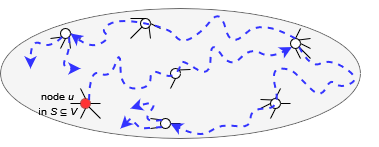
To tackle the sampling and routing problems, we design and analyze a new distributed branching random walk algorithm called amoeba-walks. The main idea is that each node in the subnetwork, starts a token that always executes a (lazy) simple random walk, but also occasionally branches into multiple tokens. See Figure 1 for an illustration. The tokens executing these algorithms carefully alternate between “mixing” and “dividing” phases, so that the algorithm induces low-congestion, and all the nodes end up with (almost-)random samples (i.e., node ids) from the subnetwork.
Theorem 3.
Consider any network with mixing time and any set . The DSubsample() problem can be solved in rounds whp.
Once we are able to efficiently distribute the random samples of the subnetwork, one may be tempted to let the nodes simply reverse the tokens to obtain low-congestion routes. However, for the permutation routing problem, the demands can be such that each node sends or receives a number of messages proportional to its degree, which could cause congestion in the (naive) amoeba-walk algorithm. However, with a slight modification, and simulation of a (virtual) random graph over the subnetwork, and leveraging the state-of-the-art permutation routing algorithm (i.e., [32]), we prove the following theorem.
Theorem 4.
Consider any network with mixing time and any set . The SPRoute() problem can be solved in rounds whp.
An immediate corollary of this theorem is that we can simulate a large number of parallel and distributed algorithms designed for an entire graph [2, 32]. For example, due to Ghaffari and Li [32], Theorem 4 implies that any (work-efficient) round CRCW PRAM algorithm can be simulated by the nodes in in time .
2 Preliminaries
We formally define the distributed network model, assumptions, and notations.
Network.
Let be a connected graph that denotes a network of nodes, where and are the set of nodes and set of (bidirectional) communication links, respectively. As is typical, and . The nodes in the graph represent a fixed set of computing entities, where each node is associated with a unique identifier (or id). Moreover, we assume that the id of any node can be encoded in bits.
The system proceeds in synchronous rounds, i.e., a message sent by a node in any round is received by its recipient node by the end of that round.
Network Properties.
Let and be the degree of node and volume of subset (resp.), where is the set of neighbors of node . Let be the max-degree. Let denote the conductance where .
Let and denote the stationary distribution and mixing time of the lazy random walk on the network. Recall that the lazy walk stays at the current node with probability 1/2, otherwise it moves to a uniformly random neighbor; see, Algorithm 2 for a reference. As the name implies, once the random walk reaches the “stationary” distribution, it stays there forever; for the lazy walk, it is known that for any node (see, e.g., [51]).
Furthermore, let be the probability distribution of the lazy random walk that started at node and ended up at node after steps. In this paper, we define the mixing time as the minimum such that for all pairs of nodes and , , where is a suitable constant.
Congestion.
In any round, each node can send bits along any edge. We consider a slightly non-standard model [61], where is polylogarithmic in (instead of ), so that the exposition of the analysis becomes simple, as each node can send random walk tokens, having distinct node ids, in a single round.
Estimates of Certain Global Parameters.
For the sake of a clean exposition, we make a simplifying assumption that the nodes have a good estimate (i.e., within constant factors) of the network’s mixing time, , and (where is part of the input).
For the routing problem, these parameters could be estimated directly, i.e., nodes can determine the various sizes by evaluating aggregate functions (such as summation, etc), for e.g., by constructing a BFS tree using the node with minimum id as the root. For the mixing time, nodes can use a “guess-and-double” trick until all routing paths are established [32], i.e., if a node cannot route a message to its destination in the anticipated time, then the node can inform the root, which can re-initiate the routing algorithm after doubling the estimate.
3 Related Work
Distributed and Parallel Random Walks.
There has been a vast literature on the design, analysis and applications of random walks in distributed networks. Alon et al. showed that the cover time (i.e., expected time taken to visit all nodes) can be significantly reduced over various families of graphs, when multiple (independent) simple random walks are started from an arbitrary node. However, they do not minimize congestion. In the CONGEST model, Das Sarma et. al showed that an -length random walk can be computed in time, i.e., sublinear in the length of the walk, where denotes the diameter of the network. They achieved it by performing several short random walks and carefully stitching them together. In a subsequent work, Das Sarma et. al [66] extended this algorithm to dynamic regular networks, where the network can change arbitrarily over time. In fact, the idea of stitching independent random walks has been exploited in the massively parallel computation [46] and overlay models [21, 7], for an exponential speed up in computing random walks.
A closely related stochastic process is a natural generalization of simple random walk, called the coalescing-branching random walks [23, 19, 20, 55, 9]. Dutta et al. [23] initiated the study the rate of information dissemination, particularly cover time for different classes of networks. In particular, they show a cover time of in expander networks, whereas, the cover time for simple random walk is known to be . This process begins with a branching factor , and an arbitrary node is initially “active”. In any step, each active node chooses random neighbors to be active (i.e., “branching” property). However, a node can be active in any step only if it is chosen by some node in the previous step (i.e., “coalescing” property). A key difference with our distributed branching random walk is that although the tokens divide into multiple tokens over time, they never coalesce into a single token at any node. Moreover, our focus is on ensuring that the process induces low-congestion (i.e., each node sends at most polylog bits over any edge in any round), whilst achieving a different goal, i.e., randomly distributing samples (i.e., node ids) of any subset of nodes to the network.
Perhaps, a type of distributed random walk that is closest to the distributed branching random walks, are “count” random walks [45]. Here, a small set of nodes start (polynomially) many walks by associating a count parameter with a token (in addition to the id of the node that started the token). The way that many random walks, by a single node, can be executed is by treating each count in each token as an independent random walk, but merging them (if they are associated with the same id) while sending them along any edge. This technique has proven to be useful in many important contexts (in the CONGEST model), such as approximating the mixing time [59], leader election with sublinear message bounds [45, 36], and testing of network conductance [26, 8]. An important observation in all those works, is that at most number of nodes start the count random walks. Thus, regardless of the count values in the tokens, the number of tokens with distinct ids traversing the network is always low (due to merging of tokens). However, amoeba-walk tokens can be started by any (polynomial) number of nodes (with distinct ids), which makes the problem of maintaining low-congestion much harder to achieve, even if merging of tokens is allowed.
Expander Routing.
While early solutions to permutation routing over expander networks were randomized [31, 32], recent works have also designed efficient deterministic algorithms [14, 12]. Since our solution uses, as a black-box, the permutation routing algorithm designed for the entire network, we provide a high-level overview of the algorithm.
The randomized algorithms work by recursively embedding Erdős-Rènyi random graphs (whilst deterministic solutions work with embedding an expander graph), on a base graph , using random walks. In particular, the base graph is a random graph with a parameter , constructed over the edge-set [32]. Then, a graph is embedded onto with low congestion and dilation, where is a disjoint union of random graphs ’s, where is a random graph over the set of nodes , where form a partition of , and for all . Such a hierarchical decomposition recursively proceeds until the graphs have a size of roughly . Finally, a routing mechanism is given using standard packet-routing techniques, i.e., randomized mapping of address space (e.g., [68, 43, 64]) and random-delay packet routing [48].
Connection to Flow Sparsifiers.
The notion of cut and flow vertex sparsifiers were introduced in the seminal works of [57, 49]. Let be a network, and terminal set , then informally, the problem is to construct a graph that preserves (i.e., bounded by a small multiplicative factor) the minimum congestion of flows for any demand that is restricted to the terminals. Note that for any given demand, there exists an optimal “flow assignment,” i.e., a set of paths along which messages from a source to a terminal are routed. Here, the optimality is defined with respect to minimizing the congestion objective222For formal definitions in vertex sparsification, we refer to [58]., which is defined as the maximum congestion over all edges, and the congestion of any edge is the total flow sent over that edge (divided by its capacity).
The main idea is that if a combinatorial optimization problem depends only on the flows (or cuts) of a subset of vertices, called terminals, then an algorithm for that problem can be run on (after having precomputed such a sparsifier), instead of , thereby significantly reducing the runtime, as . Such a fundamental “network compression” primitive has received a great deal of attention since its inception (see, e.g., [24, 15, 52, 18, 1, 44, 17]).
In comparison with our work, we point out a few differences with flow sparsification. First and foremost, we consider identifying a subgraph, i.e., and in the distributed setting, where nodes have only local knowledge. Second, another key difference is that our focus is on minimizing the completion-time objective, i.e., the time taken for the last message to reach its destination, which is a function of both congestion and dilation (i.e., length of the paths). We refer to the recent works of [30, 40] for more details on this objective (and how it is strongly desirable in packet routing in networks). Finally, we consider preserving the minimum completion-time for permutation demands, and not arbitrary demands.
4 Distributed Branching Random Walks
In this section, we design and analyze a distributed random walk algorithm called amoeba-walk. Broadly, in this algorithm, the nodes send out tokens, where the tokens always execute simple random walk for a certain number of rounds (i.e., mix), and every so often, each of them branch into two tokens (i.e., divide). The lazy version of an amoeba-walk can be analogously defined, i.e, the tokens would always execute the lazy simple random walk. In this paper, we work with lazy random walks, as the simple random walk may not always converge to the stationary distribution, for e.g., in bipartite networks.
Each node in subset , starts the “amoeba-walk token,” , where the token consists of three entries: (1) is the id of node (that started the token), (2) is the number of steps after which the token divides into two tokens, and (3) denotes the “count” of the token .
The count of an amoeba-walk token plays an important role because it represents the “weight” of the token; in other words, one can think of the token as a set of (lazy simple random walk) tokens moving together, with the cardinality of the set equal to the count. Whenever a token divides into two tokens, its count is equally divided amongst those two tokens. However, when a token has count equal to 1, then that token will not divide into multiple tokens. Thus, finally, at the end of the execution, each amoeba-walk token has its count equal to 1. Since our goal is to (randomly) distribute the node ids of the subnetwork in the entire network, the total count of all amoeba-tokens at the start of the execution, is set such that . See Algorithm 1 for the pseudocode.
First, we provide a congestion analysis to necessitate the mixing of tokens, before dividing them, i.e., when the parameter , we show that the amoeba-walk algorithm can cause congestion issues at some edge (e.g., some node is not able to forward a token along an edge in a round). Moreover, this analysis also sheds light on the shortcomings of the existing count random walk algorithm (e.g., [45, 59, 26, 36, 8]; see Section B for a similar analysis), especially in the case where the total number of nodes starting the tokens is high. Subsequently, we prove that the amoeba-walk has low-congestion when is equal to .
Theorem 5.
Consider a network with conductance and max-degree . There exists a subset of nodes for which at least one node sends more than bits in expectation, for any constant , along an edge in a single round during the execution of .
Proof.
If the set of nodes are “close together” in the network, and if is large enough, when the tokens have a high count and are dividing into multiple tokens, there are nodes in that end up getting a large number of tokens (from many distinct nodes). The key idea is to shift our focus from a collection of tokens to individual tokens of count value equal to one from round 1, i.e., each count is indeed executing a lazy random walk (though the random choice may be correlated with other counts).
Notation.
Let the initial count (in round 1), started by nodes in , be denoted as . For the sake of analysis, the initial count started by node in , is viewed as a collection of individual counts, indexed by . Let be the random variable for the total count of node (over all tokens present) at any node in any round . Let be the indicator random variables for the presence of the count of node at any node in any round . Let denote the probability that a lazy random walk that starts at node in round and ends at node in round , for . Let if is even, and otherwise. Let be the ball of radius around a node , where denotes the distance between nodes and in . Let and where ; note .
Setting up the Bottleneck.
Consider some node and . Let . Let be the set of nodes closest to the node among nodes in , including node , where . Let and . By pigeonhole principle, either or . If , then and , whereas if , then and . Furthermore, if , then , whereas if , then .
Analysis.
As each count is executing a lazy random walk, for any nodes and , and any count , . By linearity of expectation, and due to max-degree , the following two claims hold: (1) , if , then , and (2) , if and , then . By combining the two claims, and the bound on conductance, , , as and , . Thus, the node needs to send tokens from distinct nodes in round , in expectation.
For showing that amoeba-walks can have low-congestion, we rely on a useful property about multiple lazy random walks. Informally, it says that if each node starts with roughly random walk tokens (i.e., the collective set of tokens333Here, we mean the distribution of tokens, i.e., the number of tokens at any node divided by the total number of tokens in the network., in the network, are roughly already initially in stationary distribution), then in any round , the expected number of tokens at any node is at most ; if , this property also holds, whp. Indeed, variants of this property appear in different contexts of distributed networks, including overlay networks (e.g., [6, 21]) and distributed property testing (e.g., [10]).
Claim 6.
Consider any network . Let each node start at most tokens that independently execute lazy random walk (i.e., Algorithm 2) where , where is a suitably large constant. Then, in any round , the number of tokens at any node is at most with high probability.
Proof.
For the sake of analysis, at the start, add “virtual” tokens to each node until each node has (real or virtual) tokens. Note that adding additional tokens can only increase the congestion. Without loss of generality, let the initial vector of tokens is . Further, let be the lazy random walk transition matrix of ; it is well-known that the stationary distribution vector is . Using the property of the stationary distribution, we know that . With the help of this fact, we can bound the expected number of tokens at any node.
Let the number of tokens at node in round . Let denote the vector of tokens in round . We can show the following statement via induction for any ,
For the first round, the statement is trivially true. Moreover, from any round to the next, an elementary calculation reveals that,
Now we use the fact that is proportional to the stationary distribution,
Thus, for any round , . Since the mixing time of lazy random walk is at most polynomial in [51], . As is a sum of binary independent random variables over all tokens on all nodes, by Chernoff bounds (cf. Section A) and union bound, the number of tokens at any node in any round is whp.
To prove that amoeba-walks, for a parameter , respects the congestion requirements, we exploit a careful alternation between the reliance on individual (i.e., for “divide” phase) and collective (i.e., for “mix” phase) probability distribution of tokens.
Lemma 7.
Consider any network with mixing time and any set . The following statements hold for the execution of , whp.
-
1.
Each node sends or receives bits in any round.
-
2.
After rounds, for every token on any node, and .
-
3.
After rounds, the total number of tokens present at any node , amounts to , where is the degree of node in round 1.
Proof.
We analyze the algorithm in “epochs,” where epoch starts in round , i.e., the length of each epoch is rounds. We maintain two invariants in every epoch, whp; for every node , (1) at the start, node has at most tokens, and (2) in any round, node has tokens. If this can be shown, note that the first two statements (in the lemma) are proved.
Weighted Balls-and-Bins.
Consider a stochastic process where, at most balls are randomly thrown into bins, where is a suitably large constant. Specifically, each ball is independently placed in bin with probability , where . Let denote the indicator random variable for ball placed in bin . Let denote the random variable for number of balls in bin . By a Chernoff bound (cf. Section A) and union bound over all balls and bins, , whp, where denotes the “max load” on any bin .
Congestion Analysis for Lazy Random Walks.
Let every node start at most tokens that independently execute the lazy random walk in any round over the network . As the tokens are collectively in stationary distribution, by Claim 6, node has at most tokens in any round, whp.
Analysis of Amoeba-Walks.
At the start of any epoch , after the token-division (i.e., Line 7–9 in Algorithm 1), if at every node , there are at most tokens, then by the congestion analysis of lazy random walks, until the start of epoch , the number of tokens at any node is at most , whp.
At the end of any epoch , i.e., right before the next token-division in round , each token is (independent of other tokens) “well-mixed,” as it traversed the network for rounds (i.e., from the start to end of epoch ). In other words, the probability of that token ending up at any node at round is (cf. Section 2). Thus, we can recover the bound on the number of tokens at any node at the start of epoch by the aforementioned weighted balls-and-bins process, with high probability. Finally, by a union bound on all rounds, acheives the congestion bounds in every round, with high probability.
Finally, as there are (totally) tokens in final phase, with each of them having independently executed lazy random walk, the third statement holds, whp, again due to the weighted balls-and-bins process.
5 Applications
In this section, we provide applications of the distributed branching walk algorithm to the aforementioned sampling and routing problems for subnetworks.
5.1 Subnetwork Sampling
See 3
Proof.
First, the nodes execute algorithm to randomly distribute the tokens in the network. Due to Lemma 7, after rounds, the total number of tokens (with count equal to 1) at any node , amounts to whp.
Forward Mixing.
Recall that when the count value in any token is equal to 1 (i.e., after a token-division), the token (independently) executes lazy random walk for rounds, before halting at a node. Thus, the probability of that token ending up at any node is , where is some large constant depending on the parameter (cf. Section 2). However, at the end of execution, for such a token (with count equal to 1), we want to analyze the final probability distribution of the source of the token.
Backward Mixing.
For the sampling analysis, the reversibility property of random walks (see, e.g., [3]) turns out to be useful. Consider any node and any token (referred to as “sample”) (where denotes the node id of the token) at any node . Let us define two events and , where refers to and refers to . Using reversibility, we consider the sample doing a lazy random walk, starting from the node , backwards in time (up until round 1). Thus, similar mixing arguments apply to this sample, even in the reverse sequence, with following implications, whp,
Using conditional probability (cf. Section A), and the following ratio manipulation, we get that , with high probability. Here, we show the steps for the upper bound, but similar arguments apply for the lower bound.
Finally, by setting (e.g., so that ) to be large enough, and by a union bound over all nodes and all samples, the proof of the theorem is complete.
5.2 Subnetwork Permutation Routing
The problem of permutation routing over subnetworks would be easy if all the nodes of the subnetwork are part of a single (well-)connected component in the network: those nodes could simply run an existing algorithm for permutation routing [31, 32, 14, 12] in that component. In general, however, those nodes could be arbitrarily spread out in the given network, which makes it hard to find efficient routes between the nodes. Towards that end, we consider “simulating” a virtual network for the subset of nodes participating in the routing problem over the given network . In particular, an edge in corresponds to a (not necessarily simple) path in ; at most bits can be sent over an edge in in a virtual round, where one virtual round can be simulated in some bounded number of rounds in . To further understand the simulation, the notions of “congestion” and “dilation” for a set of paths (in the multicommodity routing literature) are useful.
Definition 8 (adapted from [32], Multicommodity-Routing or MRoute problem).
-
Input: Network ; Source-Terminal Set where and node knows the id of node and a message that needs to be sent to node , where is of size at most bits.
-
Ensure: Return a set of paths with congestion and dilation such that for every , is a path connecting nodes and , and every node in is aware of its neighbors on .
-
Notation: Consider the following standard notation for this problem.
-
–
Let be the congestion of the solution, where equates to the number of times, the edge , appears in the path .
-
–
Let be the dilation of the solution, i.e., the length of the longest path.
-
–
Let be the width of the input.
-
–
The problem of simulating the virtual network can be viewed as finding the set of paths in of the multicommodity routing problem for the set of edges in . Once this set of paths is established with congestion and dilation , the elegant randomized-delay technique by Leighton, Maggs and Rao [48] can be used to efficiently send a message from one end of a path to the other; for e.g., in recent years, the following theorem has been useful in the context of low-congestion shortcuts [29, 41].
Theorem 9 (adapted from [29]).
Given a set of paths as the solution for an MRoute problem with in a network . Then, for every , node can send the message to node over the path in at most rounds.
Early solutions to permutation routing [31, 32] exploited random walks to construct several layers of such virtual networks on top of each other, forming a hierarchical decomposition of the nodes. Specifically, they require the nodes to embed their ids in tokens, and the tokens execute simple random walks until they are (sufficiently) randomly distributed among the nodes. By doing so, these tokens can be used to form a (low congestion and low dilation) “random graph” virtual network, where the edges are randomly chosen by the nodes.
If the nodes could establish a connection directly to the node id in a token, the virtual network can easily be formed. However, as the network is static, one standard way, for any node to establish a connection to the node id in a token (that executed a random walk and ended at that node), is to reverse the token until it reaches the (source) node that started the token (see, e.g., [31, 36]), so that this “token-reversal” can be executed, in parallel, by all nodes. However, depending on the random walk algorithm executed by the tokens, such (reversed) routes may not always have low-congestion.
For instance, if the nodes execute in network , and the subnetwork size , and there is some node with and for all , , then the aforementioned token-reversal strategy can cause congestion issues. By design of the virtual network [31, 32], each node has random virtual connections in the subnetwork (i.e., proportional to its degree). But the path taken by the amoeba-walk token started by node , before it first splits into two tokens, would consist of (at least) one node whose degree is . That node would clearly be a bottleneck when (distinct) tokens of the node traverse their paths in reverse direction from their destinations. Thus, we would like to avoid such congestion issues in token-reversal, whilst retaining the sampling properties of amoeba-walk (cf. Section 5.1). This is done by splitting the initial count equally in amoeba-walk tokens at each node ; see Algorithm 3.
See 4
Proof.
The main idea can be summarized as follows: (1) consider a new “virtual” network, , with a mixing time of , where one (virtual) round of communication in can be simulated by rounds of communication in , and then, (2) run the best-known distributed algorithm for permutation routing (e.g., [32]) over the virtual network , resulting in an overall round complexity of .
Details about Virtual Network.
In the network , each node has degree , and at most bits can be exchanged along any edge in any virtual round. The “structure” of (ideally) corresponds to a random -out graph over “subnodes,” where each node simulates subnodes, and each subnode connects to random subnodes (drawn from a uniform distribution) from the subnodes. A random -out graph is obtained when each node connects to (uniformly) random nodes; for , such a graph has a mixing time of , with conductance and max-degree, whp; see, e.g., [27]. Thus, would be an expander444Each node could have self-loops, but even if the self-loops are discarded, the remaining graph is an expander with conductance. graph with a mixing time of with high probability, where each node has degree equal to .
Distributing Samples and Creating Routes.
Let every node simulate subnodes, where each subnode is responsible for sending or receiving a message along an edge of node , for the SPRoute() problem. Let the subnodes of any node be indexed by 1 to , so that the id of a subnode is the concatenation of id of node and its index. Let be the set of all subnode ids. Let the nodes execute algorithm. Finally, let be the multi-set of subnode ids (referred to as “samples”), where the multiplicity of a subnode is equal to the total count among all its tokens at node , at the end of the execution of Algorithm 3.
On Congestion and Subsampling.
The congestion and sampling analyses of the amoeba-walk algorithm can be inherited by Algorithm 3. In the first round, each node receives distinct tokens (i.e., from different subnodes) whp, due to Line 6 of Algorithm 3. After the first round, the nodes execute the amoeba-walk algorithm, with the only exception that the total number of distinct ids is now equal to the volume of set , so the congestion analysis (cf. Lemma 7) also holds for Algorithm 3.
Furthermore, since all nodes execute Algorithm 3 for the parameter , the subsampling analysis for amoeba-walk (cf. Theorem 3) holds for the final distribution of the tokens, except that the distribution guarantee would be for the subnodes, instead of nodes. In particular, with high probability, for any node , any sample , any , , as the total count started by any node in is equally divided among its subnodes in round 1 (due to Line 4 of Algorithm 3).
Efficiently Forming the Virtual Network.
The nodes in can use the samples to establish the aforementioned -out random graph as the virtual network, which is done by traversing the paths taken by the tokens (that contain those samples) in the reversed direction. To that end, for each round during the execution of Algorithm 3, every node maintains a dictionary to “log” the total count (over all tokens) of a certain subnode delivered by a certain neighbor in round . Such logs are helpful for appropriately choosing a neighbor for sending (back) a message intended to a particular node. Let for any token , and is a multi-set such that . For establishing the token-reversal paths, each node stores in round .
Let be the set of nodes that choose node as their neighbor for the virtual network (via available samples, at the end of Algorithm 3); by design, the size of this set of incoming edges is . For each node , and if each node in sends a (distinct) message, using the path traversed by the sample (i.e., a token containing a subnode of node ), then each of those messages must be forwarded, in the network (via locally stored dictionaries), to the next node in rounds (resp.), until all the messages delivered to node in at most rounds.
To see that the token-reversal paths have low-congestion, due to Line 4 of Algorithm 3 (and the sampling guarantees for subnodes), for any node in , each incoming edge in the virtual network , is (almost-)uniform randomly mapped to its set of subnodes, i.e., each subnode of a node is the recipient of distinct (reversal) messages by other nodes in in any virtual round (or, in other words, incoming virtual edges) with high probability. This key observation implies that in any (real) round, during token-reversal, the number of distinct (reversal) messages at any node is , with high probability, as in each round of the (forward) execution of Algorithm 3, by Theorem 7, each node received tokens from distinct subnodes, with high probability.
Simulation of Virtual Network.
6 Conclusion and Future Work
Motivated by distributed computing for subnetworks, we provide two distributed random walk algorithms and their congestion analyses. As an application, we provide a solution for the subnetwork permutation routing problem that runs in rounds. Thus, as a consequence, if , we resort to the state-of-the-art guarantees [32], and for e.g., if , our solution runs in rounds. In fact, once the routing paths have been established, our solution has an overall message complexity of , i.e., the entire network need not even participate in subsequent communication among the nodes in .
We conclude with a few open questions and directions for future work.
-
1.
By design, the amoeba-walk incurs an (extra) multiplicative factor in the round complexity (i.e., until all tokens have count equal to 1). This is because tokens divide into only two tokens in the interval of rounds. Thus, a natural open question is whether there exists an algorithm that can (randomly) distribute the samples (i.e., node ids) of the subnetwork in at most rounds.
-
2.
Our solution for subnetwork permutation routing is randomized, which relies on efficient simulation of a random graph (with good expansion properties) over the subnetwork, and black-box application of an algorithm for permutation routing. Recent works [14, 12] have provided deterministic solutions to permutation routing over expander networks. We believe that it is interesting if one can deterministically simulate an expander graph over the subnetwork, e.g., using a deterministic analogue of amoeba-walks.
-
3.
In a breakthrough in packet routing, Haeupler, Räcke and Ghaffari [40] constructed a -competitive oblivious routing scheme [62, 63] that minimizes the completion-time (i.e., congestion and dilation) of the routes on any graph, whilst giving a distributed universally-optimal solution, up to factors, for any permutation routing demand, where a node can be part of sources/terminals. It is interesting if analogous performance guarantees can obtained for any subnetwork premutation demand, where the solution is universally-optimal, up to subpolynomial factors of the subnetwork size.
References
- [1] Alexandr Andoni, Anupam Gupta, and Robert Krauthgamer. Towards (1 + )-approximate flow sparsifiers. In Proc. SODA, pages 279–293, 2014. doi:10.1137/1.9781611973402.20.
- [2] John Augustine, Mohsen Ghaffari, Robert Gmyr, Kristian Hinnenthal, Christian Scheideler, Fabian Kuhn, and Jason Li. Distributed computation in node-capacitated networks. In Proc. SPAA, pages 69–79, 2019. doi:10.1145/3323165.3323195.
- [3] John Augustine, Anisur Rahaman Molla, Ehab Morsy, Gopal Pandurangan, Peter Robinson, and Eli Upfal. Storage and search in dynamic peer-to-peer networks. In Proc. SPAA, pages 53–62, 2013. doi:10.1145/2486159.2486170.
- [4] John Augustine, Gopal Pandurangan, and Peter Robinson. Fast byzantine agreement in dynamic networks. In Proc. PODC, pages 74–83, 2013. doi:10.1145/2484239.2484275.
- [5] John Augustine, Gopal Pandurangan, and Peter Robinson. Fast byzantine leader election in dynamic networks. In Proc. DISC, pages 276–291, 2015. doi:10.1007/978-3-662-48653-5_19.
- [6] John Augustine, Gopal Pandurangan, Peter Robinson, Scott T. Roche, and Eli Upfal. Enabling robust and efficient distributed computation in dynamic peer-to-peer networks. In Proc. FOCS, pages 350–369, 2015. doi:10.1109/FOCS.2015.29.
- [7] John Augustine and Sumathi Sivasubramaniam. Spartan: A framework for sparse robust addressable networks. In Proc. IPDPS, pages 1060–1069, 2018. doi:10.1109/IPDPS.2018.00115.
- [8] Tugkan Batu, Amitabh Trehan, and Chhaya Trehan. All you need are random walks: Fast and simple distributed conductance testing. In Proc. SIROCCO, pages 64–82, 2024. doi:10.1007/978-3-031-60603-8_4.
- [9] Petra Berenbrink, George Giakkoupis, and Peter Kling. Tight bounds for coalescing-branching random walks on regular graphs. In Proc. SODA, pages 1715–1733, 2018. doi:10.1137/1.9781611975031.112.
- [10] Keren Censor-Hillel, Eldar Fischer, Gregory Schwartzman, and Yadu Vasudev. Fast distributed algorithms for testing graph properties. Distributed Comput., 32(1):41–57, 2019. doi:10.1007/S00446-018-0324-8.
- [11] Keren Censor-Hillel, Dean Leitersdorf, and Volodymyr Polosukhin. On sparsity awareness in distributed computations. In Proc. SPAA, pages 151–161, 2021. doi:10.1145/3409964.3461798.
- [12] Yi-Jun Chang, Shang-En Huang, and Hsin-Hao Su. Deterministic expander routing: Faster and more versatile. In Proc. PODC, pages 194–204, 2024. doi:10.1145/3662158.3662797.
- [13] Yi-Jun Chang, Seth Pettie, Thatchaphol Saranurak, and Hengjie Zhang. Near-optimal distributed triangle enumeration via expander decompositions. J. ACM, 68(3):21:1–21:36, 2021. doi:10.1145/3446330.
- [14] Yi-Jun Chang and Thatchaphol Saranurak. Deterministic distributed expander decomposition and routing with applications in distributed derandomization. In Proc. FOCS, pages 377–388, 2020. doi:10.1109/FOCS46700.2020.00043.
- [15] Moses Charikar, Tom Leighton, Shi Li, and Ankur Moitra. Vertex sparsifiers and abstract rounding algorithms. In Proc. FOCS, pages 265–274, 2010. doi:10.1109/FOCS.2010.32.
- [16] Soumyottam Chatterjee, Gopal Pandurangan, and Nguyen Dinh Pham. Distributed MST: A smoothed analysis. In Proc. ICDCN, pages 15:1–15:10, 2020. doi:10.1145/3369740.3369778.
- [17] Yu Chen and Zihan Tan. On (1 + )-approximate flow sparsifiers. In Proc. SODA, pages 279–293, 2024. doi:10.1137/1.9781611977912.63.
- [18] Julia Chuzhoy. On vertex sparsifiers with steiner nodes. In Proc. STOC, pages 673–688, 2012. doi:10.1145/2213977.2214039.
- [19] Colin Cooper, Tomasz Radzik, and Nicolas Rivera. The coalescing-branching random walk on expanders and the dual epidemic process. In Proc. PODC, pages 461–467, 2016. doi:10.1145/2933057.2933119.
- [20] Colin Cooper, Tomasz Radzik, and Nicolas Rivera. Improved cover time bounds for the coalescing-branching random walk on graphs. In Proc. SPAA, pages 305–312, 2017. doi:10.1145/3087556.3087564.
- [21] Maximilian Drees, Robert Gmyr, and Christian Scheideler. Churn- and dos-resistant overlay networks based on network reconfiguration. In Proc. SPAA, pages 417–427, 2016. doi:10.1145/2935764.2935783.
- [22] Chinmoy Dutta, Gopal Pandurangan, Rajmohan Rajaraman, and Scott T. Roche. Coalescing-branching random walks on graphs. In Proc. SPAA, pages 176–185, 2013. doi:10.1145/2486159.2486197.
- [23] Chinmoy Dutta, Gopal Pandurangan, Rajmohan Rajaraman, and Scott T. Roche. Coalescing-branching random walks on graphs. ACM Trans. Parallel Comput., 2(3):20:1–20:29, 2015. doi:10.1145/2817830.
- [24] Matthias Englert, Anupam Gupta, Robert Krauthgamer, Harald Räcke, Inbal Talgam-Cohen, and Kunal Talwar. Vertex sparsifiers: New results from old techniques. In Proc. APPROX-RANDOM, pages 152–165, 2010. doi:10.1007/978-3-642-15369-3_12.
- [25] Laurent Feuilloley, Juho Hirvonen, and Jukka Suomela. Locally optimal load balancing. In Proc. DISC, pages 544–558, 2015. doi:10.1007/978-3-662-48653-5_36.
- [26] Hendrik Fichtenberger and Yadu Vasudev. A two-sided error distributed property tester for conductance. In Proc. MFCS, pages 19:1–19:15, 2018. doi:10.4230/LIPICS.MFCS.2018.19.
- [27] Abraham D. Flaxman. Expansion and lack thereof in randomly perturbed graphs. Internet Math., 4(2):131–147, 2007. doi:10.1080/15427951.2007.10129290.
- [28] Mohsen Ghaffari. An improved distributed algorithm for maximal independent set. In Proc. SODA, pages 270–277, 2016. doi:10.1137/1.9781611974331.CH20.
- [29] Mohsen Ghaffari and Bernhard Haeupler. Distributed algorithms for planar networks II: low-congestion shortcuts, mst, and min-cut. In Proc. SODA, pages 202–219, 2016. doi:10.1137/1.9781611974331.CH16.
- [30] Mohsen Ghaffari, Bernhard Haeupler, and Goran Zuzic. Hop-constrained oblivious routing. In Proc. STOC, pages 1208–1220, 2021. doi:10.1145/3406325.3451098.
- [31] Mohsen Ghaffari, Fabian Kuhn, and Hsin-Hao Su. Distributed MST and routing in almost mixing time. In Proc. PODC, pages 131–140, 2017. doi:10.1145/3087801.3087827.
- [32] Mohsen Ghaffari and Jason Li. New distributed algorithms in almost mixing time via transformations from parallel algorithms. In Proc. DISC, pages 31:1–31:16, 2018. doi:10.4230/LIPICS.DISC.2018.31.
- [33] George Giakkoupis, Frederik Mallmann-Trenn, and Hayk Saribekyan. How to spread a rumor: Call your neighbors or take a walk? In Proc. PODC, pages 24–33, 2019. doi:10.1145/3293611.3331622.
- [34] George Giakkoupis, Hayk Saribekyan, and Thomas Sauerwald. Spread of information and diseases via random walks in sparse graphs. In Proc. DISC, pages 9:1–9:17, 2020. doi:10.4230/LIPICS.DISC.2020.9.
- [35] Seth Gilbert, Gopal Pandurangan, Peter Robinson, and Amitabh Trehan. Dconstructor: Efficient and robust network construction with polylogarithmic overhead. In Proc. PODC, pages 438–447, 2020. doi:10.1145/3382734.3405716.
- [36] Seth Gilbert, Peter Robinson, and Suman Sourav. Leader election in well-connected graphs. Algorithmica, 85(4):1029–1066, 2023. doi:10.1007/S00453-022-01068-X.
- [37] Rachid Guerraoui, Florian Huc, and Anne-Marie Kermarrec. Highly dynamic distributed computing with byzantine failures. In Proc. PODC, pages 176–183, 2013. doi:10.1145/2484239.2484263.
- [38] Bernhard Haeupler and Dahlia Malkhi. Distributed resource discovery in sub-logarithmic time. In Proc. PODC, pages 413–419, 2015. doi:10.1145/2767386.2767435.
- [39] Bernhard Haeupler, Gopal Pandurangan, David Peleg, Rajmohan Rajaraman, and Zhifeng Sun. Discovery through gossip. In Proc. SPAA, pages 140–149, 2012. doi:10.1145/2312005.2312031.
- [40] Bernhard Haeupler, Harald Räcke, and Mohsen Ghaffari. Hop-constrained expander decompositions, oblivious routing, and distributed universal optimality. In Proc. STOC, pages 1325–1338, 2022. doi:10.1145/3519935.3520026.
- [41] Bernhard Haeupler, David Wajc, and Goran Zuzic. Universally-optimal distributed algorithms for known topologies. In Proc. STOC, pages 1166–1179, 2021. doi:10.1145/3406325.3451081.
- [42] Stephan Holzer and Roger Wattenhofer. Optimal distributed all pairs shortest paths and applications. In Proc. PODC, pages 355–364, 2012. doi:10.1145/2332432.2332504.
- [43] Anna R. Karlin and Eli Upfal. Parallel hashing: an efficient implementation of shared memory. J. ACM, 35(4):876–892, 1988. doi:10.1145/48014.350550.
- [44] Robert Krauthgamer and Ron Mosenzon. Exact flow sparsification requires unbounded size. In Proc. SODA, pages 2354–2367, 2023. doi:10.1137/1.9781611977554.CH91.
- [45] Shay Kutten, Gopal Pandurangan, David Peleg, Peter Robinson, and Amitabh Trehan. Sublinear bounds for randomized leader election. Theor. Comput. Sci., 561:134–143, 2015. doi:10.1016/J.TCS.2014.02.009.
- [46] Jakub Lacki, Slobodan Mitrovic, Krzysztof Onak, and Piotr Sankowski. Walking randomly, massively, and efficiently. In Proc. STOC, pages 364–377, 2020. doi:10.1145/3357713.3384303.
- [47] Ching Law and Kai-Yeung Siu. Distributed construction of random expander networks. In Proc. INFOCOM, pages 2133–2143, 2003. doi:10.1109/INFCOM.2003.1209234.
- [48] Frank Thomson Leighton, Bruce M. Maggs, and Satish Rao. Universal packet routing algorithms (extended abstract). In Proc. FOCS, pages 256–269, 1988. doi:10.1109/SFCS.1988.21942.
- [49] Frank Thomson Leighton and Ankur Moitra. Extensions and limits to vertex sparsification. In Proc. STOC, pages 47–56, 2010. doi:10.1145/1806689.1806698.
- [50] Christoph Lenzen and Boaz Patt-Shamir. Improved distributed steiner forest construction. In Proc. PODC, pages 262–271, 2014. doi:10.1145/2611462.2611464.
- [51] David A. Levin, Yuval Peres, and Elizabeth L. Wilmer. Markov Chains and Mixing Times. Amer. Math. Soc., 2nd edition, 2017. URL: https://pages.uoregon.edu/dlevin/MARKOV/.
- [52] Konstantin Makarychev and Yury Makarychev. Metric extension operators, vertex sparsifiers and lipschitz extendability. In Proc. FOCS, pages 255–264, 2010. doi:10.1109/FOCS.2010.31.
- [53] Laurent Massoulié, Erwan Le Merrer, Anne-Marie Kermarrec, and Ayalvadi J. Ganesh. Peer counting and sampling in overlay networks: random walk methods. In Proc. PODC, pages 123–132, 2006. doi:10.1145/1146381.1146402.
- [54] Michael Mitzenmacher, Rajmohan Rajaraman, and Scott T. Roche. Better bounds for coalescing-branching random walks. In Proc. SPAA, pages 313–323, 2016. doi:10.1145/2935764.2935791.
- [55] Michael Mitzenmacher, Rajmohan Rajaraman, and Scott T. Roche. Better bounds for coalescing-branching random walks. ACM Trans. Parallel Comput., 5(1):2:1–2:23, 2018. doi:10.1145/3209688.
- [56] Michael Mitzenmacher and Eli Upfal. Probability and Computing: Randomized Algorithms and Probabilistic Analysis. Cambridge University Press, 2005. doi:10.1017/CBO9780511813603.
- [57] Ankur Moitra. Approximation algorithms for multicommodity-type problems with guarantees independent of the graph size. In Proc. FOCS, pages 3–12, 2009. doi:10.1109/FOCS.2009.28.
- [58] Ankur Moitra. Vertex sparsification and universal rounding algorithms. PhD thesis, Massachusetts Institute of Technology, Cambridge, MA, USA, 2011. URL: https://hdl.handle.net/1721.1/66019.
- [59] Anisur Rahaman Molla and Gopal Pandurangan. Distributed computation of mixing time. In Proc. ICDCN, page 5, 2017. URL: http://dl.acm.org/citation.cfm?id=3007784.
- [60] Gopal Pandurangan, Peter Robinson, and Michele Scquizzato. A time- and message-optimal distributed algorithm for minimum spanning trees. In Proc. STOC, pages 743–756, 2017. doi:10.1145/3055399.3055449.
- [61] David Peleg. Distributed computing: a locality-sensitive approach. SIAM, 2000. doi:10.1137/1.9780898719772.
- [62] Harald Räcke. Minimizing congestion in general networks. In Proc. FOCS, pages 43–52, 2002. doi:10.1109/SFCS.2002.1181881.
- [63] Harald Räcke. Optimal hierarchical decompositions for congestion minimization in networks. In Proc. STOC, pages 255–264, 2008. doi:10.1145/1374376.1374415.
- [64] Abhiram G. Ranade. How to emulate shared memory. J. Comput. Syst. Sci., 42(3):307–326, 1991. doi:10.1016/0022-0000(91)90005-P.
- [65] Parikshit Saikia and Sushanta Karmakar. Improved distributed approximation for steiner tree in the CONGEST model. J. Parallel Distributed Comput., 158:196–212, 2021. doi:10.1016/J.JPDC.2021.08.004.
- [66] Atish Das Sarma, Anisur Rahaman Molla, and Gopal Pandurangan. Fast distributed computation in dynamic networks via random walks. In Proc. DISC, pages 136–150, 2012. doi:10.1007/978-3-642-33651-5_10.
- [67] Hsin-Hao Su and Hoa T. Vu. Distributed data summarization in well-connected networks. In Proc. DISC, pages 33:1–33:16, 2019. doi:10.4230/LIPICS.DISC.2019.33.
- [68] Leslie G. Valiant and Gordon J. Brebner. Universal schemes for parallel communication. In Proc. STOC, pages 263–277, 1981. doi:10.1145/800076.802479.
Appendix A Tools in Probability Theory
We exploit the following Chernoff bounds (see, Mitzenmacher and Upfal [56]) in our paper.
Theorem 10.
Let and where are binary independent random variables. Then for any .
Moreover, we recall the definition of conditional probability [56].
Definition 11.
The conditional probability that event occurs given that event occurs is defined as, , where .
Appendix B Congestion Analysis of Count Random Walks
In this section, we provide a congestion analysis for the count random walk algorithm (see, Kutten et al. [45]) that can be started by any subset of nodes in a network .
Similar to Theorem 5, the key observation is that if the subnetwork size is large, and if the initial count in each token is also large (despite the total count being not more than ), then some node may have to send bits over an edge in some round (for any constant ) with high probability, violating the congestion constraints.
Theorem 12.
Consider a network with conductance and max-degree . There is a subset of nodes in which at least one node sends bits with high probability, for any constant , along an edge in some round during the execution of algorithm.
Proof.
Similar to the proof of Theorem 5, the key idea is to shift our focus from a collection of tokens to individual tokens of count value equal to one from round 1, where each count is independently executing a lazy random walk.
Notation.
Let the initial count (in round 1), started by nodes in , be denoted as . For the sake of analysis, the initial count started by node in , is viewed as a collection of individual counts, indexed by . Let be the random variable for the total count of node (over all tokens present) at any node in any round . Let be the indicator random variables for the presence of the count of node at any node in any round . Let denote the probability that a lazy random walk that starts at node in round and ends at node in round , for . Let if is even, and otherwise. Let be the ball of radius around a node , where denotes the distance between nodes and in . Let and where ; note .
Setting up the Bottleneck.
Consider some node and . Let . Let be the set of nodes closest to the node among nodes in , including node , where . Let and . By pigeonhole principle, either or . If , then and , whereas if , then and . Furthermore, if , then , whereas if , then .
Analysis.
As each count is executing a lazy random walk, for any nodes and , and any count , . By linearity of expectation, and due to max-degree , the following two claims hold: (1) , if , then , and (2) , if and , then . By combining the two claims, and the bound on conductance, , , as and , . Thus, the node needs to send tokens from distinct nodes in round , in expectation.
Moreover, as is defined as the sum of counts from node to node in round , it can be viewed as a sum of (independent) random walks that started at node and ended at node in round . To that end, is the sum of independent binary random variables; by Chernoff bounds, whp. By a union bound, this holds true for any pair where . Thus, for any constant , the node needs to send tokens from distinct nodes in round , with high probability.