Dependency-Curated Large Neighbourhood Search

Abstract
In large neighbourhood search (LNS), an incumbent initial solution is incrementally improved by selecting a subset of the variables, called the freeze set, and fixing them to their values in the incumbent solution, while a value for each remaining variable is found and assigned via solving (such as constraint programming-style propagation and search). Much research has been performed on finding generic and problem-specific LNS selection heuristics that select freeze sets that lead to high-quality solutions. In constraint-based local search (CBLS), the relations between the variables via the constraints are fundamental and well-studied, as they capture dependencies of the variables. In this paper, we apply these ideas from CBLS to the LNS context, presenting the novel dependency curation scheme, which exploits them to find a low-cardinality set of variables that the freeze set of any selection heuristic should be a subset of. The scheme often improves the overall performance of generic selection heuristics. Even when the scheme is used with a naïve generic selection heuristic that selects random freeze sets, the performance is competitive with more elaborate generic selection heuristics.
Keywords and phrases:
Combinatorial Optimisation, Large Neighbourhood Search (LNS), Constraint-Based Local Search (CBLS)Copyright and License:
![[Uncaptioned image]](x1.png) © Frej Knutar Lewander, Pierre Flener, and Justin Pearson; licensed under Creative Commons License CC-BY 4.0
© Frej Knutar Lewander, Pierre Flener, and Justin Pearson; licensed under Creative Commons License CC-BY 4.0
2012 ACM Subject Classification:
Computing methodologies Heuristic function constructionSupplementary Material:
Software (Solver): https://github.com/astra-uu-se/gecode-lnsarchived at
 swh:1:dir:6415a1abc5e2361c3994f6e8a17cfc4716edc89f
archived at
swh:1:dir:099aba93950a85b9ccbb07a750c31877cb21f019
Acknowledgements:
We thank Mikael Zayenz Lagerkvist and Dexter Leander for their help with the Gecode implementation.Funding:
Supported by grant 2018-04813 of the Swedish Research Council (VR).Editors:
Maria Garcia de la BandaSeries and Publisher:
 Leibniz International Proceedings in Informatics, Schloss Dagstuhl – Leibniz-Zentrum für Informatik
1 Introduction
Large neighbourhood search (LNS) [23, 19] is a method that combines systematic search with local search to improve the scalability of the former on constrained optimisation problems using heuristics of the latter. LNS starts from an incumbent solution that is iteratively improved by fixing a subset of the variables to their values in the incumbent solution and a value for each remaining variable is found and assigned via solving (such as constraint programming-style propagation and search). This method has been very successful on a wide variety of problems, such as vehicle routing [23, 2], bin packing [28], and scheduling [8, 24].
Traditionally, a modeller has to construct a problem-specific selection heuristic for the determination of the subset of variables to fix [8, 22]. However, there are now many variants of LNS that automatically determine that subset with good search performance, such as (but not limited to) (reverse) propagation guided LNS [18], cost impact guided LNS [12], explanation-based LNS [20], self-adaptive LNS [26], and variable-relationship guided LNS [24].
In most combinatorial optimisation solvers, such as for mixed integer linear programming, constraint programming (CP), Boolean satisfiability (SAT), and constraint-based local search (CBLS), when some variable becomes fixed, the values of some other variables can be found and assigned via search-free unique solving (via inference such as CP propagation, SAT unit propagation, and CBLS invariant propagation). Therefore, the relations between and the assigned variables are functional dependencies. In CBLS, these functional dependencies are fundamental and heavily studied [15, 16, 27, 10]. We have not found generic LNS selection heuristics or CP branching heuristics that automatically exploit these functional dependencies that are exploited in CBLS. However, they are often exploited manually by the modeller when for example creating a problem-specific CP branching heuristic that guides search.
Our contributions are:
-
applying from CBLS to a CP context (and hence to CP-based LNS) the idea of a directed possibly cyclic graph that is induced by the functional dependencies between variables via the constraints of the model;
-
designing a scheme that exploits the induced directed graph to remove variables from the LNS space that are functionally defined by others;
-
describing how our scheme can be automated;
-
showing that state-of-the-art generic LNS selection heuristics are easily extended to make use of our scheme;
-
showing that our scheme often improves the overall performance when used with state-of-the-art generic selection heuristics; and
-
showing that our scheme, when used with a naïve generic LNS selection heuristic that fixes a set of variables selected at random inside each LNS iteration, is competitive with more elaborate state-of-the-art generic LNS selection heuristics, even when they also use our scheme.
We first give related work from CBLS in Section 2, before we present how to apply it to a CP context (and hence to CP-based LNS) in Section 3. We then give an example of functional dependencies for a CP model in Section 4. We describe generic LNS selection heuristics from the literature in Section 5. We present our scheme in Section 6. We give our experiment setup in Section 7 and discuss the results in Section 8. Finally, we conclude in Section 9.
2 Constraint-Based Local Search
In constraint-based local search [15, 16, 27, 10] (CBLS), each constraint of the problem is either made to always implicitly hold via the initialisation and neighbourhood, or replaced by one or more invariants, where an invariant (also called a one-way constraint) defines a subset of the constrained variables, called its output variables, of the replaced constraint by the remaining variables, called its input variables. Invariants that replace a constraint of the problem are called violation invariants, where a violation invariant introduces and defines a violation variable, absent in the problem, which takes the value if the replaced constraint holds, else a positive value, usually proportional to the amount of violation. The replaced constraint is therefore softened, but only an assignment of the variables where all violation variables take the value is a solution, as it satisfies all the constraints of the problem.
The invariants and variables induce a directed graph, called the invariant graph, with the invariants and variables as vertices and the definitions of variables via invariants as arcs, where each variable has an outgoing arc to each invariant that it is an input variable to and an incoming arc from the invariant that defines it (if any). Note that in any CBLS model, any variable is defined by at most one invariant. All the possibly multiple (if not zero) source vertices and possibly multiple (if not zero) sink vertices are variables, where the source variables transitively define the remaining variables via the invariants.
As an example of an invariant graph, consider the subset-sum constraint satisfaction problem, where given a set of integers and an integer , a subset of the set is to be found that sums to exactly . A corresponding invariant graph contains integer variables, where each variable takes the value if is in the subset and otherwise; one invariant with as inputs the variables and as output the integer variable , which takes as value the sum of the integers in the subset; and one violation invariant with as input and as output the violation variable , which is to be minimised and takes as value the absolute difference between and . This amounts to softening the constraint . The source variables are the variables , and they transitively define the other variables via the two invariants. Any assignment of the variables where takes the value is a solution, as then, which is minimal. The invariant graph is shown in Figure 1, where circled vertices are variables and boxed vertices are invariants.
During a CBLS-style search, only the values of the source variables are changed, while the values of the remaining variables are found via CBLS-style invariant propagation.
In CBLS, the variables and constraints induce the invariant graph of definitions of variables, whether this is done by the CBLS modeller or by automated analysis of, say, a MiniZinc [17] model [4]. In the sequel, we apply the idea of the induced invariant graph to CP models to find functional definitions of variables, which can be exploited during LNS.
3 The Dependency Graph of a CP Model
In a CP model, some constraints are dependency constraints, where a dependency constraint on the variables determines the values of the variables in when the variables in become fixed. We can view as a function that determines the values of output variables when the input variables become fixed. We say that is a dependency constraint and that functionally defines via , denoted by , or simply that functionally defines .
For example, consider the integer variables and , the array of integers, and the constraint , which constrains to be equal to the integer in at index . When becomes fixed to some value , the value of becomes assigned to the integer in at index . The constraint is a dependency constraint, via which functionally defines .
As another example, consider the Boolean variable , the array of Boolean variables , and the constraint , which constrains to take the value True if any of the variables in takes the value True, else takes the value False. The constraint is a dependency constraint, via which functionally defines .
Some constraints are not dependency constraints. For example, consider the integer variables and , and the constraint , which enforces that is smaller than or equal to . This constraint is not a dependency constraint as neither nor can be defined via it by the other variable.
For a CP model, the dependency constraints and the variables induce a directed graph, called the dependency graph [13], where for each set of variables that functionally defines a set of variables via some dependency constraint , there is a vertex , an arc for each vertex , and an arc for each vertex . Note that the dependency graph is possibly cyclic: we will see an example of an acyclic dependency graph in Figure 2 in Section 4, and an example of a cyclic dependency graph in Figure 3 in Section 7.2.3. Also note that all the variables and all the dependency constraints are in the dependency graph, while the other (non-dependency) constraints are not.
A dependency graph differs from an invariant graph as follows:
-
in a dependency graph, a variable can have any number of incoming arcs, while it can have at most one in an invariant graph;
-
a dependency graph does not contain non-dependency constraints, while in an invariant graph, all constraints that are not made to implicitly hold are encoded (as invariants); and
-
an invariant graph is required when performing CBLS-style invariant propagation, while a dependency graph is not required when performing CP-style solving (neither in search nor in CP-style propagation).
For any acyclic dependency graph, the source variables transitively functionally define all remaining variables. Therefore, for any acyclic dependency graph, the minimum-cardinality set of such variables is the set of source variables. However, this does not always hold for a cyclic dependency graph (as we will see for the dependency graph shown in Figure 3 in Section 7.2.3). In Section 6, we present a greedy scheme that, given a CP model (inducing a cyclic or acyclic dependency graph), finds a low-cardinality set of such variables, which can be exploited to guide LNS.
4 Example: Relaxed Car Sequencing (RCS)
We now give an example to show how the dependency graph is constructed from a CP model. The car sequencing (constraint satisfaction) problem [5] has a set of car classes, each class with a set of mandatory features (called options in [5]), each feature with a capacity on how many cars of that feature can be produced in a subsequence of given size, and an order stating how many cars of each class to produce. The problem is to find a production sequence for all ordered cars, such that the capacity restrictions on features are satisfied and all ordered cars are produced. Since LNS can only be performed on constrained optimisation problems, we transform the problem into one by relaxing it into the relaxed car sequencing (RCS) problem by including an additional dummy class of car that has no features; relaxing the constraint that all ordered cars are to be produced by replacing it by a constraint that each car is to be produced at most once; and introducing an objective variable that is to be minimised and is the number of dummy cars that are produced. Note that for any solution to the relaxed problem, if the objective variable takes the value , then the solution satisfies the constraints of the original problem, as all cars are produced.
Lines 2–8 declare the set of cars to be produced, the set of features, the set of car classes, the array of the sizes of the feature subsequences, the array of the maximum capacities for the feature subsequences, the array of the numbers of ordered cars for each class, and the two-dimensional matrix of the features that the car classes use respectively. The sets of cars to be produced, features, and car classes are required to be intervals. Lines 9–13 declare the dummy car class, the set of car classes including the dummy car class, and the two-dimensional matrix of the features that the car classes and dummy class use, respectively. On line 14, the array class of variables is declared, where class[c] denotes the class of car c. On lines 15–17, the two-dimensional matrix carHasFeature of variables is declared and is functionally defined by class, where carHasFeature[c,f] denotes if feature f is to be installed on car c. On lines 18–19, the array numProduced of variables is declared and is functionally defined by class, where numProduced[c] denotes the number of cars of class c that are actually produced. Line 20 enforces that no car class is overproduced. Lines 21–23 enforce that the feature capacity is not violated for any subsequence. Finally, Line 24 declares that the number of dummy cars is to be minimised.
This model was retrieved from the MiniZinc Benchmark repository and relaxed from a constraint satisfaction model into a constrained optimisation model as well as rewritten by renaming parameters and variables and replacing each constraint predicate with the corresponding constraint function where possible.222The MiniZinc Benchmark repository: https://github.com/MiniZinc/minizinc-benchmarks
The acyclic dependency graph for RCS with three cars to produce, two features, and two car classes induced by the MiniZinc model in Listing 1 is shown in Figure 2, where circled vertices are variables and boxed vertices are dependency constraints.
5 Large Neighbourhood Search
LNS [23, 19] is an iterative method for optimisation problems, starting from an incumbent feasible solution that is improved during search. In every iteration, first a subset of the variables, called the freeze set, is selected and the values of these variables are kept from the incumbent solution, then search (for example CP-style branch and bound search) is performed until some stopping criterion is met, and finally, if a better solution was found, then the incumbent solution is replaced by it and a constraint that all future solutions must be better than the new incumbent solution is added. The selection of a freeze set is done via a selection heuristic, which can be either problem-specific or generic. Typically, problem-specific selection heuristics (such as [8, 22]) cannot easily be reused between problems.
In Section 5.1 we give a naïve generic selection heuristic that selects the freeze set at random, and in Sections 5.2 to 5.4 we give more elaborate generic selection heuristics from the literature.
5.1 Randomised LNS
Randomised LNS is a naïve generic selection heuristic that inside each LNS iteration creates a freeze set by, for each variable , selecting uniformly from the continuous closed interval a value : if is below some threshold (in our implementation ), then is included in the freeze set. The threshold is typically updated during search (with initial value in our implementation), where it is decreased to escape local minima of the LNS space, while it is increased to focus on exploring a smaller part of the LNS space.
5.2 Propagation Guided LNS and Reverse Propagation Guided LNS
Propagation guided LNS [18] (PG-LNS) has a selection heuristic that gradually expands the freeze set inside each LNS iteration, starting from the empty set, by freezing variables with the largest reduction in domain size. The freeze set is expanded until the size of the CP search space becomes smaller than some predefined size (computed from the sum of the logarithms of the sizes of the current domains of the variables).
Reverse propagation guided LNS [18] (RPG-LNS) differs from PGLNS by having a selection heuristic that gradually excludes variables from the freeze set inside each LNS iteration, starting from the set of all variables, by excluding variables with the smallest reduction in domain size. The freeze set is shrunk until the size of the CP search space becomes greater than some predefined size (which is dynamically updated during search).
5.3 Cost Impact Guided LNS
Cost impact guided LNS [12] (CIG-LNS) has an impact collecting procedure and a selection heuristic, where the latter makes use of information gathered by the former.
During impact collection, several dives are performed, where in each dive, first a random permutation of the variables is constructed, then each variable in the permutation is fixed to its value in the incumbent solution, and then the change in the lower (upper) bound of the objective variable (often called cost variable) for a minimisation (maximisation) problem is retrieved. For each variable and over the dives, the sum of the retrieved changes in the bound of the objective variable is stored and used by the selection heuristic. For each variable, this sum is called the impact of that variable.
The selection heuristic gradually shrinks the freeze set inside every LNS iteration, starting from the set of all variables, by excluding the variables with the greatest impacts as gathered by the impact collecting procedure.
Typically, the impact collecting procedure is performed every LNS iterations and dives are performed during it.
5.4 Variable-Relationship Guided LNS
Given a variable that is not fixed, the local cost of is the change in the lower (upper) bound of the objective variable for a minimisation (maximisation) problem when is fixed to its value in the incumbent solution.
Variable-relationship guided LNS [24] (VRG-LNS) has a selection heuristic such that inside each LNS iteration the freeze set is gradually shrunk, starting from the set of all variables, by either first selecting a random subset of the variables and then removing one amongst them that has the greatest local cost, or removing a variable that is constrained by one or more of the same constraints as the previously excluded variable. The selection heuristic shrinks the freeze set by alternating between and , starting with . The number of excluded variables is low in initial iterations but changes during search, where it is increased in some iterations to escape local minima of the LNS space, before it is restored to its original size.
The VRG-LNS selection heuristic selects a variable that shares constraints with the previously selected variable , but does not exploit what we call the dependency graph as the shared constraints do not have to be dependency constraints and there is no requirement that or functionally define each other.
6 Dependency Curation for LNS
In the selection heuristics of PG-LNS, RPG-LNS, and VRG-LNS, the freeze set is gradually updated inside each LNS iteration to include variables such that many other variables are assigned values via CP-style propagation [18, 24]. For these selection heuristics, such variables are found either experimentally or heuristically during search. We now show such variables can also be found by exploiting the dependency graph before search starts and how they can be used by any LNS selection heuristic.
We call any set of variables that transitively functionally define all remaining variables a set of search variables, as only their values must be found via search.
Consider a CP model with the set of variables. Finding a set of search variables is trivial as itself is a set of search variables, though of maximum cardinality. Our idea is that the smaller the set is, the more CP-style propagation will occur, as the value of each variable in is found and assigned via only propagation (as transitively functionally defines ). Additionally, for any (generic or problem-specific) selection heuristic, if the freeze set is forced to become a subset of , then the LNS space is reduced, no data has to be stored, and no operations have to be performed on any variable in by the selection heuristic, potentially improving its memory footprint and running time.
Note that if the dependency graph is acyclic, then the minimum-cardinality set of search variables is the set of source variables. Otherwise, the dependency graph contains at least one strongly connected component (SCC) with two or more vertices, and finding a low-cardinality set of search variables is a subtle issue, as discussed next.
As the variables and dependency constraints are known up-front, a low-cardinality set of search variables can be constructed before search starts. A (generic or problem-specific) selection heuristic can use the constructed set of search variables throughout search by forcing the freeze set to be a subset of that set.
Our scheme, called the dependency curation scheme (DCS), finds a low-cardinality set of search variables given the variables, vertices, and arcs of a dependency graph. It is shown in greedy Algorithm 1, where:
-
function returns an ordered list of SCCs for vertices and arcs , such that each SCC is before all other SCCs that are reachable from it, like [25] but where the returned list is reversed (as the graph is explored in depth-first order);
-
function returns all incoming arcs to vertex in the set of arcs;
-
function returns all outgoing arcs from vertex in the set of arcs;
-
function returns an empty stack;
-
function returns True if the stack contains no elements, else False;
-
function removes the top-most element from the stack and returns it; and
-
procedure pushes element onto stack .
First, the sets of visited vertices and of search variables are initialised, lines 2–3. Each SCC of the dependency graph is iterated over, where SCC is iterated over before all other SCCs that are reachable from are iterated over, line 4. While there are unvisited variables in , line 5, a variable with the lexicographically lowest priority is retrieved from the unvisited variables in , where the priority of a variable is the in-degree of and the opposite of the out-degree of , line 6. Variable is added to the set of search variables, line 7, and to the set of visited vertices, line 8. The empty stack is created, line 9, before is added as the top-most element to , line 10. While is not empty, line 11, its top-most element is removed, line 12. The outgoing arcs from are retrieved, line 13, and removed from , line 14. For each arc , where has not been visited and either is a variable or has no incoming arcs in , line 15, vertex is added to the set of visited vertices, line 16; its incoming arcs are removed from , line 17; and is added as the top-most element to , line 18. Finally, the found set of search variables is returned, line 19.
Note that Algorithm 1 is greedy as the selection of a search variable , line 6, potentially makes the set not a minimal-cardinality set of search variables.
For example, consider the car sequencing problem given in Section 4 with three cars, two features, and two car classes; its MiniZinc model in Listing 1; and its dependency graph in Figure 2. The dependency graph contains 16 SCCs: one for each vertex. Algorithm 1 first creates the initially empty sets of search variables and visited vertices, lines 2–3. The sets , , and of vertices are the first three SCCs that are iterated over, as , , and are the only vertices without incoming arcs, line 4. The remaining lines then explore the dependency graph in a fashion similar to depth-first search, starting from these source variables, where traversed outgoing arcs are removed and outgoing arcs from any non-variable vertex are only traversed if all its incoming arcs have been traversed and removed. The dependency graph is acyclic, and therefore the variables , , and transitively functionally define the remaining variables and actually form (in this case) a minimum-cardinality set of search variables.
If each strongly connected component only has a single vertex, then the dependency graph is acyclic and the algorithm can be bypassed, as the minimum-cardinality set of search variables is the set of source variables.
For a CP model, DCS finds a low-cardinality set of search variables that can be used with any (generic or problem-specific) selection heuristic by forcing its freeze set to be a subset of that set of search variables. Note that DCS itself is not a selection heuristic and must be used together with one, such as any of the generic selection heuristics in Sections 5.1 to 5.4.
VRG-LNS (Section 5.4) [24] is similar to DCS as both find the information of relations on variables via constraints before LNS iterations. However, they differ from each other, as VRG-LNS uses both dependency and non-dependency constraints that each pair of variables share, while DCS uses the functional definitions of variables via only dependency constraints.
7 Experiments
In Section 7.1, we give the details of our extensions to the solver that was used for the experiments. In Section 7.2, we describe how we selected the problems and for each problem, its specification and how its initial incumbent solutions are generated.
7.1 Setup
We extended the Gecode-based information-sharing portfolio solver in [11] – containing amongst other assets the CP solver Gecode [6]; Gecode-based LNS for randomised LNS, PG-LNS, and RPG-LNS; and Gecode-based LNS inspired by CIG-LNS and VRG-LNS – by:
-
allowing for supplying a set of search variables;
-
enforcing the freeze set to be a subset of the set of search variables, if one was supplied;
-
allowing for running a single generic LNS selection heuristic without any parallelism instead of simultaneously running multiple communicating assets in parallel (effectively making it a non-portfolio solver); and
-
allowing for supplying an initial solution to be used as the first incumbent solution.
Note that we could have chosen any open-source CP solver, such as MiniCP [14], but we chose to extend the solver in [11], as it is very competitive; already has support for randomised LNS, PG-LNS, and RPG-LNS; as well as already has support for a variation each of CIG-LNS and VRG-LNS.
We decided not to implement the generic selection heuristics of explanation-based LNS [20] and self-adaptive LNS [26], as there is no Gecode-based LNS or one inspired thereof for either of them in the portfolio solver [11].
Additionally, since variable objective LNS [21] does not have a generic selection heuristic and therefore must be paired with (a generic or problem-specific) one, we decided not to use the generic selection heuristic that makes use of it [11].
There are problem-specific LNS selection heuristics, for example [8] for the job shop problem and [22] for steel mill slab design. However, we here only compare the performance of generic LNS selection heuristics, both with and without the use of DCS, as DCS can be used with any (generic or problem-specific) LNS selection heuristic. Additionally, we believe that the use of DCS for most problem-specific LNS selection heuristics gives little to no improvement in performance, as for any such LNS selection heuristic, the functional definitions via constraints are typically exploited by it by design.
For each run on a problem instance, we supply the same initial incumbent solution in order to make a fair comparison between selection heuristics on the same instance, as we can then compare the quality of their found solutions.
7.2 Problem Selection
We selected four problems: relaxed car sequencing (Section 4) [5] (RCS), steel mill slab design [9, 22] (SMSD), job shop (JSP), and the travelling salesperson problem with time windows [7] (TSPTW). RCS and SMSD were selected since their models contain many dependency constraints, and therefore our conjecture was that DCS improves performance. Conversely, JSP was selected since its model contains few dependency constraints, and therefore our conjecture was that DCS does not improve performance. Lastly, TSPTW was selected since the induced dependency graph is cyclic (as will be seen in Section 7.2.3), because of cyclic dependency constraints. SMSD was used both in [12] and [24], while a version of RCS was also used in the latter.
We used models in the solver-independent MiniZinc language [17] and instances for RCS and SMSD from the MiniZinc Benchmark repository, where we rewrote each model and instance for ease of readability, by renaming parameters and variables, moving some parameters from the models to the instances, and replacing each constraint predicate with the corresponding constraint function where possible. As the JSP model in the MiniZinc benchmark repository does not make use of suitable global constraints (such as disjunctive), we handcrafted a new MiniZinc model for JSP but used MiniZinc instances from the MiniZinc benchmark repository. We handcrafted a MiniZinc model for TSPTW, starting from [3]. We translated published instances for TSPTW into MiniZinc-readable instances.333TSPTW instances: https://myweb.uiowa.edu/bthoa/tsptwbenchmarkdatasets.htm
We created for each problem a DCS generator that, for each problem instance, finds a low-cardinality set of search variables.
We gave the specification for RCS in Section 4. The dependency graph for each RCS instance is acyclic, and the minimum-cardinality set of search variables is the set of classes of the cars, as shown in Section 6. The initial incumbent solution for each RCS instance is where the class of each car is the dummy class, as that fulfils the capacity restrictions on the features.
We give the specifications, the found sets of search variables, and how the initial incumbent solutions are created for the remaining problems in Sections 7.2.1 to 7.2.3.
7.2.1 Steel Mill Slab Design (SMSD)
The steel mill slab design problem is a constrained optimisation problem that has a set of orders, each with a size and colour; a set of slabs, each taking one of a set of capacities; and a colour capacity . Orders are to be assigned to slabs, such that for each slab, the number of differently coloured orders does not exceed and the sizes of the fitted orders do not exceed the capacity of the slab. The objective is to minimise the unused capacity (called slack) of the slabs (unused slabs have zero slack).
The SMSD MiniZinc model also contains symmetry-breaking constraints that for any pair of slabs and , with , required the total size of the fitted orders of to be at most the total size of the fitted orders of and for any pair of orders and , with and where and both have the same colour and size, require order to be placed in the same slab as or a previous slab than .
The dependency graph for each instance is acyclic, and the minimum-cardinality set of search variables is the set of slabs that the orders are placed in.
The initial supplied incumbent solution for each instance is automatically generated by assigning each order to a distinct slab.
7.2.2 Job Shop (JSP)
The job shop problem is a constrained optimisation problem that has a set of machines and a set of jobs, where each job consists of a sequence of tasks, each having a discrete duration, and the tasks of a job each require a distinct machine. For any job , before the task at index may be started, all previous tasks of must have been completed. No two tasks requiring the same machine can be performed simultaneously. Once a machine has started working on a task, it must run it until completion. The objective is to minimise the latest completion time of all tasks.
The dependency graph for each instance is acyclic, and the minimum-cardinality set of search variables is the set of starting times of the tasks.
The initial supplied incumbent solution is to perform the tasks of each job sequentially, without any two tasks of any two jobs being performed simultaneously.
7.2.3 Travelling Salesperson with Time Windows (TSPTW)
Consider locations that are to be visited, where one location is called the depot, with a travelling duration between each directed pair of locations, and for each location an earliest visiting time and a latest visiting time . A TSPTW tour is a Hamiltonian cycle of the weighted directed graph induced by the locations as nodes, starting at the depot, visiting each location exactly once and between times and , with a zero visit duration. If the salesperson arrives at location before , then they have to wait until before departing. The total duration of the tour is to be minimised.
Note that for other TSPTW problems, the objective function to be minimised is typically the total travel time, such as in [3]. However, and only for realism, we here instead minimise the total duration of the tour, including the wait times.
A MiniZinc model for TSPTW is in Listing 2. Lines 3–8 declare the number of locations, the depot location, the set of locations to be visited, the array of the earliest visiting times of the locations, the array of the latest visiting times of the locations, and the two-dimensional matrix with the travelling durations between the locations, respectively. On line 9, the array pred of variables is declared, where pred[l] denotes the location that is visited just before location l. On lines 10–11, the array durFromPred of variables is declared and is functionally defined by pred, where durFromPred[l] denotes the travelling duration from location pred[l] to location l. On line 12, the array arrival of variables is declared, where arrival[l] denotes the arrival time at location l. The arrival time back at the depot is the total duration of the tour. On lines 13–14, the array departure of parameters and variables is declared and is functionally defined by the arrival times at non-depot locations in arrival, where departure[l] denotes the departure time from location l; it differs from arrival[l] if l is the depot or the salesperson arrives at l before early[l] and has to wait there until early[l] before departing. Note that departure[depot] is the earliest visiting time of the depot, which is a parameter. On lines 15–16, the array departurePred of variables is declared and is functionally defined by pred and departure, where departurePred[l] is the departure time from location pred[l]. On lines 17–18, the arrival time at each location is functionally defined by durFromPred and departurePred. Line 19 enforces that the pred variables form a Hamiltonian cycle. Line 20 enforces that each location is visited before its latest visiting time. Finally, line 21 declares that arrival[depot] is to be minimised, which is the total duration of the tour.
For each location l variable pred[l] defines variable durFromPred[l]. The variables in the array departure are transitively functionally defined by themselves and the variables in the array pred, and the same is true for the variables in the arrays departurePred and arrival. Therefore, there is a cycle in the induced dependency graph containing the variables in the arrays departure, departurePred, and arrival. Using DCS, the greedily found low-cardinality set of search variables has the variables in the arrays pred and departure. The cyclic dependency graph for TSPTW with three locations corresponding to the MiniZinc model in Listing 2 is shown in Figure 3.
In order to generate initial incumbent solutions for the TSPTW instances, we created a MiniZinc model for a constrained satisfaction problem from Listing 2 by replacing line 21 with solve satisfy. We used the Gecode [6] CP solver (without LNS) with a timeout of minutes to find for each instance a solution to be used as the initial incumbent solution. For some instances, no solution was found before timing out, and they are therefore not used.
8 Results
We ran our experiments on a desktop computer with an ASUS PRIME Z590-P motherboard, a GHz Intel Core i9 11900K processor, and four GB MT/s DDR4 memories, running Ubuntu LTS with GCC (the GNU Compiler Collection) 11.
For each selection heuristic, both with DCS and without DCS, and each problem instance, we ran independent runs, each under a timeout of minutes from the same initial incumbent solution.
We used the scoring function proposed in [1] and used in [24], where for each instance, the mean objective value over the independent runs is denoted by , the best found objective value over any run for the instance is denoted by , and the objective value of the initial incumbent solution is denoted by . Therefore, the scores range over the closed continuous interval , where a low score is better than a high one.
| CIG-LNS | PG-LNS | Randomised LNS | RPG-LNS | VRG-LNS | ||||||
|---|---|---|---|---|---|---|---|---|---|---|
| DCS | no | yes | no | yes | no | yes | no | yes | no | yes |
| JSP | 0.13 | 7.45 | 7.30 | 28.53 | 0.18 | 18.37 | 32.68 | 18.35 | 32.20 | 33.19 |
| RCS | 22.11 | 0.47 | 9.94 | 0.48 | 24.72 | 0.34 | 9.93 | 0.43 | 20.35 | 0.63 |
| SMSD | 1.62 | 0.87 | 4.06 | 0.67 | 1.14 | 0.85 | 5.64 | 0.73 | 6.45 | 0.81 |
| TSPTW | 4.65 | 1.82 | 3.67 | 1.36 | 4.87 | 2.18 | 3.71 | 1.80 | 5.41 | 2.20 |
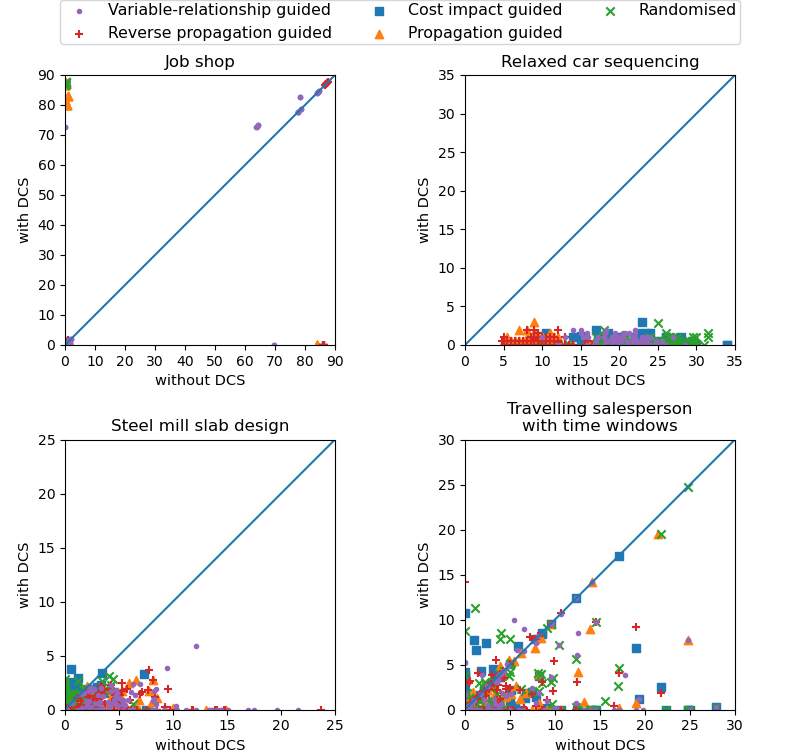
For all generic selection heuristics, using DCS improves performance for RCS, SMSD, and TSPTW, but worsens performance for JSP. These results support our conjectures that using DCS improves performance for RCS and SMSD, but does not improve performance for JSP. For JSP and each generic selection heuristic except VRG-LNS, using DCS has significantly worse performance than not using it. For JSP and VRG-LNS, using DCS has similar performance to not using it. However, there are a few JSP instances where using DCS with VRG-LNS, PG-LNS, and RPG-LNS has significantly better performance than when not using it. For RCS and each selection heuristic, the performance of using DCS is significantly better than when not using it. For both SMSD and TSPTW and each selection heuristic, the performance of using DCS is better than when not using it. Additionally, for RCS, SMSD, and TSPTW, using DCS makes the naïve randomised LNS competitive with the remaining more elaborate generic selection heuristics, even when they use DCS.
9 Conclusion and Future Work
We have presented our dependency curation scheme (DCS), which can be used with any (generic or problem-specific) LNS selection heuristic. We have compared the performance of a naïve generic randomised selection heuristic and more elaborate state-of-the-art generic selection heuristics from the literature both with and without DCS, revealing overall improved performance when using DCS. Our experiments show that the performance of using DCS with the naïve randomised selection heuristic is competitive with the more elaborate state-of-the-art generic selection heuristics, even when they use DCS.
In future work, we intend to implement for our extension of the Gecode-based portfolio solver [11] our dependency curation scheme, so that the solver works without the modeller needing to provide (a generator that finds) a set of search variables. Once our scheme is implemented, we intend to compare the performance of the generic selection heuristics, both with and without DCS, on all optimisation problems in the MiniZinc [17] benchmark repository, to verify the results of this paper and to compare our extended Gecode-based portfolio solver with other state-of-the-art optimisation solvers. Additionally, we intend to extend the (non-portfolio) Gecode [6] CP solver by implementing our scheme and a naïve randomised generic LNS selection heuristic, thereby allowing a modeller to easily use competitive LNS for any MiniZinc constrained optimisation model.
Also, for VRG-LNS, a variable is selected for exclusion from the freeze set if it shares a constraint with a previously excluded variable . When used with DCS, each variable that does not share a constraint with but that transitively functionally defines a variable that does so should be eligible for selection. Our idea is to make this modification to VRG-LNS and empirically test if it improves performance when used with DCS.
Finally, we intend to create a generic branching heuristic for CP-style tree search, where the variables that are selected to be branched over must be a subset of the low-cardinality set of search variables found by DCS.
References
- [1] H. Murat Afsar, Christian Artigues, Eric Bourreau, and Safia Kedad-Sidhoum. Machine reassignment problem: The ROADEF/EURO Challenge 2012. Annals of Operations Research, 242:1–17, 2016. doi:10.1007/s10479-016-2203-7.
- [2] Russell Bent and Pascal Van Hentenryck. A two-stage hybrid algorithm for pickup and delivery vehicle routing problems with time windows. Computers and Operations Research, 33(1):875–893, January 2006. doi:10.1016/j.cor.2004.08.001.
- [3] Gustav Björdal, Pierre Flener, and Justin Pearson. Generating compound moves in local search by hybridisation with complete search. In Louis-Martin Rousseau and Kostas Stergiou, editors, CP-AI-OR 2019, volume 11494 of LNCS, pages 95–111. Springer, 2019. doi:10.1007/978-3-030-19212-9_7.
- [4] Gustav Björdal, Jean-Noël Monette, Pierre Flener, and Justin Pearson. A constraint-based local search backend for MiniZinc. Constraints, 20(3):325–345, July 2015. doi:10.1007/s10601-015-9184-z.
- [5] Mehmet Dincbas, Helmut Simonis, and Pascal Van Hentenryck. Solving the car-sequencing problem in constraint logic programming. In Yves Kodratoff, editor, ECAI 1988, pages 290–295. Pitman, 1988.
- [6] Gecode Team. Gecode: A generic constraint development environment, 2019. The Gecode solver and its MiniZinc backend are available at https://www.gecode.org.
- [7] Michel Gendreau, Alain Hertz, Gilbert Laporte, and Mihnea Stan. A generalized insertion heuristic for the traveling salesman problem with time windows. Operations Research, 46(3):330–335, 1998. doi:10.1287/opre.46.3.330.
- [8] Daniel Godard, Philippe Laborie, and Wim Nuijten. Randomized large neighborhood search for cumulative scheduling. In Susanne Biundo, Karen L. Myers, and Kanna Rajan, editors, ICAPS 2005, pages 81–89. AAAI Press, 2005. URL: http://www.aaai.org/Library/ICAPS/2005/icaps05-009.php.
- [9] Jayant Kalagnanam, Milind Dawande, Mark Trumbo, and Ho Lee. Inventory matching problems in the steel industry. IBM Research Report, Computer Science/Mathematics, April 1999.
- [10] Frej Knutar Lewander, Pierre Flener, and Justin Pearson. Invariant graph propagation in constraint-based local search. Journal of Artificial Intelligence Research, 2025. Forthcoming.
- [11] Dexter Leander. Building portfolio search in Gecode for MiniZinc. Master’s thesis, Department of Information Technology, Uppsala University, Sweden, September 2024. Available at https://urn.kb.se/resolve?urn=urn:nbn:se:uu:diva-533041, with the code at https://github.com/DLeander/gecode-dexter.
- [12] Michele Lombardi and Pierre Schaus. Cost impact guided LNS. In Helmut Simonis, editor, CP-AI-OR 2014, volume 8451 of LNCS, pages 293–300. Springer, 2014. doi:10.1007/978-3-319-07046-9_21.
- [13] Toni Mancini and Marco Cadoli. Exploiting functional dependencies in declarative problem specifications. Artificial Intelligence, 171(16–17):985–1010, November 2007. doi:10.1016/j.artint.2007.04.017.
- [14] Laurent Michel, Pierre Schaus, and Pascal Van Hentenryck. MiniCP: A lightweight solver for constraint programming. Mathematical Programming Computation, 13(1):133–184, 2021. The source code and teaching materials are available at http://minicp.org. doi:10.1007/s12532-020-00190-7.
- [15] Laurent Michel and Pascal Van Hentenryck. Localizer: A modeling language for local search. In Gert Smolka, editor, CP 1997, volume 1330 of LNCS, pages 237–251. Springer, 1997. doi:10.1007/BFb0017443.
- [16] Laurent Michel and Pascal Van Hentenryck. Localizer. Constraints, 5(1–2):43–84, 2000. doi:10.1023/A:1009818401322.
- [17] Nicholas Nethercote, Peter J. Stuckey, Ralph Becket, Sebastian Brand, Gregory J. Duck, and Guido Tack. MiniZinc: Towards a standard CP modelling language. In Christian Bessière, editor, CP 2007, volume 4741 of LNCS, pages 529–543. Springer, 2007. The MiniZinc toolchain is available at https://www.minizinc.org. doi:10.1007/978-3-540-74970-7_38.
- [18] Laurent Perron, Paul Shaw, and Vincent Furnon. Propagation guided large neighborhood search. In Mark Wallace, editor, CP 2004, volume 3258 of LNCS, pages 468–481. Springer, 2004. doi:10.1007/978-3-540-30201-8_35.
- [19] David Pisinger and Stefan Ropke. Large neighborhood search. In Michel Gendreau and Jean-Yves Potvin, editors, Handbook of Metaheuristics, volume 272 of ORMS, chapter 4, pages 99–127. Springer, 2019. doi:10.1007/978-3-319-91086-4_4.
- [20] Charles Prud’homme, Xavier Lorca, and Narendra Jussien. Explanation-based large neighborhood search. Constraints, 19(4):339–379, October 2014. doi:10.1007/s10601-014-9166-6.
- [21] Pierre Schaus. Variable objective large neighborhood search: A practical approach to solve over-constrained problems. In Alexander Brodsky, editor, ICTAI 2013, pages 971–978. IEEE Computer Society, 2013. doi:10.1109/ICTAI.2013.147.
- [22] Pierre Schaus, Pascal Van Hentenryck, Jean-Noël Monette, Carleton Coffrin, Laurent Michel, and Yves Deville. Solving steel mill slab problems with constraint-based techniques: CP, LNS, and CBLS. Constraints, 16(2):125–147, April 2011. doi:10.1007/s10601-010-9100-5.
- [23] Paul Shaw. Using constraint programming and local search methods to solve vehicle routing problems. In Michael Maher and Jean-François Puget, editors, CP 1998, volume 1520 of LNCS, pages 417–431. Springer, 1998. doi:10.1007/3-540-49481-2_30.
- [24] Filipe Souza, Diarmuid Grimes, and Barry O’Sullivan. An investigation of generic approaches to large neighbourhood search. In Paul Shaw, editor, CP 2024, volume 307 of LIPIcs, pages 39:1–39:10. Dagstuhl Publishing, 2024. doi:10.4230/LIPIcs.CP.2024.39.
- [25] Robert Tarjan. Depth-first search and linear graph algorithms. SIAM Journal on Computing, 1(2):146–160, 1972. doi:10.1137/0201010.
- [26] Charles Thomas and Pierre Schaus. Revisiting the self-adaptive large neighborhood search. In Willem-Jan van Hoeve, editor, CP-AI-OR 2018, volume 10848 of LNCS, pages 557–566. Springer, 2018. doi:10.1007/978-3-319-93031-2_40.
- [27] Pascal Van Hentenryck and Laurent Michel. Constraint-Based Local Search. The MIT Press, 2005.
- [28] Gerhard Wäscher and Thomas Gau. Heuristics for the integer one-dimensional cutting stock problem: A computational study. OR Spektrum, 18:131–144, 1996. doi:10.1007/BF01539705.