Quantum Relaxations of CSP and Structure Isomorphism

Abstract
We investigate quantum relaxations of two key decision problems in computer science: the constraint satisfaction problem (CSP) and the structure isomorphism problem. CSP asks whether a homomorphism exists between two relational structures, while structure isomorphism seeks an isomorphism between them. In recent years, it has become increasingly apparent that many special cases of CSP can be reformulated in terms of the existence of perfect classical strategies in non-local games, a key topic of study in quantum information theory. These games have allowed us to study quantum advantage in relation to many important decision problems, such as the -colouring problem, and the problem of solving binary constraint systems. Abramsky et al. (2017) have shown that all of these games can be seen as special instances of a non-local CSP game. Moreover, they show that perfect quantum strategies in this CSP game can be viewed as Kleisli morphisms of a graded monad on the category of relational structures, which they dub the quantum monad. In this way, the quantum monad provides a categorical characterisation of quantum advantage for the non-local CSP game.
In this work we solidify and expand the results of Abramsky et al., answering several of their open questions. Firstly, we compare the definition of quantum graph homomorphisms arising from this work with an earlier definition of the concept due to Mančinska and Roberson and show that there are graphs which exhibit quantum advantage under one definition but not the other. Our second contribution is to extend the results of Abramsky et al. which only hold in the tensor product framework of quantum mechanics to the commuting operator framework. Next, we study a non-local structure isomorphism game, which generalises the well-studied graph isomorphism game. We show how the construction of the quantum monad can be refined to provide categorical semantics for quantum strategies in this game. This results in a category where morphisms coincide with quantum homomorphisms and isomorphisms coincide with quantum isomorphisms.
Keywords and phrases:
CSP, graph isomorphism, quantum information, non-local game, quantum graph homomorphism, monadCopyright and License:
![[Uncaptioned image]](x1.png) © Amin Karamlou; licensed under Creative Commons License CC-BY 4.0
© Amin Karamlou; licensed under Creative Commons License CC-BY 4.0
2012 ACM Subject Classification:
Theory of computation Quantum information theory ; Theory of computation Categorical semanticsAcknowledgements:
I would like to thank Samson Abrasmky and Nihil Shah for many helpful discussions. In particular, the idea of using specification structures to extract a total category from partial categories was suggested by and worked out with Samson Abramsky. I would also like to thank Sam Staton and Rui Soares Barbosa for detailed feedback on an earlier draft of this work which has led to several improvements in the current version.Funding:
I acknowledge funding from the EPSRC project Resources in Computation [EP/V040944/1].Editors:
Paweł Gawrychowski, Filip Mazowiecki, and Michał SkrzypczakSeries and Publisher:
 Leibniz International Proceedings in Informatics, Schloss Dagstuhl – Leibniz-Zentrum für Informatik
1 Introduction
1.1 CSP and structure isomorphism
The fundamental structures of computation –graphs, strings, databases, programs, etc. all find a convenient mathematical representation in terms of (finite) logical structures, known as relational structures. It is not surprising then that many of the most important challenges and achievements of theoretical computer science can be phrased in terms of the properties of these structures, and how they interact with one another. We will focus on two decision problems about relational structures that are of central importance in theoretical computer science. The first is known as the constraint satisfaction problem111This problem is also known as structure homomorphism problem. We shall use the two terms interchangeably. (CSP). In modern terms, it can be phrased as follows.
-
Constraint Satisfaction Problem: Given as input a pair of relational structures over the same signature, decide if there exists a homomorphism .
The importance of CSP is underscored by the fact that instances of it arise naturally in practically every area of modern science. For example, in bioinformatics, CSPs arise in protein folding, where the challenge is to determine a protein’s 3D structure while satisfying constraints related to chemical bonds and angles. In database theory, CSPs capture the problem of query evaluation, where determining whether a query can be satisfied involves finding a homomorphism between the query structure and a database. In robotics, the path planning problem, in which a robot aims to navigate from some starting position to a goal position while avoiding obstacles can be formulated as a CSP.
The second problem is known as structure isomorphism.
-
Structure isomorphism: Given as input a pair of relational structures over the same signature, decide if there exists an isomorphism .
The study of structure isomorphism is of central importance in computational complexity theory. It is clear that this problem is in NP, however, structure isomorphism is not known to be solvable in polynomial time nor to be NP-complete. Babai’s recent breakthrough [5] places the problem in quasi-polynomial time which lends some support to the idea that structure isomorphism might be an NP-intermediate problem.
1.2 Quantum relaxations
Ever since the pioneering works of Bell [6] and Kochen-Specker [19] in the 1960s physicists have known that a system which operates according to the laws of quantum physics is capable of producing correlations that a system operating according to classical physics cannot. Today, this phenomenon is referred to as quantum advantage and is being extensively studied with the hope that it will allow us to build devices such as quantum computers that can perform information processing tasks which are out of reach for classical computers.
An important theoretical tool for understanding quantum advantage is the framework of non-local games. In these games, two collaborating players (usually called Alice and Bob) are placed in separate rooms so that they are unable to communicate with each other. A referee then asks each of them some questions and compares their answers. The two players win the game if the referee is satisfied that their answers agree with some pre-defined winning conditions. The remarkable feature of these games is that if the players are allowed to share an entangled quantum state between them, they can sometimes win games that they would have otherwise lost. In these cases we say that the players have a quantum winning strategy but no classical winning strategy. The study of non-local games has led to tremendous advances in our understanding of quantum theory, and has even helped solve a major open problem in mathematics, known as the Connes embedding question [18].
Over the past few decades, it has become clear that many standard decision problems studied in theoretical computer science, which are special instances of CSP, can be rephrased in the language of non-local games. This prompted the authors of [1] to recast CSP as a non-local game. For the purposes of this introduction, we aim to convey some intuition for the game by describing its operation in the special case where the relational structures in question are graphs.
Example 1.
Consider graphs . The -CSP game is played as follows:
-
1.
Verifier sends Alice an edge of , and Bob an element .
-
2.
Alice returns a pair of vertices from and Bob returns an element of .
-
3.
Alice and Bob win the game if:
-
(a)
is an edge of .
-
(b)
and .
-
(a)
We say that Alice and Bob have a perfect strategy in the above game if they can always win the game regardless of what questions the verifier decides to ask them. If only classical (and non-signalling) strategies are allowed then Alice and Bob have a perfect strategy precisely when CSP is solvable. In other words, they win the game perfectly if and only if there exists a graph homomorphism . However, when the players are allowed to use quantum resources, they can sometimes win this game perfectly even if . Based on these facts, we can say that there exists a quantum homomorphism from to and write whenever Alice and Bob have a perfect quantum strategy in the -CSP game. Clearly, every classical homomorphism is also a quantum homomorphism. This is why we are justified to say that quantum homomorphisms are a relaxation of classical homomorphisms.
A further important step taken in [1] was the introduction of a graded monad on , which they refer to as the quantum monad. We denote the functor component of this monad (which is parameterised by some Hilbert space ) by . As with any monad has a Kleisli category associated to it. The objects of this category are the objects of while morphisms between objects and are maps in of the form . The authors of [1] prove the following theorem which shows that such Kleisli morphisms are precisely quantum homomorphisms.
Theorem 2 ([1]).
For graphs and there is a one-to-one correspondence between:
-
1.
.
-
2.
.
In this sense, provides a categorical abstraction which perfectly captures the notion of quantum homomorphism.
1.3 Structure and contributions
In this paper we will solidify and extend the results of [1] by answering several open questions mentioned in their work. After introducing preliminary material in Section 2, we shall study the non-local CSP game in Section 3. Our first contribution in this section will be a comparison of the two alternative definitions of quantum graph homomorphisms introduced in [23] and [1]. We show that there exists a pair of graphs which are quantum homomorphic under the definition given in [23] but not under the definition in [1]. Our next contribution is to extend the characterisation of quantum homomorphisms in [1] which only holds in the tensor product framework to the commuting operator framework. In Section 4 we shall introduce a non-local structure isomorphism game, and show that much like the CSP game perfect quantum strategies in this game have a very special form. This will allow us to define the concept of quantum structure isomorphism. Finally, in Section 5 we explore categorical characterisations of quantum homomorphisms and quantum isomorphisms. As we have mentioned, it was already observed in [1] that quantum homomorphisms coincide with Kleisli morphisms of the graded quantum monad . Perhaps surprisingly we shall show that Kleisli isomorphism for this graded monad corresponds to classical isomorphism rather than quantum isomorphism. Thus, we shall adopt a different approach to provide a categorical account of quantum isomorphism. Namely, we will show that the functor can be equipped with the structure of a “monad” with a partial multiplication operation. We will then show that Kleisli isomorphisms for this partial quantum monad coincide with quantum isomorphisms. This construction is motivated by the importance of partial algebraic structures in quantum information, which was first noticed in the seminal work of Kochen and Specker [19]. Detailed proofs are provided in the appendix.
2 Notation and preliminaries
We assume some basic familiarity with linear algebra, and category theory, and quantum information.
2.1 Relational structures
A finite relational signature is a set of relation symbols where each symbol has an associated non-negative integer called its arity. A relational structure with signature is then a tuple where is a set known as the universe of and for each is a relation of length . A relational structure is said to be finite if its universe is finite.
Let and be two relational structures over the same signature . A function is said to preserve a relation with arity if . Here we have adopted the convention that boldface lowercase letters denote tuples . Moreover, whenever we use the notation we are implicitly implying that is the element at position of a tuple . We say that reflects a relation if the above holds with the implication reversed. is said to be a homomorphism if it preserves every . If is bijective and reflects every relation it is called an isomorphism. A partial homomorphism is a partial function which preserves all relations. The category has -structures as objects and -structure homomorphisms as morphisms.
2.2 Quantum theory
We write for the set of positive bounded operators on a Hilbert space and for the set of (orthogonal) projectors on . We refer to two projectors as being orthogonal to each other if . We write iff is positive semi-definite. and commute iff . The product of two projectors is a projector iff they commute. For any family of projectors it holds that iff whenever .
We recall two mathematical formalisms for studying different types of measurements on physical system. The first is known as a projection valued measurement (PVM). A PVM is a function which satisfies . Here, the elements of represent the possible outcomes of a measurement. We shall also consider positive operator-valued measurements (POVMs). A POVM is a function which satisfies . As is contained in , it is clear that every PVM is a POVM. If a POVM is performed on a pure state outcome will be observed with probability . A set of POVMs is commeasurable222Also known as compatible or jointly measurable. iff there exists a POVM which marginalises to each of the . A remarkable feature of quantum theory (one which is in fact necessary for quantum advantage [36]) is that not all observations are commeasurable. We will write whenever and are commeasurable. We remark that it is possible to have POVMs which are pairwise commeasurable but not triplewise commeasurable [15]. Two POVMs are said to commute iff every element of their image commutes. If we restrict our attention to PVMs then commeasurability has particularly nice characteristics summarised by the following lemma (see e.g. [14]).
Lemma 3.
For a set of PVMs the following are equivalent:
-
1.
The are pairwise commuting.
-
2.
There exists a unique joint measurement which is projective and defined as .
2.3 Non-local games
Non-locality and its generalisation in the form of contextuality are important non-classical features of quantum mechanics. These phenomena have been extensively studied as a source of quantum advantage beginning with the pioneering works of Bell [6] and Kochen-Specker [19].
A (bipartite) non-local game is a cooperative game played between a verifier and two players, usually referred to as Alice and Bob. Formally, following [9] a non-local game is defined as where are finite input sets, are finite output sets, is a probability distribution on , and is called the payoff function. For our purposes, it suffices to think of as a valued boolean predicate. We will also assume that has full support. The game proceeds according to the following protocol:
-
1.
The verifier samples a pair using and sends to Alice and to Bob.
-
2.
Without communicating, Alice and Bob respond with and respectively.
-
3.
The players win the game if .
We focus on cases where the game consists of one round of the above protocol.
The goal of Alice and Bob is to maximise their winning probability. To achieve this goal they are allowed to agree on a fixed strategy S for the game beforehand. A correlation333Also known as a behaviour or empirical model. represents the joint conditional probability of Alice and Bob responding with and on inputs and respectively.
There are several classes of strategies that Alice and Bob can employ in a non-local game. We are interested in three of these classes.
-
1.
A deterministic classical strategy is defined by two functions and which map inputs to outputs for each of Alice and Bob respectively. Hence we have .
-
2.
A quantum tensor strategy consists of a shared state for finite dimensional complex Hilbert spaces , and two sets, and where for each and for each are POVMs over and respectively. Upon receiving and Alice and Bob perform the measurements and respectively and return the results. Hence we have .
-
3.
A quantum commuting strategy consists of a shared state for some potentially infinite dimensional Hilbert space , and two sets of POVMs and , representing Alice and Bobs measurements as above. Note that in these strategies all of Alice’s measurement operators must commute with all of Bob’s measurement operators. Then we have .
For we will often refer to a -strategy for a non-local game. Here describes the type of strategy being used, for classical, for tensor, and for commuting. We focus exclusively on perfect strategies, where the game is won with probability 1. In this case we must have
Any -strategy is a -strategy since we can simply ignore entanglement in the latter case. Remarkably, it can be shown that in some cases a perfect -strategy for a non-local game exists even when a perfect -strategy cannot exist. In such cases, we say that a non-local game exhibits pseudotelepathy. Moreover, it can be straightforwardly shown that any -strategy is a -strategy. A non-trivial result of Tsirelson shows that if we restrict to finite-dimensional Hilbert spaces these two classes of strategies coincide [35, 34]. A recent breakthrough result [18] shows that -strategies form a strictly larger set than -strategies.
A non-local game is said to be synchronous if Alice and Bob have the same question set , the same answer set , and the equation is satisfied.
This means that given the same inputs Alice and Bob must always respond with the same outputs to win the game. we write to denote synchronous games. Perfect strategies for these games have nice properties which make them easier to analyse. In particular variations of the following lemmas have appeared throughout the literature (see e.g. [4, 31]).
Lemma 4.
Let be a synchronous game. If there exists a perfect -strategy for this game then there exists a perfect -strategy where:
-
The state is the maximally entangled state ;
-
The POVMs and are projective;
-
for all ;
-
iff .
Lemma 5.
Let be a synchronous game. There exists perfect -strategy for this game iff there exists a unital -algebra which admits a faithful tracial state , and projections for and satisfying:
-
;
-
if .
3 CSP game
Let us begin by describing the CSP game444Referred to as the relational structure homomorphism game in [1]. introduced in [1]. For simplicity, we focus throughout this paper on the case where our signature consists of a single relation of arity .
Example 6.
Consider relational structures . The -homomorphism game is played as follows:
-
1.
Verifier sends Alice a tuple , and Bob an element .
-
2.
Alice returns a tuple , and Bob returns an element .
-
3.
Alice and Bob win if (a): , and (b): .
For we write and say that there exists a -homomorphism between and whenever Alice and Bob have a perfect -strategy in the -homomorphism game. A simple observation is that perfect classical strategies correspond to homomorphisms.
Proposition 7 ([1]).
.
3.1 Tensor strategies
We now recall the characterisation of -strategies for the CSP game that was derived in [1]. Our first observation is that if a perfect -strategy for the CSP game exists, then there must exist a (possibly different) perfect -strategy which exhibits some very strong properties.
Theorem 8 ([1]).
The existence of a perfect -strategy in the -CSP game implies the existence of a perfect -strategy which satisfies:
-
The POVMs and are projective where we define .
-
The state is a maximally entangled state .
-
.
-
If and then .
The authors then note that this theorem shows that all the information determining the strategies is contained in Alice’s operators . Hence, they define projectors whenever . These projectors are well-defined since we have whenever . Moreover, for each we have PVMs which are jointly measurable by the PVM . Thus, is equivalent to the PVM given by
Based on the above observations the authors define the notion of a -homomorphism as follows:
Definition 9.
Let be a finite-dimensional Hilbert space of dimension . A -homomorphism from to in is given by a family of projectors in satisfying:
-
(P1)
For all , we have .
-
(P2)
For all adjacent in the Gaifman graph of , and all , we have .
-
(P3)
If and , then .
This definition is justified by the following theorem:
Theorem 10 ([1]).
The following are equivalent:
-
1.
-
2.
There exists a -homomorphisms from to .
3.2 Comparing two definitions of tensor homomorphism for graphs
In this section, we restrict our attention to the case where the relational structures and are both graphs. As we saw in example 1 the CSP game restricts to a graph homomorphism game when the relational structures and are both graphs. There is however an alternative non-local game for graph homomorphisms, due to Mančinska and Roberson which was introduced in [23]. We refer to this game as the MR graph homomorphism game. It is played as follows:
Example 11.
Given graphs and , the MR graph homomorphism game is played as follows:
-
Verifier sends a vertex to Alice and a vertex to Bob.
-
Alice responds with a vertex and Bob responds with a vertex .
-
Alice and Bob win the game if:
-
1.
.
-
2.
.
-
1.
This variant of the graph homomorphism game gives rise to an alternative notion of quantum graph homomorphism.
Definition 12.
An MR quantum graph homomorphism over a finite-dimensional Hilbert space from a graph to a graph is given by a family of projectors satisfying (P1) and (P3).
Clearly, every quantum homomorphism is an MR quantum homomorphism. We now set out to answer the following question from [1].
Question 13.
Does the existence of an MR quantum homomorphism from to imply the existence of a quantum homomorphism from to ?
We answer this question in the negative by explicitly constructing graphs and such that an MR quantum homomorphism from to exists but where a quantum homomorphism does not exist. Our separation will be achieved by studying the -colouring game which is a special case of the graph homomorphism game (Obtained by taking to be the complete graph of size .). Restricting the above definitions to this specific case we have:
Definition 14.
An MR quantum -colouring of a graph is given by a family of projectors satisfying:
-
1.
.
-
2.
for all and all .
Definition 15.
A quantum -colouring of a graph is given by a family of projectors satisfying conditions 1 and 2 from the previous definition and the additional condition
-
3.
for all and all .
We now consider the case where is the 14 vertex graph from [24]. To construct this first consider the following family of vectors in :
We then define a graph from this set by assigning a node to every vertex and an edge between any two nodes which represent orthogonal vectors555It is worth noting that the graph has also appeared in a somewhat different context in [37], where it was used to provide a proof of the state-independent Kochen-Specker theorem with only 13 rays. This has since been shown to be the minimum number of vectors necessary for such a proof [8].. This graph is drawn in figure 1.
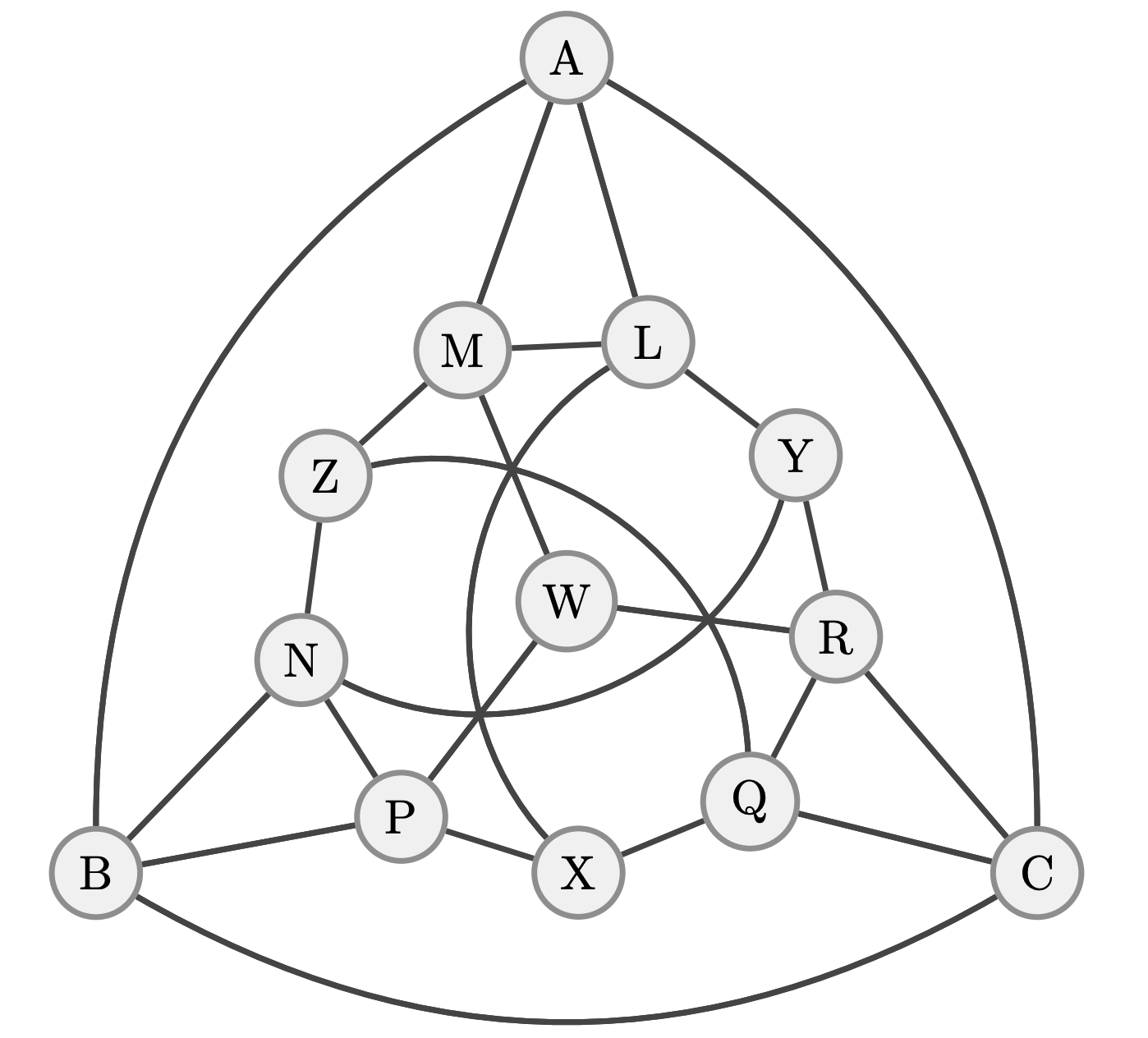
The graph is obtained by adding an apex node to which we denote by . The following results were already shown in [24].
Proposition 16 ([24]).
There exists no classical -colouring of .
Theorem 17 ([24]).
There exists an MR quantum -colouring of .
Thus, this graph provides an example of quantum advantage in the MR graph colouring game. In fact, in [24] they conjecture that is the smallest graph with this property. A recent preprint claims a computational proof of this conjecture [21]. We prove the following theorem, which separates MR quantum homomorphisms from quantum homomorphisms.
Theorem 18.
There exists no quantum -colouring of .
3.3 Commuting operator strategies
We now aim to analyse commuting operator strategies in the CSP game. For the case of the MR graph homomorphism game, such strategies have been explored in [33, 32, 31]. The following result is known:
Theorem 19.
Let and be graphs. In the MR graph homomorphism game iff there exists a unital -algebra which admits a faithful tracial state, and projections for and such that (P1) and (P3) are satisfied.
To derive these results the authors rely heavily on the fact that the MR graph homomorphism game is synchronous. We wish to derive an analogue of the above result for the CSP game. Unfortunately, this game is not synchronous so we cannot immediately make use of Lemma 5. Our first step is thus to define a synchronous version of the CSP game and show that its perfect strategies coincide with the original game of [1].
Example 20.
Consider relational structures . The synchronous -homomorphism game is played as follows:
-
1.
Verifier sends Alice and Bob tuples respectively.
-
2.
Alice and Bob return tuples respectively.
-
3.
Alice and Bob win the game if:
-
.
-
and .
-
Theorem 21.
For there exists a perfect -strategy in the -CSP game iff there exists a perfect -strategy in the synchronous -CSP game.
Thus, any result that applies to perfect strategies in the synchronous CSP game also applies to the original game.
We now prove a commuting operator framework analogue of Theorem 10.
Theorem 22.
The following are equivalent:
-
.
-
There exists a unital -algebra which admits a faithful tracial state , and projections for and satisfying (P1), (P2), and (P3).
4 Structure isomorphism game
A non-local graph isomorphism game has been introduced in [4] and studied extensively since (see e.g. [25, 22, 28, 29, 30]). This game can be generalised to arbitrary relational structures. An open question mentioned in [1] is to figure out how this game fits into the quantum monad framework. This is the question which we address in this section. Let us begin by explaining the structure isomorphism game. As with the CSP game, this game can be formulated in both a synchronous and non-synchronous fashion. To simplify some proofs we focus on the synchronous formulation.
Example 23.
Consider relational structures . The -isomorphism game is played as follows:
-
1.
Verifier sends Alice and Bob tuples respectively.
-
2.
Alice and Bob return tuples respectively.
-
3.
Alice and Bob win the game if:
-
and .
Assuming this condition is met we define to be the unique tuple in among and , and we define similarly. To win, the following condition must also be satisfied:
-
We write whenever a perfect -strategy exists in this game for . Notice that unlike in the case of the homomorphism game Alice and Bob do not necessarily receive inputs from the same structure. Moreover, the winning conditions of the game dictate that to win Alice and Bob’s responses must be from whichever structure their input was not from.
4.1 Classical strategies
As before we can verify that perfect classical strategies are isomorphisms.
Proposition 24.
.
4.2 Tensor strategies
We now turn our attention to -strategies in the isomorphism game. Our goal is to characterise such strategies in a manner analogous to what was done for the homomorphism game in [1]. We begin by showing that strategies can be assumed to have a special form.
Theorem 25.
The existence of a perfect -strategy in the -isomorphism game implies the existence of a perfect -strategy which satisfies:
-
1.
and are PVMs where we define , and similarly for ;
-
2.
The state is a maximally entangled state ;
-
3.
;
-
4.
for all ;
-
5.
If does not hold then ;
-
6.
if then .
We note that using the synchronous nature of the game allows us to simplify some of the steps in the corresponding proof of Theorem 8 in [1]. Now let us once again define projectors whenever for some . Item (6) in Theorem 25 shows that these are well-defined projectors. As in the homomorphism case we then have for each PVMs which are jointly measurable. Hence is equivalent to the PVM given by We can then define a -isomorphism as follows.
Definition 26.
Let be a finite-dimensional Hilbert space of dimension . A -isomorphismm in between and is given by a family of projectors in satisfying (P1), (P2), and:
-
(P4)
For all ;
-
(P5)
For all adjacent in the Gaifman graph of and all we have .
-
(P6)
If does not hold .
A helpful alternative definition is to note that a -isomorphism is given by a family of projectors such that is a -homomorphism from to and is a -homomorphism from to .
To justify this definition we prove the following:
Theorem 27.
The following are equivalent:
-
1.
-
2.
There exists a -isomorphism between and .
4.3 Commuting operator strategies
As in the case of the homomorphism game, we can provide a characterisation of perfect -strategies as follows. We omit a detailed proof as this makes use of Lemma 5 and then follows exactly the same argument as Theorem 27.
Theorem 28.
The following are equivalent:
-
.
-
There exists a perfect -strategy in the (synchronous) -CSP game iff there exists a unital -algebra which admits a faithful tracial state , and projections for and satisfying (P1), (P2), (P4), (P5), and (P6).
5 Categorical characterisations
In this section, we explain how quantum homomorphisms and isomorphisms can be captured categorically in the Kleisli category of a suitable generalisation of the concept of a monad.
5.1 The graded quantum monad
We start by describing the graded quantum monad introduced in [1]. Let us define graded monads.
Definition 29 ([11]).
A graded monad is a (lax) monoidal functor from a monoidal category to the category of endofunctors over .
Now let denote the monoid of natural numbers under the usual multiplication operation. The graded quantum monad of [1] is defined as follows.
Example 30.
The (finite-dimensional) graded quantum is an graded monad defined by the following components:
-
is the functor defined by:
-
–
is the set of all functions of the form satisfying the normalisation condition .
-
–
maps to .
-
–
iff the following conditions are satisfied:
-
*
.
-
*
where .
-
*
-
–
-
where and for .
-
.
The following result links the graded quantum monad to quantum homomorphisms.
Theorem 31 ([1]).
The following are equivalent for :
-
1.
.
-
2.
.
We now point out that one can define an alternative version of the quantum monad which can be used to study representations of graph homomorphisms over any Hilbert space, not just those which are finite-dimensional. For this purpose, consider the monoidal category , which has Hilbert spaces as objects, unitary maps as morphisms, the tensor product of Hilbert spaces as its monoidal product, and the Hilbert space as its unit object.
Example 32.
There exists a -graded quantum monad which is defined in the same way as , where we replace the unit with the Hilbert space and the multiplication operation . with the tensor product . Moreover, since a graded monad is a lax monoidal functor we must also construct a natural transformation whenever there exists a unitary map . This is defined as .
Proposition 33.
is a graded monad.
We then have the following analogue of our previous theorem:
Theorem 34.
The following are equivalent for :
-
There exists a quantum homomorphism from to in the Hilbert space .
-
.
5.2 The partial quantum monad
So far we have introduced suitable definitions for quantum homomorphisms and quantum isomorphisms of relational structures. Moreover, we have described a graded quantum monad whose Kleisli morphisms correspond precisely to quantum homomorphisms. Given these results, one might expect that Kleisli isomorphisms of coincide with quantum isomorphisms. Our next result shows that this is not the case.
Proposition 35.
The following are equivalent:
-
1.
-
2.
Therefore, even though Kleisli morphisms of correspond to quantum homomorphisms we see that Kleisli isomorphisms coincide with classical isomorphisms.
We now describe a method for overcoming this limiting result. Recall that the set admits the structure of a partial semiring whereby the operation is only defined when two projectors are orthogonal and . is only defined when two projectors commute. Based on this observation we now define an alternative partial notion of Kleisli composition for the functor where we use the matrix product instead of the Kronecker product. To explain this in more detail recall from [1] that given two Kleisli morphisms and their composition can be explicitly described by the formula
Now consider instead two morphisms and . If these morphisms satisfy the condition that for all we can define a composite morphism given by
Moreover, for any Hilbert space there is a natural notion of Kleisli identity map given by which sends to where for . It is straightforward to verify that whenever the composition of morphisms under is well-defined the associativity and unitality axioms of a category are satisfied. Thus we almost have a category, except that composition operation is a partial rather than total operation. These observations prompt us to define the concept of a partial category.
Definition 36.
A partial category consists of:
-
A collection of objects, denoted .
-
For each pair of objects , a set of morphisms (or arrows) .
-
For each object , the identity morphism .
-
For each triple of objects , a composition law:
Given by a partial operation where for all , , and , the following axioms hold :
-
–
Associativity: is well-defined iff is well-defined. Moreover, when this is the case
-
–
Identity: and are always well-defined. Moreover, and .
-
–
This can equivalently be seen as a category enriched in the category of sets and partial functions.
The partial category we have described above then arises as the Kleisli category of a partial version of the quantum monad which we now describe.
Example 37.
The partial quantum monad is a partial monad:
-
is defined as previously.
-
where and for .
-
is defined whenever . In this case we have .
Note that here fails to be a natural transformation since the morphism assigned to each object is a partial rather than a total homomorphism. Nevertheless, whenever compositions are well-defined this operation does satisfy the naturality axiom. From this point onwards we shall write and to distinguish the (partial) kleilsi categories of the partial and graded version of the quantum monad respectively.
We can now explore what a suitable notion of isomorphism in would look like. In a Kleisli category, the identity map is given by the monad unit. Thus, let us write whenever there exists a pair of Kleisli morphisms and satisfying:
-
,
-
,
-
.
Our next theorem shows that such isomorphisms are precisely quantum isomorphisms.
Theorem 38.
The following are equivalent:
-
1.
There exists a quantum isomorphism in .
-
2.
.
This theorem shows that by replacing the Kronecker product with matrix multiplication we can overcome the collapse of Kleisli isomorphisms for to classical isomorphism.
Remark 39.
It is a standard fact that given any semiring one can define a version of the probability distribution monad over that semiring (see e.g. [17]). The partial monad structure we have placed on the functor can be seen as arising from this construction using the partial semiring structure of the set .
5.3 Overcoming partiality
Our final result is a method for overcoming the partiality inherent in to derive a (total) category where morphisms are quantum homomorphisms and isomorphisms are quantum isomorphisms. The idea is to change the objects of so that they contain more fine-grained type information. In this way, we will be able to limit the morphisms in and out of each object to precisely those morphisms which are composable via . Our approach to formalising this idea is based on a refinement of the notion of specification structures introduced in [2].
Definition 40.
Let be a partial category. A specification structure over is defined by the following data:
-
A set of properties over for each object in .
-
A relation for each pair of objects in .
Given , this relation is required to satisfy the following conditions:
-
Skip: .
-
Sequential Composition: and .
-
Totality: and .
Note that our definition of a specification structure is not the same as in [2]. In particular, since they assume that is a category they do not need to enforce a totality condition.
Given and as above one can define a (total) category . The objects are pairs with and . A morphism is a morphism such that . The composition of and is simply . Our next result verifies that this construction indeed yields a valid category.
Proposition 41.
Let be a specification structure on a partial category . is a category.
We now describe the specification structure that shall be placed on . For this purpose, it will be helpful to think of a morphism for finite structures as column stochastic matrices with entries in . Column stochastic means that each column of the corresponding matrix must sum to (and hence represents a PVM). In this case, the composition operation is simply the usual notion of matrix multiplication with addition and multiplication given by the corresponding operations in the partial semiring . Moreover, a PVM with outcomes in can be thought of as a vector indexed by elements of whose entries are projectors summing to . Given a morphism let us use capital letters to clarify that we are thinking of it as a matrix in this form. Likewise, given a PVM we write to clarify that we are thinking of it as a vector.
Theorem 42.
The following data describes a specification structure on .
-
An element of consists of a set of PVMs with outcomes in . These must include all delta distributions (i.e. ).
-
Given , and a morphism we have iff .
Thus, we now have a category whose morphisms correspond to quantum homomorphisms and whose isomorphisms correspond to quantum isomorphisms.
As a final point, it is important to make sure that in passing from to we do not lose any quantum homomorphisms. This means we need to make sure that whenever a quantum homomorphism exists between and there exist properties and such that there is a morphism .
Proposition 43.
For relational structures and the following are equivalent:
-
1.
There exists a morphism .
-
2.
There exists properties and such that
6 Conclusions and Outlook
We have explored the framework of quantum CSPs that was first studied in [1]. We answered several open questions about quantum homomorphisms mentioned in this paper and showed how the notion of quantum isomorphism of relational structures can fit into the categorical framework of the quantum monad . To achieve this we considered not as a graded monad but as a monad with a partial multiplication operation which is intimately connected with the partial semiring structure of the set . We then showed that this monad gives rise to a partial Kleisli category where morphisms are quantum homomorphisms and isomorphisms are quantum isomorphisms. Finally, we used the idea of a specification structure, which is inspired by Hoare logic [16] to turn this partial Kleisli category into a total category. We outline some directions for future work:
-
Partial semiring semantics: Semirings play a prominent role in many areas of logic in computer science. In automata theory for example it has long been recognised that semirings provide semantics for weighted automata [20, 26, 10]. In database theory, they can be used to define concepts such as probabilistic or incomplete databases [13]. Semiring valued CSPs have also been studied in [7]. Motivated by these applications there attention has been devoted to studying semiring valued semantics for first-order logic where logical statements can take on values from a commutative semiring rather than just being treated as true or false [12, 27]. If we extend this idea to define partial semiring valued semantics for first-order logic based on the structure of we would obtain a first-order variant of the propositional version of quantum logic introduced by Kochen and Specker [19]. Would such a logic be helpful for “quantising” standard concepts from automata theory, databases, or CSPs? Moreover, can our partial quantum monad provide a unified categorical abstraction for such results in the same way that distribution monads do for total semirings [17]?
-
Parameterised monads: We would like to explore connections between our partial quantum monad and the notion of parameterised monad introduced in [3]. Much like specification structures parameterised monads are inspired by the idea of Hoare logic. The Kleisli category of a parameterised monad over has objects which are pairs where and is an object from a parameterising category . The composition of morphisms is then “guarded” by suitable pre and post-conditions related to this parameterising category. There is some similarity between this construction and our category . The main difference appears to be that in our case the parameterising category depends on the object . Thus it would be interesting to see if one can refine the definition of parameterised monads to define a parameterised quantum monad whose Kleisli category is equivalent to .
References
- [1] Samson Abramsky, Rui Soares Barbosa, Nadish de Silva, and Octavio Zapata. The Quantum Monad on Relational Structures. In Kim G. Larsen, Hans L. Bodlaender, and Jean-Francois Raskin, editors, 42nd International Symposium on Mathematical Foundations of Computer Science (MFCS 2017), volume 83 of Leibniz International Proceedings in Informatics (LIPIcs), pages 35:1–35:19, Dagstuhl, Germany, 2017. Schloss Dagstuhl – Leibniz-Zentrum für Informatik. doi:10.4230/LIPIcs.MFCS.2017.35.
- [2] Samson Abramsky, Simon Gay, and Rajagopal Nagarajan. Specification Structures and propositions-as-types for concurrency, pages 5–40. Springer Berlin Heidelberg, Berlin, Heidelberg, 1996. doi:10.1007/3-540-60915-6_2.
- [3] Robert Atkey. Parameterised notions of computation. Journal of functional programming, 19(3-4):335–376, 2009. doi:10.1017/S095679680900728X.
- [4] Albert Atserias, Laura Mančinska, David E. Roberson, Robert Šámal, Simone Severini, and Antonios Varvitsiotis. Quantum and non-signalling graph isomorphisms. Journal of Combinatorial Theory, Series B, 136:289–328, 2019. doi:10.1016/j.jctb.2018.11.002.
- [5] László Babai. Graph isomorphism in quasipolynomial time. CoRR, abs/1512.03547, 2015. arXiv:1512.03547.
- [6] John S Bell. On the einstein podolsky rosen paradox. Physics Physique Fizika, 1(3):195, 1964.
- [7] Stefano Bistarelli, Ugo Montanari, Francesca Rossi, Thomas Schiex, Gérard Verfaillie, and Hélène Fargier. Semiring-based csps and valued csps: Frameworks, properties, and comparison. Constraints, 4:199–240, September 1999. doi:10.1023/A:1026441215081.
- [8] Adán Cabello, Matthias Kleinmann, and José R Portillo. Quantum state-independent contextuality requires 13 rays. Journal of Physics A: Mathematical and Theoretical, 49(38):38LT01, August 2016. doi:10.1088/1751-8113/49/38/38lt01.
- [9] R. Cleve, P. Hoyer, B. Toner, and J. Watrous. Consequences and limits of nonlocal strategies. In Proceedings. 19th IEEE Annual Conference on Computational Complexity, 2004., pages 236–249, 2004. doi:10.1109/CCC.2004.1313847.
- [10] M Droste. Handbook of Weighted Automata. Springer-Verlag, 2009.
- [11] Soichiro Fujii, Shin-ya Katsumata, and Paul-André Mellies. Towards a formal theory of graded monads. In International Conference on Foundations of Software Science and Computation Structures, pages 513–530. Springer, 2016. doi:10.1007/978-3-662-49630-5_30.
- [12] Erich Grädel, Hayyan Helal, Matthias Naaf, and Richard Wilke. Zero-one laws and almost sure valuations of first-order logic in semiring semantics. arXiv preprint arXiv:2203.03425, 2022. doi:10.48550/arXiv.2203.03425.
- [13] Todd J Green, Grigoris Karvounarakis, and Val Tannen. Provenance semirings. In Proceedings of the twenty-sixth ACM SIGMOD-SIGACT-SIGART symposium on Principles of database systems, pages 31–40, 2007.
- [14] Teiko Heinosaari, Daniel Reitzner, and Peter Stano. Notes on joint measurability of quantum observables. Foundations of Physics, 38(12):1133–1147, November 2008. doi:10.1007/s10701-008-9256-7.
- [15] Chris Heunen, Tobias Fritz, and Manuel L. Reyes. Quantum theory realizes all joint measurability graphs. Phys. Rev. A, 89:032121, March 2014. doi:10.1103/PhysRevA.89.032121.
- [16] Charles Antony Richard Hoare. An axiomatic basis for computer programming. Communications of the ACM, 12(10):576–580, 1969. doi:10.1145/363235.363259.
- [17] Bart Jacobs. Introduction to coalgebra, volume 59. Cambridge University Press, 2017.
- [18] Zhengfeng Ji, Anand Natarajan, Thomas Vidick, John Wright, and Henry Yuen. Mip*=re, 2020. arXiv:2001.04383.
- [19] Simon Kochen and E. P. Specker. The problem of hidden variables in quantum mechanics. Journal of Mathematics and Mechanics, 17(1):59–87, 1967. URL: http://www.jstor.org/stable/24902153.
- [20] Werner Kuich and Arto Salomaa. Semirings, automata, languages, volume 5. Springer Science & Business Media, 2012.
- [21] Olivier Lalonde. On the quantum chromatic numbers of small graphs, 2023. arXiv:2311.08194.
- [22] Martino Lupini, Laura Mančinska, and David E. Roberson. Nonlocal games and quantum permutation groups. Journal of Functional Analysis, 279(5):108592, 2020. doi:10.1016/j.jfa.2020.108592.
- [23] Laura Mančinska and David E Roberson. Quantum homomorphisms. Journal of Combinatorial Theory, Series B, 118:228–267, 2016. doi:10.1016/J.JCTB.2015.12.009.
- [24] Laura Mančinska and David E Roberson. Oddities of quantum colorings. arXiv preprint arXiv:1801.03542, 2018.
- [25] Laura Mančinska and David E Roberson. Quantum isomorphism is equivalent to equality of homomorphism counts from planar graphs. In 2020 IEEE 61st Annual Symposium on Foundations of Computer Science (FOCS), pages 661–672. IEEE, 2020.
- [26] Mehryar Mohri. Weighted automata algorithms. Handbook of weighted automata, pages 213–254, 2009.
- [27] Lovro Mrkonjić. The model theory of semiring semantics, 2020.
- [28] Benjamin Musto, David Reutter, and Dominic Verdon. A compositional approach to quantum functions. Journal of Mathematical Physics, 59(8):081706, 2018.
- [29] Benjamin Musto, David Reutter, and Dominic Verdon. The morita theory of quantum graph isomorphisms. Communications in Mathematical Physics, 365(2):797–845, 2019.
- [30] Prem Nigam Kar, David E. Roberson, Tim Seppelt, and Peter Zeman. NPA Hierarchy for Quantum Isomorphism and Homomorphism Indistinguishability. arXiv e-prints, page arXiv:2407.10635, July 2024. doi:10.48550/arXiv.2407.10635.
- [31] Carlos M. Ortiz and Vern I. Paulsen. Quantum graph homomorphisms via operator systems. Linear Algebra and its Applications, 497:23–43, 2016. doi:10.1016/j.laa.2016.02.019.
- [32] Vern I. Paulsen, Simone Severini, Daniel Stahlke, Ivan G. Todorov, and Andreas Winter. Estimating quantum chromatic numbers. Journal of Functional Analysis, 270(6):2188–2222, 2016. doi:10.1016/j.jfa.2016.01.010.
- [33] Vern I. Paulsen and Ivan G. Todorov. Quantum chromatic numbers via operator systems. The Quarterly Journal of Mathematics, 66(2):677–692, March 2015. doi:10.1093/qmath/hav004.
- [34] Volkher B Scholz and Reinhard F Werner. Tsirelson’s problem. arXiv preprint arXiv:0812.4305, 2008.
- [35] Boris Tsirelson. Bell inequalities and operator algebras. This was posted by Boris Tsirelson as problem, 33, 2006.
- [36] Roope Uola, Tobias Moroder, and Otfried Gühne. Joint measurability of generalized measurements implies classicality. Physical Review Letters, 113(16), October 2014. doi:10.1103/physrevlett.113.160403.
- [37] Sixia Yu and C. H. Oh. State-independent proof of kochen-specker theorem with 13 rays. Physical Review Letters, 108(3), January 2012. doi:10.1103/physrevlett.108.030402.