The Inherent Structure of Experiments
as a Constraint to Spatial Analysis and Modeling

Abstract
We argue that in order to justify a modeling approach for a particular purpose, we need to better understand the experimental structure that is supposed to be represented by a given model application. For this purpose, we introduce a logic for specifying causal as well as spatio-temporal experiments, based on which we reinterpret Sinton’s structure of spatial information from a pragmatic, experimental viewpoint. We illustrate the use of this logic based on a landuse modeling example, showing to what extent remote sensing and simulation approaches can be justified by decomposing the example into experiments required for answering its main question.
Keywords and phrases:
pragmatic Logic, experimental Norms, spatio-temporal ModelsFunding:
Simon Scheider: This research was funded by the European Research Council (ERC) under the Horizon Europe programme (Grant Agreement No. 101170816).Copyright and License:
![[Uncaptioned image]](x1.png) © Simon Scheider and Judith A. Verstegen; licensed under Creative Commons License CC-BY 4.0
© Simon Scheider and Judith A. Verstegen; licensed under Creative Commons License CC-BY 4.0
2012 ACM Subject Classification:
General and reference Experimentation ; Information systems Spatial-temporal systemsEditors:
Katarzyna Sila-Nowicka, Antoni Moore, David O'Sullivan, Benjamin Adams, and Mark GaheganSeries and Publisher:
 Leibniz International Proceedings in Informatics, Schloss Dagstuhl – Leibniz-Zentrum für Informatik
1 Introduction
Experiments are fundamental to science. They not only serve to generate empirical knowledge, but also constrain how information sources are used in analysis and modeling to ensure valid results. They provide a basis for justification of knowledge and trust in scientific insights. Understanding experimental practice thus illuminates scientific methodology bottom-up, i.e., from study design and data acquisition to the construction of theoretical and computational models for addressing scientific questions [28, 23].
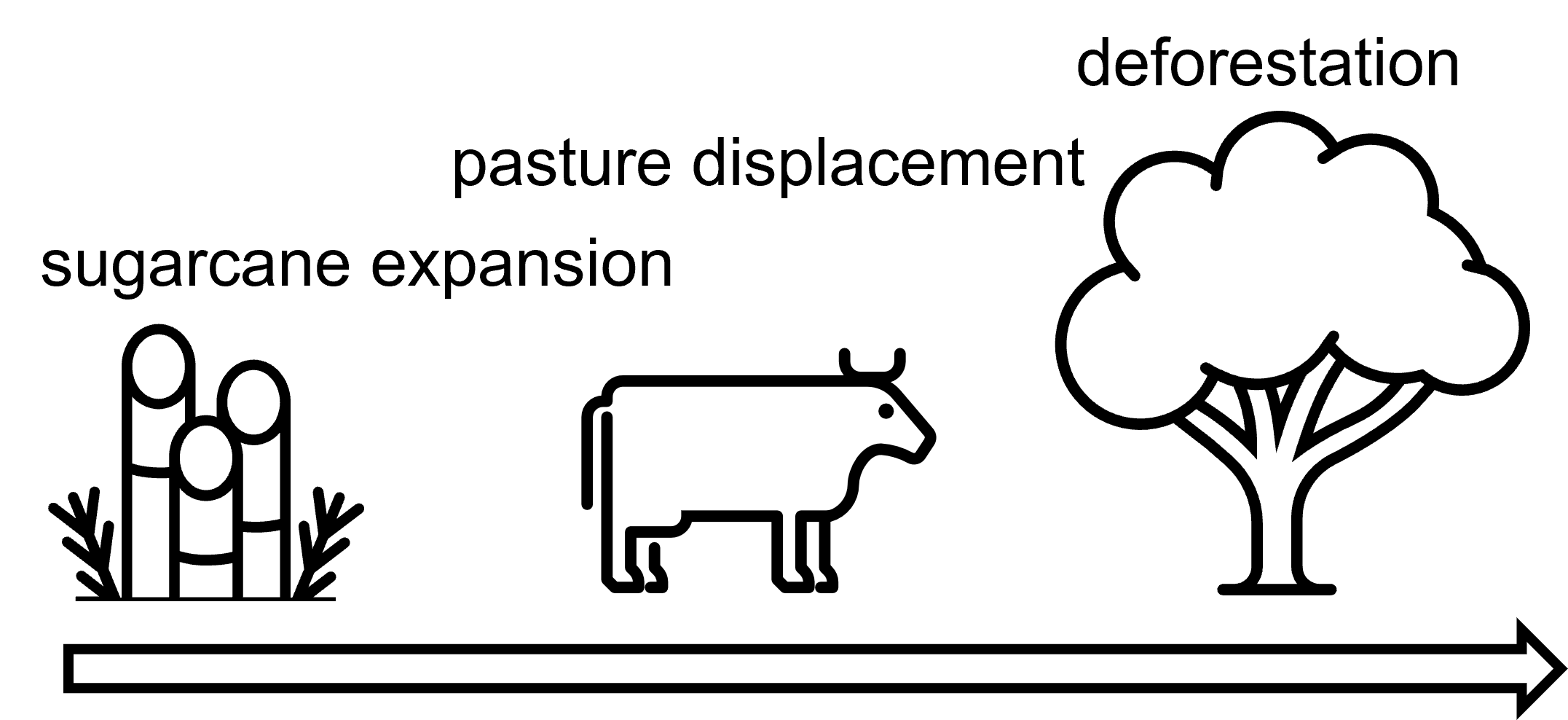
While machine learning based GeoAI modeling techniques [14] can simplify the design of complex models, our understanding of the experimental basis of the knowledge that is produced with such models still remains limited, in particular when deciding whether a given model can support a given claim or not [22]. Consider the example of land use change in Brazil, where increased demand for agricultural commodities such as bioethanol may drive deforestation. The process is complex: increased demand stimulates sugarcane expansion, yet sugarcane rarely replaces forests directly [1]. Instead, it displaces pastures, which then encroach upon forests (Fig. 1). Additional indirect effects arise from competing land uses, such as sugar and beef production.
Some studies claim to be able to detect and predict such indirect land use change via remote sensing [2], while others challenge this claim [27]. While remote sensing is a powerful tool for finding the visible traces of land use change, the images cannot directly reveal the causal mechanisms behind them. Assessing the effects of increased bioethanol demand, including indirect effects, requires a causal model that simulates controlled intervention experiments. Only in a model where certain invisible factors such as demand can be artificially controlled, fixed or left free for such a large system, we can compare two (with and without intervention) or more possible progressions of a process to find out the effects of an intervention. In contrast to remote sensing images, spatial simulation models, such as raster based land use change models, enable such reasoning [27]. Why is that? The disagreement in the community seems not merely related to model selection but to a deeper confusion about the types of experiments that different models can meaningfully represent.
Our scientific goal is thus fundamental: to clarify the role of experiments in the context of spatio-temporal modeling. This involves, on the one hand, understanding the structure of experiments – that is, what needs to be fixed, controlled, and measured – and how they can be performed. On the other hand, it requires understanding how we can interpret modeling purposes – namely, the questions a model is supposed to answer – in terms of such experiments. We argue that this kind of knowledge – pragmatic knowledge111The notion of pragmatics originates in linguistics, particularly in speech act theory. However, pragmatic methodology has far broader implications, placing action at the center of knowledge production [12]. [22] – is essential for interpreting models. Since models constrain the kinds of experiments they can represent, it is our pragmatic knowledge of the underlying experiment that allows us to judge whether a given spatio-temporal model is valid for a particular purpose. In recent work [23], we have suggested a way of understanding modeling purposes in terms of questions that reflect such spatio-temporal experiments, following insights on how the inherent structure of spatial information is a constraint to analysis, as suggested by David Sinton in 1978 [24]. However, while Sinton’s original idea of “attributes” “held constant”, “being controlled” or “measured” has inspired GIScientists to suggest corresponding geodata- and conceptual models [7, 3, 15], it remains underdeveloped from a theoretic point of view [5]. The idea has neither been rethought from the perspective of experimental design and causality, nor from a viewpoint of pragmatics222Our title is therefore rephrasing Sinton’s paper emphasizing the role of experiments.. From this standpoint, we address the following key questions:
Q.
What is the role of experiments in spatio-temporal modeling?
Q 0A.
What constitutes a spatio-temporal experiment?
Q 0B.
How is knowledge about the structure of experiments inherent in spatio-temporal modeling?
Q 0C.
Which types of spatio-temporal experiments need to be distinguished when answering questions with a model?
For this purpose, we develop a pragmatic approach to experimental knowledge, drawing on the methodical constructivist school of philosophy [17, 11, 18]. According to these scholars [16, 10, 13], an experiment is an action that implements a situation (condition), initiates a process (the latter not being an action), and observes the resulting situation (measure). We suggest a logic of experimental knowledge to make explicit the structure of experiments underlying spatio-temporal models. To this end, we introduce a formal grammar of situations in Sec. 2, which serves to construct the knowledge claims that must be supported by experiments (Sec. 3). Our pragmatic logic is based on the work of the logician Paul Lorenzen and aligns with modern causal theory [20, 28]. We then place Sinton’s ideas on firmer pragmatic grounds by introducing classes of spatio-temporal experiments in Sec. 4. Finally, in Sec. 5, we demonstrate how our theory can be used to decompose the land use change example above in terms of its inherent experiments. Based on this we justify a simulation modeling and reject a purely remote sensing-based approach.
2 A pragmatic grammar for situations and goals
In this section, we introduce a grammar for a pragmatic language following Lorenzen [17, 18] about situations underlying experiments, including actions, processes and states, as well as goals and imperatives which can be used to formulate requests. The language is explained with example sentences, and specified in terms of a basic EBNF syntax:
where expression may consist of words for literals (“hello world”) or terms (without quotes) substitutable by further expressions. Expressions can be sequences (A B), alternatives (A | B) or repetitions (A?) (zero or one) of such words. A string is parsed by applying rules recursively to words in a sequence.
2.1 Predicators and nominators for things
We use words for kinds of things (predicators) and individual things of some kind (nominators). In addition to predicators for space and time which range over individual locations and moments in time (in spatial and temporal reference systems), we use the possibility of forming amounts of space and time [25], such as regions and time intervals. The former can be used to talk about the amount of space occupied by certain things. Similar predicators we use for amounts of stuff or objects [23]. Furthermore, we call all these predicators for space, objects, stuff, and their amounts endurances, meaning that they play a particular role in describing situations: they can change in time, whereas occurrences are the things that are going on in time, reflecting a common distinction in information ontology.
Grammatic rule 1.
object : “house” | “river” | “ball” | … | person
stuff : “energy” | matter | “heat” | …
matter : “water” | “gold” | …
portion : “amount of” (object | stuff | space)
endurance : object | stuff | portion | space
thing : time | endurance
predicator : thing | occurrence
Nominators allow us to refer to particular things, either by introducing names, or by using (in a common situation of speech) indicators (“this”, “that”) together with predicators:
Grammatic rule 2.
here, there : “this” space
now, then : “this” time
home : “this” house
In the following we use various nominators for each predicator above, including names for persons, objects etc.
2.2 Occurrences, actions, situations and claims
Other predicators stand for different occurrences, to say what “goes on” with things. We distinguish dynamic from static occurrences using process predicators (involving some change of a situation that happens at a moment in time) and state predicators (involving some situation is static at a moment in time). Furthermore, we use a special class of predicators for talking about what can be done (do-predicator):
Grammatic rule 3.
occurrence : process | state | do-predicator
Grammatic rule 4.
process : “generate” | “stumble” | “rain” | “grow” | …
Grammatic rule 5.
state : “stay” | “linger” | “rest” | …
Do-predicators are distinct from other occurrences, since they stand for kinds of actions that can be attributed to the persons performing them, including their purposes [9, 12]:
Grammatic rule 6.
do-predicator : “make” | “measure” | “run” | “stay” | “drink” | “use” | …
The copula is used to form situations with occurrences, to say that some occurrence has happened, and to form situations with do-predicators, to denote action performances:
Grammatic rule 7.
: “is” | “are”
: “do”(“es”)?
happening : ()? (time-nominator)? occurrence (“ing”)? (appredicator)?
performance : ()? (time-nominator)?
action : performance do-predicator (“ing”)? (appredicator)?
Appredicators are expressions that further specify the occurrence, which may use prepositions together with nominators. A happening uses a temporal nominator and the copula with some predicator for occurrences. For example:
“at that time is raining this amount of water”
“now is growing”
In a similar way, we use the copula for reporting on action performances:
“at that time does stay at this house”
“now does run home”
Note that we can always interpret an action performance as if it was a process, i.e., a behavior [28], since do-predicators are occurrences. Situations are either happenings or actions that are controlled by endurance nominators, referring to those things to which this happens/who control the action. In particular, we require a person in control of actions:
Grammatic rule 8.
situation : endurance-nominator happening | (person-nominator)? action
For example:
“this person at this time does stay at this house”
“here at this time is raining this amount of water”
“this tree now is growing”
The distinctive role of situations, which are sorts of time-dependent propositions, has been recognized early on in artificial intelligence, where they are called fluents [19].
Grammatic rule 9.
proposition : situation | …
Propositions are used to make defensible claims. From a pragmatic perspective, the latter are speech acts, actions that can be performed by persons in a dialogue. To be able to express such acts, we introduce a way of saying that someone makes a claim using any proposition formed from the grammar above.
Grammatic rule 10.
claim : (person-nominator)? performance “(” proposition “)”
For example, Nora now makes the claim that it will be raining tomorrow:
“Nora now (here tomorrow is raining)”
2.3 Goals and imperatives
Goals are propositions intended by persons. They can be wished without ever pursuing an action (wishful thinking), but in the more practically relevant cases, we talk about goals that actually can be pursued via actions. We form goals from propositions using a conjunction “such that” or . For example, if I am traveling, I might wish to be at home at a certain time:
“such that I then do stay at home”
We can distinguish goals based on what kind of proposition is used. Whenever we are using a situation as a goal, we are wishing that the latter may come about:
Grammatic rule 11 (goals).
: “such that”
goal : situation | …
An example for a modificative goal is my wish to be at home (above), meaning a modification of the place at which I am staying. Imperatives are speech acts that prompt some action from a person. This can be expressed either by indicating the action directly, or by requesting a goal and leaving the action that implements the goal open to the person addressed. In order to express imperatives, we use the copula :
Grammatic rule 12.
imperative : (person-nominator)? “!” (action | goal)
For example, a mother may request from her daughter Nora to be at home in time for dinner:
“Nora ! at this time are having dinner”
“Peter ! at this time do cycle home”
The first imperative is a request to bring about some situation using some modificative goal333“Aufforderung zur Herbeifuehrung eines Sachverhaltes”, see [18, p. 44]. This leaves it open to Nora how and when she takes action to meet the goal. The second imperative, in contrast, requests an action explicitly. Following Lorenzen [18, p.45], we call the first case final imperatives, and the second a-final imperatives. Finally, we allow for a corresponding speech act, a request, which expresses that someone is performing a request using an imperative.
Grammatic rule 13.
request : (person-nominator)? performance “(” imperative “)”
For example, Nora’s mother Ellie requests Nora to run some errands later:
“Ellie now (Nora ! today do run this errand)”,
stands for the corresponding request. If we leave away the person nominators in such acts, we mean that the person who utters the request is requesting something from herself, meaning the person sets herself a goal. For example, I might now set myself the goal of running errands later today:
“now (! today do run this errand)”
3 A pragmatic logic of experiments
In this section, we explain how the pragmatic language developed so far can be used to construct logic formulas, expressing experimental knowledge. Formulas can be used to express experimental norms for persons who should do something to perform an experiment, more specifically (and recursively), who should make claims, decisions and plans. To formalize experimental control, we introduce practical modalities. Furthermore, we use experiential rules to express claims about experimental outcomes. Rules can be tested by experiments and represented by knowledge bases and information models.
3.1 Knowledge of action consequences, inferences and decisions
In pragmatic philosophy, knowledge is understood as a form of know-how, meaning it must be actionable: knowledge enables action, encompassing the skills necessary to achieve goals, articulate and pursue interests, and ultimately navigate life within a heterogeneous society [17, 12]. What distinguishes knowledge from mere opinion is the notion of validity: a valid claim is a proposition that is successfully justifiable, which in turn requires the success of the actions underlying its defense, including the successful execution of experiments.
To be valid, claims must be generalizable across multiple examples. To express such generalizable claims, we employ standard logical connectives: disjunction () for “or,” conjunction () for “and,” and negation () for “it is not the case that.” These can be combined to form complex propositions. Additionally, we use the implication operator () to denote conditional statements: “if the first proposition is true, then the second must also be true.” For example, the logical formula expresses a structured claim where and are arbitrary propositions.
Quantifiers extend conjunction and disjunction over arbitrarily many propositions by introducing variables. Variables are placeholders for elements within a specified domain – a collection of nominators that share a common predicate. To denote domains, we use upper-case symbols corresponding to predicators in Sect. 2.1. For example, the domain Person consists of nominators referring to individuals. Variables such as can be substituted by any element from their respective domains. The universal quantifier () generalizes conjunction across all elements of a domain, asserting that a proposition holds for every substitution:
now is raining now is wet
This states that it is raining and wet everywhere in space. Conversely, the existential quantifier () generalizes disjunction, asserting that a proposition holds for at least one substitution:
is raining is wet
This expresses that at every location in space, there exists some point in time where it is raining and wet. We refer to such quantified logical expressions as formulas. Formulas can be used to describe complex situations involving actions or processes.
A crucial aspect of pragmatic knowledge is understanding how actions lead to consequences. We distinguish between conditions, which must hold at the time an action is performed, and consequences, which describe the expected results. An action is deemed unsuccessful with respect to a goal if its consequences do not fulfill that goal. The reason for failure can often be traced back to unmet conditions. This leads to the notion of knowledge about the consequences of actions444“Handlungsfolgenwissen” [12, 9]. Such knowledge is formalized using consequential rules, which capture the expected outcomes of actions under specific conditions:
Schema 1 (consequential rules).
Here, denotes a formula capturing requirements (conditions necessary for the action), and denotes a formula capturing the expected consequences. For example:
Nora now uses on then is burning.
This rule asserts that lighting a candle with a match under Nora’s agency results in the candle burning – though this claim is context-dependent. It holds for an adult on Earth but fails for a child or in a zero-oxygen environment. In pragmatics, this only demonstrates the need to refine requirements for assuring validity. Progression rules describe changes in state over time due to processes rather than actions:
Schema 2 (progression rules).
The temporal ordering implicitly assumes that the antecedent conditions occur before the consequent state. For example:
now contains this amount of water here now raining that amount of water) then contains (this + that) amount of water.
Progression rules need to be justified by experiments (see below) or derived from other knowledge. A set of such rules forms a rule base: for consequential rules and for progression rules. Together with a set of formulas describing the current situation , we obtain a knowledge base: or . If we can infer a formula from such a knowledge base using logical inference, we write .
In addition to knowledge about consequences of actions and progressions, we also require knowledge about people’s behavior in terms of speech acts. These are actions like claims and requests in which some explicit knowledge base is required. Correspondingly, we introduce rules of inference (for actions that derive claims from other claims) as well as decision rules (for deriving goals from other claims or other goals):
Schema 3 (rules of inference).
Schema 4 (decision rules).
A particularly relevant example of a decision is to plan. Pragmatically, plans are understood as artifacts that are a result of a process of planning [8]. However, they are more than that: Plans are also symbolic manifestations of imperatives (formalized by using a request ). For one, we plan according to a planning goal, which can be understood as a final imperative specifying an intended situation that should be realized by a plan. The plan itself manifests likewise a final or an a-final imperative, consisting of a series of actions to be performed or of subgoals to be pursued in order to reach this goal. A successful plan, thus, satisfies a conditioned imperative: it needs to successfully realize the goal whenever we follow it in an experiment. We can express this kind of knowledge also in terms of rules.
3.2 Practical modalities
Based on such knowledge bases, we can assess what can be done. Namely in the sense of knowing whether an expected consequence is achievable in a given situation. The latter can be defined based on whether A is logical implied by consequential rules in this situation:
Definition 1 (A is achievable).
Literally, , or A is achievable means that some expected consequence described by the formula A can be justified by (repeatedly) applying consequential rules from the knowledge base to the situation . When it is clear which knowledge base is meant, we can also leave away the subscript: .
The power of this practical modal logic [17, 18] is to capture everyday notions of dispositions and action potentials relative to a situation. This becomes clear when we define the modal variants:
Definition 2 (A is avoidable).
Definition 3 (A is unachievable).
Definition 4 (A is unavoidable).
Definition 5 (A is controllable).
If a consequence is avoidable, this means its contrary can be achieved. If it is unachievable, we fail to justify it can be achieved. And if it is unavoidable, we fail to justify that it can be avoided. For example, in a situation where a state launches atomic missiles to attack another state, which also possesses atomic missiles, an atomic war is unavoidable. This is because, according to our knowledge of consequential rules of warfare and assuming a certain behavior, namely that the corresponding protocols are implemented by the group of people responsible for them, we fail to find a path of action that would not involve launching a counter-attack, and thus we may not find a way to prevent a war in this situation.
Controllable situations are both achievable and avoidable. Sometimes we can avoid a consequence only constructively, based on changing a situation described in a corresponding formula using another nominator, i.e., to switch nominators. This leads to a more specific case of value controllability:
Definition 6 (A is (constructively) avoidable).
Definition 7 (A is (value) controllable).
The atomic counter-attack is a case in point, because there needs to be a switch for controlling the missile launch, and this switch is always in some position.
In an equivalent way, we can use modal logic to reason with knowledge of a situation and some progression model, which can be expressed as a collection of progression rules:
Definition 8 (necessary).
Literally, is a necessary consequence of a given situation at time , under the assumption that the progression rules and the situation descriptions are defendable, and if is a logical implication. By abstracting from the particular base , we also write for the situations that will happen as a consequence of this situation at some time . For example, in case we have a progression model of rainfall covering the extent of a lake, we may be able to predict the amount of water of that lake at a time after the rainfall stopped, given that we know its water content in the current situation. The definitions of these so called mellontic modalities [17] are equivalent to the practical ones above, including possible (), impossible (), and contingent ( ⋈ ). Contingent consequences are those that are possible yet we still fail to show that they are logically implied. That is, based on our progression model, we just don’t know.
3.3 Experiments
The empirical (a-posteriori) knowledge [17] that we can obtain from an experiment can be written down in the form of experiential rules that are very similar to consequential rules introduced above, except that they involve the triggering of a process p (grammatic rule 4):
Schema 5 (experiential rule).
Literally, if we do something to start process under the condition , then we can expect situation to occur [16]. Knowledge obtained from a given experiment can include many such rules. Experiential rules constitute both constructive building blocks and tests for empirical theories. In the latter case, by using a theory to infer an experiential rule that is compared with the result of a corresponding experiment, in the former case, by directly generalizing from experiential rules.
Yet, like all actions, experiments can fail, and in consequence, rules become invalid. How exactly can experiments fail? This depends on their purpose [10, 13]. The purpose of an experiment [16] derives from the trans-subjectivity of empirical knowledge: it is to reproduce the process p such that it leads to similar situations (consequences) under the same conditions, regardless of who is triggering the process and with which instruments (under which further circumstances). Conditions can be either fixed (not changed in the experiment) or controlled (changed in the experiment). This means that all conditions must be achievable via actions (definition 3), while controls need to be, in addition, controllable (can be switched on or off) (definition 7). In addition, we often need to leave some other situations contingent (“free”, or not pre-determined) (section 3.2, last paragraph). Conditions and contingent situations are required to prevent the experiment from being disturbed. The situations (grammatic rule 8) that are the consequences (schema 1) of the experiment can be represented by measures. Altogether, we call this the experimental reproducibility norm, and it has the following general form:
Schema 6 (experimental reproducibility norm).
An experiment is successful if the fixed conditions are achievable in situation , the controlled conditions are controllable (in ) for each particular value , and the situation is contingent, and if, when achieving all conditions and starting the process under arbitrary circumstances , equivalent outcomes occur (under some equivalence ) in the resulting situation ():
The nominators (fixes, taken from domains ), (controls, taken from domains ), (contingents from domains ), (measures, taken from domains ) thereby serve to identify and reproduce the respective situations.
For example, an experimental norm for a simple spatio-temporal experiment about growing crops in a geographic region could look like this:
Norm 1.
This norm defines an experiment () to determine how many beans can be produced in a region , independent of who performs it () or when (). The experiment requires sowing beans in at (controllable situation ) and ensuring that later sales () do not interfere, avoiding market disturbances. If beans are sown and properly cultivated (), the norm expects that by (), an approximate amount of beans will be produced. This norm is a priori: it does not specify the exact yield but requires that outcomes be reproducible up to equivalence. Experiments implementing this norm either fix or control or leave contingent conditions when triggering the process. If reproducibility fails – e.g., due to lack of seeds, planting restrictions, or market constraints – the experiment fails.
In case of failure, we can adjust an experimental norm to ensure valid experiential rules. Lange [16] suggested the following principle ways to deal with such disturbances:
-
1.
Isolating disturbances through shielding (possible in labs or simulations).
-
2.
Cleaning up disturbances by controlling, fixing, or rendering them contingent (e.g., via randomization).
-
3.
Incorporating disturbances as errors, increasing the tolerance of equivalences.
These adjustments constitute what Lange calls fault avoidance knowledge (referred to as exhaustion in [16]). For example, if bean growth depends on weather conditions or market quotas, fixing the yearly weather conditions and removing quota constraints could make the experiment reproducible. Note that inferential statistics, at its core, is a method for incorporating the disturbances of repeatable experiments using stochastic models (i.e., random generators) [18]. Methodologically, it comes after the introduction of experiments, not before.
Causal experiments play an exceptional role for science, since they allow us to determine causes. Yet, distinguishing causes from other experimental relations likewise requires pragmatic knowledge, an insight gained early by Georg Hendrik von Wright [28] in terms of his interventionist causality norm, and much later picked up in contemporary causal inference theory [20]. The corresponding experimental norm for causal experiments is more strict as it requires in addition a particular counterfactual situation, i.e., considering a consequential situation that occurs if we had not taken an action [21]. The norm requires that if some controls are not achieved, then the corresponding measures need to be different:
Schema 7 (interventionist causality norm).
If an experiment satisfies such a norm, there is a one-to-one correspondence between possible control situations and measure situations. This is the case, e.g., when we run randomized control trials, where a control group lacks the condition, and the experiment is successful in case that group also lacks the expected consequence [21]. We can then call the control domain a cause of the measure domain. In case of failure to satisfy such a norm, we can clean up disturbances, i.e., by incorporating conditions, or by adding contingencies into the norm. The corresponding strategies are well known from the causal reasoning literature [20], including fixing confounders (common causes of conditions and consequences), and leaving contingent intermediators (effects of controls that are causes of consequences) and colliders (common effects of controls and consequences) [21].
Data record experiential rules in terms of the underlying nominators (in our bean growing example ). Yet, such data records leave away many details needed to understand the underlying experiment. This includes not only the irrelevant further circumstances (here: time and person), but in particular, the fact that fixes and controls uniquely determine (are keys for) measures, and the question what kind of situations are controlled, fixed, or measured. To keep some of this information in an abbreviated form, we use the following notation for the type of experiential knowledge base that corresponds to an experimental norm:
Definition 9 (experiential knowledge base).
Thus, for experiments, we usually control (c), fix (f) or measure (m) some domains D. For experiments that include claims, we additionally control, fix or measure knowledge claims () (which of course may be justified by further experiments). And for experiments that include goals, decisions and plans, we control, fix or measure requests for bringing about a situation in which we can make knowledge claims (. For the fixed conditions, we also write down constants instead of the domain from which they stem.
4 Classes of spatio-temporal experiments
All other differentiation in experiments is a consequence of taking into account different ways of bringing about controls, triggering processes, and realizing measures [16]. An instrument for starting the process is called experimental apparatus. Instruments for observing and recording are called measurement instruments. For measurements, we also need to control conditions, yet only for the process started within the sensor of the measurement instrument itself. An example for the latter would be a temperature measurement using a thermometer, where the process is the expansion of a thermometric material in the sensor [4], and among the controlled conditions are, for example, the location and height above ground. A natural or “quasi” experiment is one in which the researcher does not control or fix the conditions of a process, but instead selects among conditions of processes that were already recorded. For spatio-temporal experiments, we distinguish the following classes, following Sinton [24], but enriched by more recent ideas about conceptual models of spatial information [23]. We specify experiments555Note this is only a subset of possible spatio-temporal experiments. based on their underlying experimental norms:
Norm 2 (experimental norm for spatial fields).
Spatial fields fix time and control space in order to measure some endurance nominators (which could be amounts, stuff, objects). An example would be a raster map of forest density per grid cell.
Norm 3 (experimental norm for spatial coverages).
Spatial coverages fix time and control endurances in order to measure some amount of space occupied by the endurance. An example would be a map of vector polygons of a land use, vegetation, or soil type.
Norm 4 (experimental norm for spatial lattices).
Spatial lattices fix time and control an amount of space in order to measure some endurance controlled by this amount of space. An example would be statistical census tract data.
When using time as a control instead, we obtain various forms of time series experiments that involve space:
Norm 5 (experimental norm for temporal fields).
A temporal field controls time and fixes space, resulting in a time series that records measurements at a location over time. An example would be river discharge continuously measured at a catchment outlet, resulting in a hydrograph.
Norm 6 (experimental norm for trajectories).
Trajectory experiments serve to measure motion, including movements of (rigid) objects (tracks) or spreadings etc. [6]. Note that spatio-temporal experiments are usually not causal, since they do not satisfy a counter-factual, interventionist causality norm. For example, when measuring a horizontal spatial temperature field, different locations will share the same temperature value, thus location cannot be considered a cause for temperature change. This is different when moving in the vertical direction (as temperature decreases with height). Yet, we can use causal experiments together with spatio-temporal measurements in order to infer knowledge in various ways, as illustrated in our example.
5 The hidden experiments in landuse simulation modeling
In our sugarcane example case, we are interested in the question: what is the effect of one or more increased bioethanol demands on the spatial distribution of forest landuse [27]? With hidden experiments, we mean the (largely implicit) knowledge of the types of experiments that need to be mastered to answer this question. On the highest level of abstraction, our example corresponds to a causal experiment, where we need to control the bioethanol demand, fix conditions that also influence landuse (such as sugar demand), and keep contingent conditions that occur as intermediators of landuse planning goals, in order to infer a spatial distribution of landuse (forest) in a situation later :
Norm 7 (Bioethanol demand landuse inference).
The problem is that the bioethanol demand needs to be causally controlled, meaning we need to compare the consequences of a demand increase with a reference scenario [27] in which the original demand remains the same, a scenario that has never been observed. Furthermore, landuse is subject to various invisible effects and human decisions that are not represented in observed landuse changes. Since we cannot actually control market demand, there is no way for us to perform a corresponding experiment. Furthermore, the problem can also not be solved by consulting past landuse images and running a remote sensing experiment over time: A remote sensing experiment controls locations or time and measures crop land type in terms of a field. Based on this, we can only measure landuse change over time and space in a non-causal manner, and only under the factual conditions of changing demands in the history of Brazil. It then becomes impossible to isolate the effects of bioethanol demand from sugar demand [27]. What we need instead is an experiment that measures the causal effects of invisible demands on decisions under counterfactual conditions.
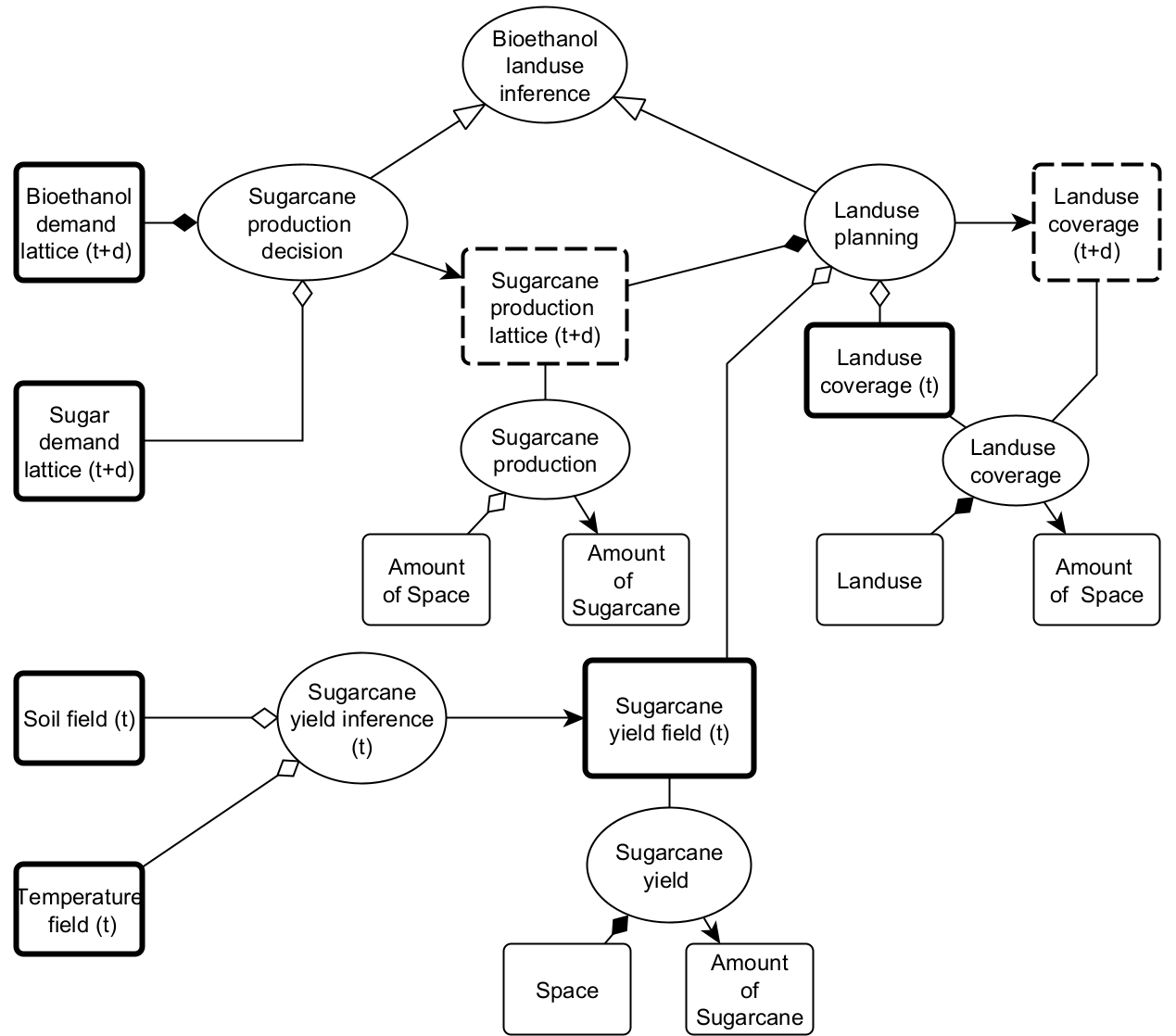
For this reason, we need to construct a model of the causal experiment666Cf. our definition in [23], where a model of an experiment is a method that answers the same question as the experiment., in which we can actively control the situations that trigger the process – such as in a simulation model. And for this purpose, we need to decompose the experiment into sub-experiments for which we can obtain some experiential knowledge to be used in the model. And here is where the task becomes really complex, because we have to figure out a way that these experiments feed into each other, see Fig. 3. First of all, the knowledge about the market demand needs to be input of a decision experiment. This experiment controls knowledge claims about the market demand at and produces a final plan with several subgoals, including the sugarcane production goal at for a certain spatial region. Here is a specification of the experimental norm:
Norm 8 (Sugarcane production decision).
The result corresponds to a lattice experiment: for each region, we measure an amount of sugarcane that it should produce. The corresponding knowledge constitutes in turn a controllable input for a planning experiment, namely the decision of how to redistribute landuse to reach this production goal:
Norm 9 (Landuse planning).
Note that in this planning experiment, the different production goals are competing because of a collider, which is the fixed total area available for landuse. Thus, if we increase sugar cane production, we need to decrease the production of other crops, pasture or forest. This is what demand-driven land use change models typically do, e.g. the models CLUE-S [26] and PLUC [27]. To perform this planning experiment, we need to fix claims about two kinds of further experiments, one is about the sugarcane potential yield, a spatial field that indicates for each location the potential sugarcane production density at the given time (t) (Figure 2).

This knowledge, in turn, can be obtained by inference starting from a field of weather information and a field of soil types (the GAEZ method by the FAO)[27]:
Norm 10 (Sugarcane yield inference).
The second input condition is a knowledge claim about the current landuse coverage at time t (Figure 2), which can be obtained from remote sensing images. The planning experiment results in a single subgoal, namely the request to realize another landuse coverage at time . The final step is to implement the plan and thus to realize the planned sugarcane production.
6 Conclusion
In this paper, we proposed a formal pragmatic account of experiments to clarify their role in spatio-temporal modeling (Q). Our broader goal is to develop a systematic way to judge whether a given modeling approach is suitable for gaining knowledge about a particular type of experiment – especially those represented by spatial information models.
To this end, we introduced a grammar of situations and a pragmatic logic of experiments. This allows us to define experiments by their experimental norms, i.e., by distinguishing which experimental conditions must be fixed, controlled, or left contingent (via a practical modal logic), and by identifying the measured consequences as resulting from underlying actions that trigger processes (Q A). Causal experiments follow stricter, counterfactual norms. We then characterized experiential knowledge bases in terms of these norms, the domains of situation variables involved, the inferences made, and the goals pursued – particularly in contexts involving human decisions. Sinton’s structural ideas about spatio-temporal information were reframed in terms of non-causal experimental norms (Q B).
Using the sugarcane example, we showed how decomposing its components by experimental norms clarifies why remote sensing alone is insufficient to answer the question. We identified the need for additional experiments to assess indirect effects on deforestation, including decision-, planning-, and inference-experiments, as well as underlying spatio-temporal experiments – fields, lattices, and coverages (Q C).
This work lays the foundation for a theory that evaluates spatio-temporal models by their fitness for purpose (cf. [23]), independently of implementation details. Such a theory is urgently needed as machine learning models replace traditional approaches without accounting for purpose or experimental logic. Future work should expand the pragmatic logic across modeling examples, formalizing experiment decomposition and supporting reasoning about spatial designs and sampling strategies. In this sense, our work remains preliminary.
References
- [1] Marcos Adami, Bernardo Friedrich Theodor Rudorff, Ramon Morais Freitas, Daniel Alves Aguiar, Luciana Miura Sugawara, and Marcio Pupin Mello. Remote Sensing Time Series to Evaluate Direct Land Use Change of Recent Expanded Sugarcane Crop in Brazil. Sustainability, 4(4):574–585, 2012. doi:10.3390/su4040574.
- [2] Eugenio Y Arima, Peter Richards, Robert Walker, and Marcellus M Caldas. Statistical confirmation of indirect land use change in the Brazilian Amazon. Environmental Research Letters, 6(2):024010, 2011. doi:10.1088/1748-9326/6/2/024010.
- [3] Gilberto Camara, Max J Egenhofer, Karine Ferreira, Pedro Andrade, Gilberto Queiroz, Alber Sanchez, Jim Jones, and Lubia Vinhas. Fields as a generic data type for big spatial data. In Geographic Information Science: 8th International Conference, GIScience 2014, Vienna, Austria, September 24-26, 2014. Proceedings 8, pages 159–172. Springer, 2014. doi:10.1007/978-3-319-11593-1_11.
- [4] Hasok Chang. Inventing temperature: Measurement and scientific progress. Oxford University Press, 2004. doi:10.1093/0195171276.001.0001.
- [5] Nicholas Chrisman. Exploring Geographic Information Systems, 2nd Edition. Wiley, 2002.
- [6] Antony Galton. Qualitative spatial change. Oxford University Press, 2000.
- [7] Antony Galton. Fields and objects in space, time, and space-time. Spatial cognition and computation, 4(1):39–68, 2004. doi:10.1207/s15427633scc0401_4.
- [8] Armin Grunewald. Kulturalistische Planungstheorie. In Methodischer Kulturalismus: Zwischen Naturalismus Und Postmoderne, pages 315–343. Suhrkamp, 1996.
- [9] Dirk Hartmann. Kulturalistische Handlungstheorie. In Methodischer Kulturalismus: Zwischen Naturalismus Und Postmoderne, pages 70–114. Suhrkamp, 1996.
- [10] Peter Janich. Das Experiment in der Psychologie. In Konstruktivismus und Naturerkenntnis, pages 275–289. Suhrkamp, 1996.
- [11] Peter Janich. Methodical constructivism. In Issues and Images in the Philosophy of Science, pages 173–190. Springer, 1997.
- [12] Peter Janich. Logisch-pragmatische Propaedeutik. Velnbrueck Wissenschaft, 2001.
- [13] Peter Janich. Das Experiment in der Biologie. In Kultur und Methode, pages 330–366. Suhrkamp, 2006.
- [14] Krzysztof Janowicz, Song Gao, Grant McKenzie, Yingjie Hu, and Budhendra Bhaduri. GeoAI: spatially explicit artificial intelligence techniques for geographic knowledge discovery and beyond. International Journal of Geographical Information Science, 34(4), 2019. doi:10.1080/13658816.2019.1684500.
- [15] Werner Kuhn. Core concepts of spatial information for transdisciplinary research. International Journal of Geographical Information Science, 26(12):2267–2276, 2012. doi:10.1080/13658816.2012.722637.
- [16] Rainer Lange. Vom Koennen zum Erkennen. Die Rolle des Experimentierens in den Wissenschaften. In Methodischer Kulturalismus: Zwischen Naturalismus Und Postmoderne, pages 157–196. Suhrkamp, 1996.
- [17] Paul Lorenzen. Normative logic and ethics. Bibliographisches Institut, Mannheim, 1969.
- [18] Paul Lorenzen. Lehrbuch der konstruktiven Wissenschaftstheorie. Springer, 1987.
- [19] John McCarthy and Patrick J Hayes. Some philosophical problems from the standpoint of artificial intelligence. In Readings in artificial intelligence, pages 431–450. Elsevier, 1981.
- [20] Judea Pearl. Causality. Cambridge university press, 2009.
- [21] Mattia Prosperi, Yi Guo, Matt Sperrin, James S Koopman, Jae S Min, Xing He, Shannan Rich, Mo Wang, Iain E Buchan, and Jiang Bian. Causal inference and counterfactual prediction in machine learning for actionable healthcare. Nature Machine Intelligence, 2(7):369–375, 2020. doi:10.1038/s42256-020-0197-y.
- [22] Simon Scheider and Kai-Florian Richter. Pragmatic geoai: Geographic information as externalized practice. KI-Künstliche Intelligenz, 37(1):17–31, 2023. doi:10.1007/s13218-022-00794-2.
- [23] Simon Scheider and Judith A Verstegen. What is a spatio-temporal model good for?: Validity as a function of purpose and the questions answered by a model. In 16th International Conference on Spatial Information Theory (COSIT 2024), pages 7–1. Schloss Dagstuhl – Leibniz-Zentrum für Informatik, 2024. doi:10.4230/LIPIcs.COSIT.2024.7.
- [24] David Sinton. The inherent structure of information as a constraint to analysis: Mapped thematic data as a case study. Harvard papers on geographic information systems, 1978.
- [25] Eric Top, Simon Scheider, Haiqi Xu, Enkhbold Nyamsuren, and Niels Steenbergen. The semantics of extensive quantities within geographic information. Applied Ontology, 17(3):337–364, 2022. doi:10.3233/AO-220268.
- [26] Peter H. Verburg and Koen P. Overmars. Dynamic simulation of land-use change trajectories with the CLUE-s model. In Eric Koomen, John Stillwell, Aldrik Bakema, and Henk J. Scholten, editors, Modelling land-use change: Progress and applications, pages 321–337. The GeoJournal Library, 2007. doi:10.1007/978-1-4020-5648-2_18.
- [27] Judith A Verstegen, Floor van der Hilst, Geert Woltjer, Derek Karssenberg, Steven M de Jong, and André PC Faaij. What can and can’t we say about indirect land-use change in Brazil using an integrated economic–land-use change model? Gcb Bioenergy, 8(3):561–578, 2016. doi:10.1111/gcbb.12270.
- [28] Georg Henrik Von Wright. Explanation and understanding. Cornell University Press, 2004.