Reconstructing Random Graphs from Distance Queries

Abstract
We estimate the minimum number of distance queries that is sufficient to reconstruct the binomial random graph with constant diameter with high probability. We get a tight (up to a constant factor) answer for all outside “threshold windows” around , : with high probability the query complexity equals , where is the diameter of the random graph. This demonstrates the following non-monotone behaviour: the query complexity jumps down at moments when the diameter gets larger; yet, between these moments the query complexity grows. We also show that there exists a non-adaptive algorithm that reconstructs the random graph with distance queries with high probability, and this is best possible.
Keywords and phrases:
random graphs, graph reconstruction, distance queries, query complexityFunding:
Michael Krivelevich: Research supported in part by NSF-BSF grant 2023688.Copyright and License:
![[Uncaptioned image]](x1.png) © Michael Krivelevich and Maksim Zhukovskii; licensed under Creative Commons License CC-BY 4.0
© Michael Krivelevich and Maksim Zhukovskii; licensed under Creative Commons License CC-BY 4.0
2012 ACM Subject Classification:
Mathematics of computing Random graphs ; Mathematics of computing Graph algorithmsEditors:
Anne Benoit, Haim Kaplan, Sebastian Wild, and Grzegorz HermanSeries and Publisher:
 Leibniz International Proceedings in Informatics, Schloss Dagstuhl – Leibniz-Zentrum für Informatik
1 Introduction
Reconstruction of graphs was thoroughly studied in many different contexts and has various applications, e.g., in DNA sequencing [2, 13, 34], phylogenetics [1, 23, 29], and recovering neural networks [39]. A vast amount of literature is devoted to the average-case problem, i.e. to the reconstruction of random graphs [8, 12, 19, 21, 28, 31, 33, 35, 41]. In particular, the conjecture of Kelly and Ulam [24, 42] which is considered as one of the main reconstruction challenges is known to be true in binomial random graphs whp111With high probability, that is, with probability tending to 1 as . [8, 28, 35].
Let be a connected graph on , and let be a set of pairs of vertices. In the usual way, we denote by the graph distance between and in . Let us say that reconstructs , if is the only graph on with distances between , i.e. for every graph on such that for all , we have . We will also call the graph -reconstructible in this case.
In this paper, we study the model of reconstruction with an access to distance query oracle introduced in [5], although its variants were considered long before that for modelling reconstruction of a phylogenetic tree [18, 25, 43]. For every queried pair of vertices, the oracle answers the distance between these vertices in the hidden unknown graph . For a queried pair of vertices , we denote the oracle’s answer to this query by , omitting the unknown graph in the subscript. An adaptive algorithm, at every step, selects the next query (a pair of vertices) based on the responses from the oracle to earlier queries.
Let . If there exists an adaptive algorithm such that, for the hidden input graph on , it queries at most pairs of vertices comprising a set that reconstructs , then we call -reconstructible by . Let us call the minimum such that is -reconstructible by some algorithm the (distance) query complexity of . It is easy to see that, in the worst case, the query complexity equals : all pairs should be queried in order to reconstruct the graph. For example, this is the case when is a clique. Reyzin and Srivastava [37] showed that, even for some trees, pairs are required to query. On the other hand, Mathieu and Zhou [31] presented an algorithm such that whp a uniformly random -regular graph on is -reconstructible by this algorithm, and wondered whether methods similar to those developed in their paper are applicable to sparse binomial random graphs . In this paper, in contrast, we study the distance query complexity of relatively dense random graphs assuming for some , i.e., when the random graph has bounded diameter whp. Although our main motivation lies in attempting to achieve tight bounds for the average-case complexity in a situation where the general setup is hard to analyse, additional interest in this problem is sparked by a surprising phenomenon, which will be discussed in the next two paragraphs.
One can expect that dense graphs are typically harder to recover through distance queries, as the influence of a single edge to be recovered on distances between vertices might be less pronounced and thus harder to detect. In order to get some intuition of how the query complexity of the random graph evolves, let us first assume that is significantly above the threshold for the property of having diameter at most 2, namely, as . In this case, whp every pair of non-adjacent vertices has at least two common neighbours. Indeed, probability that a fixed pair of vertices has at most one common neighbour equals
Therefore, by the union bound, every non-adjacent pair of vertices of has at least two common neighbours whp. Then whp the query complexity equals . Indeed, for any set of pairs of vertices of size less than , changing any single adjacency relation of a pair from does not influence the distance between and for any . Therefore, any set that does not contain all pairs does not reconstruct whp.
On the other hand, it seems likely that for close to the connectivity threshold , the query complexity might be much less – quasilinear, as in the case of random regular graphs. Note that, in general the query complexity does not decrease as the graph becomes sparser since, in particular, as we mention above, for certain trees, the query complexity equals . Nevertheless, we show that, on average, as density decreases, the query complexity jumps down at specific moments around hitting times of diameter’s increments. However, between these moments the query complexity grows quite rapidly. In particular, there exist such that whp the diameter of is larger than the diameter of while the query complexity of the former is also larger.
Related work
Kannan, Mathieu, and Zhou [22, 30] presented a reconstruction algorithm that uses distance queries for bounded degree graphs. They also proved an information–theoretic lower bound for trees with maximum degree 3 and asked whether is achievable for all bounded degree graphs. Tight results for certain families of bounded degree graphs – trees, chordal graphs, and graphs with bounded treelength – were recently obtained by Bastide and Groenland in [4]. In particular, they proved that for every , any randomised algorithm requires queries to reconstruct -vertex trees of maximum degree for a certain sequence of sizes of trees, which is tight since there exists a deterministic algorithm to reconstruct such trees using queries. In [31], Mathieu and Zhou answered the question from [22] for random -regular graphs with constant : whp distance queries is enough to reconstruct a uniformly random -regular graph.
A modified version of the problem where the hidden graph is a tree and it is only allowed to query pairs of leaves (that are known) comes from biology: it serves as a model of reconstructing evolutionary (phylogenetic) trees and was introduced by Waterman, Smith, Singh, and Beyer [43]. This problem is well studied: lower bounds on query complexity for deterministic and randomised algorithms were obtained in [25] and [4] respectively, and upper bounds were investigated in [11, 23, 25, 27].
Other types of query oracles explored in the literature include all-shortest-path, all-distances, and shortest-path queries. The first two oracles answer all shortest paths [5, 38] and all distances [5, 14] from a queried vertex respectively. The shortest-path oracle answers a shortest path between a queried pair of vertices [22, 37]. Erlebach, Hall, and Mihal’ák [15] studied reconstruction of from all-shortest-path queries for and for specific .
Mathieu and Zhou [31] also showed that their construction of the set of distance queries can be used to get an upper bound for the metric dimension of random -regular graphs. Let us recall that the metric dimension of a graph is the minimum cardinality of such that all vertices of have different vectors of distances to the vertices from . Such resolving sets or their variants were used, in particular, to label canonically vertices of random graphs [3, 26]. The metric dimension of was studied by Bollobás, Mitsche, and Prałat in [10]. In particular, they proved that the metric dimension of undergoes the following “zigzag” behaviour: if , then whp; see also [36] for related results. Although in our proof of the upper bound for the distance query complexity of we use a resolving set whose size is far from being optimal, as we show below the “jumps” of the metric dimension and of the query complexity are synchronous – both happen around , .
Our contribution
As follows from the next result, the query complexity drops for the first time when passes a threshold on its way down. More generally, we prove that, for every integer constant , as soon as passes a threshold , the query complexity drops by a factor of .
Theorem 1.
Let be a fixed integer, , , and let . Then there exist and an adaptive algorithm such that, for whp is -reconstructible by .
Theorem 2.
Let be a fixed integer, , and let as . Then whp has query complexity at least .
Theorem 2 is proven in Section 5. Let us emphasise that its proof is based on an explicit argument which is more efficient than the usual information-theoretic approach: we show a lower bound on the query complexity of a deterministic graph in terms of its diameter and maximum degree, see Claim 14. Unlike the information-theoretic approach, our approach allows to bound the query complexity of any given graph. So, it actually demonstrates that, when the number of queries is less than the bound, even knowing the input graph does not help choosing the optimal quering strategy – no matter which pairs of vertices are queried, there is always a graph with exactly the same answers.
Note that, for any as and any
| (1) |
the bounds in Theorem 1 and Theorem 2 differ by a constant factor, see Figure 1. So, roughly speaking (ignoring the constant factor) the query complexity in the interval (1) increases with .
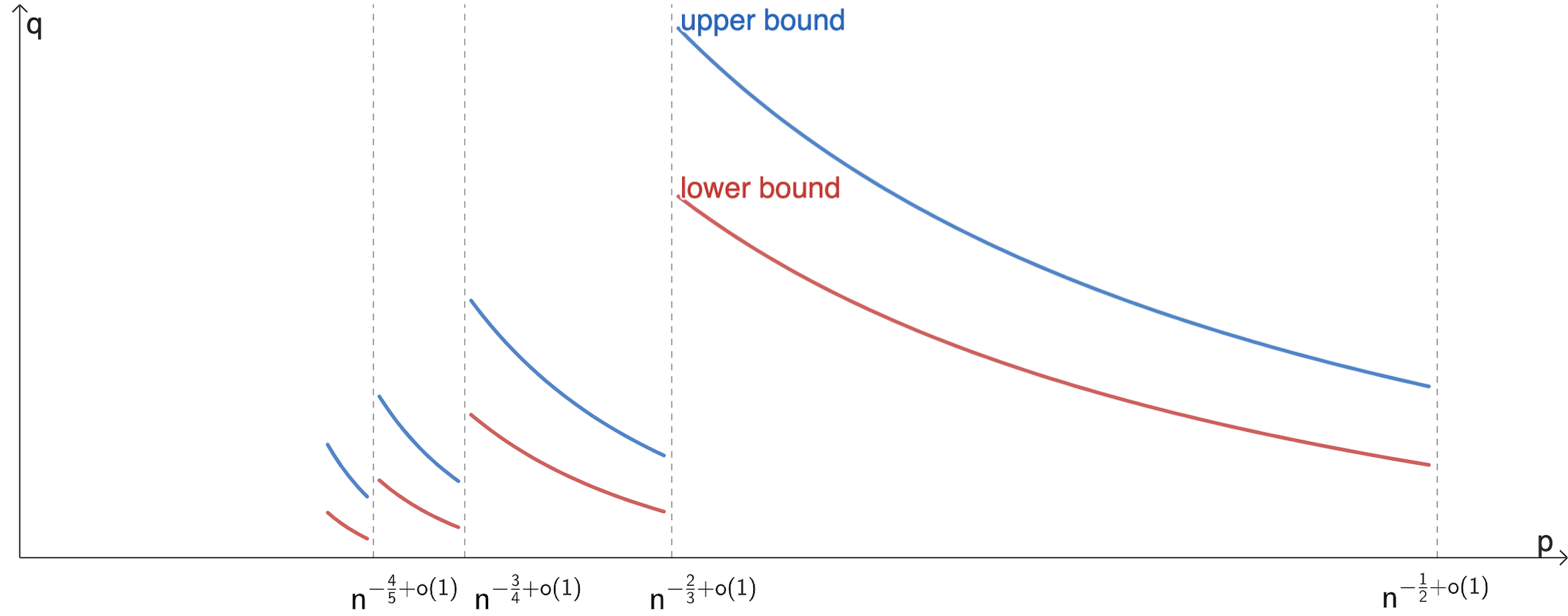
We also prove tight (up to a constant factor) bounds for “non-adaptive reconstructibility”. It turns out that if the set of queried pairs is fixed, then both upper and lower bounds on the minimum such that is -reconstructable increase by a factor of when satisfies (1).
Theorem 3.
Let be a fixed integer, , and let . Then there exists a set of size at most such that whp is -reconstructible.
Theorem 4.
Let be a fixed integer, , and let as . If
then there is no set of size at most such that whp is -reconstructible.
Proofs outline
For simplicity of presentation, let us assume that , where for some . The crucial observation that allows to prove tight (up to a constant) upper bounds both for adaptive and non-adaptive query complexities is the following: if and are queried and , then and are not adjacent.
Although whp the diameter of equals , for a sufficiently large fixed set , every vertex has a vertex from in its -neighbourhood. Indeed, if has size , then the expected number of -paths from a fixed vertex to is . Thus, using standard concentration inequalities, it is possible to overcome the union bound over the choice of for and sufficiently large. Actually, the following stronger property can be proved: whp for every , there exists such that while , where is a spanning subgraph of that is obtained by excluding the edge . Thus, as soon as all pairs of vertices with at least one vertex in are queried, all the remaining adjacencies are reconstructible whp. Indeed, for non-adjacent , there exists such that and , thus we may reconstruct all non-adjacencies. All the other pairs of vertices must be adjacent since otherwise if we could exclude, say, the edge , then there is an such that while, in the corrupted graph, the distance between and would be at least . This proves Theorem 3, see details in Section 4. A counterpart of this very simple algorithm was employed by Mathieu and Zhou in [31], who showed that it allows typically to reconstruct random regular graphs with queries, which is tight, up to a -factor.
The proof of Theorem 1 in Section 3 is based on similar ideas but also utilises the possibility of updating queries adaptively: indeed, instead of querying all pairs simultaneously, we may split the set into equal parts and then, for every , query a pair only if has not yet been excluded from the consideration. A vertex is excluded from the consideration at time , if it has sufficiently many (at least for some large enough constant ) vertices in the intersection of its -neighbourhood with . This allows to query the desired number of pairs whp. In order to complete the proof, it remains to observe that whp there are no that have different vertices so that and . This would imply the existence of a good as in the proof of Theorem 3 for any pair .
Proofs of both lower bounds in Theorem 2 and Theorem 4 use the notion of an undetectable pair in a graph having diameter with a set of queried pairs : a pair of vertices is undetectable if and there is no “path” in , where , such that of its “edges” are actual edges of , and the one remaining pair of consecutive vertices belongs to . It is easy to see that if has at least one undetectable pair, then it is not reconstructible from since the addition of the edge does not change answers to queries. When is small, then a simple counting proof shows that there are undetectable pairs in whp. This proves Theorem 2, see details in Section 5.
In order to improve the lower bound by a factor of for the “non-adaptive reconstructibility” (Theorem 4), we first refine the notion of undetectability, and then introduce a randomised algorithm that finds an undetectable pair (in the refined sense) in whp. Let us call a pair of vertices -undetectable in , if and there is no “path” in such that of its “edges” are actual edges of , the one remaining pair of consecutive vertices belongs to , and the distance between the two vertices in this pair is at least . Though the refined notion is weaker, it still allows to prove non-reconstructibility: if has diameter and has a pair which is -undetectable for all , then is not -reconstructible. Notice that, to decide whether a given pair is undetectable, it is sufficient to know only the edges induced by the union of -neighbourhoods of and . In Section 6, we show that the following algorithm finds an undetectable pair whp: at every step, choose a pair of vertices uniformly at random from the set of unconsidered vertices, consider all vertices in -neighbourhoods of , and check whether is -undetectable for all .
Structure of the paper
The rest of the paper is organised as follows. In Section 2 we recall properties of random graphs that we will use in our proofs: namely, asymptotic behaviour of sizes of balls of small radii and the diameter. Proofs of upper bounds – Theorem 1 and Theorem 3 – appear in Sections 3 and 4 respectively. In Sections 5 and 6 we prove the lower bounds, Theorems 2 and 4 respectively. Finally, in Section 7 we raise several natural questions that we leave unanswered.
2 Properties of random graphs
In this section, we describe certain properties of that we will use in the proofs. We also refer the reader to monographs [9, 16, 20] for a comprehensive exposition of properties of random graphs and of probabilistic tools – especially, to [20, Chapter 2] containing well-known standard concentration inequalities (in particular, Chernoff bounds for binomial distribution [20, Theorem 2.1], Hoeffding’s exponential tail bound for the hypergeometric distribution [20, Theorem 2.10], and Harris’ lemma [20, Theorem 2.12]) that we will use in the proofs and will not state them explicitly.
Let us state a technical claim about the sizes of -neighbourhoods in that we will use frequently both for lower and upper bounds. For and , everywhere in the paper we denote by the (random) -ball around in . We will also denote for .
Claim 5.
Let be a positive integer and let . Fix . With probability , in we have , for all .
Proof.
From the Chernoff bound, it follows that with probability . Let us prove by induction over that, for every, , with probability . Assume that for an , this probability bound is already obtained. Let us expose the -ball around and denote the set of vertices at distance exactly by . Due to the induction assumption, we may suppose that . Thus, the number of vertices in having neighbours in (denoted by ) is distributed as . Clearly, . Since , we get that
by the Chernoff bound, as needed.
Let us recall the result of Bollobás [7] about the asymptotic distribution of the diameter of , see also [9, Chapter 10.2].
Theorem 6.
Let be a constant and . Then the diameter of converges in distribution to a random variable taking values and with probabilities and respectively.
Since the property of having diameter at most is monotone, we immediately get the following corollary.
Corollary 7.
If as , then whp the diameter of is at most . If as , then whp the diameter of is at least .
3 Proof of Theorem 1
Let us recall that is a fixed integer, , and . We let . Let be large enough and let us choose a large enough real . Let us also set and fix a set of size . We will need the following auxiliary statements.
Lemma 8.
Let and let be a fixed set of size . Then with probability , at least vertices of have at least vertices at distance at most in .
For an edge of a graph , we denote by the spanning subgraph of obtained by deleting . If , then we let .
Lemma 9.
Whp there are no and such that, for all ,
| (2) |
Let us consider a balanced partition of into disjoint sets and assume that is a graph satisfying conclusions of Lemma 8 and Lemma 9 deterministically, i.e.:
-
1
for every , the number of vertices that have at least vertices such that is at least ;
-
2
there are no and such that (2) holds for all .
Let us prove that these conclusions imply the statement of Theorem 1.
Let us first query all pairs from in . Then, we query all pairs from and find all vertices such that there are at least vertices satisfying . Let be the set of all such vertices . If , then we set . We then proceed by induction: assume that at step disjoint sets are chosen and . We then query all pairs from and find all vertices such that there are at least vertices satisfying . We let be the set of all such . If , then we set . From , we get that, for every , . Thus, the inductive procedure stops at some moment , i.e. , and we query
pairs.
Let us now show that is reconstructible from the set of queried pairs. For every , we have to recover all adjacencies between and . Without loss of generality we may assume that is either from or from for some . Since all pairs from are queried, we may consider only . It is crucial that for all such , the pairs for are queried, so that we got both and from the oracle.
Let us first assume that and are non-adjacent in . Let be at distance at most from . From , it follows that there exists such that while . It may only happen when are not adjacent. Thus, we may “reconstruct non-adjacencies” for all pairs of non-adjacent vertices in .
Now, assume that is obtained from by removing some edges that belong to and that for we get exactly the same answers as for for all queried pairs. Let , where and . As above, we let be at distance at most from in . From , we get that there exists such that . This inequality holds true since distances in cannot be less than in . But then as by the assumption since the pair was queried. On the other hand, in and . So – a contradiction. Thus, edges are also reconstructible, Theorem 1 follows.
3.1 Proof of Lemma 8
Fix and of size . For , we let be the event saying that at least vertices in are at distance at most from . We denote the number of such vertices. We have to prove that .
Fix a vertex . For any , subject to the event , the set is a uniformly random -subset of that contains . We derive the following inequality from Hoeffding’s exponential tail bound for the hypergeometric distribution (see [20, Theorem 2.10]): for every ,
| (3) |
First of all, (3) implies that uniformly over if . By the union bound and Claim 5, we get that for such with probability . We then further assume that and that is so large that .
For , denote by the -ball around in . Due to Claim 5, with probability , for all . We then expose only edges induced by and assume that the latter event holds deterministically.
For , we let be the event saying that less than vertices in have neighbours in . Let . Note that . Therefore, it suffices to prove that . A vertex from has a neighbour in for a fixed with probability
since . Therefore, by the Chernoff bound,
We get that for and for large . Since the relation on pairs of vertices from is symmetric, every vertex from belongs to at most balls , . We shall use the following bounded difference inequality applied to considered as a function of edges between and :
Theorem 10 ([32]).
Let be independent, and let satisfy
for some and every , . Then, for every ,
Assuming that is a graph on such that contains exactly the exposed edges, we get that, for any pair , values and differ by at most since may change only the values of such that the vertex of from belongs to . Therefore, we may set all equal to . Then Theorem 10 implies that, for some constant ,
where the penultimate inequality is due to , completing the proof.
3.2 Proof of Lemma 9
Assume that
Claim 11.
Fix a vertex . With probability , .
Proof.
Due to Claim 5, we have that with probability . For simplicity of presentation, let us assume that (the case does not differ much). Subject to , the random variable has a hypergeometric distribution, implying that
Let us define the following family of graphs on : fix a vertex and draw from this vertex disjoint paths of length at most to distinct vertices from and avoiding the edge ; fix another vertex and draw from this vertex a path of length at most to each of the paths starting at and avoiding the edge : these paths from are not necessarily disjoint.
Claim 12.
Whp does not contain any subgraph from .
Proof.
First of all note that any has at least and at most vertices. Moreover, for any in this range, the number of graphs in with exactly vertices is at most for a certain constant – there are at most choices for the ends in of disjoint paths emanating from and at most ways to choose the remaining vertices. Let us bound from below the number of edges in such a graph and apply the union bound. Let us fix vertices and that play the role of ends of paths from in . Note that a graph from can be obtained from this set of vertices by a sequential addition of 2 paths joining two vertices that are presented in the graph at the previous step. First paths are of length at most , and the last paths are of length at most . Assuming that at the -th step the number of added vertices equals , we get that the constructed graph has density
Finally, assuming , the expected number of subgraphs in is at most
Let us now fix and assume that the graph satisfies the following properties deterministically:
-
for all , ;
-
;
-
does not contain a graph from family .
It is then sufficient to prove that there exists such that .
Take a shortest path (of length at most ) between and . We then proceed by induction. Assume that at step , we found disjoint shortest paths from to respectively. Let be the first vertices (after ) on respectively. We have that there exists such that . Without loss of generality let . Observe that the shortest path between and cannot intersect any of outside of . Eventually we get disjoint paths from to . If, for some , , we are done. Otherwise, contains a graph from – a contradiction.
4 Proof of Theorem 3
Let . Without loss of generality we may assume that
| (4) |
so that . Let be a fixed set of vertices of size . Let us query all the pairs from . Thus, we query at most pairs. As in the previous section, we let , and, for , we let denote the set of vertices in at distance at most from .
We further show that whp in for every , there is an such that is at distance at most from and at least from in the graph obtained from by removing the edge . It would immediately imply that whp is -reconstructible. Indeed, we need only to reconstruct adjacency relations between pairs of vertices . If are non-adjacent, then we queried , such that , . This may only happen when are non-adjacent. Then we can reconstruct all non-adjacencies. It remains to prove that we cannot delete any subset of edges from without changing the answers to the queries. If , then we queried , such that , , and any shortest path from to follows the edge . Thus, the edge must be in the graph.
Therefore, the following lemma immediately imples Theorem 3.
Lemma 13.
Whp for every , there is an such that
Proof.
Fix vertices and remove the edge if it is in . Let be the (closed) -neghbourhood of in , and let be the (closed) -neghbourhood of in for . Note that, as soon as is exposed, and are defined solely by adjacencies that are entirely outside and their cardinalities do not depend on edges induced by – only on the size of . Therefore, due to Claim 5, we may assume that , , . By the Chernoff bound and due to (4), the number of neighbours of vertices from in is with probability . Note that the above makes sense only when . In the case , we do not need to apply the Chernoff bound since , , and there is no edge in the considered graph.
We then exclude from the neighbours of and get that the refined set still has the size . If we can prove that with probability , there exists a vertex that has a neighbour in and does not have neighbours in , we immediately get the statement of Lemma 13: if is a path of length at most from to in , then by construction the neighbour of on is in . Then the farthest from vertex in has a neighbour in – a contradiction. The probability bound on the latter event is also immediate since
5 Proof of Theorem 2
Without loss of generality, we assume . Let us show that Theorem 2 follows from
Claim 14.
Let , . There exists such that, for every graph on with diameter at most and maximum degree , its query complexity satisfies:
| (4) |
Indeed, whp has edges, diameter at most (by Corollary 7), and maximum degree (by Claim 5, see also [6]), implying that the query complexity of is at least whp, as needed.
Proof of Claim 14..
Let be an integer that does not satisfy (4). Let have size . Let us call a pair of vertices undetectable in if:
-
are not adjacent in ,
-
the pair was not queried,
-
there is no “path” , , such that of its “edges” are actual edges of , and the one remaining pair of consecutive vertices belongs to .
Assuming that the pair is undetectable in , observe that the addition of the edge agrees with the answers to all the queries. Indeed, if it affects some queried pair , then there should be a path of length at most in – a contradiction.
It remains to prove that has an undetectable pair. For an appropriate choice of , the number of pairs that do not satisfy the third property of an undetectable pair is at most
On the other hand, the number of pairs that satisfy the first two properties is at least , implying the existence of an undetectable pair.
6 Proof of Theorem 4
Let , , where . We assume that a set of pairs of vertices from is fixed in advance to be queried. We call a pair small if
-
the number of such that and for some is at most ;
-
there are no such that and for some ;
-
there are no such that, for some , , , and either or .
Claim 15.
Whp at least pairs of vertices are small.
Proof.
Due to Claim 5, whp, for every , for every , there are at most ordered pairs such that and . Then whp the following holds: if the number of pairs satisfying the first condition in the definition of a small pair is less than , then . The later inequality is false for large enough . Similarly, whp, for every , there are at most ordered pairs such that and for some . Then whp the following holds: if the number of pairs satisfying the second condition in the definition of a small pair is less than , then . The later inequality is false for large enough as well.
Let us finally show that whp the number of pairs satisfying the third condition in the definition of a small pair is at least . We will do it in two steps: first, we will show that whp there are only pairs that have in their “neighbourhood” queried pairs with ; second, we will observe that whp as soon as a queried pair has , then the intersection of the -ball around and the -ball around has size around – that will be sufficient to finish the proof.
Fix a queried pair . Since the expected number of paths of length at most between is at most , we get that the distance between is at most with probability at most by Markov’s inequality. Therefore, the expected number of pairs in that are at distance at most is at most . By Markov’s inequality, we get that the number of such pairs in is . As we noted above, whp, for every pair , there are at most pairs such that , for some . Let us fix a sequence growing to infinity with sufficiently slowly. We get that whp, if the number of pairs that have and for some such that and is at least , then . This is false for all large enough . This proves that whp the number of pairs satisfying the last property in the definition of small pairs with the restriction that (note that it always holds for is at least . It then remains to prove that whp the number of pairs with no such that and, for some , , , and either or , is at least as well.
As promised, we first show that whp, for any such that and any , the intersection of the -ball around and the -ball around has size at most . Fix and expose the -ball around it. Due to Claim 5, with probability , this ball has size . Let us now observe that we may assume that all vertices from have degrees at most in . Indeed, the complementary event implies that there exists a vertex such that the total number of -paths and -paths between in is at least , which is false with probability : due to [40, Theorem 5], there exists such that, with probability , the number of paths of length at most between any two vertices in is at most .
Then, fix . For , let be the -neighbourhood of in , and let be the set of neighbours of in . Note that, for every vertex , a shortest path from to leaves at some vertex . Thus, the set coincides with . Then
| (5) |
with probability . Moreover, due to Claim 5, with probability , for every , .
Expose all , , and assume that and hold deterministically. Since is the number of vertices in that have at least one neighbour in , we get, by the Chernoff bound,
We finally get from (5) that with probability ,
as needed. From this and since whp, for every vertex and every , due to Claim 5, we get that whp, for every satisfying , there at most pairs such that,
| (6) |
So, the event that the number of pairs that have a pair satisfying and (6) is at least implies
which is false for all large . Due to symmetry, we get that whp the number of pairs that have a pair satisfying , , , and is less than as well, completing the proof.
Let . We call a pair of vertices -undetectable, if
-
are not adjacent in and ,
-
there is no “path” , such that of the pairs of consecutive vertices , , , are actual edges of , the one remaining pair of consecutive vertices is from , and the distance between the vertices in this pair is at least in .
Let us recall that whp has diameter due to Corollary 7. Assuming that the pair is -undetectable for all , observe that whp the addition of the edge agrees with the answers to all the queries. Indeed, if it affects some queried pair , then there should be a path of length in while in the distance between should be at least . This contradicts the fact that is -undetectable since if we consider the sequence obtained form the path by replacing the prefix and the suffix , we get that the pair is queried, , and all the other consecutive pairs of vertices are edges of . Thus, whp the event that there exists a pair which is -undetectable for all implies that is not -reconstructible. It then remains to prove that whp has a pair which is -undetectable for all .
Let us now consider the following iterative procedure. At every step , we are given with a set of “considered” vertices (initially ), then we sample a pair uniformly at random from and expose and . If the pair is not small or are adjacent (note that the exposed edges are enough to get these decisions), then we just skip this step and switch to the step with .
Now, assume that at the current step , we observe that the pair is small and are not adjacent. Note that the pair is -undetectable for every since it is small (so, due to the first bullet point in the definition of a small pair, it cannot have any “path” of length at most from the definition of an undetectable pair). The crucial observation is that the edges between and have not been exposed yet unless they are entirely inside . We then expose these missing edges and show that they define an event that has sufficiently large probability and implies that the pair is -undetectable (see Claim 16 below). After this step, we switch to the step with as before.
We perform steps, where is chosen so that . Due to Claim 5, whp (in the measure of the union of the balls exposed before this step) , implying that whp (in the same measure), for every , the probability that the pair we sample at step is small (in the measure of the random pair ) is at least by Claim 15.
Claim 16.
There exists an event that depends only on edges between and , implies that the pair is -undetectable, and satisfies
Proof.
Fix , , such that the pair was queried. Note that since is small, it may only happen when , .
Without loss of generality, assume that . Note that, if there exists an edge in between and , then the distance between is at most . Due to Claim 5, whp
Since , due to Hoeffding’s exponential tail bound for the hypergeometric distribution, whp and . Then
Since is small, the number of queried in is at most . Now, we define the desired event : for every and every queried pair , there exists an edge between the respective and . Then, due to the Harris inequality [17],
Whp in at least steps we get a small non-adjacent pair. Due to Claim 16, we then get that the probability that, for at least one of these small pairs , the respective event happens is at least
completing the proof.
7 Open questions
Although we get tight bounds on distance query complexity for the binomial random graph when the edge probability satisfies (1), as gets closer to a hitting time of a diameter increment, the difference between the bounds increases. In particular, there is a polynomial gap between the bounds even for the “non-adaptive reconstructibility” when satisfies
It would be interesting to get at least the right power of in the query complexity in this case.
The further natural step is to generalise our results to growing diameter, i.e. to . Although Theorems 2, 3, and 4 are generalised directly to , it is unclear whether it is possible to extend Theorem 1 without any significant modification of the proof method. The main complication is in the application of the bounded difference inequality (Theorem 10) since we use the fact that for all and some sufficiently large constant . If is growing, then there is no such .
As we mention in Introduction, Mathieu and Zhou [31] proved that, for constant , the query complexity of the random -regular graph on is at most whp. On the other hand, it is easy to prove the information–theoretic lower bound . It seems likely that the query complexity of the random -regular graph actually equals whp, and we are asking whether the lower bound is tight.
References
- [1] R. Afshar, M. T. Goodrich, P. Matias, and M. C. Osegueda. Reconstructing Biological and Digital Phylogenetic Trees in Parallel. In Fabrizio Grandoni, Grzegorz Herman, and Peter Sanders, editors, 28th Annual European Symposium on Algorithms (ESA 2020), volume 173 of Leibniz International Proceedings in Informatics (LIPIcs), pages 3:1–3:24, Dagstuhl, Germany, 2020. Schloss Dagstuhl – Leibniz-Zentrum für Informatik. doi:10.4230/LIPIcs.ESA.2020.3.
- [2] R. Arratia, D. Martin, G. Reinert, and M. S. Waterman. Poisson process approximation for sequence repeats, and sequencing by hybridization. Journal of Computational Biology, 3(3):425–463, 1996. doi:10.1089/CMB.1996.3.425.
- [3] L. Babai, P. Erdős, and S. M. Selkow. Random graph isomorphism. SIAM Journal on Computing, 9(3):628–635, 1980. doi:10.1137/0209047.
- [4] P. Bastide and C. Groenland. Optimal distance query reconstruction for graphs without long induced cycles. arXiv preprint arXiv:2306.05979, 2023.
- [5] Z. Beerliova, F. Eberhard, T. Erlebach, A. Hall, M. Hoffmann, M. Mihal’ak, and L. S. Ram. Network discovery and verification. IEEE Journal on selected areas in communications, 24(12):2168–2181, 2006. doi:10.1109/JSAC.2006.884015.
- [6] B. Bollobás. The distribution of the maximum degree of a random graph. Discrete Mathematics, 32:201–203, 1980. doi:10.1016/0012-365X(80)90054-0.
- [7] B. Bollobás. The diameter of random graphs. Transactions of the American Mathematical Society, 267:41–52, 1981.
- [8] B. Bollobás. Almost every graph has reconstruction number three. Journal of Graph Theory, 14(1):1–4, 1990. doi:10.1002/JGT.3190140102.
- [9] B. Bollobás. Random Graphs. Cambridge University Press, 2 edition, 2001.
- [10] B. Bollobás, D. Mitsche, and P. Prałat. Metric dimension for random graphs. Electronic Journal of Combinatorics, 20(4):P1, 2013.
- [11] R. Brodal, G. S. Fagerberg, C. N. S. Pedersen, and A. Östlin. The complexity of constructing evolutionary trees using experiments. BRICS Report Series, 8(1), 2001.
- [12] Y. Demidovich, Y. Panichkin, and M. Zhukovskii. Reconstruction of graph colourings. arXiv preprint, 2023. arXiv:2308.01671.
- [13] M. Dyer, A. Frieze, and S. Suen. The probability of unique solutions of sequencing by hybridization. Journal of Computational Biology, 1(2):105–110, 1994. doi:10.1089/CMB.1994.1.105.
- [14] T. Erlebach, A. Hall, M. Hoffmann, and M. Mihal’ák. Network discovery and verification with distance queries. Algorithms and Complexity, pages 69–80, 2006.
- [15] T. Erlebach, A. Hall, and M. Mihal’ák. Approximate discovery of random graphs. In Stochastic Algorithms: Foundations and Applications, SAGA 2007, volume 4665 of Lecture Notes in Computer Science. Springer, 2007. doi:10.1007/978-3-540-74871-7_8.
- [16] A. Frieze and M. Karoński. Introduction to Random Graphs. Cambridge University Press, 2015.
- [17] T. E. Harris. A lower bound for the critical probability in a certain percolation process. Mathematical Proceedings of the Cambridge Philosophical Society, 56:13–20, 1960.
- [18] J. J. Hein. An optimal algorithm to reconstruct trees from additive distance data. Bulletin of mathematical biology, 51(5):597–603, 1989.
- [19] H. Huang and K. Tikhomirov. Shotgun assembly of unlabeled Erdős–Rényi graphs. Probab. Theory Relat. Fields, 192:575–624, 2025. doi:10.1007/s00440-024-01347-4.
- [20] S. Janson, T. Łuczak, and A. Ruciński. Random Graphs. J. Wiley & Sons, 2000.
- [21] T. Johnston, G. Kronenberg, A. Roberts, and A. Scott. Shotgun assembly of random graphs. Probability Theory and Related Fields, 2025. doi:10.1007/s00440-025-01380-x.
- [22] S. Kannan, C. Mathieu, and H. Zhou. Graph reconstruction and verification. ACM Transactions on Algorithms, 14(4):1–30, 2018. doi:10.1145/3199606.
- [23] S. K. Kannan, E. L. Lawler, and T. J. Warnow. Determining the evolutionary tree using experiments. Journal of Algorithms, 21(1):26–50, 1996. doi:10.1006/JAGM.1996.0035.
- [24] P. J. Kelly. A congruence theorem for trees. Pacific Journal of Mathematics, 7:961–968, 1957.
- [25] V. King, L. Zhang, and Y. Zhou. On the complexity of distance-based evolutionary tree reconstruction. In Proceedings of the Fourteenth Annual ACM-SIAM Symposium on Discrete Algorithms (SODA’03), pages 444–453, 2003.
- [26] L. Kučera. Canonical labeling of regular graphs in linear average time. In Proceedings of 28th Annual Symposium on Foundations of Computer Science (FOCS’87), pages 271–279, 1987.
- [27] A. Lingas, H. Olsson, and A. Östlin. Efficient merging, construction, and maintenance of evolutionary trees. In Automata, Languages and Programming, pages 544–553, 1999.
- [28] N. Linial and J. Mosheiff. On the rigidity of sparse random graphs. Journal of Graph Theory, 85(2):466–480, 2017. doi:10.1002/JGT.22073.
- [29] G. D. Marmerola, M. A. Oikawa, Z. Dias, S. Goldenstein, and A. Rocha. On the reconstruction of text phylogeny trees: evaluation and analysis of textual relationships. PloS one, 11(12):e0167822, 2016.
- [30] C. Mathieu and H. Zhou. Graph reconstruction via distance oracles. In International Colloquium on Automata, Languages and Programming (ICALP’13), pages 733–744, 2013.
- [31] C. Mathieu and H. Zhou. A simple algorithm for graph reconstruction. In 29th Annual European Symposium on Algorithms (ESA’21), pages 68:1–68:18, 2021. doi:10.4230/LIPIcs.ESA.2021.68.
- [32] C. McDiarmid. On the method of bounded differences. In Surveys in Combinatorics: Invited Papers at the Twelfth British Combinatorial Conference, London Mathematical Society Lecture Note Series, pages 148–188. Cambridge University Press, 1989.
- [33] E. Mossel and N. Ross. Shotgun assembly of labelled graphs. IEEE Transactions on Network Science and Engineering, 6(2):145–157, 2019. doi:10.1109/TNSE.2017.2776913.
- [34] A. S. Motahari, G. Bresler, and D. N. Tse. Information theory of dna shotgun sequencing. IEEE Transactions on Information Theory, 59(10):6273–6289, 2013. doi:10.1109/TIT.2013.2270273.
- [35] V. Müller. Probabilistic reconstruction from subgraphs. Commentationes Mathematicae Universitatis Carolinae, 17(4):709–719, 1976.
- [36] G. Odor. The role of adaptivity in source identification with time queries. PhD thesis, EPFL, 2022.
- [37] L. Reyzin and N. Srivastava. Learning and verifying graphs using queries with a focus on edge counting. In Algorithmic Learning Theory, pages 285–297. Springer, 2007. doi:10.1007/978-3-540-75225-7_24.
- [38] S. Sen and V. N. Muralidhara. The covert set-cover problem with application to network discovery. In International Conference and Workshops on Algorithms and Computation (WALCOM’10), pages 228–239, 2010.
- [39] D. Soudry, S. Keshri, P. Stinson, M.-h. Oh, G. Iyengar, and L. Paninski. Efficient “shotgun” inference of neural connectivity from highly sub-sampled activity data. PLoS Computational Biology, 11(12):e1004657, 2015.
- [40] J. Spencer. Counting extensions. Journal of Combinatorial Theory, Series A, 55:247–255, 1990. doi:10.1016/0097-3165(90)90070-D.
- [41] H. Spinoza and D. B. West. Reconstruction from the deck of -vertex induced subgraphs. Journal of Graph Theory, 90:497–522, 2019. doi:10.1002/JGT.22409.
- [42] S. M. Ulam. A collection of mathematical problems. Number 8 in Interscience Tracts in Pure and Applied Mathematics. Interscience Publishers, New York–London, 1960.
- [43] M. S. Waterman, T. F. Smith, M. Singh, and W. A. Beyer. Additive evolutionary trees. Journal of Theoretical Biology, 64(2):199–213, 1977.