An Optimal Algorithm for Shortest Paths in Unweighted Disk Graphs

Abstract
Given in the plane a set of points and a set of disks centered at these points, the disk graph induced by these disks has vertex set and an edge between two vertices if their disks intersect. Note that the disks may have different radii. We consider the problem of computing shortest paths from a source point to all vertices in where the length of a path in is defined as the number of edges in the path. The previously best algorithm solves the problem in time. A lower bound of is also known for this problem under the algebraic decision tree model. In this paper, we present an time algorithm, which matches the lower bound and thus is optimal. Another virtue of our algorithm is that it is quite simple.
Keywords and phrases:
disk graphs, weighted Voronoi diagrams, shortest pathsCopyright and License:
![[Uncaptioned image]](x1.png) © Bruce W. Brewer and Haitao Wang; licensed under Creative Commons License CC-BY 4.0
© Bruce W. Brewer and Haitao Wang; licensed under Creative Commons License CC-BY 4.0
2012 ACM Subject Classification:
Theory of computation Computational geometry ; Theory of computation Design and analysis of algorithmsEditors:
Anne Benoit, Haim Kaplan, Sebastian Wild, and Grzegorz HermanSeries and Publisher:
 Leibniz International Proceedings in Informatics, Schloss Dagstuhl – Leibniz-Zentrum für Informatik
1 Introduction
Let be a set of points in the plane. Each point of is associated with a disk centered at the point. Note that the disks may have different radii. The disk graph induced by these disks has vertex set and an edge between two vertices if their disks intersect. We consider the single-source-shortest-path (SSSP) problem of computing shortest paths from a source point to all vertices in where the length of a path in is defined as the number of edges in the path.
The problem was studied previously. A straightforward solution is to first construct explicitly and then run a breadth-first-search algorithm, which takes time since may have edges in the worst case. Kaplan, Katz, Saban, and Sharir [15] proposed the first subquadratic time algorithm, and their algorithm runs in time. Later Klost [18] gave an time improved solution. On the other hand, it is known that the problem has an time lower bound under the algebraic decision tree model even if all disks have the same radius [6].
In this paper, we present a new algorithm whose runtime is , which matches the lower bound and thus is optimal. Another virtue of the algorithm is that it is quite simple. Indeed, the most complex step of our algorithm is constructing a static additively-weighted Voronoi diagram, which can be easily done using Fortune’s sweeping algorithm [14]. Aside from that, the algorithm’s description in the paper is self-contained.
Concurrently with our work, de Berg and Cabello have also achieved an time algorithm using a different approach [4].
Related work.
Disk graphs are among the most well-studied topics in computational geometry due to their applications and geometric properties, e.g., [1, 10, 8, 20, 3, 13, 7, 24]. The SSSP problem we consider is actually an unweighted case because the length of each edge of is defined to be one. In the weighted case, the length of each edge is defined to be the Euclidean distance between the two disk centers corresponding to the two vertices of the edge. Kaplan, Katz, Saban, and Sharir [15] also gave an algorithm for the weighted case, and the algorithm runs in time. An, Oh, and Xue [2] very recently derived an improved algorithm of time.
The SSSP problem on unit-disk graphs (in which all disks have the same radius) has also been extensively studied. Cabello and Jejčič [6] first solved the unweighted case in time, matching the lower bound [6]. If the points are presorted by - and -coordinates, Chan and Skrepetos [9] showed that it can be solved in additional time. The weighted case was first solved by Roditty and Segal [22] in time for any . Later, Cabello and Jejčič [6] solved it in time. The algorithm by Cabello and Jejčič [6] is bottlenecked by a dynamic bicromatic closest pair data structure, which has since seen improvements by Kaplan, Mulzer, Roditty, Seiferth, and Sharir [16] and also by Liu [19]. Recently, Wang and Xue [25] gave a new algorithm of time. This has been slightly reduced to by Brewer and Wang [5]. Furthermore, Brewer and Wang [5] proved that the problem can be solved using comparisons under the algebraic decision tree model, matching an lower bound in the same model [6].
Kaplan, Katz, Saban, and Sharir [15] also studied a “reversed version” of the shortest path problem in disk graphs. Chan and Huang [8] very recently improved the algorithm of [15]. Both algorithms used the previous SSSP algorithm for disk graphs as a decision procedure. With our new SSSP algorithm, these algorithms can be slightly improved and also simplified.
2 Preliminaries
We follow the notation already defined in Section 1, e.g., , , , .
We define for to be the set of vertices of whose distance from in is equal to . Note that . For convenience, we define .
For any two points in the plane, let denote the (Euclidean) distance between and .
To differentiate from other points in the plane, we refer to points of as sites. For any site , let denote the input disk centered at and the radius of . Notice that two sites have an edge in if and only if . We consider as the weight of , and for any point , we define the (additively) weighted distance from to as . Note that if is outside the disk , then is the smallest distance from to any point of .
For any subset and a point , we define a nearest neighbor of to be a site in whose weighted distance to is minimal. Formally, we define to be a nearest neighbor of in . In cases where has more than one nearest neighbor in , we let refer to an arbitrary one. We also define .
With respect to the weights of the sites of , we will make heavy use of the (additively) weighted Voronoi diagram of , which is a partition of the plane into Voronoi regions, edges, and vertices [14, 23]. The Voronoi region of a site is usually defined as the set of points nearer to than to any other site in . For convenience, we will let also include its boundary, defining as the set of points at least as near to than to any other site in . Formally, . This way, the plane is covered by the Voronoi regions. The Voronoi edge between two sites is defined by . Note that may have multiple connected components, each of which is a straight line segment or a hyperbolic arc [14, 23]. Voronoi vertices are the points that are equidistant to at least three sites in such that all other sites in are farther than these. We use to denote the weighted Voronoi diagram of .
Let denote the dual graph of . Specifically, is the vertex set of , and the edge set of consists of all pairs of sites whose Voronoi regions share a Voronoi edge, i.e., . Note that if the sites of all have the same weight (i.e., all disks have the same radius), then is the Delaunay triangulation of . We define the neighborhood of a site to be the set of sites that share an edge with in . By extension, we define the neighborhood of a set by .
3 The algorithm
In this section, we present our algorithm to compute the sets for . It is easy to extend our algorithm to also compute predecessor information for the shortest paths.
We follow the same algorithmic scheme of Cabello and Jejčič [6] for unit-disk graphs and manage to extend their algorithm to our general disk graph case. In what follows, we first describe the algorithm, then discuss the implementation and time analysis, and finally prove its correctness.
3.1 Algorithm description
We begin with constructing the weighted Voronoi diagram . Then the algorithm runs in iterations, and each -th iteration will compute the set . Initially, we have . In the -th iteration for , we compute as follows, assuming that has already been computed. Let , i.e., the neighbors of in that are not in . We remove a site from and determine whether . If it is, then we add to and update , i.e., we add the neighbors of in that are not in to . We repeat this until , at which point the -th iteration is complete. After the -th iteration, we check if . If so, then we are done, and the algorithm stops. Otherwise, we continue to the -th iteration. Algorithm 1 gives the pseudocode.
3.2 Algorithm implementation and time analysis
We now discuss how to implement the algorithm efficiently.
First of all, computing and thus can be done in time [14]. Note that the combinatorial sizes of both and are [14, 23].
Next, notice that the number of vertices added to on Line 7 in iteration is at most the sum of the degrees of the vertices of in the graph . Because the sets are disjoint and has edges, this means that the number of vertices added to by Line 7 throughout the whole algorithm is . By the same reasoning, we conclude that the number of vertices added to by Line 12 throughout the whole algorithm is also . We can also know that the while loop on Line 8 has at most iterations throughout the whole algorithm because a vertex is removed from in each iteration.
It remains to determine the time complexity for the operation of checking whether on Line 10. To this end, it suffices to find , i.e., the nearest neighbor of in . To find , in the beginning of the -th iteration, we compute the weighted Voronoi diagram for , denoted by , which takes time [14], and then construct a point location data structure for in time [17, 11]. After that, can be found in time by a point location query with on . As such, the total time of Line 10 in the whole algorithm is . As , the overall time for constructing in the whole algorithm is .
We thus conclude that the time complexity of the whole algorithm is .
3.3 Algorithm correctness
We start with proving the following two observations that our algorithm’s correctness relies on.
Observation 1.
For any two sites , they are connected by an edge in if and only if or .
Proof.
Recall that and have an edge if and only if . Notice that holds if and only if or .
Observation 2.
For any site , is in if and only if .
Proof.
By definition, has a site with . If , then . By Observation 1, has an edge connecting and . As and , we obtain that .
If , then there is an edge in connecting to a site . By Observation 1, . It then follows that .
We now prove that the algorithm is correct. Let be the set computed by our algorithm and let be the “correct” set of vertices at distance from in . Then, our goal is to prove that for all . We do so by induction on . Our base case is that , which is obviously true because they are both . Our inductive hypothesis is that for all . To prove that , we will argue both and .
First of all, since for all , our algorithm guarantees that every site of is at distance from in and thus . To see this, a site is added to in Line 11 because . By Observation 2, .
We next prove that . Consider a site . Our goal is to show that is also in . We will prove in Lemma 3 that there exists a vertex and a - path in such that all internal vertices of are in (note that internal vertices refer to vertices of excluding and ). Let the vertices of be . We argue that all with are added to . To this end, because for all , it is sufficient to argue that is added to because when is popped from , it will pass the check on Line 10 by Observation 2 and then be added to . Indeed, is added to on Line 7 because . Since , will be added to on Line 12 no later than right after is added to on Line 11. Following the same argument, will all be added to and thus added to as well. This proves that . Therefore, .
In summary, we have proved and thus the correctness of the algorithm.
Lemma 3.
For any and any site , there exist a site and a - path in such that all internal vertices of the path are in .
Proof.
We extend the proof of [6, Lemma 1] for the unit-disk graph case to our general disk graph problem.
Let , i.e., is a nearest neighbor of in . Consider the line segment and the sites whose Voronoi regions in intersect . Let be these sites in the order that their Voronoi regions intersect with and . Note that repetitions are possible, so it could be that for . See Figure 1 for an example. For ease of discussion, we assume that does not contain any Voronoi vertices of (otherwise, we could replace by a point arbitrarily close to and then follow the same argument). This implies that, for every , crosses the Voronoi edge between and . This further implies that and are adjacent in , so is a - path in .
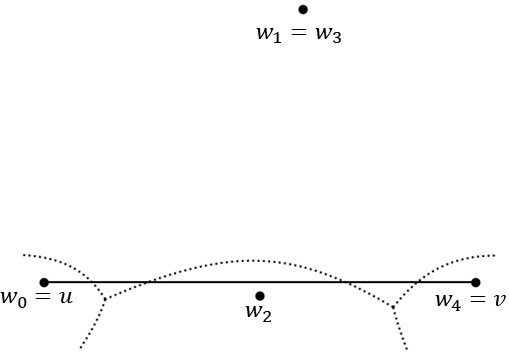
Next, we need to show that all internal vertices () of are in . We will first prove that there is an edge in connecting and , meaning that since . Then, we will show that , so must hold. This will complete the proof of the lemma.
Proving has an edge .
We first argue that has an edge . Indeed, since , there is a vertex connecting to by an edge in . By Observation 1, . Since , we have . By Observation 1, has an edge .
Consider any with . We now argue that has an edge . Recall that intersects . Let be a point of ; see Figure 2. We can derive the following:
where (1) is due to the triangle inequality, (2) is due to (therefore, ), (3) is due to , and (4) is due to Observation 1 and the fact that has an edge . Consequently, by Observation 1, has an edge .
Proving .
To prove that , , as before, we pick a point and derive the following:
where (1) is due to the triangle inequality and our general position assumption (because , equality occurs only if , , and are collinear, violating our general position assumption), (2) is due to (therefore, ), (3) is due to , and (4) is due to Observation 1 and the fact that has an edge , as proven above.
Notice that since otherwise proved above would contradict with . Also, since has an edge and , cannot be in (since otherwise would be in , contradicting with that ). This proves that .
The following theorem summarizes our result.
Theorem 4.
Given a set of disks in the plane and a source disk, shortest paths from the source to all other vertices in the disk graph induced by all disks can be computed in time.
Extension to the (resp., ) metric.
In the metric, each disk becomes a square centered at a site of . For this case, an -time algorithm was given by Klost [18] to solve the SSSP problem, which uses the involved techniques in [3]. We can solve this problem in time in a much simpler way by making the following changes to Algorithm 1. First, use the metric to measure the distance of any two points in the plane. Second, use additively-weighted Voronoi diagrams in the metric instead. Note that constructing an additively-weighted Voronoi diagram for a set of points in the metric is equivalent to constructing a Voronoi diagram for a set of squares in the metric. This latter problem can be solved in time, e.g., by the algorithm of Papadopoulou and Lee [21]. As such, Algorithm 1 can be modified to solve the metric case in time. The algorithm is much simpler than the one in [18]. The case can be treated analogously.
References
- [1] Shinwoo An, Kyungjin Cho, and Eunjin Oh. Faster algorithms for cycle hitting problems on disk graphs. In Proceedings of the 18th Algorithms and Data Structures Symposium (WADS), pages 29–42, 2023. doi:10.1007/978-3-031-38906-1_3.
- [2] Shinwoo An, Eunjin Oh, and Jie Xue. Single-source shortest path problem in weighted disk graphs. In Proceedings of the 41st International Symposium on Computational Geometry (SoCG), pages 7:1–7:15, 2025. doi:10.4230/LIPIcs.SoCG.2025.7.
- [3] Alexander Baumann, Haim Kaplan, Katharina Klost, Kristin Knorr, Wolfgang Mulzer, Liam Roditty, and Paul Seiferth. Dynamic connectivity in disk graphs. Discrete and Computational Geometry, 71:214–277, 2024. doi:10.1007/s00454-023-00621-x.
- [4] Mark de Berg and Sergio Cabello. An algorithm for single-source shortest paths in disk graphs. In Proceedings of the 33rd Annual European Symposium on Algorithms (ESA), page to appear, 2025. doi:10.48550/arXiv.2506.07571.
- [5] Bruce W. Brewer and Haitao Wang. An improved algorithm for shortest paths in weighted unit-disk graphs. In Proceedings of the 36th Canadian Conference on Computational Geometry (CCCG), pages 57–64, 2024. arXiv:2407.03176.
- [6] Sergio Cabello and Miha Jejčič. Shortest paths in intersection graphs of unit disks. Computational Geometry: Theory and Applications, 48:360–367, 2015. doi:10.1016/j.comgeo.2014.12.003.
- [7] Sergio Cabello and Wolfgang Mulzer. Minimum cuts in geometric intersection graphs. Computational Geometry: Theory and Applications, 94(101720), 2021. doi:10.1016/j.comgeo.2020.101720.
- [8] Timothy M. Chan and Zhengcheng Huang. Faster algorithms for reverse shortest path in unit-disk graphs and related geometric optimization problems: Improving the shrink-and-bifurcate technique. In Proceedings of the 41st International Symposium on Computational Geometry (SoCG), pages 32:1–32:14, 2025. doi:10.4230/LIPIcs.SoCG.2025.32.
- [9] Timothy M. Chan and Dimitrios Skrepetos. All-pairs shortest paths in unit-disk graphs in slightly subquadratic time. In Proceedings of the 27th International Symposium on Algorithms and Computation (ISAAC), pages 24:1–24:13, 2016. doi:10.4230/LIPIcs.ISAAC.2016.24.
- [10] Brent N. Clark, Charles J. Colbourn, and David S. Johnson. Unit disk graphs. Discrete Mathematics, 86:165–177, 1990. doi:10.1016/0012-365X(90)90358-O.
- [11] Herbert Edelsbrunner, Leonidas J. Guibas, and Jorge Stolfi. Optimal point location in a monotone subdivision. SIAM Journal on Computing, 15(2):317–340, 1986. doi:10.1137/0215023.
- [12] Herbert Edelsbrunner and Ernst P. Mücke. Simulation of simplicity: A technique to cope with degenerate cases in geometric algorithms. ACM Transactions on Graphics, 9:66–104, 1990. doi:10.1145/77635.77639.
- [13] Jared Espenant, J. Mark Keil, and Debajyoti Mondal. Finding a maximum clique in a disk graph. In Proceedings of the 39th International Symposium on Computational Geometry (SoCG), pages 30:1–30:17, 2023. doi:10.4230/LIPIcs.SoCG.2022.49.
- [14] Steven Fortune. A sweepline algorithm for Voronoi diagrams. Algorithmica, 2:153–174, 1987. doi:10.1007/BF01840357.
- [15] Haim Kaplan, Matthew J. Katz, Rachel Saban, and Micha Sharir. The unweighted and weighted reverse shortest path problem for disk graphs. In Proceedings of the 31st Annual European Symposium on Algorithms (ESA), pages 67:1–67:14, 2023. doi:10.4230/LIPIcs.ESA.2023.67.
- [16] Haim Kaplan, Wolfgang Mulzer, Liam Roditty, Paul Seiferth, and Micha Sharir. Dynamic planar Voronoi diagrams for general distance functions and their algorithmic applications. Discrete and Computational Geometry, 64:838–904, 2020. doi:10.1007/s00454-020-00243-7.
- [17] David G. Kirkpatrick. Optimal search in planar subdivisions. SIAM Journal on Computing, 12:28–35, 1983. doi:10.1137/0212002.
- [18] Katharina Klost. An algorithmic framework for the single source shortest path problem with applications to disk graphs. Computational Geometry: Theory and Applications, 111:101979, 2023. doi:10.1016/j.comgeo.2022.101979.
- [19] Chih-Hung Liu. Nearly optimal planar nearest neighbors queries under general distance functions. SIAM Journal on Computing, 51:723–765, 2022. doi:10.1137/20M1388371.
- [20] Daniel Lokshtanov, Fahad Panolan, Saket Saurabh, Jie Xue, and Meirav Zehavi. Subexponential parameterized algorithms on disk graphs (extended abstract). In Proceedings of the 33rd Annual ACM-SIAM Symposium on Discrete Algorithms (SODA), pages 2005–2031, 2022. doi:10.1137/1.9781611977073.80.
- [21] Evanthia Papadopoulou and D.T. Lee. The -Voronoi diagram of segments and VLSI applications. International Journal of Computational Geometry and Application, 11(101720):503–528, 2001. doi:10.1142/S0218195901000626.
- [22] Liam Roditty and Michael Segal. On bounded leg shortest paths problems. Algorithmica, 59:583–600, 2011. doi:10.1007/s00453-009-9322-3.
- [23] Micha Sharir. Intersection and closest-pair problems for a set of planar discs. SIAM Journal on Computing, 14:448–468, 1985. doi:10.1137/0214034.
- [24] Anastasiia Tkachenko and Haitao Wang. Dominating set, independent set, discrete -center, dispersion, and related problems for planar points in convex position. In Proceedings of the 42nd International Symposium on Theoretical Aspects of Computer Science (STACS), pages 73:1–73:20, 2025. doi:10.4230/LIPIcs.STACS.2025.73.
- [25] Haitao Wang and Jie Xue. Near-optimal algorithms for shortest paths in weighted unit-disk graphs. Discrete and Computational Geometry, 64:1141–1166, 2020. doi:10.1007/s00454-020-00219-7.
- [26] C.-K. Yap. A geometric consistency theorem for a symbolic perturbation scheme. Journal of Computer and System Sciences, 40:2–18, 1990. doi:10.1016/0022-0000(90)90016-E.