Tight Guarantees for Cut-Relative Survivable Network Design via a Decomposition Technique

Abstract
In the classical survivable-network-design problem (), we are given an undirected graph , non-negative edge costs, and some tuples , where and . The objective is to find a minimum-cost subset such that each - pair remains connected even after the failure of any edges. It is well-known that can be equivalently modeled using a weakly-supermodular cut-requirement function , where the objective is to find the minimum-cost subset of edges that picks at least edges across every cut .
Recently, motivated by fault-tolerance in graph spanners, Dinitz, Koranteng, and Kortsartz proposed a variant of that enforces a relative level of fault tolerance with respect to . Even if a feasible -solution may not exist due to lacking the required fault-tolerance, the goal is to find a solution that is at least as fault-tolerant as itself. They formalize the latter condition in terms of paths and fault-sets, which gives rise to path-relative (which they call relative ). Along these lines, we introduce a new model of relative network design, called cut-relative (), where the goal is to select a minimum-cost subset of edges that satisfies the given (weakly-supermodular) cut-requirement function to the maximum extent possible, i.e., by picking edges across every cut .
Unlike , the cut-relative and path-relative versions of are not equivalent. The resulting cut-requirement function for (as also path-relative ) is not weakly supermodular, and extreme-point solutions to the natural LP-relaxation need not correspond to a laminar family of tight cut constraints. Consequently, standard techniques cannot be used directly to design approximation algorithms for this problem. We develop a novel decomposition technique to circumvent this difficulty and use it to give a tight -approximation algorithm for . We also show some new hardness results for these relative- problems.
Keywords and phrases:
Approximation algorithms, Network Design, Cut-requirement functions, Weak Supermodularity, Iterative rounding, LP rounding algorithmsCopyright and License:
![[Uncaptioned image]](x1.png) © Nikhil Kumar, J. J. Nan, and Chaitanya Swamy; licensed under Creative Commons License CC-BY 4.0
© Nikhil Kumar, J. J. Nan, and Chaitanya Swamy; licensed under Creative Commons License CC-BY 4.0
2012 ACM Subject Classification:
Theory of computation Approximation algorithms analysis ; Mathematics of computing Discrete optimizationFunding:
Supported in part by NSERC grant 327620-09.Editors:
Anne Benoit, Haim Kaplan, Sebastian Wild, and Grzegorz HermanSeries and Publisher:
 Leibniz International Proceedings in Informatics, Schloss Dagstuhl – Leibniz-Zentrum für Informatik
1 Introduction
In the classical survivable-network-design problem (), we are given an undirected graph , non-negative edge costs , and some source-sink pairs with requirements , for . The goal is to find a minimum-cost set of edges such that there are at least edge-disjoint - paths in , for all . We overload notation and use to denote both the edge-set, and the corresponding subgraph of .
imposes an absolute level of fault-tolerance in a solution subgraph , by ensuring that for any bounded-size fault-set of edges that may fail, the graph retains some connectivity properties. More precisely, due to Menger’s theorem, or the max-flow min-cut theorem, the feasibility condition on can be stated equivalently as follows. For every , and every fault-set with :
-
(S1)
(Path-version) there is an - path in ;
-
(S2)
(Cut-version) for every - cut (i.e., ), we have , where .
Recently, motivated by work on fault-tolerance in graph spanners, Dinitz, Koranteng, and Kortsartz [8], proposed a variant of that aims to impose a relative level of fault-tolerance with respect to the graph . The idea is that even if the instance in infeasible, because itself does not possess the required level of fault-tolerance, one should not have to completely abandon the goal of fault-tolerance: it is still meaningful and reasonable to seek a solution that is “as fault-tolerant as ”, and in this sense is fault-tolerant relative to .
To formalize this, it is useful to consider the definition of in terms of fault-sets. Roughly speaking, we would like to capture that is a feasible solution if
| for every fault-set (valid for ), and have similar connectivity. | (*) |
To elaborate, in , if there is even one fault-set under which fails to have the required connectivity, i.e., and for some - cut , then “all bets are off”; we declare that the instance in infeasible. But declaring infeasibility here feels unsatisfactory because we allow one specific “problematic” fault-set to block us from obtaining any kind of fault-tolerance. In contrast, (* ‣ 1) aims to provide a per-fault-set guarantee, by asking for a solution that functions as well as in terms of connectivity under the failure of any fault-set (considered for ). We can formalize “ and have similar connectivity” in two ways, via paths or cuts, and this gives rise to the following two problem definitions.
Definition 1.1.
Let be an instance.
-
(R1)
Path-relative : is a feasible solution if for every and with , has an - path has an - path.
-
(R2)
Cut-relative (): is a feasible solution if for every and with , for every - cut , .
The goal in both problems is to find a minimum-cost feasible solution.
Perhaps surprisingly, path-relative and cut-relative are not equivalent, even when the instance involves a single - pair. It is not hard to show that if is feasible for , it is also feasible for path-relative SNDP111Fix any and with . If has an - path, then for every - cut. So since is feasible for cut-relative , we have for every - cut, which implies that has an - path. but the converse fails to hold; see Section 7 for an example.
Path-relative was defined by Dinitz et al. [8], who referred to this problem simply as relative . They considered (among other problems) the path-relative version of -edge connected subgraph (), which is the special case of where we have an - pair with for every pair of nodes. (In this case, the path-relative and cut-relative versions do turn out to be equivalent [8].) They called the resulting path-relative problem, -edge fault-tolerant subgraph (), and observed that the feasibility condition for can be equivalently stated as: is feasible iff for all . The function is called a cut-requirement function, as it stipulates the (minimum) number of edges across any cut in any feasible solution. Cut-requirement functions constitute a very versatile framework for specifying network-design problems, where given a cut-requirement function , the corresponding -network-design problem (), also called the -connectivity problem, is to find a minimum-cost set such that for all . For instance, it is easy to see that corresponds to for the cut-requirement function , defined by (and is where for all ); various other network-design problems, such as the -join problem, point-to-point connection problem etc., can be modeled using suitable cut-requirement functions (see, e.g., [10, 11]).
Cut-relative is a problem that we introduce in this paper. Its formulation in terms of cuts is the problem one obtains when we replace in the cut-based formulation of by the cut-requirement function for (general) : that is, (similar to ), we can say that is feasible for iff for all (we show this easy equivalence in Section 2); in other words, corresponds to . To gain some intuition for cut-relative , and contrast it with path-relative , consider with a single - pair and requirement , for simplicity. A feasible solution to path-relative offers a per-fault-set guarantee as encapsulated by (R1). But, for a given fault-set with , we get a weak fault-tolerance guarantee in terms of - cuts: if for even one - cut then there is no requirement on for this fault-set . Cut-relative offers a per-fault-set and per-cut guarantee, since for (every with and) every - cut , we require that if .
Along the lines of , we can easily extend the cut-relative model to capture, more broadly, the cut-relative version of any network-design problem specified by a cut-requirement function: given a cut-requirement function , in the corresponding cut-relative -network-design problem (), we seek a min-cost such that for all ; that is, we seek to satisfy the cut-requirement function to the maximum extent possible. We refer to as the base cut-requirement function, to distinguish it from the cut-requirement function that defines .
Modeling power.
We arrived at , which can be seen as a fault-tolerant cut-covering problem, as a technically natural extension of . We show below that offers a surprising amount of modeling power, and, in particular, allows one to capture stronger forms of relative fault-tolerance compared to . In , there is a sharp relative-fault-tolerance threshold at : if is feasible, then and have the same components whenever , but there are no guarantees for larger fault-sets. With , one can capture a weaker guarantee also for other fault-sets, which allows for a more graceful degradation of relative fault-tolerance as increases.
Example 1.2.
One way of modeling graceful relative-fault-tolerance degradation is as follows: given a non-increasing function , we seek a min-cost subgraph such that for every fault-set , and have exactly the same components with at most nodes. If models a communication network where connected nodes can communicate with each other, then this yields the desirable guarantee that, post-faults, if a node can communicate with more than nodes in then the same holds for ; if this number is at most , then post-faults, it can communicate with the same nodes in and . Note that if , then is feasible for ; by adding more “levels” to , we can obtain fault-tolerance guarantees for larger fault-sets.
In Section 3, we show that this problem can be modeled as with the weakly-supermodular function , where , for .
Example 1.3.
Generalizing Example 1.2 substantially, suppose along with , we have a monotone function , i.e., if . We now seek a subgraph such that for every fault-set and with , we have that is (the node-set of) a component of iff it is a component of . Similar to Example 1.2, we can model this as by defining , for (Theorem 3.2).
This setup yields fault-tolerance degradation depending on monotone properties of components other than just their size, which creates a rich space of problems. For example, suppose is the weak-diameter of . Setting if , and some for larger , we seek a solution such that for with , and have the same components of weak-diameter at most .
1.1 Our contributions
We introduce cut-relative network-design problems and develop strong approximation guarantees for these problems. We obtain an approximation guarantee of for cut-relative , which, notably, matches the best-known approximation factor for . Our guarantee applies more generally to , whenever the base cut-requirement function satisfies certain properties and the natural LP-relaxation of the problem can be solved efficiently. Our guarantee is relative to the optimal value of this LP, and is tight in that it matches the integrality gap of this LP.
We also show that even in the simplest setting with only one - pair (wherein is polytime solvable), cut-relative and path-relative capture as a special case, and are thus APX-hard (Section 6). Previously, even NP-hardness of path-relative in the - case (which is studied by [8, 9]) was not known.
Technical contributions and overview.
Technically, our main contribution is to show that we can obtain such a strong guarantee despite the fact that the cut-requirement function defining cut-relative network-design (i.e., ) is not weakly supermodular, which is the key property that drives the -approximation algorithm for . To elaborate, there is a celebrated -approximation algorithm for due to Jain [15] based on iterative rounding. This crucially exploits the fact that the underlying cut-requirement function is weakly supermodular: for any two node-sets , we have:
This property allows one to argue that given an LP-solution , any two tight sets that cross – i.e., sets for which holds for and are all non-empty – can be “uncrossed”, and thereby an extreme-point solution to the LP can be defined via a laminar family of tight cut constraints. By a laminar family, we mean that any two sets in the family satisfy or , and uncrossing two crossing tight sets means that they can be replaced by an equivalent laminar family of tight sets. Jain’s seminal contribution was to show that given such a laminar family defining an extreme point, there always exists an edge for which ; picking such an edge and iterating then yields the -approximation. This technique of uncrossing tight cut-constraints to obtain a laminar family of tight cut-constraints has proved to be quite versatile, becoming a staple technique that has been leveraged to obtain strong guarantees in various network-design settings such as, most notably, network-design problems with degree constraints [13, 17, 19, 5, 4, 16]. More generally, this technique of uncrossing to obtain a structured family of tight constraints has been utilized for various combinatorial-optimization problems; see, e.g., [18].
As mentioned earlier, the main complication with is that the underlying cut-requirement function is usually not weakly-supermodular, even if the base cut-requirement function is. In particular, the cut-requirement function defining cut-relative is not weakly-supermodular. This difficulty was also noted by Dinitz et al. [8] when they considered -edge fault-tolerant subgraph (, or path- or cut- relative in our terminology). For this special case, they identify a notion called local weak-supermodularity that is satisfied by the cut-requirement function for , and observed that Jain’s machinery can be used as is if this property holds; that is, one can uncross tight sets to obtain a laminar family, and hence obtain a -approximation for proceeding as in Jain’s algorithm for .
However, for general , such an approach breaks down, because, as we show in Section 2.1, one can construct quite simple instances where an (optimal) extreme point cannot be defined by any laminar family of tight cut constraints. In particular, this implies that the cut-requirement function is (in general) not locally weakly-supermodular (even when is weakly-supermodular); moreover, it does not satisfy any property that allows for the uncrossing of tight sets. The upshot here is that the standard technique of uncrossing tight sets to obtain a laminar family does not work, and one needs new ideas to deal with cut-relative network design.
The chief technical novelty of our work is to show how to overcome the impediment posed by the lack of any such nice structural property for , via a novel decomposition technique that allows one to reduce cut-relative with a weakly supermodular base cut-requirement function to (standard) with (different) weakly supermodular cut-requirement functions (see Theorem 4.1).
We introduce a little notation to describe this. Let denote on graph with base cut-requirement function . For , define its deficiency to be ; we say that is a small cut if its deficiency is positive (i.e., ). We use to denote the subgraph induced by . Let denote .
Assume that the underlying base cut-requirement function is weakly supermodular (as is the case with ). Observe first that if there is no small cut then is the same as . Our key technical insight is that, otherwise, we can utilize a novel splitting operation to simplify our problem. We show (see Theorem 4.5) that if we pick a small cut with maximum deficiency, then one can define suitable weakly-supermodular functions and such that any solution to the original -instance yields solutions to and , and vice-versa. The intuition here is as follows. Since is a small cut, any feasible solution must include all edges in . The functions and are essentially the restrictions of to and respectively, taking this into account. Consequently, moving to and does not really impact the constraints for cuts that do not cross ; but we do eliminate the constraints for crossing cuts. This is the simplification that we obtain via the splitting operation, and one needs to argue that this does not hurt feasibility; that is, the constraints for such cuts are still satisfied when we take along with the and solutions. Here we exploit the weak-supermodularity of , which implies that the deficiency function is also weakly supermodular. One can use this, and the fact that has maximum deficiency, to bound the deficiency of any crossing set in terms of the deficiency of non-crossing sets, and hence show that the cut-constraint for is satisfied.
By recursively applying the above splitting operation to and , we end up with a partition of and weakly-supermodular functions for all such that, for each , the graph contains no small cut with respect to . It follows that solving on the graph for all yields a solution to the original instance (Theorem 4.1).
While we can obtain this decomposition efficiently, assuming that one has suitable algorithmic primitives involving the base cut-requirement function (shown in the full version), in fact we only need this decomposition in the analysis: in order to obtain the stated LP-relative -approximation algorithm, we only need to be able to find an extreme-point optimal solution to the natural LP-relaxation for (also after fixing some variables to ). This is because the translation between -solutions for , and -solutions on for all , also applies to fractional solutions, and implies that any extreme-point solution to yields extreme-point solutions to the LP-relaxations of on for all (parts (b) and (c) of Theorem 4.1); hence, by Jain’s result, we can always find some fractional edge of value at least , round its value to , and iterate. For , we can find an extreme-point optimal solution efficiently because we argue that one can devise an efficient separation oracle for (Lemma 2.3). This yields a -approximation algorithm for , and more generally , whenever is weakly supermodular and can be solved efficiently (see Algorithm CRNDP-Alg in Section 5).
Other related work.
Network design is a fairly broad research topic, with a vast amount of literature. We limit ourselves to the work that is most closely connected to our work.
As mentioned earlier, path-relative was introduced by Dinitz et al. [8]. In addition to , which is the path-relative version of , they study the path-relative versions of two other special cases of , for which they developed constant-factor approximation algorithms: (1) with for all ; (2) one - pair with . Both results were subsequently extended by [9] who gave a -approximation for with for all , and a -approximation when there is one - pair with . The only result known for general path-relative is due to [7], who (among other results) devise an -approximation algorithm with running time. As noted earlier, on the hardness side, prior to our work, it was not known if the setting with one - pair is even NP-hard.
An influential paper by Goemans and Williamson [10] (see also the survey [11]), which built upon the work of [1] for the Steiner forest problem, developed the primal-dual method for network-design problems. Their work also popularized the use of cut-requirement functions to specify network-design problems, by showing how this framework can be used to capture a slew of problems, and how their primal-dual framework leads to a -approximation algorithm for -cut-requirement functions satisfying some properties. This work was extended to handle general integer-valued cut-requirement functions, which captures , in [20, 12], which led to an -approximation for . The seminal work of Jain [15] later improved this to a -approximation, and in doing so, introduced the powerful technique of iterative rounding. Later work of [17, 19] on degree-bounded network design added another ingredient to iterative rounding, namely iteratively dropping some constraints. This paradigm of iterative rounding and relaxation has proved to be an extremely versatile and powerful tool in developing algorithms (and structural results) for network-design problems, and more generally in combinatorial optimization; see [18] for an extensive study.
Iterative rounding and relaxation derives its power from the fact that an extreme-point solution to an LP-relaxation of the problem can be defined using a structured family of tight constraints, such as, often a laminar family of cut constraints in the case of network-design problems. As noted earlier, this key property does not hold for cut-relative (and path-relative ). Recently, various works have considered network-design problems that give rise to cut constraints that are less structured and not quite uncrossable; see [2, 3, 6] and the references therein. Our work can be seen as furthering this research direction.
2 Preliminaries and notation
Recall that we are given an undirected graph with nonnegative edge costs . For a subset and subset , which we will interchangeably view as the subgraph of , we use to denote , i.e., the edges of on the boundary of . Recall that denotes , and denotes the subgraph induced by . A cut-requirement function on is a function . (We allow to be negative chiefly for notational simplicity; this does not affect anything, as we will only examine sets for which .) Recall the following network-design problems.
-
-network-design problem (): find a min-cost edge-set such that for all .
-
Cut-relative network-design problem (): find a min-cost edge-set such that for all . This corresponds to . We call the base cut-requirement function.
-
Survivable network design problem () is a special case of . The input also specifies tuples , where and for all . Defining for all , we obtain that is the -network-design problem.
-
Cut-relative (): The input here is the same as in . In Definition 1.1 (R2), was defined as: find a min-cost such that for every , every with , and every - cut , we have whenever . Later in Section 1, we stated that this can be equivalently formulated as with base cut-requirement function . We now justify this statement.
We will consider network-design problems defined on various graphs and with various cut-requirement functions. Given a graph and cut-requirement function , we use to denote on the graph with cut-requirement function , and to denote on the graph with base cut-requirement function .
Properties of cut-requirement functions.
Let . We say that is weakly supermodular if for any two node-sets , we have . We say that is symmetric if for all , and is normalized if .
Since we are working on undirected graphs, we can always replace any cut-requirement function by its symmetric, normalized version , where for all and , without changing the resulting network-design problem(s), i.e., we have and .
Lemma 2.1 shows that weak-supermodularity is preserved under various operations. This will be quite useful in the analysis of our decomposition technique. Part a of the lemma shows that weak supermodularity is preserved under symmetrization and normalization, so for any or instance involving a weakly-supermodular base cut-requirement function , we may assume that is symmetric and normalized.
All omitted proofs and details can be found in the full version of the paper.
Lemma 2.1.
Let be weakly supermodular. Then
-
(a)
is weakly supermodular.
-
(b)
Let . Define for all . Then is weakly supermodular, and is symmetric if is symmetric. In particular, for any , the function is weakly supermodular, and is symmetric if is symmetric.
-
(c)
Let , and be a collection of subsets of closed under taking set intersections, unions, differences, and complements with respect to , i.e., if then , and implies that .
Define the projection of onto with respect to as the function given by , and for all . If is symmetric, then is weakly supermodular and symmetric.
Proof.
Part (a) follows from a simple case analysis; part (b) follows because is symmetric, submodular. We focus on proving part (c). Essentially, the closure properties of enable us to transfer the weak-supermodularity of to the function .
We first argue that is symmetric. If , we have by definition. Otherwise, if , we have where the last inequality follows since . We also have by the same type of reasoning, and so for all .
Now we show that is weakly supermodular. Consider . If any of the sets are empty, then or . The former holds when or is empty; the latter holds when or is empty, where we also utilize the fact that is symmetric. So assume otherwise. Then, for every , we have .
Let and , where . Let and . For any , we can write , where due to the closure properties of . It follows that for all . So if , we obtain that , and if , we obtain that .
The intuition behind the projection operation is as follows. Suppose is a cut-requirement function and we know that no edges are picked from . Then, roughly speaking, captures the constraints that arise on due to and .
2.1 LP-relaxation for CR--NDP
We consider the following natural LP-relaxation for . From now on, we assume that the cut-requirement function is weakly supermodular, symmetric, and normalized. Given and , let denote .
| s.t. | (1) | ||||||
| (2) | |||||||
The LP-relaxation for is similar, with the cut-constraints taking the simpler form for all . We denote this LP by . Our algorithm is based on iterative rounding, where we iteratively fix some variables to . Suppose that we have fixed for all . Then, in that iteration, we are considering the residual problem on the subgraph , which leads to the following variant of :
| (P’) | |||||||
| s.t. | (3) | ||||||
Defining for all , we can rephrase constraints (3) as for all . Since is weakly supermodular, symmetric (Lemma 2.1 (b)), and normalized, (P’) is of the same form as : we have (P’) . This will be convenient for iterative rounding, as the residual problem is of the same form as the original problem. and (P’) involve an exponential number of constraints, but using the ellipsoid method, we can find an extreme-point optimal solution provided we have a separation oracle for them. Recall that a separation oracle is a procedure that given a candidate point determines if it is feasible, or returns a violated inequality. Observe that a separation oracle for also yields a separation oracle for (P’), since (P’) is simply after fixing some variables to .
Fact 2.2 (Ellipsoid method [14]).
Given a polytime separation oracle for , one can find an extreme-point optimal solution to LPs and (P’) in polytime.
For , i.e., when , a polytime separation oracle for can be obtained using min-cut computations. This was shown by [8] for path-relative , which is equivalent to cut-relative ; refining their ideas yields a separation oracle for for general .
Lemma 2.3.
When , there is a polytime separation oracle for . Hence, one can obtain extreme-point optimal solutions to and (P’) in polytime.
Proof.
The second statement follows from Fact 2.2. Let be the tuples defining the instance, which recall leads to the cut-requirement function for all . Say that is a small cut if , and it is a small cut for if and . Note that if for any small cut , then we must have in any feasible solution.
Now we can equivalently phrase the constraints of as follows: for any edge , we must have or, for every , the minimum - cut also separating and under the -capacities should have capacity at least . So to detect if is a feasible solution, we simply need to consider every edge with and every , and find the minimum - cut also separating and under the capacities. If an - cut separates , then lies on the -side and lies on the -side, or the other way around. So to find the minimum - cut also separating and , we find the minimum - cut – by which we mean the minimum - cut where are on the same side, and are on the other side–and the minimum --cut and take the one with smaller capacity.
Extreme-point solution to not defined by a laminar family
We show that for the instance shown in Fig. 1, the extreme-point solution shown in the figure, cannot be expressed as the solution to any laminar family of tight cut constraints (1) (along with tight edge constraints (2)). The instance is - -edge connectivity: that is, the base cut-requirement function is given by if is an - cut, and otherwise.
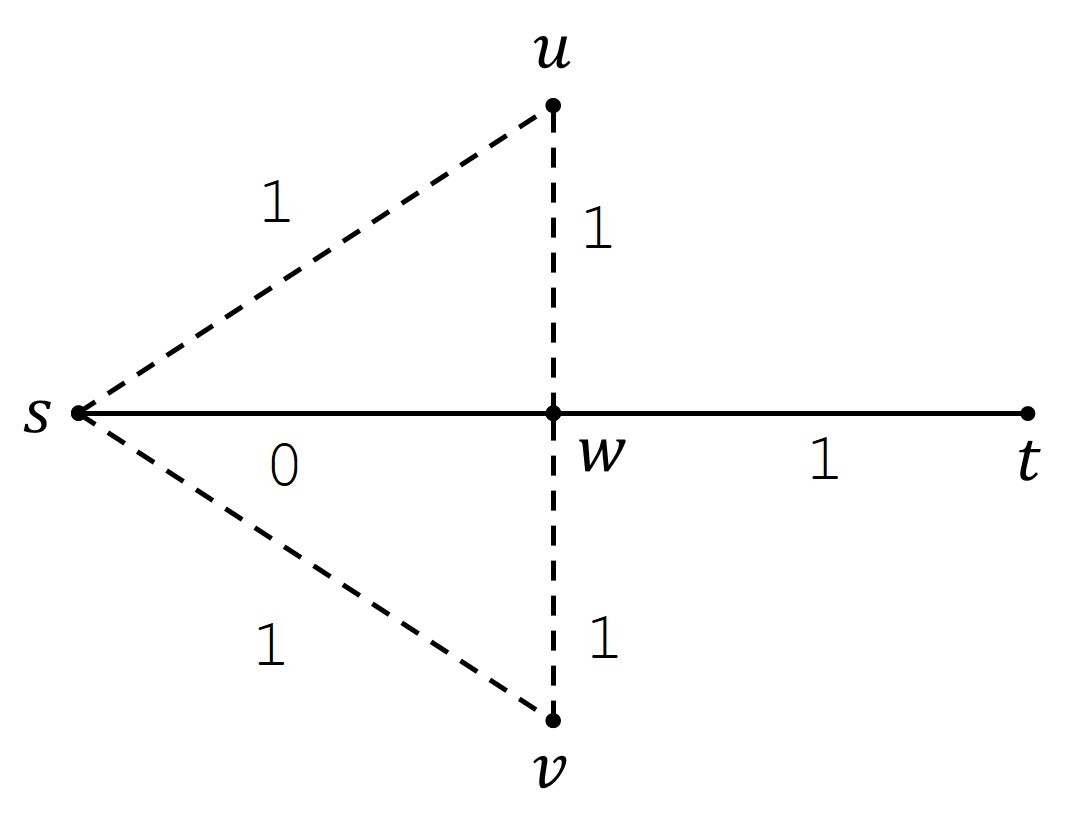
Note that the only small cut above containing is . One can verify by inspection that is feasible. It is not hard to see that is the unique solution to the following set of equations, which come from constraints that are tight at .
| (4) | ||||
| (5) |
This shows that is an extreme-point solution to . With edge costs and for all other edges, is also an optimal solution. The constraints for all imply that (since for all )
Adding these constraints, we obtain that . Therefore, the cost of any feasible solution is at least , and we have .
cannot be defined via a laminar family.
We now argue that cannot be defined by any laminar family of tight cut constraints and tight edge constraints. Note that any tight cut constraint corresponds to an - cut. So a laminar family of tight cut constraints consists of a union of two chains , where a chain is a nested collection of sets: comprising sets containing but not , and comprising sets containing but not . Then is also a laminar family, yielding the same cut-constraints as , and and all sets in contain but not . So we only need to consider laminar families of tight cut constraints corresponding to a chain of sets containing and not .
A simple argument now rules out the existence of any such chain that can uniquely define along with the tight edge constraints (5). Any such chain of sets is obtained by ordering the elements , and taking sets of the form , where is some prefix (including the empty prefix) of this ordered sequence; so contains at most sets. Since has fractional edges, , it must be that contains linearly independent vectors. So contains exactly sets, and in particular the set , and all vectors in are linearly independent. This yields a contradiction, since .
3 Modeling power of CR--NDP
We prove that the Examples 1.2 and 1.3 listed under “Modeling power” in Section 1 model the stated problems. Recall that in both examples, we have a non-increasing function .
Theorem 3.1.
Consider the base cut-requirement function in Example 1.2, where , for .
-
(a)
The function is weakly-supermodular.
-
(b)
is feasible for iff for every fault-set , and every with , is (the node-set of) a component of iff it is a component of .
Proof.
The function is downwards-monotone: if , then . This follows from the definition, since is a non-increasing function. Weak-supermodularity of is now immediate since we have , if , and otherwise .
Note that is not symmetric or normalized, but as indicated by Lemma 2.1, we can consider with the symmetric, normalized version of as the base cut-requirement function, without changing the problem.
To prove the feasibility characterization in part (b), we note that the function is constructed so that for any and , we have iff , so that implies that is not a component of . Suppose is such that for all . Consider any fault-set and any such that . By the above, if is a component of , then , and so must also be a component of . But this also implies that if is a component of , then it is a component of ; otherwise, there is some that is a component of with , and so must be a component of , which is not the case.
Conversely, suppose that for every , and with , we have that is a component of iff it is a component of . If for some , then take . Since , we have . But is a component of and not , which yields a contradiction.
Theorem 3.2.
Let be a monotone function, i.e., if , as in Example 1.3. Consider , where the base cut-requirement function is given by , for all . Then
-
(a)
is weakly-supermodular;
-
(b)
is feasible for iff for every fault-set , and every with , is (the node-set of) a component of iff it is a component of .
Proof.
We mimic the proof of Theorem 3.1. Since is monotone, we obtain that is downwards-monotone, and hence weakly-supermodular.
For part (b), similar to before, we have that iff . Suppose is feasible for . Consider any fault-set and any be such that . By the above, , so if is a component of , then it must also be a component of . Again, this also implies that if is a component of , then it is a component of : otherwise, there is some that is a component of , and , which means that is a component of .
Conversely, suppose that for every , and with , we have that is a component of iff it is a component of . If for some , then take . Since , we have . But is a component of and not , which yields a contradiction.
4 Structure of feasible CR--NDP solutions: a decomposition result
We now prove our decomposition result, showing that can be reduced to with suitably-defined weakly-supermodular cut-requirement functions. Recall that the base cut-requirement function is weakly supermodular (and symmetric, normalized), but the cut-requirement function underlying need not be. Given and , we use to denote the restriction of to edges in , i.e., the vector .
Theorem 4.1 (Decomposition result).
There is a partition of and weakly-supermodular, symmetric, and normalized functions such that the following hold.
-
(a)
is a feasible solution to iff and is a feasible solution to for all .
-
(b)
is feasible to iff for all , we have for all , and is feasible to .
-
(c)
is an extreme-point solution to iff for all , we have for all , and is an extreme-point solution to .
Before delving into the proof of Theorem 4.1, we state the following immediate corollary of Theorem 4.1 (c), which directly leads to a -approximation algorithm for whenever can be solved efficiently.
Corollary 4.2.
Let be an extreme-point solution to . There exists some for which .
Proof.
By Theorem 4.1 (c), there is a partition of and -instances defined on each part such that induces an extreme-point solution in each -instance. By Jain’s result, this implies that in each of these instances, there is some edge with .
The rest of this section is devoted to the proof of Theorem 4.1. For a set , define its deficiency . We use (or ) when we want to make the cut-requirement function and graph (or edge-set) explicit. By Lemma 2.1 (b), is weakly supermodular; also, it is symmetric (and normalized). We say that is a small cut (or more explicitly a small--cut) if . Clearly, if there is no small cut, then becomes equivalent to . Our chief insight and key structural result is that if there is a small cut, then we can simplify the instance and move to smaller instances, by “splitting” the instance along a suitable small cut (Theorem 4.5). By repeating this operation, we eventually obtain an instance with no small cuts, which leads to Theorem 4.1. The splitting operation relies on the following modification of .
Definition 4.3.
Let . Recall that . Let . Define the function , which we call the restriction of to , as follows.
The intuition here is that for , is a lower bound on the residual requirement that needs to be met from given that we pick all edges of . Note that since and are symmetric, , and so is the symmetric, normalized version of of the residual requirement function .
In the splitting operation, we pick a small cut of maximum deficiency, and move to instances on the smaller graphs , and obtained by restricting to , and restricting to respectively (Theorem 4.5). Lemma 4.4 states some basic properties of the restriction of . Part (b) will be quite useful in proving that the splitting operation maintains feasibility, and part (a) allows us to repeat the splitting operation on the smaller instances. For a set , and set of edges, we use to denote the edges of with both ends in .
Lemma 4.4.
Let . Let be the restriction of to . Let .
-
(a)
is weakly supermodular, symmetric, and normalized.
-
(b)
Let . Then, .
Proof.
For part (a), we can proceed in two ways. As noted earlier, is the symmetric, normalized version , so part (a) follows from Lemma 2.1 (a). Alternatively, observe that is the projection of onto with respect to , which is closed under set intersections, unions, differences, and complements with respect to . So by Lemma 2.1 (c), we obtain that is weakly supermodular and symmetric. Also, is normalized by definition.
For part (b), the stated equality follows by simply plugging in , and noting that for , we have .
Theorem 4.5 (Splitting along a small cut).
Suppose that there is some small cut. Let be a maximum-deficiency cut. Note that and .
-
(a)
is a feasible solution to iff , is a feasible solution to , and is a feasible solution to .
-
(b)
is feasible to iff for all , is feasible to , and is feasible to .
Proof.
Part (a) can be seen as the special case of part (b), where is integral. We prove part (a) here, as the proof is somewhat (notational) simpler. For notational simplicity, let and . Let .
The “only if” direction follows easily from the definition of the restriction of . Let be feasible to . Since is a small cut, we must have . Consider any . Since is feasible, we have , which implies that . Similarly, we have , so . Combining the inequalities, and using the definition of restriction, we obtain that . Since was arbitrary, this shows that is feasible to .
A symmetric argument shows that is a feasible solution to .
Conversely, suppose that , is a feasible solution to , and is a feasible solution to . Recall that . Consider any . Lemma 4.4 (b) can be used to readily argue that if or , then the constraint for set in is satisfied. We show this for ; a symmetric argument applies for . If is a small--cut, then . Since , this implies that . Otherwise, we have , so by Lemma 4.4 (b), we have that . Thus, we always have .
Now consider such that .
We exploit the weak supermodularity of , and that has
maximum deficiency, to bound in terms of the deficiency of sets that do
not cross , and thus show that the constraint for is satisfied.
We have
where in the first inequality we also use the fact that is symmetric. In both cases, we have where , and . As shown previously, for , we have , or equivalently, . Note that since . Since is a maximum-deficiency small cut, this also implies that for : we have .
If both and are small--cuts, then we are done since then we have that . Otherwise, since , we have , since at least one of is not a small--cut.
Proof of Theorem 4.1.
Parts (a) and (b) follow easily by induction on the number of nodes, using parts (a) and (b) of Theorem 4.5. Consider part (a). The base case is when there is no small--cut, in which case, we have , and . Otherwise, let . Since and are weakly-supermodular, we can recurse and induct on and instances, both of which have fewer nodes, to obtain partitions of and ; we combine these to obtain . Theorem 4.5 (a) and the induction hypothesis then readily yield part (a) here. The only thing to note is that since the induction hypothesis yields for a part , and by Theorem 4.5 (a), we have . Similarly, for any part .
Part (b) follows similarly from Theorem 4.5 (b). Part (c) follows from part (b), because it is not hard to see, using part (b), that any convex combination of feasible solutions to yields a convex combination of feasible -solutions, and vice versa.
One may wonder if the -instances in the decomposition of Theorem 4.1 can be specified more directly or succinctly. In the full version, we prove some properties of the decomposition given by its proof, which as a consequence, enable one to do so. But we need our splitting approach to argue why this succinct description fulfills the properties in Theorem 4.1. The properties we establish also imply that the decomposition in Theorem 4.1 can be computed efficiently given suitable algorithmic access to the base cut-requirement function .
5 Algorithmic implication: LP-relative -approximation algorithm
We now exploit the decomposition result stated in Theorem 4.1, and Corollary 4.2, to obtain a -approximation algorithm. We assume that we have a separation oracle for , which implies that we can efficiently find an extreme-point optimal solution to and any LP that arises in a subsequent iteration after fixing some variables to (Fact 2.2).
Remark 5.1.
The collection of small cuts does not change across iterations; that is, is a small--cut iff it is a small--cut in some other iteration. This is because, for any , we change and by the same amount in every iteration. In the first iteration, we have for every and every small cut , and so in any subsequent iteration. So we do not have any constraints for small cuts in subsequent iterations, and this causes problems with uncrossing tight constraints. Nevertheless, we are able to argue, due to our decomposition result, that there is always some edge with .
Theorem 5.2.
Proof.
By Corollary 4.2, at least one edge gets added to in every iteration, so the algorithm terminates in at most iterations. The cost bound follows by induction on the number of iterations to termination. The base case is trivial. Suppose , where is the solution found in subsequent iterations for the instance . Let be the optimal solution to . Then, by induction, we have and , since is a feasible solution to . We also have . Therefore, .
Since admits a polytime separation oracle (Lemma 2.3), we obtain the following result as a corollary.
Theorem 5.3.
There is a -approximation algorithm for .
6 Hardness result
We now show that cut-relative and path-relative are APX-hard, even when the base instance involves only one - pair, by showing that the -edge connected subgraph () problem can be cast as a special case of these problems. (This hints at the surprising amount of modeling power of {cut, path}- relative .) Previously, even NP-hardness of path-relative in the - case was not known.
Let be an instance of . We may assume that is at least -edge connected, i.e., for all , as otherwise there is no feasible solution (and this can be efficiently detected).
Consider the following path-relative instance. We add a source and sink , and edges of cost , for all . Let denote this graph. The base- instance asks for -edge connectivity between and , where . That is, the base cut-requirement function is given by if is an - cut, and otherwise. We show that path-relative and cut-relative are actually equivalent in this case, and that they encode on the graph .
Theorem 6.1.
is a feasible solution to the above {cut, path}-relative instance and is a feasible -solution for . Hence, this {cut,path}-relative instance is the same as on the graph .
Proof.
Recall that we are assuming that is (at least) -edge connected. The following observation will be handy. The only small cuts in are and (and their complements). For any other - cut , taking , we have that . So we have .
direction.
We argue that is feasible for cut-relative , which also implies that it is feasible for path-relative . Clearly, covers both small cuts. For any other - cut , taking , we have , since is a feasible -solution for .
direction.
Suppose that is feasible for path-relative . If there is some edge , then consider the fault-set . Then clearly has no - path, since . But has an - path . So we must have . A similar argument shows that .
We next argue that for every - cut for which . This is equivalent to showing that , since . Assume that without loss of generality. Suppose . Since , there is some edge . Suppose . Consider the fault-set . Then and has no - path, since we have constructed to ensure that . However, has an - path: . This contradicts that is feasible for path-relative .
So we have shown both that is feasible solution for , and that is feasible for cut-relative .
Since the cost of the edges in is , the above {cut, path}-relative instance is exactly the same as on the graph .
7 Non-equivalence of path-relative SNDP and cut-relative SNDP
We consider the same graph and base instance as in Fig. 1. The graph is reproduced below for convenience, and recall that the base cut-requirement function models - -edge connectivity: so if is an - cut, and otherwise.
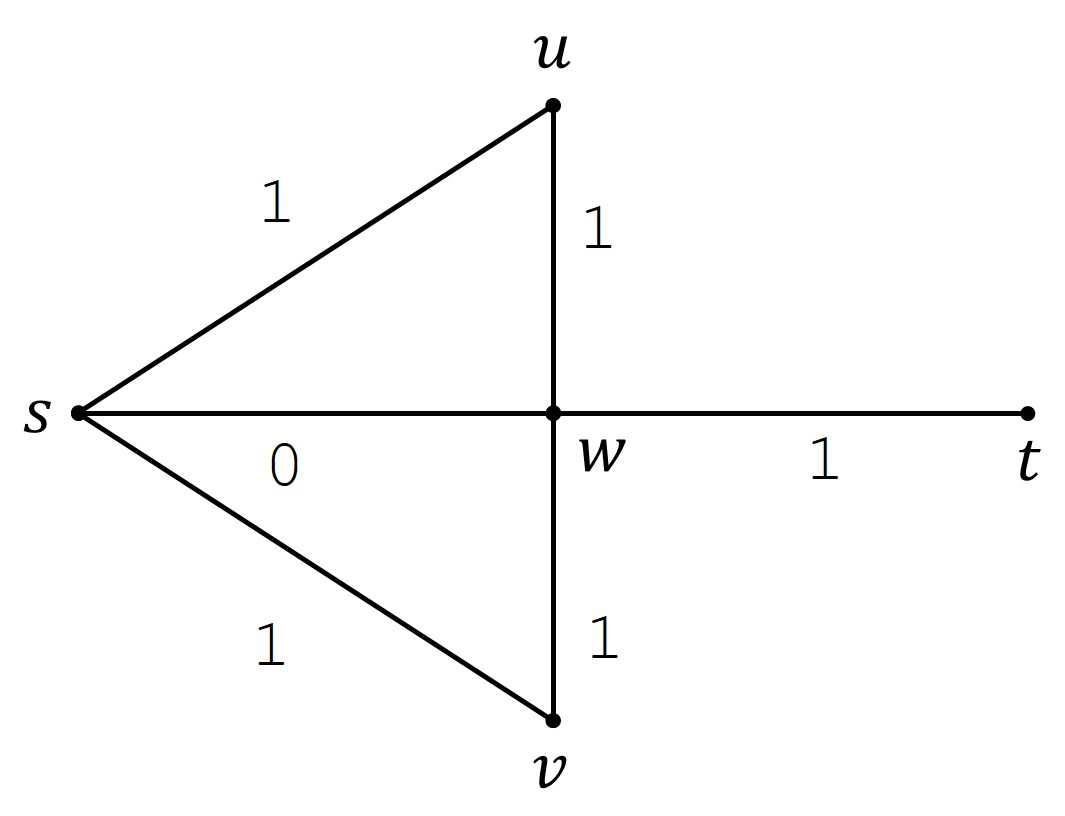
A feasible solution to path-relative is given by the edge-set , which has cost . (This is in fact an optimal solution to path-relative .)
However, is not feasible for cut-relative . This is because, we require in any feasible solution . Moreover, one can infer that any feasible -solution must include all but one of the edges from . This is because for any with , one can verify that there is an - cut such that and ; so , which implies that there is no feasible solution that excludes . A feasible -solution must also include the edge , so the optimal value for cut-relative is .
While cut-relative and path-relative are not in general equivalent, they are closely related. Dinitz et al. [9] showed (see Lemma A.1 in [9]) that one can give a cut-based formulation for path-relative , where is feasible iff for every such that and are connected graphs, where is the vertex-set of the component containing . That is, we require the cut-constraints of to hold for a suitable collection of node-sets (as opposed to all node-sets in ). This immediately implies that and path-relative are equivalent when the underlying graph is a (capacitated) complete graph. Also, as mentioned earlier, path-relative and cut-relative are equivalent [8].
References
- [1] A. Agrawal, Phil Klein, and R. Ravi. When trees collide: An approximation algorithm for the generalized Steiner problem on networks. SIAM Journal on Computing, 24:440–456, 1995. doi:10.1137/S0097539792236237.
- [2] Ishan Bansal. A global analysis of the primal-dual method for edge-augmentation problems. In Proceedings of the 26th IPCO, pages 58–71, 2025. doi:10.1007/978-3-031-93112-3_5.
- [3] Ishan Bansal, Joseph Cheriyan, Logan Grout, and Sharat Ibrahimpur. Improved approximation algorithms by generalizing the primal-dual method beyond uncrossable functions. Algorithmica, 86(8):2575–2604, 2024. doi:10.1007/S00453-024-01235-2.
- [4] Nikhil Bansal, Rohit Khandekar, Jochen Könemann, Viswanath Nagarajan, and Britta Peis. On generalizations of network design problems with degree bounds. Mathematical Programming, 141(1-2):479–506, 2013. doi:10.1007/S10107-012-0537-8.
- [5] Nikhil Bansal, Rohit Khandekar, and Viswanath Nagarajan. Additive guarantees for degree-bounded directed network design. SIAM Journal on Computing, 39(4):1413–1431, 2009. doi:10.1137/080734340.
- [6] Sylvia C. Boyd, Joseph Cheriyan, Arash Haddadan, and Sharat Ibrahimpur. Approximation algorithms for flexible graph connectivity. Mathematical Programming, 204:493–516, 2024. doi:10.1007/S10107-023-01961-5.
- [7] Chandra Chekuri and Rhea Jain. Approximation algorithms for network design in non-uniform fault models. In Proceedings of the 50th ICALP, pages 36:1–36:20, 2023. doi:10.4230/LIPICS.ICALP.2023.36.
- [8] Michael Dinitz, Ama Koranteng, and Guy Kortsarz. Relative survivable network design. In Proceedings of the 25th APPROX, pages 41:1–41:19, 2022. doi:10.4230/LIPICS.APPROX/RANDOM.2022.41.
- [9] Michael Dinitz, Ama Koranteng, Guy Kortsarz, and Zeev Nutov. Improved approximations for relative survivable network design. In Proceedings of the 21st WAOA, pages 190–204, 2023. doi:10.1007/978-3-031-49815-2_14.
- [10] M. Goemans and D. Williamson. A general approximation technique for constrained forest problems. SIAM J. on Computing, 24:296–317, 1995. doi:10.1137/S0097539793242618.
- [11] M. Goemans and D. Williamson. The primal-dual method for approximation algorithms and its application to network design problems. In Dorit Hochbaum, editor, Approximation algorithms for NP-hard problems, chapter 4. PWS Publishing Company, 1996.
- [12] Michel X. Goemans, Andrew V. Goldberg, Serge A. Plotkin, David B. Shmoys, Éva Tardos, and David P. Williamson. Improved approximation algorithms for network design problems. In Proceedings of the 5th SODA, pages 223–232, 1994. URL: http://dl.acm.org/citation.cfm?id=314464.314497.
- [13] M.X. Goemans. Minimum bounded-degree spanning trees. In Proceedings of the 47th FOCS, pages 273–282, 2006.
- [14] Martin Grötschel, Lászlo Lovász, and Lex Schrijver. Geometric algorithms and combinatorial optimization. Algorithms and Combinatorics 2. Springer, 1993.
- [15] Kamal Jain. A factor 2 approximation algorithm for the generalized Steiner network problem. Combinatorica, 21(1):39–60, 2001. doi:10.1007/S004930170004.
- [16] N. Klein and N. Olver. Thin trees for laminar families. In Proceedings of the 64th FOCS, 2023.
- [17] Lap Chi Lau, Seffi Naur, Mohammad Salavatipour, and Mohit Singh. Survivable network design with degree or order constraints. SIAM Journal on Computing, 39(3):1062–1087, 2009. doi:10.1137/070700620.
- [18] Lap Chi Lau, R. Ravi, and Mohit Singh. Iterative methods in combinatorial optimization. Cambridge University Press, 2011.
- [19] Mohit Singh and Lap Chi Lau. Approximating minimum bounded degree spanning trees to within one of optimal. In Proceedings of the 39th STOC, pages 661–670. ACM, 2007. doi:10.1145/1250790.1250887.
- [20] David P. Williamson, Michel X. Goemans, Milena Mihail, and Vijay V. Vazirani. A primal-dual approximation algorithm for generalized steiner network problems. Combinatorica, 15(3):435–454, 1995. doi:10.1007/BF01299747.