Bicriteria Approximation for k-Edge-Connectivity

Abstract
In the -Edge Connected Spanning Subgraph (-ECSS) problem we are given a (multi-)graph with edge costs and an integer , and seek a min-cost -edge-connected spanning subgraph of . The problem admits a -approximation algorithm and no better approximation ratio is known. Recently, Hershkowitz, Klein, and Zenklusen [STOC 24] gave a bicriteria -approximation algorithm that computes a -edge-connected spanning subgraph of cost at most the optimal value of a standard Cut-LP for -ECSS. We improve the bicriteria approximation to and also give another non-trivial bicriteria approximation .
The -Edge-Connected Spanning Multi-subgraph (-ECSM) problem is almost the same as -ECSS, except that any edge can be selected multiple times at the same cost. A bicriteria approximation for -ECSS w.r.t. Cut-LP implies approximation ratio for -ECSM, hence our result also improves the approximation ratio for -ECSM.
Keywords and phrases:
-edge-connected subgraph, bicriteria approximation, iterative LP-roundingCopyright and License:
![[Uncaptioned image]](x1.png) © Zeev Nutov and Reut Cohen; licensed under Creative Commons License CC-BY 4.0
© Zeev Nutov and Reut Cohen; licensed under Creative Commons License CC-BY 4.0
2012 ACM Subject Classification:
Theory of computation Design and analysis of algorithmsEditors:
Anne Benoit, Haim Kaplan, Sebastian Wild, and Grzegorz HermanSeries and Publisher:
 Leibniz International Proceedings in Informatics, Schloss Dagstuhl – Leibniz-Zentrum für Informatik
1 Introduction
A graph is -edge-connected if it contains edge-disjoint paths between any two nodes. We consider the following problem.
-Edge-Connected Spanning Subgraph (-ECSS)
Input: A (multi-)graph with edge costs and an integer .
Output: A min-cost -edge-connected spanning subgraph of .
The problems admits approximation ratio by a reduction to a bidirected graph (c.f. [17]), and no better approximation ratio is known. Recently, Hershkowitz, Klein, and Zenklusen [14] (henceforth HKZ) gave a bicriteria -approximation algorithm that computes a -edge-connected spanning subgraph of cost at most the optimal value of a standard Cut-LP for -ECSS. Our first result improves the connectivity approximation to .
Theorem 1.
-ECSS admits a bicriteria approximation ratio w.r.t. the Cut-LP.
The -Edge-Connected Spanning Multi-subgraph (-ECSM) problem is almost the same as -ECSS, except that any edge can be selected multiple times at the same cost. For -ECSM, approximation ratios for even and for odd were known long time ago [10, 11], and it was conjectured by Pritchard [29] that -ECSM admits approximation ratio . HKZ [14] showed that -ECSM has an -approximation threshold and that a bicriteria approximation for -ECSS w.r.t. the standard Cut-LP implies approximation ratio for -ECSM. Thus the novel result of HKZ [14] implies an approximation ratio for -ECSM (improving the previous ratio of [16]), and we reduce the approximation ratio to .
Corollary 2.
-ECSM admits approximation ratio .
In addition, we also study bicriteria approximation ratios when the cost approximation is bellow , and prove the following.
Theorem 3.
-ECSS admits a bicriteria approximation ratio .
We note that while HKZ presented a novel original approach for attacking the problem and gave the first additive bicriteria approximation, our contribution here is more modest, as follows.
-
This enabled us to improve the connectivity approximation from to .
-
We use the same idea to present another nontrivial bicriteria approximation .
We now survey some related work. -ECSS is an old fundamental problem in combinatorial optimization and network design. The case is the MST problem, while for the problem is MAX-SNP hard even for unit costs [7]. Pritchard [29] showed that there is a constant such that for any , -ECSS admits no -approximation algorithm, unless P = NP. No such hardness of approximation was known for -ECSM, and Pritchard [29] conjectured that -ECSM admits approximation ratio . This conjecture was resolved by HKZ [14], who also proved a matching hardness of approximation result.
The -ECSS problem and its special cases have been extensively studied, c.f [22, 8, 10, 11, 18, 1, 4, 17, 13, 12, 29, 30, 32, 14] for only a small sample of papers in the field. Nevertheless, the current best known approximation ratio for -ECSS is , the same as was four decades ago. The -approximation is obtained by bidirecting the edges of , computing a min-cost directed spanning subgraph that contains edge-disjoin dipaths to all nodes from some root node (this can be done in polynomial time [5]), and returning its underlying graph. A -approximation can also be achieved with the iterative rounding method [15], that gives a -approximation also for the more general Steiner Network problem, where we seek a min-cost subgraph that contains edge-disjoint paths for every pair of nodes . The directed version of -ECSS was also studied, c.f. [5, 13, 1, 17], and for this case also no better than -approximation is known, except for special cases.
Bicriteria approximation algorithms were widely studied for degree constrained network design problems such as Bounded Degree MST and Bounded Degree Steiner Network, c.f. [31, 21, 20] and the references therein. A particular case of a bicriteria approximation is when only one parameter is relaxed while the cost/size of the solution is bounded by a budget . For example, the -approximation for the Budgeted Max-Coverage problem can be viewed as a bicriteria approximation for Set Cover, where only a fraction of of the elements is covered by sets. Similarly, in the budgeted version Budgeted ECSS of -ECSS, instead of we are given a budget and seek a spanning subgraph of cost at most that has maximum edge-connectivity .
One can view Theorem 1 as a additive approximation for Budgeted ECSS, where is the maximum edge-connectivity under the budget . We note that budgeted connectivity problems were studied before for unit costs. Specifically, in the Min-Size -ECSS and Min-Size -CSS problems we seek a -edge-connected and -node-connected, respectively, spanning subgraph with a minimal number of edges. Nutov [24] showed that the following simple heuristic (previously analyzed by Cheriyan and Thurimella [1]) is a bicriteria approximation for Min-Size -CSS: compute a min-size -edge-cover (a spanning subgraph of minimal degree ) and then augment it by an inclusion minimal edge set such that is -connected. This bicriteria approximation implies a approximation for Budgeted Min-Size -CSS, which is tight, since the problem is NP-hard. A similar result for -ECSS, for large enough , can be deduced from the work of Gabow and Gallagher [12].
One can obtain a bicriteria approximation for -ECSS for any , by just solving the -ECSS problem. This is since the approximation is w.r.t. the Cut-LP. Specifically, if is a -ECSS Cut-LP solution, then is a -ECSS Cut-LP solution, thus a -approximation w.r.t. Cut-LP for -ECSS computes a -connected subgraph of cost . Similar “LP-scaling” gives a bicriteria approximation for any for the Steiner Network problem.
The node connectivity version -CSS of -ECSS was also studied extensively [19, 6, 25, 1, 24, 2, 28, 26, 27]; it admits approximation ratio when is bounded by a constant, but for general only a polylogarithmic approximation is known [6, 25]. The Survivable Network Design Problem (SNDP) is the node-connectivity version of Steiner Network when there should be internally node disjoint path between every ; -CSS is a particular case when for all . The Rooted SNDP is another particular case of SNDP where we require disjoint paths from a root to every node in a given set of terminals, and the -Out-Connected Spanning Subgraph (-OCSS) problem is a particular case of Rooted SNDP when . Since the best approximation ratios for these problems are w.r.t. to the Cut-LP (a.k.a. “biset LP”) they can be used to obtain bicretiria approximations using the method described above. We summarize the best approximation ratios for these problems and the bicriteria approximation ratios that can be derived for them by a simple “LP-scaling” in the following table.
2 The Algorithm
For an edge set and disjoint node sets let denote the set of edges in with one end in and the other end in , and let . Let and , where is the node complement of . For let . We will often refer to a proper subset of (so ) as a cut. A standard Cut-LP for -ECSS is:
As in HKZ [14], we will use the iterative rounding relaxation method. This means that while , we repeatedly compute an extreme point optimal solution to the Cut-LP above, and do at least one of the following steps:
-
1.
Remove from an edge with .
-
2.
Add to a partial solution an edge with , and remove from .
-
3.
Relax some cut constraints to for some integer .
The relaxation of the cut constraints will be implemented in two different ways.
-
(i)
Relaxing the cut constraint of a single cut (and also of ) and then contracting into a single node ; this also removes the constraint of every cut such that both and are non-empty. We will store the nodes that correspond to such relaxed contracted cuts in a set .
-
(ii)
Relaxing the constraints of all cuts that separate two nodes (that correspond to contracted sets ) to . This is achieved by adding to the partial solution a “ghost edge” of capacity , and considering the “residual” demands of sets w.r.t the ghost edges. We will store the added ghost edges in a set .
Instead of working with the cut constraints it would be convenient to consider the residual constraints for an appropriately defined set function . To define this , suppose that we are already given:
-
A partial solution of already chosen “integral” edges, that were removed from .
-
A set of “ghost-edges” – these are new virtual edges that are added to the solution.
-
A set of nodes that correspond to contracted cuts whose constraints are relaxed.
Let be a set function defined on proper node subsets by
| (1) |
This function is a relaxation of the usual residual function of -ECSS. Consider the following LP-relaxation with the function above:
| (2) |
A set is -positive if . Given an LP solution we say that is -tight if the LP-inequality of holds with equality, namely, if . An -core, or simply a core if is clear from the context, is an inclusion-minimal -positive -tight set (note that an -core must be -positive and not only -tight).
To contract a node subset of a graph means to identify all nodes in into one node ; edges that have an end in now have as their end and the arising loops (if any) are deleted. During the algorithm, we iteratively contract certain node subsets of , so we denote the initial graph by .
Our algorithm is given in Algorithm 1. The main difference between Algorithm 1 and that of HKZ is that we never add parallel ghost edges, namely we must have whenever we add a ghost edge . This has a chain reaction of simplifying some other parts of the algorithm. For example, we add a ghost edge when (and ) while the analogous condition in HKZ is . The upper bound in HKZ is needed to control the number of parallel ghost edges added, which also complicates the analysis.
Lemma 4.
Let be defined by (1) and suppose that and for all . Let be an extreme point of the polytope such that for all , where . Then at least one of the following holds.
-
(i)
There is an -core with ; moreover, no edge in has both ends in .
-
(ii)
There are with and , where .
Furthermore, such or such can be found in polynomial time.
Interestingly, the two cases in Lemma 4 depend on whether there exist a laminar set family such that is the unique solution to the equation system . Specifically, if such exists then case (i) in Lemma 4 holds, otherwise case (ii) must hold.
In the next Section 3 we will show that the algorithm terminates after a polynomial number of iterations and prove the connectivity guarantee . Since in each iteration the cut constraints are only relaxed (by contractions, or by including nodes in , or by adding ghost edges), the cost of the produced solution is at most the initial LP-value. In this context note that the relaxation of the nodes is not canceled when are removed from , it is just replaced by the relaxation caused by the added ghost edge .
3 Connectivity guarantee
For every ghost edge added, let be the set of (at least ) edges in that appear in . A key observation is the following.
Lemma 5.
For any distinct ghost edges added during the algorithm, .
Proof.
This follows from the condition that when a ghost edge added, there is no other ghost edge between and . Specifically, assume w.l.o.g. that was added after . Then all edges in are -edges – go between the sets that correspond to , while no edge in is a -edge.
Lemma 6.
When a core is found in the algorithm but not yet contracted, , , and . Consequently,
-
if .
-
if .
Proof.
If then , hence , contradicting that is a core (recall that a core must be an -positive set). We have , so there are or fractional edges in . Since is -tight, is a positive integer that is either or , so there are or (integral) edges in . If then and if then ; see Fig. 1(a,b) where and or , respectively.
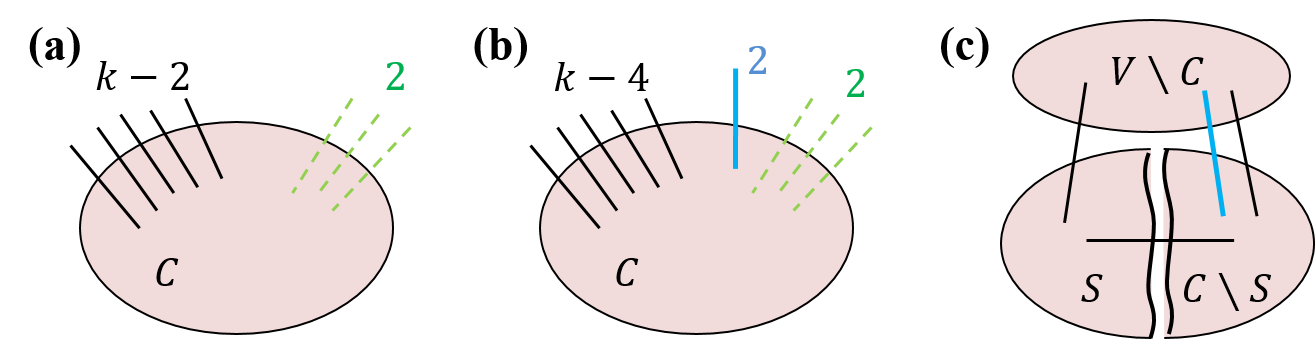
The following lemma shows that the conditions of Lemma 4 hold during the algorithm, and thus the algorithm terminates.
Lemma 7.
During the algorithm and holds for all . Furthermore, for all .
Proof.
By Lemma 6, when enters we have and . This implies . The addition of a ghost edge incident to excludes from but does not increase . Hence will never be chosen as a core and will never enter again. If we had when entered , then will leave with and will never enter again. Thus for all .
A set family is laminar if any two sets in the family are either disjoint or one contains the other. Let be the family of subsets of that correspond to the contracted sets during the algorithm (recall that denotes the initial graph). It is known and not hard to see that is laminar. We will say that a cut of is compatible with a graph during the algorithm if or for every that was contracted so far to obtain . As long as is compatible with , we can look at the cut of that corresponds to , which for simplicity of notation we will also denote by , and lower bound (the degree of the set that corresponds to w.r.t to the partial solution ) instead of (the degree of w.r.t to the final solution ), since and hence .
We would like to establish the bound for a cut of such that is laminar. For such , it is easy to determine the last graph that is compatible with. For a cut of let be the inclusion minimal set in that properly contains . If then compatible with till the end of the algorithm. If then (such that is laminar) is compatible with as long as is not contracted, hence we will analyze such as a cut of right before the core is contracted. Due to the fact that at this moment no edge in has both ends in and since and (by Lemma 4(i)), the difference between and is small.
Lemma 8.
When a core in the algorithm is found but not yet contracted, the following holds for any proper subset of .
-
(i)
and .
-
(ii)
.
Proof.
We prove (i). by Lemma 5. If for some then by Lemma 6. Otherwise, the constraint of is relaxed by ghost edges only, and since (Lemma 4(i)) and (Lemma 6), we get
We prove (ii). If then since when the ghost edge is added. Otherwise, and since (by Lemma 6) and by part (i) we get
concluding the proof.
The notation and are well defined for any node subset at any iteration of the algorithm. We now extend it to any subset of . We can view a ghost edge as a pair of sets in that correspond to . We say that such a ghost-edge covers if one of is contained in and the other in . Let denote the set of ghost edges in that cover and let be their number.
Corollary 9.
Let be a cut such that is laminar. Then and . Furthermore, if and then . Consequently, .
Proof.
The bound follows from Lemma 5, so we prove only the bound . For it follows from Lemma 6, so assume that . If is contained in some set in , then let be the inclusion minimal set in that contains . The bound then follows from Lemma 8(i). Otherwise, the constraint of was relaxed by ghost edges only and then .
Before establishing the bound for sets such that is not laminar, we need three additional lemmas. The next lemma considers sets and such that both are laminar; one can verify that this is equivalent to being laminar. Moreover, this means that is an inclusion maximal set in , and any other set in , except for maybe (if ), is contained in one of .
Lemma 10.
Let and let be a proper subset of such that the set family is laminar. Then .
Proof.
If then by Lemma 5. Otherwise, . Since and by Corollary 9, and by Lemma 6, we get (see Fig. 2(a))
concluding the proof.
We say that a set overlaps a set , or that overlap, if the pair is not laminar, namely if the sets are all non-empty. Now we consider sets that overlap some . Note however, that it may be that overlaps some , but does not, so we can still deduce from Corollary 9 that . To avoid this confusion we will examine among the sets one that is more “compatible” with . More formally, let be the family of sets in that overlaps, and note that so far we examined the case . So now w.l.o.g. we will assume that . Under this assumption, we have the following.
Lemma 11.
If then for any .
Proof.
Let and suppose that . It is known that ; this is so since every set in that overlaps also overlaps , but overlaps but not , c.f. [33, Lemma 23.15]. Thus . If then and we get contradicting the assumption .
Lemma 12.
Suppose that .
-
(i)
If is a minimal set in then .
-
(ii)
If is a unique maximal set in then .
Proof.
We prove (i). The minimality of implies that if then is laminar. Therefore by Lemma 8(ii) .
We prove (ii). The maximality of implies that if then is laminar. Therefore by Lemma 10 .
Lemma 13.
If then .
Proof.
Suppose that there are two disjoint sets in . Then there are two minimal sets in that are disjoint, say ; see Fig. 2(b). Then by Lemma 12(i)
Otherwise, is a nested family with a unique maximal set and a unique minimal set ; see Fig. 2(c) and note that and possibly . Then by Lemma 12 we get
concluding the proof.
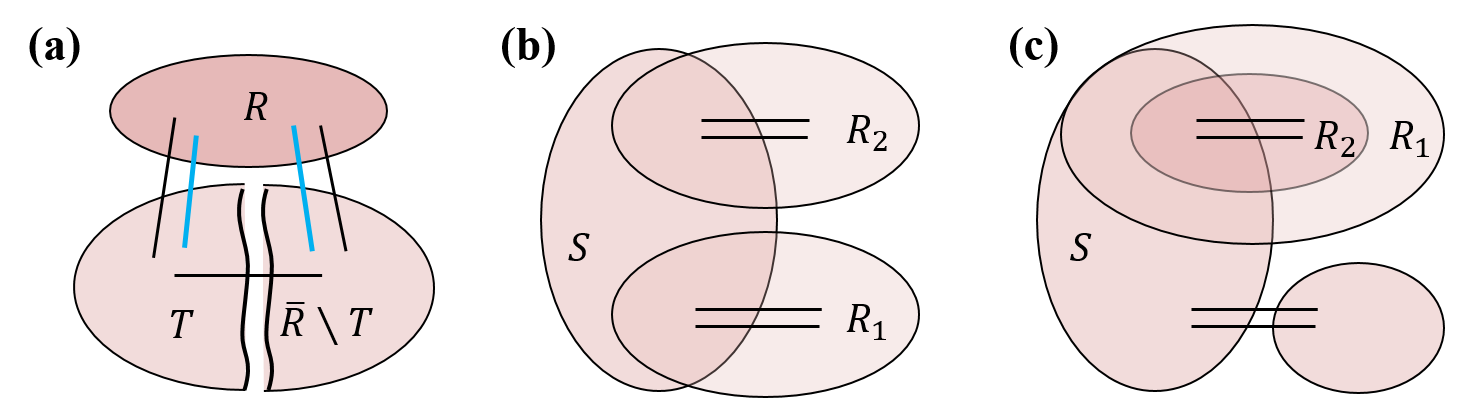
This concludes the proof of the connectivity guarantee of Algorithm 1. Now we show that the algorithm terminates after a polynomial number of iterations.
Lemma 14.
The algorithm terminates after iterations, where .
Proof.
Let be an extreme point computed at the first iteration of the algorithm. It is known (c.f. [13]) that , namely, at most variables are fractional. This follows from two facts. The first is that after the integral entries are substituted, the fractional entries are determined by a full rank system of constraints where is laminar, c.f. [15, 13]. The second is that a laminar family on a set of elements has size at most . The latter fact also implies that . By Lemma 7, the ghost edges form a -matching on , thus . At each iteration we remove an edge from , or add a set to , or add a ghost edge. Hence the number of iterations is bounded by .
4 Properties of extreme point solutions (Lemma 4)
Here we will prove Lemma 4. Fix an extreme point solution as in the Lemma. Then there exists a family of -positive -tight sets such that is the unique solution to the equation system ; namely, and the characteristic vectors of the sets are linearly independent. We will call such a family -defining. The following was essentially proved in [14].
Lemma 15 ([14]).
If there exists a laminar -defining family then there is an -core such that and ; moreover, no edge in has both ends in .
Proof.
Let be the family of minimal sets in . It was proved by HKZ [14] that there is such that and no edge in has both ends in ; we provide a proof sketch for completeness of exposition. Suppose to the contrary that for every . Assign tokens to every edge , and then reassign these tokens – one to the smallest set in that contains and one to the smallest set in that contains (if such sets exist). The paper of Jain [15] shows that then for any , the tokens assigned to sets in can be redistributed such that gets at least tokens and every gets at least tokens, giving the contradiction . The proof in [15] is by induction on . If is a leaf then already has tokens, since for every . Else, can collect tokens from each child in , so if has at least two children then we are done. Else, has exactly one child, and then [15] shows that by linear independence, there are tokens assigned to , which together with the extra tokens of the child of gives the required tokens. This shows that there is such that .
Note that for any , no edge in has both ends in ; this is since for every there is such that , since the variable must appear in at least one equation among . Let be such that . If is an -core then we are done. Otherwise, let be an -core properly contained in . We claim that , and that . This follows from the following observations.
-
1.
, since is -positive and since we assume that for all .
-
2.
For every there is such that , since the variable must appear in at least one equation among .
This gives , as required.
In the rest of this section we will prove the following.
Lemma 16.
Under the assumptions of Lemma 4, if no laminar -defining family exists then there are with and .
In the rest of this section assume that the assumptions of Lemma 4 hold ( and for all ), and that no laminar -defining family exists.
Lemma 17.
There are -positive -tight sets that cross (namely, all the four sets are non-empty) such that the following holds:
-
(i)
or for some .
-
(ii)
or for some .
Proof.
For a cut let be the incidence vector of . Let be the family of -positive -tight sets (if is tight but not -positive, then , since for all ). Let us say that are -uncrossable if at least one of the following holds:
-
(a)
are both -tight and .
-
(b)
are both -tight and .
We will prove two claims that will imply the lemma.
Claim.
There are that are not -uncrossable.
Proof.
Let be a maximal laminar subfamily of . Let denote the linear space spanned by the incidence vectors of the sets in and similarly is defined. Since no laminar -defining family exists and by the maximality of , there is such that ; any such overlaps some set in . Choose such that overlaps the minimal number of sets in , and let be a set that overlaps. We show that (a) cannot hold; the proof that (b) cannot hold is similar. Suppose to the contrary that (a) holds, namely that and are both -tight. It is known that each of the sets overlaps strictly less sets in than , c.f. [33, Lemma 23.15]. Thus by our choice of , each of these sets has its incidence vector in , namely . But , contradicting that .
Claim.
If are not -uncrossable then cross and both (i) and (ii) hold.
Proof.
We show that cross. If do not overlap then or and we are done. We claim that also . Otherwise, , , and thus and , implying that are both -tight and . Now we prove that (i) holds; a proof that (ii) holds is similar, and in fact can be deduced from (i) by the symmetry of . Suppose to the contrary that (i) does not hold. Denoting we have:
The first equality is since are tight, and the second can be verified by counting the contribution of each edge to both sides. The first inequality is since is a feasible LP-solution. The second inequality is since none of is a singleton from or its complement, hence coincides on these sets with the symmetric supermodular function , that satisfies the inequality . Consequently, equality holds everywhere, hence are both tight. Moreover, , and this implies , contradicting that are not -uncrossable.
By the first claim there exists that are not -uncrossable, while by the second claim such cross and satisfy both (i) and (ii), concluding the proof of the lemma.
By the symmetry of , assume w.l.o.g. that and for .
Lemma 18.
If then .
Proof.
By the assumption of Lemma 4, and . Since is -positive, . Thus we get (see Fig. 3(a))
Consequently, , as claimed.
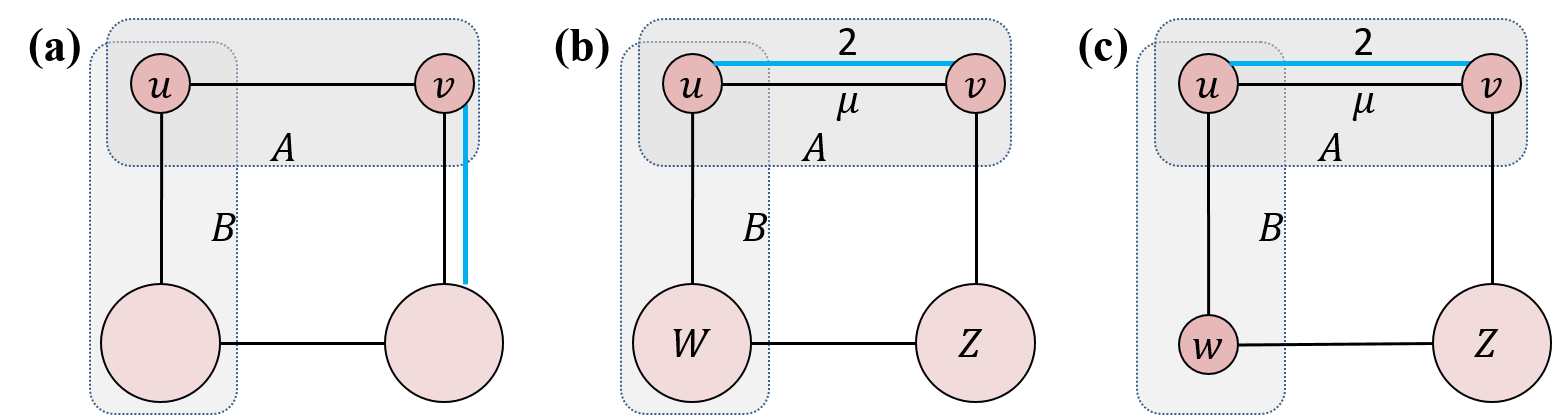
The next lemma shows that if then there is an “alternative” node such that we can add a ghost edge or .
Lemma 19.
If then there is such that one of the following holds:
-
(i)
, , and .
-
(ii)
, , and .
Proof.
For disjoint sets let , and let be the “coverage” of by , , and the fractional edges. Note that
In particular, implies that or for some .
Let and , see Fig. 3(b). Note that since are -tight and that . This implies (see Fig. 3(b))
Thus we get
Consequently, , since . Thus or , and w.l.o.g. assume that . This implies that for some ; (see Fig. 3(c)). Note that , since and since by the assumption of Lemma 4. Also, , since is -positive. Thus we have
concluding the proof.
To show a polynomial time implementation it is sufficient to prove the following lemma, that was essentially proved in [14]; we provide a proof for completeness of exposition.
Proof.
An extreme point solution can be found using the Ellipsoid Algorithm. For that, we need the show an existence of a polynomial time separation oracle: given , determine whether is a feasible LP solution or find a violated inequality. Checking the inequalities is trivial. For cut inequalities, assign capacities to the edges in as follows: if , if , and if . The inequality of a cut is violated if and only if and none of is a singleton in . Thus to find an -cut with violated inequality do the following. If then we find a minimum -cut ; if then we found a violated inequality, else no -cut with violated inequality exists. If and , then for every we contract into and find a minimum -cut ; if for some , then we found a violated inequality, else no -cut with violated inequality exists. Similarly, If then for every pair we contract into and into and find a minimum -cut ; if for some then we found a violated inequality, else no -cut with violated inequality exists.
We show how to find all -cores. Assume w.l.o.g. that for all . One can see that a cut is an -core if and only if is an inclusion minimal set that has -capacity and . For every ordered pair with we check if there exists an -cut (so and ) of capacity exactly , and if so, then we find the inclusion minimal such cut . The -cores are the inclusion minimal sets among the sets .
5 Proof of Theorem 3
In the algorithm of Theorem 3 we use the following function :
| (3) |
The main difference between Algorithm 1 and the following Algorithm 2 are:
-
1.
We use a different function – the one defined in (3).
-
2.
We round to edges with .
-
3.
Adding a ghost edge requires integral -edges.
A counterpart of Lemma 4 is as follows.
Lemma 21.
Let be defined by (3) and suppose that and for all . Let be an extreme point of the polytope with for all , where . Then at least one of the following holds.
-
(i)
There is an -core with and ; moreover, no edge in has both ends in .
-
(ii)
There are with and , where .
Furthermore, such or such can be found in polynomial time.
Proof.
By Lemma 15, if there exists an -defining laminar family, then there is an -core such that , , and no edge in has both ends in . But is not possible, as otherwise there is with . Hence in this case (i) holds.
We now show that if no laminar -defining family exists then (ii) holds. Similarly to Lemma 17 we conclude that there is a pair of -tight -positive sets that cross such that and for some .
We claim that if then . By the assumption of the lemma, and . Since is -positive, . Thus we get (see Fig. 3(a))
Consequently, , as claimed.
We prove that if then there is such that one of the following holds:
-
, , and .
-
, , and .
Let and . Note that
In particular, implies that or for some .
Let and . Note that since are -tight and that . This implies , see Fig. 3(b). Thus we get
Consequently, , since . Thus or , and w.l.o.g. . This implies that for some , see Fig. 3(c). Note that , since and since by the assumption of the lemma. Also, , since is -positive. Thus we have
The polynomial time implementation details are identical to those in Lemma 20.
We now prove the connectivity guarantee. As before, let be the family of subsets of that correspond to the contracted sets during the algorithm. Similarly to the previous case, we have the following sequence of lemmas.
Lemma 22.
When a core is found in the algorithm but not yet contracted, , , and . Consequently, if and if .
Proof.
If then , contradicting that is a core. Since and is a positive integer, we must have , as otherwise there is with .
Lemma 23.
During the algorithm and holds for all . Furthermore, for all . Thus the algorithm terminates after iterations.
Proof.
By Lemma 22, when enters we have and . This implies . The addition of a ghost edge incident to excludes from but does not increase , hence will never enter again. If we had when entered , then will leave with and will never enter again. Thus for all . The proof that the algorithm terminates after iterations is identical to the proof of Lemma 14.
Lemma 24.
When a core is found in the algorithm but not yet contracted, the following holds for any proper subset of .
-
(i)
and .
-
(ii)
.
Proof.
We prove (i). by Lemma 5. If for some then by Lemma 22. Otherwise, the constraint of is relaxed by ghost edges only, and since (by Lemma 21(i)) and (by Lemma 22), we get .
We prove (ii). If then since when the ghost edge is added. Otherwise, and since (by Lemma 22) and by part (i) we get
concluding the proof.
Corollary 25.
Let be a cut such that is laminar. Then and . Furthermore, if and then . Consequently, .
Proof.
The bound follows from Lemma 5, so we prove only the bound . For it follows from Lemmas 22, so assume that . If is contained in some set in , then let be the inclusion minimal set in that contains . The bound then follows from Lemma 24(i). Otherwise, the constraint of was relaxed by ghost edges only and then .
Lemma 26.
Let and let be a proper subset of such that is laminar. Then .
Proof.
Lemma 27.
Suppose that .
-
(i)
If is a minimal set in then .
-
(ii)
If is a unique maximal set in then .
Proof.
We prove (i). The minimality of implies that if then is laminar. Therefore by Lemma 24(ii) .
We prove (ii). The maximality of implies that if then is laminar. Therefore by Lemma 26 .
Lemma 28.
If then .
Proof.
Suppose that there are two disjoint sets in . Then there are two minimal sets in that are disjoint, say ; see Fig. 2(b). Then by Lemma 27(i)
Otherwise, is a nested family with a unique maximal set and a unique minimal set ; see Fig. 2(c) and note that and possibly . Then by Lemma 27
concluding the proof.
References
- [1] J. Cheriyan and R. Thurimella. Approximating minimum-size -connected spanning subgraphs via matching. SIAM J. Computing, 30:528–560, 2000. doi:10.1137/S009753979833920X.
- [2] J. Cheriyan and L. A. Végh. Approximating minimum-cost -node connected subgraphs via independence-free graphs. SIAM Journal on Comput., 43(4):1342–1362, 2014. doi:10.1137/120902847.
- [3] J. Chuzhoy and S. Khanna. An -approximation algorithm for vertex-connectivity survivable network design. Theory Comput., 8(1):401–413, 2012. doi:10.4086/TOC.2012.V008A018.
- [4] A. Czumaj and A. Lingas. On approximability of the minimum-cost -connected spanning subgraph problem. In SODA, pages 281–290, 1999.
- [5] J. Edmonds. Edge-disjoint branchings. In B. Rustin, editor, Combinatorial Algorithms, pages 91–96. Academic, New York, 1973.
- [6] J. Fackharoenphol and B. Laekhanukit. An -approximation algorithm for the -vertex connected subgraph problem. In STOC, pages 153–158, 2008.
- [7] C. G. Fernandes. A better approximation ratio for the minimum size k-edge-connected spanning subgraph problem. J. Algorithms, 28(1):105–124, 1998. doi:10.1006/JAGM.1998.0931.
- [8] A. Frank. Augmenting graphs to meet edge-connectivity requirements. SIAM J. Discrete Math., 5(1):25–53, 1992. doi:10.1137/0405003.
- [9] A. Frank and É. Tardos. An application of submodular flows. Linear Algebra and its Applications, 114-115:329–348, 1989.
- [10] G. N. Fredrickson and J. F. JáJá. Approximation algorithms for several graph augmentation problems. SIAM J. Comput., 10(2):270–283, 1981. doi:10.1137/0210019.
- [11] G. N. Fredrickson and J. F. JáJá. On the relationship between the biconnectivity augmentation and traveling salesman problem. Theoretical Computer Science, 19:189–201, 1982. doi:10.1016/0304-3975(82)90059-7.
- [12] H. N. Gabow and S. Gallagher. Iterated rounding algorithms for the smallest -edge connected spanning subgraph. SIAM J. Computing, 41(1):61–103, 2012. doi:10.1137/080732572.
- [13] H. N. Gabow, M. X. Goemans, É. Tardos, and D. P. Williamson. Approximating the smallest -edge connected spanning subgraph by LP-rounding. Networks, 53(4):345–357, 2009. doi:10.1002/NET.20289.
- [14] D. E. Hershkowitz, N. Klein, and R. Zenklusen. Ghost value augmentation for -edge-connectivity. In STOC, pages 1853–1864, 2024. Full version available at arXiv:2311.09941.
- [15] K. Jain. A factor 2 approximation algorithm for the generalized steiner network problem. Combinatorica, 21(1):39–60, 2001. doi:10.1007/S004930170004.
- [16] A. R. Karlin, N. Klein, S. Oveis Gharan, and X. Zhang. An improved approximation algorithm for the minimum -edge connected multi-subgraph problem. In STOC, pages 1612–1620, 2022.
- [17] S. Khuller. Approximation algorithms for for finding highly connected subgraphs. In D. S. Hochbaum, editor, Chapter 6 in Approximation Algorithms for NP-hard problems, pages 236–265. PWS, 1995.
- [18] S. Khuller and U. Vishkin. Biconnectivity approximations and graph carvings. J. ACM, 41(2):214–235, 1994. doi:10.1145/174652.174654.
- [19] G. Kortsarz and Z. Nutov. Approximating node connectivity problems via set covers. Algorithmica, 37(2):75–92, 2003. doi:10.1007/S00453-003-1027-4.
- [20] L. C. Lau, R. Ravi, and M. Singh. Iterative methods in combinatorial optimization, volume 46. Cambridge University Press, 2011.
- [21] L. C. Lau and H. Zhou. A unified algorithm for degree bounded survivable network design. Math. Program., 154(1-2):515–532, 2015. doi:10.1007/S10107-015-0858-5.
- [22] L. Lovász. Combinatorial Problems and Exercises. North-Holland Publishing Co., Amsterdam, 1979.
- [23] Z. Nutov. Approximating minimum-cost connectivity problems via uncrossable bifamilies. ACM Trans. Algorithms, 9(1):1:1–1:16, 2012. doi:10.1145/2390176.2390177.
- [24] Z. Nutov. Small -edge-covers in -connected graphs. Discret. Appl. Math., 161(13-14):2101–2106, 2013.
- [25] Z. Nutov. Approximating minimum-cost edge-covers of crossing biset-families. Combinatorica, 34(1):95–114, 2014. doi:10.1007/S00493-014-2773-4.
- [26] Z. Nutov. Improved approximation algorithms for minimum cost node-connectivity augmentation problems. Theory Comput. Syst., 62(3):510–532, 2018. doi:10.1007/S00224-017-9786-5.
- [27] Z. Nutov. The -connected subgraph problem. In T. Gonzalez, editor, Approximation Algorithms and Metaheuristics, chapter 12, pages 213–232. Chapman & Hall, 2018.
- [28] Z. Nutov. A -approximation for -connected subgraphs. J. Comput. Syst. Sci., 123:64–75, 2022.
- [29] D. Pritchard. -edge-connectivity: Approximation and LP relaxation. In WAOA, pages 225–236, 2010.
- [30] A. Sebö and J. Vygen. Shorter tours by nicer ears: 7/5-approximation for the graph-tsp, 3/2 for the path version, and 4/3 for two-edge-connected subgraphs. Combinatorica, 34(5):597–629, 2014. doi:10.1007/S00493-014-2960-3.
- [31] M. Singh and L. C. Lau. Approximating minimum bounded degree spanning trees to within one of optimal. J.of the ACM (JACM), page 62.1, 2015.
- [32] V. Traub and R. Zenklusen. A -approximation algorithm for weighted connectivity augmentation. In STOC, pages 1820–1833, 2023.
- [33] V. V. Vazirani. Approximation Algorithms. Springer, 2010.