Composable Byzantine Agreements with Reorder Attacks

Abstract
Byzantine agreement (BA) is a foundational building block in distributed systems that has been extensively studied for decades. With the growing demand for protocol composition in practice, the security analysis of BA protocols under multi-instance executions has attracted increasing attention. However, most existing adversary models focus solely on party corruption and neglect important threats posed by adversarial manipulations of communication channels in the network. Through channel attacks, messages can be reordered across multiple executions and lead to violations of the protocol’s security guarantees, without the participating parties being corrupted.
In this work, we present the first adversary model that combines party corruption and channel attacks. Based on this model, we establish new security thresholds for Byzantine agreement under parallel and concurrent compositions, supported by complementary impossibility and possibility results that match each other to form a tight bound. For the impossibility result, we show that even authenticated Byzantine agreement protocols cannot be secure under parallel composition when or , where and denote the number of corrupted parties and communication channels, respectively. For the possibility result, we prove the existence of secure protocols for unauthenticated Byzantine agreement under parallel and concurrent composition, when and . More specifically, we provide a general black-box compiler that transforms any single-instance secure BA protocol into one that is secure under parallel executions, and we provide a non-black-box construction for concurrent compositions.
Keywords and phrases:
Byzantine agreement, protocol composition, channel reorder attack, security thresholdCopyright and License:
![[Uncaptioned image]](x1.png) © Jing Chen, Jin Dong, Jichen Li, Xuanzhi Xia, and Wentao Zhou; licensed under Creative Commons License CC-BY 4.0
© Jing Chen, Jin Dong, Jichen Li, Xuanzhi Xia, and Wentao Zhou; licensed under Creative Commons License CC-BY 4.0
2012 ACM Subject Classification:
Theory of computation Distributed algorithms ; Security and privacy Security protocolsAcknowledgements:
The authors would like to thank several anonymous reviewers for their valuable comments.Funding:
This work is partially supported by Beijing Advanced Innovation Center for Future Blockchain and Privacy Computing.Editors:
Zeta Avarikioti and Nicolas ChristinSeries and Publisher:
 Leibniz International Proceedings in Informatics, Schloss Dagstuhl – Leibniz-Zentrum für Informatik
1 Introduction
The Byzantine agreement (BA) problem [46] is a foundational challenge in distributed systems, concerned with achieving consensus among parties even in the presence of failures or malicious behavior. This problem has been extensively studied under various models, leading to significant theoretical breakthroughs, including both impossibility results [43, 26] and the development of innovative protocols [24, 9, 47, 39]. As a core mechanism for achieving distributed consistency and fault tolerance, Byzantine agreement underpins a wide range of applications, including blockchain technologies [12, 1, 48, 55, 41, 56], secure multiparty computation [54, 35, 4, 11, 17, 28, 33] and diverse distributed services [30, 45, 2].
Much of the early research on the Byzantine agreement problem was conducted under a classical model where a network of parties, each holding an initial input value, communicates over reliable synchronous channels. In this model, faults are restricted to the parties themselves: up to parties may be corrupted by an adversary, but the communication network is assumed to be secure – messages cannot be forged, altered, or dropped by the adversary once sent by an honest party. The standard goals of a BA protocol in this setting are: (1) agreement – all honest parties eventually terminate and output the same value; and (2) validity – if all honest parties start with the same input, that value is the output. Studies show that in unauthenticated settings, BA is achievable if and only if [43, 46], while in authenticated settings, where digital signatures prevent forgery [50, 36], BA can be achieved with any number of corruption [27]. The expected constant-round protocols with optimal resiliency in the two settings were then constructed in [23] and [39], respectively.
However, the aforementioned studies primarily focus on single-instance executions of Byzantine protocols, leaving the critical issue of protocol composition unaddressed. In modern distributed environments, such as sharded blockchains, multiparty computation frameworks, or cross-chain settings, multiple consensus protocols may be composed sequentially, in parallel, or concurrently. In sequential composition, each protocol instance begins only after the previous one has been completed. In parallel composition, all instances are initiated at the same time and proceed with their steps aligned with each other. The most general model, concurrent composition, grants the adversary full control over the start times and execution rates of different instances.
The shift from single-instance to multi-instance execution introduces new problems, demanding a re-examination of existing assumptions about fault models and protocol security. In particular, [44] showed that, without a unique and common session identifier for every execution of the protocol, no authenticated BA protocol can remain secure even under just two parallel executions when corruption exceeds . In other words, authenticated BA performs as poorly as unauthenticated BA under parallel composition. Common session IDs can sometimes be achieved via a bootstrap phase, but in this work we would like to pursue the power of stateless composition without relying on such a bootstrap, so that the resulting BA protocols can be directly applied whenever compositional executions are needed.
The challenge with protocol composition is that the adversary’s power is amplified, and in our study we will amplify it even further. Indeed, a key limitation of the classical model is its implicit assumption that adversarial power is confined to corrupting parties, while communication channels remain trustworthy in the sense that messages sent between honest parties will be received correctly. This abstraction overlooks more realistic adversarial behaviors, such as man-in-the-middle or message-reordering attacks, which target the network rather than the parties themselves, especially when protocol composition is concerned. By carefully disrupting or manipulating some communication channels between multiple protocol instances, an adversary may induce cross-protocol interference, leading to violations of agreement or validity that would not occur in isolated executions.
1.1 Adversary Model
To address the limitations of classical adversary models, we introduce an extended adversarial framework tailored to protocol composition environments. In this model, the adversary retains the classical ability to corrupt up to parties, allowing them to deviate arbitrarily from the protocol. In addition, channels can also be corrupted, without sending and receiving parties being corrupted or even aware of the channel attack. This reflects realistic attack approaches in networks where multiple protocols share the underlying network infrastructure.
In the real world, the adversary may exploit man-in-the-middle attacks, such as ALPACA [7], to redirect the messages and bypass the security guarantees of TLS and application layer protocols, resulting in cross-protocol attacks that rearrange the messages from different protocols without breaking the signature scheme.
Such a setting captures the inherent interdependence of parallel or concurrently running consensus protocols, where messages from different instances may traverse overlapping physical or logical channels. Through reorder attacks, the adversary can introduce inter-instance inconsistencies that undermine global agreement guarantees, even if each protocol remains individually secure under classical assumptions.
This hybrid adversary model – combining party corruption with channel attacks – introduces new theoretical challenges. In particular, these two kinds of attacks are coupled together, thus determining the exact resilience thresholds under simultaneous control of parties and channels requires a fresh analytical approach that goes beyond traditional BA models.
1.2 Our Results
Our main results establish a new tight security threshold under the new adversary model. We first present the impossibility result showing that even in the authenticated setting, BA under parallel (and concurrent) composition is not achievable if or , where is the number of corrupted parties and is the number of channels that the adversary can manipulate.
Intuitively, even if a majority of parties are honest, agreement may still fail if the adversary can confuse one party, making it unable to tell which specific protocol instance it is participating in. For example, when two protocols are running in parallel, an attacker can target a particular party and swap the messages it is supposed to receive in the two protocols, causing its result to differ from that of the other honest parties. Therefore, it is not enough to simply bound the number of corrupted parties – one must also ensure that the honest parties maintain a sufficient number of communication with parties in the same protocol. This leads to a trade-off between party corruption and channel interference, and motivates the combined threshold as the condition necessary to preserve the communication advantage of the honest majority.
We further prove possibility results under compositional executions, showing that the condition along with the condition in classical setting (which is the tight bound when only party corruption is considered) is sufficient even in the unauthenticated setting. That is, when the combined adversarial power satisfies both conditions, it is possible to design a BA protocol that remains secure under arbitrary parallel and concurrent executions. These results complement our impossibility result, forming a tight security threshold: is both necessary and sufficient for protocol composition in our adversary model.
Noticeably, for parallel composition, we provide a general black-box compiler that transforms any single-instance secure BA protocol into one that is secure under parallel executions. A non-black-box construction for concurrent composition is provided, which is secure under asynchronous networks. By carefully structuring message sending and leveraging the honest majority’s residual communication connectivity, our protocol prevents cross-instance interference and ensures that no single execution is compromised due to shared network vulnerabilities.
In conclusion, our work provides the first formal characterization of security for BA in the presence of combined party corruption and channel attacks under protocol composition, filling a critical gap in the theoretical understanding of consensus under adversarial network interference. By introducing a unified adversary model and establishing the tight security threshold, we extend the classical BA framework to more accurately reflect the complication of modern distributed systems.
2 Related Work
Composition of Byzantine Agreements.
In a stateless model where protocols do not have distinguishing IDs, which is also considered by our work, [44] studied the sequential, parallel, and concurrent composition of authenticated BA protocols and presented the impossibility result as mentioned in the introduction. It also constructed secure randomized protocols under sequential composition. Without cryptographic primitives, [3] considered concurrently secure BAs with expected-constant round in both synchronous and asynchronous networks with optimal resiliency in the classical model (i.e., ). However, as pointed out by [16], its security proof had some subtle issues regarding, e.g., the use of oblivious leader election.
Both [3] and [16] are not stateless: they assume a unique and common session ID for every execution of the protocol. As pointed out by [44], concurrent composition of any number of executions in this case is possible. Indeed, the focus of [3] and [16] was to construct expected-constant round protocols that are concurrently composible. Similarly, [37] assumed unique session IDs but considered an adversary who can corrupt a player in some but not all parallel executions.
Moreover, [16] followed the Universal Composability (UC) framework [8], which means the protocol is secure under arbitrary composition with itself and other cryptographic protocols in an adversarially controlled manner. Focusing on the asynchronous setting, [16] considered concurrent BA and presented the first information-theoretic multi-valued oblivious common coin (OCC) protocol with optimal resiliency. It further provided a modularized protocol for round-preserving parallel composition of BA that was simpler than the construction in [3].
Computation and Communication Complexity.
An important line of work considers the complexity of a single execution of a Byzantine agreement. A body of foundational studies, in particular [19, 20, 9], proposed Byzantine agreement protocols that required a quadratic number of messages. More specifically, the communication complexity necessitates nearly all-to-all communication between parties. Subsequently, for randomized Byzantine protocols, a seminal work [40] proposed a protocol where each party speaks to only other parties, though their protocol achieved almost-everywhere agreement [21] rather than agreement, where fraction of the parties reach agreement. Subsequent studies have sought to bridge this gap by achieving agreement from almost-everywhere agreement. To the best of our knowledge, so far the best communication complexity achievable for agreement in authenticated setting is rounds with communication and computation [32]. With enhanced cryptographic primitives such as LWE, this can be improved to rounds and communication [5, 25], where is the security parameter.
However, for deterministic Byzantine protocols, [18] established that achieving agreement inherently requires at least communication. Furthermore, [14] extended this lower bound to other generalized validity definitions (e.g., weak validity), demonstrating that any well-defined Byzantine agreement variant necessitates communication. Thus, deterministic Byzantine agreements incur fundamentally more overhead than randomized ones.
Different from this line of works that focused on single-instance executions of BA protocols, our work investigates compositional executions of BA protocols. Although our protocols are not necessarily optimal in terms of their complexity, our black-box compiler protocol achieves polynomial communication and computation. Further improving the complexity of our protocols and proving complexity lower-bounds in our model are interesting open problems.
Network Attacks.
Many prior works on network security have shown that channel attacks (e.g., man-in-the-middle attacks) without corrupting participating parties exist in a wide range of scenarios and pose a significant threat in real applications. By delaying, forging, dropping, or redirecting, attackers can break SSL/TLS certificate validation in many critical software applications [34, 51], cause security issues for HTTPS and its certificate trust model [15], inflict devastating damage on private and consortium blockchains [22], and so on.
Finally, it’s worth noticing that for transaction messages in DeFi, attackers (miners) can gain Miner Extracted Value (MEV) through transaction reordering attacks such as those studied in [53], while [38] indicated that currently no mitigation schemes can fully solve this problem. For a fully connected large-scale network, [52] analyzed Simple Majority Protocol (SMP) under probabilistic message loss and proved that it can reach consensus in three rounds of communication with probability approaching 1. However, those are within the same consensus protocol and the role of channel attacks in the composition of Byzantine agreements has not been explored yet.
3 Our Model
3.1 Byzantine Agreement
We consider the problem of Byzantine Agreement where is a set of parties, and is common knowledge among all parties. The protocol is executed times in parallel (or concurrently), where we denote the -th instance by . Each party in each instance is formally modeled by an interactive (randomized) Turing machine , with an input tape containing its initial value, an output tape for its final output, a random tape, and pairs of communication tapes (input/output) corresponding to the other parties in the same , denoted by and for each . More specifically, contains messages that sends to , and contains messages that receives from . Under parallel or concurrent composition, a party locally runs copies of such interactive Turing machines simultaneously, each corresponding to a particular protocol instance.
Network and Communication.
In most parts of the paper except Section 6, the network is synchronous and point-to-point: communication proceeds in rounds, each consisting of a send phase followed by a receive phase. In the send phase, a party writes the sending message onto the corresponding communication output tape. Then, in the receive phase, the message is written onto the target party’s input tape under the same protocol instance.
More specifically, the communication channel between parties and , denoted by , is the set of all input and output tapes between the two parties, for all protocol instances. By symmetry, means the same thing as and an attack on one is also an attack on the other. In an uncompromised channel , messages originating from are delivered exclusively to for all , and vice versa.
Stateless Setup.
In stateless compositions of BA protocols, there is no common session identifier for the protocol instances. The indices of different protocol instances are for discussion purposes and are not accessible by the parties. Indeed, each Turing machine has access to its tapes but doesn’t know the global index . Internally, each party may have individual numbering for its Turing machines, but those numbers may not be consistent among different parties.
For authenticated Byzantine Agreement (ABA), a common setup is shared across all protocol instances. In particular, all parties undergo a one-time trusted preprocessing phase that generates cryptographic primitives, which are then used consistently across all protocol instances. Formally, each interactive Turing machine has a read-only setup tape, and all Turing machines run by the same party share this setup tape. For example, this tape may contain the secret key of a signature scheme used by the party, as well as the public verification keys of other parties. For unauthenticated Byzantine Agreement, no cryptographic primitives are used and there is no setup tape or a setup phase.
Composition of BA Protocols.
We consider two types of protocol composition: parallel composition and concurrent composition. In parallel composition, all protocols start simultaneously, and each round has one time step across all protocol instances. In concurrent composition, the adversary can independently control the start time and the time steps of each round of each protocol instance.
Adversarial Model.
We consider an adversary operating in the point-to-point full information setting in a parallel or concurrent execution of protocol instances . Its capabilities include:
-
Corruption: The adversary can corrupt up to parties and chooses which parties to corrupt before any protocol instance begins. This is called static corruption.
-
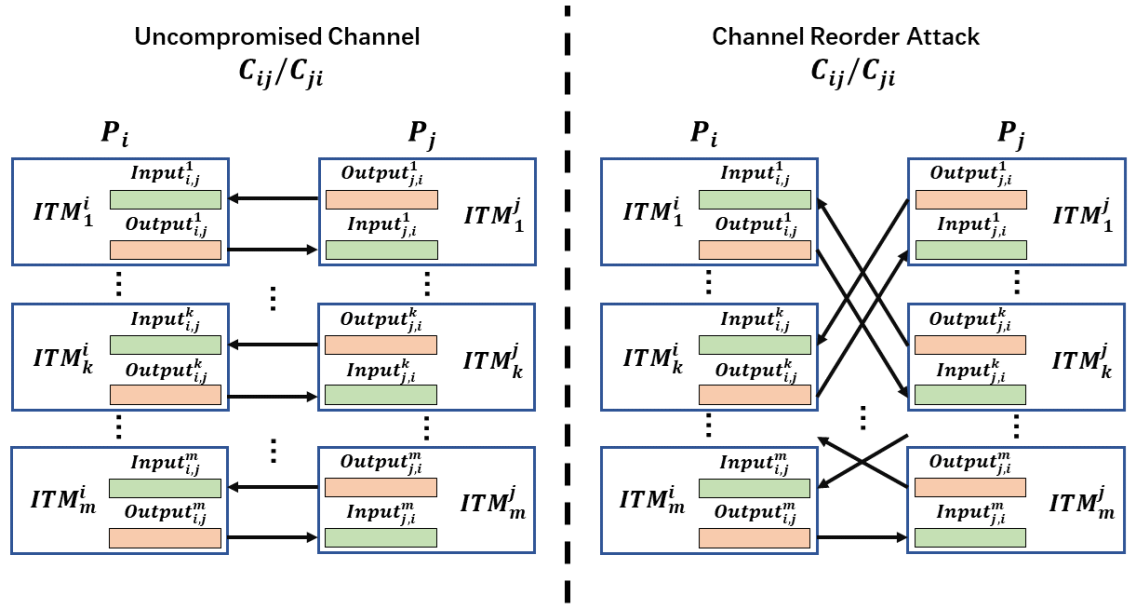
Channel Reorder Attack: The adversary can attack up to channels between honest parties. When is under attack, the adversary is allowed to redirect messages on the corresponding input tapes for different protocol instances and in both directions. See below for a formal definition, which is also illustrated in Figure 1.
Definition 1 (Channel Reorder Attack).
For any two honest parties and , a channel reorder attack on allows the adversary to arbitrarily redirect messages between different protocol instances and in both directions. Specifically, the adversary can deliver any message to any , where and .
-
Rushing: The adversary is rushing, meaning it can observe all messages sent by honest parties in a round before deciding the messages to send from corrupted parties and message reordering in the same round.
-
Computation Power: For our impossibility results, which apply to authenticated BA protocols, we assume that all parties (honest and adversarial) are probabilistic polynomial-time (PPT). In contrast, for our positive results, which apply to unauthenticated BA protocols, we allow computationally unbounded adversaries.
For this extended adversary model, a protocol is considered a solution to the BA problem if it satisfies the following properties:
Definition 2 (Byzantine Agreement).
Let be an adversary who can corrupt up to parties and channels. A protocol solves the Byzantine Agreement problem if for any adversary , the following two properties hold:
-
Agreement: All honest parties eventually terminate and output the same value.
-
Validity: If all honest parties begin with the same initial value , then their output values must all be .
3.2 Composition Security
Composition security plays a pivotal role in analyzing the robustness of cryptographic protocols executed within larger systems or concurrently with other protocol instances, rather than in isolation. Our work adopts the definition of composition security as presented in [44], with the notable distinction that we explicitly consider attacks on communication channels.
Definition 3 (Composition Security of ABA).
Let be parties for an ABA protocol . We say that remains secure under instances of parallel (or concurrent) executions, if for every PPT adversary , the requirement of BA holds for every individual instance of within the following procedure:
-
1.
Setup Phase: A single, global trusted setup phase is performed once. This phase generates setup strings for parties , which are then consistently used across all protocol instances.
-
2.
Static Corruption: The adversary statically corrupts up to parties, gaining full control over their actions. Additionally, the adversary can attack up to communication channels between honest parties, enabling channel reorder attacks described in Definition 1.
-
3.
Parallel (Concurrent) Executions: The following procedure is repeated in parallel (or concurrently) for each protocol instance, until the adversary halts:
-
The adversary specifies the initial input values for all parties.
-
Each party uniformly generates the content of its random tape for the execution in this protocol instance.
-
All parties are invoked for the execution of .
-
The adversary determines the messages sent by the corrupted parties, while honest parties strictly adhere to the protocol .
-
Messages transmitted over attacked channels are subject to the adversary’s reordering on corresponding input tapes, whereas messages on unattacked channels between honest parties are delivered reliably.
-
For unauthenticated Byzantine Agreement protocols, the definition of composition security is analogous, with the difference that no setup phase or cryptographic primitives are needed.
4 Impossibility Result
Authentication allows protocols to achieve higher fault tolerance in the stateless execution model, tolerating an arbitrary number of corrupted parties. However, this intuition breaks down in composed scenarios. When multiple executions occur, a signature from a Party on message does not prove that signed in the “current” specific execution. An adversary can “borrow” signed messages from one execution and use them in another, rendering the public-key infrastructure “useless” in distinguishing execution contexts.
Theorem 4.
There does not exist a protocol for stateless authenticated Byzantine Agreement in a synchronous network with parties that remains secure under parallel composition (even for just two executions) against an adversary , provided that (1) , or (2) .
Proof.
For condition (1), the result follows directly from Theorem 1 in [44].
We prove the result for condition (2) by contradiction. Assume that there exists an authenticated Byzantine Agreement protocol that remains secure under two parallel executions against an adversary with . We assume , otherwise we have and it can be reduced to condition (1).
We consider two independent executions of : Let and be independent copies of parties participating in protocol . The independent copies mean that for each , and are the same party that runs in two different parallel executions of . For the purpose of the proof below, we denote the set , , , and . Note that we have , so we have and .
Let denote the maximum number of communication rounds required for protocol to achieve termination in any execution. By the termination guarantees of the agreement property of Byzantine Agreement protocols, is finite and well-defined. Furthermore, given the security assumption that remains secure under parallel composition, it follows that must terminate within rounds even when executed concurrently across multiple protocol instances.
We now introduce an important abstract concept and will instantiate it in different ways in the proof. A system X is a tuple:
-
A set of parties, each party runs two copies of ITMs, and , for protocol ;
-
An adversary controlling corrupted parties and reordering channels;
-
Initial input values for all ITMs on their input tapes;
-
A network topology governing inter-party connectivity.
Intuitively, if the system contains a non-trivial adversary who corrupts some parties and reorders some channels, then the network topology is consistent with the adversary’s reordering of the channels. In some mental games, we may instantiate the system without an adversary, in which case the network topology dictates how the parties’ communication channels are inter-connected crossing the two executions of .
For any ITM run by a party in , its view in system X, denoted by , consists of the content of ’s input tapes and random tape, where the former in particular includes the initial input value and the messages received by from other parties during the execution of X.
When all parties (including ) behave deterministically, is uniquely determined by the initial configurations of the tapes and the adversarial behavior. Conversely, under randomized executions (where the content of the random tapes are sampled uniformly at random), constitutes a random variable over the corresponding probability space.

We now instantiate the system S through the following configuration:
-
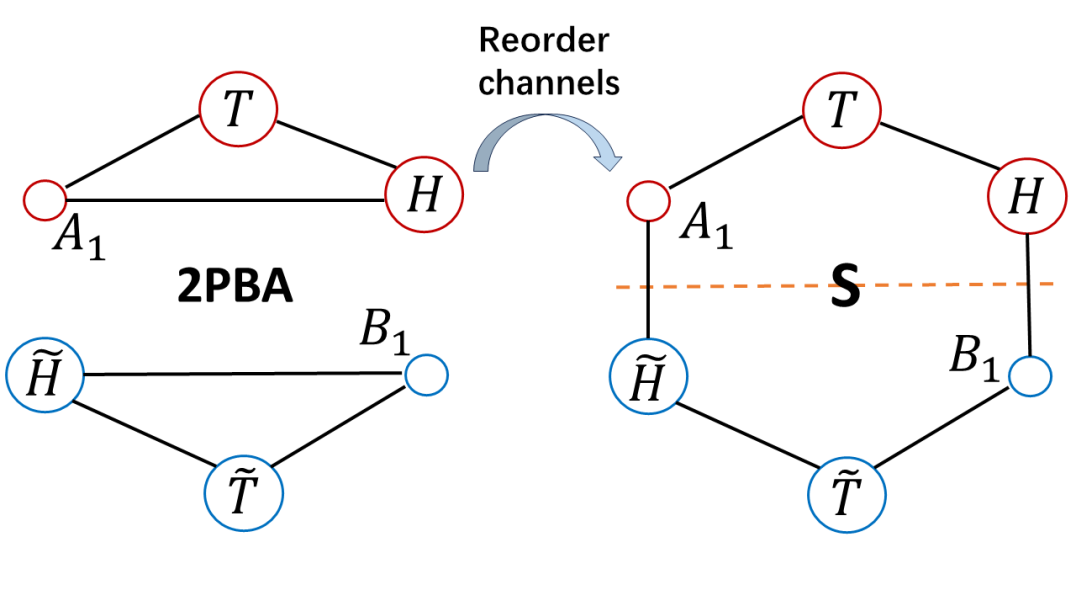
Network Topology: ITM establishes connectivity with the set (replacing its original link to ), while ITM interfaces with instead of . This structural reconfiguration is illustrated in Figure 2.
-
Initial Input Value:
-
–
ITMs in receive input ;
-
–
ITMs in receive input .
-
–
-
Adversary: In this system, there is no adversary; formally, we have and .
-
Protocol Execution: All ITMs in strictly adhere to the instruction of protocol , simulating an authenticated Byzantine Agreement environment. Specifically, each party:
-
–
Generates messages as prescribed by ’s honest execution semantics;
-
–
Sends these messages via the network topology defined above.
-
–
Now we first state the following lemmas and we will prove them afterwards.
Lemma 5.
In system S, all ITMs in output 0, and there exists at least one ITM in outputs 0. Symmetrically, all ITMs in output 1, and there exists at least one ITM in outputs 1.
Lemma 6.
In system S, all ITMs in and at least one ITM in output the same value; Symmetrically, all ITMs in and at least one ITM in outputs the same value.
Proof of Lemma 5.
To prove the lemma, we define a new system 2PBA as follows and as shown in Figure 3:
-
Network Topology: The system consists of two parallel executions of protocol , denoted (consisted of , and ) and (consisted of , and ).
-
Initial Input Value:
-
–
ITMs in receive input ;
-
–
ITMs in receive input .
-
–
-
Adversary: The adversary chooses an arbitrary subset of parties , denoted by , which satisfies . Then the adversary reorders all the channels between and , and corrupts the parties in . As we have , the adversary can indeed corrupt all these parties. In the following proof, we denote as the set of ITMs run by in the protocol , and as the same, we denote .
-
Protocol Execution:
-
–
All honest parties in strictly adhere to the instruction of protocol ;
-
–
The corrupted parties reorder their channels between , and besides this action, they adhere to the instruction of protocol .
-
–
We then prove , , and .
We proceed by induction on the round counter .
Base Case ().
-
Message Generation: All parties in both and generate identical message sets due to protocol strictly.
-
Message Routing:
-
–
In : Messages propagate through the hexagonal graph.
-
–
In : The adversary enforces the following redirections:
After reordering, communicates with rather than , communicates with rather than . Other than that, all the ITMs strictly adhere to the instruction of . It is easy to see that the actual message routing is the hexagonal graph the same as in S.
-
–
-
View Equivalence: The above routing rules induce identical message distributions at all parties’ interfaces. Thus, , , and .
Inductive Step.
Assume equivalence holds through step . For step :
-
Message Generation: Identical message distributions emerge from equivalent historical views (by inductive hypothesis).
-
Message Routing: The hexagonal routing in and adversarial redirection in preserve the same correspondence as .
-
View Update: Therefore, and maintain for the rounds.
Owing to the termination property of Byzantine Agreement, which mandates that the protocol halts within , the aforementioned procedure completes in at most rounds. Consequently, we derive that , , and .
Given the equivalence of views, the parties , and in both systems 2PBA and S must yield identical final outputs. By the validity property of Byzantine Agreement, since , , and in are initialized with input 0 and , , are honest, then . Consequently, system S inherits this outcome, we have .
Analogously, through the system 2PBA, we can rigorously demonstrate , and , thereby establishing .
Proof of Lemma 6.
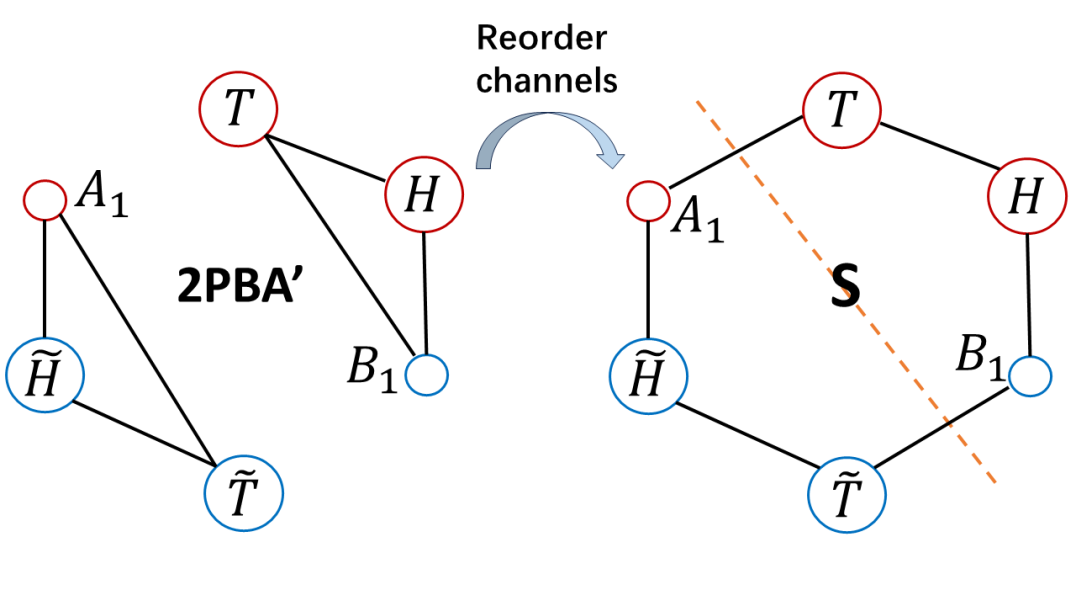
Similarly, we construct system 2PBA’ as instantiated below, shown in Figure 4:
-
Network Topology: The system consists of two parallel executions of protocol , denoted (consisted of , and ) and (consisted of , and ).
-
Initial Input Value:
-
–
ITM receives input and ITMs in receive input ;
-
–
ITM receives input and ITMs in receive input .
-
–
-
Adversary: The adversary chooses an arbitrarily subset of parties , denoted by , which satisfies . Then the adversary reorders all the channels between and , and corrupts the parties in . As we have , the adversary can indeed corrupt all these parties. In the following proof, we denote as the set of ITMs run by in the protocol , and as the same, we denote .
-
Protocol Execution:
-
–
All honest parties in strictly adhere to the instruction of protocol ;
-
–
The corrupted parties reorder their channels between , and besides this action, they adhere to the instruction of protocol .
-
–
The subsequent proof by mathematical induction is analogous to the reasoning in system 2PBA of the preceding proof; therefore it is omitted here. It is noteworthy that after we get , , and , we use the Agreement property instead of the Validity property of Byzantine agreement to deduce that . Similarly, we have .
5 Black-box Compiler for Parallel Composable BA
This section presents a novel black-box compiler that transforms any BA protocol into one that remains secure under parallel composition. The proposed approach addresses the challenges introduced by message reordering attacks through the integration of a new Reliable Message Transmission (RMT) protocol.
5.1 Reliable Message Transmission for Parallel Composition
To achieve security under parallel composition, our compiler replaces the standard point-to-point communication primitives in a given BA protocol with our newly designed Reliable Message Transmission protocol. This RMT primitive guarantees correct and unforgeable message delivery within the same protocol instance, even in the presence of adversarial message reordering. The formal specification of the RMT is presented in Protocol 1.111If the values of and are publicly known, then the threshold in Protocol 1 can be replaced by and the protocol continues to work.
Given that party wishes to send message to , the reliable message transmission protocol proceeds as follows:
-
Round 0: Party initiates this message transmission by sending the message to all parties except .
-
Round 1: Party sends the message to ; and each other party that received message from in round 0 forwards the same message to party .
-
Decision: Upon party receiving strictly more than copies of the message by the end of round 1, it accepts message from .
When , this RMT protocol ensures message delivery through a redundancy-based approach. The principle is to use a majority vote to secure message transmission against potential attacks, a technique also found in prior works but in different formats; see, e.g., [49, 29, 13]. When executed by all participating parties, the RMT primitive is characterized by two essential properties for its security within the black-box compiler.
-
Correctness: If both parties and are honest, and used the RMT protocol to send a message to in round , then will accept the message from by the end of round .
-
Unforgeability: If both parties and are honest, and did not use the RMT protocol to send message to in round , then will not accept from by the end of round .
The following lemma establishes the security guarantees of the RMT protocol:
Lemma 7.
Protocol 1 satisfies both correctness and unforgeability properties against any adversary , provided that .
Proof.
Correctness: Since is an honest party, it will send the message to all other parties except in round 0. In round 1, each party , including , forwards/sends the message to , unless:
-
is corrupted by the adversary, or
-
The communication channel or is attacked by the adversary.
Since each corruption or channel attack can prevent at most one forwarding, at most of these forwarded messages can be suppressed. Thus, receives at least forwarded messages. Since , we have , which is equivalent to . Therefore, receives strictly more than copies of the message , and accepts from as valid by the end of round 1.
Unforgeability: If did not initiate the RMT protocol for message to , then the only way for to receive is via adversarial intervention. The adversary can inject at most such messages through corrupted parties or attacked channels. Since , receives fewer than the majority threshold of messages, and thus does not accept from .
5.2 Black-box Compiler
Using the RMT protocol, our black-box compiler applies a simple yet effective transformation: given an existing BA protocol , it constructs a new protocol by replacing all point-to-point message delivery operations with the RMT protocol. The internal logic, state transitions, and computation procedures of are completely preserved, ensuring that the transformation is non-intrusive and protocol-agnostic.
Formally, a party ’s in protocol uses its corresponding in as a sub-routine. The outer one, , handles message sending and receiving according to the RMT protocol, and passes accepted messages to the inner one, . The inner one then computes its state transition and out-going messages according to , and passes the out-going messages to to send out.
Notice that in , a message that originally takes one round to deliver in now takes two rounds. As such, honest parties will only initiate a message sending in odd rounds (wlog assuming the protocol starts with round 1) and will only accept a message in even rounds. More specifically, if in the execution of an honest party sends a message to in round , then in the execution of , initiates the corresponding message sending in round and accepts the message by the end of round .
Theorem 8.
Let be a BA protocol for parties that tolerates up to Byzantine corruptions. Let be the protocol obtained by replacing all point-to-point communication in with the RMT protocol. Then, is secure under parallel composition of any number of executions against any adversary , provided that .
Proof.
Arbitrarily fixing an instance , we prove its security under parallel composition by induction. Consider a mental game with a single execution of the protocol as follows.
For each honest party and the corresponding in , let its inner Turing machine be . We construct an for , such that has the same initial input tape, random tape (and setup tape) as , and thus also as .
Note that, for any adversary in , the only effects it can have on some party in instance are the following:
-
It can fully control if the party is corrupted.
-
It can cause an honest party ’s to accept a message from a corrupted party at some round . This is because, in , no honest ITM accepts a message in odd rounds, and due to the unforgeability property of RMT, the adversary cannot forge a message from other honest parties to make an honest accept it.
Therefore, for any adversary in , we simulate a corresponding adversary in as follows:
-
Whenever corrupts a party in , corrupts the corresponding in .
-
Whenever causes an honest to accept a message from a corrupted party at round in , sends message from to at round in .
Since for every honest party , both and have the same input, random, and setup tapes at the beginning of round 1, they have the same state transition and out-going messages. Because handles message sending and receiving according to the RMT protocol, and by the construction of the adversary in , at the end of round 2 in , has accepted exactly the same messages as received by at the end of round 1 in . Thus after round 2 of has the same view as after round 1 of . That is, .
Let be the maximum finite number of rounds in protocol . For each , we compare the view of after rounds of with the view of after rounds of . By the inductive hypothesis, we have
Thus they again have the same state transition and out-going messages in the corresponding round and round .
Due to the correctness and the unforgeability properties of the RMT protocol, and by the construction of the adversary , again by the end of round of , accepts exactly the same messages as received by at the end of round in . Hence, for all .
Accordingly, we conclude that the final output value of in (which is that of ) and the final output value of in are identical. As this holds for all honest parties in , we have that inherits the same agreement and validity properties as . Thus is secure under parallel composition.
By applying our compiler to any existing BA protocol, we can construct a protocol that remains secure under parallel composition. In particular, by transforming the protocol of Garay and Moses [31], which is secure in the unauthenticated, stateless setting whenever , we obtain the following corollary:
Corollary 9.
There exists a protocol for stateless, unauthenticated BA that is secure under parallel composition of any number of executions against any adversary , provided that the total number of parties satisfies and .
While the black-box compiler significantly enhances BA protocol’s security, it introduces some performance overheads. The round complexity of the compiled protocol is doubled compared with the original protocol . The communication overhead per message in the original is asymptotically . In particular, for a message from to , sends to parties in Round 0 of RMT, and up to parties may send the message to in round 1. These overheads are the trade-off for achieving security against adversarial message reordering in parallel compositions. Designing more efficient compilers that maintain similar security guarantees while reducing communication or round complexity remains an important direction for future research.
6 Concurrent BA Protocol under Asynchronous Network
The preceding sections focused on parallel composition under a synchronous network model, where message delivery is guaranteed within a fixed time bound (i.e., a round). In this section, we shift our attention to a more challenging setting, the asynchronous network model. Here, messages can be delayed arbitrarily, and there is no global clock to coordinate the actions of different parties. Moreover, we consider concurrent composition, where protocol instances may not start simultaneously, making it significantly harder for a party to determine whether a received message indeed belongs to a particular instance or has been reordered.
To address these challenges, we first construct a reliable broadcast protocol tailored for the asynchronous setting. Building upon this foundation, we then leverage the seminal work of [6] and construct an unauthenticated BA protocol that is secure under concurrent composition in an asynchronous network. Notably, security in the asynchronous model implies security in the synchronous setting. Therefore, our BA protocol is also secure under concurrent composition in synchronous networks.
6.1 Reliable Broadcast Under Concurrent Composition
Reliable Broadcast (RB) [10] is a fundamental communication primitive that ensures a message sent by an honest sender is reliably delivered to all parties. It guarantees the following properties:
-
Agreement: If any honest party accepts a message , then all honest parties eventually accept .
-
Validity: If the sender is honest and broadcasts a message , then all honest parties eventually accept .
Based on the work of [6] and utilizing the idea behind our RMT protocol in Section 5, we present Protocol 2 that achieves reliable broadcast under concurrent executions against any adversary , under the conditions and . To our best knowledge, this is the first RB protocol that is concurrently secure in the stateless model, and may be of independent interest.
The core idea is to avoid accepting messages based solely on direct receipt. Instead, each party maintains a local view of all other parties’ state. This view is only updated after a majority (i.e., more than ) of confirming messages have been received. Specifically, let the original sender in the RB protocol be . The local state of a party with at some party , denoted by , can be in one of the following three forms:
-
: no value has been received by yet;
-
: value tentatively accepted by ;
-
: value confirmed and will not change at .
Respectively, the messages sent by a party during the protocol reflect its own state and take one of the following forms:
-
: has received value sent by ;
-
: has tentatively accepted ;
-
: value has been confirmed by .
Say party wishes to broadcast value . Each party initializes its local view of each party ’s state as . The protocol proceeds as follows:
-
Step 0 (performed by ): send to all parties including itself.
For each party :
-
Step 1: Upon receiving some message from , send to all parties.
-
Step 2: Wait until the receipt of strictly more than messages for the same value from different parties. If local state , set and send to all parties.
-
Step 3: Upon receiving some message from party , forward it to all parties.
-
Step 4: Wait until the receipt of strictly more than messages for the same and from different parties. If , set .
-
Step 5: Wait until strictly more than parties have local state for the same . If or , where can be any value, set and send to all parties.
-
Step 6: Upon receiving some message from party , forward it to all parties.
-
Step 7: Wait until the receipt of strictly more than messages for the same and from different parties. If or , where can be any value, set .
-
Step 8: Wait until parties have state for the same . If or , where can be any value, set and send to all parties.
-
Step 9: Wait until parties have state for the same . Accept .
By adapting the BA protocol from Figure 4 of [6] and replacing all broadcast procedures with our RB protocol, we have the following:
Theorem 10.
There exists a protocol for stateless, unauthenticated BA that is secure under concurrent composition of any number of executions in an asynchronous network against any adversary , where the number of parties satisfies and .
To prove Theorem 10, it suffices to prove the security of our RB protocol under concurrent composition in an asynchronous network; see Theorem 17 in Section 6.2. Theorem 10 then holds by the security of protocol and an inductive analysis similar to the proof of Theorem 8. We include the protocol in the appendix of this paper for reference purpose.
6.2 Composition Security of Reliable Broadcast
We now prove that Protocol 2 satisfies the properties of reliable broadcast under concurrent composition. In particular, we consider instances of Protocol 2 concurrently executed against adversary , under conditions and .
Lemma 11.
In any instance, for any two honest parties and , eventually sets its local state if and only if broadcasts the message during the execution of this instance.
Proof.
If an honest party broadcasts , then in the execution of any other honest party , this message will be forwarded by every party unless:
-
is corrupted by the adversary, or
-
the communication channel or is under attack.
Since each adversary action can block at most one message, the number of suppressed forwards is at most . Therefore, eventually receives more than such messages and sets its local state for to .
Conversely, if did not send the message in that instance, then the adversary can inject at most copies . Since , an honest party will not receive enough messages to satisfy the threshold, and thus will not set ’s local state to .
Lemma 12.
In any instance, for any two honest parties and , eventually sets its local state only if broadcasts the message during the execution of this instance.
Proof.
If did not send the message in that instance, then the adversary can inject at most copies . Since , an honest party will not receive enough messages to satisfy the threshold, and thus will not set ’s local state to .
Lemma 13.
In any instance, for any two honest parties and who respectively send messages and during the execution of this instance, we have .
Proof.
Assume for contradiction. Let and be the first honest parties to send and , respectively. Party must have observed strictly more than party with local state . Party must have observed strictly more than party with local state . This implies an overlap where an honest party has in the view of and in the view of .
Therefore, by Lemma 12, it implies that sent both and messages. However, an honest party sends only one type of echo message during a reliable broadcast protocol. Therefore, .
Lemma 14.
In any instance, for any two honest parties and who accept values and respectively, we have .
Proof.
If accepts , then it must have observed at least parties with the state in its local view, which includes at least honest parties. Similarly, must have observed at least parties with state in its local view, which includes at least honest parties. By Lemma 11, there exists at least one honest party that have send , and one honest party that have send . Applying Lemma 13, it follows that .
Lemma 15.
In any instance, if an honest party accepts a value , then every other honest party eventually accepts in that instance.
Proof.
Suppose accepts value . Then its local view must include at least parties with the state , including at least honest parties. By Lemma 11, every honest party in these parties must have send in that instance. Also by Lemma 11, eventually, all honest parties will receive these messages and update their local views, setting ’s state to . According to step 8 of the protocol, upon observing parties in state , every honest party updates its own state to , and send to all parties. Again, by Lemma 11, all honest parties will receive these messages and update their local views, setting ’s state eventually. Since , the number of honest parties exceeds . Thus, every honest party will eventually have at least states in its local view and will accept .
Lemma 16.
In any instance, if an honest party broadcasts a value , then all honest parties eventually accept in that instance.
Proof.
Since is honest, it sends to all parties. At least honest parties receive this message and forward to all other parties. Each honest party eventually receives more than such messages. It then sets its local state and sends to all parties. As a result, each honest party receives more than echo messages for value and each honest party , and thus sets the state . This ensures that every honest party observes enough prepare state in its local view to satisfy the condition for committing. Accordingly, each honest party updates its own state and sends to all parties.
In Step 7 of the protocol, each honest party receives more than ready messages for value and each honest party , causing each party to update the state of . Therefore, since , every honest party eventually has at least states in local view and accepts .
Theorem 17.
Protocol 2 realizes reliable broadcast against any adversary under concurrent composition in an asynchronous network, provided that and .
Proof.
Validity: In any instance, if the sender is honest and broadcast value , then by Lemma 16, all honest parties eventually accept in that instance.
Agreement: In any instance, if the sender is corrupted, and some honest party accepts a value in that instance, then by Lemma 15, all other honest parties eventually accept the same value in that instance.
7 Conclusion and Future Directions
The primary contributions of this work include the introduction of a novel adversarial model that simultaneously enables the corruption of parties and communication channels. The reorder attack is both theoretically interesting and practically viable, enhancing the security analysis for Byzantine Agreement protocols under both parallel and concurrent execution settings.
Building upon this model, our work establishes surprising positive and negative results. On the one hand, authenticated Byzantine Agreement becomes insecure when either or . While on the other hand, for unauthenticated Byzantine Agreement, secure protocols exist under both parallel and concurrent compositions when and . Notably, these findings provide tight conditions for the security of Byzantine Agreement under compositional executions – a fundamental advance in understanding protocol resilience against corruption and reorder attacks.
The framework and results established in this paper motivate several promising directions for future research:
-
1.
In terms of positive results, we provide a black-box reduction for parallel-executed BA protocols. Specifically, any unauthenticated Byzantine Agreement that is secure under single-instance execution when can be efficiently transformed into a parallel-secure protocol when in addition one has . For concurrently-executed Byzantine Agreement, we demonstrate our positive result via a concrete protocol using reliable broadcast. We believe that our reliable broadcast protocol can also be used to help other BA protocols achieve concurrent security, but a key open question remains: does there exist a black-box reduction approach that generically transforms a single-instance secure BA protocol into one that is concurrently secure? Also, the composition of BA protocols against dynamic adversaries would be very interesting to explore, since so far all studies on compositions consider static adversaries.
-
2.
The communication complexity of BA protocols has been a central focus in the literature. Under our proposed adversarial model and compositional execution framework, this work focused on polynomial-time computation and communication protocols and didn’t investigate whether the complexity bounds of compositionally-secure BA protocols diverge from those of classical single-execution authenticated Byzantine Agreement. Specifically, we are curious about how reorder attacks may impact existing communication lower- and upper-bounds. Intuitively, such attacks necessitate additional communication to preserve security, but the exact complexity trade-offs require a rigorous study.
-
3.
In this work we focus on the standard notion of validity commonly considered in the literature. Since other validity notions such as weak validity have also been studied [42], we are interested in whether our conclusions still hold with respect to those notions. Intuitively, weaker validity conditions would relax the safety constraints that BA protocols must satisfy, hence may allow the impossibility results be circumvented. Thus extending our current model to weaker validity notions constitutes a promising direction for future research.
References
- [1] Michael Abd-El-Malek, Gregory R. Ganger, Garth R. Goodson, Michael K. Reiter, and Jay J. Wylie. Fault-scalable Byzantine fault-tolerant services. SIGOPS Oper. Syst. Rev., 39(5):59–74, October 2005. doi:10.1145/1095809.1095817.
- [2] Shreya Agrawal and Khuzaima Daudjee. A performance comparison of algorithms for Byzantine agreement in distributed systems. In 2016 12th European Dependable Computing Conference (EDCC), pages 249–260. IEEE, 2016. doi:10.1109/EDCC.2016.17.
- [3] Michael Ben-Or and Ran El-Yaniv. Resilient-optimal interactive consistency in constant time. Distrib. Comput., 16(4):249–262, 2003. doi:10.1007/s00446-002-0083-3.
- [4] Michael Ben-Or, Shafi Goldwasser, and Avi Wigderson. Completeness theorems for non-cryptographic fault-tolerant distributed computation. In Proceedings of the Twentieth Annual ACM Symposium on Theory of Computing, STOC ’88, pages 1–10. ACM, 1988. doi:10.1145/62212.62213.
- [5] Elette Boyle, Ran Cohen, and Aarushi Goel. Breaking the -bit barrier: Byzantine agreement with polylog bits per party. In Proceedings of the 2021 ACM Symposium on Principles of Distributed Computing, PODC ’21, pages 319–330. ACM, 2021. doi:10.1145/3465084.3467897.
- [6] Gabriel Bracha. Asynchronous Byzantine agreement protocols. Inf. Comput., 75(2):130–143, 1987. doi:10.1016/0890-5401(87)90054-X.
- [7] Marcus Brinkmann, Christian Dresen, Robert Merget, Damian Poddebniak, Jens Müller, Juraj Somorovsky, Jörg Schwenk, and Sebastian Schinzel. ALPACA: Application layer protocol confusion - analyzing and mitigating cracks in TLS authentication. In Proceedings of the 30th USENIX Security Symposium (USENIX Security 21). USENIX Association, 2021. URL: https://www.usenix.org/conference/usenixsecurity21/presentation/brinkmann.
- [8] R. Canetti. Universally composable security: A new paradigm for cryptographic protocols. In Proceedings of the 42nd IEEE Symposium on Foundations of Computer Science, FOCS ’01, page 136. IEEE, 2001.
- [9] Miguel Castro and Barbara Liskov. Practical Byzantine fault tolerance. In Proceedings of the Third Symposium on Operating Systems Design and Implementation, OSDI ’99, pages 173–186. USENIX Association, 1999. URL: https://dl.acm.org/citation.cfm?id=296824.
- [10] Jo-Mei Chang and Nicholas F. Maxemchuk. Reliable broadcast protocols. ACM Trans. Comput. Syst., 2(3):251–273, 1984. doi:10.1145/989.357400.
- [11] David Chaum, Claude Crépeau, and Ivan Damgard. Multiparty unconditionally secure protocols. In Proceedings of the Twentieth Annual ACM Symposium on Theory of Computing, STOC ’88, pages 11–19. ACM, 1988. doi:10.1145/62212.62214.
- [12] Jing Chen and Silvio Micali. Algorand: A secure and efficient distributed ledger. Theor. Comput. Sci., 777:155–183, 2019. doi:10.1016/J.TCS.2019.02.001.
- [13] Pierre Civit, Seth Gilbert, Vincent Gramoli, Rachid Guerraoui, and Jovan Komatovic. As easy as ABC: optimal (a)ccountable (b)yzantine (c)onsensus is easy! J. Parallel Distributed Comput., 181:104743, 2023. doi:10.1016/J.JPDC.2023.104743.
- [14] Pierre Civit, Seth Gilbert, Rachid Guerraoui, Jovan Komatovic, Anton Paramonov, and Manuel Vidigueira. All Byzantine agreement problems are expensivge. In Proceedings of the 43rd ACM Symposium on Principles of Distributed Computing, PODC ’24, pages 157–169. ACM, 2024. doi:10.1145/3662158.3662780.
- [15] Jeremy Clark and Paul C. van Oorschot. SoK: SSL and HTTPS: Revisiting past challenges and evaluating certificate trust model enhancements. In 2013 IEEE Symposium on Security and Privacy, pages 511–525, 2013. doi:10.1109/SP.2013.41.
- [16] Ran Cohen, Pouyan Forghani, Juan Garay, Rutvik Patel, and Vassilis Zikas. Concurrent asynchronous Byzantine agreement in expected-constant rounds, revisited. In Theory of Cryptography Conference, pages 422–451. Springer, 2023. doi:10.1007/978-3-031-48624-1_16.
- [17] Giovanni Deligios, Martin Hirt, and Chen-Da Liu-Zhang. Round-efficient Byzantine agreement and multi-party computation with asynchronous fallback. In Theory of Cryptography Conference, pages 623–653. Springer, 2021. doi:10.1007/978-3-030-90459-3_21.
- [18] Danny Dolev and Rüdiger Reischuk. Bounds on information exchange for Byzantine agreement. Journal of the ACM (JACM), 32(1):191–204, 1985. doi:10.1145/2455.214112.
- [19] Danny Dolev and H. Raymond Strong. Authenticated algorithms for Byzantine agreement. SIAM Journal on Computing, 12(4):656–666, 1983. doi:10.1137/0212045.
- [20] Cynthia Dwork, Nancy Lynch, and Larry Stockmeyer. Consensus in the presence of partial synchrony. Journal of the ACM (JACM), 35(2):288–323, 1988. doi:10.1145/42282.42283.
- [21] Cynthia Dwork, David Peleg, Nicholas Pippenger, and Eli Upfal. Fault tolerance in networks of bounded degree. In Proceedings of the Eighteenth Annual ACM Symposium on Theory of Computing, STOC ’86, pages 370–379. ACM, 1986. doi:10.1145/12130.12169.
- [22] Parinya Ekparinya, Vincent Gramoli, and Guillaume Jourjon. Impact of man-in-the-middle attacks on Ethereum. In 2018 IEEE 37th Symposium on Reliable Distributed Systems (SRDS), pages 11–20, 2018. doi:10.1109/SRDS.2018.00012.
- [23] Paul Feldman and Silvio Micali. Optimal algorithms for Byzantine agreement. In Proceedings of the Twentieth Annual ACM Symposium on Theory of Computing, STOC ’88, pages 148–161. ACM, 1988. doi:10.1145/62212.62225.
- [24] Pesech Feldman and Silvio Micali. An optimal probabilistic protocol for synchronous Byzantine agreement. SIAM J. Comput., 26(4):873–933, 1997. doi:10.1137/S0097539790187084.
- [25] Rex Fernando, Yuval Gelles, and Ilan Komargodski. Scalable distributed agreement from LWE: Byzantine agreement, broadcast, and leader election. In 15th Innovations in Theoretical Computer Science Conference (ITCS 2024), pages 1–23. Schloss Dagstuhl – Leibniz-Zentrum für Informatik, 2024. doi:10.4230/LIPICS.ITCS.2024.46.
- [26] Michael J. Fischer, Nancy A. Lynch, and Mike Paterson. Impossibility of distributed consensus with one faulty process. J. ACM, 32(2):374–382, 1985. doi:10.1145/3149.214121.
- [27] Matthias Fitzi. Generalized communication and security models in Byzantine agreement. PhD thesis, ETH Zurich, 2003.
- [28] Matthias Fitzi, Nicolas Gisin, Ueli M. Maurer, and Oliver von Rotz. Unconditional Byzantine agreement and multi-party computation secure against dishonest minorities from scratch. In Advances in Cryptology – EUROCRYPT ’02, pages 482–501. Springer, 2002. doi:10.1007/3-540-46035-7_32.
- [29] Matthias Fitzi and Ueli M. Maurer. From partial consistency to global broadcast. In F. Frances Yao and Eugene M. Luks, editors, Proceedings of the Thirty-Second Annual ACM Symposium on Theory of Computing, May 21-23, 2000, Portland, OR, USA, pages 494–503. ACM, 2000. doi:10.1145/335305.335363.
- [30] Zvi Galil, Stuart Haber, and Moti Yung. Cryptographic computation: Secure faut-tolerant protocols and the public-key model. In Advances in Cryptology – CRYPTO ’87, pages 135–155. Springer, 1987. doi:10.1007/3-540-48184-2_10.
- [31] Juan A. Garay and Yoram Moses. Fully polynomial Byzantine agreement for n > 3t processors in t + 1 rounds. SIAM J. Comput., 27(1):247–290, 1998. doi:10.1137/S0097539794265232.
- [32] Yuval Gelles and Ilan Komargodski. Optimal load-balanced scalable distributed agreement. In Proceedings of the 56th Annual ACM Symposium on Theory of Computing, STOC ’24, pages 411–422. ACM, 2024. doi:10.1145/3618260.3649736.
- [33] Rosario Gennaro, Yuval Ishai, Eyal Kushilevitz, and Tal Rabin. On 2-round secure multiparty computation. In Advances in Cryptology – CRYPTO ’02, pages 178–193. Springer, 2002. doi:10.1007/3-540-45708-9_12.
- [34] Martin Georgiev, Subodh Iyengar, Suman Jana, Rishita Anubhai, Dan Boneh, and Vitaly Shmatikov. The most dangerous code in the world: Validating SSL certificates in non-browser software. In Proceedings of the 2012 ACM Conference on Computer and Communications Security, CCS ’12, pages 38–49. ACM, 2012. doi:10.1145/2382196.2382204.
- [35] Oded Goldreich, Silvio Micali, and Avi Wigderson. How to play ANY mental game. In Proceedings of the 19th Annual ACM Symposium on Theory of Computing, STOC ’87, pages 218–229. ACM, 1987. doi:10.1145/28395.28420.
- [36] Shafi Goldwasser, Silvio Micali, and Ronald L Rivest. A digital signature scheme secure against adaptive chosen-message attacks. SIAM Journal on computing, 17(2):281–308, 1988. doi:10.1137/0217017.
- [37] Anuj Gupta, Prasant Gopal, Piyush Bansal, and Kannan Srinathan. A new look at composition of authenticated Byzantine generals. arxiv, 2012. arXiv:1203.1463.
- [38] Lioba Heimbach and Roger Wattenhofer. SoK: Preventing transaction reordering manipulations in decentralized finance. In Proceedings of the 4th ACM Conference on Advances in Financial Technologies, AFT ’22, pages 47–60. ACM, 2023. doi:10.1145/3558535.3559784.
- [39] Jonathan Katz and Chiu-Yuen Koo. On expected constant-round protocols for Byzantine agreement. J. Comput. Syst. Sci., 75(2):91–112, 2009. doi:10.1016/J.JCSS.2008.08.001.
- [40] Valerie King, Jared Saia, Vishal Sanwalani, and Erik Vee. Scalable leader election. In Proceedings of the Seventeenth Annual ACM-SIAM Symposium on Discrete Algorithm, SODA ’06, pages 990–999. SIAM, 2006. URL: http://dl.acm.org/citation.cfm?id=1109557.1109667.
- [41] Po-Chun Kuo, Hao Chung, Tzu-Wei Chao, and Chen-Mou Cheng. Fair Byzantine agreements for blockchains. IEEE Access, 8:70746–70761, 2020. doi:10.1109/ACCESS.2020.2986824.
- [42] Leslie Lamport. The weak byzantine generals problem. Journal of the ACM (JACM), 30(3):668–676, 1983. doi:10.1145/2402.322398.
- [43] Leslie Lamport, Robert Shostak, and Marshall Pease. The Byzantine generals problem. ACM Trans. Program. Lang. Syst., 4(3):382–401, July 1982. doi:10.1145/357172.357176.
- [44] Yehuda Lindell, Anna Lysyanskaya, and Tal Rabin. On the composition of authenticated Byzantine agreement. J. ACM, 53(6):881–917, 2006. doi:10.1145/1217856.1217857.
- [45] Thomas Locher. Fast Byzantine agreement for permissioned distributed ledgers. In Proceedings of the 32nd ACM Symposium on Parallelism in Algorithms and Architectures, SPAA ’20, pages 371–382. ACM, 2020. doi:10.1145/3350755.3400219.
- [46] M. Pease, R. Shostak, and L. Lamport. Reaching agreement in the presence of faults. J. ACM, 27(2):228–234, April 1980. doi:10.1145/322186.322188.
- [47] Birgit Pfitzmann and Michael Waidner. Unconditional Byzantine agreement for any number of faulty processors. In Proceedings of the 9th Annual Symposium on Theoretical Aspects of Computer Science, STACS ’92, pages 339–350. Springer, 1992. doi:10.1007/3-540-55210-3_195.
- [48] Zhiguo Qu, Zhexi Zhang, Bo Liu, Prayag Tiwari, Xin Ning, and Khan Muhammad. Quantum detectable Byzantine agreement for distributed data trust management in blockchain. Information Sciences, 637:118909, 2023. doi:10.1016/J.INS.2023.03.134.
- [49] Tal Rabin and Michael Ben-Or. Verifiable secret sharing and multiparty protocols with honest majority (extended abstract). In David S. Johnson, editor, Proceedings of the 21st Annual ACM Symposium on Theory of Computing, May 14-17, 1989, Seattle, Washington, USA, pages 73–85. ACM, 1989. doi:10.1145/73007.73014.
- [50] R. L. Rivest, A. Shamir, and L. Adleman. A method for obtaining digital signatures and public-key cryptosystems. Commun. ACM, 21(2):120–126, 1978. doi:10.1145/359340.359342.
- [51] David Sounthiraraj, Justin Sahs, Garrett Greenwood, Zhiqiang Lin, and Latifur Khan. Smv-hunter: Large scale, automated detection of SSL/TLS man-in-the-middle vulnerabilities in android apps. In Network and Distributed System Security Symposium (NDSS), pages 1–14. The Internet Society, 2014. doi:10.14722/ndss.2014.23205.
- [52] Ran Tamir, Ariel Livshits, and Yonatan Shadmi. Simple majority consensus in networks with unreliable communication. Entropy, 24(3), 2022. doi:10.3390/e24030333.
- [53] Jianhuan Wang, Jichen Li, Zecheng Li, Xiaotie Deng, and Bin Xiao. n-mvtl attack: Optimal transaction reordering attack on DeFi. In Computer Security – ESORICS 2023, pages 367–386. Springer, 2023. doi:10.1007/978-3-031-51479-1_19.
- [54] Andrew Chi-Chih Yao. Protocols for secure computations. In Proceedings of the 23rd Annual Symposium on Foundations of Computer Science, SFCS ’82, pages 160–164. IEEE, 1982. doi:10.1109/SFCS.1982.38.
- [55] Junghun Yoo, Youlim Jung, Donghwan Shin, Minhyo Bae, and Eunkyoung Jee. Formal modeling and verification of a federated Byzantine agreement algorithm for blockchain platforms. In 2019 IEEE International Workshop on Blockchain Oriented Software Engineering (IWBOSE), pages 11–21. IEEE, 2019.
- [56] Zhenwei Zhao, Xiaoming Li, Bing Luan, Weining Jiang, Weidong Gao, and Subramani Neelakandan. Secure internet of things (IoT) using a novel Brooks Iyengar quantum Byzantine agreement-centered blockchain networking (BIQBA-BCN) model in smart healthcare. Information Sciences, 629:440–455, 2023. doi:10.1016/J.INS.2023.01.020.
Appendix A Consensus Protocol in Figure 4 of [6]
Phase(i): (by process )
Step 1: . Wait until validate -messages.
-
majority value of the validated messages.
Step 2: . Wait until validate -messages.
-
(i) If more than of the messages have the same value , then .
-
(ii) Otherwise, .
Step 3: . Wait until validate -messages.
-
(i) If validated more than messages with value then .
-
(ii) If validated more than messages with value then .
-
(iii) Otherwise, (0 or 1 with probability ).
Go to round 1 of phase