From Local Pair-Crossing Number to Local Crossing Number

Abstract
We prove that if a graph can be drawn in the plane such that each edge crosses at most other edges, then it can be redrawn so that each edge participates in at most crossings. This improves the previous exponential bound that follows from a result of Schaefer and Štefankovič and answers a question of Ackerman and Schaefer.
Keywords and phrases:
Crossing numbers, pair crossing numbersFunding:
Jacob Fox: supported by NSF awards DMS-2452737 and DMS-2154129.Copyright and License:
![[Uncaptioned image]](x1.png) © Jacob Fox, János Pach, and Andrew Suk; licensed under Creative Commons License CC-BY 4.0
© Jacob Fox, János Pach, and Andrew Suk; licensed under Creative Commons License CC-BY 4.0
2012 ACM Subject Classification:
Mathematics of computing CombinatoricsFunding:
This manuscript was completed while the authors were in residence at SLMath Berkeley, during the Spring semester of 2025, supported by NSF Grant DMS-1928930.Acknowledgements:
The authors want to express their gratitude to Géza Tóth for directing their attention to the problem discussed in this note, and for his many valuable remarks and suggestions.Editors:
Vida Dujmović and Fabrizio MontecchianiSeries and Publisher:
 Leibniz International Proceedings in Informatics, Schloss Dagstuhl – Leibniz-Zentrum für Informatik
1 Introduction
In much of the early literature about Turán’s brick factory problem and other questions related to graph drawing, the precise problem setting was ambiguous. The basic notions were thought to be so self-evident, that it was often felt that there was no need for definitions. This anomaly was pointed out by Pach and G. Tóth [11, 12], who made a distinction between several different crossing numbers. The two most important among them were the crossing number, , and the pairwise crossing number, , of a graph . The first one is the minimum possible number of crossing points between the edges of , in a drawing of , where
-
1.
two edges, including edges that have a common endpoint, are allowed to cross any finite number of times,
-
2.
no three edges meet at the same point,
-
3.
the edges are drawn as simple non-self-intersecting Jordan curves.
On the other hand, , is the minimum number of crossing pairs of edges, that is, if a pair of edges cross multiple times, it still contributes only 1 to this quantity. Obviously, we have for every graph . It was often assumed with no explanation whatsoever that these two parameters coincide. It is one of the most annoying open problems in the area to decide if this is indeed the case.
It was proved in [12] that holds for every graph . This result was subsequently improved several times [6, 7, 18, 20, 21, 22]. The best presently known bound, is due to O. Solé Pi [13].
The separation of the corresponding two parameters can also be observed at a local level. It was probably Ringel [14, 15], who first studied , the local crossing number, of a graph . It is defined as the minimum number such that can be drawn in such a way that the number of crossings along every edge is at most . As above, we can also define , the local pair-crossing number of , by counting the maximum number of different edges that cross a given edge, without multiplicities. In [2], Ackerman and Schaefer showed that if , then . Slightly modifying the example depicted on Figure 1 of [9] (see also Exercise (7.1) in [16]), we can construct a graph with , showing that these two parameters are not always equal.
Graphs with local crossing number at most are often called -planar. For getting the best constant in the crossing lemma of Ajtai, Chvátal, Newborn, Szemerédi [3] and Leighton [8], it was useful to estimate the maximum number of edges that a -planar graph with vertices can have, for ; see [1, 10, 9]. The crossing lemma, in turn, has many applications in discrete geometry, in additive combinatorics and elsewhere [19, 4].
A drawing of a graph is called simple (or a simple topological graph) if any two edges cross at most once. Hoffmann, Liu, Reddy, and C. D. Tóth [5] proved that there exists a function such that, if then also has a simple drawing in which every edge has at most crossings.
In their seminal paper [17], Schaefer and Štefankovič proved the following (see also Lemma 9.2 in [16]). Suppose that the local pair-crossing number of satisfies . Then one can redraw in such a way that the total number of crossings along any edge is at most . This implies that we have ; see Remark 1 in the last section. In [2], Ackerman and Schaefer asked whether or not this bound can be improved. The aim of this note is to replace this by a polynomial upper bound.
Let be a graph drawn in the plane. For each vertex , consider the cyclic order of the edges around . The system of these cyclic permutations is called the rotation system of the drawing.
Theorem 2.
Let be a graph that can be drawn in the plane such that every edge crosses at most other edges, that is, . Then we have
That is, can be redrawn in such a way that along every edge, the number of crossings is at most . We can also ensure that the rotation systems of the initial and final drawings are the same.
Combining this result with the theorem of Hoffmann et al. [5] mentioned above, we obtain the following.
Corollary 3.
Suppose that the local pair-crossing number of a graph is at most . Then has a simple drawing such that along every edge there are at most crossings.
2 Proof of Theorem 2
We use standard terminology; see, e.g., [16]. Let be a graph, which may have loops and multiple edges. A drawing of , denoted by , is a representation of in which the vertices are distinct points in the plane, and the edges are Jordan arcs connecting the corresponding pairs of points. Whenever there is no danger of confusion, in notation and terminology, we make no distinction between the vertices and the points representing them, and the edges and the corresponding Jordan arcs. No edge is allowed to pass through a vertex, no three edges pass through the same point, and any two edges have only finitely many points in common. We may assume that no two edges “touch,” that is, if they have an interior point in common, then they must properly cross at this point. Otherwise we can locally pull apart the two edges near their touching point to get rid of the touching. We may also assume that there is no edge that crosses itself, otherwise we can shorten it by deleting the resulting loops.
Proof of Theorem 2.
Let be a graph on vertices and edges, , and let be a drawing of in the plane such that each edge in crosses at most other edges. Let be the rotation system of the drawing . If is not connected, we can pull apart the drawing so that the connected components do not interact with one another. So, we may assume without loss of generality that is a connected graph, and let be a spanning tree of . Furthermore, let us assume that , and for each , the edges form an edge-induced connected subgraph of . We will need the following lemma.
Lemma 4.
Let and be as described above. Then for each , there is a subcurve in the plane such that
-
1.
no two subcurves cross each other properly (but one may have an endpoint on the other),
-
2.
every vertex in is an endpoint of some curve , and
-
3.
the union is a simply connected set in the plane.
Proof.
For each , we will greedily construct the subcurves with the properties described above, such that for , is simply connected and contains all of the endpoints of the edges .
We start with . Having defined with the desired properties, we obtain as follows. Consider edge . Since the edges form an edge-induced connected subgraph of , and the drawing contains the endpoints of , exactly one of the endpoints of lies in . Let be the endpoint of that does lie in and be the other endpoint that does not lie in . Then we define by starting at vertex and tracing along the curve until we reach a point on , which is either a crossing point or a vertex. Clearly, is simply connected and contains the endpoints of the edges .
Let , , be the subcurves from Lemma 4, and let . We then define to be a simple closed curve drawn very close to , such that lies inside of , that is, lies in the closed connected component of . Moreover, will not contain any crossing points in our drawing , and apart from the crossing points on , all other crossing points will lie outside of . For each subcurve , let be a simple closed curve drawn very close to , such that lies inside of , the endpoints of lie on , and all crossing points along lie inside of . Moreover, for , the crossing points along the curve lie outside of . Hence, either and are disjoint, or they are tangent if and have a common endpoint, or and have two points in common if an endpoint of lies in the interior of (or vice versa).
By construction, for each subcurve , there are edges that cross . Inside of , we can redraw each edge so that it intersects the curve at most once as follows. By starting at one of the endpoints of , we trace along until it intersects for the first time, which is right before it would intersect . We denote this subcurve as (the first part of ). Likewise, by starting at the other endpoint of , we again trace along until it intersects for the first time, and denote this subcurve as (the last part of ). We then delete the part of between and (the middle part of , and then connect and by drawing a curve inside of from the endpoint of on to the endpoint of on . Clearly, this can be done so that this new drawing of crosses at most once. We can perform this redrawing procedure to each such that afterwards, each pair of edges , will have at most one crossing point between them inside of , and each such edge crosses at most once. See Figure 1. After applying this redrawing procedure for each , let denote the new drawing of in the plane. Hence, no additional crossings were created outside of in , and the rotation system in the new drawing has not changed.

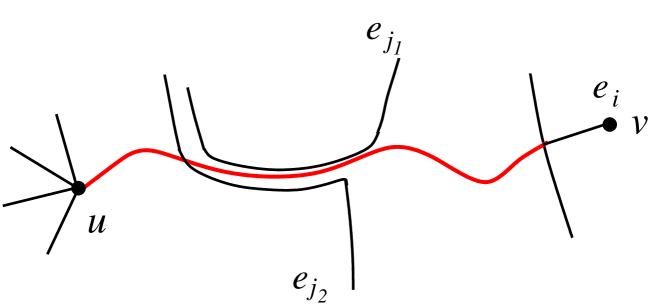
Given , we now redraw the edges of outside of as follows. First notice that for each edge , will cross at most times in . Indeed, starting at one of the endpoints of , we move along and first cross without crossing . Continuing along , since will cross at most subcurves , we have another possible crossing points on . Finally, as we approach the other endpoint of , we cross one last time for a total of at most crossing points along . Hence, outside of , each edge will give rise to at most pairwise disjoint outer arcs, with end points on . See Figure 2. Hence, all of the edges in will give rise to at most outer arcs outside of . Given the circular structure of the endpoints of these outer arcs by , we can redraw all of the outer arcs outside of such that any two outer arcs cross at most once, and the endpoints of each outer arc remain the same. Moreover, if edges and did not cross outside of , then they still do not cross outside of in the new drawing. After we redraw the outer arcs as described above, let be the new and final drawing of in the plane, and notice that the rotation system of is the same as the rotation system of . Also notice that since each edge consists of at most outer arcs, two edges and will create at most crossing points outside of in .

Finally, we show that each edge in the final drawing has at most crossing points. By the above, the number of crossing points on outside of is at most , since crosses at most other edges, and any two will create at most crossing points outside of . In order to bound the number of crossing points on inside of , let us consider the following two cases.
Case 1.
Suppose that . Recall that there are at most subcurves that cross , and for each subcurve , there are at most other edges that cross . Hence, will have at most crossing points inside of , giving us a total of at most crossing points on inside of .
Case 2.
Suppose . Again, there are at most subcurves that cross , and for each subcurve with , there are at most other edges that cross . Moreover, could have an additional crossing points along inside of . Hence, will have at most crossing points inside of .
Putting everything together, each edge in has at most crossings.
3 Concluding remarks
1.
Suppose has local pair-crossing number at most . If there is an edge with more than crossings on it, then by applying Lemma 9.2 in [17], we can simplify the drawing without creating any new pair of crossing edges (that is, the local pair-crossing number remains at most ), and without increasing the number of crossings along any edge. Repeating this step for each edge of , we end up with a drawing of having local crossing number at most .
2.
In the forthcoming journal version of this note, we show that it is possible to improve the bound in Theorem 2 to by a more involved argument.
3.
Using the redrawing technique used in the proof of Theorem 2, one can show that for any multigraph , . Although this is weaker than the result stated in the introduction due to Solé Pi, we plan to include the proof in the forthcoming journal version for the interested reader.
References
- [1] E. Ackerman. On topological graphs with at most four crossings per edge. Comput. Geom., 85:101574, 2019. doi:10.1016/J.COMGEO.2019.101574.
- [2] E. Ackerman and M. Schaefer. A crossing lemma for the pair-crossing number. In Graph Drawing and Network Visualization: 22nd International Symposium, GD 2014, Würzburg, Revised Selected Papers, pages 222–233. Springer, 2014. doi:10.1007/978-3-662-45803-7_19.
- [3] M. Ajtai, V. Chvátal, M. Newborn, and E. Szemerédi. Crossing-free subgraphs. In Theory and Practice of Combinatorics, North-Holland Math. Stud., pages 9–12. North-Holland, Amsterdam, 1982.
- [4] G. Elekes. On the number of sums and products. Acta Arithmetica, 81(4):365–367, 1997.
- [5] M. Hoffmann, C.-H. Liu, M. M. Reddy, and C. D. Tóth. Simple topological drawings of -planar graphs. In Graph Drawing and Network Visualization: 28nd International Symposium, GD 2020, Vancouver, Revised Selected Papers, pages 390–402. Springer, 2020. doi:10.1007/978-3-030-68766-3_31.
- [6] J. Karl and G. Tóth. Crossing lemma for the odd-crossing number. Comput. Geom., 108:101901, 2023. doi:10.1016/J.COMGEO.2022.101901.
- [7] J. R. Lee. Separators in region intersection graphs. arxiv:1608.01612, 2016.
- [8] F.T. Leighton. Complexity issues. In VLSI: Optimal Layouts for the Shuffle-Exchange Graph and Other Networks. MIT Press, Cambridge, MA, 1983.
- [9] J. Pach, R. Radoičić, G. Tardos, and G. Tóth. Improving the crossing lemma by finding more crossings in sparse graphs. Discrete Comput. Geom., 36:527–552, 2006. doi:10.1007/S00454-006-1264-9.
- [10] J. Pach and G. Tóth. Graphs drawn with few crossings per edge. Combinatorica, 17:427–439, 1997. doi:10.1007/BF01215922.
- [11] J. Pach and G. Tóth. Thirteen problems on crossing numbers. Geombinatorics, 9:194–207, 2000.
- [12] J. Pach and G. Tóth. Which crossing number is it anyway? J. Combin. Theory Ser. B, 80:225–246, 2000. doi:10.1006/JCTB.2000.1978.
- [13] O. S. Pi. Pair crossing number, cutwidth, and good drawings on arbitrary point sets. Discrete Comput. Geom., 73:310–326, 2025. doi:10.1007/S00454-024-00708-Z.
- [14] G. Ringel. Ein Sechsfarbenproblem auf der Kugel. Abh. Math. Sem. Univ. Hamburg, 29:107–117, 1965.
- [15] G. Ringel. A nine color theorem for the torus and the Klein bottle. In The theory and applications of graphs (Kalamazoo, Mich., 1980), pages 507–515. Wiley, New York, 1981.
- [16] M. Schaefer. Crossing Numbers of Graphs. CRC Press, 2017.
- [17] M. Schaefer and D. Štefankovič. Decidability of string graphs. J. Comput. System Sci., 68:319–334, 2004. doi:10.1016/J.JCSS.2003.07.002.
- [18] J. Matoušek. Near-optimal separators in string graphs. Combin. Probab. Comput., 23:135–139, 2014. doi:10.1017/S0963548313000400.
- [19] J. Spencer, E. Szemerédi, and W. Trotter. Unit distances in the Euclidean plane. In Graph theory and combinatorics (Cambridge, 1983), pages 293–303. Academic Press, London, 1984.
- [20] G. Tóth. Note on the pair-crossing number and the odd-crossing number. Discrete Comput. Geom., 39:791–799, 2008. doi:10.1007/S00454-007-9024-Z.
- [21] G. Tóth. A better bound for the pair-crossing number. In Thirty Essays on Geometric Graph Theory, pages 563–567. Springer, New York, NY, 2013.
- [22] P. Valtr. On the pair-crossing number. In Combinatorial and Computational Geometry, Math. Sci. Res. Inst. Publ., pages 569–575. Cambridge Univ. Press, Cambridge, 2005.