BH-tsNET, FIt-tsNET, L-tsNET:
Fast tsNET Algorithms for Large Graph Drawing

Abstract
The tsNET algorithm adapts the popular dimensional reduction method t-SNE for graph drawing to compute high-quality drawings, preserving the neighborhood and clustering structure. However, its runtime results in poor scalability for large graphs. In this poster, we present three fast algorithms for reducing the time complexity of tsNET to time and time, by integrating new fast methods for computation of high-dimensional probabilities and entropy computation with fast t-SNE algorithms for computation of KL divergence gradient. Specifically, we present two -time algorithms BH-tsNET and FIt-tsNET, incorporating partial BFS-based high-dimensional probability computation and a new quadtree-based entropy computation with fast t-SNE algorithms, and -time algorithm L-tsNET, introducing a new fast interpolation-based entropy computation. Extensive experiments using benchmark data sets confirm that BH-tsNET, FIt-tsNET, and L-tsNET outperform tsNET, achieving 93.5%, 96%, and 98.6% faster runtime, respectively, while computing similar quality drawings in terms of quality metrics (neighborhood preservation, stress, shape-based metrics, and edge crossing) and visual comparison.
Keywords and phrases:
tsNET, t-SNE, Large Graph DrawingCategory:
Poster AbstractCopyright and License:
![[Uncaptioned image]](x1.png) © Amyra Meidiana, Seok-Hee Hong, and Kwan-Liu Ma; licensed under Creative Commons License CC-BY 4.0
© Amyra Meidiana, Seok-Hee Hong, and Kwan-Liu Ma; licensed under Creative Commons License CC-BY 4.0
2012 ACM Subject Classification:
Mathematics of computing Graph algorithmsEditors:
Vida Dujmović and Fabrizio MontecchianiSeries and Publisher:
 Leibniz International Proceedings in Informatics, Schloss Dagstuhl – Leibniz-Zentrum für Informatik
1 Introduction
The tsNET [3] algorithm for graph drawing utilizes the popular dimension reduction method t-SNE (t-Stochastic Neighborhood Embedding) [11], which aims to preserve the neighborhood of data points in a low-dimensional projection.
t-SNE models the distances of data points in the high- and low-dimensional spaces as probability distributions. A low-dimensional projection is then computed by minimizing the KL (Kullback-Leibler) divergence [4] between the two probability distributions, typically using gradient descent, by moving the points in the projection according to the gradient of the KL divergence. The runtime of t-SNE is , due to the computation of pairwise distances between all pairs of data points.
tsNET uses the graph theoretic distance (i.e., shortest path) between vertices in a graph as the high-dimensional distance, which takes time, where and . Specifically, tsNET adds the following two more terms to the cost function, on top of the KL divergence term used by t-SNE: an -time compression term to accelerate untangling the drawing, and an -time entropy term for reducing clutter.
tsNET computes high-quality graph drawings which preserve the clustering and neighborhood structure of vertices. However, it is not scalable to large graphs due to the runtime for all-pair shortest path computation and runtime for the cost function.
Recently, fast t-SNE algorithms have been introduced. For example, BH-SNE (Barnes-Hut SNE) [10] utilizes NN (-Nearest Neighbors) and quadtree to reduce the computation of high-dimensional probabilities and KL divergence gradient to time. More recently, FIt-SNE (FFT-accelerated Interpolation-based t-SNE) [5] utilizes -time approximate NN to compute the high-dimensional probabilities, and a FFT (Fast Fourier Transform) [8]-accelerated interpolation to further improve the runtime of the KL divergence gradient computation to time.
However, algorithms reducing the overall runtime of tsNET have not been investigated yet. To reduce the runtime of tsNET, there are three -time components that need to be reduced: computation of all pair shortest paths, computation of KL divergence gradient, and entropy computation. While it was mentioned as a possible future work to use fast t-SNE algorithms to improve the runtime of the KL divergence term [3], methods to reduce the runtime of the entropy term were not considered yet.
In this poster, we present three new fast tsNET algorithms for drawing large graphs, integrating new fast methods for all-pair shortest path computation and entropy computation, with fast t-SNE algorithms. Specifically, our fast algorithms use a new -time partial BFS method for all-pair shortest path computation.
-
1.
The first -time BH-tsNET algorithm uses a new -time quadtree-based entropy computation, integrated with -time quadtree-based KL divergence computation of BH-SNE.
-
2.
Faster -time FIt-tsNET algorithm integrates the -time quadtree-based entropy computation with -time interpolation-based KL divergence computation of FIt-SNE.
-
3.
The fastest -time L-tsNET algorithm uses a new -time FFT-accelerated interpolation-based entropy computation, integrating -time interpolation-based KL divergence computation of FIt-SNE.
Table 1 summarizes the time complexity analysis of our fast algorithms. For the technical details, see the full version of this poster [7].
| Algorithm | Shortest Path | KL Divergence | Entropy | Overall |
|---|---|---|---|---|
| tsNET | ||||
| BH-tsNET | ||||
| FIt-tsNET | ||||
| L-tsNET |
2 Comparison Experiments
We implement BH-tsNET, FIt-tsNET, and L-tsNET in Python using the t-SNE from the scikit-learn library [9], and in C++ based on BH-SNE [10] and FIt-SNE [5]. We use benchmark graphs used in the tsNET evaluation [3] as well as standard test suites commonly used in graph drawing studies: real-world scale-free graphs, biological networks, and mesh graphs. For the details, see the full version of this poster [7].
Extensive evaluation demonstrates that BH-tsNET, FIt-tsNET, and L-tsNET obtain significant runtime improvements over tsNET, on average 93.5%, 96%, and 98.6% respectively. See Figure 1(a).




| tsNET | BH-tsNET | FIt-tsNET | L-tsNET |
| 3elt | |||
![[Uncaptioned image]](figures/3elt_tsnet.png) |
![[Uncaptioned image]](figures/3elt_bhtsnet.png) |
![[Uncaptioned image]](figures/3elt_fittsnet.png) |
![[Uncaptioned image]](figures/3elt_ltsnetfft.png) |
| oflights | |||
![[Uncaptioned image]](figures/oflights_tsnet.png) |
![[Uncaptioned image]](figures/oflights_bhtsnet.png) |
![[Uncaptioned image]](figures/oflights_fittsnet.png) |
![[Uncaptioned image]](figures/oflights_ltsnetfft.png) |
| GION_7 | |||
![[Uncaptioned image]](figures/gion7_tsnet.png) |
![[Uncaptioned image]](figures/gion7_bhtsnet.png) |
![[Uncaptioned image]](figures/gion7_fittsnet.png) |
![[Uncaptioned image]](figures/gion7_ltsnetfft.png) |
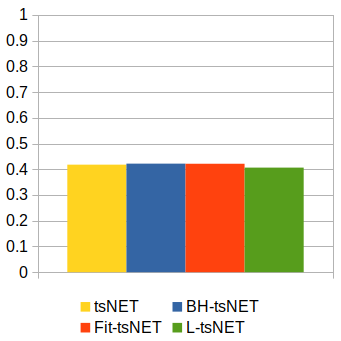
Surprisingly, our algorithms compute almost the same quality drawings as tsNET, in terms of quality metrics (neighborhood preservation [3], stress [1], edge crossings, shape-based metrics [2]), see Figures 1(b)-(e). Visual comparisons also confirm that our algorithms produce almost the same drawings as tsNET, see Table 2.
Moreover, we compare our algorithms to DRGraph, another linear-time t-SNE-based graph drawing algorithm with a different optimization function. Experiments show that our algorithms perform especially well over DRGraph in visualizing graphs with a regular structure, such as mesh graphs. For the details, see the full version of this poster [7].
Recently, we also presented fast GUMAP algorithms, designed explicitly for graph drawing based on UMAP, which reduce the time complexity from to and , utilizing spectral sparsification and edge sampling. For the details, see [6].
References
- [1] Giuseppe Di Battista, Peter Eades, Roberto Tamassia, and Ioannis G Tollis. Graph drawing: algorithms for the visualization of graphs. Pearson, 1998.
- [2] Peter Eades, Seok-Hee Hong, An Nguyen, and Karsten Klein. Shape-based quality metrics for large graph visualization. JGAA, 21(1):29–53, 2017. doi:10.7155/jgaa.00405.
- [3] Johannes F Kruiger, Paulo E Rauber, Rafael Messias Martins, Andreas Kerren, Stephen Kobourov, and Alexandru C Telea. Graph layouts by t-SNE. In CGF, volume 36(3), pages 283–294, 2017. doi:10.1111/cgf.13187.
- [4] Solomon Kullback. Information theory and statistics. Dover Publications Inc., 1997.
- [5] George C Linderman, Manas Rachh, Jeremy G Hoskins, Stefan Steinerberger, and Yuval Kluger. Fast interpolation-based t-SNE for improved visualization of single-cell rna-seq data. Nature methods, 16(3):243–245, 2019.
- [6] Amyra Meidiana and Seok-Hee Hong. SS-GUMAP, SL-GUMAP, SSSL-GUMAP: fast UMAP algorithms for large graph drawing. CoRR, abs/2509.19703, 2025. doi:10.48550/ARXIV.2509.19703.
- [7] Amyra Meidiana, Seok-Hee Hong, and Kwan-Liu Ma. BH-tsNET, FIt-tsNET, L-tsNET: fast tsNET algorithms for large graph drawing. CoRR, abs/2509.19785, 2025. doi:10.48550/ARXIV.2509.19785.
- [8] Henri J Nussbaumer. The fast fourier transform. In Fast Fourier Transform and Convolution Algorithms, pages 80–111. Springer, 1981.
- [9] Fabian Pedregosa, Gaël Varoquaux, Alexandre Gramfort, Vincent Michel, Bertrand Thirion, Olivier Grisel, Mathieu Blondel, Peter Prettenhofer, Ron Weiss, Vincent Dubourg, et al. Scikit-learn: Machine learning in python. JMLR, 12:2825–2830, 2011. doi:10.5555/1953048.2078195.
- [10] Laurens Van Der Maaten. Accelerating t-SNE using tree-based algorithms. JMLR, 15(1):3221–3245, 2014. doi:10.5555/2627435.2697068.
- [11] Laurens Van der Maaten and Geoffrey Hinton. Visualizing data using t-SNE. HMLR, 9(11), 2008.