EnMRgy: Energy Network Analysis in Mixed Reality

Abstract
The shifting and ever-growing demand for energy, for instance, driven by transformations towards new technologies such as electric vehicles, heat pumps, battery storage, or rooftop solar, requires urban infrastructure to adapt. Upgrading legacy infrastructure, such as undersized electric cables, is costly, time-consuming, and disruptive, and therefore requires a holistic perspective and thorough urban planning that considers multi energy systems and co-located utilities. We present EnMRgy, a mixed-reality decision-support system that enables experts and decision-makers to explore a city’s energy distribution networks, together with demand simulations and scenarios for infrastructure development. Within an immersive 3D city context, an energy network such as a power grid, modelled as a weighted graph, is visualised. Interactive functionalities allow users to adjust visual representations and compare scenarios across three different views. Our work enables evidence-based strategic planning for future-ready energy networks.
Keywords and phrases:
Energy, Node-Link Diagrams, Immersive Analytics, Mixed RealityCategory:
Poster AbstractCopyright and License:
![[Uncaptioned image]](x1.png) © Lucas Joos, Maximilian T. Fischer, Alexander Frings, and Daniel A. Keim; licensed under Creative Commons License CC-BY 4.0
© Lucas Joos, Maximilian T. Fischer, Alexander Frings, and Daniel A. Keim; licensed under Creative Commons License CC-BY 4.0
2012 ACM Subject Classification:
Human-centered computing Graph drawingsFunding:
The authors gratefully acknowledge financial support by the Federal Ministry for Economic Affairs and Climate Action (BMWK, grant No. 03EI1048D) and by the City of Konstanz’s Smart Green City program as part of the “Model Projects Smart Cities” funding program of the German Federal Ministry for Housing, Urban Development and Building (BMWSB, grant No. KfW 13622889).Editors:
Vida Dujmović and Fabrizio MontecchianiSeries and Publisher:
 Leibniz International Proceedings in Informatics, Schloss Dagstuhl – Leibniz-Zentrum für Informatik
1 Introduction
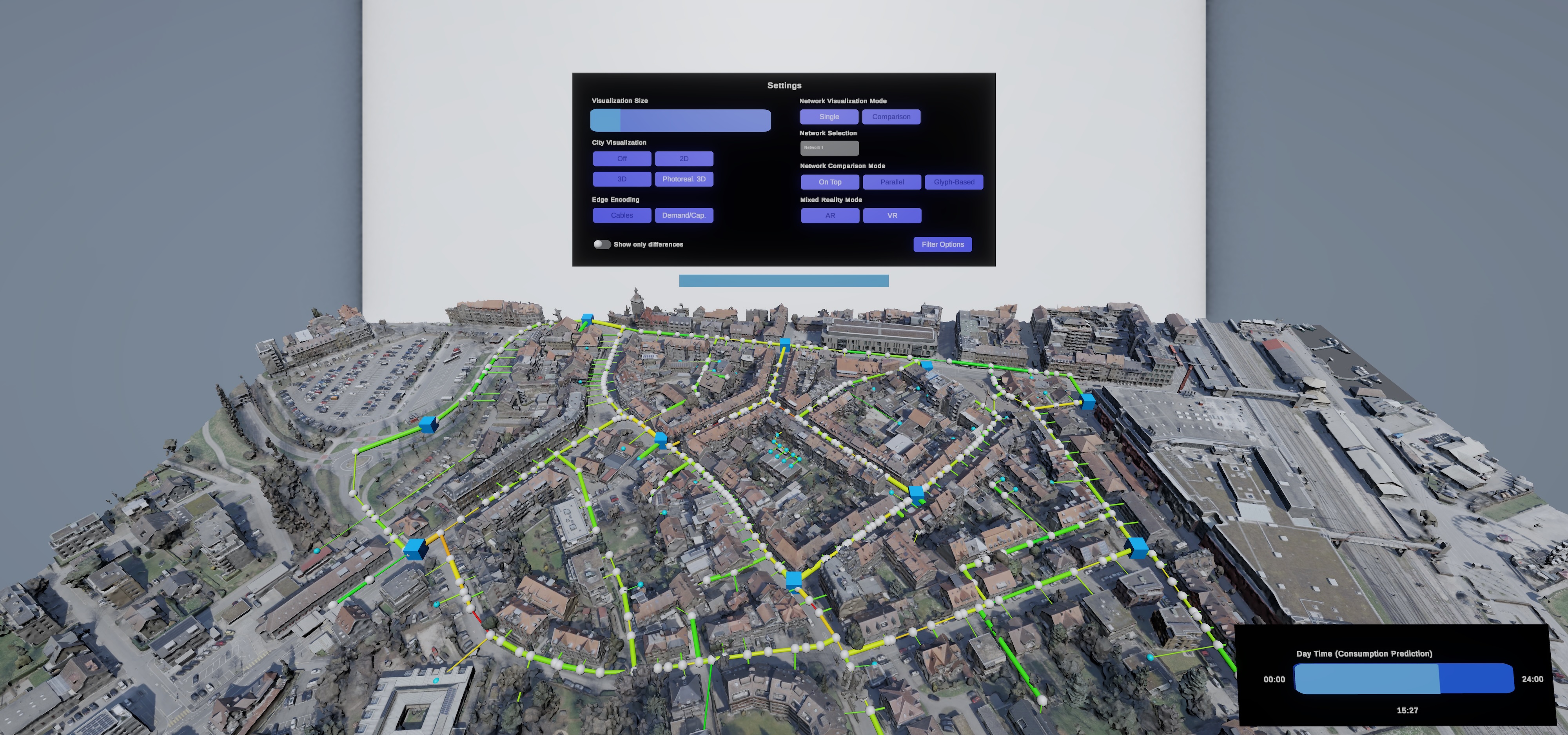
As heat pumps and electric vehicles replace combustion-based heating and transport on the move towards an all-electric society, electricity demand, especially peak loads, change. Rooftop solar adds variable generation, and batteries add new flexibility. These shifts strain legacy distribution networks built for predictable, one-way flows. Upgrading these networks is costly, slow, and disruptive, and must be coordinated with street layouts, rights of way, and co-located utilities over multi-year (often decade-long) timelines. Because actions in one energy sector (electricity, heating, fossil) affect the others, planning needs a whole-system view of multi-energy systems (MES) rather than individual analyses [3, 6].
Today, planning work is scattered across specialised domain-specific simulators, GIS tools, spreadsheets, and static reports. Engineers run power-flow and thermal-hydraulic models, planners weigh costs, permits, and construction logistics, and decision-makers juggle trade-offs under uncertainty. Comparing alternatives, such as layout changes, segmentation, or new supplies, often devolves into manual side-by-side checks. Time-varying loads, grid topology, and construction impacts (like work zones, road closures, cultural heritage protection) make it hard to see when and where bottlenecks arise. The complexity of this task requires comparative, context-rich, interpretable views [2]. Spatial optimisation links routing, cost, and geospatial constraints [9], but results are rarely explored interactively across disciplines, and cross-model comparisons remain opaque [1].
Mixed reality (MR), encompassing augmented reality (AR) and virtual reality (VR), can help address these challenges. Prior work shows that comparisons of weighted networks benefit from MR [5], especially when a three-dimensional context, such as a city model is of relevance [4]. Beyond stereoscopic vision, natural navigation can improve spatial understanding and make visual exploration more engaging [7] and enhanced visual comparison of differences between scenarios in situ. We present EnMRgy, an MR-based immersive analytics system that supports strategic MES planning for power grids.
2 The EnMRgy System
The EnMRgy (see Figure 1) provides an immersive MR environment, built with Unity and deployed on the Apple Vision Pro (2024). Interaction leverages built-in eye tracking and hand tracking for natural, controller-free gestures (e.g., gaze-and-pinch selection, manipulation, and navigation). Users can switch between AR, where surroundings and team members remain visible for collaboration, and VR for focused individual work. The system also allows users to switch between 2D ground surfaces, simplified 3D building shapes, or a photorealistic 3D model representing the city context. The weighted network, showing either cable capacities or utilisation from time-based demand simulations, is embedded in the city model (see Figure 2, top). Nodes represent consumers, junctions, and transformers. The tool leverages results from established power-flow and load-forecasting engines across energy sectors to visualise and compare critical system parameters. Simulations are typically run with specialised solvers or algorithms (e.g., PowerFactory, nPro, SPICE) using physical approximations and differential-algebraic equations (DAE). For multi-energy systems, mixed-integer optimisation is thoroughly explored [8]. A time slider lets users set the time of day used for the simulation. Users can view a single network (single mode) or compare two networks (multi mode) via (i) super-positional alignment, (ii) parallel embedding, or (iii) glyph-based representation, where differences are shown as glyphs (e.g., a 20% capacity increase) (see Figure 2, bottom, left to right). Additional visual analytics features, such as details-on-demand and filtering, complement the tool.
3 Future Perspectives
We will broaden the system’s scenario-based analysis and comparison capabilities. Planned extensions include (i) side-by-side comparison of networks with different topologies, (ii) richer demand simulations with more parameters, and (iii) additional integration of insights from recent VR research on network analysis. We will co-design additional features with domain experts to better support their workflows. Finally, we will evaluate the system’s applicability and impact through a formal user study and expert feedback.
4 Conclusion
In this work, we present EnMRgy, a mixed-reality tool for supporting decisions targeting the development and upgrade of urban energy infrastructure. The graph-based visualisation of the power grid, embedded in the 3D city context enables users to understand the current state and constraints. Through scenario-based comparison techniques and demand simulation, decision-makers can explore alternatives, advance evidence-based strategic planning, and strive toward resilient and future-ready energy network systems.
References
- [1] Kaustav Bhattacharjee, Soumya Kundu, Indrasis Chakraborty, and Aritra Dasgupta. Who Should I Trust? A Visual Analytics Approach for Comparing Net Load Forecasting Models. In 2025 IEEE PES Grid Edge Technologies Conference & Exposition (Grid Edge), pages 1–5, 2025. doi:10.1109/GridEdge61154.2025.10887523.
- [2] Maximilian T. Fischer and Daniel A. Keim. Towards a Survey of Visualization Methods for Power Grids. arXiv, 2022. doi:10.48550/arXiv.2106.04661.
- [3] Wei Gu, Zhi Wu, Rui Bo, Wei Liu, Gan Zhou, Wu Chen, and Zaijun Wu. Modeling, planning and optimal energy management of combined cooling, heating and power microgrid: A review. International Journal of Electrical Power & Energy Systems, 54:26–37, 2014. doi:10.1016/j.ijepes.2013.06.028.
- [4] Lucas Joos, Maximilian T. Fischer, Julius Rauscher, Daniel A. Keim, Tim Dwyer, Falk Schreiber, and Karsten Klein. Visual network analysis in immersive environments: A survey, 2025. doi:10.48550/arXiv.2501.08500.
- [5] Lucas Joos, Sabrina Jaeger-Honz, Falk Schreiber, Daniel A. Keim, and Karsten Klein. Visual Comparison of Networks in VR. IEEE Transactions on Visualization and Computer Graphics, 28(11):3651–3661, 2022. doi:10.1109/TVCG.2022.3203001.
- [6] Giulia Mancò, Umberto Tesio, Elisa Guelpa, and Vittorio Verda. A review on multi energy systems modelling and optimization. Applied Thermal Engineering, 236:121871, 2024. doi:10.1016/j.applthermaleng.2023.121871.
- [7] Kim Marriott, Falk Schreiber, Tim Dwyer, Karsten Klein, Nathalie Henry Riche, Takayuki Itoh, Wolfgang Stuerzlinger, and Bruce H. Thomas. Immersive analytics, volume 11190. Springer, 2018. doi:10.1007/978-3-030-01388-2.
- [8] Salman Mashayekh, Michael Stadler, Gonçalo Cardoso, and Miguel Heleno. A mixed integer linear programming approach for optimal der portfolio, sizing, and placement in multi-energy microgrids. Applied Energy, 187:154–168, 2017. doi:10.1016/j.apenergy.2016.11.020.
- [9] Jun Shu, Lei Wu, Zuyi Li, Mohammad Shahidehpour, Lizi Zhang, and Bing Han. A New Method for Spatial Power Network Planning in Complicated Environments. IEEE Transactions on Power Systems, 27(1):381–389, 2012. doi:10.1109/TPWRS.2011.2161351.