Matchgate Signatures Under Variable Permutations

Abstract
In this work, we introduce the concept of permutable matchgate signatures and leverage it to establish dichotomy theorems for #CSP and #-CSP () on planar graphs without the variable ordering restriction. We also present a complete characterization of permutable matchgate signatures and their relationship to symmetric signatures. Besides, we give a sufficient and necessary condition for determining whether a matchgate signature retains its property under a certain variable permutation, which can be checked in polynomial time. In addition, we prove a dichotomy for Pl--CSP (), where the variable ordering restriction exists.
Keywords and phrases:
Computational Complexity, Matchgate Signature, Counting CSPFunding:
Boning Meng: supported by National Key R&D Program of China (2023YFA1009500), NSFC 62532014 and NSFC 62272448.Copyright and License:
![[Uncaptioned image]](x1.png) © Boning Meng and Yicheng Pan; licensed under Creative Commons License CC-BY 4.0
© Boning Meng and Yicheng Pan; licensed under Creative Commons License CC-BY 4.0
2012 ACM Subject Classification:
Theory of computation Problems, reductions and completenessAcknowledgements:
We want to thank Mingji Xia for introducing this problem to us.Editors:
Ho-Lin Chen, Wing-Kai Hon, and Meng-Tsung TsaiSeries and Publisher:
 Leibniz International Proceedings in Informatics, Schloss Dagstuhl – Leibniz-Zentrum für Informatik
1 Introduction
Counting perfect matchings in a graph (denoted by #PM) is of great significance in counting complexity. The study of #PM was motivated by the dimer problem in statistical physics [13, 14, 15, 19], and two fundamental results emerged from this study. The first breakthrough occurred in 1961, when a polynomial time algorithm for #PM on planar graphs was developed by Kasteleyn, Temperley and Fisher [14, 19], now known as the FKT algorithm. The second significant advancement occurred in 1979, when Valiant defined the complexity class #P and proved that #PM on general graphs is #P-hard [21]. #PM was the first natural counting problem discovered to be #P-hard on general graphs and polynomial-time computable on planar graphs.
Matchgates were later introduced to generalize the FKT algorithm. Multiple studies have been undertaken to systematically define and characterize matchgates [22, 23, 24, 2, 4, 18, 7, 16]. In particular, the matchgate is proved to be highly related to the complexity classification for counting constraint satisfaction problems (denoted by #CSP) on plane graphs over Boolean domain and complex range [12, 5].
In this article, we always restrict ourselves to Boolean domain and complex range. We further develop the theory of matchgates and establish new complexity classifications for a variant of #CSP. Our primary contribution is the introduction and detailed characterization of permutable matchgate signatures – a novel concept that enables complexity analyses for #CSP variants, such as #CSP on planar graphs without the variable ordering restriction.
Section 1.1 and Section 1.2 introduce the existing results regarding matchgates and #CSP. Section 1.3 explains our motivation and presents our results.
1.1 #PM and matchgate signatures
For a graph , a matching is an edge set such that no pair of edges in shares a common endpoint. Besides, if the vertices that contains are exactly , then is a perfect matching of .
Definition 1.
An instance of #PM is a graph with weighted edges . The weight of a matching is . The output of the instance is the sum of the weights of all perfect matchings in :
When for each , the output of the instance is exactly the number of perfect matchings in the graph.
Matchgate and their associated matchgate signatures are defined in the context of #PM. A signature (also referred to as a constraint function in some works) is defined as a function that maps a string of length to a complex number. For and , we use to denote the graph obtained by deleting vertices in from .
Definition 2.
A matchgate is a plane graph with weighted edges , and together with some external nodes on its outer face labelled by in a clockwise order. The signature of a matchgate is a Boolean signature of arity and for each ,
where and a vertex in with label belongs to if and only if the th bit of is 1.
A signature is a matchgate signature if it is the signature of some matchgate. denotes all the matchgate signatures.
Matchgates provide a generalization of the FKT algorithm in the following way. Suppose is a plane graph with each vertex representing some matchgate signature, forming a signature grid. By replacing each vertex with its corresponding matchgate , the resulting graph remains a plane graph and consequently can be solved in polynomial time by the FKT algorithm. Consequently, the value of the signature grid , which is exactly , can be computed in polynomial time.
In particular, a so-called matchgate identity (MGI) has been verified to be the necessary and sufficient condition for a signature to be a matchgate signature [2, 4, 7], which provides an algebraic way to characterize matchgate signatures. This identity also enables an universal way to construct a corresponding matchgate for a matchgate signature.
Theorem 3 (MGI).
Suppose is a signature of arity . Then is a matchgate signature if and only if the following identity, denoted by MGI, is satisfied:
For each , let , . Let be the th smallest number in and let denotes a string with a 1 in the th index, and 0 elsewhere. Then
Lemma 4 ([7]).
A matchgate signature of arity can be realized by a matchgate with at most vertices, which can be constructed in time.
1.2 #CSP
A counting constraint satisfaction problem is specified by a signature set . asks for the value of an instance, which is the sum of the values over all configurations. Here, is a fixed and finite set of signatures. An instance of is specified as follows:
Definition 5 (#CSP [10]).
An instance of has variables and signatures from depending on these variables. The value of the instance then can be written as
where are signatures in and depends on for each .
The underlying graph of a instance is its incidence graph. It is a bipartite graph , where for every constraint there is a , for every variable there is a , and if and only if depends on . See Figure 1 for an example. Sometimes we also denote the value as for convenience.
There are several important variants of #CSP. A signature is said to be symmetric if the output of depends only on the Hamming weight of the input. If each signature in is restricted to be symmetric, this kind of problem is denoted by symmetric #CSP, or sym-#CSP for short. If the maximum degree of the vertices in is at most a constant , this kind of problem is denoted by -CSP [9]. If each vertex in is of degree 2, this kind of problem is denoted by Holant [8] (See Definition 15 for details). If we restrict to be a plane graph, in which the variables that depends on are ordered clockwise for each (denoted by the variable ordering restriction), then we denote this problem as Pl-#CSP. Pl--CSP is defined similarly.
To study the complexity of these problems, a number of dichotomy theorems have been established, which classify that for each signature set, the specified problem is either polynomial-time computable or #P-hard. and are two fundamental tractable signature sets, whose definition can be found in [9]. denote the matchgate signatures under a specific holographic transformation explained later in Section 2.2.2.
Theorem 6 ([9]).
If or , then is polynomial-time computable; otherwise it is #P-hard.
Theorem 7 ([9]).
Suppose is an integer. If or , then is polynomial-time computable; otherwise it is #P-hard.
Theorem 8 ([5]).
If or or , then is polynomial-time computable; otherwise it is #P-hard.
1.3 Motivation and results
The study of counting complexity has been extended to a number of different graph classes. In particular, the complexity of #PM on minor-excluded graphs has been fully classified by [11, 20]. These results generalize the FKT algorithm and the #P-hardness of #PM on general graphs. It is natural to consider adapting other counting algorithms and hardness results related to #PM, such as the dichotomy for #CSP, to the minor-excluded setting. However, existing results on Pl-#CSP rely on the variable ordering restriction, a restriction for the signatures rather than the graph class. This limitation obstructs the direct extension of Pl-#CSP to broader graph families.
To overcome this limitation, we focus on #CSP on planar graphs without the variable ordering restriction. We use to denote the class of planar graphs and #CSP to denote #CSP specified by the signature set over the graph class . #CSP is exactly #CSP on planar graphs without the variable ordering restriction.
Before investigating #CSP, we also observe that the complexity classification for Pl--CSP remains open in the literature. To address this gap, we establish the following result:
Theorem 9.
Suppose is an integer. If or or , Pl--CSP is polynomial-time computable; otherwise it is #P-hard.
The full proof of Theorem 9 is similar to that of Theorem 7 originally presented in in [9, Section 6], and can be found in the full version. Here, we only remark the major differences between the two proofs.
Returning to the framework of #CSP, we demonstrate that the concept of permutable matchgate signatures plays a pivotal role in establishing its dichotomy theorem in a straightforward way.
Definition 10 (Permutable matchgate signature).
Suppose is a signature of arity . For a permutation , we use to denote the signature
If for each , is a matchgate signature, we say is a permutable matchgate signature.
We use to denote the set of all the permutable matchgate signatures.
Theorem 11.
Let be a finite signature set and be an integer.
If or or , is polynomial-time computable; otherwise it is #P-hard.
If or or , is polynomial-time computable; otherwise it is #P-hard.
Proof.
Let . Then we have . By Definitions of and , or if and only if or respectively. Furthermore, if and only if by Definition 10. Consequently, we are done by replacing the tractable criteria for in Theorem 8 with those for . The same argument holds for as well.
The main contribution of this article is a detailed characterization of permutable matchgate signatures, showing the connection between them and symmetric matchgate signatures. This characterization has been proved to be useful in the algorithm design and the hardness proof in the subsequent work [17]. A signature is said to be realized by if it can be simulated using signatures in under polynomial-time Turing reduction.
Theorem 12 (Informal version of Theorem 25).
Each permutable matchgate signature of arity can be realized by a symmetric matchgate signature of arity and binary matchgate signatures.
Theorem 13 (Informal version of Theorem 26).
For each permutable matchgate signature , if #-CSP is #P-hard, then a symmetric matchgate signature , satisfying #-CSP is #P-hard, can be realized by and 3 specific matchgate signatures .
It is noteworthy that there are actually three types of permutable matchgate signatures (Pinning, Parity, Matching) possess different properties, but they are all related to the corresponding symmetric matchgate signatures by our proof.
In addition, we also present a sufficient and necessary condition for determining whether a matchgate signature retains its property under a specific variable permutation. This condition is a simplified version of the MGI property, since it only requires considering equations from MGI rather than all equations.
Theorem 14 (Informal version of Theorem 22).
Suppose is a matchgate signature satisfying and is a permutation. Then retains MGI if specific equations from MGI are still satisfied.
2 Preliminaries
2.1 Counting problems
For a string , the Hamming weight of is the number of s in , denoted by . We use to denote the string that differs from at every bit, which means for each .
For a signature , is denoted by the arity of . A symmetric signature of arity can be denoted by , or simply when is clear from the context, where for , is the value of when the Hamming weight of the input is . For , we also use the notation to denote the signature . We use and to respectively denote polynomial-time Turing reduction and equivalence. We denote by the signature that pins the th variable to :
2.1.1 Holant problems
A Holant problem can be seen as a problem with the restriction that all the variables must appear exactly twice.
Definition 15.
An instance of has an underlying graph . Each vertex is assigned a signature from and each edge in represents a variable. Here, is a fixed set of signatures and usually finite. The signature assigned to the vertex is denoted by . An assignment of is a mapping , which can also be expressed as an assignment string , and the value of the assignment is defined as
where and is incident to .
The output of the instance, or the value of , is the sum of the values of all possible assignments of , denoted by:
Furthermore, we use represents with the restriction that the underlying graph is bipartite, and each vertex is assigned a signature from while each vertex is assigned a signature from . We denote by the set of all equality functions. In other words, where is the signature . We also denote by for each integer . By definition, we have the following lemma. Also see Figure 1 for an example.
Lemma 16.
Let be an arbitrary graph class, be an arbitrary signature set and be an integer. Then,
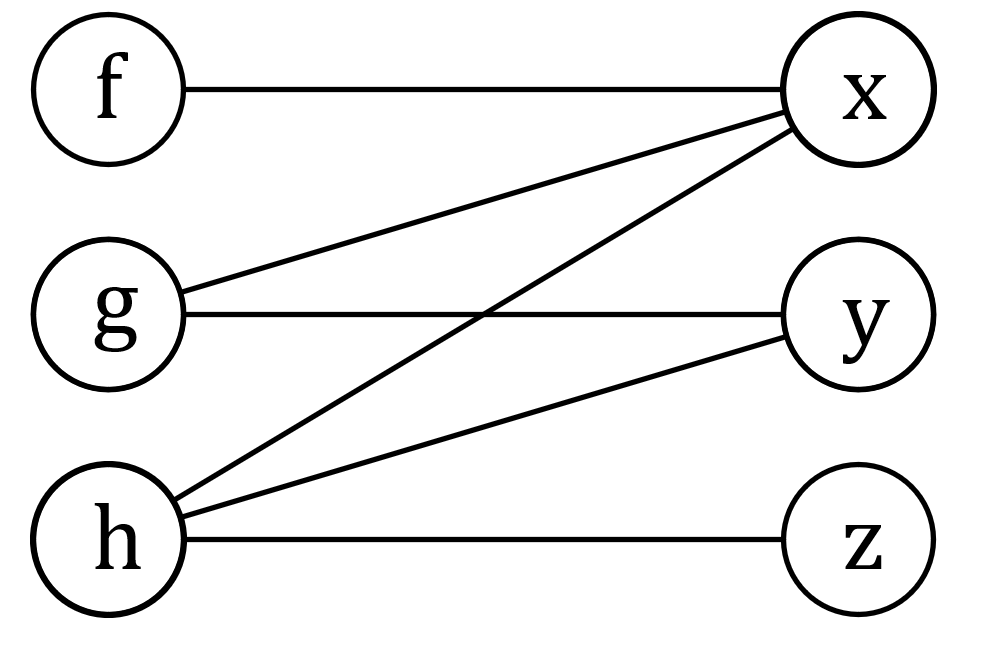
2.2 Reduction methods
2.2.1 Constructing gadgets
A gadget of has an underlying graph , where is the set of normal edges and is the set of edges with only one endpoint, called dangling edges 555In order to differentiate from the notation of a graph, we use two capital letters to represent a gadget.. Each vertex in is still assigned a signature from . A signature of arity is said to be realized by , if for each assignment , , where is the assignment of edges in . In this case, we also say can be realized by . By constructing gadgets with existing signatures, we are able to realize desired signatures.
Lemma 17.
If can be realized by , then .
Also, we present some derivative concepts related to the concept of a gadget. A left-side gadget of has a bipartite underlying graph , where each vertex is assigned a signature from , each vertex is assigned a signature from , is the set of normal edges and is the set of dangling edges. Furthermore, the endpoint of each dangling edge must belong to . It is easy to verify that, if can be realized by , then . The right-side gadget is defined similarly except that the endpoint of each dangling edge must belong to .

In the hardness proofs, we create generalized mating gadgets defined as follows, which is a generalization of the mating operation in [6]. In a generalized mating gadget, the variables of are divided into four parts: Sum-up variables, Fix-to-0 variables, Fix-to-1 variables and a single Dangling variable. We assign to each vertex of degree labelled by a solid circle in Figure 2 in the following way: for each , if the th variable is the Dangling variable, we let it correspond to the dangling edge. Otherwise we connect it to a vertex of degree 2 labelled by a hollow square. Furthermore, if the th variable is a Sum-up/Fix-to-0/Fix-to-1 variable, we assign a // signature to , and the gadget become well defined. In such constructions, the variables corresponding to or are always Sum-up variables. We remark that using we may obtain the signature, and we construct a gadget of when needed.
2.2.2 Holographic Transformation
Let be a binary signature, and we denote the two dangling edges corresponding to the input variables of it as a left edge and a right edge. Its value then can be written as a matrix , where is the value of when the value of left edge is and that of the right edge is .
This notation is conducive to the efficient calculation of the gadget’s value. Let us consider two binary signatures, and , with the right edge of connected to the left edge of . and now form a binary gadget. Subsequently, it can be demonstrated that the value of the resulting gadget is precisely , which represents the matrix multiplication of and .
For a signature of arity and a binary signature , we use to denote the signature “ transformed by ”, which is a signature of arity obtained by connecting the right/left edge of to every dangling edge of . For a set of signatures, we also define . Similarly we define . The following theorem demonstrates the relationship between the initial and transformed problems:
Let . For a set of signatures , we use to denote . As , by Theorem 18 we have:
We additionally present the following fact as a lemma for future reference.
Lemma 19.
For each , . For example, . Consequently, and for an integer , .
3 Matchgate signatures under variable permutations
In Section 3.1, we introduce the concept of the normalized matchgate signature, which simplifies the form of matchgate signatures. In Section 3.2, we prove that in polynomial time we may check whether a matchgate signature under a given permutation remains a matchgate signature. In Section 3.3, we characterize the permutable matchgate signatures in detail.
3.1 Normalize the matchgate
A matchgate signature is said to be non-trivial if it does not remain constant at 0. We say is a normalized signature if . For a normalized matchgate signature of arity and distinct , we define where and for each . For example, if the arity of is 4, then while . We denote as the index expression of , and we also say is a normalized matchgate signature without causing ambiguity.
This section presents the relationship between non-trivial matchgate signatures and normalized matchgate signatures, together with a property that normalized matchgate signatures have. The results in this section can be seen as a partial restatement of the results in [7].
Lemma 20.
Each non-trivial matchgate signature of arity can be realized by a normalized matchgate signature of arity and signatures, up to a constant factor.
Proof.
Since is non-trivial, there exists satisfying . For each , we let . It can be verified that and also satisfy MGI, which implies that is a normalized matchgate signature. Then we can use the following gadget to realize : for each satisfying , we connect a signature to the th variable of .
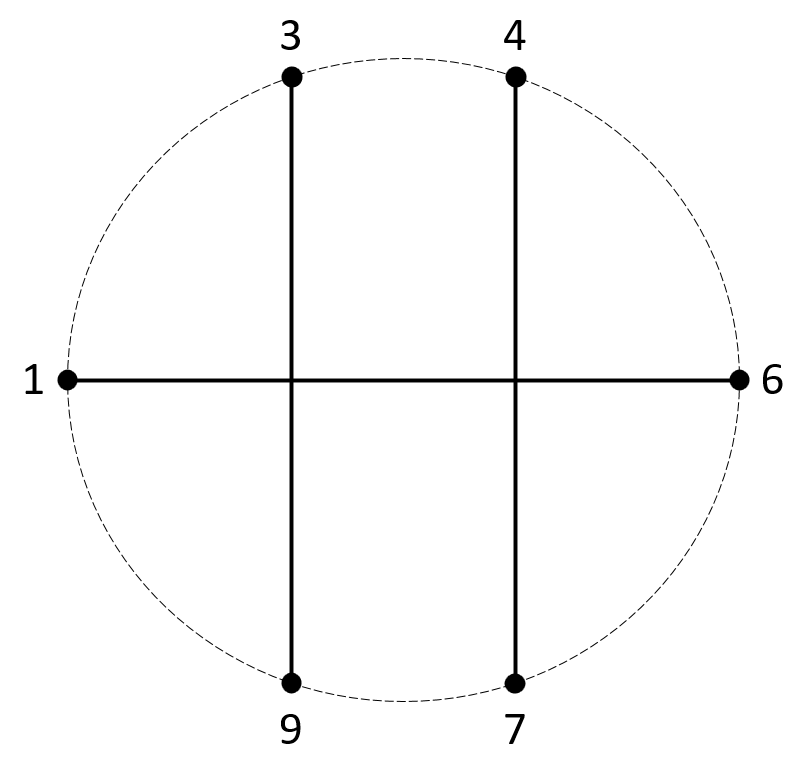
We denote as the normalization of in the above lemma. Suppose is an integer, and . is said to be an index set of size . A pairing of is a partition of whose components contain exactly 2 elements. In other words, can be seen as a perfect matching on the graph . In addition, suppose and . If is a pairing of and , then is said to be a crossing in . We use to denote the number of crossings in .
We also give a visualization of the definitions above. We draw all elements in on a circle in a sequential order. Given a pairing , we draw a straight line between the two elements in each pair belonging to . A crossing in is formed if and only if two of the straight lines form a crossing. See Figure 3 for an example.
By the construction of the universal matchgate in [7], we have the following lemma.
Lemma 21.
Suppose is a normalized signature of arity and of even parity. Then is a matchgate signature if and only if for each integer and distinct ,
3.2 Permutation Check
In this section, we show that given a normalized matchgate signature of arity and a permutation , we can decide whether is a matchgate signature in polynomial time in . To be precise, we only need to check whether satisfy all the properties in Lemma 21 restricting to .
Theorem 22.
Suppose is a normalized matchgate signature and is a permutation. If for each , , then is also a matchgate signature.
The proof of Theorem 22 can be found in the full version. Here we present the proof sketch.
Proof Sketch.
By Lemma 21, we only need to prove that for each integer and distinct ,
We prove this by induction. This statement is obviously true when . Now suppose this statement is true for , and we focus on the situation that .
For convenience, we use to denote for each in the following proof. As is a matchgate signature, we already have that
We begin by partitioning the set of all pairings. Suppose and is a partition of . Any pairing with no edges between and can be decomposed into two independent pairings on and , respectively. By the induction hypothesis, each of these sub-pairings satisfies the desired property. Summing over some valid partitions, we derive a system of equations relating the partial sums on the left-hand side (LHS) and right-hand side (RHS). A careful analysis of these equations – exploiting the inductive structure and combinatorial symmetries – yields the desired global equality between the LHS and RHS summations.
3.3 Characterizations of permutable matchgate signatures
By Theorem 22, we can use the following property to characterize permutable matchgate signature.
Corollary 23.
Suppose is a normalized matchgate signature of arity . Then is a permutable matchgate signature if and only if for each , .
Proof.
By Theorem 22, is a permutable matchgate signature if and only if for any permutation and integers , . Notice that also holds for arbitrary , hence by taking different , we have the following equation.
which implies .
On the other hand, if holds for arbitrary , then for any , .
Using the description above, we are able to classify and characterize the normalized permutable matchgate signatures in the following way.
Lemma 24.
For a normalized permutable matchgate signature of arity , one of the following holds:
-
1.
(Pinning type) For any distinct , we have .
-
2.
(Parity type 1) There exist distinct , such that .
-
3.
(Parity type 2) There exist distinct , such that .
-
4.
(Matching type) There exist distinct , such that , but .
Proof.
Suppose otherwise. As is not of Pinning type, there exists such that . Then for any distinct and , if , is of Parity type 1, so we may assume .
As is not of Parity type 1, . As is not of Parity type 2, and . Consequently, either , or . In either case is of Matching type, a contradiction. If is of Parity type 1, then there exist distinct , such that , and we have , indicating that is also of Parity type 2. Consequently, Parity type 1 and 2 can be concluded into a single type, denoted by Parity type, in which each signature satisfy the condition of Parity type 2.
Now we present our main theorems. We present the full proofs of them in Appendix A and B respectively. These proofs involve careful case analysis. We also note that , and is exactly , consequently Theorem 26 characterize those signatures which are #P-hard on general graphs but computable on planar graphs in the setting of #CSP.
Theorem 25.
Each permutable matchgate signature of arity can be realized by a symmetric matchgate signature and symmetric binary matchgate signatures up to a constant factor in the following way.
-
1.
If is of Pinning type after normalization, then and symmetric binary signatures can realize .
-
2.
If is of Parity type after normalization, then or and the symmetric binary signatures with the form or can realize .
-
3.
If is of Matching type, not of Pinning type and not of Parity type after normalization, then and the symmetric binary signatures with the form or can realize .
Theorem 26.
For each signature of arity , a symmetric signature can be realized in the setting of Holant as a planar left-side gadget.
To summarize, Theorem 25 shows that permutable matchgate signatures are exactly symmetric matchgate signatures with possible binary modification on each variable. Furthermore, for each permutable matchgate signature that may lead to #P-hardness on general graphs, Theorem 26 gives a constructive way to symmetrize them in the setting of #CSP.
4 Conclusions
In this article, we prove a dichotomy for Pl--CSP, and transform the Pl-#CSP dichotomies into #CSP dichotomies on planar graphs. We present the sufficient and necessary condition for a matchgate signature and a permutation such that is a matchgate signature as well, which can be checked in polynomial time. We also define the concept of permutable matchgate signatures, and characterize them in detail.
References
- [1] Jin-Yi Cai and Xi Chen. Complexity Dichotomies for Counting Problems. Cambridge University Press, 2017.
- [2] Jin-Yi Cai and Vinay Choudhary. Some results on matchgates and holographic algorithms. Int J Software Informatics, 1(1), 2007. URL: http://www.ijsi.org/ch/reader/view_abstract.aspx?file_no=20073.
- [3] Jin-Yi Cai and Vinay Choudhary. Valiant’s Holant theorem and matchgate tensors. Theoretical Computer Science, 384(1):22–32, 2007. doi:10.1016/j.tcs.2007.05.015.
- [4] Jin-Yi Cai, Vinay Choudhary, and Pinyan Lu. On the theory of matchgate computations. Theory of Computing Systems, 45(1):108–132, 2009. doi:10.1007/s00224-007-9092-8.
- [5] Jin-Yi Cai and Zhiguo Fu. Holographic algorithm with matchgates is universal for planar #CSP over Boolean domain. In Proceedings of the 49th Annual ACM SIGACT Symposium on Theory of Computing, pages 842–855, 2017. doi:10.1145/3055399.3055405.
- [6] Jin-Yi Cai, Zhiguo Fu, and Shuai Shao. From Holant to quantum entanglement and back. In 47th International Colloquium on Automata, Languages, and Programming (ICALP 2020). Schloss Dagstuhl – Leibniz-Zentrum für Informatik, 2020. doi:10.4230/LIPIcs.ICALP.2020.22.
- [7] Jin-Yi Cai and Aaron Gorenstein. Matchgates revisited. arXiv preprint arXiv:1303.6729, 2013. arXiv:1303.6729.
- [8] Jin-Yi Cai, Pinyan Lu, and Mingji Xia. Holant problems and counting CSP. In Proceedings of the forty-first annual ACM symposium on Theory of computing, pages 715–724, 2009. doi:10.1145/1536414.1536511.
- [9] Jin-Yi Cai, Pinyan Lu, and Mingji Xia. The complexity of complex weighted Boolean #CSP. Journal of Computer and System Sciences, 80(1):217–236, 2014. doi:10.1016/j.jcss.2013.07.003.
- [10] Nadia Creignou, Sanjeev Khanna, and Madhu Sudan. Complexity classifications of Boolean constraint satisfaction problems. SIAM, 2001.
- [11] Radu Curticapean and Mingji Xia. Parameterizing the permanent: Hardness for fixed excluded minors. In Symposium on Simplicity in Algorithms (SOSA), pages 297–307. SIAM, 2022. doi:10.1137/1.9781611977066.23.
- [12] Heng Guo and Tyson Williams. The complexity of planar Boolean #CSP with complex weights. Journal of Computer and System Sciences, 107:1–27, 2020. doi:10.1016/j.jcss.2019.07.005.
- [13] Pieter Kasteleyn. Graph theory and crystal physics. Graph theory and theoretical physics, pages 43–110, 1967.
- [14] Pieter W Kasteleyn. The statistics of dimers on a lattice: I. the number of dimer arrangements on a quadratic lattice. Physica, 27(12):1209–1225, 1961.
- [15] Pieter W Kasteleyn. Dimer statistics and phase transitions. Journal of Mathematical Physics, 4(2):287–293, 1963.
- [16] Susan Margulies and Jason Morton. Polynomial-time solvable #CSP problems via algebraic models and Pfaffian circuits. Journal of Symbolic Computation, 74:152–180, 2016. doi:10.1016/j.jsc.2015.06.008.
- [17] Boning Meng and Yicheng Pan. Dichotomies for #CSP on graphs that forbid a clique as a minor. arXiv preprint arXiv:2504.01354, 2025. doi:10.48550/arXiv.2504.01354.
- [18] Jason Morton. Pfaffian circuits. arXiv preprint arXiv:1101.0129, 2010.
- [19] Harold NV Temperley and Michael E Fisher. Dimer problem in statistical mechanics-an exact result. Philosophical Magazine, 6(68):1061–1063, 1961.
- [20] Dimitrios M Thilikos and Sebastian Wiederrecht. Killing a vortex. In 2022 IEEE 63rd Annual Symposium on Foundations of Computer Science (FOCS), pages 1069–1080. IEEE, 2022. doi:10.1109/FOCS54457.2022.00104.
- [21] Leslie G Valiant. The complexity of computing the permanent. Theoretical computer science, 8(2):189–201, 1979. doi:10.1016/0304-3975(79)90044-6.
- [22] Leslie G Valiant. Quantum computers that can be simulated classically in polynomial time. In Proceedings of the thirty-third annual ACM symposium on Theory of computing, pages 114–123, 2001. doi:10.1145/380752.380785.
- [23] Leslie G Valiant. Expressiveness of matchgates. Theoretical Computer Science, 289(1):457–471, 2002. doi:10.1016/S0304-3975(01)00325-5.
- [24] Leslie G Valiant. Holographic algorithms. SIAM Journal on Computing, 37(5):1565–1594, 2008. doi:10.1137/070682575.
Appendix A Proof of Theorem 25
Lemma 27.
If is a normalized permutable matchgate signature of arity of Parity type, then there exist a function such that for any distinct , .
Proof.
As is of Parity type, there exist distinct , such that . To avoid ambiguity, we use to denote a specific complex number satisfying . We also use to denote the complex number . Let , and . For each , let . Since , is well-defined.
It is easy to verify that . For each ,
For any distinct satisfying ,
Now we analyze normalized permutable matchgate signatures of Matching type.
Lemma 28.
Suppose is a normalized permutable matchgate signature of arity of Matching type. If is not of Parity type, then there exists an integer such that for any distinct , if , . Furthermore, if and , then .
Proof.
Suppose otherwise. Since is of Matching type, there exist distinct such that . There are three possible cases.
-
1.
There exist distinct such that . It is obvious that can serve as a certificate that is of Parity type 1.
-
2.
There exist distinct such that . Again, can serve as a certificate that is of Parity type 1.
-
3.
There exist such that . In this case, can serve as a certificate that is of Parity type 2.
In each case, is of Parity type, which is a contradiction.
By Lemma 21, if and , then , since for each of size greater than 2 there always exists such that .
Proof of Theorem 25.
Suppose (or the index expression of ) is a normalization of . For each case, we first realize , then we analyze through Lemma 20.
If is of Pinning type, by Lemma 21 . By Lemma 20, can be realized by connecting a signature to some variables of .
If is of Parity type, by Lemma 27 there exists a function such that for any distinct , . Then we can use the following gadget to realize : for each , we connect a signature to the th variable of . By Lemma 20, can be realized by connecting a signature to some variables of .
Now for some variables of , they are connected to a signature, then a signature, where is the index of the variable. For each such variable, we replace the with a and the with a respectively. The signature of the gadget remains the same after the replacement as .
Now consider the gadget formed by and all the connecting to it. If there is an odd number of signatures, the signature of the gadget is . If there is an even number of signatures, the signature of the gadget is . For each , the binary signature connecting to the th variable of is either or , which has the form or up to a constant factor.
If is of Matching type, not of Pinning type and not of Parity type, then by Lemma 28 there exists such that the following holds: for any distinct , if , then . Let and for each . It can be verified that the following gadget realize : for each , we connect a signature to the th variable of ; we also connect a signature to the th variable. By Lemma 20, can be realized by connecting a signature to some variables of , which completes the proof. Besides, if there are two connecting to the th variable of , we can remove them without changing the signature of the gadget for future convenience.
We denote the gadget in the above lemma as the star gadget of , and as the central signature of . For each , all the binary signatures connecting to the th variable of in a line form a gadget, and the signature of the gadget is denoted by the th edge signature.
Appendix B Proof of Theorem 26
We remark that and is closed under gadget construction. Hence when proving the above theorem, we only need to ensure that the obtained is symmetric and does not belong to .
Besides, such must have one of the following forms:
Lemma 29 ([12]).
Suppose and is symmetric. Then has one of the following forms.
-
1.
;
-
2.
;
-
3.
;
-
4.
;
-
5.
.
Remark 30.
In the following, we always construct the left-side gadget of . For future convenience, whenever is an edge and both and are assigned in a gadget, we actually mean that we replace with where is assigned a signature in the gadget. Besides, if a gadget is formed by connecting two existing gadgets together, we also automatically replace the connecting edge with , where is assigned a signature. These operations would not change the signature of the gadget. Consequently, it can be verified that each obtained gadget always remains a left-side gadget in our following constructions.
If is of Pinning type, we have as and is closed under gadget construction. Consequently, is either of Parity type, or of Matching type and not of Parity type.
B.1 Parity type case
Suppose is of Parity type. By Theorem 25, three kinds of binary signatures may connect to the central signature in the star gadget , which are and respectively. Suppose and are connected to . Then we have where is also of Parity type.
By assigning signature to , we realize . By assigning back to again we can realize the signature in a planar way. Consequently, we may assume all the signatures connected to has the form since we can eliminate all of the s and s by gadget construction. We also assume that for each , the th variable of is connected to the binary signature .
Case 1: .
If , is already symmetric and we are done. Now we assume . For distinct , if we connect a signature to each variable of except for the th and the th one, we realize the signature. If , and we are done.
Now we suppose for any distinct , . For any distinct , we have . If and , again we are done since . If for each , , then . And since and is closed under gadget construction, we have , which is a contradiction.
Otherwise, for each , . Let , then , and is either or . Notice that each element in can become by multiplying or 0 to 3 times. Consequently, we may connect 0 to 3 or to each variable of to get a gadget , such that after replacing with the gadget , each edge signature of the obtained star gadget is exactly . It can be then verified that, the signature of , which is also the signature of , is exactly . We are done since when .
Case 2:.
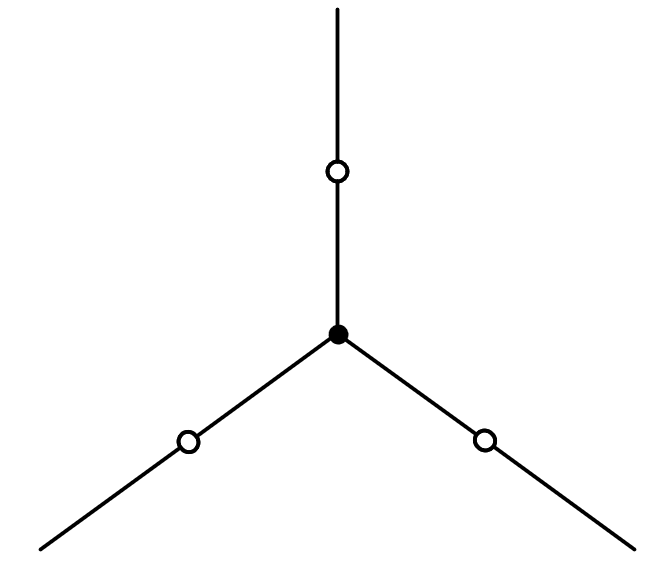
If , we suppose despite the presence of a constant factor. In other words, . Because , . By connecting the first variables of two signatures to each other, we realize . If , we are done. Otherwise, . By connecting the second variables of three signatures to , as shown in Figure 4, we realize , which is either or .
Otherwise, . For distinct , if we connect a signature to each variable of except for the th and the th one, we realize the signature. By connecting the second variable of to the th variable of , we construct a gadget whose signature is .
Now we analyze the properties of . By replacing with the corresponding star gadget in , we obtain the gadget with central signature . For the th variable of , it is connected to a signature, then a signature. We replace the with and the with respectively. As , the signature of the gadget remains the same up to a constant factor after the replacement.
Now consider the gadget formed by and the connecting to the th variable of it. The signature of the gadget is , which means that belongs to Parity type Case 1. Consequently, we are done unless for each , .
By connecting the first variable of to the th variable of , we construct a gadget whose signature is . Similarly, we are done unless for each , . As a result, the only case left is that for each , . In this case, for each , . Since and is closed under gadget construction, , a contradiction.
B.2 Matching type case
Suppose is of Matching type and not of Parity type. By Theorem 25, two kinds of binary signatures may directly connect to the central signature in the star gadget , which are and respectively. Besides, the other variable of each of these signatures might also be connected to a signature. Suppose are connected to directly and of them are further connected to . Then we have where of arity is also of Matching type and not of Parity type.
When , the central signature of is , and is also of Parity type. Therefore, it can be demonstrated that . Let be the star gadget that realize as stated in Theorem 25, and be the central signature. By Theorem 25, for each , exactly one of the following statements holds.
-
1.
The th variable of is connected to a signature. In this case we denote as an upright index of , and the th variable of as an upright variable.
-
2.
The th variable of is connected to a signature, then a signature. In this case we denote as a reversed index of , and the th variable of as a reversed variable.
Suppose the number of reversed indexes of is . In the following, is examined in 4 possible cases based on . In each case, we create generalized mating gadgets defined in Section 2.2.1.
In the subsequent analysis, we can see that two kinds of generalized mating gadgets would play an important role in each case: the Gadget 1 asks exactly one variable of to be Sum-up, while the Gadget 2 asks exactly two variables of to be Sum-up. All other upright variables are Fix-to-0 and all other reversed variables are Fix-to-1.
Also, it should be noted that the subsequent analysis does not include a detailed computation of the values of the signature of each gadget. Nevertheless, readers are encouraged to verify the results of these computations for themselves using the following observation:
Each variable corresponding to or is a Sum-up variable, and consequently does not contribute to the value of the signature. If is an upright index, and the th variable of is connected to or , then the corresponding edge signature of does not contribute to the value of the gadget. Besides, the th variable of the central signature are pinned, while remains the form after this pinning. Similarly, if a reversed variable of is connected to or , the same statement holds. Furthermore, if a reversed variable is set to be the Sum-up variable in the generalized mating gadget, then the 2 signatures meet and have no effect to the value of the gadget.
Case 1: .
Let be distinct integers.
Gadget 1.
Construct a generalized mating gadget. Let the th variable be Dangling, the th variable be Sum-up and all other variables of be Fix-to-0.
By Gadget 1, we realize the signature , and we are done unless . Similarly, by replacing with in the construction of the above gadget, we are done unless . Now we assume .
Gadget 2.
Construct a generalized mating gadget. Let the th variable be Dangling, the th and the th variable be Sum-up and all other variables of be Fix-to-0.
By Gadget 2, we realize the signature . Similarly by replacing with or , we realize and respectively. As , and one of them does not equal to 0. Without loss of generality let , and we have .
Case 2: .
Let be distinct integers and be the reversed index of .
Gadget 1.
Construct a generalized mating gadget. Let the th variable be Dangling, the th variable be Sum-up and all other variables of be Fix-to-0.
By Gadget 1, we realize the signature , and we are done unless . Similarly, by replacing with in the construction of the above gadget, we are done unless . Now we assume .
Gadget 2.
Construct a generalized mating gadget. Let the th variable be Dangling, the th and the th variable be Sum-up and all other variables of be Fix-to-0.
By Gadget 2, we realize the signature . Similarly by replacing with or , we realize and respectively. Similar to the analysis in Case 1, we are done.
Case 3: .
Let be distinct integers and be reversed indices of .
We first realize the signature using and . By connecting a to each variable of representing , a to each upright variable of and a to the th variable, we realize the signature. By making self-loops on , we realize either or . If we realize , we can realize as well by tensor production.
Gadget 1.
Construct a generalized mating gadget. Let the th variable be Dangling, the th variable be Sum-up, the th variable be Fix-to-1 and all other variables of be Fix-to-0.
By Gadget 1, we realize the signature , and we are done unless . Similarly, by replacing with in the construction of the above gadget, we are done unless . Now we assume .
Gadget 2.
Construct a generalized mating gadget. Let the th variable be Dangling, the th and the th variable be Sum-up and all other variables of be Fix-to-0.
By Gadget 2, we realize the signature . Similarly by replacing with or , we realize and respectively. Similar to the analysis in Case 1, we are done.
Case 4: .
Let be distinct reversed indices of .
We first realize the signature using and . By connecting a to each variable of representing , a to each upright variable of and a to the th variable, we realize the signature. By making self-loops on , we realize either or . Again, if we realize , we can realize as well by tensor production.
Gadget 1.
Construct a generalized mating gadget. Let the th variable be Dangling, the th variable be Sum-up, all other reversed variables of be Fix-to-1 and all other upright variables of be Fix-to-0.
By Gadget 1, we realize the signature , and we are done unless . Similarly, by replacing with in the construction of the above gadget, we are done unless . Now we assume .
Gadget 2.
Construct a generalized mating gadget. Let the th variable be Dangling, the th and the th variable be Sum-up, all other reversed variables of be Fix-to-1 and all other upright variables of be Fix-to-0.
By Gadget 2, we realize the signature . Similarly by replacing with or , we realize and respectively. Similar to the analysis in Case 1, we are done.