BlindPerm: Efficient MEV Mitigation with an Encrypted Mempool and Permutation
Abstract
Maximal Extractable Value (MEV) is a crucial challenge in blockchains and cryptocurrencies. A principal countermeasure is using encrypted mempools to hide the transaction payloads until they are committed in a block. However, the existing approaches based on encrypted mempools remain vulnerable to metadata leakage and may not provide sufficient mitigation against block producers due to their sole control in block preparation. In this paper, we propose techniques that utilize randomized permutation on the committed block, offering a multi-layer solution. With a focus on proof-of-stake (PoS) committee-based consensus, we then introduce BlindPerm, a framework that enhances an encrypted mempool with permutation and present various optimizations. Notably, we propose a construction where this enhancement comes at essentially no overhead by piggybacking on the encrypted mempool and without relying on any external entity such as randomness beacon. Further, we illustrate the effectiveness of our solutions by running simulations using historical Ethereum data.
Keywords and phrases:
Encrypted mempool, maximal extractable value, distributed systemsCopyright and License:
![[Uncaptioned image]](x1.png) © Alireza Kavousi, Duc V. Le, Philipp Jovanovic, and George Danezis; licensed under Creative Commons License CC-BY 4.0
© Alireza Kavousi, Duc V. Le, Philipp Jovanovic, and George Danezis; licensed under Creative Commons License CC-BY 4.0
2012 ACM Subject Classification:
Security and privacy Public key (asymmetric) techniquesEditors:
Andrei Arusoaie, Emanuel Onica, Michael Spear, and Sara Tucci-PiergiovanniSeries and Publisher:
 Leibniz International Proceedings in Informatics, Schloss Dagstuhl – Leibniz-Zentrum für Informatik
1 Introduction
Blockchains and in particular cryptocurrencies initially emerged with a focus on presenting a robust financial ecosystem, but the lack of attention to the issue of ordering manipulation turned out to be problematic. It became more serious with the introduction of decentralized finance (DeFi) and in particular decentralized exchange (DEX). The execution mechanism behind these platforms called smart contract has some level of transaction ordering dependence [32] that allows ordering manipulation to cause a major impact on the traded crypto asset by the actors [19]. So, a block producer can take advantage of such opportunities to achieve some benefit beyond the regular transaction fee and block reward. An illustrative scenario on a DEX known as sandwich attack involves front-running (i.e., placing a transaction before) and then back-running (i.e., placing a transaction after) a victim’s transaction to exploit the forced price fluctuations in the traded asset at the cost of victims’ loss. The profits made via including, excluding, or re-ordering transactions within blocks are described as maximal extractable value (MEV)[19]. Not only the block producer (i.e., miner, validator) can readily extract MEV due to their centralized role in preparing the block, but also any actor in the system known as searcher [1] can do so by observing the state of the system and the knowledge of profitable transactions. This mostly comes from the public nature of the blockchain that offers such knowledge, with speedy connections giving a better advantage. Note that performing the sandwich attack properly requires the correct placement of the transactions relative to that of the victim; otherwise, it may not be profitable or even lead to a loss for the attacker. Adoption of services like Flashbots [1] makes the MEV extraction even easier due to the ability to offer front-running as a service [40].
Recent years have seen substantial efforts to combat the negative effects of MEV, reflected in numerous academic works. Arguably the most notable ones are so-called order fairness protocols that consider providing a notion of fairness for the transactions that appear in a finalized block. This notion, however, is not universally agreed upon and may have various interpretations. Timed ordering [31, 30, 14] and blind ordering [52, 35, 17] are two well-known notions in the literature that aim at providing mitigation at the consensus layer. In essence, the former fallows a first come-first served approach and determines the final ordering of transactions according to their arrival times at the system and the latter hides the content of transactions until their ordering is fixed, preventing any conscious manipulation in the meantime. It is worth mentioning that both approaches aim at providing strong ordering guarantees that mitigate catastrophic effects of MEV on the system sustainability and in particular users. This may come at the cost of downgrading incentive compatibility for profit-seeking (i.e., rational) entities such as validators [4]. Having said that, Bahrani et al. [6] show an impossibility result for having fee mechanisms with incentive compatibility for both users and block-producers while having block-producers extract MEV, unless with the use of cryptography or trusted hardware.
Given that the existing proposals following timed ordering have expensive configuration costs and usually require non-optimal fault tolerance and high latency (due to enforcing extra constraints on consensus layer), realizing blind ordering in various settings has received plenty of attention [29]. However, there are two principal drawbacks to this approach that might severely affect its usefulness. First, the block producer can easily frontrun other transactions regardless of their contents, e.g., upon observing an arbitrage opportunity triggered by the latest block [40]. Consider a scenario where a popular non-fungible token (NFT) is dropped and the block producer decides to buy some NFT. They can place their transaction in an early spot, front-running others and buying at a lower price. Second, blinding is concerned with the payload of the transaction, and the leakage of side information (i.e., metadata such as submission time or address) may be enough for the attacker to carry out the attack [52].
The main intuition behind blind ordering is to make the ordering of transactions independent of their contents. We observe that a random permutation on the committed block also renders the final ordering independent of the committed one. So, one can consider it as a solution at the execution layer where the permutation mitigates any ordering manipulation already occurring in the committed block before it affects the state of the system. This is a useful strategy in mitigating the power of the block producer in imposing their desired ordering, that is shown to capture the majority of total MEV [36]. Deploying permutation is also helpful in protecting against those types of MEV that negatively affect users, particularly sandwich attacks [2]. This is due to the fact that a random permutation can either make the attack non-profitable or turn a definite profit into a possible loss simply by shuffling the front-running and the back-running transactions, creating a dilemma for the attacker.111In some blockchain systems like Ethereum, priority fees might be an important factor in affecting the inclusion and relative ordering of transactions within a block. Others like Algorand follow different ordering rules and fee only affects inclusion if at all. We note that our focus is this work is agnostic to these variations..
Random ordering has recently received attention at an abstract level, analyzing it as an ex-ante fairness where the profit a validator obtains via MEV extraction is measured relative to a random ordering as a base [3]. In this work, we show how to realize such random ordering efficiently using cryptographic techniques. We take a step further and argue about the importance of a combined solution, where blind ordering and permutation enhance each other in a complementary manner. More precisely, an encrypted mempool that is the core of blind ordering mitigates content-related attacks such as censoring, or congestion and spamming, where an attacker may fill out the mempool in the hope of front-running/back-running a profitable transaction and thus diminishing the effectiveness of the permutation [21]. Also, permutation on a committed block strengthens the effectiveness of an encrypted mempool by mitigating the role of metadata leakage and the advantage of the block producer to take the (top of the block) MEV solely.
Contributions.
The contributions of this work are as follows.
-
1.
We introduce BlindPerm, a framework that combines an encrypted mempool with permutation to provide enhanced MEV mitigation for BFT style consensus. Particularly noteworthy is that our permutation-based enhancement is generic and can come at essentially no additional cost in comparison to regular blind ordering without shuffling.
-
2.
We present several optimizations that might be of independent interest, including selective encryption which enables users to only protect their MEV-potential transactions through encryption, thereby offering efficiency gains over a fully encrypted mempool. As a side contribution, in Appendix C we show how to extend our permutation techniques to Layer-2 blockchain protocols where instead of a BFT committee a single coordinator/sequencer conducts verifiable permutation.
-
3.
We demonstrate the effectiveness of our methods via simulating MEV extraction using the Ethereum historical data. We deploy the heuristics proposed in the literature [40] to detect arbitrage and sandwich attacks in the blocks over a one-year period and compare with the existing opportunities after applying our methods.
Limitations.
Although shuffling is a powerful technique, a block producer may try to get around it. In an extreme scenario, they can just put a single transaction in the block to surely capture an opportunity, say a front-running arbitrage. They can also reduce the effect of permutation by congestion, e.g., including too many of their own transactions in the block. We argue that they should give up on a large portion of the transaction fees in both cases though the revenue from MEV extraction can be nevertheless higher. It is interesting to see how to sidestep such an ability, with an intuitive solution being to make the block preparation decentralized [50]. Our constructions rely on threshold cryptosystems that might be a hurdle to implement in settings with a large population of parties and dynamic participation. Recent attempts in the literature proposed constructions for realizing threshold cryptosystems without an interactive setup phase (known as silent setup [26]) that could provide flexibility for supporting dynamic fault-tolerance and participation.
2 Background
2.1 Threat Model
We consider the setting of a Byzantine fault tolerance (BFT) system. In this setting, there are parties at most of which are corrupted by a computationally bounded adversary to do any arbitrary behavior. We assume the existence of authenticated point-to-point channels between each pair of parties. The network model is partially synchronous [23], meaning that it may oscillate between periods of synchrony and asynchrony. The common way to treat this is to consider some unknown point as global stabilization time (GST), where it triggers the periods of synchrony that allow message delivery within a known time bound. We consider the optimal resilience of in this setting [8].
2.2 Secret Sharing
A Shamir secret sharing [45] allows a dealer to distribute a secret among a set of shareholders via SS.Share(s) , such that it can only be reconstructed uniquely by at least shares SS.Combine() , while no information on the secret is revealed otherwise.
Verifiable Secret Sharing (VSS).
The basic threshold secret sharing scheme of [45] is passively secure, meaning that it works as long as the participating parties run the protocol as specified. In a Byzantine setting parties might be malicious, so the dealer needs to convince parties about the correctness of the sharing and parties need to convince a reconstructor about the correctness of their released shares. Verifiable secret sharing (VSS) does that by having the dealer commit to the sharing and broadcast it to the parties. Starting from Feldman VSS [24], there have been numerous works in the literature to develop VSS schemes with better efficiency in various network models. These are particularly concerned with two aspects of VSS schemes including broadcasting a polynomial commitment to enable share verification and having a complaint phase to deal with any faulty/missing share.
Publicly Verifiable Secret Sharing (PVSS).
To extend the scope of verifiability to the public, not only participating parties, PVSS schemes deploy cryptographic primitives such as encryption and non-interactive zero-knowledge proofs (NIZKs). This, in turn, enables anyone to verify the correctness of the sharing phase by the dealer and the reconstruction phase by the set of shareholders. A popular and well used PVSS scheme is SCRAPE [15] with the following abstract. To share a random secret , the dealer runs PVSS.Share and outputs encrypted shares with a proof of correctness . This proof enables anyone to verify the consistency of the shares (i.e., they are evaluations of the same polynomial) and the validity of the ciphertexts (i.e., they contain valid shares). Each shareholder can invoke PVTSS.Decshare to output a decrypted share with a proof of correctness . Upon collecting valid decrypted shares, anyone can reconstruct the secret via PVTSS.Combine.
2.3 Threshold Cryptography
Distributed Key Generation (DKG).
A DKG protocol [38] shares a uniformly distributed secret among parties such that each party receives a partial secret key , a partial public key , and a common public key while no individual party learns . DKGs are commonly used as a trustless setup for threshold encryption and threshold signature schemes.
Threshold Encryption.
In a threshold encryption scheme TE, one can run the algorithm to encrypt a message under a public key resulting from a DKG among a set of parties. Each party then runs the algorithm using its own secret key to obtain a partial decryption . Finally, can be decrypted by any threshold set of partial decryptions . Note that it is also possible to verify partial decryption via an additional algorithm .
Threshold Signature.
In a threshold signature scheme TS, any subset of parties of size can jointly sign a message by having each run to produce a partial signature , and then to produce the signature . Anyone can verify a partial signature via , and the signature via .
2.4 Consensus
Consensus is a fundamental problem that aims at providing a set of parties on possibly different inputs with a common decision despite adversarial behavior by at most of them. The two core properties of a consensus protocol are safety and liveness. The former ensures all the honest parties decide on the same (valid) value and the latter ensures an honest party eventually decides. Byzantine broadcast is an important variant of consensus that enables a sender to send its input to the other parties such that all the honest ones decide on the same value.
Committee-based Consensus.
Among different formulations of consensus, state machine replication (SMR) [44] enables agreement on ever-growing inputs received from external users, making it a suitable option for blockchain. Committee-based consensus protocols have become increasingly popular in recent years due to their high throughput and low latency [46, 20, 34]. In these protocols, the committee runs a BFT style consensus where BFT parties (i.e., validators) get to agree on a proposal including a batch of transactions. The protocol is typically operated view-by-view and driven by a leader (i.e., block producer). Although the interest in committees-based blockchains has led to considerable innovations in the literature, the following protocol flow is a common paradigm for SMRs.222DAG-based BFT systems allow parallel dissemination of proposals by multiple validators [46, 20]. First, the leader prepares a block of transactions and sends the proposal to all the other parties. Second, each party votes on the proposal if it is properly formed and sends the vote back to the leader. Third, upon collecting votes the leader creates a quorum certificate (QC) and disseminates it to the parties. This process repeats more than once in each view of the protocol to commit. A concrete instantiation is HotStuff-2 [34] that is an improvement over the original HotStuff [51] following a two-phase commit process per view.
2.5 Memory Pool
In the context of blockchain, a memory pool or mempool refers to where the uncommitted transactions (i.e., pending transactions) exist. The notion of encrypted mempool is wildly known as a countermeasure against MEV, addressing the information asymmetry in the blockchain state between the user and the validator via providing privacy for transactions before they are committed [43]. Among different methods in realizing an encrypted mempool, the ones with threshold security are currently offering the most desirable qualities [29]. Low latency, wide coverage, and reasonable performance are the main features that have placed this approach in a promising position.
3 A Warm-up Protocol: MEV Mitigation with Permutation
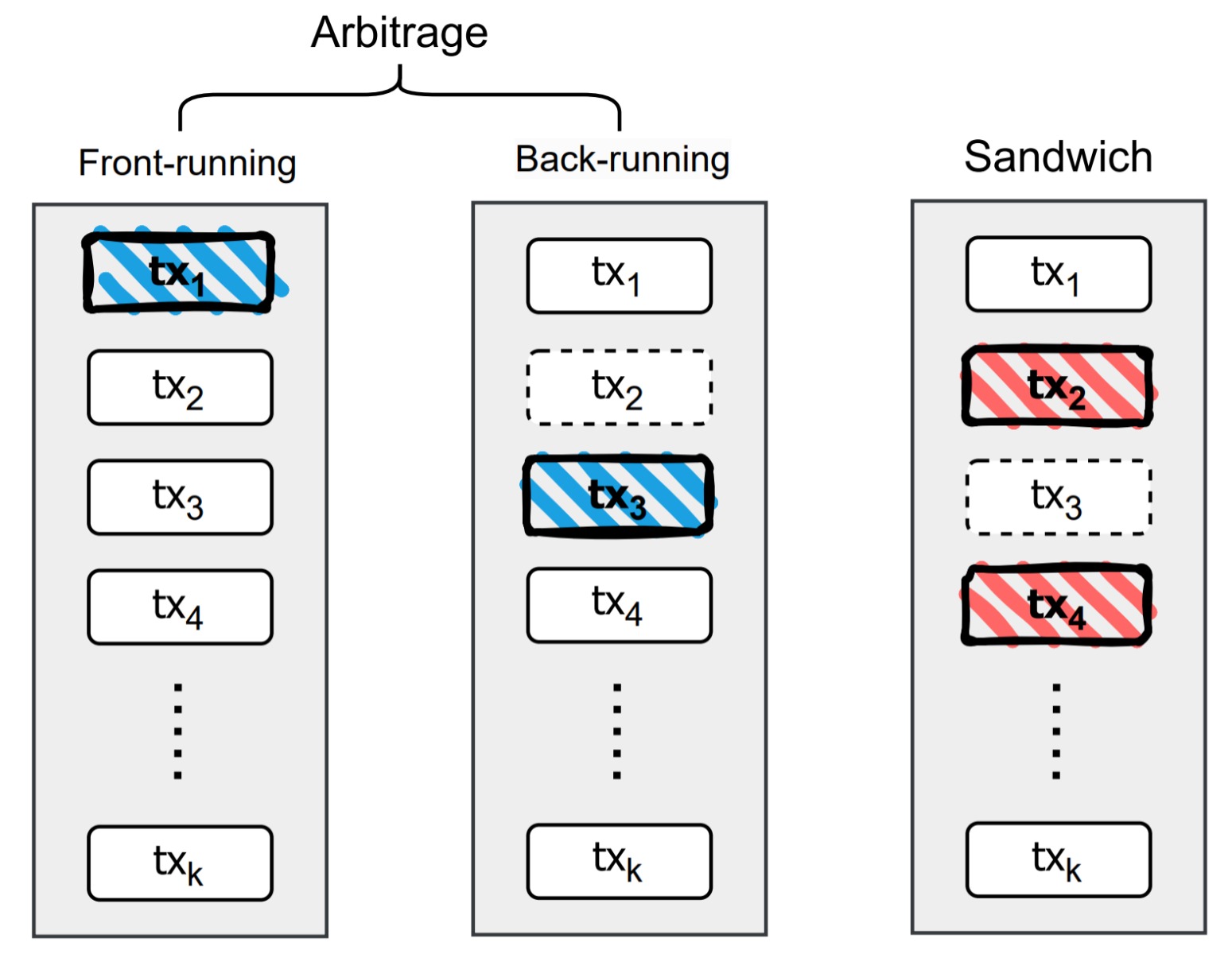
A block producer may take advantage of their full control over transaction ordering, which can lead to unfair advantages and unintended profits. For instance, they can simply place their transaction at the top of the block to benefit from a price slippage caused by some large trade on an exchange [28]. When looking closely, however, even leveraging a perfect encrypted mempool, i.e., without any metadata leakage, cannot provide enough protection. This is due to the fact that such action does not necessarily rely on the content of existing transactions in the mempool but on the latest state of the blockchain. Figure 1 depicts the common MEV extraction strategies with the highest profit in practice [40].
A random permutation on the set of transactions in a committed block takes away such forced ordering. Moreover, it hampers sandwich attacks by raising the risk of loss for the attacker. A concrete scenario would be ordering the attacker’s back-run before its front-run, causing a loss to the attacker. In another scenario, the attacker’s front-run might execute but another searcher ends up making a profit by having its back-run execute prior to that of the attacker. The permutation should occur on the committed block so that the attacker cannot nullify the outcome in case it happens not to be in its favor. It is also crucial to do it safely and in a secure way. To ensure the former, the honest validators must perform the same permutation on the same block. To ensure the latter, the randomness seeding the permutation should be unpredictable prior to the commit, and unbiasable by an adversary controlling the block producer and possibly a subset of validators. In the following section, we propose a protocol that satisfies these properties.
3.1 Protocol Description
We present our protocol in four main steps as follows. The key point is leveraging the finality of a BFT consensus to have each honest validator safely apply a permutation upon commit with shared randomness computed thereafter.
Step 1 – Submission.
Each user broadcasts their transaction tx to the network of validators.
Step 2 – Committing to the total ordering.
The protocol operates in views. Let be the current view number where a designated validator acts as the leader to propose a block . The block contains a set of transactions in the mempool. After the proposed block gets committed, each honest validator moves to the next step.
Step 3 – Deriving the seed.
To generate secure shared randomness we assume validators have already run a DKG protocol.333This is a common assumption made in the state-of-the-art BFT consensus including HotStuff-2 [34]. The randomness is securely derived by having validators jointly produce a threshold signature on the view number using a unique threshold signature scheme like BLS [11], where . Thus, when a validator observes that the block has become committed, they send a partial signature of the form by invoking to others. Let be the set of indices of valid partial signatures. Anyone can then run to produce the signature using Lagrange interpolation in the exponent. Finally, the seed for permuting block is computed as , where is a cryptographic hash function. A validator enters the next view after deriving the seed.
Step 4 – Execution.
Upon computing the seed,444A pseudorandom generator (PRG) may apply on the seed first to produce a long random string. each validator locally performs to randomly shuffle the ordering of transactions in , resulting in a permuted block . The permuted block is then executed. A standard permutation algorithm is given in [5].
3.2 Analysis
Lemma 1.
The proposed protocol satisfies a secure permutation after commit, assuming corruption threshold of holds.
Proof.
Safety and the liveness of the protocol follow directly from the underlying consensus as we treat it in a black-box manner. Due to the finality of the BFT consensus and the uniqueness of the threshold BLS signature, the honest validators apply the same permutation on a committed block they have already agreed on. Assuming at most validators are faulty, the seed is unbiasable and unpredictable to the validator proposing the block before it gets committed, guaranteeing a secure permutation.
4 BlindPerm
A broad scope of MEV comes from the availability of information about transactions, either those that are already submitted on the public mempool or the ones observed early by a capable searcher [12]. Such information could directly affect the users by facilitating the MEV for the validator or searcher through creating dependent transactions or even censoring an undesirable transaction. This essentially leads to reducing the effectiveness of the permutation as the chances of the victim’s transaction getting front-runned/back-runned nevertheless increases.555Any relative ordering of transactions is equally probable and having more dependent transactions from attackers increases the overall chance of frontrunning. Since a sole permutation-based solution cannot offer suitable protection in these situations, we propose BlindPerm, a framework that enhances an encrypted mempool with permutation. Given that an encrypted mempool may still leak some metadata related to identity or content, this combination is complementary and has the additional benefit of reducing potential negative effects, offering the best of both worlds. From the attacker’s perspective, transaction permutation shifts sandwich attacks from being riskless to being risky, and transaction blinding shifts censorship from being optional to being all-or-nothing.
Our framework includes two categories depending on the way the permutation seed is generated. The first relies on the validators and the second relies on the users to contribute to the seed. Interestingly, the second approach allows obtaining the seed essentially for free by piggybacking on the encrypted mempool. One important consideration is to ensure a guaranteed decryption for each encrypted transaction before a commit by validators; otherwise, it may either lead to an encrypted transaction being buffered indefinitely [35], or the user being able to affect the ordering according to its view of the system [7], known as speculative MEV.
4.1 Seed Contribution by Validators
In this section, we extend the protocol proposed in Section 3.1 to establish an encrypted mempool. We use threshold cryptography to let users encrypt their transactions and validators compute the seed.
Step 1 – Submission.
Each user encrypts a transaction tx under the validators’ common public key and broadcasts the encrypted transaction to the network of validators.
Step 2 – Committing to the total ordering.
The protocol operates in views. Let be the current view number where a designated validator acts as the leader to propose a block . The block contains a set of encrypted transactions in the mempool. After the proposed block gets committed, each honest validator moves to the next step.
Step 3 – Decryption and deriving the seed.
When a validator observes that the block has been committed, they produce a decryption share for each committed tx and a partial signature as their contribution towards the seed.666For ease of notation, we use the same key-pairs for both threshold encryption and signature. However, they could be different. They then send the partial decryptions together with partial signatures to others. Each validator can obtain the transaction tx and the seed by running TE.Dec and TS.Sign upon receiving valid partial contributions and enter the next view afterwards.
Step 4 – Execution.
Each validator locally performs to randomly shuffle the ordering of transactions in the committed block , resulting in a permuted block which is then executed.
4.2 Seed Contribution by Users
We now build our BlindPerm protocol with each user choosing a random symmetric-key tx-key to encrypt a transaction and secret share the key to the validators. Our main observation here is to generate the permutation seed as a function of the keys tx-key corresponding to the encrypted transactions in the committed block, e.g., XOR of all. This allows computing the seed essentially at no cost as the validators no longer produce any threshold signature and use the keys they already retrieved for decryption. Having only one honest contribution involved, the randomness is uniformly distributed. To implement secret sharing, we deploy PVSS for concreteness. However, we stress that our protocol is agnostic to the type of secret sharing scheme and all the other options presented later (see Section 8) could also be used.
Step 1 – Submission.
Each user picks a key tx-key to encrypt a transaction tx and broadcasts it to the network of validators. Moreover, the user runs PVSS.Share and broadcasts the encrypted shares and proof to the validators.
Step 2 – Committing to the total ordering.
The protocol operates in views. Let be the current view number where a designated validator acts as the leader to propose a block . The block contains a set of encrypted transactions in the mempool whose sharing has been completed at the validators. After the proposed block gets committed, each honest validator moves to the next step.
Step 3 – Decryption and deriving the seed.
When a validator observes the block has been committed, they produce a decrypted share PVTSS.Decshare for each committed transaction tx and send it to others. Upon gathering valid decrypted shares, the validator obtains tx-key using Lagrange interpolation and decrypts tx. Let be the set of keys corresponding to the valid transactions in the committed block . Each validator computes the permutation seed as and enters the next view thereafter.
Step 4 – Execution.
Each validator locally performs to randomly shuffle the ordering of transactions in the committed block , resulting in a permuted block . The permuted block is then executed.
4.3 Analysis
Lemma 2.
The proposed protocols provide confidentiality and a secure permutation after commit, assuming the corruption threshold of holds.
Proof.
The safety of the protocols directly follows from that of the underlying consensus. Due to the robustness of the underlying threshold cryptosystems, we are guaranteed to have enough shares for decryption and to derive the seed, ensuring liveness. It is guaranteed that the transactions are revealed once they are committed, given the equality of the consensus threshold and decryption threshold. When validator contribute to the seed, they need to wait for partial decryption and signature shares to run TE.Dec and TS.Sign, guaranteeing a secure permutation after commit. When users contribute to the seed, they secret share a random key tx-key to the validators. The key is recovered via running PVTSS.Combine only after committing the block by validators, guaranteeing the security of the permutation. Moreover, the existence of just one non-colluding user (with validators) implies the seed has a uniform distribution.
5 Optimizations
Selective Encryption.
Several works in the literature separate the issue of transaction censorship from the common types of MEV that suffer user experience [29, 40, 48]. Following this thread we can make some bandwidth optimization in our BlindPerm constructions, particularly the one with users’ contributions towards the seed (Section 4.2). That is, only those users owning an MEV-potential transaction encrypt and let others send their transactions in plaintext. This stems from doing the shuffling after the commit, providing protection against possible front-running, back-running, and sandwich attack against any encrypted transactions. Observe that this does not affect the security of the permutation seed for the following reason. In order for the attacker to make a profit from a victim’s transaction tx (which we assume is encrypted) via the aforementioned strategies, they need to ensure it is indeed included in the committed block. This consequently guarantees that the corresponding key tx-key will be considered in the computation of the seed seed, guaranteeing uniform randomness. In fact, even if the validator only includes one encrypted transaction (i.e., victim’s transaction) in the block it is sufficient to ensure the security of the permutation. However, one caveat arises when there is no encrypted transaction included in the committed block. It basically implies there is no MEV-potential transaction in the block and thus there is no permutation seed, paving the way for the block producer to insert their transaction at their desired spot (refer to Section 3).
Timelock Encryption.
The concept of timelock encryption or timed encryption [42] allows encrypting a message that is decryptable only after passing some determined time. In other words, it features “encrypting to the future”. To provide a guaranteed delay, traditional schemes rely on sequential computation that is unparallizable. Recently, Gaily et al. [25] presented a construction that offers the same functionality without requiring any sequential computation. In fact, it relies on an existing committee (i.e., threshold network) that produces BLS signatures on time intervals (i.e., discrete view numbers). With the use of an identity-based encryption scheme [10], anyone can encrypt a message to the future under the view number as the identity that can be decrypted only after the release of the corresponding threshold signature as the private key. Given that we already have such threshold network producing BLS signatures in our BlindPerm construction thanks to the validators (Section 4.1), one may leverage it to enable users encrypt their transactions tx to any future view number of their choice. Also, this can pose a considerable boost in communication overhead compared to the typical threshold cryptography paradigm, as the permutation seed and the decryption key for a given view number is only a single BLS signature. By separating the role of validators from the threshold network the privacy of transactions lasts even against a dishonest majority of colluding validators. However, an immediate issue that arises with a naive implementation is the possibility of decrypting a transaction tx at view without having it included in the committed block by the block producer, making it vulnerable to MEV extraction afterwards. Very recently, Choudhuri et al. [18] proposed the notion of batched threshold encryption that fixes the aforementioned issue by providing pending transaction privacy to only decrypt the batch of transactions made it to block while the partial decryption key still being independent of the batch size. An intriguing research question is how to use secure randomness both for decryption and permutation (as in [25]), while preserving privacy for pending transactions (as in [18]).
Communication-efficient PVSS.
SCRAPE [15] is a state-of-the-art PVSS with the following sharing procedure PVSS.Share. The dealer samples a uniform value , sets the secret as a group element of form , splits into shares using Shamir secret sharing, and computes the encrypted shares under parties’ public keys . The dealer also publishes commitment to shares and -sized NIZK proofs with individual shares as their witnesses, enabling anyone to check the correctness of sharing with a linear cost. Cascudo et al. [16] introduce efficiency optimizations over SCRAPE to reduce its communication and computation complexities. In particular, the dealer needs to send just -sized proof of correctness with no public commitments, making the overhead close to optimum [16]. They managed to achieve these efficiencies thanks to making two modifications in the usual model of PVSS, including assigning key pairs to the dealer and doing secret sharing in a group. Fortunately, we can use such PVSS in our BlindPerm construction by accommodating both modifications as the users are equipped with such key-pairs777Such key-pairs are nevertheless needed, either ephemeral (for wallets) or registered (for authentication). and symmetric key tx-key to share could be a random group element. We now briefly discuss the high-level idea behind the PVSS proposed in [16]. The authors initially observe that it is possible to check the correctness of sharing in SCRAPE without the involvement of the shareholders’ key-pairs. To do so, each encrypted share should be of form , establishing a shared Diffie-Hellman key between the dealer and each shareholder to communicate the share. This then turns out to be useful in allowing the dealer to produce one NIZK proof with its secret key being the witness (instead of individual shares as in SCRAPE) to ensure the correctness of sharing as a whole. We refer the reader to [16] for more details.
6 Simulation Results
We simulate the MEV extraction using real-world Ethereum data over a one-year period from August 2021 to July 2022.888The data is crawled through Ethereum archive Erigon node https://github.com/ledgerwatch/erigon. We measure the historically extracted MEV according to the heuristics introduced in [40] and compare it with the expected amount of MEV extraction after applying our methods, namely permutation and BlindPerm.999We only perform a local simulation to measure the effectiveness of our permutation-based enhancement and do not actually broadcast the transactions. We remark that the possible side-effects like congestion is handled via encrypted mempool. Moreover, in a real scenario the MEV extractors might adapt to the new mechanism that further affects the results. We run our simulations times (using Independently random seeds) to capture various relative ordering of transactions and report the average results. Note that we particularly focus on two popular strategies including arbitrage and sandwich attacks that are the most profitable [40]. For completeness, we provide the heuristics used to detect these opportunities in Appendix B.
Sandwich Attacks.
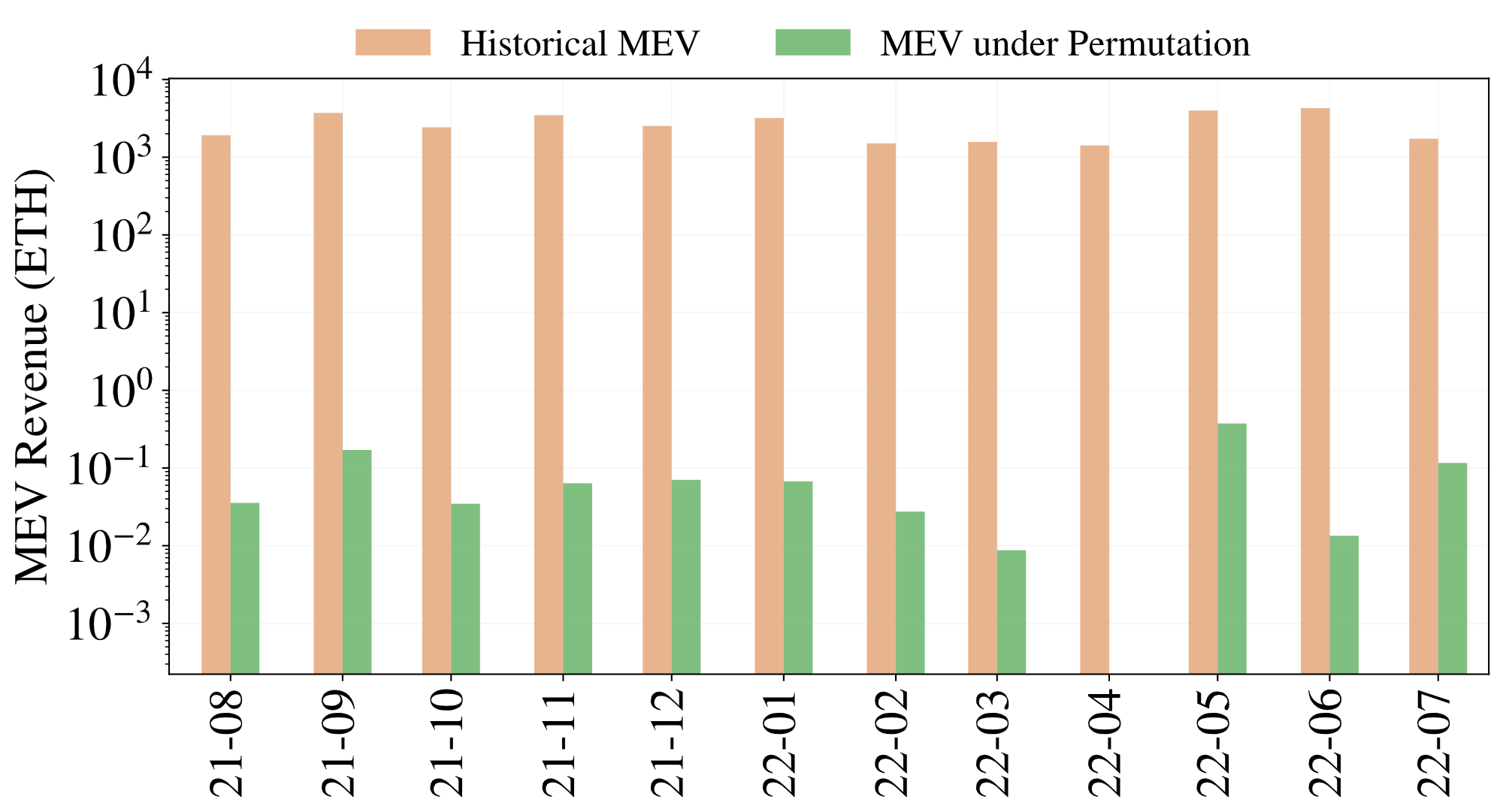
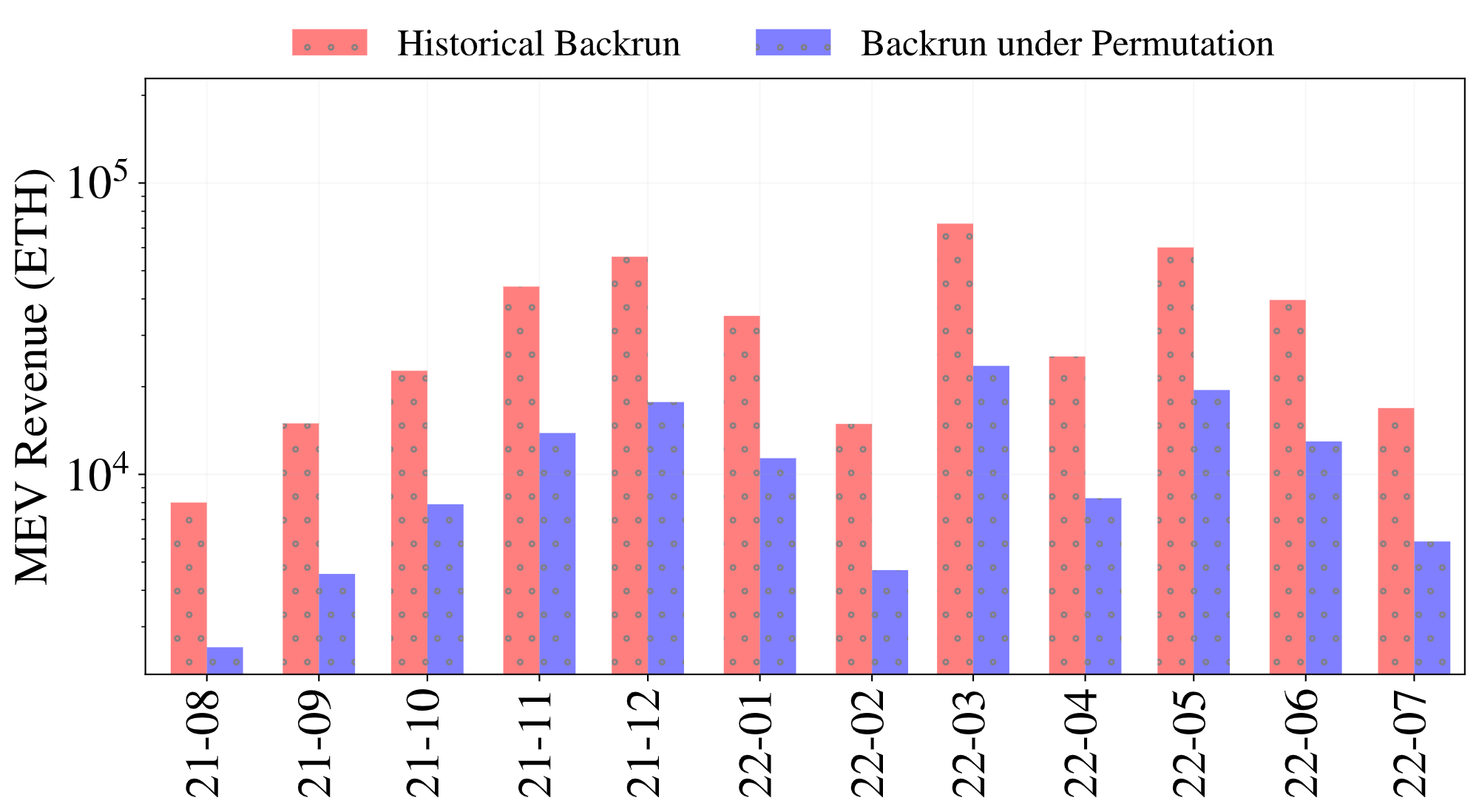
We consider two scenarios to conduct our simulations. The first scenario follows the heuristics used to detect perfect sandwich attacks where front-running, victim, and backrunning transactions are ordered immediately with no intermediaries. We measure how much revenue could have been extracted if we applied a random permutation on the list of transactions in a block before execution. We find that the revenue is reduced from a total of ETH for the historical data to ETH, showing almost a complete mitigation success as the attacks are no longer profitable.
Further, we relax the constraint and consider a (worst-case) scenario where the relative ordering of the involved transactions after permutation still holds but they are separated by multiple transactions, leading to imperfect profitable sandwich attacks.101010It is shown that over 80% of profitable sandwich attacks are perfect and also no intermediate transaction is found in almost 99.6% of privately relayed sandwich attacks [40]. To measure the expected amount of MEV extraction we find the indices of the front-running and back-running transactions, say and respectively in the historical block. If holds after the permutation, we consider win to be the event that the attack still is profitable, i.e., the victim transaction appears somewhere in the middle. So, due to the uniform distribution we have Pr[win] = , where denotes the number of transactions in the block.111111Concretely, we noticed that the average number of transactions in a block is 231 with the minimum and maximum being 3 and 1386, respectively. Thus, we find that the revenue is reduced from a total of ETH for the historical data to ETH after doing the permutation, showing almost 85% of mitigation success. The numerical results are presented in Figure 2.
Arbitrage.
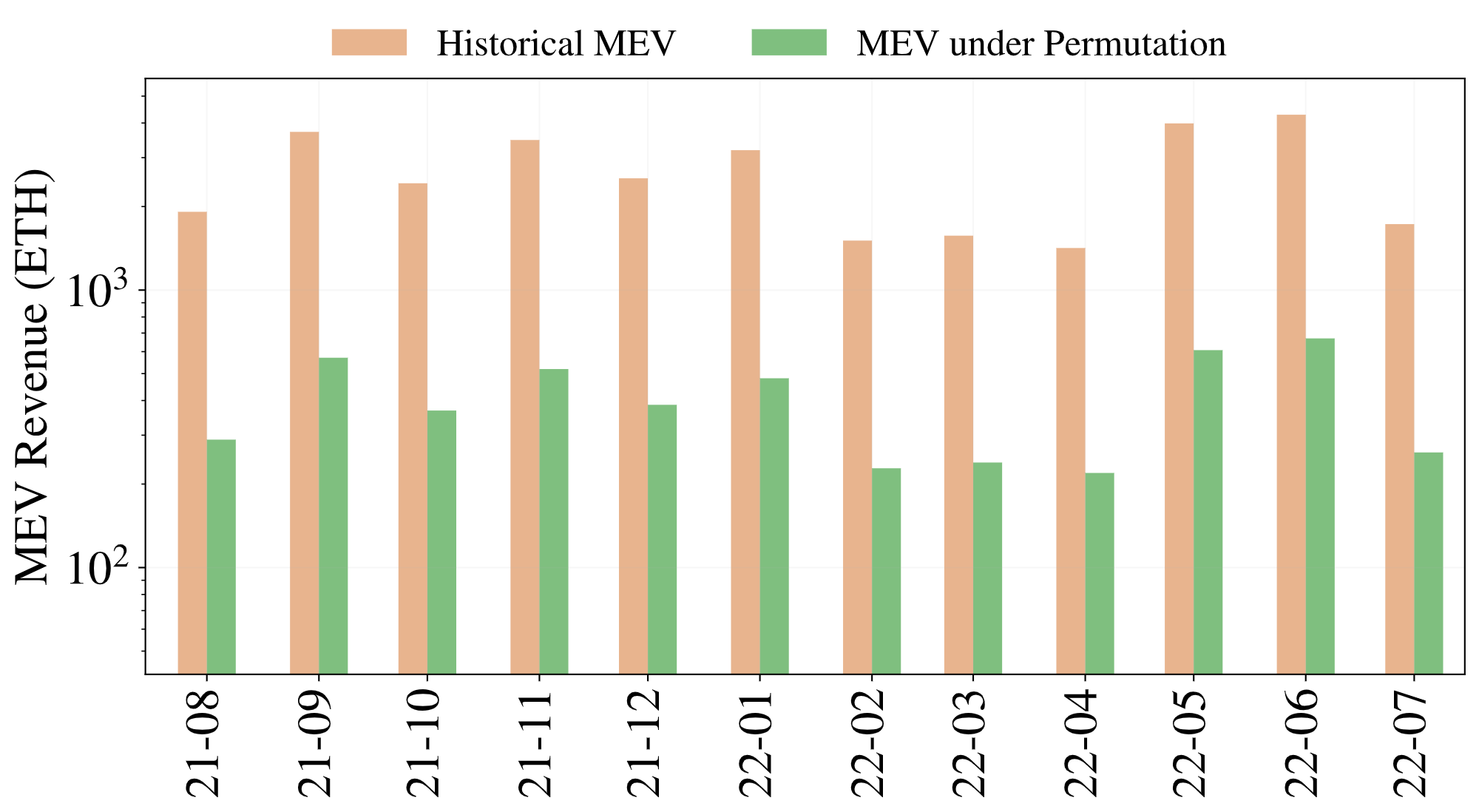
We separately run our simulations for front-running and back-running arbitrage to give a better insight on the potential impact of a random permutation in both cases. We remark that arbitrage is not inherently harmful and is usually considered benign as it allows for market sustainability, e.g., by synchronizing the price of assets across different exchanges [47]. The goal here is to reduce the sole power of the block producer (i.e., sequencer or validator) in MEV extraction and provide a rather fair chance for others to do so. Therefore, in Figure 3 we report the total MEV extraction (possibly by the block producer [39]) with and without doing permutation. We proceed with a brief description of our analysis that leads to the reported results.
-
1.
Front-running: A front-running arbitrage transaction should be profitable if it gets executed at the top of the block (i.e., the state change is due to the previous block). So, we find the index of the (front-running) arbitrage transaction in the historical block and then check if its index after the permutation is lower than or equal.121212Note that top of the block does not necessarily refer to the position with the lowest index as we detected an arbitrage transaction that is positioned at index 7 while being profitable. See https://etherscan.io/tx/0xcfd6f698657dd2851bea4b748723ed6ffb5503641f5ffbd8122ae120f148b034. If not, the arbitrage transaction could still be profitable with a weight of at most Pr[win] = , where is the index of the original arbitrage transaction after the permutation. Note that we consider a (worst-case) scenario where there is only one competitive arbitrage transaction in the block. However, given that arbitrage can be safely performed by anyone observing the latest state [47], the probability of win event may be considerably lower in practice. We find the revenue is reduced from a total of ETH for the historical data to ETH after doing the permutation, showing almost 50% of mitigation success. This actually is in line with our expectation that the chance of a sole MEV extraction reduces by half.
-
2.
Back-running: Using the heuristics we are only able to find the (back-running) arbitrage transaction and do not infer the relative position of the arbitrage transaction with the victim/opportunity transaction in the historical block. So, we rely on a common assumption that the (back-running) arbitrage transaction is ordered immediately after the victim transaction. Let , and be the indices of the victim and arbitrage transactions in the original block. If holds after the permutation, the arbitrage transaction could still be profitable with a weight of at most Pr[win] = . We find that the revenue is reduced from a total of ETH for the historical data to ETH after doing the permutation, showing almost 67% of mitigation success.
BlindPerm.
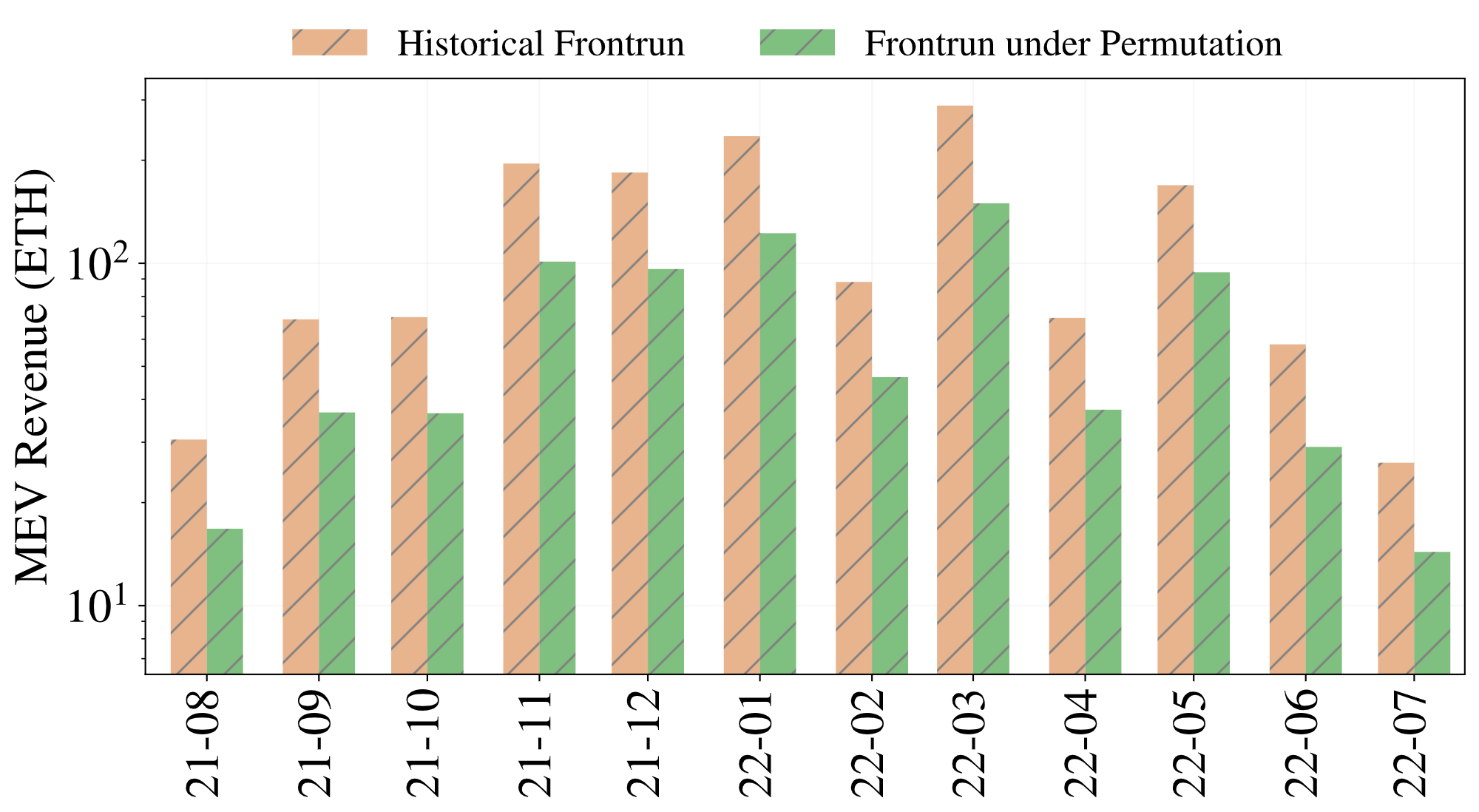
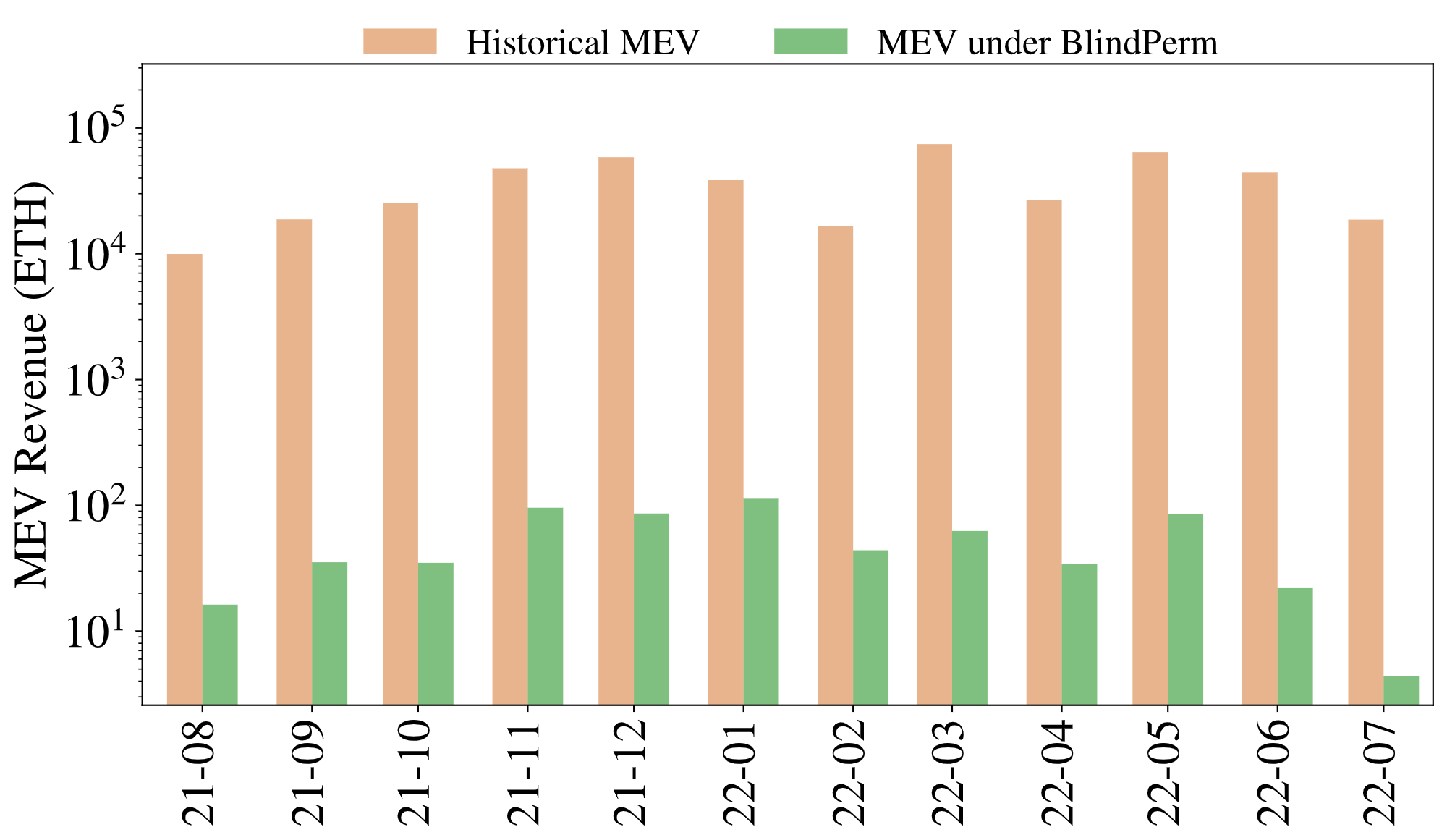
Finally, we present the last simulation result in Figure 4 where we report the cumulative MEV revenue including arbitrage and sandwich attacks for the historical data and BlindPerm. An Encrypted mempool helps with mitigating the strategies that mainly depend on the content of the (victim) transactions such as back-running arbitrage and sandwich attacks. Given that our solution provides permutation enhancement with almost no cost than building up an encrypted mempool, we refrain from a direct comparison between MEV extraction with only encryption and BlindPerm. We find that the revenue is reduced from a total of ETH for the historical data to ETH for BlindPerm.
7 Discussion
Extension to Longest-chain.
Permuting the list of transactions in a committed block before execution can also be realized in the longest-chain setting. In a proof-of-work (PoW) blockchain, the miner needs to find a solution (i.e., nonce) to a puzzle to be eligible as the block producer. Our idea is to use this nonce together with the Merkle root of the transactions (and possibly some auxiliary data) as the seed for the permutation. So, the state change occurs with regard to the permuted block. Should a miner decide to modify the ordering of transactions in the block after learning the seed, they face the threat of loss due to the difficulty rule of the puzzle. Therefore, this method enhances the recent efforts in leveraging trusted execution environments (TEEs), such as SGX [9], to provide privacy for transactions up to a point where their inclusion in the block is ensured. TEEs can be thought of as a replacement for the committee to generate a key-pair, with the public key being used for encryption. The procedure operates as follows: Encrypted transactions are initially received and decrypted within the SGX, where they are then ordered into a block. The block header, generated by the SGX, is transmitted to the miner, who begins the process of solving the associated cryptographic puzzle. Upon submission of a valid nonce, the miner is granted access to the full transaction body. Subsequently, any alteration in the transaction order within the block necessitates solving a new cryptographic puzzle. In a recent work, Alpos et al. [2] presented a construction that utilizes permutation to prevent sandwich attacks in the (PoW) longest-chain setting. At a high level, a set of previous leaders contribute towards permutation seed using a commit-reveal mechanism. They use slashing techniques to protect against biasing and splitting the transactions into chunks to increase the permutation space and thus protect against a possible collusion of leaders. Consequently, the system incurs a considerable latency and is also limited in applicability.
8 Related Work
After introducing the MEV problem in [19], a great deal of research has been conducted to propose countermeasures in various flavors. In the following, we only focus on the subset of solutions at the consensus layer.
Timed-order Fairness.
The consensus problem at the core of blockchain protocols known as SMR traditionally does not aim at getting parties agree on a specific ordering, but a total ordering where all the honest parties are guaranteed to end up with the same sequence of transactions. One way to deal with this is to augment its requirements with an order fairness property. It was shown by two concurrent works of [33, 31] that arguably the most natural definition of fairness known as receive/relative order fairness is impossible to achieve. This notion essentially states that for any two transactions tx and tx’, if some majority of nodes receive the former sooner than the latter, tx should be ordered before tx’. The impossibility result is due to the so-called Condorcet’s cycle/paradox [27], preventing parties to agree on a fair ordering of transactions even when all behave honestly [31].131313Such a cycle shows up intransitivity in the majoritarian relations, yielding a paradox in selecting a single winner. The impossibility result necessitates the adoption of other variants of timed-order fairness. Kelkar et al. [31] relaxed their definition to capture batch order fairness by making “before” to “no later”, treating such transactions in batches with relative ordering. In fact, the batch order fairness sidesteps the impossibility result by allowing output transactions in batches and ignoring the possible unfairness resulting from the cycles in each batch. Kelkar et al. [31] introduced Aequitas protocols that order a transaction tx no later than tx’ if some fraction of parties receive tx before tx’, known as -batch order fairness. Apart from necessitating a relaxed definition of order fairness, it turns out Condorcet cycles may become larger arbitrarily and also negatively affect the liveness of [31], motivating the design of a follow-up protocol called Themis [30] with a similar spirit. Cachin et al. [14] revisits the notion of order fairness by changing the relative measure of batch order fairness to differential order fairness, taking into account the difference between the number of correct parties that receive a tx before tx’ compared to that of vice versa. They argue about the usefulness of such modification to tolerate higher fault tolerance compared to that of batch order fairness [31, 30] with a reasonable value for parameter , where in their treatment only counts the honest parties.
Blind-order Fairness.
The requirement for maintaining causality in SMR systems was first put forth by [41]. They showed the importance of preserving the casual order of users/clients’ requests and proposed adding a confidentiality layer to the underlying atomic broadcast (i.e., SMR) to establish a secure causal atomic broadcast [22]. The recent efforts in literature for blind-order fairness are essentially an extension of this approach, realizing the confidentiality layer with a range of new cryptographic tools and techniques. In [52], validators just carry out the consensus to commit a block of encrypted transactions where a separate secret-management committee runs the decryption per transaction. Such separation could provide optimum fault tolerance of for the committee. Fino [35] integrates the blind-order fairness into DAG-based BFT systems that allow parallel dissemination of proposals by multiple validators, achieving high throughput [20, 46]. The proposed blind-order fairness has a hybrid structure, where the key for decryption is either obtained via a fast path using secret-sharing with post-verification or a slow path using threshold decryption. The authors in [37] develop a blind-order fairness system with minimal communication overhead, allowing users to encrypt their transactions to some future time (i.e., view number) with the corresponding private key being released by a committee then. FairPoS [17] introduces a similar notion to blind-order fairness for a longest-chain style consensus called input fairness. They rely on time-based cryptography [13] to hide the content of transactions under a single unknown key until block finalization, which consequently leads to achieving adaptive security. This is implied by the non-parallelizable sequential computation needed for decryption, preventing the leakage of sensitive information (i.e., key material) upon corrupting an honest party. Note that our proposed optimization using timelock encryption share the same rationale with [37, 17] in the sense that a single key (i.e., BLS signature) is enough for decrypting all the encrypted transactions in a committed block.
Threshold Encrypted Mempool.
Malkhi and Szalachowski [35] present four approaches to building up an encrypted mempool with threshold security, including threshold cryptography, VSS, secret sharing with post-verification, and hybrid. In what follows, we briefly describe secret sharing with post-verification and hybrid that could be used in BlindPerm depending on the application.
-
1.
Secret Sharing with Post-verification: VSS aims at ensuring the uniqueness, meaning that invoking SS.Combine with any threshold number of shares results in the same outcome, and completeness, meaning that any honest party receives a (distinct) valid share from SS.Share. The authors in [35] adapt a technique introduced in [49] to relax the requirements and only offer uniqueness. To do so, the dealer runs SS.Share, combines all shares in a Merkle tree, certifies the root, and sends with each share a proof of membership, i.e., a Merkle tree path to the root. When a party receives a share, they should verify the Merkle tree proof against the certified root (that is already broadcast by the dealer) before acknowledging it. Moreover, after running SS.Combine, each party re-encodes the Merkle tree with the reconstructed secret and compares it with the data sent by the dealer. If the comparison fails, the dealer is faulty. Observe that here the signed Merkle root acts as a commitment to somewhat relax the use of polynomial commitment. This protocol is the fastest as it uses the efficient and trivial primitives. Note that the sharing completes for each transaction when there are acknowledgments to ensure honest validators have received consistent shares, incurring latency. Another issue mentioned in [35] is the possible impact of some specific subset of validators on the latency of SS.Combine. More precisely, since there is no guarantee that all honest validators receive their shares, SS.Combine may not be run by the fastest validators and depend on a specific subset.
-
2.
Hybrid: In order to address the dependency issue, a hybrid design is proposed where secret sharing with post-verification is augmented with threshold cryptography, enabling any subset of validators to perform the decryption. Moreover, to maintain safety the protocol requires the results recovered from the SS.Combine be equal to TE.Dec. To do so, each validator can make use of secret shares or partial decryptions to check both approaches have the same output. They just need to re-encrypt the key and re-encodes the Merkle tree and check with those originally sent by the dealer.
References
- [1] Flashbots, 2022. URL: https://docs.flashbots.net/.
- [2] Orestis Alpos, Ignacio Amores-Sesar, Christian Cachin, and Michelle Yeo. Eating sandwiches: Modular and lightweight elimination of transaction reordering attacks. In 27th International Conference on Principles of Distributed Systems, 2024.
- [3] Guillermo Angeris, Tarun Chitra, Theo Diamonds, and Kshitij Kulkarni. The specter (and spectra) of miner extractable value. arXiv preprint arXiv:2310.07865, 2023. doi:10.48550/arXiv.2310.07865.
- [4] Kushal Babel, Nerla Jean-Louis, Yan Ji, Ujval Misra, Mahimna Kelkar, Kosala Yapa Mudiyanselage, Andrew Miller, and Ari Juels. Prof: Protected order flow in a profit-seeking world. arXiv preprint arXiv:2408.02303, 2024.
- [5] Axel Bacher, Olivier Bodini, Hsien-Kuei Hwang, and Tsung-Hsi Tsai. Generating random permutations by coin tossing: Classical algorithms, new analysis, and modern implementation. ACM Trans. Algorithms, 13(2):24–1, 2017.
- [6] Maryam Bahrani, Pranav Garimidi, and Tim Roughgarden. Transaction fee mechanism design in a post-mev world. In 6th Conference on Advances in Financial Technologies, 2024.
- [7] Joseph Bebel and Dev Ojha. Ferveo: Threshold decryption for mempool privacy in bft networks. Cryptology ePrint Archive, 2022.
- [8] Michael Ben-Or. Another advantage of free choice (extended abstract) completely asynchronous agreement protocols. In Proceedings of the second annual ACM symposium on Principles of distributed computing, pages 27–30, 1983.
- [9] Iddo Bentov, Yan Ji, Fan Zhang, Lorenz Breidenbach, Philip Daian, and Ari Juels. Tesseract: Real-time cryptocurrency exchange using trusted hardware. In Proceedings of the 2019 ACM SIGSAC Conference on Computer and Communications Security, pages 1521–1538, 2019. doi:10.1145/3319535.3363221.
- [10] Dan Boneh and Matt Franklin. Identity-based encryption from the weil pairing. In Annual international cryptology conference, pages 213–229. Springer, 2001.
- [11] Dan Boneh, Ben Lynn, and Hovav Shacham. Short signatures from the weil pairing. In International conference on the theory and application of cryptology and information security, pages 514–532. Springer, 2001. doi:10.1007/3-540-45682-1_30.
- [12] Lorenz Breidenbach, Christian Cachin, Benedict Chan, Alex Coventry, Steve Ellis, Ari Juels, Farinaz Koushanfar, Andrew Miller, Brendan Magauran, Daniel Moroz, et al. Chainlink 2.0: Next steps in the evolution of decentralized oracle networks. Chainlink Labs, 1, 2021.
- [13] Jeffrey Burdges and Luca De Feo. Delay encryption. In Advances in Cryptology–EUROCRYPT 2021: 40th Annual International Conference on the Theory and Applications of Cryptographic Techniques, Zagreb, Croatia, October 17–21, 2021, Proceedings, Part I, pages 302–326. Springer, 2021. doi:10.1007/978-3-030-77870-5_11.
- [14] Christian Cachin, Jovana Mićić, Nathalie Steinhauer, and Luca Zanolini. Quick order fairness. In Financial Cryptography and Data Security: 26th International Conference, FC 2022, Grenada, May 2–6, 2022, Revised Selected Papers, pages 316–333. Springer, 2022. doi:10.1007/978-3-031-18283-9_15.
- [15] Ignacio Cascudo and Bernardo David. Scrape: Scalable randomness attested by public entities. In International Conference on Applied Cryptography and Network Security, pages 537–556. Springer, 2017. doi:10.1007/978-3-319-61204-1_27.
- [16] Ignacio Cascudo, Bernardo David, Lydia Garms, and Anders Konring. Yolo yoso: fast and simple encryption and secret sharing in the yoso model. In Advances in Cryptology–ASIACRYPT 2022: 28th International Conference on the Theory and Application of Cryptology and Information Security, Taipei, Taiwan, December 5–9, 2022, Proceedings, Part I, pages 651–680. Springer, 2023. doi:10.1007/978-3-031-22963-3_22.
- [17] James Hsin-yu Chiang, Bernardo David, Ittay Eyal, and Tiantian Gong. Fairpos: Input fairness in proof-of-stake with adaptive security. Cryptology ePrint Archive, 2022.
- [18] Arka Rai Choudhuri, Sanjam Garg, Julien Piet, and Guru-Vamsi Policharla. Mempool privacy via batched threshold encryption: Attacks and defenses. In 33rd USENIX Security Symposium (USENIX Security 24), pages 3513–3529, 2024.
- [19] Philip Daian, Steven Goldfeder, Tyler Kell, Yunqi Li, Xueyuan Zhao, Iddo Bentov, Lorenz Breidenbach, and Ari Juels. Flash boys 2.0: Frontrunning in decentralized exchanges, miner extractable value, and consensus instability. In 2020 IEEE Symposium on Security and Privacy (SP), pages 910–927. IEEE, 2020. doi:10.1109/SP40000.2020.00040.
- [20] George Danezis, Lefteris Kokoris-Kogias, Alberto Sonnino, and Alexander Spiegelman. Narwhal and tusk: a dag-based mempool and efficient bft consensus. In Proceedings of the Seventeenth European Conference on Computer Systems, pages 34–50, 2022. doi:10.1145/3492321.3519594.
- [21] Wanning Ding, Yuzhe Tang, and Yibo Wang. Asymmetric mempool dos security: Formal definitions and provable secure designs. In 2025 IEEE Symposium on Security and Privacy (SP), pages 1584–1602. IEEE, 2025. doi:10.1109/SP61157.2025.00061.
- [22] Sisi Duan, Michael K Reiter, and Haibin Zhang. Secure causal atomic broadcast, revisited. In 2017 47th Annual IEEE/IFIP International Conference on Dependable Systems and Networks (DSN), pages 61–72. IEEE, 2017. doi:10.1109/DSN.2017.64.
- [23] Cynthia Dwork, Nancy Lynch, and Larry Stockmeyer. Consensus in the presence of partial synchrony. Journal of the ACM (JACM), 35(2):288–323, 1988. doi:10.1145/42282.42283.
- [24] Paul Feldman and Silvio Micali. Byzantine agreement in constant expected time. In 26th Annual Symposium on Foundations of Computer Science (sfcs 1985), pages 267–276. IEEE, 1985.
- [25] Nicolas Gailly, Kelsey Melissaris, and Yolan Romailler. tlock: practical timelock encryption from threshold bls. Cryptology ePrint Archive, 2023.
- [26] Sanjam Garg, Dimitris Kolonelos, Guru-Vamsi Policharla, and Mingyuan Wang. Threshold encryption with silent setup. In annual international cryptology conference, pages 352–386. Springer, 2024. doi:10.1007/978-3-031-68394-7_12.
- [27] William V Gehrlein. Condorcet’s paradox. Theory and Decision, 15(2):161–197, 1983.
- [28] Tivas Gupta, Mallesh M Pai, and Max Resnick. The centralizing effects of private order flow on proposer-builder separation. In 5th Conference on Advances in Financial Technologies (AFT 2023). Schloss Dagstuhl – Leibniz-Zentrum für Informatik, 2023. doi:10.4230/LIPIcs.AFT.2023.20.
- [29] Lioba Heimbach and Roger Wattenhofer. Sok: Preventing transaction reordering manipulations in decentralized finance. In 4th ACM Conference on Advances in Financial Technologies (AFT), 2022.
- [30] Mahimna Kelkar, Soubhik Deb, Sishan Long, Ari Juels, and Sreeram Kannan. Themis: Fast, strong order-fairness in byzantine consensus. In Proceedings of the 2023 ACM SIGSAC Conference on Computer and Communications Security, pages 475–489, 2023. doi:10.1145/3576915.3616658.
- [31] Mahimna Kelkar, Fan Zhang, Steven Goldfeder, and Ari Juels. Order-fairness for byzantine consensus. In Advances in Cryptology–CRYPTO 2020: 40th Annual International Cryptology Conference, CRYPTO 2020, Santa Barbara, CA, USA, August 17–21, 2020, Proceedings, Part III 40, pages 451–480. Springer, 2020. doi:10.1007/978-3-030-56877-1_16.
- [32] Ahmed Kosba, Andrew Miller, Elaine Shi, Zikai Wen, and Charalampos Papamanthou. Hawk: The blockchain model of cryptography and privacy-preserving smart contracts. In 2016 IEEE symposium on security and privacy (SP), pages 839–858. IEEE, 2016. doi:10.1109/SP.2016.55.
- [33] Klaus Kursawe. Wendy, the good little fairness widget: Achieving order fairness for blockchains. In Proceedings of the 2nd ACM Conference on Advances in Financial Technologies, pages 25–36, 2020. doi:10.1145/3419614.3423263.
- [34] Dahlia Malkhi and Kartik Nayak. Hotstuff-2: Optimal two-phase responsive bft. Cryptology ePrint Archive, 2023.
- [35] Dahlia Malkhi and Pawel Szalachowski. Maximal extractable value (mev) protection on a dag. In 4th International Conference on Blockchain Economics, Security and Protocols, page 1, 2023.
- [36] Akaki Mamageishvili, Christoph Schlegel, and Benny Sudakov. Searcher competition in block building. In 6th Conference on Advances in Financial Technologies (AFT 2024), pages 21–1. Schloss Dagstuhl – Leibniz-Zentrum für Informatik, 2024. doi:10.4230/LIPIcs.AFT.2024.21.
- [37] Peyman Momeni, Sergey Gorbunov, and Bohan Zhang. Fairblock: Preventing blockchain front-running with minimal overheads. In International Conference on Security and Privacy in Communication Systems, pages 250–271. Springer, 2022. doi:10.1007/978-3-031-25538-0_14.
- [38] Torben Pryds Pedersen. A threshold cryptosystem without a trusted party. In Advances in Cryptology—EUROCRYPT’91: Workshop on the Theory and Application of Cryptographic Techniques Brighton, UK, April 8–11, 1991 Proceedings 10, pages 522–526. Springer, 1991.
- [39] Julien Piet, Jaiden Fairoze, and Nicholas Weaver. Extracting godl [sic] from the salt mines: Ethereum miners extracting value. arXiv preprint arXiv:2203.15930, 2022. doi:10.48550/arXiv.2203.15930.
- [40] Kaihua Qin, Liyi Zhou, and Arthur Gervais. Quantifying blockchain extractable value: How dark is the forest? In 2022 IEEE Symposium on Security and Privacy (SP), pages 198–214. IEEE, 2022. doi:10.1109/SP46214.2022.9833734.
- [41] Michael K Reiter and Kenneth P Birman. How to securely replicate services. ACM Transactions on Programming Languages and Systems (TOPLAS), 16(3):986–1009, 1994. doi:10.1145/177492.177745.
- [42] Ronald L Rivest, Adi Shamir, and David A Wagner. Time-lock puzzles and timed-release crypto. Technical report, Massachusetts Institute of Technology. Laboratory for Computer Science, 1996.
- [43] Antoine Rondelet and Quintus Kilbourn. Threshold encrypted mempools: Limitations and considerations. arXiv preprint arXiv:2307.10878, 2023. doi:10.48550/arXiv.2307.10878.
- [44] Fred B Schneider. Implementing fault-tolerant services using the state machine approach: A tutorial. ACM Computing Surveys (CSUR), 22(4):299–319, 1990. doi:10.1145/98163.98167.
- [45] Adi Shamir. How to share a secret. Communications of the ACM, 22(11):612–613, 1979. doi:10.1145/359168.359176.
- [46] Alexander Spiegelman, Neil Giridharan, Alberto Sonnino, and Lefteris Kokoris-Kogias. Bullshark: Dag bft protocols made practical. In Proceedings of the 2022 ACM SIGSAC Conference on Computer and Communications Security, pages 2705–2718, 2022. doi:10.1145/3548606.3559361.
- [47] Christof Ferreira Torres, Albin Mamuti, Ben Weintraub, Cristina Nita-Rotaru, and Shweta Shinde. Rolling in the shadows: Analyzing the extraction of mev across layer-2 rollups. arXiv preprint arXiv:2405.00138, 2024. doi:10.48550/arXiv.2405.00138.
- [48] Anton Wahrstätter, Jens Ernstberger, Aviv Yaish, Liyi Zhou, Kaihua Qin, Taro Tsuchiya, Sebastian Steinhorst, Davor Svetinovic, Nicolas Christin, Mikolaj Barczentewicz, et al. Blockchain censorship. arXiv preprint arXiv:2305.18545, 2023.
- [49] Lei Yang, Seo Jin Park, Mohammad Alizadeh, Sreeram Kannan, and David Tse. DispersedLedger:High-Throughput byzantine consensus on variable bandwidth networks. In 19th USENIX Symposium on Networked Systems Design and Implementation (NSDI 22), pages 493–512, 2022. URL: https://www.usenix.org/conference/nsdi22/presentation/yang.
- [50] Sen Yang, Kartik Nayak, and Fan Zhang. Decentralization of ethereum’s builder market. arXiv preprint arXiv:2405.01329, 2024. doi:10.48550/arXiv.2405.01329.
- [51] Maofan Yin, Dahlia Malkhi, Michael K Reiter, Guy Golan Gueta, and Ittai Abraham. Hotstuff: Bft consensus with linearity and responsiveness. In Proceedings of the 2019 ACM Symposium on Principles of Distributed Computing, pages 347–356, 2019. doi:10.1145/3293611.3331591.
- [52] Haoqian Zhang, Louis-Henri Merino, Ziyan Qu, Mahsa Bastankhah, Vero Estrada-Galiñanes, and Bryan Ford. F3b: A low-overhead blockchain architecture with per-transaction front-running protection. In 5th Conference on Advances in Financial Technologies, 2023.
Appendix A Permutation Algorithm
Appendix B MEV Extraction Heuristics
Sandwich Attacks.
It is a well-known strategy, where the attacker (e.g., searcher or validator) observes the network to capture victim transactions creating a considerable rise/fall in the market price of an asset. The attack is performed by having the attacker place a front-running purchase/sell transaction prior to the victim transaction and a back-running transaction after to end the trade. Here we present the heuristics proposed in [40] to identify potentially successful sandwich attacks.
-
Heuristic 1.
The transactions , and must be included in the same block and in this exact order.
-
Heuristic 2.
Every front-running transaction maps to one and only one back-running transaction . This heuristic is necessary to avoid double counting revenues.
-
Heuristic 3.
Both and transact from asset X to Y. transacts in the reverse direction from asset Y to X.
-
Heuristic 4.
Either the same user address sends transactions and , or two different user addresses send and to the same smart contract
-
Heuristic 5.
The amount of asset sold in must be within 90% to 110% of the amount bought in . If the sandwich attack is perfectly executed without interference from other market participants, the amount sold in should be precisely equal to the amount purchased in .
Arbitrage.
It enables earning revenue by taking advantage of the price slippage in simultaneous selling and purchasing assets across different markets. The arbitrage is performed by having the searcher (e.g., searcher or validator) monitor the blockchain state change and grab a profitable opportunity in two typical ways, front-running and back-running. In the former, the searcher follows the blockchain state and tries to frontrun others at block upon the receipt of block . In the latter, the searcher observes the network to detect a transaction triggering a large change to asset price in an exchange and thus attempts to back-run this transaction. Here we present the heuristics proposed in [40] to identify potentially successful arbitrage extractions.
-
Heuristic 1.
All swap actions of an arbitrage must be included in a single transaction, implicitly assuming that the arbitrageur minimizes its risk through atomic arbitrage. We use s to denote a swap action which sells amount of the input asset to purchase amount of the output asset .
-
Heuristic 2.
Arbitrage must have more than one swap action.
-
Heuristic 3.
The swap actions of an arbitrage must form a loop. The input asset of any swap action must be the output asset of the previous action, i.e., . The first swap’s input asset must be the same as the last swap action’s output asset, i.e., .
-
Heuristic 4.
The input amount of any swap action must be less than or equal to the output amount of the previous action, i.e., .
Appendix C Verifiable Shuffling of Committed Transactions
We consider the setting where a single sequencer receives encrypted transactions from users and must order them fairly. This setting is common in Layer-2 blockchain protocols that often utilize a single coordinator/sequencer instead of a committer of BFT validators. The goal is to prevent the sequencer from dropping, duplicating, or maliciously reordering transactions. We describe two approaches: a lightweight construction based on deterministic permutation from public randomness, and a stronger construction using zero-knowledge proofs of shuffle correctness.
Let the sequencer collect ciphertexts , where each is an encrypted transaction. The sequencer must commit to this sequence, then publish an ordering of that is publicly verifiable.
C.1 Approach A: Deterministic Shuffle via Public Randomness
-
1.
Commitment. The sequencer constructs a Merkle tree with ordered leaves for . The root is published to commit to both the contents and order of .
-
2.
Public Randomness. After commitment, some public randomness is revealed.
-
3.
Deterministic Permutation. A permutation is derived from using a deterministic shuffle algorithm. This ensures that the permutation is uniquely determined by and cannot be biased by the sequencer.
-
4.
Publication. The sequencer outputs the permuted sequence together with Merkle inclusion proofs showing that each ciphertext corresponds to the committed root at the correct index.
-
5.
Verification. Any verifier recomputes from and checks that each published ciphertext has a valid Merkle proof under at index . If all checks succeed, the shuffle is accepted.
This approach is lightweight: verification requires only hash computations and Merkle proofs, while fairness is guaranteed by the unpredictability of .
C.2 Approach B: Verifiable Shuffle with Zero-Knowledge Proofs
-
1.
Commitment. The sequencer constructs a Merkle tree over as above and publishes the root .
-
2.
Shuffle and Re-encryption. The sequencer chooses a permutation and, optionally, re-randomises each ciphertext using ElGamal re-encryption:
The resulting sequence is committed with a second Merkle root .
-
3.
Proof Generation. The sequencer constructs a SNARK proof attesting to the following relation:
-
(a)
Each is a valid leaf of and each is a valid leaf of .
-
(b)
For all , is a correct re-encryption of some .
-
(c)
The mapping is a bijection. This can be enforced inside the SNARK via a multiset equality check, e.g., verifying that
at a random challenge derived from the Fiat–Shamir heuristic.
-
(a)
-
4.
Publication. The sequencer publishes , where is the proof of correctness.
-
5.
Verification. Any verifier runs the SNARK verifier on public inputs to check the proof. Verification is constant-time, independent of .
This approach supports re-encryption and unlinkability of ciphertexts, at the cost of higher prover complexity. The sequencer cannot cheat without breaking the soundness of the SNARK system.