Maker-Maker Games of Rank 4 Are PSPACE-Complete

Abstract
The Maker-Maker convention of positional games is played on a hypergraph whose edges are interpreted as winning sets. Two players take turns picking a previously unpicked vertex, aiming at being first to pick all the vertices of some edge. Optimal play can only lead to a first player win or a draw, and deciding between the two is known to be PSPACE-complete even for -uniform hypergraphs. We establish PSPACE-completeness for hypergraphs of rank . As an intermediary, we use the recently introduced achievement positional games, a more general convention in which each player has their own winning sets (blue and red). We show that deciding whether the blue player has a winning strategy as the first player is PSPACE-complete even with blue edges of size or and pairwise disjoint red edges of size . The result for hypergraphs of rank in the Maker-Maker convention follows as a simple corollary.
Keywords and phrases:
Game theory, Positional games, Combinatorial games, Complexity, HypergraphsCopyright and License:
![[Uncaptioned image]](x1.png) © Florian Galliot and Jonas Sénizergues; licensed under Creative Commons License CC-BY 4.0
© Florian Galliot and Jonas Sénizergues; licensed under Creative Commons License CC-BY 4.0
2012 ACM Subject Classification:
Theory of computation Problems, reductions and completenessEditors:
Meena Mahajan, Florin Manea, Annabelle McIver, and Nguyễn Kim ThắngSeries and Publisher:
 Leibniz International Proceedings in Informatics, Schloss Dagstuhl – Leibniz-Zentrum für Informatik
1 Introduction
Positional games.
Positional games have been introduced by Hales and Jewett [9] and later popularized by Erdős and Selfridge [4]. The game board is a hypergraph , where is the vertex set and is the edge set. Two players take turns picking a previously unpicked vertex, and the result of the game is defined by one of several possible conventions. The study of positional games mainly consists, for various conventions and classes of hypergraphs, in finding necessary and/or sufficient conditions for such player to have a winning strategy (on the number of edges, the size of the edges, the structure of the hypergraph…), and determining the complexity of the corresponding algorithmic problems. The two most popular conventions are called Maker-Maker and Maker-Breaker. These are games of an “achievement” nature, in the sense that one or both players are trying to fill any edge (i.e. pick all the vertices of some edge of the hypergraph).
The Maker-Maker convention was the first one to be introduced in all generality, by Hales and Jewett in 1963 [9]. It is the most natural convention: the edges are the winning sets, meaning that whoever first fills an edge wins the game. If no one has filled an edge by the time all vertices are picked, we get a draw. A well-known strategy-stealing argument [9] shows that optimal play leads to one of two possible outcomes: a first player win or a draw. The most famous example of a Maker-Maker game is the tic-tac-toe game on a grid, which can be generalized into the -in-a-row game on grids of any size[1]. For instance, the -in-a-row game on an infinite grid is known to be a first player win for but a draw for [8], while the cases are important open problems. In the Maker-Maker convention, both players must manage offense and defense at the same time, by trying to fill an edge while also preventing the opponent from doing so first. This creates counterintuitive phenomena such as the extra edge paradox [1], where adding an edge might turn a first player win into a draw. As such, the Maker-Maker convention is notoriously difficult to handle.
The Maker-Breaker convention was introduced for that reason, by Chvátal and Erdős in 1978 [3]. The two players are called Maker and Breaker: Maker’s goal is to fill an edge, while Breaker’s goal is to prevent Maker from filling an edge. Draws are impossible. The fact that the players have complementary goals brings convenient additional properties compared to Maker-Maker games, and as such, the Maker-Breaker convention is the most studied. A crucial property is subhypergraph monotonicity: if Maker has a winning strategy on a subhypergraph of , then he may disregard the rest of the hypergraph and apply that strategy to win on , as he has no defense to take care of. An example of a Maker-Breaker game is the board game Hex, where two players take turns placing tokens of their color to try and connect opposite sides of the board. It is well-known [7] that a draw is technically impossible, and that successfully connecting one’s sides of the board is equivalent to blocking the opponent from connecting theirs. This makes Hex a Maker-Breaker game, but only by theorem. Purely by definition, it does not fall under either Maker-Maker or Maker-Breaker conventions, as the first player to fill an edge wins but the players have different edges to fill (corresponding here to “horizontal paths” and “vertical paths” respectively).
Unified achievement games.
The more general family of achievement positional games has recently been introduced [6]. Such a game is a triple , where and are hypergraphs which are seen as having blue edges and red edges respectively. There are two players, Left and Right, taking turns picking a previously unpicked vertex: Left aims at filling a blue edge, while Right aims at filling a red edge. Whoever reaches their goal first wins the game, or we get a draw if this never happens. Achievement positional games include all Maker-Maker and Maker-Breaker games. Indeed, Maker-Maker games correspond to the case , while Maker-Breaker games correspond to the case when identifying Maker with Left and Breaker with Right and renaming Breaker wins as draws. Another way to embed Maker-Breaker games into achievement positional games is to define as the transversal hypergraph of , meaning that is the set of minimal subsets of vertices that intersect every element of .
Some principles which are common to the Maker-Maker and Maker-Breaker conventions, such as strategy stealing and pairing strategies, generalize to achievement positional games [6]. One of the motivations behind the introduction of achievement positional games, which is particularly relevant to our paper, is that the family of Maker-Maker games is not stable under the players’ moves. Indeed, even though the winning sets are the same for both players at the start, any edge which contains a vertex picked by some player during the game can thereafter only be filled by that same player. As such, mid-game positions of Maker-Maker games fall under the wider category of achievement positional games.
Algorithmic complexity.
The decision problem corresponding to the Maker-Maker convention asks whether the first player has a winning strategy, while the decision problem corresponding to the Maker-Breaker convention asks whether Maker has a winning strategy as the first player. The algorithmic complexity of positional games is usually studied depending on the size of the edges. A hypergraph is of rank (resp. is -uniform) if all its edges have size at most (resp. exactly ).
The founding result of Schaefer states that Maker-Breaker games of rank are PSPACE-complete [14]. This was improved much later to -uniform Maker-Breaker games [13], and very recently to 5-uniform Maker-Breaker games [11]. On the other hand, Maker-Breaker games of rank are solved in polynomial time [5].
As for Maker-Maker games, apart from the obvious remark that games of rank are solved in polynomial time, no direct complexity results have been obtained. However, a simple argument due to Byskov [2] reduces Maker-Breaker games of rank to Maker-Maker games of rank . It is not difficult to adapt this construction to reduce -uniform Maker-Breaker games to -uniform Maker-Maker games. Therefore, the known results for the Maker-Breaker convention imply that -uniform Maker-Maker games are PSPACE-complete. However, using Maker-Breaker games to get complexity results on Maker-Maker games has its limitations: for instance, since Maker-Breaker games of rank are tractable, it would be impossible to show that Maker-Maker games of rank are PSPACE-complete with this method.
Achievement positional games offer an alternative approach, as any starting position of an achievement positional game can be interpreted as a mid-game position of some Maker-Maker game (even more specifically, as a position obtained after just one round of play). The decision problem introduced in [6] asks whether Left has a winning strategy as the first player. Table 1 sums up all previously known complexity results for that problem, depending on the sizes and of the blue and red edges respectively. In particular, the case being PSPACE-complete implies that deciding the outcome of a Maker-Maker game of rank after one round of play is PSPACE-complete [6]. Unfortunately, this does not settle the complexity of Maker-Maker games of rank , as this first round of play may not be optimal.
| 0 , 1 | 2 | 3 | 4 | 5+ | |||||||||||
| 0 , 1 |
|
|
|
open |
|
||||||||||
| 2 |
|
|
|
|
|
||||||||||
| 3+ |
|
|
|
|
|
Our contribution.
We show that the case of achievement positional games is PSPACE-complete, even when the red edges are restricted to be pairwise disjoint. Such a game can also be interpreted as the position obtained after one round of play in a Maker-Maker game of rank , but the major difference is that this round of play is actually optimal, so that our result implies PSPACE-completeness for (starting positions of) Maker-Maker games of rank .
In Section 2, after recalling some definitions and basic results from [6], we state the PSPACE-completeness result for and we show that it implies PSPACE-completeness for Maker-Maker games of rank . Section 3 is then dedicated to the proof of the result for . Finally, Section 4 concludes the paper and lists some perspectives.
2 Preliminaries and statements of the main results
2.1 Definitions
We start by recalling some definitions from [6]. In this paper, a hypergraph is a pair where is a finite vertex set and is the edge set. An achievement positional game is a triple where and are hypergraphs. The elements of are called blue edges, whereas the elements of are called red edges. Two players, Left and Right, take turns picking a vertex in that has not been picked before. We say a player fills an edge if that player has picked all the vertices of that edge. The blue and red edges can be seen as the winning sets of Left and Right respectively, so that the result of the game is determined as follows:
-
If Left fills a blue edge before Right fills a red edge, then Left wins.
-
If Right fills a red edge before Left fills a blue edge, then Right wins.
-
If none of the above happens before all vertices are picked, then the game is a draw.
The player who starts the game can be either Left or Right. Therefore, when talking about winning strategies (i.e. strategies that guarantee a win) or non-losing strategies (i.e. strategies that guarantee a draw or a win), we will always specify which player is assumed to start the game. For instance, we may say that “Left has a winning strategy on as the first player”.
After Left picks a vertex , any blue edge that contains behaves like , in the sense that Left only has to pick the vertices in to fill . Moreover, after Left picks a vertex , any red edge that contains is “dead” and can be ignored for the rest of the game, as Right will never be able to fill . Of course, analogous observations can be made for Right. Therefore, from a starting achievement positional game on which Left has picked a set of vertices and Right has picked a set of vertices , we get a fresh new achievement positional game where:
We may refer to as the updated game, to the elements of as the updated blue edges and to the elements of as the updated red edges.
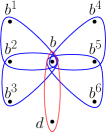
Let , pictured in Figure 1, as an example. First, suppose that Left starts. Left can pick as his first move, and is the corresponding updated game. Note that Left cannot lose anymore. By symmetry, assume that Right picks one of , or . Left picks , thus ensuring to win the game with his next move by picking either or . Now, suppose that Right starts. Right can pick as her first move, which yields the updated game . Left is forced to pick , otherwise Right would pick herself next and win. In conclusion, we see that Left has a winning strategy as the first player, but we get a draw if Right plays first.
2.2 Elementary strategic principles
We recall two basic results from [6] which will be useful. A complete pairing of a hypergraph is a set of pairwise disjoint pairs of vertices such that, for all , there exists satisfying .
Lemma 1 (Pairing Strategy; [6, Lemma 3.5]).
Let be an achievement positional game. If the hypergraph (resp. ) admits a complete pairing, then Left (resp. Right) has a non-losing strategy on both as the first player and as the second player.
Lemma 2 (Greedy Move; [6, Lemma 3.8]).
Let be an achievement positional game. Suppose that there is no edge of size , but there is a blue (resp. red) edge such that, for all . Then it is optimal for Left (resp. Right) as the first player to start by picking , which forces the opponent to answer by picking .
2.3 Statement of the main results
In Section 3, we will show the following result.
Theorem 3.
Deciding whether Left has a winning strategy as the first player on an achievement positional game with blue edges of size or and pairwise disjoint red edges of size is PSPACE-complete.
As an immediate consequence, we get PSPACE-completeness for Maker-Maker games of rank .
Corollary 4.
Deciding whether the first player has a winning strategy for the Maker-Maker game on a hypergraph of rank is PSPACE-complete.
Proof of Corollary 4 assuming Theorem 3.
The membership in PSPACE is well known for Maker-Maker games. Let be an achievement positional game with blue edges of size or and pairwise disjoint red edges of size . We define the hypergraph , where and are new vertices and:
Note that has rank , is efficiently computed from , and behaves the exact same as the achievement positional game : the first player has a winning strategy for the Maker-Maker game on if and only if Left has a winning strategy on as the first player. Therefore, to deduce the PSPACE-hardness of Maker-Maker games of rank from Theorem 3, it suffices to show that Left has a winning strategy on as the first player if and only if Left has a winning strategy on as the first player.
-
First suppose that Left has a winning strategy on as the first player. Then, playing first on , Left can simply start by picking , which forces Right to pick because . The updated game is precisely , so Left has a winning strategy as the first player.
-
Conversely, suppose that Left has a winning strategy on as the first player. We claim that necessarily has Left picking as his first move. Indeed:
-
–
Suppose that instructs Left to start by picking . Then Right is forced to pick . After that move, forms a complete pairing of the updated blue edges.
-
–
Now, suppose that instructs Left to start by picking some . Then Right has no forced move since is the only element of of size less than . Therefore, Right can pick , which forces Left to pick . If Right has no forced move, then forms a complete pairing of the updated blue edges. If Right has a forced move i.e. there exists some (necessarily unique) such that , then Right picks , and forms a complete pairing of the updated blue edges after that move.
We see that, if does not instruct Left to pick as his first move, then Right can always obtain a non-losing pairing strategy by Lemma 1, contradicting the fact that is winning for Left. In conclusion, instructs Left to start by picking , which forces Right to pick . Since the updated game after these two moves is precisely , we conclude that Left has a winning strategy on as the first player.
-
–
3 Proof of Theorem 3
Membership in PSPACE is straightforward, regardless of assumptions on the size of the edges [6]. As for PSPACE-hardness, we perform a reduction from the classic 3-QBF decision problem which has been shown PSPACE-complete by Stockmeyer and Meyer [15], or rather from its complement which is also PSPACE-complete since PSPACE and coPSPACE are the same class [10].
The problem 3-QBF can be formulated in terms of the following game. A logic formula in CNF form with clauses of size exactly is given, along with a prescribed numbering of its variables . Two players, Falsifier and Satisfier, take turns assigning truth values to the variables. We may assume that Falsifier goes first, setting to T or F. Satisfier then sets to T or F. Falsifier then sets to T or F, and so on until a full valuation is built. Satisfier wins the game if satisfies , otherwise Falsifier wins.
| 3-QBF | ||
| Input | : | A logic formula in CNF form, with clauses of size exactly , and an even number of variables with a prescribed ordering . |
| Output | : | T if Satisfier has a winning strategy as the second player, F otherwise. |
Let be a logic formula in CNF form, with clauses of size exactly , and variables with a prescribed ordering . For all , write , where the literals are ordered the same as their corresponding variables. We are now going to define an achievement positional game , with blue edges of size or and pairwise disjoint red edges of size , on which Left has a winning strategy as the first player if and only if Falsifier has a winning strategy for 3-QBF on as the first player.
3.1 Idea of the construction
Before going into details, let us briefly explain the general idea. We see Left (who starts) as Falsifier, and Right as Satisfier. Note that the red edges being pairwise disjoint implies that optimal play can only lead to a win for Left (i.e. Falsifier wins) or a draw (i.e. Satisfier wins), since Left could always apply a pairing strategy as per Lemma 1. Each variable (resp. ) will be represented by two key vertices and (resp. and ), and each clause will be represented by a blue butterfly. With optimal play, the game will have two phases. During Phase 1, the players’ moves will be largely forced, but they will each have decisions to make, corresponding to the truth values they alternately choose as they build a full valuation for the variables. For from to , Left will choose between picking or (with Right picking the other), hereby defining , then Right will choose between picking or (with Left picking the other), hereby defining . By the end of Phase 1, Right will have destroyed every butterfly corresponding to a clause that is satisfied by . During Phase 2, Right will hold on to a draw if satisfies , whereas Left will use an intact blue butterfly to win if does not satisfy . There will be five types of edges:
-
Guide-edges (blue and red) forcing both players’ moves between two decisions they have to make during Phase 1;
-
Butterfly-edges (blue only) forming butterflies which correspond to the clauses of and allow Left to win During Phase 2 if does not satisfy ;
-
Destruction-edges (red only) allowing Right to destroy all the blue butterflies if satisfies ;
-
Trap-edges (blue only) preventing Right from “cheating” during Phase 1 when she is supposed to choose between two key vertices to pick;
-
Link-edges (blue only) connecting the clause gadgets to their associated variable gadgets.
The main challenge in the proof will be to verify that regular play, which refers to the very restricted set of strategies that we define for both players during Phase 1, is actually optimal.
3.2 Definition of the game
We associate each literal with an index defined as the unique such that , as well as a key vertex defined by: , , , . We define , where , and , as follows.
-
For each , we have a variable gadget associated with the variables and , with vertex set . The variable gadgets only contain the guide-edges. We introduce the following useful notation for the list of blue guide-edges. Given two vertices and an integer , the notation means that we have the two blue edges and . The idea is that Left will pick either or , which creates the blue edge in the updated game in both cases. We extend that notation to by setting . The guide-edges are:
Note that, even though we did not include and in our definition of to avoid repeating vertices, the variable gadget for is actually connected to the variable gadget for through the blue edges and . Figure 3 with illustrates the variable gadget associated with and .
-
For each , we have a clause gadget associated with the clause , with vertex set . Note that the key vertices are the only ones to appear in both variable gadgets and clause gadgets. The clause gadgets contain the butterfly-edges, destruction-edges and link-edges. The butterfly-edges are:
The destruction-edges are:
The link-edges are:
As an illustration, the clause gadget associated with the clause is pictured in Figure 2.

Figure 2: The clause gadget associated with the clause . -
Finally, there are trap-edges that go across the different gadgets. For each , we define as the set of all such that belongs to some red edge which is either: a guide-edge in where , a destruction-edge of the form where , or a destruction-edge of the form where , and . The idea is that Left will pick and Right will be forced to defuse the corresponding trap-edges by quickly picking .
An important remark is that all blue edges have size except for , the single blue edge of size .
3.3 Regular play
Assuming Left starts, we define regular play on during Phase 1, where players build a valuation for the variables . An arrow labeled “f” signifies a forced move (when a player cannot win in one move but the opponent threatens to do so), while an arrow labeled “g” signifies a greedy move in the sense of Lemma 2. For from to , round of regular play goes as follows, with the starting situation in the associated variable gadget shown in Figure 3.
-
(1)
Left chooses the value T or F for , by picking or respectively. Both options trigger a sequence of forced moves inside the associated variable gadget:
In the updated game obtained after step (1), we get the updated guide-edges pictured in Figure 4 (in the case where Left has put to T, the other case being analogous).
Figure 4: The updated variable gadget associated with and after step (1) of round of regular play (in the case where Left has put to T). -
(2)
Right now has no forced move, and uses this window to play greedy moves inside the clause gadgets, with the aim of destroying some blue butterflies (except if , in which case she skips this step). For each and each such that Right has picked during round of regular play, Right plays the following greedy move:
For instance, consider and : if Right has picked during round of regular play, then Right will play the greedy move as illustrated in Figure 5.

Figure 5: The clause gadget associated with the clause , before (left) and (after) Right’s greedy move during round of regular play if she had picked in the previous round. -
(3)
Right chooses the value T or F for , by picking or respectively. Both options trigger a sequence of forced moves inside the associated variable gadget:
-
(4)
Left now has no forced move, and uses this window to play greedy moves inside the clause gadgets, with the aim of removing some destruction-edges to protect her blue butterflies. For each and each such that Left has picked during round (the current round) of regular play, Left plays the following greedy move:
For instance, consider and : if Left has picked during round of regular play, then Right will play the greedy move as pictured in Figure 6. Round of regular play is now over. Note that the updated variable gadget associated with and , assuming , is indeed as pictured in Figure 3 (replacing each by ) since Left picking either or during step (1) has created the updated blue edge .
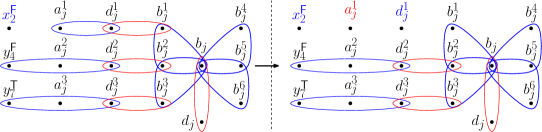
Figure 6: The clause gadget associated with the clause , before (left) and (after) Left’s greedy move during round of regular play if he had picked at the start of the round.
Let us state some simple properties of regular play. We say a blue (resp. red) edge is dead if Right (resp. Left) has killed it by picking one of its vertices, or intact if none of its vertices has been picked.
Claim 5.
Let , and consider the situation at the end of round of regular play, assuming that both players have followed regular play from the beginning. The following properties hold:
-
(i)
All guide-edges in are dead. The other guide-edges are intact, apart (if ) from and : one is dead, while the other has yielded in the updated game.
-
(ii)
All trap-edges in are dead. The other trap-edges are intact.
-
(iii)
All link-edges such that are dead. The other link-edges are intact.
-
(iv)
All destruction-edges of the form such that, either and Left has picked , or and Right has picked , are dead. The other destruction-edges are intact.
-
(v)
Left has not picked any vertex in butterfly-edges. Moreover, for all , the butterfly-edges and are intact, and the two following assertions are equivalent:
-
(a)
The butterfly-edges and are intact, and the three destruction-edges , and are dead.
-
(b)
Left has picked the three key vertices , and .
-
(a)
Proof of Claim 5.
-
(i)
This is a direct consequence of the definition of regular play.
-
(ii)
Since Right has picked for all , all trap-edges in are dead. Now, consider some where . Clearly, and are unpicked. Let be the red edge containing . By definition of a trap-edge, there are three possibilities for . If for some , then is unpicked since . If is a destruction-edge of the form , then is unpicked since those vertices are never picked during regular play. Finally, if is a destruction-edge of the form where , then could only have been picked during step (2) or (4) of some round of regular play, however this is impossible: since , the key vertex has not yet been picked.
-
(iii)
Let be a link-edge. First, suppose that , i.e. has already been picked. If Right has picked , then is dead. If Left has picked , then Right has been forced to kill by picking during step (4) of round of regular play. Finally, if , then is intact as has not yet been picked.
-
(iv)
All destruction-edges of the form are intact since those vertices are never picked during regular play. Consider a destruction-edge of the form . Assume , otherwise is clearly intact. If Left has picked , then Left has also killed by playing the greedy move during step (4) of round of regular play. If Right has picked and , then Left has been forced to kill by picking during step (2) of round of regular play. If Right has picked and , then is intact as the corresponding greedy move has not yet been played (it will during round of regular play if ).
-
(v)
The fact that Left has not picked any vertex in butterfly-edges and that the butterfly-edges and are intact for all is a direct consequence of the definition of regular play. Now, let . If Left has picked , and , then, by definition of regular play, Right has played no move inside the butterfly-edges in and Left has killed the destruction-edges , and with greedy moves. If is unpicked for some , then so is intact. Finally, suppose that Left has picked for some , which implies that . If , then Right has killed or by playing the greedy move during step (2) of round of regular play. If , then is intact.
We now show that regular play leads to the desired result for the game, i.e. Left wins correspond to Falsifier wins.
Claim 6.
Assume both players are constrained to follow regular play during Phase 1. Then, Left has a winning strategy on as the first player if and only if Falsifier has a winning strategy for 3-QBF on as the first player.
Proof of Claim 6.
First, suppose that Falsifier has a winning strategy for 3-QBF on as the first player. We define the following winning strategy for Left on as the first player. During Phase 1, for all , Left chooses according to and depending on , so that falsifies some clause of . By definition of , this means Left has picked , and . Therefore, by item (v) of Claim 5, the edges in form an intact blue butterfly and all red edges intersecting that butterfly are dead apart from . As Left is next to play, he picks . After that, Right may stall by playing inside intact red edges (in which case Left picks the other vertex of the red edge each time), but at some point she will have to pick some that does not threaten a win in one move. By symmetry, assume . Left then picks and will win the game by picking or with his next move.
Now, suppose that Satisfier has a winning strategy for 3-QBF on as the second player. We define the following non-losing (actually, drawing) strategy for Right on as the second player. During Phase 1, for all , Right chooses depending on and according to , so that ends up satisfying . By Claim 5 applied to , all blue edges that are not butterfly-edges are dead. Moreover, for all , the clause being satisfied means that Right has picked at least one of , or , so item (v) of Claim 5 ensures that one of the butterfly-edges and is dead or some destruction-edge among , and is intact. Also recall that the destruction-edge is intact for all by Claim 5. As Left is next to play, he picks some . Since Left had not picked any vertex in butterfly-edges before, Right’s move is not forced. For all (in any order) such that , Right picks , forcing Left to pick . If , then all blue edges are dead and the proof is over. Otherwise, let be the unique index such that . Assume , otherwise Right kills all remaining blue edges by picking herself. Recall that, either one of the butterfly-edges and was already dead by the end of Phase 1, or some destruction-edge was intact. In the latter case, Right picks , forcing Left to pick , so that one of the butterfly-edges and is now dead. Right picks . At most one butterfly-edge is not dead at this point, and that edge has two unpicked vertices, so Right will kill it with her next move.
3.4 Optimality of regular play
We now show that regular play is indeed optimal for both players. We start with Right, whose case is easier as her moves are hugely constrained by the trap-edges.
Claim 7.
Assume that Phase 1 is not over and that both players have followed regular play thus far. If Right is next to play, then it is optimal for Right to follow regular play with her next move.
Proof of Claim 7.
Let be the updated game, and let be the current round of regular play. There are three types of moves for Right in regular play: forced move, greedy move, or “decision move” between and .
-
Let us first consider the case where regular play suggests a forced move. Clearly, Left is indeed threatening to win in one move (recall that, by picking or at the beginning of the round, Left has “activated” every edge of the form into an actual blue edge of size : in ). Therefore, the only way Right’s move would not actually be forced is if Right could win in one move herself, but this is not the case since regular play has Left defending all of Right’s threats.
-
Now, we consider the case where regular play suggests a greedy move during step (2), which implies that and that Right has picked during round of regular play. Note that neither player is threatening a win in one move. Therefore, to show that this is a valid greedy move as per Lemma 2, it suffices to show that for all . The only blue edges containing in the original game were the link-edge and some trap-edges. The link-edge is dead since Right has picked . Now, consider a trap-edge for some . By definition of the trap-edges, we have . Since , we have , so Right has already killed by picking during round of regular play.
-
Finally, consider the case where regular play suggests picking or (the updated variable gadget is pictured in Figure 4). Suppose that Right picks some : we show that Left has a winning strategy after that move. We can assume that there exists of the form , otherwise Left has no forced move and wins in two moves by picking for instance since (we say that is a blue ). Let us determine the set . We know which red edges were intact by the end of round of regular play thanks to Claim 5, moreover some more red edges were killed during steps (1) and (2) of round : , , , and all such that and Right has picked . All in all, we get:
-
1)
Case . This is where the trap-edges come into play. Left has triggered the trap-edges in by picking earlier. If Right had followed regular play, then she would have ended up picking after a sequence of forced moves, thus defusing these traps. However, she has not, and she will lose the game. Indeed, by definition of , there exists the trap-edge . Left now picks (forced move). Since Left had picked during step (1), Right is forced to pick . In turn, Left is forced to pick because , then Right is forced to pick because . Since is in no red edge, Left has no forced move and wins using the blue for instance.
-
2)
Case i.e. . All options lead to a sequence of forced moves, at the end of which Left can use a blue to win:
-
1)
Claim 8.
Assume that Phase 1 is not over and that both players have followed regular play thus far. If Left is next to play, then it is optimal for Left to follow regular play with his next move.
Proof of Claim 8.
Note that, if there exists a clause such that Left has already picked , and , then Left can follow regular play until the end of Phase 1 (making arbitrary choices for the remaining key vertices) and win the game. Indeed, Claim 7 already tells us that Right has no interest in deviating from regular play, and Left will win during Phase 2 as we have seen in the proof of Claim 6. Therefore, we assume that there is no clause such that Left has already picked , and . This assumption will only be used once in this proof.
Let be the updated game, and let be the current round of regular play. Since forms a complete pairing of , Lemma 1 ensures that Left can play any move and still have a non-losing pairing strategy after that move. In particular, to establish optimality of the move(s) that regular play suggests for Left, it suffices to show that any other move for Left gives Right a drawing strategy. There are three types of moves for Left in regular play: forced move, greedy move, or “decision move” between and .
-
Let us start by checking that Left cannot win in one move. This is clear for the blue guide-edges and the link-edges, as regular play clearly has Right defending these threats. As for the butterfly-edges, Left never even picks one of their vertices during regular play. Now, consider a trap-edge , and assume that Right has not yet picked (otherwise that edge is already dead), which implies that . We claim that is also unpicked, so that Left cannot win in one move with that edge. To show this, we consider all three cases for the red edge that contains , according to the definition of .
-
–
First of all, suppose that for some . Since , is clearly unpicked.
-
–
Next, suppose that for some . Since those vertices are never picked during regular play, is unpicked.
-
–
Finally, suppose that for some and such that . Assume that has been picked, otherwise is clearly unpicked. In particular, we necessarily have . If Right has picked , then she will not play the greedy move until round of regular play. If Left has picked , then he will not play the greedy move until step (4) of the current round of regular play. Note that step (4) has not been reached yet, otherwise step (3) would have been over, so Right would have already picked .
We see that is unpicked in each case. In conclusion, Left cannot win in one move. In particular, every forced move suggested by regular play is indeed forced, as Right is clearly threatening to win in one move.
-
–
-
Now, we consider the case where regular play suggests a greedy move during step (4), which implies that and that Left has picked during the current round of regular play. We have just shown that Left cannot win in one move, moreover Right is clearly not threatening to win in one move either. Therefore, to show that this is a valid greedy move as per Lemma 2, it suffices to show that the only edge (red or blue) containing in is the blue edge . This is immediate, as the only edge (red or blue) containing in is the blue edge .
-
Finally, we consider the case where regular play suggests picking or . In particular, this means that round of regular play is just starting, so Claim 5 applied to describes exactly. Suppose that Left picks some instead: we want to show that Right now has a drawing strategy. It is important to note that, by Claim 5, is the only blue edge of size less than in , so that Right’s next move is not forced. In an ideal scenario, Right would like to do the following (not necessarily in that order):
-
–
Kill all remaining blue guide-edges, by picking and for all ;
-
–
Kill all remaining trap-edges, by picking or for all ;
-
–
Kill all remaining link-edges, by picking every unpicked ;
-
–
Kill all remaining butterfly-edges, by picking for all .
The idea is that all these vertices are in some intact red edge, so Right wants to pick all of them while forcing all of Left’s moves. However, the vertex that Left has just picked may be one of these vertices, or the forced move associated with one of these vertices. Therefore, Right must adapt her plan to the vertex .
-
(1)
Case . Let (unique) such that .
-
–
Right first kills all remaining trap-edges. If , then Right picks (which forces Left to pick ). Otherwise, Right picks (which forces Left to pick ). This way, she makes sure that does not contribute to a threat with the blue guide-edges in . Then, for all , she picks (which forces Left to pick ).
-
–
Right then kills all remaining butterfly-edges, by picking (which forces Left to pick ) for all .
-
–
Right now kills all remaining link-edges, by picking every unpicked (which forces Left to pick .
-
–
Finally, Right kills all remaining blue guide-edges. For all , she picks then (which forces Left to pick then ). Note that the move was actually forced for Right because of the blue guide-edge . She does the same for , except that she picks first and second if . This way, the only move which does not force Left’s answer is played last, when all blue edges are already dead.
-
–
-
(2)
Case . Let (unique) such that .
-
–
Right first kills all remaining trap-edges, by picking (which forces Left to pick ) for all .
-
–
Right then kills all remaining blue guide-edges, by picking then (which forces Left to pick then ) for all .
-
–
Right now kills all remaining link-edges, by picking and (which forces Left to pick and respectively) for all .
-
–
Finally, Right kills all remaining butterfly-edges. For this, she starts by picking (which forces Left to pick ) for all . If , then Right simply picks next to kill the last butterfly-edges. If , then we use the assumption made at the beginning of the proof of this claim: one of , or has not been picked by Left. By Claim 5, this means that one of the destruction-edges , and is intact, or that one of the butterfly-edges and is dead. As we have seen in the proof of Claim 6, this allows Right to hold on to a draw.
-
–
-
(3)
Case . By symmetry, assume for some .
-
–
Right first kills all remaining butterfly-edges, by picking (which forces Left to pick ) for all . Left never threatens to win in one move with a trap-edge during the process, as and are both unpicked for all .
-
–
Right then kills all remaining link-edges, by picking every unpicked (which forces Left to pick ). Again, the trap-edges are not an issue.
-
–
Right now kills all remaining blue guide-edges in and trap-edges in for all , by picking , then (which forces Left to pick , then respectively). Note that, since Right has now picked and , the blue guide-edges and are dead. Therefore, the updated variable gadget associated with and is as pictured in Figure 7. The blue edge comes from trap-edges in (for example, think of any trap-edge of the form , since Left has picked while Right was killing the butterfly-edges).

Figure 7: The updated variable gadget associated with and in the case after Right has taken care of all the other variable gadgets. -
–
Finally, Right kills all remaining blue guide-edges in and trap-edges in . She plays the following moves, which kill all remaining blue edges apart from the updated blue edge :
Right picks or with her next move to finish the job.
-
–
-
–
Putting claims 6, 7 and 8 together, wee see that Left has a winning strategy on as the first player if and only if Falsifier has a winning strategy for 3-QBF on as the first player. We have , and , moreover the game can be efficiently computed from the formula , so this is indeed a polynomial-time reduction. This ends the proof of Theorem 3.
4 Conclusion
When it comes to achievement positional games with blue edges of size at most and red edges of size at most , we have shown that it is PSPACE-complete to decide whether Left wins as the first player when . In particular, the same is true for . These two cases had only been proven to be -hard in [6]. The only remaining cases are , which both correspond to Maker-Breaker games on hypergraphs of rank . While it is unlikely that an approach using general achievement positional games would help constructing a PSPACE-hardness gadget for those due to Breaker’s inability to create direct threats, the hardness of the case tightens the noose around this open problem.
We have also established PSPACE-completeness for Maker-Maker games of rank . Previously, it was only known that Maker-Maker games of rank were -complete. Since Maker-Maker games of rank are trivially solved in polynomial time, the case of rank is the only one still open. An analogous PSPACE-hardness gadget to that of the proof of Corollary 4 cannot be constructed for rank , as the case of achievement positional games is tractable. However, an approach using blue and red edges may still be useful. Indeed, edges of size cannot be attributed to one particular player, but edges of size can: they would initially be edges of size , which become strictly blue or red after some player has played inside them.
Another perspective would be to prove PSPACE-completeness for -uniform Maker-Maker games (actually, even 5-uniform Maker-Maker games are open in that regard). Our construction has rank , but it relies on the existence of smaller edges: one of size and many of size . It would be easy to replace the edge of size by two edges of size . However, getting rid of all edges of size is not straightforward. With a -uniform construction, Right would need to make two forced moves at the start of the game to “activate” the red edges of size , but then we would need a way to force the first two moves of Left as well: this is more difficult since, being the first player, Left has the advantage of making the first threat.
References
- [1] J. Beck. Combinatorial Games: Tic-Tac-Toe Theory. Academic Press, Cambridge, 2008.
- [2] Jesper Makholm Byskov. Maker-Maker and Maker-Breaker games are PSPACE-complete. BRICS Report Series, 11(14), 2004. doi:10.7146/brics.v11i14.21839.
- [3] V. Chvátal and P. Erdős. Biased positional games. Ann. Disc. Math., 2:221–229, 1978. doi:10.1016/S0167-5060(08)70335-2.
- [4] Paul Erdös and J.L Selfridge. On a combinatorial game. Journal of Combinatorial Theory, Series A, 14, 1973. doi:10.1016/0097-3165(73)90005-8.
- [5] Florian Galliot, Sylvain Gravier, and Isabelle Sivignon. Maker-Breaker is solved in polynomial time on hypergraphs of rank 3. Preprint, March 2025. doi:10.48550/arXiv.2209.12819.
- [6] Florian Galliot and Jonas Sénizergues. A unified convention for achievement positional games. Preprint, March 2025. doi:10.48550/arXiv.2503.18163.
- [7] Martin Gardner. Hexaflexagons and Other Mathematical Diversions, chapter The Game of Hex, pages 38–40. University Of Chicago Press, 2 edition, 1959.
- [8] Richard K. Guy and J. L. Selfridge. Problem S10: solution by T. G. L. Zetters. The American Mathematical Monthly, 87:575–576, 1980. doi:10.2307/2321433.
- [9] A. W. Hales and R. I. Jewett. Regularity and positional games. Trans. Amer. Math. Soc., 106:222–229, 1963. doi:10.1007/978-0-8176-4842-8_23.
- [10] Neil Immerman. Nondeterministic space is closed under complementation. SIAM Journal on Computing, 17(5):935–938, 1988. doi:10.1137/0217058.
- [11] Finn Orson Koepke. Solving Maker-Breaker Games on 5-uniform hypergraphs is PSPACE-complete. Preprint, 2025. doi:10.48550/arXiv.2502.20271.
- [12] Md Lutfar Rahman and Thomas Watson. Complexity of unordered CNF games. ACM Trans. Comput. Theory, 12(3), June 2020. doi:10.1145/3397478.
- [13] Md Lutfar Rahman and Thomas Watson. 6-uniform Maker-Breaker game is PSPACE-complete. In 38th International Symposium on Theoretical Aspects of Computer Science (STACS 2021), volume 187 of LIPIcs, pages 57:1–57:15, Dagstuhl, Germany, 2021. Schloss Dagstuhl – Leibniz-Zentrum für Informatik. doi:10.4230/LIPIcs.STACS.2021.57.
- [14] T. J. Schaefer. On the complexity of some two-person perfect-information games. J. Comput. Syst. Sci., 16(2):185–225, 1978. doi:10.1016/0022-0000(78)90045-4.
- [15] Larry J. Stockmeyer and Albert R. Meyer. Word problems requiring exponential time (preliminary report). In Proceedings of the Fifth Annual ACM Symposium on Theory of Computing, STOC ’73, pages 1–9, New York, NY, USA, 1973. Association for Computing Machinery. doi:10.1145/800125.804029.