Protrusion Decompositions Revisited:
Uniform Lossy Kernels for Reducing Treewidth and Linear Kernels for Hitting Disconnected Minors

Abstract
Let be a finite family of graphs. In the -Deletion problem, one is given a graph and an integer , and the goal is to find vertices whose deletion results in a graph with no minor from the family . This may be regarded as a far-reaching generalization of Vertex Cover and Feedback vertex Set. In their seminal work, Fomin, Lokshtanov, Misra & Saurabh [FOCS 2012] gave a polynomial kernel for this problem when the family contains a planar graph. As the size of their kernel is , a natural follow-up question was whether the dependence on in the exponent of can be avoided. The answer turned out to be negative: Giannopoulou, Jansen, Lokshtanov & Saurabh [TALG 2017] proved that this is already inevitable for the special case of the Treewidth--Deletion problem.
In this work, we show that this non-uniformity can be avoided at the expense of a small loss. First, we present a simple 2-approximate kernelization algorithm for Treewidth--Deletion with a kernel size . Next, we show that the approximation factor can be made arbitrarily close to , if we settle for a kernelization protocol with calls to an oracle that solves instances of size bounded by a uniform polynomial in . We extend the above results to general -Deletion, whenever contains a planar graph, as long as an oracle for Treewidth--Deletion is available for small instances. Notably, all our constants are computable functions of and our techniques work also when some graphs in may be disconnected.
Our results rely on two novel techniques. First, we transform so-called “near-protrusion decompositions” into true protrusion decompositions by sacrificing a small accuracy loss. Secondly, we show how to optimally compress such a decomposition with respect to general -Deletion. Using our second technique, we also obtain linear kernels on sparse graph classes when contains a planar graph, whereas the previously known theorems required all graphs in to be connected. Specifically, we generalize the kernelization algorithm by Kim, Langer, Paul, Reidl, Rossmanith, Sau & Sikdar [TALG 2015] on graph classes that exclude a topological minor.
Keywords and phrases:
kernelization, graph minors, treewidth, uniform kernels, minor hittingFunding:
Roohani Sharma: Supported by the Young Scientist Fellowship of the Institute for Basic Science (IBS-R029-Y8).Copyright and License:
![[Uncaptioned image]](x1.png) © Roohani Sharma and Michał Włodarczyk; licensed under Creative Commons License CC-BY 4.0
© Roohani Sharma and Michał Włodarczyk; licensed under Creative Commons License CC-BY 4.0
2012 ACM Subject Classification:
Theory of computation Graph algorithms analysisAcknowledgements:
We thank the anonymous reviewer for pointing out a way to derive a finer bound for Lemma 26.Editors:
Meena Mahajan, Florin Manea, Annabelle McIver, and Nguyễn Kim ThắngSeries and Publisher:
 Leibniz International Proceedings in Informatics, Schloss Dagstuhl – Leibniz-Zentrum für Informatik
1 Introduction
Consider a finite family of graphs. In the -Deletion problem we are given a graph and a positive integer and we ask whether one can remove vertices from to obtain a graph that is -minor-free, that is, it does not contain any graph as a minor. This captures a wide variety of graph problems such as Vertex Cover, Feedback Vertex Set, Diamond Hitting Set, or -Path Transversal. It is known that -Deletion is fixed-parameter tractable (FPT) [28] for every family and it admits a polynomial kernel111A polynomial kernel for a parameterized problem is a polynomial-time algorithm that given an instance of returns an equivalent one such that . See the book [8]. whenever contains at least one planar graph [11]. This condition is equivalent to the existence of a constant such that every -minor-free graph has treewidth [5, §7] bounded by [26]. A canonical problem that fits into this category is Treewidth--Deletion: remove vertices from a graph to reduce its treewidth to . The arguably simplest case for which does not contain a planar graph is Vertex Planarization; here the existence of a polynomial kernel remains a major open problem [18].
What may seem like a downside of the kernelization algorithm by Fomin et al. [11] is its non-uniformity: the size of the kernel is of the form for some function . This turns out to be inevitable: Treewidth--Deletion does not admit a kernel of size unless NP coNP/poly [14]. On the positive side, uniform kernels are known for Treedepth--Deletion with vertices [14] and for families of connected graphs that include (for any ) with vertices [22] (cf. [10]).
Another way to obtain uniform kernelization is to restrict the input graph to some well-behaving graph class. There are several meta-theorems that yield linear kernels for miscellaneous problems over the class of planar graphs [4], for every proper minor-closed graph class [12], and even for every graph class that excludes some graph as a topological minor [13, 19]. These approaches suffer from a different weakness though: they require the problem in question to satisfy a certain separation condition. This translates to a restriction that every graph in the family must be connected. Consequently, we could not handle deletion to graph classes such as “planar graphs of bounded face cover” or “bounded-treewidth graphs embeddable on a torus”. In the second example, observe that the family of minimal minor obstructions to torus embeddability includes .
Lossy kernelization.
In order to overcome known barriers against polynomial kernels [3, 8], researchers started to study a lossy variant of kernelization [23]. Intuitively, an -approximate kernel reduces the task of finding an approximate solution to an instance of size where bounds the optimum. Here, the approximation factor measures how much is “lost in translation” between the two instances: a -approximate solution is translated to an -approximate solution. Such lossy kernels have been studied for Vertex Planarization [18] and for -Deletion with a connectivity constraint on solution [7, 24]. To capture the difficulty of an approximation task by parameter , solutions larger than are treated as equally bad and we define their cost as [23].
Analogously to exact kernelization, one can allow the algorithm to repeatedly call an oracle that (approximately) solves an instance of bounded size. Assuming that the oracle processes instances of size , such an algorithm is called an (approximate) polynomial Turing kernelization [16, 21]. A restricted model in which the number of oracle calls is bounded by (so, in particular, it does not depend on the input size) has been dubbed a lossy kernelization protocol [9]. In fact, allowing just two oracle calls unlocks technical tools unavailable for currently known one-shot lossy kernels [9]. Whereas there are problems that admit an exact polynomial Turing kernel and are unlikely to admit a regular polynomial kernel [17], the current lower bound techniques do not distinguish whether the oracle is called times or just once [8, §21]. It is therefore an intriguing question if and how (lossy) kernelization protocols can outperform one-shot (lossy) kernels.
Our results.
In this paper we address the two raised issues that trouble the existing kernelization algorithms for -Deletion. First, we show that a uniform polynomial kernelization for Treewidth--Deletion is possible if we settle for 2-approximation. This should be compared to polynomial-time -approximation algorithm for Treewidth--Deletion [15] whereas -approximation with an absolute constant remains elusive. Our result extends to -Deletion for any family containing a planar graph, modulo the fact that we still need an oracle solving Treewidth--Deletion. As the oracle problem differs from the original one, we obtain a slightly weaker result, namely a lossy polynomial compression.
Theorem 1 (Uniform lossy kernel).
Let be a finite family of graphs containing at least one planar graph. Then -Deletion admits a -lossy compression with vertices and of size . Moreover, Treewidth--Deletion admits a -lossy kernel with vertices and of size .
We can improve the approximation factor from 2 to for any by calling the oracle in several rounds. The number of rounds, as well as the degree in the kernel size, depend only on . Hence we obtain a uniform lossy compression protocol with approximation factor arbitrary close to 1 and with constant number of rounds.
Theorem 2 (Uniform lossy protocol).
Let be a finite family of graphs containing at least one planar graph. For any , -Deletion admits a -lossy compression protocol of call size , and at most rounds, where .
For the special case of Treewidth--Deletion, there is a -lossy kernelization protocol with same call size and number of rounds.
The proofs of Theorems 1 and 2 rely on “protrusion techniques” [8, §16]. An -protrusion is a vertex subset such that (i) treewidth of is at most and (ii) contains at most vertices with a neighbor outside . A graph admits an -protrusion decomposition if there is a vertex subset of size so that can be covered by many -protrusions (see Section 2 for formal definitions). In the proofs we transform so-called near-protrusion decompositions [11] into true protrusion decompositions with bounded parameters by sacrificing small accuracy loss. The known techniques can compress such structures in a uniform fashion as long as all graphs in the family are connected. To tackle the remaining cases, we prove the following lemma. Here, denotes the minimum size of a solution to -Deletion in , i.e., an -deletion set.
Lemma 3 (Handling disconnected forbidden minors).
Let be a finite family of graphs. There is an algorithm that, given a graph with an -protrusion decomposition and integer , runs in time and outputs a graph with vertices such that .
We remark that the factor hidden in the -notation is a computable function of . See Lemma 14 for a full statement tailored for lossy kernelization. As a corollary of Lemma 3 we obtain linear kernels on graph classes where one can compute an -protrusion decomposition. The most general cases where such a construction is known are classes with excluded topological minor [19]. Whereas the known linear kernels for -Deletion require all the graphs in to be connected [4, 12, 13, 19], we are able to drop this assumption.
Theorem 4 (Linear kernel on sparse graphs).
Let be a graph and be a finite family of graphs containing at least one planar graph. Then -Deletion admits a linear kernel on -topological-minor-free graphs.
Organization of the paper.
We begin with an informal exposition of our main technical ideas in Section 3. The most of the remaining space is devoted to Lemma 3 (Section 4) which is too technical to be covered in the overview. We prove Theorems 1 and 2 in Sections 5 and 6. Since Theorem 4 follows from Lemma 3 and previous results, it is given in the full version of the article. The full version also contains the proofs of lemmas marked with as well as background on tree decompositions and lossy kernelization.
2 Preliminaries
For any object , the notation hides factors depending on . For we denote .
Definition 5.
Let be a rooted tree and be a set of vertices in . We define the least common ancestor of (not necessarily distinct) , denoted as , to be the deepest node which is an ancestor of both and . The LCA closure of is the set .
Lemma 6 ([8, Lem. 9.26, 9.27, 9.28]).
Let be a rooted tree, be non-empty, and . All of the following hold.
-
1.
Each connected component of satisfies .
-
2.
.
-
3.
.
Protrusions.
For any , a -protrusion in a graph is a vertex set such that the treewidth of is at most and , where . When is clear from the context, we drop the subscript.
Definition 7.
For , an -protrusion decomposition of a graph is a partition of the vertex set such that:
-
1.
, and
-
2.
for each , is a -protrusion, and
-
3.
for each , .
We refer to as the root bag of the decomposition. A protrusion decomposition is called nice if for each it holds that .
Lemma 8.
An -protrusion decomposition of can be transformed in linear time into a nice -protrusion decomposition such that for each it holds that .
Proof.
Fix . By definition, we have that . Suppose that . Then and moving from to does not alter the set , hence remains a -protrusion. After performing such an operation exhaustively for each and , we obtain a nice -protrusion decomposition.
Boundaried graphs.
A -boundaried graph is a triple where is a graph, is of size and is a bijection representing a labeling function. We refer to the set as and call it the boundary of . By we refer to . Given two -boundaried graphs and , denotes the graph obtained by first taking the disjoint union of and and then identifying each vertex in with such that . For and a graph , -folio is the set of all graphs on at most vertices which appear in as a minor.
Lemma 9 ().
There is a computable function so that the following holds. Let and be a family of graphs where each graph has at most vertices. Next, for a graph and an -protrusion , let us denote , where is some labeling function, and . Note that .
Then there is an algorithm that, given and , runs in time and returns a graph with the following properties.
-
1.
is obtained from by replacing the boundaried graph with a -boundaried graph , that is such that:
-
-folio-folio
-
.
-
-
2.
Given an -deletion set in such that , one can in polynomial time find an -deletion set in of size at most . And vice versa, an -deletion set in such that can be lifted to an -deletion set of size at most in .
Additionally, suppose that is a fixed graph and is -topological-minor free. Then the algorithm outputs a graph that is also -topological-minor free in time .
3 Technical overview
We sketch the main ideas in Theorems 1 and 2 for the simplest case of Treewidth--Deletion. The starting point is a near-protrusion decomposition from [11]: one can assume that graph is equipped with disjoint sets so that , , , each component of has neighbors in and each are highly connected. The last condition implies that for any solution of size , if then must share a bag in any tree decomposition of of width . Therefore, it is safe to insert the edge to . We can thus assume that is a clique. If this clique has size then we know that any solution must remove at least half of its vertices. And so we can remove the entire clique by paying 2 in the approximation factor. After applying such a reduction rule, each component of has neighbors in total. This implies that forms an -protrusion, having both its treewidth and boundary bounded. The framework of protrusion replacement [4, 13] allows us to replace by a subgraph of constant size that exhibits the same behavior with respect to the problem in question. The caveat is that the number of such protrusions may be as large as which is prohibitive for constructing a uniform kernel.
Uniform lossy kernel.
We would like to transform the current decomposition into a -protrusion decomposition, where does not depend on . We call a component of simplicial if forms a clique. Because we can insert edges between highly connected vertices in , each non-edge may appear only in a bounded number of sets . We use this argument to bound the number of non-simplicial components by . Let us neglect the simplicial components for a moment and let denote the graph without them. Then admits a protrusion decomposition of desired form and we can compress to on vertices. This is the output of the kernelization algorithm.
It remains to provide a mechanism to lift a solution from to . First, we note that a solution can be lifted to a solution of using standard tools. The interesting step is lifting to a solution in . This is the part where the lifting step of the algorithm does a nontrivial (yet, polynomial-time) computation exploiting a treewidth bound. Consider a tree decomposition of of width and a simplicial component of . Since is a clique, it must be covered by some bag in . Therefore, we can plug into by merging a tree decomposition of of width and the tree decomposition alongside . This argument bounds the treewidth of by and on such a graph we can solve Treewidth--Deletion exactly in polynomial time. We output the union of and the optimal solution in , resulting in 2-approximation.
Uniform lossy protocol.
Improving the approximation factor below requires a different approach. We can still start with the sets as described in the beginning of this section, and make each connected component of a protrusion, this time by removing a clique in the neighbourhood of whose size is at least . The main challenge is to bound the number of simplicial protrusions. Let . Since we now aim at a lossy kernelization protocol, we can send to the oracle which outputs for which . Assume for simplicity that the oracle always returns an optimal solution. Then . And once again, we ask the oracle for a solution in .
Suppose first that . Observe that any optimal solution in satisfies so . A crucial observation is that removing from allows us to construct an -protrusion decomposition. For each simplicial component , the set forms a clique in the graph of treewidth . But the number of cliques in a bounded-treewidth graph is linear so we can group the simplicial components into protrusions according to their neighborhoods in . Together with non-simplicial components, this allows us to compress the graph into size . Let be the solution in computed with the help of the oracle. Assuming we get .
Suppose now that . We continue asking the oracle for solution in . Let be the first iteration for which . We repeat the same trick but this time the set is partitioned into subsets , each inducing a graph of treewidth . The number of cliques in can be bounded by , allowing us to construct an -protrusion decomposition.
This procedure yields a uniform kernelization protocol as long as can be bounded. But suppose we keep getting outcome . Then for we obtain . In this case we can again use the oracle to compute a solution in , bounding the number of protrusions by , and merge it with , achieving -approximation. See Figure 3 on page 3 for an illustration.
In order to handle -Deletion, we need to be more careful because inserting an edge between highly connected vertices may no longer be safe. To this end, we introduce an auxiliary graph which collects these inserted edges and exploit the fact that the optimum to -Deletion can be lower bounded by the optimum to Treewidth--Deletion, for some . We need to ask the oracle for solutions to Treewidth--Deletion over the auxiliary graph as well, and this is the reason why in general we end up with compression protocol, rather than kernelization protocol. Whereas the standard protrusion replacement technique suffices to finish the construction when all the graphs in are connected, dealing with the general case requires one more tool.
Handling disconnected forbidden minors.
There are two known ways to compress protrusions in the presence of disconnected graphs in . First, one can consider an annotated version of -Deletion, where some vertices are marked as undeletable [4], but this requires the oracle to solve a significantly harder task. Secondly, one can take advantage of a certain well-quasi-order over boundaried graphs [11] but this involves a non-constructive argument and results in factors that a priori may be an uncomputable function of . Besides, both approaches are insufficient to construct a linear kernel in Theorem 4.
To visualize the issue, consider and an -protrusion decomposition of a graph . It may be the case that is -free for some but it contains a lot of minor models of . Depending on whether a solution to -Deletion hits all the copies of outside , it may need to remove either none or a very large number of vertices in . In fact, such a problem does not admit finite integer index [19], a property crucial for protrusion replacement [4, 13].
Observe however that if contains a disjoint packing of minor models of , then we already know that no solution of size can make the graph -minor-free, so it should “focus” on hitting the -minors. There is a caveat though: it might be the case that the only minor model of in intersects each model of and so already does not appear as a minor. In order to circumvent such error-prone corner cases, we refine an -protrusion decomposition to one with dichotomy property. It states that for every connected graph on at most vertices (where is the maximum graph size in ) either does not appear as a minor in or has a large “private” collection of protrusions in which it appears. This property implies that any optimal solution can use only vertices from each protrusion, mimicking the missing separation property. Intuitively, the aforementioned collections justify that any solution of size must focus on hitting minors that do not appear in , and so it does not make sense to remove too many vertices from a single protrusion. Consequently, the constructive protrusion replacement by Garnero et al. [13] can be adapted to compress protrusions in a decomposition with the dichotomy property.
To construct a decomposition with dichotomy property we generalize the packing/covering duality for connected minor models in bounded-treewidth graphs [25]. In our case however we do not pack models of a single graph but we consider a family of connected graphs and in each step of a greedy procedure we need to choose one graph to be packed, without spoiling the invariants for the remaining graphs from . The details are technical and we omit them here.
4 Protrusion replacement for disconnected forbidden minors
In this section we collect ingredients to prove Lemma 14 which is a generalization of Lemma 3. We begin with two crucial definitions. We write to denote the power set of .
Definition 10 (Minor packing).
Let and be a finite family of graphs. We say that a protrusion decomposition of admits an -minor packing if there is a mapping such that:
-
1.
for each , ,
-
2.
for each it holds that ,
-
3.
for each distinct , the sets are disjoint.
Definition 11 (Dichotomy property).
Let and denote the family of all connected graphs on at most vertices. We say that a protrusion decomposition of graph has -dichotomy property if it admits an -minor packing, where is the family of connected graphs that belong to -folio.
We prove that any protrusion decomposition can be modified to satisfy -dichotomy property. After initializing , we consider each graph from and as long as contains an -deletion set of size for some , we insert into and remove from . More precisely, we first compute the LCA-closure for in a tree decomposition of to preserve the invariants of a protrusion decomposition. When we cannot proceed, each remaining graph must have a large packing of disjoint minor models in . Note that these models can intersect for different . We give a greedy procedure that scans a tree decomposition of bottom-up and marks bags that allow us to separate a new protrusion containing a model of (see Figure 2 on page 2). We also care to keep the set of marked bags closed under LCA, so that we end up with a protrusion decomposition of with an -minor packing. Finally, we merge it with the protrusion decomposition of .
Lemma 12.
Suppose admits an -protrusion decomposition . Then it also admits a nice -protrusion decomposition with -dichotomy property. Furthermore, this new decomposition, together with the corresponding minor packing, can be constructed in time given the old one.
The proof of Lemma 12 is technical and we defer it to Section 4.1 to keep the focus of the current section. We now explain how dichotomy property ensures that an optimal -deletion set can remove only a bounded number of vertices from each protrusion.
Lemma 13.
Suppose admits a nice -protrusion decomposition with -dichotomy property and let be a family of graphs of maximum size . Next, suppose that has an -deletion set of size . Then has an -deletion set with the property that for each we have and .
Furthermore, one can compute , given , and , in polynomial time. Moreover, every minimum -deletion set in has the described property.
Proof.
Let be the family of those connected graphs on at most vertices that appear as minors in . Due to -dichotomy property, for each there is a collection of size , such that for we have and the sets are disjoint for distinct graphs from . Since , for some indices the set is disjoint from . Let us denote this subset as . Consequently, for each we have , the sets are pairwise disjoint, and for each it holds that and , Note that .
Suppose that there exists for which . W.l.o.g. we will assume that . Let be obtained from by (1) removing , (2) inserting , (3) inserting for every , (see Figure 1). Note that because the given protrusion decomposition is nice.
We will now prove that is also an -deletion set. Suppose not, and let be a graph appearing in as a minor. Let , , be the connected components of . Note that some of them may be isomorphic. Consider a minor model of in for which the number of appearing in is minimized. More precisely, we minimize the number of indices for which . Observe that is a union of connected components of so if intersects then it must be fully contained in . If then is a minor of . But this is an induced subgraph of , which is -minor-free by assumption, so this is impossible.
Consequently, the minor model places connected components of inside . Assume w.l.o.g. that this is the case for . Aiming at contradiction, we want to modify to place outside , without affecting the models of remaining , . Since it follows that . Recall that for each it holds that (because ) and . Since each is connected, can intersect at most one for . Next, and , so there is some for which is disjoint from all , . Therefore, we can move the model of from to , obtaining a model of in with components contained in . This contradicts the choice of the model and, consequently, contradicts the assumption that . Hence is a valid -deletion set.
We can repeat this process to reduce the intersection of with each because the described modification to never adds new vertices from any . A single refinement step can be implemented in polynomial time using any polynomial-time algorithm for minor testing, for example [27, 20], which also yields an algorithm to construct . Observe that if has an -deletion set of size at most , then every minimum -deletion set in must satisfy as otherwise we could find a smaller -deletion set.
We can now combine Lemma 13 with Lemma 9 to compress each in a protrusion decomposition to a constant size. It is crucial that Lemma 9 preserves the -folio of therefore the dichotomy property is maintained after the replacement. The last point of the lemma statement refers to the solution cost capped at , which will be convenient in the design of a lossy kernelization protocol.
Lemma 14.
Let and be a family of graphs of maximum size . There is an algorithm that, given a graph with an -protrusion decomposition, runs in time and returns a graph on vertices such that .
Furthermore, given an -deletion set in , one can in polynomial time lift it to an -deletion set in , satisfying
Proof.
We apply Lemma 12 to construct a nice -protrusion decomposition with the -dichotomy property, where and . Let . We will iteratively replace each protrusion induced by with one of constant size using Lemma 9. Below we describe this process for .
We fix some labeling of and replace the boundaried graph with a boundaried graph of size . Denote the new graph and let be the set of vertices put in place of .
Claim 15.
Suppose that . Then .
Proof.
By Lemma 13 there exists an optimal -deletion set in such that . Lemma 9 guarantees that such an can be translated to an -deletion set in of size at most .
Claim 16.
The protrusion decomposition of admits -dichotomy property.
Proof.
Lemma 9 ensures that -folio-folio which can be rewritten as -folio-folio. If contributed a minor model to the minor packing corresponding to -dichotomy property, it can be replaced by a minor model of the same graph in .
Claim 17.
Suppose that . Then . Furthermore, given an -deletion set in of size , one can in polynomial time lift it to an -deletion set in of size at most .
Proof.
The previous claim allows us to apply Lemma 13 to graph and . Given we can in polynomial time find an -deletion set in of size for which . By applying Lemma 9 we can lift to a solution in of size at most . By taking to be an optimal -deletion set in , we infer that .
Claims 15 and 17 imply that and provide a mechanism to lift a bounded-size solution from to while preserving its size. Claim 16 ensures that we preserve the -dichotomy property in the new protrusion decomposition of , so we can repeat this process to replace each . Application of Lemma 9 takes time linear in the size of the protrusion being replaced, so the total running time is linear.
We now justify the final inequality for lifting solutions. Recall that when is a feasible -deletion set in then and is the minimum over . In these terms, we have . Suppose first that so . Then we simply return for which and the inequality holds. Otherwise, . We use the lifting algorithm described in Claim 17 to compute a solution in so that and we have .
4.1 Proof of Lemma 12
We first summon the known packing-covering duality for bounded-treewidth graphs.
Proposition 18 ([25, Lemma 3.10]).
Let and be graphs, such that and is connected. Then either contains a packing of disjoint minor models of or there is a set of size at most such that is -minor-free.
Furthermore, for fixed there is a linear algorithm that outputs one of these two objects, when given a corresponding tree decomposition of .
The following lemma utilizes the LCA-closure in a tree decomposition to cover a given vertex set by the root bag of a protrusion decomposition.
Lemma 19 ().
Let , be a graph of treewidth at most , and . Then there exists a nice -protrusion decomposition of with . Furthermore, can be computed in linear time when a corresponding tree decomposition of is given.
Next, we will need a mechanism to refine a protrusion decomposition by another one, while preserving an -minor packing.
Lemma 20 ().
Let be a family of connected graphs, , be a nice -protrusion decomposition of a graph , and be a nice -protrusion decomposition of with an -minor packing. Then admits a nice -protrusion decomposition with an -minor packing, whose root bag is . Furthermore, the new decomposition and its minor packing can be computed in linear time.
The following lemma shows that if we have a sufficiently large packing of -minors in a bounded-treewidth graph, for every , then we can choose a large subset from each packing, so that together all the picked minor models are disjoint.
Lemma 21.
Let , , be a graph such that and for each there is a disjoint packing of minor models of in . Then there exists a nice -protrusion decomposition of with an -minor packing. Furthermore, and the corresponding minor packing can be constructed in time .
Proof.
Consider a binary tree decomposition of of width , rooted at some node . It can be constructed in linear time [2]. For a subset let be the set of vertices appearing only in the bags from . We will describe a procedure that scans bottom-up and marks two disjoint sets , both initialized as empty. Intuitively, a node will be marked (and added to ) when it is a deepest node below which we can still find a minor model that can be added to the minor packing, and will form the LCA closure of . When we add a new node to or , we will create new connected components of not containing . To some of these components we will assign such that . We will refer to the number of components assigned to as the score of . We say that is completed when its score reaches . After the -th step we shall maintain the following invariants.
-
1.
The set comprises nodes and is contained in .
-
2.
The sum of all scores equals .
-
3.
Let denote the connected component of that contains . For every connected component of different from , it holds that .
-
4.
For each either is already completed or contains a packing of minor models of .
Clearly, the invariants hold for , before the first iteration. We will never increase a score of that has been already completed so the algorithm terminates when . As (Lemma 6), it follows that the algorithm will perform at most iterations.
Consider the -th iteration, , and suppose there are still some not completed graphs in . Consider that is not equal or descendant of any . For such let denote the set of those nodes which are descendants of but not equal to or a descendant of any . We look for the deepest node for which contains a minor model of some that is not yet completed. By invariant (4), such a node must exist because for each not completed there is a packing of at least models of in whereas can intersect at most of them, so satisfies the criteria.
We consider two scenarios. First suppose that there are some for which is descendant of and does not belong to . Choose such that is deepest and update , . In the second scenario, when there is no such , we set , . By the choice of , in the latter scenario we have created a new component of , not containing , for which . Note that can be chosen as a single component of because is connected. Then we assign to . See Figure 2 for an example.
We need to justify that all the invariants are preserved. The first two are clear.
To show invariant (3), we inspect the two scenarios. In first one, we have chosen the for some that does not yet belong to . Suppose that one of the created components of below has more than two neighbors. Then it has at least two neighbors different from . Let denote these neighbors and let . Note that must be a descendant of . By invariant (1), there are such that as well. This contradicts the choice of because satisfies the same condition and is located deeper. The same argument works in the second scenario. If some component of created below has more than two neighbors, then must have a descendant with the same property, hence it is the first scenario that must have occurred.
To advocate invariant (4) we show that for every not-yet-completed the number of disjoint minor models of in can decrease only moderately. Let denote the initial disjoint packing of minor models of in . Let denote the subfamily of those minor models which are entirely contained in . We aim to show that ; this will imply invariant (4).
Let us fix and let be the node chosen in the -th iteration, in any of the two scenarios. Recall that we work on a binary tree decomposition so has either one or two children; w.l.o.g. assume there are two of them: . Furthermore, let be the connected components of that contains , respectively. Let induce a minor model from . Suppose that . Because we have not chosen in the -th iteration, must intersect . Similarly, if then must intersect . If neither of these cases hold, must intersect because is connected. Since and the considered minor models are disjoint, we infer that . Hence invariant (4) is preserved.
Having completed all , the process stops. Let denote the number of the last iteration, let . Invariant (2) implies that . By invariant (3) we know that , that is, we do not add any new vertices to that would intersect a component of to which we have assigned some . We define ; this set has at most vertices. By Lemma 6 the neighborhood of each connected component of is contained in at most two bags of , so it contains at most vertices. For each we gather the components of assigned to . For each such component we add the set to the protrusion decomposition. This gives us the -minor packing. Using LCA-closure, the remaining components of can be grouped into sets, each with neighborhood in at most two nodes. This concludes the proof.
Proof of Lemma 12.
Let . Due to Lemma 8 we can assume that is nice, i.e., for we have . Initialize , , , and , . In the -th iteration we will remove one set from and construct a new protrusion decomposition with a root bag denoted as . We will maintain an invariant that is -minor-free for each .
In the -th iteration, , we apply Proposition 18 for every , the graph and . Suppose that for some this call returns a vertex set of size for which is -minor-free. Then we apply Lemma 19 to the graph and set to compute a nice -protrusion decomposition of whose root bag contains . Next, we apply Lemma 20, disregarding the parameter , to transform it into a nice -protrusion decomposition of whose root bag contains and . We can estimate and . We set and the invariant is preserved.
Let denote the iteration number at which this process stops. Let . We have so and . If then we are done so let us assume otherwise.
Since the process has stopped, Proposition 18 guarantees that every has a packing of disjoint minor models in . Hence the requirements of Lemma 21 are satisfied with respect to the graph . Applying the lemma gives us a nice -protrusion decomposition of with an -minor packing. Finally, we apply Lemma 20 with respect to , , and the constructed -minor packing for . As a result, we obtain a nice -protrusion decomposition of with an -minor packing. Furthermore, the root bag of contains . Therefore is -minor-free for each and so the above minor packing yields -dichotomy property.
5 Uniform -lossy polynomial compression algorithm
In this section we prove Theorem 1. Several reduction rules from the section will also come in useful in Section 6. Throughout Sections 5 and 6, we assume that the family contains a planar graph. Fix an arbitrary which is a planar graph. The Grid Minor Theorem implies that for any -deletion set of , the treewidth of is bounded in terms of [26]. We shall denote by the upper bound on the treewidth of an -minor-free graph.
Following the convention from [23], we consider solution cost capped at , i.e., we measure the cost of an -deletion set in as . This ensures that the parameter captures the difficulty of an instance . We refer the reader to [23] and the full version of this article for more details on lossy kernelization and lossy reduction rules.
Our kernelization algorithm (and protocol) starts by constructing a near-protrusion decomposition of as done in [11, Lemma ]. The construction is [11] is randomized because it relies on a randomized constant-factor approximation algorithm for -Deletion. This step, and hence the entire construction of [11, Lemma ], can be made deterministic by using the deterministic constant-factor approximation for -Deletion from [15, Corollary ].
Lemma 22 ([11, Lemma ] together with [15, Corollary ]).
There is a polynomial-time algorithm that given an instance of -Deletion, when contains a planar graph, either reports correctly that is a no-instance of -Deletion, or computes , such that:
-
, , is an -deletion set of ,
-
for each connected component of , , and
-
for each connected component of , and distinct , there are at least vertex-disjoint paths from to in .
Throughout the rest of this section, stand for the sets returned by Lemma 22 for input . We now design a -lossy strict reduction rule that bounds the size of the neighborhood of each connected component of .
Lossy Reduction Rule 1.
Let and let be a connected component of such that . In this case the reduction algorithm takes as input an instance of -Deletion and outputs the instance of -Deletion.
The solution lifting algorithm takes as input instances and a set and outputs the set , where .
We prove that such a reduction rule is a a -lossy strict reduction rule, that is, .
Lemma 23 ().
Lossy 1 is a -lossy strict reduction rule.
After an application of Lossy 1, some vertices from may get deleted. But the remaining set , together with , still satisfies the properties of Lemma 22 in the resulting graph. We keep the variable to denote this set in the new graph.
Lemma 24 ().
When Lossy 1 is no longer applicable, then there is an -protrusion decomposition of for some , where and for each , is a connected component of . Furthermore, can be computed in polynomial time.
Let be the protrusion decomposition obtained from Lemma 24. We now define the augmented graph of which is a supergraph of on the same vertex set as , and which is obtained by additionally adding the edge set in .
Lemma 25 ().
The following two (in)equalities hold:
-
1.
,
-
2.
.
We partition into two groups based on the neighborhood of in . Let , which we call the set of simplicial parts of the protrusion decomposition. Let be the set of remaining parts, referred to as non-simplicial parts. Note that we cannot simply discard for which in the case of -Deletion when contains disconnected graphs. Observe that when and then can belong to at most sets .
Lemma 26 ().
.
We show that ignoring the simplicial parts yields a 2-lossy compression reduction rule. To this end, we need an algorithm solving -Deletion exactly on bounded-treewidth graphs.
Proposition 27 ([1, Theorem ]).
When is a finite family of graphs and contains at least one planar graph, then -Deletion can be solved in time on an -vertex graph of treewidth tw.
Lossy Reduction Rule 2.
Suppose we are given an instance of -Deletion with the corresponding protrusion decomposition . The reduction algorithm outputs .
The solution lifting algorithm takes a solution of the Treewidth--Deletion problem on the instance . It computes an optimum-sized -deletion set of in time using the algorithm of Proposition 27 (we argue in Lemma 28 that this is possible). It then outputs as a solution on -Deletion for the instance .
Specifically, we prove that the simplicial parts can be added to while keeping the treewidth bounded by . Hence can be computed in polynomial time.
Lemma 28 ().
Lossy 2 is a -lossy compression reduction rule.
After the exhaustive application of Lossy 1 and 2, it only remains to bound the size of each part in , which can be done using Lemma 14. The formal proof of Theorem 1 is given next.
Theorem 1 (Uniform lossy kernel).
[Restated, see original statement.]
Let be a finite family of graphs containing at least one planar graph. Then -Deletion admits a -lossy compression with vertices and of size . Moreover, Treewidth--Deletion admits a -lossy kernel with vertices and of size .
Proof.
We describe a polynomial time -lossy compression algorithm below. Given an instance of -Deletion, first compute a near-protrusion decomposition on the instance in polynomial time using Lemma 22. This gives sets with the properties listed in Lemma 22. Set and for each connected component of , it checks whether Lossy 1 is applicable. Let be the instance returned by the reduction algorithm of Lossy 1 at the end of its exhaustive application. From Lemma 24, has an -protrusion decomposition for some (unbounded) and .
Let be the set of non-simplicial parts of . From Lemma 26, . Run the reduction algorithm of Lossy 2 on the instance of -Deletion. It returns an instance of Treewidth--Deletion such that has an -protrusion decomposition. Let be the instance returned by the algorithm of Lemma 14 on input . Observe that . From Lemma 14 the number of vertices of is bounded by . Observe that if indeed has an at most -sized vertex set whose deletion results in a graph of treewidth at most , then treewidth of has to be at most . Thus, the number of edges of , and hence the size of , is at most times the number of vertices of . Thus, the size of is , otherwise has no -sized solution.
For any , run the -compression oracle for Treewidth--Deletion on the instance and let be the returned -approximate solution of the instance of Treewidth--Deletion. The algorithm of Lemma 14 provides a lifting algorithm that, in polynomial time, outputs a -approximate solution for the instance of Treewidth--Deletion. Given the -approximate solution for the instance of Treewidth--Deletion, from Lemma 28, the solution lifting algorithm of Lossy 2, outputs a -approximate solution for the instance of the -Deletion problem. Finally since Lossy 1 is a -lossy strict reduction rule and , using the solution lifting algorithm of Lossy 1 and , one can obtain a -approximate solution for the instance of -Deletion. Clearly, in the special case of Treewidth--Deletion the above constitutes a -lossy kernelization algorithm.
6 Uniform -lossy polynomial compression protocol
This section is devoted to the proof of Theorem 2. Assume that we are given an instance of -Deletion, , and an -protrusion decomposition of from Lemma 24, for some unbounded , with . Recall that the parts of this protrusion decomposition were partitioned into two sets: (simplicial parts) and (non-simplicial parts). Lemma 26 estimates as .
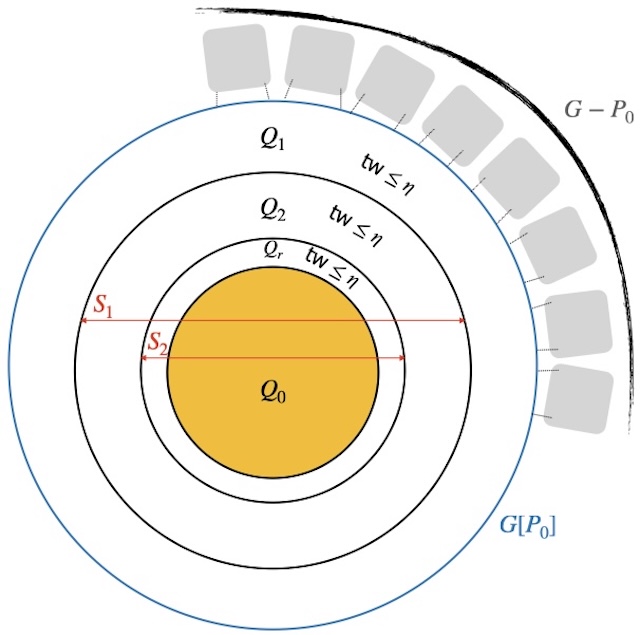
Lemma 29.
Consider and . Let . There exists a polynomial-time protocol which has access to a -approximate kernelization oracle for Treewidth--Deletion of capacity , and when given as input, it makes at most calls to the oracle , and outputs a partition of , such that
-
1.
for each , treewidth of is at most ( is allowed to be empty), and
-
2.
-
(a)
or
-
(b)
.
-
(a)
Proof.
We design an iterative procedure with at most steps. See Figure 3 for a visualization. Initialize and for each , set . Let be the set returned by the oracle on input . Then is a -approximate solution to the instance of Treewidth--Deletion, and so .
In each iteration, we maintain the following invariants: (i) is a partition of , (ii) for each , the treewidth of is at most , and (iii) at the end of the -th iteration, .
In the -th iteration, , the protocol calls the oracle on the instance and receives a -approximate solution to Treewidth--Deletion on . Then . It proceeds with the following case distinction.
-
1.
If , then the protocol terminates and outputs the partition which satisfies condition (2a).
-
2.
Otherwise, . In this case, we set . Clearly, the treewidth of is at most . Next, we set .
We now verify that the invariants are satisfied. Clearly is a partition of and the treewidth of each , , is at most . If then the invariant (iii) holds trivially. Otherwise, due to case distinction, the size of drops by factor , implying .
If the first case occurs before the -th iteration, then we are done. Otherwise, the protocol terminates after the -th iteration. The invariant (iii) implies . Substituting the definitions of and yields condition (2b): .
We argue that one can remove from the graph while paying a small loss in accuracy.
Lossy Reduction Protocol 3.
Let be an instance of -Deletion where Lossy 1 has been exhaustively applied. Let be the protrusion decomposition of from Lemma 24. Let be the partition of obtained from Lemma 29, on input . The reduction protocol outputs .
The solution lifting algorithm takes as input the instances and which is a -approximate solution for the instance of -Deletion and outputs as a solution for of -Deletion.
Lemma 30 ().
Lossy 3 is a -lossy reduction protocol.
On the other hand, discarding allows us to bound the number of simplicial parts. For this, we first need to bound the number of cliques in a graph of bounded treewidth.
Proposition 31.
An -vertex graph of treewidth tw has distinct cliques.
Proof.
Proof.
Let be the partition of obtained from Lemma 29. After the application of Lossy 3, we can assume that . Recall that for each , treewidth of is at most . From Proposition 31, the number of distinct cliques in is . Therefore, the number of distinct cliques in is at most .
Theorem 2 (Uniform lossy protocol).
[Restated, see original statement.]
Let be a finite family of graphs containing at least one planar graph. For any , -Deletion admits a -lossy compression protocol of call size , and at most rounds, where .
For the special case of Treewidth--Deletion, there is a -lossy kernelization protocol with same call size and number of rounds.
Proof.
Fix any . We describe a polynomial time -lossy compression protocol of capacity and rounds. For any it has access to -kernelization oracles for -Deletion and Treewidth--Deletion of capacities .
Given an instance of -Deletion, first compute a near-protrusion decomposition on the instance in polynomial time using Lemma 22. This gives sets with the properties listed in Lemma 22. For each connected component of , it checks whether Lossy 1 is applicable. Let be the instance returned by the reduction algorithm of Lossy 1 at the end of its exhaustive application. From Lemma 24, has an -protrusion decomposition for some (unbounded) and . Run Lossy 3 on the instance to compute .
Consider the augmented graph of . The number of , , those neighborhood in is non-empty and not a clique is bounded by from Lemma 26. For the remaining , we partition them into sets such that each part in a fixed set has the same neighborhood in and any two sets have distinct neighborhood in . Let the resulting sets be . Note that for each , is an -protrusion in and is a clique in . From Lemma 32 we infer that . Then has a -protrusion decomposition, where and .
Let be the instance obtained from Lemma 14 on input , with vertices. If has a -sized solution then the treewidth of is at most and therefore the number of edges of is at most . Finally run the -kernelization algorithm for the problem -Deletion on the instance . Let be a -approximate solution for the problem -Deletion on the instance .
Using the polynomial-time algorithm of Lemma 14, compute a -approximate solution for the instance of -Deletion. We use the solution lifting algorithm of Lemma 30 with : let be the corresponding -approximation solution obtained for the instance of -Deletion. Finally, the solution lifting algorithm of Lemma 23 takes and gives a -approximation solution for the instance .
7 Conclusion
We have presented new techniques to turn a near-protrusion decomposition into a protrusion decomposition (by sacrificing accuracy) and to process the latter in the presence of disconnected forbidden minors. A main follow-up question is whether one really needs multiple calls to the oracle to obtain a uniform -approximate kernel for Treewidth--Deletion (and other cases of -Deletion). In other words, can we improve the uniform lossy kernelization protocol to uniform lossy kernelization? Secondly, our protocol requires the oracle to handle instances of size for some function . Can we obtain a lossy kernel/protocol that is uniform also with respect to ?
References
- [1] Julien Baste, Ignasi Sau, and Dimitrios M. Thilikos. Hitting minors on bounded treewidth graphs. I. General upper bounds. SIAM J. Discret. Math., 34(3):1623–1648, 2020. doi:10.1137/19M1287146.
- [2] Hans L. Bodlaender. A linear-time algorithm for finding tree-decompositions of small treewidth. SIAM J. Comput., 25(6):1305–1317, 1996. doi:10.1137/S0097539793251219.
- [3] Hans L. Bodlaender, Rodney G. Downey, Michael R. Fellows, and Danny Hermelin. On problems without polynomial kernels. J. Comput. Syst. Sci., 75(8):423–434, 2009. doi:10.1016/J.JCSS.2009.04.001.
- [4] Hans L. Bodlaender, Fedor V. Fomin, Daniel Lokshtanov, Eelko Penninkx, Saket Saurabh, and Dimitrios M. Thilikos. (Meta) Kernelization. J. ACM, 63(5):44:1–44:69, 2016. doi:10.1145/2973749.
- [5] Marek Cygan, Fedor V. Fomin, Lukasz Kowalik, Daniel Lokshtanov, Dániel Marx, Marcin Pilipczuk, Michal Pilipczuk, and Saket Saurabh. Parameterized Algorithms. Springer, 2015. doi:10.1007/978-3-319-21275-3.
- [6] Reinhard Diestel. Graph Theory, 4th Edition, volume 173 of Graduate texts in mathematics. Springer, 2012.
- [7] Eduard Eiben, Diptapriyo Majumdar, and M. S. Ramanujan. On the lossy kernelization for connected treedepth deletion set. In Michael A. Bekos and Michael Kaufmann, editors, Graph-Theoretic Concepts in Computer Science - 48th International Workshop, WG 2022, Tübingen, Germany, June 22-24, 2022, Revised Selected Papers, volume 13453 of Lecture Notes in Computer Science, pages 201–214. Springer, 2022. doi:10.1007/978-3-031-15914-5_15.
- [8] Fedor Fomin, Daniel Lokshtanov, Saket Saurabh, and Meirav Zehavi. Kernelization: theory of parameterized preprocessing. Cambridge University Press, 2019. doi:10.1017/9781107415157.
- [9] Fedor V. Fomin, Tien-Nam Le, Daniel Lokshtanov, Saket Saurabh, Stéphan Thomassé, and Meirav Zehavi. Lossy kernelization for (implicit) hitting set problems. In Inge Li Gørtz, Martin Farach-Colton, Simon J. Puglisi, and Grzegorz Herman, editors, 31st Annual European Symposium on Algorithms, ESA 2023, September 4-6, 2023, Amsterdam, The Netherlands, volume 274 of LIPIcs, pages 49:1–49:14. Schloss Dagstuhl – Leibniz-Zentrum für Informatik, 2023. doi:10.4230/LIPIcs.ESA.2023.49.
- [10] Fedor V. Fomin, Daniel Lokshtanov, Neeldhara Misra, Geevarghese Philip, and Saket Saurabh. Hitting forbidden minors: Approximation and kernelization. SIAM J. Discret. Math., 30(1):383–410, 2016. doi:10.1137/140997889.
- [11] Fedor V. Fomin, Daniel Lokshtanov, Neeldhara Misra, and Saket Saurabh. Planar F-Deletion: Approximation, kernelization and optimal FPT algorithms. In 53rd Annual IEEE Symposium on Foundations of Computer Science, FOCS 2012, New Brunswick, NJ, USA, October 20-23, 2012, pages 470–479. IEEE Computer Society, 2012. doi:10.1109/FOCS.2012.62.
- [12] Fedor V. Fomin, Daniel Lokshtanov, Saket Saurabh, and Dimitrios M. Thilikos. Bidimensionality and kernels. SIAM J. Comput., 49(6):1397–1422, 2020. doi:10.1137/16M1080264.
- [13] Valentin Garnero, Christophe Paul, Ignasi Sau, and Dimitrios M. Thilikos. Explicit linear kernels via dynamic programming. SIAM J. Discret. Math., 29(4):1864–1894, 2015. doi:10.1137/140968975.
- [14] Archontia C. Giannopoulou, Bart M. P. Jansen, Daniel Lokshtanov, and Saket Saurabh. Uniform kernelization complexity of hitting forbidden minors. ACM Trans. Algorithms, 13(3):35:1–35:35, 2017. doi:10.1145/3029051.
- [15] Anupam Gupta, Euiwoong Lee, Jason Li, Pasin Manurangsi, and Michal Wlodarczyk. Losing treewidth by separating subsets. In Timothy M. Chan, editor, Proceedings of the Thirtieth Annual ACM-SIAM Symposium on Discrete Algorithms, SODA 2019, San Diego, California, USA, January 6-9, 2019, pages 1731–1749. SIAM, 2019. doi:10.1137/1.9781611975482.104.
- [16] Eva-Maria C. Hols, Stefan Kratsch, and Astrid Pieterse. Approximate turing kernelization for problems parameterized by treewidth. In Fabrizio Grandoni, Grzegorz Herman, and Peter Sanders, editors, 28th Annual European Symposium on Algorithms, ESA 2020, September 7-9, 2020, Pisa, Italy (Virtual Conference), volume 173 of LIPIcs, pages 60:1–60:23. Schloss Dagstuhl – Leibniz-Zentrum für Informatik, 2020. doi:10.4230/LIPIcs.ESA.2020.60.
- [17] Bart M. P. Jansen, Marcin Pilipczuk, and Marcin Wrochna. Turing kernelization for finding long paths in graph classes excluding a topological minor. Algorithmica, 81(10):3936–3967, 2019. doi:10.1007/S00453-019-00614-4.
- [18] Bart M. P. Jansen and Michal Wlodarczyk. Lossy planarization: A constant-factor approximate kernelization for planar vertex deletion. SIAM J. Comput., 54(1):1–91, 2025. doi:10.1137/22M152058X.
- [19] Eun Jung Kim, Alexander Langer, Christophe Paul, Felix Reidl, Peter Rossmanith, Ignasi Sau, and Somnath Sikdar. Linear kernels and single-exponential algorithms via protrusion decompositions. ACM Trans. Algorithms, 12(2), December 2015. doi:10.1145/2797140.
- [20] Tuukka Korhonen, Michal Pilipczuk, and Giannos Stamoulis. Minor containment and disjoint paths in almost-linear time. In 65th IEEE Annual Symposium on Foundations of Computer Science, FOCS 2024, Chicago, IL, USA, October 27-30, 2024, pages 53–61. IEEE, 2024. doi:10.1109/FOCS61266.2024.00014.
- [21] Stefan Kratsch and Pascal Kunz. Approximate turing kernelization and lower bounds for domination problems. In Neeldhara Misra and Magnus Wahlström, editors, 18th International Symposium on Parameterized and Exact Computation, IPEC 2023, September 6-8, 2023, Amsterdam, The Netherlands, volume 285 of LIPIcs, pages 32:1–32:17. Schloss Dagstuhl – Leibniz-Zentrum für Informatik, 2023. doi:10.4230/LIPIcs.IPEC.2023.32.
- [22] William Lochet and Roohani Sharma. Uniform polynomial kernel for deletion to minor-free graphs. In Julián Mestre and Anthony Wirth, editors, 35th International Symposium on Algorithms and Computation, ISAAC 2024, December 8-11, 2024, Sydney, Australia, volume 322 of LIPIcs, pages 46:1–46:14. Schloss Dagstuhl – Leibniz-Zentrum für Informatik, 2024. doi:10.4230/LIPIcs.ISAAC.2024.46.
- [23] Daniel Lokshtanov, Fahad Panolan, M. S. Ramanujan, and Saket Saurabh. Lossy kernelization. In Hamed Hatami, Pierre McKenzie, and Valerie King, editors, Proceedings of the 49th Annual ACM SIGACT Symposium on Theory of Computing, STOC 2017, Montreal, QC, Canada, June 19-23, 2017, pages 224–237. ACM, 2017. doi:10.1145/3055399.3055456.
- [24] M. S. Ramanujan. On approximate compressions for connected minor-hitting sets. In Petra Mutzel, Rasmus Pagh, and Grzegorz Herman, editors, 29th Annual European Symposium on Algorithms, ESA 2021, September 6-8, 2021, Lisbon, Portugal (Virtual Conference), volume 204 of LIPIcs, pages 78:1–78:16. Schloss Dagstuhl – Leibniz-Zentrum für Informatik, 2021. doi:10.4230/LIPIcs.ESA.2021.78.
- [25] Jean-Florent Raymond and Dimitrios M. Thilikos. Recent techniques and results on the Erdős-Pósa property. Discret. Appl. Math., 231:25–43, 2017. doi:10.1016/J.DAM.2016.12.025.
- [26] Neil Robertson and Paul D. Seymour. Graph minors. V. Excluding a planar graph. J. Comb. Theory B, 41(1):92–114, 1986. doi:10.1016/0095-8956(86)90030-4.
- [27] Neil Robertson and Paul D. Seymour. Graph minors .xiii. the disjoint paths problem. J. Comb. Theory B, 63(1):65–110, 1995. doi:10.1006/JCTB.1995.1006.
- [28] Ignasi Sau, Giannos Stamoulis, and Dimitrios M. Thilikos. k-apices of minor-closed graph classes. II. Parameterized algorithms. ACM Trans. Algorithms, 18(3):21:1–21:30, 2022. doi:10.1145/3519028.