Database Theory in Action: From Inexpressibility to Efficiency in GQL’s Order-Constrained Paths

Abstract
Pattern matching of core GQL, the new ISO standard for querying property graphs, cannot check whether edge values are increasing along a path, as established in recent work. We present a constructive translation that overcomes this limitation by compiling the increasing-edges condition into the input graph. Remarkably, the benefit of this construction goes beyond restoring expressiveness. In our proof-of-concept implementation in Neo4j’s Cypher, where such path constraints are expressible but costly, our compiled version runs faster and avoids timeouts. This illustrates how a theoretically motivated translation can not only close an expressiveness gap but also bring practical performance gains.
Keywords and phrases:
Property graphs, ISO GQL, Graph Query Languages, Pattern MatchingCopyright and License:
![[Uncaptioned image]](x1.png) © Hadar Rotschield and Liat Peterfreund; licensed under Creative Commons License CC-BY 4.0
© Hadar Rotschield and Liat Peterfreund; licensed under Creative Commons License CC-BY 4.0
2012 ACM Subject Classification:
Theory of computation Database theory ; Information systems Graph-based database models ; Information systems Query languagesSupplementary Material:
archived at
 swh:1:dir:30effa7157a9e9bbf79b73b574a5189d5b5abef4
Funding:
Both authors were supported by ISF grant 2355/24.Editors:
Balder ten Cate and Maurice FunkSeries and Publisher:
 Leibniz International Proceedings in Informatics, Schloss Dagstuhl – Leibniz-Zentrum für Informatik
1 Introduction
GQL is the new ISO standard for querying property graphs [5]. Property graphs are a rich and flexible data model in which nodes and edges can carry labels (often representing their types) and properties (in a key-value format), which makes them suitable for various domains such as finance, social networks, and knowledge graphs [9, 1, 11].
The GQL standard is lengthy and complex, first formalized in [2, 3], later distilled into its core [4], enabling precise expressiveness analysis, and subsequently positioned on a theory/practice spectrum as articulated in [6]. GQL comprises a pattern-matching layer, used in MATCH to produce bindings of nodes or edges, and a relational layer that post-processes those bindings using relational algebra. One of the key findings in [4] is that queries identifying paths with increasing edge values are not expressible in core GQL. Such queries are common in practice, leading participants in the ISO GQL design to consider possible language extensions to support them [10, 7]. For example, in a financial transaction graph, accounts are nodes with properties such as balance, and transfers are edges with properties such as amount and timestamp. While pattern matching allows to query for chains of transfers where account balances increase along the path, expressing that timestamps increase along a path is impossible. In other words, increasing value conditions can be checked on nodes, but not on edges.
In this paper, we present a constructive translation that overcomes the expressiveness gap by compiling an input graph and order condition into a leveled graph which, together with a reachability query, captures the intended semantics. Our contribution is twofold: first, we provide a principled method that makes inexpressible queries formally definable; second, we show that the same approach yields practical benefits. While such queries can be expressed in the full versions of GQL and in Cypher, the formulations are highly convoluted and require reasoning over exponentially many paths, leading to impractical runtimes as demonstrated in the experiments in [4]. In contrast, our technique achieves efficient execution in practice, as confirmed by a proof-of-concept implementation. This demonstrates how a theoretically motivated translation can both extend the expressive power of a standard language and provide concrete performance improvements.
2 Compiling Ordered-Path Constraints into a Leveled Graph
In this section we show how to compile the increasing values along edges condition into the input graph. We start by defining the data model. We assume pairwise disjoint sets Nodes, Edges, Labels, Properties, and Values, and define a labeled property graph (see, e.g., [6]) as a tuple where and are finite, are total functions, assigns an edge label to each edge, and is a partial function that stores node/edge properties.
Problem Definition.
To formulate the problem, we assume each edge is associated with a designated property val whose value is in . Formally, we assume is defined for every and that . For readability, we denote if there is a directed edge from to with . It was shown in [4] that the following problem is not expressible in pattern matching of core GQL:
Strictly Increasing-Path Existence. For every labeled property graph , and nodes , does there exist a non-empty directed path whose edge-values are strictly increasing (i.e., )?
The underlying reason that this query is not expressible is that GQL’s concatenation, by design, verifies only node equivalence.
Our Construction
We show that given a graph, we can compile the increasing value condition into it. The idea is to encode, in the node identifier of the compiled graph, the value of an incoming edge, hence reducing the increasing value conditions to ordinary reachability.
Definition 1 (Leveled graph).
Let be a labeled property graph. For each node of , let that is, is the set of values of the incoming edges to , together with a special value used for paths that start at . We assume for all values . The leveled graph of consists of nodes for every edge , and, for every , the node , and edges for every edge , and with .
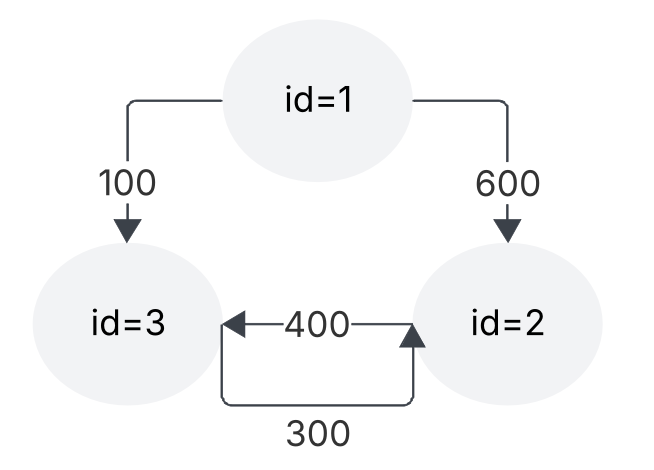
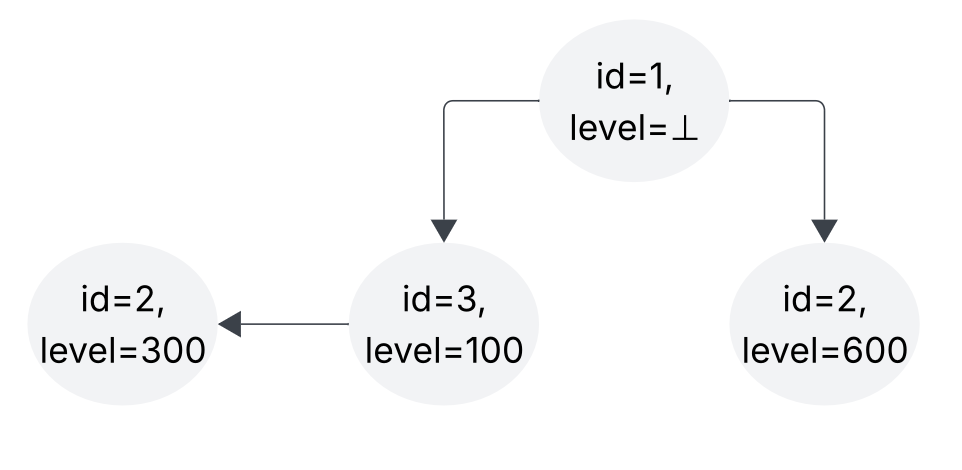
To illustrate the definition, consider the following example.
Example 2 (Increasing amounts).
The graph in Figure 1(a) describes transfers between accounts where denotes the amount of the transfer for each edge . In in Figure 1(b), each account is replicated as for every . There is an edge iff there is a transfer in and there exists for which . Thus, an increasing-transfer path from to in corresponds to a reachability problem in .
With this intuition, we can move to showing the correctness of our construction.
Theorem 3.
Fix a property graph and nodes . There exists a non-empty strictly increasing path in iff there exists such that in .
Proof Sketch.
This immediately yields the desired reduction: checking for a strictly increasing path in reduces to a reachability query in .
Time Complexity.
Using the bounds below, the construction of the leveled graph can be done in time polynomial in its input size.
Proposition 4.
One can construct from by: (i) computing for each node (ii) creating a node for each and , and (iii) for each edge in and each with , adding the edge . This can be done in time.
Proof Sketch.
Recall that hence we can compute for all in . For and the nodes and edges of , respectively, we have
Hence, to compute we need time.
The increasing-path condition is expressible in the full language with set operations (in particular, difference) [4]. Here we deliberately work at the pattern-matching level because composing the required set operations leads to blow-ups, whereas compiling the order constraint into the leveled graph lets us answer it via plain reachability.
3 Experiments
| Leveled build (ms) | Leveled query (ms) | Baseline query (ms) | Speedup () | |
| 20 | 57 | 10 | 9 | 0.13 |
| 40 | 17 | 6 | 6 | 0.26 |
| 60 | 12 | 6 | 7 | 0.39 |
| 80 | 76 | 6 | 8 | 0.10 |
| 100 | 16 | 8 | 12 | 0.50 |
| 120 | 20 | 7 | 10 | 0.37 |
| 140 | 15 | 7 | 363 | 16.50 |
| 160 | 15 | 7 | 1191 | 54.14 |
| 180 | 17 | 7 | timeout | – |
| 200 | 23 | 7 | timeout | – |
| 220 | 29 | 11 | timeout | – |
| 240 | 21 | 7 | timeout | – |
| 260 | 80 | 7 | timeout | – |
| 280 | 28 | 8 | timeout | – |
| 300 | 16 | 8 | timeout | – |
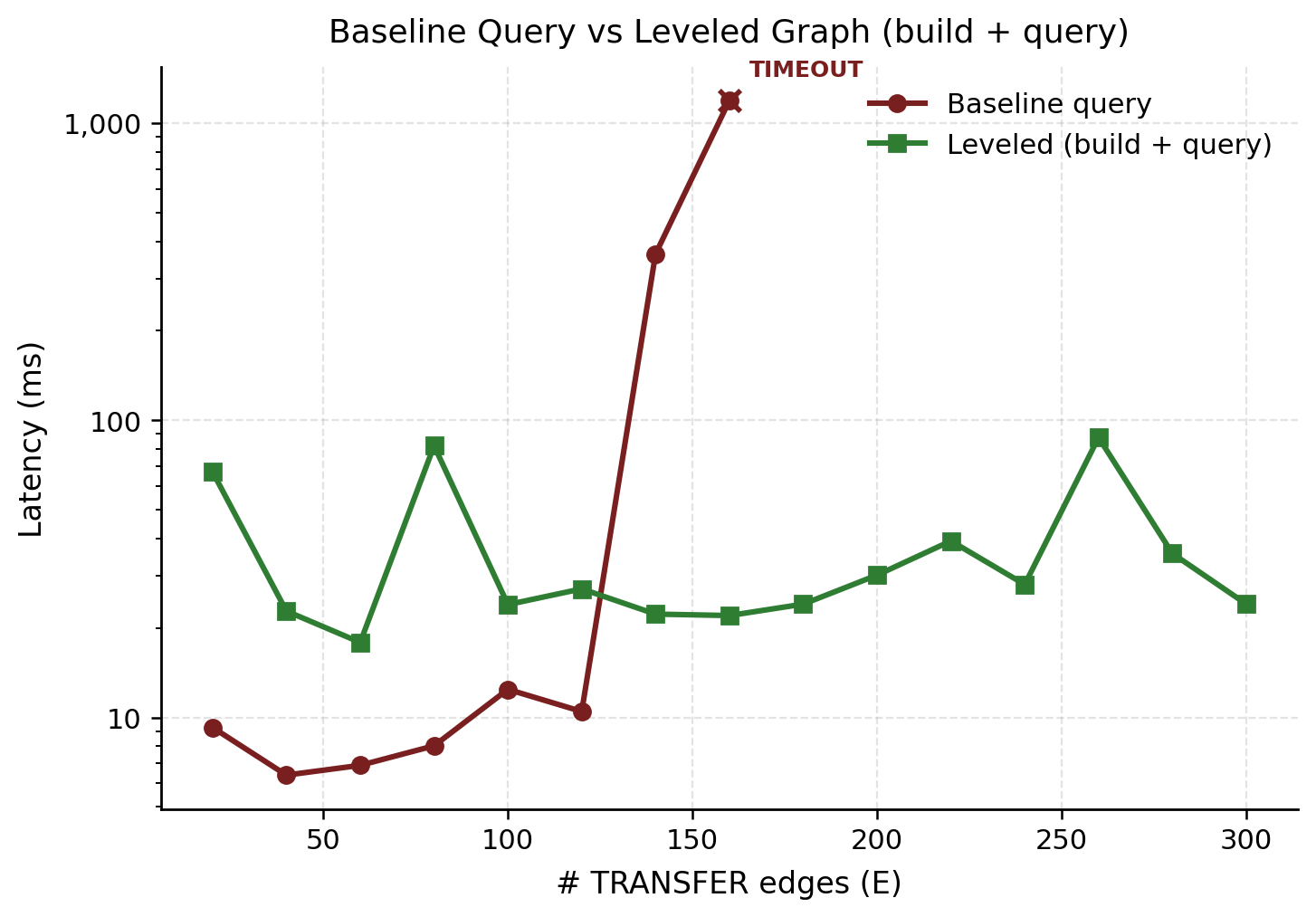
We evaluate the leveled graph compilation for strictly increasing edge values by comparing: (i) a baseline query on the original graph that enforces , and (ii) a leveled graph build along with a reachability query on the compiled leveled graph .
Setup.
We use a local Neo4j instance accessed via the official Neo4j python driver.111Experiments were run locally on macOS 15.6 (build 24G84) on a MacBook Air (Mac16,13) with an Apple M4 CPU (10 cores: 4 performance + 6 efficiency) and 16 GB RAM. The database was Neo4j 2025.07.1 (local install, default configuration), via the official Neo4j Python driver. Client stack: Python 3.13.5 and neo4j driver 5.28.2. The script rebuilds the base graph for each edge count, times the base build, compiles and times , and then runs repeated baseline/leveled queries with client-side per-run timeouts enforced by a worker process. The workload fixes accounts and varies from to in jumps of 20, each edge has an integer amount in . We run 10 times per with timeout=10 sec. Averages are over successful runs only.
Results.
Leveled reachability is nearly flat across densities (6–11 ms per run), whereas the baseline grows sharply and then times out. The leveled approach is slower for small graphs (), but becomes decisively faster as density grows: at we observe a 16.50 speedup, rising to 54.14 at . For all baseline runs hit the 10s per-run timeout, while leveled runs complete without timeouts. Note that results may vary with random graph instances, local resource contention and driver overhead.
4 Conclusions
We revisited the expressiveness gap in core GQL and showed that compiling the order constraint into the graph reduces the inexpressible query to a standard reachability one while pointing to potential runtime benefits in our prototype implementation. Looking ahead, we propose to extend our method to address a broader class of queries (such as those including alternating order constraints) and to conduct a more systematic experimental study across different implementations, languages, datasets, and scales.
References
- [1] Marcelo Arenas, Claudio Gutiérrez, and Juan F. Sequeda. Querying in the age of graph databases and knowledge graphs. In Proceedings of the 2021 International Conference on Management of Data (SIGMOD ’21), pages 2821–2828, Virtual Event, China, 2021. Association for Computing Machinery. doi:10.1145/3448016.3457545.
- [2] Nadime Francis, Amélie Gheerbrant, Paolo Guagliardo, Leonid Libkin, Victor Marsault, Wim Martens, Filip Murlak, Liat Peterfreund, Alexandra Rogova, and Domagoj Vrgoc. GPC: A pattern calculus for property graphs. In Floris Geerts, Hung Q. Ngo, and Stavros Sintos, editors, Proceedings of the 42nd ACM SIGMOD-SIGACT-SIGAI Symposium on Principles of Database Systems, PODS 2023, Seattle, WA, USA, June 18-23, 2023, pages 241–250, Seattle, WA, USA, 2023. ACM. doi:10.1145/3584372.3588662.
- [3] Nadime Francis, Amélie Gheerbrant, Paolo Guagliardo, Leonid Libkin, Victor Marsault, Wim Martens, Filip Murlak, Liat Peterfreund, Alexandra Rogova, and Domagoj Vrgoc. A researcher’s digest of GQL. In Floris Geerts and Brecht Vandevoort, editors, 26th International Conference on Database Theory, ICDT 2023, March 28-31, 2023, Ioannina, Greece, volume 255 of LIPIcs, pages 1:1–1:22. Schloss Dagstuhl – Leibniz-Zentrum für Informatik, 2023. doi:10.4230/LIPIcs.ICDT.2023.1.
- [4] Amélie Gheerbrant, Leonid Libkin, Liat Peterfreund, and Alexandra Rogova. Gql and sql/pgq: Theoretical models and expressive power. Proceedings of the VLDB Endowment (PVLDB), 18(6):1798–1810, 2025. Licensed under CC BY-NC-ND 4.0. doi:10.14778/3725688.3725707.
- [5] GQL Standards Committee. Gql standards website, 2024. Accessed: November 2024. URL: https://www.gqlstandards.org/.
- [6] Leonid Libkin, Wim Martens, Filip Murlak, Liat Peterfreund, and Domagoj Vrgoč. Querying graph data: Where we are and where to go. In Companion of the 44th Symposium on Principles of Database Systems (PODS Companion ’25), pages 1–19, Berlin, Germany, 2025. ACM. doi:10.1145/3722234.3725822.
- [7] Tobias Lindaaker. Predicates on sequences of edges. Technical report, ISO/IEC JTC1/ SC32 WG3:W26-027, 2023.
- [8] Hadar Rotschield and Liat Peterfreund. Order-Constrained-Paths-in-Leveled-Graphs. Software, swhId: swh:1:dir:30effa7157a9e9bbf79b73b574a5189d5b5abef4 (visited on 2026-02-25). URL: https://github.com/hadarrot/Order-Constrained-Paths-in-Leveled-Graphs, doi:10.4230/artifacts.25284.
- [9] Sakshi Srivastava and Anil Kumar Singh. Fraud detection in the distributed graph database. Cluster Computing, 26(1):515–537, 2023. doi:10.1007/S10586-022-03540-3.
- [10] Fred Zemke. For each segment discussion. Technical report, ISO/IEC JTC1/ SC32 WG3:BGI-022, 2024.
- [11] Jun Zhu, Zaiqing Nie, Xiaojiang Liu, Bo Zhang, and Ji-Rong Wen. Statsnowball: A statistical approach to extracting entity relationships. In Proceedings of the 18th International Conference on World Wide Web (WWW ’09), pages 101–110, Madrid, Spain, 2009. Association for Computing Machinery. doi:10.1145/1526709.1526724.