Permutation Match Puzzles: How Young Tanvi Learned About Computational Complexity

Abstract
We study a family of sorting match puzzles on grids, which we call permutation match puzzles. In this puzzle, each row and column of a grid is labeled with an ordering constraint – ascending (A) or descending (D) – and the goal is to fill the grid with the numbers 1 through such that each row and column respects its constraint.
We provide a complete characterization of solvable puzzles: a puzzle admits a solution if and only if its associated constraint graph is acyclic, which translates to a simple “at most one switch” condition on the A/D labels. When solutions exist, we show that their count is given by a hook length formula. For unsolvable puzzles, we present an algorithm to compute the minimum number of label flips required to reach a solvable configuration. Finally, we consider a generalization where rows and columns may specify arbitrary permutations rather than simple orderings, and establish that finding minimal repairs in this setting is NP-complete by a reduction from feedback arc set.
Keywords and phrases:
sorting match puzzles, permutation match puzzles, grid puzzles, constraint satisfaction, directed acyclic graphs, hook length formula, standard Young tableaux, NP-completeness, feedback arc setCopyright and License:
![[Uncaptioned image]](x1.png) © Kshitij Gajjar and Neeldhara Misra; licensed under Creative Commons License CC-BY 4.0
© Kshitij Gajjar and Neeldhara Misra; licensed under Creative Commons License CC-BY 4.0
2012 ACM Subject Classification:
Theory of computation Design and analysis of algorithms ; Mathematics of computing CombinatoricsAcknowledgements:
We would like to thank the Center for Creative Learning (CCL) at IIT Gandhinagar for introducing us to this puzzle. We also acknowledge the use of an AI assistant (Claude) for the preparation of this draft. We are also grateful to the reviewers of FUN 2026 for their feedback.Editor:
John IaconoSeries and Publisher:
 Leibniz International Proceedings in Informatics, Schloss Dagstuhl – Leibniz-Zentrum für Informatik

1 Introduction
Tanvi, while wandering the corridors of IIT Gandhinagar, ambles into the Centre for Creative Learning (CCL), where she is intrigued by a really simple looking puzzle – also shown in Figure 1. From the looks of it, it is a grid on a foam board with nine removable pieces labeled from to . It reminds her of a magic square, but here each row and column is labelled by the word ascending or descending – it turns out these are also removable bits that can be flipped over to change the label, so the board appears to hold sixty-four puzzles in all!
She wonders what the puzzle demands. After asking around, she finds that the goal is to reorganize the numbers in the grid such that each row and column is in the appropriate order. She wonders if there is a way to solve each of the sixty-four puzzles in a systematic way. A playable version of this puzzle can be found here.
In this work, we explore general versions of this puzzle, providing a fairly complete picture of questions of solvability, counting solutions, and the issue of optimally perturbing unsolvable puzzles to make them solvable.
Consider the following natural generalization of the puzzle found at CCL: given an grid where each row and column is labeled either A (ascending) or D (descending), fill the grid with numbers from 1 to such that each row (respectively, column) labeled A must contain numbers in ascending order and each row (respectively, column) labeled D must contain numbers in descending order.
The examples in Figure 3 show configurations that have no valid solutions. To understand why these puzzles are unsolvable, we first observe a key structural property that creates an impossible situation: if there exist rows with labeled D and A (or A and D) respectively, and columns with labeled A and D (or D and A) respectively, then we have a circular constraint, illustrated in Figure 3.
Consider the four cells at positions , , , and , containing values , , , and respectively. Following the arrows in the diagram, the constraints force a cyclic chain of inequalities: or , depending on the labeling, which is clearly impossible.
We now formally define the notion of a sorting match puzzle.
Definition 1 (Sorting Match Puzzles).
A sorting match puzzle of order is a pair of words , each of length , over the alphabet . A sorting match puzzle is solvable if there exists a permutation of the integers arranged in an grid such that:
-
For each , if , the entries in the row are in ascending order; if , the entries are in descending order.
-
For each , if , the column is in ascending order; if , the entries are in descending order.
We also call a sorting match puzzle row (respectively, column) uniform if all its row (resp., column) labels are identical.
Definition 2 (Uniform Sorting Match puzzles).
A sorting match puzzle is row-uniform if or ; a sorting match puzzle is col-uniform if or ; and a sorting match puzzle is uniform if it is both row-uniform and col-uniform.
A first natural question we want to address is the following: when is a sorting match puzzle solvable? Our first result is that the scenarios described in Figure 4 are the only obstructions to solvability. In particular, solvable puzzles are either row or column uniform, or are of the form and for some or and for some . This characterization also tells us that there are solvable puzzles.
Next, we want to explore both solvable and unsolvable puzzles further. For solvable puzzles, we would like to count the number of solutions. For unsolvable puzzles, we would like to know the minimum number of label flips required to make the puzzle solvable. We discover that the answer to the first question involves the hook length formula, while for the second question notice that by guessing the “shape” of the nearest solvable puzzle, we can find the answer in time by brute force. We improve this to a linear time algorithm using a simple dynamic programming approach. We note that our ideas here extend to -dimensional grids too.
Notice that ascending and descending orders can be thought of as two special permutations over . This suggests the following natural generalization of the puzzle above: where the labels can be arbitrary permutations over , and a solution is a permutation of the integers that satisfies the ordering constraints imposed by the labels – see Figure 5 for an illustration. This motivates our next definition.
Definition 3 (Permutation Match Puzzles).
A permutation match puzzle of order is a pair , where and are sequences of permutations, with each . A generalized sorting match puzzle is solvable if there exists a permutation of the integers arranged in an grid such that:
-
For each , if the entries in the row are (from left to right), then .
-
For each , if the entries in the column are (from top to bottom), then .
Sorting match puzzles are a special case of permutation match puzzles where each and is either the identity permutation (corresponding to A) or the reversal permutation (corresponding to D).
By interpreting the permutation constraints as directed edges on a grid, we observe that determining if a permutation match puzzle is solvable or not reduces to cycle detection. Permutation match puzzles inspire the following question: given a directed graph on the vertex set , where the subgraph induced by the vertices and is acyclic for each , what is the minimum number of edges we need to flip to make the acyclic? This is essentially a feedback arc set problem on a restricted class of directed graphs. Our final result is that this problem is NP-complete.
Related Work.
Permutation match puzzles belong to a rich tradition of combinatorial puzzles with algebraic and algorithmic underpinnings. The most classical example is the 15-puzzle, whose solvability was characterized by Johnson and Story [8] using permutation parity: a configuration is reachable if and only if it corresponds to an even permutation. While checking solvability is polynomial-time, Ratner and Warmuth [9] showed that finding the shortest solution for generalized sliding puzzles is NP-hard.
Our counting results connect to the theory of posets and Young tableaux. The problem of counting linear extensions of a poset is #P-complete in general [3], making our closed-form formula for sorting match puzzles particularly notable. The formula we derive is reminiscent of the celebrated hook length formula of Frame, Robinson, and Thrall [6], which counts standard Young tableaux of a given shape. Greene, Nijenhuis, and Wilf [7] gave an elegant probabilistic proof of this formula using a “hook walk” argument, which bears conceptual similarity to our recursive decomposition approach.
The structural constraints in permutation match puzzles also relate to geometric grid classes of permutations studied by Albert, Atkinson, Bouvel, Ruškuc, and Vatter [2], where permutations are constrained by monotonicity conditions on grid cells. Grid-based constraint satisfaction more broadly connects to Latin squares and Sudoku puzzles [5, 10], though our puzzles differ in using global ordering constraints rather than local distinctness conditions.
Our NP-completeness result for the minimum repair problem relates to feedback arc set problems. While minimum feedback arc set is NP-hard even for tournaments [4], and approximation algorithms exist for general instances [1], our reduction shows hardness persists even when the underlying graph has the restricted structure arising from grid-based permutation constraints.
2 Sorting Match Puzzles
We first establish a characterization of solvable sorting match puzzles.
Theorem 4.
A sorting match puzzle is solvable if and only if it is either row-uniform or col-uniform, or satisfies one of the following conditions:
-
1.
There exists and such that:
-
The first rows are labeled A and the remaining rows are labeled D, and
-
The first columns are labeled A and the remaining columns are labeled D.
-
-
2.
There exists and such that:
-
The first rows are labeled D and the remaining rows are labeled A, and
-
The first columns are labeled D and the remaining columns are labeled A.
-
Proof.
If is col-uniform, say with , then fill the grid from top-left to bottom-right, row by row, with the entries in the row being the numbers in ascending order if and in descending order if . If , then fill the grid from bottom-right to top-left, row by row, with the entries in the row from the bottom being the numbers in ascending order if and in descending order if . An analogous reasoning applies if is row-uniform.
Now consider the case when there exists and such that the first rows are labeled A and the remaining rows are labeled D, and the first columns are labeled A and the remaining columns are labeled D. Let:
-
denote the cells included in the intersection of the first rows and the first columns
-
denote the cells included in the intersection of the first rows and the remaining columns
-
denote the cells included in the intersection of the remaining rows and the first columns
-
denote the cells included in the intersection of the remaining rows and the remaining columns
One solution to this puzzle is the following: populate with the first numbers in ascending order, filling this sub-grid row by row, top-left to bottom-right, and populate with the next numbers in descending order, filling this sub-grid row by row, top-left to bottom-right. Then we fill the cells in with the next numbers in descending order, filling this sub-grid row by row, top-left to bottom-right, however keeping the numbers in each row ascending; and finally, the cells in with the next numbers in ascending order, filling this sub-grid row by row, top-left to bottom-right, however keeping the numbers in each row descending.
We refer the reader to Figure 7 for an example of this algorithm with . The other case in the theorem has a symmetric argument.
Corollary 5.
There are
sorting match puzzles of order .
Proof.
By Theorem 4, solvable puzzles are either: (i) row-uniform puzzles (where or ), giving puzzles (two choices for , and choices for ), or (ii) column-uniform puzzles (where or ), giving puzzles (two choices for , and choices for ), or (iii) non-uniform (of two types, which we will see later).
This sums up to . However, we need to make a small correction for over-counting: we have to subtract four to account for the fact that the four puzzles , , , are double-counted as they are both row-uniform and column-uniform. This makes it uniform puzzles total.
Finally, let us count the non-uniform puzzles. By Theorem 4, we have two types of non-uniform puzzles: (i) and for some , or (ii) and for some . For each type, there are solvable puzzles (one puzzle for each choice of and ). This makes it non-uniform puzzles total.
The first few terms of the series are . This sequence is not present on OEIS, and we plan to put it up soon.
Graph-Theoretic Formulation.
We observe that this puzzle can be reformulated as a problem of topologically sorting a directed graph. This view is redundant in the light of the characterization above, but will be useful when we consider the general permutation match puzzles later.
Given an instance of a sorting match puzzle, we can create a vertex for each cell in the grid, and add the following directed edges based on the A/D labels: for each row labeled A (respectively, D): add edges from left to right (respectively, right to left); for each column labeled A (respectively, D): add edges from bottom to top (respectively, top to bottom).
Theorem 6.
An instance of the ascending-descending grid puzzle has a solution if and only if its corresponding directed graph is acyclic.
Proof.
() If there exists a solution, then the numbers in the grid provide a valid topological ordering of the vertices, which implies the graph must be acyclic.
() If the graph is acyclic, any topological ordering of the vertices provides a valid solution when we replace the vertices with numbers 1 through in order.
Having established solvability, we now turn to counting solutions for sorting match puzzles that are not uniform.
2.1 Counting Solutions
Consider a sorting match puzzle , where there exist integers and such that:
-
The first rows are labeled A and the remaining rows are labeled D, and
-
The first columns are labeled A and the remaining columns are labeled D.
Recall our notation from before: for the top-left subgrid, for the top-right subgrid, for the bottom-left subgrid, and for the bottom-right subgrid. Our first claim is that in any valid solution, the numbers from to are used only in and .
Lemma 7.
In any valid solution to this puzzle, the numbers from to must appear only in and .
Proof.
We first argue that any number in must be smaller than any number in . Then the claim follows, since the entries of the grid are a permutation of to .
Consider a number in , located in the row and column; and a number in , located in the row and column. There are four cases, and we discuss one of them: the others are analogous.
Suppose and : if , then we are in an ascending column and . If , then , where is the number in the row and column. If , then , where is the number in the row and column (see Figure 8 for an illustration).
An analogous result holds if the first rows are labeled D and the remaining rows are labeled A, and the first columns are labeled D and the remaining columns are labeled A.
Theorem 8.
The number of solutions to the sorting match puzzle with parameters and (i.e., first rows and first columns labeled A, rest labeled D) is:
where is the number of standard Young tableaux of rectangular shape and .
Proof.
By the preceding lemma, numbers to fill , while the remaining numbers fill . Within each subgrid, the ordering constraints (ascending/descending in rows and columns) make filling equivalent to constructing a standard Young tableau of rectangular shape. The binomial coefficient counts ways to distribute the smallest numbers between and . Once this choice is made, the hook length formula gives the count for each rectangular subgrid independently.
2.2 Unique Solutions
Note that Theorem 4 characterizes solvability, and gives us conditions for when a permutation grid puzzle has no solution. We would now like to characterize when a permutation grid puzzle has exactly one solution. Notice that non-uniform grids have multiple solutions as suggested by our counting argument from Theorem 8: also see Figure 9 for examples on puzzles of order two.
On the other hand, if we fix a row-uniform or column-uniform puzzle, we can characterize when it has a unique solution: this happens precisely when the non-uniform side is alternating, and is filled out by a so-called “boustrophedon” pattern (see Figure 10).
Theorem 9.
A sorting match puzzle of order has a unique solution if and only if it satisfies one of the following:
-
1.
Row-uniform with alternating columns: and alternates between and .
-
2.
Column-uniform with alternating rows: and alternates between and .
Proof.
We first show that an alternating constraint pattern on an uniform puzzle has a unique solution. Consider the case with (or if is odd). Every row is ascending left-to-right. Column 1 is ascending (bottom-to-top), column 2 is descending, and so on. This creates a snake-like path: starting from cell , we traverse up column 1, then across row to column 2, down column 2, across row 1 to column 3, and so forth. We now argue that each step in this path is forced by the constraints, making the solution unique.
We show by induction that value is at cell for each . Since all rows are ascending, the value 1 cannot appear in any column other than the first. Since column 1 is ascending, the value 1 must be in row 1. Thus, cell contains 1, this is the base case. For the inductive step, suppose values occupy cells for some . We show that value must be at .
Suppose is at cell with . Since row is ascending, , so . By the inductive hypothesis, the cells containing values are exactly , hence . Now consider column 2, which is descending. All cells with satisfy (the first inequality by column 2 descending, the second by row ascending). Thus all such cells need values from , but these values are already in column 1. Since there are such cells, we have a contradiction.
Therefore is in column 1. Since cells are occupied and column 1 is ascending, we have .
After column 1 is filled with , we show must be at . If were at with , then by row ascending. But all values less than are in column 1, so cannot be filled. Thus must be in column 2. A similar inductive argument shows that values occupy cells respectively: the descending constraint on column 2 forces us to fill it from bottom to top. The pattern alternates: odd columns fill upward, even columns fill downward, creating the boustrophedon pattern. The case with alternating columns, and the symmetric cases with uniform and alternating, follow by analogous arguments.
Now suppose (row-uniform) but contains two adjacent columns with the same label, say columns and are both descending. Consider the subgrid formed by rows and columns . Let the four cells be:
where , , , .
The constraints require and and and . These constraints form a partial order where is minimum and is maximum, but and are incomparable – neither is constrained to be less than the other. This means there exist valid solutions with and other valid solutions with , giving at least two distinct solutions. As a concrete example, consider a puzzle with and . The following are both valid solutions:
For the mixed case (where neither nor is uniform), the hook length formula from the previous section shows the count is always greater than 1.
2.3 Nearest Solvable Puzzles
Imagine Tanvi encounters an unsolvable sorting match puzzle. Unwilling to give up, she plans to change some of the row and column labels to make the puzzle solvable. However, she does not want to be conspicuous in doing so. Hence she wonders: what is the minimum number of label flips needed to make the puzzle solvable?
Given an arbitrary sorting match puzzle , we may ask: what is the “nearest” solvable puzzle? Using the notation to denote the Hamming distance between two strings, we define the nearest solvable puzzle problem:
Nearest Solvable Sorting Match Puzzle
Input: A sorting match puzzle
Output: A solvable puzzle minimizing
Recall from Theorem 4 that a puzzle is solvable if and only if it avoids certain forbidden patterns. A key observation is that if either or is uniform (all ’s or all ’s), then no forbidden pattern can arise, since such patterns require transitions in both rows and columns at adjacent positions. More generally, a puzzle is solvable if both and have at most one transition point (from to or vice versa), provided these transitions are compatible – both must be transitions or both must be transitions.
Notice that by guessing the “shape” of the nearest solvable puzzle, we can find the answer in time by brute force. But we can do better. For a string , define:
-
, the number of ’s in the first positions
-
, the total number of ’s in
The cost to transform into the pattern (first positions are , remaining are ) is:
Similarly, the cost to transform into is:
We compute incrementally via the recurrence and . This yields recurrences for the costs:
As we scan from to , the cost changes by at each step, so we can track the running minimum in time for each string.
Theorem 10.
The nearest solvable sorting match puzzle can be computed in time.
Proof.
Let and denote the minimum costs over all for the respective patterns. The answer is:
The first two options make one string uniform (cost = minimum of flipping all to or all to ), leaving the other unchanged. The last two options transform both strings to have at most one compatible transition. Each quantity is computed in a single pass.
3 Permutation Match Puzzles
In this section, we turn to permutation match puzzles and establish that determining the minimum number of constraint modifications needed to make such a puzzle solvable is NP-complete. Recall that a permutation match puzzle is solvable if and only if its associated constraint graph is acyclic. This motivates the following graph-theoretic problem.
Grid Acyclification
Input: A positive integer , a non-negative integer , and a directed graph on the vertex set such that for each , the subgraph induced by the row is an acyclic tournament, and for each , the subgraph induced by the column is an acyclic tournament.
Question: Can be made acyclic by deleting at most vertices?
Deleting a vertex removes it along with all incident edges. The constraint that each row and column induces an acyclic tournament reflects the structure arising from permutation constraints: each permutation defines a total order on elements, which corresponds to a transitive tournament on the row or column.
The Grid Acyclification problem is closely related to the classical Feedback Vertex Set problem, where one seeks to remove a minimum number of vertices to eliminate all directed cycles. Our variant restricts attention to graphs with the grid structure described above.
Theorem 11.
Grid Acyclification is NP-complete.
We establish this by a reduction from Feedback Vertex Set on directed graphs. Before presenting the formal construction, we illustrate the key ideas through an example.
Example.
Consider the directed graph on five vertices shown in Figure 11. The graph contains several cycles, including and . The minimum feedback vertex set of has size one, since deleting one vertex ( or ) breaks all cycles.
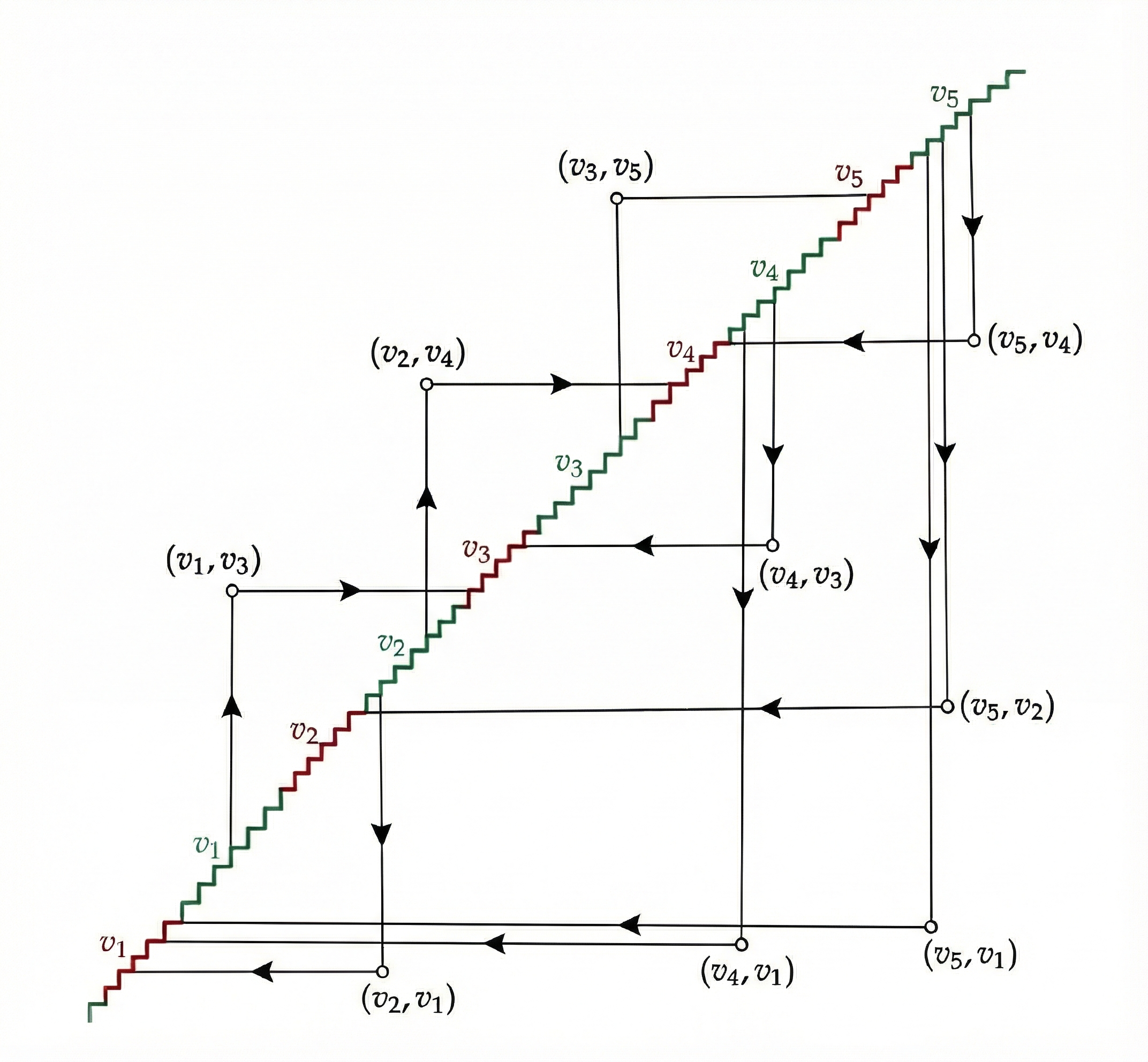
We construct a grid graph from as follows. The construction has three types of vertices (see Figure 12):
-
1.
Staircase vertices: A diagonal staircase runs from the bottom-left to the top-right corner (edges of the staircase are oriented alternately upwards and rightwards). For each vertex of , the staircase contains a red segment (where edges can only enter), followed by a connector vertex (shown in black), followed by a green segment (where edges can only leave). The connector vertex between the red and green segments of is called the key vertex for .
-
2.
Edge vertices: For each edge in , we place an edge vertex at a unique grid position.
-
3.
Inactive vertices: All remaining grid cells contain inactive vertices. These are configured as sinks in every row and column tournament, ensuring they never participate in any cycle.
The key insight is that each row and column contains at most three active (non-sink) vertices: at most two from the staircase (where the row/column crosses the diagonal) and at most one edge vertex. This sparse structure allows us to carefully control the edge orientations within each row and column tournament.
A cycle in corresponds to a cycle in that traverses:
green edge vertex red (upwards along staircase) green edge vertex red (upwards along staircase) green edge vertex red (upwards along staircase) green .
Crucially, deleting the key vertex for (the black connector between red and green ) disconnects all paths through , which corresponds to removing from the feedback vertex set in .
Formal Construction.
Let be a directed graph with and edges. We construct a grid graph of size where .
Staircase structure. The diagonal of contains a staircase pattern. For each vertex , we allocate a segment of the diagonal consisting of:
-
A red segment of consecutive diagonal cells, where is the in-degree of in .
-
A single key vertex .
-
A green segment of consecutive diagonal cells, where is the out-degree of .
The segments are arranged along the diagonal in order: red , key , green , red , key , green , and so on.
Edge vertices. For each edge , we designate a unique cell in the grid. This cell is positioned such that:
-
It shares a row with exactly one cell from the green segment of .
-
It shares a column with exactly one cell from the red segment of .
Since each vertex’s segment has enough cells to accommodate all incident edges, and each edge uses a distinct cell from each segment, the edge vertices are all distinct and well-defined.
All grid cells not designated as staircase vertices or edge vertices are inactive vertices.
Tournament orientations. We now specify the edge orientations within each row and column. Let denote the set of active vertices: all staircase vertices and edge vertices. For each row and column :
-
Inactive vertices are sinks: For every inactive vertex and every other vertex in the same row or column, the edge is directed .
-
Staircase edges follow the diagonal: Within the staircase, edges are directed from lower-left to upper-right: if and are staircase vertices with in the same row or column, then .
-
Edge vertex orientations: For an edge vertex corresponding to edge :
-
–
In its row (shared with green ): the edge goes from the green segment cell to .
-
–
In its column (shared with red ): the edge goes from to the red segment cell.
-
–
-
Direct edges between distant active vertices: If two active vertices share a row or column but are not adjacent in the staircase and neither is an edge vertex connecting them, orient the edge from left-to-right (in rows) or bottom-to-top (in columns).
These orientations ensure that each row and column induces an acyclic tournament on its vertices. We now claim that inactive vertices never participate in any cycle of . Indeed, every inactive vertex is a sink with respect to vertices that are staircase and edge vertices. Further, the subgraph induced by inactive vertices is acyclic by construction. This implies the claim.
Lemma 12.
The graph contains a cycle if and only if contains a cycle. Moreover, every cycle in passes through the key vertex for some .
Proof.
Let be a cycle in . Note that contains only active vertices. Since staircase edges are directed from lower-left to upper-right, any path along the staircase must eventually leave the staircase (at a green segment) to continue as a cycle. Such a path must use an edge vertex to jump to a later portion of the staircase.
Tracing the cycle : starting from any key vertex , the path proceeds through the green segment of , exits via some edge vertex , enters the red segment of , proceeds to , and continues. The sequence of key vertices visited corresponds exactly to a cycle in .
Let be a cycle in . We construct a corresponding cycle in : from , follow the staircase through green , take the edge vertex , enter red , proceed to , and continue. This traces a valid directed path that returns to .
Proof of Theorem 11.
Membership in NP is clear: given a set of at most vertices, we can verify in polynomial time that is acyclic.
For NP-hardness, we reduce from Feedback Vertex Set on directed graphs, which is NP-complete. Given an instance of Feedback Vertex Set, construct the grid graph as described above. We claim that has a feedback vertex set of size at most if and only if can be made acyclic by deleting at most vertices.
Suppose is a feedback vertex set of with . Let be the corresponding key vertices in . We claim is acyclic. By Lemma 12, every cycle in passes through some key vertex . If , then is deleted. If , then any cycle through corresponds to a cycle in through , but since is a feedback vertex set, such a cycle must also pass through some , meaning the cycle in passes through . Thus, all cycles are broken.
Suppose is a set of at most vertices in such that is acyclic. We construct a feedback vertex set for with using a pushing argument.
First, recall that we may assume contains no inactive vertices (removing an inactive vertex from cannot create new cycles).
For each vertex , we “push” it to a nearby key vertex:
-
If is already a key vertex, include in .
-
If is in the red segment of , include in . (Any cycle through must continue to , so deleting also breaks this cycle.)
-
If is in the green segment of , include in . (Any cycle through must have come from .)
-
If is an edge vertex, include in . (Any cycle through must pass through either or ; we choose .)
This maps each vertex in to a vertex in (possibly with repetitions), so . We claim is a feedback vertex set. Suppose for contradiction that contains a cycle . By Lemma 12, contains a corresponding cycle through . Since for all , no key vertex is the image of any vertex in under our pushing map. But then the original set did not break this cycle in , contradicting that is acyclic.
The construction of from is polynomial in , completing the reduction.
4 Concluding Remarks
We have presented a comprehensive study of permutation match puzzles, a family of constraint satisfaction problems on grids inspired by a physical puzzle. Our main contributions include a complete characterization of solvability via the acyclicity of an associated constraint graph, which reduces to an elegant “at most one switch” condition on the row and column labels. When solutions exist, we derived an exact counting formula using hook lengths, connecting these puzzles to the rich combinatorics of standard Young tableaux. For unsolvable instances, we provided a linear-time algorithm to compute the minimum number of label flips required to restore solvability. These results extend naturally to three-dimensional grids and partially filled puzzles, where the solvability criterion generalizes in a clean manner.
Several directions remain open for further investigation. First, while we established NP-completeness for the generalized setting where rows and columns specify arbitrary permutations, it would be interesting to identify tractable special cases – for instance, when the permutations come from a restricted family or when the constraint graph has bounded treewidth. Second, our results focus on complete grids; understanding the complexity of partial filling problems where only a subset of cells must be filled could lead to connections with constraint propagation and arc consistency. Third, the hook length formula suggests deeper algebraic structure; exploring whether representation-theoretic techniques can yield further insights into the solution space would be worthwhile. The interplay between simple local constraints and global structure makes permutation match puzzles a fertile ground for both recreational mathematics and algorithmic exploration.
References
- [1] Nir Ailon, Moses Charikar, and Alantha Newman. Aggregating inconsistent information: Ranking and clustering. In Proceedings of the 37th Annual ACM Symposium on Theory of Computing (STOC), pages 684–693, 2005. doi:10.1145/1060590.1060692.
- [2] Michael H. Albert, M. D. Atkinson, Mathilde Bouvel, Nik Ruškuc, and Vincent Vatter. Geometric grid classes of permutations. Transactions of the American Mathematical Society, 365(11):5859–5881, 2013. doi:10.1090/S0002-9947-2013-05804-7.
- [3] Graham Brightwell and Peter Winkler. Counting linear extensions. Order, 8(3):225–242, 1991. doi:10.1007/BF00383444.
- [4] Pierre Charbit, Stéphan Thomassé, and Anders Yeo. The minimum feedback arc set problem is NP-hard for tournaments. Combinatorics, Probability and Computing, 16(1):1–4, 2007. doi:10.1017/S0963548306007887.
- [5] Charles J. Colbourn and Jeffrey H. Dinitz. Handbook of Combinatorial Designs. Chapman and Hall/CRC, 2nd edition, 2007. doi:10.1201/9781420010541.
- [6] J. S. Frame, G. de B. Robinson, and R. M. Thrall. The hook graphs of the symmetric group. Canadian Journal of Mathematics, 6:316–324, 1954. doi:10.4153/CJM-1954-030-1.
- [7] Curtis Greene, Albert Nijenhuis, and Herbert S. Wilf. A probabilistic proof of a formula for the number of Young tableaux of a given shape. Advances in Mathematics, 31(1):104–109, 1979. doi:10.1016/0001-8708(79)90023-9.
- [8] Wm. Woolsey Johnson and William E. Story. Notes on the “15” puzzle. American Journal of Mathematics, 2(4):397–404, 1879.
- [9] Daniel Ratner and Manfred Warmuth. The -puzzle and related relocation problems. Journal of Symbolic Computation, 10(2):111–137, 1990. doi:10.1016/S0747-7171(08)80001-6.
- [10] Takayuki Yato and Takahiro Seta. Complexity and completeness of finding another solution and its application to puzzles. In Proceedings of the 14th International Symposium on Algorithms and Computation (ISAAC), pages 307–316, 2003. doi:10.1007/978-3-540-24587-2_33.