Interactive Uniform Floodlight Illumination and Rotating Rays Voronoi Diagrams

Abstract
Floodlight illumination problems are art-gallery variants, where a target domain needs to be illuminated by guards, each associated with a field of view. The rotating rays Voronoi diagram is a Voronoi diagram with rays as sites under the angular distance. There is a natural connection of this Voronoi structure with the problem of finding the minimum aperture such that a given set of uniform aperture floodlights illuminates a target domain. In this work we present an interactive visualization software for such problems, supporting different angular distances, namely, oriented and unoriented versions, and for different domains, namely, the plane and simple polygons.
Keywords and phrases:
rotating rays Voronoi diagram, oriented angular distance, unoriented angular distance, Brocard angle, floodlight illumination, coverage problems, visualization softwareCategory:
Media ExpositionFunding:
Marko Savić: Partly supported by the Ministry of Science, Technological Development and Innovation of the Republic of Serbia (Grants No. 451-03-33/2026-03/ 200125 & 451-03-34/2026-03/ 200125) and by the Science Fund of the Republic of Serbia, #7462, Graphs in Space and Time: Graph Embeddings for Machine Learning in Complex Dynamical Systems – TIGRA.Copyright and License:
![[Uncaptioned image]](x1.png) © Carlos Alegría, Ioannis Mantas, Marko Savić, and Martin Suderland; licensed under Creative Commons License CC-BY 4.0
© Carlos Alegría, Ioannis Mantas, Marko Savić, and Martin Suderland; licensed under Creative Commons License CC-BY 4.0
2012 ACM Subject Classification:
Theory of computation Computational geometrySupplementary Material:
Software: https://github.com/VD-collective/rvd-explorer [2]archived at
 swh:1:dir:ecbbe02e948195b997416d5a9fd082d6f6c1a01d
Editors:
Hee-Kap Ahn, Michael Hoffmann, and Amir NayyeriSeries and Publisher:
 Leibniz International Proceedings in Informatics, Schloss Dagstuhl – Leibniz-Zentrum für Informatik
1 Introduction
Given a ray and a point , the oriented angular distance is the counterclockwise angle needed to rotate around its apex until it passes through . The unoriented angular distance is equal to . We call -floodlight the cone around formed by the points with angular distance at most ; see Figure 1. Given a domain and a set of rays, we consider the following two closely related problems.
-
The -floodlight illumination of by : Each ray induces an -floodlight and the goal is to find the minimum , denoted by , that illuminates/covers .
-
The construction of the rotating rays Voronoi diagram of restricted to , denoted by : The diagram is a partition of into regions, where each region consists of all points in that are nearest to a particular ray under the angular distance function.
The -floodlight illumination reduces to the construction of the rotating rays Voronoi diagram, since the angle is realized on a feature of [1]. Hence, after constructing the diagram, can be found in time linear in by a traversal. Each problem has two variants, the unoriented and the oriented, depending on the distance considered.
For optimization problems where these concepts can be applied see [4, 5, 7, 12, 15, 21]. For an overview of Voronoi diagrams and illumination problems, see [6, 16] and [17, 18, 22].
Contribution.
To motivate and facilitate further research on the aforementioned problems, we provide an interactive visualization software (https://github.com/VD-collective/rvd-explorer) that supports both angular distance functions in different domains, namely the plane and polygons. Next, we describe our software and then give an overview of results.
2 Software description
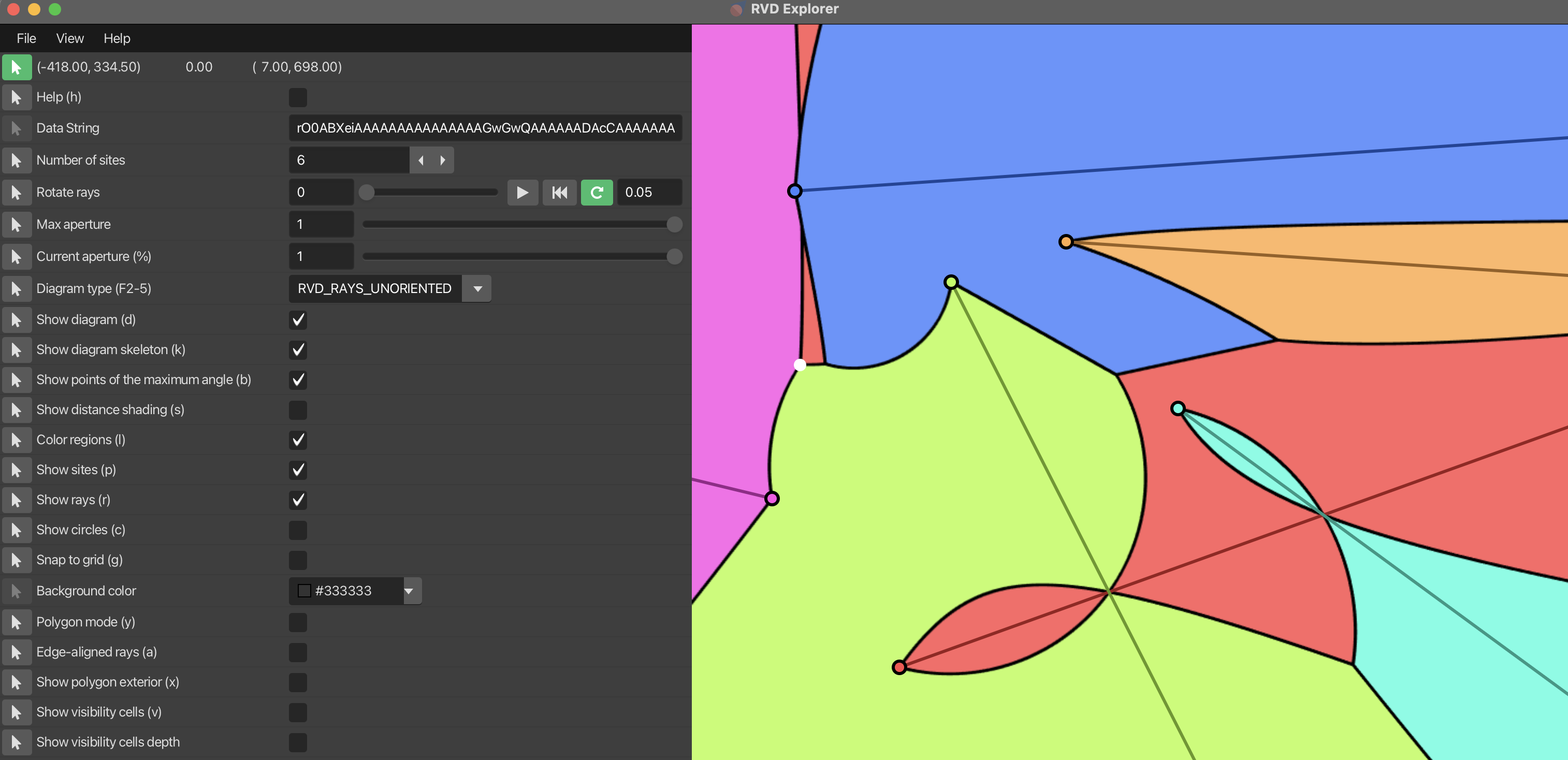
Our software RVD explorer allows users to explore rotating rays Voronoi diagrams and the -floodlight illumination problem; see a screenshot of the software in Figure 2.
Users can specify a Number of sites, place their apices and directions, and select a Diagram type between RVD_RAYS_ORIENTED and RVD_RAYS_UNORIENTED. Every site, and its corresponding Voronoi region, is associated with a distinct color for clearer visualization. Show diagram skeleton highlights (in black) the graph structure of the diagram. Show point of maximum angle highlights (with a white disk) a point inside the selected frame which realizes , i.e., the last point of the frame to be illuminated if all apertures started growing from to . The Max aperture can be bounded from above and the user can change the Current aperture (%) and also Rotate rays using the respective sliders. There are many additional features useful for studying the diagrams; the full list is shown when pressing the Help button.
Domains.
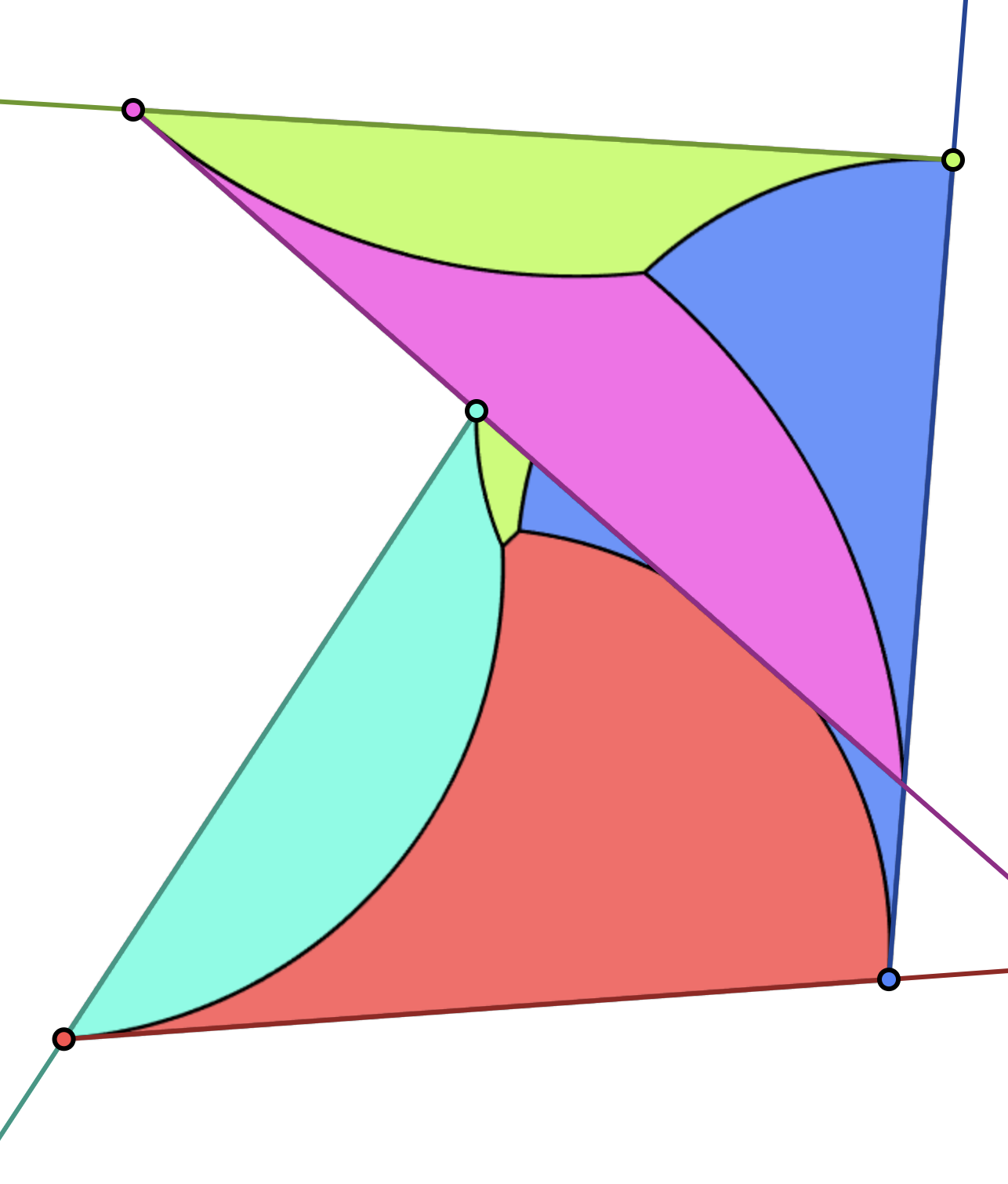
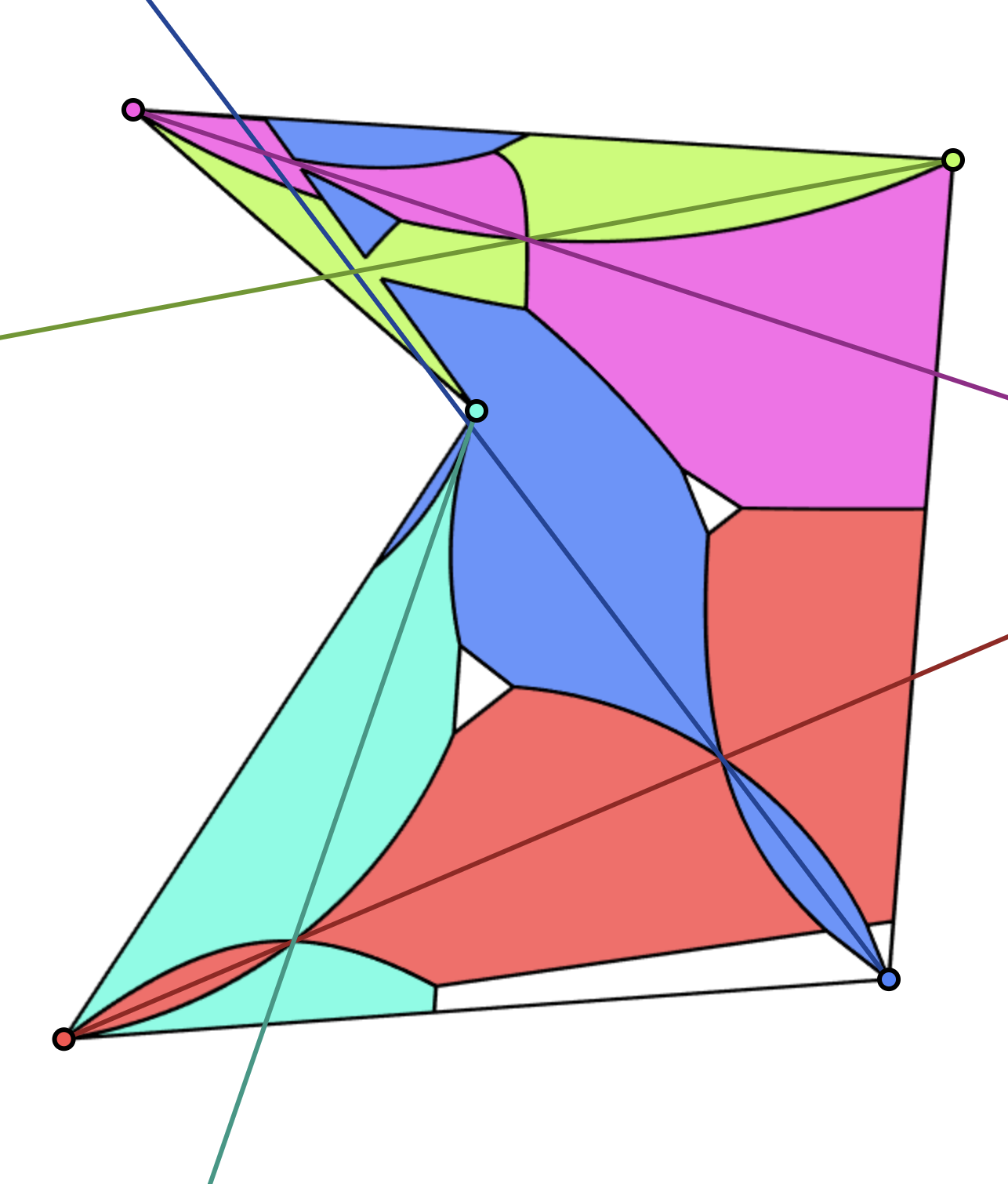
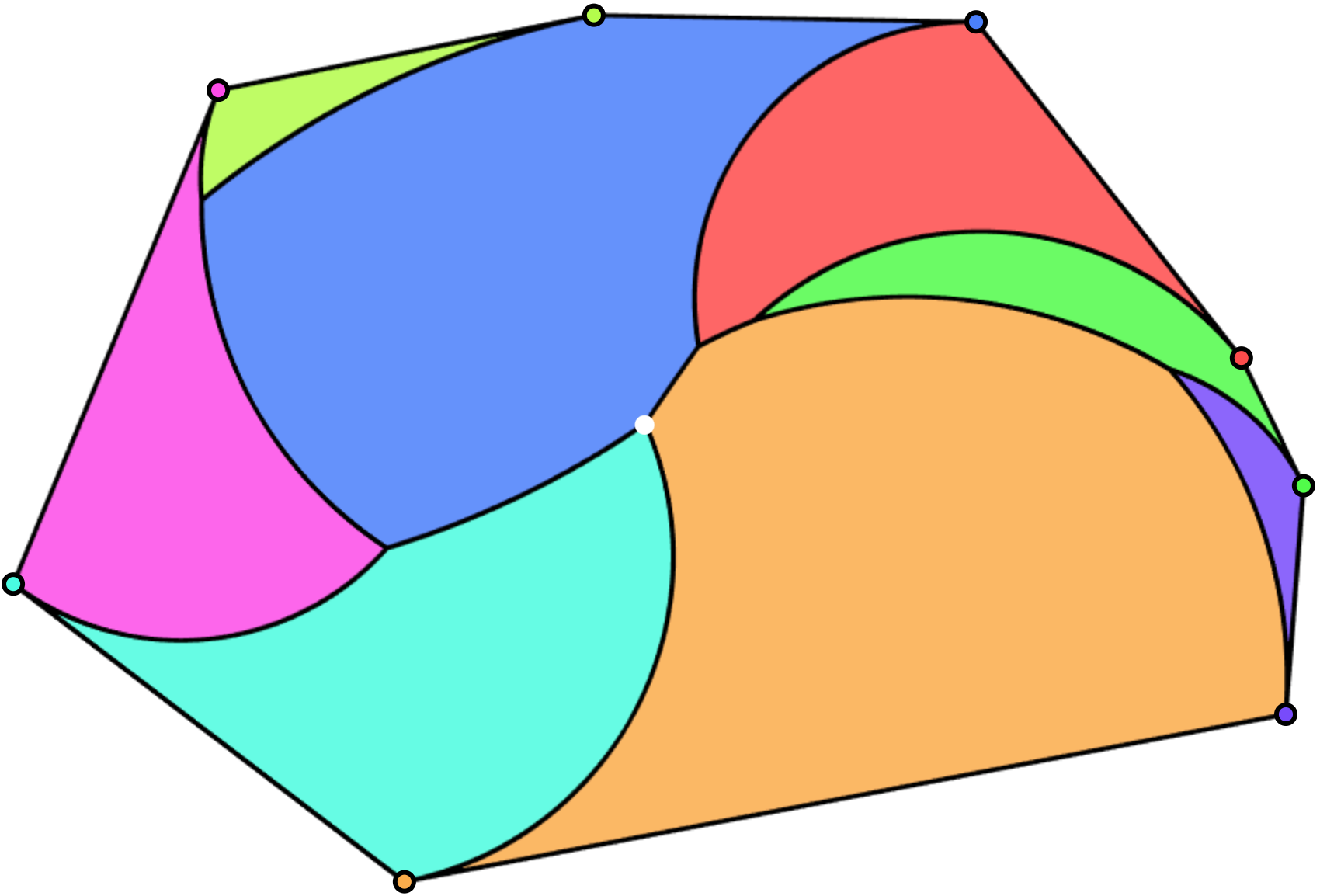
Both the entire plane and polygonal domains are supported. The domain can be chosen by toggling Polygonal domain. In the plane, rays can be placed anywhere in and distances are evaluated over the entire ; see, e.g., Figures 2 and 4. In polygonal domains, a polygon is given with one ray per vertex, and distances are only evaluated inside . When Edge-aligned rays is enabled, each edge of induces a ray with apex passing through , as in the Brocard illumination problem [3, 14]; see, e.g., Figures 3 and 5.
Implementation details.
The application is implemented in the JavaFX graphics framework. Diagrams are rendered by pixel-based rasterization of the viewport. For each pixel, angular distances to all rays are evaluated and colored by the nearest site. Thus, for a viewport, each frame renders in time. All computations run on the CPU. To maintain a fluid interactivity, pixel rows are processed in parallel and expensive operations are avoided, e.g., angles are compared without computing their values. Diagram edges are detected by comparing neighboring pixel assignments and selectively supersampled for anti-aliasing. The user interface is built on a custom lightweight library for interactive parameter control.
3 The plane
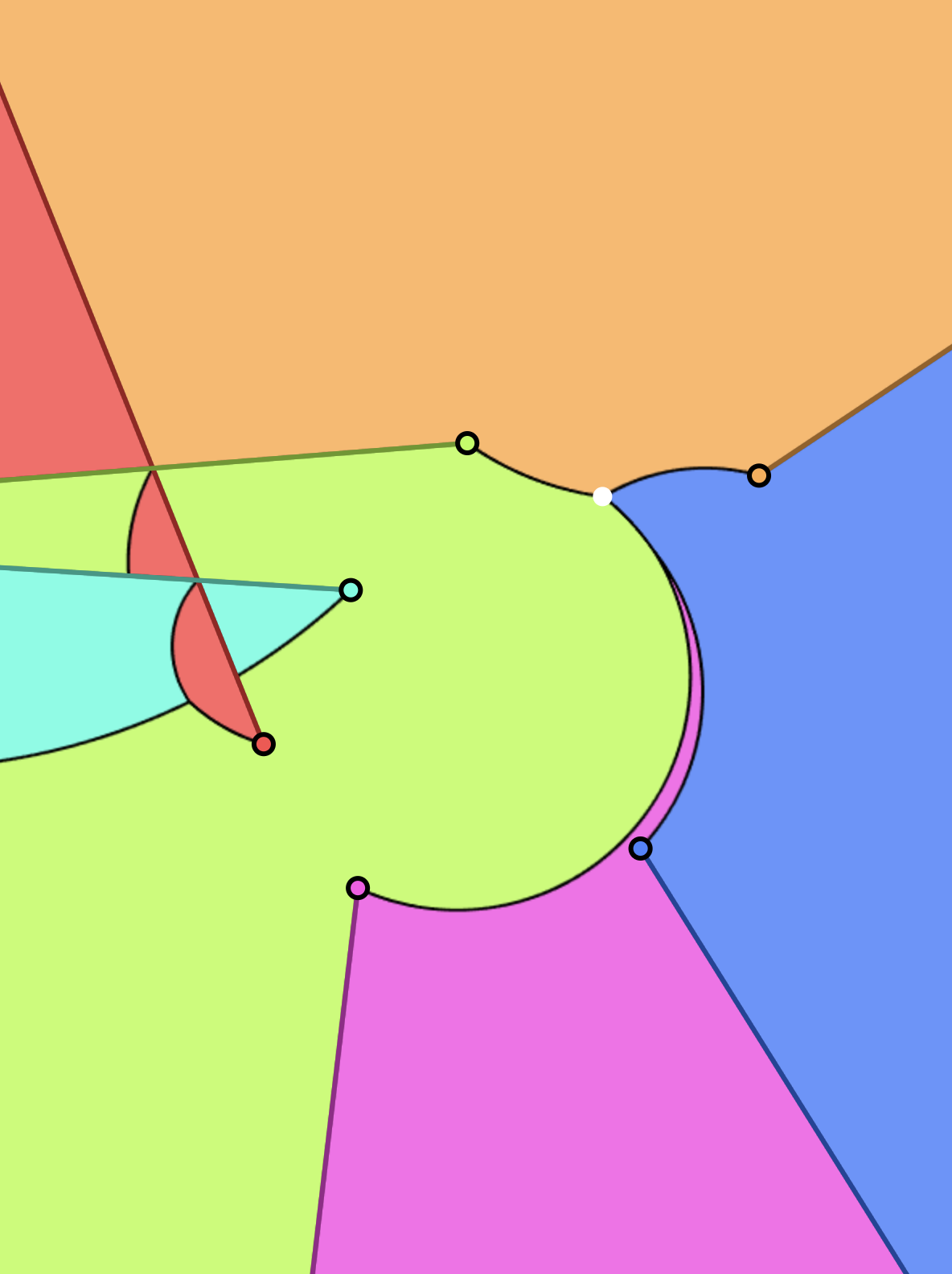
Let the domain be . We consider both the oriented and unoriented variants; see Figure 4.

Oriented RVD().
A comprehensive study of the oriented was given in [1]. A key property is that the distance function is discontinuous, at , and that the bisectors consist of circular arcs and rays. The worst-case combinatorial complexity of is shown to be and the same is true for the complexity of a single Voronoi region. An complexity upper bound, for any , is obtained via 3-dimensional envelopes [20]; the same approach yields a construction algorithm running in time.
Unoriented RVD().
The unoriented was first proposed in [9], accompanied by an worst-case complexity bound. Its bisectors were investigated in [11]; they consist of circular and hyperbolic arcs. Notably, several results of the oriented case [1] carry over: for example, with minor adaptations of the 3-dimensional envelope methods, we can obtain an complexity upper bound and an -time algorithm.
-floodlight illumination.
The angle takes values in in the oriented variant [1], and in the unoriented, it takes values in . It can be obtained by a traversal after constructing , so it requires total time [1]. It is unknown whether can be computed faster directly, without . Still, computing admits an lower bound: the simple case where all rays share the same apex is equivalent to the Max-Gap problem on a circle, which has an lower bound in the real RAM model [13, 19].
4 Polygonal domains
We consider simple polygons as domains, with edge-aligned rays induced by the polygon boundary, i.e., related to Brocard illumination [3, 14]. For such inputs, the two variants, oriented and unoriented, coincide, as by definition only counterclockwise rotation is meaningful.
Convex polygons.
The Voronoi diagram constrained to a convex polygon was studied extensively in [1]. It is a tree, has combinatorial complexity, and can be constructed in optimal deterministic time using an elaborate divide-and-conquer scheme. This result is accompanied by a simple -time algorithm; a similar algorithm to directly compute is given in [3]. The angle takes values in [1].
Simple polygons.
For simple polygons few results are known. The challenge comes from the presence of reflex vertices which obstruct the visibility of the rays. To construct , an -time algorithm was described in [14], where is the number of reflex vertices: is decomposed in visibility cells in time [8, 10] and the -time algorithm [1] is applied in each cell. The above implies an combinatorial complexity bound. A worst-case lower bound can be realized by star-shaped polygons, as the one in Figure 6.

Regarding the angle , an -time algorithm to compute it directly was given in [3]. The angle takes values in and instances arbitrarily close to the upper bound can be realized by windmill-shaped polygons as shown in Figure 7. It is a regular triangle with three outward wings attached on the corners.

References
- [1] Carlos Alegría, Ioannis Mantas, Evanthia Papadopoulou, Marko Savić, Carlos Seara, and Martin Suderland. The Voronoi diagram of rotating rays with applications to floodlight illumination. Algorithmica, 88(2):27, 2026. doi:10.1007/s00453-025-01368-y.
- [2] Carlos Alegría, Ioannis Mantas, Marko Savić, and Martin Suderland. RVD-explorer. Software, version 0.1.0., swhId: swh:1:dir:ecbbe02e948195b997416d5a9fd082d6f6c1a01d (visited on 2026-05-13). URL: https://github.com/VD-collective/rvd-explorer, doi:10.4230/artifacts.26033.
- [3] Carlos Alegría-Galicia, David Orden, Carlos Seara, and Jorge Urrutia. Illuminating polygons by edge-aligned floodlights of uniform angle (Brocard illumination). In Proceedings of the 33rd European Workshop on Computational Geometry (EuroCG 2017), pages 281–284, 2017.
- [4] Omur Arslan, Hancheng Min, and Daniel E. Koditschek. Voronoi-based coverage control of pan/tilt/zoom camera networks. In 2018 IEEE International Conference on Robotics and Automation (ICRA 2018), pages 5062–5069. IEEE, 2018. doi:10.1109/icra.2018.8460701.
- [5] Tetsuo Asano, Hisao Tamaki, Naoki Katoh, and Takeshi Tokuyama. Angular Voronoi diagram with applications. In 2006 3rd International Symposium on Voronoi Diagrams in Science and Engineering, pages 18–24. IEEE, 2006. doi:10.1109/ISVD.2006.9.
- [6] Franz Aurenhammer, Rolf Klein, and Der-Tsai Lee. Voronoi Diagrams and Delaunay Triangulations. World Scientific, 2013. doi:10.1142/8685.
- [7] Piotr Berman, Jieun Jeong, Shiva P. Kasiviswanathan, and Bhuvan Urgaonkar. Packing to angles and sectors. In Proceedings of the 19th ACM Symposium on Parallelism in Algorithms and Architectures (SPAA’07), pages 171–180, 2007. doi:10.1145/1248377.1248405.
- [8] Prosenjit Bose, Anna Lubiw, and J. Ian Munro. Efficient visibility queries in simple polygons. Computational Geometry, 23(3):313–335, 2002. doi:10.1016/s0925-7721(01)00070-0.
- [9] Mark de Berg, Joachim Gudmundsson, Herman Haverkort, and Michael Horton. Voronoi diagrams with rotational distance costs. In Abstracts of the Computational Geometry Week: Young Researchers Forum (CG:YRF), 2017.
- [10] Leonidas J Guibas, Rajeev Motwani, and Prabhakar Raghavan. The robot localization problem. SIAM Journal on Computing, 26(4):1120–1138, 1997. doi:10.1137/S0097539792233257.
- [11] Herman Haverkort and Rolf Klein. Hyperbolae are the locus of constant angle difference. arXiv preprint arXiv:2112.00454, 2021. arXiv:2112.00454.
- [12] Evangelos Kranakis, Danny Krizanc, and Oscar Morales. Maintaining connectivity in sensor networks using directional antennae. In Theoretical Aspects of Distributed Computing in Sensor Networks, pages 59–84. Springer, 2011. doi:10.1007/978-3-642-14849-1_3.
- [13] Der-Tsai Lee and Ying-Fung Wu. Geometric complexity of some location problems. Algorithmica, 1(1):193–211, 1986. doi:10.1007/BF01840442.
- [14] Ioannis Mantas. Problems on Planar Voronoi Diagrams. PhD thesis, Università della Svizzera Italiana, 2022.
- [15] Azin Neishaboori, Ahmed Saeed, Khaled A. Harras, and Amr Mohamed. On target coverage in mobile visual sensor networks. In Proceedings of the 12th ACM International Symposium on Mobility Management and Wireless Access (MobiWac’15), pages 39–46, 2014. doi:10.1145/2642668.2642671.
- [16] Atsuyuki Okabe, Barry Boots, Kokichi Sugihara, and Sung Nok Chiu. Spatial tessellations: concepts and applications of Voronoi diagrams, volume 501. John Wiley & Sons, 2009.
- [17] Joseph O’Rourke. Art gallery theorems and algorithms, volume 57. Oxford University Press Oxford, 1987.
- [18] Joseph O’Rourke. Visibility. In Handbook of Discrete and Computational Geometry, pages 875–896. CRC Press, 2017.
- [19] Vera Sacristán. Lower bounds for some geometric problems. Technical report, Technical Report MA2-IR-98, 1998.
- [20] Micha Sharir. Almost tight upper bounds for lower envelopes in higher dimensions. Discrete & Computational Geometry, 12(3):327–345, 1994. doi:10.1007/BF02574384.
- [21] Tsuyoshi Taki, Jun-ichi Hasegawa, and Teruo Fukumura. Development of motion analysis system for quantitative evaluation of teamwork in soccer games. In Proceedings of the 3rd IEEE International Conference on Image Processing, volume 3, pages 815–818. IEEE, 1996. doi:10.1109/ICIP.1996.560865.
- [22] Jorge Urrutia. Art gallery and illumination problems. In Handbook of Computational Geometry, pages 973–1027. Elsevier, 2000. doi:10.1016/B978-044482537-7/50023-1.