Polychromatic -Colorings with Bounded Discrepancy for Triangulations

Abstract
A polychromatic -coloring of a triangulation is a -coloring of the vertices such that no face is monochromatic. The discrepancy of a coloring is the maximum difference between the sizes of the color classes. Asayama and Matsumoto (Graphs and Combinatorics, 2022) proved that every triangulation admits a polychromatic -coloring with discrepancy at most , and that there exists a class of triangulations for which every polychromatic -coloring has discrepancy at least , where is the number of vertices. We improve the upper bound, showing that every triangulation admits a polychromatic -coloring with discrepancy at most and such a -coloring can be computed in quadratic time. We also show a discrepancy of at most for triangulations with a matching of size . This implies, for example, that Delaunay triangulations admit a discrepancy of at most . We provide a linear-time algorithm to compute a -coloring whose discrepancy is at most .
Keywords and phrases:
polychromatic coloring, triangulation, balanced coloring, matchingFunding:
Ahmad Biniaz: Supported in part by NSERC.Copyright and License:
![[Uncaptioned image]](x1.png) © Alma Arevalo Loyola, Ahmad Biniaz, Prosenjit Bose, and Thomas Shermer; licensed under Creative Commons License CC-BY 4.0
© Alma Arevalo Loyola, Ahmad Biniaz, Prosenjit Bose, and Thomas Shermer; licensed under Creative Commons License CC-BY 4.0
2012 ACM Subject Classification:
Mathematics of computing Graph coloring ; Theory of computation Computational geometryAcknowledgements:
Part of this work was done at the 12th Annual Workshop on Geometry and Graphs, held at Bellairs Research Institute in Barbados in February 2025. We thank the organizers and the participants.Editor:
Pierre FraigniaudSeries and Publisher:
 Leibniz International Proceedings in Informatics, Schloss Dagstuhl – Leibniz-Zentrum für Informatik
1 Introduction
Colorings of planar graphs play a central role in both combinatorial and algorithmic graph theory. The study of colorings that ensure coverage or visibility conditions has received growing attention in recent years, particularly in contexts where each region of a planar subdivision must contain representatives from multiple categories or sensors. For instance, such colorings arise naturally in network coverage problems, geometric guarding, and frequency assignment, where it is desirable that every bounded region has access to all available resources. This motivated the study of polychromatic colorings, colorings in which every face of a planar embedding contains at least one vertex of each color. For a survey on polychromatic colorings see [8].
For the case of two colors, a polychromatic -coloring of a triangulation assigns one of two colors to each vertex such that no face is monochromatic. Unlike proper colorings, which aim to separate adjacent vertices, polychromatic colorings of planar graphs emphasize inclusion: every face must see both colors. Although such colorings always exist, the balance between the sizes of the two color classes is not guaranteed. The discrepancy of a specific polychromatic -coloring of is defined as the absolute difference between the sizes of its two color classes. It measures how unevenly the two colors are distributed. For a graph , we define as the minimum discrepancy over all possible polychromatic -colorings of . Thus, captures the best achievable balance between the two colors while maintaining the polychromatic property. A polychromatic coloring of is said to be balanced when its discrepancy is at most one.
Asayama and Matsumoto [1] initiated the systematic study of balanced polychromatic -colorings in planar triangulations. Among other results, they proved that every triangulation on vertices admits a polychromatic -coloring with discrepancy at most , and they constructed infinite families of triangulations where every such coloring has discrepancy at least . They conjectured that is the best possible asymptotic upper bound.
In this work we make progress toward that conjecture. We show that every triangulation on vertices admits a polychromatic -coloring satisfying , which improves the previous bound of . Our proof refines the discharging arguments used in earlier analyses and integrates structural constraints derived from the Four Color Theorem. Moreover, the proof is constructive and leads to an algorithm to compute such a coloring.
We further establish that if a triangulation admits a matching of size , then has a polychromatic -coloring with discrepancy at most . This bound is tight for certain triangulations and immediately implies that Delaunay triangulations satisfy , since they always satisfy having a perfect matching. In addition, we provide a linear-time recoloring procedure that guarantees a polychromatic -coloring with discrepancy at most . This yields the first efficient algorithm that achieves a nontrivial upper bound on discrepancy in planar triangulations.
Our results strengthen the connection between structural graph properties and color balance in planar settings, advancing the quantitative understanding of how evenly a triangulation can be -colored while ensuring that every face remains non-monochromatic.
2 Preliminaries
Most of the basic notions about graph coloring can be found in [11] and [17]. For general concepts of graph theory, see [4] and [9]. We consider graphs that are finite and simple; that is, they have no loops or multiple edges. We denote a graph by , where is the set of vertices, and is the set of edges. For planar graphs, we denote by the set of faces. When needed, we denote by , and the sets of vertices, edges and faces to specify the graph to which we refer. We use , , and to denote the number of vertices, edges and faces, respectively. The degree of a vertex is the number of vertices adjacent to , and it is denoted by . We denote by and the maximum and minimum degree of the vertices of , respectively. The degree of a face , denoted by , is the number of edges (or vertices) on its boundary. A vertex coloring of is a function . We call it a -coloring to emphasize the number of colors.
Definition 1.
Let be a graph with vertices, let be a vertex coloring of , and let be the partition induced by . We define the discrepancy of , denoted as , to be the difference between the sizes of the largest and the smallest color class.
We say that a coloring is balanced when . Balanced proper colorings are also called equitable colorings [13].
The following are some known results that we use in the following sections.
Proposition 2 (Euler’s Formula).
Let be a connected planar graph with vertices, edges, and faces. Then .
Proposition 3 (Diestel [9]).
Every planar graph with vertices has at most edges and at most faces. Every planar triangulation with vertices has exactly edges and faces. Every planar quadrangulation with vertices has exactly edges and faces.
An independent set of is a subset of vertices such that no two elements of are adjacent. Observe that in a proper coloring, every color class is an independent set. The independence number of , denoted by , is the size of the maximum independent set.
Proposition 4 (Caro and Roditty [7]).
Let be a planar triangulation with vertices and minimum degree . Then
Given a planar graph and its planar embedding, the dual graph of , denoted by is such that the set of vertices of corresponds to the set of faces of , and two vertices are adjacent if and only if the corresponding two faces share an edge of their boundary. The following claim is implied by Tait’s reformulation of the Four Color Theorem [16].
Proposition 5.
Let be a planar triangulation. The dual graph has a proper -edge-coloring.
A matching of is a subset of edges such that no two elements of share a common vertex. A maximum matching is a matching with maximum cardinality. A perfect matching is a matching that includes all vertices of , and a near-perfect matching includes all of them, but one.
Proposition 6 (Nishizeki and Baybars [14]).
Every planar triangulation with vertices has a matching of size at least .
3 Upper Bounds
In this section, we prove that every planar triangulation has a polychromatic -coloring with discrepancy at most . We first show some bounds related to other parameters of .
In the first subsection, given a planar triangulation with a maximum matching , we show how to find a polychromatic -coloring whose discrepancy is at most . In particular, the discrepancy is at most when has a perfect matching.
In the second subsection, given a proper -coloring of the triangulation we show how to partition the four color classes into two sets so that the resulting coloring is polychromatic and its discrepancy is bounded depending on the size of the largest color class in the -coloring. In particular, we guarantee the existence of a polychromatic -coloring with discrepancy at most for graphs with independent number at most . In the last subsection, we extend this idea to improve the general upper bound.
3.1 Discrepancy and Matchings
Polychromatic -colorings of triangulations are closely related to spanning quadrangulations and matchings as stated in [1], [2], and [5]. It is known that every triangulation has a spanning quadrangulation, where a quadrangulation is a plane graph such that each of its faces is a quadrilateral. It is also known that every quadrangulation is bipartite, and hence -colorable.
Let be a planar triangulation, and let be a spanning quadrangulation of . Every face of is the union of two adjacent faces of , with their shared edge removed. Moreover, contains exactly two boundary edges of each face of . Observe that the unique proper -coloring of corresponds to a polychromatic -coloring of . We now show how the size of the discrepancy relates to the size of a matching of in the following lemma.
Lemma 7.
Let be the unique proper -coloring of and let be a matching in . Then, is a polychromatic -coloring in with .
Proof.
Let and be the color classes in . Every edge in the matching has one endpoint in each color class. Let and be the unmatched vertices. Then and . Without loss of generality, assume that Then, .
Now, to define an appropriate spanning quadrangulation with the appropriate matching, the strategy is to start with a matching in the triangulation , and then show that there exists a spanning quadrangulation containing a large fraction of edges from .
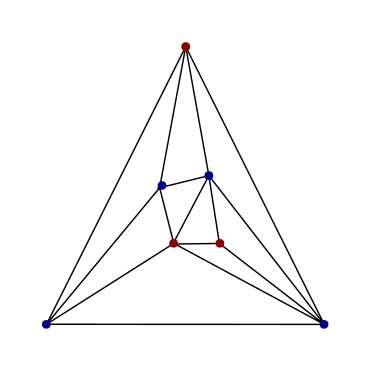
There is a well-known equivalence between the -coloring of the vertices of a triangulation and the -coloring of the edges of its dual . Such edge-coloring induces a partition of the edges of into 3 perfect matchings of . Let , and be the sets of edges of corresponding to each of the 3 perfect matchings in . Let for . We note that each is a spanning quadrangulation of . (see e.g. [1], [5], [6], and [12]).


 (a)
(b)
(c)
(a)
(b)
(c)


 (d)
(e)
(f)
(d)
(e)
(f)
Lemma 8.
Let be a matching in . There exists a spanning quadrangulation of that has a matching of size at least .
Proof.
Every edge of appears by construction in exactly 2 of the ’s, which implies that one of the ’s contains at least edges of .
The following is the main result of this subsection.
Theorem 9.
Every triangulation with vertices has a polychromatic -coloring with discrepancy at most , where is a matching in .
Proof.
By Lemma 8, has a a spanning quadrangulation that has a matching of size at least . By Lemma 7 the proper -coloring of is a polychromatic -coloring of with discrepancy at most .
Corollary 10.
Every planar triangulation has a polychromatic -coloring whose discrepancy is at most .
Proof.
A relevant application of Theorem 9 is to obtain a better upper bound for the discrepancy of polychromatic -colorings in Delaunay triangulations, stated in the following Corollary.
Corollary 11.
Let a graph on vertices corresponding to the Delaunay triangulation of a set of points in the plane. has a polychromatic -coloring whose discrepancy is at most .
Proof.
It is known that Delaunay triangulations have perfect matchings [3, 10]. Then by Theorem 9, has a polychromatic -coloring whose discrepancy is at most .
Observe that the bound is true for any triangulation with a perfect matching.
3.2 Discrepancy and Independent Sets
In this section, the strategy is to start with a proper -coloring of the triangulation, and define a -coloring that is polychromatic whose discrepancy is bounded according to the sizes of the color classes in the -coloring. This idea was used in [1] to prove the general bound. We extend the idea to relate the discrepancy to the size of the maximum independent set, which generalizes two of their main results and Theorem 9.
Let be a planar triangulation with vertices. Let be a -proper coloring of . Let be the respective color classes and let , , , be their respective sizes. We note that . Without loss of generality, assume . Since we get the following inequality:
Observation 12.
We describe a -coloring of , whose color classes are , (sometimes referred to as the colors red and blue), and , their respective sizes. The discrepancy of is defined as with . Therefore, . We consider two cases to eliminate the absolute value.
Observation 13.
If , then If , then
Lemma 14.
If or , then has a polychromatic -coloring whose discrepancy is at most .
Proof.
Let be the -coloring that assigns and . Then and . We claim that is a polychromatic -coloring. Since every face of is triangular, it contains vertices from 3 different color classes of the -coloring . Therefore, in every face contains at least one red and one blue vertex.
Since , we have that . Thus, if then .
If then by applying Observation 12 we get . Once again we get then .
Lemma 15.
If , then has a polychromatic -coloring whose discrepancy is at most .
Proof.
Let be the polychromatic 2-coloring defined in the proof of Lemma 14. By observation 12, we know that . Since , we have We conclude that
Theorem 16.
Let be a planar triangulation with vertices. If has a proper -coloring whose largest color class has size at most , then has a polychromatic -coloring such that .
Proof.
Observation 17.
By the Four Color Theorem, every triangulation has a proper -coloring. Since the color classes are independent sets, Theorem 16 can always be applied with , the independence number of .
Corollary 18.
Let be a planar triangulation with vertices. Then has a polychromatic -coloring whose discrepancy is at most . Moreover, if then has a polychromatic -coloring whose discrepancy is at most
Proof.
By the Four Color Theorem, has a proper -coloring . Let be the size of the largest color class of . By Observation 17 and Proposition 4, we have and we can apply Theorem 16 with . Since every planar triangulation with vertices has minimum degree at least , it follows that:
If then
There is a relation between the size of a matching and the size of the maximum independent set in .
Observation 19.
We have provided an alternative proof for two theorems from [1]. Moreover, we have generalized these results by establishing an upper bound on the discrepancy of a polychromatic -coloring in terms of an upper bound on the size of the largest color class in a proper -coloring.
3.3 Improving the General Discrepancy Bounds
In this section we prove the following theorem:
Theorem 20.
Let be a planar triangulation with vertices. Then has a polychromatic -coloring whose discrepancy is at most .
Recall the two color classes from the previous section (that are obtained as a partition of the colors of a proper -coloring). In view of Lemma 14 we may assume that as otherwise the discrepancy is at most . The main proof idea is to start by coloring all vertices in red, all vertices in blue, and possibly splitting the vertices in between red and blue to get a smaller discrepancy.
Let be the set of faces that contain a vertex from and let be the set of faces that do not. If and then all faces in are guaranteed to be polychromatic, regardless of the color of the vertices in . In addition, every face contains a vertex from that we can assign to to make polychromatic. Let be the set of vertices in belonging to at least one face in . Let . We call the vertices in essential, since they are required to be in the color class to make the coloring polychromatic. The rest of the vertices in are called non-essential, and we denote the set as . Let be the -coloring that assigns and let . The sizes of the color classes of are and . Observe that is a polychromatic -coloring and , by Observation 13 and Lemma 14. As a warm-up, in the following proposition we bound the discrepancy of by analyzing the properties of ; this result is independent of the rest of the section.
Proposition 21.
.
Proof.
We give an upper bound for based on the following observations:
-
1.
Every vertex in is in at least faces from because . Every face in has exactly one vertex from . Then .
-
2.
Every vertex in is in at least one face from by definition. Every face in has exactly one vertex in . Then .
By Proposition 3, the total number of faces of is , then we conclude that:
| (1) |
We know that , then . By Observation 12, we have , which implies that:
| (2) |
Some extra observations help to improve this bound. Let be a planar triangulation with vertices. Let be a proper -coloring of such that the difference between the sizes of the largest and the smallest color class, i.e. , is minimum over all proper -colorings of . From the results in Subsection 3.2 (Lemma 14), we know that if or , then the coloring that assigns and is polychromatic and has a discrepancy at most . Thus, we may assume that and in the following. Then, Observation 12 implies that . Therefore, we get
Observation 22.
.
Let be the set of vertices in whose degree equals and let be those with degree at least .
We refer to the faces in as good faces. We classify every essential vertex as type I if it is in exactly one good face and type II if it is in at least two good faces. For any vertex in , let be the set of neighbors of in for all .
Lemma 23.
Every essential vertex of type I has an odd degree and .
Proof.
Let be an essential vertex of type I with degree . Since is in exactly one good face, there is exactly one vertex in and one vertex in that are adjacent to each other. The other vertices are alternating between elements in and elements in starting and ending with color 1 adjacent to the good face, otherwise we contradict that vertex is of type I. This implies that of the neighbors have color 1.
We say that a connected subgraph of is --alternating if it is properly -colored with colors and .
Lemma 24.
Let . If is an essential vertex and every vertex in has degree , then the vertices in form a --alternating separating cycle in . Moreover, if is type I, then has odd degree .
Proof.
Let . Since , is inside a separating triangle formed by and the endpoints of a --edge. Then there is a --edge for each vertex in and a - edge for each good face incident to , all those edges together form a --alternating separating cycle whose inside vertices are and all the vertices in . Let be the length of . Observe that is even and at least 4, so in the case where is of type I, exactly one of the edges in is part of a good face containing and edges are part of a separating triangle that contains a vertex of color 1. Then . Note that .
Observation 25.
For every vertex satisfying Lemma 24, as shown in the proof of the lemma. Since we assume that , we have that .
Observation 26.
Let be a --alternating separating cycle. If we swap the colors and of the vertices inside , we obtain another valid -coloring of .
Lemma 27.
Every essential vertex of type I is adjacent to at least one vertex in .
Proof.
Let be an essential vertex of type I. By Lemma 23, since , . Assume for a contradiction that every vertex in has degree . By Lemmas 23 and 24, has odd degree , and there is a --separating alternating cycle containing exactly one vertex of color , namely , and vertices of color in its interior. By swapping colors 1 and 4 in (Observation 26) we obtain a valid proper -coloring whose color classes that has vertices of color 1 and vertices of color 4. This would decrease the difference between and and hence contradicts our choice of .
We have to be careful here as color 4 may now be the largest color class in . Hence the difference would be
where the inequality is valid by Observation 22 and Observation 26. This still contradicts our choice of in view of Observation 26.
Similar to the partition of in essential and non-essential vertices, we partition according to the faces they belong to. Let be the set of vertices in belonging to at least one face that does not contain a vertex from . Let . Let and call these vertices non-essential since they can be colored red or blue without violating the polychromatic 2-coloring property.
Observation 28.
If a vertex has degree and two neighbors in , then the four faces that contain contain a vertex in and thus is non-essential.
In the following Lemma we state an upper bound for , which we later use to bound the discrepancy of a polychromatic -coloring.
Lemma 29.
.
Proof.
We use a discharging argument. We assign unit of charge to every face in . For every vertex , we assign a charge equal to . Thus, the total initial charge is . Apply the transfer of charge as follows: Each face in transfers its charge to its unique vertex in . For every vertex , if , then transfer unit of charge to each of its neighbors that is in . The total final charge is equal to the total initial charge. We analyze the final charge in the vertices of and .
Claim 1.
Every vertex in has final charge at least .
Let . We know . If , then has final charge equal to . If , then has at most one neighbour in , otherwise it contradicts Observation 28. Therefore, the final charge is at least . If , then has at most neighbors in , since no two color 4 vertices are adjacent. Thus, the final charge of is at least .
Claim 2.
Every vertex in has final charge at least .
Let be an essential vertex. If is of type II, then it gets at least units of charge from the two faces in . Assume is type I, then it gets 1 unit of charge from its incident face. By Lemma 27, is adjacent to a vertex such that , from which it gets an additional unit of charge. Thus, every vertex in has final charge at least .
Since the total final charge is equal to the total initial charge, the final charge in is at most the total initial charge.
| (3) |
We know that and , then and . By Observation 12, we have , which implies that:
| (4) |
We know that , and . If , then let be the -coloring that assigns . Otherwise, add some vertices from to in order to guarantee . The sizes of the color classes of are and . Observe that is a polychromatic -coloring and . By Lemma 29, . This finishes the proof of Theorem 20.
Remark.
The only place that we use the minimality of our 4-coloring is the contradictory argument in the proof of Lemma 27 where a color-4 vertex and its color-1 neighbors are inside a 2-3-separating cycle formed by its color-2 and color-3 neighbors. Any such cycle is identified by the neighbors of a color-4 vertex. To get an algorithm, we could start from an arbitrary 4-coloring (that can be computed in time [15]) and then for each such color-4 vertex we swap the color of with its color-1 neighhbors. This reduces . This extra step takes a total of time for all such ’s.
4 Linear-time Algorithm to Compute a Polychromatic -Coloring with Bounded Discrepancy for Planar Triangulations
In this section, we show how to compute, for a given planar triangulation, a polychromatic -coloring whose discrepancy is at most , in linear time. We use the linear-time algorithm by Bose et al. [5] to compute an initial polychromatic -coloring. Their algorithm uses a linear time algorithm to compute a maximum matching in the dual graph of a triangulation by Biedl et al. [2]. Thus, for any given planar graph, a polychromatic -coloring can be computed in linear time. However, this polychromatic -coloring may not have a guarantee on the discrepancy. We show how to extend this algorithm to guarantee a discrepancy of at most , without increasing the time complexity. The main approach is to make local modifications. We start by showing that the discrepancy of any polychromatic -coloring on the vertices of a triangulation has an upper bound in terms of the maximum degree of .
Theorem 30.
Let be a planar triangulation with vertices and maximum degree . Every polychromatic -coloring of has discrepancy at most .
Proof.
Let be a planar triangulation with vertices, and a polychromatic -coloring of . By Proposition 3 the number of faces of is exactly . Since is a polychromatic coloring, every face contains at least one vertex of each color class. The number of faces that contain a vertex is the degree of the vertex, . Then, any vertex belongs to at most faces. Therefore, every color class of has size at least . This implies that
To bound the discrepancy after a recoloring process, we define a class of colorings in which there is no single vertex to recolor that decreases the discrepancy and preserves polychromaticity. A polychromatic -coloring of the vertices of a triangulation is locally minimal if there is no vertex in that can be recolored to reduce the discrepancy of without producing a monochromatic face. This naturally raises the question: How large can the discrepancy of a locally minimal coloring be?
Theorem 31.
Let be a planar triangulation with vertices. Every polychromatic -coloring of that is locally minimal has discrepancy at most .
Proof.
We start with the upper bound on the discrepancy. Consider an arbitrary planar triangulation and a locally minimal polychromatic -coloring as described before. Let , be the respective color classes, and let , be their respective sizes. Without loss of generality, assume . If then the discrepancy is at most 1. Assume that . Due to minimality of , every vertex is incident to a face with an edge such that both and are in , because otherwise we could recolor to reduce discrepancy. Each such edge is in exactly two faces of , and hence count for at most two vertices in . That means that the number of monochromatic edges of color is at least . Let be the subgraph of induced by . is a planar graph with vertices, then by Proposition 3 it has at most edges. Therefore, there are no more than monochromatic edges of color . It follows that Since , we have that , or . Thus . The discrepancy is at most .
We show that this bound is tight by constructing an infinite family of triangulations with a locally minimal polychromatic -coloring whose discrepancy is . We start with equal to a planar triangulation on vertices of color . Into each triangular face of , we place three vertices of color , connected as shown (for one face) in Figure 3. Note that no -vertex can be changed to a -vertex in any instance of this construction, as each is adjacent to an edge of ; thus the construction is minimal. With vertices, has triangular faces, by Proposition 3. This means that , and so the construction has for each . Since , we have or . Thus, , as in the upper bound. The discrepancy is then . So we meet the upper bound by starting with any triangulation of any size.
Theorem 32.
Let be a planar triangulation with vertices. A polychromatic -coloring on the vertices of whose discrepancy is at most can be computed in time complexity.
Proof.
The proof follows from the following algorithm.
Correctness.
The first step is to run the algorithm provided in [5], to compute a coloring with no monochromatic faces. The algorithm always maintains a valid polychromatic -coloring, since it only recolors a vertex when it does not produce monochromatic faces. We only recolor vertices from red to blue and every vertex is recolored at most once. Then the algorithm terminates, and the discrepancy decreases in every recoloring step until the coloring is locally minimal.
Running Time.
Each iteration of the while loop examines a vertex and possibly changes its color. We say a vertex is recolorable if , and is not in a face with two vertices from . We can process the vertices in any given order, since a vertex that is not recolorable never becomes recolorable. For every vertex , we can verify if it is recolorable in because we evaluate all the faces that contain . Since every face is triangular, during the whole process we check every face three times, and since is planar, the number of faces is . Therefore, the total run of the algorithm takes assuming constant-time adjacency and face incidence queries.
5 Conclusions
We studied the discrepancy of polychromatic -colorings for planar triangulations and presented improved bounds and algorithms. We conclude with a few open questions for further investigation. The main conjecture in this area remains open: does every triangulation on vertices admit a polychromatic -coloring with discrepancy at most ? From an algorithmic perspective, it remains open whether a polychromatic -coloring with discrepancy less than can be computed in linear time.
References
- [1] Yoshihiro Asayama and Naoki Matsumoto. Balanced polychromatic 2-coloring of triangulations. Graphs and Combinatorics, 38(1):1–12, 2022.
- [2] Therese C. Biedl, Prosenjit Bose, Erik D. Demaine, and Anna Lubiw. Efficient algorithms for Petersen’s matching theorem. J. Algorithms, 38(1):110–134, 2001. doi:10.1006/JAGM.2000.1132.
- [3] Ahmad Biniaz. A short proof of the toughness of delaunay triangulations. J. Comput. Geom., 12(1):35–39, 2021. Also in SOSA’20. doi:10.20382/JOCG.V12I1A2.
- [4] J.A. Bondy and U.S.R Murty. Graph Theory. Springer Publishing Company, Incorporated, 1st edition, 2008.
- [5] Prosenjit Bose, David Kirkpatrick, and Zaiqing Li. Worst-case-optimal algorithms for guarding planar graphs and polyhedral surfaces. Computational Geometry, 26(3):209–219, 2003. doi:10.1016/S0925-7721(03)00027-0.
- [6] Prosenjit Bose, Thomas Shermer, Godfried Toussaint, and Binhai Zhu. Guarding polyhedral terrains. Computational Geometry, 7(3):173–185, 1997. doi:10.1016/0925-7721(95)00034-8.
- [7] Yair Caro and Yehuda Roditty. On the vertex-independence number and star decomposition of graphs. Ars Combin, 20:167–180, 1985.
- [8] Július Czap and Stanislav Jendrol. Facially-constrained colorings of plane graphs: A survey. Discrete Mathematics, 340(11):2691–2703, 2017. doi:10.1016/J.DISC.2016.07.026.
- [9] Reinhard Diestel. Graph Theory, volume 173 of Graduate Texts in Mathematics. Springer-Verlag, Heidelberg, 6 edition, 2025.
- [10] M.B. Dillencourt. Toughness and delaunay triangulations. Discrete & computational geometry, 5(6):575–602, 1990. doi:10.1007/BF02187810.
- [11] Tommy R Jensen and Bjarne Toft. Graph coloring problems. John Wiley & Sons, 2011.
- [12] André Kündgen and Carsten Thomassen. Spanning quadrangulations of triangulated surfaces. In Abhandlungen aus dem Mathematischen Seminar der Universität Hamburg, volume 87, pages 357–368. Springer, 2017.
- [13] Walter Meyer. Equitable coloring. The American mathematical monthly, 80(8):920–922, 1973.
- [14] Takao Nishizeki and Ilker Baybars. Lower bounds on the cardinality of the maximum matchings of planar graphs. Discrete Mathematics, 28(3):255–267, 1979. doi:10.1016/0012-365X(79)90133-X.
- [15] Neil Robertson, Daniel Sanders, Paul Seymour, and Robin Thomas. The four-colour theorem. Journal of Combinatorial Theory, Series B, 70(1):2–44, 1997. doi:10.1006/JCTB.1997.1750.
- [16] Tait. 4. on the colouring of maps. Proceedings of the Royal Society of Edinburgh, 10:501–503, 1880. doi:10.1017/S0370164600044229.
- [17] Zsolt Tuza. Graph coloring. In Handbook of Graph Theory, chapter 5, pages 408–438. CRC Press, 2nd edition, November 2013.