Online Preemptive Matching Revisited

Abstract
We study the online preemptive matching problem, in which the edges of a graph arrive sequentially and the algorithm must maintain a matching by accepting or rejecting arriving edges and possibly discarding previously accepted ones. We prove a new upper bound of on the competitive ratio achievable for the problem. This bound applies to arbitrary randomized algorithms, bipartite graphs and if we allow the algorithm to output a fractional solution.
Our result improves upon the strongest previously known upper bound of , due to Huang et al. [SODA’19]. Previous hardness constructions relied on edge sequences described by vertex arrivals where each arriving vertex reveals its edges to yet unvaried vertices. Under such sequences, Huang et al. showed that there exists a non-preemptive online algorithm with competitive ratio (or for fractional solutions). Consequently, our hardness construction is the first result which shows hardness for instances where the optimal algorithm employs preemption.
Keywords and phrases:
Online Algorithms, Preemptive Algorithms, Approximate Maximum MatchingCategory:
Track A: Algorithms, Complexity and GamesFunding:
Peter Kiss: This research was funded in whole or in part by the Austrian Science Fund (FWF) 10.55776/ESP6088024.Copyright and License:
![[Uncaptioned image]](x1.png) © Peter Kiss and Mohammad Sharifi; licensed under Creative Commons License CC-BY 4.0
© Peter Kiss and Mohammad Sharifi; licensed under Creative Commons License CC-BY 4.0
2012 ACM Subject Classification:
Theory of computation Online algorithms ; Theory of computation Approximation algorithms analysis ; Theory of computation Streaming modelsAcknowledgements:
The authors would like to thank Sayan Bhattacharya, Thatchaphol Saranurak and Aaron Bernstein for helpful discussions.Editors:
Sayan Bhattacharya, Danupon Nanongkai, Michael Benedikt, and Gabriele PuppisSeries and Publisher:
 Leibniz International Proceedings in Informatics, Schloss Dagstuhl – Leibniz-Zentrum für Informatik
1 Introduction
We study the problem of maintaining a matching in an online graph under preemption (sometimes referred to as online matching with free disposal). The input is a simple graph whose edges arrive one by one in an adversarial order. Upon the arrival of an edge , the algorithm must decide whether to incorporate into its current matching or to discard it permanently. In contrast to the classical online setting, the algorithm is also allowed to preempt previously selected edges, i.e., to remove edges arbitrarily from its current output. The objective is to maximize the size of the final matching. An algorithm is said to be -competitive if, for every input sequence, the size of the matching it produces is at least an -fraction of the size of an optimal offline solution.
Since its introduction to the online algorithms literature in the seminal work of Karp, Vazirani, and Vazirani [20], the online matching problem has received extensive attention. This interest stems both from its appealing theoretical nature and from its practical relevance (see [24]), most notably in the modeling of online advertisement markets. The problem in the absence of preemption is better understood. Gamlath et al. [11] showed that under adversarial edge arrivals, no algorithm can achieve a competitive ratio exceeding , a bound attained by the simple greedy algorithm. Much of the literature has focused on models in which vertices arrive sequentially and reveal some or all of their incident edges. Depending on the precise model, strictly better than -competitive algorithms are known [13, 27, 11, 20, 25, 16] (for a more complete list see [15]).
Given the importance of the problem, many works have explored relaxations of the purely online model. In these settings, the algorithm may receive additional information about the underlying graph [2, 9, 22], or may be allowed to perform limited non-online modifications to its output [1, 12, 5]. The preemptive variant of online matching, the focus of this paper, is both a natural relaxation of the classical model and a source of theoretical and practical applications. Notably, state-of-the-art hardness results for the semi-streaming matching problem rely on hardness constructions for preemptive online matching [18, 19].
The current state of the art for preemptive matching is (arguably) somewhat unsatisfactory. As in the purely online setting, no algorithm with competitive ratio strictly better than is known under adversarial edge arrivals. In contrast, existing hardness results for preemptive matching focus on vertex arrival models for which competitive ratios strictly exceeding are achievable even without preemption.
Existing Work.
Define an online vertex-future edge arrival sequence as follows. Vertices arrive sequentially, and upon the arrival of a vertex , all edges between and vertices that have not yet arrived are revealed. At this point, the algorithm must decide whether and how to match . This model is at least as hard as the fully online vertex arrival model (introduced by Huang et al. [13], see [16, 25]), in which vertices have arrival times and deadlines (by which they must be matched) and only reveal edges to previously arrived neighbors (for a brief discussion on this, see Section 5.2). At the same time, it generalizes the classical online bipartite matching problem, in which vertices arrive on only one side of the bipartition.
Existing hardness results for preemptive matching rely on a key observation: under vertex-future edge arrival sequences, preemption is never beneficial. To see this, consider the first vertex whose incident edges are revealed, and suppose the algorithm matches to some neighbor . By definition, no further edges incident to will arrive. Thus, the only possible reason to preempt the edge is to rematch later, but such a rematching cannot increase the size of the output.
Consequently, any hardness result that applies to purely online algorithms under vertex-future edge arrivals also holds for preemptive algorithms. Based on this observation, the classical hardness bound of for online bipartite matching due to Karp et al. [20] was the first known upper bound for online preemptive matching. Subsequent works by Epstein et al. [10] and Huang et al. [14] extended these ideas to bipartite graphs with vertex arrivals on both sides of the bipartition, establishing upper bounds of and , respectively.
On the algorithmic side, Huang et al. [14] showed that there exists a non-preemptive online algorithm with competitive ratio approximately for the fully online vertex arrival model (or in the fractional setting). Although this model is not equivalent to vertex-future edge arrivals, it is straightforward to show (see Section 5.2) that these positive results extend to our formulation.
This leads to a notable gap in the literature. On the one hand, no algorithm is known to leverage preemption to surpass the greedy competitive ratio under adversarial edge arrivals. On the other hand, all existing hardness results circumvent the preemptive nature of the problem by relying on vertex-future edge arrivals, and therefore cannot rule out the existence of a better than competitive algorithm.
1.1 Our Result
Our main contribution is an improved upper bound for the online preemptive matching problem.
Theorem 1.
Any online preemptive matching algorithm has competitive ratio at most .
Theorem 1 holds even if the algorithm is randomized or outputs a fractional matching, and if the input graph is bipartite. Note that its a folklore fact that for any randomized integral algorithm for the problem there exists a deterministic fractional one with the same competitive ratio. A key novelty of our approach is that we construct instances on which an optimal algorithm does make use of preemption, thereby more faithfully capturing the inherent difficulty of the model than prior hardness constructions.
Our hard instance underlying Theorem 1 is based on an edge arrival sequence that can be viewed as a special case of a -vertex-future edge arrival model. In this model, each vertex appears in distinct arrival phases, and upon each appearance it reveals a subset of its incident edges to vertices that have appeared fewer times. For our results, it suffices to consider ; in fact, choosing is already sufficient to improve upon the previous hardness bound of .
Finally, we note that Kapralov’s approximation hardness results for semi-streaming matching [18, 19] rely on preemptive matching hardness constructions derived from vertex-future edge instances due to Karp et al. [20] and Epstein et al. [10]. Since our constructions constitute only a mild relaxation of the model, we hope they may also serve as a useful tool for proving stronger hardness results in the semi-streaming setting.
Concurrent Work.
Concurrently and independently with our work, Assadi, Xiang and Jiang have listed a paper titled “Semi-Streaming Matching in a Single Pass: A New Framework for Lower Bounds via Blueprints” (appearing at STOC26) on their website which might have implications for the preemptive model.
Related Work.
Preemptive matching is known to admit better then -approximate algorithms for structured inputs. Jiang and Zhang [17], Chiplunkar et al. [8], Tirodkar and Vishwanathan [26] and Buchbinder et al. [7] have studied the problem for acyclic graphs. Pashkovich and Snow [23] have considered inputs with bounded maximum degree and derived positive results beating the greedy algorithm even in the lack of preemption.
2 Technical Overview
Throughout this paper, we study deterministic online preemptive fractional matching algorithms. In the fractional setting, the algorithm maintains a fractional matching by assigning weights to edges, subject to the constraint that the total weight of edges incident to any vertex is at most . The objective is to maximize the sum of the weights of all edges. Upon the arrival of an edge, the algorithm may assign it an arbitrary weight satisfying this constraint. The algorithm is also allowed to preempt edge weights, i.e., to reduce the weight of any edge at any time.
We say that a graph together with an edge-arrival instance is -hard if is the best competitive ratio achievable by any algorithm on this instance. Note that for bipartite graphs there is no integrality gap between the maximum size integral and fractional matchings. From a hardness perspective its also important to note that for any randomized integral preemptive algorithm there exists a deterministic fractional variant with the same competitive ratio.
For ease of exposition, we assume that in addition to adding vertices and edges, the adversary may also freeze vertices. By freezing a vertex , the adversary guarantees that no additional edges incident to will arrive in the future. Consequently, once a vertex is frozen, the algorithm has no incentive to reduce the weight of edges incident to . We refer the reader to Section 4 for a formal discussion.
2.1 Warm-up: Improving upon Hardness
Existing Constructions.
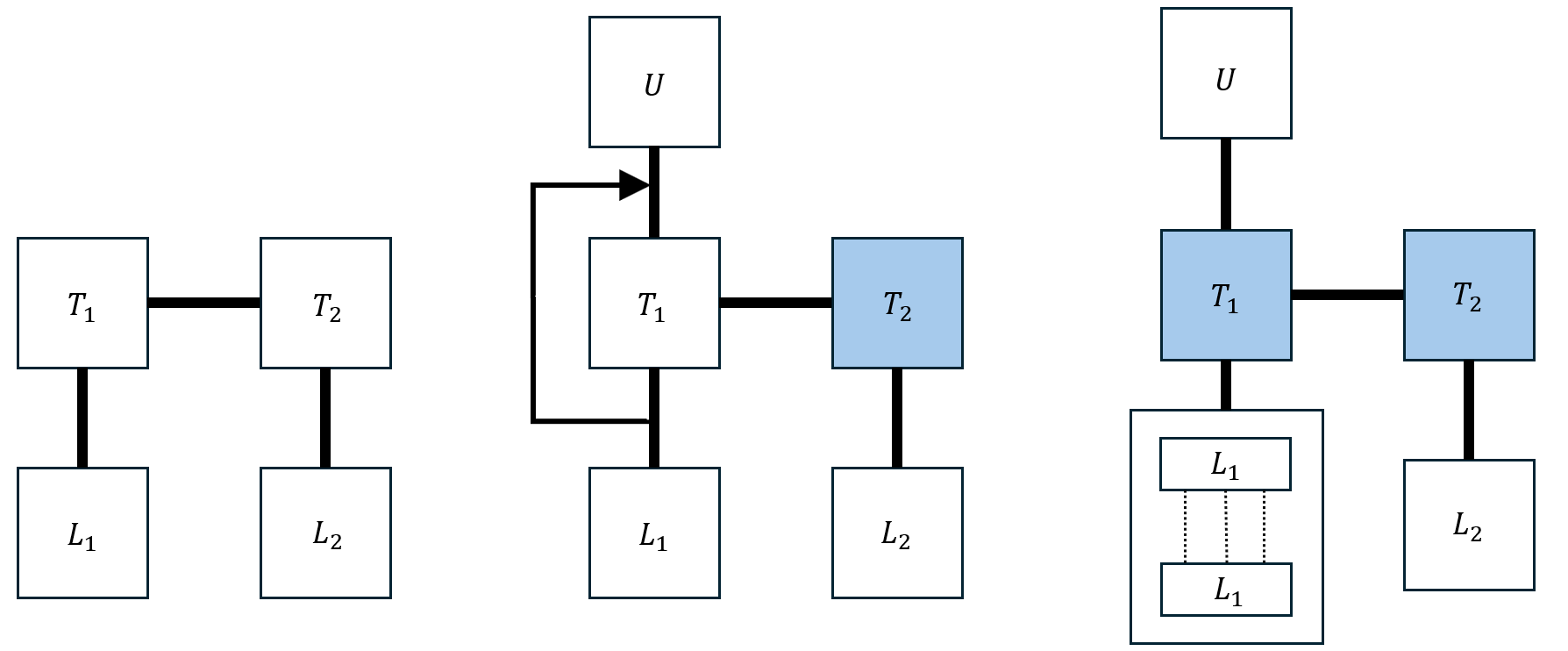
Our approach builds on the following observation: existing hard instances for this problem do not merely establish an upper bound on the competitive ratio, but also force the algorithm to produce solutions with a very rigid structure. In particular, in both [10, 14], the vertices of the bipartite input graph can be partitioned into four equal-sized independent sets: (the tight vertices) and (the loose vertices). Edges exist only between the pairs –, –, and – (see Figure 1), and the graph admits a perfect matching between tight vertices and loose vertices in .
Although not proven in their respective papers, it can be shown that both constructions share the following property: in order to achieve the optimal competitive ratio , the algorithm must output a solution in which the tight vertices have average weight arbitrarily close to . Therefore, if our goal is to prove any strict separation from the previous best upper bound , we may safely assume that, when applied to these instances, the algorithm produces a solution in which the tight vertices have average weight close to .
Exploiting Structure.
For simplicity, suppose we insert such an instance and the algorithms output is completely uniform: vertices in have average weight , while vertices in have average weight . Our goal is to penalize the algorithm for assigning weight to the tight vertices. We freeze all vertices in , and introduce a new set of vertices of size , connected to by a complete bipartite graph. Since vertices in are frozen, the algorithm doesn’t want to preempt weight from edges incident to them. Consequently, the only way to assign weight to edges between and is by preempting weight from edges between and .
Regardless of the algorithm’s preemptive decisions, once and its incident edges are introduced, either the vertices in or those in must have average weight at least (we can safely assume the algorithm keeps the vertices of tight). For simplicity, assume that the vertices in end up with uniform average weight . We then freeze vertices of and insert a copy of the initial hard instance between the vertices of .
At this stage, the graph admits a perfect matching: vertices in can be matched to , and vertices in can be matched among themselves. Thus, the maximum matching size is . Prior to the second insertion of the initial instance within , the algorithm cannot increase its total weight by shifting weight from – edges to – edges. Hence, before the final step, the algorithm’s total weight is at most , since the initial instance is -hard.
When the -hard instance is recursively inserted into , the vertices of already carry “frozen” average weight . Intuitively, the algorithm can increase this weight by at most , as the subgraph induced by is itself -hard. Therefore, the competitive ratio of the output at this point is upper bounded by
2.2 Showing a Strict Separation
A primary goal of this paper is to demonstrate that online preemptive matching is strictly harder than online matching under vertex-future edge arrivals. Unfortunately, the best known competitive ratio for the latter, when restricted to integral algorithms, is approximately , as shown by Huang et al. [14]. Consequently, it is not sufficient to prove an arbitrary constant separation from the previous hardness bound of . To overcome this barrier, our construction employs several additional techniques, which we now outline at a high level.
Working with Non-Tight Tight Vertices.
In the simplified construction above, the algorithm may slightly deviate from the assumed structure. We therefore establish a strong relationship between the extent to which tight vertices deviate from being fully tight and the resulting loss in competitive ratio. In Section 4, we show that if the algorithm produces a solution in which tight vertices have weight at most , then its competitive ratio degrades to , for the hard instance of Epstein et al. [10]. This requires reformulating their analysis in the fractional setting and generalizing it to algorithms that do not necessarily optimize their competitive ratio.
Scaling .
Further improvements come from scaling the size of to for an integer . In this case, during the recursive step we insert the -hard instance among the heaviest vertices in . Intuitively, increasing the size of causes a larger fraction of the initial weight of to reside on vertices that block the algorithm’s ability to improve its solution when the hard instance is inserted for the second time.
Optimizing the Recursive Argument.
Observe that the final step of the construction does not rely on the internal structure of the underlying -hard instance. Instead, the argument implies the existence of a strictly harder instance with competitive ratio . This means the resulting hard instance can be substituted into the last step of the construction, allowing for a recursive formalization. We formalize this recursion scheme in Lemma 8, and in Section 4.3 we approximate the strongest competitive ratio bound achievable by this approach.
Further Discussion.
The upper bound of established in this paper can likely be improved through a more refined analysis. Since our primary goal was to demonstrate a strict separation compared to the limitations of existing approaches using the simplest possible construction, we did not fully explore all possible approaches. For instance, this is why Lemma 7 relies on the simpler (but weaker) hard instance of [10], rather than the more intricate state-of-the-art construction of [14].
We would like to highlight the fact that the previous upper bound of by Huang et al. [14] is a constant that serves as a significant barrier in the approximation for the matching problem in multiple computational models. Namely, Konrad and Naidu [21] have shown a -pass semi-streaming streaming algorithm and multiple papers [4, 6, 3] have derived fully dynamic poly-logarithmic update time algorithms with the same approximation ratio.
It might also not be instantly clear why is it the case that if we are to insert an -hard instance between in independent set of size with frozen weight the algorithm may only improve its output by an additive factor of if the underlying vertices don’t share the same frozen weight. We overcome this difficulty through creating multiple copies of the instance and treating the independent sets as meta vertices (for a formal derivation see Section 5.1).
Finally, the reader may observe that the simplified construction above yields a non-bipartite input graph. In the full construction, instead of inserting the -hard sub-instance within , we insert it between and a corresponding set belonging to a copy of the initial instance (see Section 4.2), thereby preserving bipartiteness.
3 Preliminaries
Let be a graph. A fractional matching in is a function such that for every vertex ,
where denotes the set of edges incident to . We will refer to the weight of a vertex as . We will sometimes refer to the total weight of edges incident on a set of vertices by .
Definition 2 (Online Preemptive Fractional Matching with General Edge Arrival).
Let be a graph whose edges arrive online in a sequence . An online preemptive fractional matching algorithm maintains a fractional matching in an online fashion as follows:
-
1.
Online arrival: At each step , the edge arrives, revealing its endpoints. The algorithm must decide on a fractional assignment for this edge.
-
2.
Fractional matching constraint: At all times, the algorithm maintains a fractional matching:
where denotes the set of edges incident to vertex whose fractional weight has been assigned so far.
-
3.
Preemption: The algorithm is allowed to decrease the fractional weight of any previously assigned edge at any time.
The goal of the algorithm is to maximize the total fractional matching value
subject to the above constraints.
Definition 3.
Let be an online algorithm for an online matching problem, and let be an input sequence of arriving edges. For each , let and denote the values of the matching produced by and by an optimal offline algorithm on , respectively.
The competitive ratio of on the sequence is defined as
4 Our Hard Construction
In this section, we present our hard construction for the online preemptive fractional matching problem and its analysis. We begin by introducing several formal definitions that will be used throughout the remainder of the section.
Definition 4.
A graph on vertices is said to have a tight-loose structure if can be partitioned into four equal-sized, disjoint independent sets such that:
-
There exist perfect matchings in between and , and between and , and
-
The edge set satisfies
Much of our analysis focuses on specific edge arrival sequences on tight–loose graphs, under which any algorithm is forced to output a highly structured solution with weak competitive guarantees. This behavior is formalized by the following definition.
Definition 5.
Let be a tight-loose structured graph on vertices together with an associated edge arrival sequence. We say that this pair forms an -tight-loose online preemptive fractional matching instance for constant and function if any online preemptive fractional matching algorithm observing the arrival sequence must output a fractional matching satisfying the following condition:
-
If the total weight assigned to vertices in is
for some , then the total weight assigned to vertices in satisfies
Equivalently, if the algorithm assigns an average weight of to vertices in , then the resulting solution can be at most competitive. We assume throughout that the algorithm is aware of the bipartite decomposition of the input graph.
We next formalize the ultimate objective of this section, namely the construction of edge arrival sequences under which no algorithm can achieve a strong competitive ratio.
Definition 6.
A bipartite graph together with an associated edge arrival sequence is called an -hard online preemptive fractional matching instance if every online preemptive fractional matching algorithm observing the sequence must output a solution whose competitive ratio is at most and admits a perfect matching. As before, we assume that the algorithm is aware of the bipartite decomposition of the input graph.
Outline of the Argument.
We now state two lemmas which together imply our main result. The first lemma establishes the existence of a tight-loose instance with suitable parameters. Its proof appears in Section 4.1.
Lemma 7.
There exists a -tight–loose online preemptive fractional matching instance.
Our hard construction builds upon the tight-loose instance guaranteed by Lemma 7 through which we derive a recursive upper bound on the competitive ratios achievable by online preemptive fractional matching algorithms. In Section 4.3, we show how this recursion yields the bound stated in Theorem 1. The recursive argument itself is formalized and proved in Section 4.2.
Lemma 8.
Assume that there exists a bipartite -hard online preemptive fractional matching instance for some . Fix an arbitrary , and define
Let
Then there exists a bipartite -hard online preemptive fractional matching instance.
Arguing about Preemption
Throughout this section, for analytical convenience, we make several assumptions about the behavior of online preemptive fractional matching algorithms. These assumptions do not restrict generality and are introduced solely to simplify the competitive-ratio analysis.
Our first assumption is that the adversary may freeze vertices. By freezing a vertex, the adversary guarantees that no further edges incident to that vertex will be revealed. Consequently, we may assume without loss of generality that the algorithm never preempts weight from edges incident to frozen vertices. Since frozen vertices cannot receive additional weight in the future, preempting edges incident to them cannot improve the algorithm’s competitive ratio. Formally, for any algorithm that preempts weight from frozen vertices, there exists an alternative algorithm that does not do so and achieves no worse competitive performance.
We further assume that whenever an edge is inserted, the algorithm assigns weight so as to make at least one of its endpoints tight. The algorithm has no incentive not to follow this strategy, as any weight assigned in this manner can be preempted later if needed. Moreover, after the insertion of an edge, we assume that the algorithm only preempts weight from edges incident to the tight endpoints of that edge (i.e., from vertices whose loads may increase as a result of the insertion), and not from elsewhere in the graph. This assumption is without loss of generality: preempting weight from unrelated edges cannot improve the algorithm’s competitive ratio at the current time, and any such preemption can always be deferred to a later point.
Finally, we assume that whenever the algorithm is faced with a choice between assigning total weight or to a vertex set , and this choice does not affect the weights of any other vertices, the algorithm always chooses the latter option. Although this assumption may appear odd and self-evident, some of our arguments rely on the algorithm placing excessive weight on certain vertices, and one might wonder whether the algorithm could avoid such situations by choosing the smaller assignment.
To justify this assumption, assume that in such cases the adversary may, for analytical purposes, introduce a collection of dummy vertices connected to , allowing the algorithm to increase the total weight on to , while guaranteeing that the optimal offline solution does not use any of these edges. Since the algorithm may later preempt these edges at no cost, it has no rational reason not to exploit this additional flexibility.
4.1 Analyzing the Tight-Loose Structure of [10]
In this section, we formally show that any online fractional algorithm observing the hard instance of Epstein et al. [10] must incur a loss in competitive ratio if it employs preemption in a way that deviates from the tight–loose structure. This establishes Lemma 7. Our proof can be viewed as an extension of the original hardness argument of Epstein et al. to the setting of fractional algorithms where the algorithm does employ preemption.
The construction of Epstein et al. [10]
The instance consists of layers of vertices, where each layer contains vertices. Through the arrivals the vertices of each layer will be partitioned into sets loose and ordered set tight , with once the sequence finished. This partitioning and ordering will depend on the choices of the algorithm for all layers except layer . For layer 1 half of its vertices fall in each of and is ordered arbitrarily. We will describe this partitioning dynamically as edges arrive. In the final input graph all edges will run between vertex sets and for . Note that there will be no edges between and for .
Edges arrive in phases where in phase the edges between and arrive. At the start of phase the adversary sets and . In each update the adversary chooses the next vertex in according to the ordering and inserts edges from to all vertices of . Then it moves the lowest weight vertex of to . At the end of the phase the adversary decreasingly orders the remaining vertices of according to their current weight.
The final graph consists of the following:
-
Complete sub-graphs between vertices of and for all
-
An upper triangular graph between the vertices of and for
Dealing with Preemption
While reasoning about preemption is already challenging when an algorithm’s sole objective is to maximize its competitive ratio, our setting requires a more delicate analysis. In particular, we must establish a trade-off between the maximum competitive ratio an algorithm can achieve and the degree to which it allows the tight vertices in the construction of Epstein et al. [10] to deviate from being fully tight. Ideally, an algorithm would like to place weight on edges between loose vertices; however, by construction, no such edges exist.
In this setting, the algorithm’s best available strategy is to place weight on edges connecting tight vertices to loose ones. Whenever the edges incident to a vertex and the vertices of are revealed, the algorithm has an opportunity to do so, as it knows that some of the neighbors of in layer will eventually be classified as loose. We may safely assume that the algorithm assigns as much weight as possible to these revealed edges: any weight temporarily assigned to edges between tight vertices can always be preempted later if needed.
Since at all times the set contains at least vertices, the algorithm can always make tight. Thus, without loss of generality, we assume that immediately after the edges from to are revealed, the algorithm makes tight.
Observe that during phase , edges arrive only between layers and , and no edges between layers and are yet present. Therefore, at this point, the algorithm could only consider preempting weight from edges between layers and , or from those between and . For analytical convenience, we further wish to assume that during phase the algorithm only preempts weight from edges between layers and , and not from edges between layers and .
To justify this assumption, we allow the algorithm a temporary relaxation: during phase , it may increase the total weight assigned to vertices in layer beyond . However, when phase begins and the adversary reveals the edges incident to some vertex and the vertices of , the algorithm is required to preempt weight from edges incident to until its total incident weight is at most . We refer to this forced preemption step, when it occurs, as the pruning of a vertex in layer .
Under this relaxation, the algorithm is never incentivized to remove weight from edges between layers and during phase . Moreover, since in phase edges are introduced only incident to vertices in , the algorithm may only benefit from preempting weight from edges between and , as there are no edges between and .
Competitive Analysis.
Call the residual weight of a vertex at some point in time to be minus its current weight, that is how much more load it can take. Further define the following notation:
-
Let stand for the total residual weight of vertices with weight at most in at the start of phase before any pruning occurs,
-
Let stand for the total weight preempted from vertices of during phase (including pruning if it occurs).
Claim 9.
for all .
As the proof of Claim 9 is rather numerically heavy and it would disrupt the flow of presentation we defer it to Appendix A.1.
We now show how can it be used to conclude Lemma 7. Consider how much can the algorithm increase the weight of its output when the edges of any vertex to are revealed. If -s residual weight is it can place weight on its recently arrived edges. In addition it may preempt weight from some of its edges and place that weight somewhere else. However, this does not increase the total weight of its output. Hence, the total weight of the algorithms output is , refer to this value .
Let stand for . After the algorithm preempts edge weights in phase from edges between layers and the can never recover that weight as it will not observe further edges. Hence, will stand for the average residual weight of tight vertices at the end of the insertion sequence. By summing up the left hand side of Claim 9 over all layers we get:
Here we used that for any layer . By summing up the right hand side we get:
Here we used that for any layer as the algorithm may only remove at most weight of the vertices of layer . By evoking the claim and reordering we get that . The graph contains a matching of size Hence, the algorithm has competitive ratio
as we can select to be an arbitrarily large value.
4.2 Proving the Recursive Formula
This section is devoted to proving our recursive formula from Lemma 8. Recall that the lemma assumes there exists some -hard bipartite instance for online preemptive fractional matching. We further know from Lemma 7 that there exists a -tight-loose instance, which will be the starting point of the adversary.
After inserting the tight-loose structure let the resulting graph and its tight and loose vertex sets be denoted by where all four vertex sets have the same size . Recall that by the definition of a tight-loose structure edges may only run between , and . Assume that the algorithm assigns an average weight of to vertices of .
At this point there is a perfect matching present in the instance and by the lemma we know that the algorithms competitive ratio can be at most , denote this value by . This implies an upper bound on the average weight of loose vertices of of . It could be the case that the average weight of and vertices are not the same. Let these average weight values for the two sets be denoted by and respectively, where .
Claim 10.
The average weight of vertices in and are and respectively.
Proof.
Let , and stand for the total weight of edges running between vertex sets , and respectively. As all edges run between these bipartition, we have that . From the definition of and we also know that and .
Combining the equalities we get that and . As all edges of loose vertices run to their corresponding tight sets we can conclude theclaim.
At this point, the adversary creates a copy of the instance together with the algorithm’s current output. Whether such copying is permissible varies across the literature. In Section A.2, we explain why, from a hardness perspective, it is without loss of generality to assume that the adversary may duplicate instances – including the algorithm’s output – in the context of the online preemptive fractional matching problem.
Let the copied instance be denoted by . The adversary then inserts vertex sets and of size for some integer constant . At this point the algorithm freezes the vertices of . Afterwards the adversary inserts complete bipartite sub-graphs between vertices of and . The algorithm will react to this insertions. After this reaction let the vertex sets and refer to the highest weight vertices of and respectively.
Claim 11.
The average weights of vertices in both and are at least .
Proof.
Without loss of generality focus on the average weight of . Consider how the algorithm may have reacted to the insertion of the complete bipartite sub-graph between and . As is frozen at this point, the algorithm doesn’t want to preempt weight from edges. The algorithm also wants to make at least one endpoint of all the edges in this complete bipartite graph tight to maximize its competitive ratio. The average weight of is minimized if the algorithm decides to make the endpoints tight.
Before the insertion the average weight of vertices is so the algorithm can safely place a total weight of on the newly arrived edges to . Afterwards, it might choose to preempt some weight from edges to distribute them into edges. Either way, the total weight of edges between and will be by Claim 10. As consists of the highest weight vertices of they will be hosting at least a fraction of this weight implying the claim.
Now the adversary freezes vertices and creates further copies of the whole instance so far (lets refer to this as the medium stage), in each including the output of the algorithm. Let and correspond to the copies of and in these instances. Finally, the adversary inserts the initial -hard instance between the vertices of and .
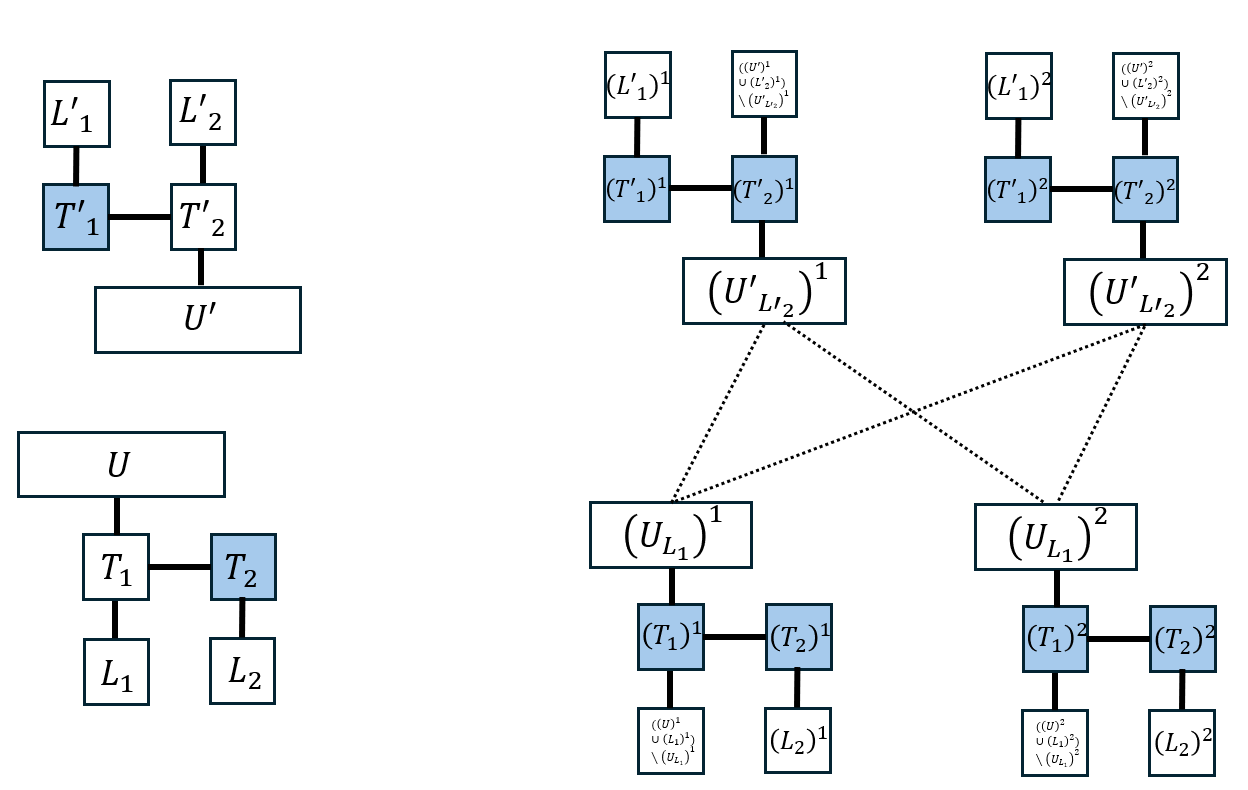
The detail of this process are formally explained in Section 5.1 and the guarantees of its outcome are summarized by Lemma 15. Essentially, the algorithm treats vertex sets as meta vertices in a bipartite meta graph and inserts the -hard instance into . The insertion of an edge between a pair of meta vertices is simulated through an insertion of a complete bipartite graph between the corresponding vertex sets. Now we turn to analyzing the competitive ratio.
Claim 12.
At the end of the edge arrival sequence the weight of an optimal offline solution is .
Proof.
The resulting graph has vertices. The initial instance was on vertices which were first copied once. The addition of vertex sets increased the vertex site size to a further and the medium stage instance was copied times. So its sufficient to argue that there exist a perfect matching in the graph at the end. Note that in each copy of the medium stage instance vertex sets and can be perfectly matched to vertices of and respectively due to the definition of the initial tight-loose structure. In the meta graph from the definition of an -hard instance there must exist a perfect matching of the meta vertices. As meta edges represent a complete bipartite sub-graph between the corresponding vertex sets vertices of can be perfectly matched to vertices of .
It remains to argue that for all copies of the medium stage instance vertex sets copies and can be matched to their corresponding and sets unmatched so far. Without loss of generality focus on the former pair. We know that there exist a perfect matching between and from the definition of the tight-loose structure and there is a complete bipartite sub-graph between and . Let be denoted to the restriction of this perfect matching to vertices of . Match the endpoints of through the edges of . The remaining vertices of can be arbitrarily matched within the complete subgraph .
Finally, with the following claim upper bounding the performance of the algorithm, we may conclude the lemma.
Claim 13.
The algorithms output at the end of the edge arrival sequence can have total weight at most .
Proof.
After the initialization of the tight-loose instance by Lemma 7 the competitive ratio of the algorithm is at most , hence the algorithms output has weight at most . Once its copied the first time this jumps to . When the complete bipartite sub-graphs between and are inserted the algorithm may increase its output weight by to . At this point the medium stage instance is copied times blowing this value up by .
4.3 Concluding Theorem 1
In this section we finally conclude our main Theorem 1. This is achieved through a precise approximation of what competitive ratio upper bound can be established using Lemma 8. Define , the constant in our main theorem.
Claim 14.
Let , then for any we have
for fixed constant .
Observe that Claim 14 combined with Lemma 8 and the -hard instance of Epstein et al. [10] implies our main theorem. If we set any to be the competitive ratio shown by an -hard instance, the claim and lemma together imply the existence of an -hard instance.
Proof.
Define . Note that . The expression can now be re-stated as
Fix . Note that the choice of the constant is sensitive, but any sufficiently large but comparably smaller value then suffices. Consider the function,
In order to describe the tightest case of the initial min-max expression we need to consider when is maximized. Hence, we examine .
The second inequality follows from . This implies that the expression is maximized when is minimized so we can proceed with assuming . is linear with respect to the parameter . Consequently, it must obtain its maximum on one of the endpoints of the interval range so its sufficient to prove that
Via machine its easy to check that and concluding the proof.
5 Technical Notes
5.1 Recursing on Meta-Graphs
The final step in the proof of Lemma 8 crucially relies on the assumption that an -hard instance can be used to bound how much additional weight an algorithm may place on vertices that already carry frozen weight. In this section, we formalize this assumption.
Lemma 15.
Suppose an online preemptive fractional matching algorithm is fed a bipartite graph together with an edge arrival sequence, and at some point produces a fractional matching . Assume further that the following conditions hold:
-
There exist pairwise disjoint independent sets and , each of size ;
-
For every , all neighbors of vertices in have been frozen;
-
For every , the average vertex weight induced by on is at least ;
-
There exists a bipartite -hard online preemptive fractional matching instance on vertices.
Then there exists a graph and an associated edge arrival sequence such that:
-
1.
contains a perfect matching between and , and
-
2.
If the algorithm’s input is extended by this arrival sequence, the total weight of its output can increase by at most .
Proof.
We construct a bipartite meta-graph with vertex sets and , each of size . Each meta-vertex in (respectively, ) corresponds to one independent set (respectively, ) in .
We now insert the -hard instance into . Whenever an edge between meta-vertices corresponding to and arrives in the -hard instance, we insert a complete bipartite subgraph between the corresponding independent sets and in . This process defines the edge set and its arrival sequence. Since the -hard instance admits a perfect matching, it follows that contains a perfect matching between and .
Next, we relate the behavior of the algorithm on to an induced fractional matching on . Whenever the algorithm increases or decreases the weight of an edge with and by an amount , we apply a corresponding change of to the weight of the edge between the meta-vertices representing and , in the same direction.
We first observe that these updates define a valid execution of an online preemptive fractional matching algorithm on the meta-graph under the -hard arrival sequence. Since all neighbors of vertices in each are frozen in , we may assume that the algorithm never preempts weight from edges outside of during the arrivals of . Consequently, the average weight of vertices in each remains within the interval throughout this process, which implies that the induced vertex weights in always lie in .
Because the instance inserted into is -hard, the total weight of the induced fractional matching on is at most . By construction, this implies that the total increase in weight across all edges of during the arrivals of is at most , completing the proof.
5.2 Comparing Vertex-Future Edge and Generalized Vertex Arrivals
In this section, we justify claims regarding the relationship between the vertex-future edge arrival model and the generalized vertex arrival model [27], as well as the competitive ratios achievable in the former.
In the standard definition of generalized vertex arrivals, vertices are associated with arrival times and deadlines. When a vertex arrives, it reveals all edges incident to previously arrived vertices. At its deadline, the algorithm must irrevocably decide whether to match the vertex to an available neighbor. It is typically assumed that by the time of its deadline, a vertex has observed all of its neighbors.
A generalized vertex arrival sequence can be simulated within the vertex-future edge arrival model by setting the arrival time of each vertex in the latter equal to its deadline in the former. Under this transformation, all edges incident to a vertex are revealed before the time at which a matching decision must be made, establishing the claimed relationship between the two models.
The converse, however, does not hold. In the generalized vertex arrival model, for a vertex to observe all of its neighbors by its deadline, all of those neighbors must have arrived beforehand and revealed their incident edges. In particular, even in bipartite graphs – where edges do not run between neighbors of the same vertex – this constraint persists: once all neighbors of a vertex have arrived, any subsequently arriving vertices must reveal all edges incident to the existing vertices. This restriction does not apply in the vertex-future edge arrival models.
Finally, we argue that known positive results for the generalized vertex arrival model extend to the vertex-future edge arrival model. The randomized integral and deterministic fractional algorithms of Huang et al. [14] are based on the Ranking and Water-Filling frameworks. At a high level, these algorithms rely only on local information, namely the edges revealed so far and the matched status or weight of neighboring vertices. Since this information is also available in the vertex-future edge arrival model, their competitive ratio guarantees carry over unchanged.
References
- [1] Spyros Angelopoulos, Christoph Dürr, and Shendan Jin. Online maximum matching with recourse. J. Comb. Optim., 40(4):974–1007, 2020. doi:10.1007/s10878-020-00641-w.
- [2] Antonios Antoniadis, Themis Gouleakis, Pieter Kleer, and Pavel Kolev. Secretary and online matching problems with machine learned advice. Discret. Optim., 48(Part 2):100778, 2023. doi:10.1016/j.disopt.2023.100778.
- [3] Amir Azarmehr, Soheil Behnezhad, and Mohammad Roghani. Fully dynamic matching: -approximation in polylog update time. In David P. Woodruff, editor, Proceedings of the 2024 ACM-SIAM Symposium on Discrete Algorithms, SODA 2024, Alexandria, VA, USA, January 7-10, 2024, pages 3040–3061. SIAM, 2024.
- [4] Soheil Behnezhad. Dynamic algorithms for maximum matching size. In Nikhil Bansal and Viswanath Nagarajan, editors, Proceedings of the 2023 ACM-SIAM Symposium on Discrete Algorithms, SODA 2023, Florence, Italy, January 22-25, 2023, pages 129–162. SIAM, 2023. doi:10.1137/1.9781611977554.ch6.
- [5] Aaron Bernstein, Jacob Holm, and Eva Rotenberg. Online bipartite matching with amortized O(log n) replacements. J. ACM, 66(5):37:1–37:23, 2019. doi:10.1145/3344999.
- [6] Sayan Bhattacharya, Peter Kiss, Thatchaphol Saranurak, and David Wajc. Dynamic matching with better-than-2 approximation in polylogarithmic update time. J. ACM, 71(5):33:1–33:32, 2024. doi:10.1145/3679009.
- [7] Niv Buchbinder, Danny Segev, and Yevgeny Tkach. Online algorithms for maximum cardinality matching with edge arrivals. Algorithmica, 81(5):1781–1799, 2019. doi:10.1007/s00453-018-0505-7.
- [8] Ashish Chiplunkar, Sumedh Tirodkar, and Sundar Vishwanathan. On randomized algorithms for matching in the online preemptive model. In Nikhil Bansal and Irene Finocchi, editors, Algorithms - ESA 2015 - 23rd Annual European Symposium, Patras, Greece, September 14-16, 2015, Proceedings, Lecture Notes in Computer Science, pages 325–336. Springer, 2015. doi:10.1007/978-3-662-48350-3_28.
- [9] Davin Choo, Themistoklis Gouleakis, Chun Kai Ling, and Arnab Bhattacharyya. Online bipartite matching with imperfect advice. In Forty-first International Conference on Machine Learning, ICML 2024, Vienna, Austria, July 21-27, 2024. OpenReview.net, 2024. URL: https://openreview.net/forum?id=61WtHsVKWF.
- [10] Leah Epstein, Asaf Levin, Danny Segev, and Oren Weimann. Improved bounds for randomized preemptive online matching. Inf. Comput., 259(1):31–40, 2018. doi:10.1016/j.ic.2017.12.002.
- [11] Buddhima Gamlath, Michael Kapralov, Andreas Maggiori, Ola Svensson, and David Wajc. Online matching with general arrivals. In David Zuckerman, editor, 60th IEEE Annual Symposium on Foundations of Computer Science, FOCS 2019, Baltimore, Maryland, USA, November 9-12, 2019, pages 26–37. IEEE Computer Society, 2019. doi:10.1109/FOCS.2019.00011.
- [12] Varun Gupta, Ravishankar Krishnaswamy, and Sai Sandeep. Permutation strikes back: The power of recourse in online metric matching. In Jaroslaw Byrka and Raghu Meka, editors, Approximation, Randomization, and Combinatorial Optimization. Algorithms and Techniques, APPROX/RANDOM 2020, Virtual Conference, August 17-19, 2020, volume 176 of LIPIcs, pages 40:1–40:20. Schloss Dagstuhl – Leibniz-Zentrum für Informatik, 2020. doi:10.4230/LIPIcs.APPROX/RANDOM.2020.40.
- [13] Zhiyi Huang, Ning Kang, Zhihao Gavin Tang, Xiaowei Wu, Yuhao Zhang, and Xue Zhu. How to match when all vertices arrive online. In Ilias Diakonikolas, David Kempe, and Monika Henzinger, editors, Proceedings of the 50th Annual ACM SIGACT Symposium on Theory of Computing, STOC 2018, Los Angeles, CA, USA, June 25-29, 2018, pages 17–29. ACM, 2018. doi:10.1145/3188745.3188858.
- [14] Zhiyi Huang, Binghui Peng, Zhihao Gavin Tang, Runzhou Tao, Xiaowei Wu, and Yuhao Zhang. Tight competitive ratios of classic matching algorithms in the fully online model. In Timothy M. Chan, editor, Proceedings of the Thirtieth Annual ACM-SIAM Symposium on Discrete Algorithms, SODA 2019, San Diego, California, USA, January 6-9, 2019, pages 2875–2886. SIAM, 2019. doi:10.1137/1.9781611975482.178.
- [15] Zhiyi Huang, Zhihao Gavin Tang, and David Wajc. Online matching: A brief survey. ACM SIGecom Exchanges, 22(1):135–158, 2024. doi:10.1145/3699824.3699837.
- [16] Zhiyi Huang, Zhihao Gavin Tang, Xiaowei Wu, and Yuhao Zhang. Fully online matching II: beating ranking and water-filling. In Sandy Irani, editor, 61st IEEE Annual Symposium on Foundations of Computer Science, FOCS 2020, Durham, NC, USA, November 16-19, 2020, pages 1380–1391. IEEE, 2020. doi:10.1109/FOCS46700.2020.00130.
- [17] Tianle Jiang and Yuhao Zhang. Edge arrival online matching: The power of free disposal on acyclic graphs. In Marios Mavronicolas, Qi Qi, and Grant Schoenebeck, editors, Web and Internet Economics - 20th International Conference, WINE 2024, Edinburgh, UK, December 2-5, 2024, Proceedings, Lecture Notes in Computer Science, pages 591–608. Springer, 2024. doi:10.1007/978-3-032-08560-3_33.
- [18] Michael Kapralov. Better bounds for matchings in the streaming model. In Sanjeev Khanna, editor, Proceedings of the Twenty-Fourth Annual ACM-SIAM Symposium on Discrete Algorithms, SODA 2013, New Orleans, Louisiana, USA, January 6-8, 2013, pages 1679–1697. SIAM, 2013. doi:10.1137/1.9781611973105.121.
- [19] Michael Kapralov. Space lower bounds for approximating maximum matching in the edge arrival model. In Dániel Marx, editor, Proceedings of the 2021 ACM-SIAM Symposium on Discrete Algorithms, SODA 2021, Virtual Conference, January 10 - 13, 2021, pages 1874–1893. SIAM, 2021. doi:10.1137/1.9781611976465.112.
- [20] Richard M. Karp, Umesh V. Vazirani, and Vijay V. Vazirani. An optimal algorithm for on-line bipartite matching. In Harriet Ortiz, editor, Proceedings of the 22nd Annual ACM Symposium on Theory of Computing, May 13-17, 1990, Baltimore, Maryland, USA, pages 352–358. ACM, 1990. doi:10.1145/100216.100262.
- [21] Christian Konrad and Kheeran K. Naidu. On two-pass streaming algorithms for maximum bipartite matching. In Mary Wootters and Laura Sanità, editors, Approximation, Randomization, and Combinatorial Optimization. Algorithms and Techniques, APPROX/RANDOM 2021, University of Washington, Seattle, Washington, USA (Virtual Conference), August 16-18, 2021, LIPIcs, pages 19:1–19:18. Schloss Dagstuhl – Leibniz-Zentrum für Informatik, 2021. doi:10.4230/LIPIcs.APPROX/RANDOM.2021.19.
- [22] Pengfei Li, Jianyi Yang, and Shaolei Ren. Learning for edge-weighted online bipartite matching with robustness guarantees. In Andreas Krause, Emma Brunskill, Kyunghyun Cho, Barbara Engelhardt, Sivan Sabato, and Jonathan Scarlett, editors, International Conference on Machine Learning, ICML 2023, 23-29 July 2023, Honolulu, Hawaii, USA, volume 202 of Proceedings of Machine Learning Research, pages 20276–20295. PMLR, 2023. URL: https://proceedings.mlr.press/v202/li23am.html.
- [23] Kanstantsin Pashkovich and Thomas Snow. Online algorithm for fractional matchings with edge arrivals in graphs of maximum degree three. In Jannik Matuschke and José Verschae, editors, Approximation and Online Algorithms - 23rd International Workshop, WAOA 2025, Warsaw, Poland, September 18-19, 2025, Proceedings, Lecture Notes in Computer Science, pages 198–212. Springer, 2025. doi:10.1007/978-3-032-06706-7_14.
- [24] Alvin E Roth. Online and matching-based market design. Cambridge University Press, 2023.
- [25] Zhihao Gavin Tang and Yuhao Zhang. Improved bounds for fractional online matching problems. In Proceedings of the 25th ACM Conference on Economics and Computation, pages 279–307, 2024. doi:10.1145/3670865.3673459.
- [26] Sumedh Tirodkar and Sundar Vishwanathan. Maximum matching on trees in the online preemptive and the incremental dynamic graph models. In Yixin Cao and Jianer Chen, editors, Computing and Combinatorics - 23rd International Conference, COCOON 2017, Hong Kong, China, August 3-5, 2017, Proceedings, Lecture Notes in Computer Science, pages 504–515. Springer, 2017. doi:10.1007/978-3-319-62389-4_42.
- [27] Yajun Wang and Sam Chiu-wai Wong. Two-sided online bipartite matching and vertex cover: Beating the greedy algorithm. In Magnús M. Halldórsson, Kazuo Iwama, Naoki Kobayashi, and Bettina Speckmann, editors, Automata, Languages, and Programming - 42nd International Colloquium, ICALP 2015, Kyoto, Japan, July 6-10, 2015, Proceedings, Part I, volume 9134 of Lecture Notes in Computer Science, pages 1070–1081. Springer, 2015. doi:10.1007/978-3-662-47672-7_87.
Appendix A Missing Proofs
A.1 Proof of Claim 9
During phase the algorithm can only place weight on edges between and . Let stand for the amount of weight the algorithm places on the edges to of the -th vertex in the ordering of when exploiting its residual weight. Therefore, . Further define, with a slight trick in notation, that stands for amount the weight the algorithm places on the same edges through preempting from the previous layer . Hence, .
At the start of the phase vertices of have weight and they are all assigned to . As edges of vertices of arrive the lightest vertex of always moves to . Let stand for the weight of the -th vertex of which was moved to .
Up until and including the time when the algorithm has reached the -th vertex in the algorithm has placed weight on the edges running between and . Out of the set contains the lightest vertices when the -th vertex is added to . As at this point there are vertices in :
| (1) |
For , define
Inequality 1 could be re-stated as,
| (2) |
Our goal will be to upper bound . By Inequality 2
Here we exploited that the product telescopes. We define and open up to get,
Since for all for the term concerning preemption we get,
In order to upper bound the term coming from residual weights observe that the sequence is decreasing, while is increasing. By Abel summation,
Since is increasing and bounded by ,
By properties of harmonic series we have that,
Substituting this into the previous equation we get:
Combining our bounds on the preemptive and residual values we can finally upper bound
During phase the algorithm distributes of on the edges running between layer and , and during phase it does not preempt from the same edges. As at most of this weight is placed on vertices of and the rest is on we can conclude that,
A.2 Copying the Instance
Certain steps in the proof of Lemma 8 rely crucially on the assumption that, at any point in time, the adversary may create an arbitrary number of copies of the current input instance on which the algorithm behaves identically. As this assumption may appear nonstandard, we justify it here at a high level.
We note that our recursive argument can, in principle, be carried out even without assuming that the resulting copies are perfectly identical. We nevertheless adopt this assumption in order to simplify the presentation.
Suppose the adversary wishes to create copies of the current state of the input graph and the algorithm’s output on an instance with vertices, in order to establish an upper bound of on the competitive ratio of a deterministic online preemptive fractional matching algorithm. For simplicity, assume that the value of an optimal offline solution for the instance is at least .
We first consider a discretized variant of the online preemptive fractional matching problem. In this model, edges arrive online as usual, and the algorithm may update its solution both online and via preemption. However, every update must assign to each edge a weight that is a multiple of , for some sufficiently large predetermined parameter .
Under this discretization, after the arrival of an edge the algorithm has only finitely many possible actions: it may increase or decrease the weight of any of the edges by an integer multiple of . As a result, after any update the algorithm has at most possible distinct actions. Since there are edge arrivals in total, the algorithm can produce at most
distinct outputs over the entire execution.
The precise bound is not important; what matters is that it is a function of and . We now choose with . Observe that for any continuous fractional algorithm, there exists a discretized algorithm that at all times produces a fractional matching differing by at most per edge.
If the original (continuous) algorithm has competitive ratio , then the discretized algorithm achieves competitive ratio . Thus, from a hardness perspective, we may assume without loss of generality that the algorithm is discretized using a sufficiently large parameter . In particular, for a fixed input sequence on vertices, the algorithm can reach only some large but finite number of distinct outputs.
Now suppose the adversary wishes to force the algorithm to produce identical copies of its output. It suffices for the adversary to generate independent copies of the current input instance. We may further assume that after each edge insertion, the algorithm only updates weights on incident edges, as any additional preemptions can be postponed to a later time. Under this assumption, across all copies, the discretized algorithm can behave in at most distinct ways.
We classify copies into types, where two copies belong to the same type if the algorithm produces identical fractional matchings on them. Any type containing fewer than copies can be ignored by the adversary, as such copies contribute at most total weight to the algorithm’s solution, which is negligible compared to the inflated optimal solution.
For each type containing at least copies, the adversary can partition these copies into groups of exactly , discarding at most leftover copies per type. The total contribution of all discarded copies remains bounded by .
As a result, the adversary can extract identical copies of the instance on which the algorithm behaves identically. Since the value of the optimal solution under this amplification grows to , the ignored portions of the instance affect the algorithm’s competitive ratio by only an term. This justifies the assumption that the adversary may freely create identical copies of the instance in our hardness construction.