Randomizing Parallel Real-Time Tasks:
A Scheduler-Oblivious Mechanism to Harness Security

Abstract
Periodic parallel task models, such as DAG, offer significant potential for modeling safety-critical real-time applications, but can introduce security vulnerabilities on multicore platforms. The deterministic schedules of periodic real-time tasks can be exploited through schedule-based side-channel attacks – causing missed deadlines or leaking sensitive information. Schedule randomization can address this vulnerability, yet existing work targets sequential tasks and lacks models that incorporate security for parallel workloads while meeting the real-time constraints. Furthermore, no widely accepted metric quantitatively measures the security gained from randomization against different attacker classes.
This paper proposes Controlled DAG Randomization (CDR), a scheduler-oblivious framework that randomizes the schedule of periodic real-time DAG tasks while preserving hard deadline guarantees. Each DAG is transformed into an Augmented DAG (ADAG) via two mechanisms: dependency augmentation, which adds edges to constrain concurrency, and temporal augmentation, which inserts additional vertices/subtasks that introduce random delays. At runtime, two algorithms randomize the structure of each released instance of the DAG: one adds random precedence edges, and the other assigns randomized execution budgets to the augmented subtasks of the ADAG– both while maintaining schedulability. Two attacker-aware metrics, System Threat and Task Distribution Entropy, are proposed, targeting intrusive and observation-based attackers, respectively. Extensive simulations on single- and multi-task systems show significant vulnerability reductions. We also observe that increased resources do not always strengthen security and can diminish randomization effectiveness, highlighting the need for carefully designed schedules to realize real security benefits.
Keywords and phrases:
Real-time systems, DAG scheduling, side-channel defenseCopyright and License:
![[Uncaptioned image]](x1.png) © Xiuqi Zhang and Risat Mahmud Pathan; licensed under Creative Commons License CC-BY 4.0
© Xiuqi Zhang and Risat Mahmud Pathan; licensed under Creative Commons License CC-BY 4.0
2012 ACM Subject Classification:
Computer systems organization Real-time systems ; Security and privacy Operating systems securityEditor:
Angeliki KritikakouSeries and Publisher:
 Leibniz International Proceedings in Informatics, Schloss Dagstuhl – Leibniz-Zentrum für Informatik
1 Introduction
The increasing complexity of modern Real-Time Systems (RTS)– from autonomous vehicles to advanced robotics – demands multicore platforms to meet stringent timing and computational requirements. The DAG task model, representing parallel workloads via vertices (subtasks) and edges (dependencies), is a major contender for such systems. Many real-time tasks recur periodically with deterministic execution patterns. While essential for schedulability analysis and certification, this determinism paradoxically exposes timing side-channels: an attacker who has compromised a non-critical task can exploit predictable resource access patterns to disrupt execution or extract sensitive data [10, 2, 27]. Even without direct compromise, observation-based side-channel attacks benefit from such predictability.
These risks motivate disrupting deterministic scheduling patterns while preserving schedulability guarantees. Despite decades of research on periodic DAG schedulability [13, 18, 22, 15], the systematic integration of security into parallel real-time scheduling remains largely unexplored. Schedule randomization is a promising defense: varying execution order of the subtasks obscures deterministic patterns. Early approaches like TaskShuffler [36] randomized fixed-priority uniprocessor schedules, but Nasri et al. [25] showed that naive randomization and attacker-oblivious metrics (e.g., generic schedule entropy) can fail to provide security or even create new attack vectors.
For periodic parallel workloads modeled as DAG s, the problem runs deeper than shuffling a ready queue: concurrency creates many execution scenarios that determine which attacker–victim execution overlaps are possible. A usable defense requires three properties: (1) a constructive mechanism that produces diverse parallel execution scenarios without modifying the scheduler – i.e., a scheduler-oblivious approach – since altering a certified RTOS invalidates certification and incurs re-verification costs; (2) a hard real-time safety argument that the injected randomness cannot cause missed deadlines; and (3) attacker-aware metrics that quantify security from randomization. To that end, we propose Controlled DAG Randomization (CDR), a framework that enables execution of DAG subtasks in an order that is unpredictable to external observers while guaranteeing schedulability. The main contributions are:
-
1.
Theoretical Framework for Randomization: We propose the Augmented DAG (ADAG) model, which transforms a DAG by inserting additional edges and “fake” subtasks. We prove a sufficiency result: this model can represent any valid randomized schedule achievable by work-conserving or even non-work-conserving non-preemptive schedulers.
-
2.
Runtime Randomization Algorithms: The ADAG model defines a large space of randomized DAG s. We design two runtime algorithms (one for edges, one for fake subtasks) that efficiently sample one such random DAG from this space while preserving schedulability. This enables evaluating the security provided by randomization across the full range of uniformly distributed achievable schedules.
-
3.
Attacker-Aware Security Metrics: We propose two security metrics: System Threat, quantifying the probability of exploitable attack vectors and measuring defense against Schedule-Intrusive Attackers (i.e., who can change system behavior), and Task Distribution Entropy, measuring the uncertainty of each subtask’s execution window and measuring defense against Schedule-Non-Intrusive Attackers (i.e., who do not change behavior but only observe the system).
-
4.
Empirical Evaluation and Insights: Extensive simulations reveal significant vulnerability reductions across multiple attack classes. We observe a counterintuitive phenomenon: adding cores can sometimes reduce security, showing that a DAG’s structure and the available slack jointly determine the security achievable through randomization.
The paper proceeds as follows: Section 2 reviews related work; Sections 3–4 present the system and adversary models; Section 5 introduces the security metrics; Section 6 presents the randomization technique and parameterization algorithm; Section 7 extends to multi-task systems; Section 8 reports the evaluation; and Section 9 discusses integration and future work.
2 Related Work
The determinism of RTS, while essential for schedulability analysis, paradoxically introduces security vulnerabilities: adversaries can exploit predictable execution patterns to infer schedules and establish side channels against both fixed-priority [25] and dynamic-priority [9] schedulers [36, 19]. Shared resources such as caches and memory further widen the attack surface via side-channel leakage [32] and false data injection [5, 31].
The vulnerability in deterministic resource allocation is not unique to RTS; it parallels challenges in cloud computing. Han et al. [14] demonstrated that cloud tenants can exploit deterministic virtual machine (VM) placement to co-locate malicious VMs with victims, extracting sensitive information via cross-VM side channels. However, this “co-location problem” is more serious in RTS. In the cloud, the primary defense is avoidance – altering placement policies to minimize co-residence probability. In RTS, particularly those modeled as DAG s, absolute avoidance is often infeasible: strict precedence constraints and tight deadlines compel the scheduler to pack tasks closely in both time and across cores. Malicious and victim tasks are therefore frequently forced to execute concurrently or in close sequence. This inherent co-location makes RTS more susceptible to side-channel attacks than cloud environments, necessitating defenses based on randomization rather than mere separation.
Randomization has been explored as a defense against deterministic execution patterns. TaskShuffler [36, 35] introduced randomness into task execution orders for uniprocessor systems, but Nasri et al. [25] showed that naive (i.e., attacker-oblivious) randomization can be ineffective or even introduce new vulnerabilities due to uncontrolled priority inversion, underscoring the need for attacker-aware defenses. Follow-up work such as REORDER [28] extended these ideas to dynamic-priority systems but largely inherited the same limitations in security quantification. A critical challenge in randomized scheduling is balancing security gains with schedulability. Juma et al. [16] formally analyzed this “security-schedulability trade-off” in cloud systems, showing that optimizing for side-channel resistance is often NP-hard. In the cloud, the cost of security is typically measured as migration overhead or reduced throughput. In RTS, the cost is schedulability – binary and critical: excessive overhead may cause deadline misses and system failure. Our framework addresses this trade-off for the real-time domain. Instead of expensive runtime migrations, we employ a graph transformation (DAG to ADAG) combined with two low-overhead runtime algorithms that randomly select precedence edges and assign execution times to fake subtasks at each job release, so that different instances exhibit unpredictable execution patterns. By bounding the randomization budget via Graham’s bound [13, 22, 18], we guarantee that security overhead never violates hard deadline constraints. Although we use Graham’s bound, any other DAG schedulability test may be used instead, e.g., the path-based analysis of He et al. [15].
In dependable computing more broadly, research has moved beyond pure deadline feasibility toward augmented guarantees. For instance, Nair et al. [23] developed fault-tolerant scheduling for multiprocessors that manages redundancy to tolerate processor failures. Our approach aligns with this trend by treating security as a quality-of-service dimension: just as fault tolerance ensures reliability through redundancy, our randomized scheduling ensures confidentiality through unpredictability. While OS-level defenses such as SchedGuard [11] modify the scheduler itself, our approach transforms the task graph, remaining compatible with standard non-preemptive schedulers and complementary to schedule-modification based approaches.
Finally, quantifying security from randomization requires appropriate metrics. Although “schedule entropy” [36] remains widely used [4, 33], one limitation is that it is attacker-oblivious [25]. Other domains also share this need; for instance, Han et al. [14] defined quantitative measures for co-residence probability in cloud computing. Building on this, we introduce two attacker-aware metrics – System Threat and Task Distribution Entropy – that evaluate the security of randomized schedules against specific adversary classes.
3 System Model
We consider a real-time system comprising a set of independent periodic parallel tasks executing on identical cores. Each task is modeled as a Directed Acyclic Graph (DAG) , where is the set of vertices (subtasks), each representing a sequential execution unit, and is the set of directed edges. An edge encodes precedence: may execute only after completes. We denote the sets of predecessors and successors of a subtask by and , respectively. A subtask with no predecessor is the source; one with no successor is the sink. Without loss of generality, we assume each DAG has exactly one source and one sink.
Each task recurs infinitely with period and relative deadline : all subtasks of an instance released at time must complete by . We consider implicit deadlines: . For each , let denote the known Worst Case Execution Time (WCET), which is the maximum time subtask takes to execute on any core. A path in is a sequence of vertices such that for all . The length of a path is the sum of the WCETs of its vertices. We denote the length of the longest path in as . The volume (total work) of is . The utilization of task is , and the total system utilization is .
We first present the randomization technique for one DAG task and later discuss the extension to multiple DAG tasks. When clear from context, we omit the subscript ; for example, subtask of DAG will be written as . We assume a discrete-time model: all execution times, periods, and deadlines are integers.
For the scheduling algorithm, we adopt federated scheduling [18]: each DAG task receives dedicated cores (with ). The subtasks of each DAG are scheduled on cores under a Non-Preemptive Work-Conserving (NPWC) policy – a subtask becomes ready once all predecessors complete, ready subtasks are dispatched to idle cores immediately, and each dispatched subtask runs to completion without preemption. Many parallel runtime schedulers (e.g., breadth-first, Cilk’s work-stealing) are NPWC [24, 12, 29]. Our randomization technique only alters the DAG structure (adding edges and fake subtasks); no scheduler modification is required. Although each ’s subtasks execute exclusively on its cores, malicious subtasks may still attack victims in other tasks via chip-level shared resources (caches, I/O channels). To this end, we denote as the set of all subtasks across all DAGs in the system.
4 Adversary Model
This section presents the adversary model from two perspectives: what attackers want – their goals and capabilities (Section 4.1) – and what they need – the attack vectors that enable those goals (Section 4.2).
By Kerckhoffs’ principle [17], a system’s security should not depend on the secrecy of its design. Accordingly, we assume the attacker has full knowledge of the system, including task set parameters (e.g., periods, deadlines, WCET s) and the scheduling algorithm.
4.1 What an attacker wants: Capabilities and Targets
We distinguish two classes of schedule-based attackers by their goal and mode of interaction: the Schedule-Intrusive Attacker and the Schedule-Non-Intrusive Attacker.
Definition 4.1.
A Schedule-Intrusive Attacker is a type of schedule-based attacker that has compromised at least one subtask of a DAG and then aims to affect or change the behavior of some other (victim) subtasks of the same or other DAG s.
The Schedule-Intrusive Attacker cannot modify scheduling parameters (e.g., period, deadline, priority), but can execute arbitrary code within the compromised subtask’s execution window, gaining access to all resources available to that subtask. This enables false-data injection [37] or resource-contention attacks such as cache-based Denial-of-Service [6]. Additionally, we assume that nodes from other ADAG s cannot tamper with the ADAG generation code or its associated data. This can be ensured by executing the generation algorithm within a trusted component or under standard system-level isolation mechanisms (e.g., MMU/MPU-based memory protection). Finally, we assume the runtime enforces per-node execution budgets to mitigate WCET overruns and prevent DoS attacks through temporal isolation.
Definition 4.2.
A Schedule-Non-Intrusive Attacker is a type of schedule-based attacker that simply aims to observe the behavior of some victim subtask to gain additional information even without having compromised some subtask.
The Schedule-Non-Intrusive Attacker does not directly interfere with a victim’s execution but gathers critical information through side channels. For example, an attacker may passively observe power, electromagnetic, or WiFi fluctuations to infer sensitive data such as keystrokes or the type of computation performed [2], then use the extracted information to compromise other system components (e.g., using a recovered password to access a critical application) or reveal private data. This distinction matters because the two types rely on different attack vectors (as will be discussed in Section 4.2) and require separate metrics and mitigation strategies, both addressable by schedule randomization.
4.2 What an attacker needs: Attack Vectors
An attack vector is the means by which an attacker exploits a vulnerability. Schedule-based vectors fall into two categories: those that depend on the attacker’s execution relative to a victim subtask’s execution window, and those that depend on knowing the exact (absolute) time of the victim’s execution. Nasri et al. [25] identified the following four relative-timing vectors:
Definition 4.3.
An Anterior vector is an attack vector in which an attacker task executes before the victim task.
Definition 4.4.
A Posterior vector is an attack vector in which an attacker task executes after the victim task.
Definition 4.5.
A Pincer vector is an attack vector in which an attacker task executes both before and after the victim.
Definition 4.6.
A Concurrent vector is an attack vector in which an attacker task executes at the same time as the victim task.
The Pincer vector demands that the attacker execute both before and after the victim, making it the hardest to exploit. Nasri et al. [25] adopted this definition possibly to expose weaknesses in existing defenses – showing that even a hard-to-launch attack can succeed. From a defensive standpoint, eliminating both the Anterior vector and Posterior vector automatically eliminates Pincer vector, so we adopt a strictly stronger variant that models an attacker who needs either (i.e., not necessarily both) relative-timing vectors:
Definition 4.7.
A PincerOR vector is an attack vector in which an attacker task executes either before or after the victim task.
These four vectors require the attacker to co-execute with the victim – running immediately before, after, or concurrently. They characterize the Schedule-Intrusive Attacker, which interferes with or probes the victim through shared resources. Since chip-level shared resources (last-level caches, memory buses) span all cores, we assume an attacker subtask on any core can target a victim on any other core whenever an attack vector’s relative timing relationship is satisfied.
A Schedule-Non-Intrusive Attacker, by contrast, remains passive and relies on timing alignment: it succeeds when the attacker can predict when a victim computation occurs, so that external observations (e.g., power, electromagnetic, or WiFi traces) can be sampled at the right moment. We model this as a fifth vector, the Absolute-Time-aware vector.
Definition 4.8.
An Absolute-Time-aware vector is an attack vector in which an attacker is able to predict when (i.e., the absolute time) the victim task will be executed.
For example, if a Schedule-Non-Intrusive Attacker knows the exact time a decryption routine executes, it can sample power or thermal traces at that moment to infer the key length or the specific algorithm in use.
5 Metrics for Measuring Security
This section introduces two metrics quantifying how effectively CDR defends against schedule-based attacks. System Threat (Section 5.1) measures defense against the Schedule-Intrusive Attacker, and Task Distribution Entropy (Section 5.2) measures defense against the Schedule-Non-Intrusive Attacker. We then compare, using an example, our proposed Task Distribution Entropy with the Schedule Entropy of TaskShuffler [36] (Section 5.3).
5.1 System Threat
A Schedule-Intrusive Attacker requires both a victim and an attacker subtask on the same system (Section 4.2), and that any subtask may act maliciously toward any other – regardless of which core the subtasks execute on (Section 4.1). Recall that is the set of all subtasks across all DAGs. Let and denote the sets of vulnerable and attacker subtasks, respectively. Such information may be obtained using threat analysis and risk assessment [34]. We assume an attacker must execute within a bounded interval relative to the victim, called the vulnerable window, because attacks far from the victim’s execution are unlikely to succeed.
Definition 5.1 (Vulnerable window).
The vulnerable window of a vulnerable subtask is the time interval during which an attacker subtask’s execution can negatively affect the victim’s behavior.
Let Anterior, Posterior, PincerOR, Concurrent denote the set of attack vectors available to a Schedule-Intrusive Attacker (Section 4.2). Consider a subtask of DAG task , scheduled under the NPWC algorithm (Section 3), whose instance starts executing at time and finishes at . The vulnerable window of this instance for attack vector is the interval defined as follows:
where and are the durations of the windows immediately before and after subtask ’s execution, respectively, during which an attacker subtask can successfully launch an attack (Fig. 1(a)).
We assume that if the attacker does not execute within the vulnerable window, then no attack can be launched (Fig. 1(a)). Let denote the minimum time an attacker must execute within the vulnerable window of victim to launch an attack of type .
Because the tasks are periodic, the schedule repeats after a fixed repeating window111With a single task, the repeating window is just the period; with multiple tasks it is the hyperperiod. (equal to the least common multiple of all task periods when all are released simultaneously). An attacker can therefore study one repeating window to predict all future schedules when no randomization is performed. Next, we define threat and system threat event. Our metric System Threat is the probability of a system threat event.
Definition 5.2 (Threat).
A subtask threatens a subtask if executes within for at least time units in the repeating window for some and . Such a threat event is denoted as .
Definition 5.3 (System Threat Event).
A system threat event occurs when at least one vulnerable subtask is threatened by at least one attacker subtask within an arbitrary repeating window. Formally, is the union of all individual threat events in a repeating window:
where is the subset of attack vectors to which subtask is vulnerable.
Definition 5.4 (System Threat).
The System Threat, denoted , is the probability that a system threat event occurs in an arbitrary repeating window:
| (1) |
Fig. 1(b) illustrates System Threat on a two-core schedule. Victim subtask runs on core and is only vulnerable to a Posterior attack; its vulnerable window (red) follows each execution of . Two attacker subtasks and run on core across three repeating windows with different (i.e., randomized) start times. In Repeating Window 1, overlaps with the vulnerable window, producing a threat ; a system threat event therefore occurs (✓). In Repeating Window 2, neither attacker overlaps the window, so no system threat event occurs (). In Repeating Window 3, both and overlap the window – two individual threats – but these together still constitute a single system threat event (✓), since is defined as the union of all threats within one repeating window. Overall, 2 out of 3 repeating windows contain a system threat event, giving .
5.2 Task Distribution Entropy
System Threat captures whether an attacker subtask overlaps a victim’s vulnerable window but does not address vulnerability to the Absolute-Time-aware vector. An Absolute-Time-aware vector succeeds when an attacker can predict when a subtask executes, so the defense must make execution timing hard to predict.
We propose a second metric, Task Distribution Entropy, a Shannon-style [30] entropy measuring the slot uncertainty of a given subtask – how the start time of the subtask varies across the time slots within the period of the task. This task-oriented perspective contrasts with the Schedule Entropy of TaskShuffler [36], which is slot-oriented: for each time slot, [36] measures how many different subtasks could execute in that time slot. As we will show in Section 5.3, the task-oriented view provides a more accurate evaluation of security.
Definition 5.5 (Task Distribution Entropy).
For a subtask belonging to DAG with period , the Task Distribution Entropy is
| (2) |
where is the probability that starts execution in time slot , and and .
Task Distribution Entropy quantifies a subtask’s temporal uncertainty. If a subtask tends to start in the same time slot relative to the start of the period, the probability dominates and is low, making the subtask easy to predict. Conversely, higher means start times are spread more uniformly, making an Absolute-Time-aware vector harder.
5.3 Comparison with TaskShuffler
TaskShuffler [36] uses a slot-oriented view of uncertainty: for each time slot, it asks which subtask could execute here? We instead use a task-oriented view: for each subtask, we ask when could this subtask execute (i.e., how its start time is distributed across the time slots within the period of the task)? We compare the two approaches with a simple example.
Consider a DAG with a large number of subtasks, , and a large period . In each period, the start time of each subtask is uniformly random (hard to predict) except for one subtask (easy to predict). The subtask executes with equal chance in the or time slots in every period (as shown in Fig. 2).
Definition 5.6 (Schedule Entropy [36]).
The Schedule Entropy of TaskShuffler measures, for each time slot , the uncertainty over which subtask222TaskShuffler [36] does not consider parallel tasks; we use “subtask” here for consistent terminology. executes in that slot:
| (3) |
where is the probability that executes in time slot , and and .
Note that Eq. (2) computes the entropy of a subtask over different time slots, whereas Eq. (3) computes the entropy of a time slot over different subtasks. Applying Eq. (3) to the example in Fig. 2, all subtasks other than have an equal probability of of appearing in any slot other than and . The slot entropy for these slots is . For slots and , subtask executes with probability . The remaining probability is distributed equally among the other subtasks, giving each a probability of . The entropy is thus:
By contrast, our proposed Eq. (2) yields , which directly reveals ’s high predictability – a fact that the slot-oriented schedule entropy obscures. The extension of TaskShuffler [35] takes the minimum slot entropy as its system-level metric;333The original TaskShuffler [36] sums the entropy for all slots as the system security evaluation, which suffers even more from the same limitation. for this example, that minimum is , which grows logarithmically with and far exceeds when is large. By contrast, is constant regardless of , correctly indicating that the execution time slot of is nearly deterministic.
Task Distribution Entropy thus evaluates security on a subtask-by-subtask basis, leaving it to the system designer to determine how to assess the overall system’s security (e.g., via the average or minimum Task Distribution Entropy across all subtasks). The example above exposes two limitations of schedule entropy [36]: (i) it is slot-oriented rather than task-oriented, so high entropy in some slots can mask the vulnerability of specific subtasks; and (ii) aggregating into an “overall system entropy” overstates security, because high entropy in one part of the schedule provides little protection for a more predictable part. In practice, an attacker is more likely to target individual subtasks rather than the entire system at once, so an aggregated entropy metric tends to overestimate security.
6 Randomization Approach
This section presents our proposed randomization framework, Controlled DAG Randomization (CDR), which transforms a standard DAG task into an ADAG (Augmented DAG). We first define the ADAG model – a parameterized construction that, given a DAG and a set of additional precedence edges , produces an augmented graph . Two mechanisms drive the augmentation: Dependency Augmentation (adding to restrict execution orders) and Temporal Augmentation (inserting “fake” subtasks that introduce controlled delays). We prove this model sufficient: for any valid non-preemptive schedule , there exist a choice of and fake-subtask WCET s that generate an ADAG whose execution using the NPWC scheduler reproduces (Theorem 6.3). We then present two runtime algorithms that, at each job release, efficiently select a random (Section 6.4) and assign random execution budgets to the fake subtasks (Section 6.5) while guaranteeing deadlines. This section focuses on single-DAG randomization; the extension to multi-task systems appears in Section 7. Fig. 3 illustrates the complete framework.
6.1 DAG Augmentation Framework
CDR converts an original DAG into an ADAG through two phases.
Phase 1: Dependency Augmentation.
This phase adds ordering constraints to the DAG. The original defines the minimal precedence for correctness but typically permits multiple topological orderings, implying multiple execution scenarios. To prevent attackers from exploiting specific concurrency patterns (e.g., a Concurrent vector), we enforce sequential ordering between independent subtasks (illustrated by the dashed edge in Stage 2 of Fig. 3).
We add new precedence edges between subtask pairs that have no existing dependency. Since multiple additions may jointly induce a cycle even if each is individually valid, we require the following property when randomly picking .
Definition 6.1 (Valid Dependency Extension).
Given a DAG , a set of directed edges over disjoint from the original set of edges is a Valid Dependency Extension if the resulting graph is acyclic.
We select a valid dependency extension to generate an intermediate graph ; we perform this selection online as will be presented in Section 6.4.
Phase 2: Temporal Augmentation.
Given the intermediate graph where , this phase injects “fake” workloads to introduce controllable delays. We construct the ADAG by inserting a fake subtask for each original node . Every incoming edge to is replaced by two edges and , as shown in Stage 3 of Fig. 3. The execution time of is unspecified at this point (denoted as ‘?’ in Fig. 3) and will be assigned at runtime by the budget allocation algorithm.
Dependency augmentation narrows feasible topological orders, fixing which parallel execution orders are allowed. Temporal augmentation inserts fake subtasks so that every precedence edge in the intermediate DAG becomes a controllable delay chain , controlling when each eligible subtask becomes runnable at the earliest. At this stage, the construction treats as a given input; how is selected is a runtime concern addressed in Section 6.4. As we prove in Theorem 6.3, this construction of the ADAG does not limit the space of achievable randomizations.
Algo. 1 formalizes the ADAG construction for a given . Algo. 1 initializes with the original and extension edges (line 4). For each original subtask , a new fake subtask is created and added as a predecessor of (lines 6–7). Line 8 extracts all predecessors of that are in ; for each such , the original edge is replaced by (line 10), so that every path to now passes through .
Let denote the set of fake subtasks in the final ADAG , where . The total volume of is . It is not difficult to see that the construction of the ADAG preserves the original precedence constraints. In practice, the ADAG construction can be implemented as a compile-time source-to-source transformation, as discussed in Section 9. The fake subtasks can execute any piece of code (e.g., a cache-clearing routine, an empty loop) and can even accommodate the overhead of online ADAG generation while respecting their allocated execution budgets.
By construction, the transformation replaces every original edge with a two-edge path , preserving all original reachability relations and keeping acyclic (since is a Valid Dependency Extension and splitting edges into longer paths introduces no cycles).
6.2 Sufficiency of the ADAG Model
Having established the mechanisms for dependency and temporal augmentation, we now address the framework’s expressive power: Can the ADAG model represent any desired execution behavior? An execution timeline (or simply timeline) is a concrete assignment of start times to subtasks consistent with non-preemptive scheduling on cores, whether work-conserving or not. This section proves a sufficiency result: for any valid timeline, there exists a choice of added edges and fake subtasks’ WCET s that compels the NPWC scheduler to exactly reproduce the timeline. Let be a schedule for a DAG on identical cores, mapping every subtask to a start time.
Definition 6.2 (Valid Timeline).
A schedule , where denotes the start time of subtask , is a Valid Timeline for on cores if:
-
1.
Precedence: .
-
2.
Capacity: At most subtasks execute at any time.
-
3.
Non-Preemption: Each subtask executes till completion without being preempted.
This definition captures all possible non-preemptive schedules, whether work-conserving or not: the only restrictions are resource capacity ( cores) and precedence – a core may idle even if ready subtasks exist. We now state a theorem confirming that the ADAG model can express every non-preemptive schedule. Its implications are discussed after the proof.
Theorem 6.3 (Model Sufficiency).
Let be a Valid Timeline for a DAG on cores. There exist a Valid Dependency Extension and a set of fake subtasks’ WCET s such that the NPWC scheduler executing the resulting ADAG produces a schedule where every original subtask starts at (i.e., the same schedule is generated).
Proof.
We will first construct and then show how the NPWC scheduler can generate .
Phase 1 (Dependency Augmentation).
For every pair with , add the edge to . That is, every subtask that finishes at or before starts its execution becomes a new predecessor of . A cycle in would yield for some on the cycle – a contradiction, so is acyclic.
Phase 2 (Temporal Augmentation).
For each , insert a fake subtask : every edge is replaced by two edges and . Let (or if is the source) and we set the execution budget of the fake subtask as .
After Phase 1, every subtask that finishes before starts is a predecessor of , so all such subtasks complete no later than . The only tasks that are still running at in NPWC are those that finish strictly after . Since itself occupies one of the cores at in , at most other tasks (whether started before or exactly at ) occupy cores at that instant due to non-preemptive behavior. Hence at least one core is idle during ; the fake subtask fills exactly this gap by following the work-conserving behavior, so only becomes ready at . Since at most subtasks are in execution at , at least one core is free for to start executing at time . Since each subtask in NPWC starts at , the NPWC scheduler generates the same schedule as .
Why the Sufficiency Result Matters.
Theorem 6.3 shows that the ADAG construction reproduces any execution behavior possible under non-preemptive scheduling, whether work-conserving or not. This means randomization can be realized entirely by transforming the task graph (choosing and WCET s for the fake subtasks). The underlying scheduler remains untouched, avoiding the intrusive and costly process of modifying a certified OS kernel. Moreover, the proof is constructive: it shows how to translate a desired valid timeline into concrete graph constraints (added edges and fake-subtask delays) that make that timeline emerge under NPWC scheduling.
The preceding subsections defined the ADAG model and established that it can reproduce any valid non-preemptive schedule. We now address the complementary runtime question: given a DAG task, how should and the execution times of the fake subtasks be chosen at each job release without missing the deadline?
6.3 Schedulability Analysis
At runtime, fake subtasks receive random execution times based on the spare processing capacity (i.e., available slack) before the deadline. The random execution time for all the fake subtasks is determined based on schedulability analysis of the DAG. The question is: for a given number of dedicated cores , how large can the fake-work volume be while keeping schedulable under NPWC scheduler? We use Graham’s classic bound [13] to determine the random execution time of the subtasks.
Theorem 6.4 (Graham’s Bound [13, 22]).
A periodic DAG scheduled with a NPWC policy on dedicated cores meets its deadline if:
| (4) |
Transforming into increases volume and potentially the critical path. We adapt Graham’s bound to the ADAG model as follows:
Lemma 6.5.
The ADAG derived from DAG is schedulable under NPWC scheduling if:
| (5) |
Proof.
Applying Graham’s bound (Eq. (4)) to and substituting yields the result after rearranging.
Eq. (5) makes the security–schedulability trade-off explicit. The right-hand side, , is the total slack offered by cores over a deadline window of length after accounting for the original work . This slack is the randomization budget: it can be “spent” on (i) additional fake-work volume (Temporal Augmentation) and (ii) any increase in the augmented critical path . The critical-path cost is amplified by the factor in Eq. (5). When is close to , scheduling flexibility vanishes, leaving little room for schedule-based randomization. Stages 4a and 4b of Fig. 3 illustrate this interplay: a randomly sampled set of fake WCET s may violate the bound, requiring a scale-down of the WCETs of the fake subtasks before the ADAG becomes schedulable.
Since both augmentation mechanisms consume slack – Dependency Augmentation can increase and Temporal Augmentation increases – each must respect Eq. (5). The following two runtime algorithms jointly construct a random ADAG from the space of all possible ADAGs at each job release:
-
1.
Runtime Dependency Augmentation: randomly selects to reduce exploitable concurrency, restricting choices to those that (i) preserve acyclicity and (ii) keep the intermediate DAG feasible under Graham’s bound (Section 6.4).
- 2.
6.4 Runtime Dependency Augmentation
Dependency augmentation randomly adds precedence edges to constrain concurrency, reducing exploitable overlaps (in particular, Concurrent vectors). Adding edges does not change the randomization budget (the right-hand side of Eq. (5)), but can increase the critical-path length of the intermediate graph, consuming a larger share of that budget on the left-hand side. Accordingly, our augmentation mechanism admits an edge only if it (i) does not create a cycle and (ii) preserves feasibility under Graham’s bound.
Algo. 2 generates a randomized valid dependency extension by sampling candidate edges with probability . An edge is safe if adding it to the current graph keeps the graph acyclic and satisfies Graham’s bound, i.e., (i) it does not introduce a directed cycle (equivalently, there is no existing path before adding ), and (ii) the intermediate graph still satisfies Eq. (5) for the given .
The cycle check is a standard reachability query. We maintain the transitive closure of the edge set incrementally, reducing each check to a constant-time set membership test; maintaining this closure across candidate edges yields worst-case complexity.
An edge is added only if no path from to exists in the current graph (line 7), preventing cycles, and only if the intermediate graph still satisfies Graham’s bound (line 9), maintaining schedulability after every addition. The parameter controls the density of augmentation: a higher samples more candidate edges, producing a more constrained graph with less exploitable concurrency. The resulting intermediate DAG (e.g., the dashed edge in Stage 2 of Fig. 3) can therefore be safely passed to Phase 2, where runtime fake-subtask budgets are sampled within the remaining schedulability margin.
6.5 Runtime Fake Subtask Refresh (FRESH)
We now describe how to assign random WCET s to fake subtasks at runtime while preserving schedulability.
Directly using Eq. (5) to randomly assign fake-subtask execution time is problematic because depends on the assigned fake WCET s: different assignments can change the critical path from one branch to another. Fig. 4 illustrates this: the top path has length in the original DAG (ignoring the square-shaped fake subtasks), but in the ADAG the bottom path has length and becomes the longest. We address this circular dependency via the following lemma.
Lemma 6.6.
If the condition in Eq. (5) is met, then we have
| (6) |
Proof.
Follows from Eq. (5) and that .
We use the right-hand side of Eq. (6) as the initial budget to randomly assign WCET s to the fake subtasks. Since this condition is necessary but not sufficient, we verify the assigned WCET s against Eq. (5). If the check fails, we iteratively scale down all fake WCET s by a factor until Eq. (5) holds.
To derive a suitable , let denote the sum of WCET s of the original subtasks on the current longest path of , so that . After scaling, this path’s length becomes , and the total fake volume becomes . Substituting into Eq. (5) gives:
Solving for yields:
| (7) |
which is the estimated scale-down factor for all fake WCET s. However, applying may still not satisfy Eq. (5) because a different path now may become critical after scaling. For instance, in Fig. 4, scaling by gives the top path a total WCET of and the bottom path . The top path becomes the longest path, and Eq. (5) is still not met. We therefore iterate – recomputing on the new critical path and scaling again – until the bound is satisfied. Algo. 3 formalizes this process; Fig. 3 (Stages 4a–4b) walks through a concrete example.
Algo. 3 constructs the ADAG (line 4), computes the initial budget via Eq. (6) (line 5), randomly distributes this budget among the fake subtasks, storing the result in the array of fake WCET s (line 6), and iteratively scales them using from Eq. (7) until Eq. (5) is satisfied (lines 7–10). The loop terminates because in every iteration (since Eq. (5) was not satisfied) and the floor operation ensures strictly decreases. Since (Eq. (6)), the iteration count is bounded by (pseudo-polynomial); in practice, convergence averages fewer than 3 iterations across all experiments in Section 8. The state-of-the-art single-DAG schedulability test [15] can replace Graham’s bound; we use Eq. (4) for simplicity of presentation.
At each job release, both augmentation phases run again and generate another random ADAG. Dependency Augmentation (Algo. 2) randomly selects precedence edges to restrict concurrency while preserving acyclicity and Graham feasibility. FRESH (Algo. 3) then constructs the ADAG– inserting one fake subtask per original subtask (Algo. 1) – and samples random fake-subtask budgets, scaling them if necessary to satisfy Eq. (5).
7 Expansion to Multi-Task System
The preceding sections developed CDR for a single DAG on dedicated cores. We now extend it to multi-task systems under federated scheduling [18]. The key idea is to partition tasks by utilization: each high-utilization task receives its own dedicated cores, while all low-utilization tasks share a common cluster of the remaining cores.
Consider the taskset of periodic DAG tasks to be scheduled on cores (as defined in Section 3). Federated scheduling partitions into High-utilization tasks: and Low-utilization tasks: . Each high-utilization task is assigned dedicated cores [18] – the smallest core count that satisfies Graham’s bound (Theorem 6.4) for . The taskset is then schedulable if the cores remaining after these assignments suffice for the low-utilization tasks [18]:
| (8) |
We apply CDR to each category as follows.
For High-utilization tasks, each runs in isolation on its dedicated cores, so the single-task CDR framework applies directly. We run FRESH (Algo. 3) on each such task independently, using the slack on its dedicated cores (see Section 6.3) to inject randomization.
For Low-utilization tasks, after assigning cores to high-utilization tasks, the remaining cores form a shared cluster for all tasks in . When Eq. (8) holds with strict inequality, this cluster has a capacity margin . We exploit this margin for randomization: is distributed randomly among the tasks in , and each task’s share is then distributed among its fake subtasks. Formally, for each , we increase its utilization by subject to two constraints:
-
1.
, so that remains a low-utilization task; and
-
2.
, so that Eq. (8) remains satisfied.
8 Experiment and Evaluation
We evaluate CDR through extensive experiments. Two metrics from Section 5 guide the evaluation: System Threat (probability of victim–attacker temporal overlap; Eq. (1)) and Task Distribution Entropy (Shannon entropy of a subtask’s start-time distribution; Eq. (2)). We first study how attack-model parameters affect System Threat. We then assess multi-task security under federated scheduling using the full CDR pipeline (dependency augmentation followed by temporal augmentation). We isolate single-task scenarios to characterize how augmentation affects an individual DAG without inter-task interactions. Finally, we report runtime overhead measurements of CDR (Section 8.5). Exploring the parameter space required approximately 200 000 core-hours on an AMD EPYC 9354 Zen4 cluster using an OpenMP/MPI implementation, driven by sweeping attack-model, augmentation, and core-count parameters across hundreds of task sets with 10 000 Monte Carlo runs each. Random numbers were generated via the Mersenne Twister [21].
8.1 Experimental Setup
We randomly generated all DAG s using the method of Melani et al. [22]. Generation starts from a root subtask and repeatedly expands each non-terminal subtask by sampling a set of successors. Each successor is designated terminal or non-terminal with a preset probability, and non-terminal successors are expanded recursively up to a maximum depth of 3.
We consider four Schedule-Intrusive Attacker vectors: Anterior, Posterior, PincerOR, and Concurrent. Unless otherwise specified, the vulnerable-window length is set to 20% of the victim subtask’s WCET. The minimum attacker execution time () is set to 10% of the corresponding vulnerable-window length. Section 8.2 reports how varying these parameters affects System Threat.
We evaluate configurations using System Threat (Eq. (1)) and Task Distribution Entropy (Eq. (2)), estimated via Monte Carlo simulation. Each run produces one randomized schedule for a full hyperperiod. System Threat is estimated as the fraction of total runs that contain at least one system threat event (Def. 5.3). We use 10,000 runs per DAG for System Threat and 5,000 runs for Task Distribution Entropy, yielding a relative standard error below .
8.2 Sensitivity to Attack Parameters
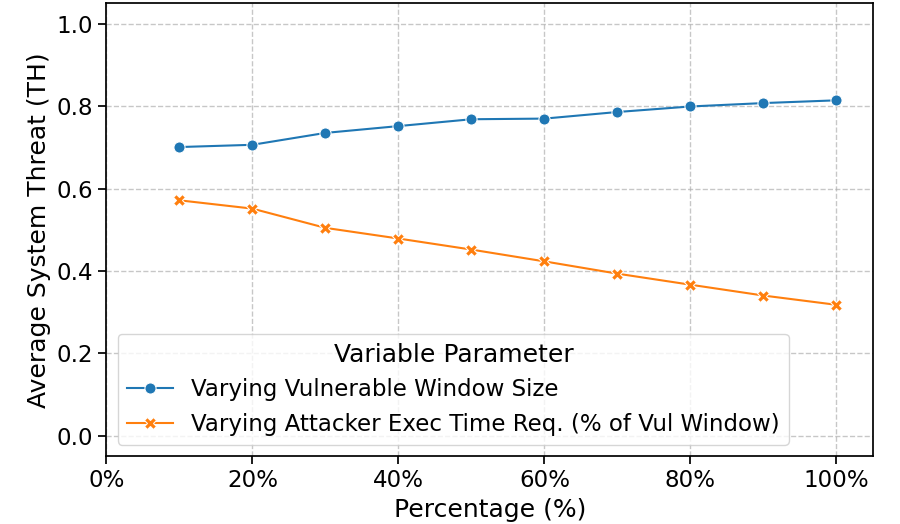
We first investigate how attack parameters affect System Threat using 100 DAG tasks (). We swept two parameters in 10% increments: (1) Vulnerable window size: from 10% to 100% of the victim subtask’s WCET, and (2) Required attacker time: from 10% to 100% of the vulnerable window.
As Fig. 6 shows, System Threat increases with larger vulnerable windows and decreases with longer required attacker execution times. Based on these trends, we fix the vulnerable window at 20% and the required attacker time at 10% for all subsequent experiments.
8.3 Evaluation of Multi-Task Security
We evaluate multi-task systems under federated scheduling. We generated 200 task sets, each containing a random number of DAG s, with total utilization up to 15.0.
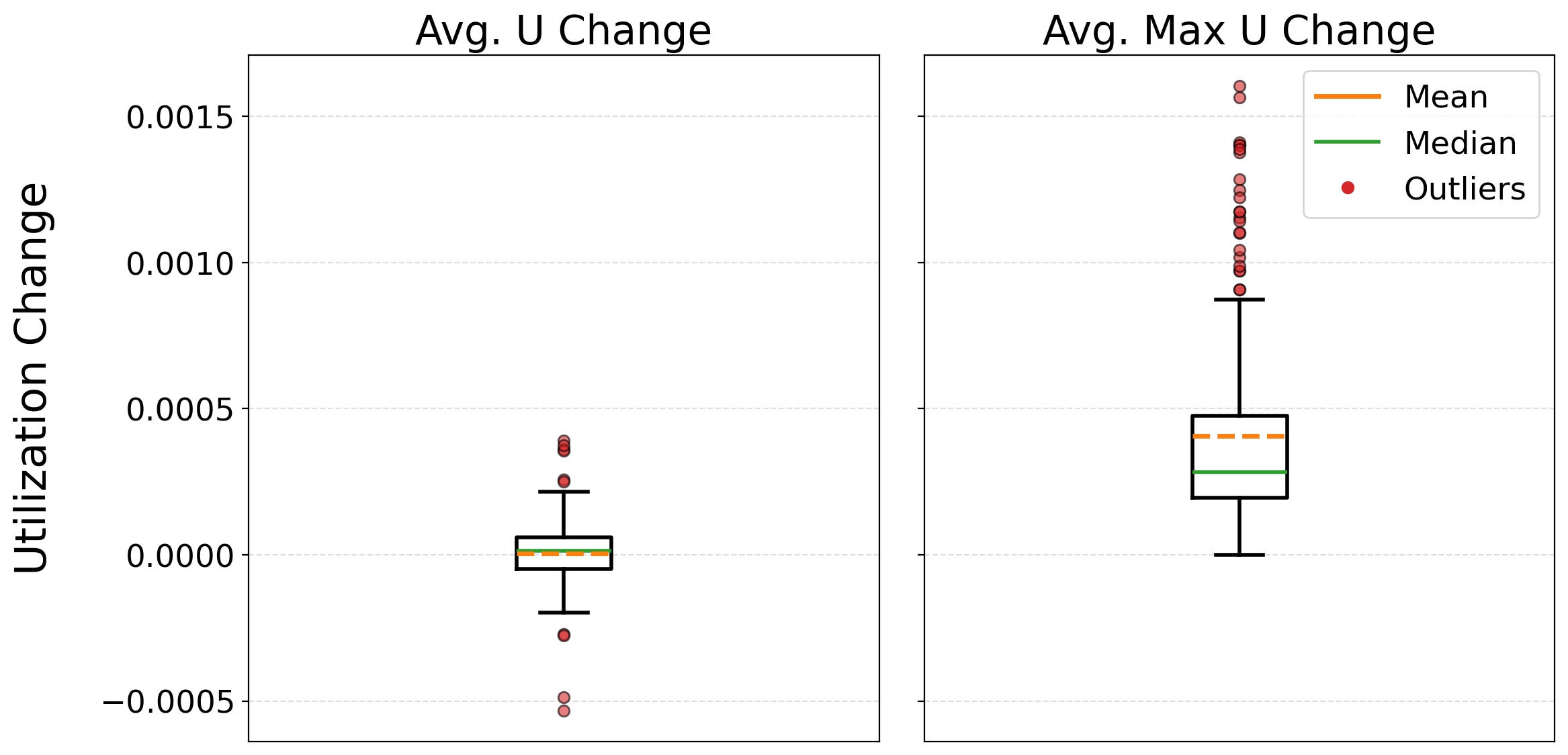
The hyperperiod (the least common multiple of all task periods) can grow very large for random period sets – in ours, the largest exceeds – making full-hyperperiod simulation infeasible. We therefore scale each task set to a bounded hyperperiod chosen from a predefined set of HCN [26]: we select the HCN closest to the original hyperperiod, then for each task replace its period with the divisor of closest to . Subtask WCET s are scaled by , where is the new period assigned to task and the fractional remainders are then redistributed greedily (largest remainder first) to minimize utilization error. Fig. 6 confirms that this scaling introduces negligible utilization distortion even when compressing hyperperiods from down to at most 45,360.
We apply both CDR phases: Schedulability-Constrained Edge Augmentation (Dep. Aug.; Algo. 2) followed by FRESH. Core availability is expressed as a core multiplier , where is the available core count and the minimum satisfying the federated schedulability condition (Eq. (8)); is minimal provisioning and larger indicates more spare capacity. Let denote the fraction of subtasks designated as vulnerable and the fraction of subtasks designated as attackers.
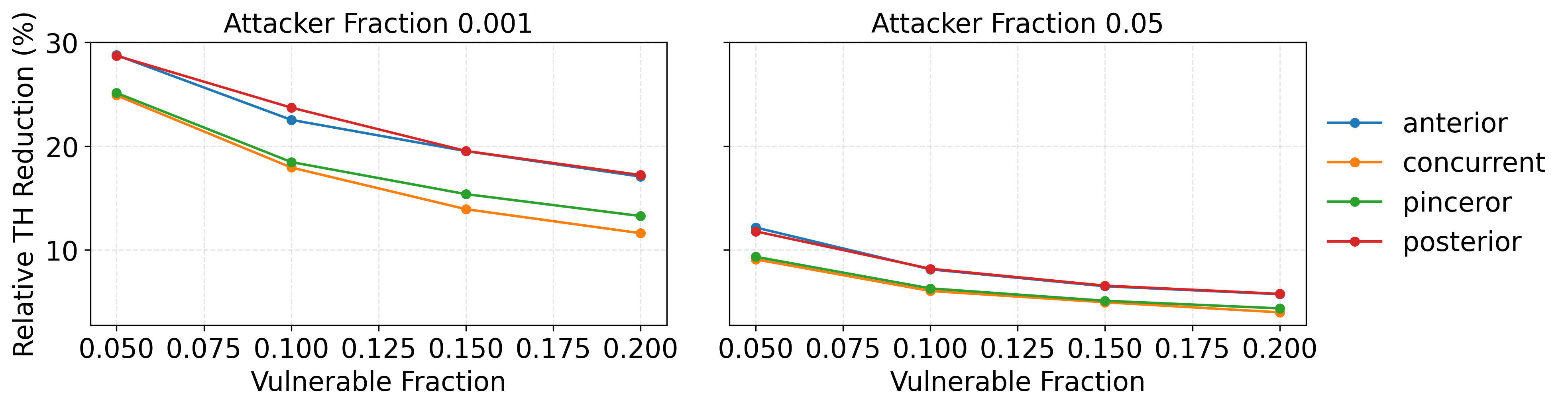

Fig. 8 shows System Threat reduction for varying and : threat decreases consistently across all configurations, with larger reductions when fewer subtasks are vulnerable or when the attacker fraction is small. Fig. 8 (left) plots threat reduction versus the core multiplier . The results exhibit a non-monotonic dependence on : for larger (more aggressive dependency augmentation), threat reduction can decrease as grows from toward before increasing at higher . The right panel of Fig. 8 aggregates threat reduction over all possible attacks for varying values of . Increasing enforces more serialization (reducing exploitable concurrency) but also amplifies non-monotonic behavior, analyzed in Section 8.4.
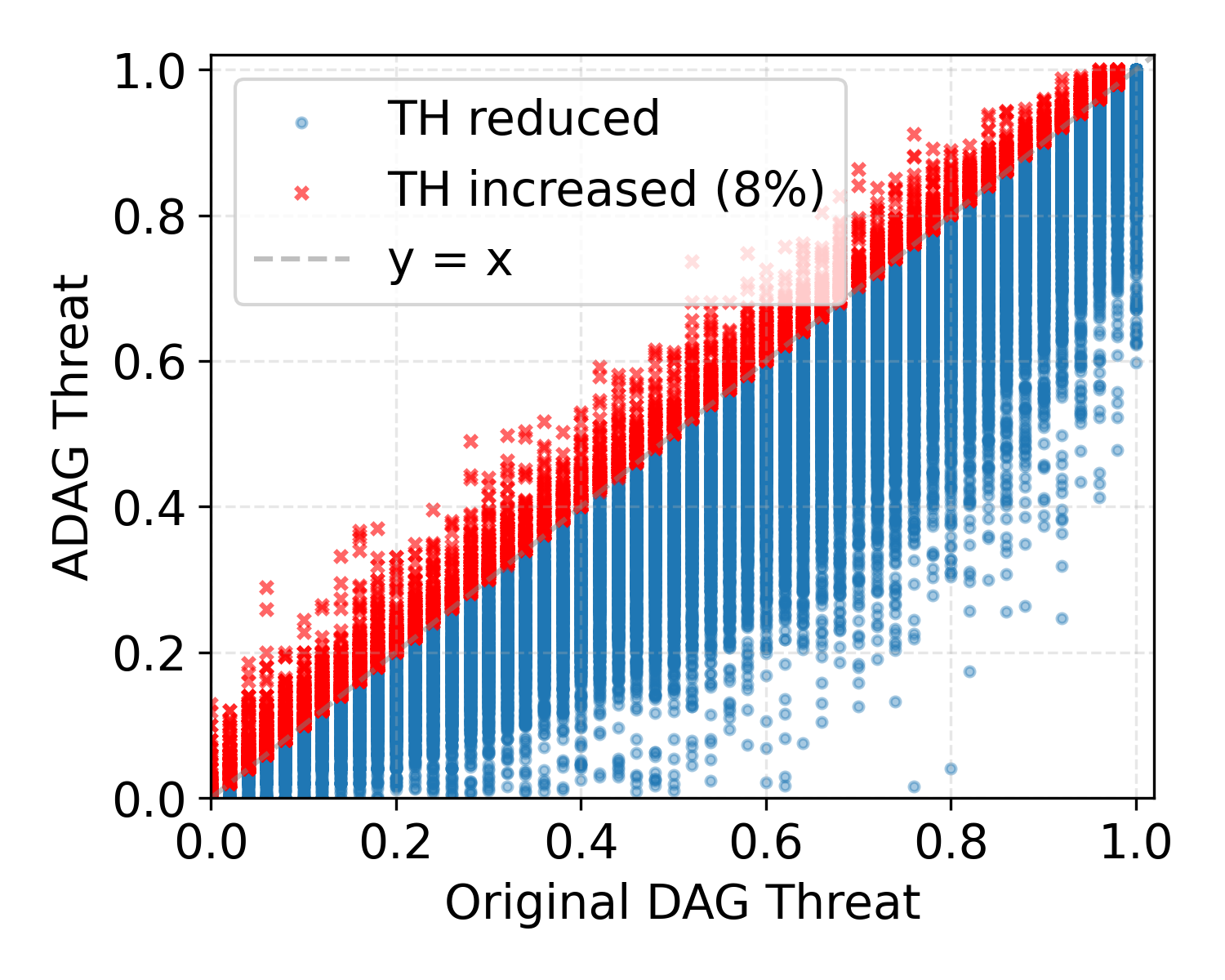
Fig. 9 shows anomalies – cases where the ADAG exhibits higher threat than the original DAG. These (red points) constitute only about 8% of task sets and the increase in threat for each such task is relatively small (the vertical distance of each red dot from is small). This aligns with Nasri et al.’s [25] observation that randomization can open new attack vectors. An offline screening step that retains only the candidate ADAG s not raising threat would mitigate these regressions, a direction we leave for future work.
Entropy Analysis.
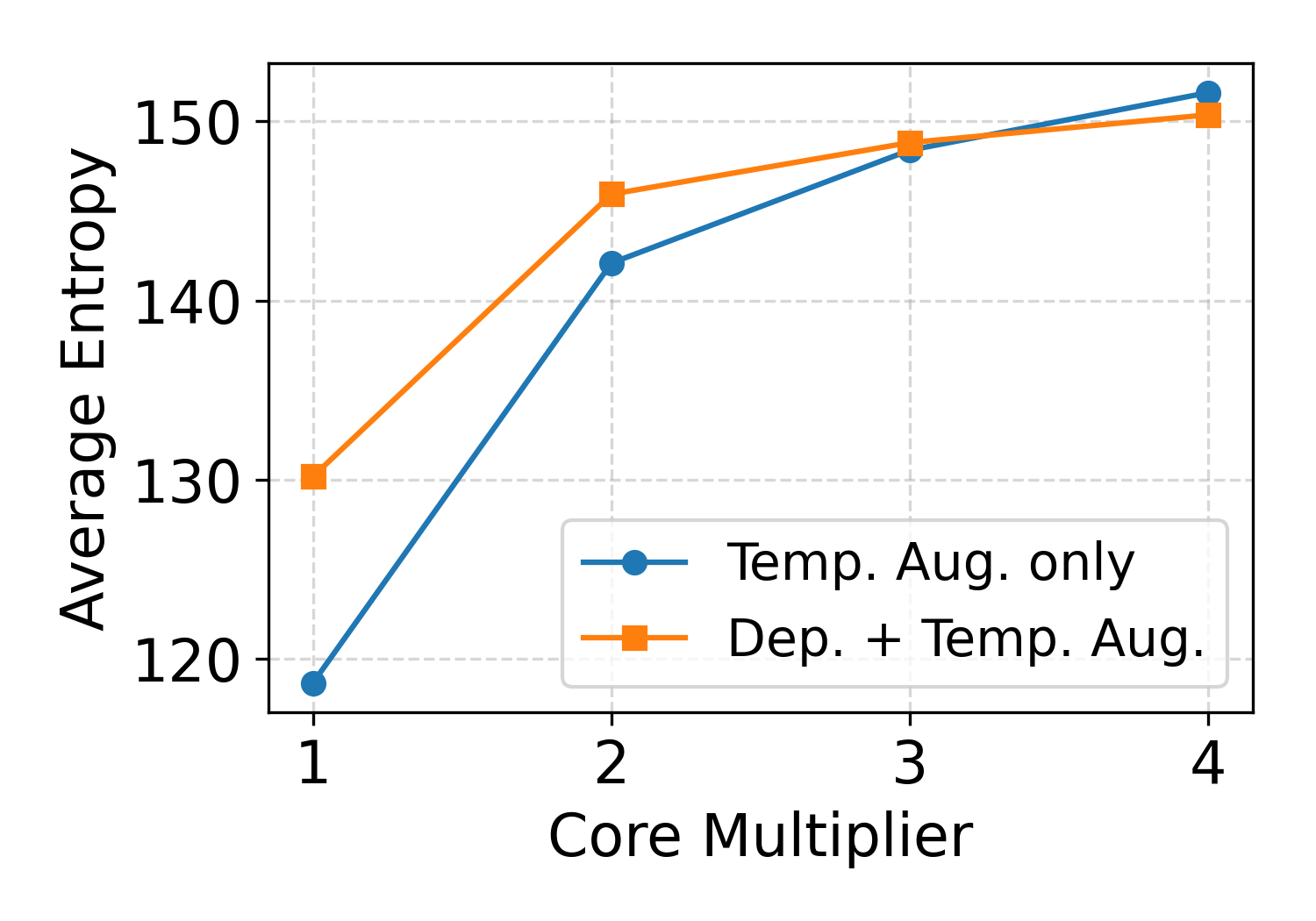
Beyond threat reduction, we assess how CDR affects schedule unpredictability by measuring Task Distribution Entropy. Since Dependency Augmentation inserts edges that serialize previously concurrent subtasks, one might expect it to reduce Task Distribution Entropy by constraining execution orders. To test this, Fig. 11 compares Temporal Augmentation alone with both augmentation phases combined. Both configurations show that average Task Distribution Entropy increases monotonically with core count, as additional slack enlarges the randomization budget. At low to moderate core counts, the combined configuration yields higher entropy than Temporal Augmentation alone. The additional edges shift subtasks to start times that temporal augmentation alone cannot reach, spreading each subtask’s start-time distribution more uniformly across time slots. However, at high core counts (), Temporal Augmentation alone surpasses the combined configuration. When resources are abundant, the extra serialization imposed by dependency edges becomes a constraint rather than a benefit: the large fake subtask budgets already provide sufficient randomization on their own, and the added edges restrict the scheduling freedom that would further increase entropy.
8.4 Analysis of Intrinsic Security via Single-Task Scenarios
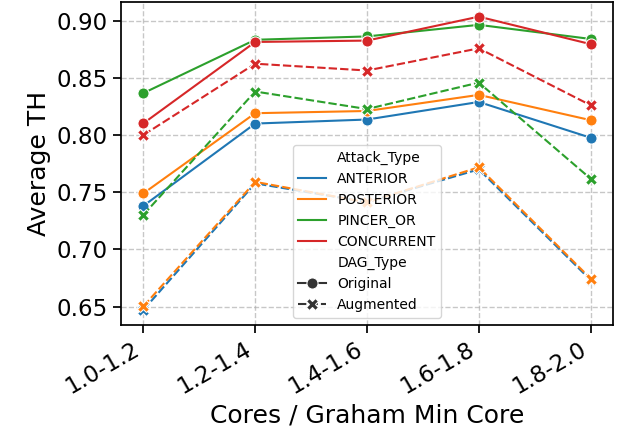
To investigate the non-monotonic behavior observed in multi-task settings, we isolate single-DAG systems, decoupling inter-task attack scenarios from the intrinsic properties of the task graph. We generated 400 DAG tasks with and varied the core multiplier () from 1.0 to 2.0.
Fig. 11 plots System Threat against the core multiplier. Threat follows a reverse-U-shaped curve, highest at intermediate core counts and lowest at the extremes of the core range. Equivalently, threat reduction peaks when the system is either tightly or generously provisioned. This non-monotonic trend reveals that allocating more cores does not necessarily improve security. The counter-intuitive finding stems from two competing effects, which we term intrinsic and extrinsic security:
-
1.
Intrinsic security arises from limited parallelism. Tight core budgets force more sequential execution, reducing attacker–victim overlap. Adding cores increases concurrency and opens more vulnerable windows, eroding this inherent protection.
-
2.
Extrinsic security arises from randomization. The randomization budget grows with the number of cores . At low core counts, even small budgets effectively shift execution windows because parallelism is limited. As increases moderately, the loss of intrinsic security outpaces the randomization gains. At high core counts, the randomization budget becomes large enough to dominate, restoring threat reduction.
These two mechanisms explain the multi-task results (Section 8.3). Dependency edges (Fig. 8) strengthen intrinsic security by enforcing serialization within each DAG, but increased concurrency as core count grows gradually offsets this effect, reproducing the non-monotonic trend. Threat reduction is higher in single-task systems because randomization directly separates attacker–victim windows, whereas independent per-task randomization limits the ability to reduce cross-task overlap.
8.5 Runtime Overhead
Using the 400 DAGs from Section 8.4, this section presents the runtime overhead of ADAG generation, the total time spent by the NPWC scheduler (i.e., scheduling overhead) in making all the scheduling decisions in a period of an ADAG, and its comparison to that of the original DAG. We performed time measurements using the std::chrono::steady_clock (monotonic, nanosecond-resolution) wrapped in Resource Acquisition Is Initialization (RAII) scoped timers around each ADAG generation phase and the NPWC scheduler in our simulator. For this set of experiments, we used a mid-range desktop AMD Ryzen 5 3600 CPU with threads pinned (OMP_PROC_BIND=close, OMP_PLACES=cores). Each point in the plots of Fig. 12 represents the median for 100 trials, with the relative standard error kept below .
We measured (the left subfigure in Fig. 12) the time taken by the three individual phases of ADAG generation: (1) fake-subtask insertion, Algo. 1, (2) Dependency Augmentation, Algo. 2, and (3) Temporal Augmentation under FRESH, Algo. 3. We set the extra edge probability and core multiplier . The total time by all three phases for each release of a DAG has median with a 99th percentile below , dominated by FRESH (median ), then fake-subtask insertion (median ), and the edge augmentation (median at , shrinking sharply as fewer extra edges are added at smaller ). The overhead of ADAG generation thus stays in the few-hundred-microsecond range.
The total overhead of the NPWC scheduler in making all the scheduling decisions (e.g., checking predecessors’ completion, deciding which ready nodes to dispatch for execution) in one period is measured (the middle sub-figure in Fig. 12) for the original DAG, for the ADAG with no dependency augmentation () and also with both temporal and dependency augmentations (). The scheduling overhead of NPWC exhibits no noticeable variation with or without dependency augmentation; the curves for and in the middle subfigure nearly overlap. The difference in overhead for scheduling ADAG in comparison to the original DAG is mainly due to temporal augmentation; however, the absolute per-period total scheduling overhead stays in tens to hundreds of microseconds.
To quantify the additional scheduling overhead relative to the baseline (i.e., unaugmented DAG), we compute the ratio of the scheduling overhead of the ADAG to that of the original DAG, varying the extra-edge probability across core multipliers (right subfigure of Fig. 12). The NPWC scheduler incurs approximately higher overhead when scheduling ADAG s compared to the original DAG across the entire range of . This increase is primarily attributable to the doubling of the number of vertices in the ADAG (i.e., total nodes in an ADAG). The contribution of dependency augmentation is, as discussed above, quite minor.
CDR reduces System Threat in both single- and multi-task systems, at sub-millisecond per-release randomization cost and an approximately scheduler overhead: dependency augmentation provides intrinsic security through serialization, while temporal augmentation provides extrinsic security via randomization. Resource provisioning exhibits a non-obvious trade-off – intermediate core counts may reduce randomization benefits, so systems should be either tightly or generously provisioned. In multi-task environments, per-task randomization alone does not eliminate cross-task leakage through shared microarchitectural resources; combining it with spatial isolation (e.g., cache partitioning or bandwidth throttling) would further strengthen security.
9 Discussion
Integrating into Existing Systems.
CDR is a user-space/compiler-level transformation: the scheduler remains unchanged. At compile time, a source-to-source transform applies Temporal Augmentation (Algo. 1), expanding each subtask into a fake–real pair and encoding candidate dependency edges as conditional synchronization points. At run time, each job release selects random dependency edges (Algo. 2) and invokes FRESH (Algo. 3) to assign random fake-subtask durations – both within the schedulability budget.
Source-to-source compilers that automatically restructure parallel programs are well established. PLuTo [7] generates tiled, OpenMP-annotated parallel code from C loop nests fully automatically. The C3 pre-compiler [8] instruments OpenMP shared-memory programs with barriers and coordination logic for checkpointing – without modifying the underlying runtime. More directly, Ayav et al. [3] formalize fault-tolerance as automatic program transformations on hard real-time periodic tasks, inserting heartbeating and checkpointing commands while formally proving that schedulability is preserved. CDR follows the same paradigm: a compile-time structural transformation that adds a non-functional property – schedule randomization – to real-time tasks while preserving deadline guarantees.
The ADAG model naturally accommodates runtime overheads (e.g., graph traversal, FRESH execution itself). Given a known worst-case overhead per fake subtask, the runtime reduces its active duration to , so each fake subtask’s random duration absorbs the overhead, preserving the schedulability guarantee without additional safety margins. By the same reasoning, even a non-randomized ADAG provides explicit slots for per-subtask overhead, making it a useful model for accounting for general RTS overheads.
Future Work.
Two directions stand out. First, when vulnerable or attacker subtasks are known, heuristics can concentrate the fake-subtask budget on those subtasks for a more targeted defense than uniform randomization. Second, deterministic (non-random) fake-subtask assignments that provably block specific attack vectors while satisfying the schedulability bound could provide a complementary “static defense” alongside the randomized approach.
10 Conclusion
We presented CDR, a scheduler-oblivious framework that randomizes parallel real-time DAG schedules via graph transformation while preserving hard deadline guarantees. The ADAG model is provably sufficient to represent any feasible non-preemptive schedule, and two attacker-aware metrics – System Threat and Task Distribution Entropy– quantify defense against intrusive and observation-based attackers. Experiments show significant vulnerability reductions and reveal that additional cores can erode security by enabling concurrency that outpaces randomization gains, underscoring the need for security-aware resource provisioning in multicore real-time systems.
References
- [1] B. Andersson and J. Jonsson. The utilization bounds of partitioned and pfair static-priority scheduling on multiprocessors are 50%. In 15th Euromicro Conference on Real-Time Systems, 2003. Proceedings., pages 33–40, Porto, Portugal, 2003. IEEE Comput. Soc. doi:10.1109/EMRTS.2003.1212725.
- [2] Abdullah Al Arafat, Zhishan Guo, and Amro Awad. VR-Spy: A Side-Channel Attack on Virtual Key-Logging in VR Headsets. In 2021 IEEE Virtual Reality and 3D User Interfaces (VR), pages 564–572, 2021. doi:10.1109/VR50410.2021.00081.
- [3] Tolga Ayav, Pascal Fradet, and Alain Girault. Implementing fault-tolerance in real-time systems by automatic program transformations. In Proceedings of the 6th ACM & IEEE International Conference on Embedded Software, EMSOFT ’06, pages 205–214, New York, NY, USA, 2006. Association for Computing Machinery. doi:10.1145/1176887.1176917.
- [4] H. Baek and C. M. Kang. Scheduling randomization protocol to improve schedule entropy for multiprocessor real-time systems. Symmetry, 12(5):753, 2020. doi:10.3390/sym12050753.
- [5] S. Baroumand, A. Zaman, and L. Mihaylova. Attack detection and fault-tolerant control of interconnected cyber-physical systems against simultaneous replayed time-delay and false-data injection attacks. Iet Control Theory and Applications, 17(5):527–541, 2022. doi:10.1049/cth2.12393.
- [6] Michael Bechtel and Heechul Yun. Memory-Aware Denial-of-Service Attacks on Shared Cache in Multicore Real-Time Systems. IEEE Transactions on Computers, 71(9):2351–2357, 2022. doi:10.1109/TC.2021.3108044.
- [7] Uday Bondhugula, Albert Hartono, J. Ramanujam, and P. Sadayappan. A practical automatic polyhedral parallelizer and locality optimizer. In Proceedings of the 29th ACM SIGPLAN Conference on Programming Language Design and Implementation, PLDI ’08, pages 101–113, New York, NY, USA, 2008. Association for Computing Machinery. doi:10.1145/1375581.1375595.
- [8] Greg Bronevetsky, Daniel Marques, Keshav Pingali, Peter Szwed, and Martin Schulz. Application-level checkpointing for shared memory programs. SIGPLAN Not., 39(11):235–247, 2004. doi:10.1145/1037187.1024421.
- [9] C. Chen, S. Mohan, R. Pellizzoni, and R. Bobba. On scheduler side-channels in dynamic-priority real-time systems. CoRR, abs/2001.06519, 2020. doi:10.48550/arxiv.2001.06519.
- [10] Chien-Ying Chen, Sibin Mohan, Rodolfo Pellizzoni, Rakesh B. Bobba, and Negar Kiyavash. A Novel Side-Channel in Real-Time Schedulers. In 2019 IEEE Real-Time and Embedded Technology and Applications Symposium (RTAS), pages 90–102, 2019. doi:10.1109/RTAS.2019.00016.
- [11] Jiyang Chen, Tomasz Kloda, Ayoosh Bansal, Rohan Tabish, Chien-Ying Chen, Bo Liu, Sibin Mohan, Marco Caccamo, and Lui Sha. SchedGuard: Protecting against schedule leaks using linux containers. In 2021 IEEE 27th Real-Time and Embedded Technology and Applications Symposium (RTAS), pages 14–26, 2021. doi:10.1109/RTAS52030.2021.00010.
- [12] Matteo Frigo, Charles E. Leiserson, and Keith H. Randall. The implementation of the Cilk-5 multithreaded language. SIGPLAN Not., 33(5):212–223, 1998. doi:10.1145/277652.277725.
- [13] R. L. Graham. Bounds on Multiprocessing Timing Anomalies. SIAM Journal on Applied Mathematics, 17(2):416–429, March 1969. doi:10.1137/0117039.
- [14] Yi Han, Jeffrey Chan, Tansu Alpcan, and Christopher Leckie. Using Virtual Machine Allocation Policies to Defend against Co-Resident Attacks in Cloud Computing. IEEE Transactions on Dependable and Secure Computing, 14(1):95–108, 2017. doi:10.1109/TDSC.2015.2429132.
- [15] Qingqiang He, Nan Guan, Mingsong Lv, Xu Jiang, and Wanli Chang. Bounding the Response Time of DAG Tasks Using Long Paths. In 2022 IEEE Real-Time Systems Symposium (RTSS), pages 474–486, 2022. doi:10.1109/RTSS55097.2022.00047.
- [16] Nahid Juma, Jonathan Shahen, Khalid Bijon, and Mahesh Tripunitara. The Overhead from Combating Side-Channels in Cloud Systems Using VM-Scheduling. IEEE Transactions on Dependable and Secure Computing, 17(2):422–435, 2020. doi:10.1109/TDSC.2018.2790932.
- [17] Auguste Kerckhoffs. La cryptographie militaire. J. des Sci. Militaires, 9:161–191, 1883.
- [18] Jing Li, Jian Jia Chen, Kunal Agrawal, Chenyang Lu, Chris Gill, and Abusayeed Saifullah. Analysis of Federated and Global Scheduling for Parallel Real-Time Tasks. In 2014 26th Euromicro Conference on Real-Time Systems, pages 85–96, 2014. doi:10.1109/ECRTS.2014.23.
- [19] S. Liu and W. Yi. Task parameters analysis in schedule-based timing side-channel attack. IEEE access : practical innovations, open solutions, 8:157103–157115, 2020. doi:10.1109/access.2020.3019323.
- [20] J. M. López, J. L. Díaz, and D. F. García. Utilization Bounds for EDF Scheduling on Real-Time Multiprocessor Systems. Real-Time Systems, 28(1):39–68, 2004. doi:10.1023/B:TIME.0000033378.56741.14.
- [21] Makoto Matsumoto and Takuji Nishimura. Mersenne twister: A 623-dimensionally equidistributed uniform pseudo-random number generator. ACM Trans. Model. Comput. Simul., 8(1):3–30, 1998. doi:10.1145/272991.272995.
- [22] Alessandra Melani, Marko Bertogna, Vincenzo Bonifaci, Alberto Marchetti-Spaccamela, and Giorgio C. Buttazzo. Response-Time Analysis of Conditional DAG Tasks in Multiprocessor Systems. In 2015 27th Euromicro Conference on Real-Time Systems, pages 211–221, Lund, Sweden, July 2015. IEEE. doi:10.1109/ECRTS.2015.26.
- [23] Piyoosh Purushothaman Nair, Arnab Sarkar, and Santosh Biswas. Fault-Tolerant Real-Time Fair Scheduling on Multiprocessor Systems with Cold-Standby. IEEE Transactions on Dependable and Secure Computing, 18(4):1718–1732, 2021. doi:10.1109/TDSC.2019.2934098.
- [24] Girija J. Narlikar. Scheduling threads for low space requirement and good locality. In Proceedings of the Eleventh Annual ACM Symposium on Parallel Algorithms and Architectures, SPAA ’99, pages 83–95, New York, NY, USA, June 1999. Association for Computing Machinery. doi:10.1145/305619.305629.
- [25] Mitra Nasri, Thidapat Chantem, Gedare Bloom, and Ryan M. Gerdes. On the Pitfalls and Vulnerabilities of Schedule Randomization Against Schedule-Based Attacks. In 2019 IEEE Real-Time and Embedded Technology and Applications Symposium (RTAS), pages 103–116, 2019. doi:10.1109/RTAS.2019.00017.
- [26] S. Ramanujan. Highly Composite Numbers. Proceedings of the London Mathematical Society, s2_14(1):347–409, 1915. doi:10.1112/plms/s2_14.1.347.
- [27] Beheshteh Raouf and Seyedamirabbas Mousavian. False data injection to conceal load-altering attacks via electric vehicles. Sustainable Energy, Grids and Networks, 42:101640, 2025. doi:10.1016/j.segan.2025.101640.
- [28] Jiankang Ren, Zheng Wang, Chi Lin, Mohammad S. Obaidat, Hongrui Xie, Haihui Zhu, Chunxiao Liu, Kaiwen Wang, and Guozhen Tan. REORDER++: Enhanced Randomized Real-Time Scheduling Strategy Against Side-Channel Attacks. IEEE Transactions on Network Science and Engineering, 10(6):3253–3266, 2023. doi:10.1109/TNSE.2023.3254653.
- [29] Maria A. Serrano, Alessandra Melani, Roberto Vargas, Andrea Marongiu, Marko Bertogna, and Eduardo Quiñones. Timing characterization of OpenMP4 tasking model. In 2015 International Conference on Compilers, Architecture and Synthesis for Embedded Systems (CASES), pages 157–166, 2015. doi:10.1109/CASES.2015.7324556.
- [30] C. E. Shannon. A mathematical theory of communication. The Bell System Technical Journal, 27(3):379–423, 1948. doi:10.1002/j.1538-7305.1948.tb01338.x.
- [31] Y. Song, X. Liu, Z. Li, M. Shahidehpour, and Z. Li. Intelligent data attacks against power systems using incomplete network information: A review. Journal of Modern Power Systems and Clean Energy, 6(4):630–641, 2018. doi:10.1007/s40565-018-0427-z.
- [32] David Trilla, Carles Hernandez, Jaume Abella, and Francisco J. Cazorla. Cache Side-Channel Attacks and Time-Predictability in High-Performance Critical Real-Time Systems. In 2018 55th ACM/ESDA/IEEE Design Automation Conference (DAC), pages 1–6, 2018. doi:10.1109/DAC.2018.8465919.
- [33] Nils Vreman, Richard Pates, Kristin Krüger, Gerhard Fohler, and Martina Maggio. Minimizing Side-Channel Attack Vulnerability via Schedule Randomization. In 2019 IEEE 58th Conference on Decision and Control (CDC), pages 2928–2933, 2019. doi:10.1109/CDC40024.2019.9030144.
- [34] David Ward, Ireri Ibarra, and Alastair Ruddle. Threat Analysis and Risk Assessment in Automotive Cyber Security. SAE International Journal of Passenger Cars - Electronic and Electrical Systems, 6(2):507–513, August 2013. doi:10.4271/2013-01-1415.
- [35] Man-Ki Yoon, Jung-Eun Kim, Richard Bradford, and Zhong Shao. TaskShuffler++: Real-Time Schedule Randomization for Reducing Worst-Case Vulnerability to Timing Inference Attacks. doi:10.48550/arXiv.1911.07726.
- [36] Man-Ki Yoon, Sibin Mohan, Chien-Ying Chen, and Lui Sha. TaskShuffler: A Schedule Randomization Protocol for Obfuscation against Timing Inference Attacks in Real-Time Systems. In 2016 IEEE Real-Time and Embedded Technology and Applications Symposium (RTAS), pages 1–12, 2016. doi:10.1109/RTAS.2016.7461362.
- [37] Ruochi Zhang and Parv Venkitasubramaniam. Stealthy Control Signal Attacks in Linear Quadratic Gaussian Control Systems: Detectability Reward Tradeoff. IEEE Transactions on Information Forensics and Security, 12(7):1555–1570, 2017. doi:10.1109/TIFS.2017.2668220.