A Postcard from Mars: Exploring Interplanetary Communications in Virtual Reality

Abstract
In this paper we present an Immersive Speculative Enactment focused on the theme of interplanetary communications. These are a novel approach extending conventional Speculative Enactments to Virtual Reality. We created a narrative-based scenario in which participants played the role of human colonists on either Mars or the Moon, to explore a possible future in which interplanetary communication becomes a necessity. To enact this scenario, we created a VR interactive experience to elicit feedback on the idea of communicating across planets. Through an exploratory qualitative analysis of this immersive enactment, we found that while the future envisioned was seen as too distant to prompt realistic behaviour from all participants, the enactment helped us and the participants to reflect on the experience. We discuss these findings, drawing potential implications for the improvement of the feeling of “really being there” even in implausible situations and further contribute reflections on the role of ISEs in space-related scenarios.
Keywords and phrases:
Immersive Speculative Enactments, Interplanetary Communications, Virtual RealityCopyright and License:
![[Uncaptioned image]](x1.png) © Adalberto L. Simeone; licensed under Creative Commons License CC-BY 4.0
© Adalberto L. Simeone; licensed under Creative Commons License CC-BY 4.0
2012 ACM Subject Classification:
Human-centered computing Virtual realityEditors:
Leonie Bensch, Tommy Nilsson, Martin Nisser, Pat Pataranutaporn, Albrecht Schmidt, and Valentina SuminiSeries and Publisher:
 Open Access Series in Informatics, Schloss Dagstuhl – Leibniz-Zentrum für Informatik
1 Introduction
In HCI, the concept of “Possible Futures” [19] has gained attention, the idea that a research artifact exists within a set of exact circumstances, that might deviate from the effective state it will be in, once deployed in its context of use. The more distant this future is, the greater the “cone of possibilities”.
If we adopt a positive view of humanity’s future, decades or centuries from now if we assume that humans will have been able to establish a permanent or semi-permanent presence in the Solar System, we will have a variety of new interaction challenges that so far have only been explored by science-fiction. One of these is the communication delay across interplanetary distances due to inescapable physical limitations. Even across the relatively “small” distances (on a galactic scale) of our Solar System, a signal needs to travel at the speed of light from the Earth between five and twenty minutes each way to reach the planet Mars (the time varies depending on the relative distances between the two planets). This problem has been notably popularised by books and live action films or show like The Martian (2015) or The Expanse (2015) and many others, where protagonists have to plan around the delay in communications.
Compared to instant messaging here on Earth, across interplanetary distances it will become impossible to hold real-time conversations. This poses a considerable strain in how communication between people happens. Nonetheless, it represents an interaction challenge that people in the future will need to address.
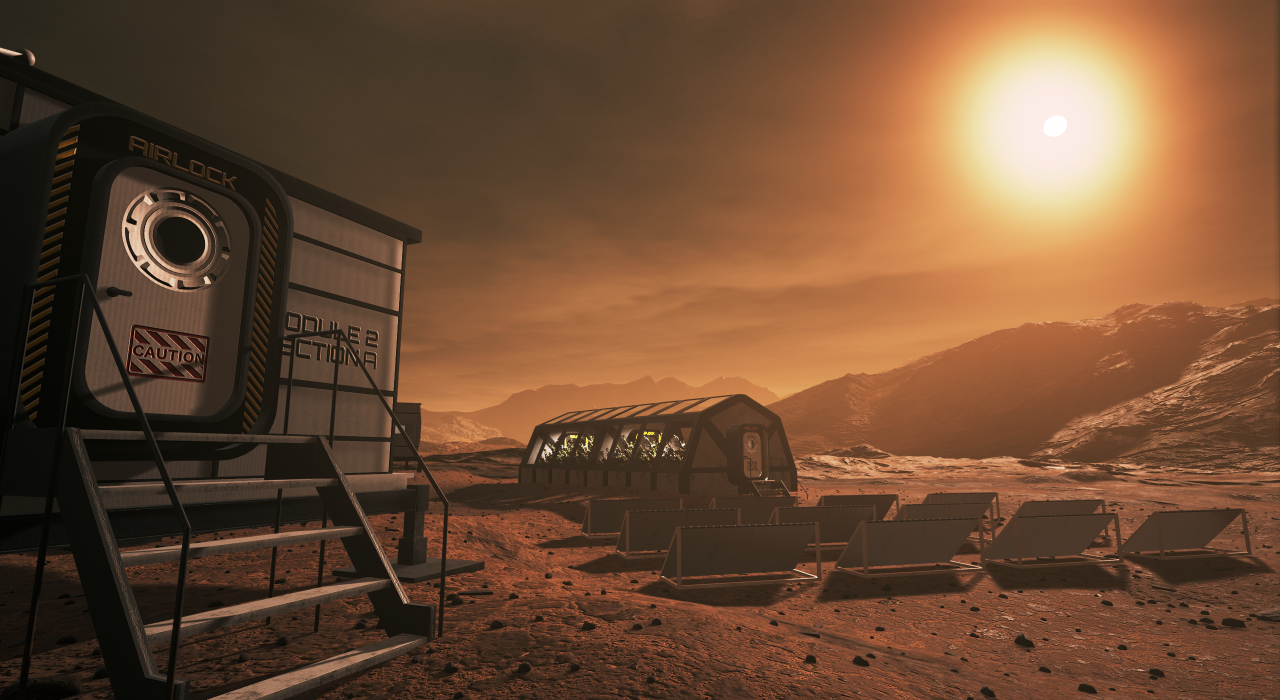
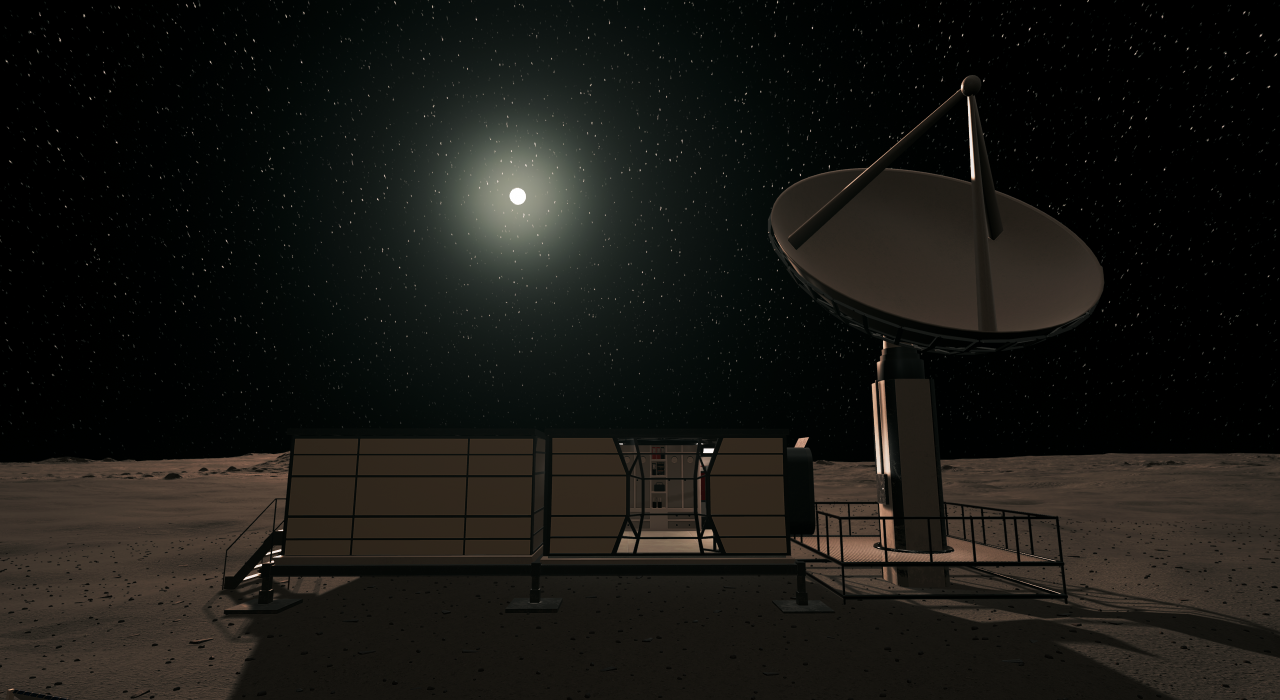
To investigate how this delay would affect user behaviour and draw insights on the design of such far-future interaction scenario using VR, we developed an immersive “enactment” of a scenario, based on a methodology we proposed et al. [20]. Immersive Speculative Enactments (ISE) are exploratory user studies in which participants are immersed in a Virtual Environment (VE) depicting a possible future, in this case one where an extra-terrestrial outpost exists. Participants of the ISE were required to perform a task given to them by the “Mission Control” on Earth, and report back on the outcome. We experimentally manipulated the duration of the time delay by having one group of participants perform the task in a Martian outpost (see Figure 1) where a message required a round-trip of at least ten minutes of real time (which, for practical purposes, was based on when the two planets are at their closest distance). A second group experienced the same scenario but set in a Lunar outpost (see Figure 2) where the delay was more negligible, less than a four second round-trip.
Finally, we report the qualitative results of a thematic analysis based on the enacting of the Interplanetary Communications ISE. The behaviour users exhibited differed from what they imagined would do in a real-life situation. The main factors point towards the VR experience lacking a sense of “urgency” and to the VR system not providing consequences for their interactions. We thus discuss this and other themes emerged from our analysis and the implications they might have for designers of immersive VR experiences and enactments.
2 Related Work
Here, we give an overview of relevant related work, discussing speculative approaches, along with how other works have studied the intersection of HCI and space technologies.
2.1 Immersive Speculative Enactments
ISEs [20], a methodology originating from other non-immersive HCI speculative methods. The aim of ISEs is to use the results of the analysis of the user from these VR studies to provide insights that can potentially be applied in the real-world and to stimulate discussion on these topics.
Conventional speculative methods include Design Fictions [3] are a method that consists in describing a possible future or artefact, and using this opportunity for subsequent reflection. User Enactments [18] represent a more hands-on approach in which the possible future is enacted in the real-world. In Speculative Enactments, use speculative methods and real actors to engage participants in reflecting about a fictional artefact or scenario in the real-world. ISEs combine these methods but use VR to provide a realistic representation of the possible future the experimenters had in mind. This approach benefits the limitless potential of VR in allowing participants to experience a vivid recreation of the speculative scenario, but also “locks in” the imagined future to how the experimenters designed it, whereas in other conventional methods user imagination can play a bigger role.
2.2 HCI in Space
The intersection of HCI practices and their application in the domain of space exploration constitutes a nascent trend. With the increase of the capabilities provided by contemporary VR headsets, a number of studies have sought to explore how VR can be used for this purpose. Nilsson et al. [16] also used VR to simulate a lunar lander and involved astronauts and other related professionals to critically evaluate the design choices, in a simulated lunar environment. Their results align with the ones we obtained through this ISE, in identifying the limitations of the level of immersion provided by VR. In a related study [7], the use of physical gloves to enhance the believability of the simulation was also evaluated, showing positive effects on presence. Using more conventional means, Freitas et al. [11] developed Conversational User Interfaces to support astronauts operating in extraterrestrial habitats, using a Wizard of Oz to provide guidelines for such systems. In [27], Vanderdonckt et al. investigated the suitability of existing interaction design frameworks for application in extra-terrestrial settings, suggesting future research to take a greater focus on the analysis of these themes.
3 Design of the Outpost
The extra-terrestrial outposts were designed using the Unreal Engine. They consist of an exterior area with a hydroponic module, a solar panel array, a communication dish, and the main habitat (see Figure 1). The difference between the Lunar and Martian outpost is the appearance of the exterior terrain. The Martian environment was based on an asset pack purchased from the Unreal Engine Marketplace, “Mars Landscape”111Mars Landscape: https://www.fab.com/listings/2aabc0be-3ec2-49cb-afd3-e598b47e1019. From it, we also derived a similar landscape material to depict the appearance of the Lunar regolith. The two VEs are essentially identical, save for the appearance of the terrain. Mountains were added in the background of the Martian environment for aesthetic purposes and were not generated from the terrain data.
3.1 The Habitat
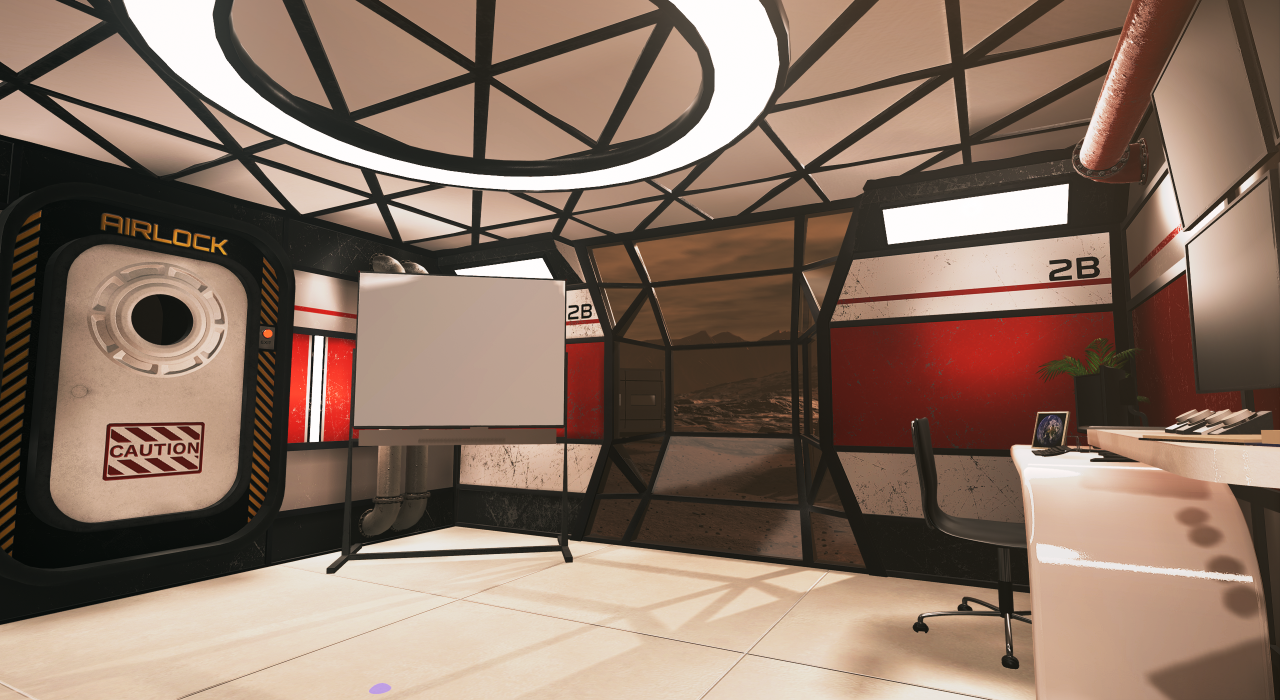
The design of the interior habitat (see Figure 3) was inspired by a NASA-sponsored 3D Printed Habitat competition ran in partnership with “America Makes”. The goal of the challenge was to design habitats that could be built using 3D printers which would use local materials or even a mission‘s waste products. It must be noted that designs for deep space habitats are often envisioned as cylindrical. However, to utilise the space available in our VR lab to its fullest extent, we decided to model the room in 1:1 scale with the physical bounds where the ISE would take place, a room of . Although the presence of a glass wall showing the exterior might not be realistic for an habitat built with today’s knowledge, we decided that seeing the planet’s exterior might reinforce the illusion of being there.
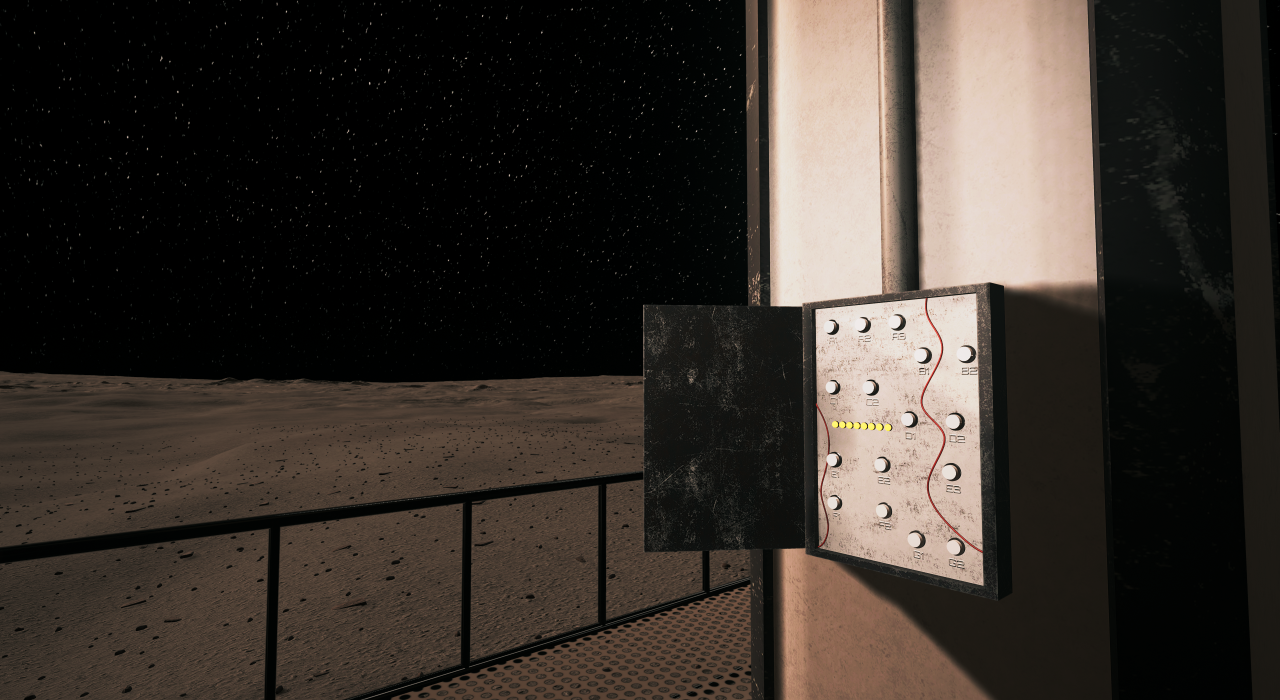
Transition to the exterior was handled by touching a button placed next to the airlock. This would trigger a teleportation to the exterior area. In order to reuse the physical space, users found themselves rotated after the teleportation. This allowed us to reuse the physical area for the exterior. This area, delimited with railings, contained the manual override panel to control the communication dish’s orientation – the objective of the task (see Figure 5). Once outside, the user’s view was modified to give the semblance of wearing a helmet, but due to time and resource constraints we did not implement a realistic airlock transition nor suit-wearing interactive behaviour.
3.2 Interaction and Speculation
Where conventional enactments use materials such as short videos, in-person events, brochures, etc. to prompt the speculation [8], the immersive analogue consisted in a sandbox VE. The VE, through its graphical design, reinforces the boundaries of the enactment, while the interactive elements of the VE allow the users to express themselves and improvise their reaction. These elements together provide the lens through which we can observe a glimpse of their speculative behaviour in such a situation.
Since the time spent by users who decided to engage with the task would represent only a minor proportion of the total immersion time, we brainstormed about what kind of activities a prospective space colonist would be interested in doing, while waiting from a reply from Earth. The design of the environment had to support the open-ended nature of the enactment. While the narrative suggested a “mission” the user had to complete, they remain free to completely disregard it.
For the design of the interactive aspects, We were inspired by contemporary science-fiction games such as Deus Ex: Human Revolution or Prey (2017), which portray sequences in otherwise ordinary environments. For example, the initial “fake” apartment of the protagonist in Prey, or Adam Jensen’s or V’s apartments in Deus Ex or Cyberpunk 2077. With some notable exceptions, these do not usually provide the player with major gameplay activities or puzzles, but rather they provide contextually appropriate interactive elements that players would expect to find in such settings. For example, food items, reading materials, watching the TV, checking the mail on a computer, taking a shower, etc.
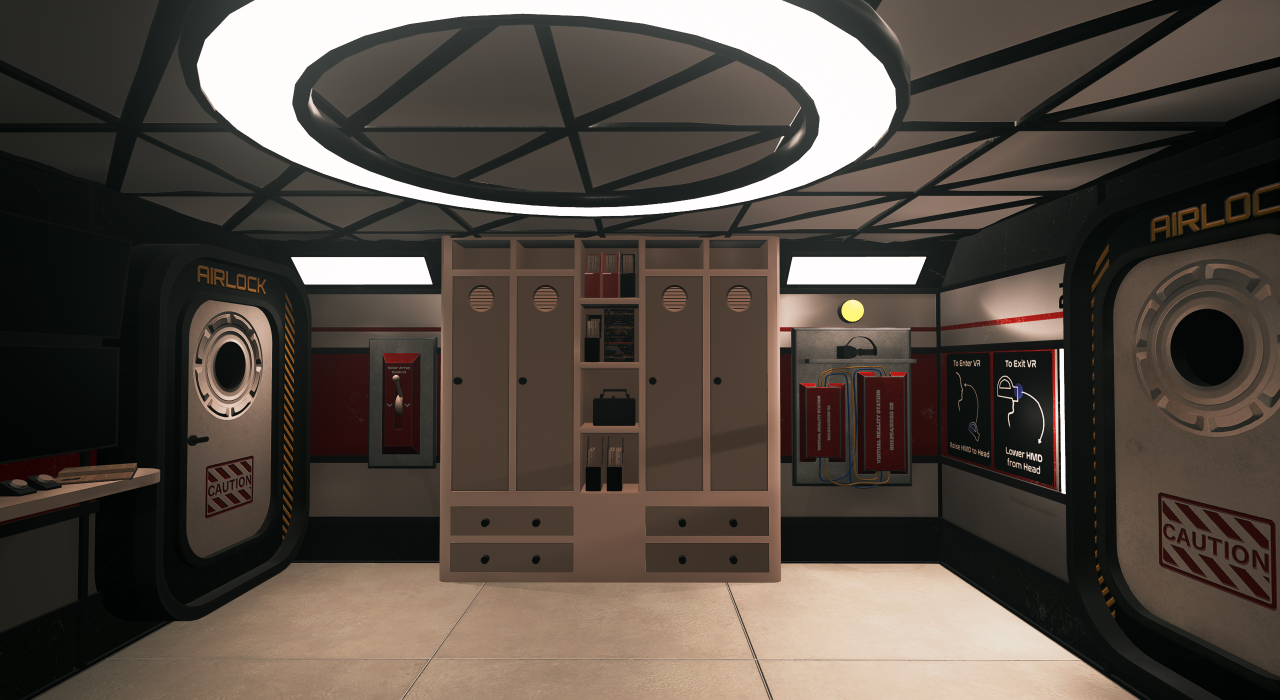
Similarly, we added several interactive objects that could be manipulated via the natural interaction metaphors [15] commonly found in VR games that leverage the availability of 6-DOF controllers. Thus, small objects were not static, but could be grabbed by the user and used to interact with the environment (e.g., a pen to write on the whiteboard) or inspected more closely (e.g., an ebook reader, a tablet with instructions on the task). The environment also presented various other interactive objects such as: a music player, drawers that could be opened by grabbing the handle and pulling towards oneself, screens that could be switched on and off, reporting readings from the nearby hydroponics farm (which was inaccessible) and solar panel array (see Figure 3-4).
3.3 The Scenario: Mission to Mars (and to the Moon)
The scenario depicted in the ISE had users play the role of colonists on another planet. The experience was purposely set in the hypothesised early stages of human space exploration. Participants were not intended to represent the “first humans” on Mars nor the the first to return to the Moon after the 20th century. In the scenario, it is assumed that a (semi-) permanent presence on either Mars or the Moon has been established and that some initial infrastructure has been built as well.
We created a plausible backstory that we relayed to each participant before starting the experiment. Participants play the role of technical staff being sent to perform routine maintenance to an automated outpost. A distinction between an imagined larger settlement and a more isolated outpost was made in order to explain why participants would find themselves alone in this location.
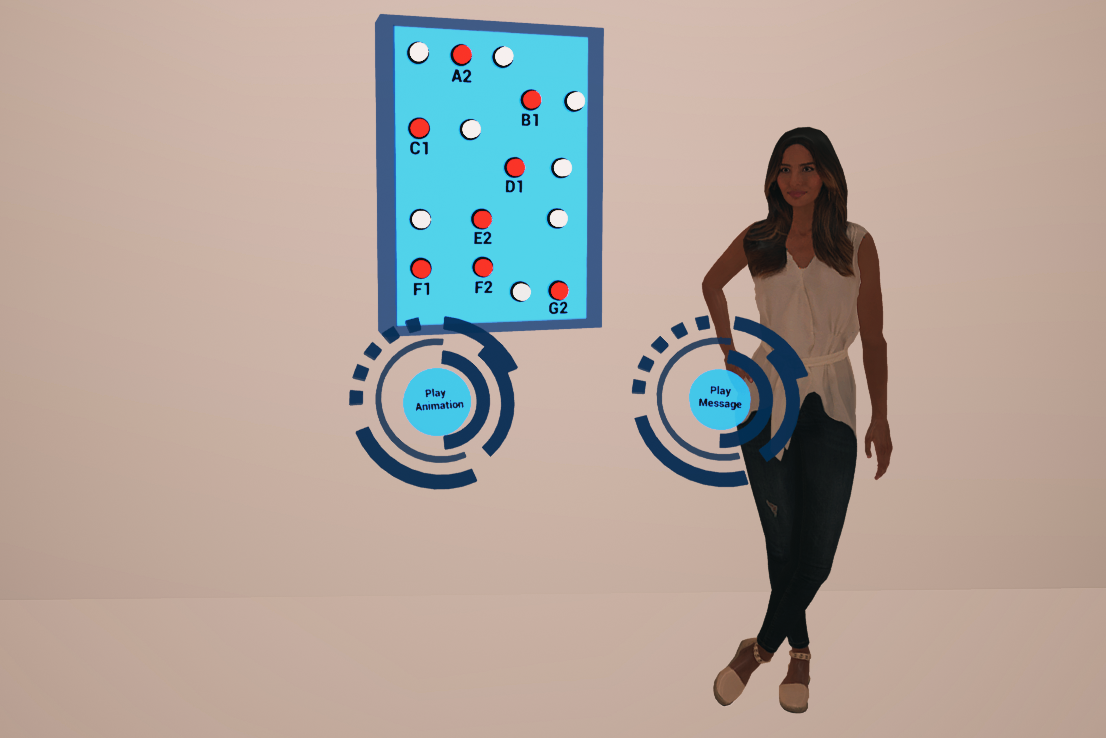
The VR experience begins inside the habitat. After one minute in the VE, a notification of an incoming message will be shown on the screens (Figure 3). The message urges the participant to walk towards the “VR Communication station” (Figure 4) and use the headset provided. This additional “virtual” VR system provides a VR-in-VR experience, where they will be able to play the message back, and eventually reply. The motivations behind the choice of using a second layer of VR are discussed successively. The message instructs the participant to go outside and operate the manual override of the external communication dish’s control panel (see Figure 5). The mission control on Earth requires this to be done in order to correct the course for an incoming delivery on the surface of the planet. The message contains an animation of a sequence of buttons they need to press on the device’s control panel located outside, in order to re-orient it. It also informs them that a reference of this information can be found on a (virtual) tablet located on one of the desks, which they can pick up to remind themselves of the correct sequence.
Once outside, they can open the panel by holding the trigger and performing a pulling motion with the controller. They can press the buttons by colliding the controller with each one. By entering the correct sequence, the dish will rotate to the needed position. A series of coloured LEDs informs the user whether the sequence they have entered is correct or wrong, in which case it resets and they can try again. After performing the task, participants are instructed to return inside, send a response through the VR-in-VR system, and then wait to receive a confirmation back. In the Lunar environment this confirmation arrives almost instantaneously, whereas in the Martian environment the communication was artificially delayed until 10 minutes had elapsed. This duration was chosen to simulate a situation in which the two planets were relatively close, to keep the duration of the experiment manageable.
3.4 VR Communication System
We opted for this solution for two reasons, one practical and one design-oriented. Firstly, because the only actual example of communication between parties located on different celestial bodies is represented by the Apollo radio exchange. In hard science-fiction media (that is, media that attempts to maintain a degree of scientific realism – such as in The Expanse books and TV show, as opposed to the Star Wars universe), the thopos of interplanetary (or even interstellar) communication is represented by asynchronous video message fragments that are recorded at one end, then sent to the receiving end. Due to the lack of resources necessary to hire professional actors to record the messages originating from Earth, we considered this alternative.
We considered the feasibility of such a VR communication system based on current technological capabilities. For instance, NASA’s Curiosity rover can establish a direct link with Earth at a rate of 32kB/s. When routing data through the Mars Reconnaissance Orbiter, transmission speeds can reach up to 2MB/s, whereas the Odyssey orbiter supports rates ranging from 128kB/s to 2MB/s. However, these connections are constrained by power availability and orbital alignments, limiting the transmission window to just eight minutes per Martian sol. The Mars Reconnaissance Orbiter then forwards data to Earth at a maximum rate of 750kB/s.
Given these constraints, the direct streaming of audiovisual data from Mars to Earth would likely be impractical in the early stages of human colonisation, particularly for non-essential communication. The establishment of a deep space Interplanetary Internet might alleviate this problem [1]. Transmitting short encoded messages, which would then be interpreted and reconstructed locally through the help of an embodied or conversational user interface might feel more “natural” for the user, as also investigate dby Goncalves et al. [11].
In our implementation we assume that the outpost provides such an “AI” system. Upon receiving a message from Earth, the AI, personified by a three-dimensional avatar (see Figure 6) can voice it and thus relay any instruction to the user of the VR station. This introduces an additional VR system in the VR experience itself (a similar approach was used as a metaphor for a VR transition technique [17]). Participants can “log into” this VR-in-VR system by walking towards the VR station, grabbing the virtual headset and moving it towards their head. They can remove it by performing a similar, but inverted, motion. The VR station is shown to the right side of Figure 4, under the green light. Once in the system, a 3D User interface allows the user to interact with the local “AI” who reports the received message and communicates it through synthesised speech recordings.
Although the data rate will be less of a problem in Earth-Moon transmission, to provide similar conditions across the two scenarios, the VR-in-VR system is also present in the Moon scenario.
4 User Study
The main aim of the study was to enact a VR scenario that prompted participants to confront themselves with the idea of inhabiting planets other than earth, and encountering delayed interplanetary communications. By enacting this scenario, we wanted to explore, from a qualitative perspective, this novel speculative approach, and understand whether the overall scenario and the duration in the delay between communications would affect our participants’ behaviour. To achieve these aims, we designed the narrative-driven VR scenario previously described. We ran a between-groups test in which the independent variable was the delay duration, and thus either the Martian or Lunar environment.
4.1 Participants
We recruited 26 volunteer participants (19 Male, 7 Female; ) randomly assigned to one of the two groups (13 in the Martian environment, 13 on the Moon). They were asked to rate their average experience with VR technologies on a scale from 1 (use VR rarely) to 7 (use VR multiple times per week), with a mean self-reported rating of .
4.2 Task and Procedure
The study protocol was reviewed and approved by our University‘s Ethics Review board. Participants were instructed that they would receive a communication from Earth asking them to perform an activity outside. We told them that they were free to act as they wished. We added a maximum time-limit of 20 minutes after receiving the first message, in the event that participants refused or were not able to complete the task as described. However, this limit was never reached and every participant was able to finish the task.
To avoid the so-called “wow factor” experienced by people being immersed in VR for the first time, participants were first required to undergo a tutorial session instructing them on how to interact with the objects, how to move, and how to open doors. The assumption is that, were they actually in that situation, they would not be unfamiliar with the equipment present therein. After completing this tutorial, the actual experiment begins and was then concluded after receiving confirmation from Earth in the Martian scenario, or after spending a further ten minutes in the Moon scenario, in order to have a comparable duration between the two conditions.
4.3 Measures
We recorded each participant’s first-person interactions in VR. Explicit consent for the treatment and use of the video and audio recordings was collected. After the conclusion of the experiment, participants were required to fill-in two questionnaires: the Slater-Usoh-Steed Presence questionnaires [25] and Kennedy’s Simulator Sickness questionnaire [13]. Successively, we conducted semi-scripted interviews with the participants based on the following list of topics, and asked further clarifications where necessary.
-
1.
Their experience of the VR-in-VR system.
-
2.
Their behaviour in VR.
-
3.
Whether they felt present in VR.
-
4.
How they felt emotionally while performing the task.
-
5.
Whether they would behaved differently if the scenario were actually real.
5 Questionnaire Results
The results of the questionnaire scores were analysed using the Mann-Whitney U Test. The semi-scripted interviews were analysed through a thematic analysis [5] and are discussed in the following section.
The results of Kennedy’s SSQ showed that there were no significant differences between the two environments on the total score . The average SSQ score for participants in the Martian environment was , whereas in the Lunar environment it was , out of a maximum possible score of 300. There were no significant differences in terms of self-reported Presence ratings between the two environments , computed as the sum of response indicating a score of 6 or 7 scores on six total questions.
6 Thematic Analysis
We transcribed all the interviews and generated a document consisting of 224 question and answer pairs. We then performed an inductive Thematic Analysis [5] on the data. In a first iteration we assigned codes to each unit of data, obtaining a total of 12 codes. In the second iteration, the codes annotated so far were further elaborated to understand the reasons that led participants to behave in the way they did and their overall experience within the ISE.
Through this analysis we identified four main themes: 1) Presence; 2) Sense of Urgency; 3) Hypothesised Real-Life Behaviour; 4) Interplanetary Communications.
6.1 Theme 1: Presence
This theme focuses on the inclination of participants to suspend their disbelief and behave in a way adherent to the scenario’s setting. We associated 41 of the total 224 items to this theme, which contains two codes: 1) those participants who did not a priori suspend their disbelief of the ISE (23); 2) those who approached it with a “gaming mindset” (18).
6.2 Suspension of Disbelief
Seven participants explicitly expressed that they were sceptical of the potential of the VR experience to provide a believable rendition of an extra-terrestrial scenario. They approached it with a detached attitude. Participant #24 said: “It’s just VR, the worst thing that can happen is that it’s game over”, also echoed by P25: “I think it’s a game, so I came to it like a game. Doesn’t matter much.” P9 stated that “I did not really think [my actions] would really set something in motion.”
Again, P24 questioned whether we should even try to make VR experiences more believable, as the “the feeling of failure [could] escape the VR and bring it from the outside to inside.” Referring to the potential of negative VR experiences transcending the boundaries and affecting our real-life emotional well-being. For example, the backlash from failing a training simulator drill. P6 motivated their behaviour due to the knowledge that the experimenters were present in the room: “I would have acted different if I knew that people weren’t watching me. I would have talked more with myself.” Further, we did not initiate any conversation, but some participants asked for permissions. For example, P9 said “I was a bit hesitant to pull that [lever]. If I had not asked anyone if I could pull it, I would have left it alone.” P9 instead considered the element of time as being crucial to the suspension of disbelief: “Within a small time fragment, how much can someone get convinced that this is real?”.
6.3 Gaming Mindset
P21 said: “I was basically just trying everything out.”, echoed by P8: “Like because I game also so I am used to try to explore a little bit of everything.” These statements reflect the behaviour of those players who enjoy exploring a game to its fullest extent and exhibit completionist or hoarder attitudes [4, 12]. Inevitably, this play style will confront players with the limitations of the game or system. Indeed, due to time constraints, only the objects described in the Design of the Outpost section were manipulable. The scene, however, showed several others that might have been interactive. P8 wanted to pick up all the objects in the cabinets (see Figure 4), while P13 wished they could have been able to use the computer (see Figure 3). P13 lamented the difficulty in using the controllers to perform precise movements such as using the crayon to draw on the whiteboard. P18 attributed their desire of interacting with the objects due to a sense of loneliness: “The feeling that you are on this planet alone. […] There’s this sense of loneliness. That’s why I was looking at other things to do, like the radio, the books…”
P24 and P26 highlighted the impossibility of sitting down as a strong cause of breaks-in-Presence, perhaps because a chair was shown (see Figure 3). P26 stated: “[…] one thing that I miss because I really wanted to do is that you cannot sit down. That’s something that disconnects you a lot. Because it’s something you would normally do. We are not usually standing up in real life.”
6.4 Theme 2: Sense of Urgency
This theme describes the reasons participants gave to explain why they felt they behaved in a way that was different from how they thought they would behave were the situation real. We associated 53 items to this theme, which comprises two codes: 1) those who associated urgency to danger (35); 2) those who associated it to a lack of consequences (18). In the following, we discuss the reasons behind this contrast.
Urgency linked to Danger.
Participants reported that they were aware of the dangers of what, if the scenario were real, would arguably be considered a routine task. Participant #4 said: “It’s a difficult situation, it’s a different planet, you’re alone, everything could go wrong.” However, the behaviour they exhibited while immersed in VR was starkly different. They associated the missing sense of urgency to the lack of explicit danger. P21 said “I didn’t feel [a sense of urgency] but I guess it would work if they sent a message saying Earth will be destroyed in five minutes.” Similarly P10 said: “Some kind of flashing lights, an alarm blaring in the background. That would create an urgency, but it would also create a more stressing situation of course.”
Lack of consequences.
In scenarios where there is no extrinsic danger, five participants mentioned that other sources of tension and urgency might be derived from giving in-world consequences to user actions. Participant #22 mentioned that objects in the VE should be fragile: “That would probably trigger you to be more careful with the environment. Because I was throwing around my tablet and of course it didn’t break.” Participant #23 echoed this view: “[…] then I would be more conscious because I can do bad things and then they have some effect on how it’s going.”
On some level, participants reported feeling anxious due to them being unaware of the potential consequences of their actions, even if what they were afraid of would not have had any negative ramifications. P26 commented: “I felt a bit anxious when pressing the buttons. Just because I didn’t know how dangerous it was.”, while P24: “I felt some anguish, perhaps ‘I shouldn’t do that because of consequences.”’ This highlights how implementing actual in-world positive or negative consequences might have a strong impact on their behaviour.
6.5 Theme 3: Hypothesised Real-Life Behaviour
The majority of participants acknowledged that, were they really on Mars or on the Moon, they would have behaved differently. Twenty-six items described the reactions they would have had in a real scenario. Overall, participants felt they would have exhibited a more mundane behaviour, saying that they would not have tried to explore and interact so much. P8 and P18 would have read the book during the wait; P9 and P21 would have switched to other tasks; others reported that they would not have interacted with the objects and perhaps just sat down to wait.
P2 and P5 motivated their behaviour by hypothesising that in real-life they would be already familiar with the environment depicted in the outpost or others similar to it, and thus being already experienced, interaction with objects would hold no novelty for them. P24 mentioned the issue of authority: “I would know whether [exploring or interacting with objects] was allowed or something like that. If it was allowed I would probably do it.”
Two participants said they would not spend so much time outside the outpost. P4 explained: “I know it’s a game about Mars, but I have to go outside. It will be the only experience I will ever have of Mars. I have to go out to see what it’s like on Mars.” P8 found it a scary experience: “I wanted to experience Mars because I won’t be able to do so at home any more and yet it was a thrill as well because it is so scary.”
6.6 Theme 4: Interplanetary Communications
This theme resumes the feedback users gave on the VR-in-VR system and the concept of communicating between different planets. Fifty items were associated to the theme.
The system received mixed feedback depending on whether its purpose was understood or not, that is, the idea of reproducing locally the received text communications in place of video or other more demanding media in terms of bandwidth. Those who considered it superfluous would have preferred a video message. Others appreciated the presence of a human virtual character. P7 said: “I think the fact there was a figure and not just the sound of a voice was helpful.” The feedback we received also highlights issues in interplanetary communications: the temporal validity of these messages. Both parties react on messages that by the time they are delivered refer to a situation already in the past. P26 mentioned that it was not possible to have feedback on the progress of the task or what to do in case the orders they had begun to carry out had been superseded by an evolving situation back on Earth, whose information was still travelling towards them. Four participants did not understand there was a virtual tablet that resumed the information they got via VR, despite it being mentioned in the message. Having redundant information that actively attempts to catch the user’s attention seems essential in ensuring the information is conveyed and understood correctly.
7 Discussion
Immersive Speculative Enactments hold the promise of creating a believable testbed for novel technologies, allowing users to explore their existence in a fully virtual space. For HCI research, this holds the promise of extending existing approaches to Speculative Enactments. Here, we discuss our findings with focus on creating environments that users perceive as real, we relate it to the design of simulations and games, and we reflect on aspects of an ISE and its supporting systems that we can improve in order to elicit behaviour that can be studied as a reliable analogue of enacting the scenario in the real-world. Finally, we present focus points for design and deployment of ISEs to support emerging work focusing on space-related enactments.
7.1 Improving Interaction
Based on the results of the thematic analysis, enhancing objects’ physics behaviour might improve the believability of the experience. Sjolie et al. state that the VE should generally avoid violating the assumption that it is depicting a truly real experience [21]. Simulating object behaviour to a realistic extent would be a further element supporting this assumption. If being “careless” or behaving in a way that is not adherent to the scenario’s context resulted in breaking or damaging objects and thus rendering them unusable, it is conceivable that participants could have behaved differently and tried to be more careful. Especially if these objects were critical to the mission.
In games, those that allow users to manipulate objects usually treat them as indestructible (e.g., Ultima 9 [24], Skyrim [23]). In “The Gallery” [9], a VR game, some objects shatter when thrown. In a non-VR game, users manipulate objects through intermediary expedients (such as pressing a button to “equip” an object), thus breaking an object could be seen as a source of frustration since the user is not directly responsible [10]. Players of egocentric VR games are instead usually directly expressing agency on an object through natural interaction, and thus might find it more acceptable. Further exploration of these insights might have significant implications on player experience and user behaviour. Designing uncomfortable interactions [2] as a component of ISEs (such as having to carry weight or wear garments simulating a spacesuit) might also positively reinforce behaviour that is adherent to the scenario.
7.2 Introducing users to ISEs
Differently from conventional enactment, ISEs present a stark contrast between the moment before immersion, and immediately after. Literature has investigated the moment of entering [22, 26] and exiting VR [14]. Introductory sequences are a mainstay of digital games. Analogously, we think that designers should use them to ease the immersion of the participant from a previously real and mundane environment, into the world of a possible future. With reference to this ISE, an example introduction could be a sequence where the participant is aboard a vehicle travelling towards the outpost. Such sequences could also give designers opportunities to relay instructions to participants. Performing the stage-setting directly through the ISE can remove links that tie the participant to the outside world, and thus potentially lower their immersion.
7.3 Usability of Interplanetary Communication System
The ISE presented participants with one specific solution to this challenge, the VR-in-VR system. Based on our observation of how participants used it, the two most critical aspects that future designers should focus on are the recording and conversation support phases. The AI assistant was only used to relay messages, however participants indicated that talking to someone would have been preferable, based also on their own experience of sending voice clips in contemporary instant messaging apps. Using the AI as a listener could provide a less artificial setting. Further, in addition to providing feedback on the delivery of their own messages, such systems should estimate a time window of when a reply might be received. Indeed, we observed participants going back in the VR system or glancing at the screen for such information.
It would also be beneficial to integrate new AI embodied conversational agents based on Large-Language Models that could provide further clarifications based on the communication received so far. Ideally, such an agent would be “trained” on pre-existing mission knowledge. Incoming broadcasts would update the current status of the mission and allow the extra-terrestrial operative to ask further questions, before formulating an actual response to send back. By clearly distinguishing between the real communications and those extrapolated by the conversational agent, the operative could use this as an opportunity for further reflection and analysis. It would also be useful to replicate this approach on the other side, with a conversational agent simulating what is known about their status back on Earth. Future research should investigate these more complex form of exchanges to provide further insights on interplanetary communications.
8 Limitations and Implications for Space-related ISEs
ISEs rely on the open-ended nature of an enactment [20]: they should present users with a scenario where they are free to engage with the task presented if any, or potentially also be free to disregard it. This, however, increases the burden on the designers as they have to add interactive objects or environments that might not be used in the enactment. We think this is necessary to ensure that there are as few presence-breaking elements as possible. Ultimately, ISEs also serve as an iterative process: by analysing which elements led to user behaving in unexpected ways, the overall fidelity of the simulation can be improved.
Concerning their specific application to space-related scenarios, in particular to extra-terrestrial settings or extra-vehicular activities, our findings are in line with Nilsson et al. [16]. Our participants also noted that the ISE did not simulate the martian environmental conditions, or the absence of equipment they might be carrying in such a situation, were it real.
Our participants also expressed the feeling of being “alone”. We think this is a promising direction for future work. Depending on the scenario, it is conceivable the participant might not be effectively alone on another planet but have other “local” colleagues (i.e., local to the planet) they could interact with in real-time, in addition to the Earth-based staff. This represents an important requirement for the simulation of scenarios based on extra-terrestrial outposts. Future research should investigate the introduction of other virtual characters in ISEs and study how Wizard of Oz approaches (where these characters are played by the experimenters) impact participant behaviour with respect to AI-based agents.
9 Conclusion
Immersive Speculative Enactment represent a methodological approach that enables experimenters to simulate and analyse open-ended scenarios. They rely on the idea of allowing participants to engage or disregard the logic of the scenario. As such, these require a significant investment in creating the interactivity necessary to minimise the risk of breaks in presence. In return, ISEs allow experimenters to analyse complex scenarios that, especially in the case of space missions, have no other way of being simulated with the degree of fidelity provided by immersive technologies. Our analysis of a scenario based on interplanetary communications presented criticalities in terms of interactive and environmental fidelity, which provided insights to improve later ISEs.
Common to other speculative methodologies, ISEs can also be seen as a “predictive” tool. Its usefulness will need to be evaluated in the context of the distance between the future imagined by the experimenters, and the “real” future that might come to pass decades or even centuries from now. However, by providing the opportunity of reflecting on research questions that will be relevant only in the medium to long term, ISEs have already affected this possible future. In the interest of improving the usefulness of ISEs, future research should perform “retrospectives” to study how the “old” future differed from the future, now present, which might benefit future research questions that researchers who are accustomed to have interplanetary conversations might have.
References
- [1] Ian F. Akyildiz, Özgür B. Akan, Chao Chen, Jian Fang, and Weilian Su. Interplanetary internet: state-of-the-art and research challenges. Computer Networks, 43(2):75–112, 2003. doi:10.1016/S1389-1286(03)00345-1.
- [2] Steve Benford, Chris Greenhalgh, Gabriella Giannachi, Brendan Walker, Joe Marshall, and Tom Rodden. Uncomfortable interactions. In Proceedings of the sigchi conference on human factors in computing systems, pages 2005–2014, 2012. doi:10.1145/2207676.2208347.
- [3] Julian Bleecker. Design fiction: A short essay on design, science, fact and fiction. Near Future Laboratory, 29, 2009.
- [4] Barbaros Bostan. Player motivations: A psychological perspective. Computers in Entertainment (CIE), 7(2):22, 2009.
- [5] Virginia Braun and Victoria Clarke. Using thematic analysis in psychology. Qualitative research in psychology, 3(2):77–101, 2006.
- [6] Robbe Cools, Renée Venema, Augusto Esteves, and Adalberto L. Simeone. The impact of near-future mixed reality contact lenses on users. In ACM Symposium on Spatial User Interaction, SUI, pages 1–13, New York, NY, USA, 2024. Association for Computing Machinery. doi:10.1145/3677386.3682099.
- [7] Florian Dufresne, Tommy Nilsson, Geoffrey Gorisse, Enrico Guerra, André Zenner, Olivier Christmann, Leonie Bensch, Nikolai Anton Callus, and Aidan Cowley. Touching the moon: leveraging passive haptics, embodiment and presence for operational assessments in virtual reality. In Proceedings of the 2024 CHI Conference on Human Factors in Computing Systems, pages 1–18, 2024. doi:10.1145/3613904.3642292.
- [8] Chris Elsden, David Chatting, Abigail C. Durrant, Andrew Garbett, Bettina Nissen, John Vines, and David S Kirk. On speculative enactments. In Proceedings of the 2017 CHI conference on human factors in computing systems, pages 5386–5399. ACM, 2017. doi:10.1145/3025453.3025503.
- [9] Cloudhead Games. The Gallery. Game [PC], 2017.
- [10] Kiel M. Gilleade and Alan Dix. Using frustration in the design of adaptive videogames. In Proceedings of the 2004 ACM SIGCHI International Conference on Advances in computer entertainment technology, pages 228–232. ACM, 2004.
- [11] Ana Rita Goncalves Freitas, Alexander Schülke, Simon Glaser, Pitt Michelmann, Thanh Nguyen Chi, Lisa Marie Schröder, Zahra Fadavi, Gaurav Talekar, Jette Ternieten, Akash Trivedi, et al. Conversational user interfaces to support astronauts in extraterrestrial habitats. In Proceedings of the 20th International Conference on Mobile and Ubiquitous Multimedia, pages 169–178, 2021.
- [12] Adam S Kahn, Cuihua Shen, Li Lu, Rabindra A. Ratan, Sean Coary, Jinghui Hou, Jingbo Meng, Joseph Osborn, and Dmitri Williams. The trojan player typology: A cross-genre, cross-cultural, behaviorally validated scale of video game play motivations. Computers in Human Behavior, 49:354–361, 2015. doi:10.1016/J.CHB.2015.03.018.
- [13] Robert S. Kennedy, Norman E. Lane, Kevin S. Berbaum, and Michael G. Lilienthal. Simulator sickness questionnaire: An enhanced method for quantifying simulator sickness. The international journal of aviation psychology, 3(3):203–220, 1993.
- [14] Jarrod Knibbe, Jonas Schjerlund, Mathias Petræus, and Kasper Hornbæk. The dream is collapsing: the experience of exiting vr. In Proceedings of the 2018 CHI Conference on Human Factors in Computing Systems, pages 1–13, 2018.
- [15] Ryan P. McMahan, Chengyuan Lai, and Swaroop K. Pal. Interaction fidelity: the uncanny valley of virtual reality interactions. In International Conference on Virtual, Augmented and Mixed Reality, pages 59–70. Springer, 2016. doi:10.1007/978-3-319-39907-2_6.
- [16] Tommy Nilsson, Flavie Rometsch, Leonie Becker, Florian Dufresne, Paul Demedeiros, Enrico Guerra, Andrea Emanuele Maria Casini, Anna Vock, Florian Gaeremynck, and Aidan Cowley. Using virtual reality to shape humanity’s return to the moon: Key takeaways from a design study. In Proceedings of the 2023 CHI Conference on Human Factors in Computing Systems, pages 1–16, 2023.
- [17] Sebastian Oberdörfer, Martin Fischbach, and Marc Erich Latoschik. Effects of ve transition techniques on presence, illusion of virtual body ownership, efficiency, and naturalness. In Proceedings of the Symposium on Spatial User Interaction, pages 89–99. ACM, 2018. doi:10.1145/3267782.3267787.
- [18] William Odom, John Zimmerman, Scott Davidoff, Jodi Forlizzi, Anind K. Dey, and Min Kyung Lee. A fieldwork of the future with user enactments. In Proceedings of the Designing Interactive Systems Conference, pages 338–347, 2012. doi:10.1145/2317956.2318008.
- [19] Antti Salovaara, Antti Oulasvirta, and Giulio Jacucci. Evaluation of prototypes and the problem of possible futures. In Proceedings of the 2017 CHI Conference on Human Factors in Computing Systems, pages 2064–2077. ACM, 2017. doi:10.1145/3025453.3025658.
- [20] Adalberto L. Simeone, Robbe Cools, Stan Depuydt, João Maria Gomes, Piet Goris, Joseph Grocott, Augusto Esteves, and Kathrin Gerling. Immersive speculative enactments: Bringing future scenarios and technology to life using virtual reality. In Proceedings of the SIGCHI Conference on Human Factors, CHI, pages 1–20. ACM, 2022. doi:10.1145/3491102.3517492.
- [21] Daniel Sjölie, Gregoria Kalpouzos, and Johan Eriksson. Neural correlates of disrupted presence: Strange disruptions in a naturalistic virtual environment. In ICAT-EGVE, pages 21–28, 2014.
- [22] Frank Steinicke, Gerd Bruder, Klaus Hinrichs, Markus Lappe, Brian Ries, and Victoria Interrante. Transitional environments enhance distance perception in immersive virtual reality systems. In Proceedings of the 6th Symposium on Applied Perception in Graphics and Visualization, pages 19–26. ACM, 2009. doi:10.1145/1620993.1620998.
- [23] Bethesda Game Studios. The Elder Scrolls V: Skyrim. Game [PC], 2011.
- [24] Origin Systems. Ultima IX: Ascension. Game [PC], 1999.
- [25] Martin Usoh, Ernest Catena, Sima Arman, and Mel Slater. Using presence questionnaires in reality. Presence: Teleoperators & Virtual Environments, 9(5):497–503, 2000. doi:10.1162/105474600566989.
- [26] Dimitar Valkov and Steffen Flagge. Smooth immersion: the benefits of making the transition to virtual environments a continuous process. In Proceedings of the 5th Symposium on Spatial User Interaction, pages 12–19. ACM, 2017. doi:10.1145/3131277.3132183.
- [27] Jean Vanderdonckt, Radu-Daniel Vatavu, Julie Manon, Michael Saint-Guillain, Philippe Lefevre, and Jessica J. Marquez. Might as well be on mars: insights on the extraterrestrial applicability of interaction design frameworks from earth. In Extended Abstracts of the CHI Conference on Human Factors in Computing Systems, pages 1–8, 2024. doi:10.1145/3613905.3650807.
- [28] Xuesong Zhang and Adalberto L. Simeone. Using the think aloud protocol in an immersive virtual reality evaluation of a virtual twin. In Proceedings of the 2022 ACM Symposium on Spatial User Interaction, SUI, pages 1–8, New York, NY, USA, 2022. Association for Computing Machinery. doi:10.1145/3565970.3567706.