Integrating Human-In-The-Loop AI to Tackle Space Communication Delay Challenges

Abstract
Deep space missions face significant communication delays that disrupt both operational workflows and psychological support for crew members. Unlike low Earth orbit operations, delays ranging from several minutes to nearly an hour make real-time communication with mission control infeasible, forcing crews to act with greater independence under uncertain conditions. This position paper examines how human-in-the-loop AI, digital twins, and edge AI can be integrated to mitigate these delays while maintaining astronaut autonomy and engagement. We argue that human-in-the-loop AI enables decision-making processes that are responsive to local context while remaining adaptable to changing mission demands. Digital twins offer real-time simulation and predictive modelling capabilities, allowing astronauts to explore options and troubleshoot without waiting for ground input. Edge AI brings computation closer to data sources, enabling low-latency inference onboard spacecraft for time-critical decisions. These ideas are explored through two use cases: using deepfakes to support emotionally resonant communication with loved ones, and applying visual-language models for onboard fault diagnosis and adaptive task replanning. We conclude with reflections on system design challenges under constrained and high-stakes conditions.
Keywords and phrases:
Human-in-the-loop AI, communication delays, human spaceflightFunding:
Nikos Mavrakis: This research is supported in part by Durham Space Research Centre (SPARC) and in part by The Royal Society “Robotic Manipulation of Soft Bags” project (ref: RG/R1/251450).Copyright and License:
![[Uncaptioned image]](x1.png) © Nikos Mavrakis, Effie Lai-Chong Law, and Hubert P. H. Shum; licensed under Creative Commons License CC-BY 4.0
© Nikos Mavrakis, Effie Lai-Chong Law, and Hubert P. H. Shum; licensed under Creative Commons License CC-BY 4.0
2012 ACM Subject Classification:
Human-centered computingEditors:
Leonie Bensch, Tommy Nilsson, Martin Nisser, Pat Pataranutaporn, Albrecht Schmidt, and Valentina SuminiSeries and Publisher:
 Open Access Series in Informatics, Schloss Dagstuhl – Leibniz-Zentrum für Informatik
1 Introduction
Human spaceflight and exploration have seen a renewed interest from government space agencies and industry. While Low Earth Orbit (LEO) has been the main focus for recent human spaceflight activities, the new Space Race aims to place humans in lunar orbit, Mars, and the lunar surface for long-term establishment. These targets require advanced technical capabilities. The Artemis missions will involve spacesuits with numerous sensors for transmitting multi-modal data, for visual sensing, life support, and fault detection [16]. The Gateway space station will support human missions ranging from 30 to 90 days and autonomous operations while not staffed [32]. But no matter the nature and place of the spaceflight operation, there is a significant capability that must be met: the need for robust communication. This includes communications between the Mission Control Centre (MCC) and astronauts, as well as communications between astronauts with local spacecraft systems such as robotic arms.
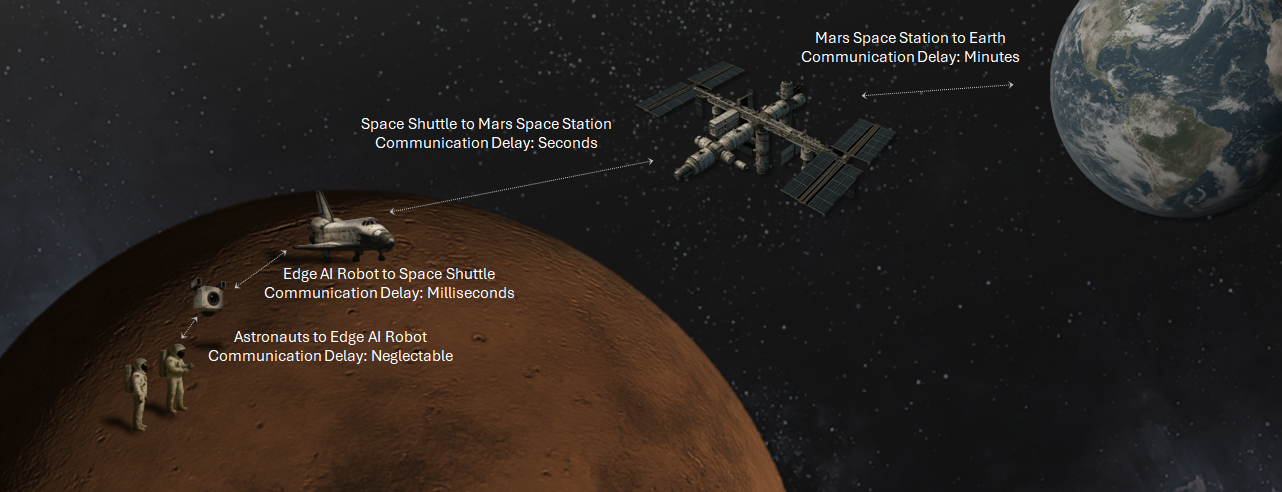
There exist various challenges to effective communications in space, both environmental and technical [47]. The most prominent challenge in maintaining communications in the space is signal delay. Signals, (including commands, telemetry, voice, and video), can take minutes to hours of travel between MCC and distant spacecraft via the Deep Space Network (DSN). Significant communication delays in deep-space missions pose major challenges for real-time data exchange and operational efficiency (Fig. 1). As a spacecraft moves farther from Earth, these delays increase; for example, after 90 and 480 days of travel (covering 0.4 and 2.7 Astronomical Units), one-way signal delays can reach 4 and 22 minutes, respectively [43][64].
Dealing with communication delays is very important in the context of human spaceflight, especially for longer-term missions further from Earth. Research performed on the ISS has shown that communication delays of 50 seconds, which correspond to delays that could be present in deep space missions, can negatively affect the crew’s behaviour, leading to task performance degradation, stress, and deteriorating mood [44]. Communication delays can be challenging not only for astronauts, but for the MCC as well. This has been showcased in mission analog studies, where increased communication delays did affect the MCC task performance, as well as unavoidably increased their workload, elevated stress levels, and led to task failure [35][21]. These studies mention astronaut compliance issues as a result of communication delays, leading to a lack of command acknowledgement. Some other spaceflight concerns related to communication delays are impacts on team cohesion and impacts on emergent medical assistance from the MCC [57].
These delays necessitate autonomous and adaptive solutions to maintain mission effectiveness while ensuring human oversight and decision-making remain integral [64]. Indeed, the outcome of some studies involving real astronauts [44] suggested “increase crew autonomy” and “reduce back-and-forth communications” as ways to address communication delays and the resulting performance degradation and related stress. One astronaut in the study also stated: “I think if we fly to Mars we are going to have a spaceship that is more autonomous than the ISS. So you don’t have as much low-level comm. with the ground on each of the steps of the procedures”. When asked what type of tools would help with communication delays, the astronauts stated the need for a “recording-tool” and “text or video-based communications” as well as that “the AMO [autonomous mission operations] software” helps increase their autonomy. It is evident that increased autonomy could mitigate some effects of communication delays, by reducing the number of times the communication takes place. To tackle this challenge, in this paper, we discuss how AI could be leveraged to provide more autonomy to the crew. AI has been explored before as a prominent tool to solve challenges in human spaceflight [53], but in this paper, we focus on the usage of AI and its potential to address communication delays in human spaceflight. Recent advances in human-in-the-loop AI offer promising ways to bridge these communication gaps by balancing automation with human expertise, including designs that put humans in decision-making processes. Rather than fully autonomous systems making decisions in isolation, AI enables astronauts and mission controllers to guide, adapt, and refine AI-driven processes in real time, even under significant latency constraints. This hybrid approach enhances mission resilience, allowing crews to interact with AI systems that learn from human feedback and adjust to evolving mission needs.
Communications between the MCC and crew take place for various purposes: some important purposes include task planning, system monitoring and fault management, astronaut health monitoring, and communication with family members. Each type of communication can have different modalities, such as voice commands, video feeds, log transcripts, monitoring signals, etc. This paper focuses on categorising communications into two types: task-oriented and social-oriented. Task-oriented communication focuses on operational efficiency, such as teleoperating robotic arms onboard. Social-oriented communication, on the other hand, supports crew psychological well-being, as astronauts seek connection with people on Earth, especially family members. Solutions like AI-driven Delay-Tolerant Networks [3][13].and Enhanced Communication Protocols [60][26] incorporate human-in-the-loop AI to ensure critical tasks are performed with precision, even in delayed-response environments. Space Braiding [51] is a recent initiative aimed at fostering meaningful remote interactions by leveraging AI while keeping human intent at the core of communication design.
In the following sections, we first review the literature on the use of AI in space in general and communication delays in particular, examining their potential and limitations in addressing this critical challenge for deep space exploration. Specifically, we examine the applicability of Digital Twins and Edge AI in addressing space communication delays. Next, we present our proposed solutions through two use cases: one explores task-oriented communication, applying the concept of backtracking to robotic arm operations, while the other focuses on social-oriented communication, investigating the potential benefits of deepfakes in casual conversations with social contacts on Earth.
2 Literature Review
2.1 AI in Space
The uses of AI in most aspects of spaceflight have been showcased and described before. A recent literature review categorised different AI methodologies and algorithms, and matched them with technical problems in satellite engineering where they could provide a solution [61]. This review focused more on technical aspects of satellite engineering, rather than operations and issues in human spaceflight. The review by Furano et al. focused on AI applications and challenges for embedded systems in space [33]. The potential of AI in facilitating mission operations and space exploration is described by Russo et al. [72]. AI has also been introduced in the phases of spacecraft design, with an example being an expert system as an assistant in the process of engineering design [9].
In the field of space communications, Fontanesi et al. have presented a very detailed review of the application of AI in communication issues [28]. They categorised different AI methodologies, described common hardware and task-related problems in satellite communications, mentioned the state-of-the-art in AI to solve these problems, and provided other relevant reviews. But even this detailed review did not mention the challenges and opportunities for AI in mitigating communication delays, or the implications in human spaceflight.
AI has also been proposed in the context of addressing challenges in human spaceflight. Some notable applications include deploying autonomous AI agents for task planning and scheduling, onboard system fault detection and management, and AI-powered robotic assistants onboard the ISS. A prominent example is the NASA Autonomous Systems and Operations project (ASO) that deployed AI methods for increasing crew autonomy and automating operations both in deep space mission analogs and onboard the ISS [29]. Finally, various robotic assistants have been deployed onboard the ISS to help astronauts with everyday tasks, such as Robonaut2 [22], SPHERES [78], Astrobee [12], Int-Ball [58] and Int-Ball2 [39]. Again, these efforts of introducing AI and increased autonomy onboard the ISS did not address communication delay issues.
Due to the sensitive and high-stakes nature of space missions, responsible AI design is essential [23]. Graham and Thangavel [36] argue that while AI offers significant advantages for space applications, its deployment presents unique risks that require tailored responsible AI frameworks. Balancing the prevention of harm with mechanisms for accountability and remediation is necessary. Oche et al. [61] emphasised the importance of responsible AI considerations when applied to key areas of space missions, including spacecraft health monitoring, remote sensing, satellite communications, and robotic autonomous systems.
2.2 AI for Space Communication Delays
One primary approach to addressing communication delays involves integrating AI into spacecraft systems to enable autonomous decision-making. Since real-time communication over vast interplanetary distances is impractical, AI allows spacecraft to perform critical functions independently. For instance, AI algorithms can autonomously process scientific data, adjust mission parameters, and manage unexpected events, ensuring mission continuity despite communication lags [8]. NASA and the German Aerospace Center (DLR) have been developing intelligent AI assistants, such as the Mars Exploration Telemetry-Driven Information System (METIS), to monitor spacecraft systems, detect anomalies, and support astronaut autonomy by reducing reliance on mission control [8]. AI is also being leveraged to develop advanced communication protocols that can dynamically adapt to space environments. AI-driven systems can optimise data transmission by selecting underutilised frequency bands, minimising interference, and maximizing available bandwidth. This adaptability is crucial for maintaining robust communication links despite challenges such as space weather fluctuations and resource constraints [29]. NASA’s cognitive radio technology exemplifies this approach, using AI to make real-time decisions about spectrum use and improving resilience against signal degradation [56].
Delay-Tolerant Networking (DTN) is a networking paradigm designed to function effectively over long distances and intermittent connections, making it particularly suited for space missions [3]. AI-enhanced DTN protocols have been developed to improve routing efficiency and data delivery in these challenging conditions. For example, AI-based routing mechanisms can predict network disruptions and dynamically adjust data paths, increasing the reliability of space communications [13]. ESA and NASA are actively researching AI-augmented DTN models to enhance interplanetary communication, ensuring stable data transmission despite extreme delays [3].
In addition to technical advances, innovative communication tools such as Space Braiding have been introduced to mitigate the psychological and operational impacts of communication delays on astronauts. Space Braiding creates the illusion of real-time conversation by intelligently managing pre-recorded message exchanges, thereby preserving a natural dialogue flow despite inherent delays [70]. Recent studies funded by ESA have demonstrated the effectiveness of Space Braiding in improving crew well-being, enabling effective problem-solving under high-latency conditions, and facilitating psychological support through therapist-guided sessions during simulated Mars missions [51].
AI’s role extends to optimising satellite communication networks by analysing vast amounts of operational data and predicting potential issues such as signal interference and bandwidth allocation. For example, AI systems can dynamically adjust satellite parameters to maintain optimal communication links, thereby reducing latency and enhancing data throughput [28]. Research has highlighted the potential of AI in improving the efficiency of satellite communication networks by addressing challenges such as resource management and network control [45]. Additionally, integration with Augmented Reality (AR) tools can enable astronauts to interact with communication data in real time, further enhancing operational efficiency [8].
2.3 Human-in-the-loop AI for Space Missions
Unlike fully autonomous systems, which operate without human intervention, human-in-the-loop AI combines human intuition, expertise, and situational awareness with AI’s computational capabilities. This approach ensures that mission-critical decisions remain aligned with human intent while benefiting from AI’s ability to process vast amounts of data and make rapid adjustments.
One concrete example of this approach is AI-assisted spacecraft navigation, as seen in NASA’s autonomous navigation systems. Traditional deep-space navigation relies heavily on Earth-based tracking and ground control for trajectory adjustments. However, long communication delays make immediate course corrections impractical. NASA’s AutoNav system, originally deployed on the Deep Space 1 probe and later refined for Mars rovers like Perseverance, enables spacecraft to autonomously adjust their paths. Despite its autonomy, AutoNav remains under human oversight; mission planners set high-level goals, and the AI executes navigation while continuously sending updates back to Earth for validation [11][55].
A similar hybrid model is applied in AI-supported fault detection and recovery, an essential function in spacecraft operations where failures can have catastrophic consequences. ESA has been testing AI-based fault detection through OPS-SAT, a mission that allows ground controllers to interact with and fine-tune AI decisions when anomalies arise [25] [30]. Meanwhile, NASA’s R5 Valkyrie, a humanoid robot designed for deep-space exploration, is capable of performing routine maintenance tasks on spacecraft. However, rather than operating in full autonomy, Valkyrie allows astronauts and mission controllers to modify its actions through isolation of remote commands [69].
Medical decision-making in space is another domain where human-in-the-loop AI proves invaluable. Long-duration missions require astronauts to manage their own healthcare without immediate guidance from Earth [59]. To address this, NASA has developed the Clinical Decision Support System (CDSS), which assists astronauts by analysing physiological data, identifying potential health risks, and recommending treatments [71]. However, instead of relying entirely on AI-generated diagnoses, astronauts remain actively involved by providing symptom inputs and cross-checking AI-generated recommendations against available medical guidelines and consultations with ground-based physicians.
Beyond operational efficiency, human-in-the-loop AI is also being explored for maintaining crew psychological well-being during long-duration missions. The Space Braiding initiative [60][26], for instance, leverages AI to filter and adapt asynchronous messages from family members, ensuring that astronauts receive meaningful and supportive communication even under delayed conditions.
By integrating human oversight into AI-driven processes, deep-space missions can retain flexibility, enhance operational safety, and preserve the psychological well-being of astronauts despite communication delays.
2.4 Digital Twins and Space Communication Delays
Digital Twins (DTs) offer a powerful solution by enabling real-time simulation, predictive modelling, and autonomous decision-making. Virtual replicas of spacecraft, planetary rovers, or habitats allow engineers and astronauts to anticipate challenges and reduce reliance on Earth-based commands [52]. One of the primary advantages of DTs is their ability to support local decision-making and autonomy. With long signal travel times, spacecraft cannot always wait for instructions from mission control. Instead, onboard DTs can simulate potential outcomes of various actions in real time, enabling spacecraft or planetary rovers to make informed decisions without immediate human input. This capability enhances mission efficiency and reduces risks associated with delays [68].
DTs also play a crucial role in predictive maintenance and fault detection [79]. By continuously monitoring spacecraft components and systems, they can identify signs of wear or potential failures before they become critical. Engineers can then test repair strategies in a virtual environment before executing them in space, minimizing the need for extensive back-and-forth communication with Earth [52].
In addition to supporting real-time operations, DTs enhance training and simulations on Earth. Mission control teams can interact with highly detailed virtual replicas of spacecraft or space habitats, allowing them to test responses to unforeseen conditions without direct input from the remote system. Astronauts can also use DTs to rehearse tasks before performing them in space, improving their success rate and reducing the risk of errors[67].
Another advantage is optimised data compression and synchronisation. Instead of transmitting vast amounts of raw data back to Earth, DTs can preprocess and filter critical information, significantly reducing bandwidth requirements. Spacecraft can also update themselves using pre-programmed decision models within their DT framework, allowing them to function more independently [74].
Looking ahead, human-AI collaboration in space habitats will be an essential aspect of future missions. Mars bases or lunar settlements could integrate DTs to manage life-support systems, optimise resource utilization, and respond to emergencies autonomously [37]. By reducing dependence on real-time Earth intervention, these AI-driven systems will enable sustainable long-term human presence in space.
Several space agencies and private companies are already leveraging DTs to mitigate communication delays and enhance autonomy in space missions. In NASA’s Artemis Program, DTs are being developed to autonomously monitor lunar spacecraft, habitats, and the planned Lunar Gateway station, enabling predictive maintenance and operational efficiency. For NASA’s Mars Rover missions, the Perseverance Rover’s Earth-based DT allows engineers to simulate commands and troubleshoot issues remotely before execution, minimising delays caused by long communication times.
Similarly, Digital Twin Earths (DTEs) are high-fidelity models that predict environmental changes in Earth’s atmosphere, reducing the need for continuous real-time satellite data transmission [7]. Similarly, Boeing’s Digital Twin of the CST-100 Starliner spacecraft supports pre-emptive testing of navigation, life support, and propulsion systems, ensuring safer and more reliable space travel [18].
Lockheed Martin’s Orion spacecraft also benefits from a DT, which aids in testing flight scenarios and emergency procedures, enhancing mission preparedness [66]. Meanwhile, SpaceX Starship employs AI-driven DTs, allowing the spacecraft to autonomously detect and address structural or operational issues during deep-space missions [4]. These advances collectively contribute to greater autonomy, efficiency, and resilience in space exploration.
2.5 Edge AI and Space Communication Latency
The term Edge AI is inspired by edge computing, the process of moving the computational and storage systems of a computer network closer to the “edge”, i.e. the point of deployment where the data come from. Similarly, Edge AI refers to the deployment of AI models closer to the source of data collection, usually as part of an embedded computer [34]. This solution can mitigate communication delays, as data transferring between the user, storage, and computation system is significantly reduced.
This idea is not new, and it is typically associated with Internet-of-Things (IOT) networks. Due to the large amounts of data generated by each device, different data types collected, limited communication bandwidth, varying processing capabilities of each device, and variable power demands, communication between devices can have increased latency. A mitigation technique example is the usage of AI algorithms as a routing task agent in systems according to each device’s task request number, power consumption, available battery and other resources [6]. An extensive review paper on ways of mitigating latency, arising both from computational constraints and communication constraints is presented by Shi et al [75]. In the review, the mitigation methods are categorised into methods for communication-efficient Edge AI systems that optimise the AI algorithms, and methods that optimise the data processing systems and principles.
Since satellites are remote systems with embedded processing capabilities, Edge AI can offer a promising solution for the communication delay problem. In a similar way with ground communications, Edge AI could be used to determine what data types need to be prioritised for transmission, how they could be compressed/optimised, how to plan and schedule link operations, and how to take advantage of novel computing architectures and processing capabilities in space. The increased launches and usage of satellite constellations has made this need more relevant. A recent paper outlines the processing and memory requirements that modern onboard AI/ML systems must meet to enable edge computing and AI integration in satellite communications. It also discusses the technical challenges in satellite communications that these systems could help address [62][40]. Leveraging AI and edge computing has been proposed to enable scheduling optimisation between ground stations and satellites, in the context of a satellite constellation network [83]. An Edge AI architecture for satellite constellations in LEO can also help constellations make AI inference onboard, rather than downlinking the data to a ground server that runs an inference algorithm, then having the inference result uplinked and distributed to end-users through the constellation [84].
Our position in this paper is that Edge AI could be leveraged more for communications in human spaceflight. The simplest way this can happen is by exploiting the constellation communication results and paradigms mentioned above: the space station can be simultaneously another computation/communication module in the constellation, the edge where data is collected, and the end user. A recent user case of interest is space crew health assessment. Edge AI could be used to gather health and biometric data from the crew and perform inference on each crewmember’s health condition. Training for such a system could be performed by medical data on Earth, and the inference system could be performed in space [82] through a constellation network or other high-performing embedded processors and Edge TPUs [46]. Since Edge processors would offload computing data, medical diagnosis can be performed using many different data types, such as EEG and other biosensing signals, camera images, voice commands, and text data. Data transformation, processing, and AI inference could be performed either onboard or using a constellation, providing a first medical state report, minimising the need to contact the MCC, and providing additional information when contacted.
3 User Cases
To showcase the applicability of AI as a delay-mitigation measure, we discuss two hypothetical human spaceflight user cases. The first user case addresses social-based communications, and the second task-based communications. We propose the usage of AI agents based on similar scenarios in terrestrial applications.
3.1 User Case 1: Deepfakes for Social-oriented Communications in Deep Space Exploration
While initial studies on Space Braiding [51] funded by agencies such as the UKSA, ESA and NASA highlight its potential, key areas require more empirical validation to assess its long-term impact on communication efficiency, team cohesion for various group sizes, and astronaut well-being. As a text-based tool, Space Braiding may be well-suited for task-oriented communication but less effective for social interactions, such as conversations with family and friends, where voice and video communication are more natural and emotionally engaging. Research into more accessible interfaces that support multimodal communication could help address this limitation. A viable alternative can be deepfakes.
Deepfakes are highly realistic digital creations that utilise AI, complex algorithms, and advanced data processing techniques [65]. These technologies enable the seamless integration of an individual’s real-world visual and auditory characteristics into carefully crafted artificial environments, producing media that appear strikingly authentic [80]. Combined with generative AI techniques such as conversation agents and human behaviour synthesis, deepfakes enable the creation of believable virtual agents that can conduct supportive conversations. Despite concerns about their potential for manipulation, deepfakes are not inherently deceptive or malicious [38]. In fact, they can be used positively in cultural applications, entertainment, and even psychological well-being [15].
Recent research has explored how people emotionally engage with deepfakes, even when they are fully aware of their artificial nature. Using neuropsychological methods, Eiserbeck et al. [24] examined how recognising AI-generated faces influences emotional processing. Their findings suggest that participants perceived smiling faces labelled as “fake” as less positive and reacted to them more slowly. However, their responses to angry faces were consistent, regardless of whether the faces were real or artificial. Soto-Sanfiel et al. [77] investigated human interactions with deepfakes across different genres, such as celebrities, advertising, and politics. Their study revealed that immersive narratives and familiarity with the content can enhance engagement and enjoyment.
Building on this potential, we propose utilising deepfakes to address the psychological needs of spacecraft crews by enabling emotional connections with their loved ones during long missions. Family members and friends can continuously record videos of daily activities, which will be stored in a database. These recordings will serve as training data for AI models to generate deepfake avatars that accurately replicate their appearances, voices, and behaviours. When a crew member wishes to interact with a family member, the system will retrieve relevant content and render it as a fully immersive 3D simulation with advanced re-enactment techniques [19]. By integrating these AI-generated representations into a virtual environment and leveraging the power of Edge AI, the system can create a lifelike and emotionally engaging experience, helping astronauts feel more connected to their families despite the vast physical distance, thereby sustaining their mental health.
However, the ethical implications of using deepfakes in this context must be carefully considered [50][20]. Consent is a critical factor – family members and friends must have full control over how their likenesses are used and be able to withdraw permission at any time. Additionally, prolonged interaction with AI-generated representations may blur the boundaries between reality and simulation [38], potentially affecting astronauts’ emotional well-being upon returning to Earth. There is also the risk of unintended psychological effects, such as over-reliance on artificial interactions at the expense of genuine human connection [81]. Hence, safeguards must be implemented, including clear guidelines for ethical use, regular psychological assessments, and mechanisms to ensure that deepfake interactions support rather than replace authentic relationships [2].
At the same time, given the applied nature of the system, responsible AI [23] design must be considered. Modern conversational agents retain “memory” of previous interactions and personalise behaviour using techniques such as retrieval-augmented generation [49]. This typically involves accessing past conversation logs and user-specific information, which may be sensitive. It is, therefore, essential to protect such data through privacy-preserving methods and to incorporate robustness measures against adversarial attacks that could expose confidential content. Additionally, as re-enactment techniques [19] are used to enable emotionally engaging interactions, care must be taken to ensure that the synthesised behaviours remain faithful to the original reference material. In such cases, explainable or interpretable AI [1] can be used to trace which data contributed to a particular dialogue or generated output. Finally, as the aim is to create deepfakes that faithfully represent a wide spectrum of behaviours and appearances, it is important to incorporate bias-aware AI design.
To further mitigate psychological and ethical risks, a layered approach combining pre-mission training, contextual framing, and adaptive system design is recommended. Astronauts should be prepared in advance to understand the emotional limits and affordances of interacting with synthetic agents, reducing the risk of over-attachment [48]. Deepfake interactions could include subtle sensory cues to reinforce their artificial nature, enabling users to assess authenticity without disrupting emotional engagement [42]. Continuous psychological monitoring can inform dynamic adjustments to interaction frequency and tone, supporting individual mental health needs [5]. Moreover, governance should involve interdisciplinary oversight – ethicists, psychologists, and user representatives – to ensure responsible use and protect those whose likenesses are involved [27]. This ensures that deepfakes are used to augment, not replace, authentic relationships in space.
Furthermore, we identify two key research challenges. First, while most deepfake research to date has focused on mimicking visual and auditory signals [17], one significant sensory modality remains largely overlooked: olfaction [54]. Although smell cues may be subtle, they can play a crucial role in evoking a sense of social presence, for example, through familiar scents such as perfume, aftershave, or shampoo. These smells often trigger emotional reminiscence and a sense of connection to loved ones. We argue that incorporating olfactory signals into deepfake experiences could further enhance emotional engagement [10]. Second, everyday life on Earth includes a range of emotionally charged experiences, both positive and negative. To help astronauts feel more “at home” during long missions, deepfake-enabled interactions should reflect this emotional diversity. Relying solely on overly comforting or idealized content could distort astronauts’ perception and memory of social relationships, potentially making it more difficult to readjust to real-world interactions upon returning to Earth. The challenge lies in finding the right balance between positive and less positive interaction episodes to maintain emotional authenticity.
3.2 User Case 2: Task Planning and Backtracking in a Deep Space Scenario
Novel AI systems could be used in human spaceflight in fault management, recovery, and replanning during the execution of mission tasks. Automated planning of mission operations is not new, with various systems being already heavily used in spaceflight, such as NASA’s ASPEN [31] and CLASP [63] task scheduling and planning systems. Such systems have extended capabilities of fault prediction and replanning. However, in some cases, the MCC still needs to be contacted in case a failure is external, task-related, and has elevated risk for the rest of the mission operations.
A prominent example is the recent micrometeoroid damage of the Space Station Remote Manipulator System (SSRMS, also known as Canadarm2). On May 12th 2021, astronauts onboard the ISS reported damage on the protective covering of the manipulator, caused by micrometeoroid impact. The damage was reported during a routine inspection, and high-resolution images of the damage were taken and sent to the MCC to assess the damage. The assessment of the images and the resulting state of the arm took more than two weeks, before the MCC concluded that the arm’s performance was not affected, and that near-term operations could resume. Should such a failure take place on a lunar mission or mission to Mars, the communication latency in transmitting the fault images, combined with the time to perform fault analysis by the MCC could result in significant mission delays with potentially serious consequences.
This effect could be mitigated if the fault images were uploaded to an onboard server, where an AI agent could perform risk assessment. More specifically, Visual Language Models could be a fitting solution. Visual Language Models are generative AI models that can reason under both visual and text-based modalities [85]. They combine vision encoding with Large Language Models (LLMs) and can generate text responses from the combination of a given image and a text prompt. Their significance lies in their capability to handle both known problems in computer vision, such as out-of-class classification, and providing generative responses to tackle problems such as image summarisation and description. They have very recently started to be used as anomaly detection systems [41] and are being introduced to some more risk-averse industries and hazardous workspaces [14].
As fault detection systems, VLMs would be fed with a diagnostics image, such as a set of plots showing the change of a critical variable over time, and a text prompt. VLM would then reason over the fault detected after analysing the provided image and the text prompt, giving a generative response over the fault type and management. If such a system was used in the case of the ISS arm example, the astronauts could feed the images showing the arm damage to a VLM, along with graph data from diagnostics plots, and a text prompt asking whether the arm is operational. The result of the VLM could influence their decision to continue with the scheduled operations without the need to contact the MCC, saving 14 days of operation time. Such systems would be valuable in cases of limited or very delayed communications, such as on future Mars missions.
Finally, task replanning after fault detection is another spaceflight operation that could benefit from AI and VLMs. Mission operation planners already incorporate some replanning capabilities based on potential fault cases, mostly related to system failures and faults. VLMs could instead be incorporated into the existing mission planners, to provide capabilities based on task failures. Such a paradigm has recently been demonstrated in robotic manipulation, where a robot extracts an image of a failed task, such as an unsuccessful grasp, identifies the task-specific failure mode, and replans an action to resolve it [76].
It should be noted that VLMs, similar to most learning-based algorithms, have significant implementation and reliability challenges that would need to be resolved before they are applied in the critical environment of space. One core limitation would be the lack of data: VLMs require vast amounts of data to be trained. In the context of spaceflight, the data required for training a VLM as a fault detection tool, such as user manuals and fault diagrams, may be too few for meaningful training or not accessible due to regulatory and commercial constraints. Model “hallucinations”, meaning structurally consistent but not meaningful answers, should also be addressed in VLMs. These concerns were addressed in the context of LLMs in space operations, by the authors in [73]. To deal with the lack of data, the authors used a vector embedding of space systems documents combined with user queries on pre-trained LLMs, to evaluate their performance in answering queries related to system handbook search. To evaluate the hallucination performance, the authors inserted known information (system wiki pages, software documentation ea) into the vector embedding, and compared the answers to the inserted. The authors showed that LLMs returned useful answers while searching system handbooks, but with unpredictable and high hallucination rates, that depend on the prompt provided by the user. The authors stated that LLMs could be used as co-pilots in space operations, but the results depend on prompt engineering, potentially requiring hyperparameter tuning or re-training.
4 Conclusion
This paper offers a position on the integration of AI solutions to tackle challenges in space communications delay for human spaceflight. Our analysis focused on the need for resilient communication delays in human spaceflight, and we categorised these needs as task-based and social-based, i.e. as needs related to the mission objectives and operations, and needs related to the social communication between space crew and Earth. We provided a set of promising recent technologies that address these delays, from the fields of Human-in-the-loop AI, Digital twins, and Edge AI literature. We also described how cutting-edge technologies of deepfakes and VLMs could be integrated with existing spaceflight systems to mitigate the challenges posed by communication delays in deep space mission scenarios. Our paper provides a starting point for discussions in the introduction of novel AI techniques in human spaceflight for delay mitigation, as well as insights on the technologies that are most promising in this direction.
References
- [1] Amina Adadi and Mohammed Berrada. Peeking inside the black-box: A survey on explainable artificial intelligence (xai). IEEE Access, 6:52138–52160, 2018. doi:10.1109/ACCESS.2018.2870052.
- [2] Sami Alanazi and Seemal Asif. Exploring deepfake technology: creation, consequences and countermeasures. Human-Intelligent Systems Integration, pages 1–12, 2024.
- [3] Nicola Alessi, Carlo Caini, Tomaso De Cola, Sebastian Martin, and Jeremy Pierce Mayer. Dtn performance analysis of multi-asset mars-earth communications. International Journal of Satellite Communications and Networking, 40(1):11–26, 2022. doi:10.1002/SAT.1326.
- [4] Prasad S Ambalkar, Parth M Mandhare, Pranav P Ninawe, Siddharth R Shingne, Rovin R Singh, and Pravin Jaronde. Digital twins and ai, the cosmic revolution in space technology: Revolutionizing space operations, digital twins, and ai in action. In Harnessing AI and Digital Twin Technologies in Businesses, pages 132–142. IGI Global, 2024.
- [5] Alessandro Arone, Tea Ivaldi, Stefania Palermo Konstantin Loganovsky, Elisabetta Parra, Walter Flamini, and Donatella Marazziti. The burden of space exploration on the mental health of astronauts: a narrative review. Clinical Neuropsychiatry, 18(5):237, 2021.
- [6] Beste Atan, Mehmet Basaran, Nurullah Calik, Semiha Tedik Basaran, Gulde Akkuzu, and Lutfiye Durak-Ata. Ai-empowered fast task execution decision for delay-sensitive iot applications in edge computing networks. IEEE Access, 11:1324–1334, 2023. doi:10.1109/ACCESS.2022.3232073.
- [7] Ana P Barros. Digital twin earth: the next-generation earth information system, 2024.
- [8] Oliver Bensch, Leonie Bensch, et al. Ai assistants for spaceflight procedures: Combining generative pre-trained transformer and retrieval-augmented generation on knowledge graphs with augmented reality cues. arXiv preprint arXiv:2409.14206, 2024.
- [9] Audrey Berquand, Francesco Murdaca, Annalisa Riccardi, Tiago Soares, Sam Generé, Norbert Brauer, and Kartik Kumar. Artificial intelligence for the early design phases of space missions. In 2019 IEEE Aerospace Conference, pages 1–20. IEEE, 2019.
- [10] Ceylan Besevli, Giada Brianza, et al. Smell above all: Envisioning smell-centred future worlds. In ACM Designing Interactive Systems Conference, pages 2530–2544, 2024.
- [11] Shyam Bhaskaran. Autonomous navigation for deep space missions. In SpaceOps 2012, page 1267135. AIAA, 2012.
- [12] Maria G. Bualat, Trey Smith, Terrence W. Fong, Ernest E. Smith, and D. W. Wheeler. Astrobee: A new tool for iss operations. In 15th International Conference on Space Operations, 2018. American Institute of Aeronautics and Astronautics Inc, AIAA, 2018.
- [13] Pau Garcia Buzzi, Daniel Selva, and Marc Sanchez Net. Autonomous delay tolerant network management using reinforcement learning. Journal of Aerospace Information Systems, 18(7):404–416, 2021. doi:10.2514/1.I010920.
- [14] Zhiling Chen, Hanning Chen, Mohsen Imani, Ruimin Chen, and Farhad Imani. Vision language model for interpretable and fine-grained detection of safety compliance in diverse workplaces. Expert Systems with Applications, 265:125769, 2025. doi:10.1016/J.ESWA.2024.125769.
- [15] Rob Cover. Deepfake culture: the emergence of audio-video deception as an object of social anxiety and regulation. Continuum, 36(4):609–621, 2022.
- [16] Steve Creech, John Guidi, and Darcy Elburn. Artemis: an overview of nasa’s activities to return humans to the moon. In 2022 ieee aerospace conference (aero), pages 1–7. IEEE, 2022.
- [17] Florinel-Alin Croitoru, Andrei-Iulian Hiji, et al. Deepfake media generation and detection in the generative ai era: A survey and outlook. arXiv preprint arXiv:2411.19537, 2024.
- [18] Robert C Dempsey, Edward A Van Cise, Michael L Lammers, and Richard S Jones. Automated software for crewed spacecraft—bridging the gap from sci fi to reality. In Space Operations: Beyond Boundaries to Human Endeavours, pages 163–186. Springer, 2022.
- [19] Ramamurthy Dhanyalakshmi, Claudiu-Ionut Popirlan, and Duraisamy Jude Hemanth. A survey on deep learning based reenactment methods for deepfake applications. IET Image Processing, 18(14):4433–4460, 2024. doi:10.1049/IPR2.13201.
- [20] Nicholas Diakopoulos and Deborah Johnson. Anticipating and addressing the ethical implications of deepfakes in the context of elections. New media & society, 23(7):2072–2098, 2021. doi:10.1177/1461444820925811.
- [21] Madison Jill Diamond. Will communication delays impact mission controllers?: An investigation of mood, performance, and workload during analog missions. Master’s thesis, The University of North Dakota, 2022.
- [22] Myron A Diftler, Joshua S Mehling, et al. Robonaut 2-the first humanoid robot in space. In IEEE international conference on robotics and automation, pages 2178–2183. IEEE, 2011.
- [23] Virginia Dignum. Responsible Artificial Intelligence: How to Develop and Use Ai in a Responsible Way. Springer Verlag, 2019.
- [24] Anna Eiserbeck, Martin Maier, Julia Baum, and Rasha Abdel Rahman. Deepfake smiles matter less—the psychological and neural impact of presumed ai-generated faces. Scientific Reports, 13(1):16111, 2023.
- [25] David Evans and Mario Merri. Ops-sat: A esa nanosatellite for accelerating innovation in satellite control. In SpaceOps 2014 Conference, page 1702, 2014.
- [26] Ute Fischer, Kathleen Mosier, Josef Schmid, Andrew Smithsimmons, and Rob Brougham. Braiding–a novel approach to supporting space/ground communication under signal latency. Acta Astronautica, 207:411–424, 2023.
- [27] Luciano Floridi, Josh Cowls, et al. Ai4people-an ethical framework for a good ai society: opportunities, risks, principles, and recommendations. Minds and machines, 28:689–707, 2018. doi:10.1007/S11023-018-9482-5.
- [28] Gianluca Fontanesi, Flor Ortíz, et al. Artificial intelligence for satellite communication: A survey. IEEE Communications Surveys & Tutorials, 2025.
- [29] Jeremy D Frank. Artificial intelligence: Powering human exploration of the moon and mars. In ASCEND 2020, page 4164. AIAA, 2020.
- [30] Simone Fratini, Nicola Policella, Ricardo Silva, and Joao Guerreiro. On-board autonomy operations for ops-sat experiment. Applied Intelligence, 52(6):6970–6987, 2022. doi:10.1007/S10489-020-02158-5.
- [31] Alex Fukunaga, Gregg Rabideau, Steve Chien, and David Yan. Aspen: A framework for automated planning and scheduling of spacecraft control and operations. In Proc. International Symposium on AI, Robotics and Automation in Space, pages 181–187. Citeseer, 1997.
- [32] Sean Fuller, Emma Lehnhardt, Jon Olansen, Jennifer S Mason, Dylan Connell, Tiffany Travis, and Christopher Fleming. Gateway program development progress. In 75th International Astronautical Congress, number IAC-24, B3, 1, 10, x85927 in 1. IAF, 2024.
- [33] Gianluca Furano, Gabriele Meoni, et al. Towards the use of artificial intelligence on the edge in space systems: Challenges and opportunities, 2020.
- [34] Sukhpal Singh Gill, Muhammed Golec, et al. Edge ai: A taxonomy, systematic review and future directions. Cluster Computing, 28(1):1–53, 2025.
- [35] Sideena Grace. Investigating the Impact of Communication Delay on Mission Control as an Effective Team Member with the Crew. PhD thesis, Massachusetts Institute of Technology, 2023.
- [36] Thomas Graham and Kathiravan Thangavel. Artificial intelligence in space: An analysis of responsible ai principles for the space domain. In International Astronautical Congress, 2023.
- [37] Nicolas Gratius, Zhichen Wang, Min Young Hwang, Yu Hou, Annika Rollock, Cory George, Mario Bergés, and Burcu Akinci. Digital twin technologies for autonomous environmental control and life support systems. J. of Aerospace Information Systems, 21(4):332–347, 2024. doi:10.2514/1.I011320.
- [38] Jeffrey T Hancock and Jeremy N Bailenson. The social impact of deepfakes, 2021. doi:10.1089/CYBER.2021.29208.JTH.
- [39] Daichi Hirano, Shinji Mitani, Keisuke Watanabe, Taisei Nishishita, Tatsuya Yamamoto, and Seiko P. Yamaguchi. Int-ball2: On-orbit demonstration of autonomous intravehicular flight and docking for image capturing and recharging. IEEE Robotics and Automation Magazine, pages 2–14, 2024.
- [40] Bassel Al Homssi, Kosta Dakic, et al. Artificial intelligence techniques for next-generation massive satellite networks. IEEE Communications Magazine, 62:66–72, 2024. doi:10.1109/MCOM.004.2300277.
- [41] Er Jin, Qihui Feng, Yongli Mou, Stefan Decker, Gerhard Lakemeyer, Oliver Simons, and Johannes Stegmaier. Logicad: Explainable anomaly detection via vlm-based text feature extraction. arXiv preprint arXiv:2501.01767, 2025. doi:10.48550/arXiv.2501.01767.
- [42] Xinyi Jin, Zhuoyue Zhang, Bowen Gao, Shuqing Gao, Wenbo Zhou, Nenghai Yu, , and Guoyan Wang. Assessing the perceived credibility of deepfakes: The impact of system-generated cues and video characteristics. New Media & Society, 27(3):1651–1672, 2025. doi:10.1177/14614448231199664.
- [43] John A Karasinski, Lauren B Landon, et al. Assessment of the state of communication delay research in preparation for missions beyond low earth orbit. In 2025 Human Research Program Investigators’ Workshop, 2025.
- [44] Natalie M Kintz, Chih-Ping Chou, et al. Impact of communication delays to and from the international space station on self-reported individual and team behavior and performance: A mixed-methods study. Acta Astronautica, 129:193–200, 2016.
- [45] Oltjon Kodheli, Eva Lagunas, et al. Satellite communications in the new space era: A survey and future challenges. IEEE Communications Surveys & Tutorials, 23(1):70–109, 2020. doi:10.1109/COMST.2020.3028247.
- [46] Chayakrit Krittanawong, Nitin Kumar Singh, et al. Human health during space travel: State-of-the-art review, 2023.
- [47] Andreas Könsgen and Anna Förster. Current state and future challenges in deep space communication: A survey, 2021. doi:10.1515/ITIT-2021-0002.
- [48] Patrick Lee, Yung Kang, Ning F. Ma, Ig-Jae Kim, and Dongwook Yoon. Speculating on risks of ai clones to selfhood and relationships: Doppelganger-phobia, identity fragmentation, and living memories. In Proceedings of the ACM on Human-computer Interaction, 2023.
- [49] Patrick Lewis, Ethan Perez, et al. Retrieval-augmented generation for knowledge-intensive nlp tasks. In Retrieval-augmented generation for knowledge-intensive NLP tasks, NIPS ’20, Red Hook, NY, USA, 2020. Curran Associates Inc.
- [50] Minghui Li and Yan Wan. Norms or fun? the influence of ethical concerns and perceived enjoyment on the regulation of deepfake information. Internet Research, 33(5), 2023. doi:10.1108/INTR-07-2022-0561.
- [51] Braided Communications Limited. Enabling effective communication for human space exploration beyond low earth orbit. ESA STAR RFP 3-16884/21/NL/GLC, 2023.
- [52] Wei Liu, Mengwei Wu, Gang Wan, and Minyi Xu. Digital twin of space environment: Development, challenges, applications, and future outlook. Remote Sensing, 16(16):3023, 2024. doi:10.3390/RS16163023.
- [53] Matthew B Luebbers, Christine T Chang, Aaquib Tabrez, Jordan Dixon, and Bradley Hayes. Emerging autonomy solutions for human and robotic deep space exploration. Proc. of Space CHI: Human-Computer Interaction for Space Exploration (SpaceCHI), 2021.
- [54] Emanuela Maggioni, Robert Cobden, Dmitrijs Dmitrenko, Kasper Hornbæk, and Marianna Obrist. Smell space: mapping out the olfactory design space for novel interactions. ACM Transactions on Computer-Human Interaction (TOCHI), 27(1):1–26, 2020. doi:10.1145/3402449.
- [55] Mark Maimone, Andrew Johnson, Yang Cheng, Reg Willson, and Larry Matthies. Autonomous navigation results from the mars exploration rover (mer) mission. In Experimental Robotics IX: The 9th International Symposium on Experimental Robotics, pages 3–13. Springer, 2006.
- [56] Katherine T McBrayer, Patrick Chai, and Emily Judd. Communication delays, disruptions, and blackouts for crewed mars missions. AIAA, page 4239, 2022.
- [57] Jancy C McPhee and John B Charles. Human health and performance risks of space exploration missions: evidence reviewed by the NASA human research program, volume 3405. US National Aeronautics & Space Administration, 2009.
- [58] Shinji Mitani, Masayuki Goto, Ryo Konomura, Yasushi Shoji, Keiji Hagiwara, Shuhei Shigeto, and Nobutaka Tanishima. Int-ball: Crew-supportive autonomous mobile camera robot on iss/jem. In 2019 IEEE Aerospace Conference, pages 1–15. IEEE, 2019.
- [59] Kiran Mohammad. Navigating the challenges and opportunities of human spaceflight: Health, psychology, and preparation for long-duration missions. In AIAA Aviation Forum and Ascend 2024, page 4817, 2024.
- [60] Kathleen L Mosier and Ute M Fischer. Meeting the challenge of transmission delay: Communication protocols for space operations. Human Factors, 65(6):1235–1250, 2023. doi:10.1177/00187208211047085.
- [61] Paul A. Oche, Gideon A. Ewa, and Nwanneka Ibekwe. Applications and challenges of artificial intelligence in space missions. IEEE Access, 12:44481–44509, 2024. doi:10.1109/ACCESS.2021.3132500.
- [62] Flor Ortiz, Victor Monzon Baeza, et al. Onboard processing in satellite communications using ai accelerators. Aerospace, 10(2):101, 2023.
- [63] Jordan Padams, Dana Freeborn, Kerry Cawse-Nicholson, Steve Chien, and Amruta Yelamanchili. Scheduling and operations of the ecostress mission. Pasadena, CA: Jet Propulsion Laboratory, National Aeronautics and Space …, 2021.
- [64] Megan Parisi, Kaitlin McTigue, et al. The impact of delayed communication on nasa’s human-systems operations: Preliminary results of a systematic. Advances in Human Factors of Transportation, page 49, 2024.
- [65] Gan Pei, Jiangning Zhang, et al. Deepfake generation and detection: A benchmark and survey. arXiv preprint arXiv:2403.17881, 2024.
- [66] Gregory J Pierce, Joshua D Heeren, and Terry R Hill. Orion sysml model, digital twin, and lessons learned for artemis i. In INCOSE International Symposium, volume 33, pages 290–304. Wiley, 2023.
- [67] Octavio Piñal and Amadeo ArguelMaggioniles. Mixed reality and digital twins for astronaut training. Acta Astronautica, 219:376–391, 2024.
- [68] Lucio Pinello, Lorenzo Brancato, Marco Giglio, Francesco Cadini, and Giuseppe Francesco De Luca. Enhancing planetary exploration through digital twins: A tool for virtual prototyping and hums design. Aerospace, 11(1):73, 2024.
- [69] Nicolaus A Radford, Philip Strawser, et al. Valkyrie: Nasa’s first bipedal humanoid robot. Journal of Field Robotics, 32(3):397–419, 2015. doi:10.1002/ROB.21560.
- [70] ESA STAR Report. Impact of communication delay on future crewed space missions. ESA STAR Report, 2023.
- [71] Brian K Russell, Barbara K Burian, et al. The value of a spaceflight clinical decision support system for earth-independent medical operations. npj Microgravity, 9(1):46, 2023.
- [72] Antonia Russo and Gianluca Lax. Using artificial intelligence for space challenges: A survey. Applied Sciences (Switzerland), 12, 2022.
- [73] Clemens Schefels, Carsten Hartmann, Kathrin Helmsauer, and Leonard Schlag. Evaluating large language models for space operations. DLR, 2024.
- [74] Mariana Segovia and Joaquin Garcia-Alfaro. Design, modeling and implementation of digital twins. Sensors, 22(14):5396, 2022. doi:10.3390/S22145396.
- [75] Yuanming Shi, Kai Yang, Tao Jiang, Jun Zhang, and Khaled B. Letaief. Communication-efficient edge ai: Algorithms and systems. IEEE Communications Surveys and Tutorials, 22:2167–2191, 2020. doi:10.1109/COMST.2020.3007787.
- [76] Marta Skreta, Zihan Zhou, Jia Lin Yuan, Kourosh Darvish, Alán Aspuru-Guzik, and Animesh Garg. Replan: Robotic replanning with perception and language models. arXiv preprint arXiv:2401.04157, 2024. doi:10.48550/arXiv.2401.04157.
- [77] María T Soto-Sanfiel, Ariadna Angulo-Brunet, and Sanjay Saha. Deepfakes as narratives: Psychological processes explaining their reception. Computers in Human Behavior, 165:108518, 2025. doi:10.1016/J.CHB.2024.108518.
- [78] Enrico Stoll, Steffen Jaekel, Jacob Katz, Alvar Saenz-Otero, and Renuganth Varatharajoo. Spheres interact-human-machine interaction aboard the international space station. Journal of Field Robotics, 29:554–575, 2012. doi:10.1002/ROB.21419.
- [79] Raymon Van Dinter, Bedir Tekinerdogan, and Cagatay Catal. Predictive maintenance using digital twins: A systematic literature review. Information and Software Technology, 151:107008, 2022. doi:10.1016/J.INFSOF.2022.107008.
- [80] Pramukh Nanjundaswamy Vasist and Satish Krishnan. Deepfakes: an integrative review of the literature and an agenda for future research. Communications of the Association for Information Systems, 51(1):14, 2022. URL: https://aisel.aisnet.org/cais/vol51/iss1/14.
- [81] Alfio Ventura and Nils Köbis. Understanding opportunities and risks of synthetic relationships: Leveraging the power of longitudinal research with customised ai tools. arXiv preprint arXiv:2412.09086, 2024. doi:10.48550/arXiv.2412.09086.
- [82] Ethan Waisberg, Joshua Ong, Phani Paladugu, Sharif Amit Kamran, Nasif Zaman, Andrew G. Lee, and Alireza Tavakkoli. Challenges of artificial intelligence in space medicine. Space: Science and Technology (United States), 2022, 2022.
- [83] Yuanming Wang, Kongyange Zhao, Xiaoxi Zhang, and Xu Chen. Towards space intelligence: Adaptive scheduling of satellite-ground collaborative model inference with space edge computing. In IEEE Conference on Computer Communications Workshops. IEEE, 2024. doi:10.1109/INFOCOMWKSHPS61880.2024.10620909.
- [84] Su Yao, Yiyin Lin, et al. Leoedge: A satellite-ground cooperation platform for the ai inference in large leo constellation. IEEE Journal on Selected Areas in Communications, 2024.
- [85] Jingyi Zhang, Jiaxing Huang, Sheng Jin, and Shijian Lu. Vision-language models for vision tasks: A survey. IEEE Transactions on Pattern Analysis and Machine Intelligence, 2024.