Multi-Axis, Multi-Material Additive Fabrication of Multi-Layer Conformal SMD Circuitry to Support In-Space Mission Resilience

Abstract
This work presents the development and evaluation of multi-material, multi-axis Material Extrusion (MEX) additive manufacturing combined with electroplating for the fabrication of complex conformal circuitry. The proposed approach enables the direct printing of functional electronics onto conformal surfaces, while offering a lower-cost and lower-complexity alternative to conventional PCB manufacturing and other in-space electronics fabrication methods. A key contribution of this work is the introduction of small multi-material bridges as a lightweight and scalable solution to miniaturisation challenges in 3D-printed electronics. The printed circuits’ physical dimensions were analysed and compared among samples, and their electrical performance was benchmarked against traditional FR4 PCBs. Lastly, the role of such a system is evaluated in the context of a space exploration mission. While the printed circuits exhibited increased noise and reduced reliability, they successfully demonstrated the ability to regulate and deliver current. The results highlight the potential of MEX-based additive manufacturing as a potential lower-cost alternative technique to proposed in-space additive electronics manufacturing processes.
Keywords and phrases:
Space Digital Fabrication, Additive Manufactured Electronics Systems, 3D printed electronics, In-space manufacturingCopyright and License:
![[Uncaptioned image]](x1.png) © Ivan Revenga Riesco, Borut Lampret, Connor Myant, and David Boyle; licensed under Creative Commons License CC-BY 4.0
© Ivan Revenga Riesco, Borut Lampret, Connor Myant, and David Boyle; licensed under Creative Commons License CC-BY 4.0
2012 ACM Subject Classification:
Hardware Flexible and printable circuits ; Hardware Full-custom circuitsFunding:
The authors thank UKRI EPSRC for the financial support (EP/Y037421/1).Editors:
Leonie Bensch, Tommy Nilsson, Martin Nisser, Pat Pataranutaporn, Albrecht Schmidt, and Valentina SuminiSeries and Publisher:
 Open Access Series in Informatics, Schloss Dagstuhl – Leibniz-Zentrum für Informatik
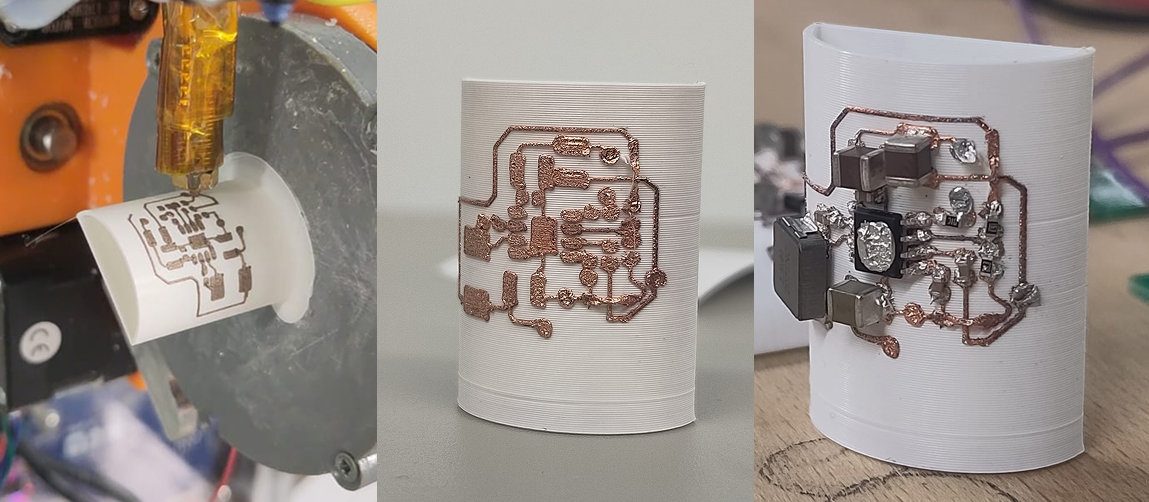
1 Introduction
The benefits of Additive Manufcaturing (AM) are particularly important for the low-volume, high-variety nature of the space industry. AM allows for the creation of intricate, lightweight structures that better utilise a given volume while at the same time minimising waste. Currently, there already exist many companies utilising AM on Earth to print components for space, great examples include Relativity Space printing entire rockets [5] or SWISSTo12 printing complex antenna arrays for communication satellites [14].
But the potential of AM is not bounded to Earth, in fact, the benefits of AM become more relevant and noticeable when used in a space-based ecosystem. Effective resource utilisation and waste minimisation is crucial for sustainable space missions and settlements. Additionally, AM processes are almost always digital in nature, enabling for different designs to be fabricated from a given machine, allowing for in-mission upgrades and increasing mission flexibility. In recent years, different AM techniques have been demonstrated in microgravity, including Material Extrusion (MEX) [1], Digital Light Processing (DLP) [2] and Directed Energy Deposition (DED) [12]. From these demonstrators it can be seen that even within a microgravity environment some additive techniques work and while the printed parts exhibit some differences, the remain structurally sound [8]. The main focus has been on printing structural elements in order to enable the construction of large space structures [7], produce replacement parts for satellites [9] or improve tools for astronauts [16]. These are exciting applications that will decrease Earth dependency and open up a whole dimension of possibilities when it comes to space activities. However, our modern systems are not purely mechanical, almost everything contains electronics in one way or another. Space technology is not an exception, and every subsystem heavy relies on them, from life support to propulsion, all the way to telecommunications. If our space missions ever want to eliminate Earth dependency, they will need to be able to locally fabricate their own electronics.
With the benefits of AM for space in mind and understanding the need for space electronics fabrication, a few academic and commercial initiatives have emerged to attempt to bridge this gap. Among these you can find Space foundry who demonstrated the use of Plasma Jet Printing to produce circuitry in a parabolic flight [3], Nscrypt published regarding the fabrication of circuits using silver inks for space [10] and HummInk which are working on an ESA project to upgrade their ink-based printer for in-space operation [13]. Apart from these, there are some other actors involved in additive electronics fabrication but their interest to pursue space fabrication is less clear. Overall, there appear to be two main method families, the plasma-based methods and ink-deposition methods. Both of these have their respective advantages and disadvantages. For example, ink methods have been shown to be able to achieve accuracy < 100 nm [15] but controlling the dynamics of the ink droplets in microgravity adds complexity [6]. On the other hand, plasma methods do not require solvents or curing making them more efficient in terms of launched mass per fabricated part but the plasma containment and longevity of the nozzles reduces the potential practicality and sustainable use of these methods. Both of these families of methods have been shown to work within multi-material printing ecosystems, first printing substrates and then conductive traces, even on conformal substrates. In this work, we propose the use of multi-axis, multi-material MEX with electroplating for the in-space fabrication of conformal circuitry as a lower cost, less complex and potentially more robust alternative.
In this work, it has been shown how to use low-cost multi-axis, multi-material MEX in order to produce conformal SMD, multi-layer 3D-printed circuitry. The design, printing and post-processing of such circuits have been thoroughly covered while providing key process insights. The circuits have been fabricated, assembled, electrically, thermally tested and compared against regular FR4 PCB counterparts. Finally, the system was evaluated and it has been discussed how it fits within a human-space environment.
2 Methodology - Sample design and fabrication
2.1 Circuit Design
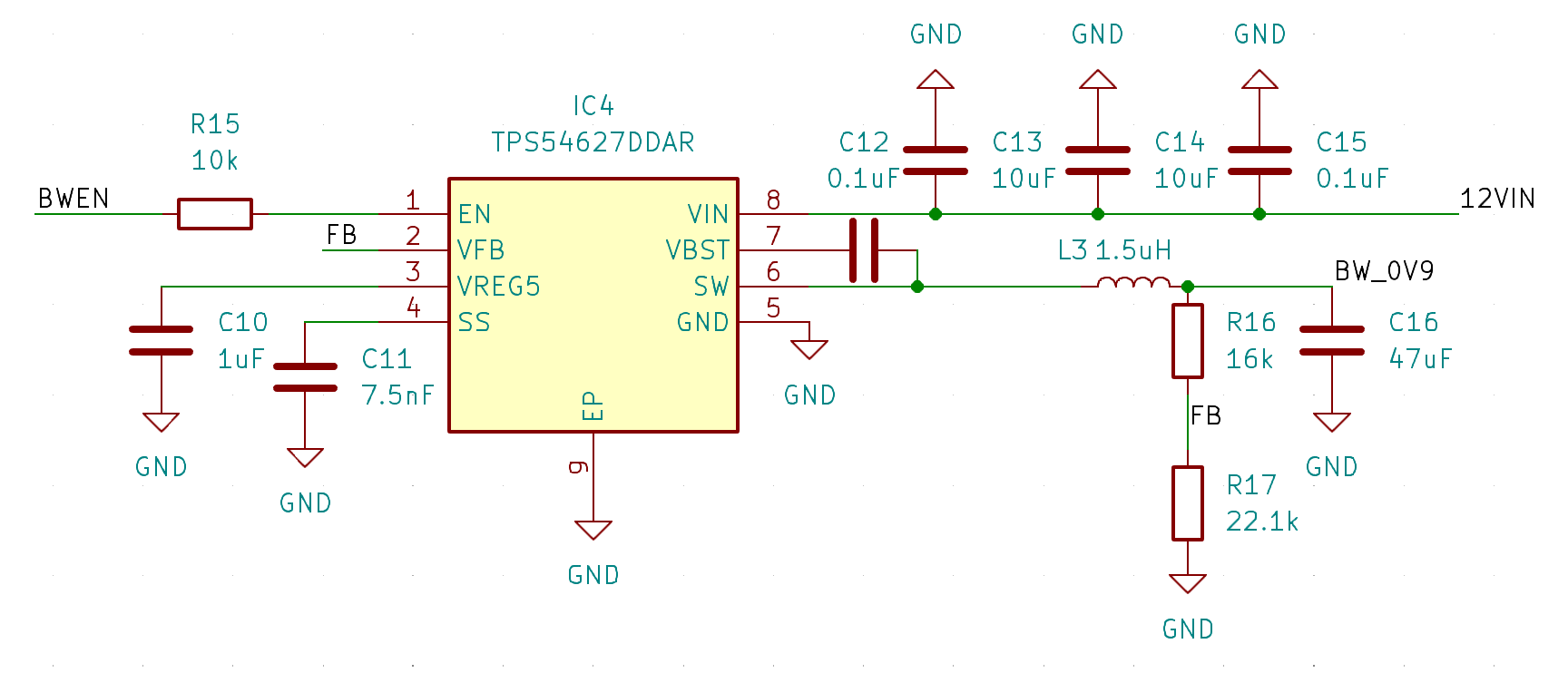
The chosen circuit was a DC-DC switching voltage regulator circuit based on the TPS54627DDAR IC from Texas Instruments. The purpose of the circuit was to actuate a nichrome wire based burn wire system within a hypothetical deployment system (e.g rocket or satellite) where the available input voltage is 12V and a 0.9 Ohm nichrome wire is used. The circuit was designed using the WEBENCH tool from Texas Instruments with a regulator target voltage of 1.3V (0.4 V on Schottky diode + 0.9 V on burn wire) in order to dissipate 1 W through the burn wire as stated on [11]. The circuit schematic can be seen on Figure 2.
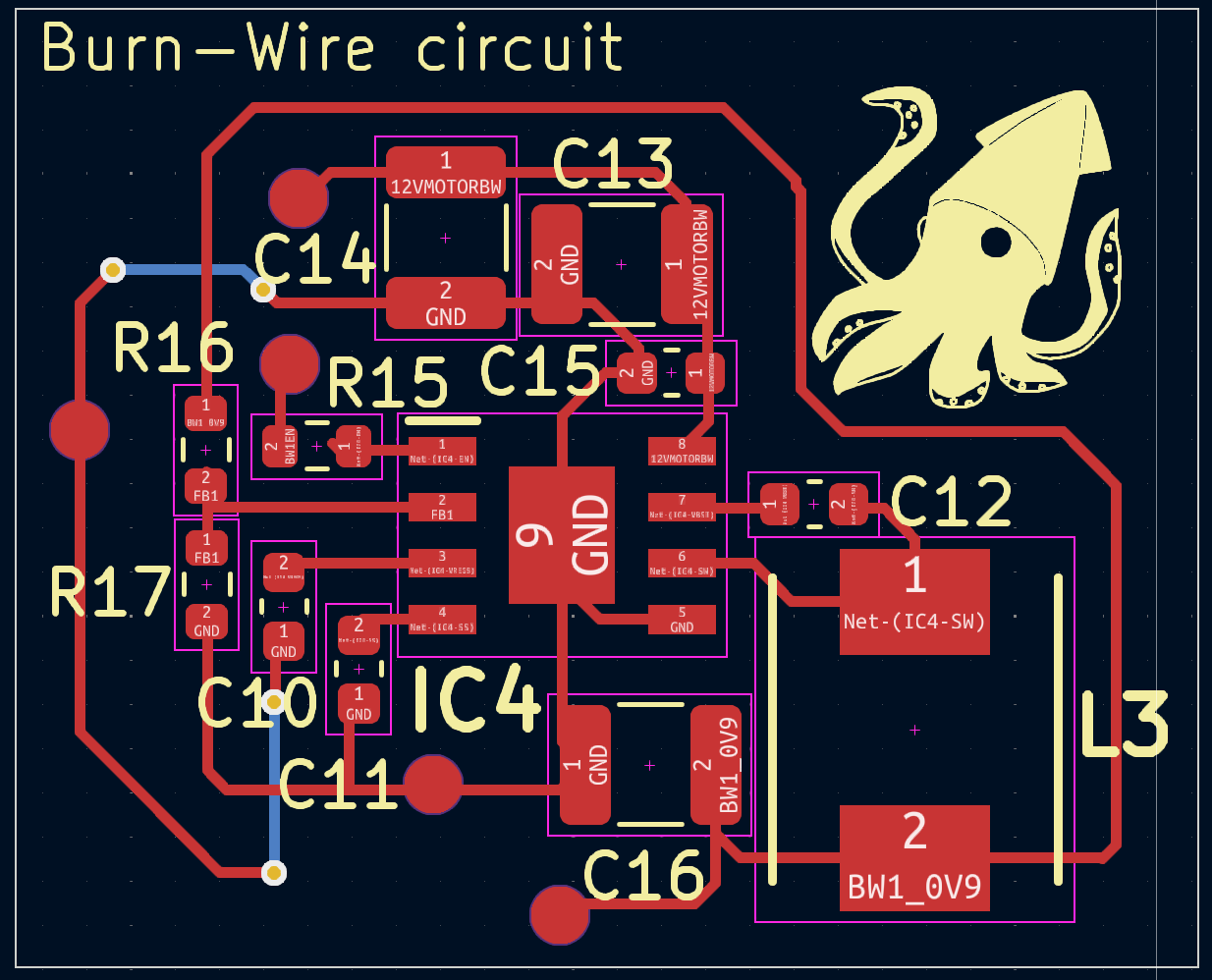
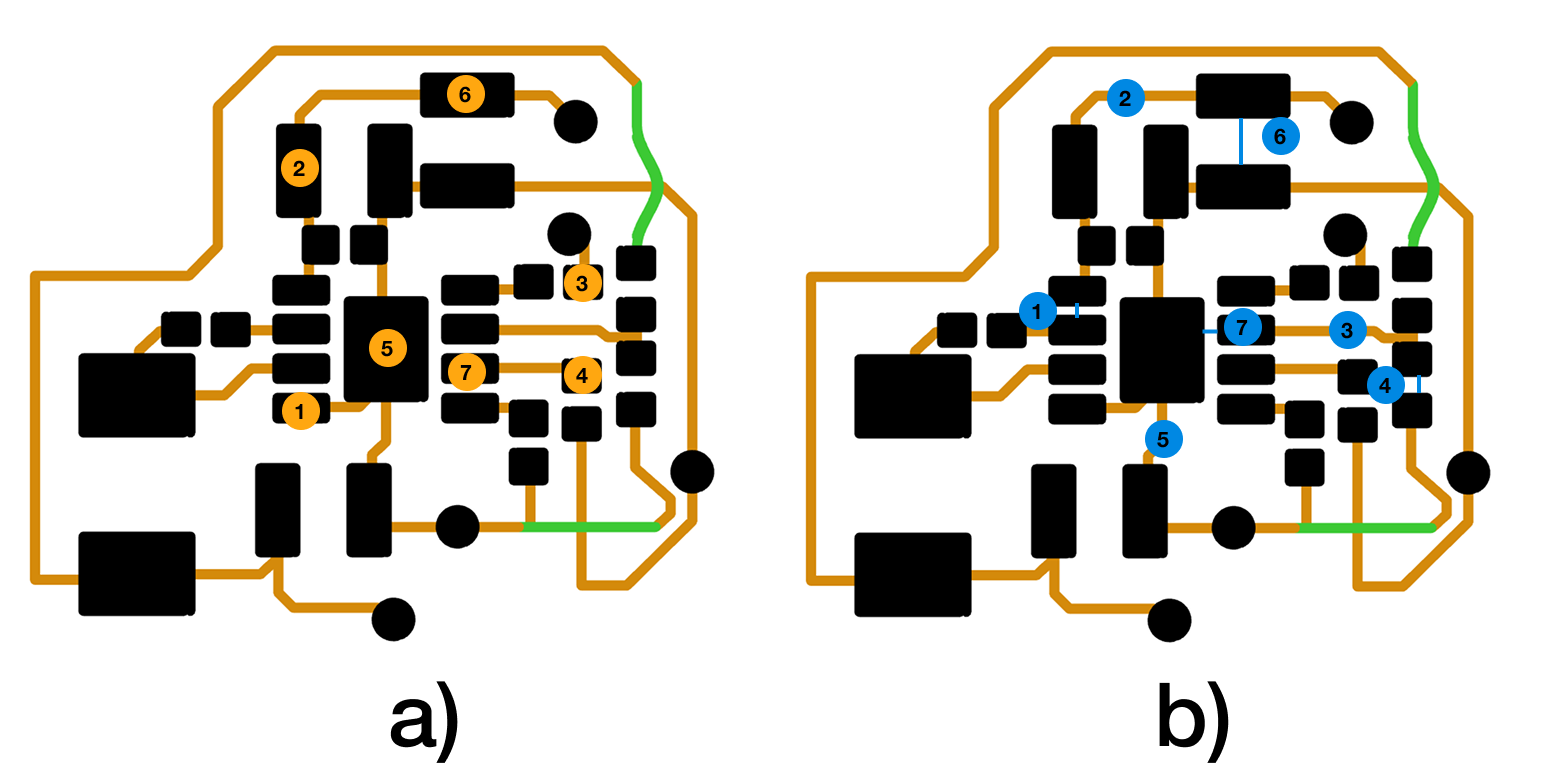
The circuit was laid out on KiCad following closely the data sheet of the TPS54627DDAR IC. The layout was made compact to make it comparable to real-life PCB circuit layouts, while keeping in mind the capabilities, tolerances and resolution of printer. To demonstrate the fine features achievable on this work, the design was done purely with pads and 0.25mm traces, even though for thermal and signal integrity issues it is often recommended to use larger polygons and ground pours. The passive components were selected to be 0603 or larger as with the current set up, printing 0402 pads resulted unreliable. Due to the complexity of the regulator design, the circuit was not achievable within 1 layer routing which required to use vias as there were 2 pairs of intersecting traces. For the inputs and outputs of the circuit, instead of using connectors, a variety of circular pads were exposed for the 12VIN, GND, BW-0V9, BWEN nets. The idea behind this was to then be able to connect wires to these terminals and interface the circuit. The resulting layout can be seen in Figure 3. In order to have a benchmark of the printed circuit, the circuit was sent to manufacture at a regular PCB manufacturer as a 2 layer FR4 board without any modifications.
2.2 3D Modelling and Tool-path generation
The following sub-section describes in detail how the circuit was modeled and how the tool-path for the conformal traces was designed and carried out. The printer used to print these samples is an E3D toolchanger with an Open5X modification, therefore software-wise the Open5X Grasshopper-based G-code generator was used [4]. Additionally all the modelling of the substrate, generation of the traces and pads was done in Rhino and Grasshopper. In this instance, the circuit was drawn manually in Rhino using a 1:1 print from the KiCad layout. Once the circuit was drawn planarly it would be projected onto the target substrate and offset from the substrate by the printing layer height (0.1mm).
2.2.1 Substrate
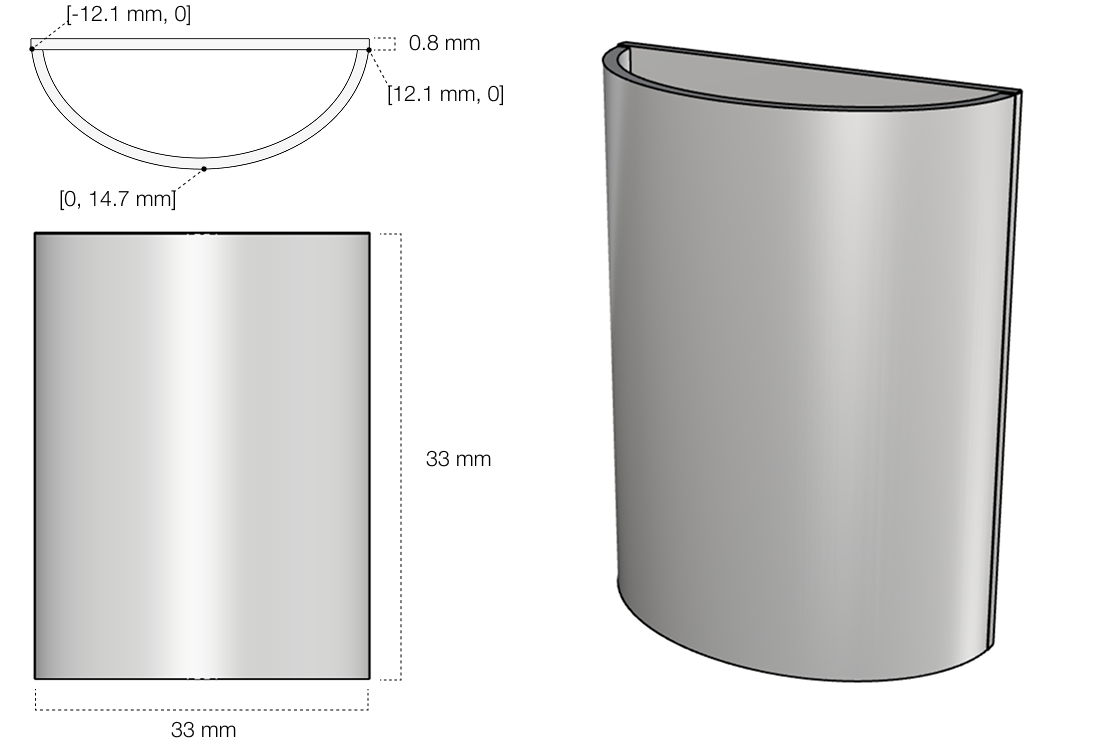
The target surface was a single curvature, spline-based extrusion. Such a surface could resemble the curvature of the fuselage of a rocket, the wing of an extraterrestrial UAV or the linkage of a rover’s robotic arm. The substrate was printed out of PLA printed at 235 °C due to the long nozzle configuration for multi-axis printing at 40 mm/s. The substrate was reinforced with a back plate to prevent deformation due to thermal warping while printing the substrate itself and while printing the traces on it. The substrate was sliced using Prusaslicer, with a layer height of 0.2mm and printed with a 0.4mm nozzle. The substrate and its dimensions can be seen in Figure 4.
2.2.2 Traces and pads
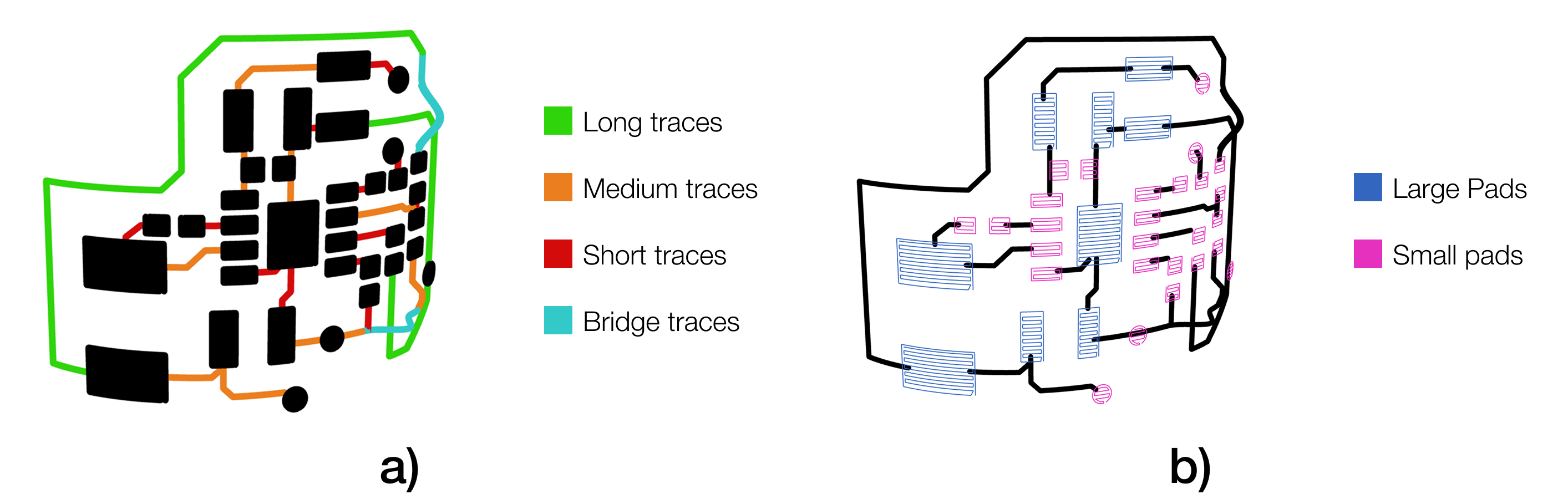
The traces and pads were printed out of Electrifi filament at 145 °C, 5 mm/s using a 0.25mm nozzle. All of the electrifi based printed was done in two sequential conformal 0.1mm layers of the entire circuit. The traces joining the different pads consisted of individual polylines of different lengths and orientations. All the pads were designed as scaled down (by 0.25mm) rectangles with a 100% rectilinear infill pattern and outer perimeter. The direction of the rectilinear infill was made the same as the z-axis layer height direction of the substrate. It was found that the adhesion of the Electrifi traces was greatly improved by printing along the layer heights of the substrate instead of perpendicular to it. It was also found that to minimise the effects of retraction and trace detachment from travel motion, it was best to first print all the traces and then print the pads than vice-versa. Additionally, when printing the pads it was found best to first print the infill and finish by doing the outer perimeter, this helped the pads maintain a rectangular shape and better adhere to the substrate. All the traces and pads can be seen in Figure 5, each of these were one continuous print.
2.2.3 Bridges
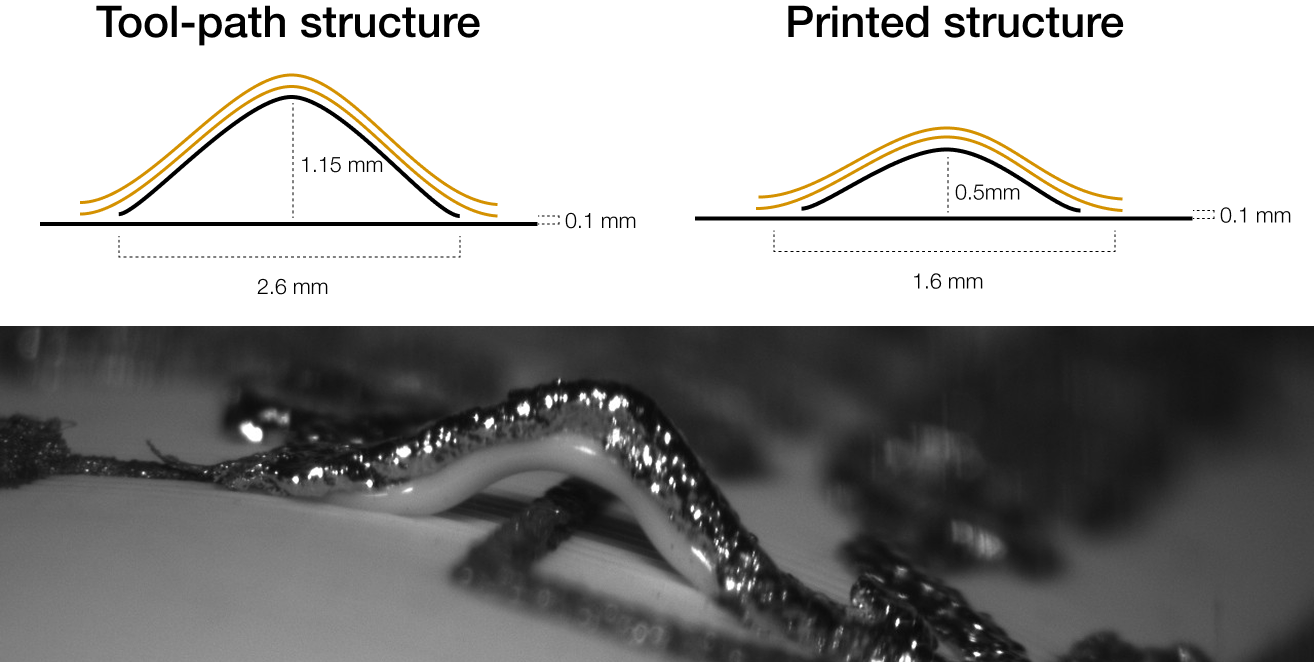
The circuit counts with two bridges: one on the FB net and on the GND net (Figure 3). These bridges are made out of single trace of PLA, printed at 235 °C, 1 mm/s using the 0.4mm nozzle. The bridge and the bridging trace are splines, procedurally produced in a grasshopper script. The script takes into account the location of the intersection, the substrate surface (in order to make the bridge normal to the surface) and some user-defined parameters like height and width of the bridge. In these samples the bridges were 1.15 mm tall from the substrate and 2.6 mm wide, these values were found to work consistently but the authors believe they can be made smaller. An important consideration with these bridges is that they should leave empty space on top of the bridged trace, in order to allow access to the electrolyte when plating. Lastly, another important consideration when attempting to produce these bridges and their respective traces is that the XY nozzle position of the tool-heads needs to match to 0.1 mm (around half of the printed trace), otherwise the bridging trace might miss the bridge and droop, potentially shorting with the bridged trace. Figure 6 shows the differences between the intended and the actual printed bridge structures in this work, with a microscope image of one of them.
2.3 Electroplating
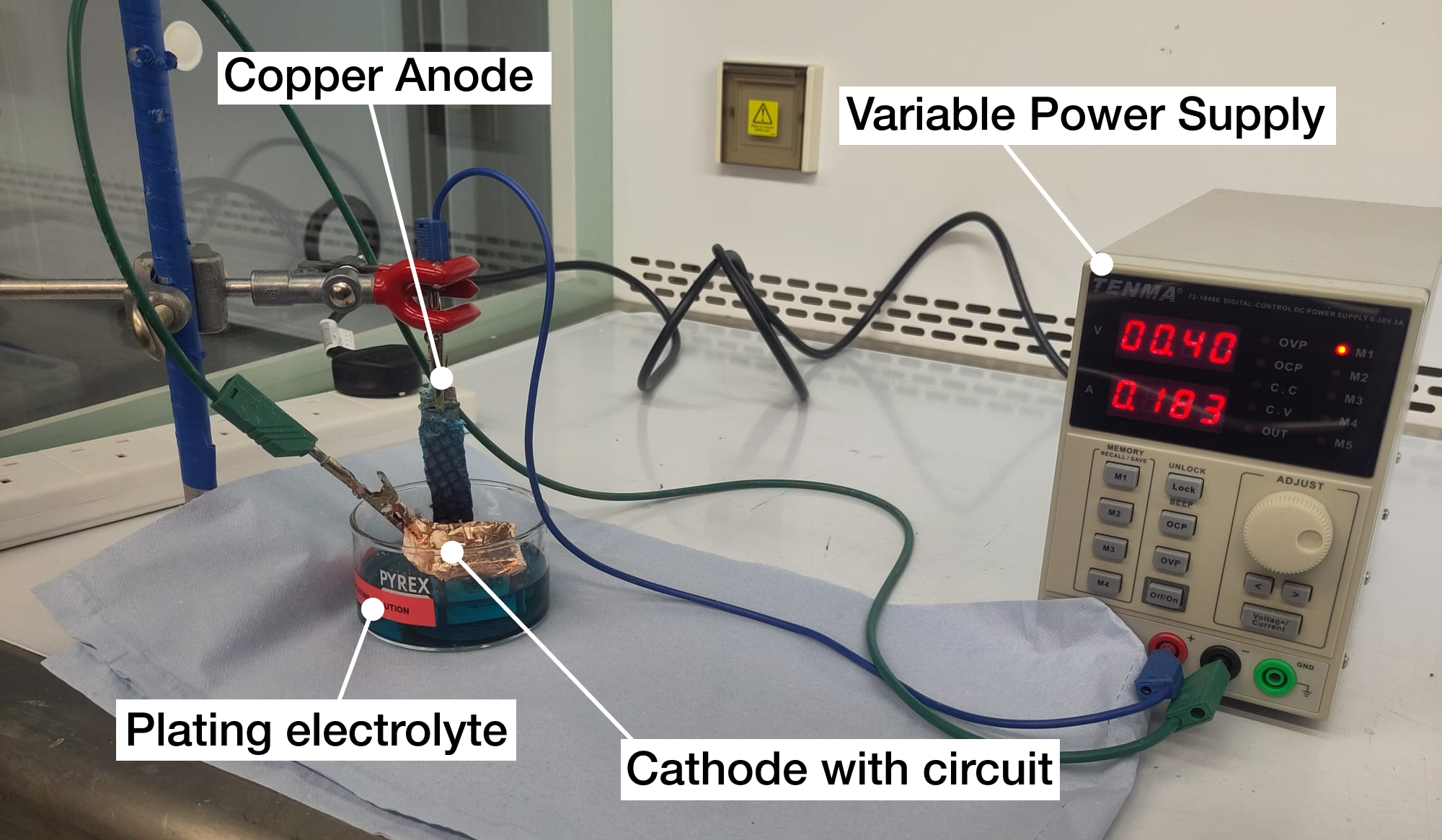
In order to enhance the conductivity of the deposited Electrifi traces and make them comparable with traditional PCBs, the samples were electroplated. The electrolyte consisted on a copper sulphate solution with sulphuric acid and brightener additives. The solution was poured in a shallow round beaker and the copper anode submerged and held up by a clamp. The cathode or part to plate required a more intricate setup as each individual trace/net required its own contact point with the power supply. The general setup is shown in Figure 7.
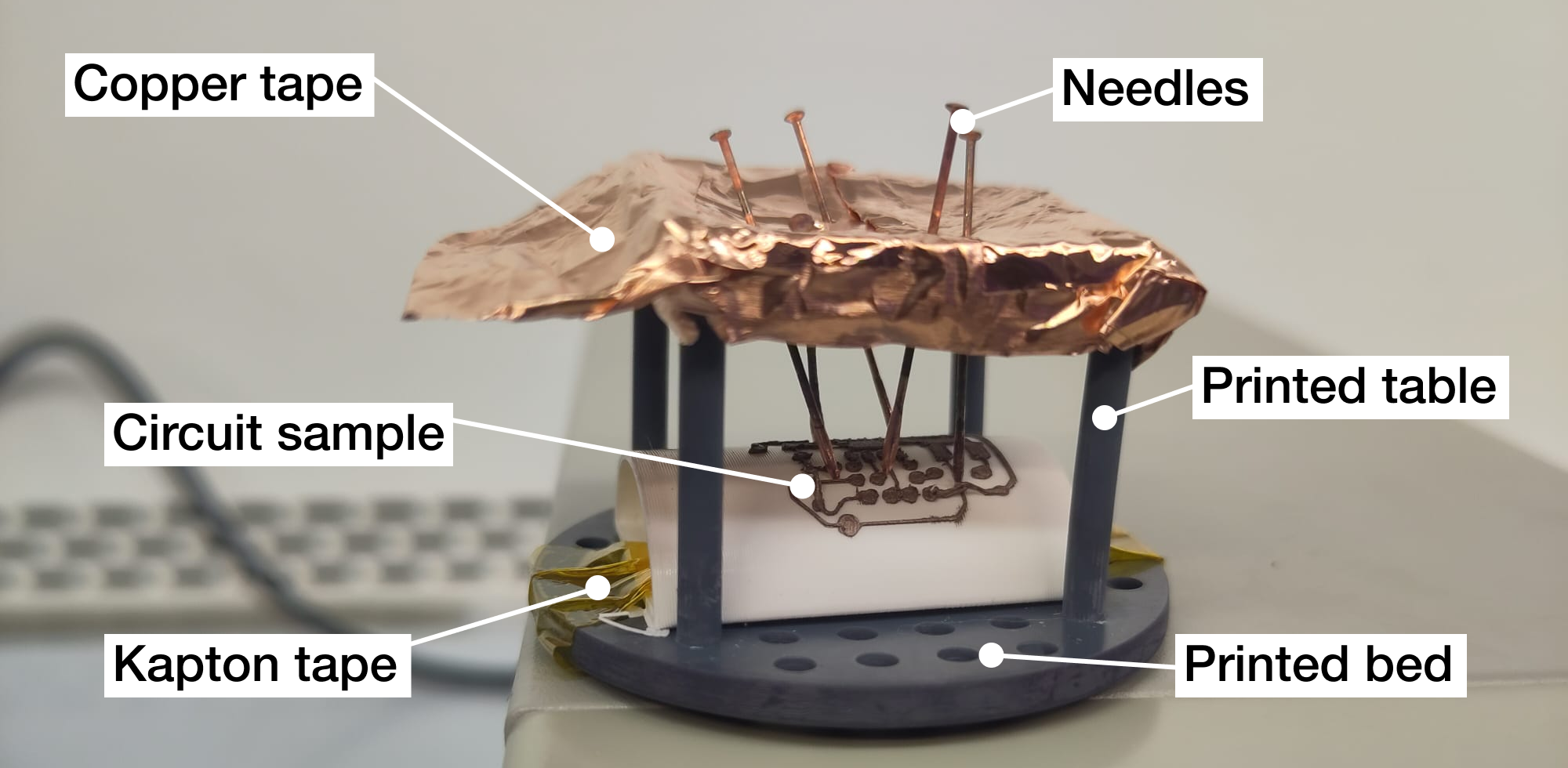
The cathode setup was a small 3D printed rig with a base and a table-like structure, Figure 8. The plating samples would be placed on the base and under the table structure. The top of the table structure would be covered with 3-5 layers of copper tape. Using needles, the copper tape would be pierced and each needle would then touch a trace to plate. Lastly, the copper tape would be connected to the ground of the power supply to complete the circuit. The copper tape acts as support for the needles ensuring they maintain contact with the traces while also providing the electrical connection required for the plating to happen.
The plating was carried out at 0.4 V which depending on the amount of target traces to plate would yield currents from 5 to 20 mA for about 20 minutes. Due to the size of the needles and the compactness of the circuit, only about 5 needles could be mounted consistently at a time, requiring multiple plating cycles per sample until all traces were plated. To achieve the most uniform plating, similar-size traces would be plated together in the same plating cycles. After plating, the samples were all tested for potential short circuits between neighbouring pads/traces, before proceeding to the component assembly.
2.4 Component assembly
In order to place components on the 3D printed circuits, soldering is not an ideal approach (although possible once plated). Even the melting point of leaded solder is high enough to liquefy PLA and Electrifi, which results in deforming the structure of the printed pads. Instead, conductive silver epoxy resin was used (MP011123). The 0603 passive components required very careful placement of the component and the resin. This silver-based resin tends to self-adhere a lot, become flaky and not stick to other surfaces. These effects make it difficult to work with, especially at such small scales. The craftsmanship required to mount the components manually is certainly comparable with SMD soldering. However, with the epoxy’s working time of 20 minutes the process becomes increasingly more difficult as time goes by and the permanent nature of such thermosets makes removing components or fixing shorts a more difficult task.
The approach taken in this work to mount the components was the following: Prepare the whole setup beforehand due to the strict 20 minutes working time. Prepare beforehand all the components planned to be mounted in this cycle and work under a microscope. Then in a small container mix a very small amount of epoxy (<0.1 g) using a larger spatula and set a 15 minute timer. Using a very small fine tip (e.g. the tip of a disposable syringe) pick up very small amounts of resin and deposit them in both pads, ensuring that there are no shorts (between pads and other traces) and that there will be enough resin for the component to set into. Using plastic tweezers, pick up the component and carefully press it into the resin on the pads, the component (given there is enough resin) should remain in place. Repeat this process for each component until the time is up, trying carefully not to hit by mistake any other component as the resin is still fresh. Once cured, another pass of resin is given to the components to strengthen the bonding.
There was a small caveat to the mounting of the components on the printed samples. When projecting the circuit into the substrate, it had been mirrored along the axis of the substrate which went unnoticed until the mounting of the components. This mirroring effect resulted in a physically unfeasible layout for mounting the regulator IC. However, if the IC is to be flipped and mounted upside down, the pinout does match. Due to component lead times, instead of redesigning the circuit samples, the regulator ICs were mounted upside down. The pins were carefully epoxied to the pads and the ground thermal pad was grounded using epoxy to pin 5.
2.5 Testing methodology
In order to validate the circuits, three different tests were carried out. The tests included a physical dimension test, to understand the variation between the design and the 3D printed samples, an electrical test to compare the circuit performance between the FR4, 3D printed samples and the intended design. Lastly a thermal test was carried out to test whether exposures to very low temperatures (-80 C) would impact or damage the 3D printed samples.
The first test was a visual inspection using a microscope followed by 14 physical measurements. The microscope images were used to compare the width of 7 pads and 7 gaps between pads/traces on the three 3D printed samples. These measurements were randomly chosen around the high-density area of the circuit, shown in Figure 9. Additionally, the bridges were perpendicularly imaged, measured and compared among the 3D printed samples. The measurements were performed on the 3D printed samples after electroplating and without components.
The second test performed was an electrical test where the circuits were connected to a 12 V power supply and the output voltage of the circuit measured using an oscilloscope (unloaded measurement). Due to issues with the regulator ICs, this test was only possible to be performed on one FR4 PCB sample (F2) and one 3D printed sample (P4). The circuits were then loaded with different load sizes (3.3 - 1.8 Ohm) and the output voltage and current were again recorded. The test results were compared among the two samples under the different loading conditions.
The last test was a thermal test where the F2 and C4 samples were placed in a freezer at -80 degrees for 1 hour and for 4 hours. After each cycle, they were taken out, left to reach room temperature, dried from condensed moisture and connected to the 12 V power supply. The voltages under unloaded conditions were measured and compared.
3 Results
3.1 Physical dimensions
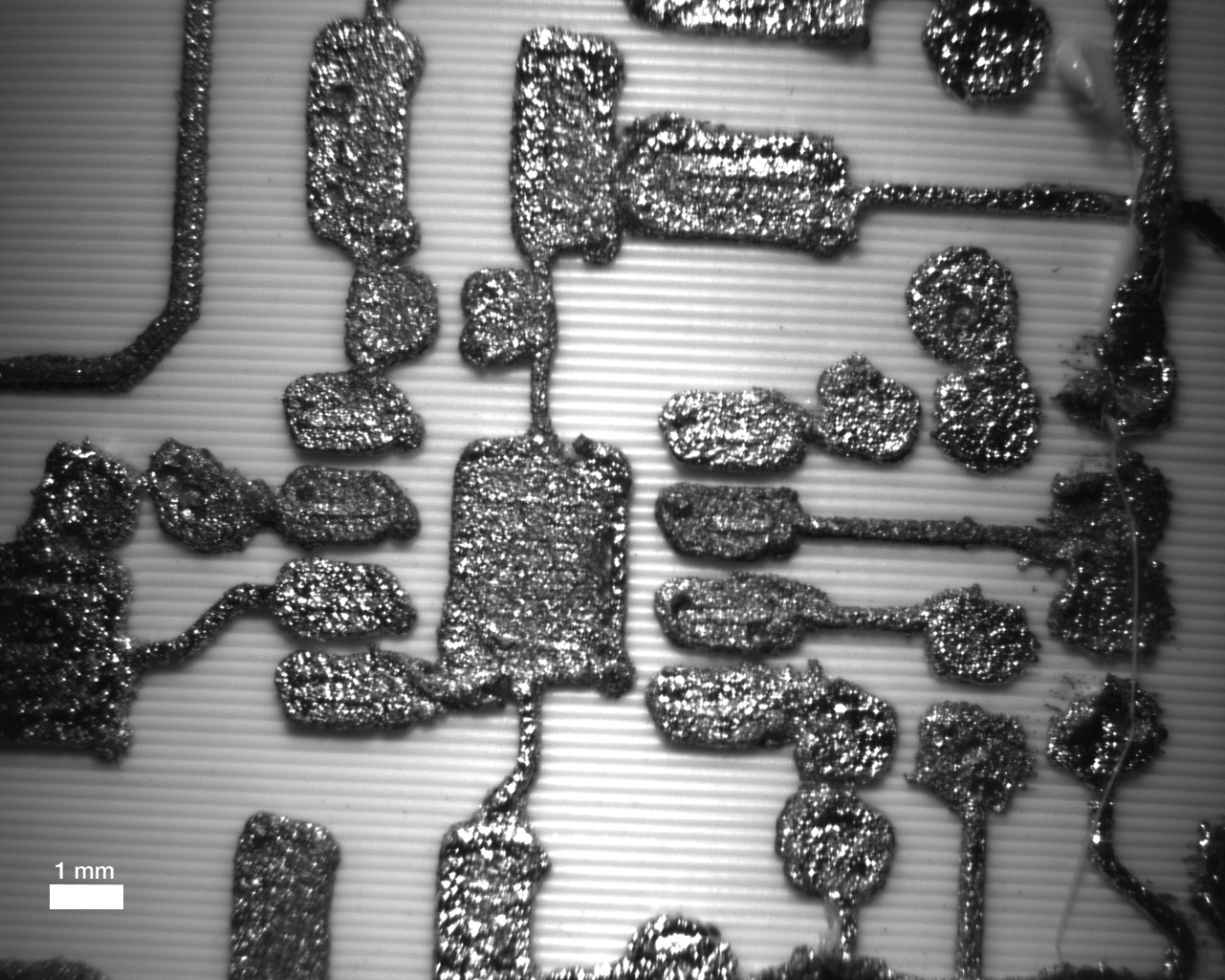
The following section presents the measurements taken from the microscope imagery of the 3D printed samples. Figure 10 is an example, showing P3 from the top with reference scale.
3.1.1 Traces and pads
Table 1 shows the measurements described on Figure 9 a) for each of the three 3D printed samples. The majority of the pads in the samples display larger pad widths than initially designed for. The difference in values ranges from -0.03mm (P4, 5) to + 0.44mm (P4, 4). Sample P1 is the most dimensionally accurate sample overall with an 11% average error over the 7 different measurements. P3 and P4 are slightly less accurate at 16.8% and 16.3% respectively. The smaller pads, suffered the largest amount of relative error which was expected given the their overall dimensions is closer to the nozzle diameter and machine tolerances.
| Pad width measurement | Design (mm) | P1 (mm) | P3 (mm) | P4 (mm) |
|---|---|---|---|---|
| 1 | 1.75 | 1.84 | 2.00 | 1.99 |
| 2 | 1.37 | 1.63 | 1.53 | 1.55 |
| 3 | 1.21 | 1.44 | 1.48 | 1.56 |
| 4 | 1.21 | 1.38 | 1.64 | 1.65 |
| 5 | 2.64 | 2.70 | 2.65 | 2.61 |
| 6 | 2.96 | 3.19 | 3.29 | 3.23 |
| 7 | 1.77 | 1.95 | 2.16 | 1.98 |
| Average error (%) | NA | 11.3 | 16.8 | 16.3 |
Table 2 shows the measurements for the 7 trace width and spacing measurements, described on Figure 9 b) for each of the 3D printed samples. The measurements taken on the trace widths (2,3 and 5) were mostly larger than intended across all samples, with relative errors ranging from -0.02 mm (P1, 5) to +0.10 mm (P3, 2). This was particularly noticeable on measurements 2 and 3, whereas in measurement 5, all samples followed the intended 0.25 mm more closely. Contrary to the pad and trace widths, the spacings were smaller than in the digital design, with relative differences ranging from -0.23 mm (P4, 4) to -0.06 mm (P1, 6). As with the pad width measurements, P1 has the lowest overall average error (18.3%) across the trace width and spacing measurements resulting in the highest dimensionally accurate sample. On the other hand and similar to the other measurements, P3 and P4 are closer together at 23.6% and 21.3%.
| Pad width measurement | Design (mm) | P1 (mm) | P3 (mm) | P4 (mm) |
|---|---|---|---|---|
| 1 | 0.34 | 0.26 | 0.17 | 0.22 |
| 2 | 0.25 | 0.30 | 0.35 | 0.27 |
| 3 | 0.25 | 0.30 | 0.28 | 0.31 |
| 4 | 0.59 | 0.43 | 0.42 | 0.36 |
| 5 | 0.25 | 0.23 | 0,27 | 0.26 |
| 6 | 1.55 | 1.49 | 1.38 | 1.38 |
| 7 | 0.48 | 0.34 | 0.40 | 0.34 |
| Average error (%) | NA | 18.3 | 23.6 | 21.3 |
3.1.2 Bridges
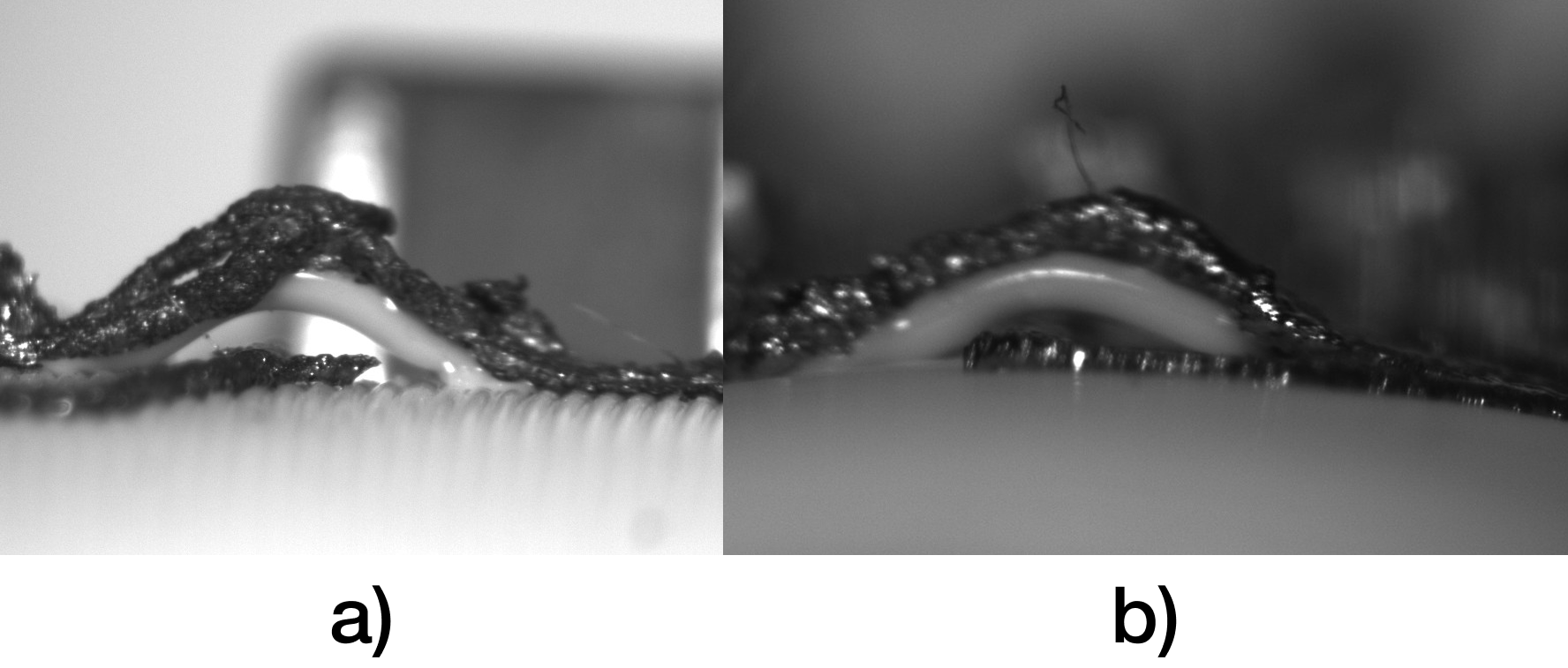
Table 3 displays the measurements taken from both bridges on all three 3D printed samples. The bridges are labelled as B1 and B2, when looking at Figure 9, the green traces mark the two bridges. B1 is the bottom bridge and B2 is the top bridge. The results show large disparities (in the range 26%-73% absolute errors) between the intended dimensions of the bridges and the actual printed ones. The width of the bridges had an overall better dimensional accuracy with values ranging between 26% (P4,B2) to 42.9% (P4,B1). Regarding the height of the bridges, the errors were significantly higher with values between 56.8% (P1,B1) all the way to 73.9% (P3,B1). On average, among the three samples there were no significant differences between B1 and B2. In terms of dimensional accuracy the best bridge was B2 on P1 and the worst one was B1 on P3, showing the same pattern as with the printed traces, where P1 has the highest dimensional accuracy and P3 the lowest. Both B2 P1 and B1 P3 are shown on Figure 11.
| Bridge name | Design | B1 P1 | B2 P1 | B1 P3 | B2 P3 | B1 P4 | B2 P4 |
| Width (mm) | 2.6 | 1.60 | 1.89 | 1.58 | 1.73 | 1.48 | 1.92 |
| Height (mm) | 1.15 | 0.50 | 0.44 | 0.30 | 0.33 | 0.40 | 0.36 |
| Width error (%) | NA | 38.4 | 27.4 | 39.2 | 33.6 | 42.9 | 26.12 |
| Height error (%) | NA | 56.8 | 61.8 | 73.9 | 70.9 | 65.2 | 68.53 |
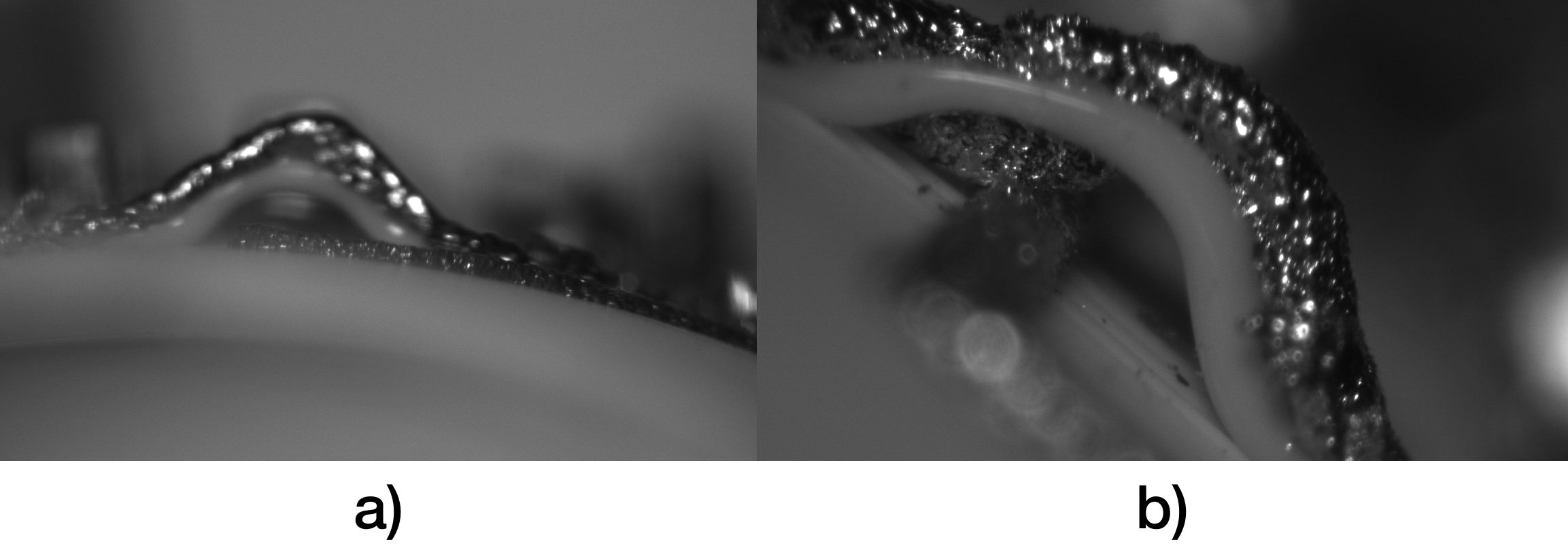
However, the dimensional accuracy of the PLA bridges is not the best metric to assess the quality of actual bridging, as it does not provide any information on the deposited Electrifi traces. Performing a purely qualitative assessment on the bridging traces, the best and worst bridges result to be B1 P1 and B1 P4, pictures in Figure 12. It can be seen how on B1 P1, the two Electrifi layers follow closely the PLA bridge and do not overflow or fall. On the other hand, B1 P4 appears to have a successful first layer but the second one appears to overflow and fall over the bridge. The falling of that trace actually touches the trace underneath causing a short. However, this is not an actual electrical issue as both of these nets are ground, they were just separated as part of the manufacturers layout guidelines to minimise noise from getting on the regulator’s feedback signal.
3.2 Circuit testing
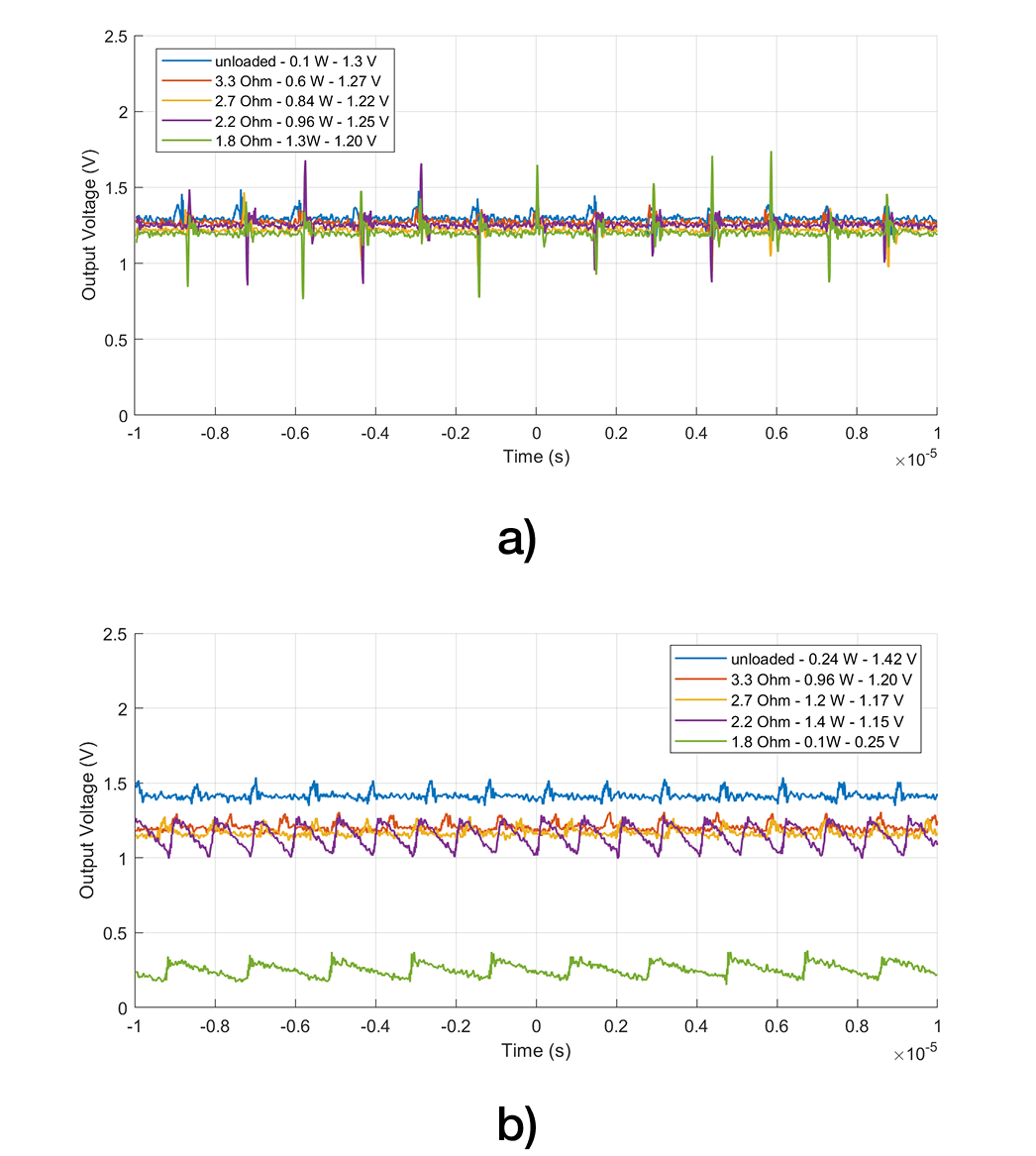
The results of the electrical testing carried out to F2 and P4 are graphically displayed on Figure 13. F2 showed a more stable behaviour overall. When unloaded the output average voltage was 1.3 V, as originally designed. When loaded with 1.8 Ohms, the average voltage dropped to a minimum of 1.20 V. The overall trend with F2 was a small decrease in voltage as a function of the loading which varied between (1.2 V to 1.3 V). F2 showed periodic high and low voltage peaks at a frequency of around 600 kHz, which reached over 1.5 V and below 1 V. P4 showed overall a less stable and in some cases, noisier behaviour as a function of loading. Unloaded, P4 output an average voltage of 1.42 V, +0.12 V higher than the original design. As it was further loaded the voltage lowered to 1.17 V under 2.7 Ohms. Up to this point, the output voltage was stable with small traces of the 600 kHz periodic peaks and troughs. When loaded with 2.2 Ohm, the output voltage became significantly more oscillatory and with greater peak-to-peak voltage, following a sawtooth pattern at a frequency of around 1 MHz. However, the average output voltage did not drop significantly, remaining at around 1.15 V. Pushing the loading further to 1.8 Ohm caused a great drop in voltage down to about 0.25 V, the power consumption also dropped significantly to about 0.1 W and the sawtooth oscillatory pattern on the output voltage appeared at a frequency of approximately 600 kHz. Under the tests performed, both circuits were able to deliver similar amounts of power to the load, although F2 was able to do so more reliably, it did not show signs of failure and would likely be able to deliver larger currents.
3.3 Thermal testing
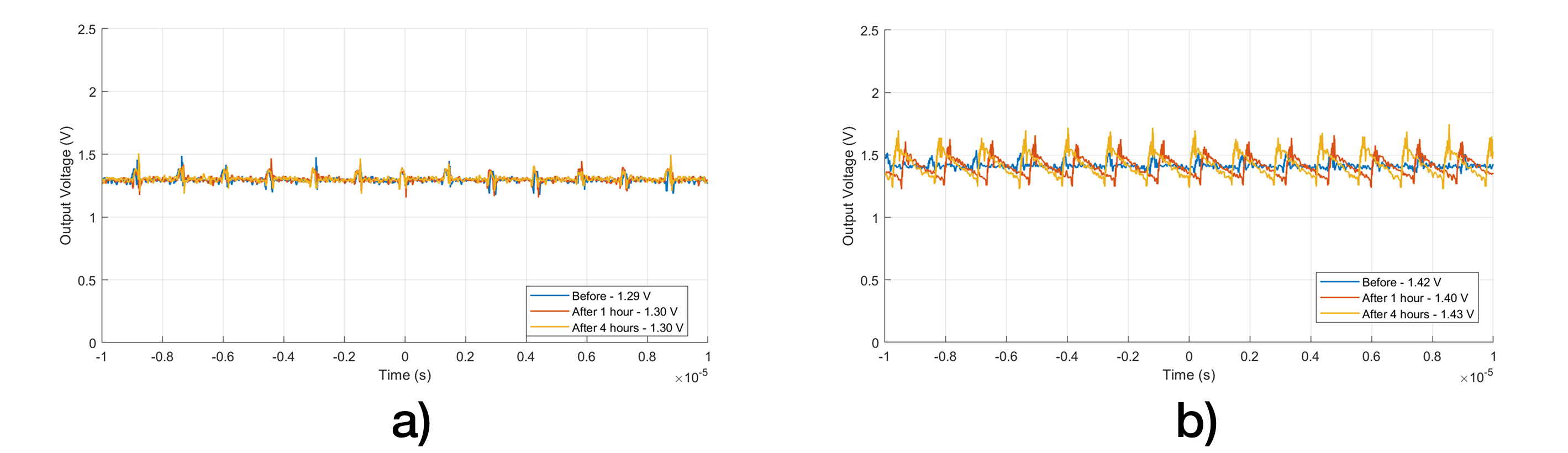
Figure 14 shows the output voltage after the low-temperature exposure to both F2 and P4 (unloaded). After both the 1 and 4 hour cycles, F2 does not appear to have suffered any effects as the output voltage before and after the testing look very similar. P4 shows higher disparities compared to before the thermal testing. The largest differences appear when comparing before and after the first 1 hour cycle, showing the sawtooth, oscillatory behaviour which appeared on the loading tests after certain loading. Between the 1 hour and 4 hour cycle it does not appear to have varied significantly with both tests resulting in similar output sawtooth patterns.
4 Discussion
4.1 Circuit fabrication evaluation
The results of the physical measurements showed that the printed Electrifi, almost always resulted on larger printed parts with errors in the order of 18%. Although significant, for this particular circuit layout, it was acceptable, demonstrating the ability to print dense SMD circuits with small footprints. The printed samples did not show shorting, apart from the B1 bridge on P4. The source of these dimensional differences is believed to be a combination of two factors. The first one, thought to be the main contributor to the size differences on the pads, is the retraction motion between travels. After printing a pad or a trace the nozzle will stop for 200 ms, retract and then move vertically, perpendicularly from the substrate. Often if there is Electrifi residue on the nozzle, some plastic will get adhered to the printed pad causing bulging in one of the corners (this effect can be seen repeatedly on Figure 10). This effect also makes the pads look more irregular and not resemble the rectangles/squares they were designed to be. The other effect causing disparities in both traces, pads and spacings has to do with potential errors and mismatches during the 5-axis calibration process. An error between the predicted and the actual centre of rotation (for either of the axes) will result in the substrate being on a different position to the intended g-code generator position. This error in position can appear on either of the 3 directions (X,Y,Z) and often results in differences in height when printing, hence differences on the thickness of the printed traces.
All the printed bridges were significantly different from the programmed toolpaths. This was thought to possibly happen, and the bridges were made larger intentionally. These disparities were caused by a combination of gravity, non-effective cooling and fast printing speed. In microgravity, the same settings used in this work would likely result on better dimensionally accurate bridges. On Earth, printing to achieve these free hanging structures requires either a faster cooling implementation or a printing speed reduction. When testing the manufacturability of the bridges it was noted that often it is more desirable to have a less steep bridge. If the adhesion between the Electrifi trace and the bridge is not sufficient, the printed trace will peel off when going through the steepest part of the bridge. Overall, the manufacturability, electroplating and functionality of the bridges were successfully demonstrated. One possible improvement for these structures could look at printing an adjacent PLA trace to prevent the Electrifi traces from dropping to make the circuit more resilient to small position errors between tool-heads.
Regarding the circuit performance, the F2 FR4 PCB sample served as a great benchmark to ensure that the schematic design and layout were sound and worked as intended. The periodic peaks seen on both samples are most definitely product of the switching action, as the switching frequency of the device is 650 kHz. The amplitude and duration of these peaks is relatively small and their existence of these on the F2 sample likely have to do with the lack of a ground plane layer to ensure better return/decoupling on the output capacitor. The performance mismatches of P4 can be broadly split into two: the set point mismatch when unloaded and then the sawtooth behaviour when loaded in excess. The voltage set point offset to 1.42 V instead of 1.3 V is thought to be caused by additional resistance introduced by suboptimal bonding between the feedback resistors and the silver epoxy. It is not believed to be a tolerance error as the resistors used had a tolerance of 1% which in the worst case scenario, would result on an output voltage of 1.33 V. The sawtooth behaviour appears to be the result of stress on the circuit. Given the results of the thermal testing (showing sawtooth pattern when unloaded), suggest that passing those higher currents during the electrical loading tests could have permanently impacted the circuit. It is not thought that the chip got damaged, but instead a thin or poorly plated trace. When passing those higher currents though that equivalent small trace it could have heated too much enough to deform the trace and alter the conductivity. Because of the oscillatory nature of the output voltage, following this broken trace theory, the affected trace could be one of the 2 traces connecting the output capacitor (C16). Despite this, the 3D printed circuit was proven to be able to deliver a fair amount of wattage (sufficient to actuate the intended burn-wire) without the use of larger copper polygons.
Preliminary thermal testing did not appear to have any effect on F2. When it comes to P4, the behaviour appears to be different before and after the thermal tests. However, this is believed to be a product of the electrical loading testing and not the thermal testing. No visible cracks, defects or delamination were identified on either of the samples. To further investigate the effects of uneven shrinkage on the 3D printed samples, longer, repeated thermal cycling should be performed.
4.2 Human-space environment evaluation
This work showed the technical feasibility of this methodology to produce functional, conformal, SMD circuitry. However, for its use in space, it is required to evaluate the suitability of such a process in a human-space environment and how it would fit within an astronaut workflow.
4.2.1 System evaluation
The overall methodology can be split into three different steps, each of these taking happening within a different part of equipment and materials, these are shown on Figure 15.

In terms of equipment, the system is a couple of orders of magnitude less complex than other in-space 3D printing electronics solutions. The main reason is because these systems are more focused on microelectronics and component fabrication than substrate and circuit fabrication. The lower complexity of this system means that it is easier to operate, requiring less training and being more accessible to the entirety of a mission’s crew (as it is essentially regular MEX 3D printing with a couple extra steps). The lower complexity means tat the system is cheaper, easier to fix and easier to maintain. On the other hand, the system is more limited when it comes to printing scale, resolution and repeatability, but for the larger scale circuitry this system proves to be significantly more advantageous. Lastly, the number of different types of materials required to produce circuitry is relatively low (not including components), requiring only PLA, Electrifi, Electrodes, plating solution and conductive epoxy.
The main bottleneck of such a system is definitely the component assembly, as in the proposed solution it is done manually. The reason it was done manually is due to the conformality of the substrate and the bonding method, which make it incompatible with traditional pick-and-place machines. The use of epoxy for bonding makes the process more time consuming, more error prone and less reversible. This is not a unique issue to this system and in general cold-bonding for electronics is a highly relevant research area.
Nevertheless, the low complexity of such an approach poses high benefits that inherently make the on-demand fabrication of electronics circuitry more resilient, and in turn making space missions more resilient too.
4.2.2 Example use case and workflow
The following section provides and example situation during a space mission where the proposed system would highly enhance mission resilience. In this specific scenario, this is achieved through in-mission upgrades, which allow the crew to achieve higher scientific return. The scenario uses an example where conformality is highly desired, but the system is not limited to these curved structures.
“A settlement on mars is currently studying the low-density Martian atmosphere, they are interested in producing and testing Martian aircraft. They have spent the first few months of their mission performing measurements and now have a good understanding on the density, winds and other Martian atmospheric events. Thanks to generative design they were able to produce a variety of optimised small aircraft designs and would like to start trialling these on a real-life scenario. For this reason, they will be making use of their multi-axis, multi-material MEX 3D printer to produce aerodynamic surfaces with highly integrated on-board electronics on the structure. They were able to test a variety of designs, iterate a couple of times and achieve a highly efficient Martian aircraft design. Thanks to the ability to produce these lightweight, highly integrated, functional, conformal structures they were able to produce a large swarm of Martian aircraft which now image the surrounding areas and produce really valuable scientific data for future ore extraction and settlement determination.”

With the understanding on how this system can fit within a space mission, the remaining part of this section will outline what the workflow would look like for an astronaut using the proposed system.
The whole system would exist inside a human habitat and for astronauts to use. First it would require the design of the circuit from an electrical point of view, this design would then be laid out within a highly integrated CAD tool, automatically projecting onto the target geometry the traces and pads. The CAD design could be done from Earth and sent to the crew to print or entirely developed by the crew on-site. The G-code for the target design would be easily generated requiring minimal intervention from the astronauts (as with current commercial slicers). The astronaut would then load the machine and print the parts. After printing, they would perform a visual inspection on the deposited traces, aiming to find open or short circuits. If the print was to fail it could be re-printed (settings could be adjusted if deemed required). A successful print would then be taken to be electroplated, in a low-gravity plating bath enclosure. After even plating, the astronaut would then perform an electrical test to ensure there have been no shorts from copper deposition on adjacent pads and traces. Lastly, the astronaut would have to manually place and bond the components using conductive epoxy. After curing, they can be tested and qualified for their respective space applications.
As seen, after printing, the process becomes relatively involved, requiring the astronaut to manually perform tests, plating and assembly. Despite this, it is acceptable for the low-volume high-variety, prototyping and repairing activities an astronaut would encounter. The authors believe it is possible to optimise this system to be more integrated and automatic, without increasing a significant increase in complexity.
5 Conclusion and Future Work
In conclusion, this work has demonstrated the ability to produce complex conformal circuitry using multi-material, multi-axis MEX and electroplating. It has been proposed and demonstrated the use of small multi-material bridges as a lightweight way to address miniaturisation on 3D printed electronics. The physical dimensions of the printed parts were evaluated and compared among samples. The electrical performance of the 3D printed circuit was compared against a FR4 PCB benchmark and showed the ability to regulate and deliver current. The printed part showed more noise and less reliable behaviour but demonstrated the ability of this method to produce conformal rigid complex functional circuitry. Overall, it was demonstrated how a lower complexity, lower cost method such as multi-material MEX could be used as an alternative to other electronics, in-space manufacturing methods. This work presents a proof of concept and its real-world, in-space implementation requires a more careful examination to the underlying processes. Future work should look at a more extensive/complex circuit characterisation, more reliable ways to miniaturise 3D printed circuitry (bridges) with the ultimate goal of increasing reliability and repeatability in MEX 3D printed electronics.
References
- [1] Q. A. Bean, K. G. Cooper, J. E. Edmunson, M. M. Johnston, and M. J. Werkheiser. International space station (ISS) 3d printer performance and material characterization methodology. In International Space Station (ISS) 3D Printer Performance and Material Characterization Methodology, 2015. NTRS Author Affiliations: NASA Marshall Space Flight Center, Jacobs Technology, Inc. NTRS Report/Patent Number: M15-4562 NTRS Document ID: 20150016234 NTRS Research Center: Marshall Space Flight Center (MSFC). URL: https://ntrs.nasa.gov/citations/20150016234.
- [2] Rui Dou, Weizhe Tang, Kaixin Hu, and Li Wang. Ceramic paste for space stereolithography 3d printing technology in microgravity environment. Journal of the European Ceramic Society, 42(9):3968–3975, 2022. doi:10.1016/j.jeurceramsoc.2022.03.030.
- [3] Curtis Hill, Frank Ledbetter, and Curtis Hill. Space technology mission directorate. unknown, 2022.
- [4] Freddie Hong, Steve Hodges, Connor Myant, and David Boyle. Open5x: Accessible 5-axis 3d printing and conformal slicing. In CHI Conference on Human Factors in Computing Systems Extended Abstracts, pages 1–6, 2022. doi:10.1145/3491101.3519782.
- [5] NS Kilkenny. 3d printed rocket launched using innovative nasa alloy. nasa. gov, 2023.
- [6] Weibin Li, Ding Lan, and Yuren Wang. Exploration of direct-ink-write 3d printing in space: Droplet dynamics and patterns formation in microgravity. Microgravity Science and Technology, 32(5):935–940, 2020. doi:10.1007/s12217-020-09820-0.
- [7] Mao Mao, Zijie Meng, Xinxin Huang, Hui Zhu, Lei Wang, Xiaoyong Tian, Jiankang He, Dichen Li, and Bingheng Lu. 3d printing in space: from mechanical structures to living tissues. International Journal of Extreme Manufacturing, 6(2):023001, 2024. Publisher: IOP Publishing. doi:10.1088/2631-7990/ad23ef.
- [8] T. J. Prater, N. J. Werkheiser, and F. E. Ledbetter. Summary report on phase i and phase II results from the 3d printing in zero-g technology demonstration mission. NTRS Author Affiliations: NASA Marshall Space Flight Center, Wheelhouse Consulting, LLC NTRS Report/Patent Number: M-1457 NTRS Document ID: 20180002403 NTRS Research Center: Marshall Space Flight Center (MSFC). URL: https://ntrs.nasa.gov/citations/20180002403?utm_source=chatgpt.com.
- [9] Shannon Ridinger. Nasa’s dragonfly project demonstrates robotic satellite assembly critical to future space infrastructure development. NASA, 2017.
- [10] Ellie Schlake and Nirmala Kandadai. Laser sintering direct ink write silver nanoflake ink for on-demand manufacturing of electronics in space. IEEE Journal on Flexible Electronics, 3(6):242–251, 2024. Conference Name: IEEE Journal on Flexible Electronics. doi:10.1109/JFLEX.2024.3384331.
- [11] Adam Thurn, Steve Huynh, Steve Koss, Paul Oppenheimer, Sam Butcher, Jordan Schlater, and Peter Hagan. A nichrome burn wire release mechanism for CubeSats. The 41st Aerospace Mechanisms Symposium, 2012.
- [12] “unknown”. URL: https://www.esa.int/Science_Exploration/Human_and_Robotic_Exploration/ESA_launches_first_metal_3D_printer_to_ISS.
- [13] “unknown”. Manufacturing and repairing of micro-patterns for electronics in micro-gravity through high precision capillarity printing (hpcap). URL: https://activities.esa.int/4000144338.
- [14] “unknown”, January 2025. URL: https://swissto12.com/products/space/.
- [15] “unknown”, May 2025. URL: https://hummink.com/products-nazca-prototyping-precision-possibilities/.
- [16] Andrea Zocca, Jörg Lüchtenborg, Thomas Mühler, Janka Wilbig, Gunther Mohr, Thomas Villatte, Fabien Léonard, Gert Nolze, Marc Sparenberg, Jörg Melcher, Kai Hilgenberg, and Jens Günster. Enabling the 3d printing of metal components in µ-gravity. Advanced Materials Technologies, 4(10):1900506, 2019. doi:10.1002/admt.201900506.