A Research Framework to Develop a Real-Time Synchrony Index to Monitor Team Cohesion and Performance in Long-Duration Space Exploration

Abstract
As humanity prepares for long-distance space exploration, optimizing group performance, the ability of a group to achieve its goals efficiently, is critical. Astronaut crews will endure isolation, confinement, and operational stress, making group synchrony – the alignment of behaviors, emotions, and physiological states – a key factor in mission success. Synchrony influences team cohesion, performance, and resilience, necessitating effective crew management strategies. This paper proposes a framework for a real-time, unobtrusive index of group synchrony to support astronauts and mission control. Research indicates that team cohesion fluctuates in isolated environments, with reduced communication and interpersonal conflicts emerging over time. A system tracking synchrony could mitigate these issues, providing proactive support and improving remote management. Additionally, it could serve as a cognitive and physiological feedback tool for astronauts and a decision-making aid for mission control, enhancing well-being and efficiency. Our approach integrates behavioral and physiological synchrony measures to assess team cohesion and performance. We propose a multi-modal synchrony index combining movement coordination, communication patterns, and physiological signals such as heart rate, electrodermal activity, and EEG. This index will be validated across different tasks to ensure applicability across diverse mission scenarios. By developing a robust synchrony index, we address a fundamental challenge in space missions: sustaining team effectiveness under extreme conditions. Beyond space exploration, our findings could benefit high-risk, high-isolation teams in submarine crews, polar expeditions, and remote research groups. Our collaboration with the Centre National d’Etudes Spatiales, the Institut de Médecine et de Physiologie Spatiales, and the Toulouse University Hospital marks the first step, with experimental data collection starting this year. Ultimately, this research fosters more adaptive, responsive, and resilient teams for future space missions.
Keywords and phrases:
Performance, Synchronie, Crew monitoring, CohesionCopyright and License:
![[Uncaptioned image]](x1.png) © Federico Nemmi, Emma Chabani, Laure Boyer, Charlie Madier, and Daniel Lewkowicz; licensed under Creative Commons License CC-BY 4.0
© Federico Nemmi, Emma Chabani, Laure Boyer, Charlie Madier, and Daniel Lewkowicz; licensed under Creative Commons License CC-BY 4.0
2012 ACM Subject Classification:
Applied computing Life and medical sciencesEditors:
Leonie Bensch, Tommy Nilsson, Martin Nisser, Pat Pataranutaporn, Albrecht Schmidt, and Valentina SuminiSeries and Publisher:
 Open Access Series in Informatics, Schloss Dagstuhl – Leibniz-Zentrum für Informatik
1 Context
Human space exploration, particularly long-distance space exploration missions (LDSEM), represents one of the most challenging frontiers for human performance and adaptation. Among the many factors influencing mission success, group performance, defined as the ability of a group to achieve its goals efficiently, and synchrony, defined as the alignment of behaviors, emotions, and physiological states, are a critical area of focus, since it has been repeatedly shown that group synchrony and performance are positively associated. These concepts, encompassing how well a team collaborates, aligns in behavior, and maintains a shared cognitive and emotional state, are essential to the sustained operational efficiency and psychological well-being of astronauts. The unique demands of space missions – including isolation, confinement, extreme environmental conditions, and prolonged stress – highlight the need to understand and optimize group performance and synchronization to ensure the safety of operations, mission success, and crew health. The importance of group synchrony in LDSEM has not gone unnoticed. Indeed, several studies have focused on group dynamics and synchrony in teams that lived and worked together for different stretches of time, sometimes for prolonged periods of time and in conditions simulating those of LDSEM (i.e., Isolated and Confined Environments, hereafter ICE). A recent review and meta-analysis [5] summarised the findings of several analogue missions of different lengths and with and without ICE conditions. Bell and colleagues found that the relationship between cohesion, defined as the members’ inclinations to forge social bonds and stick together, and performance was positive and significant for teams with the following characteristics: living and working together for shorter stretches of time, and not in ICE conditions. At variance with this result, this relationship was not as clearly observable in group living and working together for longer stretches of time, and in ICE conditions. This is probably related to the fact that cohesion, among other team dynamics, tended to fluctuate more for teams in ICE than for teams in non-ICE conditions [5], possibly masking existing associations. In line with this idea, two other major patterns were observed for ICE missions: communication between crew members and the mission control (MC) tended to sharply decrease with time and all missions reported at least one conflict among members at the mark of 90 days or by 40% of elapsed mission time [5]. The above mentioned meta-analytical results highlight the great positive impact that a continuous, real-time, unobtrusive index of group synchrony may have on LDSEM. Indeed, if cohesion, a proxy of group synergy, shows highly fluctuating levels, then tracking it at any given time will help to follow the group dynamic more closely. This could, in turn, allow for targeted interventions to restore synergy. The tracking of group cohesion might be even more critical if sensitive cooperative tasks, whose performance is associated to synchrony levels, are to be performed. When communications between crew and the MC decrease with time, the MC could benefit from a group synchrony index, since overt communication could dwindle to a level where inferring group synchrony would be impossible. Additionally, the synchrony index could help MC unmask latent or unresolved conflicts, and their after-effects, within the team and react by putting more emphasis on group synchrony during critical phases of missions. Finally, the crew itself could benefit from a measure of their current synchrony, especially because teams seem to be able to stabilize their level of synchrony when feedback about it is provided [11]. The current work details our group’s efforts to develop the research framework needed to develop a real-time, continuous and unobtrusive index of group synchrony, to be used not only during LDSEM, but also in other contexts where tracking group synchrony is of essence. The paper is structured as follows: the first part focuses on the theoretical model of group performance, the second part focuses on group synchrony, the third part proposes a theoretical framework relating group performance and synchrony, and the final part reports the proposed research framework while highlighting the questions that remain open.
2 Group performance
2.1 Input – mediating mechanism – outcome
Understanding group performance and synchrony requires a clear model of group functioning. Theoretical models play a crucial role in research, intervention design, and performance measurement. They help link physiological dynamics with team behavior, emotions, and outcomes. One of the most influential models in this field is the Input-Process-Outcome (IPO) model, originally introduced by McGrath [50] and later refined by Hackman and Morris [29]. The IPO model describes group functioning as a transformation of inputs – such as individual traits, team structure, and task constraints – through processes involving member interactions, leading to outcomes like goal achievement and perceived team effectiveness. Over time, researchers have expanded the model to include mediating mechanisms beyond physical behavior, such as shared cognition and motivation, leading to the Input-Mediating Mechanism-Outcome (IMO) framework [35, 45, 47]. Further refinements, like the Input-Mediating Mechanism-Outcome-Input (IMOI) model, recognize that outcomes can influence future inputs, particularly in long-term teams. While these models have shaped research on group performance for decades, contemporary perspectives increasingly view teams as dynamic, multi-level, and complex systems that may require alternative modelling approaches to better capture the intricacies of team interactions and performance over time.
2.2 Mathieu model
The Mathieu model was put forward in a seminal paper in 2017 [48] and sees the elements concurring to group performance as belonging to three main groups: 1) structural features, akin to environmental and task-related inputs in the IMOI models), 2) compositional features, akin to individual-based inputs, such as personality traits in the IMOI models, and 3) mediating mechanisms. However, rather than be seen as compartmentalized, the elements included in these 3 groups are seen as overlapping and co-evolving over time. Structural features are environmental and task-related, such as task scope and complexity that work towards group effectiveness [48]. Compositional features include elements pertaining to individual group members, such as IQ or personality traits, whose combination defines group-wise characteristics, such as the average IQ of the team or diversity, if heterogeneity is measured [46]. Finally, the mediating mechanisms are affective, behavioral, and cognition interdependent processes that convert inputs to outcomes. Such team processes can be conceived as transition, action, interpersonal processes, and emergent states that occur in varying episodic cycles [45]. Among the emergent states related to teams functioning, those deemed to be most important are cohesion, defined as the bond among team members [3], trust, and team potency, defined as the team’s shared belief about their ability to accomplish relevant goals [63]. Meta-analyses of the relevant literature have shown that cohesion and team potency are positively related to team objective performance [34, 63], whereas trust is related to both objective team performance and affective outcomes [7, 16].
3 Synchronization
Group synchronization refers to the coordinated alignment of actions, emotions, and physiological processes among individuals. It occurs at behavioral (actions, communication), cognitive (thoughts, emotions), and physiological (brain and autonomic activity) levels, all of which are linked to group performance [18, 40, 43, 49]. Research has explored how these levels interact – whether physiological synchronization stems from behavioral or affective synchronization – but there is no consensus. Although causal mechanisms remain debated, studies have identified key relationships, such as the impact of task complexity on team physiology and the link between cohesion and behavioral synchrony. The following sections will describe these levels and their empirical connections.
3.1 Behavioral synchrony
Behavioral synchrony refers both to physical movements and actions and to communication. In light of the theoretical models described above, synchrony in these domains falls within the mediating mechanism group of features and can be thought of as akin to the processes in the IPO model.
3.1.1 Measures of behavioral synchrony
Behavioral synchrony can be assessed with both manual and automatic methods. As for manual methods, annotation of video recordings of team members performing the assigned task has been used. Trained observers assess whether a behavioral or communication interaction is present or absent among dyads in the team and within windows of fixed time [25]. These types of methods have been validated in empirical studies [25, 68], but are not compatible with the real-time tracking of synchrony levels. However, automatic methods have been developed, such as measuring the association between team members’ movements, estimated using video-based optical flow [15, 54, 55], or measured using accelerometers worn on the effectors involved in the completion of the task [12]. Although this family of measurement can be used for real-time synchrony tracking, it has some limitations. For one, synchrony measures based on movement estimation from video-based optical flow are better suited for tasks where participants stay relatively still. Indeed, involuntary and automatic body and posture adjustments related to non-verbal communication are measured. As such, these measures are adapted for tasks such as brainstorming or decision making, where team members are seated, rather than to tasks demanding complex movements (e.g., assembling a Lego set). At variance, features based on measuring the movements of the effectors used for task completion are intrinsically task-specific: it is necessary to know in advance the effector(s) that will be used for task completion and the best placement for the accelerometers. As such, these measures are hard to generalize across tasks. As for communication synchrony, automatic methods have also been developed based on the similarity of words used by team members, detected by speech recognition algorithms [26] or by measuring recurrent patterns in the temporal structure of the conversation [23]. These methods are compatible with real-time detection and have the intrinsic advantage of being generalizable across tasks, as long as communication between team members is allowed and relevant. However, they are resource-intensive from an operational viewpoint, as each team member should be equipped with a microphone, and the speech recognition algorithm and similarity assessment are computationally intensive.
3.1.2 Behavioral synchrony and group outcomes
Behavioral synchrony is closely linked to group outcomes, influencing relationship formation, cohesion, rapport, and performance. [67, 28, 25, 22, 59]. Studies show that behavioral synchrony is related to interpersonal liking [55], while its absence correlates with conflict [54]. Experimental manipulations increasing synchrony have improved in-group cohesion [66]. However, its impact on performance is complex – while synchrony benefits teamwork in some contexts, it can hinder performance in cognitively demanding tasks. For instance, high synchrony in complex tasks like construction or interpersonal perception can reduce effectiveness, possibly due to an emphasis on harmony over critical discussion. Conversely, synchrony defined by leadership-followership complementarity can enhance group efficiency [22]. Communication-based synchrony also correlates with performance and social outcomes such as rapport and empathy [24, 23, 26, 68, 36]. However, its effects vary with context. In psychotherapy, vocal pitch synchrony has been negatively associated with therapeutic alliance, while language similarity benefits short-tenure groups but may harm long-term teams by fostering off-topic discussions [32]. The nature of the task also matters: mimicry-based measures, such as measures of similarity in word choice and speech pattern, align more with social bonding, whereas measures of complementarity in communication (e.g., turn-taking) better predict analytical performance [17, 36]. Overall, while behavioral synchrony is crucial for group functioning, its impact on performance depends on task type and complexity and team characteristics (e.g., team tenure).
3.2 Cognitive synchrony
Cognitive synchrony can be conceived as the ensemble of shared cognitive (e.g., transactive memory system, shared cognitive models, etc.) and affective (e.g., psychological safety, cohesion, trust, etc.) processes emerging from team interaction.
3.2.1 Measures of cognitive synchrony
When examining the relevant literature, it becomes clear that this is the most complex level of synchrony to measure, since by definition, cognitive functions and affective states are not directly observable. It is, thus, not surprising that synchrony in cognitive processes is usually inferred from the other levels of synchrony, behavioral or physiological, albeit paper-and-pencil methods have been proposed (e.g., for the transactive memory system [44]). Cognitive synchrony in groups can be assessed by measuring similarities in demographics, psychological traits, and cognitive styles, whereas diversity is quantified through the variability in these measures. Affective synchrony is usually measured using questionnaires or other self-reporting methods. Since all of these measures are based on questionnaires, they are clearly not adapted to real-time measurement. Although some of them are shorter and could be presented auditorily during operational tasks, this would have the obvious disadvantage of diverting attention from the task and negatively impact the ecological validity of the study. Nonetheless, questionnaires are considered the “gold standard” when it comes to cognitive synchrony. As such, any experimental protocol devised to validate unobtrusive methods to measure cognitive synchrony will still need to include one or more questionnaires that will be used as ground truth.
3.2.2 Cognitive synchrony and group outcomes
Elements related to cognitive synchrony have been repeatedly shown to be associated with group outcomes, both in terms of objective and affective outcomes. Average intelligence across group members and average scores of conscientiousness, agreeableness, and extraversion are related to objective performance [4, 19]. Similarly, functional diversity, defined as team members coming from different functional areas or backgrounds, is positively related with objective performance [6]. In terms of cognitive synergy, both the transactive memory system (TMS) and shared cognitive models have been found to be associated with group performance [2, 47], with TMS also being associated with self-reported measures of team member satisfaction [2]. Meta-analytical analyses of studies conducted in long-term employment groups in industry and commerce have shown that psychological safety and trust are related to both objective group performance and affective outcomes such as commitment and satisfaction [16, 21]. As for cohesion, although there is a consensus on the fact that cohesion is positively related to objective performance, the findings about affective outcomes are not as clear [3, 8, 34]. Although there is a vast literature on the association between cognitive synchrony and group outcomes, it is worth mentioning that the reported studies and meta-analyses are based exclusively on ad hoc groups recruited for the duration of an experiment, making them hardly comparable to groups of astronauts spending many months together, or on long-term groups from private firms or governmental agencies, environments where the stress and demands endured are not comparable to those experienced by astronauts. Even for groups recruited in higher stress environments, such as firefighter departments or first responder units, there is a lack of generalizability of the findings to astronauts, since these groups do not experience an isolated and confined environment. How the specific interaction of long-term tenure, highly stressful, and isolated and confined environment may influence the relationship between cognitive synchrony indices such as cohesion and objective performance is still an open question.
3.3 Physiological Synchrony
Physiological synchrony refers to the interdependent structure amongst physiological signals of group members that can take the form of changes in magnitude, frequency, and phase that occur at the same time within two or more team members, but also to complementary changes that are time-locked amongst group members. In the current paper, when we refer to physiological signals, we include both signals from the periphery, usually thought to be related to autonomic nervous system activation (i.e., heart rate, respiration, electrodermal activity), and signals pertaining to the central nervous system (i.e., electrical activity measured using electroencephalography). Overall, it should be noted that a recent meta-analysis [49] reported significant meta-analytical associations between physiological synchrony measures, based on sympathetic activity, parasympathetic activity, or both, and affective outcomes. However, the direction of the association was different between measures, being positive for sympathetic and combined measures, and negative for parasympathetic measures. The highest meta-analytical correlation, found for parasympathetic activity, was around 0.2, interpretable as a very weak correlation. A positive meta-analytical association was also found between physiological synchrony and measures of group performance (r = 0.26) [49]. It should be taken into consideration that because of the relatively low number of papers included in the meta-analysis, measures derived from different signals were analysed together. Moreover, since the meta-analysis included studies using different task types, the variability of the association between synchrony and performance as a function of task type may have deflated the magnitude of the correlation. Note that the studies included in the meta-analysis by Mayo and colleagues (2021) were conducted in laboratories and not in simulated or real space conditions. As such, some of the results may not hold in such conditions. Physiological measures of synchrony have the appealing characteristics of being unobtrusively recordable (i.e., with no effect on the task and without the participant noticing), continuously and in real-time. Different physiological sensors have different usability profiles in relation to their size, their resilience to noise, and the easiness of their analysis.
3.3.1 Heart rate
Heart rate and heart rate variability reflect the balance between the sympathetic and parasympathetic nervous systems. Physiological synchrony in heart rate has been observed in various tasks, including cooperative gaming, drumming, decision-making, and military exercises [28, 25, 51]. Studies link heart rate synchrony to both performance and affective outcomes, although the relationships are complex and the direction of the association is sometimes inconsistent [28, 30, 31, 62, 64, 27, 38, 52]. Heart rate is easily measured with photoplethysmography (PPG) in wearable devices, whereas electrocardiography (ECG) offers higher precision but requires electrodes in contact with the skin. Smart garments with embedded ECG sensors provide new operational possibilities. Heart rate measurements, both from PPG and ECG, have been shown to be reliable in microgravity conditions.
3.3.2 Electrodermal activity
Electrodermal activity (EDA) reflects skin electrical variations controlled by the sympathetic nervous system, making it a key measure of stress, arousal, and affective states. EDA-based synchrony has been studied in various group tasks, including teleoperation, creative problem-solving, and collaborative programming [31, 37, 61]. It is more consistently linked to affective outcomes than objective performance, although findings on directionality vary [9, 10, 14, 37, 39, 53]. Most studies report positive associations, although some find negative or null results. EDA is traditionally measured using gelled electrodes on fingers or palms, though newer wearable dry-electrode solutions reduce noise and improve usability in dynamic tasks [56, 57]. To the best of our knowledge, there are no formal reports of tests of EDA signals in microgravity, however the physiological mechanisms responsible for this signal, (i.e., the activity of sweat glands in the skin) are unlikely to be affected by microgravity.
3.3.3 Electroencephalography
Electroencephalography (EEG) measures the electrical activity of the brain, specifically the sum of post-synaptic potentials of pyramidal neurons in the neocortex. The emergence of “hyperscanning” [20] has allowed for the simultaneous recording of brain activity from two or more individuals, enabling the study of inter-brain synchronization (IBS). IBS is thought to reflect how brain activity becomes synchronized with another individual, much like how brain activity synchronizes with external stimuli, such as a flickering light or a musical note. A recent meta-analysis [60], focusing on laboratory studies, categorizes IBS research into three areas: association with input factors, association with mediating mechanisms, and association with output. The study found moderate associations between IBS and input factors. The analysis also revealed a moderate association between IBS and mediating mechanisms, particularly stronger in turn-taking tasks compared to synchronization and free tasks. However, the association between IBS and output – measured in terms of objective performance – was weak. Notably, many studies that focused on objective performance showed negative associations with IBS. This could explain the weaker meta-analytical association between IBS and objective performance and point to the fact that the IBS quantification method and/or the type of task can influence the direction of the association. EEG-based IBS research has primarily focused on controlled laboratory tasks with limited ecological validity, such as simple movement tasks [41], joint attention to visual stimuli [42], and speech coordination [1]. However, more recent research has successfully applied “hyperscanning” in ecological tasks. For instance, Toppi et al. [65] explored IBS between pilot crews during a simulated flight, and Hu et al. [33] examined IBS during cooperative and competitive decision-making tasks. Studies like these are particularly valuable as they involve real-world tasks and the use of portable EEG systems, such as dry electrode setups that do not require conductive gel. All of the aforementioned studies found a positive relationship between IBS and objective performance [41, 42, 1, 65, 33]. Despite its potential, EEG-based IBS faces several limitations. Although some studies use smaller, portable, dry electrode systems, most still require at least 14 electrodes, complicating operational adoption. Additionally, EEG data are highly susceptible to environmental and physiological noise, making real-time application challenging. Aggressive preprocessing and semi-automatic de-noising procedures are typically employed, but human intervention for visual inspection remains necessary. Finally, the various metrics used to quantify IBS have not been systematically compared, making it difficult to select the most reliable and effective method. These challenges have delayed the real-time use of EEG-based IBS for tracking group performance. In terms of its use in microgravity, EEG measures have been shown to be robust under microgravity conditions, although specific changes relative to terrestrial recordings have been identified [58, 13].
4 Relationship between group performance and synchrony
Based on the relevant literature on group performance and synchrony, we propose a model of the relationship between these two concepts. This model is meant to clarify the relationship between different sub-elements of group performance and group synchrony in order to inform the experimental framework necessary to the development of a real-time measure of synchrony that is meaningful for group performance. The model is presented in figure 1.
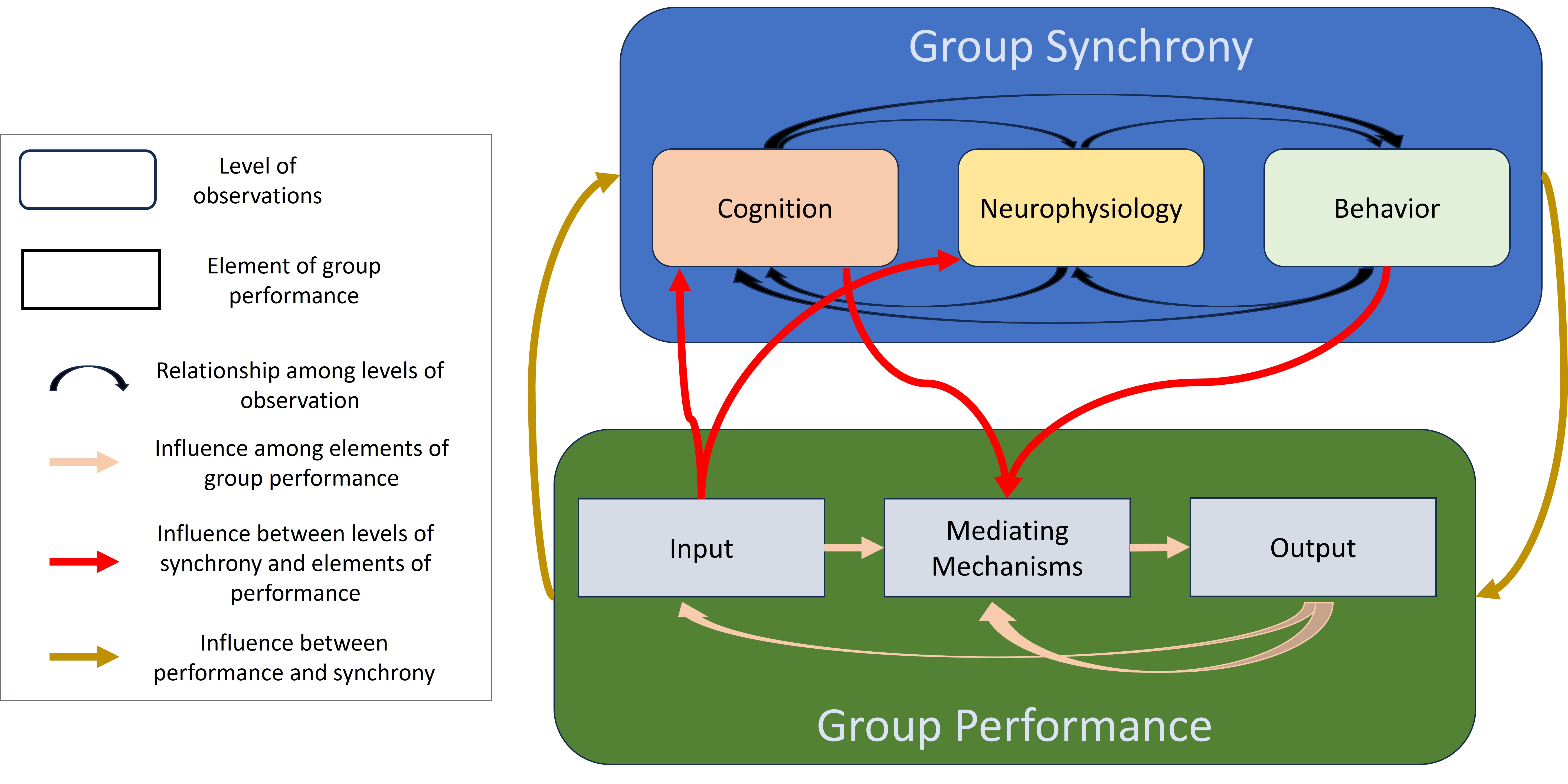
Group performance output, including both objective and affective outcome of teamwork, is determined by how the input is modified by the mediating mechanisms taking place within the group. In turn, the output can become input again, as material production of the group and the starting point of the next iteration. Affective outcomes can feed back into the loop, or influence the mediating mechanisms, for example by modifying shared mental models or by increasing group potency. As for synchrony, the different levels at which it can be observed (i.e., cognition, neurophysiology and behavior) all interact with each other. Elements of group performance and levels of synchrony observation can influence each other. The input needed for group performance can influence cognition and neurophysiology (e.g., compositional features such as personality traits or intelligence influence cognitive synchrony; perceptual features from task-related stimuli influence neurophysiological synchrony). Additionally, cognitive and behavioral synchrony are closely associated with the mediating mechanisms that are necessary to transform the input into the output of the group performance. Finally, although in this model, neurophysiological synchrony does not interact directly with elements of group performance, it can influence the mediating mechanisms via its relationship with both cognitive and behavioral synchrony. Overall, there is a circular relationship between group synchrony and group performance. Group synchrony influences group performance and vice-versa. Note, however, that this influence is not necessarily positive: while positive outcomes (e.g., attaining team goals or increasing trust and cohesion) can increase synchrony, negative outcomes (e.g., not attaining team goals and the associated stress) can decrease synchrony. In turn, the influence of synchrony on group performance varies as a function of the task demand: as an example, tasks demanding divergent thinking can be hindered rather than facilitated by high levels of group synchrony. However, affective outcomes, such as trust or cohesion, and synchrony seem to have a more straightforward relationship: when the latter increases, the former increases too. Among the different elements of this combined model, some are more easily measurable than others. Specifically, we argue that while mediating mechanisms (the element most closely related to output) cannot be directly measured in real-time, as they are mainly cognitive in nature, two elements of synchrony, namely behavioral and neurophysiological synchrony, can be measured in real-time. They can also be leveraged as an index of important mediating mechanisms (such as cohesion) and ultimately, predict group performance. This led us to the experimental framework that will be presented in the following section. On the basis of this theoretical model, three families of study on this topic can be defined. First, “type 1” research: the group performance focused studies. These are studies that aim to better understand the relationship between the elements pertaining to group performance strictly speaking (i.e., the pink arrows within the green box in figure 1). “Type 2” research is the inter-elements studies, composed by studies aiming at better understanding the relationship between specific elements of group performance and specific observational levels of synchrony (e.g., how input influences cognitive and neurophysiological synchrony or how cognitive and behavioral synchrony influence the mediating mechanisms; see the red arrows in figure 1). Finally, “type 3” research is the performance-synchrony relationship studies. These are studies that look at the association of synchrony (measured with indices pertaining to specific levels of observation or with composite indices) and group performance, and specifically, group outcome, under different conditions (golden arrows in figure 1).
5 Research framework
The global research framework that we propose is schematically presented in figure 2.
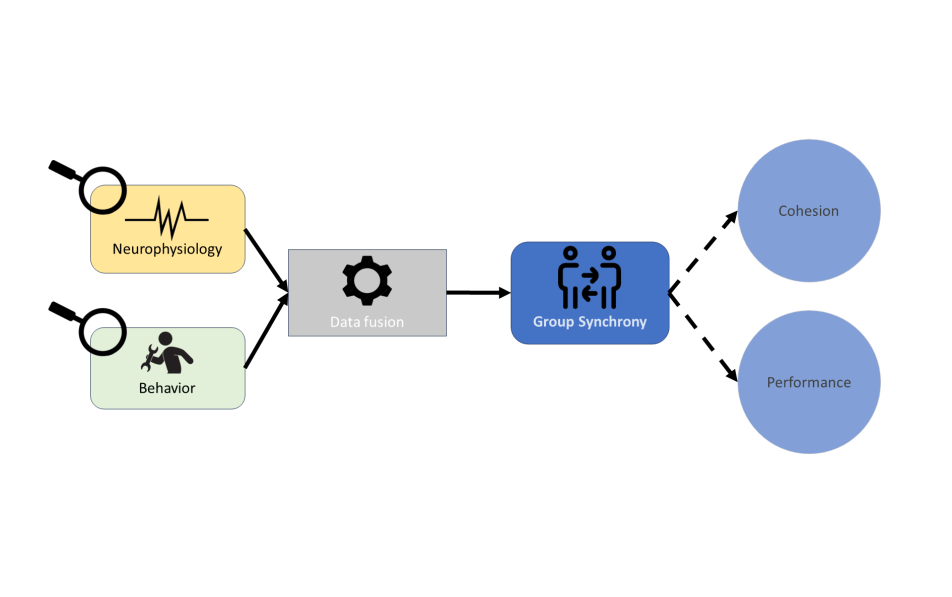
The main idea is to measure neurophysiological and behavioral synchrony in real-time within teams. Neurophysiological and behavioral indices of synchrony would then be merged using data fusion techniques in order to obtain a single multi-source group synchrony index, predictive of cohesion and, in a task-dependent manner, of performance (see below). This synchrony index may then be shared with the team itself, as feedback useful for maintaining the desired level of cohesion and for alerting when critical states (e.g., extremely low levels of cohesion) are nearing. This index would also be used by Mission Control or any other long-distance managing entity, to inform the group about managing strategies, task assignment, etc. Based on the plethora of measures used to assess neurophysiological and behavioral synchrony, and on the complex relationship between these features and affective and objective outcomes of teamwork, it is necessary to first select the best measures and to characterise their relationship with cohesion and performance during different task types. In particular, it is important to observe how synchrony measures relate to cohesion and performance during tasks where synchrony is the overt aim, during “convergent tasks” (i.e., tasks where synchrony is not the overt aim, but is expected to improve performance), and during “divergent tasks” (i.e., tasks where synchrony and cohesion can have a negative impact on performance). Within the taxonomy of studies described above, this study belongs both to the inter-elements studies and to the performance synchrony studies. Indeed, we will focus on specific levels of observation of synchrony, trying to associate them with a mediating mechanism (i.e., cohesion) but also to the overall group performance, and specifically, the objective outcome of teamwork, under different conditions (i.e., different task types). The framework that will be used to develop experimental protocols for the measures selection phase is outlined in figure 3.
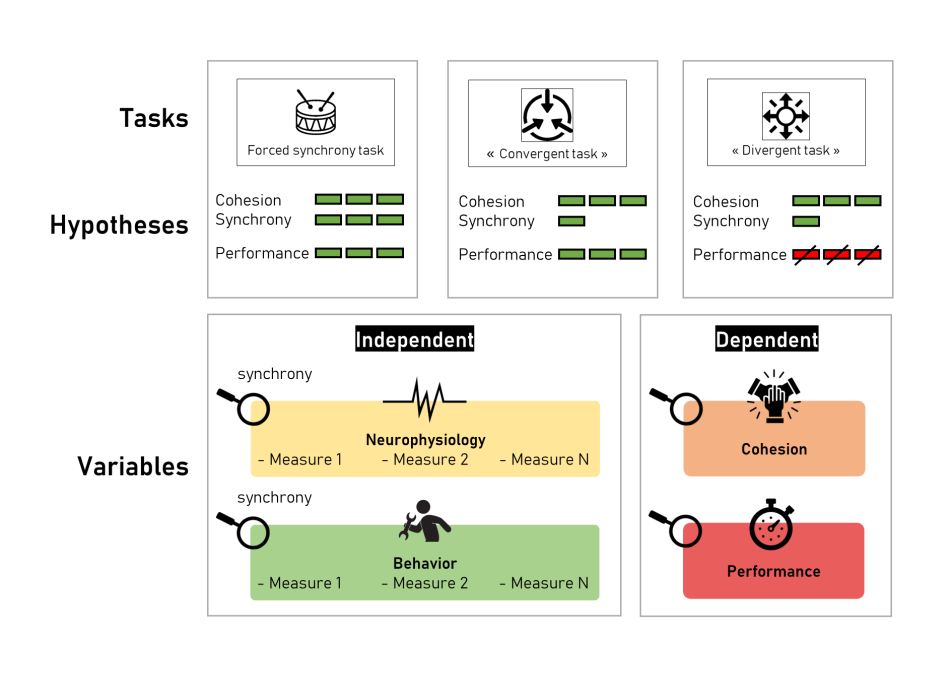
In order to characterise and eventually select the best features, we propose the following: the experimental protocol will include three different tasks. For each of these tasks, cohesion and objective performance will be measured. One task will have synchrony as its overt aim: synchronous drumming (i.e., drumming in time with a metronome) has been repeatedly shown to induce behavioral and physiological synchrony and to increase cohesion among team members. This task can be conceived as a validation task, useful for testing the ability of the selected features to measure synchrony, and its association with performance and cohesion, when these latter are known to be present. Another task will be a “convergent task”, such as decision making or a simulated hiring task [33]. The third task in the protocol will be a “divergent task”, a task where an excess of synchronization and cohesion can hinder the performance, as divergent thinking among team members is necessary, such as the creative phase of brainstorming. The measure of synchrony that will be included in this first step remains an open question. On the basis of the literature, we are aiming at including a movement-based and a communication-based measure of behavioral synchrony, respectively an optical flow-based and a language style matching-based measure. As for the specific metric of synchrony to use (e.g., multivariate recurrence, cross-correlation, phase coherence), this is still open to debate. As for neurophysiological synchrony, we are aiming to record heart rate, EDA, and EEG data. For neurophysiological synchrony, we are planning to include several indices of synchrony, and specifically, at least one linear index (e.g., cross-correlation) and one frequency-based index (e.g., frequency or phase coherence), but the specific indices to use are yet to be identified.
6 Conclusion
In this paper, we have presented a literature review about group performance and group synchrony. Based on this literature review, we have presented an experimentally oriented theoretical model of the relationship between elements of group performance and of group synchrony. We then used this model to inform a research framework to develop a real-time, continuous index of group synchrony that can be used as a proxy for cohesion and, eventually, to predict group performance. We argue that such an index could be extremely useful in the context of space missions, and especially for long-distance missions. Indeed, the relevant literature suggests that cohesion is especially fluctuating for crews spending long stretches of time in isolated and confined environments. Moreover, these crews tend to communicate less with mission control as time-on-mission increases, and they tend to experience at least one conflict within 90 days of a given mission. All this evidence suggests that an index of group synchrony, that is able to track group cohesion and to predict group performance, may be equally useful for crew members and for mission control. It could serve as feedback for the crew to increase cohesion levels and as a cue for mission control to help with personnel management. Such a group synchrony index could, of course, be helpful in other contexts where crew members have to live and work in isolated and confined environments for long stretches of time. Clearly, the applicability or real-time synchrony assessments would depend on specific mission conditions. For astronauts, the index could always be available in real-time, if the necessary calculations are made within the spacecraft, but mission control would lose the ability of having proper real-time assessments with the spacecraft’s increasing distance from Earth. However, we argue that even in the absence of a real-time assessment, a synchrony index could provide valuable information to mission control and alert them about anomalies in synchrony levels. At the time of writing, the team is finalizing the experimental protocol of the first step of our research plan: the characterization and selection of behavioral and neurophysiological synchrony indices and their relationship with cohesion and group performance, under different task types. The data collection campaign is planned to start in the current year, in collaboration with the National Centre for Space Study (CNES), the Institute for Space Medicine and Physiology (MEDES) and the Toulouse University Hospital.
References
- [1] Sangtae Ahn, Hohyun Cho, Moonyoung Kwon, Kiwoong Kim, Hyukchan Kwon, Bong Soo Kim, Won Seok Chang, Jin Woo Chang, and Sung Chan Jun. Interbrain phase synchronization during turn-taking verbal interaction—a hyperscanning study using simultaneous eeg/meg. Human brain mapping, 39(1):171–188, 2018.
- [2] J. R. Austin. Transactive memory in organizational groups: The effects of content, consensus, specialization, and accuracy on group performance. Journal of Applied Psychology, 88(5):866–878, 2003. doi:10.1037/0021-9010.88.5.866.
- [3] Daniel J Beal, Robin R Cohen, Michael J Burke, and Christy L McLendon. Cohesion and performance in groups: a meta-analytic clarification of construct relations. Journal of applied psychology, 88(6):989, 2003.
- [4] S. T. Bell. Deep-level composition variables as predictors of team performance: A meta-analysis. Journal of Applied Psychology, 92(3):595–615, 2007. doi:10.1037/0021-9010.92.3.595.
- [5] Suzanne T Bell, Shanique G Brown, and Tyree Mitchell. What we know about team dynamics for long-distance space missions: a systematic review of analog research. Frontiers in psychology, 10:811, 2019.
- [6] Suzanne T Bell, Anton J Villado, Marc A Lukasik, Larisa Belau, and Andrea L Briggs. Getting specific about demographic diversity variable and team performance relationships: A meta-analysis. Journal of management, 37(3):709–743, 2011.
- [7] Christina Breuer, Joachim Hüffmeier, and Guido Hertel. Does trust matter more in virtual teams? a meta-analysis of trust and team effectiveness considering virtuality and documentation as moderators. Journal of Applied Psychology, 101(8):1151, 2016.
- [8] Milly Casey-Campbell and Martin L Martens. Sticking it all together: A critical assessment of the group cohesion–performance literature. International Journal of Management Reviews, 11(2):223–246, 2009.
- [9] Guillaume Chanel, J Matias Kivikangas, and Niklas Ravaja. Physiological compliance for social gaming analysis: Cooperative versus competitive play. Interacting with Computers, 24(4):306–316, 2012. doi:10.1016/J.INTCOM.2012.04.012.
- [10] Jonas Chatel-Goldman, Marco Congedo, Christian Jutten, and Jean-Luc Schwartz. Touch increases autonomic coupling between romantic partners. Frontiers in behavioral neuroscience, 8:95, 2014.
- [11] Phoebe Chen, Sophie Hendrikse, Kaia Sargent, Michele Romani, Matthias Oostrik, Tom F Wilderjans, Sander Koole, Guillaume Dumas, David Medine, and Suzanne Dikker. Hybrid harmony: a multi-person neurofeedback application for interpersonal synchrony. Frontiers in neuroergonomics, 2:687108, 2021.
- [12] E. Codrons, N. F. Bernardi, M. Vandoni, and L. Bernardi. Spontaneous group synchronization of movements and respiratory rhythms. PLOS ONE, 9(9):e107538, 2014. doi:10.1371/journal.pone.0107538.
- [13] James C Cole, Abdullah M Akbar, Swati Chakarvarty, and Faisal R Jahangiri. The effects of microgravity on eeg recordings: A systematic review. J of Neurophysiological Monitoring, 2(2):14–24, 2024.
- [14] Joana F Coutinho, Markku Penttonen, Anu Tourunen, Jaakko Seikkula, Anssi Peräkylä, Wolfgang Tschacher, and Virpi-Liisa Kykyri. Electrodermal and respiratory synchrony in couple therapy in distinct therapeutic subsystems and reflection periods. Psychotherapy Research, 35(2):207–222, 2023.
- [15] R. Dale, G. A. Bryant, J. H. Manson, and M. M. Gervais. Body synchrony in triadic interaction. Royal Society Open Science, 7(9):200095, 2020. doi:10.1098/rsos.200095.
- [16] Bart A De Jong, Kurt T Dirks, and Nicole Gillespie. Trust and team performance: A meta-analysis of main effects, moderators, and covariates. Journal of applied psychology, 101(8):1134, 2016.
- [17] Céline De Looze, Stefan Scherer, Brian Vaughan, and Nick Campbell. Investigating automatic measurements of prosodic accommodation and its dynamics in social interaction. Speech Communication, 58:11–34, 2014. doi:10.1016/J.SPECOM.2013.10.002.
- [18] Leslie A DeChurch and Jessica R Mesmer-Magnus. The cognitive underpinnings of effective teamwork: a meta-analysis. Journal of applied psychology, 95(1):32, 2010.
- [19] D. J. Devine and J. L. Philips. Do smarter teams do better: A meta-analysis of cognitive ability and team performance. Small Group Research, 32(5):507–532, 2001. doi:10.1177/104649640103200501.
- [20] Guillaume Dumas. Towards a two-body neuroscience. Communicative & integrative biology, 4(3):349–352, 2011.
- [21] M Lance Frazier, Stav Fainshmidt, Ryan L Klinger, Amir Pezeshkan, and Veselina Vracheva. Psychological safety: A meta-analytic review and extension. Personnel psychology, 70(1):113–165, 2017.
- [22] Amber A Fultz. The relationships between synchrony, rapport, and small group performance. PhD thesis, Oregon State University, 2023.
- [23] R. Fusaroli and K. Tylén. Investigating conversational dynamics: Interactive alignment, interpersonal synergy, and collective task performance. Cognitive Science, 40(1):145–171, 2016. doi:10.1111/cogs.12251.
- [24] Riccardo Fusaroli, Drew H Abney, Bahador Bahrami, Christopher T Kello, and Kristian Tylén. Conversation, coupling and complexity: Matching scaling laws predict performance in a joint decision task. In Poster presented at the 35th annual conference of the cognitive science society, 2013.
- [25] Riccardo Fusaroli, Johanne S Bjørndahl, Andreas Roepstorff, and Kristian Tylén. A heart for interaction: Shared physiological dynamics and behavioral coordination in a collective, creative construction task. Journal of Experimental Psychology: Human Perception and Performance, 42(9):1297, 2016.
- [26] A. L. Gonzales, J. T. Hancock, and J. W. Pennebaker. Language style matching as a predictor of social dynamics in small groups. Communication Research, 37(1):3–19, 2010. doi:10.1177/0093650209351468.
- [27] I. Gordon, A. Gilboa, S. Cohen, and T. Kleinfeld. The relationship between physiological synchrony and motion energy synchrony during a joint group drumming task. Physiology & Behavior, 224:113074, 2020. doi:10.1016/j.physbeh.2020.113074.
- [28] I. Gordon, A. Gilboa, S. Cohen, N. Milstein, N. Haimovich, S. Pinhasi, and S. Siegman. Physiological and behavioral synchrony predict group cohesion and performance. Scientific Reports, 10(1):8484, 2020. doi:10.1038/s41598-020-65670-1.
- [29] J Richard Hackman and Charles G Morris. Group tasks, group interaction process, and group performance effectiveness: A review and proposed integration. Advances in experimental social psychology, 8:45–99, 1975.
- [30] Robert A Henning and Kristopher T Korbelak. Social-psychophysiological compliance as a predictor of future team performance. Psychologia, 48(2):84–92, 2005.
- [31] Robert Arthur Henning, Wolfram Boucsein, and Monica Claudia Gil. Social–physiological compliance as a determinant of team performance. International journal of psychophysiology, 40(3):221–232, 2001.
- [32] K. Heuer, L. C. Müller-Frommeyer, and S. Kauffeld. Language matters: The double-edged role of linguistic style matching in work groups. Small Group Research, 51(2):208–228, 2020. doi:10.1177/1046496419874498.
- [33] Yi Hu, Yafeng Pan, Xinwei Shi, Qing Cai, Xianchun Li, and Xiaojun Cheng. Inter-brain synchrony and cooperation context in interactive decision making. Biological psychology, 133:54–62, 2018.
- [34] Ute R Hülsheger, Neil Anderson, and Jesus F Salgado. Team-level predictors of innovation at work: a comprehensive meta-analysis spanning three decades of research. Journal of Applied psychology, 94(5):1128, 2009.
- [35] Daniel R Ilgen, John R Hollenbeck, Michael Johnson, and Dustin Jundt. Teams in organizations. Annual review of psychology, 56(1):517–543, 2005.
- [36] Zac E Imel, Jacqueline S Barco, Halley J Brown, Brian R Baucom, John S Baer, John C Kircher, and David C Atkins. The association of therapist empathy and synchrony in vocally encoded arousal. Journal of counseling psychology, 61(1):146, 2014.
- [37] Eunice Jun, Daniel McDuff, and Mary Czerwinski. Circadian rhythms and physiological synchrony: Evidence of the impact of diversity on small group creativity. Proceedings of the ACM on Human-Computer Interaction, 3(CSCW):1–22, 2019. doi:10.1145/3359162.
- [38] S. Järvelä, J. Kätsyri, N. Ravaja, G. Chanel, and P. Henttonen. Intragroup emotions: Physiological linkage and social presence. Frontiers in Psychology, 7:105, 2016. doi:10.3389/fpsyg.2016.00105.
- [39] Howard B Kaplan, Neil R Burch, Samuel W Bloom, and Robert Edelberg. Affective orientation and physiological activity (gsr) in small peer groups. Psychosomatic Medicine, 25(3):245–252, 1963.
- [40] Sadaf Kazi, Salar Khaleghzadegan, Julie V Dinh, Mark J Shelhamer, Adam Sapirstein, Lee A Goeddel, Nnenna O Chime, Eduardo Salas, and Michael A Rosen. Team physiological dynamics: A critical review. Human factors, 63(1):32–65, 2021. doi:10.1177/0018720819874160.
- [41] Ivana Konvalinka, Markus Bauer, Carsten Stahlhut, Lars Kai Hansen, Andreas Roepstorff, and Chris D Frith. Frontal alpha oscillations distinguish leaders from followers: multivariate decoding of mutually interacting brains. Neuroimage, 94:79–88, 2014. doi:10.1016/J.NEUROIMAGE.2014.03.003.
- [42] Fanny Lachat, Laurent Hugueville, Jean-Didier Lemaréchal, Laurence Conty, and Nathalie George. Oscillatory brain correlates of live joint attention: a dual-eeg study. Frontiers in human neuroscience, 6:156, 2012.
- [43] Daniël Lakens, Thomas Schubert, and Maria-Paola Paladino. 13 social antecedents and consequences of behavioral synchrony. Shared representations: Sensorimotor foundations of social life, page 254, 2016.
- [44] K. Lewis. Measuring transactive memory systems in the field: Scale development and validation. Journal of Applied Psychology, 88(4):587–604, 2003. doi:10.1037/0021-9010.88.4.587.
- [45] Michelle A Marks, John E Mathieu, and Stephen J Zaccaro. A temporally based framework and taxonomy of team processes. Academy of management review, 26(3):356–376, 2001.
- [46] John Mathieu, M Travis Maynard, Tammy Rapp, and Lucy Gilson. Team effectiveness 1997-2007: A review of recent advancements and a glimpse into the future. Journal of management, 34(3):410–476, 2008.
- [47] John E Mathieu, Tonia S Heffner, Gerald F Goodwin, Eduardo Salas, and Janis A Cannon-Bowers. The influence of shared mental models on team process and performance. Journal of applied psychology, 85(2):273, 2000.
- [48] John E Mathieu, John R Hollenbeck, Daan van Knippenberg, and Daniel R Ilgen. A century of work teams in the journal of applied psychology. Journal of applied psychology, 102(3):452, 2017.
- [49] Oded Mayo, Michal Lavidor, and Ilanit Gordon. Interpersonal autonomic nervous system synchrony and its association to relationship and performance–a systematic review and meta-analysis. Physiology & Behavior, 235:113391, 2021.
- [50] Joseph Edward McGrath. Social psychology: A brief introduction. Book, 1964.
- [51] J. R. Mesmer-Magnus and L. A. DeChurch. Information sharing and team performance: A meta-analysis. The Journal of Applied Psychology, 94(2):535–546, 2009. doi:10.1037/a0013773.
- [52] P. Mitkidis, J. J. McGraw, A. Roepstorff, and S. Wallot. Building trust: Heart rate synchrony and arousal during joint action increased by public goods game. Physiology & Behavior, 149:101–106, 2015. doi:10.1016/j.physbeh.2015.05.033.
- [53] Dan Mønster, Dorthe Døjbak Håkonsson, Jacob Kjær Eskildsen, and Sebastian Wallot. Physiological evidence of interpersonal dynamics in a cooperative production task. Physiology & behavior, 156:24–34, 2016.
- [54] A. Paxton and R. Dale. Argument disrupts interpersonal synchrony. Quarterly Journal of Experimental Psychology, 66(11):2092–2102, 2013. doi:10.1080/17470218.2013.853089.
- [55] A. Paxton and R. Dale. Frame-differencing methods for measuring bodily synchrony in conversation. Behavior Research Methods, 45(2):329–343, 2013. doi:10.3758/s13428-012-0249-2.
- [56] Hugo F Posada-Quintero and Ki H Chon. Innovations in electrodermal activity data collection and signal processing: A systematic review. Sensors, 20(2):479, 2020. doi:10.3390/S20020479.
- [57] Hugo F. Posada-Quintero, Ryan Rood, Yeonsik Noh, Ken Burnham, John Pennace, and Ki H. Chon. Novel dry electrodes for recording electrodermal activity. In 2016 38th Annual International Conference of the IEEE Engineering in Medicine and Biology Society (EMBC), pages 5701–5704, 2016. doi:10.1109/EMBC.2016.7592021.
- [58] Sandra Pusil, Jonathan Zegarra-Valdivia, Pablo Cuesta, Christopher Laohathai, Ana Maria Cebolla, Jens Haueisen, Patrique Fiedler, Michael Funke, Fernando Maestú, and Guy Cheron. Effects of spaceflight on the eeg alpha power and functional connectivity. Scientific reports, 13(1):9489, 2023.
- [59] Fabian Ramseyer and Wolfgang Tschacher. Nonverbal synchrony or random coincidence? how to tell the difference. Development of Multimodal Interfaces: Active Listening and Synchrony: Second COST 2102 International Training School, Dublin, Ireland, March 23-27, 2009, Revised Selected Papers, pages 182–196, 2010. doi:10.1007/978-3-642-12397-9_15.
- [60] Coralie Réveillé, Grégoire Vergotte, Stéphane Perrey, and Grégoire Bosselut. Using interbrain synchrony to study teamwork: A systematic review and meta-analysis. Neuroscience & Biobehavioral Reviews, 159:105593, 2024.
- [61] Bertrand Schneider, Yong Dich, and Iulian Radu. Unpacking the relationship between existing and new measures of physiological synchrony and collaborative learning: A mixed methods study. International Journal of Computer-Supported Collaborative Learning, 15:89–113, 2020. doi:10.1007/S11412-020-09318-2.
- [62] KM Sharika, Swarag Thaikkandi, Nivedita, and Michael L Platt. Interpersonal heart rate synchrony predicts effective information processing in a naturalistic group decision-making task. Proceedings of the National Academy of Sciences, 121(21):e2313801121, 2024.
- [63] Alexander D Stajkovic, Dongseop Lee, and Anthony J Nyberg. Collective efficacy, group potency, and group performance: meta-analyses of their relationships, and test of a mediation model. Journal of applied psychology, 94(3):814, 2009.
- [64] A. J. Strang, G. J. Funke, S. M. Russell, A. W. Dukes, and M. S. Middendorf. Physio-behavioral coupling in a cooperative team task: Contributors and relations. Journal of Experimental Psychology: Human Perception and Performance, 40(1):145–158, 2014. doi:10.1037/a0033125.
- [65] Jlenia Toppi, Gianluca Borghini, Manuela Petti, Eric J He, Vittorio De Giusti, Bin He, Laura Astolfi, and Fabio Babiloni. Investigating cooperative behavior in ecological settings: an eeg hyperscanning study. PloS one, 11(4):e0154236, 2016.
- [66] Bahar Tunçgenç and Emma Cohen. Movement synchrony forges social bonds across group divides. Frontiers in psychology, 7:782, 2016.
- [67] Tanya Vacharkulksemsuk and Barbara L Fredrickson. Strangers in sync: Achieving embodied rapport through shared movements. Journal of experimental social psychology, 48(1):399–402, 2012.
- [68] T. Yokozuka, H. Miyamoto, M. Kasai, Y. Miyake, and T. Nozawa. The relationship between turn-taking, vocal pitch synchrony, and rapport in creative problem-solving communication. Speech Communication, 129:33–40, 2021. doi:10.1016/j.specom.2021.03.001.