Digital Health for Space: Towards Prevention, Training, Empowerment, and Autonomy

Abstract
Future long-duration and deep-space missions will rely on digital health technologies to ensure the health and safety of the crew, as well as to enable the required mission autonomy. This position paper redefines the current paradigms of digital health by emphasizing prevention, self-management, and individual empowerment for health as central challenges for both space and terrestrial medicine. We focus on future mission scenarios and highlight the potential of co-evolving digital health and related technologies, particularly sensing, artificial intelligence (AI), and human-computer interaction (HCI), across the continuum of space medicine: from astronaut selection and training to prevention, diagnostics, therapy, rehabilitation, and long-term care. Future digital health technologies can respond to pressing needs arising from limited medical infrastructure, rising care costs, and increasing demands on healthcare systems in space and on Earth.
To structure research and development needs, we introduce a framework with four autonomy levels based on mission distance and communication latency (Earth orbit, Lunar Gateway and Moon vicinity, Mars, and deep space) that illustrate how mission context constrains medical support and dictates system requirements. Using the Lunar Orbital Platform-Gateway as a near-future reference, we discuss how growing communication delays demand greater onboard autonomy and new telemedical strategies. Within the proposed framework, we integrate solutions built around AI-supported decision making, multimodal monitoring, and adaptive HCI, which should be co-designed through human-centered methods to form a cohesive health management ecosystem. The framework opens up synergies for proactive and trustworthy health support under isolation and limited ground contact. The paper consolidates current technological readiness and strategic challenges, offering guidance for space health research and policy, with clear translational benefits for terrestrial care delivery.
Keywords and phrases:
Digital Health in Space, AI-based Decision Support, Wearable Health Monitoring, Human-Computer Interaction (HCI), Autonomous Medical SystemsCopyright and License:
![[Uncaptioned image]](x1.png) © Mario A. Cypko, Ulrich Straube, Russell J. Andrews, and Oliver Amft; licensed under Creative Commons License CC-BY 4.0
© Mario A. Cypko, Ulrich Straube, Russell J. Andrews, and Oliver Amft; licensed under Creative Commons License CC-BY 4.0
2012 ACM Subject Classification:
Applied computing Health informatics ; Human-centered computing Interaction design theory, concepts and paradigmsEditors:
Leonie Bensch, Tommy Nilsson, Martin Nisser, Pat Pataranutaporn, Albrecht Schmidt, and Valentina SuminiSeries and Publisher:
 Open Access Series in Informatics, Schloss Dagstuhl – Leibniz-Zentrum für Informatik

1 Introduction
Modern terrestrial healthcare systems are increasingly burdened by aging demographics, the growing prevalence of chronic diseases, and the widespread shortage of healthcare professionals. Concepts such as prevention, self-management of health, and decentralized care are widely recognized as crucial. However, their practical implementation remains limited due to fragmented infrastructures, unclear responsibilities, and underdeveloped technological ecosystems.
In remote or underserved regions, disaster and conflict zones, people already face similar limitations to those in space: delayed or irregular access to care, reliance on simplified telemedicine solutions and limited real-time monitoring. Examples include chronically ill patients who are rarely consulted remotely, emergency responders who work with minimal diagnostic tools, or elderly people in long-term care who are not constantly monitored. These terrestrial conditions are similar, to a lesser extent, to the restrictions that apply to space missions.
However, human spaceflight magnifies structural challenges by turning slow-moving terrestrial problems into immediate survival risks. Microgravity accelerates musculoskeletal decline [19]. Radiation exposure increases significantly beyond Earth’s magnetic shielding [22]. Communication may be delayed, intermittent, or completely unavailable. Delays begin at the Lunar Orbital Platform-Gateway (LOP-G) and become more severe on missions to Mars and beyond [13]. In such environments, medical evacuation is impossible and real-time support from Earth can no longer be relied on.
Space exploration demands the development of resilient and autonomous healthcare systems that integrate prevention, individual empowerment, and real-time situational awareness. Human spaceflight environments offer a unique testing ground for developing digital health technologies and models. Once validated under extreme conditions, these solutions can be transferred to terrestrial healthcare systems that urgently require transformation.
This position paper uses space exploration as a strategic lens to investigate how digital health technologies, especially artificial intelligence (AI)-based decision support, continuous multimodal sensing, and adaptive human-computer interaction (HCI), must co-evolve to support individual autonomy and proactive health management. We propose a situational framework of autonomy levels across four mission stages, Earth orbit, lunar vicinity (e.g. Lunar Gateway), Mars, and deep space, and outline the system-level requirements at each stage.
Through this lens, we highlight LOP-G as a concrete near-future scenario, where moderate autonomy, intermittent support, and resource constraints converge. LOP-G illustrates the urgent need for trustworthy, transparent, and user-adaptive digital health ecosystems. Our argument is that the co-development of monitoring technologies, AI, and HCI in space not only provides mission-critical capabilities, but also transferable insights for Earth. Advances made under extreme conditions can accelerate progress in preventive healthcare, education, and self-management, particularly in terrestrial systems challenged by workforce shortages and rising costs.
2 Situational Framework: Autonomy Levels by Mission Distance
Future digital health systems in space must dynamically adapt to the conditions of each mission. Key variables include increasing distance from Earth, longer communication delays, and rising demands for autonomous operation beyond low Earth orbit. Figure 1 introduces a structured framework with four progressive levels of autonomy, defined by mission distance and expected communication latency. The levels correspond to specific health management scenarios, operational constraints, and system requirements. Each stage also reflects analogous conditions on Earth, where similar limitations affect the delivery of medical care.
-
Level 0 (Real-time Telemedicine) - Earth Orbit (ISS / Low Earth Orbit) Full external medical support available. Clinical tasks are guided by Earth-based experts with minimal onboard autonomy.
-
–
Communication Delay: ~0.03–0.25 s (one-way), effectively real-time.
-
–
Return to Earth: ~3-6 h (e.g., via Soyuz or Crew Dragon; emergency concepts such as UC Davis’ “Space Ambulance” aim for ~4 h return capability).
-
–
System Requirements: Basic health monitoring (e.g., ECG, heart rate), minimal explainable AI support, dependence on ground control.
-
–
Earth Analogue: Urban hospital settings or intensive care units with constant expert supervision and high-bandwidth infrastructure.
-
–
-
Level 1 (Conditional Autonomy) - Moon (LOP-G / Lunar Surface)
Requires moderate onboard autonomy to bridge intermittent connections and resource constraints.
-
–
Communication Delay: ~1.2–2.6 s (one-way).
-
–
Return to Earth: ~3-5 d (depending on launch readiness and transfer trajectory).
-
–
System Requirements: Continuous wearable and behavioral monitoring, hybrid AI, basic digital twin models, asynchronous decision support, adaptive HCI for varying users.
-
–
Earth Analogue: Remote outposts, submarines, or Antarctic research stations with delayed telemedical support and non-specialist medical personnel.
-
–
-
Level 2 (High Autonomy) - Mars (Transit / Surface)
Autonomous health operations must compensate for extended delays and mission-critical isolation.
-
–
Communication Delay: 4–24 min (one-way), depending on the planetary alignment.
-
–
Return to Earth: 6-9 month (e.g., minimum-energy transfer), possibly >1 year if waiting for next return window.
-
–
System Requirements: Comprehensive multimodal monitoring, MGM with digital twins, advanced predictive analytics, decision support, highly contextualized HCI.
-
–
Earth Analogue: Disaster zones or warzones with disrupted infrastructure, limited staff, and time-critical care needs.
-
–
-
Level 3 (Full Autonomy) - Beyond (Deep Space Missions)
Complete onboard autonomy for diagnostics, interventions, and preventive care. No possibility of medical evacuation or remote assistance.
-
–
Communication Delay: Several hours to no contact, depending on location and antenna pointing (e.g., beyond Mars orbit or into interstellar space).
-
–
Return to Earth: Not possible (no feasible rescue within human lifetime or mission design).
-
–
System Requirements: Self-sufficient care: AI-supported diagnosis and intervention, robotic support, transparent models, adaptive HCI to sustain crew trust and self-efficacy.
-
–
Special Case: The enthralling and to date still visionary approach of hibernation (torpor) for the crew may require continuous AI-based vital control without human oversight [5].
-
–
Earth Analogue: Isolated elderly in rural regions or long-term care settings without specialist access, especially in crisis or climate-affected regions.
-
–
LOP-G represents a realistic near-term scenario to assess both the technological readiness and operational integration of conditional autonomy systems (Level 1). In contrast to the ISS, crew on LOP-G will periodically operate with limited external support. This creates a demand for moderate on-board decision-making capabilities and greater reliance on predictive monitoring and self-managed care. LOP-G therefore provides a crucial test environment for developing health management systems that must function under the more extreme conditions anticipated for Mars missions and beyond.
A structured continuum of situation-specific autonomy demands that health systems identify critical mission contexts, adjust operational modes, and follow predefined procedural models. These systems must remain robust and context-sensitive to enable smooth transitions between supported and fully autonomous care, especially in scenarios where evacuation is not possible and communication with Earth is delayed.
3 Technology Readiness and Open Challenges
Numerous foundational technologies for space-relevant digital health have already been demonstrated aboard the International Space Station (ISS). Wearable biosensors, including smart garments such as ESA’s MagIC-Space vest, have allowed unobtrusive monitoring of ECG, respiration, temperature, and movement during sleep without compromising astronaut comfort or mobility [8]. Radiation dosimetry has also achieved reached a high level of maturity. For example, ESA’s active dosimeter continuously provides real-time data on the absorbed dose and the equivalent doses within the spacecraft [22]. Robotic systems such as Robonaut 2 have been used to explore remotely operated diagnostic procedures, including ultrasound imaging and simulated injections [20]. However, these systems remain largely disconnected. They are developed independently and tested under idealized conditions, either within the resource-rich environment of the ISS or in terrestrial contexts such as hospital settings and home care. As a result, their transferability is limited. Technologies designed for short-term clinical monitoring on Earth often perform poorly under the physiological stress, behavioral variability, and environmental constraints encountered in space or in remote terrestrial locations, such as polar research stations, disaster zones, or submarines. Three major categories of integration challenges can be identified:
-
Sensor Fusion and Environmental Validity: Wearable, ingestible, and ambient sensors are usually validated in stable terrestrial environments. Their reliability in dynamic and extreme conditions, such as microgravity, partial gravity, or high-radiation zones, remains uncertain [21, 1]. Motion, fluid redistribution, and changes in sensor-skin adhesion may lead to physiological baseline shifts and signal artifacts. These conditions challenge conventional signal processing methods. To ensure reliable measurements throughout different mission phases, systems require redundant sensing modalities, context-aware filtering, and adaptive calibration strategies.
-
AI Maturity and Contextualization: On Earth, AI systems increasingly support diagnostics, triage, and predictive analytics. These typically rely on large datasets from well-characterized populations. However, in space or other isolated settings, current AI applications often lack transparency, robustness, and the ability to adapt to mission-specific constraints. Most systems do not integrate knowledge of environmental stressors, resource limitations, or procedural workflows. Future architectures must combine data-driven approaches with structured evidence-based models and formal process representations to support interpretability and simulation-based decision making under uncertainty.
-
Human-System Interaction: Usability under mission-relevant stressors, such as cognitive load, restricted mobility due to gloves or microgravity, and time-critical scenarios, has rarely been systematically studied. Many current HCI approaches follow engineering-driven designs and are not developed in collaboration with end users [17, 3]. Research shows that a lack of transparency, limited adaptability, and insufficient participatory design reduce user trust and adherence to AI-supported systems [4]. These risks are especially relevant for long-duration missions and future space tourism, where users may have limited medical training.
These open challenges require a shift in research and development strategies. Future digital health systems must be designed as cohesive and adaptive ecosystems. Rather than building isolated technical modules, developers must integrate robust sensor platforms, interpretable AI, and interaction systems that support transparent, interpretable, and user-adaptive HCI. Health autonomy should scale based on mission constraints while remaining transparent and understandable for all crew members, regardless of background or role.
Technological readiness should be evaluated not only by the existence of functional prototypes but also by integration maturity, adaptability to different mission phases, and usability under operational stress. Platforms such as the LOP-G, with intermittent communication and evolving autonomy requirements, offer a unique opportunity to test integrated systems under controlled yet realistic spaceflight conditions.
4 Co-Evolution of Monitoring, AI and HCI: Building an Integrated Digital Health Ecosystem
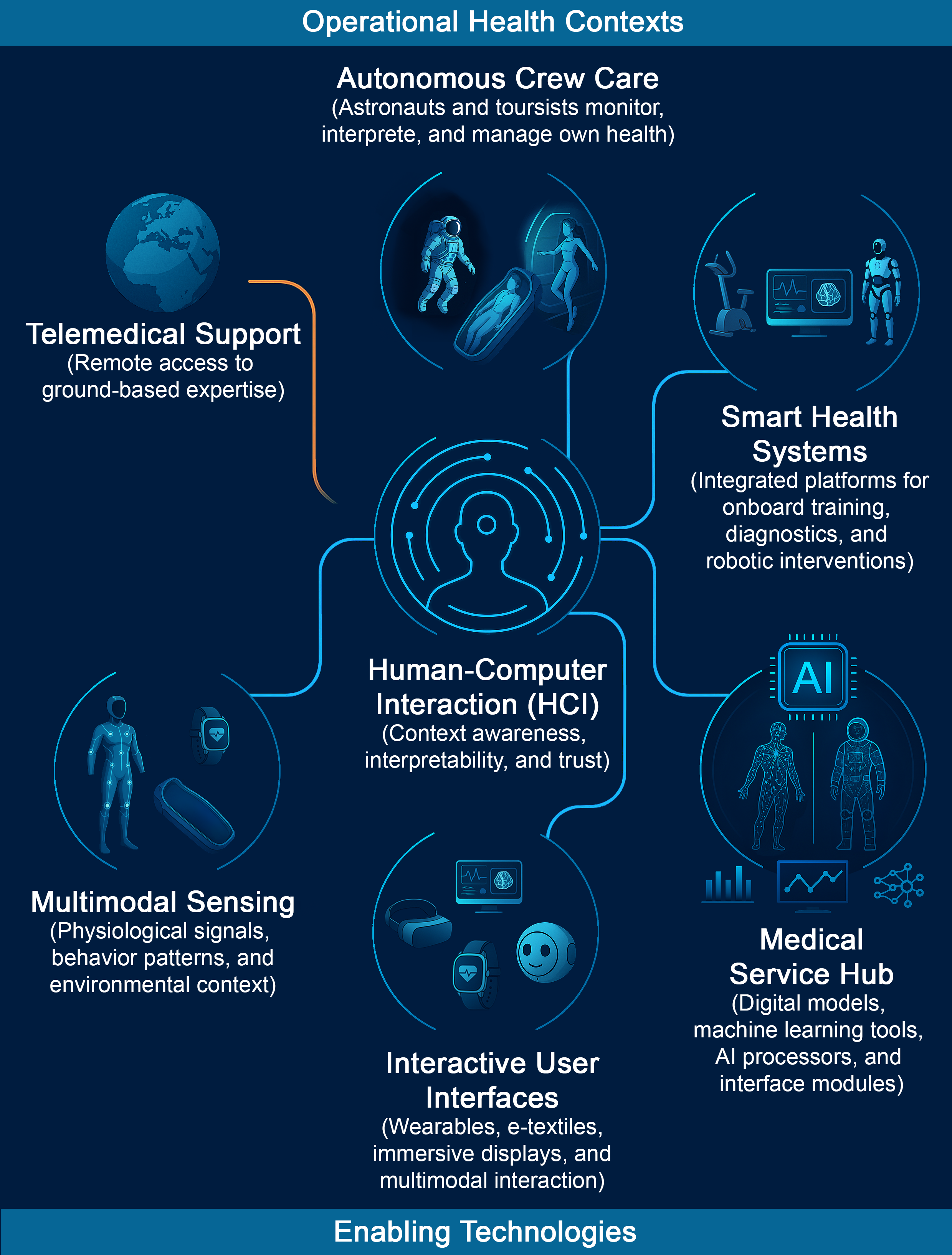
Digital health in space must be developed as an integrated framework. Progress in three key areas is required to support autonomous health operations during human spaceflight: continuous multimodal monitoring, structured AI, and adaptive HCI. Figure 2 presents this perspective as a modular system framework. HCI serves as a design principle that organizes the integration of enabling technologies such as multimodal sensing, interactive user interfaces, and the medical service hub with operational health contexts such as telemedical support, autonomous crew care, and smart health systems. HCI provides the conceptual basis for adaptive, interpretable, and trustworthy interaction between humans and system components. The framework allows closed-loop configurations that maintain health-related functions under varying levels of connectivity. Although bidirectional communication with Earth-based telemedical services remains possible in some scenarios, it cannot serve as a reliable baseline. The figure illustrates the need for integrated development across all components. Design decisions in sensing, inference, or interaction must reflect the requirements of each health context and support coherence throughout the framework.
To illustrate how the technological ecosystem evolves alongside mission-specific autonomy, Figure 1 also outlines selected milestones across the domains of monitoring, AI, and HCI. At Level 0, early-stage HCI interfaces serve primarily as research tools to observe crew interaction and guide future system development. On the Moon (Level 1), procedural AI guidance and initial digital astronaut models enable asynchronous decision support. Mars missions (Level 2) demand context-aware hybrid models and adaptive interfaces to support time-sensitive crew decisions without real-time supervision. Finally, deep space scenarios (Level 3) require fully integrated self-care ecosystems, including self-learning and self-correcting AI-HCI systems capable of autonomous adaptation and operational robustness in the absence of fallback options.
Multimodal Monitoring as a Basis for Context-Aware, Autonomous Health Support.
Combining wearables, smart textiles, acoustic diagnostics, and external sensing technologies (e.g., radar or LIDAR) enables researchers to construct holistic context-aware health profiles [19, 2, 9]. Data quality and validity are essential, particularly in microgravity or partial gravity environments, where physiological baselines shift and sensor-skin interactions may degrade signal fidelity [21]. Adaptive calibration strategies and multimodal redundancy must therefore be integrated into system design.
Raw data must be transformed into meaningful insight through AI systems that combine real-time analytics with structured medical reasoning. Data-driven approaches, such as deep learning and generative models, are effective in identifying patterns in large and complex datasets. These must be combined with explainable AI (XAI) techniques to support trust and interpretability. In parallel, structured models are essential to represent astronaut physiology, environmental constraints, and procedural logic. Model-Guided Medicine (MGM) integrates digital patient representations, context-aware environmental models, and formal process descriptions (e.g., Bayesian networks and Business Process Modeling Notation) to generate explainable simulation-based recommendations aligned with mission protocols, while preserving critical human judgment and decision making [6, 7, 12].
HCI must Adapt to User Diversity, Cognitive States, and Mission Context.
As onboard autonomy increases, astronauts must understand data and act independently. HCI systems must therefore accommodate diverse user profiles, from astronauts to scientists and space tourists, and adapt to varying cognitive states and environmental conditions. Interfaces should provide transparent feedback on system status, clearly communicate AI reasoning, and dynamically adjust to the expertise and workload of the user. Multimodal input modalities, including voice, gesture, and augmented reality overlays, are especially important where manual interaction is restricted, such as under microgravity or while wearing gloves [17, 4]. Participatory design and iterative prototyping are critical to ensure usability, safety, and long-term engagement.
Co-Design is Essential to Avoid Fragmented and Unusable Systems.
Intelligent digital health systems must be developed as co-evolving ecosystems that integrate real-time monitoring, structured AI, and user-centered interfaces from the outset. Fragmented development undermines resilience: AI models disconnected from live data lack robustness, sensors that produce uninterpretable output erode user trust, and interfaces that fail to reflect system logic compromise safety. Integrated co-design involving engineers, clinicians, AI developers, and HCI experts is essential to ensure transparency, usability, and mission readiness.
Even integrated systems are fallible. Performance depends on signal quality, mission-specific context modeling, and appropriate human interpretation. Failures can result from sensor malfunctions, poor data quality, or flawed assumptions in AI design. Systems must therefore support critical user awareness by clearly communicating uncertainties, showing confidence levels, and flagging incomplete input data. Failover mechanisms and graceful degradation strategies must be integrated to ensure mission safety even under partial system failures or degraded sensor performance. In parallel, reference models and fallback protocols provide structured responses in decision-critical scenarios, especially when autonomous behavior must remain explainable and controllable.
Embedding these safeguards into a co-design framework allows digital health systems to balance autonomy and accountability. This approach must be grounded in participatory design and iterative prototyping to ensure safety, transparency, and sustained usability across diverse missions.
5 Real-Time Learning and Training to Support Autonomous Health Decisions
Autonomous healthcare in space depends not only on technical systems but also on the crew’s preparedness to understand, trust, and act upon health-related data and AI-generated recommendations. As autonomy increases with mission distance, astronauts must assume new roles as informed decision-makers, caregivers, and active participants in managing their health.
Training must Shift from Routines to Situational Health Understanding.
Current astronaut training includes basic first aid and selected emergency protocols. Long-duration missions, however, require deeper comprehension of diagnostic signals, preventive measures, and procedural alternatives under resource constraints. Static instructions or video briefings are insufficient when complex procedures must be adapted to real-time crew status and evolving mission conditions. Immersive training environments using virtual or augmented reality offer scenario-based rehearsal, contextual feedback, and adaptive learning [15, 18, 16]. Training must be linked to MGM frameworks to reflect current physiological data and mission context.
Real-Time Guidance Turns Confusion into Learning and Trust.
Onboard AI systems can support not only decisions but also learning by delivering contextual information, step-by-step guidance, and explanatory feedback. When sensor anomalies occur, the systems can walk users through verification steps, risk assessments, and potential actions using layered explanation interfaces. These link physiological data with expected norms and mission context, helping transform uncertainty into a learning opportunity and strengthening user competence and system trust.
Adaptive AI for Autonomous Health Decisions.
Autonomous adaptation during missions is critical, as historic data may be unavailable or incomplete. Onboard AI must support “on-the-fly” learning using limited and evolving datasets. As Waisberg et al. [23] outline, techniques such as transfer learning and synthetic data generation may enable models to adapt based on mission-specific sensor input while maintaining interpretability. Kumar et al. [14] further highlight how embedded AI systems can detect space-induced health syndromes (e.g., SANS) via onboard learning, even under strict latency and compute constraints.
Health Competence and Motivation are Key to Self-Empowered Care.
Space crews are heterogeneous: scientists, operators, or future tourists may vary widely in their medical knowledge, stress response, and willingness to follow preventive protocols. Interfaces must therefore support personalized health literacy: adaptive explanations, motivational nudging, and progressive learning pathways. Behavioral modeling, when coupled with monitoring and AI analytics, can detect early signs of non-adherence and prompt corrective engagement before risks escalate. Such strategies are already explored in Earth-based care systems and are essential for maintaining preventive practices during extended missions.
Interfaces must be Designed to Teach, Not Just Inform.
Training must continue throughout the mission. HCI systems should respond to user queries, guide appropriate actions, and provide clear contextualized feedback on health behaviors and outcomes. This approach supports informed action and builds the confidence needed to maintain autonomy without compromising safety or psychological resilience.
To support responsible use of autonomous health systems, training must also cultivate critical thinking. Crews must learn when to rely on AI-generated recommendations and when to challenge them, based on sensor reliability, contextual understanding, or ethical concerns. This reinforces health self-efficacy and fosters informed, autonomous decision making rather than passive acceptance.
6 Future Work: Strategic Priorities for Research and Validation
To realize the vision of autonomous, user-centered digital health systems in space, several strategic research directions must be pursued. These extend beyond individual technologies and emphasize system integration, operational realism, and ethical deployment under extreme conditions.
From Conceptual Models to Operational Systems.
While this paper outlines a co-evolutionary approach combining monitoring, AI, and HCI, many proposed components, such as digital astronaut models, model-guided decision support, or adaptive interfaces, remain at the conceptual or prototypical stage. Future work must focus on the integration, testing, and validation of these systems under space-relevant constraints. The LOP-G offers an ideal near-term platform to test conditional autonomy, edge diagnostics, and context-sensitive user interfaces.
Edge AI and Robust Onboard Computing.
Extended communication delays and intermittent contact require that critical health data be processed locally. Future systems must prioritize resilient, energy-efficient edge computing capable of filtering, analyzing, and contextualizing multimodal sensor streams in real time. This includes hardware robustness under radiation and power constraints, as well as software strategies for uncertainty estimation, prioritization of alerts, and fallback procedures. Recent advances in edge computing platforms show that AI-based inference can be conducted reliably under space conditions. ESA’s -Sat-1 demonstrated successful onboard deep learning using radiation-hardened Myriad 2 vision processing units for real-time image filtering [10]. Similarly, Goodwill et al. [11] presented the NASA SpaceCube Edge tensor processing unit with triple-modular redundancy to ensure fault-tolerant AI processing in radiation-prone environments. These examples support the feasibility of localized health inference, anomaly detection, and fallback logic under extreme conditions.
Personalized Interfaces and Embedded Learning.
As medical autonomy increases, astronauts must become both operators and learners. Interfaces must adapt to individual health literacy, stress levels, and cognitive load. Future development should focus on context-aware explanation interfaces, interactive feedback channels, and embedded training mechanisms that support decision-making without requiring constant supervision. This includes ongoing adaptation to user profiles and mission phases.
Ethical Autonomy and Trusted Decision Support.
Autonomous AI systems in space must be designed for transparency, explainability, and user control. Crew members need to critically interpret AI recommendations, particularly in high-stakes scenarios without Earth-based oversight. Future work must address model limitations, error propagation, and trust calibration. Reference models, confidence estimation, and explicit communication of data quality should be standard features in decision-critical systems.
Terrestrial Translation and Dual-Use Potential.
Digital health systems developed for space exploration can offer substantial benefits to Earth-based healthcare. Isolated elderly individuals, understaffed clinics, and emergency responders in remote or crisis-affected areas face comparable constraints. Future research should explore adaptation pathways, evaluate societal impact, and identify regulatory and ethical implications for dual-use deployment. Space health innovation must be understood as a catalyst, not a siloed niche.
7 Conclusion
The paper outlines a forward-looking vision for digital health in space, centered on prevention, individual empowerment, and adaptive autonomy. We introduced a structured framework of autonomy levels to demonstrate how mission distance and communication constraints shape health system requirements. Within our framework, we emphasized the co-evolution of multimodal monitoring, model-guided and explainable AI, and adaptive HCI as the foundation for context-aware and trustworthy care.
Rather than treating sensing, AI, and HCI as isolated technologies, we argue for their integrated development through user-centered design and iterative validation. Human factors, learning support, and ethical oversight are not secondary features, but essential design principles that allow autonomy without compromising safety or comprehension.
The Lunar Gateway provides a critical near-term platform to evaluate these concepts under realistic operational constraints. Insights gained from timely space missions will inform a stepwise advancement of digital health systems for more complex scenarios, including Mars transit and deep-space habitats.
Beyond their relevance for spaceflight, the digital health technologies and principles discussed here address urgent needs on Earth. Remote diagnostics, self-managed care, and adaptive AI support have the potential to transform healthcare delivery in underserved regions, during crises, and for aging populations. By investing in digital space health, we also invest in the resilience and future-readiness of healthcare on Earth.
References
- [1] Russell J Andrews. Wearable revolution: Predictive, preventive, personalized medicine (pppm) par excellence. In Predictive, Preventive, and Personalised Medicine: From Bench to Bedside, pages 339–348. Springer, 2023.
- [2] Annalisa Baronetto, Luisa S Graf, Sarah Fischer, Markus F Neurath, and Oliver Amft. Gastrodigitalshirt: a smart shirt for digestion acoustics monitoring. In Proceedings of the 2020 ACM International Symposium on Wearable Computers, pages 17–21, 2020. doi:10.1145/3410531.3414297.
- [3] Leonie Bensch, Tommy Nilsson, Paul de Medeiros, Florian Dufresne, Andreas Gerndt, Flavie Rometsch, Georgia Albuquerque, Frank Ole Flemisch, Oliver Bensch, Michael Preutenborbeck, et al. Towards balanced astronaut-oriented design for future eva space technologies. In SpaceCHI: 3.0 A Conference on Human-Computer Interaction for Space Exploration, 2023.
- [4] Carolina Centeio Jorge, Catholijn M Jonker, and Myrthe L Tielman. Interdependence and trust analysis (ita): a framework for human–machine team design. Behaviour & Information Technology, pages 1–21, 2024.
- [5] Alexander Chouker, Thu Jennifer Ngo-Anh, Robin Biesbroek, Gerhard Heldmaier, Marc Heppener, and Jürgen Bereiter-Hahn. European space agency’s hibernation (torpor) strategy for deep space missions: linking biology to engineering. Neuroscience & Biobehavioral Reviews, 131:618–626, 2021.
- [6] Mario A Cypko, Matthaeus Stoehr, Marcin Kozniewski, Marek J Druzdzel, Andreas Dietz, Leonard Berliner, and Heinz U Lemke. Validation workflow for a clinical bayesian network model in multidisciplinary decision making in head and neck oncology treatment. International journal of computer assisted radiology and surgery, 12:1959–1970, 2017. doi:10.1007/S11548-017-1531-7.
- [7] Mario A Cypko and Dirk Wilhelm. Ladies and gentlemen! this is no humbug. why model-guided medicine will become a main pillar for the future healthcare system. International Journal of Computer Assisted Radiology and Surgery, 19(10):1919–1927, 2024. doi:10.1007/S11548-024-03269-X.
- [8] Marco Di Rienzo, Emanuele Vaini, and Prospero Lombardi. Development of a smart garment for the assessment of cardiac mechanical performance and other vital signs during sleep in microgravity. Sensors and Actuators A: Physical, 274:19–27, 2018.
- [9] Francesco Fioranelli, Ronny G Guendel, Nicolas C Kruse, and Alexander Yarovoy. Radar sensing in healthcare: Challenges and achievements in human activity classification & vital signs monitoring. In International Work-Conference on Bioinformatics and Biomedical Engineering, pages 492–504. Springer, 2023.
- [10] Gianluca Giuffrida, Luca Fanucci, Gabriele Meoni, Matej Batič, Léonie Buckley, Aubrey Dunne, Chris Van Dijk, Marco Esposito, John Hefele, Nathan Vercruyssen, et al. The -sat-1 mission: The first on-board deep neural network demonstrator for satellite earth observation. IEEE Transactions on Geoscience and Remote Sensing, 60:1–14, 2021.
- [11] Justin Goodwill, Gary Crum, James MacKinnon, Cody Brewer, Michael Monaghan, Travis Wise, and Christopher Wilson. Nasa spacecube edge tpu smallsat card for autonomous operations and onboard science-data analysis. In Proceedings of the Small Satellite Conference. AIAA, 2021.
- [12] Denise Junger, Elisaveta Just, Johanna M Brandenburg, Martin Wagner, Katharina Schaumann, Thomas Klenzner, and Oliver Burgert. Toward an interoperable, intraoperative situation recognition system via process modeling, execution, and control using the standards bpmn and cmmn. International journal of computer assisted radiology and surgery, 19(1):69–82, 2024. doi:10.1007/S11548-023-03004-Y.
- [13] John A Karasinski, Jimin Zheng, Melodie Yashar, and Jessica J Marquez. Integrating mission timelines and procedures to enhance situational awareness in human spaceflight operations. In Proc. SpaceCHI 2.0 Workshop, 2022.
- [14] Rahul Kumar, Ethan Waisberg, Joshua Ong, Karsten Chima, Dylan Amiri, and Alireza Tavakkoli. Optimizing autonomous artificial intelligence diagnostics for neuro-ocular health in space missions. Life Sciences in Space Research, 44:64–66, 2025.
- [15] Kaitlin McTigue, Megan Parisi, Tina Panontin, Shu-Chieh Wu, and Alonso Humberto Vera. Extreme problem solving: the new challenges of deep space exploration. In SpaceCHI: Human-Computer Interaction for Space Exploration, 2021.
- [16] Kaitlin R McTigue, Megan E Parisi, Tina L Panontin, Shu-Chieh Wu, and Alonso H Vera. How to keep your space vehicle alive: Maintainability design principles for deep-space missions. In Proceedings of SpaceCHI 3.0, A Conference on Human-Computer Interaction for Space Exploration (SpaceCHI 3.0). MIT Media Lab, MA, USA, 2023.
- [17] Tommy Nilsson, Leonie Bensch, Florian Dufresne, Flavie Rometsch, Paul de Medeiros, Enrico Guerra, Florian Saling, Andrea EM Casini, and Aidan Cowley. Out of this world design: Bridging the gap between space systems engineering and participatory design practices. In Proceedings of SpaceCHI 3.0, A Conference on Human-Computer Interaction for Space Exploration (SpaceCHI 3.0). MIT Media Lab, MA, USA, 2023.
- [18] Megan E Parisi, Kaitlin R McTigue, Tina L Panontin, Shu-Chieh Wu, and Alonso H Vera. Extreme problem solving ii: How can 4 astronauts do the jobs of 80 experts? In SpaceCHI 2.0 Advancing Human-Computer Interaction for Space Exploration, 2022.
- [19] Emanuele Pulvirenti, Richard S. Diteesawat, Mohammad N. Zadeh, Marina Konstantatou, and Jonathan M. Rossiter. Metafit – towards soft, safe and effective body interfacing for health in space. In Proc. SpaceCHI 2.0 Workshop, 2022.
- [20] Julie Robinson, Kirt Costello, Pete Hasbrook, David Brady, Tara Ruttley, Bryan Dansberry, William Stefanov, and et al. International Space Station Benefits for Humanity. NASA/NP-2018- 03-016-JSC, 3 edition, 2018. Accessed on March, 20th 2025. URL: https://www.nasa.gov/wp-content/uploads/2019/04/benefits-for-humanity_third.pdf.
- [21] Stephen K. Robinson. Health & medical outcomes from exploration (home): Summary document. Year 5 annual report, University of California, Davis and National Aeronautics and Space Administration (NASA), Davis, CA, USA, May 2024.
- [22] Ulrich Straube, Thomas Berger, and Matthias Dieckmann. The esa active dosimeter (ead) system onboard the international space station (iss). Zeitschrift für Medizinische Physik, 34(1):111–139, 2024.
- [23] Ethan Waisberg, Joshua Ong, Phani Paladugu, Sharif Amit Kamran, Nasif Zaman, Andrew G Lee, and Alireza Tavakkoli. Challenges of artificial intelligence in space medicine. Space: Science & Technology, 2022.