XR/UX for Virtual and Mixed Mock-Ups Utilization in Space Habitat Design Development: Use Cases and Lessons Learnt
Abstract
In the frame of Artemis/Gateway programs, TASI developed in 2019 a 3D tool to support the Habitat Modules Design verification since the early phase of the design process. The aim is to improve the use of virtual mock-ups for encouraging flexible decision–making and knowledge sharing, and to reinforce fruitful interaction between the interdisciplinary teams involved in the projects. Since the virtual environment is currently not considered applicable for the HITL design developmental requirements verification phases, the lesson learnt emerged by the final users feedbacks (astronauts Samantha Cristoforetti, Luca Parmitano and Alex Gerst) during IHAB design reviews sessions in immersive environment (2019-2021) have been considered as guideline to propose a mixed reality environment able to overcome the 3D tool usability criticalities emerged. In this paper are briefly discussed the application of the VR/UX process in the frame of the crew systems design review of IHAB where the HSI requirements (e.g. anthropometrics, range of motion, orientation, clearance…) and tasks operations (e.g. galley area for dining together, four crew of 99th percentiles) have been evaluated. The comparison between the design guidelines emerged in the frame of the HITL developmental tests in a low fidelity physical mock-up performed in Turin in May 2024 and the crew feedbacks collected during the vr session in an immersive environment by using avatars, in 2021 reviewing the same crew systems are showed to be considered as additional support to reinforce the need to promote the development of virtual environments to maximize their use to support future Space Habitat Design developments. The opportunity to reduce cost/time in providing suitable verification tools like a mixed mock-up composed by simplified physical parts combined with virtual reality scenarios is under way in the frame of ERM Esprit module which will be characterize by six windows to permit the crew to observe the moon surface and take photos from the Gateway station. Testbed scenarios e.g. window scratch pane removal tasks procedures are under evaluation to test future tools combining physical infrastructures with digital set extensions supported by the XR innovative technologies under development. The main envisaged objectives go through the need to contribute to innovate processes and tools following the ongoing digital transformation in support of future habitat design development which includes lunar surface habitat (in partial gravity).
Keywords and phrases:
Crew Systems, User eXperience, Virtual Reality, Human System Integration, Human Centered Design, Mixed Reality, Human in the LoopCopyright and License:
![[Uncaptioned image]](x1.png) © Marinella Ferrino and Jan Persson; licensed under Creative Commons License CC-BY 4.0
© Marinella Ferrino and Jan Persson; licensed under Creative Commons License CC-BY 4.0
2012 ACM Subject Classification:
Human-centered computingEditors:
Leonie Bensch, Tommy Nilsson, Martin Nisser, Pat Pataranutaporn, Albrecht Schmidt, and Valentina SuminiSeries and Publisher:
 Open Access Series in Informatics, Schloss Dagstuhl – Leibniz-Zentrum für Informatik
1 Introduction
Collaborative Design is a process that brings together different ideas, roles and team members, reinforcing social relations interacting in a virtual space. This approach encourages a flexible decision-making and knowledge sharing [5]. A technical referential propose an innovative design process based on Virtual Reality technologies and User’s Experience approach has been provided to be shared within the International Community in 2021 [1].
This is based on the results achieved developing new tools enhanced through the use of virtual reality technologies [4, 2, 3] for making design assessments more effective, improve the occasion to put the physical user in the loop to obtain feedbacks and in parallel reduce the cost and the logistic complexity aiming to give a huge contribution to the feasibility to stimulate creativity through rapid prototyping, exploring interaction modalities and fostering interdisciplinary collaboration creating an inclusive environment where professionals from diverse fields, including scientists, engineers, researchers, and artists, can come together and collaborate on the design of future systems beyond the scope of traditional space systems engineering [1].
Our activities started in 2018 to put in place a design review in virtual environment supported by the HCD/ UX approach combined by VR technologies. The focus was to involve the final users since the early phase of the projects to identify habitability issues and find solutions e.g. for Crew Systems volume accommodation during the preliminary design development phases. ESA EAC VR team contributed to the 3Dtool verification providing the VPN connection within TASI, TASF and ESA EAC crew office teams which permitted the users to join together in real time from different sites in an immersive environment by using their own avatars to review the preliminary design related to the crew systems volume accommodation in IHAB where the main crew interfaces were evaluated in a low fidelity but totally “virtual” mock up.
2 VR/UX Design In Collaborative Environment Process
The Design process is based on a digital platform tool which permit to share information between engineers, designers, experts and final users in real time (in local and/or remote connection) to perform brainstorming, trade-offs, analysis and design concept reviews involving all the disciplines needed to support the activities. The team could be composed by different actors based on the applications selected and related goals. This approach will permit to collect design guidelines based on user needs, and to reduce cost/time in resolving issues and find solutions in a shared environment, enhancing cooperation within the people involved and expert’s community. For Preliminary Design Review (PDR) for the International Habitat (IHAB) module for the Lunar Gateway space station, Thales Alenia Space teamed up with the European Space Agency’s European Astronaut Center (EAC) to virtually review the IHAB’s functional volumes and related crew accommodations. All teams involved in this virtual session, including astronauts, are preparing for life around Moon orbit by focusing on habitability requirements to enable the crew to sleep, eat, manage stowage and conduct science experiments. ESA astronauts Alexander Gerst and Luca Parmitano used their avatars to check out future habitation accommodation on Lunar Gateway | Thales Group (see figure 1).

This was made possible by a new application developed by Thales Alenia Space, called GATEWAY4U, which provides a collaborative virtual environment allowing engineers and astronauts to experience the habitat’s environment during the design phase. It offers an accurate depiction of the module’s architecture, layout, and functions.
Involving the crew early in the module design process enables engineers to leverage astronauts’ unparalleled experience aboard the International Space Station. Their feedback will help shape upcoming design phases and support a user-centered design approach.
The tool can handle various types of information, including:
-
CAD models and system structures (subsystems, equipment, etc.)
-
Presentation and discussion of alternative design solutions (trade-offs)
-
Identification and resolution of critical issues and conflicts
-
Support for system engineering and configuration tasks in dedicated sessions
-
Assistance during design development and verification phases
-
Potential application for training and integration phases, and future product/service evolution
In the context of HABITAT design, the main envisaged applications are:
-
Design concept review from the early stages of development
-
Optimization of habitable volume
-
Human factors and ergonomic analysis
-
Internal architectural trade-offs

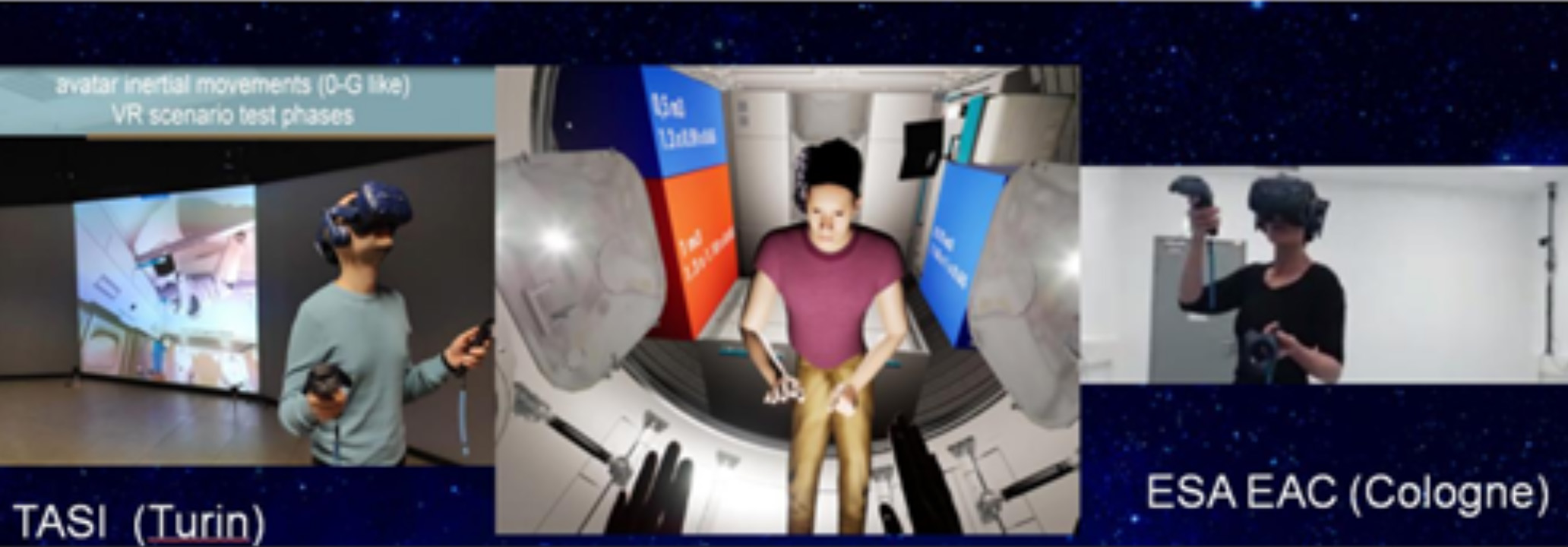
The GATEWAY4U application has undergone constant improvement since being developed. In July 2019, EAC worked with astronaut Samantha Cristoforetti in Cologne and Thales Alenia Space’s teams in Turin and Cannes to conduct a collaborative session that reviewed preliminary IHAB and ESPRIT designs, as always based on a combination of virtual reality (VR) and user experience (UX). The Design process is composed by the following main steps:
-
1.
System Modelling (CAD model simplification, VR scenario definition, Mission scenario, task analysis). The VR scenario will be defined based on the mission design phases needs and the operating environment. Understanding is gained through the following activities: Develop missions and scenarios, Develop concept of operations, Allocate functions between user and system.
-
2.
Collaborative Design (Usability Tests) The usability test are based on the active involvement of users and a clear understanding of task requirements. Users provide valuable knowledge about the context of use, the tasks, and how users are likely to work with the future product or system. Astronauts (e.g., mission specialist or payload specialist) with their extensive knowledge collected over years of experience allows for increased understanding of user needs and provide feedback on how to use the product or system. Engineering experts: ground operations personnel can interact with the final users to clarify issues and improving the understanding of proper tasks and system requirements aiming to find solutions in a more effective way.
-
3.
Data Collection & Analysis (user’s needs, design guidelines identification) The collected data will be analyzed to extract the main guidelines based on user’s experience to be used in the next step of the design refinement process. Within the iterative design process described here, the evaluation activities evolve designs by identifying areas for design improvement through the gathering of quantitative and qualitative data. Evaluation of design concepts and alternatives is crucial to achieving optimal design solutions. Evaluations must begin early and continue throughout an iterative system design process. Representative users in the simulations and evaluations phases to ensure that results capture the capabilities of the user and are relatable to the mission situations.
3 Design Review in Virtual and Physical Mock-ups: Use-cases
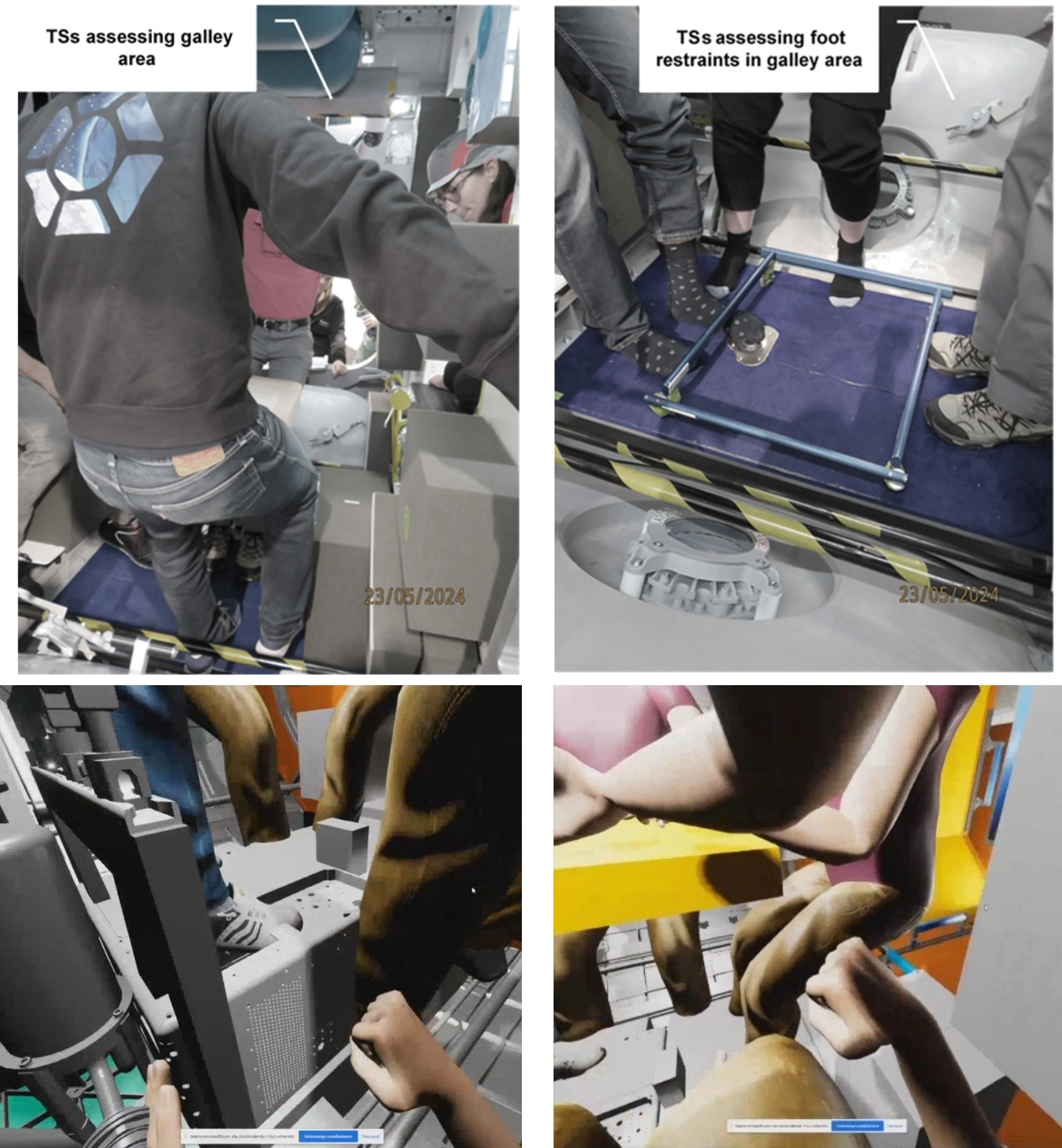
The IHAB developmental test in virtual l mock-up performed in 2021 involving astronauts from remote in a real-time virtual session have been described in previous section. Avatars representing the users interacting in remote connection in real time are shown in Figure 1 and 3. Here below the low fidelity IHAB physical mock-up used for the developmental test performed in May 2024 is showed in Figure 4. The Galley area included a prototype of a table that has been evaluated by the test subjects of different anthropometric percentiles, that have been selected following the NASA HITL process).

3.1 Use-case 1: IHAB Galley area usability and crew worksite evaluation
Four subjects of different anthropometric percentiles evaluated the usability of the volume available for dining together in the Galley area considering the accessibility to the equipment needed such as food warmer, potable water dispenser and trash bags. Dedicated R&MA (e.g., Velcro, handrail, foot restraint, etc.) items are positioned in the galley area according to the tasks/subtasks sequence.
Based on the user’s feedbacks received when reviewing the design in physical mock-up in addition of the evaluation of the table overall size and height the following design guidelines have been detected: (1) remove the equipment ANITA to free up Galley space and potentially reallocate it to the multipurpose areas. (2) install four additional handrails mounted on deck side to provide secure foot restraints points during meals. (3) Study the possibility to reduce or tailor the envelope of the adjacent pump package to increase the leg space
The comparison between the Galley area operational scenarios developed in 3D environment and in physical low fidelity mock up showed in Figure 5 physical and virtual environments gives evidence that, despite of the limitations when using the digital scenario only, the user’s performing the tasks in 2021 provided the same comments to orient the redesign of the Galley area, therefore, the crew since at that time, was able to perceive the issues regarding the Galley area usability issues, regarding the items and restraints accessibility, range of motion criticalities, therefore, it can be confirmed the benefits in using the virtual environments to find solutions and anticipate final users feedback as design guidelines to help engineers and designers to understand the user’s needs and take them into account as early as possible to develop Space Habitat really “user” oriented.
The following two Use Cases are related to give evidence of the application of the VR/UX approach described in para 2.0. The ongoing projects are in different design developmental phases and the lesson learnt acquired in the recent past encouraged us to promote the use of the Design in Collaborative Environment process and to propose the use of a Mixed Mock-up (composed by a physical simplified parts + virtual scenarios) to review tasks operations e.g. window scratch pane removal as shown in Figure 6.
3.2 Use-case 2: ERM ESPRIT virtual mock up for window scratch pane installation simulation
For the planned HITL in low/medium mixed mock up Demo, physical parts representing the internal layout architecture of the windows bay and surrounding equipment’s (e.g. handrails, CTBs) volumes to simulate the physical interference with the surrounding hardware will be provided including a scratch pane prototypes concept will be provided to review the crew tasks operations taking into account the crew needs to remove easily and little time the pane to access to the windows to take photos and observe the moon surface. This approach will permit to verify the criticalities envisaged in positioning e.g. the crew restraints and suggest design solution to fulfill the user’s needs aiming to optimize the windows worksite usability from crew visibility, accessibility and operability point of views.

3.3 Use-case 3: MPH Virtual Mock-up for Hatch Opening and Closing Door’s Task Simulation
In the frame of the ASI TASI NASA project MPH there is the need to review the Doors Hatch opening and closing tasks, permitted to develop IVA and EVA virtual scenarios as shown in Figure 7 to give support to the engineering team who is in charge of the design of the MPH Door and related crew I/Fs that have to be operated in a safe and easy way. Therefore, dedicated VR sessions have been put in place to apply the VR/UX approach to clarify crew usability issues handling the doors mechanisms (e.g. gearbox lever grip, shutter knob..) and evaluating the EVA restraints accommodation considering the needs to fulfill all the range of crew percentiles taking into account the peculiarity of being in a partial gravity environment.

Mockup/Simulation Description and Physical representations needed: MPH airlock volume with EVA platform & steps, EVA hatch (HF size & crew interfaces, xEVAS suit, mobility aids, xEVAs suit don/doff stands (MF volumetric), low fidelity volumetric representation of items in the airlock o virtual representations acceptable for: xEVAs UIP, airlock repress controls/displays, communications controls/displays.
To improve the realistic crew range of motion in EVA scenario the use of a dummy simulating the xEVA suit, gloves, etc. is envisaged; this to improve the human body envelope perception to understand clearance to access the crew interfaces and range of motion needed to perform EVA tasks (e.g. MPH Hatch Door’s opening and closing; gearbox handle operability; EVA restraints usability, windows field of views analysis).
3.4 VR scenario updating
Early in the design, single-system or even single-component evaluations are performed. However, as the design matures, evaluations also mature to include entire subsystems, systems, and eventually integrated systems. High-fidelity evaluations should be conducted later in the design lifecycle.
To improve the VR scenario, the human movement’s simulation and the human behavior capabilities like in absence of gravity have been implement. User’s feedback has been collected to orient the avatar’s functionalities upgrading: · human simulation · human interactions · features, gesture. As result, a full body avatar has been developed based on reverse kinematic applied to hands tracking in order to replicate the arm’s movements. Based on the above, ergonomic and human factors analysis considering that the user can move or translate from one location to another in an “immersive” environment to review operational scenarios and crew operational needs identifying criticalities in advance and assess the system interacting in real time with other users in local or remote connections.
It is still contemplated by NASA to add, as future enhancement, Intra-Vehicular Robotics (IVR) capabilities to Gateway. Gateway remains uncrewed for much of the time and a mobile IVR device, able to translate between base points inside the cabin and between modules, is envisioned to be available for inspections and maintenance tasks and potentially working in support of crew during crewed periods. IHAB will include scarring for installation of the so called IVR homebase. The training for and use of IVR on Gateway, once it is decided to have it implemented, will form another potential application and VR use case, still to be understood in more detail.
4 Conclusions
Based on the results of the use of the VR/UX process described in para 2.0 here below are summarized some guidelines emerged during the Gateway4U tool developmental tests, which helped to clarify on how improve testbeds and verification facilities enhanced by extended reality technologies. The crew provided useful feedbacks on how to improve the 3D tool usability, clarifying the human perception issues detected evaluating the CS volumes and the human I/Fs objects interaction by using the VR functionalities available.
In the frame of Gateway Habitat Modules (e.g. IHAB, Esprit) design development reviews, in virtual and physical mock-ups, contributed to compare the usability of these verification mock ups environments and gave us additional knowledge to contribute to the transition by combining physical testbeds with digital elements, to simulate operability scenarios and find design solutions that could be achieved at a fraction of the cost of the traditional HITL process. Therefore, the next step of our activities is oriented to verify the potentiality of mixed mock-ups (composed by simplified physical parts + virtual scenarios that could be upgraded as soon the design will be more mature) to avoid the limitations detected in using virtual mock-ups only, providing new tools to be used for human systems and habitability requirements assessments:
Scheduling Design Session (SET UP)
Scheduling is fundamental. Based on the LLs acquired during the 3D tool development activities the protocols for the VR scenario set up finalization should consider the following steps: · LL1 to evaluate the efforts for the VR scenario finalization 3D models/detailed procedures) shall be provided from the involved parties at least two weeks in advance. · LL2 VR scenario shall be shared between the VR sessions participants in advance to permit corrective actions if needed. · LL3 A user manual will be provided to permit adequate training session to the involved team. · LL4 Dedicated dry runs (1 off-line and 1 on-line) to be planned before the test to identify criticalities in advance in order to avoid misunderstanding and detect time schedule’s limitation.
Proposed Roadmap for TRS updating Benefits & Limitations will be taken into account as requirements guidelines to address the next GATEWAY4U upgrading phases for: · Collisions detection features improvements · Avatar behaviors functionalities upgrading (to improve the sense of presence in VR) · Design process optimization (protocols, roles, scenarios, test procedures, questionnaires definitions…) · Data base collection and management Further digital tools/services linked with AR and MR applications are envisaged (e.g. design, training, support to operation, integration and testing phases).
Usability Testbed for Mixed Mock-Ups Under Development. The mixed mock-up where physical and digital mockup/simulation elements are highly integrated should be developed in the frame of the current PDR activities by TASI and tested in the frame of the ERM Esprit crew I/Fs accommodation, reviewing the worksite for each of the six Windows that will characterize this Cis Lunar Habitat. It is expected to exploit the potential to considerably enhance the validity of the future design evaluations, aiming to reach a higher level of realism and also saving time and resources in the process. In addition, the projection of visual cues into the real world could help to reduce the perception of the physical space limitations, thus increasing the user’s sense of presence in the simulated environment. this approach is considered also a great opportunity to demonstrate the role of the HCD/UX methods in developing the future design verification facilities to perform HITL developmental tests.
References
- [1] Fátima Avilés-Castillo, Jorge Buele, and Guillermo Palacios-Navarro. Virtual reality and user experience: Current trends and future challenges. IEEE Access, 2025. doi:10.1109/ACCESS.2025.3554434.
- [2] ESA. URL: https://blogs.esa.int/exploration/virtual-reality-session-with-esa-astronauts-for-gateway-design/.
- [3] ESA. URL: https://www.esa.int/Science_Exploration/Human_and_Robotic_Exploration/Columbus/ESA_ISS_Science_System_-_Operations_Status_Report_74_Increment_24.
- [4] M Ferrino, B Bekooy, D Saia, E Della Sala, A Sabbagh, and E Flesia. Usability aspects for a new toolbox user needs based enabled by 3d additive manufacturing technologies for iss columbus module. In 65th International Astronautical Congress (IAC), 2014.
- [5] Tommy Nilsson, Leonie Bensch, Florian Dufresne, Flavie Rometsch, Paul de Medeiros, Enrico Guerra, Florian Saling, Andrea EM Casini, and Aidan Cowley. Out of this world design: Bridging the gap between space systems engineering and participatory design practices. In Proceedings of SpaceCHI 3.0, A Conference on Human-Computer Interaction for Space Exploration (SpaceCHI 3.0). MIT Media Lab, MA, USA, 2023.