CASIMAR, a Collaborative BVSR Project

Abstract
CASIMAR is a pioneering collaboration project within the Bundesverband studentischer Raumfahrt e.V. (BVSR), uniting student groups across Germany in designing, developing and testing a modular lunar rover and specialized EVA (extravehicular activity) tools for human-robot interaction experiments at the LUNA Analog Facility in Cologne, Germany. This student-driven initiative aims to establish a lasting framework for integrating projects of BVSR into the professional lunar exploration research environments. The rover development focuses on three mission scenarios: EVA support, search & rescue, and stand-alone operations, all focused on improving human-robot interaction for astronaut safety and efficiency. In parallel, students develop EVA tools which are essential for hands-on experience and also will be complementary to the rover’s proposed capabilities. The tools also enable early testing campaigns within the LUNA Analog Facility before the rover’s completion. To enhance design, training, and operational planning, CASIMAR will integrate a virtual reality (VR) environment that will serve as a digital twin of the rover and lunar setting, supporting interactive simulations, early-stage validation, and astronaut training. CASIMAR will not only contribute innovative technological solutions but also foster interdisciplinary collaboration and practical experience of future aerospace professionals.
Keywords and phrases:
CASIMAR, BVSR, LUNA Analog Facility, rover, EVA, tools, students, collaboration, virtual reality, VR, digital twin, HRI, HCICopyright and License:
![[Uncaptioned image]](x1.png) © Rico Nerger, Ian Luca Benecken, Paul Droste, Kristina Remić, Hanjo Schnellbächer, Stefan Ursu, Nils Hensch, Gregor Mokansky, Malte Eckermann, Simon Hestermann, Alexander Kerth, Talin Aswad, and Azalia Azzahra; licensed under Creative Commons License CC-BY 4.0
© Rico Nerger, Ian Luca Benecken, Paul Droste, Kristina Remić, Hanjo Schnellbächer, Stefan Ursu, Nils Hensch, Gregor Mokansky, Malte Eckermann, Simon Hestermann, Alexander Kerth, Talin Aswad, and Azalia Azzahra; licensed under Creative Commons License CC-BY 4.0
2012 ACM Subject Classification:
Human-centered computing Human computer interaction (HCI) ; HardwareEditors:
Leonie Bensch, Tommy Nilsson, Martin Nisser, Pat Pataranutaporn, Albrecht Schmidt, and Valentina SuminiSeries and Publisher:
 Open Access Series in Informatics, Schloss Dagstuhl – Leibniz-Zentrum für Informatik
1 Introduction
1.1 What is CASIMAR?
CASIMAR is the first hands-on development project, in which student groups from across Germany collaborate under the central management of BVSR. Its main objective is the development of a lunar rover and specialised EVA (Extravehicular Activity) tools for operations in the LUNA Analog Facility in Cologne, Germany. The project strives to provide students from different universities across Germany access to LUNA in ways that would otherwise be difficult to achieve for any independent student group. Most development aspects will focus on human-robot interaction (HRI), in line with the authors understanding of LUNA as a facility with a strong focus on astronautic aspects of lunar exploration.
Eight different student societies are currently collaborating in the project. The overall goal is to provide students with access to the LUNA facility and create heritage for using the facility for educational purposes. While parts of the CASIMAR team are focusing on designing and building a rover with a major focus on HRI, other parts of the team are focusing on the development of EVA tools and in situ resource utilization (ISRU) experiments. The overall idea is to integrate those two domains of the project into a joint experiment campaign down the line, to be executed in the LUNA Analog Facility by the students themselves.
This paper shall present an overview of the project, which is currently in the early stages of requirement definition. The authors submit this paper to foster discussion in the CHI/HRI community and wish to receive feedback on the current project approach from the community.
1.2 Bundesverband studentischer Raumfahrt e.V.
The BVSR serves as the umbrella organization for fourteen German and two Austrian student groups actively engaged in hands-on space-related projects. Founded in 2022, BVSR represents and supports these groups on the national and international stage. In total, BVSR supports over one thousand students in aerospace and aerospace-related fields of study. [1]
1.3 Organisational Structure
The CASIMAR Project is led by two senior students with prior project and group management experience on behalf of BVSR. Any member of any student group under the BVSR umbrella can participate in CASIMAR by expressing their interest in the project. If any particular student group is not already participating and is not represented in CASIMAR, a representative is chosen by the group to coordinate the activities of that group. This representative then reports to the CASIMAR management on behalf of that student group, but is also responsible for recruiting members for their team at their respective university. This structure is visualized in figure 1.
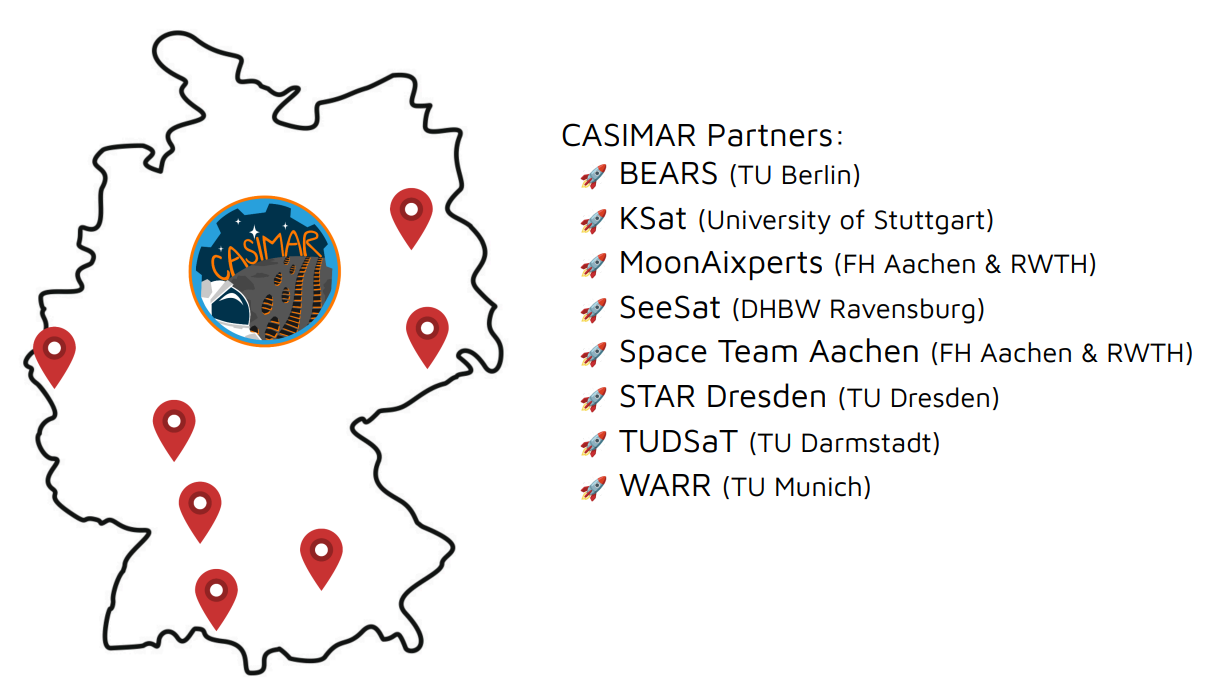
Each student group takes over one or multiple tasks, takes care of a specific subsystem of the planned rover, or an EVA tool. Their contribution to the overall CASIMAR project is being integrated in coordination with the CASIMAR management and the group of representatives. This hierarchy is not necessarily strictly enforced in all communication. Instead, direct communication within and across groups between all students participating in CASIMAR is actively encouraged to foster inter-group contacts and cooperation – while keeping the project management and group representatives informed of any progress and especially newly discovered issues. The current participating groups of CASIMAR are visualized in figure 2.
In addition, the CASIMAR management is responsible for the project’s communication with ESA and DLR, and especially the personnel of the LUNA Analog Facility and ensures that any requirements or constraints – technical as well as organisational – set by ESA or DLR are being followed within the project.
Communication between multiple university locations is being established using modern video conference systems and instant messaging systems, but it is augmented by in-person meetings and workshops hosted by at the universities of the groups participating in CASIMAR.

1.4 LUNA Analog Facility
The LUNA Analog Facility has been developed in cooperation between the German Aerospace Center (DLR) and the European Space Agency (ESA) in Cologne, Germany, to provide a sophisticated facility for testing and validating technology for lunar exploration. To allow in-depth experiments and studies, LUNA offers several systems and capabilities for simulating the lunar environment, specifically the moons polar regions. At this time, a 33 m-by-20 m area filled with EAC-1A regolith simulant [2], seismic sensors, an adjustable lunar sun simulator, as well as several live-surveillance and live-communication systems (Monitoring and Control System, MCS-L) are available. The regolith bed also includes a deep-floor area with a depth of 3m that features underground structures such as an artificial lava tube at the bottom. Experiment data is collected by the facility and can be provided to a customer after a campaign. Integration for live interfacing, communication and control from ESA, MUSC or GSOC control centres is also possible. Future upgrades, in order of the current schedule, include the updated Candelabra Sun Simulator (Q4/2025), Extended Reality Motion Capture (Q4/2025), the Moon Zeppelin Ramp (Q1/2026), and the Puppeteer Gravity Offload System (Q3/2026). [5]
2 CASIMAR Project
2.1 Lunar Rover Platform
The project’s core concept revolves around the development of a modular rover platform for use in the LUNA Analog Facility, with several groups responsible for creating the main platform. Additional groups would contribute instruments, payloads, software, and other essential components, fostering intergroup collaboration.
To the knowledge of the authors, there is currently no rover-development focused primarily on human-robot interaction in an extraterrestrial context. The obvious exceptions are past and present developments of astronaut mobility rovers, like the Apollo Lunar Roving Vehicle, but these differ significantly from the scope of the proposed CASIMAR rover. The main focus of CASIMAR will be HRI in an astronautic lunar exploration context, with the goal of presenting a testing environment for rover-based HRI and providing tangible research into this field. In other words; How can an astronaut interact with an independent rover companion during EVAs and beyond.
As a student project, it shall provide training opportunities for future engineers, researchers, and managers of astronautic missions.
The development of the rover is currently in the early stages of requirement-based engineering. Three general mission types were devised to cover broad aspects of an astronaut supporting rover: EVA support, search & rescue, and stand-alone operation, which are introduced in the following paragraphs. These different mission types represent different magnitudes of HRI the rover platform shall be designed for; cooperation with astronauts and support during their activities, helping an injured or potentially even incapacitated astronaut, and independent operation without personnel in the vicinity of the rover respectively. The missions are conceptualised in such a way that the finished platform can be tested in the LUNA Analog Facility. The extent to which the rover will be able to handle the different aspects of the presented missions is subject of the upcoming detailed rover development.
At first, the rover shall primarily be developed as a remotely operated vehicle, preferably using the remote control capabilities provided by the LUNA Analog Facility. The rover shall enable the implementation of different degrees of autonomy to enable research into the field of HRI with autonomous machines specifically.
EVA Support
The primary design driver of the CASIMAR rover development shall be the support of an astronaut or multiple astronauts during their EVA activities. To facilitate this, the mission was not designed with tasks specifically for the rover to accomplish, but instead with general or abstract tasks for the astronauts to complete. The rover shall then be designed to support the astronaut or astronauts during these tasks.
Examples of these tasks are:
-
Taking surface samples in designated locations,
-
Deploying scientific equipment on the surface and/or recover such equipment, or
-
Conducting maintenance activities on surface-equipment (habitation infrastructure, landers, etc.).
Some example capabilities the rover could be designed for in this supportive role are:
-
Transport of scientific equipment and tools,
-
Guiding an astronaut on a safe path,
-
Providing illumination during transit and in the target region during a task,
-
Providing external camera view to observe the astronaut during a task,
-
Transporting samples for the astronaut, or
-
Providing a relatively clean work surface for the astronaut during tasks (“workbench” or potentially a glove box).
Search & Rescue
Even with every feasible precaution and safety feature, lunar exploration will still be a risky endeavour. In case an astronaut is injured or even incapacitated during an EVA, the rover shall be able to provide support. This support is grouped into several different levels of complexity with example tasks a rover could be designed for at each level:
-
Search; The rover shall be able to locate an astronaut on the surface and distinguish them from the surroundings, even in adverse lighting conditions (up to total darkness) and with the astronaut lying on the ground.
-
Beacon; After spotting the astronaut, the rover shall act as a beacon for other astronauts to find the downed colleague immediately.
-
First Aid; Once located, the rover shall provide “first aid” to the astronaut. This could mean extending the usable life support duration by coupling a “first aid” payload to the astronaut or other forms of first aid feasible within the constraint of an EVA suit.
-
Rescue; If possible, the rover should guide the astronaut back to safety or even transport an incapacitated human.
Stand–alone Operation
An astronaut will not be able to work 24 hours per day, 7 days per week but instead will need breaks and downtime. A lunar support rover should use this downtime to accomplish additional tasks on the surface independent from the astronauts in order to increase the utility of the allocated mass, which has to be transported to the lunar surface in the first place. The following example tasks could be archived by a rover without an astronaut, if considered during the design of the rover:
-
Check on equipment placed on the surface previously,
-
Scout a path for a future EVA (detailed Mapping and hazard identification),
-
Deploy specific scientific payloads, or
-
Retrieve specific scientific payloads and surface samples.
2.2 EVA Tools for Lunar Exploration
The basic challenge in keeping a voluntary student project active is to motivate students to participate over the entire course of the project. As CASIMAR is self-organised by students under the BVSR-umbrella, it is not part of any university curriculum and has therefore no external motivator. With the rover as a long term development goal on the order of multiple years, this continuous motivating of students is achieved by tangible development tasks that new members can accomplish in a relatively short time frame with little prior experience.
For CASIMAR, the development of specialised EVA tools was chosen as such a short term development task, in parallel to the rover. This enables students to get hands-on experience with a variety of tasks that require them to think about, e.g., safety requirements for interaction with astronauts, the available features of the LUNA Analog Facility, and ultimately the HRI elements by thinking about how those tools can complement the rover later on.
Furthermore, the development of EVA tools allows for multiple preliminary campaigns in the LUNA Analog Facility before the rover development is completed, which enables the CASIMAR project to establish heritage for future campaigns. This way campaign logistics can receive multiple trial runs and the overall interaction between the LUNA Analog Facility team and the CASIMAR project and BVSR in general can be established. At this time, four different student societies – BEARS, KSat, MoonAixperts, and STAR Dresden – are working semi-independently on various EVA tools and ISRU experiments, of which some prototypes will be tested in an integrated setup in the LUNA Analog Facility in 2025. It is intended that this integrated test will be conducted in a fully simulated analogue spacewalk scenario with the HECC (Human Exploration Control Center) in Munich, Germany, involved in the planning and execution of the tests, providing remote operational capabilities to guide the analogue spacewalkers through the simulated EVA.
The tools for this first campaign are currently under development. They include a multi-tool, which can be used to pick up small rocks and hold a dust bag. Unique features of this tool are the integrated light source through an detachable light, which helps the astronaut see the surface in the previously described lighting environment, as well as the heavy use of compliant mechanisms to avoid the use of dust-sensitive bearings wherever possible.
In addition to the multi-tool, a small handheld regolith sieve will also undergo testing during the first experiment campaign. The main objective is to allow Astronauts to filter small regolith samples based on different grain sizes. The sieve’s design is tailored to be used with bulky EVA suits, especially the gloves, and can be operated entirely without the need for any additional equipment. However, combining it with the multi-tool can be beneficial. The operating principle is based on centrifugal force, which pushes the collected regolith samples through a filter. The sieve also contains the complete sample to minimize dust generation to avoid inhibiting the astronauts visibility.
Apart from the hand tools, a previously developed vibration based regolith conveyor system shall be tested for its deployment ergonomics within the constraints of an EVA suit. [6]
2.3 Usage of VR Simulation
Accompanying the rover and EVA tool development will be the development of a virtual reality (VR)-environment, serving an array of purposes throughout the life cycle of the CASIMAR project. The proposed VR-environment, similar to the rover, will be subject to concurrent engineering processes and gain complexity along with the rover design, serving as a digital twin for initially designing, later training, and finally possibly operating the system. The more immediate advantage of the VR-environment shall be the evaluation of the rovers design by displaying models of the rover and its constituent parts in the environment it is later deployed in, leveraging benefits of experiencing the rover to scale in conditions that the rover and corresponding EVA astronaut are expected to experience. An example for these conditions are the challenging lighting conditions of the lunar south pole as well as lunar gravity as has been explored for the Argonaut lander, formally known as EL3, in the works of Nilsson et al. [4]. This will provide insightful feedback at an early stage that common design review processes may only allow post assembly with the rover, or in the case of environment interaction, post utilization.
Initially limited to review of the physical elements but also later given a finalized and frozen hardware design, it is intended to facilitate software tests with an emulation of the rovers operating system in the VR environment providing early insights into how it interacts with a lunar environment as well as providing a testing environment for interactions with astronauts without risks of injuries due to unexpected behaviour of robotic components.
At the end of the design phase the VR-environment should contain a digital twin, with the virtual rover mimicking the appearance and behaviour of the physical counterpart. It is further envisioned to utilize this digital twin as a foundation for training elementary rover interactions for the accompanying astronauts, as well as emulating entire multi-stage missions as may be expected during actual lunar expeditions, to reduce risk and provide familiarity with the procedures ahead of time, with the perspective of applying game-based learning similar to the JIVE platform [3]. These trainings may reduce the time to learn the rover interactions drastically and may be done in the absence of the rover, which there will potentially only be one manufactured prototype of. Finally experimenting with facilitating the actual commanding of the rover using VR in our environment is proposed, by then only requiring synchronization between the physical and virtual rover, including the changing environment, and commanding capabilities of the VR-application as a new and alternative way to handle the control of the rover. For the commanding abilities, various input devices will be considered and evaluated on their intuitiveness and coverage of rover controls, to then assess their effectiveness for physical and digital rover control. This has only been identified as a subject requiring further research and will be pursued once the design of the rover and the corresponding controls of it and its potential payloads have been consolidated.
3 Conclusion and Outlook
The CASIMAR project represents an ambitious step forward in student-led lunar exploration research, uniting multiple student groups under the BVSR to design and develop a modular rover and specialized EVA tools. By leveraging the unique capabilities of the LUNA Analog Facility in Cologne, Germany CASIMAR aims to establish the foundation for future interdisciplinary collaboration in the field of human-robot interaction (HRI) and lunar mission support technologies at a student level.
The participants have successfully established organisational structures to enable development of a rover capable of EVA support, search & rescue, and stand-alone operations. In parallel, the development of EVA tools will provide a valuable hands-on experience for students while enabling early testing campaigns that will enhance astronaut capabilities in lunar analogue environments. Furthermore, the integration of a virtual reality (VR) simulation environment as a digital twin for design validation, astronaut training, and operational planning will add another layer of innovation to the project. The VR environment will facilitate iterative design processes and risk-free testing, thereby improving the rover’s overall efficiency and usability.
Looking ahead, CASIMAR aims to transition from its current conceptual and requirement definition phase into full-scale development, implementation and testing. Key future milestones include:
-
Completion of requirement definition of the rover based on the proposed mission types.
-
Conducting full-scale simulated analogue spacewalks of students in the LUNA Analog Facility testing student-developed tools, refining their design and operational effectiveness with support from ESA/DLR.
-
Implementing the VR simulation environment to simulate real-time interaction with the rover, supporting astronaut training and remote operations.
-
Establishing strong ties with space agencies, research institutions, and industry partners to secure funding and technical support for long-term sustainability.
-
Encouraging more student groups to participate in CASIMAR, thereby expanding the project’s reach and fostering continuous knowledge transfer.
CASIMAR will not only contribute to technological advancements in lunar exploration but will also help train the next generation of aerospace engineers, researchers, and managers. By maintaining its focus on interdisciplinary and interregional collaboration, modular system development, and immersive simulation, CASIMAR can provide great benefits in the field of lunar exploration. The coming years will be crucial in transforming the project’s ambitious vision into tangible contributions for space research and astronautic missions.
References
- [1] Bundesverband studentischer Raumfahrt e.V. - BVSR. bvsr.space, last accessed 31. March 2025.
- [2] Engelschiøn V. S. et al. Eac-1a: A novel large-volume lunar regolith simulant. Scientific Reports, 2022. doi:10.1038/s41598-020-62312-4.
- [3] Martial Costantini et al. Using the method of loci in virtual reality to reduce robotic operations training time of astronauts. In 73rd International Astronautical Congress (IAC), Paris, France, September 18-22, 2022.
- [4] Nilsson Tommy et al. Using virtual reality to shape humanity’s return to the moon: Key takeaways from a design study. In CHI ’23: Proceedings of the 2023 CHI Conference on Human Factors in Computing Systems, Hamburg, Germany, April 23-28, 2023. doi:10.1145/3544548.3580718.
- [5] LUNA. LUNA Analog Facility – Space operations and astronaut training portfolio: LUNA services. Document, German Aerospace Center (DLR), January 2025.
- [6] Moonaixperts RegOne Project. https://www.moonaixperts.de/regone, last accessed 17. May 2025.