Design of Distance Tariffs in Public Transport

Abstract
Setting the ticket prices is a crucial decision in public transport. Its basis, relevant for all related questions, such as dynamic prices or prices for different passenger groups, is the underlying fare strategy. Popular fare strategies are based on zones or on distances. Transitions from one fare strategy to another occur frequently, e.g., if public transport operators are joined to a larger association, or if structural decisions in a region have taken place.
In this paper we report practically relevant issues when a fare structure should be changed to a distance tariff, a problem frequently arising when a ticket system based on mobile devices is introduced. We present mixed-integer linear programs for finding the parameters of a distance tariff, analyze rounding properties, and reflect how the change in revenue for the operator and the number of highly affected passengers can be controlled. Additionally, we evaluate the developed models experimentally.
Keywords and phrases:
public transport, fare strategy, distance tariffFunding:
Reena Urban: European Union’s Horizon 2020 research and innovation programme [Grant 875022] and by the Federal Ministry of Education and Research [Project 01UV2152B] under the project sEAmless SustaInable EveRyday urban mobility (EASIER).Copyright and License:
![[Uncaptioned image]](x1.png) © Philine Schiewe, Anita Schöbel, and Reena Urban; licensed under Creative Commons License CC-BY 4.0
© Philine Schiewe, Anita Schöbel, and Reena Urban; licensed under Creative Commons License CC-BY 4.0
2012 ACM Subject Classification:
Applied computing Transportation ; Mathematics of computing Mixed discrete-continuous optimizationEditors:
Jonas Sauer and Marie SchmidtSeries and Publisher:
 Open Access Series in Informatics, Schloss Dagstuhl – Leibniz-Zentrum für Informatik
1 Introduction
The choice of ticket prices for public transport usage is a crucial decision. Ticket prices are important for covering the costs of the public transport operator. Through price elasticities (see, e.g., [9, 2, 5]), they affect the number of people traveling by public transport. They also contribute to the passenger satisfaction, and they even may affect the routes passengers choose [3, 12]. A variety of fare strategies is implemented worldwide, each with a different focus and purpose. In the following we sketch three basic types which come with many variations in practice.
Flat tariffs.
In a flat tariff, every ticket has the same price. This has the advantage that it is very easy to understand, but on the other hand it is often perceived as unfair because passengers with a short journey pay the same price as passengers with a long journey.
Zone tariffs.
Zone tariffs are more granular. They group stations to zones and set fares based on the traversed zones. Within each fare zone a flat tariff is applied, but traversing different zones yields different prices. It is common that the price for a journey in a zone tariff depends on the number of traversed zones, usually with a few exceptions. Such a zone tariff is also called counting zone tariff. In the past years, zone tariffs have been very popular and are implemented in many cities in Europe (e.g., Berlin, London, Paris, Copenhagen) as well as worldwide (e.g., Vancouver, Melbourne, Johannesburg). The design of and the transition to zone tariffs with practical applications has been broadly investigated in the literature, e.g., [8, 4, 13, 27].
Distance tariffs.
Distance tariffs are the most differentiated fare strategy. They determine the price of a ticket based on the length of the corresponding journey. This can for example be the actual distance traveled in the network (network distance tariff) or the beeline (Euclidean) distance between the start and the end station of the journey (beeline distance tariff, also called airline distance tariff). In this paper, we consider affine distance tariffs, which are composed of a price per kilometer and an additional base amount. Distance tariffs are the standard system in most long-distance (railway) transportation systems and get nowadays more popular also in regional bus transportation. There are several reasons for this: First of all, charging a price which is proportional to the beeline distance seems to be fair in an area where rivers and mountains do not impose barriers for traveling. Furthermore, the rising popularity of mobile tickets and smart cards has led to an increased interest in distance tariffs because check-in/check-out systems can rather easily be used to determine the length of a journey. A particular promising setting is that passengers use mobile devices that track the coordinates and compute the distance traveled when the destination is reached. This is easy to handle for people that use public transport only occasionally and therefore in Germany an alternative to the so-called Deutschlandticket that offers unlimited access to all urban and regional public transport systems for frequent users.
The transition to a distance tariff has been regarded mainly with respect to demand change. [12] simulates route choice effects when changing from a zone tariff to a distance tariff and evaluates travel times as well as amount of fares paid. In [28], a bilevel approach maximizing the demand under the consideration of route choice based on cost and time components is discussed. A different kind of distance tariff that takes the number of stations into account instead of a kilometer distance is considered in [14, 15, 10].
In this paper, we consider a different topic than previous papers. We develop mathematical models for the design of a distance tariff focusing on practice-oriented questions arising. The models are based on standard data available for ticket sales, and the formulations presented can be implemented directly. Therefore, this paper provides the means to generate relevant tariff setting and make informed decisions.
The design of an affine distance tariff seems to be an easy exercise: one only has to determine the price per kilometer and a fixed base amount. Nevertheless, when we discussed the introduction of a distance tariff with partners from public transport operators, we learned of several issues to be considered. In this paper we share our findings that occurred during such projects by presenting how such practical requirements can be modeled.
The remainder of the paper is structured as follows. We present the general model for the transition to a distance tariff in Section 2. We then discuss the modeling issues that stem from our partners within a (confidential) real-world case study: Distance tariffs should be integral (Section 3). In most real cases there exists an upper limit as a cap on the ticket price. This upper limit is a third variable in the model as shown in Section 4. Public transport operators wish to control the deviation in revenues (Section 5.1) and are also interested in the passengers’ perspective, which means that there should be a bound on the number of highly affected passengers as introduced in Section 5.2. An experimental evaluation of the developed models is presented in Section 6. We conclude in Section 7.
2 A model for the transition to a distance tariff
Informally speaking, a fare structure assigns a ticket price to every passengers’ journey. Hence, in order to define formally what a fare structure and a distance tariff are, we first need the network in which the passengers travel.
Let us define the public transport network PTN as a graph with being the stations and being the links between stations on which a regular service exists. A passengers’ journey is a path in the PTN. In order to reflect all possible passengers journeys through the network, we define as the set of all paths in the PTN.
A fare structure assigns a ticket price to every path in the PTN, realizing a fare strategy, which may be a distance tariff, a zone tariff or a flat tariff. This paper deals with models to determine distance tariffs.
Given an org-dest-path in the PTN, we consider two common options to assign a distance (or length) to path :
- Network distance:
-
In this case, is the length of path in the PTN.
- Beeline distance:
-
In this case, is the beeline distance between the origin and the destination of path . The path itself is not needed.
We assume that that all paths have positive lengths and that all distances are rounded up to full kilometers. The latter means that a distance tariff as described in the following requires passengers to pay the price per kilometer for every kilometer started on their journey. In small regions of operation a smaller unit might be used to round to. Note that, while network and beeline distance are the most common options, any other way to determine the length of a path can be employed as well, where is the set of natural numbers starting from .
Notation 1.
Let be the set of all paths in the PTN. A fare structure is a distance tariff if the price for every path is defined as
where the two parameters and describe the price per kilometer and the base amount of the distance tariff, and is the length of path .
We denote a distance tariff with price per kilometer and base amount by . The corresponding price list of is given as with .
The goal of this paper is to develop models for the transition from an existing tariff to a distance tariff as defined in Notation 1. Since neither the operator would like to have a (big) loss in its income nor the passengers would like to have a (large) increase in their ticket prices, the idea is to design the distance tariff such that the new prices are as close as possible to the current prices. This leads to the concept of reference prices, which may be the current ticket prices or other preferable prices that should be realized. The goal then is to minimize the deviation to the reference prices. This objective has been introduced in [7], and is followed in many other publications such as [1, 8, 14, 15, 4].
In order to model the deviations, let a set of passenger groups be given. For each group let be the number of passengers of group , the path the passengers of group wish to travel, its length, and the reference price.
-
The set of passenger groups can for example be a set of origin-destination (OD) pairs , which means to consider at most one passenger group (and hence one path) between each pair of an origin station and a destination station. We also can allow different passenger groups within the same OD pair, representing different paths between the same origin and destination.
-
The distance can be derived as network or beeline distance of path of passenger group , i.e., . Note that all paths with the same pair of origin and destination station are assigned the same distance if the beeline distance is applied, whereas the network distance may lead to passenger groups with the same pair of origin and destination station but with different distances because their paths differ.
-
As the reference price , we apply the current price to be paid by passenger group for traveling along path .
-
Note that two passenger groups with can be joined to a new passenger group with and . We hence may assume that passenger groups are pairwise disjoint regarding distance or reference price.
Finally, the new price of the passenger group is denoted by . If it is determined by a distance tariff , we have . The vector contains all the new prices.
The basic distance tariff design model for a transition to a distance tariff can now be stated. It looks for a distance tariff with price per kilometer and base amount , requiring , and minimizing the sum of absolute deviations between the new prices and the reference prices :
| (1) | ||||||||
The variables with can be replaced such that the program consists of only two variables, and , and the absolute value can be replaced by a bottleneck variable for each such that we equivalently obtain its linear version:
| (2) | ||||||||
Example 2.
To illustrate the different tariff types considered in this paper, we consider an example derived from the sioux_falls data set, see Figure 4, of the software library LinTim [18, 19]. To generate passenger groups, we compute the network distance of each origin destination pair and a reference price based on the zone tariff depicted in Figure 4(a). As noted above, we combine passenger groups which share the same distance and reference price. Note that this example is part of the experimental evaluation in Section 6 (where it is denoted as data set A with ).
In the graphical representations, e.g. in Figure 1(a), each passenger group is marked as a point showing its distance (rounded to full kilometers) and reference price. The size of the marker depends on the number of passengers of the group. The fare structure is plotted as a function of the distance , e.g., in Figure 1(a), the orange line represents the distance tariff. The price list can be read off as the function values at .
We illustrate an optimized distance tariff for Example 2 in Figure 1(a).
Recall that for all . We can add additional bounds to model (1):
Lemma 3.
Proof.
Let be an optimal distance tariff. First assume that . This means that for all . Decreasing to hence decreases the objective function value, which is a contradiction to being an optimal distance tariff.
Second assume that . This yields
for all . Decreasing to hence decreases the objective function value, again a contradiction to being an optimal distance tariff.
Note that instead of the sum of absolute deviations as in (1) also the maximum absolute deviation or the sum of squared deviations may be considered as objective functions [21, 8, 1, 14, 15, 4]. Minimizing the maximum absolute deviation is strongly dependent on outliers, and hence does not lead to good results in practice. Also, while minimizing the sum of squared deviations is easy to solve by a simple regression analysis, it is not what practitioners want; it is still more dependent on outliers than minimizing the sum of absolute deviations. Another reason that makes minimizing the sum of absolute deviations attractive for practical settings is that optimization problem (1) satisfies the following two properties (which are not satisfied if the sum of absolute deviations is replaced by the maximum absolute deviation or by the the sum of squared deviations):
- (P1)
-
There is always an optimal solution with a passenger group for which the reference price and the new price coincide, i.e., . If and , then there are even two passenger groups with this property [26]. This means that there always exist two passenger groups whose ticket prices stay the same when the old fare structure is transformed to a distance tariff.
- (P2)
-
As we show in Lemma 4, with a few exceptions, the new ticket price is larger than the reference price for at most half of the passengers and it is smaller for at most half of the passengers, i.e., it may be considered as balanced. Consequently, at most half of the passengers experience increasing ticket prices when the fare structure is transformed to a distance tariff.
Moreover, some detailed analysis [26] shows that the optimization problem (1) can be solved in linear time in the number of passenger groups.
Lemma 4 (Halving property).
Let be an optimal distance tariff, i.e., an optimal solution to model (1). Then one of the following is true:
-
1.
and .
-
2.
and .
Proof.
We apply the argument from [22, 23]. Assume . Then we can increase the base amount by some so that
This however improves the objective function value because
Hence, is a better solution, which is a contradiction to being optimal.
The same argument works for the case that with and as long as . However, if , it is not allowed to reduce the base amount . This is the only situation in which it can be optimal that more than half of the passengers have a higher new ticket price than their (old) reference price.
3 Integrality constraints
A common practical requirement is to have integer values for the resulting ticket prices. Note that by scaling the reference prices, we can ensure integer multiples of 10ct, 50ct, etc. Here, we not only want to ensure this for the ticket prices of the actual set of passenger groups , but also for all potential journeys, i.e., for all paths in the PTN. This can be guaranteed by requiring the integrality condition for the whole price list, i.e.,
These conditions may be added to the basis formulation (1):
| (3) | ||||||||
We may replace by for some sufficiently large , but it is computationally not advantageous to have so many integer variables. This number can be reduced since it is in fact equivalent to require integrality only for and as the next lemma shows.
Lemma 5.
if and only if for all .
Proof.
If and are integer, then clearly is integer for all natural numbers . Vice versa, let be integer for all . For and we receive that and are both integer. Hence also is integer, and from this we get that is also integer.
The consequence is that (3) is equivalent to
| (4) | ||||||||
in which we only have two integer variables and instead of the many variables . Clearly, the program can again be linearized as already seen for (2).
Two heuristic solutions that we have tested are the following:
- rounded
-
As a heuristic we can also solve the program (1) without integrality constraints and round the optimal variables and to their closest integers. However, this is only a heuristic, although the rounding property of [11] is often satisfied for location or regression-like problems (see [24]), which have a similar structure as (1).
- rounded
-
Another option is to round the prices to the closest integer. Note however, that this does not result in a distance tariff since the resulting values will not satisfy any more.
Both optimal integer solutions and the two heuristics are illustrated in Figure 1(b).
4 Setting an upper price cap on the ticket prices
Implementing a distance tariff as in Notation 1, the ticket price increases unlimitedly with the distance. In practice, public transport tariffs often have a cap on the maximum ticket price per journey. Consider a path . As long as the length of is small, the price function is an affine linear distance tariff that becomes constant if the length of the path exceeds a threshold distance . Formally, let the price cap be . Then the price for a path with length is defined as a continuous piecewise linear function in :
which results in a threshold distance for which , i.e., the price stays at for all passengers traveling further than . In the following we investigate distance tariffs with such a cap on the ticket prices.
Notation 7.
Let be the set of all paths in the PTN. A fare structure is a capped distance tariff if the price for every path is defined as
where the parameters and describe the price per kilometer and the base amount of the distance tariff, and is the cap on the ticket price. As before, is the length of path , measured by beeline or network distance. We denote a capped distance tariff with price per kilometer , base amount and upper price limit by . If , its threshold distance is given as .
Figure 2 shows an example of input data with an optimized capped distance tariff analogously to Figure 1. The horizontal part is the result of the upper price limit .
We can compute , and with the following model:
| (5) | ||||||||
The additional variable denotes the maximum price of the capped distance tariff, and the binary variables indicate whether a passenger group has to pay the maximum price, or not. The first two constraints ensure that is always smaller than the minimum of the affine distance tariff and the upper price limit. The next two constraints ensure that is not smaller, but equal to if and equal to if . Finally, the last two constraints ensure the relation between and : If , the constant part must be larger than the affine part , and vice versa if .
In the following we first bound the optimal value for . This then enables us to determine a reasonable constant for the big parameter in model (5). Recall that .
Lemma 8.
There is always an optimal solution to model (5) with and .
Proof.
Let denote an optimal capped distance tariff.
First, assume that . We then have for all . Therefore, we can replace by , which yields the same optimal objective function value and is hence also an optimal solution. For the following let .
Second, assume that . We replace by . For all passenger groups with (which only can occur if ), the contribution to the objective function value does not change. For the remaining passenger groups, we have that and hence obtain a reduction in the objective function value, which is a contradiction to being optimal. This yields that there is an optimal solution with and hence also with .
Third, assume that . We consider replacing by . For all passenger groups with the contribution to the objective function value does not change because the price is determined by . For the remaining passenger groups, we have that . Therefore,
Thus, in this case the objective function value of is smaller than of , which is a contradiction to being an optimal solution. This yields that there is an optimal solution with .
Proof.
Let . Because of the additional constraints of Lemma 8, we have and in any feasible solution . This yields , and . The big- constraints in (5) are therefore redundant in case the big- is active.
The halving property as shown for model (1) in Lemma 4 does analogously hold for capped distance tariffs:
Lemma 10 (Halving property).
Let be an optimal capped distance tariff, i.e., an optimal solution to model (5). Then one of the following is true:
-
1.
and .
-
2.
and .
Proof.
The result can be shown analogously to Lemma 4. Instead of shifting the line , we shift the complete graph of .
5 Controlling the revenue and number of highly affected passengers
The objective function minimizing the sum of absolute deviations between reference prices and new prices implicitly controls the deviation of revenue and ticket price increases. However, in practice it may be required explicitly that the revenue is changed by a certain amount or that only a certain amount of passengers is affected by a high increase in the ticket price. These additional requirements are taken into consideration in Sections 5.1 and 5.2.
5.1 Controlling the changes in revenue
Under the assumption that all passengers pay the reference prices for their tickets, the revenue is given by . When designing a new fare structure, there might be the requirement to obtain a certain revenue . In practice the value may be given in relation to the revenue gained by the reference prices as with or as with . This bound can be acknowledged in the optimization process by adding the following linear constraint to the previous models 1, 2, 3, 4, and 5 independent of the integrality and upper price limit specifications:
| (6) |
Note that this additional constraint does in general not preserve previously shown properties of the solutions like the halving property.
Starting with model (1) or (5) without a constraint on the revenue and noticing that the revenue is lower than desired, one may be inclined to equally increase all ticket prices until the desired revenue is realized. Formally, this means that if , we set and increase the base amount to . This however does in general not lead to an optimal solution with respect to the objective of minimizing the sum of absolute deviations from reference prices as illustrated in Figure 3(a). Thus, it is only a heuristic.
5.2 Controlling the number of highly affected passengers
While a high deviation between a reference price and a new ticket price is recognized and punished by the objective function, it is still possible that the price for a passenger group increases significantly. To prevent this, we can add a set of constraints to the previous models: For each passenger group let be a threshold for the ticket price. Let be a limit on the number of passengers for which the new ticket price exceeds the threshold. In practice the threshold may be chosen as with or as with . The limit may be given as with . An example is illustrated in Figure 3(b).
This restriction can be realized by incorporating the following set of constraints into the previous models 1, 2, 3, 4, and 5 independent of the integrality and upper price limit specifications::
| (7) | |||||
| (8) | |||||
| (9) | |||||
where we choose as in Lemma 9. If , then the binary variable is set to 1 and indicates that the new price exceeds the threshold. The total number of all passengers for which the threshold is exceeded is computed and limited by . Note that this additional constraint does in general not preserve previously shown properties of the solutions like the halving property.
6 Experimental evaluation
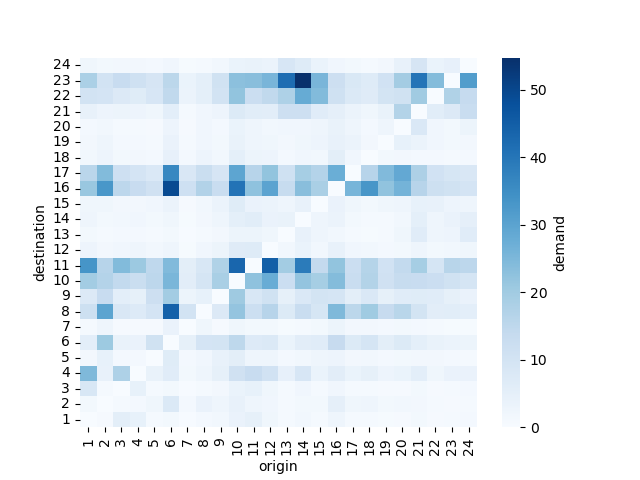
In order to discuss the differences of the models, we conduct an experimental evaluation. For the input data we consider the data set sioux_falls provided in the open source software library LinTim [18, 19], see Figure 4. We generate two sets of passenger groups where for the reference prices are computed according to a zone tariff depicted in Figure 4(a) and for the reference prices are computed based on a network distance tariff. Small perturbations are introduced by rounding the distances of the passenger groups. For , we create a set of passenger groups . Thus, the reference prices for represent a perturbed distance tariff and for a perturbed zone tariff. By using two distance functions to determine , , in data set A and data set B, we get a total of 10 instances, detailed in Table 1. The models are implemented on a machine with Intel(R) Core(TM) i5-1335U CPU and 32GB RAM using Gurobi 12 [6].
stations of the same color form a zone.
| for ratio_zone | ||||||||
|---|---|---|---|---|---|---|---|---|
| Data set | distance function | 0 | 0.25 | 0.5 | 0.75 | 1 | ||
| data set A | rounded network | 15 | 92 | 129 | 129 | 129 | 40 | |
| data set B | rounded beeline | 153 | 128 | 183 | 183 | 183 | 59 | |
We implement and test 12 models discussed in this paper, see Table 2. In particular, we consider the basic distance tariff design models (dist), models with integer prices (integer) as well as controlling the revenue (revenue) and the number of highly affected passengers (passengers). For each of these models, a version with capped prices (cap) is implemented, as well as alternative models and heuristic approaches marked by ∗.
For controlling the revenue, we set , i.e., the revenue of the new solution has to be at least as high as the revenue generated by the reference prices. For controlling the number of highly affected passengers, we choose , i.e., all passengers that have to pay more than 110% of the reference price are highly affected. Additionally, we restrict the number of highly affected passengers to , i.e., at most 10% of the passengers may be highly affected. When integer prices are considered, we consider integer multiples of 10ct, both for the prices and the parameters .
| Abbreviation | Model | Added parameters |
| dist | LP (2) | – |
| dist (cap) | MIP (5) | |
| integer | MIP (3) (linearized) | multiples of 10ct |
| integer (cap) | MIP (5) with | |
| rounded∗ | LP (2), rounded a posteriori | |
| integer∗ | MIP (4) (linearized) | |
| rounded∗ | LP (2), rounded a posteriori | |
| revenue | LP (2) with (6) | |
| revenue (cap) | MIP (5) with (6) | |
| revenue heuristic∗ | LP (2), a posteriori | |
| passengers | MIP (2) with (7)-(9) | , |
| passengers (cap) | MIP (5) with (7)-(9) |
6.1 Solver time
As shown in Figure 5, the solver time of all models is low, with a maximal solver time of under 50 seconds. However, there is a clear difference between non-capped models and capped models. All non-capped models have solver times of under 2 seconds. For the capped models, however, the solver time increases to almost 50 seconds.
Additionally, the influence of the input structure and the corresponding number of passenger groups , see Table 1, on the solver time is evident. While a pure zone tariff as input () is the easiest to solve with solver times under 2 seconds also for models with an upper bound, the instances where both zone tariffs and distance tariffs are used to generate the input, i.e., , are hardest to solve. Furthermore, since data set A is a smaller data set, it has lower solver times than data set B.
Figure 6 details the solver time of the alternative formulations and heuristics. Note that for integer distances , , the models (3) and (4) are equivalent. However, modeling only as integer variables clearly outperforms modeling all prices , , as integer variables. Note that the solver times of the revenue model and the heuristic revenue model are almost identical.
6.2 Evaluating different models
Solutions for the models described in Table 2 for are depicted Figure 7. Note that for other values of ratio_zone the solutions are structured similarly.
We observe that for data set A, for all models except integer, the non-capped model and the capped model share the same base amount and price per kilometer . Further evaluation shows that here the added flexibility of capped distance tariffs can hardly result in better solutions, see Figure 8. For data set B, however, introducing an upper limit results in new base amount and price per kilometer for all models. Thus, the capped distance tariffs can better represent the reference prices of the passengers. For both data sets, the solutions for models with continuous prices are similar to each other. However, enforcing integer prices leads to considerably different solutions. For data set B, with a maximum distance of 153, enforcing integer prices results in a flat tariff, or a capped distance tariff that closely resembles a flat tariff. If integer prices are required here, it might be better to aggregate distances, e.g to multiples of 5.
Evaluating the total deviation between prices and reference prices.
Figure 8 details the objective value, i.e., the weighted absolute deviation from the reference prices for all considered models. In addition to the absolute objective value, a normalized version is depicted, where the objective value is represented in comparison to the objective value of the basic distance tariff (dist), i.e.,
| (10) |
Figure 8 shows that reference prices derived from a distance tariff (ratio_zone=0) can be approximated best but due to structure of the input data the reference prices cannot be met exactly. Furthermore, the absolute value of the total deviation increases with ratio_zone. Only for a zone-tariff-based input, i.e., , the absolute objective values fall a little. This might be due to having fewer passenger groups .
By introducing an upper limit on the prices, the weighted absolute deviation can be reduced compared to the model without upper bound. In particular, multiple models outperform the basic distance tariff (dist). As observed in Figure 7, this effect is more pronounced for data set B than for data set A.
Note that for data set B, enforcing integer prices has a considerable effect on the solution quality, increasing the weighted absolute deviation to up to 180% of the corresponding deviation for the basic distance tariff. This is due to the high number of integer distance values paired with low prices, which often leads to flat tariffs that cannot approximate the input data well.
For all other models, the solution quality does not deviate by more than 25% compared to the deviation for the basic distance and the deviation is often considerably lower. Note that for data set B, enforcing the revenue to be at least as high as the revenue according to the reference prices can be done without noticeable losses in the objective value. This shows that imposing additional constraints still allows for tariffs that represent the reference prices well.
Evaluating the revenue.
In addition to the objective value, we evaluate the revenue of the solutions in Figure 9. Note that the revenue is normalized by the revenue of the reference prices, i.e.,
| (11) |
Compared to the revenue generated by the reference prices, the revenue according to the new tariffs reduces by at most 7% and even increases slightly for some models. Note that when controlling for the revenue, the revenue does not decrease. Thus, simplifying the tariff to a distance based tariff with relevant practical constraints is possible without a high impact on the operator’s revenue.
6.3 Evaluating alternative models and heuristics
The alternative models and heuristics solution methods marked by ∗ in Table 2 are evaluated in comparison to the original models.
Evaluating the total deviation between prices and reference prices.
When considering integer prices, Figure 10 shows that the equivalent models (3) ( integer) and (4) ( integer) do indeed find equally good solutions. However, rounding the prices or the base amount and price per kilometer a posteriori results in very different solutions. While rounding does not lead to a distance tariff, the total deviation from the reference prices is always as good as the distance tariff (dist) and sometimes even results in slightly lower deviations. In contrast, rounding the base amount and price per kilometer results in solutions with up to 5 times higher deviations form the reference prices compared to the basic distance tariff. This effect is even more pronounced for data set B, where there are more integer values for the considered distances. Note that the heuristic for revenue controlled tariffs performs almost as well as the exact solution method. However, a closer examination of the solutions shows that the resulting tariffs differ even though the objective values are almost identical.
Evaluating the revenue.
When considering the revenue depicted in Figure 11, we observe again that rounding the base amount and price per kilometer is an outlier compared to other models and can lead to significantly reduced revenues. The exact and heuristic models for revenue control are both able to avoid revenue losses. Note that while the heuristic model is designed to meet the reference price revenue exactly, the exact method can lead to slightly higher revenues with the same deviation from the reference prices.
7 Conclusion and further research
This paper provides models with several practically relevant specifications for changing a fare strategy to a distance tariff. In addition to a basic distance tariff composed of a price per kilometer and a base amount, also integrality requirements are discussed. A capped distance tariff additionally implements an upper price bound on the ticket prices. Furthermore, two constraints that can be added to the models and control the change in the revenue or the number of highly affected passengers, respectively, are suggested. The reported optimization models allow to explore and evaluate different options for distance tariffs with the possibility to add special requirements in the constraints. The experimental evaluation shows that practical constraints can be added when designing distance tariffs without sacrificing too much solution quality or revenue. In a confidential case study our partners found the results useful for their decisions on a distance tariff.
We anticipate further research in two different directions: First, the results are related to locating lines and other structures in computational geometry. In particular, for the capped distance tariff, we locate an “angled line” whose theoretical properties could be discussed along the lines of [25], not only for the median but also for the respective center problem.
Second, further research in tariff planning in public transport is interesting. We aim to strengthen the MIP formulations to solve large, realistic data sets by leveraging the structure of the reference prices. This is especially promising when the reference prices are derived from a zone tariff with few zones. Additionally, a bicriteria version as in [20] in which the revenue and the number of passengers using public transport are considered as two (conflicting) objective functions is a useful extension. Furthermore, passengers’ routes are influenced not only by their travel times but also by the tariff system. Since the routes of the passengers are crucial for planning lines and timetables, there is a need of integrating also tariff planning with these stages, and to discuss the differences between the sequential and the integrated approach [16, 17] also in this setting.
References
- [1] L. Babel and H. Kellerer. Design of tariff zones in public transportation networks: theoretical results and heuristics. Mathematical Methods of Operations Research, 58(3):359–374, December 2003. doi:10.1007/s001860300311.
- [2] R. Cervero. Transit pricing research. Transportation, 17(2):117–139, February 1990. doi:10.1007/BF02125332.
- [3] A. Chin, A. Lai, and J. Y. J. Chow. Nonadditive Public Transit Fare Pricing Under Congestion with Policy Lessons from a Case Study in Toronto, Ontario, Canada. Transportation Research Record, 2544(1):28–37, January 2016. doi:10.3141/2544-04.
- [4] A. Galligari, M. Maischberger, and F. Schoen. Local search heuristics for the zone planning problem. Optimization Letters, 11(1):195–207, January 2017. doi:10.1007/s11590-016-1069-6.
- [5] D. Gattuso and G. Musolino. A Simulation Approach of Fare Integration in Regional Transit Services. In F. Geraets, L. Kroon, A. Schöbel, D. Wagner, and C. D. Zaroliagis, editors, Algorithmic Methods for Railway Optimization, Lecture Notes in Computer Science, pages 200–218, Berlin, Heidelberg, 2007. Springer. doi:10.1007/978-3-540-74247-0_10.
- [6] Gurobi Optimization, LLC. Gurobi Optimizer Reference Manual, 2025. URL: https://www.gurobi.com.
- [7] H. W. Hamacher and A. Schöbel. On Fair Zone Designs in Public Transportation. In J. R. Daduna, I. Branco, and J. M. P. Paixão, editors, Computer-Aided Transit Scheduling, Lecture Notes in Economics and Mathematical Systems, pages 8–22, Berlin, Heidelberg, 1995. Springer. doi:10.1007/978-3-642-57762-8_2.
- [8] H. W. Hamacher and A. Schöbel. Design of Zone Tariff Systems in Public Transportation. Operations Research, 52(6):897–908, December 2004. doi:10.1287/opre.1040.0120.
- [9] D.A. Hensher and J. King. Establishing fare elasticity regimes for urban passenger transport. Technical Report C37, The University of Sydney, 1998.
- [10] R. Hoshino and J. Beairsto. Optimal pricing for distance-based transit fares. In Proceedings of the AAAI Conference on Artificial Intelligence, volume 32(1), 2018. doi:10.1609/aaai.v32i1.11413.
- [11] R. Hübner and A. Schöbel. When is rounding allowed in integer nonlinear optimization? European Journal of Operational Research, 237:404–410, 2014. doi:10.1016/j.ejor.2014.01.059.
- [12] S. Maadi and J.-D. Schmöcker. Route choice effects of changes from a zonal to a distance-based fare structure in a regional public transport network. Public Transport, 12(3):535–555, October 2020. doi:10.1007/s12469-020-00239-9.
- [13] B. Otto and N. Boysen. Zone-based tariff design in public transportation networks. Networks, 69(4):349–366, 2017. doi:10.1002/net.21731.
- [14] S. Paluch. On a fair fare rating an a bus line. Communications-Scientific letters of the University of Zilina, 15(1):25–28, 2013. doi:10.26552/com.C.2013.1.25-28.
- [15] S. Paluch and T. Majer. On a fair manifold fare rating on a long traffic line. Transport Problems, 12(2):5–11, 2017. doi:10.20858/tp.2017.12.2.1.
- [16] P. Schiewe and A. Schöbel. Periodic timetabling with integrated routing: Towards applicable approaches. Transportation Science, 54(6):1714–1731, 2020. doi:10.1287/trsc.2019.0965.
- [17] P. Schiewe and A. Schöbel. Integrated optimization of sequential processes: General analysis and application to public transport. EURO Journal on Transportation and Logistics, 11:100073, 2022. doi:10.1016/j.ejtl.2022.100073.
- [18] P. Schiewe, A. Schöbel, S. Jäger, S. Albert, C. Biedinger, T. Dahlheimer, V. Grafe, O. Herrala, K. Hoffmann, S. Roth, A. Schiewe, M. Stinzendörfer, and R. Urban. LinTim - Integrated Optimization in Public Transportation. Homepage. https://www.lintim.net/. Open source. Accessed 2025-01.
- [19] P. Schiewe, A. Schöbel, S. Jäger, S. Albert, C. Biedinger, T. Dahlheimer, V. Grafe, O. Herrala, K. Hoffmann, S. Roth, A. Schiewe, M. Stinzendörfer, and R. Urban. LinTim: An integrated environment for mathematical public transport optimization. Documentation for version 2024.12. Technical report, Rheinland-Pfälzische Technische Universität Kaiserslautern-Landau, 2024. URL: https://nbn-resolving.org/urn:nbn:de:hbz:386-kluedo-85839.
- [20] P. Schiewe, A. Schöbel, and R. Urban. A Bi-Objective Optimization Model for Fare Structure Design in Public Transport. In Paul C. Bouman and Spyros C. Kontogiannis, editors, 24th Symposium on Algorithmic Approaches for Transportation Modelling, Optimization, and Systems (ATMOS 2024), volume 123 of Open Access Series in Informatics (OASIcs), pages 15:1–15:19, Dagstuhl, Germany, 2024. Schloss Dagstuhl – Leibniz-Zentrum für Informatik. doi:10.4230/OASIcs.ATMOS.2024.15.
- [21] A. Schöbel. Zone Planning in Public Transportation Systems. In L. Bianco and P. Toth, editors, Advanced Methods in Transportation Analysis, Transportation Analysis, pages 117–133, Berlin, Heidelberg, 1996. Springer. doi:10.1007/978-3-642-85256-5_6.
- [22] A. Schöbel. Locating least-distant lines in the plane. European Journal of Operational Research, 106(1):152–159, April 1998. doi:10.1016/S0377-2217(97)00254-3.
- [23] A. Schöbel. Locating Lines and Hyperplanes: Theory and Algorithms, volume 25 of Applied Optimization Series. Kluwer, 1999. doi:10.1007/978-1-4615-5321-2.
- [24] A. Schöbel. Integer location problems. In Contributions to Location Analysis, pages 125–145. Springer, 2019.
- [25] A. Schöbel. Locating dimensional facilities in a continuous space. In G. Laporte, S. Nickel, and F. Saldanha da Gama, editors, Location Science, chapter 7, pages 143–184. Springer, 2020.
- [26] A. Schöbel and R. Urban. Fare structure design in public transport, 2025. doi:10.48550/arXiv.2502.08228.
- [27] Y. Yang, L. Deng, Q. Wang, and W. Zhou. Zone Fare System Design in a Rail Transit Line. Journal of Advanced Transportation, 2020:e2470579, December 2020. doi:10.1155/2020/2470579.
- [28] D. Yook and K. Heaslip. Determining Appropriate Fare Levels for Distance-Based Fare Structure: Considering Users’ Behaviors in a Time-Expanded Network. Transportation Research Record, 2415(1):127–135, January 2014. doi:10.3141/2415-14.