Energy-Efficient Line Planning by Implementing Express Lines

Abstract
While a shift from individual transport to public transport reduces greenhouse gas emissions, public transport itself also consumes a non-negligible amount of energy. Acceleration processes have a high part in that, especially in urban transportation networks where stops are not far from each other. Express lines which skip stops hence use less energy than a vehicle on a normal line on the same route. Additionally, they increase the attractiveness of public transport by reducing travel times. In this paper, we introduce the express line planning problem ELP which extends the well-known line planning problem by the additional planning of express lines and which stops they skip. The problem is stated in a bicriteria setting minimizing the passengers travel time and the energy consumption of the public transport system. We investigate the problem’s complexity and develop two different MIP formulations and show their equivalence. The models are tested numerically on medium sized instances.
Keywords and phrases:
Line Planning, Express Lines, Sustainable Public TransportFunding:
Sarah Roth: Funded by BMBF Project number 05M22UKB (SynphOnie).Copyright and License:
![[Uncaptioned image]](x1.png) © Sarah Roth and Anita Schöbel; licensed under Creative Commons License CC-BY 4.0
© Sarah Roth and Anita Schöbel; licensed under Creative Commons License CC-BY 4.0
2012 ACM Subject Classification:
Applied computing Transportation ; Applied computing Decision analysisEditors:
Jonas Sauer and Marie SchmidtSeries and Publisher:
 Open Access Series in Informatics, Schloss Dagstuhl – Leibniz-Zentrum für Informatik
1 Motivation
While an expansion of public transport facilitates the shift from individual transport to public transport and hence reduces greenhouse gas emissions, also public transport itself consumes a non-negligible amount of energy. Both aspects improving the attractiveness of public transport, and avoiding emissions can be improved by introducing express lines that skip some of the stops: This enables people to travel faster between their origins and their destinations making the usage of public transport more attractive. Further, each skipped stop means that the vehicle avoids an acceleration process, and, hence, consumes less energy than a vehicle on a normal line on the same route. This is underlined by the fact that the acceleration process is the most energy consuming part of driving in an urban transportation network where stops are not that far from each other.
However, there are also some downsides in the implementation of express lines as skipping a stop might lead to higher travel times for the passengers who want to board/alight at that stop. In addition, the introduction of new lines might increase the energy consumption of the transport system if it results in a higher number of vehicles. Therefore, the decisions where express lines are implemented and which stops are skipped are essential to its practical effect.
The goal of this paper is to design a line concept consisting of both express lines that skip some stops and normal lines that stop at every stop. Therefore, we integrate the decision which stops to skip in an express line into the line planning process. Our contribution is the following.
-
1.
We state the express line planning problem ELP in a bicriteria setting, minimizing the passengers’ travel time as well as the energy consumption of the transport system.
-
2.
We discuss the complexity of ELP and develop two distinct MIP formulations.
-
3.
We compare the two MIP formulations in terms of size and prove their equivalence.
-
4.
We also provide an experimental comparison of the two MIP formulations in terms of their run times and analyze the usage of express lines as well as the trade off between a reduction of travel time and a decrease in energy consumption.
The remainder of the paper is structured as follows: In Section 2 we give an overview of relevant literature. The basis of the new express line planning problem is the known line planning problem with minimal transfers and frequencies (described in Section 3.1). For its modeling we provide two different ways of representing an express line in Section 3.2. The express line planning problem ELP is then stated in Section 4.1. Here also its complexity is discussed. Now, the two MIP models which are based on the representation of express lines by stops (see Section 4.2) and by edges (see Section 4.3) are formulated. They are compared in Section 5. In Section 6, results from numerical experiments are presented. We conclude in Section 7.
2 Literature
2.1 Express Lines reducing Energy Consumption
In recent years, there were many papers published studying the possibility to reduce the energy consumption of a public transport system by installing an express mode (e.g. [3, 6, 5, 15, 13, 14]). Here, the implementation of express lines is often investigated in the context of timetabling (see e.g. [3, 14, 5]) and often solved by genetic algorithms ([6, 15, 13, 14]). The combination with timetabling is due to the fact that, in the context of railways, the necessity of an express line’s train to overtake a normal line’s train might cause serious problems due to a limited number of tracks. This problem is often studied on a small instance of one single line (see [3, 6, 5, 13, 14]) while [15] plan a cross-line express into an existing metro system. While the decrease of the total travel time is an objective in all these papers, [3] and [14] also aimed at minimizing the energy consumption. This paper also aims at investigating the implementation of express lines under both objectives, the minimization of the passengers’ travel time and the minimization of the transport systems’ energy consumption. However, we want to do the planning of express lines on the whole public transport network instead of just a single line, which enables us to consider passenger route changes. Further, we want to plan express lines already in the line planning step deciding where an express line should be implemented.
2.2 Line Planning with Passenger Routing and Express Lines
Line planning is a well-researched field in public transport optimization. There have been numerous papers published in this area. Recent overviews include [1, 10]. Different objective functions have been researched in Line Planning [11]. While there are many papers that minimize the total cost of a line plan we are interested in those that minimize the total travel time of the passengers. Here, the integration of passenger routing is of particular interest as it allows flexibility in the passengers route choice depending on the design of the public transport system (see [8]). The model developed in this paper will be based on the line planning model with minimal transfers and frequencies (LPMTF) presented in [12]. That paper, however, like most research in line planning, only considers lines that stop at all stops on their path. Only a few papers have been published on line planning with different stopping patterns, see Section 16.4.1. in [10] for a recent overview. Often, a system split is assumed (cf. [7]), i.e. we know in advance whether the passengers will travel on express or on normal lines. This might be reasonable in the context of long distance trains, but in the context of a public transport system, we would like to have more flexibility in the choice of passenger routes. We hence develop a model in which passengers can freely choose their mode of transport. Another point that distinguishes our model from the ones in the literature is the objective of minimizing the system’s energy consumption. The models on express lines or on skip stop planning usually have the objective of minimizing operating costs.
Another interesting stream of literature is the design of a BRT line, see [4] and references therein.
3 Modeling Express Lines
3.1 The Underlying Line Planning Model
Line planning problems aim at covering the links of a public transport network with lines such that passengers can travel on these lines from their origins to their destinations. A public transport network is a graph whose vertices are stops and whose edge set consists of the direct links between pairs of stops. A line is now defined as follows:
Definition 1.
A line is a (simple) path in the PTN. The set of vertices of line is denoted by and the set of edges of line is denoted by . Let give us the position of a vertex in the path of line with denoting the number of stops of line . Given a fixed planning period, say one hour, the frequency of a line says how often the line is operated during this planning period.
Given a line pool which contains candidate lines, the goal of line planning is to determine the set of lines which should be operated and determine a frequency for each of them. The set of selected lines is called a line plan, and the pair is called a line concept.
The express line planning problem to be developed in this paper is an extension of the line planning problem with minimal transfers and frequencies (LPMTF) from [12]. It aims at finding a subset of lines from a given line pool as well as passenger paths through the network such that the line-and-frequency-dependent operating costs are within a given budget and the total travel time of the passengers is minimized. The passengers’ travel time consists of the driving times along every edge in the PTN together with a penalty added for every transfer from one line to another. Therefore, as underlying graph structure, the so-called change&go network is used. The CGN is an extended PTN based on a given line pool . We use a slightly modified version 111We thank Sven Jäger for the efficient modification of the CGN. of the original definition from [12]. Transferring as well leaving the origin and entering the destination are performed by the passengers via a station node . The change&go network is built as follows:
Figure 1(b) shows the change&go network derived from the PTN and the three lines depicted in Figure 1(a).


Let us briefly state the MIP formulation for (LPMTF). We are given a with passenger demand for each denoting the number of passengers intending to travel from to . For each edge , we know the time needed for its traversal . In addition, we are given a change penalty . Further, we are given a line pool and costs for each line as well as a budget on the total cost of the line concept. Each vehicle serving a line has capacity for passengers. denotes the node-arc-incidence matrix of the corresponding . The travel time function on the edges of the CGN is defined by for and by for . Now, let us define the node potential for the flow of passengers:
for each and .
The decision variables are the frequency assigned to each line and the passenger flow, i.e., the number of passengers with origin and destination traveling on edge .
| (LPMTF) | min | (1) | ||||
| s.t. | (2) | |||||
| (3) | ||||||
| (4) | ||||||
| (5) | ||||||
| (6) | ||||||
The objective (1) minimizes the total travel time of the passengers. Constraints (2) are passenger flow constraints. These determine paths from the origins to the destinations for all passengers. Constraints (3) ensure that sufficient capacity is offered on each edge to transport all passengers along the paths determined in (2), and constraint (4) ensures that the given budget on the total cost is respected.
3.2 Two Ways of Modeling Express Lines
In the express line planning problem we do not only want to select lines from a given line pool, but we also want to be able to install an express line for each selected line. In the following, the notion of an express line is formally defined. An illustration can be found in Figure 2.
Definition 2.
Let with be a line. An express line based on line is given by with .
Remark 3.
For a line with stops there are possible express lines.
It is possible to just add the express lines to the line pool and use the normal line planning models with passenger routing from the literature. However, adding all possible express lines to the pool would mean adding an exponential number of lines. This is computationally not possible. Hence, we now define two different ways of describing an express line. An express line can be given by its nodes (stop-based representation) or its edges (edge-based representation). In Figure 3, the two ways of modeling an express line based on a normal line are depicted.
red stops are served.
red edges are part of the express line.
We, now, first define the notion of a stopping pattern for the stop-based representation.
Definition 4.
Let be an express line based on a line with stops, . The vector with is called the stopping pattern of .
Note that an express line is, by definition, required to skip at least one stop and to stop at the first and the last stop of the normal line it is based on. Hence, we can define the notion of a valid stopping pattern.
Definition 5.
A stopping pattern based on a line with is called valid if and .
A valid stopping pattern defines an express line based on line .
Second, we define the notion of an edge choice for the edge-based representation. Therefore, we define the set of the potential edges of an express line based on a line with vertices by:
From these edges, we want to choose which ones belong to the express line.
Definition 6.
Let be an express line based on a line with stops. The indicator vector with is called the edge choice of .
However, not every subset of these edges corresponds to a feasible express line. For example, the edge set from Figure 3(b) does not correspond to a reasonable express line. Hence, we introduce the notion of a valid choice of edges.
Definition 7.
An edge choice is called valid, if it corresponds to a directed path from to vertex on the directed graph with and if .
An express line given by a choice of edges stops at the nodes incident to the chosen edges. By the definition of it being valid, it is ensured that the stops of the express line do not change their order. They can only be skipped. Further, the first and the last stop must be visited and at least one stop is skipped. Now, let us show that these two ways of representing an express line are equivalent and that the notions of validity of the edge choice and the stopping pattern coincide.
Lemma 8.
Let with be a line and be an express line based on . Each valid stopping pattern corresponds to a valid edge choice , and vice versa.
The proof of this lemma can be found in Section A.1. In the following, we will exploit this knowledge to develop two equivalent MIP formulations of the express line planning problem.
4 The Express Line Planning Problem and two MIP Formulations
4.1 The Express Line Planning Problem (ELP)
Let us now state the express line planning problem ELP. As input we have a together with a line pool . Additionally, some lines of the pool can be implemented as express lines. This means that for each line in we have four choices: It can be implemented as a regular and as an express line, only as an express line, only as a regular line or it is not chosen at all. We treat the sets and as disjoint sets but for ease of notation we do not introduce an additional index for the express lines. We are interested in minimizing energy and travel times.
For the energy, let the energy consumption for traversing the edge be given for each edge in the PTN. For a line in we hence have a total consumption of energy . For an express line based on its energy consumption depends on its stopping pattern. We assume that by skipping a stop we can save of energy, i.e., the energy consumption of an express line based on line is where is the number of skipped stops in .
For the travel time we assume the travel times for the passengers along edge to be given for all . Further, we are given a change penalty and we assume that by skipping a stop we can save a travel time of . Finally, there is OD data provided that gives us the number of passengers who want to travel from one stop to another stop . The travel time of a passenger along a path is computed as in LPMTF.
The problem is then to find a feasible set of lines for each line pool and together with frequencies and a stopping pattern for each as well as passenger paths , such that all passengers can travel between their origins and destinations. We aim to minimize both the total sum of all travel times over the passengers and the total energy consumption of all lines in the line concept.
Theorem 9.
The express line planning problem ELP is NP-complete.
Proof.
In the decision version of the (bicriteria) express line planning problem, we want to decide whether there exist feasible line selections and with frequencies, a stopping pattern for each and a path for every OD-pair such that the total travel time is below a certain value and the total energy consumption is below a certain value . For a given set of lines, stopping patterns and passenger paths it can be verified in polynomial time whether the solution is feasible to this problem. Therefore, it lies in .
In order to see that ELP is NP-complete we use that the line planning problem (LPMTF) is NP-complete ([12]) and show that its decision version is a special case of the decision version of ELP: This can be seen by setting , i.e., the special case in which there are no express lines to plan. For LPMTF the NP-hardness is shown for equal costs for every line . It can be easily modified to the costs which we use in ELP (by adding additional edges to the lines).
In the following we present two different ways of modeling the express line planning problem as a MIP. The models differ mainly in the expression of the choice of the stopping pattern of an express line.
4.2 The Stop-Based Model
First, we model the express line planning problem with express line being defined by their stopping patterns. As input we have an instance of the ELP. In addition, for this model, we assume an upper bound on the frequency . Such an upper bound is e.g. given by sum of all passengers divided by the capacity of a vehicle. Further, we set an upper bound on the number of passengers traveling on an arc to . The network for the stop-based model is the change&go network based on the PTN and the union of the line pools (a line that might be chosen as a normal line and a line that might serve as basis for an express line are considered as two different lines). Figure 4 depicts the change&go network as described before for the lines in Figure 1(a) that simultaneously serve as basis for express lines.
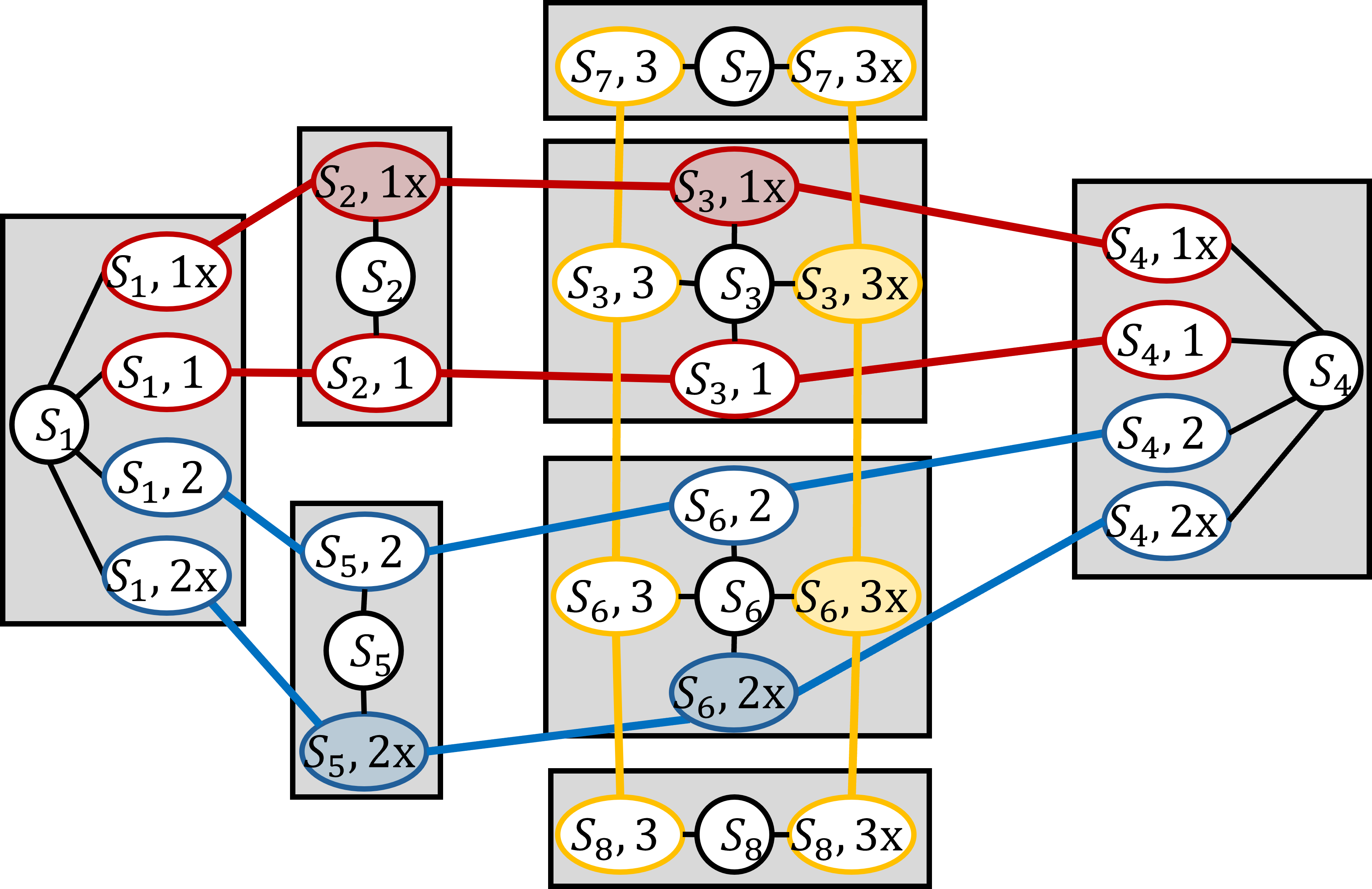
We introduce the following notation for the edge set belonging to a specific line :
Further, we need to define a travel time function for the arcs in the CGN. These are based on the given travel times in the PTN. We define
The decision variables yield the number of passengers of OD-pair on edge , decides on the frequency of line for all lines , and the binary variable decides on the stopping pattern of an express line by
So, is complementary to the stopping pattern (Definition 5). The MIP formulation reads:
| min | (7) | |||
| min | (8) |
| s.t. | (9) | |||||
| (18) | ||||||
| (19) | ||||||
| (20) | ||||||
| (21) | ||||||
| (22) | ||||||
| (23) | ||||||
| (32) | ||||||
| (33) |
The first objective Equation 7 minimizes the total energy consumption of the line concept. The second objective Equation 8 minimizes the total travel time of the passengers. Constraints Equation 9 and Equation 18 are already known from (LPMTF) and yield a passenger flow as well as the capacity constraints. If a stop is skipped, passengers cannot board (Equation 19) or alight (Equation 20) at this stop. By choosing large enough, this does not impose any constraints on the passenger flow if the stop is served. Constraints Equation 21 ensure that an express line is only implemented, if a stop is skipped. As is chosen large enough, this does not impose any constraint on the frequency in the case that the stop is served. Constraints Equation 22 ensure that no stops are counted as skipped if the corresponding express line is not chosen to be in the line concept (). Equation 23 ensures that line stops at the first and the last stop of the underlying normal line.
Lemma 10.
Any feasible assignment of the decision variables yields a valid stopping pattern and each valid stopping pattern can be represented as a feasible assignment of the variables .
Proof.
The stopping pattern obtained by for all is valid due to constraints 21 and 23 being respected by the feasible assignment . On the other hand, every valid stopping pattern yields a feasible assignment of the variables by . Due to validity of the constraints 21 and 23 are respected.
The two objectives of the MIP above are not linear. We provide a linearization of this model in the appendix (Section A.2).
4.3 The Edge-Based Model
The second model is based on the depiction of express lines as a choice of edges. Hence, we need a new network including all the potential edges for each express line.
4.3.1 The Edge-Based Express Change and Go Network
For an express line based on a line with nodes, we further introduce two artificial nodes and for initializing a flow that determines the choice of edges of that line. We set and .
For an express line the set of potential vertices coincides with the vertex set of the line which it is based on (). Further, we denote by the vertices of express line including the source and the sink node for the flow. Let us further define the vertex set .
The vertex set of the express change&go network is now defined as follows:
Now, we also distinguish between the following two edge sets of express line . While
denotes the set of all possible edges (arcs into both directions) of express line , there is also another arc set associated with express line :
This set includes all forward arcs from the set of possible edges and links them with the source and the sink node. Also the source and the sink are linked by an arc. This set of arcs is depicted in Figure 5(a). Now, we can define the edge set of the express change and go network.

An example for an express change and go network based on the PTN with three lines (see Figure 1(a)) can be found in Figure 5(b). Here, the three lines also serve as set for the potential express lines ().
The passengers can use all edges for traveling except those connecting an artificial source or sink node to an express line. Hence, we allow passenger flow on the following edge set:
4.3.2 The Edge-Based Express Line Planning MIP Formulation
The second MIP formulation that we develop is based on the choice of edges of an express line. As input we have an instance of the ELP. In addition, we assume, as before, an upper bound on the frequency . The network for the edge-based model is the previously defined edge-based express-change&go network based on the PTN and the two line pools and . Again, we need to define two functions that, based on the input, assign travel times and, respectively, energy costs to the edges of the CGN:
As these costs should, for edges of an express line, depend on the number of stops skipped by this edge, we first introduce the following notation for an edge’s number of skipped stops as well as the set of corresponding edges in the PTN:
to be the number of stops skipped by edge and
Now, we define the travel time on each arc of the CGN as
For the energy consumption of line on edge we define
The decision variables yield the number of passengers of OD-pair on edge , decides on the frequency of line for all lines , and the binary variable decides on the express line’s choice of edges.
Further, for each express line , let be the incidence matrix of the graph which is a subgraph of . Let us define for each .
The MIP model now reads:
| min | (34) | ||||||
| min | (35) | ||||||
| s.t. | (36) | ||||||
| (37) | |||||||
| (38) | |||||||
| (39) | |||||||
| (40) | |||||||
| (41) | |||||||
| (42) | |||||||
| (51) | |||||||
| (52) | |||||||
The two objectives minimize the total travel time of all passengers (35) as well as the total energy consumption (34). Constraints (36) to (38) are the passenger flow and capacity constraints on the express change&go network. In particular, constraints (38) make sure, that passengers cannot travel on all potential edges of an express line but only on the chosen ones. Constraints (39) ensure the line flow for each express line and Constraints (40) ensure that at least one stop must be skipped. Due to Constraints (41) an express line is always implemented into both directions.
Lemma 11.
Each valid edge choice corresponds to a feasible assignment of the variables and for each feasible solution there is a valid edge choice derived from the variables.
Proof.
Given a feasible assignment of the , we set for all . Due to constraints (39) and (40) is a valid edge choice. On the other hand, every valid choice of edges yields a feasible assignment of the variables by . Due to the validity of the constraints (39) and (40) are respected.
The first Objective (34) and the Constraints (38) of the MIP above are not linear. We provide a linearization of this model in the appendix (Section A.3).
5 Comparison of the Models
In this chapter, we want to compare the two MIP formulations of the Express Line Planning Problem (ELP) developed in the previous section. As a brief reminder, Table 1 provides an overview of all three models described in this paper.
| Model | LPMTF | Stop-based ELP | Edge-based ELP | ||||||||||
|---|---|---|---|---|---|---|---|---|---|---|---|---|---|
| Problem | Line Planning | Express Line Planning | Express Line Planning | ||||||||||
| Line Pool | |||||||||||||
| Network |
|
|
|
||||||||||
|
Figure 1(b) | Figure 4 | Figure 5(b) | ||||||||||
|
|
|
|
We now want to compare the two new MIP formulations of the ELP. In order to show their equivalence, let us first prove the equivalence of the express lines of the two models.
Lemma 12.
Each feasible express line in the stop-based model corresponds to an express line in the edge-based model, and vice versa, and they yield the same objective function values concerning both the passengers’ travel time and the energy consumption.
Proof.
By Lemma 10 we know that the assignment of in the stop-based MIP corresponds to a valid stopping pattern which by Lemma 8 corresponds 1:1 to a valid choice of edges for that can be translated to an assignment to the variables in the edge-based MIP which is feasible by Lemma 11. As all these transformations are equivalent, this reasoning also works into the other direction. Let denote the energy cost functions and the travel time functions of the stop- and the edge-based MIP formulation, respectively. Let us now show that for any two subsequent non-skipped stops , i.e. the travel times on line of the two models are equal, i.e.
Now, let us compare the energy costs of the two lines obtained in the two models.
Now, we can state the following theorem.
Theorem 13.
Let be an instance of the express line planning problem. The two models are equivalent, i.e. for each feasible solution of the node-based model there is a solution of the edge-based model yielding the same set of lines, frequencies and passenger paths as well as the same objective function value, and vice versa.
The proof of Theorem 13 is based on Lemma 12 and can be found in Section A.4.
Although they yield equivalent solutions, the stop-based model and the edge-based model differ in the sizes of the networks that they are based on. Both the change&go network used for the stop-based model and the express change&go network used for the edge-based model are based on the as well as the line pools and . By the definition of the for the edge-based model and the for the edge-based model, we obtain and .
In order to estimate the actual sizes depending on the input PTN and the line pools, we define to be the maximal line length in the line pool. In Table 2 the numbers of nodes as well as the numbers of edges are compared. The terms in which they differ are marked in red. The express change&go network for the edge-based model has only a few more nodes than the change&go network, however, in one summand the number of edges is quadratic in the length of the longest line in the line pool while the corresponding summand for the number of edges in the change&go network of the stop-based model is linear in that length.
| Stop-based Model | Edge-based Model | |
|---|---|---|
| Network | ||
| # Nodes | ||
| # Edges | ||
Similarly, we oppose the sizes of the two MIP formulations in Table 3. Again, the terms in which the numbers of variables and constraints differ are marked in red. For each of them, it is the case that the term in the edge-based model is quadratic in the length of the longest line in the line pool while the corresponding one for the number of edges in the change&go network of the stop-based model is linear in that length. Hence, the edge-based model has more variables and more constraints and is based on a bigger network. This also holds for the linearized version of the models. In Table 3 there is one row each, where the number of variables/constraints added for the linearization of the models is depicted.
| Stop-based Model | Edge-based Model | |
|---|---|---|
| # Variables | ||
| added for lineraization | ||
| # Constraints | ||
| added for linearization |
6 Numerical Experiments
In this section, we compare the run times of the stop-based and the edge-based MIP formulation for ELP with each other and with LPMTF for the line planning problem without express lines. The two models for ELP have been implemented in python in the software toolbox LinTim ([9]) in their linearized versions. For the LPMTF, we use the implementation provided by LinTim. We tested the models on different instances using Gurobi on a 13th Gen Intel(R) Core(TM) i5-1335U with 1.30 GHz memory.
6.1 Instance Parameters / Setting of the Experiments
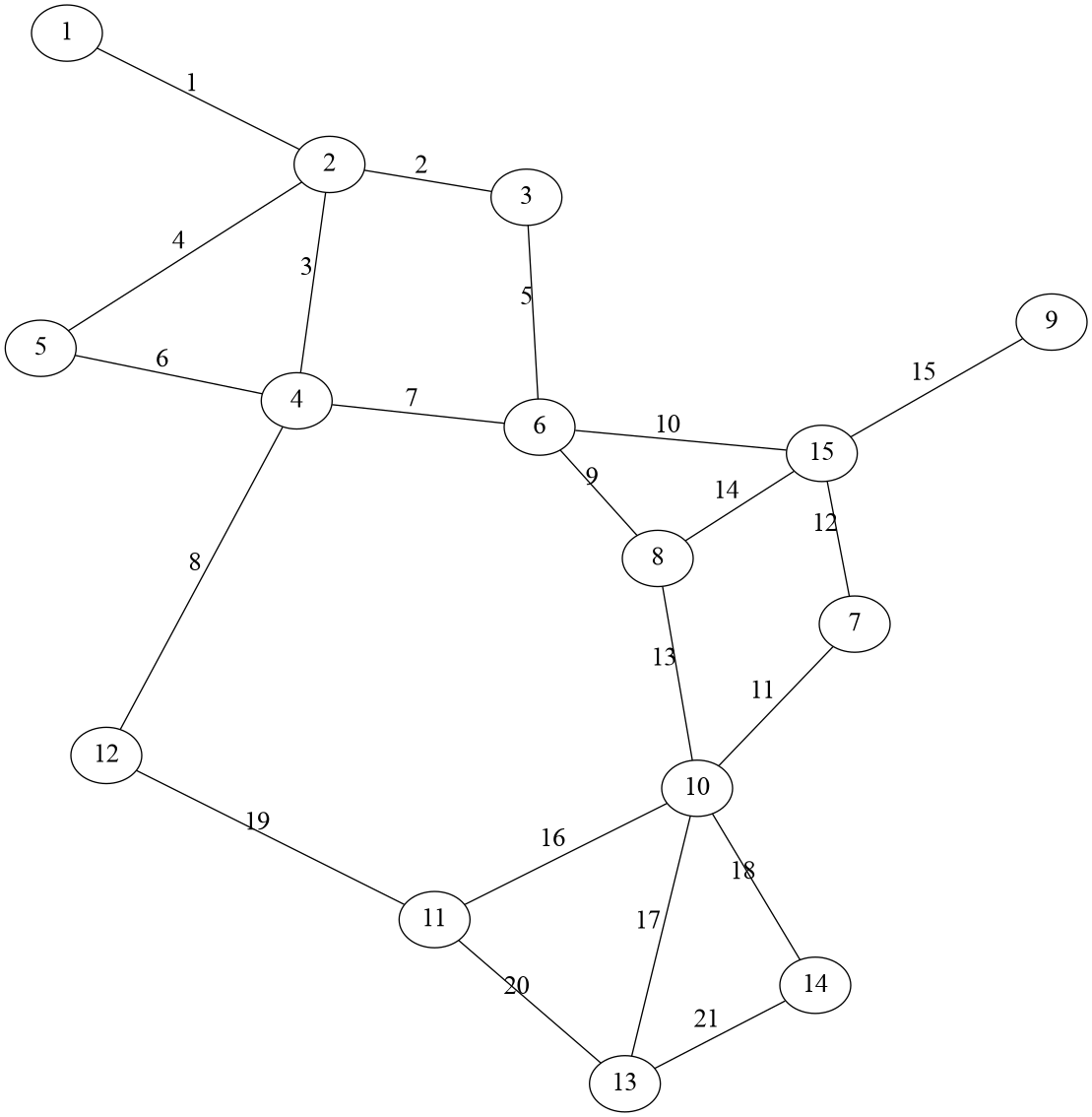
The instances under consideration are the two networks “Mandl” and “Sioux-Falls” from LinTim depicted in Figure 6. The instance data from LinTim, besides the , also comprises OD-data and distances as well as travel times for all edges . For the time saved by skipping one stop we assume time units. The change penalty is set to time units. The energy consumed for one edge is calculated based on the formulas for the energy consumption during the acceleration process, the cruising phase as well as the amount of regenerated energy in the braking phase of an electric bus given in [2]. As a target speed for the bus we assume 30 km/h and we use the distance as input for these formulas. For the other parameters, we refer to the appendix. These formulas are also used for the calculation of the energy saved by skipping one stop . For each instance, we assume that the express lines can be based on all normal lines in the pool, i.e. . For this pool, we provide two options: a small line pool and a larger line pool which are both computed with the LinTim-method k_shortest_paths for . Their sizes are depicted in Figure 6(c).

| Mandl | Sioux-Falls | |
|---|---|---|
| 15 | 24 | |
| 21 | 38 | |
| 10 | 20 | |
| 23 | 54 |
6.2 Runtime Analysis
In this subsection, we want to compare the run times of the node-based MIP formulation and the edge-based MIP formulation of the ELP. We solve the models in a one-criteria setting minimizing the travel time and bounding the total energy consumption from above. Like this we can also compare their solution times to the one of the line planning model LPMTF denoted by LP in Table 4. For each instance, we calculate the solutions for five different values of this energy bound. The run time experiments were stopped after a time of one hour. Table 4 shows the run times or, respectively, the optimality gap in percent concerning the travel time objective with a bounded amount of energy consumption for the different models and instances. We observe that, although the edge-based model has a bigger number of variables and constraints than the node-based model, it yields faster computation times and smaller optimality gaps on all instances. This holds, in particular, for the bigger network (Sioux Falls). A possible explanation might be that the edge-based model relies on flow constraints that are relatively easily solvable. Further, the stop-based model requires two different big M ( - an upper bound on the frequencies - and - an upper bound on the number of passengers on an arc) as input, while the edge-based model requires only . In addition, is much larger than . This might also be a reason for the stop-based model being solved more slowly than the edge-based model. Further, we observe the strong tendency that the lower the bound on the energy consumption is chosen the more time is needed to solve the model. This holds for both the node-based and the edge-based MIP formulation. The ELP that also aims at finding a stopping pattern for the express lines has significantly higher computation times than the problem LPMTF on the same instance. This holds for all instances.
| Energy | Run Time (s)/ Gap (%) after 1h | ||||||
|---|---|---|---|---|---|---|---|
| Bound | small pool size | large pool size | |||||
| Node-based | Edge-based | LP | Node-based | Edge-based | LP | ||
| 85 000 | 3.94 (%) | 1070.18 | 0.25 | 11.44 (%) | 1.18 (%) | 1.08 | |
| 80 000 | 5.99 (%) | 2080.46 | 0.48 | 11.66 (%) | 2.63(%) | 0.86 | |
| Mandl | 75 000 | 5.42 (%) | 0.35 (%) | 0.41 | 10.09 (%) | 2.75 (%) | 1.47 |
| 70 000 | 6.87 (%) | 0.96 (%) | 0.59 | 12.13 (%) | 3.68 (%) | 1.87 | |
| 65 000 | 6.69 (%) | 3.60 (%) | – | 11.35 (%) | 3.42 (%) | – | |
| 170 000 | 2.27 (%) | 107.26 | 0.26 | 9.47(%) | 0.85 (%) | 0.26 | |
| 155 000 | 2.64 (%) | 93.62 | 0.23 | 10.5 (%) | 1.08 (%) | 0.23 | |
| Sioux | 140 000 | 2.93 (%) | 1218.49 | 0.65 | 11.37 (%) | 2.52 (%) | 19.76 |
| Falls | 125 000 | 2.86 (%) | 0.07 (%) | 6.13 | 12.92 (%) | 3.35 (%) | 6.13 |
| 110 000 | 3.79 (%) | 0.64 (%) | 5.13 | 19.27 (%) | 4.55 (%) | 5.13 | |
6.3 Pareto Fronts: The Usage of Express Lines
In this section, the objective values of the computed solutions are analyzed. Therefore, we calculate Pareto fronts that show the pairs of solution values for which it is not possible to obtain a better value for one objective without worsening the other. For the computation we used the edge-based model but as we are just looking at the solution values and not at the run times, we could as well have used the equivalent stop-based model. The Pareto fronts were generated using an -constraint method minimizing the total travel time and varying the bound on the energy consumption. In Figure 7, three different Pareto fronts for the two different networks are plotted. The blue graph corresponds to the solutions obtained by the model for Line Planning without express lines (LPMTF). The green and the red graph depict the solution values of the express line planning problem on a small line pool (green) and a larger line pool (red). We can observe that the introduction of express lines improves the solution quality in both objectives. A larger line pool enables even better solutions. Nevertheless, we can see that there is a trade-off between the amount of energy consumption and the total travel time of the passengers.
7 Conclusion and Outlook
In this paper, we introduced the express line planning problem ELP and showed that it is NP-complete. Further, we developed the stop-based and the edge-based MIP, we proved the equivalence of the two MIP models. Numerical experiments solving a linearized version of the MIPs with Gurobi have shown that the edge-based MIP formulation, though of larger size, yields faster to results or, respectively, obtain solutions with a smaller optimality gap than the stop-based model. In addition, we observe that the introduction of express lines decreases both the total energy consumption of the public transport system as well as the total travel time of the passengers. Further research might be conducted on investigations of the structure of optimal line plans depending on the demand. The development of efficient solution methods for solving real-world instances is also an interesting research area.
References
- [1] Javier Durán-Micco and Pieter Vansteenwegen. A survey on the transit network design and frequency setting problem. Public Transport, 14(1):155–190, 2022. doi:10.1007/S12469-021-00284-Y.
- [2] Marc Gallet, Tobias Massier, and Thomas Hamacher. Estimation of the energy demand of electric buses based on real-world data for large-scale public transport networks. Applied energy, 230:344–356, 2018.
- [3] Yuan Gao, Lixing Yang, and Ziyou Gao. Energy consumption and travel time analysis for metro lines with express/local mode. Transportation Research Part D: Transport and Environment, 60:7–27, May 2018. doi:10.1016/j.trd.2016.10.009.
- [4] R. Hoogervorst, E. van der Hurk, P. Schiewe, A. Schöbel, and R. Urban. The bus rapid transit investment problem. Computers and Operations Reserach, 167(106640), 2024.
- [5] Zhujun Li, Baohua Mao, Yun Bai, and Yao Chen. Integrated optimization of train stop planning and scheduling on metro lines with express/local mode. IEEE Access, 2019. doi:10.1109/ACCESS.2019.2921758.
- [6] Qin Luo, Yufei Hou, Wei Li, and Xiongfei Zhang. Stop plan of express and local train for regional rail transit line. Journal of Advanced Transportation, 2018. doi:10.1155/2018/3179321.
- [7] Bum Hwan Park, Yong-Il Seo, Sung-Pil Hong, and Hag-Lae Rho. Column generation approach to line planning with various halting patterns - application to the korean high-speed railway. Asia-Pacific Journal of Operational Research, 30(04):1350006, 2013. doi:10.1142/S0217595913500061.
- [8] P. Schiewe. Integrated Optimization in Public Transport Planning, volume 160 of Optimization and Its Applications. Springer, 2020. doi:10.1007/978-3-030-46270-3.
- [9] Philine Schiewe, Anita Schöbel, Sven Jäger, Sebastian Albert, Christine Biedinger, Thorsten Dahlheimer, Vera Grafe, Olli Herrala, Klara Hoffmann, Sarah Roth, Alexander Schiewe, Moritz Stinzendörfer, and Reena Urban. Documentation for lintim 2024.12, 2024. URL: https://nbn-resolving.de/urn:nbn:de:hbz:386-kluedo-85839.
- [10] M. Schmidt and A. Schöbel. Modeling and optimizing transit lines. In S. Parragh and T.V. Woensel, editors, Handbook on Transport Modeling, Research Handbooks in Transportation Studies, chapter 16. Edward Elgar Publishing, 2025.
- [11] A. Schöbel. Line planning in public transportation: models and methods. OR Spectrum, 34(3):491–510, 2012. doi:10.1007/S00291-011-0251-6.
- [12] Anita Schöbel and Susanne Scholl. Line Planning with Minimal Traveling Time. In Leo G. Kroon and Rolf H. Möhring, editors, 5th Workshop on Algorithmic Methods and Models for Optimization of Railways (ATMOS’05), volume 2 of Open Access Series in Informatics (OASIcs), pages 1–16. Schloss Dagstuhl – Leibniz-Zentrum für Informatik, 2006. doi:10.4230/OASIcs.ATMOS.2005.660.
- [13] Lianhua Tang, Andrea D’Ariano, Xingfang Xu, Yantong Li, Xiaobing Ding, and Marcella Samà. Scheduling local and express trains in suburban rail transit lines: Mixed–integer nonlinear programming and adaptive genetic algorithm. Computers & Operations Research, 135:105436, November 2021. doi:10.1016/j.cor.2021.105436.
- [14] Jia Xie, Jie Zhang, KeYang Sun, ShaoQuan Ni, and DingJun Chen. Passenger and energy-saving oriented train timetable and stop plan synchronization optimization model. Transportation Research Part D: Transport and Environment, 98:102975, September 2021. doi:10.1016/j.trd.2021.102975.
- [15] Anan Yang, Bo Wang, Jianling Huang, and Chen Li. Service replanning in urban rail transit networks: Cross-line express trains for reducing the number of passenger transfers and travel time. Transportation Research Part C: Emerging Technologies, 115:102629, June 2020. doi:10.1016/j.trc.2020.102629.
Appendix A Appendix
A.1 Proof of Lemma 8
Proof.
Let be an express line based on a line with .
Claim 14.
Let be a valid stopping pattern of . Then with
is a valid choice of edges and .
Proof.
A valid choice of edges must allow a flow from to in the graph . There is a flow from to on the graph if the flow constraints hold:
| (53) | |||||
| (54) | |||||
| (55) | |||||
First let us show that for each there is at most one outgoing arc with .
Assume there were two nodes and with such that and but then is a contradiction to . Analogously, we can argue that there is at most one incoming arc for each .
As is a valid stopping pattern, it holds . This yields the existence of the following minima: For , let and . Now, if it follows that for all and for all . Consequently, the flow constraints Equation 53 - Equation 55 hold.
Hence, we obtain the inequality
As from it follows that , we know that stops at exactly the same vertices as .
Claim 15.
Let be a valid choice of edges for . Then with
is a valid stopping pattern and .
Proof.
As is a valid choice of edges, there is a flow from to on the arcs corresponding to the chosen edges. In particular, this means that there is exactly one incoming edge for node with , hence by definition we get . Further exploiting the definition of we get also obtain that .
Further, as is a valid choice of edges, we get that . Due to the fact that defines a flow on (containing no backwards arcs), there is at most one incoming edge for each vertex, and, therefore, we get . Hence, yields a valid stopping pattern. By definition of we know that stops exactly at those vertices that are adjacent to the edges of .
A.2 Linearized Stop-Based MIP
In order to linearize the stop-based MIP formulation, we introduce the following variables for each express line and each stop on that line. They are set to if the stop is served and, otherwise, take the value of the frequency or, respectively, the number of passengers traveling there:
With the help of these variables, we can reformulate the two objectives so that we obtain the corresponding linear objectives Equation 56 and Equation 57. Hence, we obtain the MIP formulation below. Constraints (58) to (61) ensure the desired behavior of the newly introduced decision variables.
| min | (56) | ||||||
| min | (57) | ||||||
| s.t. | |||||||
| (58) | |||||||
| (59) | |||||||
| (60) | |||||||
| (61) | |||||||
| (62) | |||||||
| (63) | |||||||
| (64) | |||||||
A.3 Linearization of the Edge-based Model
In order to linearize the edge-based MIP formulation, we introduce the following variables for each express line and each stop on that line. They are set to the line’s frequency if the edge is chosen for the express line and 0 otherwise:
With the help of these variables, we can reformulate the objective (34) and the Constraints (38) so that we obtain the corresponding linear objectives Equation 65 and Equation 68. Hence, we obtain the MIP formulation below. Constraints (69) to (71) ensure the desired behavior of the newly introduced decision variables.
| min | (65) | |||||
| min | (66) | |||||
| s.t. | (67) | |||||
| (68) | ||||||
| (69) | ||||||
| (70) | ||||||
| (71) | ||||||
| (72) | ||||||
| (73) | ||||||
A.4 Proof of Theorem 13 - Equivalence of the Models
Proof.
Claim 16.
Any feasible solution of the stop-based model can be transformed to a feasible solution of the edge-based model with the same objective function values.
Proof.
Let , and be the solution values of the stop-based models for the corresponding variables. Now we set the values of the frequencies of the edge-based model to:
For all and we set:
For all and we set:
If we set and else,
we set
Finally, we determine the values for the passenger flow for all . Let us assume wlog that . Let us choose such that . Then we set
This assignment yields a feasible solution to the edge-based model. Due to Lemma 8 (and its proof) the valid stopping pattern obtained by the feasible solution corresponds to a valid choice of edges given by the values of , hence by Lemma 11 the constraints (39), (40) and (41) are respected. As the stopping patterns of express line coincide in both models (Lemma 8), also the passenger flow (36) is feasible and the frequencies respect the capacities (37), (38).
The values of the objective functions of the edge-based model coincide with the values of the stop-based model by Lemma 12.
Claim 17.
Any feasible solution of the edge-based model can be transformed to a feasible solution of the node-based model with the same objective function values.
Proof.
Let , and be the solution values of the edge-based model for the corresponding variables. Now we set the values of the frequencies:
Finally, we determine the values for the passenger flow for all . Let us assume wlog that . Now we set:
This assignment yields a feasible solution to the stop-based model. Due to Lemma 8 (and its proof) the valid choice of edges obtained by the feasible solution corresponds to a valid stopping pattern given by the values of , hence by Lemma 11 the constraints (21), (22) and (23) are respected. As the stopping patterns of express line coincide in both models ( Lemma 8), also the passenger flow (9) is feasible and the frequencies respect the capacities (18). Obviously, no passenger in a feasible flow of the edge-based model could enter/board at a skipped node as the express line was not incident to it, therefore, constraints (19) and (20) are valid. The values of the objective functions of the stop-based model coincide with the values of the edge-based model by Lemma 12.