Computer Vision Integration for Automated Piece Positioning in an Industry 4.0 Setup
 Alexandre dos Santos Roque
Carlos Eduardo Pereira
Edison Pignaton de Freitas111Corresponding author
Alexandre dos Santos Roque
Carlos Eduardo Pereira
Edison Pignaton de Freitas111Corresponding author
Abstract
This paper presents the design and development of an alternative, cost-effective automated piece positioning system, specifically tailored for Small and Medium-sized Enterprises (SMEs), which integrates computer vision with EtherCAT-controlled servo motors. The proposed method combines a robust vision system with an AI-enhanced algorithm based on edge detection to precisely identify object contours. This enables a Programmable Logic Controller (PLC) to control the servo motor, adjusting the piece’s angle with high accuracy. Experimental results demonstrate the solution’s practical viability, achieving a minimal angular oscillation of less than 0.0012° and a promising low image processing time of approximately 20ms, showcasing its potential for enhancing manufacturing efficiency and quality in industrial applications.
Keywords and phrases:
Industry 4.0, Automation, Vision systems, Piece positioning, Servo motorsCopyright and License:
![[Uncaptioned image]](x1.png) © Augusto de Souza, Alexandre dos Santos Roque, Carlos Eduardo Pereira, and
© Augusto de Souza, Alexandre dos Santos Roque, Carlos Eduardo Pereira, and
Edison Pignaton de Freitas; licensed under Creative Commons License CC-BY 4.0
2012 ACM Subject Classification:
Applied computing Industry and manufacturingAcknowledgements:
This study was financed in part by the Coordenação de Aperfeiçoamento de Pessoal de Nível Superior – Brasil (CAPES) – Finance Code 001, and by the ELLITT Strategic Research Network, Sweden.Editors:
Hazem Ismail Ali and Harrison KurunathanSeries and Publisher:
 Open Access Series in Informatics, Schloss Dagstuhl – Leibniz-Zentrum für Informatik
1 Introduction
The Fourth Industrial Revolution is profoundly reshaping existing industrial production systems through a process of digital transformation, based on the integration of Cyber-Physical Systems (CPS) complemented by the Internet of Things (IoT) and Artificial Intelligence (AI) to gather and extract value and knowledge from the vast amount of available data [10]. This paradigm shift demands increased automation, precision, and adaptability, presenting both opportunities and significant challenges, particularly for Small and Medium-sized Enterprises (SMEs) that often lack the capital and specialized expertise for large-scale industrial automation solutions [16].
New technologies have been developed, and existing ones refined, to meet these evolving industrial demands. Edge computing, for instance, is now a reality where high-performance Programmable Logic Controllers (PLCs) on the factory floor operate with distributed intelligence, enabling the delegation of higher-level industrial network applications to the PLCs. This significantly enhances the industrial network’s reliability and responsiveness, especially in the event of communication failures [13].
In the Industry 4.0, the narrative often highlights advanced robotics and interconnected technologies. While collaborative robots (cobots) offer promise for secure, intuitive, and flexible interactions, their adoption, particularly in SMEs, remains limited due to high costs, complexity, and the need for specific application scenarios [21]. This underscores a persistent need for alternative, more accessible, and cost-effective solutions for part manipulation and precise positioning that can genuinely foster Industry 4.0 concepts within SMEs.
Computer vision (CV) systems are widely prevalent in industry, employed for critical tasks such as defect inspection, part detection, and precise positioning. Their non-contact nature, flexibility, and ability to provide real-time data make them invaluable for enhancing quality control, requirements analysis, and automating complex processes. In the automotive sector, computer vision, often augmented by artificial intelligence, is harnessed to automate procedures and identify minor defects, serving as an ongoing tool in vision-based applications [9], also contributing to safety requirements specification [18]. This technological capability presents a compelling opportunity for SMEs to implement advanced automation without the prohibitive costs associated with traditional robotic systems.
In alignment with these prevailing market trends and the specific needs of SMEs, this paper outlines a pivotal element within an industrial production cell, with the principal aim of automating a manual process. The endeavor seeks to amplify production efficiency and minimize errors during the manufacturing process. The resultant prototype is designed to ascertain the angle of a specific part and rectify its position to facilitate its seamless insertion into another piece of equipment along the production line. Opting for a servo motor instead of a complex robotic arm was a strategic decision intended to render the process more cost-effective and accessible, aligning with the investment capabilities of SMEs.
This study presents key contributions to the field of industrial automation, particularly for SMEs:
-
Development of a Novel Cost-Effective System: an alternative integrated system combining machine vision and EtherCAT-controlled servo motors for highly precise component positioning, offering a viable alternative to expensive robotic solutions.
-
Focus on SME-Centric Automation: The proposed solution is specifically designed to address the barriers faced by SMEs in adopting Industry 4.0 technologies, providing an accessible and practical approach to enhance their manufacturing processes.
-
Demonstration of High Precision and Efficiency: Through experimental validation, the prototype achieves exceptional angular accuracy and efficient image processing, proving its robustness and operational effectiveness in real-world industrial scenarios.
-
Real-Time Control Integration: The seamless integration of EtherCAT protocol ensures deterministic and high-speed communication, critical for real-time precise control in automated manufacturing environments.
-
Practical Application for Manual Process Automation: The work provides a concrete example of automating a common manual task (angular alignment for component insertion), demonstrating how advanced technologies can be applied to improve specific bottlenecks in production lines.
The paper is structured as follows: Section 2 introduces the issue addressed in this study; Section 3 spotlights relevant work in the domain of part manipulation and visual analysis; Section 4 delves into the development of the benchtop prototype; Section 5 presents the tests conducted and the results obtained from prototype experiments; and Section 6 presents the conclusions, also delineating directions for future research endeavors.
2 Problem Statement
Achieving precise and adaptable component positioning remains a significant challenge in modern industrial automation. Traditional manufacturing methods often fall short in delivering the accuracy and flexibility demanded by contemporary production processes [22]. As industrial operations become increasingly intricate, there is a clear need for innovative, cost-effective solutions that seamlessly integrate advanced technologies to enable real-time and high-precision component manipulation. This is particularly critical for SMEs, which frequently face substantial barriers, such as high investment costs and a lack of specialized expertise, when attempting to adopt traditional, large-scale automation systems [16].
Computer vision techniques are recognized as fundamental enablers for Industry 4.0, offering capabilities for tasks like 3D position measurement and robot guidance, which are crucial for enhancing manufacturing efficiency and quality control [22]. However, the implementation of highly advanced CV algorithms and complex robotic systems can be prohibitive for SMEs, necessitating the exploration of alternative, more accessible approaches [16].
This study addresses this gap by proposing an integrated approach that combines machine vision systems with servo motor control. Machine vision facilitates real-time data capture and analysis, while servo motors provide precise and responsive control over movement. This combination offers a cost-effective alternative to more complex robotic systems, making advanced automation more attainable for SMEs seeking to foster Industry 4.0 concepts [17, 7].
Specifically, this paper concentrates on automating a critical manual process within an industrial production unit: verifying the angular orientation of a component and correcting its position to facilitate seamless insertion into another piece of equipment along the production line. By focusing on this common yet challenging task, the aim is to develop a prototype that demonstrates how machine vision can ensure accurate component placement, thereby optimizing the production process and significantly diminishing potential errors during operations, particularly in environments characteristic of SMEs.
3 Related Works
The integration of advanced technologies, particularly CV systems, is a cornerstone of Industry 4.0, enabling enhanced automation and quality control across various manufacturing sectors [9]. These applications, encompassing advanced machine vision for quality inspection and intelligent diagnostics, as well as machine learning for predictive maintenance, are crucial for optimizing industrial processes and reducing operational costs [4, 19]. While many solutions leverage industrial robots in conjunction with vision systems for precise piece positioning, these often represent a high-cost approach, posing significant barriers for SMEs due to substantial capital investment and the need for specialized expertise [8]. This section reviews selected works in the field of piece positioning and manipulation using vision systems, highlighting their methodologies, outcomes, and existing gaps, with a particular emphasis on identifying opportunities for more accessible and cost-effective control systems relevant to SMEs.
Recent studies have explored piece positioning solutions primarily involving collaborative or industrial robotic arms integrated with vision systems. For instance, the work [17] presents a system for piece positioning that utilizes a collaborative robotic arm, a camera, and a computer for image processing, with communication established via the Robot Operation System (ROS). While effective, their system was limited to a rotational angle of approximately ±45º. In contrast, the prototype presented in our current work is designed to operate across a full 0º to 360º range.
Similarly, in [7], a piece positioning system featuring an industrial camera and an industrial-grade computer orchestrating robot directives through OpenCV and edge detection techniques is introduced. Our proposed system similarly employs advanced edge detection principles, but integrates sophisticated AI algorithms through the Shape Search III vision tool [15], enabling quicker processing times and robust object discernment against diverse background settings. Further, [1] developed a piece positioning system based on a vision system and a trio of servo motors, facilitating precision movement along the X, Y, and Z axes. Despite achieving remarkable accuracy, this design did not incorporate the capacity to rotate the target piece, thereby limiting its versatility compared to our proposed solution.
In another approach, [20] presented a system for identifying and capturing pieces on a conveyor belt using a SCARA robotic arm and a USB camera. This utilized YOLOV3, RetinaNet, and custom algorithms for part detection and orientation, with robot control via serial port. However, for robust industrial deployment, such a system would require significant enhancements in industrial-grade equipment and communication protocols. In [6], the authors developed a collaborative system for angular piece manipulation using a Universal Robots UR-05 collaborative robotic arm and an Intel RealSense camera, with image processing based on YOLO integrated with OpenCV, providing data via TCP/IP. Additionally, the study of [14] explores a flexible part assembly system combining a vision system with a SCARA robotic arm, using LabVIEW NI. While successful for parts without reflection interference, it proved inefficient for metallic parts with tonal variations, necessitating rework. Finally, in [2], a pick & place system using a SCARA articulated arm is implemented via ROS and computer vision, demonstrating adaptability for object recognition and pick-and-place in various industrial settings.
Beyond robot-centric solutions, other vision-based systems focus on specific assembly assistance or positioning tasks. The work [11] proposes a system for detecting and transferring the zero position of a direction using a macro camera and a servo motor. Their edge detection approach demonstrated commendable accuracy in identifying a central point for positioning. While effective, this system relies on X and Y coordinates, whereas our prototype directly utilizes the angle derived from image processing for precise angular correction. In [3], a part screening system on a conveyor belt is presented, using a camera with lateral lighting and an artificial neural network (BP neural network) for classification. Although exhibiting good performance, its limitation in classifying a large number of parts at high conveyor speeds highlights a common challenge. Our system, with its rapid image capture and analysis time of approximately 20ms, is designed to be highly efficient for high-speed or high-density part scenarios. Furthermore, the study of [5] introduces a product assembly assistance system combining Pick-To-Light (PTL) modules with computer vision technology. This system guides operators through complex assembly processes, using a camera with a computer vision algorithm for two-step verification of part picking. This exemplifies the use of CV in worker-assisted systems, offering an alternative to full automation, though their CV implementation for new products requires manual labeling and neural network training. In the realm of industrial logistics, [12] developed a method for monitoring conveyor belt congestion using computer vision, employing an edge detection algorithm with statistical approaches. This work, while focused on monitoring rather than direct positioning, underscores the versatility of CV in industrial logistics and its potential for outperforming deep learning methods in specific scenarios.
The reviewed literature demonstrates the pervasive application of computer vision in industrial automation, particularly for piece positioning and quality control. However, a significant portion of these advanced solutions relies on expensive industrial or collaborative robotic arms, often coupled with complex software frameworks, presenting substantial cost and implementation barriers for SMEs. While some studies explore servo motor integration, they frequently address linear positioning or lack the comprehensive angular correction capabilities required for intricate assembly tasks. This work distinguishes itself by offering an alternative, cost-effective solution specifically designed for SMEs. This approach provides a practical, high-precision method for angular piece positioning, addressing a critical gap in accessible automation solutions for SMEs without the prohibitive investment in full-fledged robotic systems, thereby fostering Industry 4.0 adoption in resource-constrained environments.
4 Computer vision system integration and development
The prototype’s implementation leveraged an integrated system of Omron industrial automation components, specifically engineered for robust industrial applications. The Figure 1 shows a block diagram that provides a visual representation of the prototype’s structural arrangement and operational workflow.
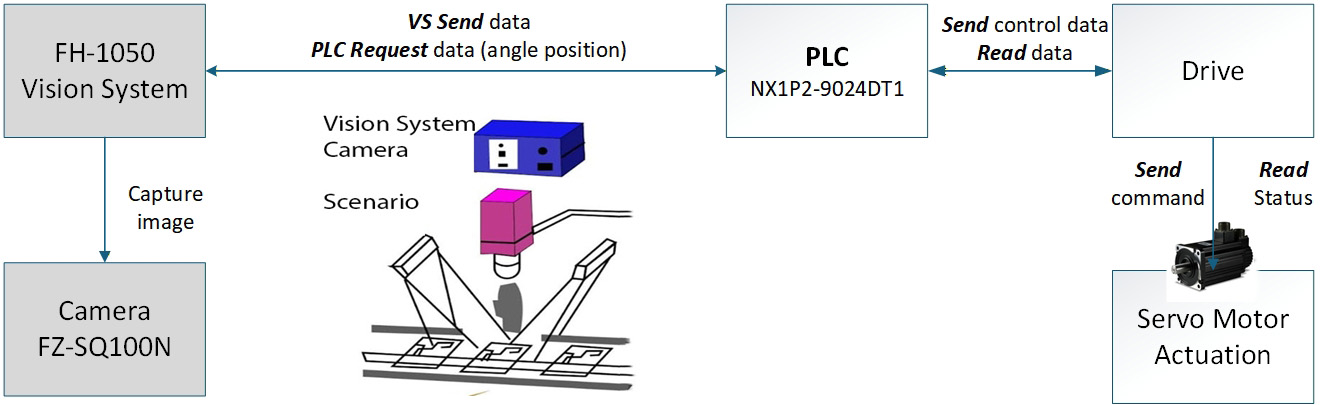
In a general view, the vision system acts as a key component, acquiring and processing the image of the piece, and sending the data to the PLC according to the specific requirement observed based on the piece’s angle analysis. Thus, the PLC control algorithm determines the movement that must be performed, sending and receiving data from the motor drive that controls the servo motor.
4.1 Image Acquisition
A smart compact camera utilizing CMOS technology, model FZ-SQ100N, was employed. This camera captures color images, offers adjustable focus through an integrated trim pot, and features dimmable front illumination controlled via the FH vision system. It boasts effective pixels measuring 720 (H) x 480 (V), with a pixel size of 6.0 x 6.0 . Its field of view ranges from 29 mm x 18 mm up to 300 mm x 191 mm, and installation can be carried out at distances ranging from 32 mm to 380 mm from the object being photographed. The camera’s focus was manually adjusted using the trim pot until optimal resolution was attained, and the camera was positioned at a distance of 300 mm from the object to be photographed. The lighting conditions were controlled using the camera’s dimmable front illumination to ensure consistent image quality regardless of ambient light variations.
4.2 Vision System
For the critical tasks of image processing, piece recognition, and precise angular measurement of the components, the FH-1050 vision system was specifically utilized. The vision system’s CPU operates using the Embedded Windows operating system and is equipped with dedicated PanDA software for vision system tasks. Configuration and programming of the vision system were carried out through the PanDA software. The initial steps involved configuring the communication protocol, EtherCAT, and assigning the vision system’s address as node 2 within the EtherCAT protocol. Subsequently, the inspection tool responsible for piece recognition and angle measurement was set up. The Shape Search III tool, known for its AI-enhanced algorithm based on edge detection, was chosen. This selection was motivated by its robust performance in industrial settings, seamless integration with Omron hardware, and its advanced capabilities for precise object discernment against diverse backgrounds. This algorithm aids in identifying the contour of the object under analysis. The vision system stores the object’s contours in its memory and designates this data as the standard model. With the standard model stored in the system’s memory, every time an image is captured and the tool is executed, the system compares the newly acquired model, based on its contours, with the existing standard model. This comparison yields correlation data between the models, the angular difference between the standard and current models, and the pixel coordinates in the X and Y directions. Figure 2 provides a visual representation of the Shape Search III tool featuring contours of the standard model.
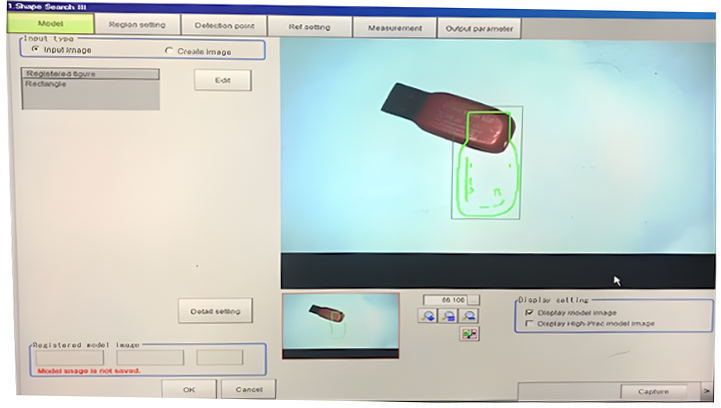
During the setup process, the model piece was positioned in the desired location for gripping and inserting the component. Subsequently, the inspection region was defined, delineating the area where the part with the standard model would be located. The entire camera’s reading field was then configured. In the final step, within the measurement parameters, rotation was enabled, and allowable rotation limits for the model were set from ° to 180°. This configuration ensured that the tool was primed to identify the standard model throughout the entire image frame, regardless of its orientation, spanning from 0° to 360°. To facilitate the transmission of the analyzed part’s angle to the PLC, a Fieldbus tool was integrated into the vision system. This tool facilitates the exchange of vision system data with the PLC using the EtherCAT protocol. The first dataset transmitted included information about the angle measurement derived from the Shape Search III tool’s model.
4.3 The Control Process
The utilized Programmable Logic Controller (PLC) model was NX1P2-9024DT1, which inherently features two Ethernet ports, one for Ethernet IP and another for EtherCAT. The Sysmac Studio software was employed for PLC programming and configuration. EtherCAT protocol configuration takes place within the dedicated protocol field, involving the inclusion of devices that are intended to communicate with the PLC, along with their addresses on the EtherCAT network. In this scenario, the PLC functions as the Master device, the driver operates as a slave for node 1, and the vision system serves as a slave for node 2. The algorithm devised for angle acquisition and servo motor drive control was implemented using Ladder programming language, following the control flow presented in Figure 3. Upon initiating the control algorithm, the servo motor drive is enabled and readied for operation. Additionally, a request is dispatched to the vision system to provide angle information pertaining to the workpiece.
Subsequently, the PLC receives the angle value, which is scaled by 1000 (a division is required). A crucial step involves converting this angle from the vision system’s output range of [°, 180°] to the motor driver’s operational range of [0°, 360°]. Specifically, if the angle received from the vision system is less than 0°, 360° is added to it; otherwise, the angle is used directly. The resulting value is then stored in the “Degrees” variable. This specific conversion method was chosen to preserve the physical configuration of the 0° reference point established by the vision system. By doing so, any angle (e.g., °) detected by the vision system is directly mapped to its equivalent absolute position (e.g., 270°) within the motor’s 0°–360° operational range, ensuring that the motor’s 0° corresponds precisely to the vision system’s 0°. Furthermore, in this step, the rotational speed of the motor is defined, configured at a rate of 500 units.

The final part of the flowchart illustrates the instruction to execute the motor rotation based on the value stored in the “Degrees” variable. Following the angle correction maneuver, once the motor has completed its rotation, it returns to the initial position in accordance with the value stored in the “Pos_ini” variable. At this point, the algorithm concludes its operation, awaiting the initiation of a new cycle.
4.4 Actuation – Servo Drive and Motors
The chosen drive model is the R88D-1SN04H-ECT, a single-phase 220V AC drive designed for motors with a capacity of up to 400W. The selected motor model is the R88M-1M40030T-S2, a 400W motor with a torque of 1.27 Nm and an integrated 23-bit absolute encoder. The parameterization of the drive and motor assembly is executed using the Sysmac Studio platform. The assembly has been configured for circular motion, without restrictions on maximum or minimum position, and with a working distance of 360° per motor revolution.
5 Experiments and Results
To validate the system’s functionality, four angles were selected, one in each quadrant, namely: 38°, 165°, 240°, and 335°. Ten image captures of the part were performed at each chosen angle, with recorded values of the piece’s angle and the total processing time of the vision system. This was done to assess the processing time and the precision of the vision system’s measurements. The results obtained are presented in Table 1. Minor variations in angle measurement occurred, along with fluctuations in processing time.
| First Quadrant (Target: 38°) | Second Quadrant (Target: 165°) | ||||
|---|---|---|---|---|---|
| Item Angle | Vision Angle | Time | Item Angle | Vision Angle | Time |
| 38° | 38.0015° | 20ms | 165° | 165.0027° | 22ms |
| 38° | 38.0017° | 21ms | 165° | 165.0024° | 21ms |
| 38° | 38.0012° | 20ms | 165° | 165.0031° | 20ms |
| 38° | 38.0020° | 20ms | 165° | 165.0025° | 20ms |
| 38° | 38.0019° | 19ms | 165° | 165.0027° | 20ms |
| 38° | 38.0015° | 20ms | 165° | 165.0033° | 20ms |
| 38° | 38.0013° | 20ms | 165° | 165.0031° | 22ms |
| 38° | 38.0012° | 20ms | 165° | 165.0029° | 20ms |
| 38° | 38.0021° | 21ms | 165° | 165.0026° | 20ms |
| 38° | 38.0009° | 20ms | 165° | 165.0032° | 21ms |
| Third Quadrant (Target: 240°) | Fourth Quadrant (Target: 335°) | ||||
| Item Angle | Vision Angle | Time | Item Angle | Vision Angle | Time |
| 240° | 240.0081° | 20ms | 335° | 335.0057° | 20ms |
| 240° | 240.0085° | 20ms | 335° | 335.0055° | 20ms |
| 240° | 240.0077° | 20ms | 335° | 335.0060° | 22ms |
| 240° | 240.0075° | 21ms | 335° | 335.0061° | 22ms |
| 240° | 240.0083° | 20ms | 335° | 335.0063° | 20ms |
| 240° | 240.0081° | 20ms | 335° | 335.0059° | 21ms |
| 240° | 240.0087° | 19ms | 335° | 335.0061° | 20ms |
| 240° | 240.0083° | 20ms | 335° | 335.0058° | 21ms |
| 240° | 240.0078° | 20ms | 335° | 335.0066° | 20ms |
| 240° | 240.0084° | 21ms | 335° | 335.0061° | 20ms |
In Table 2, the data obtained in Table 1 is depicted. It illustrates the maximum and minimum angles, as well as the variation between the largest and smallest measurements. Furthermore, it showcases the maximum and minimum processing times, along with the variation between them. Angle measurement exhibited minimal oscillation, being less than or equal to 0.0012° across the four quadrants. Image processing time was also low, approximately 20ms, and the 2ms variation does not affect the overall process cycle time.
| Quadrant | First | Second | Third | Fourth |
|---|---|---|---|---|
| Angle | 38° | 165° | 240° | 335° |
| Max. Angle | 38.0021° | 165.0033° | 240.0087° | 335.0066° |
| Min. Angle | 38.0009° | 165.0024° | 240.0075° | 335.0055° |
| Delta Angle | 0.0012° | 0.0009° | 0.0012° | 0.0011° |
| Max. Time | 21ms | 22ms | 21ms | 22ms |
| Min. Time | 19ms | 20ms | 19ms | 20ms |
| Delta Time | 2ms | 2ms | 2ms | 2ms |
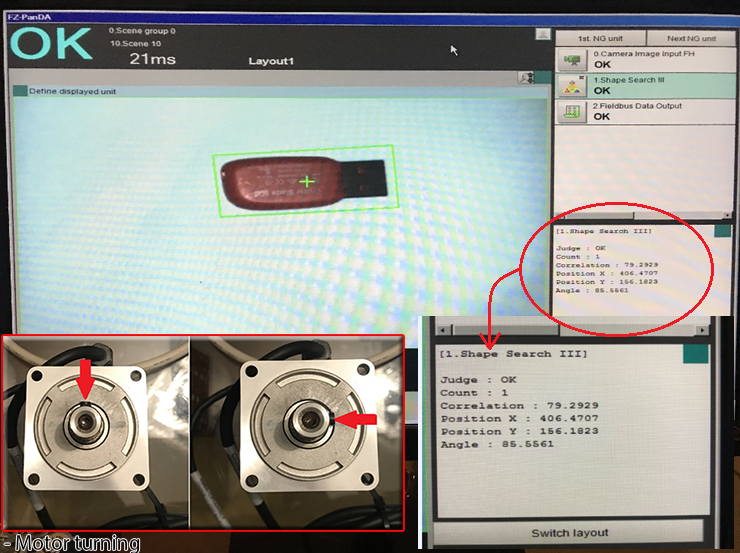
Figure 4 illustrates the system’s operational outcome, depicting the part accurately positioned at 85° and highlighting the precise angle determined by the Shape Search III tool. Additionally, the bottom-left portion of the figure provides a before-and-after comparison of the motor’s rotation, confirming the successful angular adjustment executed to align the piece to this 85° target.
6 Conclusions
This paper demonstrated the design and experimental validation of a novel, cost-effective automated piece positioning system tailored for SMEs. The prototype effectively integrates a robust computer vision system with an AI-enhanced edge detection algorithm and EtherCAT-controlled servo motors, achieving high angular precision (oscillation less than 0.0012°) and rapid image processing (approx. 20ms). This solution offers a viable alternative to expensive robotic systems, addressing a critical barrier for SMEs in adopting Industry 4.0 technologies and enhancing manufacturing efficiency and quality. The implementation and testing of the system using the EtherCAT protocol further underscore its suitability for modern industrial environments, where deterministic and high-speed communication is paramount.
For future work, exploring predictive piece positioning is a promising direction. This could leverage Industry 4.0 concepts like edge computing and advanced analytics to build a comprehensive database for training predictive models. Such models would anticipate minor angular deviations, enabling pre-emptive, small corrections and optimizing the production cycle by minimizing reactive adjustments. Additionally, investigating the system’s adaptability to a wider range of part geometries and materials, potentially incorporating advanced AI-based vision solutions, such as newer YOLO models for multi-component recognition, and its integration into a broader production line management system, would be valuable.
References
- [1] Maxim Ya Afanasev, Yuri V Fedosov, Yuri S Andreev, Anastasiya A Krylova, Sergey A Shorokhov, Kseniia V Zimenko, and Mikhail V Kolesnikov. Machine vision for auto positioning in the modular industrial equipment: A case study. In IEEE Conf on Industrial Cyberphysical Systems (ICPS), volume 1, pages 223–229. IEEE, 2020. doi:10.1109/ICPS48405.2020.9274689.
- [2] Adem Candemir and Fatih Cemal Can. Pick &place task implementation of a scara manipulator via robot operating system and machine vision. International Journal of Mechanical Engineering, ISSN: 0974-5823, 7(6):420–430, 2022.
- [3] Shuaihua Chen. Research and practice of industrial sorting technology based on machine vision. In 2021 6th International Conference on Intelligent Computing and Signal Processing (ICSP), pages 1075–1078. IEEE, 2021. doi:10.1109/ICSP51882.2021.9408646.
- [4] Oto Haffner, Erik Kučera, and Danica Rosinová. Applications of machine learning and computer vision in Industry 4.0, 2024. doi:10.3390/app14062431.
- [5] Darko Hercog, Primož Bencak, Uroš Vincetič, and Tone Lerher. Product assembly assistance system based on pick-to-light and computer vision technology. Sensors, 22(24):9769, 2022. doi:10.3390/s22249769.
- [6] Nian-Ze Hu, Qi-Ren Lin, Ruo-Wei Wu, You-Xing Zeng, Bo-An Lin, Shang-Wei Liu, Kai-Hsun Hsu, Jeng-Dao Lee, Ying-Hsiu Hung, and Chun-Min Tsai. Develop an intelligent robotic arm grasp and control system capable of determining the angle of objects. In 2022 IEEE 4th Eurasia Conference on IOT, Communication and Engineering (ECICE), pages 582–584. IEEE, 2022. doi:10.1109/ECICE55674.2022.10042951.
- [7] Yiren Huang, Weidong Hao, Zhihao Wang, and Hao Wu. Engineering applications based on Industrial robots and machine vision. In Int Conf on Image Proc, Computer Vision and Machine Learning (ICICML), pages 496–500. IEEE, 2022. doi:10.1109/ICICML57342.2022.10009862.
- [8] Sudhanshu Joshi, Manu Sharma, Shalini Bartwal, Tanuja Joshi, and Mukesh Prasad. Critical challenges of integrating opex strategies with i4. 0 technologies in manufacturing SMEs: A few pieces of evidence from developing economies. The TQM Journal, 36(1):108–138, 2024. doi:10.1108/TQM-08-2022-0245.
- [9] Fotios K Konstantinidis, Spyridon G Mouroutsos, and Antonios Gasteratos. The role of machine vision in Industry 4.0: an automotive manufacturing perspective. In 2021 IEEE International Conference on imaging systems and techniques (IST), pages 1–6. IEEE, 2021. doi:10.1109/IST50367.2021.9651453.
- [10] Paulo Leitão, Flávia Pires, Stamatis Karnouskos, and Armando Walter Colombo. Quo vadis Industry 4.0? position, trends, and challenges. IEEE Open Journal of the Industrial Electronics Society, 1:298–310, 2020. doi:10.1109/OJIES.2020.3031660.
- [11] Mingfei Li, Haibin Liu, Donglai Xu, and Chaowei Lu. Research on the mechanical zero position capture and transfer of steering gear based on machine vision. In 2021 2nd International Symposium on Computer Engineering and Intelligent Communications (ISCEIC), pages 1–6. IEEE, 2021. doi:10.1109/ISCEIC53685.2021.00008.
- [12] Yifan Li, Yingchun Niu, Yang Liu, Li Zheng, Zichen Wang, and Wenming Zhe. Computer vision based conveyor belt congestion recognition in logistics industrial parks. In 2021 26th IEEE International Conference on Emerging Technologies and Factory Automation (ETFA), pages 1–8. IEEE, 2021. doi:10.1109/ETFA45728.2021.9613245.
- [13] Zorana Mandić, Stevan Stankovski, Gordana Ostojić, and Božidar Popović. Potential of edge computing PLCs in Industrial automation. In 2022 21st International Symposium INFOTEH-JAHORINA (INFOTEH), pages 1–5. IEEE, 2022. doi:10.1109/INFOTEH53737.2022.9751324.
- [14] Phansak Nerakae, Pichitra Uangpairoj, and Kontorn Chamniprasart. Using machine vision for flexible automatic assembly system. Procedia Computer Science, 96:428–435, 2016. doi:10.1016/j.procs.2016.08.090.
- [15] OMRON. Technology overview pattern matching algorithm shape search III. Technical report, SAE Technical Paper, 2013.
- [16] E Reinhard and S Abdoli. Smart pick and place as an application of digital transformation in small and medium-sized enterprises (SMEs). In 2024 IEEE International Conference on Industrial Engineering and Engineering Management (IEEM), pages 989–993. IEEE, 2024. doi:10.1109/IEEM62345.2024.10857002.
- [17] Ismail Rokhim, Nur Jamiludin Ramadhan, and Tazkia Rusdiana. Image processing based ur5e manipulator robot control in pick and place application for random position and orientation of object. In 2021 3rd International Symposium on Material and Electrical Engineering Conference (ISMEE), pages 124–130. IEEE, 2021. doi:10.1109/ISMEE54273.2021.9774170.
- [18] Alexandre dos Santos Roque, Daniel Pohren, Edison Pignaton Freitas, and Carlos Eduardo Pereira. An approach to address safety as non-functional requirements in distributed vehicular control systems. Journal of Control, Automation and Electrical Systems, 30(5):700–715, 2019.
- [19] Alexandre S Roque, Vinicius W Krebs, Iuri Castro Figueiro, and Nasser Jazdi. An analysis of machine learning algorithms in rotating machines maintenance. IFAC-PapersOnLine, 55(2):252–257, 2022. doi:10.1016/j.ifacol.2022.04.202.
- [20] Jian Wang, Heyang Xu, and Ziting Chen. Vision-based conveyor belt workpiece grabbing using the SCARA robotic arm. In 2022 International Conference on Machine Learning, Control, and Robotics (MLCR), pages 172–176. IEEE, 2022. doi:10.1109/MLCR57210.2022.00039.
- [21] Astrid Weiss, Ann-Kathrin Wortmeier, and Bettina Kubicek. Cobots in Industry 4.0: A roadmap for future practice studies on human–robot collaboration. IEEE Transactions on Human-Machine Systems, 51(4):335–345, 2021. doi:10.1109/THMS.2021.3092684.
- [22] Longfei Zhou, Lin Zhang, and Nicholas Konz. Computer vision techniques in manufacturing. IEEE Transactions on Systems, Man, and Cybernetics: Systems, 53(1):105–117, 2022. doi:10.1109/TSMC.2022.3166397.