Framing in Communication: From Theories to Computation
Abstract
Framing has become recognised as a powerful communication strategy for winning debates and shaping opinions and decisions. Entman defines framing as an action of selecting “some aspects of a perceived reality and make them more salient in a communicating text, in such a way as to promote a particular problem definition, causal interpretation, moral evaluation, and/or treatment recommendation for the item described”. Instead of engaging in costly and difficult exchanges of argument and counter-argument, a politician or a journalist can then try to reframe a dialogue on, for example, fracking from economic benefits to environmental hazards, or a dialogue on abortion from pro-life to pro-choice. Introduced in 1960’s sociology, framing has been imported into communication sciences and media studies as an attempt to address the ways in which news is reported and, thus, a way in which to tackle manipulation and fake news. The topic has spread to other disciplines such as psychology, philosophy, semantics, pragmatics, political science, journalism, and, most recently – to computational linguistics and artificial intelligence. This seminar aims to pave the way to synthesising definitions developed in these theoretically and empirically driven areas and then to operationalise them in computational and applied areas by means of cross-disciplinary hands-on exchanges in facilitated discussions. Our goal is to support the development of innovative technologies, which can help us to quantify framing phenomena, to study framing at scale, and to deploy computational techniques in order to intervene against malicious attempts to influence opinions and decisions of the general public.
Keywords and phrases:
Communication Strategies, Discourse and Dialogue, Computational Argumentation, Natural Language ProcessingSeminar:
March 27–April 1, 2022 – http://www.dagstuhl.de/22131Copyright and License:
![[Uncaptioned image]](x1.png) Except where otherwise noted, content of this report is licensed under a
Creative Commons BY 4.0 International license
Except where otherwise noted, content of this report is licensed under a
Creative Commons BY 4.0 International license
2012 ACM Subject Classification:
Computing methodologies Discourse, dialogue and pragmatics1 Executive Summary
Katarzyna Budzynska (Warsaw University of Technology, PL)
Chris Reed (University of Dundee, GB)
Manfred Stede (Universität Potsdam, DE)
Benno Stein (Bauhaus-Universität Weimar, DE)
License: ![[Uncaptioned image]](x2.png) Creative Commons BY 4.0 International license © Katarzyna Budzynska, Chris Reed, Manfred Stede, and Benno Stein
Creative Commons BY 4.0 International license © Katarzyna Budzynska, Chris Reed, Manfred Stede, and Benno Stein
Language is used for many purposes, both private and public. When speech or text is directed to wide audiences, it often aims at influencing stances, opinions, and dispositions of readers. This can be done by relatively transparent, rational argumentation, but also in considerably more subtle ways, by phrasing utterances in such a way that the underlying intent is noticed by readers more in passing – or not consciously at all. This is the realm of “framing”, which concerns the careful selecting of the aspects of an event to be reported (those that fit the goal of letting a positive or negative evaluation shine through); the choice of terms that carry an inherent evaluation (e.g., “the frugal four” versus “the stingy four” in recent EU negotiations); and employing stylistic devices that correspondingly support the purpose (e.g., a monotonic versus a lively rhythm). Framing has been studied for quite some time, from many different perspectives, and it has also been covered by popular science books. Under these circumstances, it is not surprising that definitions and emphasis differ quite a bit between and even within disciplines – the notion of framing can itself be framed, too.
The computational research on language processing has addressed some of the linguistic purposes mentioned above: Sentiment analysis and opinion mining are well-established fields; argumentation mining has more recently caught much attention and is in the process of “settling down”. Framing, being less transparent at the linguistic surface, has seen only very few attempts at formal modelling so far. The proposers of this seminar are convinced, however, that a computational treatment of framing is a central next step – extending opinion and argument analysis – and its operationalization calls for a deeper understanding of the term and the underlying mechanisms. Before computational theories can be formulated and applications be built, the potential contributions by the various relevant disciplines (sociology, political science, psychology, communication science, and others) should be studied carefully and assessed for potential common ground. This is the first purpose of the proposed seminar, and the second is the follow-up step of developing a roadmap for productive computational research toward the automatic identification of framing in text and speech, and modelling the connection to the underlying reasoning processes. To accomplish this, the seminar will address a relatively broad range of topics, covering relevant subfields of linguistics, computational modelling and application, as well as practical investigation of framing in the social sciences.
Framing, being less transparent at the linguistic surface, has seen only very few attempts on formal modelling so far. The proposers of this seminar are convinced, however, that a computational treatment of framing is a central next step – extending opinion and argument analysis – and its operationalisation calls for a deeper understanding of the term and the underlying mechanisms. Before computational theories can be formulated and applications be built, the potential contributions by the various relevant disciplines (sociology, political science, psychology, communication science, and others) should be studied carefully and assessed for potential common ground. This is the first area of the proposed seminar, and the second is the follow-up step of developing a roadmap for productive computational research toward the automatic identification of framing in text and speech, and modelling the connection to the underlying reasoning processes.
To accomplish this, the seminar addressed a range of topics, including:
-
Argumentation theory, discourse analysis, rhetoric
-
Journalism, political science, communication science
-
Sociolinguistics, psycholinguistics
-
Computational pragmatics and discourse modelling
-
Computational social science and social media
-
Computational models of argument and debating technologies
2 Table of Contents
3 Introductory talks
3.1 Framing in Practice: Towards Computational Approach
Konrad Kiljan (University of Warsaw, PL)
License: Creative Commons BY 4.0 International license © Konrad Kiljan
Despite its ambiguity, the notion of framing has been used for decades in various trainings aimed at boosting speakers’ persuasiveness and communication skills. Wide recognition of framing as an extremely effective tool in media studies and debate education resulted in it becoming an umbrella term applied to multiple techniques for marketing purposes. This talk proposes a reduction in the term’s scope with the aim of covering by it only the aspects recognised across both domains. A context-weary content analysis can then be applied to categorise framing attempts in accordance with Habermas’s classification. The second part of the session included a set of practical exercises allowing the seminar’s participants to reflect on the lived experience of framing in communication to enrich their sensitivity to the implicit notions that are often difficult to map while analysing transcripts.
3.2 Framing in Communication: From Theories to Computation Background: Discourse Analysis
Andrea Rocci (University of Lugano, CH)
License: Creative Commons BY 4.0 International license © Andrea Rocci
This introductive presentation was aimed to show how a classic notion of frame derived from linguistics semantics can serve as an operational concept in discourse analysis ([8],[7]). Communication scholars are familiar with Goffman’s notion of frame as a basic definition of a situation “built up in accordance with principles of organization” that shape the understanding of events and regulate social events and “subjective involvement” in them [4]. This famously non-operational notion has formed the basis of various attempts at “frame analysis” aimed at reconstructing culturally shared patterns of interpretation used by communicators. Most of these literature is however unaware of the parallel concept frame developed in linguistics ([1],[2],[3]), due primarily to the work of Charles Fillmore on Frame Semantics since the early 1970s. This frame notion emerges as a direct development of the concept of the argument frame of a predicate, including the roles (deep cases, theta-roles) that characterize each argument place. In fact, Frame Semantics shows that the meaning of lexical predicates has to be understood relative to largely tacit, structured background scenes or frames. Thus, the linguistic and Goffmanian notions of frame are reconciled. From the point of view of the rhetorical choices of the communicator, framing involves two levels of meaningful choice. At a first level, the communicator can decide to present a given situation according to different conceptual frames. A classic example of alternative framing is offered by Aristotle in Rhetoric (III, 2, 1405b) when he observes that the Orestes can be rightly called both mother-slayer and father’s avenger. The two epithets select alternative framings of the very same action perpetrated by Orestes. Both frames can be truthfully predicated of the situation, but their evaluative implications are opposite.
At a second level, once a given frame has been chosen, the choice of the specific lexical predicates and syntactic construction within it can serve to selectively activate certain components of the frame and to select a viewpoint on the scene.
Tropes such as metaphor and metonymy allow, respectively, the cross-domain mapping of frame structure and the collapsing of distant but related scenes into a unitary humanly perceivable frame ([5],[9]).
The cases of framing considered up to this point, both literal and metaphorical/metonymical, concern the propositional content of the utterance. Yet, framing can be applied also at the pragmatic level of utterances. Pragmatic frames are not different in kind from semantic ones, much like performative verbs are not really different from other lexical predicates in most respects, including the fact they have an argument frame defining a series of roles [6].
References
- [1] C. J. Fillmore, “Lexical semantics and text semantics,” New directions in linguistics and semiotics, vol. 32, pp. 123–147, 1984.
- [2] C. J. Fillmore, Form and meaning in language, vol. 1. CSLI Publications, Center for the Study of Language and Information, 2003.
- [3] C. J. Fillmore and C. F. Baker, “A frames approach to semantic analysis,” in The Oxford handbook of linguistic analysis, pp. 313–339, Oxford University Press, 2012.
- [4] E. Goffman, Frame analysis: An essay on the organization of experience. Harvard University Press, 1974.
- [5] C. Pollaroli and A. Rocci, “The argumentative relevance of pictorial and multimodal metaphor in advertising,” Journal of argumentation in context, vol. 4, no. 2, pp. 158–199, 2015.
- [6] A. Rocci, “Manoeuvring with voices the polyphonic framing of arguments,” Examining argumentation in context: Fifteen studies on strategic manoeuvring, vol. 1, p. 257, 2009.
- [7] K. B. Jensen and R. T. Craig, The International Encyclopedia of Communication Theory and Philosophy, 4 Volume Set. John Wiley & Sons, 2016.
- [8] A. Rocci and M. Luciani, “Semantics and verbal communication,” Verbal communication, pp. 57–76, 2016.
- [9] A. Rocci, S. Mazzali-Lurati, and C. Pollaroli, “The argumentative and rhetorical function of multimodal metonymy,” Semiotica, vol. 2018, no. 220, pp. 123–153, 2018.
3.3 Framing in the Communication Discipline
Jean Goodwin (NC State University)
Andrew Binder (NC State University)
License: Creative Commons BY 4.0 International license © Jean Goodwin, Andrew Binder
Research on framing in Communication emerged in the 1970s, influenced by work on cognitive frames (social psychology), situational frames (sociology) and interactional frames (discourse analysis). From the Communication perspective, all messages are framed: communicators select the information they convey and present it in a way that makes some aspects more salient, others less. On some topics, such as science-based issues, lists of typically deployed news frames have been developed, but little attention has yet been given to identifying “master” frames across topics. And as Scheufele has cautioned, it is a mistake to assume that a communicator’s (discursive) message framing straightforwardly induces the audience to adopt a (cognitive) framing. The evidence for the relatively small persuasive effects of framing emerges predominantly from studies of equivalency framing, in which the same information (how much water is in the glass) is conveyed in different manners (“half full/half empty”). In these cases, the context provided by the message may induce the audience to apply a cognitive scheme, coming to see the topic as that frame. But much framing of interest is emphasis framing, in which some aspects of a complex situation are made salient. Such framing can make an aspect more cognitively accessible, but is likely to have little persuasive effect, especially in an environment where there are numerous competing frames. Finally, interactional framing – the ways interlocutors make sense of their communication – remain understudied.
3.4 Computational Argumentation
Henning Wachsmuth (Universität Paderborn, DE)
License: Creative Commons BY 4.0 International license © Henning Wachsmuth
Computational argumentation deals with computational analysis and synthesis of natural language arguments. In this tutorial talk, we give an overview of computational argumentation from a natural language processing (NLP) prospective. Starting from basics of human argumentation, we introduced the main argument mining, argument assessment, and argument tasks. We detail how to approach such tasks with NLP methods on the example of stance classification before we provide insights into the main applications of computational argumentation. On this basis, we discuss the relation of computational argumentation to framing in communication.
3.5 Knowledge in Computational Argumentation
Anette Frank (Universität Heidelberg, DE)
License: Creative Commons BY 4.0 International license © Anette Frank
In this background talk on argumentation, I am stressing the need of knowledge in computational argumentation. I first point to the role of context vs. content in computational argument analysis, where we have shown that current algorithms for argument analysis are strongly relying on contextual signals, like discourse markers – at the cost of content. This can lead to undesirable model biases, especially when being confronted with novel task settings or data distributions.
I then demonstrate recent work conducted in the ExPLAIN project, which aims to reconstruct implicit background knowledge in natural language arguments – which is easy for humans to fill in by reading between the lines, but where computational systems struggle. We identify the relevance of commonsense knowledge and showcase that by including such knowledge resources in downstream computational argumentation tasks we can improve system performance. We then show that background knowledge a system uses to make such implicit knowledge explicit in arguments can be generated in natural languages – which helps to make the process transparent and controllable.
4 Flash talks
4.1 NLP Methods for Indoctrination Detection in German History Textbooks
Lucie Flek (Universität Marburg, DE)
Ivan Habernal (TU Darmstadt, DE)
Christopher Klamm (Universität Mannheim, DE)
Dani Sandu (European University Institute, IT)
Lars Wolf (TU Darmstadt, DE)
License: Creative Commons BY 4.0 International license © Lucie Flek, Dani Sandu, Ivan Habernal, Christopher Klamm, and Lars Wolf
Main reference: Lars Wolf: “NLP methods for indoctrination detection in German history textbooks” (Master Thesis), TU Darmstadt, 2021.
Controlling information and mass media is crucial for dictators to stay in power. While propaganda and fake news detection has seen a surge in research attention lately, this work focuses on analyzing deeper beliefs and values. As a collaboration between political science and computer science, we introduce the novel task of indoctrination detection. We processed 46 scanned textbooks from the German Democratic Republic (GDR) and the Federal Republic of Germany (FRG), used in history classes from 1948 to 1989 and covering the two countries’ common history from 1900 to after World War II. We automatically analyze these textbooks regarding several facets of indoctrination, which include gatekeeping, selective attribution, subjective language, and appropriation. For examining these, we use embedding-, semantic role labeling- and emotion-based techniques to identify word meaning shifts, activity and passivity of entities and emotions towards entities in the textbooks. We then create a corpus for the new task of indoctrination detection by manually annotating 336 excerpts of the history textbooks for indoctrination mechanisms and entities affected. We use this new corpus to train a machine learning model for indoctrination detection, evaluating the predictive power of the semantic features we developed based on the insights we gained from our analysis. We demonstrate that the NLP techniques can mainly capture emotionally loaded expressions, while still struggling with broader subtle contexts.
4.2 Detect – Verify – Communicate: Fact-Checking and Framing?
Iryna Gurevych (TU Darmstadt, DE)
License: Creative Commons BY 4.0 International license © Iryna Gurevych
Combating misinformation is a challenge the information society approaches by equipping computer users with effective tools for identifying and debunking fake news. However, current Natural Language Processing (NLP) techniques are computationally expensive, fall short of fighting real-world misinformation, and do not adequately address real-life scenarios. Additionally, we believe automatic NLP systems should also communicate against misinformation in a manner persuasive to the end user. In this talk, we briefly discuss our ongoing work on these topics. Namely, we are pursuing research that addresses misinformation detection with systems that are more data efficient and less expensive. To narrow the gap between NLP and real-world fact-checking, we constructed two richly annotated fact-checking datasets using (i) real-world claims from Snopes and (ii) real-world-like claims from search queries with long documents. Finally, to edify false beliefs, we are collaborating with cognitive scientists and psychologists to create a system that automatically detects and responds to attitudes of vaccine hesitancy, encouraging anti-vaxxers to change their minds with effective communication strategies. These strategies work by affirming beliefs, reframing the anti-vaxxer argument to point out flawed logic, and hopefully dissuading someone from believing false information. This is a joint work by Iryna Gurevych, Andreas Hanselowski, Nils Reimers, Max Glockner, and Luke Bates.
4.3 Framing(framing(framing(…)))
Arno Simons (DZWH – Berlin, DE)
License: Creative Commons BY 4.0 International license © Arno Simons
The computational treatment of framing presupposes a deep understanding of the term and the underlying mechanisms. To gain such an understanding, a historical view on the genesis and development of the framing concept is instructive. In his talk, Arno Simons traced the concept from its use today back to key works in the 1960s and even further to its roots in gestalt psychology, pragmatism, phenomenology, and early sociology. This historical mapping revealed that the framing concept has been intimately linked to the idea that our “reality” is socially constructed. Also, the term framing has been defined and used in distinctively different ways. It can refer to both processes and outcomes of processes, and it can focus on either the psychological or the sociological level, or both. When modelling framing computationally, we should be aware of and transparent about which definition of the concept we are following. Equally important, we must understand that the computational modelling of framing does not necessarily call for a completely new method or toolkit, because many existing tools, from named-entity recognition over topic modelling to argument mining already capture essential aspects of framing, at least in ways that we could harness if we paid attention. Finally, Arno argued that we should reflect on the ways in which our modelling of framing, e.g. in the form of fact-checking implementations, is itself a way of framing reality, which might feed back into the very social phenomena we are trying to serve or analyze with our applications and algorithms.
4.4 Quantifying Luhmann: A Semi-Supervised Approach to Automatic Detection of Social Systems
Martin Potthast (Universität Leipzig, DE)
License: Creative Commons BY 4.0 International license © Martin Potthast
Niklas Luhmann is a well-known German social systems theorist who proposed a functional differentiation of society. His theory has been widely recognized in the social sciences, but it is just one among many. In our work, we attempt for the first time to quantify the social systems theory according to Luhmann. We do so by harnessing the books of Luhmann himself: He wrote 8 books, one for each system he identified. The books, divided into passages, serve as a labeled ground truth for texts that pertain to a given social system. To develop a method to classify texts into social systems, we employ seed-guided text classification, where a number of seed words are derived from Luhmann’s books that are discriminative of each individual system compared to the others. This is done with the goal of transfersing a trained model from the domain of Luhmann’s books to more generic text domains, such as Wikipedia, news articles, or other scientific articles. Our approach shows promising results, indicating that a classification of text into social systems is indeed possible. This may give rise to quantitative analyses of social systems in social sciences, supporting social scientists in their daily work.
5 Working Groups
5.1 Grounding and Theory: A Process-Oriented Approach to Framing
Maud Oostindie (Maastricht University, NL)
Anette Frank (Universität Heidelberg, DE)
Konrad Kiljan (University of Warsaw, PL)
Marcin Koszowy (Warsaw University of Technology, PL)
John Parkinson (Maastricht University, NL)
Andrea Rocci (University of Lugano, CH)
Joanna Skolimowska (Warsaw University of Technology, PL)
License: Creative Commons BY 4.0 International license © Maud Oostindie, Anette Frank, Konrad Kiljan, Marcin Koszowy, John Parkinson, Andrea Rocci, and Joanna Skolimowska
5.1.1 Introduction
Framing, for Bateson [2] and Goffman [7], is a process through which people make sense of everyday situations and contexts by highlighting and/or excluding specific information. This process creates frames, which are in their turn challenged, and re-created through discursive practices. Myriad authors and disciplines have since engaged with the notion of framing, but the concept remains fuzzy, with different disciplines defining and using the concept in different ways. In his 1993 article, Entman [5] raises this issue and claims that “framing is often defined casually, with much left to an assumed tacit understanding of reader and researcher” (p. 52). This fuzziness as well as the casual and diverse nature of the engagement with the concept across academic disciplines has important implications for the empirical investigation and application of framing. If we do not have a precise understanding of framing, how are we able to recognize framing in the wild?
The aim of the Dagstuhl seminar on framing in communication was to make framing recognizable and understandable for empirical investigation. Specifically, the seminar aimed to make a start with making the step from framing theory to computation, creating guidelines for computational models of framing. The aim of our breakout group was to focus on the theory part of the seminar, and to develop a set of cues for empirical analysis that can eventually inform computational models. Starting from the premise that framing is a recognizable phenomenon, we set out to identify ways in which this phenomenon can be recognized manually. Our aim is to develop a minimal and operationalizable understanding of framing. Our aim here is not to provide an operationalization for quantitative or computational analysis of framing. We come back to this on the proposed research (cf. Section 5.1.4). First, we introduce a bit of relevant academic background, and then we outline the main findings of our breakout group during the Dagstuhl seminar.
5.1.2 Background
In the overlapping fields of communication, discourse analysis, and argumentation theory, some recent work has been done on:
-
1.
theorizing framing and
-
2.
employing novel methodologies in the study of (re)framing.
In terms of theoretical findings, framing has been associated with offering the audience a salient premise in a deliberative process that can ground decision and action Fairclough and Mădroane [6] or assumptions (basic perspectives) underlying the debate [8]. In terms of methods in the study of framing in communication, Aakhus and Musi [12] have employed frame semantics and knowledge-driven argument mining to retrieve semantic frames present in a large corpus about fracking. Specifically, the words associated with the core elements of a semantic frame have been automatically retrieved in order to map how different actors, positions, and venues of discussion are assembled around what is treated as irreconcilable in the controversy. A phenomenon of rephrasing which may be dealt with in terms of changing frames by the speakers has been recently studied in relation to argumentation structures [16], by employing corpus linguistics [10] and experimental [15] methods to study its persuasiveness.
On top of that, relevant work on framing has been done at the intersection of communication, deliberation, and conflict. Specifically, the authors investigate how people (re)frame situations and interactions in deliberative and informal encounters. Black [4] demonstrates how the method of storytelling gets used to reframe conflict. Since framing is a discursive process centred on communication, people can challenge and alter how interaction is framed. By reframing issues and relationships, people reframe the meaning of a conflict [4].
5.1.3 Findings
Applying methods and theories of anthropology, semiotics, argumentation and cultural studies, we forged a working definition of framing as a shared scene building process. This process-oriented understanding of the communicative practice of framing takes into account both its constitutive linguistic elements and the social contexts it refers to in order to trigger associations with them [1]. The rhetorical power of framing derives from the fact that it allows the participants of dialogues (and other types of communication) to convey and extract meaning from smaller bits of text in a way that is very economical, yet not necessarily stylistically coarse. As a result, single utterances evoke entire stories which convey concepts of purpose, value, efficacy and self-worth [3]. Being a means of building mutual understanding between the participants of communication, framing can be used for informative as well as persuasive aims. At the same time, framing is a dynamic process that helps people communicate and reach a mutual understanding. In this sense, framing is not just instrumental but also communicative [9].
The elements used to build frames can be categorized into three main types:
-
1.
things (agents, entities),
-
2.
properties (attributes) and
-
3.
relationships.
As indicated by theatre practitioners [11], these basic components allow for the construction of scenes that are later read as building blocks of recognizable stories. Referring to broader stories gives a speaker a chance to make use of their rhetorical power without revealing them all. Successful framing exposes the listeners to a scene in a way that allows them to grasp the essential meaning of the entire story [13]. The way ingredients of a particular scene are interpreted and linked with a specific story depends on the individuals’ familiarity with the socially acquired depository of their types and their sensitivity towards their indicators. As a single symbol, metaphor, storyline, perspective or stylistic cue can transform the entire meaning of a frame, it might often be misinterpreted or fail to succeed due to differences in the patterns of interpretation adopted by dialogue participants.
An exemplary usage of framing can be observed in Russian propaganda pieces describing the 2022 invasion of Ukraine as a “result of NATO expansion”. In terms of actors, properties and relationships, it refers to stories and worldviews from the Cold War period in which only two powerful imperialist blocks are treated as decision-making agents. Leaving out an independent nation from the scene and describing one side as an expansive aggressor suggests that escalation of war should be read not even as a response, but a direct consequence of an equilibrium-seeking system. Countering this narrative in a dialogical situation would require the introduction of other actors, reinterpretation of their properties and relationship and can be successful only by reference to other, at least equally deeply embedded stories that the audience can later find more in line with other sources of knowledge and meaning.
Framing and reframing in communication, thus, relate to reframing the main aspects of frames: things (agents, entities), properties (attributes), and relationships. We term the reframing of things compositional framing, the reframing of properties attributive framing, and the reframing of relationships relational framing. This implies that the empirical cues for identifying frames are to identify the things in a frame, the properties, and the relational structure.
5.1.4 Proposed Research
Presented process-oriented approach to framing delivers a starting point to build computational models for mining and employing framing in natural language, however, a proper operationalization of the concept is needed. We propose taking a few steps back and theorizing first about a way for qualitative analysis of framing. The next step would be to develop a coding scheme for quantitative analysis. Only then, we believe, it is possible to think about computational models. For us, one of the main challenges in the aim of developing a computational model for framing is the complexity of the conceptualization.
References
- [1] Aminoff, Elissa M. “Putting Scenes in Context.” Scene Vision: Making Sense of What We See, edited by Kestutis Kveraga and Moshe Bar, The MIT Press, 2014, pp. 135–54
- [2] Bateson, G. (1972). Steps to an ecology of mind. Ballantine Books.
- [3] Baumeister, Roy F. Meanings of Life. Guilford Press, 1991.
- [4] Black, L. W. (2020). Framing democracy and conflict through storytelling in deliberative groups. Journal of Deliberative Democracy, 9(1).
- [5] Entman, R. M. (1993). Framing: Towards clarification of a fractured paradigm. McQuail’s reader in mass communication theory, 390-397.
- [6] Fairclough, I. & Mădroane, I.D. (2016). An argumentative approach to policy ‘framing’. Competing ‘frames’ and policy conflict in the Roşia Montană case. Rozenberg Quarterly
- [7] Goffman, E. (1974). Frame analysis: An essay on the organization of experience. Harvard University Press.
- [8] Goodwin, J. (2019). Re-framing climate controversy: The strategies of The Hartwell Paper. In Proceedings of the 9th Conference of the International Society for the Study of Argumentation.
- [9] Habermas, J. (1984). The theory of communicative action (T. McCarthy, Trans.). Beacon Press.
- [10] Konat, B., Budzynska, K., & Saint–Dizier, P. (2016). Rephrase in argument structure. In P. Saint Dizier & M. Stede (Eds.), Foundations of the Language of Argumentation. COMMA 2016 Workshop. University of Potsdam, September 13, 2016 (pp. 32–39). University of Potsdam.
- [11] Murphy, Vincent. Page to Stage: The Craft of Adaptation. University of Michigan Press, 2013
- [12] Musi, E. & Aakhus, M. (2019). Framing fracking: Semantic frames as meta-argumentative indicators for knowledge-driven argument mining of controversies. Journal of Argumentation in Context, 8(1), pp. 112- 135. doi: 10.1075/jaic.18016.mus
- [13] Park, Soojin, & Marvin M. Chun. “The Constructive Nature of Scene Perception.” Scene Vision: Making Sense of What We See, edited by Kestutis Kveraga and Moshe Bar, The MIT Press, 2014, pp. 45–72
- [14] Putnam, L. L., & Holmer, M. (1992). Framing, reframing, and issue development.
- [15] Schumann, J., Zufferey, S., & Oswald, S (2019). What makes a straw man acceptable? Three experiments assessing linguistic factors. Journal of Pragmatics, 141(1), 1–15. https://doi.org/10.1016/j.pragma.2018.12.009
- [16] Visser, J., Koszowy, M., Konat, B., Budzynska, K., & Reed, C. (2018). Straw man as misuse of rephrase. In Steve Oswald and Didier Maillat (Eds.), Argumentation and Inference. Proceedings of the 2nd European Conference on Argumentation, Fribourg 2017 (pp. 941–962). College Publications.
5.2 Towards an Account of the Dynamics of Framing
Zlata Kikteva (Universität Passau, DE)
Annette Hautli-Janisz (Universität Passau, DE)
Christopher Klamm (Universität Mannheim, DE)
Steve Oswald (University of Fribourg CH)
Chris Reed (University of Dundee, GB)
Wassiliki Siskou (Universität Konstanz, DE)
Manfred Stede (Universität Potsdam, DE)
Henning Wachsmuth (Universität Paderborn, DE)
License: Creative Commons BY 4.0 International license © Zlata Kikteva, Annette Hautli-Janisz, Christopher Klamm, Steve Oswald, Chris Reed, Wassilik Siskou, Manfred Stede, and Henning Wachsmuth
5.2.1 Introduction
Framing is a dynamic process that allows for the use of multiple frames within a single discourse unit. This presupposes that frames must undergo certain changes and/or interact with each other. The goal of our working group was to identify the types of interactions that happen between and within frames, so-called ‘framing moves’, and to examine the way they occur, i.e., patterns of framing dynamics.
While our working assumption is that similar framing dynamics can be found in both dialogues and monologues, we focused on the dialogical structures to narrow the scope of the research. We embed patterns of the framing dynamics in the dialogue protocols offered by [2] in order to put some constraints on them. Our account of framing dynamics is constrained by dialogue type, i.e., within an instance of a given type (say, a negotiation dialogue) each of the framing moves is available according to protocol and constraints that are proper to the dialogue type.
5.2.2 Research Progress
5.2.2.1 Frames in Context
As we view frames dynamically, we decided not to focus in detail on the definition of framing. Instead, we bracket it out with an underspecified placeholder definition into which a variety of more specific definitions might be slotted. For the purposes of this research, a frame is an assignment, either intentional or non-intentional of salience with respect to a set of information. It can be thought of as a vector, , that allocates a set of changes to salience values for an extensive set of information units (e.g., a set of relative percentages increases and decreases of salience values for all the propositions in a knowledge base). This simplistic model allows multiple frames to be applied simultaneously, allows frames to incorporate definitions that rest heavily on models of topics, and allows frames to be compared quantitatively and qualitatively. Frames apply to a unit of contiguous discourse material, called a Frame Unit (FU). Frame shifts occur between two adjacent FUs.
5.2.2.2 Patterns of Framing Dynamics
We can identify seven crucial components to assess the underlying dynamics. We extracted the dominant patterns of framing dynamics in an inductive manner using prototypical examples from various domains and call each pattern a ‘framing move’. Below, we provide the definitions of each identified framing moves as a new framework for modelling framing dynamics:
-
Start: initiates or introduces a new (initial) frame
-
Take on: accepts a frame and continues it; new speaker
-
Elaborate: increases or reduces specificity of a frame; same or new speaker
-
Reframe: modifies a frame but maintains some continuity; same or new speaker
-
Switch: introduces a new (different) frame without necessarily rejecting the previous frame; same or new speaker
-
Reject: rejects the suitability of a frame; new speaker
-
Merge: selectively combines two or more frames; same or new speaker
In Fig. 1, for example, we illustrate the interplay and transitions between different frame types. An initial frame may be elaborated into or reframed into . There may also be a switch to a frame . From , several further options evolve (as holds for and but is not shown). We will illustrate these patterns in a real-life example with the following constructed dialogue excerpts on the topic of crime rate with two speakers:
speaker 1 – start: Crime is a dreadful plague in this country. [Topic: crime rate | frame: illness/plague]
speaker 2 – take on: Indeed, this infection needs to be eradicated. [Topic: crime rate (inherited from previous turn) | stance: same | frame: illness (inherited from previous turn)]
speaker 2 – elaborate: It’s infecting our cities, our towns and our boroughs. [Topic: crime rate (inherited from previous turn) | stance: same | frame: illness (inherited from previous turn)]
speaker 1 – reframe: Yeah, it’s like a cancerous tumour that just keeps on growing. [Topic: crime rate (inherited from previous turn) | stance: same | frame: illness-cancer]
speaker 1 – switch: Just look at the numbers [: the murder rate is up 10% per year, now over 100,000 homicides annually.] [Topic: crime rate (inherited from previous turn) | stance: same | frame: statistics (new)]
speaker 2 – reject: Hey – consider how the citizens suffer from this constant threat of burglaries. [Topic: crime rate (inherited; possibly switching to subtopic) | stance: same | frame: popular well-being]
5.2.3 Data Analysis – Real-Life Dialogue Example
We applied the concepts of framing moves to a real-life example dialogue. We chose an excerpt previously analyzed in terms of blends (defined as integrated mental spaces recruiting conceptual input from different input spaces) by [1] to test the applicability of the framing moves. The dialogue is taken from Loveline, a call-in radio show in North America that gives listeners medical and relationship advice666http://kroq.radio.com/shows/ (offline). In the following dialogue, the hosts are reacting to the caller’s concern about getting two orgasms in a row:
adam – start: Well listen, the Lord was kind to you that day. [frame: miracle]
dr. drew – reframe: He spoke directly to him. [frame: message] [Embed/push new dialogue type]
adam – start: Drew, do you think anything’s wrong with the guy? [frame: health issue]
dr. drew – take on: No, no, no [frame: health issue]
adam Well listen just enjoy it. [Unembed/pop dialogue type]
adam – reframe: It happened to you once. It’ll be like sort of a Holy Grail you chase for the rest of your life. [frame: Grail]
adam – elaborate: But y’know count yourself among the blest. It happened to you once and that’s more than it’s happened to me.
dr. drew – reframe: Well this could be some kind of Purgatory, [frame: religion]
dr. drew – switch: sort of a Sisyphus-like
constantly trying to recreate that and never quite achieving it. [frame: Sisyphus]
adam – merge: It is sort of a strange thing that you have this incredible sort of never-ending orgasm once and then end up chasing it like it was Moby Dick for the rest of your life. [frame: Moby Dick]
The example illustrates almost all of the identified framing moves. Adam begins the dialogue with the frame of a miracle which is then reframed by Dr. Drew who brings up the idea of a message. After the two humorous comments, Adam in a more serious manner starts a new frame of the health issue which is then taken on by Dr. Drew when he responds to the question. Adam goes back to the humorous approach with a reframe and elaboration when he talks about the experience of the caller as a Holy Grail after which Dr. Drew suggests an alternative view on the experience by calling it a purgatory thus reframing again. Dr. Drew switches the frame completely by comparing the caller, who will be trying to achieve something impossible, to Sisyphus. The dialogue excerpt is concluded with Adam merging the previously mentioned frames of the Holy Grail by referring to the caller’s experience as something ‘incredible’ with the frame of Sisyphus (‘you end up chasing’) into a new frame of Moby Dick.
5.2.4 Future Directions
Understanding the framing dynamics in dialogues can help readers reflect on the (non) intentional use of framing at a structural level beyond the content itself and can help us understand the effect of the interplay between multiple frames in a text. Our preliminary work provides a starting point for a comprehensive study of the dynamics of framing. We presented seven crucial components to assess the underlying dynamics. These framing moves were extracted in an inductive manner using two prototypical examples. We plan to extend this process by conducting an annotation study on different datasets (e.g., politics, humour, etc.) with multiple annotators to create a robust scheme in order to test our presented framework on a large scale. Given the close connections to related subfields such as dialogue protocols, future work will further strengthen our proposed framework’s unique position and novelty within the research landscape.
References
- [1] Seana Coulson. Extemporaneous blending: Conceptual integration in humorous discourse from talk radio, Style 39 (2) : 107-122, 2005
- [2] Douglas N. Walton & Erik C. W. Krabbe. Commitment in Dialogue: Basic Concepts of Interpersonal Reasoning. State University of New York Press, Albany NY, 1995
5.3 Developing Benchmark Datasets for Frame Identification
Khalid Al-Khatib (University of Groningen, NL)
Katarzyna Budzynska (Warsaw University of Technology, PL)
Alexander Bondarenko (Martin-Luther-Universität Halle-Wittenberg, DE)
Lucie Flek (Universität Marburg, DE)
Anette Frank (Universität Heidelberg, DE)
Iryna Gurevych (TU Darmstadt, DE)
Noam Slonim (IBM – Haifa, IL)
License: Creative Commons BY 4.0 International license © Khalid Al-Khatib, Katarzyna Budzynska, Alaxander Bondarenko, Lucie Flek, Anette Frank, Iryna Gurevych, Noam Slonim
5.3.1 Introduction and Background
Constructing high-quality datasets for frame identification is an essential step in developing and evaluating corresponding computational models. To build a framing dataset, different questions can be asked such as: What are the possible typologies of frames? How to outline clear and practical annotation guidelines? And how to ensure the feasibility of the annotation given the complex nature of the task? Here, we discuss a pilot annotation study that seeks to deliver some preliminary answers to the questions above. We strive to propose frame typology in a relevant and appealing manner to the Natural Language Processing (NLP) community and back this up with real-world examples and a small dataset.
5.3.1.1 Existing Framing Datasets
Card et al. developed the media frame dataset [8], conducting an annotation study of nearly 16,000 news articles on the topics of same-sex marriage, immigration, and smoking. Frame labels are adopted from Boydstun et al. set [7] that contains 15 general frames, including quality of life and public opinion, among others. In the computational argumentation area, Ajjour et al. modelled frame as a group of arguments that focus on a certain aspect such as “economics” [6]. The frame labels were derived from the debate portal “debatepedia.org”, where users provide topic-specific aspects for arguments. The dataset comprises around 12,000 arguments belonging to 1,623 frames.
Heinisch and Cimiano [9] experimented with the Ajjour et al.’s [6] and the media frames Card et al. datasets [8]. Comparing the two studies regarding the used frame ontologies, Heinisch and Cimiano [9] emphasise three main facets of differences: (1) frame granularity (15 vs. 1,623), (2) domain of arguments (news articles on policy debates vs. any topic proposed by online users), and (3) ontology origin (experts annotation vs. online users meta-information).
5.3.2 Pilot Annotation Study
5.3.2.1 Data Source
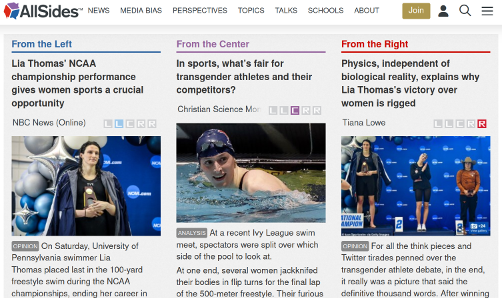
We picked up the recent controversial topic about transgender “Lea Thomas”, a swimmer who won a national college championship in the United States. This event sparked an intense debate about whether it was fair for transgender female athletes to compete with Cis females. We selected three articles with different views on this topic using the web portal www.allsides.com. This portal publishes various articles on similar news stories from different political viewpoints: right, left, and centre (cf. Figure 2).
5.3.2.2 Annotation Method
For the frame annotation, we used a data-driven, bottom-up approach, i.e., as a group, we read each article sentence by sentence, identifying the possible frames there, observing interesting cases, and outlining the primary findings. Using the argument frame typologies proposed in the previous work (cf. Section 5.3.1), we discussed each sentence and assigned it with a respective frame type.
5.3.2.3 Frame Typology
Here, we describe the frame categories we found in the articles:
-
Topical frames which address the topic of a discussion such as “economy” and “health”.
-
Value frames which reflect personal values and beliefs such as “fairness” and “quality of life”.
-
Style-based frames which is demonstrated by the stylistic means of presenting the discussed topic. For example, this can be based on vocabulary selection in sense of using certain words and terminology, metaphors, or specific types of modalities to leverage a particular message.
-
Sentiment-based frames relates to the choice of vocabulary that encodes a certain sentiment about a target entity or topic. Though this type can be categorised as a sub-type of style-based frame, we decide to consider it as a stand-alone type due to its prominence in the annotated texts. We also propose to distinguish two kinds of sentiment frames: (1) explicit sentiment that is explicitly illustrated by a chosen vocabulary (e.g., positive cheering words) and (2) implicit sentiment that centres on what “feelings” the text invokes in a reader.
5.3.3 Discussion
Generally speaking, developing an appropriate typology of frames requires a thorough understanding of framing and a solid theoretical ground for modelling it. Though this was the primary goal of one of the working groups in the workshop, we had limited time for collaborating and sharing the needed knowledge. Nevertheless, our pilot study illustrates several observations:
-
Fame annotation is, in most cases, quite difficult and time-consuming. We have noticed that expert annotators are necessary for frame annotation, at least in the earlier stages of annotation.
-
Some articles are substantially easier for identifying their frames. We assume that making the frames explicit and easy to grasp vs. making them implicit and subtle may be a strategy of the authors to convey the main message (e.g., persuade the audience).
-
The frame can be represented in various forms; for instance, by a simple key phrase (e.g., fairness and equality) or by a more complex discourse relation (e.g., the contrast relation between fairness and security).
-
Some articles attempt to address different frames and focus on one for them, while some completely ignore all but one of the frames.
-
Frame identification, similar to many tasks in NLP but to a greater extent, is subject to the author’s intent and readers’ interpretation.
-
Frames can be established in diverse elements of the articles, including their headlines, images with their captions, and lead paragraphs.
References
- [1]
- [2]
- [3]
- [4]
- [5]
- [6] Y. Ajjour, M. Alshomary, H. Wachsmuth, and B. Stein, “Modeling frames in argumentation,” in Proceedings of the 2019 Conference on Empirical Methods in Natural Language Processing and the 9th International Joint Conference on Natural Language Processing, EMNLP-IJCNLP 2019, K. Inui, J. Jiang, V. Ng, and X. Wan, Eds. Association for Computational Linguistics, 2019, pp. 2922–2932. [Online]. Available: https://doi.org/10.18653/v1/D19-1290
- [7] A. E. Boydstun, D. Card, J. H. Gross, P. Resnick, and N. A. Smith, “Tracking the development of media frames within and across policy issues,” in APSA 2014 Annual Meeting Paper, 2014.
- [8] D. Card, A. E. Boydstun, J. H. Gross, P. Resnik, and N. A. Smith, “The media frames corpus: Annotations of frames across issues,” in Proceedings of the 53rd Annual Meeting of the Association for Computational Linguistics and the 7th International Joint Conference on Natural Language Processing of the Asian Federation of Natural Language Processing, ACL 2015. The Association for Computer Linguistics, 2015, pp. 438–444. [Online]. Available: https://doi.org/10.3115/v1/p15-2072
- [9] P. Heinisch and P. Cimiano, “A multi-task approach to argument frame classification at variable granularity levels,” it Inf. Technol., vol. 63, no. 1, pp. 59–72, 2021. [Online]. Available: https://doi.org/10.1515/itit-2020-0054
5.4 Towards Operationalizing Frames through Axiomatization
Liesbeth Allein (KU Leuven, BE)
Philipp Cimiano (Universität Bielefeld, DE)
Ivan Habernal (TU Darmstadt, DE)
Martin Potthast (Leipzig University, DE)
Arno Simons (DZWH – Berlin, DE)
Benno Stein (Bauhaus-Universität Weimar, DE)
License: Creative Commons BY 4.0 International license © Lisbeth Allein, Philipp Cimiano, Ivan Habernal, Martin Potthast, Arno Simons, and Benno Stein
This section summarizes the results of a working group discussion during the Dagstuhl Seminar 22131 “Framing in Communication: from Theories to Computation.” Given the large number of diverging and competing frameworks and theories used to analyze framing in the computer science, the social sciences, and the digital humanities, this working group started from first principles by attempting to capture frames through axiomatization.
5.4.1 Axiomatization of Frames
An axiom declares a salient property of a real-world phenomenon. A set of axioms, or axiomatic systems, inductively defines the phenomenon if it entails all basic properties of the phenomenon that are not implied by others known about it. Such a set of axioms is irreducible. It opens the door to theoretical analysis of the phenomenon, i.e., the derivation of theorems that govern it. If derived theorems can be verified by observation in the real world, this raises trust in the validity of the set of axioms. A set of axioms only serves as a theoretical model of a phenomenon, if its derivable theorems predict real-world observations with sufficient accuracy.
Axiomatization relieves us from having to define frames directly, as definitions of seemingly elusive concepts, and those of frames in particular, are notoriously subject to fierce debate. In contrast, basic observations of and about frames are much less subject to debate.
As a first step towards an axiomatization of frames, we state the following three axioms:
-
Axiom 1. Frames exist.
-
Axiom 2. Exposure to frames has measurable effects.
-
Axiom 3. A frame can be defined by what belongs to the frame, or by what does not belong to the frame. We call the latter a co-frame (“frame dualism”).
These axioms capture fundamental prerequisites for an operationalization of frames.
Axiom 1 postulates the existence of frames in communication. Frames have a representation both in people’s minds as well as in communication media, language in particular. When a frame is adopted by people, they can do this more or less reflexively (i.e., knowing that they adopt a particular frame rather than another frame). Axiom 2 postulates that frames can have measurable effects in the real world. For instance, people may change their behavior as a result of adopting a frame. Or the presence of a frame in a given piece of writing may be noticed by them. Axiom 3 postulates that the definition of a given frame can be discerned by investigating its “boundary”, i.e., a frame can be discriminated from its surroundings. For example, words can be identified that have a clear connotation with the frame, or actions of people, or depictions of situations, etc. This renders frames also distinguishable from other frames, albeit interrelations between frames are not excluded. Everything that does not belong to a given frame is collectively referred to as its co-frame, thus inducing a kind of frame dualism. When dealing with an inventory of frames (i.e., string names of frames), given one frame , all other frames from the inventory combined are its co-frame. A co-frame can also be described by a ranking of frames according to saliences of the frame in question. The most salient frame of the co-frame of frame is its main co-frame. We do not claim this set of axioms to be complete, i.e., there may be more axioms required to derive all properties of frames that have been previously observed.
From Axioms 1 and 2, it follows that the knowing or unknowing adoption of frames, and their possible measurable effects on people’s behavior induces what we call camps: We define a camp by those people who share a common understanding of / recognition of / reaction to exposure to frame .
As a further consequence of Axiom 2, the measurability of a frame also opens the door to its quantification. In this regard, we hypothesized that the presence of a frame may vary in terms of how well it can be recognized, called “strength” in our discussions at the time. In hindsight, a better choice of terms would have been “perceptibility”, since this term comes with less ambiguous connotations.
5.4.2 Small Empirical Study
We conducted a brief framing perceptibility user study to support Axiom 2. We extracted six tweets about the ongoing Russian invasion of Ukraine that are said to evoke the genocide frame. Given a pair of tweets, the 21 participants of the seminar present at the time were then asked to indicate ad hoc and independent of each other in which of the two the frame of genocide is more perceptible. In our words then, which tweet contains a stronger genocide frame. We asked for participants’ opinions about three pairs:
-
Tweet A1 (weaker). Ex. 2:
A genocide that didn’t happen; nuclear ambitions that Ukraine doesn’t have and a threat to Russia that does not exist. I have yet hear a single justification for the murderous invasion of this country that even remotely bears scrutiny. #Ukraine
-
Tweet B1 (stronger). Ex. 8:
How are Western leaders sleeping during this genocide? It was posted by a woman who recorded herself right after the attack #Ukraine
-
Tweet A2 (weaker). Ex. Y:
Putin claims he is attacking to eliminate #Ukraine’s ‘‘Nazi’’ government… headed by a Jewish president! Screw sanctions, Putin only cares about the price of oil. If Biden would end the insane embargo of Venezuela, oil prices would collapse and so would Putin’s killing spree.
-
Tweet B2 (stronger). Ex. X:
#Putin is committing mass murder in #Ukraine. Why are we not doing everything in our power to stop him?
-
Tweet A3 (stronger). Ex. Z:
US taxpayer $$$ will fund mass murder and ethnic cleansing in my country, Ukraine.
-
Tweet B3 (weaker). Ex. 3:
Outrageous hypocrisy! This is the military who have committed human rights atrocities & genocide for decades in the name of ‘‘Burma’s sovereignty’’. Both regimes must be held accountable for all serious human rights violations. #Ukraine
Our basic operationalization of frame perceptibility (strength) to arrive at ground truth labels was this: We define the strength of a frame as the number of references to the frame. Applied to the tweets, this meant we counted the number of term occurrences which either directly refer to genocide, or have a connotation with the frame (highlighted bold), in context of what the tweet was intending to say. Tweet B3 referred to another genocide, not the one in Ukraine. The voting was as follows:
A1:  6 vs. B1: 15
A2:  6 vs. B2: 14 vs. Tie: 1
A3: 14 vs. B3:  6 vs. Tie: 1
This distribution of votes results in a Krippendorff’s Alpha of -0.0349, which indicates random inter-annotator agreement and negative results for our ad hoc experiment, despite the seeming tendency of the group towards the true answer. So, while the majority decision would have been correct in all three cases, no individual annotator performed consistently well. Two comments were given by annotators: “Framing does not have ‹strength›” and “‹Stronger›is the wrong conceptualization”, prompting a discussion and our change of terminology suggested above.
Axioms 2 and 3 imply that frames are discernible entities, an important prerequisite for any kind of operationalization of frames or framing. A frame provides a structure for perceiving and interpreting phenomena in a particular way. Elements of such structures can include scenes – which are themselves structures containing actors and things, and relations between actors/things – and answers to questions such as:
-
What is going on?
-
What is at stake?
-
Who are the important actors? What are their roles? How do they relate to each other?
-
What is the problem?
-
What are possible solutions? What are criteria for ranking solutions?
-
What can be expected to happen next?
In this regard, another more intricate operationalization of frame “perceptibility” (formerly “strength”) that we conceived of was that the perceptibility of a frame is reciprocal to the number of answers it gives to the aforementioned questions.
Two frames can be compared not only in relation to the number of answers they provide, but more generally in relation to all aspects of their structure. Given frames f1 and f2, we can ask:
-
Does f1 answer (some of) the same questions as f2?
-
Does f1 mention (some of) the same actors? If yes, are these actors given the same or different (complementary or opposite) roles?
-
Does f1 posit (some of) the same problems as f2? If yes, does f1 posit the same or different solutions to these problems? If not, are the problems posed by f1 and f2 complementary or mutually exclusive or in opposition to each other, etc.?
Comparisons of this kind can be used to provide assessments of degrees of overlap, complementarity, or mutual exclusivity of two frames.
5.4.3 Operationalizing Frames
The suggested three axioms above can serve as base for a number of tasks, ranging from basic tasks where two tasks are compared to more complex tasks and applications. Computational systems performing those tasks could assist stakeholders from various fields (e.g., journalists, politicians, speech writers, marketeers, educators).
Task 1 is to measure the effect of framing with all other variables fixed, i.e. we assume two texts with the same frame. The goal is to judge, first manually, then by computer models, which text is stronger. We leave the exact definition of “stronger” open for now.
In Task 2, the goal is to identify whether two texts have the same frame. Our perspective differs from the existing approaches to frame identification such that we do not rely on an existing set of predefined frame types, rather the task is simplified to a binary decision comparing two instances.
The next task, however, makes further assumptions and thus does rely on the availability of frame types. Task 3 is therefore text labeling, i.e. given a single text, does it have frame ? For instance, does this text describe a war as a genocide?
While the previous tasks were inherently classification-oriented, Task 4 is a text generation one. We formulate it as a text rephrasing task. Namely, given a text, we want to reframe it using a frame . The open question here remains, as in the majority of text generation tasks, how to objectively evaluate the functionality.
Our list of potential tasks also includes an analysis of co-frames, where we allow for multi-label framing of texts, or an ambitious task of identifying whether a text is intentionally framed.
Given the operationalization of framing through a clear task definition, we envision the following applications. First, paraphrasing and reframing can be tailored to specific needs with respect to the audience. As with any other text generation task, a potential dual-use must be taken into account. Second, a writing assistant actively supporting framing or helping reframing a message can be beneficial in the educational context. Finally, an automated tool that highlights frames in a piece of text can help the reader to reflect on the effects of framing.
5.4.4 Corpus Construction for Framing Analysis
Here we outline potential strategies for compiling a corpus of annotated data. Our main presupposition is that we do not define what frames are. We propose selecting reporting on events, as framing influences how we perceive them, such as natural disasters.
Let’s exemplify with a set of texts about a volcano eruption. We might observe that some of these events are labeled with extremely opposite frames, such as “disaster” and “tourist attraction”. Therefore, starting with a structured database of such events uniquely identified by location and date, we might be able to sample relevant texts from social media or news. This collection would allow us to bootstrap tasks one and two, and also come up with a set of disaster-specific frame types for task three. The reframing task might be constrained in such a way that we would allow annotators only minimal lexical changes that would result in a different frame.
6 Participants
-
Khalid Al-Khatib – University of Groningen, NL
-
Liesbeth Allein – KU Leuven, BE
-
Alexander Bondarenko – Martin-Luther-Universität Halle-Wittenberg, DE
-
Katarzyna Budzynska – Warsaw University of Technology, PL
-
Philipp Cimiano – Universität Bielefeld, DE
-
Lucie Flek – Universität Marburg, DE
-
Anette Frank – Universität Heidelberg, DE
-
Iryna Gurevych – TU Darmstadt, DE
-
Ivan Habernal – TU Darmstadt, DE
-
Annette Hautli-Janisz – Universität Passau, DE
-
Zlata Kikteva – Universität Passau, DE
-
Konrad Kiljan – University of Warsaw, PL
-
Christopher Klamm – Universität Mannheim, DE
-
Marcin Koszowy – Warsaw University of Technology, PL
-
Maud Oostindie – Maastricht University, NL
-
Steve Oswald – University of Fribourg, CH
-
John Parkinson – Maastricht University, NL
-
Martin Potthast – Universität Leipzig, DE
-
Aniket Pramanick – TU Darmstadt, DE
-
Chris Reed – University of Dundee, GB
-
Andrea Rocci – University of Lugano, CH
-
Arno Simons – DZWH – Berlin, DE
-
Wassiliki Siskou – Universität Konstanz, DE
-
Joanna Skolimowska – Warsaw University of Technology, PL
-
Noam Slonim – IBM – Haifa, IL
-
Manfred Stede – Universität Potsdam, DE
-
Benno Stein – Bauhaus-Universität Weimar, DE
-
Henning Wachsmuth – Universität Paderborn, DE
![[Uncaptioned image]](22131.jpg)