Transparent Quantitative Research as a User Interface Problem
Abstract
The replication crises in many scientific fields galvanize movements toward Open Science. Within this movement is a push for increasing research transparency. Although researchers in the areas of Human–Computer Interaction (HCI) and Visualization (VIS) face these challenges, they have methodological expertise to study, design, and evaluate innovations that could help improve research transparency. This Dagstuhl Seminar gathers HCI and VIS researchers and those from adjacent fields such as statistics and psychology to discuss challenges in promoting and adopting research transparency, create prototypes of potential solutions, and receive feedback from policy influencers in the research community. This seminar fostered seeds for future initiatives and collaboration toward improving research transparency in HCI, VIS, and other scientific fields.
Keywords and phrases:
Open Science, Research Transparency, Replicability, Reproducibility, Dagstuhl SeminarSeminar:
September 25–30, 2022 – http://www.dagstuhl.de/223922012 ACM Subject Classification:
Human-centered computing Empirical studies in HCI ; Human-centered computing Empirical studies in visualizationCopyright and License:
![[Uncaptioned image]](x1.png) Except where otherwise noted, content of this report is licensed under a
Creative Commons BY 4.0 International license
Except where otherwise noted, content of this report is licensed under a
Creative Commons BY 4.0 International license
1 Executive Summary
Chat Wacharamanotham (Swansea University, GB and University of Zurich, CH,
chat@acm.org)
Yvonne Jansen (CNRS – Talence, FR, yvonne.jansen@cnrs.fr)
Amelia A. McNamara (University of St. Thomas – St. Paul, US,
amelia.mcnamara@stthomas.edu)
License: ![[Uncaptioned image]](x2.png) Creative Commons BY 4.0 International license © Chat Wacharamanotham, Yvonne Jansen, and Amelia A. McNamara
Creative Commons BY 4.0 International license © Chat Wacharamanotham, Yvonne Jansen, and Amelia A. McNamara
Introduction
Many scientific fields face a replication crisis: A sizable portion of quantitative research studies could not be replicated. When these studies were re-run with higher statistical power (i.e., more participants), their results yielded effects substantially weaker or even opposite of that in the original studies. This lack of replicability threatens the credibility of research claims and undermines the general public’s trust in science. The replication crisis motivated the Open Science movement that promotes transparency throughout the scientific process: research funding, research design, data collection and analysis, peer reviewing, and knowledge dissemination. These phenomena attracted the interest of researchers in the fields of Human–Computer Interaction (HCI) and Visualization (VIS) for two reasons. Like other fields, HCI and VIS researchers face challenges in promoting transparency among their peers, effectively implementing and educating transparent practices, and incorporating transparency in the research evaluation processes. However, HCI and VIS researchers have the methods and skills to empirically study these phenomena and design potential solutions. The fields of HCI and VIS also provide a challenging testbed for these inventions.
This Dagstuhl seminar initiated and advanced works on these issues by bringing together 23 researchers from HCI, VIS, statistics, psychology, data science, and philosophy. They were from Australia, Austria, Canada, Denmark, Finland, France, Germany, the Netherlands, Sweden, Switzerland, the UK, and the USA. Three participants joined online due to the COVID situation and travel difficulties.
Program
We worked in groups to identify problem areas and prototype potential solutions in a Hackathon. We solicited feedback on these prototypes from conference and journal editors and community leaders. The seminar unfolded as follows:
- Day 1:
-
After a brief introduction to the purpose of the seminar and the overall plan, participants discussed in small groups to identify problems and challenges to work on in the Hackathon. These discussions were intentionally designed to be free-form to avoid prematurely limiting the areas of interest. To stimulate discussions and spark ideas, we provided the participants access to free-text responses to a survey on the perception of research transparency that we collected from HCI researchers in the weeks before the seminar. Four rounds of discussion were interleaved with three-minute presentations of intermediate results in the plenary to facilitate convergence and consolidation.
In each plenary round, we also asked a few participants to interview each other in front of the room to acquaint everyone with their background and research interest. Day 1 concluded with four clusters of topics to be worked on: (1) Educating researchers, (2) Clarifying the threats from the lack of transparency, (3) Clarifying the “transparency” concept, and (4) Working on how to influence policy and procedures in the publication process.
- Day 2:
-
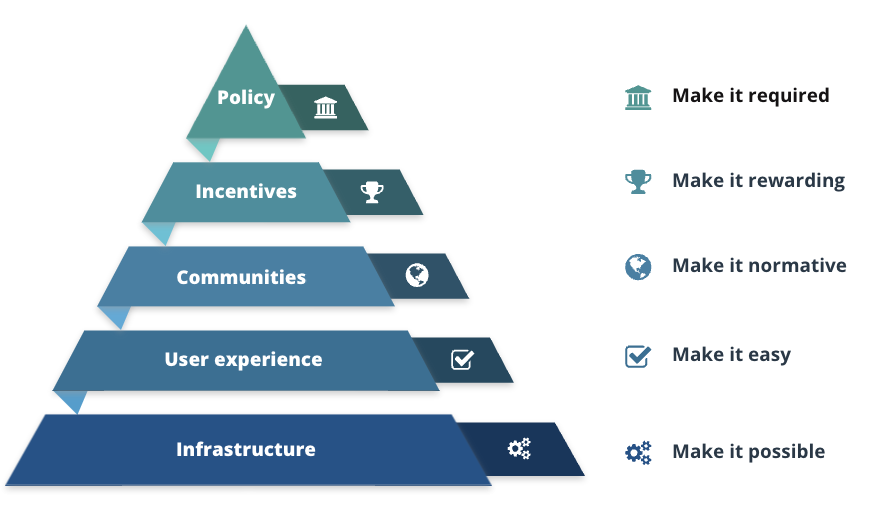
Participants joined the problem cluster according to their interests and started the Hackathon. We provided each group with collaborative workspaces on Google Docs and Miro (an online whiteboard platform). After two Hackathon sessions in the morning, we further stimulated their work with an input lecture from Tim Errington, the Senior Director of Research at the Center for Open Science (see below for an abstract). This lecture highlighted challenges in promoting research transparency and provided a framework for changing research culture at multiple levels: from top-down research funding policy and bottom-up to ease the implementation of transparent practices by providing infrastructure and incentives. After the lecture, the Hackathon continued. We wrapped up the day with a 3-minute presentation from each group and a plenary discussion.
- Day 3:
-
The Hackathon continued in the morning. We gave the participants prompts to encourage them to hone in on a concrete idea and realize a prototype that demonstrates the idea’s essence. The afternoon is free time for the participants to self-organize group activities to promote trust and informal interactions. We did not organize an excursion because the transportation companies were unavailable.
- Day 4:
-
The Hackathon continued in the morning. In the afternoon, the participants presented their preliminary results to four panelists who joined online. The panelists hold influential positions in the research publication process in HCI and VIS: the SIGCHI President, the TOCHI editor-in-chief, the TVCG Associate Editor in Chief and Eurographics Publication Board, CG&A Associate Editor-in-chief, TVCG Associate Editor, and the vice-chair of the IEEE VIS Steering Committee. A discussion on feedback from policy-making perspectives followed each presentation. The conversation with the panelists broadened participants’ views about stakeholders and potential concerns. After the discussion, there was a plenary discussion to process the input from the panel collectively. We identified four areas to work on in the manifesto: definition, benefits, subfield-suitability, and progressive transparency.
- Day 5:
-
Participants worked in groups to draft a manifesto on research transparency. The seminar concluded with a plenary session where we identified possible future projects, their follow-up actions, and coordinators.
Results
The tangible results of the seminar comprise four prototypes from the Hackathon and a draft manifesto:
-
1.
To influence research funders’ policies, we drafted a list of policy suggestions for incentivizing research transparency and Open Science.
-
2.
To inspire researchers and students, we prototyped how we could collect, analyze, and showcase papers in the visualization field that are exemplary in their transparent practices.
-
3.
To improve infrastructure, we identified low-hanging fruits in improving the user interfaces of the ethical review and publication processes to encourage transparent practices.
-
4.
To ease the adoption of transparency practices, we prototyped a cheat sheet that provides reminders for considering transparent practices at each of the research stages. The cheat sheet also provides pointers to relevant guides and resources.
The draft manifesto clarifies the definition of research transparency, describes its benefit, calls for each subfield to identify its suitable set of transparent practices, and argues how transparent practices could be viewed as a progression instead of demanding everyone to be perfect at their first try. These results provide a starting point for future follow-up research and educational activities that will advance the understanding and adoption of research transparency in HCI, VIS, and beyond.
2 Table of Contents
3 Input Lecture
3.1 How science knows what it knows: Challenges in research transparency
Timothy M. Errington (Center for Open Science – Charlottesville, US, tim@cos.io)
License: Creative Commons BY 4.0 International license © Timothy M. Errington
In large-scale replication studies such as in Psychology and Cancer Biology, many replication studies yielded a smaller effect size than the original study [1, 2]. Low replicability challenges the credibility of science. Replicability is associated with several research best practices, such as preregistration, using large samples, and sharing research materials [3]. However, this knowledge seems inadequate to change scientists’ behaviors widely. To change the research culture, we need to address both the lack of know-how and the lack of motivation. Both top-down and bottom-up efforts are necessary as shown in Figure 1: Funders should design incentives and policies that will change the norm of research practices. Conversely, research communities must establish infrastructures and invent technologies to facilitate these practices.
References
- [1] Open Science Collaboration (2015). Estimating the reproducibility of psychological science. Science, 349(6251), aac4716. http://dx.doi.org/10.1126/science.aac4716
- [2] Timothy M. Errington, Alexandria Denis, Nicole Perfito, Elizabeth Iorns, and Brian A. Nosek (2021). Reproducibility in cancer biology: challenges for assessing replicability in preclinical cancer biology. Elife, 10, e67995. https://doi.org/10.7554/eLife.67995
- [3] John Protzko, Jon Krosnick, Leif D. Nelson, Brian A. Nosek, Jordan Axt, Matthew Berent, Nick Buttrick, Matthew DeBell, Charles R. Ebersole, Sebastian Lundmark, Bo MacInnis, Michael O’Donnell, Hannah Perfecto, James E Pustejovsky, Scott S. Roeder, Jan Walleczek, and Jonathan Schooler (2020). High replicability of newly-discovered social-behavioral findings is achievable. https://doi.org/10.31234/osf.io/n2a9x
3.2 Summary of Q&A and discussion
Lahari Goswami (University of Lausanne, CH, lahari.goswami@unil.ch)
Chat Wacharamanotham (Swansea University, GB University of Zurich, CH,
chat@acm.org)
License: Creative Commons BY 4.0 International license © Lahari Goswami and Chat Wacharamanotham
Temporary changes.
Trying out proof-of-concept solutions to transparency may require a shift in the incentives involved in the research process. Such a shift could be agreed upon to be temporary and to be adapted as needed.
Scaling up.
Proof-of-concept solutions that are implemented in smaller conferences/journals require reflecting on the actual changes and their results. The transfer is more likely to happen by abstracting the lessons learned.
Methodological diversity.
For fields that use more than quantitative research methodology – including HCI and VIS – preregistration could be a common starting point because it is widely applicable. Dialogues are needed with people from those methodologies to develop suitable infrastructure. For example, the preregistration template for qualitative research was developed by the lead from qualitative researchers.
Synergy across practices.
To maximize the effectiveness of various novel transparent practices introduced into the scientific process, educating researchers on how these practices are connected to each other as an ecosystem is necessary. Such consideration could also help reduce researchers’ effort, e.g., by aligning the information required for ethical review with those in preregistration.
4 Working Groups
After the first day of the seminar, we formed four working groups to address different aspects of research transparency. Below is a summary of the results from each working group ordered top-down: from the policy level to a concrete checklist for individual researchers.
4.1 Influencing research funders’ policies
Contributors in alphabetical order:
Chat Wacharamanotham (Swansea University, GB University of Zurich, CH, chat@acm.org)
Duong Nhu (Monash University – Clayton, AU, duong.nhu1@monash.edu)
Lynda Hardman (CWI – Amsterdam, NL Utrecht University, NL, Lynda.Hardman@cwi.nl)
Sophia Crüwell (University of Cambridge, GB, slbc2@cam.ac.uk)
License: Creative Commons BY 4.0 International license © Chat Wacharamanotham, Duong Nhu, Lynda Hardman, and Sophia Crüwell
We reviewed the existing policies from funding agencies: Australia ARC and NHMRC, European ERC, the Netherlands’ NWO, and UK’s UKRI. Although these policies encourage open-access publication and sharing of research data, they lack other transparency practices. We also found the policies focus on goals without adequately providing resources and infrastructure. Therefore, we drafted seven policy recommendations. For each recommendation, we discussed the status quo, its benefits, possible barriers, and possible improvements. Below is a summary of each recommendation:
R1: Mandate Open Science as the default in all funding schemes, with open-access publication as a required minimum.
Several research funders already required open access to research publications. Where ethically feasible, researchers should make all data and analysis methods available on FAIR-compatible repositories and annotate them with appropriate domain-specific metadata.
R2: Provide funding for infrastructure and personnel to implement Open Science practices.
Institutions, departments, or individual researchers may need more resources or knowledge to meet all requirements of conducting Open Science research. Funding should be made available for (inter)national infrastructures and repositories for secure data storage and controlled access to data.
R3: Include Open Science practices as an independent dimension in evaluating proposals, individual researchers, and departments.
Open Science practices take additional resources (e.g., time, money, personnel). Instead of spending resources on Open Science practices, researchers channel these resources to write more papers. However, more papers that are not transparent increase noise in the body of knowledge. Therefore, when evaluating research proposals, researchers, and department performance, Open Science practices should be incorporated as an independent dimension that could be considered in the context of other metrics such as grant income or publication count.
R4: Positive discrimination of researchers who use or have used Open Science.
Adoption of Open Science practices may lead to a disadvantage in the current system, which is focused on quantity and novelty over quality. If engagement with Open Science is only optional, we could punish Open Science pioneers, thus disincentivizing engagement with Open Science. Funders can address this problem by giving special consideration to researchers whose track records demonstrate Open Science practices.
R5: Develop recommendations and rules for sharing research artifacts.
Funders should mandate or recommend types of licenses and – where available – specialized repositories for sharing research artifacts. These rules or recommendations will facilitate data dissemination and reuse.
R6: Encourage Open Science Best practices.
Best practices in Open Science evolves as innovation are developed and tested in various subfields. Funders can accelerate these processes by publishing and periodically updating lists of recognized best practices. Additionally, funders should invest in developing Open Science innovations and maintaining essential Open Science infrastructures.
R7: Provide Open Science training for all personnel involved in research.
Researchers at different career stages have different training needs: Junior researchers might need awareness and practical skills in implementing Open Science practices. Established researchers will need to be convinced of the relevance of Open Science and why they are relevant in a new norm of scientific practices. Funding agencies should open calls for research projects to develop innovative educational materials for Open Science and to evaluate their effectiveness. Additionally, funding agencies could incentivize institutions to allocate resources and provide competence in training Open Science knowledge and skills.
After presenting this draft to the panelists, we received feedback that buy-in from the research community is essential to make changes, especially for the fields of HCI and VIS, where there’s a wide range of research methods and contribution types. Any policy changes mustn’t marginalize any research methodologies or domains. The follow-up action for this work is to refine the recommendations further to address the methodological diversity concern and engage in conversation with funding organizations.
4.2 Positive Examples of Research Transparency
Contributors in alphabetical order:
Eunice Jun (University of Washington – Seattle, US, emjun@cs.washington.edu)
Lonni Besançon (Linköping University, SE, lonni.besancon@gmail.com)
Michael Sedlmair (Universität Stuttgart, DE, michael.sedlmair@visus.uni-stuttgart.de)
Pierre Dragicevic (INRIA – Bordeaux, FR, pierre.dragicevic@inria.fr)
Theophanis Tsandilas (Université Paris-Saclay, Orsay, FR Inria – Orsay, FR, fanis@lri.fr)
Wesley Willett (University of Calgary, CA, wesley.willett@ucalgary.ca)
License: Creative Commons BY 4.0 International license © Eunice Jun, Lonni Besançon, Michael Sedlmair, Pierre Dragicevic, Theophanis Tsandilas, and Wesley Willett
We saw an opportunity to encourage transparent research practices by curating a set of examples from visualization research. These examples will serve as a starting point for teaching transparent research, motivating visualization researchers to practice research transparency, and motivating the community to invent new creative transparent methods. Toward these goals, we identified forms of transparency: (1) research process and methods, (2) artifacts, (3) data, and (4) claims and limitations. Combining these forms with a taxonomy of visualization contribution types (Munzner, 2008) resulted in a matrix for the examples. As a prototype for this seminar, we brainstormed and discussed how some papers we knew fit into this matrix.
From the panelists’ feedback, we realized the importance of clarifying that these examples show the possibilities of transparency. Some contribution types may lend themselves to some forms of transparent practices easier than others. The paper should be framed as a recommendation instead of a checklist to avoid alienating some research contributions.
For the next step, we plan to collect examples that span this matrix by conducting a survey targeting visualization experts, and we drafted survey questions. We plan to publish this work in IEEE Computer Graphics and Applications (CG&A) as a viewpoint paper with extensive supplementary materials on OSF.
References
- [1] Tamara Munzner (2008). Process and pitfalls in writing information visualization research papers. In Information visualization (pp. 134-153). Springer, Berlin, Heidelberg. doi.org/10.1007/978-3-540-70956-5_6
4.3 Tweaks to the Ethics Review & Publication Pipeline that Encourages Transparency
Contributors in alphabetical order:
Julien Gori (Sorbonne University – Paris, FR, gori@isir.upmc.fr)
Kavous Salehzadeh Niksirat (University of Lausanne, CH, kavous.salehzadehniksirat@unil.ch)
Olga Iarygina (University of Copenhagen, DK, olia@di.ku.dk)
Ulrik Lyngs (University of Oxford, GB, ulrik.lyngs@cs.ox.ac.uk)
Yvonne Jansen (CNRS – Talence, FR, yvonne.jansen@cnrs.fr)
License: Creative Commons BY 4.0 International license © Julien Gori, Kavous Salehzadeh Niksirat, Olga Iarygina, Ulrik Lyngs, and Yvonne Jansen
We looked at the steps of the research pipeline, from ethics application to published articles, as shown in Figure 2. We identified several opportunities to encourage open and transparent research practices along this pipeline. Instead of looking to impose the “sticks” – punishments or requirements – we focus on “carrots”, emphasizing selfish benefits to incentivize the practices. This analysis results in minor changes to ethics review templates, transparency statements on the CHI website, PCS submission interface, and acceptance notifications. These all emphasize reasons for authors to strive for transparency in their research.
For the ethics review template, we prototyped additions of instructions that could remind researchers to consider preregistration, documenting their data analysis process or making them reproducible, and repositories to share their data.
Specifically to the ACM CHI Conference on Human Factors in Computing Systems (CHI) – a major HCI conference, we drafted an update to the Guides for Authors to provide concrete suggestions and be more concise. We also created a mockup of the paper submission form (Figure 3) and acceptance email message that will encourage researchers to think about different types of research artifacts and data to share.

We also discussed an idea of repurposing the comments fields from the paper websites, e.g., the ACM Digital Library, for the authors to point to research materials that become available post-publication. Reference manager software could alert researchers of these updates – similar to Retraction Watch alert plug-in for Zotero.
The panelists are positive about a minor modification to the submission form and suggested that this idea could be tested in small conference venues by convincing their paper chairs. As for the evolving paper idea, a panelist warned that a side effect of this feature might discourage authors from submitting materials on the paper deadline. Lastly, although placing reminders in the ethics review form is helpful, not all research activities go through the ethics approval process. Besides, several countries may still need to implement an ethics approval process.
The following steps in this direction are to refine the draft items for ethics submission templates, solicit feedback from local ethics committees, and publish a guiding resource for local ethics boards that wish to include open research practices in ethics review.
4.4 Infrastructure for evolving research and mega studies
Contributors in alphabetical order:
Florian Echtler (Aalborg University, DK, floech@cs.aau.dk)
Pierre Dragicevic (INRIA – Bordeaux, FR, pierre.dragicevic@inria.fr)
Ilya Musabirov (University of Toronto, CA, ilya@musabirov.info)
License: Creative Commons BY 4.0 International license © Florian Echtler, Pierre Dragicevic, and Ilya Musabirov
We challenged the idea that research ends with publications. Instead, research should be considered evolving scholarly records where scholarly discussions are added and refined over time. Although this idea has been previously discussed [1], a technical infrastructure must be developed. We discussed the requirements of such technical infrastructure and its necessity to support the research lifecycle from pre-publication, such as preregistrations and internal reviews. We discuss the pros and cons of repurposing version control systems (e.g., GitHub) or tools like hypoths.is that overlay upon existing infrastructure. We also discussed the emerging trend of mega studies where multiple labs collaborate on one study to enable larger sample sizes. These studies lend themselves to transparent practices because much information must be digitally shared among collaborators. However, there are also challenges in tracing rationale in study design and data analyses across multiple actors.
The panelists pointed out challenges. Requiring the reviews to be public may discourage potential reviewers, such as junior researchers, who risk their careers if their review disagrees with senior paper authors. Signed public reviewing could face copyright issues, while anonymous public reviewing might lead to spam.
References
- [1] Brian Lavoie, Eric Childress, Ricky Erway, Ixchel Faniel, Constance Malpas, Jennifer Schaffner, and Titia Van der Werf (2014). The Evolving Scholarly Record. OCLC Online Computer Library Center, Inc. 6565 Kilgour Place, Dublin, OH 43017.
4.5 A Cheatsheet for a Transparent CHI Paper
Contributors in alphabetical order:
Amelia A. McNamara (University of St. Thomas – St. Paul, US, amelia.mcnamara@stthomas.edu)
Erich Weichselgartner (Universität Graz, AT, erich.weichselgartner@uni-graz.at)
Jan B. Vornhagen (Aalto University, FI, jan.vornhagen@aalto.fi)
Lahari Goswami (University of Lausanne, CH, lahari.goswami@unil.ch)
Viktorija Paneva (Universität Bayreuth, DE, Viktorija.Paneva@uni-bayreuth.de)
License: Creative Commons BY 4.0 International license © Amelia A. McNamara, Erich Weichselgartner, Jan B. Vornhagen, Lahari Goswami, and Viktorija Paneva
In recent years there has been an upsurge of high-quality and accessible learning materials for Open Science practices (e.g., FORRT, FOSTER777https://forrt.org/, https://www.fosteropenscience.eu/). However, these have yet to see widespread use in the CHI community. Therefore, we offer CHI authors a tailored cheat sheet as an easy-to-use reference and guide to existing resources, allowing for convenient integration of these practices into their current workflow. We identified typical research phases in HCI studies and brainstormed relevant guides and resources for each stage. These pieces of information are assembled on two-page cheat sheets that briefly explain the rationale for each practice, provide concrete and concise action items, and point to resources to learn more (Figure 4). The current version of the cheat sheet is available on OSF888https://doi.org/10.17605/OSF.IO/YHWUQ. Further contributions are welcome on the GitHub repository999https://github.com/jvornhagen/ACheatSheetForTheTransparentCHIPaper/.

5 A Manifesto for Transparent Quantitative Research
We distilled lessons learned from the seminar into the following manifesto.
5.1 Definition
Contributors in alphabetical order:
Chat Wacharamanotham (Swansea University, GB University of Zurich, CH, chat@acm.org)
Jan B. Vornhagen (Aalto University, FI, jan.vornhagen@aalto.fi)
Julien Gori (Sorbonne University – Paris, FR, gori@isir.upmc.fr)
Pierre Dragicevic (INRIA – Bordeaux, FR, pierre.dragicevic@inria.fr)
Yvonne Jansen (CNRS – Talence, FR, yvonne.jansen@cnrs.fr)
License: Creative Commons BY 4.0 International license © Chat Wacharamanotham, Jan B. Vornhagen, Julien Gori, Pierre Dragicevic, and Yvonne Jansen
“Transparency in research refers to honesty and clarity in all communications about the research processes and outcomes – to the extent possible.”
We unpack each facet of this definition as follows:
- Honesty and clarity
-
are both necessary. A paper that is very clear but makes misleading claims is not transparent. But a paper written by authors who are fully honest but unskilled at clear communication is not fully transparent either.
- Communications
-
include communications between the researchers and their colleagues, peers, institutions, the press, and the general public.
- The research process
-
includes all the known, crucial decisions made to achieve the reported outcome.
- The research outcomes
-
include research materials (including data and software), findings, and communication artifacts (research papers, videos). Being transparent about research outcomes includes sharing material (e.g., code and data) but also being clear about the limitations of the research.
- To the extent possible.
-
Transparent research practices operate within ethical, resource, legal, and other constraints. These include ethics constraints (such as participant rights and protections), legal constraints (such as data protection laws), and resource constraints (such as access to data repositories). We also acknowledge that there is information that is not accessible by the researchers; we can only ask them to communicate the information they can reasonably know.
5.2 Benefits
Contributors in alphabetical order:
Erich Weichselgartner (Universität Graz, AT, erich.weichselgartner@uni-graz.at)
Eunice Jun (University of Washington – Seattle, US, emjun@cs.washington.edu)
Lonni Besançon (Linköping University, SE, lonni.besancon@gmail.com)
Olga Iarygina (University of Copenhagen, DK, olia@di.ku.dk)
Sophia Crüwell (University of Cambridge, GB, slbc2@cam.ac.uk)
Wesley Willett (University of Calgary, CA, wesley.willett@ucalgary.ca)
License: Creative Commons BY 4.0 International license © Erich Weichselgartner, Eunice Jun, Lonni Besançon, Olga Iarygina, Sophia Crüwell, and Wesley Willett
Transparent research practices support the refinement, reuse, and verifiability of published research as well as its extension through follow-on research and meta-analyses. Transparent practices also support the use of research materials and findings for instruction and can increase the visibility, perceived credibility, and citation of both individual research findings and broader research areas. Transparent sharing of materials may also allow for more error detection and correction, thus fostering a larger error-correction culture. Furthermore, making research materials available to other researchers to use in their contexts will reduce duplication of effort while also helping grow and diversify research communities.
5.3 Transparency needs tailoring
Contributors in alphabetical order:
Amelia A. McNamara (University of St. Thomas – St. Paul, US, amelia.mcnamara@stthomas.edu)
Kavous Salehzadeh Niksirat (University of Lausanne, CH, kavous.salehzadehniksirat@unil.ch)
Sophia Crüwell (University of Cambridge, GB, slbc2@cam.ac.uk)
Ulrik Lyngs (University of Oxford, GB, ulrik.lyngs@cs.ox.ac.uk)
License: Creative Commons BY 4.0 International license © Amelia A. McNamara, Kavous Salehzadeh Niksirat, Sophia Crüwell, and Ulrik Lyngs
Transparent research is not about rigid box-checking. Not all transparent research practices apply to all kinds of research, and the specific implementation of any given transparent practice depends on the subfield and research type. The practices that are useful for, for example, in-depth interview studies differ from those that are useful for iterative design & user testing studies or for large-scale online experimental work. Therefore, we do not want to make specific, one-size-fits-all recommendations. Instead, we suggest questions researchers can ask themselves and their field. Thinking about the typical research process and outputs in your field, consider the following:
-
1.
What elements would help build credibility for your work for reviewers and readers?
-
2.
If another researcher wanted to build on your work, what elements would be helpful?
These questions could be used to build transparency guidelines for a particular subfield or guide an individual researcher in implementing transparent practices in their own research.
5.4 Transparency could be progressive
Contributors in alphabetical order:
Duong Nhu (Monash University – Clayton, AU, duong.nhu1@monash.edu)
Lahari Goswami (University of Lausanne, CH, lahari.goswami@unil.ch)
Theophanis Tsandilas (Université Paris-Saclay, Orsay, FR & Inria, Orsay, FR, fanis@lri.fr)
Viktorija Paneva (Universität Bayreuth, DE, Viktorija.Paneva@uni-bayreuth.de)
License: Creative Commons BY 4.0 International license © Duong Nhu, Lahari Goswami, Theophanis Tsandilas, and Viktorija Paneva
Becoming transparent requires our research community to give up old research practices and adopt new research methods. Transparency is a progressive process that starts with small steps before it becomes a long-term, well-established practice. It can seem intimidating at first, but here are some steps that can guide you on your journey to making your research practice more transparent:
Become aware.
Understanding and adopting transparent practices for the first time can seem difficult and complicated. There is no one-size-fits-all mechanism for adopting transparent practices. So it is essential not to set unrealistic expectations for ourselves when starting. Let’s start with the easy step, which is documenting our research process – initially for ourselves. An example would be maintaining a research journal. Understanding that transparent practices depend on the context of our research is crucial – as a result, one should self-regulate, reflect and learn from our process. The documentation should be refined for others to comprehend.
Learn.
Learn from others. Other practitioners have spent numerous hours learning about transparent research practices and incorporating those into their research. Use this valuable resource. Learn by example – look for good examples of papers related to your area of research that showcase how this particular type of research can be made more transparent. Also, you are not alone in this. Discuss with the people in your immediate environment, e.g., peers, supervisors, and other colleagues, how you can collaborate to make your work more transparent and learn from each other.
Adopt.
Transparency can be adopted step by step. Researchers should consider what parts of the project can be shared and plan from the beginning of the project, from grant proposal to ethics application. Transparency is not only about sharing but also about self-reflection and learning from your progress. Documenting the project’s progress is an easy task and an excellent start to integrating transparency into your research. It will help better understand the research problem, detect mistakes early, and make it easier to review and evaluate later. This documentation will eventually become a foundation for writing comprehensive documentation for sharing with the community.
Educate.
Your practice of transparent research methods can serve as an example for your students and your community. A minimal step is to share your open research knowledge with your peers and, if you are a teacher, to incorporate it into your teaching materials.
Influence.
We can take advantage of our roles within our institution and research community to advance transparent research practices. We can encourage and reward openness and transparency as reviewers and program committee members. Criteria of transparency may vary across subcommunities in our field, so we need to work with our peers in these communities to understand better how transparency applies to their research methods.
6 Participants
-
Lonni Besancon – Linköping University, SE
-
Sophia Crüwell – University of Cambridge, GB
-
Pierre Dragicevic – INRIA – Bordeaux, FR
-
Julien Gori – Sorbonne University – Paris, FR
-
Lahari Goswami – University of Lausanne, CH
-
Lynda Hardman – CWI – Amsterdam, NL & Utrecht University, NL
-
Olga Iarygina – University of Copenhagen, DK
-
Yvonne Jansen – CNRS – Talence, FR
-
Eunice Jun – University of Washington – Seattle, US
-
Ulrik Lyngs – University of Oxford, GB
-
Amelia A. McNamara – University of St. Thomas – St. Paul, US
-
Duong Nhu – Monash University – Clayton, AU
-
Viktorija Paneva – Universität Bayreuth, DE
-
Michael Sedlmair – Universität Stuttgart, DE
-
Kavous Selahzadeh Niksirat – University of Lausanne, CH
-
Theophanis Tsandilas – Universitë Paris-Saclay, Orsay, FR & Inria, Orsay, FR
-
Jan Benjamin Vornhagen – Aalto University, FI
-
Chat Wacharamanotham – Swansea University, GB
-
Erich Weichselgartner – Universität Graz, AT
-
Wesley J. Willett – University of Calgary, CA
![[Uncaptioned image]](22392.jpg)
7 Remote Participants
-
Florian Echtler – Aalborg University, DK
-
Ilya Musabirov – University of Toronto, CA
8 Panelists
-
Neha Kumar – SIGCHI President Georgia Institute of Technology – Atlanta, US
-
Jean-Daniel Fekete – TVCG Associate Editor in Chief and Eurographics Publication Board Inria – Orsay, FR
-
Kristina Höök – TOCHI editor-in-chief KTH Royal Institute of Technology – Stockholm, SE
-
Petra Isenberg – CG&A Associate Editor-in-chief, TVCG Associate Editor, and the vice-chair of the IEEE VIS Steering Committee Inria, Orsay, FR