Cognitive Augmentation
Abstract
Mobile phones and other connected wearable systems transformed the way we interact with information, offering access to vast amounts of knowledge at our fingertips. However, the challenge remains on how to make this information more accessible and intuitive. The field of cognitive augmentation aims to enhance our cognitive abilities through technology, allowing us to interact with digital data more naturally and efficiently. This Dagstuhl Seminar brought together experts in neuroscience, psychology, physiology, wearable computing, human-computer interaction, machine perception, and pattern recognition to discuss the possibility of augmenting our cognitive skills and creating new digital senses. The seminar explored the latest findings in these fields and their potential for improving human performance, productivity, and creativity. Ultimately, the goal is to bridge the gap between humans and machines, enabling a more seamless and intuitive interaction between the two. The main discussion topic centered around the possibilities and challenges of digitally augmenting our cognition.
Keywords and phrases:
augmented humans, augmented reality, wearable computingSeminar:
December 4–9, 2022 – http://www.dagstuhl.de/224912012 ACM Subject Classification:
Human-centered computing Human computer interaction (HCI) ; Human-centered computing Ubiquitous and mobile computingCopyright and License:
![[Uncaptioned image]](x1.png) Except where otherwise noted, content of this report is licensed under a
Creative Commons BY 4.0 International license
Except where otherwise noted, content of this report is licensed under a
Creative Commons BY 4.0 International license
1 Executive Summary
Kai Kunze (Keio University – Yokohama, JP)
Pattie Maes (MIT – Cambridge, US)
Florian ‘Floyd’ Mueller (Monash University – Clayton, AU)
Katrin Wolf (Berliner Hochschule für Technik, DE)
License: ![[Uncaptioned image]](x2.png) Creative Commons BY 4.0 International license © Kai Kunze, Pattie Maes, Florian ‘Floyd’ Mueller, and Katrin Wolf
Creative Commons BY 4.0 International license © Kai Kunze, Pattie Maes, Florian ‘Floyd’ Mueller, and Katrin Wolf
The real and digital worlds are increasingly more interconnected, leaving people to split their attention between tasks in the physical world in an increasing amount of ubiquitous systems and IoT services. We see an increase in accidents related to the usage of digital tools (such as interacting with a smartphone while driving). As governments and healthcare experts around the world call for changing lifestyles in response to the Covid-19 pandemic, the development, and usage of remote communication and touchless technologies are rapidly becoming an essential part of the “new normal”. At the same time, the absence of touch and physical contact highlights their critical importance in human life, from school to hospital to care facilities. We need more intuitive, direct ways to interface with technology. Students and educators find it harder and harder to concentrate, and news outlets are already talking about the distraction economy. The seminar focused on people interacting with information from the digital domain, in a minimally disruptive way, creating novel sensory experiences using and extending human perception and ultimately cognition.
The overall objective of the seminar was to foster research, explore, and model new means for increasing human intake of information in order to lay the foundation for augmented cognition, especially through somatosensation: the ability to sense the environment through our body.
Machine Learning has often been used to mimic or surpass some cognitive functions of the human mind (visual object/face recognition, playing chess, etc.). Such efforts appear to put humans and computers in a competitive relationship, as emphasized in AI vs. Human competitions. Once a fear of AIs “replacing” human workers is now taken much more seriously and discussed in the public sphere. This Dagstuhl proposal suggests a different approach to the human-computer relationship by applying a cooperative and empowering framework. One important characteristic of the human mind is that it has significant fluctuations in productivity and capacity. Our mind has ebbs and flows, and is affected by various factors, some of which we do not even realize. These fluctuations manifest in patterns in human behavior and physiological signals (body temperature, eye movements, galvanic skin response, etc.). With this seminar, we aim to discuss technologies that can give us more insights into the ebb and flow of the human mind as a basis for cognitive augmentation.
The participants developed several frameworks and taxonomies for understanding and evaluating different types of cognitive augmentation, based on their goals, methods, and impacts. The frameworks focus on enhancement, compensation, offloading, and replacement, and consider factors such as safety, efficacy, and social impact. There are several publication plans and several participants already agreed to organize conference workshops together (for example at AugmentedHumans 2023 and UbiComp/ISWC 2023).
Overall, the Dagstuhl Seminar on Cognitive Augmentation advanced our research fields by creating a shared understanding of the concept and its implications, promoting interdisciplinary collaboration and communication, and identifying promising directions for future research and development. The outcomes of the seminar are to inform the design, implementation, and evaluation of cognitive augmentation technologies, and contribute to augmenting human cognition by applying ethical principles.
2 Table of Contents
3 Seminar Overview
The concept to use information technology to augment the human intellect goes back to the 1960s [Winograd, Engelbart]. The basic idea is to extend the computational (and other) capabilities of the human mind using technology. While augmenting the human intellect is a long time focus of various research efforts, we think it is necessary to rethink what intelligence amplification means and become more specific towards Cognitive Augmentation [Schmidt]:
-
Cognitive scientists and psychologists have now better insights on how perception, cognition and, in general, how our mind works
-
Affordable physiological and cognitive activity recognition systems are being developed in the HCI and wearable computing research communities
-
Advances in new sensing and actuation technologies (e.g., somatosensory and odor actuation, wearable EEG) that can be integrated with our senses
-
Advances in real-life tracking of physical, cognitive and emotional states
The ongoing technical progress in these key areas will enable fundamentally new approaches to amplify the human intelligence. The technological advances mentioned above already started to fundamentally transform how we communicate with each other and will do this even further. The seminar was split into topics tackling state-of-the-art, future directions, and potential issues and perils:
-
Discussion of existing and emerging technology for cognitive augmentation approaches and methodologies between the different communities.
-
Discovering compelling application cases
-
Exploring new sensing and actuation modalities to amplify human intelligence
-
Exploring technology for more effective skill sharing and learning Discussing privacy and ethical implications
In contrast to more traditional Dagstuhl Seminars, we followed a more active approach using an ignite talk format to introduce participants and reduce the time of talks and to leave the rest of the week for hands-on sessions, group work, deeper discussions, and socializing.
We also invited the participants to bring demonstrations of their research to Dagstuhl, so participants can experience the research on their own body. We believe that this is crucial in the field of cognitive augmentation, as our mind is embodied and simple discussion or written reports cannot completely convey the effectiveness and experience of some technologies.
The seminar started with very short ignite talks on the first day, so all participants could get to know the interests of each other. This session was followed by a clustering of discussion items, ideas and interests for the participants to foster spontaneous discussions and an exchange of ideas during breaks. The second day, we had a special full day workshop on “Human Augmentation Design”, a detailed description will follow in the next section. The third day was more speculative dealing with human futures and ethical implications. The forth day focused on human cognitive attributes (e.g. attention, agency etc.) and included a special workshop on memory augmentation (details also given later). The last day was used for wrap up and for discussions on collaborations after the seminar (e.g. joint publications, workshop organizations, book chapters etc.).
The participants organized and participated in several workshops that focused on different aspects of cognitive augmentation. In the rest of this report, we will highlight two workshops (one with a hands-on-prototyping session): A Human Augmentation Design and a Memory Augmentation workshop. We conclude with the list of ignite talks from the participants.
4 Workshops
In the following we will go into details about two workshops, the Human Augmentation Design and the Memory Augmentation workshop held as part of the seminar.
4.1 Human Augmentation Design: Immediate Issues
Steeven Villa (LMU München, DE), Matthias Hoppe (LMU München, DE), Thomas Kosch (HU Berlin, DE), and Katrin Wolf (Berliner Hochschule für Technik, DE)
License: Creative Commons BY 4.0 International license © Steeven Villa, Matthias Hoppe, Thomas Kosch, and Katrin Wolf
4.1.1 Introduction
Human augmentation is a new Human-Computer Interaction (HCI) field. Subsequently, cognitive augmentation proliferated as a research area into the human augmentation field. HCI professionals and academics spent the last decades to show how the new wave of ubiquitous technologies, such as AI, AR, and VR, can be used to improve human cognition. However, with the creation of new technologies allowing people to improve their natural abilities and the addition of new users, a whole new set of challenges arises. In this one-day workshop, we compile and discuss the meta-issues that human augmentation, and especially cognitive augmentations, will face in the coming years. In the activities performed in the workshop, such as planning, prototyping, evaluating, and discussing augmentation technologies, participants focused on the validity of research methodologies, the definition of human augmentation used, the societal challenges included, and ethical implications of their research. The overarching objective of this workshop is to raise awareness of the immediate conceptual, methodological, and social challenges that face the field of cognitive augmentation.
4.1.2 Agenda
-
Part one – Introduction:
-
–
Welcome and introduction – Thomas Kosch
-
–
Keynote: “Human Augmentation Design: Immediate Issues” – Steeven Villa
-
–
-
Part two – Hands-on-session:
-
–
Hands-on Session: Prototyping and Evaluating Cognitive Augmentation – Steeven Villa, Thomas Kosch, Matthias Hoppe, All attendees
-
–
Result Presentations – All attendees
-
–
-
Part three – Discussion:
-
–
Walk and Talk: Concepts, Implications, and Ethics of Cognitive Augmentation – All attendees
-
–
Open Discussion of Results – All attendees
-
–
4.1.3 Outcomes – Part One: Introduction
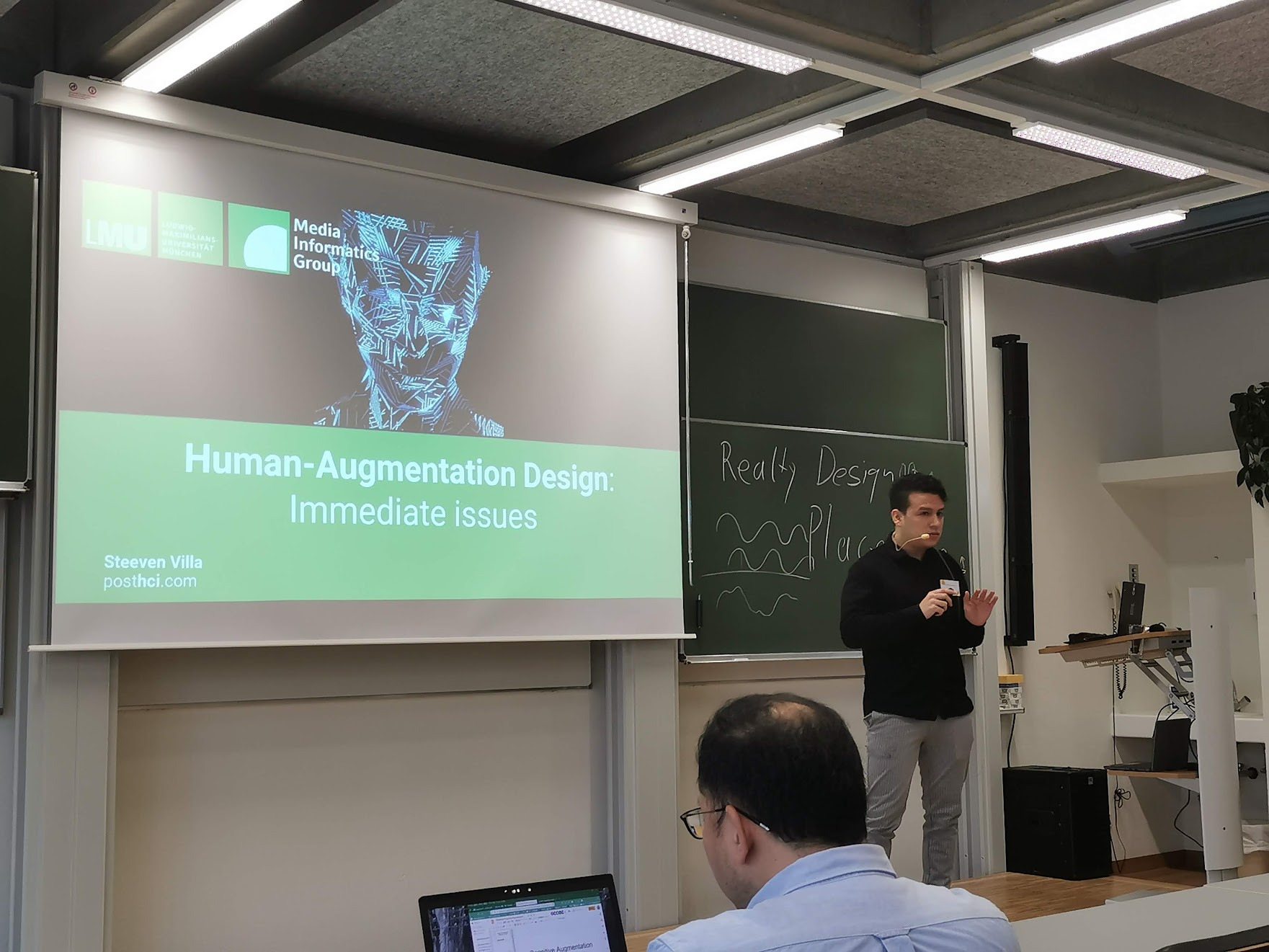
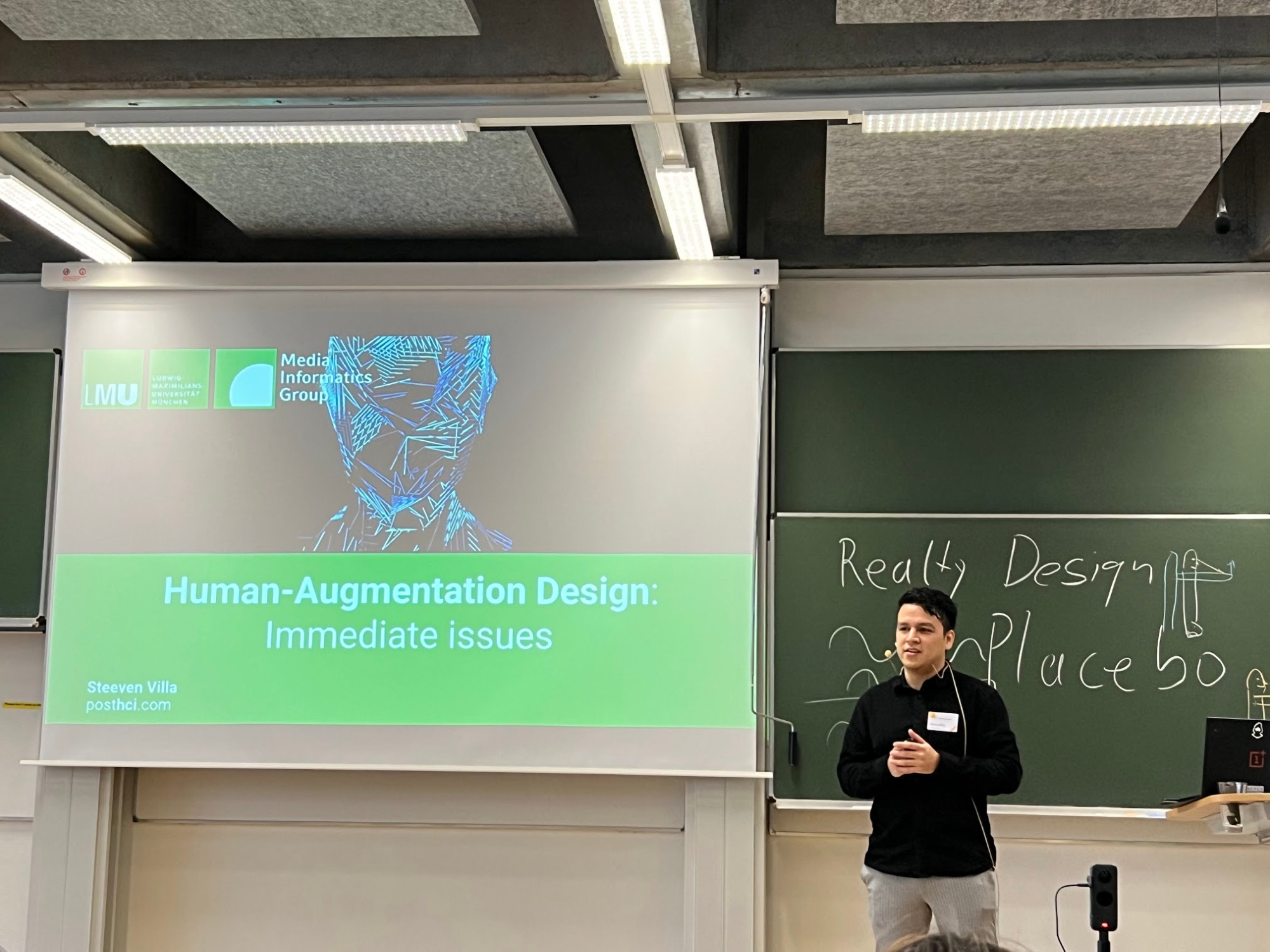
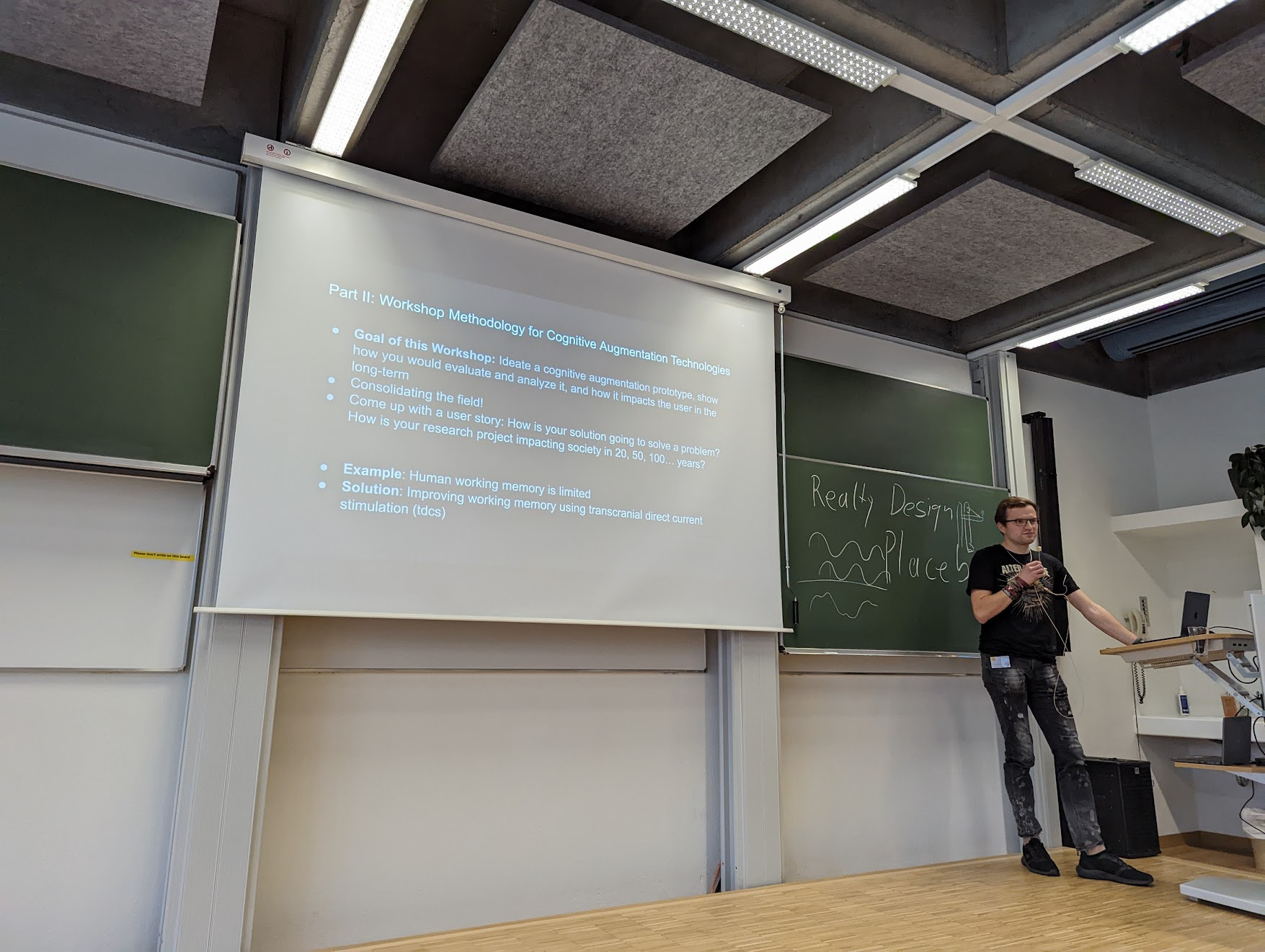
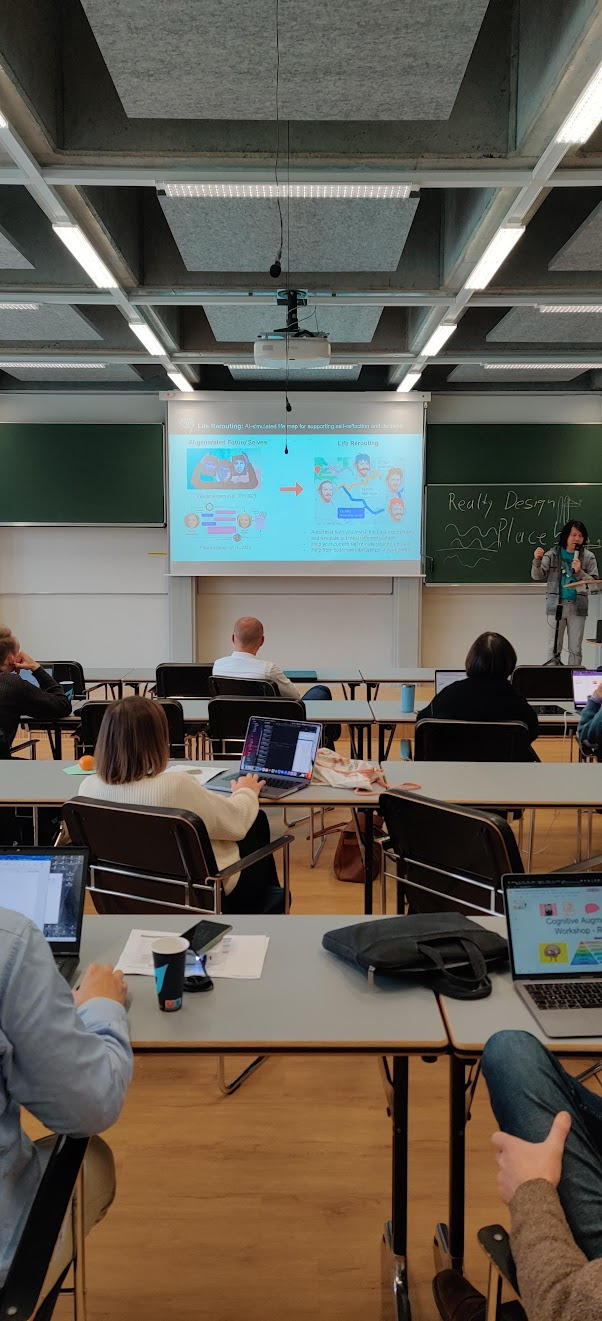
In the first part, a keynote by Steeven Villa was presented (see Figure 1). During the keynote, the points of society’s perceptions of human augmentation, the impact of human augmentation on self-perception, and risk-taking behavior were addressed. In the last part of the keynote, methodological recommendations for evaluation validity were presented. The session was followed by a round of questions and discussion.
4.1.4 Outcomes – Part Two: Hands-On Session
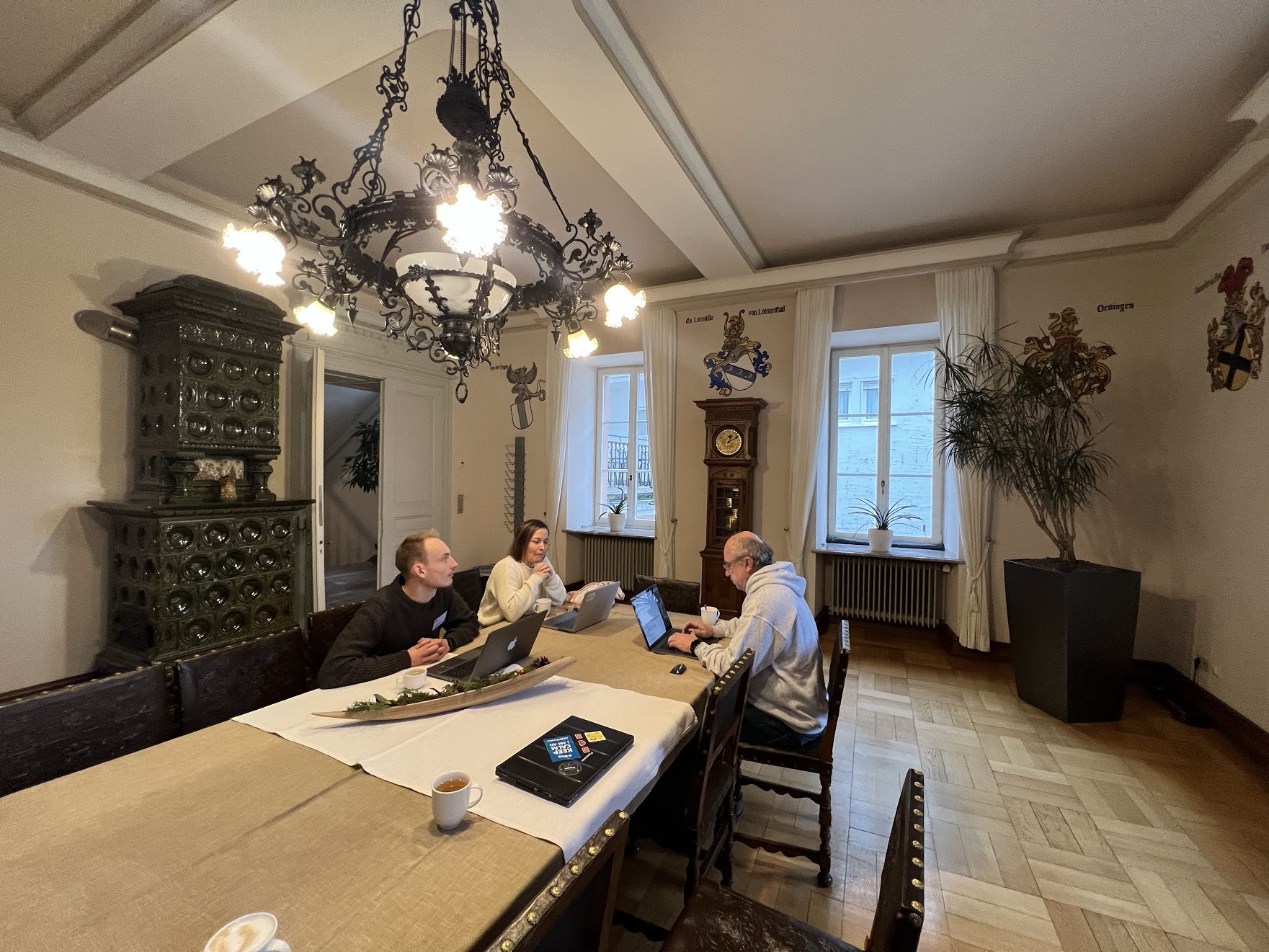
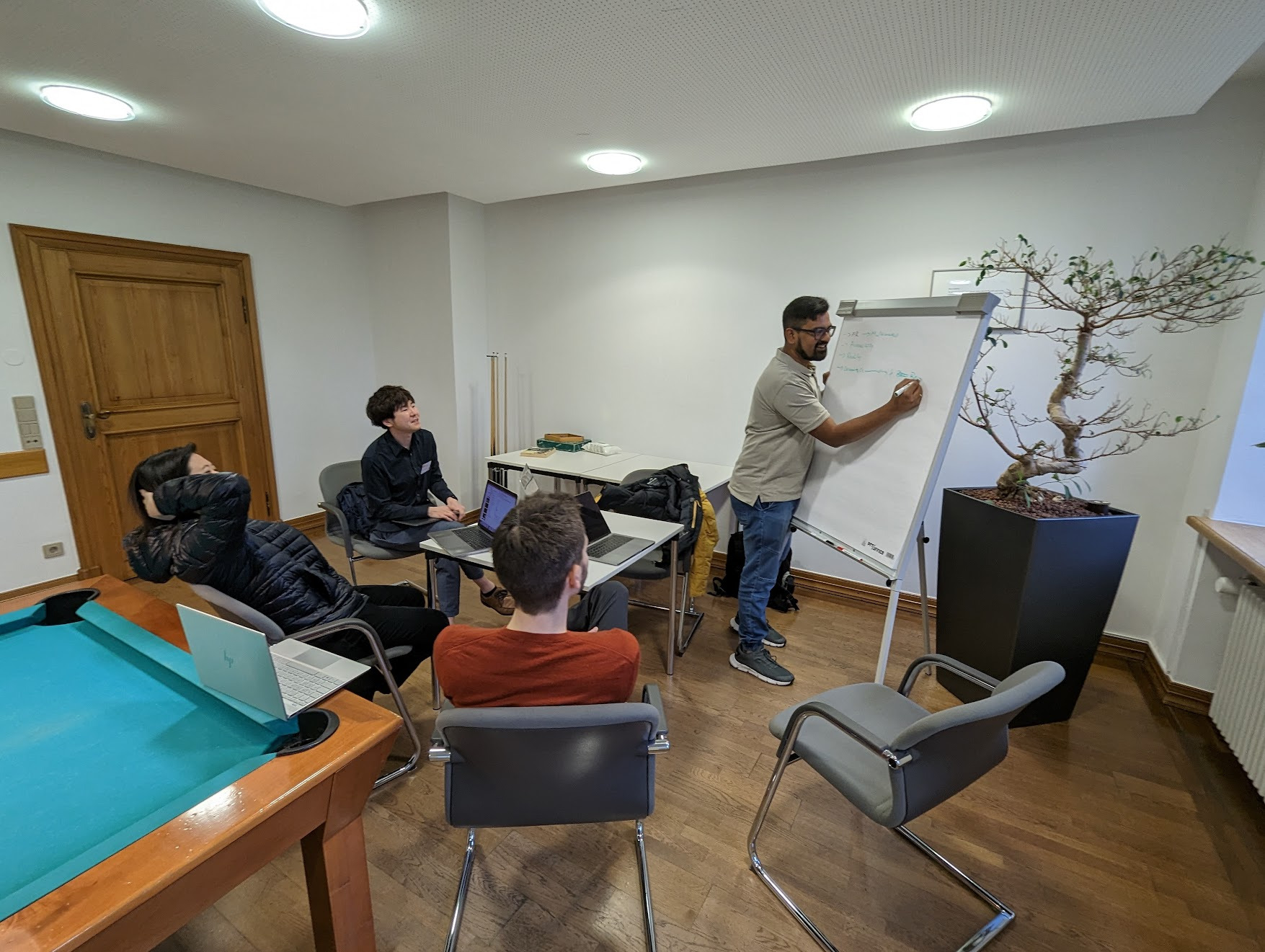


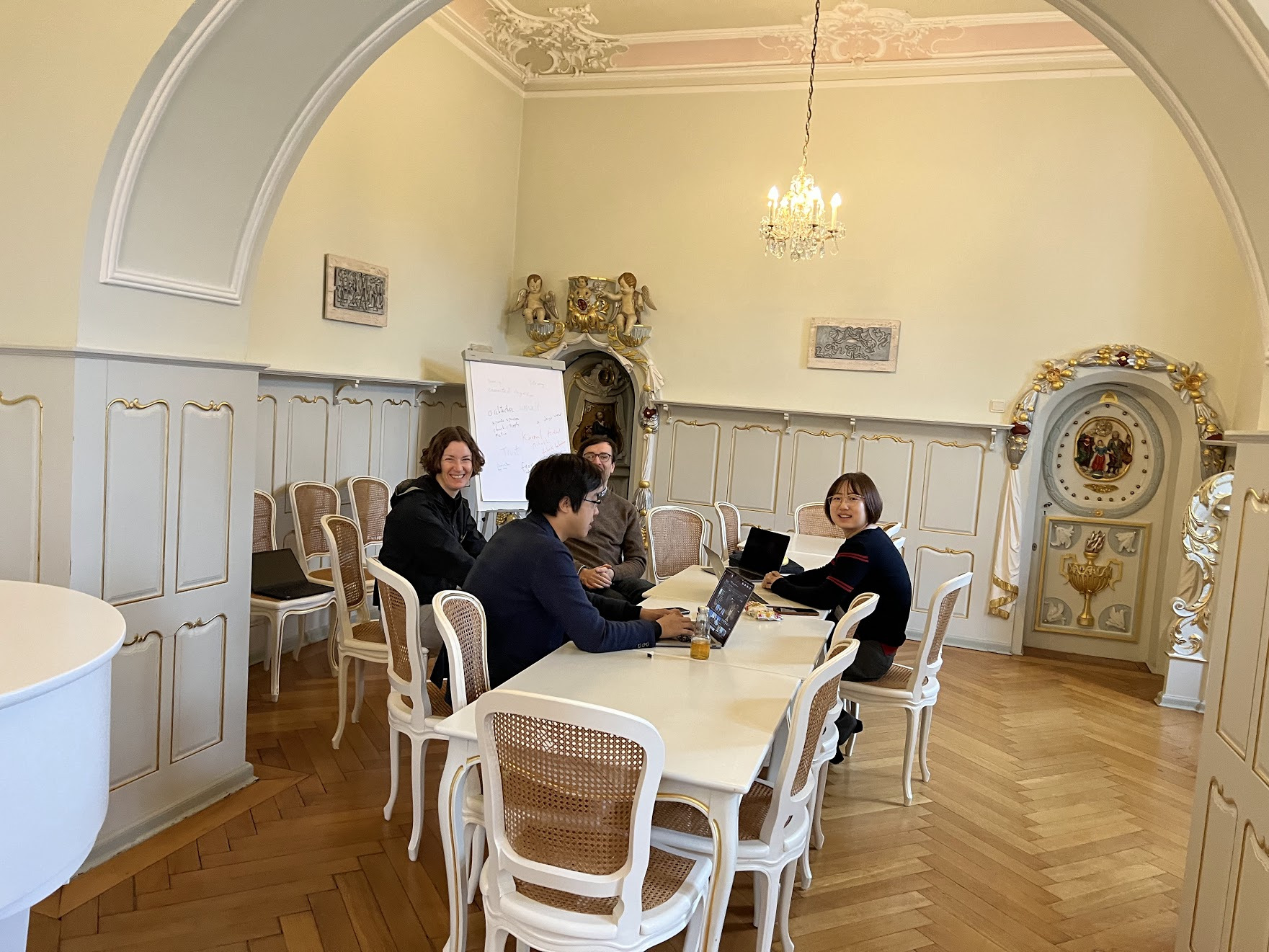
During the hands-on part of the workshop, the participants were put into groups and asked to brainstorm and make prototypes of cognitive enhancements. We instructed participants to develop hypothetical and conceptual lo-fi prototypes. This allowed participants to freely explore and express their ideas without being restricted by physical constraints.
The groups were then instructed to develop a cognitive augmentation prototype and a plan for its evaluation and analysis, as well as its long-term effects on the user. The prototype idea then had to be presented in the form of a user story, showing how the prototype solves a problem and talking about how it will affect society in 20, 50, and 100 years.
After the prototyping session, four groups presented their results, the concepts are presented below:
“Life Rerouting”: while one might wonder how their life would have changed if they had taken a different route, with an AI-simulated life map, you can find answers to these questions and help yourself think and make decisions. “Life Rerouting” not only lets you stay in different timelines, but it also helps you figure out how the path you choose now will affect your future.
“Umm-less”: The system helps a speaker that might be stuck in a conversation and cannot find the right words by using Auto-Complete Talking that shows world-anchored AR cues.
The system recognizes the conversation and context and suggests next possible worlds by combining transcription of the conversation with auto-complete suggestions.
“TransCap”: Every person has their strengths and weaknesses in different skills. Learning a new skill can take time and effort. TransCap is an augmentation device that can transport human capabilities. Instead of learning a new skill just to be used once, one can borrow it from another person who already knows the desired skill.
“Collective Intelligence”: How can human beings understand each other and create social empathy? By being exposed to different cultures, communities, or even species, collective intelligence is shaped. However, by fading information via AR (hiding other people or blocking out fears), this exposure is changed. Therefore, exposure can change the bigger picture and cause dangerous impacts on society caused by the management of companies or social groups.
4.1.5 Outcomes – Part Three: Discussion
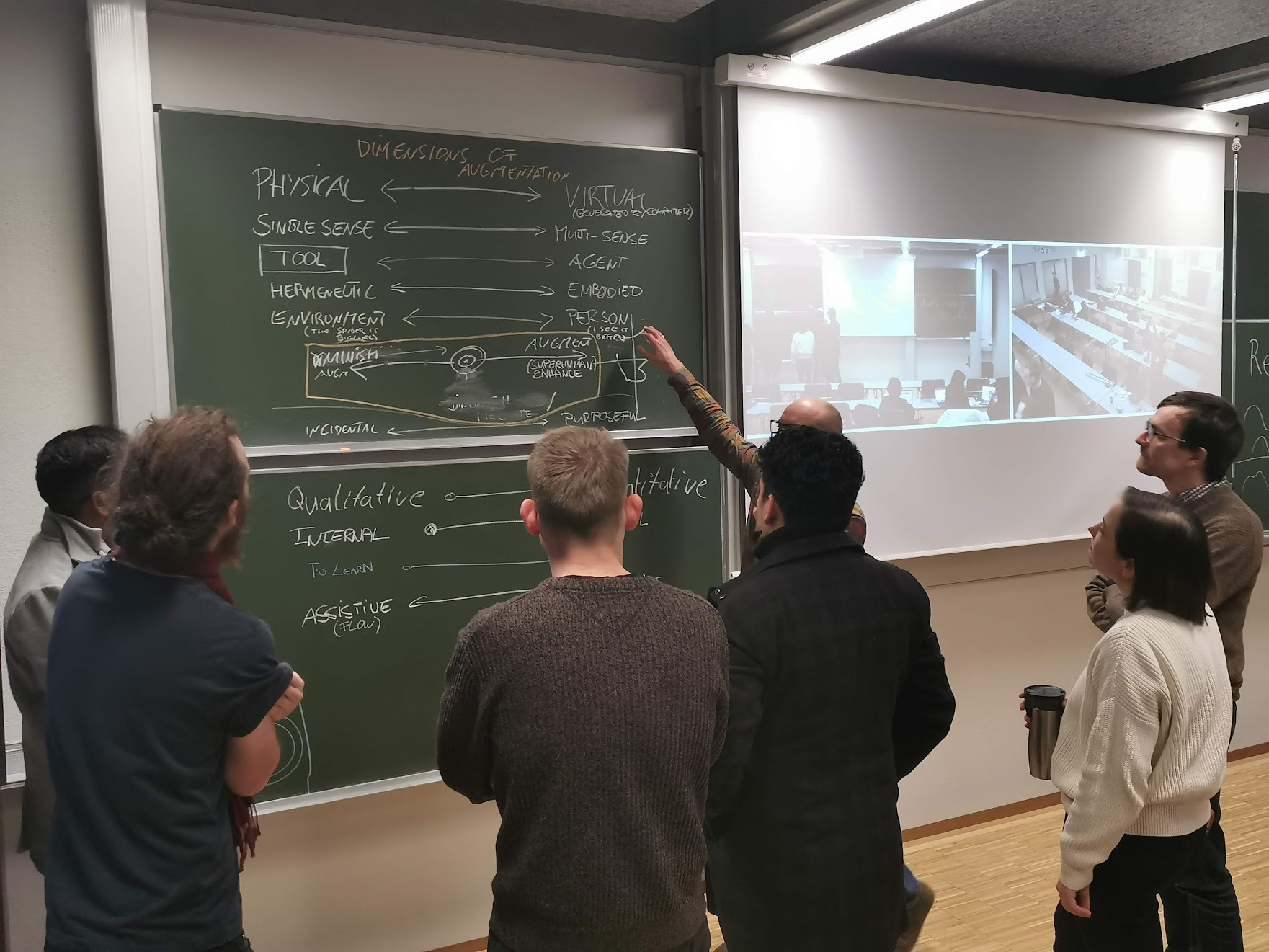

In the final part, we encouraged participants to engage in an open discussion about the points raised during the keynote and the prototyping session. We invited participants to walk in groups around the facilities of Dagstuhl. The participants then spent the remaining time of the session discussing these topics outside. After the session outside, some participants returned to the room to visualize and summarize the concepts discussed during the day.
4.1.6 Conclusion
While the creation and evaluation of human augmentation technologies are still challenging, the human augmentation field is growing. In a keynote, the current challenges of human augmentation technologies were presented and discussed by the participants. Subsequently, the participants presented low-fidelity prototypes of future human augmentation technologies while denoting their challenges. A final discussion of the implications of human augmentation technologies showed how evaluation methods need improvement and a design space for such technologies needs to be created. Overall, the workshop is considered a success, building the next cornerstone for the human augmentation community.
4.2 Memory Augmentation Workshop
Samantha W.T. Chan (MIT – Cambridge, US)
License: Creative Commons BY 4.0 International license © Samantha W.T. Chan
Co-authors/Organizers/Facilitators: Samantha Chan, Pattie Maes, Evangelos Niforatos, Nathan Whitmore, Gayathri Subramanian, Jiawen Han, Rakesh Patibanda, Florian ‘Floyd’ Mueller
Aim: The workshop aimed to introduce the topic of Memory Augmentation in HCI through a series of five short talks. Workshop participants (mainly from the Cognitive Augmentation Dagstuhl Seminar) are led by facilitators to discuss taxonomies, open questions, opportunities, and ideas for future interventions in the area.
Materials: The workshop organizers prepared a document with a rough outline of the taxonomy and a spreadsheet listing existing systems for memory augmentation and their relation to the taxonomy. A Miro board and Zoom room link were also prepared beforehand.
4.2.1 Agenda
Five short talks are given to set the stage (8-min talk + 5 min Q&A for each speaker).
-
Pattie Maes, MIT Media Lab (Remote) Introduction to workshop
Introduce the purpose of the session. “7 sins of memory” talk about some prior HCI work -
Evangelos Niforatos, TU Delft (Remote)
Episodic memory / Contextual Lifelogging & Affect / Physiological sensing (AI+HMDs) -
Samantha Chan, MIT Media Lab (In-Person)
Needs of the Elderly, Augmenting Prospective Memory -
Nathan Whitmore, MIT Media Lab (Remote)
Role of Sleep in Memory and the use of Targeted Memory Reactivation -
Gayathri Subramanian, NorthWestern University (Remote)
Entrainment and Brain Stimulation for Memory Improvements
Breakout sessions are done to work on a memory augmentation taxonomy.
-
Pattie Maes – Intro to breakout sessions Breakout groups (45 mins)
-
3 in-person groups (Facilitators: Samantha, Rakesh, Jiawen)
Facilitators take notes using whiteboards and pin-boards and take pictures afterwards or use Miro board. -
1 remote group (Facilitator: Pattie) – uses Miro board.
-
Guiding Questions for the Breakout Groups:
-
1.
Which memory augmentation systems/apps do you know?
-
2.
What remains to be tackled in the field of Human Memory Augmentation (challenges/opportunities)?
-
3.
What are interesting ideas for memory augmentation interventions? Use Schacter’s 7 sins of memory as the framework to guide the discussion.
-
1.
-
Facilitators report back on group discussions.
4.2.2 Feedback on Taxonomy
Workshop organizers developed and added two taxonomy categories to the Miro board for participants to discuss and provide feedback on. The resulting outlines are shown below, the items in italics are what were added to the taxonomies during the discussions.
-
1.
Taxonomy Category: What type of memory function does the system help with:
-
Prospective memory: Encoding / Recall
-
Factual memory: Encoding / Consolidation / Recall
-
Episodic memory: Encoding / Consolidation / Recall
-
Working memory
-
Procedural memory: Skills/motor memory, Forming/breaking habits, Implicit attitudes/biases
-
Forgetting and/or rewriting traumatic memories: Diagnosis of memory problems / Sharing of memories
-
-
2.
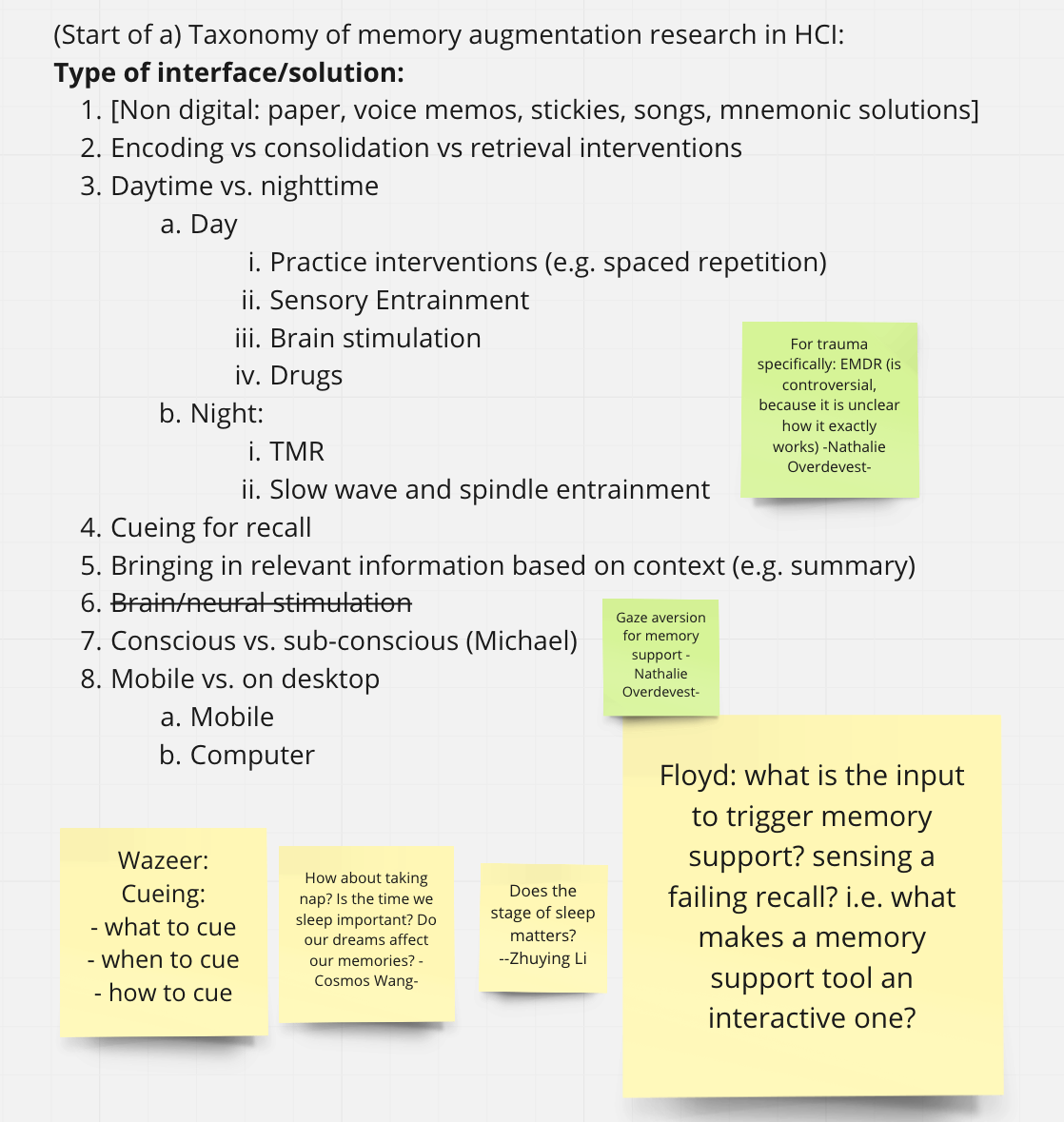
Taxonomy Category: Type of interface/solution:
-
Non-digital: paper, voice memos, stickies, songs, mnemonic solutions
-
Encoding vs consolidation vs retrieval interventions
-
Day
-
–
Practice interventions (e.g. spaced repetition)
-
–
Sensory Entrainment
-
–
Brain stimulation
-
–
Drugs
-
–
-
Night
-
–
Targeted Memory Reactivation (TMR) during sleep
-
–
Slow wave and spindle entrainment
-
–
-
Cueing for recall
-
Bringing in relevant information based on context (e.g. summary)
-
Conscious vs. sub-conscious
-
Mobile vs. on desktop
-
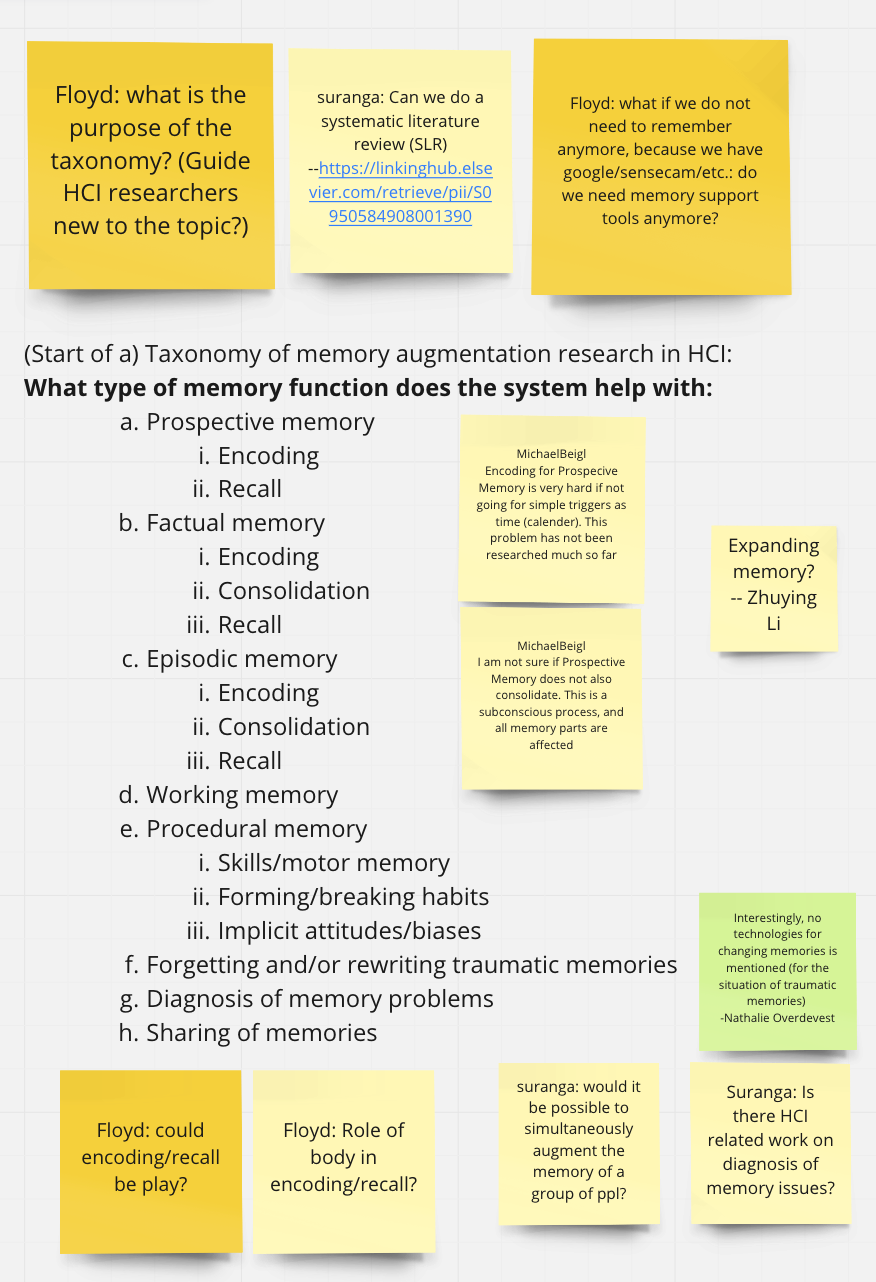



General Feedback: It was suggested to clearly define the purpose of the taxonomy, that it is meant to guide HCI researchers who are new to the topic. A question was raised on whether we need memory support tools anymore since we already have tools like Google and SenseCam.
Feedback on taxonomy based on memory function: It was argued that there is still a need for tools to support aspects of memory function such as prospective memory, changing memories, and diagnosis of memory issues (See Figure 5).
Feedback on taxonomy based on type of interface/solution: Many participants described non-digital solutions such as sticky notes and paper memos. Some of these non-digital solutions can be digitalized. We should clarify that the taxonomy should only include digital interfaces. It was mentioned that we should consider: What are the inputs to trigger memory support? Could it be when sensing a failing recall? What makes a memory support tool an interactive one? (see 5).
Potential new taxonomy categories: Participants suggested that the interfaces could also be categorized based on target users and in terms of human-technology relations, as proposed below (see also Figure 5).
Taxonomy Category: Human-Technology Relations.
-
Technology that stores stuff for us, and we need to remember to ask the technology
-
Technology that reminds us to remember
-
Technology which stimulates us to remember
-
Technology that indicate when memory error was made
4.2.3 Responses to Guiding Questions
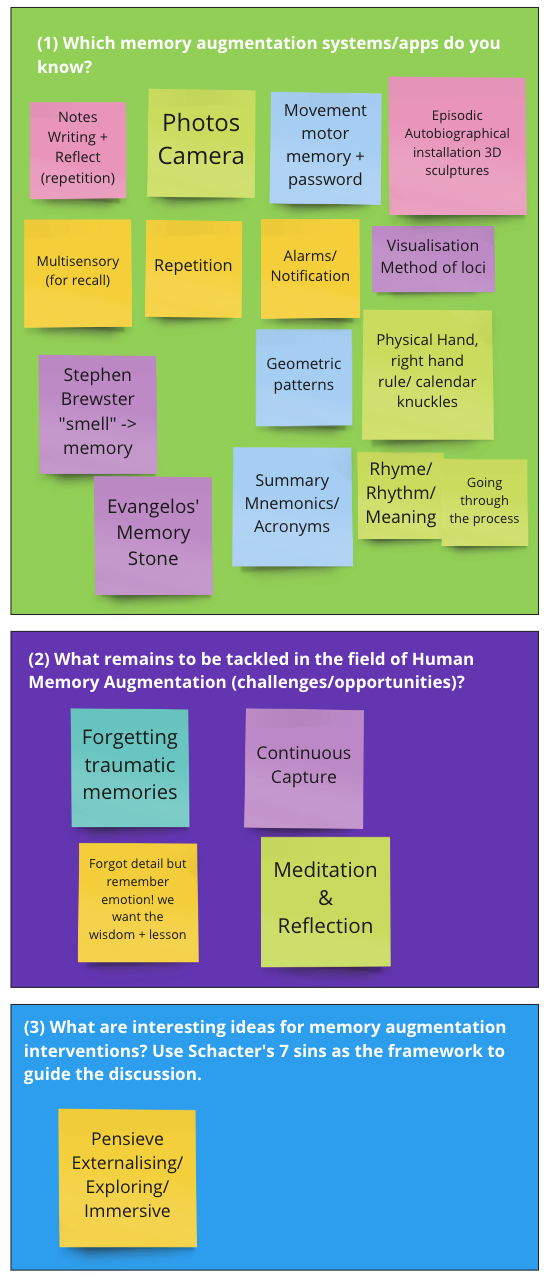
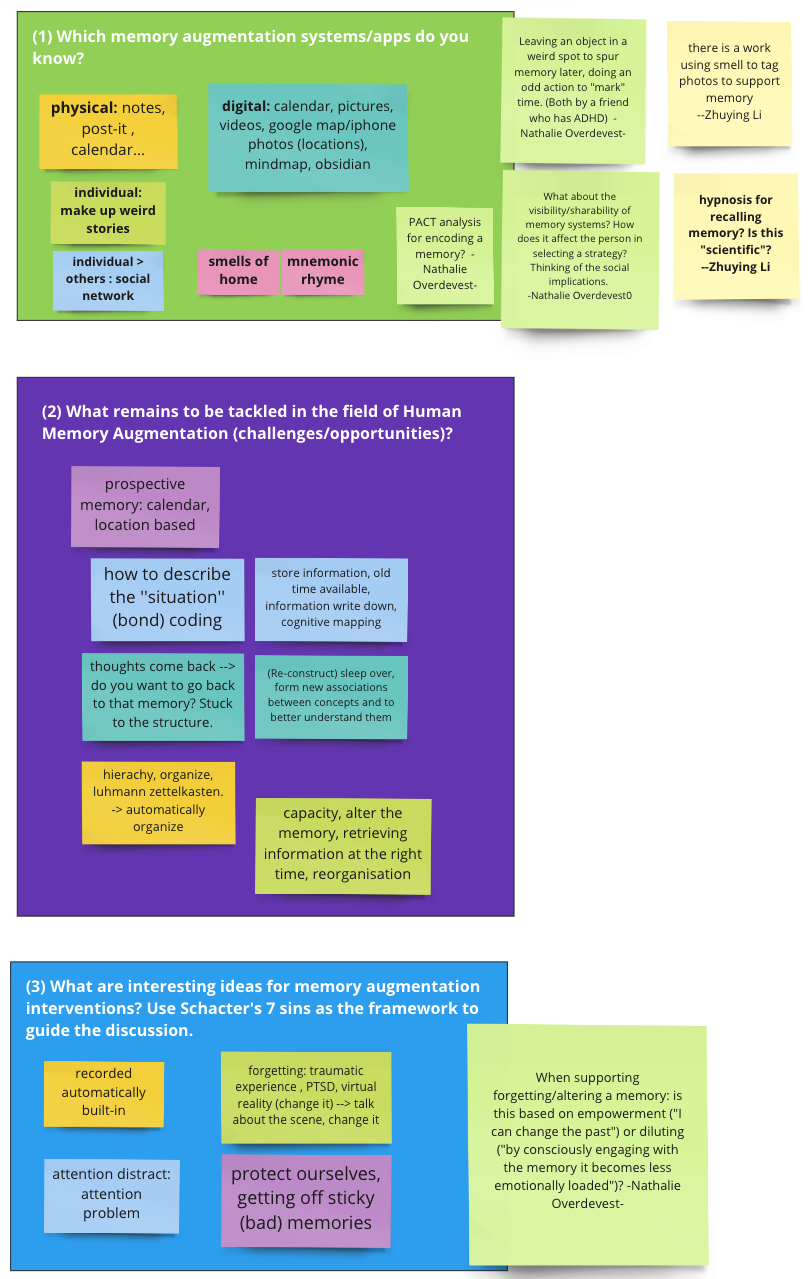
The four Breakout Groups discussed answers to the three guiding questions. The summary of the responses to each question are as follows. Figures 4 to 7 show the question responses on Miro board for each group respectively.
1. Which memory augmentation systems/apps do you know?
Many participants discussed mnemonic devices and strategies that they have used or seen before. These include “traditional world-anchored reminders (knot in handkerchief)” (Group 1), gestures or memories mapped to our physical hands like the right-hand rule and calendar month lengths using knuckles (Group 3), making up weird stories, and leaving objects in weird locations (Group 2). A few participants talked about movement-related or kinesthetic strategies for remembering, such as doing an odd action to mark time (Group 2), and using geometric patterns and motor memory for remembering passwords (Group 3). Mnemonic rhymes (Group 2, Group 3), rhythm, summary, acronyms, and the method of loci were also mentioned (Group 3). Another strategy included receiving reminders from other people (Group 2).
Existing physical tools are used to record and externalize memories, such as notes (Group 2, Group 3), post-it, calendar (Group 2), the act of writing down, reflecting and repetition were thought to assist in remembering (Group 3). Digital tools were also mentioned. All groups talked about using digital media (photos and videos) and albums “to consolidate episodic memory” (Group 1) with tools like Google Photos (Group 1), Google Maps, and iPhone photos (Group 2).
Participants also pointed out digital reminders from voice assistants (Group 1), alarms and notifications (Group 3) on computers or phones. A participant recalled seeing a prototype that “stored” episodic, autobiographical memories in an installation with 3D sculptures (Group 3).
The Olfoto interface [1], which used smell (olfactory cues) to tag photos/memories (Group 2, Group 3), was mentioned by participants from two groups.
2. What remains to be tackled in the field of Human Memory Augmentation (challenges/opportunities)?
Many participants highlighted that there remains a lack of HCI systems for “intentional forgetting”, temporarily suppressing memories (Group 1) and forgetting traumatic memories (Group 3). Another key area was in altering memories (Group 2), be it situations for re-coining memories via psychotherapy for phobias (Group 1) or perhaps reconstructing memories during sleep to form new associations between concepts and to better understand them (Group 2). Along with these aspects, participants also emphasized the importance of future systems being able to authenticate memories or identify false and altered memories (Group 1).
Another common theme that emerged from the discussions was the need for better “compression” of memory and experience (Group 1). Systems should be able to automatically organize memories (Group 2), and summarize wisdom and lessons learned from the memories (Group 3). Future tools should help users to easily code and describe the situation and information related to the memory (Group 2). Retrieving information at the right time and prospective memory related reminder systems (e.g., calendar, location based) still remain as key issues to address (Group 2).
In terms of designing tools for memory augmentation, there remain opportunities for the creation of hardware and software platforms to experiment with and good translation of tools from research settings to real life use and contexts such that they are non-disruptive and usable (Group 4).
The topic of ethics and privacy in using tools for memory augmentation remains to be addressed. Participants in Group 4 posed open questions on the topic, for example, “Should we create superhumans or focus on those who need it?”, “Who [would] “own’ our memories?”, “What if technologies are used to rewrite our memories and brainwash us?”
3. What are interesting ideas for memory augmentation interventions? Use Schacter’s 7 sins of memory as the framework to guide the discussion.
The “sin of memory persistence” was discussed the most. Participants thought of ways to protect and get rid of sticky (bad) memories (Group 2). In one scenario, participants talked about remembering old passwords instead of the current one and wondered if there could be a system to help in intentionally forgetting a password (Group 1). A few participants raised the concept of forgetting traumatic experiences in virtual reality (VR) settings (Group 2, Group 4) where the system could enable the user to talk about the experience and then change it. This change or alteration of memories could be based on empowerment (“I can change the past”) or diluting (“by consciously engaging with the memory […] it becomes less emotionally loaded”) (Group 2). A related idea was to have a digital “Pensieve” (a fictional item in the Harry Potter book series for exploring memories) to assist users in externalizing and exploring memories in an immersive setting (Group 3) which could also be in VR.
The “sin of absent-mindedness” often refers to the lack of attention when encoding memories. A participant suggested that there could be “[a] wearable that “caresses’ the wearer when they are encoding [memories]”. The “sin of misattribution” (i.e., having the wrong perception of the memory’s source) might be addressed with “quizzes to check your memories – [like a] family pub quiz”.
Other ideas that might not be directly related to the 7 sins of memory included adding personalities or affective associations to memories. This could be via smell and body movement, and could be related to the “inner child” concept in trauma therapy (Group 1). The idea of exploring alternative memory pathways with media was also pitched, for example, introducing fake memories or backstories to explore and reflect on different choices as if you are playing a role-playing game (Group 1). Another concept was to create opportunities for daydreaming to help with encoding recent memories (Group 4).
References
- [1] Brewster, S., McGookin, D., Miller, C. (2006, April). Olfoto: designing a smell-based interaction. In Proceedings of the SIGCHI conference on Human Factors in computing systems (pp. 653-662).
5 Overview of Talks
5.1 Cognitive Augmentation: New sensory experiences and memories need new technology
Michael Beigl (KIT – Karlsruher Institut für Technologie, DE)
License: Creative Commons BY 4.0 International license © Michael Beigl
Cognitive augmentation is the use of technology to enhance our cognitive abilities, such as to enhance our skills or memory or to improve problem-solving. To fulfill that promise, new technologies need to be developed that are able to augment and enhance these abilities. Creating new sensory experiences and memories go together. In our research, we address cognitive augmentation technologies to create entirely new sensory experiences that then impact the way we remember. For example, we develop technologies that allow users to experience sensations that are not possible because we lack the senses, but which are at the same time pleasant or useful. This has the potential to open new avenues for exploration and discovery, and could then fundamentally change the way we think about sensory experiences and open up new applications. These enhancements to our sensory experiences can also have a profound impact on our cognitive abilities. By expanding our range of sensory input, we can not only improve our ability to experience the physical world around us, but find new ways to learn, remember, and make decisions based on that new information. We conduct research in the area of creating new sensory experiences mainly through haptic displays and investigate new ways of learning new skills and adding new facts to memory through passive haptic learning with applications ranging from psychological treatment to sports, music, and industry. A major focus of our group is the development of (open) hardware and software for sensory and cognitive augmentation, such as OpenEarable, Tactile Interfaces and EdgeML.
As a grain of salt, I find it impossible to prospectively define Grand Challenges. Some Challenges might be:
-
1.
Development of effective, open and easily reproducible technologies (both in hardware and software) to enhance and enhance human senses
-
2.
Overcoming the technical and biological barriers to implementing sensory augmentation. This will probably be mainly joint work with ongoing health activities.
-
3.
Dealing with the social and psychological effects of sensory augmentation: Finally, there are also significant social and psychological challenges associated with sensory augmentation.
5.2 Seamless integration of virtuality as cognitive augmentation
Michael D. Bonfert (Universität Bremen, DE)
License: Creative Commons BY 4.0 International license © Michael D. Bonfert
While the term metaverse is heavily debated and defined in various ways, the concept starts taking shape in practice. Virtual and online worlds will be incorporated more and more into our physical world, making them ubiquitous. To access and control digital information, HCI needs to explore future interfaces with virtual content that move from device-centric 2D interactions to reality-anchored, pervasive 3D interactions. These interfaces might involve multimodal access and multisensory feedback for integrating virtuality into everyday activities.
As a preliminary step, we need to understand how to design interactions in the purely virtual, as the following examples illustrate. With Get a Grip! we explored mapping physics-based object handling known from reality to dexterous manipulation of virtual objects. The controller Triggermuscle creates a sense of weight for virtual objects. In the case study, Seeing Faces Is So Important, we explored holding meetings on social VR platforms and compared it to videoconferencing during the Covid-19 pandemic. More generally, with the Interaction Fidelity Model, we aim to describe how closely VR interactions reproduce interactions from reality by distinguishing between distinct aspects of fidelity and providing precise terminology.
Conceiving future XR interactions that integrate virtuality into physical reality, we must achieve a careful balance. While digital information is seamlessly incorporated into the real world, it should not distract from reality. While we might want pervasive access to virtuality, we must achieve this for everyone, with high accessibility across modalities. While the virtual content can be personal, it should not be intrusive and must remain secure. The realities should ideally augment each other and the users, rather than compete. These trade-offs will be a challenge for the next decades.
5.3 Augmenting Human Memory
Samantha W.T. Chan (MIT – Cambridge, US)
License: Creative Commons BY 4.0 International license © Samantha W.T. Chan
Memory is a cognitive ability used in our everyday lives. However, it eventually declines and its adaptive nature results in memory troubles. Most of our lapses in memory are due to prospective memory troubles related to forgetting to perform future intended tasks, for example, forgetting to take medication or bring items when leaving the house. With the advancement of technologies and the growth of the aging population, new requirements and opportunities arise. Many technologies available today lack the means to understand our complex everyday situations to support prospective memory. There is a need to provide support through enhancing our memory and assisting with memory tasks, as well as to encourage our receptivity to these interventions. My work aims to investigate the ways to augment prospective memory through technologies that are aware of our cognitive contexts and integrate with our perception and behaviors. I introduce how we can enhance memory through memory training by digitally mediating a memory strategy. The user studies show that this improves users’ performance on prospective memory tasks and self-reported memory. Technologies can encourage receptivity to memory training by sensing cognitive contexts through physiological signals (bio-signals) and suggesting training sessions during moments of low emotional arousal and cognitive load (calm moments). I unveil user perceptions of voice reminders which use the voices of friends and family, and discuss how this might benefit user receptivity. Cognitive understanding of the user and cognitive influence can be combined for implicit interactions to augment human memory.
5.4 Group Physiology in Cognitive Augmentation
Jiawen Han (Keio University – Yokohama, JP)
License: Creative Commons BY 4.0 International license © Jiawen Han
My talk is about how to apply physiological data to augment group interaction and collective cognition. With the advent of wearable sensing, individuals’ behavioral and physiological data could be tracked and analyzed almost in real-time. Unlike behavioral data, physiological signals could hardly be observed by the naked eye. But analysis and interpretation afterward could help us reflect and recall past live group events.
I shared some of my works on quantifying a group’s physiological data and relating to collective cognition triggered by external stimuli. Moreover, I introduce one of my works to use physiological data as input to predict life experiences and be later shared with others. In that case, group physiology could be not only reflected but also augmented with feedback systems. However, we also need to think about the balance or the trade-off between augmentation and distraction. What kind of system or feedback shall we provide or design to keep the essence of the natural process, with cognitive ability augmented unconsciously?
References
- [1] Jiawen Han, George Chernyshov, Moe Sugawa, Dingding Zheng, Danny Hynds, Taichi Furukawa, Marcelo Padovani, Kouta Minamizawa, Karola Marky, Jamie A Ward, and Kai Kunze. 2022. Linking Audience Physiology to Choreography. ACM Trans. Comput.-Hum. Interact. Just Accepted (August 2022). https://doi.org/10.1145/3557887
- [2] Yan He, George Chernyshov, Jiawen Han, Dingding Zheng, Ragnar Thomsen, Danny Hynds, Muyu Liu, Yuehui Yang, Yulan Ju, Yun Suen Pai, Kouta Minamizawa, Kai Kunze, and Jamie A. Ward. 2022. Frisson Waves: Exploring Automatic Detection, Triggering and Sharing of Aesthetic Chills in Music Performances. Proc. ACM Interact. Mob. Wearable Ubiquitous Technol. 6, 3, Article 118 (September 2022), 23 pages. https://doi.org/10.1145/3550324
5.5 Being embodied in abstract and multiple bodies
Matthias Hoppe (LMU München, DE)
License: Creative Commons BY 4.0 International license © Matthias Hoppe
My research is exploring the use of Virtual Reality (and Mixed Reality in general) to go beyond what is possible in the real world. VR allows a user to slip into other bodies in various worlds. The self-perception of one’s body can be altered by presenting the user by varying the look of one’s body, or change how others are perceived by a simple touch gesture that utilizes social touch [1]. However, VR enable to present the user with a different viewpoint as well. In previous research, we presented the existence of a perspective continuum in VR [1]. Here, the viewpoint of the experience is altered to enable an out-of-body experience for the users, as they have control over a character via motion control. However, the users see themselves from their outside, therefore resulting in an experience where they are embodied in “two bodies”, one is the character, the other is the camera. How this experience and embodiment of the two bodies is perceived, highly depends on the users. While some feel like “they are the character” while looking at it from the outside, others have the feeling of only being an observer, or even being embodied in two bodies at the same time. This poses the question of the limits of human embodiment if one person can be present and embodied in multiple bodies at the same time? Can these bodies also take on abstract forms? Can humans be augmented to not only be present in multiple bodies, but also multiple times?
References
- [1] Hoppe, Matthias, et al. “There Is No First-or Third-Person View in Virtual Reality: Understanding the Perspective Continuum.” CHI Conference on Human Factors in Computing Systems. 2022. Hoppe, Matthias, et al. “A human touch: Social touch increases the perceived human-likeness of agents in virtual reality.” Proceedings of the 2020 CHI Conference on Human Factors in Computing Systems. 2020.
5.6 Thinking Social Acceptability alongside with Cognitive Augmentation
Marion Koelle (OFFIS – Oldenburg, DE)
License: Creative Commons BY 4.0 International license © Marion Koelle
The emergence of cognitive augmentation technologies promises a range of unique benefits: they may improve accessibility and help create equitable opportunities for everybody, while also supporting people in developing, even extending, their natural abilities and skills. Yet, new social dynamics, needs, and challenges may dynamically emerge when a novel technology is “released” into-the-wild. Cognitive augmentation technology may (and likely will) create social tensions or intensify existing individual or societal vulnerabilities. Therefore, it is crucial to research social, societal and ethical implications alongside technology-driven advances of cognitive augmentation.
In my work, I ask how we might operationalize social acceptability and related social and societal phenomena as a core component in HCI research. My past research focused on social acceptability issues with body-worn cameras (see Figure 7) that can serve as assistive devices for the visually impaired or improve indoor navigation (1) but face significant social acceptability issues, e.g., due to concerns about bystander privacy (2). More recently, I expanded my research focus towards the design and fabrication of on-body interfaces, e.g., electrode sleeves (3) or hair interfaces (4), focusing on their perceptual, social and ethical aspects and their wearability in social contexts. With our current and future research, my freshly founded research group and I aim to contribute theories and models that help articulate the role technology plays in social contexts, empirical studies that test and refine these theories, and new tools and methods that help to design interfaces that meet social and societal needs.

5.7 Cognitive Augemtation using Assistive Devices using Robotics Technology
Yuichi Kurita (Hiroshima University, JP)
License: Creative Commons BY 4.0 International license © Yuichi Kurita
I enjoyed my first stay in Dagstuhl to the fullest. The discussions with researchers related to cognitive augmentation were very stimulating and suggested what I should do next.
I develop assistive devices using robotics technology (mainly pneumatic artificial muscles and teleoperated robots). In our field, improving exercise and work performance are important evaluation axes. However, through our discussions at Dagstuhl, we strongly recognized that these affect cognition simultaneously. Conversely, cognitive augmentation will also affect physical activity. We need to determine whether this impact will be positive or negative.
In addition, I felt that social action is also important to ensure that these technologies reach a wider audience on an equal basis. Human augmentation technology should not be a technology for a limited number of people. Let’s bring augmentation technology to all people. I feel the important thing is to design the future. We must imagine what we want to be and what we need to do to make it happen.
5.8 Craftsmanship Augmentation: Learn, Master, and Retain Delicate Skills
Jie Li (EPAM Systems – Hoofddorp, NL)
License: Creative Commons BY 4.0 International license © Jie Li
As people are increasingly relying on technology to complete tasks that used to be done by hand. We are losing certain traditional skills such as calligraphy, especially handwriting in Chinese. Character amnesia is a frequent phenomenon that experienced Chinese speakers forget how to write certain characters previously well-known to them. The same goes with other delicate craftsmanship that is a tangible manifestation of the cultural heritage but is on the verge of extinction (e.g., Sichuan embroidery).
In addition to dependency on technology, younger generations find it demanding to learn to write Chinese characters or these delicate skills that often require a lengthy apprenticeship. To ensure that the knowledge and skills are passed onto future generations, cognitive augmentation technology could be used to help people learn and master these skills more efficiently and easily.
By placing sensors on the human body, technology such as brain-computer interfaces (BCIs) or electromyography (EMG) have the potential to translate electrical activities of the brain or the muscles into commands that the computer or device can understand and execute. People can be augmented to control a digital pen or brush using their thoughts or using programmed muscle memories, even if they are unable to physically perform these tasks due to injury or illness. This could help to prevent these skills from being lost due to lack of practice.
Grand challenges regarding craftsmanship augmentation include that:
-
1.
Can we develop augmented craftsmanship that can efficiently help us learn, master and retain a sense of control and precision that is comparable to or even much better than a skilled craftsman?
-
2.
How can we ensure that these skills are still appreciated when we can speed up the learning and mastering process?
5.9 Cognitive augmentation for attunement
Zhuying Li (Southeast University – Nanjing, CN)
License: Creative Commons BY 4.0 International license © Zhuying Li
My research interests lie in developing cognitive augmentation technology to help people be more attuned to themselves, others, and the environment. To explore this, we have built a series of design works such as HeatCraft, a wearable system that can generate thermal stimuli based on one’s body temperature sensed by an ingestible sensor. The stimuli’s temperature and body temperature change reversely, so when body temperature raises, the stimuli’s temperature drops down. Our study shows that this device could influence how people perceive and use their body. For example, a participant chose to drink some icy water to get the heat in winter. Another example is our recent work in progress GoChirp, an AI-powered wearable device that can continuously sense the existence of surrounding birds via recognizing bird songs, and provide haptic sensations when birds are detected. The device was designed for enhancing people’s awareness of wild lives and engaging them with nature in urban lives. In general, we hope the future workaround cognitive augmentation is not only about transhuman and augmenting one’s capability, but also considers the experiential perspective. We hope to develop more humanized cognitive augmentation technology to better support attunement.
5.10 Enhancing human capabilities and experiences
Stephan Lukosch (University of Canterbury – Christchurch, NZ)
License: Creative Commons BY 4.0 International license © Stephan Lukosch
My research focuses on human augmentation to enhance our capabilities and experiences. I study the effect and impact of human augmentation in different domains such as sports, games, health, safety & security, or engineering. Cognitive augmentation is a form of human augmentation that aims to create novel experiences using and extending human perception and cognition. In previous work, we have explored how a location-based information system in combination with augmented reality impacts work processes, awareness, and workload for hotspot policing [1]. While the location-based information system enhanced human perception and cognition, the timing of information delivery, the adaptation of content to situational characteristics and the modes of information delivery are of interest for further investigation. In more recent work, we have investigated the use of everyday objects to interact in augmented reality [2], how to provide augmented feedback for the correct execution of strength exercises, how to bridge the spatial gap between local and remote players in location-based games, how to provide collaboration awareness during complex co-located collaborative tasks, or how to support the mental imagery practice of elite athletes in preparation for competitions. While all projects are embedded in different domains, all have aimed at enhancing cognitive capabilities and experiences and provided initial insights into a deeper understanding of human and cognitive augmentation. Still, further research is necessary to identify use cases for cognitive augmentation or to determine benefits of cognitive augmentation. Can cognitive augmentation be used to facilitate presence, awareness, decision-making, knowledge recall, skill acquisition, or empathy? What kind of sensors and input do we need to create cognitive augmentation? From an ethical and societal perspective, it is further necessary to explore if we want to create new cognitive capabilities or whether we want to enhance/augment existing ones? What are possible benefits, drawbacks and ethical dilemmas for cognitive augmentation? Should, e.g., others be aware of someone using cognitive augmentation? These questions are just some of those that future work on cognitive augmentation will need to address.
References
- [1] Engelbrecht, H. & Lukosch, S. G., Dangerous or Desirable: Utilizing Augmented Content for Field Policing, International Journal of Human Computer Interaction (IJHCI), 2020, 36, 1415-1425
- [2] Greenslade, M.; Clark, A. & Lukosch, S., User-Defined Interaction Using Everyday Objects for Augmented Reality First Person Action Games, IEEE Conference on Virtual Reality and 3D User Interfaces Abstracts and Workshops (VRW), 2022, 842-843
5.11 Cognitive Enhancement
Pattie Maes (MIT – Cambridge, US)
License: Creative Commons BY 4.0 International license © Pattie Maes
While today’s devices put the world’s information at our fingertips, they do not help us with some of the cognitive skills that are arguably more important to leading a successful and fulfilling life, such as attention, grit, motivation, creativity, memory and learning, mindful decision-making, and emotion regulation. Building upon insights from psychology and neuroscience, my research group at MIT creates AI systems and interfaces for enhancing human cognition. Our designs range from assistive technologies that help people overcome disabilities to technologies that help people further develop their natural abilities and skills.
One of the areas we are particularly interested in lately is opportunities for enhancing cognition during sleep. Good sleep is crucial not just for health, but also daytime cognitive performance. There is an opportunity for HCI researchers to venture into systems and experiences that interface with and influence the sleeping mind. Commercially available devices for sleep such as Oura ring, Fitbit and Smartwatches primarily focus on monitoring and quantifying sleep. Instead, our work looks at how stimuli presented during sleep, including scent, sound and electrical stimulation issued at specific moments of the sleep cycle, can impact memory (strengthening & weakening), time to sleep onset, and depth of sleep.
5.12 Immersive Accessibility
Roshan Lalintha Peiris (Rochester Institute of Technology, US)
License: Creative Commons BY 4.0 International license © Roshan Lalintha Peiris
I currently co-direct the En-Ability Lab at RIT. The objectives of the En-Ability Lab is to enable, empower and enhance abilities through technology and design. At the En-Ability Lab, one of my main research directions is “Immersive Accessibility” that looks at immersive technologies (AR/VR and Haptics) and accessibility. Under Immersive Accessibility, we conduct research under two main themes, 1) Making Immersive Technologies Accessible and 2) Immersive Technologies for Accessibility Applications. Under theme 1, we primarily identify accessibility limitations of existing immersive technologies and explore methods to make them more accessible. Here, one example project is SoundVizVR where we examine new ways to visualize sounds in VR using mini-maps and indicators to improve the accessibility of VR for Deaf or Hard of Hearing (DHH) users. Under the 2nd theme, we explore new ways to use immersive technologies for accessibility. For example, in the OneButtonPIN research, we examine using haptics to make the PIN code entry process more secure and accessible for Blind and Low Vision participants while the Haptic Captioning project aims to enhance captions and improve speaker indication for DHH caption viewers.
With Cognitive Augmentation, my main goal is to examine ways in which we can re-imagine existing assistive technologies to be more implicitly integrated with users.
5.13 Sensing Visual Attention in Remote Education to Support Learning
Tobias Wagner (Universität Ulm, DE)
License: Creative Commons BY 4.0 International license © Tobias Wagner
Due to the increasing integration of cameras in everyday devices (e.g., smartphones, smartwatches, head-mounted displays) and the continuous progress of hardware and software in eye-tracking, there is a possibility of capturing users’ visual attention continuously and in real time. Sensing the human eye allows the assessment of users’ cognitive states and processes, providing crucial information for systems that aim to augment users’ cognitive abilities. We were interested in using gaze-based information in remote education to enhance meaningful learning, improve communication and collaboration [1, 2]. Here, challenges such as accurately sensing the visual attention of a crowd of distributed users in real-time [3] and the meaningful augmentation of learners’ cognitive abilities remain. In the future, we will investigate how educational systems can provide gaze-based feedback to support learners’ cognitive processes and abilities during learning and perfecting skills.
References
- [1] Teresa Hirzle, Marian Sauter, Tobias Wagner, Susanne Hummel, Enrico Rukzio, and Anke Huckauf. 2022. Attention of Many Observers Visualized by Eye Movements. 2022 Symposium on Eye Tracking Research and Applications. https://doi.org/10.1145/3517031.3529235
- [2] Marian Sauter, Tobias Wagner, and Anke Huckauf. 2022. Distance between gaze and laser pointer predicts performance in video-based e-learning, independent of the presence of an on-screen instructor. 2022 Symposium on Eye Tracking Research and Applications. https://doi.org/10.1145/3517031.3529620
- [3] Marian Sauter, Teresa Hirzle, Tobias Wagner, Susanne Hummel, Enrico Rukzio, and Anke Huckauf. 2022. Can Eye Movement Synchronicity Predict Test Performance With Unreliably-Sampled Data in an Online Learning Context? 2022 Symposium on Eye Tracking Research and Applications. https://doi.org/10.1145/3517031.3529239
5.14 Diving into Virtual Worlds
Po-Yao (Cosmos) Wang (National Taiwan University – Taipei, TW)
License: Creative Commons BY 4.0 International license © Po-Yao (Cosmos) Wang
I envision a future where people can dive into game worlds. To make this happen, I previously pursued my Master’s degree in Computer Science and Information Engineering at National Taiwan University. To expand game genres, I published Game Illusionization: A workflow for applying optical illusions to video games to tell people how to make games with illusions. People can follow our workflow step by step to create their own illusion games. We offer an illusion database for people to search their desired illusions. And we also provide editors to help people build their illusion games in Unity Game Engine. I hope this work can inspire people to apply illusions to interactions more, and also make the game industry more thriving. Apart from illusions, I also research in Virtual Reality. However, VR headsets are not immersive enough. So, I think maybe dreaming is one of the solutions, where we have full sensations, and we think everything in the dreams are so realistic. Especially, I would like to research in the lucid dream. Lucid dream means we can control our dream content, just like playing video games, but in a more immersive way. Through explorations, I believe one day we could build immersive experiences for gamers.
5.15 Augmenting Liveness
Jamie A. Ward (University of London, GB)
License: Creative Commons BY 4.0 International license © Jamie A. Ward
What does it mean to be live and to experience liveness? The experience of live performance, be it theater, dance, music, comedy, or even inspirational talks, is a unique multi-sensorial phenomena that connects people in a particular moment. But the concept of liveness defies clear definition. It might be connected to co-presence in a particular space, yet equally it can transcend space and be experienced across many spaces at once, such as during live broadcast events. It might be the social connection forged in a shared experience, but can equally apply to an individual experiencing some event happening for the first time. This would suggest a link to the uniqueness of the performance, enhancing the feeling that those involved, those who get to experience it, are privy to something special. One intriguing take is that liveness is related to jeopardy, that there is always the possibility that things might go wrong – that, even in the most choreographed performance, no-one knows what is going to happen next. This, for me, is the true spirit of what it means to be live: a shared exploration by audience and performers of where they are headed and what they can discover together.
In my work, I ask how we can measure liveness, and how we can recreate it during situations that are not live – how might we augment our experiences to be more live? To do this I bring together my research in wearable computing, human activity recognition and social neuroscience, and combine this with my experience as a professional actor working in theater. I use the methodology of “theater as a laboratory” to try to uncover the social signals and behaviors that occur during live performance, and uncover what these tell us more broadly about the human condition. My work uses wearable motion sensors, wearable neural hyper-scanning and physiological sensors to study the brains and bodies of audiences and performers during live theater and dance. From a technical perspective, this work aims to solve problems related to multi-person sensing, streaming, and signal processing. From a user-experience perspective, the work aims to solve ways in which such data might be used to enhance performances – to augment our experience in some way. And from a wider perspective, the work aims to uncover what it means to be live.
5.16 Coding Our Cognition
Kai Kunze (Keio University – Yokohama, JP)
License: Creative Commons BY 4.0 International license © Kai Kunze
I’m interested in how we use computer programming principles to systematically change our cognitive processes. “Coding your cognition” refers to the intentional and systematic process of modifying or improving one’s cognitive abilities, such as memory, attention, and creativity, through computational means. This concept is based on the idea that the mind is not fixed but plastic, which means that it can change and adapt throughout life in response to environmental and experiential factors. If we understand the intrinsic mechanisms and attributes of our mind. We can apply actuation to change them.
We are currently exploring these principles, for early stage research prototypes targeting our visual perception. In a first example, we are simulating a visual impairment experience using optical see-through glasses [1]. Users can experience both losses of central vision and loss of peripheral vision at different levels. We can raise the awareness regarding We also attempt to transfer eyegaze from one person to another [2].
These are just very early works focusing on visual perception. Compared to our cognition, we understand much more about our vision system, as it’s much easier to test and probe. Yet, in the following years, we plan to extend this approach towards higher level cognitive processes.
References
- [1] Zhang, Q., Barbareschi, G., Huang, Y., Li, J., Pai, Y. S., Ward, J., and Kunze, K. (2022, October). Seeing our Blind Spots: Smart Glasses-based Simulation to Increase Design Students’ Awareness of Visual Impairment. In Proceedings of the 35th Annual ACM Symposium on User Interface Software and Technology (pp. 1-14).
- [2] Zhang, Q., Huang, Y., Chernyshov, G., Li, J., Pai, Y. S., and Kunze, K. (2022, March). GazeSync: Eye movement transfer using an optical eye tracker and monochrome liquid crystal displays. In 27th International Conference on Intelligent User Interfaces (pp. 54-57).
5.17 Cognitive Augmentation through Sensory Illusion
Katrin Wolf (Berliner Hochschule für Technik, DE)
License: Creative Commons BY 4.0 International license © Katrin Wolf
Imagining future computers will “weave themselves into the fabric of everyday life until they are indistinguishable from it” [1] suggests that future pervasive computers are embedded into traditional materials. Aiming at the creation of a rich and good user experience when interacting with pervasive computers, I see two opportunities. We could either embed other technology that creates a haptic sensation, or we use the concept of sensory illusion that augments our perception without the need for additional technology. Sensory illusion can extend the design space traditional materials properties are offering, e.g., can create the illusion that any surface provides a rich bandwidth of touch feedback when being pressed like a button, such as softness, wetness, and bendability.
In previous work on sensory illusion, I and colleagues applied knowledge from cognitive science to human-computer interaction (a) to better understand the sensory involvement when using certain interface modalities and (b) to explore the possibility of sensory illusion to compensate for shortcomings of interface technologies to extend the user experience. We investigated the tactile and non-visual perception of surface textures, aiming for defining texture patterns that serve as haptic cues for haptic surface texture perception [4]. In another work, we found that sonic cues bias the haptic surface perception by strengthening the haptic perception of the texture pattern if a sonic cue is given in parallel (Wolf and Bennett 2013b). We furthermore investigated how proprioception can support or replace visual feedback on pointing gesture execution [5]. Moreover, we explored the effect of visual distortion in combination with electrotactile feedback on surface illusions [3]. In this investigation, it could be shown that surface illusion can be induced through visual distortion of texture projected on a flat surface as well as through electrotactile stimuli provided when a surface is touched. Finally, I proposed concrete interaction design ideas for illusion-based pervasive interfaces considering any surface to possibly be an interface believing that windows, furniture, and even the floor we walk on will be an interface one day [2].
References
- [1] Weiser, M. (1991). The Computer for the 21st Century. Scientific american, 265(3), 94-105.
- [2] Wolf, K. (2017). Augmenting Interface Perception through Sensory Illusion. In Proceedings of the CHI 2017 Workshop on Amplification and Augmentation of Human Perception, May 07, 2017, Denver, CO, USA
- [3] Wolf, K., & Bäder, T. (2015, April). Illusion of surface changes induced by tactile and visual touch feedback. In Proceedings of the 33rd Annual ACM Conference Extended Abstracts on Human Factors in Computing Systems (pp. 1355-1360). ACM.
- [4] Wolf, K., & Bennett, P. D. (2013, April). Haptic cues: texture as a guide for non-visual tangible interaction. In CHI’13 Extended Abstracts on Human Factors in Computing Systems (pp. 1599-1604). ACM.
- [5] Wolf, K., Müller-Tomfelde, C., Cheng, K., & Wechsung, I. (2012, May). Does proprioception guide back-of-device pointing as well as vision?. In CHI’12 Extended Abstracts on Human Factors in Computing Systems (pp. 1739-1744). ACM.
5.18 Cognitive augmentation is bodily
Florian ‘Floyd’ Mueller (Exertion Games Lab, Monash University – Melbourne, Australia)
License: Creative Commons BY 4.0 International license © Florian ‘Floyd’ Mueller
Cognitive augmentation is concerned with the augmentation of cognition, but due to the intertwinedness of the human mind and the body, we argue that augmentation is always bodily. We demonstrate this through a series of research design works around augmented cycling experiences, augmented social cohabitating experiences, and augmented emotion amplification experiences. The results of these works suggest interesting ways forward for augmentation research, in particular how the design of augmentation can highlight experiential aspects, facilitating playful experiences. Ultimately, with our work, we want to enhance our knowledge around the design of augmentation to help people understand who they are, who they want to become, and how to get there.
http://exertiongameslab.org
6 Acknowledgements
This work is partially supported by the Cybernetic Being project under JST Moonshot R&D Program (Grant number JPMJMS2013) as well as by the Deutsche Forschungsgemeinschaft (DFG) under the SPP 2199 project Illusionary Surface Interfaces (number 425869442). Florian ‘Floyd’ Mueller thanks the Australian Research Council, especially DP190102068, DP200102612 and LP210200656. Kai Kunze wants to thank Mai Yamagami and Renate Kunze for their continuous support.
7 Participants
-
Michael Beigl – KIT – Karlsruher Institut für Technologie, DE
-
Michael D. Bonfert – Universität Bremen, DE
-
Samantha W.T. Chan – MIT – Cambridge, US
-
Jiawen Han – Keio University – Yokohama, JP
-
Matthias Hoppe – LMU München, DE
-
Masahiko Inami – University of Tokyo, JP
-
Shoya Ishimaru – TU Kaiserslautern, DE
-
Shunichi Kasahara – Sony CSL – Tokyo, JP
-
Marion Koelle – OFFIS – Oldenburg, DE
-
Thomas Kosch – HU Berlin, DE
-
Kai Kunze – Keio University – Yokohama, JP
-
Yuichi Kurita – Hiroshima University, JP
-
Jie Li – EPAM Systems – Hoofddorp, NL
-
Stephan Lukosch – University of Canterbury – Christchurch, NZ
-
Paul Lukowicz – DFKI – Kaiserslautern, DE
-
Kouta Minamizawa – Keio University – Yokohama, JP
-
Qianqian Mu – Aarhus University, DK
-
Pat Pataranutaporn – MIT – Cambridge, US
-
Rakesh Patibanda – Monash University – Clayton, AU
-
Roshan Lalintha Peiris – Rochester Institute of Technology, US
-
Enrico Rukzio – Universität Ulm, DE
-
Albrecht Schmidt – LMU München, DE
-
Valentin Schwind – Frankfurt University of Applied Sciences, DE
-
Paul Strohmeier – Max-Planck-Institut für Informatik Saarbrücken, DE
-
Steeven Villa – LMU München, DE
-
Tobias Wagner – Universität Ulm, DE
-
Jamie A. Ward – University of London, GB
-
Don Anusha Withanage – The University of Sydney, AU
-
Katrin Wolf – Berliner Hochschule für Technik, DE
![[Uncaptioned image]](x3.jpg)
8 Remote Participants
-
Cindy Hsin-Liu Kao – Cornell University – Ithaca, US
-
Zhuying Li – Southeast University – Nanjing, CN
-
Pattie Maes – MIT – Cambridge, US
-
Florian ‘Floyd’ Mueller – Monash University – Clayton, AU
-
Suranga Nanayakkara – National University of Singapore, SG
-
Evangelos Niforatos – TU Delft, NL
-
Nathalie Overdevest – Monash University – Clayton, AU
-
Bektur Ryskeldiev – Mercari – Tokyo, JP
-
Aryan Saini – Monash University – Clayton, AU
-
Stel Stelarc – Bentley, AU
-
Po-Yao (Cosmos) Wang – National Taiwan University – Taipei, TW