Designing the Human-Machine Symbiosis
Abstract
Our understanding of computers simply executing tasks is changing towards one where the human and machine enter a symbiosis: computers are increasingly extending human capacity by integrating with bodily senses, thanks to sensor and actuator advances as well as enhanced software developments. Wearables, augmented reality, exoskeletons and implantable devices are all emerging trends that mark the beginning of such a human-machine symbiosis. What is still missing, though, is a thorough understanding of how to design such symbiotic user experiences in a systematic way, as, despite the increase of associated systems entering the market, there is a lack of understanding of how such a human-machine symbiosis emerges and what theoretical frameworks underlie it. Open questions around this topic are concerned with whether such systems can enhance human empowerment, what role a sense of control plays in the associated user experiences, and how to responsibly design devices that all people can benefit from. To begin answering such questions, this Dagstuhl Seminar invites experts from both industry and academia in order to bring together leaders from so far independent streams of investigation to work on a coherent approach to human-machine symbiosis that engages a holistic perspective while considering also societal and ethical issues.
Keywords and phrases:
Human-Machine Symbiosis, Embodiment, Wearables, Bodily ExtensionsSeminar:
May 21–26, 2023 – https://www.dagstuhl.de/232122012 ACM Subject Classification:
Networks Network performance analysis ; Applied computing Computer-aided design ; Information systems Data streams ; Software and its engineering Concurrent programming languagesCopyright and License:
![[Uncaptioned image]](x1.png) Except where otherwise noted, content of this report is licensed under a
Creative Commons BY 4.0 International license
Except where otherwise noted, content of this report is licensed under a
Creative Commons BY 4.0 International license
1 Summary
Florian ‘Floyd’ Mueller (Monash University – Melbourne, AU, floyd@exertiongameslab.org)
License: ![[Uncaptioned image]](x2.png) Creative Commons BY 4.0 International license © Florian ‘Floyd’ Mueller
Creative Commons BY 4.0 International license © Florian ‘Floyd’ Mueller
In May 2023, a Dagstuhl Seminar took place in which 22 researchers and academics from across the world gathered for a week in Schloss Dagstuhl, Saarland, Germany, to discuss the future of the changing relationship between humans and computational machines, appraised by the group as an emerging form of “human-machine symbiosis”. The following manuscript documents said seminar and the efforts of its participant to investigate the underlying mechanisms of human-machine symbiosis, as well as knowledge guiding the design of such technologies, and the challenges the field of human-machine symbiosis faces moving forward.
In 1960 Licklider predicted that the future of computing would be one in which humans and machines would become tightly coupled and form a complimentary “symbiosis”, extending human capabilities [19]. Today, it appears we may be witnessing the advent of such a future. The traditional conceptual frameworks that attempted to describe the human-machine relationship over the last century of computing in terms of command and response, of master and slave, are becoming ever more antiquated. With the emergence of increasingly intelligent algorithms, complex computer architecture, and advanced sensor technologies, machines are now able to sense, understand, and act on the world as agents independent of human input and oversight. Describing this growing trend as “human-computer integration” in 2017 [12, 13], Farooq and Gruden deemed it to be a new paradigm within HCI, with “human-computer integration” referring to a move in technology away from the “stimulus-response” paradigm we commonly think of when we talk about interaction, and toward a “symbiotic partnership” between humans and computers, in which both parties are integrated and must be considered holistically.
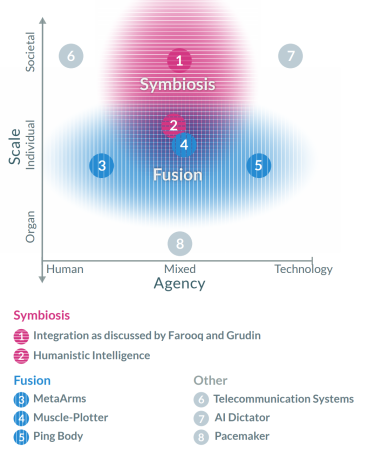
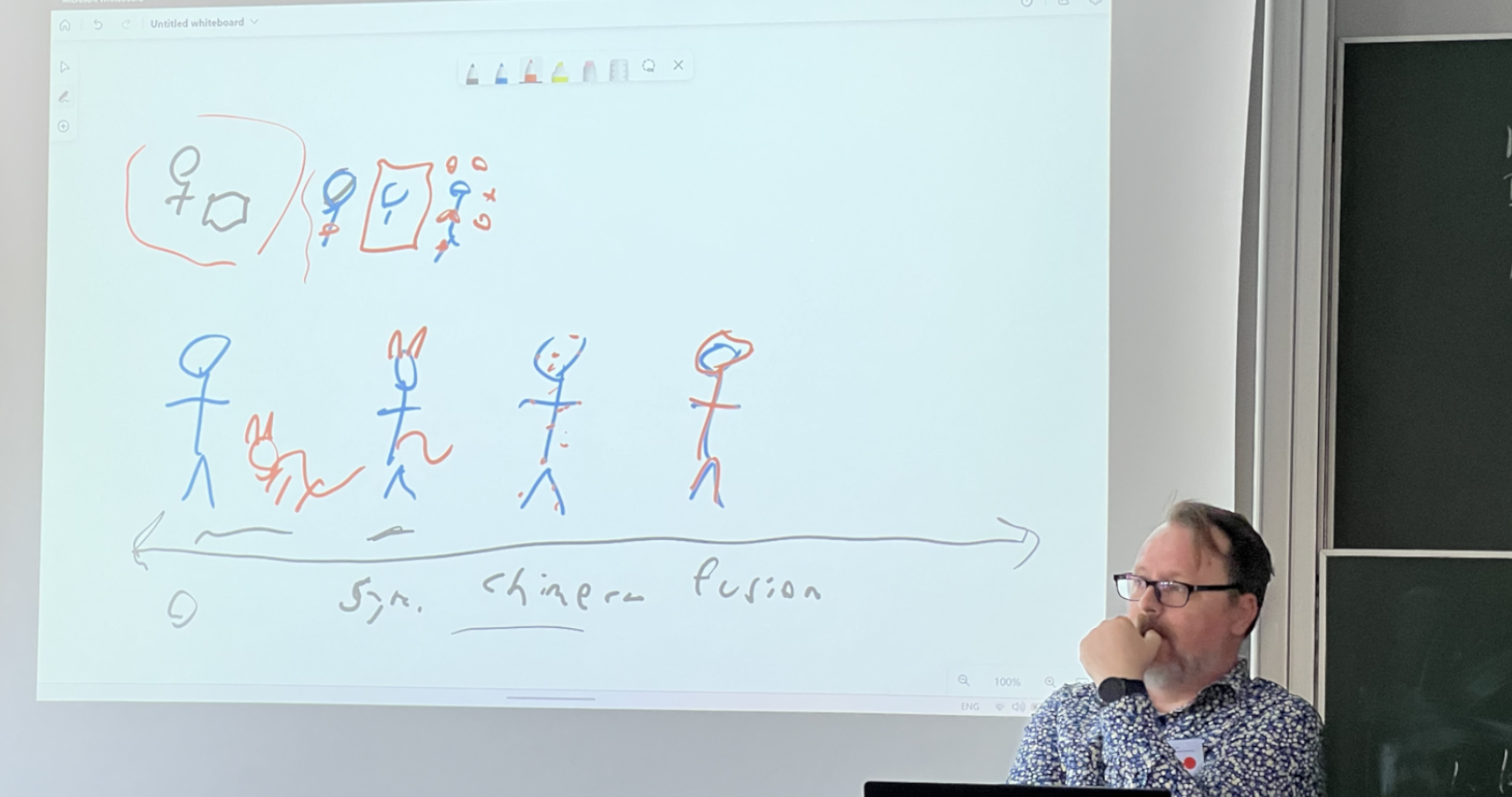
The notion of human-computer integration was further developed at a 2018 Dagstuhl Seminar [26], in which 29 leading experts from industry and academia came together over a five-day seminar to develop and discuss the future of human-computer integration (HInt). The discussions during this seminar ultimately produced a foundational work titled “Next Steps in Human-Computer Integration” [25] which was presented at CHI 2020. The work, articulating a synthesis of contributions made toward human-Computer integration, summarised the contemporary state of the emerging paradigm. The paper defined HInt as “a new paradigm with the key property that computers become closely integrated with the user”, which included examples in which “humans and digital technology work together, either towards a shared goal or towards complementary goals (symbiosis)”; and “integration in which devices extend the experienced human body or in which the human body extends devices (fusion)”. Through this updated rendition, it became clear that this new state of the human-machine relationship was not only marked by the newly emerging capacity for machines to exhibit agency and work in tightly coupled collaborative partnerships with humans [20, 5, 18, 21, 29]; but also by the tendency for emerging technologies to extend human capabilities by bidirectionally sensing and actuating human physiology and act as extensions of the human body [7, 15, 16, 22, 33, 34].
Moving forward, much research has since been made in contribution to furthering our understanding of human-computer integration theory and the design of integration systems, including a definitive book on human-computer integration titled: “Human–Computer Integration: Towards Integrating the Human Body with the Computational Machine” [28]. These contemporary conceptualizations and theoretical contributions to HInt have largely taken on a more “bodily” focus, centering on how machines can integrate with the human body, physiological processes, and experiences [31, 32]. Such theoretical contributions include: the bodily integration framework [24], which describes the user experience of integration systems that both sense and actuate the human body by considering the human’s sense of bodily agency and sense of bodily ownership; experiential integration [6, 7], which seeks to understand how machines can be integrated into an individual’s pre-reflective experience of “self” as opposed two “other”; and the brain-computer integration framework [30], which provides a design space for brain-computer interfaces that bidirectionally sense and actuate the human brain, as well at the user experiences they create. Taken together, these works provide the conceptual tools to understand and design technologies that are physically close to or conform to the body [16, 33, 34, 2], extend the body’s sensory and motor capabilities[15, 22], augment cognitive abilities [4, 14, 10], and provide novel modalities for human expression and play [23, 3, 9, 17, 11, 21], facilitating empowerment and self-actualization.
More recently, contributions to HInt theory are increasingly concerned with the inter-agential dynamics and relationships that arise from systems that are closely coupled with the human body but are able to act with their own agency [20, 11], often sharing agency with, or borrowing agency from their human counterpart. Such theoretical works include: the intertwined integration framework [27], which maps the possible user experiences that arise from a combination of the alignment of the system with the user, and the user’s awareness of the agency of the system; integrated embodiment [18], which explores how human-ai partnerships can be embodied within a single physical body; and the integrated exertion framework [1], which describes the different experiences of human-machine partnerships that may arise in an exertion context. Considering these newer contributions, it becomes increasingly evident that the original conceptualization of symbiosis and fusion as two opposing forms of integration, one social and one bodily, no longer completely describes the new and evolving relationships we are beginning to see emerge between humans and computers, highlighting a significant gap in our understanding of human-machine symbiosis theory and design.
Considering the recent acceleration in technological advances that enable autonomous agents and artificial intelligence to form new and previously unseen relationships with humans, both socially and physiologically, the importance of having a strongly developed and fully articulated definitive theory of human-machine symbiosis and their design becomes extremely pertinent. While the growing presence of human-machine symbiosis in our daily lives can greatly extend human capacity, capability, experience, and culture, recent research has also highlighted that human-computer symbiosis holds the strong potential to develop into parasitic relationships which can be detrimental to humanity [8]. Thus, considering the growing relevance of symbiosis, in contrast to the relatively nascent state of the field in terms of theoretical understanding and design knowledge, the present seminar sought to lead a concerted effort in developing the theory of human-machine symbiosis, articulating its underlying mechanism, and outlining the grand challenges facing the field moving forward. In doing so, the seminar asked: What symbiosis is, the mechanisms through which it operates, and what kinds of symbioses are possible? Then with this knowledge, the seminar aimed to build an understanding of how to guide the design of symbiosis. Finally, through acknowledging the limitations to our current understanding of symbiosis and our abilities in designing symbiotic systems, the seminar articulated a set of grand challenges that we can work toward to move the field forward. The following documents the activities undertaken by the participants of the seminar in an effort to actualize these aims.
References
- [1] Josh Andres, Nathan Semertzidis, Zhuying Li, Yan Wang, and Florian Mueller. Integrated exertion–understanding the design of human–computer integration in an exertion context. ACM Transactions on Computer-Human Interaction, 29(6):1–28, 2023.
- [2] Andrea Bianchi, Steve Hodges, David J Cuartielles, Hyunjoo Oh, Mannu Lambrichts, and Anne Roudaut. Beyond prototyping boards: future paradigms for electronics toolkits. In Extended Abstracts of the 2023 CHI Conference on Human Factors in Computing Systems, pages 1–6, 2023.
- [3] Oğuz ‘Oz’ Buruk, Louise Petersen Matjeka, and Florian Mueller. Towards designing playful bodily extensions: Learning from expert interviews. In Proceedings of the 2023 CHI Conference on Human Factors in Computing Systems, pages 1–20, 2023.
- [4] Yi Fei Cheng, Hang Yin, Yukang Yan, Jan Gugenheimer, and David Lindlbauer. Towards understanding diminished reality. In Proceedings of the 2022 CHI Conference on Human Factors in Computing Systems, pages 1–16, 2022.
- [5] S Chien, Seungyeon Choo, Marc Aurel Schnabel, Walaiporn Nakapan, Mi Jeong Kim, and Stanislav Roudavski. Living systems and micro-utopias: towards continuous designing. In Proceedings of the 21st International Conference of the Association for Computer-Aided Architectural Design Research in Asia CAADRIA 2016, pages 713–722, 2016.
- [6] Valdemar Danry, Pat Pataranutaporn, Adam Haar Horowitz, Paul Strohmeier, Josh Andres, Rakesh Patibanda, Zhuying Li, Takuto Nakamura, Jun Nishida, Pedro Lopes, et al. Do cyborgs dream of electric limbs? experiential factors in human-computer integration design and evaluation. In Extended Abstracts of the 2021 CHI Conference on Human Factors in Computing Systems, pages 1–6, 2021.
- [7] Valdemar Danry, Pat Pataranutaporn, Florian Mueller, Pattie Maes, and Sang-won Leigh. On eliciting a sense of self when integrating with computers. In Augmented Humans 2022, pages 68–81. 2022.
- [8] Rod Dickinson, Nathan Semertzidis, and Florian Mueller. Machine in the middle: Exploring dark patterns of emotional human-computer integration through media art. In CHI Conference on Human Factors in Computing Systems Extended Abstracts, pages 1–7, 2022.
- [9] Ellen Yi-Luen Do. Design for assistive augmentation – mind, might and magic. Assistive augmentation, pages 99–116, 2018.
- [10] Barrett Ens, Maxime Cordeil, Chris North, Tim Dwyer, Lonni Besançon, Arnaud Prouzeau, Jiazhou Liu, Andrew Cunningham, Adam Drogemuller, Kadek Ananta Satriadi, et al. Immersive analytics 2.0: Spatial and embodied sensemaking. In CHI Conference on Human Factors in Computing Systems Extended Abstracts, pages 1–7, 2022.
- [11] Xiao Fang, Nathan Semertzidis, Michaela Scary, Xinyi Wang, Josh Andres, Fabio Zambetta, and Florian Mueller. Telepathic play: Towards playful experiences based on brain-to-brain interfacing. In Extended Abstracts of the 2021 Annual Symposium on Computer-Human Interaction in Play, pages 268–273, 2021.
- [12] Umer Farooq, Jonathan Grudin, Ben Shneiderman, Pattie Maes, and Xiangshi Ren. Human computer integration versus powerful tools. In Proceedings of the 2017 CHI Conference Extended Abstracts on Human Factors in Computing Systems, pages 1277–1282, 2017.
- [13] Umer Farooq and Jonathan T Grudin. Paradigm shift from human computer interaction to integration. In Proceedings of the 2017 CHI Conference Extended Abstracts on Human Factors in Computing Systems, pages 1360–1363, 2017.
- [14] Lukas Gehrke, Pedro Lopes, and Klaus Gramann. Toward human augmentation using neural fingerprints of affordances. In Affordances in Everyday Life: A Multidisciplinary Collection of Essays, pages 173–180. Springer, 2022.
- [15] Masahiko Inami, Daisuke Uriu, Zendai Kashino, Shigeo Yoshida, Hiroto Saito, Azumi Maekawa, and Michiteru Kitazaki. Cyborgs, human augmentation, cybernetics, and jizai body. In Augmented Humans 2022, pages 230–242. 2022.
- [16] Hsin-Liu Cindy Kao. Hybrid body craft: toward culturally and socially inclusive design for on-skin interfaces. IEEE Pervasive Computing, 20(3):41–50, 2021.
- [17] Sang-won Leigh, Abhinandan Jain, and Pattie Maes. Exploring human-machine synergy and interaction on a robotic instrument. In NIME, pages 437–442, 2019.
- [18] Zhuying Li, Tianze Huang, Rakesh Patibanda, and Florian Mueller. Ai in the shell: Towards an understanding of integrated embodiment. In Extended Abstracts of the 2023 CHI Conference on Human Factors in Computing Systems, pages 1–7, 2023.
- [19] Joseph CR Licklider. Man-computer symbiosis. IRE transactions on human factors in electronics, (1):4–11, 1960.
- [20] Dominika Lisy. In-corpo-real robot-dreams: Empathy, skin, and boundaries. In 2021 9th International Conference on Affective Computing and Intelligent Interaction Workshops and Demos (ACIIW), pages 01–05. IEEE, 2021.
- [21] Azumi Maekawa, Hiroto Saito, Daisuke Uriu, Shunichi Kasahara, and Masahiko Inami. Machine-mediated teaming: Mixture of human and machine in physical gaming experience. In Proceedings of the 2022 CHI Conference on Human Factors in Computing Systems, CHI ’22, New York, NY, USA, 2022. Association for Computing Machinery.
- [22] Azumi Maekawa, Hiroto Saito, Daisuke Uriu, Shunichi Kasahara, and Masahiko Inami. Machine-mediated teaming: Mixture of human and machine in physical gaming experience. In Proceedings of the 2022 CHI Conference on Human Factors in Computing Systems, pages 1–11, 2022.
- [23] Florian Mueller, Tuomas Kari, Zhuying Li, Yan Wang, Yash Dhanpal Mehta, Josh Andres, Jonathan Marquez, and Rakesh Patibanda. Towards designing bodily integrated play. In Proceedings of the Fourteenth International Conference on Tangible, Embedded, and Embodied Interaction, pages 207–218, 2020.
- [24] Florian Mueller, Pedro Lopes, Josh Andres, Richard Byrne, Nathan Semertzidis, Zhuying Li, Jarrod Knibbe, Stefan Greuter, et al. Towards understanding the design of bodily integration. International Journal of Human-Computer Studies, 152:102643, 2021.
- [25] Florian Mueller, Pedro Lopes, Paul Strohmeier, Wendy Ju, Caitlyn Seim, Martin Weigel, Suranga Nanayakkara, Marianna Obrist, Zhuying Li, Joseph Delfa, et al. Next steps for human-computer integration. In Proceedings of the 2020 CHI Conference on Human Factors in Computing Systems, pages 1–15, 2020.
- [26] Florian Mueller, Pattie Maes, and Jonathan Grudin. Human-computer integration (dagstuhl seminar 18322). In Dagstuhl Reports, volume 8. Schloss Dagstuhl-Leibniz-Zentrum fuer Informatik, 2019.
- [27] Florian Mueller, Nathan Semertzidis, Josh Andres, Joe Marshall, Steve Benford, Xiang Li, Louise Matjeka, and Yash Mehta. Towards understanding the design of intertwined human-computer integrations. ACM Transactions on Asian and Low-Resource Language Information Processing, 2023.
- [28] Florian Mueller, Nathan Semertzidis, Josh Andres, Martin Weigel, Suranga Nanayakkara, Rakesh Patibanda, Zhuying Li, Paul Strohmeier, Jarrod Knibbe, Stefan Greuter, Marianna Obrist, et al. Human–computer integration: Towards integrating the human body with the computational machine. Foundations and Trends® in Human-Computer Interaction, 16(1):1–64, 2022.
- [29] Pat Pataranutaporn, Valdemar Danry, Joanne Leong, Parinya Punpongsanon, Dan Novy, Pattie Maes, and Misha Sra. Ai-generated characters for supporting personalized learning and well-being. Nature Machine Intelligence, 3(12):1013–1022, 2021.
- [30] Nathan Semertzidis, Fabio Zambetta, and Florian Mueller. Brain-computer integration: A framework for the design of brain-computer interfaces from an integrations perspective. ACM Transactions on Computer-Human Interaction, 2023.
- [31] Nathan Arthur Semertzidis, Zoe Xiao Fang, Pedro Lopes, Kai Kunze, Paul Pangaro, Florian Mueller, and Pattie Maes. What we talk about when we talk about human-computer integration. In CHI Conference on Human Factors in Computing Systems Extended Abstracts, pages 1–4, 2022.
- [32] Nathan Arthur Semertzidis, Michaela Scary, Xiao Fang, Xinyi Wang, Rakesh Patibanda, Josh Andres, Paul Strohmeier, Kai Kunze, Pedro Lopes, Fabio Zambetta, et al. Sighint: Special interest group for human-computer integration. In Extended Abstracts of the 2021 CHI Conference on Human Factors in Computing Systems, pages 1–3, 2021.
- [33] Jürgen Steimle, Marie Muehlhaus, Madalina Luciana Nicolae, Aditya Shekhar Nittala, Narjes Pourjafarian, Adwait Sharma, Marc Teyssier, Marion Koelle, Bruno Fruchard, and Paul Strohmeier. Design and fabrication of body-based interfaces (demo of saarland hci lab). In Extended Abstracts of the 2023 CHI Conference on Human Factors in Computing Systems, pages 1–4, 2023.
- [34] Anusha Withana, Daniel Groeger, and Jürgen Steimle. Tacttoo: A thin and feel-through tattoo for on-skin tactile output. In Proceedings of the 31st Annual ACM Symposium on User Interface Software and Technology, pages 365–378, 2018.
2 Table of Contents
3 Introductions
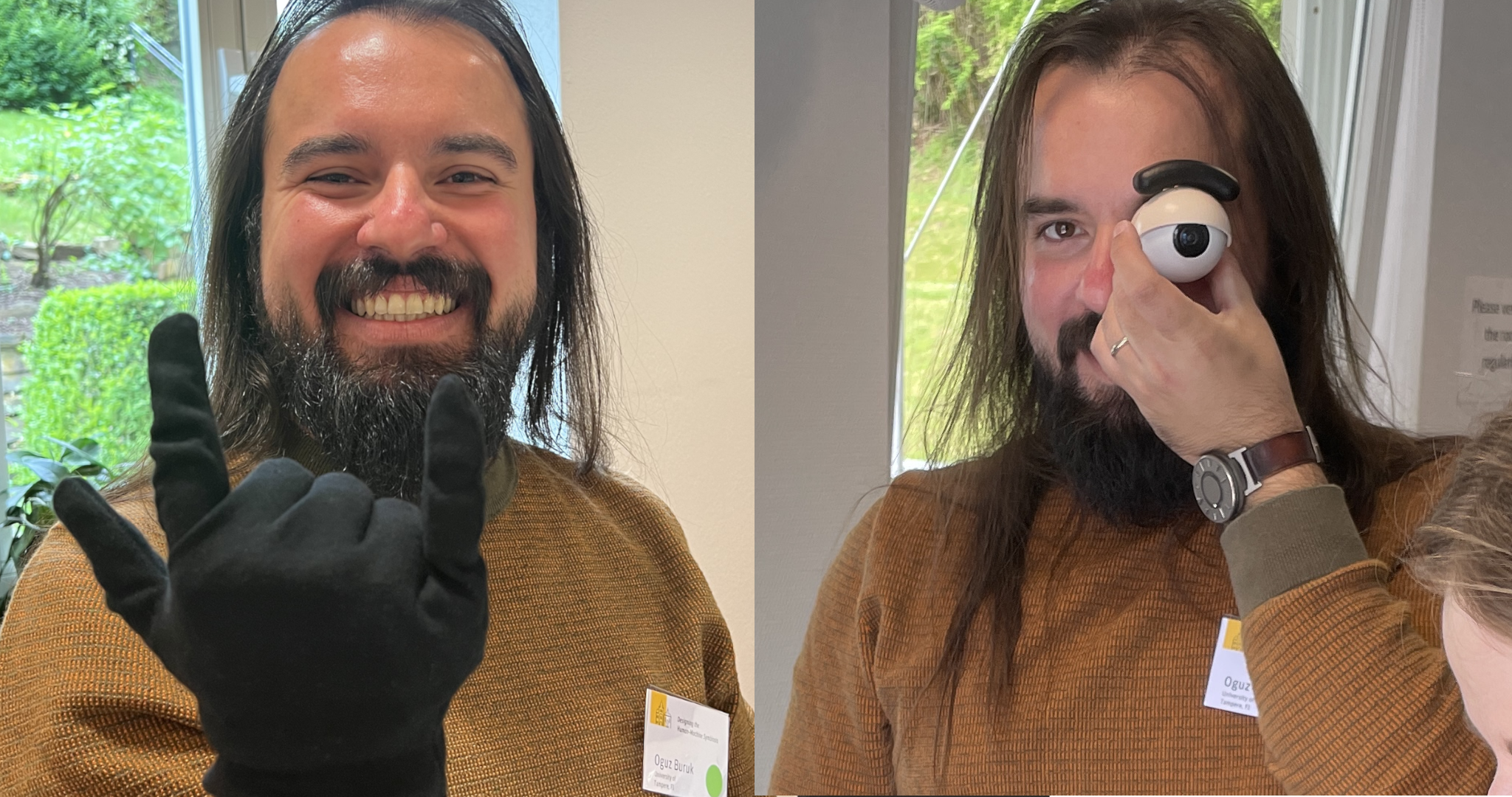
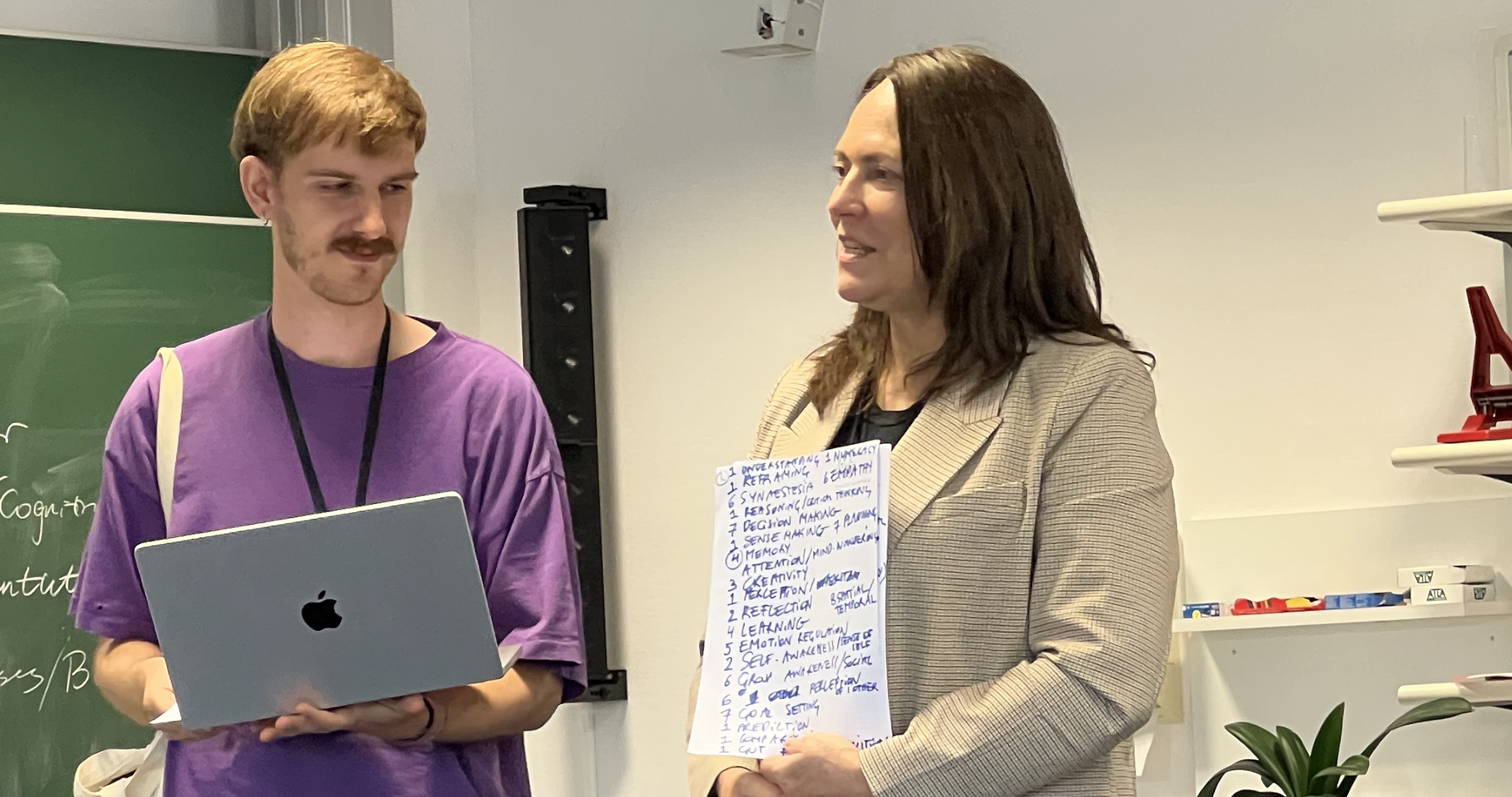
To begin the seminar, an embodied introductory activity was first undertaken in order to facilitate an accelerated familiarisation between seminar participants, while also establishing an atmosphere of playfulness, openness, and enthusiasm for group interaction. This involved the seminar participants standing in a circle and introducing themselves with their name and a bodily gesture, with all other participants needing to repeat the name and gesture. This was completed clockwise around the circle of participants, and for each new participant introduction, the introduction of all previous participants would also be repeated in sequence. This accumulated to 253 introductions for the 22 participants present by the end.
The introductory activity was followed by opening remarks from organizer Florian ‘Floyd’ Mueller, who provided theoretical context for the seminar and set the basis for the discussion of designing the human-machine symbiosis moving forward. At this point, several whiteboards were also established that participants could add to at any point during the town hall sessions. This included a whiteboard for listing the “challenges and opportunities” of designing the human-machine symbiosis, which anyone could append to as challenges and opportunities became evident through presentations and discussion. Similarly, a whiteboard titled “the marketplace” was established for anyone to post ideas for potential collaborative future projects, papers, workshops, or other initiatives with the intention that other participants could express their interest to join said initiative. The marketplace specifically produced several offshoot human-machine symbiosis research initiatives that are now currently being continued after the completion of the seminar, including: the organization of a posthuman theory and design workshop; the organization of a brain-computer interface workshop, and research paper; research projects involving symbiotic systems that utilize biological materials; and the writing of several other Dagstuhl proposals.
Each seminar participant then gave a prepared presentation introducing their research. In order to preserve a spirit of open and spontaneous group ideation, discourse, and collaboration, we strove to avoid a conference-like format of dry, dense lengthy presentations and instead adopted a “PechaKutcha” inspired presentation format; a rapid-fire series of short six-minute, visually oriented (picture and video) presentations. In addition to showcasing their work and its relation to human-machine symbiosis, the content of each presentation also included an articulation of what the presenter expected from the seminar, the grand challenges facing their niche of human-computer symbiosis (which were appended to the challenges whiteboard), and what prior work the group should read and why, with the interest of establishing a common conceptual toolbox which the group can draw from to develop human-machine symbiosis theory and discussion. An abstract of each presentation can be found at the end of the present report.
3.1 Defining human-machine symbiosis
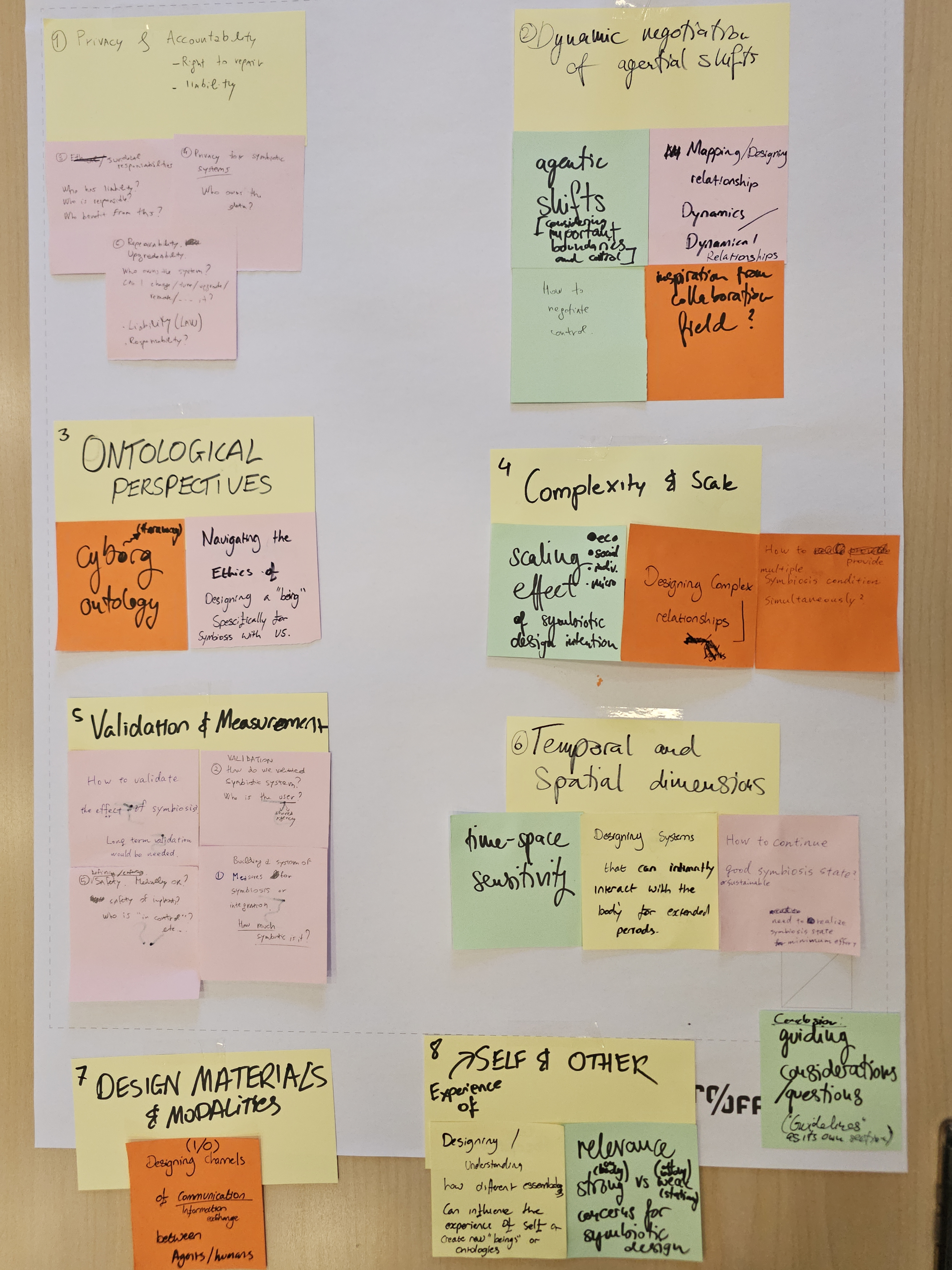
Through the presentations above, a comprehensive list of “challenges” was collated by the time every participant had presented, providing a strong foundation for steering discussion during the remainder of the seminar toward topics that require further elaboration. It has been argued that HCI requires “grand challenges”, namely in that it provides a steering force to drive coordinated action in guiding future research, theory, design, and commercial development [3, 1, 2]. Acknowledging this need, these challenges were further consolidated into a set of concrete “Grand Challenges for Human-Machine Symbiosis”, with the intention their articulation would give guidance to researchers wishing to contribute to the development of the theory by providing specific and actionable gaps in knowledge or capability to which they can contribute through future research. Furthermore, the collation of recommended reading provided by each participant of the seminar now serves as a library curated by experts that may provide entrants into human-machine symbiosis research a foundational understanding of core concepts, theory, and knowledge that may guide their own future investigations, making the field more accessible to potential new contributors.
Following the completion of all participant presentations, a discussion took place in which the participants synthesized the concepts brought to light during the presentations, as well as the opportunities and challenges that were also highlighted. Through this discussion, it became evident that many challenges and opportunities pointed toward there being a significant need to articulate a clearer, more grounded, more comprehensive definition of what human-machine symbiosis is. This sentiment was further reinforced by many participants showing eagerness to draw knowledge from existing biological science explanations of symbiotic relationships, in conjunction with existing theories that deal with concepts like “self” (such as philosophy of mind) and describe “agents”, “agency”, and inter-agent interactions. With this considered, all 22 participants were broken into three breakout groups, with each group tasked with individually providing an articulation of what “human-machine symbiosis” is. Each group approached this in its own unique way, emerging from how its members organized to address the task of defining human-machine symbiosis, which resulted in it being articulated in terms of its dimensions, features, and underlying postulates, which each breakout group presented to the rest of the seminar in its entirety.
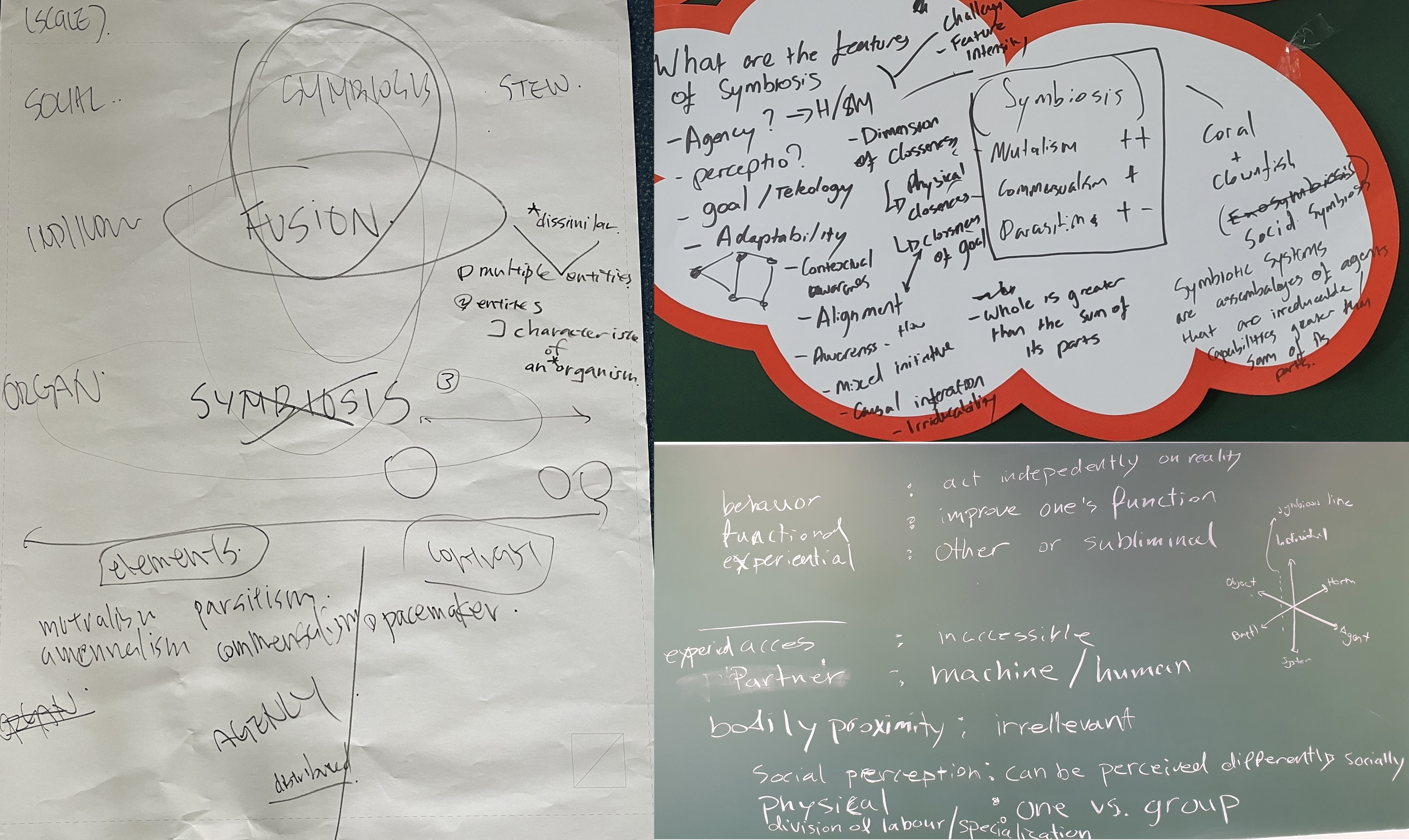
All participants then gathered to return to the main seminar room and a town hall discussion followed in which the participants attempted to integrate the three definitions into a unifying framework of human-machine symbiosis. A summary of the consensus suggested that central to symbiosis is a dynamic relationship between tightly coupled agents who are able to act independently on reality, yet assemble to exhibit emergent properties or capabilities that would otherwise not be possible with the constituent agents in isolation. These relationships would include at least one human and one machine agent but can include many of either. It was also agreed there could be a number of different types of these relationships that describe dynamics between the symbiotic agents. These types were drawn from biology and include: Mutualism (where both agents benefit); commensalism (where one agent benefits and one is unaffected); and parasitism (where one agent benefits at the expense of the other) however some suggested that it may be best to focus first on mutualism before exploring other types of relationships for the sake of simplicity. However, the attempt to define human-machine symbiosis also highlighted some theoretical challenges which were unable to be solved by the conclusion of the discussion, including where the line is between an algorithm and an agent (i.e. when does a program become an agent with agency?), where does symbiosis sit in relation to human-computer integration (i.e. are fusion and symbiosis still two subsets of integration?). Another ongoing question was whether symbiotic systems needed to be close to the human body, with the common concession being that on-body systems were not a requisite, but seen as more likely to form symbiotic relationships, or lend themselves to forming stronger symbiosis. Finally, the major themes and outcomes of this discussion were transcripted and translated into sections and subtitles of a future “Designing the human-machine symbiosis” paper, resulting in an initial skeleton of the manuscript, concluding the first day of the seminar.

3.2 Interactivity session
The second day of the seminar was introduced by Ellen Yi-Luen Do, starting off with an “interactivity session” that involved live interactive demonstrations of systems and technologies relating to human-machine symbiosis. Several of the participants of the seminar had brought with them prototypes or technologies which were set up around the main seminar room. Other participants could then move about the room to try out systems and ask questions, with the intention that this hands-on demonstration of symbiosis-enabling technologies may inspire participants to ideate their own symbiosis systems.
Nathan Semertzidis demonstrated a novel electroencephalography (EEG) headset as well as transcranial electrical stimulation (tES) device, which his projects often employ in combination with a closed-loop to bilaterally sense and stimulate the brain. Participants were given the opportunity to experience a phosphine, a flash of light experienced in the visual field evoked by the stimulation of the optic nerve using the tES device. Nathan argued that these technologies employed in human-machine symbiosis systems could serve to provide a bridge between biological neural networks (the brain) and artificial neural networks (A.I.) opening up many possibilities for mental mergers with A.I. systems.
Nahoro Yamamura distributed to each participant a Lego set which, when assembled, formed a prosthetic extra finder participants could wear as a bodily extension. The finger was indented as an exercise to explore how the body might react to a prosthetic extension, and whether the brain would integrate it into its body schema. Some participants wore the finger for the entire duration of the seminar, reporting that sometimes it would be experienced as part of their body (for example describing that they got confused when they would move the rest of their fingers and the prosthetic would not move).
Zoe Xiao Fang demonstrated a lollipop that, when bitten, could deliver a tune to the brain through its bone-conductive lollipop stick. This demonstration highlighted the potential for food-related technologies to integrate with human physiology.
Andrea Bianchi demonstrated a collaborative microcontroller remote development toolkit. It was explained that the system was originally developed to facilitate the teaching of microcontroller development remotely during COVID-19-related lockdowns, however, it was hypothesized that such systems could also be used to teach and prototype symbiotic systems.
Jürgen Steimle demonstrated a software toolkit that enables the prototyping of bodily extensions and on-body interactions. Similarly, it was considered such toolkits could be used to rapidly prototype symbiotic systems.
Masahiko Inami demonstrated webcams that had been anthropomorphized as eyes, and speakers that had been anthropomorphized as mouths, which could both be fixed to any surface. This demonstration was intended to be a playful exploration of the embodiment and integration of inanimate objects.
Valdemar Danry demonstrated two AI conversational agents using large language models to duplicate existing people, allowing participants to talk with them. One was a duplication of Leonardo da Vinci, and another was a duplication of himself at a younger age. It was discussed that such AI systems could in the future form social symbiosis with their human counterparts, freeing cognitive demand by sharing tasks, appearing as one but distributing the workload.
3.3 Domains of symbiosis
Following on from the previous days defining of symbiosis and inspired by the interactivity session, the participants were then prompted to consider what types of symbiosis systems, areas of symbiosis theory, or application domains they would most like to further develop or contribute to. Participants then wrote their answers down on sticky notes, which were then posted on the main blackboard of the seminar town hall room. All participants then attempted to group these sticky notes in a self-organized manner until higher-level groupings emerged.
These high-level groupings were then reorganized into a set of application domains (applications human-machine symbiosis systems could be designed for). Participants were then instructed to form breakout groups with each group focusing on one application domain. Initially, these were 1) augmented body: sensory-motor 2), augmented cognition, 3) social symbiosis, 4) biological symbiosis, and 5) symbiotic play. However social symbiosis and biological symbiosis were merged into a single group due to having a low number of members in each. Each group was then tasked with ideating hypothetical examples of human-machine symbiosis systems designed for their given application domains. Each of the groups generated a great number of designs, that were then further refined into two to four designs that were explored more deeply. The groups then reconvened in the main seminar room and presented their designs to the rest of the seminar participants, concluding the day’s activities. The following presents a summary of what each group presented.
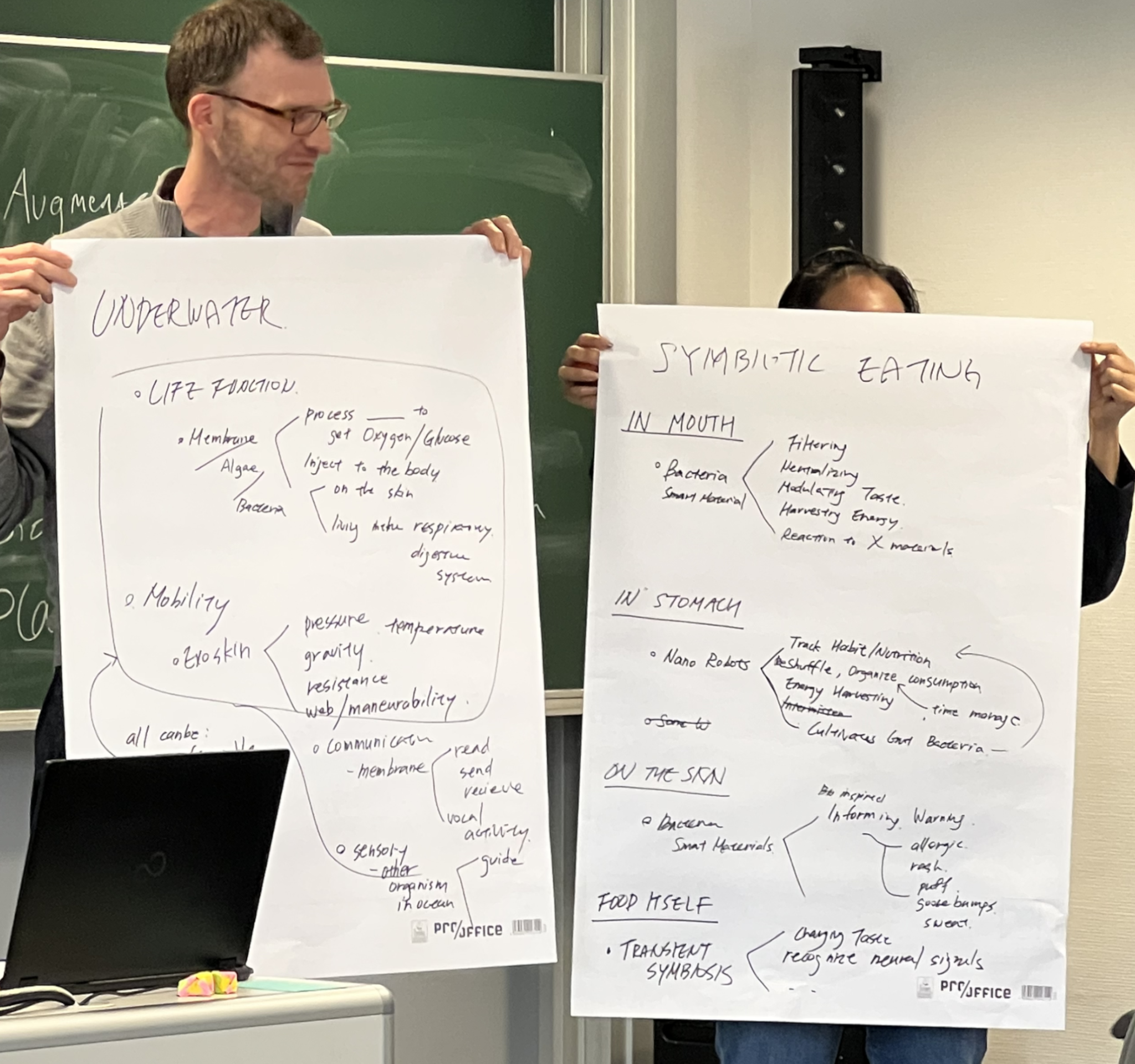
Group 1) “augmented body” ideated several systems that symbiotically augmented the body to enhance its capabilities in a variety of contexts. This included symbiosis for underwater living, which proposed engineering biological symbiotes that support human homeostasis as well as mobility in aquatic environments through technologies such as microbe-filled wearable membrane bioreactors, and “exoskins” which can sense and respond to properties of the water around it. Group 1 also ideated systems for “symbiotic eating” including microbes, smart materials, and nanorobots that can perform functions in the human mouth, stomach, skin, and on the food itself in order to modulate energy and nutrition intake, and alter the experience of eating such as taste.
Group 2) “augmented cognition” proposed several systems that work toward enhancing the capabilities of various domains of human cognition. One example was a system that augments memory processes by monitoring the brain for occurrences of error-related potentials or inability to recall information, reflexively rewinding through a log the system has kept of the day (e.g. through video or auditory recording) to find the information in its correct form. Similarly, the system could also employ predictive algorithms to allow the user to “recall” information from events yet to occur. The group also suggested that systems could capitalize on how affective states can alter memory encoding and recall to improve learning and facilitate desired forgetting.
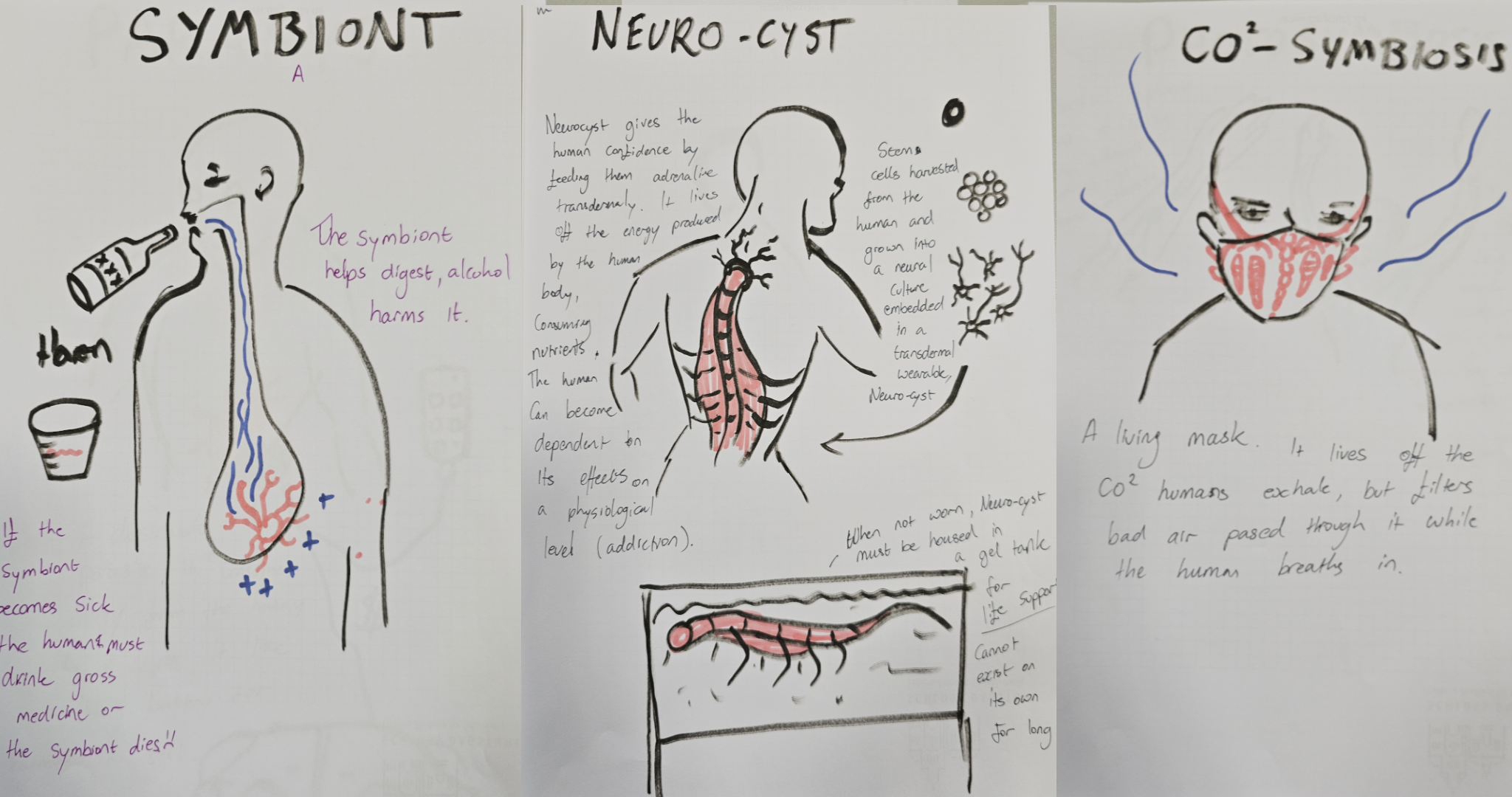
Group 3) “biosocial symbiosis” was a combination of participants interested in investigating the social applications and consequences of symbiosis, and participants interested in symbiotic systems that have biological components. As such, the designs that came out of this group typically involved some kind of biological symbiotic system, whose use brought with it social consequences, both between the symbiont and the wearer, as well as between other members of society. These included: a second spine that gives the wearer courage through the direct injection of adrenaline which it produces but must be kept in a fish tank during non-use to avoid adrenal overdose; an implantable photosynthetic organism that gives the wearer the ability to photosynthesis but must constantly be managed else it will overgrow (and its use is also associated with a specific socioeconomic status); and a subdermal bioreactor that consumes excess nutrients from its wearer who can then sell the energy stored in the bioreactor for income.
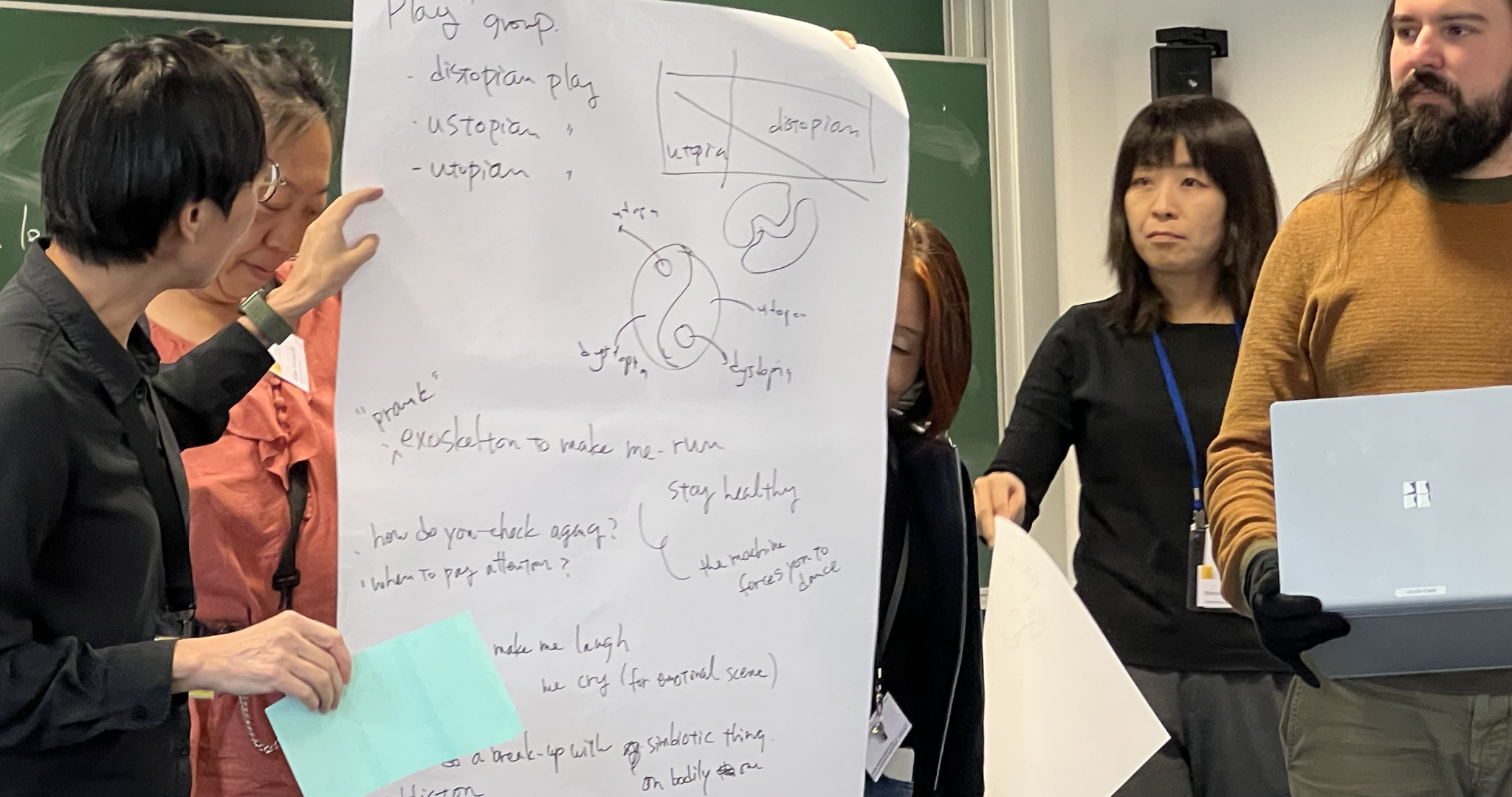
Group 4) “symbiotic play” ideated examples that explored how symbiotic systems could be designed for games or playful experiences. This highlighted that symbiotic games and play can serve as a lens for safely identifying and exploring potential dystopic futures symbiotic systems may one day actualize. Some examples included a “prank” exoskeleton that forces its wearer to run or dance benefiting them through exercise; and swarms of interactive prosthetic “eye entities” that the user can see through, providing them with emergent abilities based on how they configure the eyes.
3.4 Symbiosis special interest groups
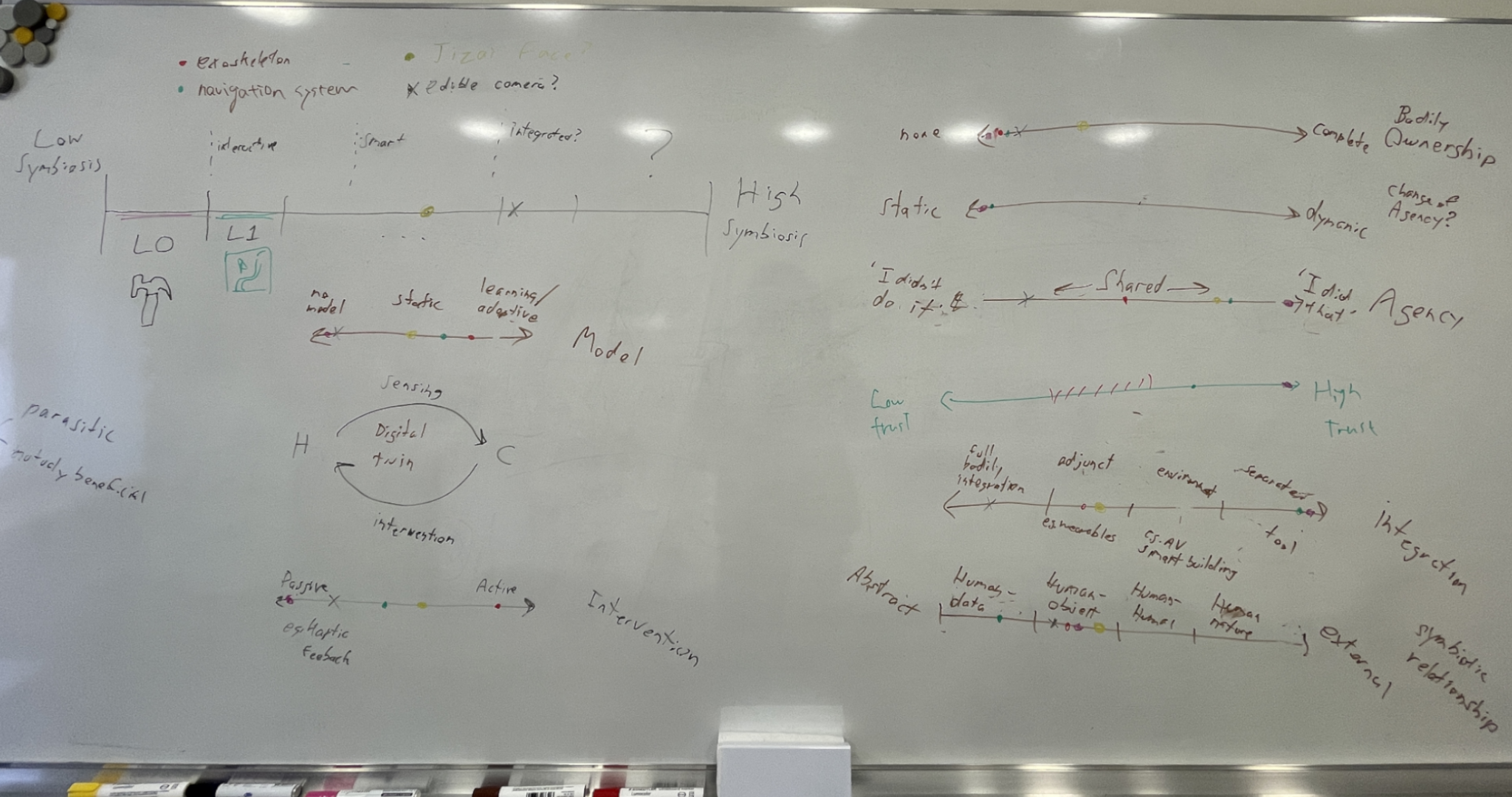
The third day of the seminar was initiated with a town hall discussion that reviewed the progress we had made so far in developing human-machine symbiosis theory and in the identification and articulation of its grand challenges and next steps, while also highlighting what conceptual areas required further development. Considering these points, participants then broke up into groups centered around projects, initiatives, and special interests that had accumulated on the “marketplace” whiteboard throughout the duration of the seminar. What each group did during this breakout session depended on the specific topic it was aligned with, with each group autonomously working toward its self-organized agenda. The topics covered by each group included: further developing human-machine symbiosis theory, with a specific focus on the different “levels” of symbiosis; further developing human-machine symbiosis theory, with a specific focus on the temporal, spatial, and structural properties and outcomes of symbiotic relationships; exploration of how human-machine symbiosis could facilitate deeper connections with nature, with a focus on writing a Dagstuhl seminar proposal around the topic; exploring the idea of human-machine symbiosis using biological materials, with a focus on ideating possible future research projects; and an exploration of the concept of “body hijacking” as an example of human-machine symbiosis, specifically referring to technological systems that allow one agent to take over the body of another. Each breakout group reconvened in the main seminar room and presented what they produced to the rest of the participants.
3.5 Hike
The seminar participants then embarked on a hike in Saarschleife along Mettlach, which lasted for most of the remainder of the day. The hike was intended to revive, refresh and inspire participants by breaking from the constant intensive discussion and conceptualization of the days prior, while also giving them an opportunity to exchange thoughts, ideas, and career advice, and to forge new research relationships and collaborations. Furthermore, during the hike participants saw that it was a good opportunity to keep an eye out for naturally occurring examples of symbiosis, which lead to participants drawing inspiration from examples that were encountered such as lichens, pollinator symbiosis, symbiosis between ants and plants, and the parasitism of vines growing on trees. The hike ended with drinks and dinner at a local restaurant, concluding the day.
3.6 Human-AI Symbiosis workshop
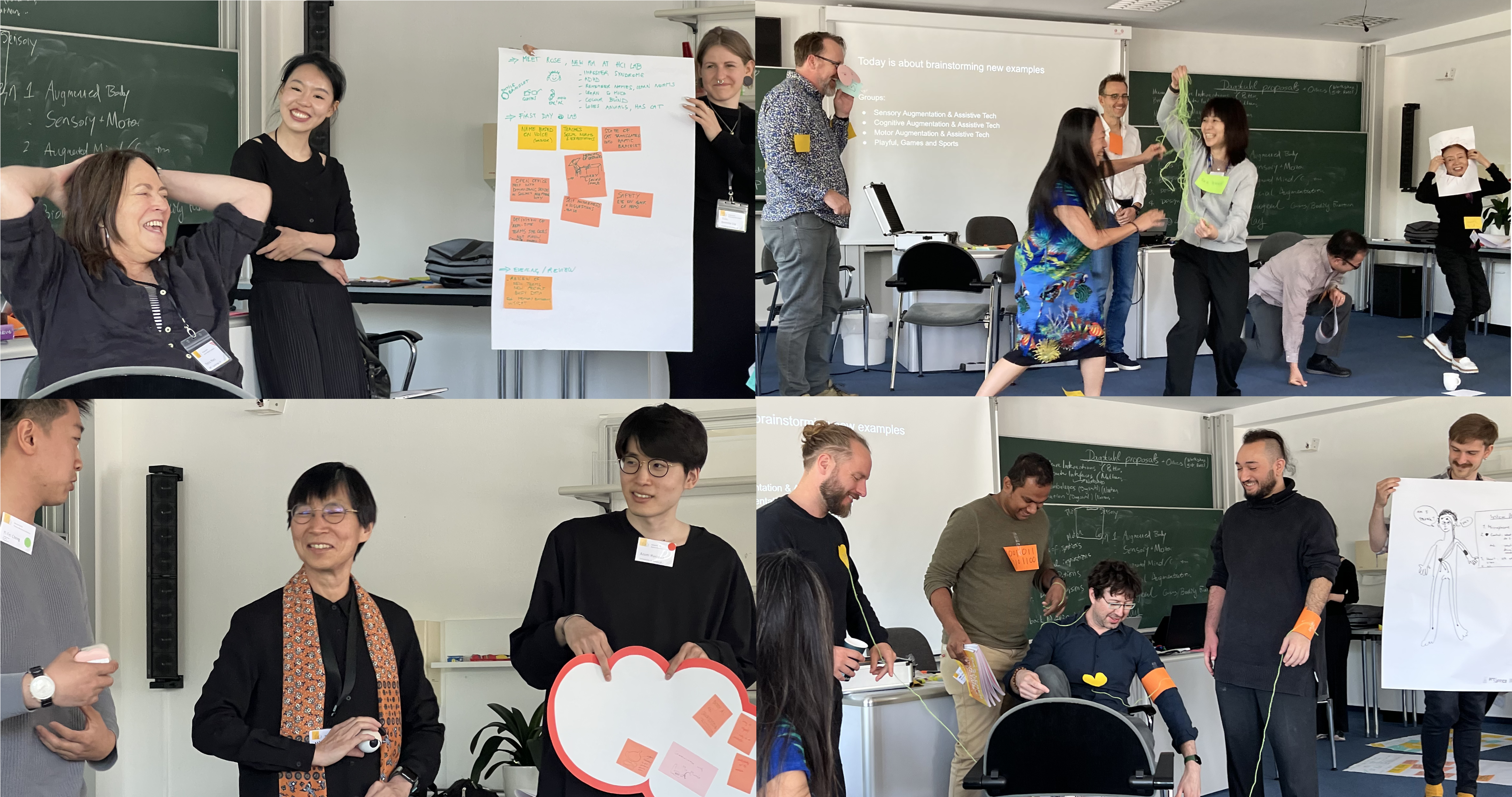
The next day began with the initiation of a workshop led by Valdemar Danry and Pattie Maes, focusing on how recent advances in generative AI can be applied toward the development of AI-centered human-machine symbiosis relations (human-AI symbiosis). The workshop began with a presentation showcase demonstrating work the MIT Media lab’s fluid interfaces group has been doing to augment human cognition through offloading cognitive resources from the human to often wearable AI symbiotic systems, enabling the experience of enhanced memory, attention, and sensory abilities. Similarly, research conducted by others using generative AI was also showcased in order to demonstrate the widespread potential such technology may offer through symbiosis with a human partner (e.g. such as enhanced creative ability). Participants were then introduced to resources they could utilise to begin work on such systems themselves.
Following the presentation, participants then formed breakout groups around different applications that would benefit from human-AI symbiosis. The groups included: sensory augmentation and assistive tech; cognitive augmentation and assistive tech; motor augmentation and assistive tech; and play, games and sports. Each group ideated novel designs that exemplified how generative AI could be employed toward the ends of the specific application domain they were assigned with. Most groups generated a large number of designs, which were then refined to a single design that would be demonstrated to the rest of the participants after reconvening in the main seminar room. Most groups chose to present their designs and ideas in the form of a roleplay, usually with different participants acting out the role of the human user, the AI symbiont, and various components of the system.
3.7 Collating and writing
A town hall discussion was then held focused on the writing of the “Designing the Human-Machine Symbiosis” manuscript. Participants further refined the outlining sections of the manuscript and identified other areas requiring further development the group could contribute toward. Based on these sections, breakout groups formed around the topics: defining human-machine symbiosis; methods and measures to study human-machine symbiosis; topologies of human-machine symbiosis; and the grand challenges facing human-machine symbiosis. Each of these groups contributed to the writing of the main manuscript by focusing on their aligned section. In addition, another breakout group was formed to draft a new Dagstuhl proposal for Human-Nature Interaction. Groups continued writing their sections until the completion of the working day.
3.8 Conclusion
The final day of the seminar began with closing remarks from the organizers. A final town hall discussion was held in which participants reiterated what we have established so far in building a theory of human-machine symbiosis and articulating a set of challenges that future research could address to make further contributions to the field. We also highlighted where there might be gaps in the concept, and what next steps could be taken to further crystalize the concept. It was also decided a slack group be formed to maintain contact between participants and facilitate ongoing discussion in the human-machine symbiosis research community. Following these closing remarks, participants spent the remainder of their time at Dagstuhl contributing to the “Designing the human-machine symbiosis” manuscript. As of writing this report, the manuscript is still currently in development.
References
- [1] Jason Alexander, Anne Roudaut, Jürgen Steimle, Kasper Hornbæk, Miguel Bruns Alonso, Sean Follmer, and Timothy Merritt. Grand challenges in shape-changing interface research. In Proceedings of the 2018 CHI conference on human factors in computing systems, pages 1–14, 2018.
- [2] Barrett Ens, Benjamin Bach, Maxime Cordeil, Ulrich Engelke, Marcos Serrano, Wesley Willett, Arnaud Prouzeau, Christoph Anthes, Wolfgang Büschel, Cody Dunne, et al. Grand challenges in immersive analytics. In Proceedings of the 2021 CHI Conference on Human Factors in Computing Systems, pages 1–17, 2021.
- [3] Juliet Norton, Ankita Raturi, Bonnie Nardi, Sebastian Prost, Samantha McDonald, Daniel Pargman, Oliver Bates, Maria Normark, Bill Tomlinson, Nico Herbig, et al. A grand challenge for hci: Food+ sustainability. interactions, 24(6):50–55, 2017.
4 Overview of Talks
4.1 If all you have is a hammer
Andrea Bianchi (Korea Advanced Institute of Science and Technology – Daejeon, KR,
andrea@kaist.ac.kr)
License: Creative Commons BY 4.0 International license © Andrea Bianchi
Since the dawn of mankind, the history of the human race is reflected in the history of their tools and their usage. Many of these tools provide augmentation to our physical capabilities: power tools increase the body’s strength, bikes increase locomotion efficiency, and glasses and microscopes increase vision and the human ability to explore the world. However, more interestingly, tools also shape the way we think. It is known that “if all you have is a hammer, everything looks like a nail” (Maslow’s hammer), and to some extent, this is true for any type of tool, as they unconsciously reshape our perception of reality, our consciousness, and our understanding of how to interact with the world surrounding. In this short presentation, I show examples of digitally augmented physical tools that shape our perception of reality and give us new perspectives on how to design for supporting prototyping as an exploration activity, and virtual-physical interactions.
4.2 Symbiosis over time with physical computing
Anusha Withana (University of Sydney, AU, anusha.withana@sydney.edu.au)
License: Creative Commons BY 4.0 International license © Anusha Withana
In biology, symbiosis sustains over long durations of time. With AI and reinforced learning, now we can see how software systems can co-evolve, somewhat similar to what Licklider envisioned in his visionary paper. However, how physical or tangible interfaces can co-evolve with humans over long periods is underexplored. I believe that computational and personal fabrication has a lot to offer in this context. Considering the slow development of hardware, we may need symbiotic software systems that model human behavior and can anticipate or predict future needs. These predictive or anticipatory symbiotic models will help us to create a seamless symbiotic adaptation of physical interfaces such as wearable devices, implantables, and other physical devices. Furthermore, the emerging domain of bio-fabrication could add a lot of value in creating co-evolving systems. In our work, we explore these directions as mechanisms to create co-evolving symbiotic physical interfaces.
4.3 Design of dynamic human-machine coupling system
Azumi Maekawa (The University of Tokyo, JP, azumi@star.rcast.u-tokyo.ac.jp)
License: Creative Commons BY 4.0 International license © Azumi Maekawa
We humans have had a desire to expand our own abilities through technology since ancient times. With the development of technology, autonomous machines that can achieve physical performance and information processing beyond human abilities have become possible. These autonomous machines have the potential to extend our abilities and fundamentally change our lives. However, it is not yet clear how machines can engage with the dynamic and high-intensity movements of humans, and how humans and machines can function as a unified entity. Due to differences in the characteristics and nature of motion capabilities between humans and machines, simply coupling the two is currently challenging. In this talk, I will introduce prototypes that explore how humans and machines can integrate and harmonize in dynamic motion. I will also briefly present the insights and challenges obtained from this exploration.
4.4 Making sense of information anywhere
Barrett Ens (Monash University – Melbourne, AU, barrett.ens@monash.edu)
License: Creative Commons BY 4.0 International license © Barrett Ens
The miniaturisation of sensing, networking, and processing technologies has increasingly made information readily available. Taking this further, emerging Augmented Reality (AR) technologies and near-future holographic displays (such as light field and laser plasma displays) will soon allow rich visual information to be displayed anywhere, beyond the confines of small 2D screens. On one hand, these advances will allow relevant information to be more directly integrated with the activities, places or objects to which it is related. However, they will also bring significant challenges in designing useful and productive interfaces for visualising information and interacting with it. Given these coming developments, how can we leverage spatial interaction and situated information spaces to improve the way we perceive, interact with, and understand information? In this talk I will briefly introduce the motivations for my work on spatial interface design for data exploration and sensemaking.
4.5 Hybrid skins for symbiosis
Cindy Hsin-Liu Kao (Cornell University – Ithaca, USA, cindykao@cornell.edu)
License: Creative Commons BY 4.0 International license © Cindy Hsin-Liu Kao
Sensor device miniaturization and novel material breakthroughs have enabled hybrid skins as an emerging wearable form. These conformable skin interfaces are hybrid in their integration of technological function with existing cultural body art form factors and often involve social, design, and engineering challenges in their realization. These hybrid skins create a symbiosis with the human body through their direct skin contact, serving as one of the most intimate physical interactive interfaces in human-computer interaction. While engineering these hybrid skins has received increased interest in the past decade, open questions remain regarding the symbiosis relationship between these hybrid skins and the human wearer. Specifically, how do we design the agency and control of our interactions for, with, and by these hybrid skins? As hybrid skins evolve beyond the skin layer and even onto our bodily organs and cellular surfaces, what does it mean to be human in the age of symbiosis?
4.6 Dermal layers in between the human self and the robot other
Dominika Lisy (Linköping University, Sweden, dominika.lisy@liu.se)
License: Creative Commons BY 4.0 International license © Dominika Lisy
My interest lies in exploring material boundaries to understand conceptual relations of dualisms and how they intra-actively co-constitute each other (see Barad 1998, 2003, 2007, 2014). In my work with the skin as a feminist figuration, I am exploring different dermal characteristics such as processes of keratinisation, layeredness, and permeability, which allow me to reconfigure dualistic relations as non-oppositional. Being and knowing through the skin makes apparent how boundaries harden/keratinise or dissolve to determine the potentiality of affective mingling with other bodies (see Serres 1985/2008) – also, other “bodies of knowledge”. Their material-discursive touching might provide an ethical space for reconfiguring human-robot-relationalities. In my work I argue that the process of asymmetrical agential cutting (see Suchman 2006) is an embodied ethical practice, and that the figuration of the skin makes apparent how different ways of knowing are layered.
4.7 Designing the human-machine symbiosis? fun with creative technology and design
Ellen Yi-Luen Do (University of Colorado – Boulder, USA, ellen.do@colorado.edu)
License: Creative Commons BY 4.0 International license © Ellen Yi-Luen Do
A way to Design the Human-Machine Symbiosis is through Fun with Creative Technology and Design. To facilitate cross-disciplinary research we need to provide the environments for creativity, a lab for making things [2]. We build physical and computational artifacts that are “objects” to think with, and this way of working helps us develop methods and tools to make better things. I argued earlier that the Design for Assistive Augmentation should take 3M’s into consideration: Mind, Might, and Magic [3], to have technology wonderfully blended in everyday life activities. Meanwhile, isn’t it time we discuss the art and science of the Human-Machine Symbiosis, and to investigate the engineering and design of such? We could be reflecting (art), understanding, and explaining (science), solving problems (engineering), and inventing and making (design). Let’s remember that the words design and program are remarkably close in their Greek and Latin roots. De (meaning out) and sign (meaning mark) and pro (meaning forward or out) and gram (meaning writing) both mean to mark out or make an explicit representation. Finally, let me quote Paul Graham here: What hackers and painters have in common is that they’re both makers. Along with composers, architects, and writers, what hackers and painters are trying to do is make good things [1].
References
- [1] Paul Graham. Hackers & painters: big ideas from the computer age. “ O’Reilly Media, Inc.”, 2004.
- [2] Ellen Yi-Luen Do and Mark D Gross. Environments for creativity: a lab for making things. In Proceedings of the 6th ACM SIGCHI conference on Creativity & cognition, pages 27–36, 2007.
- [3] Ellen Yi-Luen Do. Design for assistive augmentation – mind, might and magic. Assistive augmentation, pages 99–116, 2018.
4.8 Symbiosis is bodily
Florian ‘Floyd’ Mueller (Monash University – Melbourne, AU, floyd@exertiongameslab.org)
License: Creative Commons BY 4.0 International license © Florian ‘Floyd’ Mueller
Symbiosis is concerned with the intertwinedness of the human body and interactive technology. We demonstrate this through a series of research design works around symbiotic cycling experiences, symbiotic entertainment experiences, and symbiotic arts experiences. The results of these works suggest interesting ways forward for symbiosis research, in particular how the design of symbiosis can highlight experiential aspects, facilitating playful experiences. Ultimately, with our work, we want to enhance our knowledge around the design of symbiosis experiences to help people understand who they are, who they want to become, and how to get there.
4.9 Skin as an interface for human-machine symbiosis
Jürgen Steimle (Saarland University – Saarbrücken, DE, steimle@cs.uni-saarland.de)
License: Creative Commons BY 4.0 International license © Jürgen Steimle
Skin is the largest organ in the human body and the primary interface between the body and its environment. It is through skin contact that we interact with objects; it is through skin that we perceive multi-modal haptic cues; and it is through our skin that we communicate through touch and visual appearance. I argue that skin is a promising platform for human-machine symbiosis, as devices can be deployed in intimate proximity to the human body. I will present recent results from my group’s research on ultra-thin, skin-conformal devices that can be ergonomically worn on the skin for physiological sensing, touch interaction and haptic output. Furthermore, my talk will emphasise the importance of computational models and tools for designing wearable devices that are tailored to human anatomical properties, wearability and desired applications.
4.10 Toward identifying features that make human-machine relationships symbiotic
Kumiyo Nakakoji (Future University – Hakodate, JP, kumiyo@fun.ac.jp)
License: Creative Commons BY 4.0 International license © Kumiyo Nakakoji
By reflecting on six different types of systems and projects that we have worked on over the years, I would like to explore what would be a common framework for the human-machine symbiosis, where individuals and computational environments “evolve” together through their interactions. The “evolution” takes different forms in different contexts. The six types of symbiosis in our versions include: (1) human-computer cooperative problem solving systems, (2) knowledge interaction design for amplifying representational talkback, (3) an online knowledge community where artifacts, stakeholders, the community, and the roles of participants play in the community would evolve in parallel, (4) data experience and engagement platforms for interactive data visualization systems to help users in sense-making and story composition, (5) pseudo-haptics by touch-centric interaction embodiment, where a user perceives what physically does not exist through pseudo-haptics, and finally (6) MR (mixed-reality) world engagement to explore how an individual constructs a congruent image of the “reality” while interacting with a mixed reality environment where physical objects and virtual objects interact with each other.
4.11 Agency-preserving action augmentation using brain-computer interfaces
Lukas Gehrke (Technische Universität Berlin, DE, info@lukasgehrke.com)
License: Creative Commons BY 4.0 International license © Lukas Gehrke
Advances in hardware that augment users’ motions have reignited dreams of overcoming human limitations, recovering lost abilities as well as simplifying learning new skills. Yet, augmented users report dissociative experiences during or following augmented action. They do not experience agency. To drive adoption of human action augmentation, one of the grand challenges then is to design for agency experience, so users feel as though they are in the “driving seat” once again. One way to preserve users’ sense of agency is by keeping the physical impact on their body in line with their intention to move. Using brain-computer interfaces, our work sets out to preserve the experience of agency by establishing a fast communication channel between the augmentation hardware and users’ brain signals reflecting their intent to act.
4.12 JIZAI body and symbiosis
Masahiko Inami (University of Tokyo, JP, drinami@star.rcast.u-tokyo.ac.jp)
License: Creative Commons BY 4.0 International license © Masahiko Inami
The harmony of humans and computers is critical, hinging on three crucial aspects. Firstly, cognitive transparency is required, meaning that individuals should be able to manipulate the entire system seamlessly without cognitive barriers, akin to the control one has over their own body. Secondly, we introduce the concept of authority delegation. As Don Norman metaphorically referred to in the context of ”horse reins”, we should be capable of controlling it as an extension of ourselves when we pull the reins, and seamlessly delegate authority to the computer system when we loosen them. We refer to this as JIZAI-ness. Lastly, the principle of co-emergence comes into play, where a relationship similar to a jazz session is established – the computer system inspires humans and humans inspire the computer system, in turn fostering a more innovative environment. This is integral to the symbiosis of humans and computers.
4.13 Speculation on a world with social digital cyborgs
Nahoko Yamamura (Univeristy of Tokyo, JP, yamamura@star.rcast.u-tokyo.ac.jp)
License: Creative Commons BY 4.0 International license © Nahoko Yamamura
Half a century since the concept of a cyborg was introduced, digital cyborgs, enabled by the spread of wearable robotics, are the focus of much research in recent times. We introduce JIZAI ARMS, a supernumerary robotic limb system consisting of a wearable base unit with six terminals and detachable robotic arms. The system was designed to enable social interaction between multiple wearers, such as an exchange of arm(s), and explore possible interactions between digital cyborgs in a cyborg society. Human augmentation researchers, product designers, system architects and manufacturers have collaborated in an interdisciplinary approach to create a technically complex system while considering the aesthetics of a digital cyborg. As a next step, we have begun to explore the bodily expressions created by social digital cyborgs through dance performance.
4.14 Brain-computer symbiosis
Nathan Semertzidis (Monash University – Melbourne, AU, nathan@exertiongameslab.org)
License: Creative Commons BY 4.0 International license © Nathan Semertzidis
Nathan Semertzidis is a researcher at the Exertion Games Lab, part of the Department of Human-Centred Computing at Monash University, Australia. Diagnosed with genetic hearing loss, Nathan has depended on hearing aids for most of his life, which from a young age inspired his interest in how technology can be experienced as an extension of the human body. His research focuses on investigating the design of brain-computer integration systems, technologies that both sense and actuate brains to facilitate the artificial extension of the nervous system. Nathan’s research involves the development, deployment and evaluation of novel brain-computer integration systems through empirical studies, art installations, and game development. Through this Dagstuhl seminar, Nathan draws from his research experience, as well as his own personal relationship with “symbiosis” gained from cultivating corals and ant colonies at home, to ask: “what is human-machine symbiosis and how does it inform brain-computer integration?”.
4.15 Tools, medium, mediator, partner, and beyond…
Sheng-Fen ‘Nik’ Chien (National Cheng Kung University – Tainan, TW,
schien@mail.ncku.edu.tw)
License: Creative Commons BY 4.0 International license © Sheng-Fen ‘Nik’ Chien
New technologies are often introduced as tools to support works, or complement disabilities. Tools can become extensions of us: those we act with, as well as those we think with, i.e. mediums. Artists are often pioneers to demonstrate radical uses of new technologies: those as mediators of audiences and artworks, as well as those as partners in their art-creation process. These radical uses provide foresight, which in turn initiates reflections on the impacts of new technologies, and brings insights of new social development. Recent advances in computing technologies, in particular neural network based machine learning, warrant a revisit of “Man-Computer Symbiosis” envisioned by Licklider in 1960. For the Dagstuhl Seminar, I plan to take the stance of creative reflective practitioners (artists) to explore definitions and implications of human-computer symbiosis.
4.16 Understanding games and play in a posthuman era
Oǧuz ‘Oz’ Buruk (Tampere University, FI, oguz.buruk@tuni.fi)
License: Creative Commons BY 4.0 International license © Oǧuz ‘Oz’ Buruk
With the rapid advances in technology, artificial intelligence, robotic companions, bodily integrated technologies, brain-machine interfaces, and space habituation technologies are now here or on the horizon. When integrated fully at the societal level, these technologies will profoundly impact how we live and experience the world around us. Can we try to understand these futures through an antisolutionist approach by using games and play as a central lens? What will games and play be like in a posthuman age? What can designing games and play of a posthuman era tell us about future societies? Answering these questions and examining games and play in posthuman technofutures by utilizing antisolutionist design methods can reveal much about the experiences that await us in the future. In other words, through speculative and critical design methods such as design fiction, fictional probes, pastiche scenarios, creating fictional narratives, worlds and prototypes demonstrating how games and play will be like in posthuman futures will help us understand the experiential texture of symbiotic living with computers.
4.17 How will people live symbiotically with AI?
Pattie Maes (Massachusetts Institute of Technology – Cambridge, USA, pattie@media.mit.edu)
License: Creative Commons BY 4.0 International license © Pattie Maes
The advent of AI forces us to reimagine human machine symbiosis at the Cognitive level. Symbiotic systems to date have often targeted bodily symbiosis, eg of senses and motor systems, but we are now facing a historic, unprecedented opportunity to design the symbiosis of the computer and human minds. How might AI systems augment us rather than replace us? What knowledge and skills should humans still learn to internalize, even though AI systems could easily do the job for them? How can AI systems be designed in a human centric way, with the goal of supporting people in becoming the person they’d like to be? Our research group at the MIT Media Lab has for a while now been focused on these questions, building symbiotic systems for reasoning, learning, memory, and more, but we have only scratched the surface of this important challenge, which I believe may well be one of the hardest challenges of this era.
4.18 Machine poetics
Sang-won Leigh (Samsung Design Innovation Center – San Francisco, USA Georgia Tech – Atlanta, USA, sang.leigh@design.gatech.edu)
License: Creative Commons BY 4.0 International license © Sang-won Leigh
Throughout history we have augmented our physical abilities with machines. Concepts for flying machines and today’s exoskeletons were recorded as early as the 13th century. Today, as technology permeates every aspect of our lives, it is easy to imagine a much closer integration of machines into the tasks we carry out, or even our own existence. There would be extreme synergies between machine tools and humans, with technology essentially becoming a natural extension of our bodies. This, what I would call a symbiosis, requires a close examination given how we are already incredibly influenced by technological systems surrounding us, and how deep of a physical, cognitive or existential influence it could make to ourselves. Instead of rehashing existing lifestyles and system concepts into a word symbiosis, the exploration may need to be rooted in a critical, experiential investigation both looking at psychosomatic experience and alternative realities of human-machine symbiosis.
4.19 Human-Machine symbiosis via a mixed reality
Yi Fei Cheng (Carnegie Mellon University – Pittsburgh, USA, yifeic2@andrew.cmu.edu)
License: Creative Commons BY 4.0 International license © Yi Fei Cheng
Mixed reality (MR) technologies promise to transform how we interact with digital information. With its capabilities to directly integrate virtuality into physical reality and blur the digital-physical divide, it serves as a promising platform to enable humans and computers to enter a symbiosis. However, while MR may enrich our lived experiences with playful integrations of virtuality or beneficially provide just-in-time digital information to supplement decision making and communication, it also has the potential to detrimentally distract and overwhelm. Enabling a seamless integration of virtuality is therefore just the first step in enabling symbiosis. What is equally critical is to ensure that we can achieve a careful balance between virtual and physical reality. I believe significant work lies ahead in both exploring new ways for more seamless integrations of virtuality and reality and designing technologies that always retain a beneficial balance between the two.
4.20 Human-machine symbiosis
Zhuying Li (Southeast University – Nanjing, CN, zhuying9405@gmail.com)
License: Creative Commons BY 4.0 International license © Zhuying Li
The rapid development of sensing and actuating technologies has unlocked unprecedented opportunities to blur and extend the boundaries of the human body through the integration of such technologies. In my talk, I will show my works of ingestible play where players swallow an ingestible sensor and play with their interior body data collected by the sensor. Such a play genre allows people to experience having a foreign technology inside their physical body and engaged with their bodily information they could not have known before, which might increase their bodily awareness and understanding. Furthermore, the recent advancements in AI technologies offer us the prospect of forming a sensory or cognitive symbiotic relationship with machines. For example, AI-powered mobile devices can augment our sensory channel by continuously gathering information from our bodies and surrounding environments, providing feedback that we may otherwise overlook. In this talk, I will introduce an AI-powered wearable device that can identify birds based on their songs, providing users with haptic feedback to enhance their environmental awareness and engage them with the natural environment. Moreover, I will demonstrate how AI can augment our cognitive processes, such as decision-making and reasoning. In support of this, I will share our latest work – an arm-worn exoskeleton designed to make certain decisions for the user, effectively assuming control over the user’s arm to perform specific actions.
5 Participants
-
Andrea Bianchi – KAIST – Daejeon, KR
-
Oguz Buruk – University of Tampere, FI
-
Yi Fei Cheng – Carnegie Mellon University – Pittsburgh, US
-
Sheng-Fen Chien – National Cheng Kung University – Tainan, TW
-
Valdemar Danry – MIT – Cambridge, US
-
Ellen Yi-Luen Do – University of Colorado – Boulder, US
-
Barrett Ens – Monash University – Clayton, AU
-
Zoe Xiao Fang – Zhejiang University – Hangzhou, CN
-
Lukas Gehrke – TU Berlin, DE
-
Masahiko Inami – University of Tokyo, JP
-
Cindy Hsin-Liu Kao – Cornell University – Ithaca, US
-
Sang Leigh – Samsung Research America – San Francisco, US & Georgia Institute of Technology – Atlanta, US
-
Zhuying Li – Southeast University – Nanjing, CN
-
Dominika Lisy – Linköping University, SE
-
Azumi Maekawa – University of Tokyo, JP
-
Pattie Maes – MIT – Cambridge, US
-
Florian ‘Floyd’ Mueller – Monash University – Clayton, AU
-
Kumiyo Nakakoji – Future University – Hakodate, JP
-
Nathan Semertzidis – Monash University – Clayton, AU
-
Jürgen Steimle – Universität des Saarlandes – Saarbrücken, DE
-
Don Anusha Withanage – The University of Sydney, AU
-
Nahoro Yamamura – University of Tokyo, JP
![[Uncaptioned image]](x4.jpg)