SportsHCI
Abstract
This report presents the work developed by 22 researchers and academics from across the world gathered for a week in Schloss Dagstuhl, Saarland, Germany, to discuss the future of interactive systems designed to support sport and exercise activity, a field called Sports HCI. Firstly, we present the activities developed day by day, from attendee’s presentations to concrete community actions. Secondly, we show in detail the talks presented by the attendees, the interactivity and demo sessions, the discussion sessions, and the implications of the discussed topics to the Sports HCI field. Finally, we present the Sports HCI design pathways that attendees proposed based on the daily activities developed throughout the seminar. Ultimately, we hope this report inspires and motivates other Dagstuhl seminar proposals interested in the exciting field of HCI.
Keywords and phrases:
SportsHCI, Embodiment, Wearables, Mobile ComputingSeminar:
July 16–21, 2023 – https://www.dagstuhl.de/232922012 ACM Subject Classification:
Human-centered computing Interaction paradigmsCopyright and License:
![[Uncaptioned image]](x1.png) Except where otherwise noted, content of this report is licensed under a
Creative Commons BY 4.0 International license
Except where otherwise noted, content of this report is licensed under a
Creative Commons BY 4.0 International license
1 Executive Summary
Florian ‘Floyd’ Mueller
Carine Lallemand
Dennis Reidsma
Elise van den Hoven
License: ![[Uncaptioned image]](x2.png) Creative Commons BY 4.0 International license © Florian ‘Floyd’ Mueller, Carine Lallemand, Dennis Reidsma, and Elise van den Hoven
Creative Commons BY 4.0 International license © Florian ‘Floyd’ Mueller, Carine Lallemand, Dennis Reidsma, and Elise van den Hoven
In July 2023, a seminar took place in which 22 researchers and academics from across the world gathered for a week in Schloß Dagstuhl, Saarland, Germany, to discuss the future of the design of interactive systems to support sport and exercise activity, concerning the emerging field of “SportsHCI”. The following report documents the seminar and the efforts of the participants to investigate the underlying gaps in developing interactive technologies for sports by Human-Computer Interaction (HCI) practitioners, as well as knowledge guiding the design of such technologies, and the challenges the field of SportsHCI faces moving forward.
Interactive systems are increasingly used to support sports and physical exercise activities, not only for functional purposes, such as sensing achievements to determine personal records but also for experiential reasons, such as highlighting the joy of movement, aiming to enrich the sports experience. The result is a surge in human-computer interaction systems for sports, such as sports watches that not only optimize runners’ athletic training plans but also provide beat-adjusted music for entertainment, augmented reality systems in stadiums to support the audience experience, and AI-enhanced capture systems to allow parents to watch their kids play soccer from afar in real-time. We call the resulting field “SportsHCI”.
A growing body of sensors, devices, and systems support these SportsHCI applications, allowing people to engage with athletic performance in novel and interesting ways, extending the field of HCI beyond the mouse and keyboard paradigm. Unfortunately, what is missing, though, is a thorough understanding of how to design such SportsHCI systems in a systematic way. This is in part due to a lack of a theoretical framework that is concerned with the coming together of computing and the physically active human body in a way that incorporates and integrates all aspects of movement, performance, learning, and experience, and a lack of understanding of how this combination has implications for how we approach the design of SportsHCI. It seems reasonable to assume that efforts that aim to address this could help people to engage more in physical activity and make high performance more accessible, and maybe even reach previously unengaged people, motivating them to try physical activity, so that ultimately, more people profit from the many physical, social, and mental health benefits sport and exercise activity can provide.
This Dagstuhl Seminar built on prior work that highlighted that supporting sport and exercise activities with technology should not only be concerned with functional aspects, such as measuring and comparing athletic performance, but it should also consider the experiential aspects, in other words, for example, how do sports people feel about their athletic performance. Therefore, this seminar invited experts from across the world and with different backgrounds, who understand that successful sport and exercise activity-support technology needs to be designed also with this experiential perspective in mind, and seek to develop guidance on how to support it. This seminar invited experts from both industry and academia, including experts from sports science as well as HCI and design, to work towards several large goals, including the identification of grand challenges in SportsHCI, so that a coherent approach could be developed to help more people profit from the benefits of sports and physical exercise.
There were several main outcomes of the Dagstuhl Seminar. The most notable of these are: a draft Grand Challenges paper was outlined, which since then has been finalised and submitted to a major conference in the field; an outline was made for a large Marie Curie grant proposal that accommodates all participants in the seminar; a proposal and call for papers have been drafted for a special issue in one of the major journals in the field; and plans have been laid for setting up, over the course of the coming two years, a separate international conference dedicated to the topic of this seminar. Furthermore, additional papers have been identified that could be developed jointly on the basis of the work done in this seminar. For all these points, concrete community actions were identified, and participants volunteered to take the lead on those actions, thus ensuring followup on the ideas developed during the seminar. Indeed, since finalizing the seminar, several of these action points have already been further taken up.
2 Table of Contents
3 Organisation of the Seminar
The Seminar was organised in several phases to lead to the definition of Grand Challenges in the field of SportsHCI, as well as to articulate concrete community actions to bring the field forward after completion of the Seminar. First, participants introduced themselves and their work and identified initial challenges that they encountered in their work. These challenges were collected, extended through discussions, and roughly organised into candidate Grand Challenges for the field of SportsHCI. These Grand Challenges were elaborated further in break-out groups. To elaborate our shared vision on these challenges, they were then built upon to articulate novel design ideas in teams of four or five participants, followed by a session in which the teams built on the design ideas to articulate the potential for scientific impact for each of those ideas. This further clarified our thoughts on the Grand Challenges as well. In addition, demonstrations of novel SportsHCI systems by various participants as well as a hike in the environment were organised for inspiration and to trigger further exchange of ideas. Finally, the week ended with a session in which everyone worked on the report, on documentation of results, and on identifying (and volunteering for) follow-up actions to be taken after the Seminar. The remainder of this section describes these various activities in more detail in chronological order.
3.1 Preparations
Prior to the workshop, the organizers have asked the participants to prepare a pitch (Pecha Kucha format), including the following elements: an introduction of each participant (including their hobbies), a presentation of their relevant SportsHCI work, their expectations for the seminar, their recommended reading for other participants and their rationale behind that choice, and the challenges they encountered in their work in the SportsHCI field. The recommended readings were collected in a shared folder, and more were added throughout the week.
A spreadsheet “who has what to offer” was furthermore shared prior to the seminar, with a focus on sports and activities that could be done during the week. Participants brought equipment and offered joint sessions of the following activities: running, meditation, yoga, gymnastic rings, volleyball, table tennis.
3.2 Day 1: Introductions to the Seminar and Participants; Initial Challenges
The seminar took place in one of the Dagstuhl school’s conference rooms. Beforehand, the organizers established several work group materials, such as whiteboards, flipover sheets, sticky notes, and markers, to allow participants to record their thoughts and opinions and share them in easy sight inside the room. To begin the seminar, an interactive icebreaker activity was first undertaken to foster quick connections among the participants and establish a playful and enthusiastic group atmosphere. The activity involved forming a circle, where each participant introduced themselves with their name and a corresponding bodily gesture. The rest of the participants would then repeat both the name and gesture. Each time a new participant joined in, all the previous introductions were reiterated in sequence. By the end of the activity, with 22 participants present, a total of 253 introductions were accumulated and everyone was thoroughly familiar with the names of all participants.
After the engaging introductory activity, organizer Florian ‘Floyd’ Mueller provided the opening remarks, which contextualized the seminar and set the basis for the discussion of designing for SportHCI. Floyd encouraged participants to add, while listening through the various introductions, their thoughts on “challenges and opportunities” of designing for SportsHCI to the available flipover sheets at any time during the session.
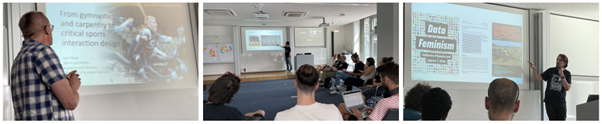
Each seminar participant then gave a prepared presentation introducing their research (see Figure 1). In order to preserve a spirit of open and spontaneous group ideation, discourse, and collaboration, we strove to avoid a conference-like format of dry, dense lengthy presentations and instead adopted for a “Pecha Kucha” inspired presentation format; a rapid-fire series of short six-minute, visually oriented (picture and video) presentations. In addition to showcasing their work and its relation to SportsHCI, the content of each presentation also included an articulation of what the presenter expected from the seminar, the challenges they encountered in their investigations, and what prior work the group should read and why. An abstract of each presentation can be found at the end of the present report. Finally, during the Pecha Kucha talks, challenges that presenters mentioned and challenges that attendees members associated through the presentation were added as sticky notes to flipover sheets. They were initially grouped according to five categories: technology, users, society, research, and design.
3.3 Day 2: Interactivity session and group work on the Grand Challenges
An interactivity-style session involved participants trying out each others’ SportsHCI systems and artefacts. These demonstrations are documented in Section 5.
The remainder of the day was spent working further on elaborating Grand Challenges for the field of SportsHCI. This was prepared beforehand by organiser Dennis Reidsma using a shared information board in the Miro platform. All challenges and opportunities identified in Day 1 were added to this information board as separate notes, and lightly grouped into themes prior to the session on Day 2. In a plenary session on Day 2, participants associated additional themes with these notes. A discussion on what constitutes a “grand challenge” was held, and some inclusion and exclusion criteria were defined. Participants were then invited to select a few key challenges for the next stage of the activity.
Then, in breakout groups in two rounds (groups were reshuffled in round 2), challenges were further worked out on the Miro board as the next step towards getting at our grand challenges. After each round, a plenary presentation was given by each group, where they briefly described the current understanding of the high-level description of the challenge, and mentioned several core facets to the challenge. This process is further described in Section 6.
3.4 Day 3: Concrete Community Actions; Hike
In the morning of the third day, organiser Elise van den Hoven facilitated a strategic discussion on ways to bring the field forward. The focus was now not on the content and research problems but rather on organisational things that we as a field can pursue to consolidate the field of sportsHCI (special issues, workshops or special venues, etc). Participants first wrote down individual ideas for follow-up actions, which were then collectively sorted and clustered on the digital Miro board. This was followed by a plenary discussion to clean up the categories and clarify the ideas. Subsequently, participants split up into subgroups, selecting the most important action points. Participants were then invited to take concrete action by writing text for five key action points (e.g., draft the call for a journal special issue). These outcomes were documented as separate documents, and shared between participants for future action.
In the afternoon, participants joined the traditional Saarschleife Tafeltour hike in the region. Organizers suggested taking the opportunity of walking together to share career mentoring advice.

3.5 Day 4: Novel SportsHCI Designs and Potential Scientific Impact
In the morning of the fourth day, organizer Carine Lallemand invited the participants to participate in a design challenge based on the paper “10 lenses to design Sports-HCI” [1]. The goal was to come up with design concepts related to one of the lenses, and to present them in the form of a role playing activity. Participants were randomly assigned to a group of 4 and randomly assigned a lens from the 10 lenses of the paper. After reading the 2-3 pages on that lens, each group could choose their own method to come up with ideas for designs; then they picked one and acted it out to the other groups. A quick debriefing was done with the groups after the roleplay. This was all documented in text (see Section 7) as well as in videos shared in the shared repository maintained by the organisers. This exercise was furthermore the inspiration for one of the outcomes of the seminar (plans for a follow-up paper on the lenses).
In the afternoon, organiser Dennis Reidsma presented slides to introduce the idea of an impact pathway, along with relevant terminologies and resources. These pathways are particularly interesting for funding proposals, as they are the basis for many funding agencies’ expectations regarding articulation of expected scientific impact. The groups (same as in the morning) proceeded to write an impact pathway related to their design lens and concept, in the standard pattern used on the slides. These impact pathway descriptions are presented in Section 7.
In the evening, participants were invited by participant Florian Daiber to join a visit to the DFKI lab. Half of the group travelled to Saarbrücken to experience the infinity climbing demo which is included in the overview of the interactivity session in Section 5.
3.6 Day 5: Wrap-up, Conclusive Remarks, and Concrete Followup Actions
The last morning of the seminar was devoted to wrapping up all the ideas and insights collected during the week. Based on a report outline prepared by Carine Lallemand and a list of tasks, the participants produced extensive notes and text fragments for all chapters of this report. They also peer-reviewed the concrete text results from the session of Day 3.
Besides the report, it was of utmost importance to define and divide the responsibilities for the follow-up actions. For all concrete “next step actions”, and based on personal interests and preferences, the group assigned a main person as the “shaper / lead” and listed all the participants interested to commit to work on the task.
References
- [1] Florian Mueller, Damon Young, et al. 10 lenses to design sports-hci. Foundations and Trends® in Human–Computer Interaction, 12(3):172–237, 2018.
4 Overview of Talks
4.1 Embodied interaction
Elise van den Hoven (University of Technology Sydney – Sydney, AU Eindhoven University of Technology, NL, elise.vandenhoven@uts.edu.au)
License: Creative Commons BY 4.0 International license © Elise van den Hoven
Within my international research program Materialising Memories (MM)666https://www.materialisingmemories.com/ we study embodied interaction in its different meanings. This includes physical technology on or around human bodies as well as giving tangible artefacts agency (according to a definition by Dourish [1]). The typical MM application aims to support remembering practices in the broadest possible sense, including sharing holiday memories, reflection about everyday life, grieving a lost loved one, curating digital photo collections to understanding forgetfulness in older adults, to name a few. One of the projects focuses on motor memory, which is the memory of the muscles in the human body and relevant to SportsHCI. We are currently investigating whether HCI and interaction design can use this as a resource for designing technology, and how people can benefit from technology designed by taking motor memory into account.
References
- [1] Paul Dourish. Where the action is: the foundations of embodied interaction. MIT press, 2001.
4.2 Designerly approaches to exercising motivation and injury prevention
Carine Lallemand (University of Luxembourg, LU Eindhoven University of Technology, NL, carine.lallemand@uni.lu)
License: Creative Commons BY 4.0 International license © Carine Lallemand
As the leader of an educational community focused on challenge-based learning for sports, wellbeing and preventive health (Vitality Squad, TU Eindhoven), I have been supervising or leading a large variety of projects related to SportsHCI. Being part of a department of industrial design, our vision revolved around designerly ways to trigger healthy lifestyles with solutions contributing to both physical and mental vitality. Relying on aesthetics of interaction principles and the use of data as a creative material, we design interactive artefacts to support motivation and change. My work, done in collaboration with several Ph.D. candidates, covers several application areas and target audiences, with a main focus on exercising motivation (Daphne Menheere), sports injury prevention (Juan Restrepo Villamizar), office vitality through active ways of working (Ida Damen, Roy van den Heuvel), and the design of (inter)active urban environments (Loes van Renswouw [1, 2, 3]). We see an important role for data in the design process, to gain insight into these complex new behavior patterns in everyday life.
In my talk, I presented several projects to illustrate our main design approaches. Based on the Runners’ journey [4, 5], projects were developed to trigger exercising motivation using qualitative interfaces [6, 7], data physicalization [8], and aesthetics of friction [9, 10]. We approached injury prevention by on-skin interfaces [11] or the concept of interaction-through-negotiation [12]. I concluded my talk with two challenges for SportsHCI: 1/ the necessity to further develop non-normative views on sports and motivation and to address audiences who are not already intrinsically motivated by physical activity. 2/ the responsible and meaningful use of data.
References
- [1] Loes van Renswouw, Steven Vos, Pieter van Wesemael, and Carine Lallemand. Exploring the design space of interactive urban environments: Triggering physical activity through embedded technology. In Proceedings of the 2021 ACM Designing Interactive Systems Conference, DIS ’21, page 955–969, New York, NY, USA, 2021. Association for Computing Machinery.
- [2] Loes van Renswouw, Jelle Neerhof, Steven Vos, Pieter van Wesemael, and Carine Lallemand. Sensation: Sonifying the urban running experience. In Extended Abstracts of the 2021 CHI Conference on Human Factors in Computing Systems, CHI EA ’21, New York, NY, USA, 2021. Association for Computing Machinery.
- [3] Pieter van Wesemael Loes van Renswouw, Carine Lallemand and Steven Vos. Creating active urban environments: insights from expert interviews. Cities Health, 7(3):463–479, 2023.
- [4] Daphne Menheere, Carine Lallemand, Erik Van Der Spek, Carl Megens, Andrew Vande Moere, Mathias Funk, and Steven Vos. The runner’s journey: Identifying design opportunities for running motivation technology. In Proceedings of the 11th Nordic Conference on Human-Computer Interaction: Shaping Experiences, Shaping Society, pages 1–14, 2020.
- [5] Daphne Menheere, Mark Janssen, Mathias Funk, Erik van der Spek, Carine Lallemand, and Steven Vos. Runner’s perceptions of reasons to quit running: Influence of gender, age and running-related characteristics. International Journal of Environmental Research and Public Health, 17(17):6046, August 2020.
- [6] Dan Lockton. Designing qualitative interfaces: Experiences from studio education. In DRS2022: Bilbao, DRS2022. Design Research Society, June 2022.
- [7] Daphne Menheere, Carine Lallemand, Ilse Faber, Jesse Pepping, Bram Monkel, Stella Xu, and Steven Vos. Graceful interactions and social support as motivational design strategies to encourage women in exercising. In Proceedings of the Halfway to the Future Symposium 2019, HTTF 2019, New York, NY, USA, 2019. Association for Computing Machinery.
- [8] Daphne Menheere, Evianne van Hartingsveldt, Mads Birkebæk, Steven Vos, and Carine Lallemand. Laina: Dynamic data physicalization for slow exercising feedback. In Proceedings of the 2021 ACM Designing Interactive Systems Conference, DIS ’21, page 1015–1030, New York, NY, USA, 2021. Association for Computing Machinery.
- [9] Alynne de Haan, Daphne Menheere, Steven Vos, and Carine Lallemand. Aesthetic of friction for exercising motivation: A prototyping journey. In Proceedings of the 2021 ACM Designing Interactive Systems Conference, DIS ’21, page 1056–1067, New York, NY, USA, 2021. Association for Computing Machinery.
- [10] Daphne Menheere, Alynne de Haan, Steven Vos, and Carine Lallemand. Raya: A tangible exercise buddy reminding oneself of the commitment to exercise. In Human-Computer Interaction – INTERACT 2021: 18th IFIP TC 13 International Conference, Bari, Italy, August 30 – September 3, 2021, Proceedings, Part V, page 471–475, Berlin, Heidelberg, 2021. Springer-Verlag.
- [11] Juan Restrepo-Villamizar, Steven Vos, Evert Verhagen, and Carine Lallemand. Crafting on-skin interfaces: An embodied prototyping journey. In Proceedings of the 2021 ACM Designing Interactive Systems Conference, DIS ’21, page 1129–1142, New York, NY, USA, 2021. Association for Computing Machinery.
- [12] Juan Restrepo. Hyaku: A qualitative negotiation-through-interaction interface to support runners in achieving balanced training sessions. In DRS2022: Bilbao, DRS2022. Design Research Society, June 2022.
4.3 Research focus in context
Dennis Reidsma (University of Twente – Enschede, NL, d.reidsma@utwente.nl)
License: Creative Commons BY 4.0 International license © Dennis Reidsma
My work in Sports Interaction Technology is shaped around Things that Interact for a Purpose against a background of Theory and Domain Knowledge. Each of these may be the focus of my research in some projects, but may as easily serve as the mere context for other projects. The “things” are typically digital technologies, often with expressive qualities. Holographic virtual reality for telepresence; smart objects with sensors and lights on a sports field; game-like settings in immersive virtual reality; robots and embodied agents; music technology; and many more. When the “thing” is the central concern, research questions involve finding good architectures, algorithms, and models, or working on novel creative, and playful designs. Alternatively, the “thing” may just be something used as a vehicle to explore other questions. The “interaction” in my work involves the sense-think-act cycle that is always embedded in the technology that I develop or use. Research questions at this level are about modifying elements in that cycle (what is sensed, what form do responses take, and how are the two mapped in an unfolding interactive dialog with the technology) and asking how this changes the immediate social and physical behaviour and experience of users. The larger “purpose” of my work tends to involve contributions to play, care, and learning – sports can be said to be all three of those. Research questions that focus on the purpose mostly concern longer-term impact: does the technology indeed change social relations, health, and well-being, learning, etcetera? These questions are typically very intensive to answer and thus less frequently put in the center of my own work. The “theory and domain knowledge” about sports, play, and movement, finally, is present in two ways. On the one hand, it serves as a necessary foundation to inform the other three pillars. On the other hand, sports interaction technology can be used as a lab setup to explore and answer more fundamental questions that contribute to sports and movement theory.
4.4 From gymnastics and carpentry to critical sports interaction design
Lars Elbæk (University of Southern Denmark – Odense M, DK, lelbaek@health.sdu.dk)
License: Creative Commons BY 4.0 International license © Lars Elbæk
As a former elite gymnast, it paved my way into sports science, and I challenged myself to re-train the backward somersault to show off on my 60-year birthday. Despite being a trained carpenter with dyslexia, I pursued building houses, incorporating the double diamond as a window design of my house. With philosophy and a sports-physiology master’s, I entered interaction design, creating SportsPlanner without knowing the discipline. This journey led to establishing the first Sports Innovation and Entrepreneurship program in sports science education, encompassing technology. Research has circled around developing games for an interactive back-yard trampoline, making a platform for filming and using visual data to strengthen learning in school physical education. As these two projects we have also in the Kids n’ Tweens project developed the iMO-LEARN interactive stool for move-and-learn. In the field of physical activity for special needs we have co-designed the Handi-Wall with the local company PlayAlive inc. We have developed the “Real Man” platform using gamification for social connecting and enhancing behavioral change among blue workers. We have co-designed the feedback elements of the Eye4Talent football coaching tool. Considering health crises and talent development, technology presents ethical dilemmas. We see reality stars being online coaches having no knowledge and compassion and thus coaching towards fertilised eating disorders. It could also be that talent is produced from the many, but too much data may exclude and restrict motivational fellowship, reducing the talent pool. How will AI affect and on which values should we build ethical future HCIsport?
4.5 Designing Sports Interaction Technology to create meaningful movement for all
Dees Postma (University of Twente – Enschede, NL, d.b.w.postma@utwente.nl)
License: Creative Commons BY 4.0 International license © Dees Postma
The field of SportsHCI holds great potential to contribute to a more active and sportful society. Ubiquitous computing, wearable sensors, and artificial intelligence allow for on-the-fly, real-time interactions to support motor learning, skill acquisition, performance, and long-term engagement in sports. To live up to these promises, the field of SportsHCI needs to address a number of challenges to be able to tackle the big societal issues that we face today. The first of these challenges is to join forces within the HCI community and beyond to get a multidisciplinary perspective on wicked problems like: physical inactivity, decreasing physical activity, and impoverished physical literacy. Together, we need to rethink sensing techniques, processing approaches, and actuation paradigms to match the capabilities of interactive technologies to the needs of sports and movement.
4.6 Complexity simplified? Understanding and Designing for the Subjective experiences of Objective Sports Measures
Armağan Karahanoğlu (University of Twente – Enschede, NL, a.karahanoglu@utwente.nl)
License: Creative Commons BY 4.0 International license © Armağan Karahanoğlu
Improving the data accuracy and performance metrics is one of the driving forces of Sports-HCI. Research shows that the introduction of performance and biomechanical measurements altered the act and practice of sports. However, experience of the data collection technology (e.g., sports trackers) changes the way the athletes experience and immerse themselves in sports. I argue that athlete’s subjective experience of objective measures is richer and more complex than their looking into performance and biomechanical data. For example, athletes can misinterpret data or may feel frustrated when the meaning derived from sports data does not match with their expectations or feeling of their performance. Furthermore, such mismatch and misinterpretation may negatively influence athletes’ perceptions of self, such as self-worth and self-care. Hence, I challenge the sports-HCI with going beyond making data readable, understandable and interpretable, and investigating the practices of when the numbers and the data representation are not aligned with what an athlete feels about their body and performance. In my work, I investigate how sports technology influences athletes’ experience and sensemaking of sports-data, their sporting and bodily experiences. I presented an initial framework that can shed light on investigating athlete’s data sensemaking practices and concluded with the grand challenge of further investigating the “subjective experiences of objective measures”.
4.7 SportsHCI: where interactive technologies inspire new uses and users
Robby van Delden (University of Twente – Enschede, NL, r.w.vandelden@utwente.nl)
License: Creative Commons BY 4.0 International license © Robby van Delden
SportsHCI provides an additional opportunity to engage in sports. Our SportsHCI projects include virtual rowing, tag, skiing and volleyball. These projects showed how VR and projections might visualise elements of our bodily behaviour and might steer us to behave in different ways. It also made us rethink what sports is and what SportsHCI could be. This familiarised us with the notion of sportification amidst a un(-)ification triangle of playification, gamification, and sportification. Adding or removing sportslike elements might be one starting point of what SportsHCI technologies could add in, SportsHCI and beyond. We will continue to explore where technologies can really be of added value and will provide new types of motivations. I see interactions can be aimed at getting people to actively move to exhaustion and excellence, but also as technology which could unlock feelings of awe and enjoyment of moving physically just a little for entrance level athletes. Furthermore, new and not yet existing mixed reality sports, such as GPT4’s teamsport SpectraBall where rugby, beatsaber and football are combined, not only provide new experiences for athletes but also open up untapped potential for relatedness through the act of jointly (watching) sports.
4.8 Digital Breathing Coach – exploring explicit interaction on the run
Vincent van Rheden (Salzburg Universit, AT, vincent.vanrheden@plus.ac.at)
License: Creative Commons BY 4.0 International license © Vincent van Rheden
In this research project I developed a simple instance of breath coach that supports runners with breathing. Specifically we support Locomotor-Respiratory Coupling (LRC), also known as Rhythmic Breathing. Locomotor-Respiratory Coupling (LRC), a breathing technique in which the breath is coupled to steps, can positively impact running experience and economy. Locomotor-Respiratory Coupling (LRC), typically is done in whole-integer ratios, counted in steps per inhalation and exhalation. For example, one could use a 2:2 ratio, implying that the runner performs two steps per inhalation and two steps per exhalation: An Android application picks up the runner’s steps and guides the breath through sound feedback. Based on a proof of concept a full fledged Android application is designed and developed to support longitudinal studies. Follow-up steps will explore feeding the system with breath data to further support the runner at individual level when needed. Additionally we aim to explore explicit interactions during the running activity, exploring interactions that do not interfere with the running experience or the running motion.
4.9 Designing Superhero Movement Experiences
Perttu Hämäläinen (Aalto University, FI, perttu.hamalainen@aalto.fi)
License: Creative Commons BY 4.0 International license © Perttu Hämäläinen
Human-computer interaction has potential to impact physical activity through two key ways: Making it easier to learn movement skills and improving the motivation to keep learning and moving. In my work, I have been mostly focusing on motivation, although my group has also done some learning interventions. I mostly build on intrinsic motivation theories such as Self-Determination Theory and the work of Silvia et al. [1] on curiosity. These highlight the importance of satisfying basic psychological needs such as competence, autonomy, social relatedness, and novelty. In my talk, I present examples of a stream of research originating in my own doctoral research, almost 20 years back: Creating “superhero movement experiences” with both physical and digital manipulations that aim to make one feel more competent as a mover. For instance, one might become the protagonist of a kung-fu game where one’s body appears stronger, faster, and more flexible, and where one can execute backflips so that one only does the movement up to a point that is safe, and the game then takes over and guides the virtual body through the rest of the skill. I will also briefly comment on supporting other needs, such as curious exploration of novel movement opportunities in an urban environment, approached through an AI system that recognizes parkour spots and creates spot maps based on Google Street View images.
References
- [1] Paul J Silvia. Curiosity. The science of interest, pages 97–107, 2017.
4.10 Digital Motion in Sports, Fitness, and Wellbeing
Lisa Anneke Burr (Salzburg University, AT, lisaanneke.burr@plus.ac.at)
License: Creative Commons BY 4.0 International license © Lisa Anneke Burr
The project “Digital Motion in Sports, Fitness, and Wellbeing” (DiMo) is motivated by the belief that by digitizing the quality of movement and making emotion visible during movement, we can support people in their movement and lead them to optimal performance and motion experiences. The project aims to give people a better understanding of their physical activity by linking motion and emotion, resulting in an overall new (digital) experience. Within this project, I worked on two streams: 1. exploring respiration as an interaction modality while in motion, and 2. working with visual respiration data feedback while running. Here, my focus lay on supporting breath pacing in treadmill runners while also trying to address impacts on breathing awareness. In the seminar, I am really interested in conversations on how technology can be used to build or increase body awareness to support training, recovery, as well as pleasure and enjoyment during sports. I am also keen to dive into discussions about ethical questions that arise in the field of emerging technologies in sports.
4.11 Using Human Augmentations to Learn and Enhance Sports Skills
Don Samitha Elvitigala (Monash University – Melbourne, AU, don.elvitigala@monash.edu)
License: Creative Commons BY 4.0 International license © Don Samitha Elvitigala
Different skills need to be acquired in sports to perform well. Also, following the correct technique will not only enhance performance but also will avoid unnecessary injuries. Hence, my research has focused on integrating sensing and feedback into our bodies for skill learning and enhanced performance. For example, GymSoles allow our body to feel where our centre of pressure is to keep the correct body posture while lifting weight. The interface is integrated with our body taking foot pressure as input and creating vibrio tactile patterns to internalise our centre of pressure allowing the body to keep the correct posture. Similarly, in CricketCoach, we explored how feedback from SMA wires could be used in a cricket training session to render the hand feedback of a cricket coach, allowing a more naturalistic experience in self-cricket learning. In the future, I want to explore how body integrations can automatically be adjusted according to the contextual changes of the player’s environment.
4.12 Multisensory Wearable Technology to Enhance and Transform Body Perception
Laia Turmo Vidal (Universidad Carlos III de Madrid, ES, laia.turmo@uc3m.es)
License: Creative Commons BY 4.0 International license © Laia Turmo Vidal
Attuning to, cultivating, and enhancing body perception is crucial in sports. Advances in sensing, actuating, and wireless technology offer new ways to understand body physiology and movements. Further, wearable technology facilitates integration in challenging sporting contexts. My work in SportsHCI focuses on designing and evaluating sensory technologies to enhance and transform body perception. I presented two aspects of my work. First, Intercorporeal Biofeedback, a type of technology that enhances individual and mutual body perception, and that has been proven to improve understanding, communication, performance, and movement learning in yoga, strength training and circus training. Secondly, I presented Body Perception Transformation technologies, which utilize sensory feedback to create illusions of body changes, like feeling faster, lighter, or more fluid. Evaluations in everyday physical activity contexts and with dancers have shown that these technologies yield empowering, creative and motivating experiences for individuals. I concluded presenting current SportsHCI challenges, and perspectives I wish to discuss.
4.13 Athlete Experience in Figure Skating and Outdoor Recreation
Michael Jones (Brigham Young University – Provo, UT, USA, jones@cs.byu.edu)
License: Creative Commons BY 4.0 International license © Michael Jones
Interactive computing is reshaping the athlete experience in sports and in outdoor recreation more broadly defined. This talk will discuss these issues in the context of figure skating and day hiking. In figure skating, the primary issues revolve around injecting data into the coach-athlete relationship where the athlete is a child and the parent is also involved. In the context of day hiking we present self-reported motivations for headphone use and non-use in the United States. These motivations involve safety, mediating social interaction and creating specific experiences. Before the seminar, I uploaded an essay and a research paper for pre-seminar reading. The essay frames cars in nature and foreshadows modern discussions of smartphones and nature. The research paper is an inductive study of sources of enjoyment in figure skating for elite skaters published in 1989. It focuses on enjoyment–an important concept in sports at all levels. My tentative pre-seminar grand challenge is: redefine SportsHCI to enhance the wellness benefits of lifelong participation in sports.
4.14 Data visualization in sports
Paolo Buono (University of Bari, IT, paolo.buono@uniba.it)
License: Creative Commons BY 4.0 International license © Paolo Buono
Data visualization is an established field of HCI. One of the main goals is to help users to understand and analyze data through visualization techniques and interaction. Visualizations have the property of being processed in parallel by the human perceptive system. Good visualizations should allow the observer to quickly understand the data and make decisions. Classic approaches, such as Shneiderman’s Mantra, cannot be implemented anymore due to the massive amount of data. AI might help, but in many cases, the role of the user is not clear. Sports data are multivariate and are produced massively, making them challenging to compute and visualize. We aim to investigate the feasibility and utility of data visualization in sports, analyzing first soccer data visualization and interactive interfaces for video analysis.
4.15 Towards the Design of Playful water activities
Maria Fernanda Montoya Vega (Monash University – Melbourne, AU,
maria.montoyavega@monash.edu)
License: Creative Commons BY 4.0 International license © Maria Fernanda Montoya Vega
Water’s pleasant nature and associated health benefits have captivated the interest of HCI researchers. Prior WaterHCI work mainly focused on advancing instrumental applications, such as improving swimming performance, and less on designing systems that support interacting with technology in water in more playful contexts. In this regard, I explore the somaesthetic design of playful interactive water experiences, specifically, floating, surfing and diving, aiming to enrich the experiential aspect of the water activity through technology. Employing somaesthetic design, I aim to develop different playful prototypes to understand the integration of the soma (human mind and body), the technology and the water, towards a synergy that enriches the water experience. To date, I have designed an extended reality system for a flotation tank experience, which suggests interesting opportunities for the technological enrichment of water experiences. Ultimately, I hope that our WaterHCI work supports people to be playful and benefit from the many advantages of being in the water.
4.16 Blending micro-health behaviors into everyday activities through “invitations” as SportsHCI
Xipei Ren (Beijing Institute of Technology, CN, x.ren@bit.edu.cn)
License: Creative Commons BY 4.0 International license © Xipei Ren
Sitting in front of computers has become a major part of our workaday routines, challenging us in maintaining active and healthy lifestyles. This challenge becomes even more salient and more relatable to many of us after COVID-19. Is it possible to design interface and interaction so that the health behaviour intervention is integrated into the target users’ established lifestyles and daily routines? We argue that by leveraging existing social mechanisms, a SportsHCI design can enable health interventions in a natural and effective way. One simple example could be facilitating a social context where users feel being invited for micro health gains. To better illustrate this design mechanism, we use several design instances (Step-by-Step, Anti-Sedentary Robot, Co-Drink, Co-Coffee) to exemplify our proposal. We would also like to learn your advice to inspire us in figuring out the design, evaluation and scaling-up methods of this persuasive strategy.
4.17 Experiencing Cycling Indoors and Outdoors
Andrii Matviienko (KTH Royal Institute of Technology – Stockholm, SE,
matviienko.andrii@gmail.com)
License: Creative Commons BY 4.0 International license © Andrii Matviienko
Cycling is a great way to remain physically active, maintain cardiovascular health, and improve physical shape. While cycling outdoors is de facto a standard that includes cycling tours, training, or commuting, cycling indoors has become more popular over the last decade. In my research, I explore technological improvements for indoor and outdoor cycling. I will present how we employed multimodal and extended reality user interfaces and new tandem-based cycling simulation methods to facilitate cycling safety and realism. The results of these works demonstrate how technology can improve the cycling experience and reduce motion sickness indoors and facilitate safety outdoors.
4.18 AI+MR for augmented sport training systems
Fabio Zambetta (RMIT University – Melbourne, AU, fabio.zambetta@rmit.edu.au)
License: Creative Commons BY 4.0 International license © Fabio Zambetta
SportsHCI can benefit from the integration of MR (Mixed Reality) interfaces with AI (Artificial Intelligence) algorithms, particularly CV (computer vision) and ML (Machine Learning algorithms). We discuss the blend of such technologies in use cases related to training high performing athletes in table tennis, albeit ideas and principles can be extended to other racket sports and, in fact, to a variety of other sports, as well. We are also very interested in the interplay of such technologies with humans in the loop (athletes and coaches), specifically wrt their acceptance of such technologies, their perception of user experience and the opportunities for such technologies to be assisting athletes and para athletes.
4.19 Towards SportsHCI to improve skill acquisition and performance in athletes
Florian Daiber (German Research Center for Artificial Intelligence (DFKI) – Saarbrücken, DE, florian.daiber@dfki.de)
License: Creative Commons BY 4.0 International license © Florian Daiber
In the last years, sports technology has become ubiquitous and there has been a large body of work in HCI and Ubicomp as well as commercial products including apps, wearables and smart sports environments. SportsHCI has the potential to analyze complex human movements and provide guidance when learning a new motor skill. In our research we investigate intelligent assistants to support skill acquisition and improve performance in athletes. To achieve this goal we investigate different feedback techniques, both on the athlete’s body and in their training environment. This includes smart environments using intelligent sports equipment and projections as well as wearables and virtual reality headsets, which enable us to provide in-situ feedback to enhance motor learning. We are particularly interested in implicit, in-situ and real-time feedback for example by using EMS but also playful approaches in mixed realities.
4.20 The Role of HCI in Enhancing Inclusivity and Encouraging Engagement in Sports and Exercise
Daniel Harrison (Northumbria University – Newcastle-upon-Tyne, UK,
daniel.b.p.harrison@northumbria.ac.uk)
License: Creative Commons BY 4.0 International license © Daniel Harrison
Much of the historic focus of physical activity-related HCI has either been related to: those starting out their journey; or, to performance, particularly in (semi-) professional athletes. Over time this has broadened to include a range of sports, fitness levels, and technologies. However, more work remains to be done to establish a more inclusive SportsHCI research agenda that caters for all athletes, as well as promotes enjoyment and continued engagement regardless of gender, race, background, ability, body size, or time-pressures. While there is a broader movement in HCI around designing inclusive and accessible technologies, this should be more explicit in SportsHCI. Here I will bring examples from the cycling communities to highlight this need. I argue that a Feminist HCI framework can help emphasise inclusivity and diversity from an intersectional standpoint, allowing SportsHCI to better address individual needs and preferences, challenge stereotypes, and create a more welcoming environment for all.
4.21 SportsHCI benefits from integration
Florian ‘Floyd’ Mueller (Monash University – Melbourne, AU, floyd@exertiongameslab.org)
License: Creative Commons BY 4.0 International license © Florian ‘Floyd’ Mueller
SportsHCI benefits from the integration of the human body and interactive technology. We demonstrate this through a series of research design works around integrated cycling experiences, integrated entertainment experiences, and integrated arts experiences. The results of these works suggest interesting ways forward for SportsHCI research, in particular how the design of integrated SportsHCI can highlight experiential aspects, facilitating playful exertion experiences. Ultimately, with our work, we want to enhance our knowledge around the design of integrated SportsHCI experiences to help people understand who they are, who they want to become, and how to get there.
4.22 Digital Twins and SportsHCI: Design Challenges and Benefits
Regina Bernhaupt (Eindhoven University of Technology (TU/e), NL, r.bernhaupt@tue.nl)
License: Creative Commons BY 4.0 International license © Regina Bernhaupt
Data – qualitative or quantitative – has become central for Sports HCI. My personal take on data is from the perspective of digital twins. The goal of digital twins is to have a full representation of an artefact, process, machine or even a digital replica of a human. The identified key challenge from my perspective is that time, evolvement over time and especially how to enable people with the future. Digital twins have the ability to simulate and predict in real time – making it imperative for people to interact with future states and alternative futures. We know that humans are not very good when it comes to planning, predicting the future and knowing what to come is sometimes disturbing for people and how they react. It will be important to consider the ethics when designing with digital twins, to ensure that sports systems will be a positive contributor to humans health and their planning of sport activities and does not become a burden or a scary prediction instrument that is foreshading possible diseases or injuries. The key topic emerging from this challenge is to understand overall on how to interact with data and representations that relate to the future: “future interactions”.
5 Overview of Interactivity Session
The second day of the seminar was introduced by organizer Dennis Reidsma, starting off with an “interactivity session” that involved live interactive demonstrations of systems and technologies relating to sports HCI. Numerous participants in the seminar showcased their prototypes and technologies, strategically arranged throughout the main room and the nearby hall. This layout allowed other attendees to freely explore the setups, test the systems, and engage in interactive discussions. The main goal was to provide a hands-on demonstration of interactive technologies, hoping to inspire participants to conceptualize their innovative interactive systems for different sports contexts.
Laia Turmo Vidal demonstrated “SoniBand” [1], a wearable device designed for real-time sonification of movement angles, through a range of movement-generated sounds. Embedded in a patch of fabric in a bracelet, SoniBand can be worn in various body locations (e.g. arm, leg, neck). Soniband integrates a BITalino R-IoT embedding a 9-axis Inertial Motion Unit (IMU). The R-IoT transmits movement angle data wirelessly to a Raspberry Pi Zero, which can be controlled using a web browser e.g., in a smartphone. The device registers the minimum and maximum angle of the body part (calibration), and then it sonifies the movement angle. SoniBand includes different metaphorical sonifications, such as wind, water, or rusty gears.

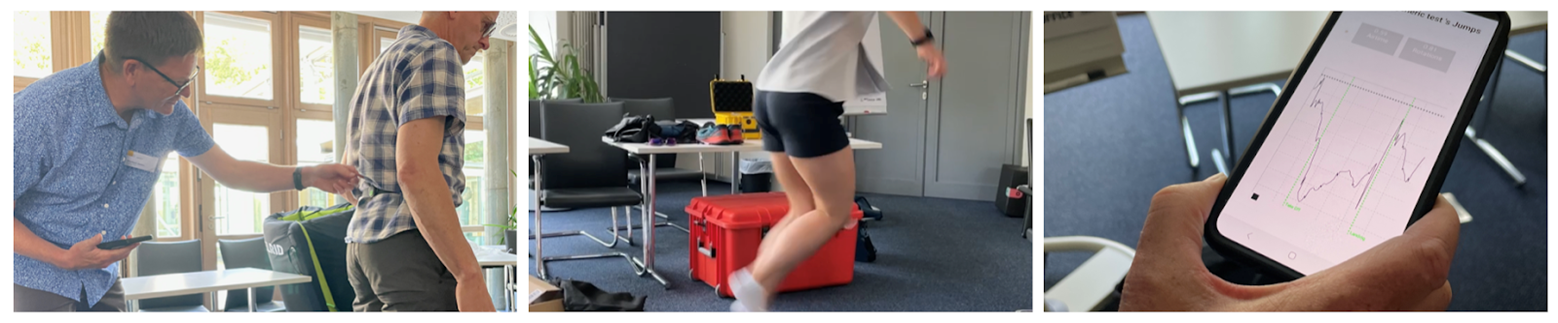
Michael Jones [2] presented a measurement system for figure skating jump detection, consisting of a wearable IMU and a smartphone. The wearable IMU was affixed to the participant’s lower back, which sampled motion at 120 Hz and sent all readings wirelessly to the smartphone. The smartphone ran a jump detection algorithm tuned to specific properties of figure skating jumps. A jump was detected when the airtime of the participant’s jump was sufficiently large and when the rotational velocity around the participant’s longitudinal axis surpassed a given threshold. In this demo, Mike recorded the participants’ results on a whiteboard to encourage competition among them. Participants achieving a jump off the ice created a greater appreciation for the difficulty of spinning jumps performed on ice. Particularly, participants rarely completed more than one rotation while in the air. In contrast, skaters in international competitions routinely perform 2.5 or more rotations in the air.
Perttu Hämäläinen demonstrated an anticipatory visualization for VR dancing. A key visuomotor control challenge in dancing is following the choreography or movements demonstrated by someone else. This is hard to do in real-time due to the inertia of the body and the delays inherent in human visuomotor control. The only way to perfectly follow a choreography in real-time is to have some anticipatory knowledge about it, either through memorization or additional cues such as a visualization of the upcoming movements. Perttu presented a novel way to do this for complex full-body contemporary dance movements, going beyond the highly simplified visualization techniques of current dancing and rhythm games that only specify parts of the movement such as footstep positions in space. Participants engaged in this demo by using the VR headset and following the choreography visualised in the VR environment.
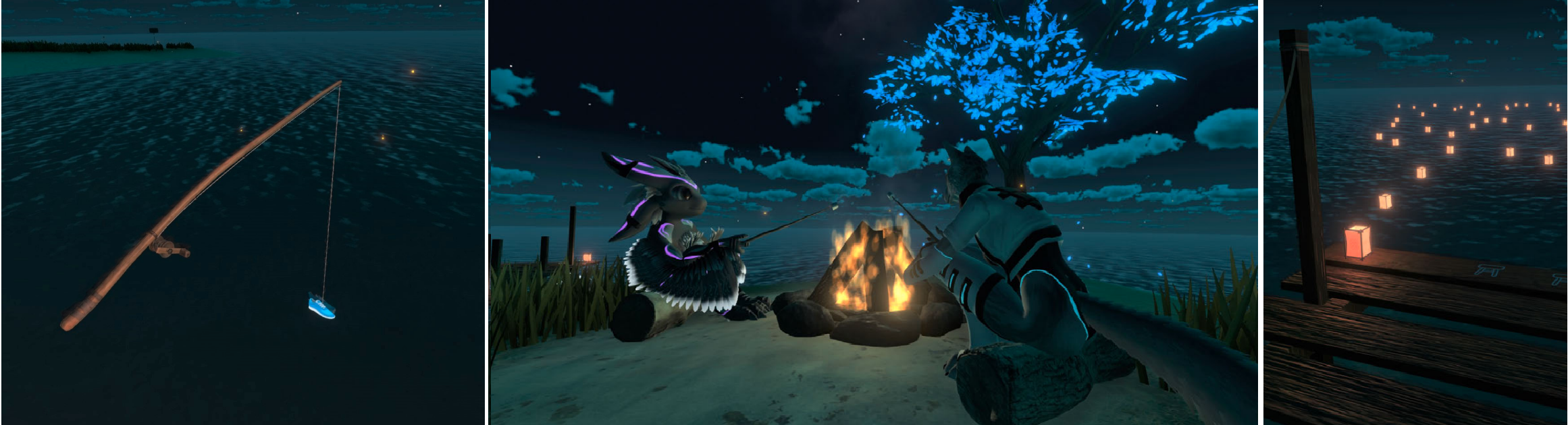
Robby van Delden presented “FireFly Island”, an interactive social VR world created for a dyad-based exploration through which social intimacy can grow. This demo was developed on the basis of Savio Menifer’s MSc thesis777https://essay.utwente.nl/89341/ with further input of Medra, Joris Weijdom, and Dirk Heylen. In this demo, a set of interactive triggers facilitate moments of non-sexual intimacy, such as an area with proximity-sensitive witch hats and selfie mirrors that physically brings people closer together. The demonstrator identified how relatedness also in sports and through the medium of VR/XR can provide ample opportunities to deliberately provide epochs of reflection to stimulate relatedness beyond or mixed with more fast-paced physical activity-based interactions.
Lars Elbæk presented the “MeCaMInD” method card toolbox [3]. He explained how researchers, teachers and potentially the seminar attendees could use this toolbox to access a design methods collection that will equip them with tangible tools to integrate movement into their design practice, transforming traditional creative methodologies with an innovative, movement-centred approach. The Method Cards for Movement-based Interaction Design (MeCaMInD) project is an ambitious initiative funded by the EU through the Erasmus+ strategic partnership program. 888https://mecamind.eu The project’s objective is to introduce movement as an integral component in designing new movement practices, artefacts, and interaction designs for sports and physical activities. The intent is to drive the development of more sustainable movement technologies and sports concepts, enhancing health and well-being for people.

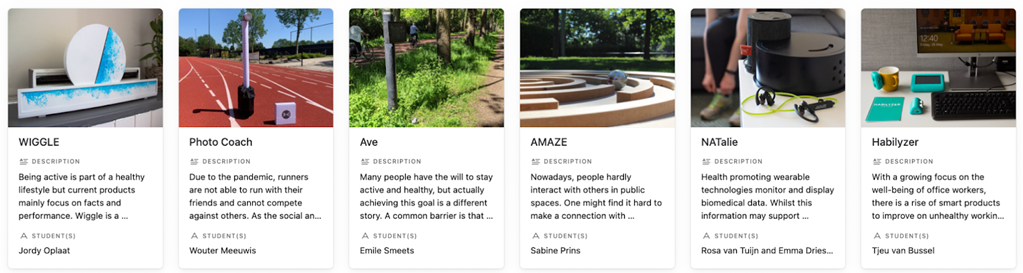
Carine Lallemand presented the Vitality database, a collection of student and researchers projects on the topic of vitality realized at the Eindhoven University of Technology from 2017-2023. It addresses the challenge in design education or design research communities to document and share past projects in order to learn from them and potentially valorize them through dissemination activities. In the Vitality database, each project is tagged with metadata to allow for easy sorting and filtering by topic, method, and material used. The idea behind the demo was to envision how such a database could be used by the SportsHCI community as a whole (rather than by a single institution). First, the design exemplars can inspire future products or be used for educational purposes so that students working on a SportsHCI project have prior design work to review and build on. These design exemplars can also be combined by topics to create papers such as annotated portfolios or explorations of design spaces. Other tabs can be created in the database for recommended readings and publications.
Florian Daiber presented slackliner 2.0 [4], an interactive slackline training assistant which features head and skeleton tracking, and real-time feedback through life-size projection. Like in other sports, proper training leads to a faster increase of skill and lessens the risk of injuries. We chose a set of exercises from slackline literature and implemented an interactive trainer which guides the user through the exercises giving feedback if the exercises were executed correctly. The present demo showcases an interactive sports training system that provides in-situ feedback while following a well-guided learning procedure.
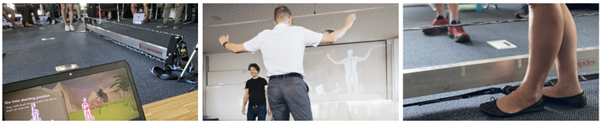
Vincent van Rheden presented the Digital Breathing Coach [5], which supports Locomotor-Respiratory Coupling (LRC), also known as Rhythmic Breathing. Locomotor-Respiratory Coupling (LRC), a breathing technique in which the breath is coupled to steps, can positively impact running experience and economy. Locomotor-Respiratory Coupling (LRC), typically is done in whole-integer ratios, counted in steps per inhalation and exhalation. For example, one could use a 2:2 ratio, implying that the runner performs two steps per inhalation and two steps per exhalation. BreathTool, an Android application picks up the runner’s steps and guides the breath through sound feedback. Based on a proof of concept a full fledged Android application is designed and developed to support longitudinal studies.

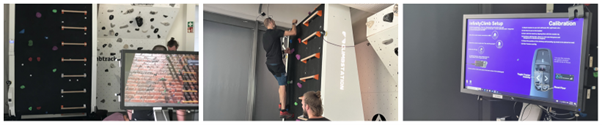
Florian Daiber, finally, presented InfinitiWall [6], an integration of a Virtual Reality outdoor rock climbing experience coupled with a rock climbing treadmill which allows the virtual experience to extend infinitely in vertical space.
6 Defining the Grand Challenges of Sports HCI
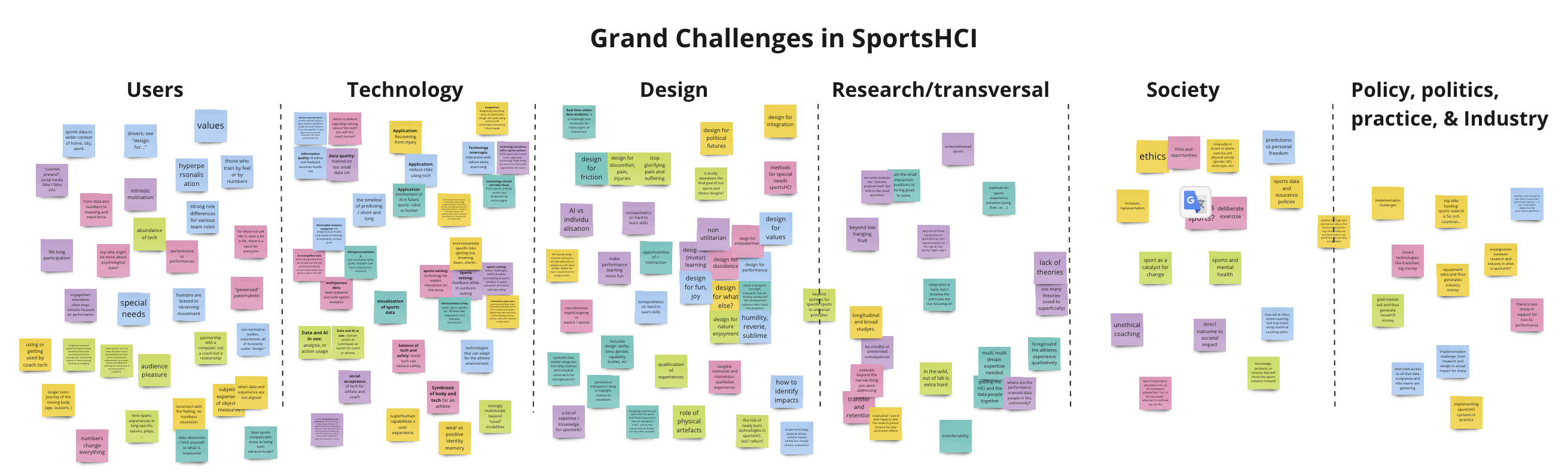
Through the Pecha Kucha presentations, a comprehensive list of “challenges” was collated by the time every participant had presented, providing a strong foundation for steering discussion during the remainder of the seminar toward topics that require further elaboration. Previous works have argued that HCI requires “grand challenges”, namely in that it provides a steering force to drive coordinated action in guiding future research, theory, design, and commercial development [9, 10, 8, 7]. Acknowledging this need, these challenges were further consolidated into a set of concrete “Grand Challenges for SportsHCI”, with the intention their articulation would give guidance to researchers wishing to contribute to the development of the theory by providing specific and actionable gaps in knowledge or capability to which they can contribute through future research.
To determine what constitutes a Grand Challenge in SportsHCI, some inclusion criteria were discussed:
-
Is the challenge specific to SportsHCI or more salient in our field? If not, does it play out differently?
-
Is the challenge important for the field and not easily solved?
-
Is the challenge not addressed yet in current work?
-
Can the challenge be solved within the next 10 years?
With the help of the Miro board (see Figure 11) and according to the abovementioned criteria, participants discussed a list of potential grand challenges. This included: reconciling performance and experience, the feeling of data (objective vs. subjective data), the temporal aspect in SportsHCI, sports data in a wider context (home, nature, city, work) from both a technology and an activity perspective, designing for political futures, athletic performance from the experiential perspective, the role of the audience, promoting physical literacy, addressing inequality by reaching people at a disadvantage, and developing a strategic vision for the field. Then, in breakout groups, all 22 participants were broken into four groups, with each group tasked with discussing one of the proposed grand challenges and taking notes on the Miro board. A second round was conducted with the reshuffling of the groups with a different challenge. After each round, a plenary presentation of highlights was given for each challenge addressed by a breakout group.
Following the completion of all participant presentations, a discussion took place in which the participants synthesized the concepts brought to light during the presentations, as well as the opportunities and challenges that were also highlighted.
The challenges were extensively documented in a separate initial draft for a Grand Challenges paper; here we only provide initial summaries of the Grand Challenges that were separately discussed during the Seminar.
6.1 Time in SportsHCI
Time emerges as a critical aspect in sports experiences, encompassing various phases that demand consideration. These phases range from the immediate timespan of the sports activity itself to preparatory and recovery phases. Additionally, long-term time periods, like seasons and training for major competitions, like the Olympics, hold significance. Aging also influences sports, prompting changes across different life phases. The influence of aging on sports prompts adaptations across different life phases. Consequently, designing with time as a central consideration becomes indispensable, involving careful attention to time span and data sampling for efficient monitoring and feedback. Moreover, despite its challenges, predictive methods and visualizations based on temporal data are crucial for positively manipulating athletes’ time span, mitigating skill deterioration over time. Furthermore, understanding the body’s changes over time in SportsHCI design poses underlying challenges, mainly due to the scarcity of longitudinal data. Addressing this requires implementing longitudinal methods for subjective evaluation, and once human interactions are successfully modeled, the question remains of how to effectively engage with these models and interact with predictions and simulated outcomes.
6.2 Strategic vision for the field of SportsHCI
Much of our discussion (across both sessions) moved around the fact that sports themselves are often not inclusive, and by promoting a generic message of “we should be more inclusive” we are not providing an actionable vision for the future. Beyond inclusivity (which we re-categorised as “access and participation” to more accurately reflect the conversations we were having in the sessions, we also discussed sustainability and how similarly this was too broad of a term to be useful in providing a useful strategic vision – this is something we better need to define and more explicitly break down in order to be useful (do we mean sustainable in human-costs, in fiscal costs, in environmentalism, in terms of access to facilities?). We also discussed that, by their very nature, conversations around the strategic vision for SportsHCI are political and how the political landscape across different places and sports will have a significant influence on our work, meaning that our strategic visions would need to be aware of this and sufficiently broad. Within the context of inequalities, we discussed how SportsHCI tech can exacerbate (or even be the root cause of) inequalities, because of design decisions, target audiences, and costs.
6.3 Performance and Experience
We discussed other ways to “enjoy” sports beyond improving athletic performance. We realised an experience as joy is very narrow and using “appreciation” of the experience describes better how to enclose the sport experience and provide a holistic view. In that sense we as sports researchers can support several ways to appreciate sports. We also discussed how our field can learn from other fields that moved from performance to the experience, such as game research, in which at the start they were focused on developing for competition and then they created more experiential games based on arts, for example. Performance, measurement, judgement, competition, winning and losing are core elements of sport. However, the unmeasured subjective athlete experience drives both performance and participation. Conversely, performance strongly impacts the athlete experience. Performance and experience are closely interrelated in SportsHCI. The grand challenge is to incorporate elements of both performance and experience in HCI for sports. Doing so may increase performance and participation while improving the athlete’s performance.
6.4 Subjective and Objective Data
We discussed the need to understand how we can provide meaningful data independently of being subjective or objective, and also not only meaningful for the athlete but also for the coach. We discussed how there is a two-way feedback loop where: (1) objective data is “translated” to actionable, subjective data (i.e., joint data is turned into coach advice to an athlete, such as “raise our right elbow”); (2) subjective data is “verified” (fact checked) using objective data (e.g., misconceptions about dancers’ lightness when dancing actually depends on the colour of their shoes). A lot of research work is still based on quantification and measurement. While there is certainly room for that, there are plenty of opportunities to capture people’s experience of sport (how they feel about it). This is important in Sports HCI, because for many people the feeling of being “immersed” in sports is key.
6.5 Engineering SportsHCI
SportsHCI introduces a number of very specific engineering challenges that may not be so salient/prominent or even present in some other HCI fields. Compared to the other application fields of HCI, SportsHCI often puts more emphasis on accuracy, timely measurement, embodied experiences, and high-level integration with bodily exertion. This requires higher fidelity levels and robustness of the prototype. Yet, there lacks toolkit and design methods to help designers easily engineer their out-of-box ideas into testable/experienceable probes, which sometimes also limit the novelty of SportsHCI research and work efficiency. Partly because of this, the prototypes for SportsHCI are not that easy to avoid disturbing people in use due to their physical obtrusiveness, making it challenging to create an ultra-realistic setup for testing proposed design concepts. Additionally, unlike other computing technologies that were designed for constant usage, many SportsHCI techs are designed for special sports, which makes them not being used very frequently. How should we deal with these occasionally used technologies? And how can we make sure such technologies can be evolved to fit the changes of users’ needs? A systemic thinking might be needed to study and design SportsHCIs ecologically. Some specific challenges include:
- Complex data.
-
Data consists of large and complex time series, that require processing to turn into meaningful interpretations. For HCI applications often the detections and interpretations need to happen on the spot so the interactive application can immediately respond to it. At the same time, discovering meaningful interpretations sometimes needs a) too much processing power and b) to work on the full data (including “future” data). The challenge is to find ways to develop (possibly based on training stages) the AI that can deliver real-time immediate meaningful interpretations for the HCI to respond to the user‘s activity.
- Movement artefacts.
-
Not all, but many measuring systems are prone to “movement artefacts” (EEG, eye tracking, …). This means a user must sit pretty still when working with that measurement system. Unlike in other HCI fields, SportsHCI is by definition high on movement, so if we want to use those kinds of measurement systems, we need to find fundamentally new ways to deal with / get around those movement artefacts.
- Robust prototyping platforms.
-
Existing prototyping platforms are often not robust enough for use in the SportsHCI context; there is a need for other, more robust prototyping toolkits tailored to both the setting in terms of sensing and actuation paradigms, and to the context in terms of robustness.
- Sensing sports movement.
-
Compared to some other movement-based contexts in HCI, sports see a wide range of movement speed and power; measurement systems require high resolution at low values but also enough room at the high end to deal with explosive actions (cf the figure skaters who jump so hard that the IMU is maxed out, in the demo of Mike Jones during this seminar).
- Robust and challenging environmental circumstances.
-
Sports sensing and actuation happen in challenging settings that require more robust technology compared to many other mobile/wearable/ubiquitous works. Water, sand, ice, bumping into rocks and mountains, collisions between athletes, etcetera. This robustness problem is exacerbated by the need for long-term studies – ideally, systems could survive year-long deployments, which for prototypes in more lenient circumstances is already challenging, but in sports settings even more so.
- Safety, sports regulations, and wearables.
-
Wearables may run into regulations forbidding athletes from wearing anything (including jewelry, etc.) for safety reasons; the engineering of the thing needs to prevent any safety risk (and regulations then must adapt). Wearables interfere with, and are interfered with by, athletic movement. The physical obtrusiveness of wearables is a problem for athletes’ movement. Solutions may involve off-body sensing, smaller components integrated across the body rather than bulky wearables, different weight distribution of wearable, flat electronics that don’t extrude, and other directions. The athletes’ movement is also a problem for the physical wearable: straps are not good enough, and we need new attachments that don’t shift and don’t hinder.
- Per-sport specific things to measure and model.
-
In sports we often deal with very specific types and categories of movement that do not automatically generalize to other sports. A spin in ice skating is (data-wise) not the same as a spin in skateboarding or gymnastics. So where quite a bit of work on movement-centric HCI looks for generalizable models, we need approaches and methodologies that help us, in any sports context, to quickly get at those sport-specific movements.
6.6 Other Challenges
Other challenges that were discussed but not yet elaborated during the seminar, include the challenge of involving movement in the design of new practices and artefacts; the challenge of doing SportsHCI designs and studies that do not focus on novelty but instead offers the opportunity to triangulate already-known results (that is, go from “having a bunch of cases” to “having generalizable, well-grounded knowledge”); and the challenge of finding good methodologies to do forms of meta-analysis in this field.
In summary, the discussions of grand challenges during the seminar, of which an initial selection has been summarized above, has led to a deep insight of the community of seminar participants into where the future directions of the field lie; these insights will be written up in a manuscript for a major conference.
References
- [1] Judith Ley-Flores, Laia Turmo Vidal, Nadia Berthouze, Aneesha Singh, Frédéric Bevilacqua, and Ana Tajadura-Jiménez. Soniband: Understanding the effects of metaphorical movement sonifications on body perception and physical activity. In Proceedings of the 2021 CHI Conference on Human Factors in Computing Systems, pages 1–16, 2021.
- [2] Michael Jones, Sarah Ridge, Mia Caminita, Kirk E Bassett, and Dustin Bruening. Automatic classification of take-off type in figure skating jumps using a wearable sensor. 2022.
- [3] Lars Elbæk, Rasmus Vestergaard Andersen, Robby W Van Delden, José María Font Fernández, René Engelhardt Hansen, Perttu Hämäläinen, Mats Johnsson, Lærke Schjødt Rasmussen, Søren Lekbo, Solip Park, et al. Method cards for movement-based design. 2023.
- [4] Christian Murlowski, Florian Daiber, Felix Kosmalla, and Antonio Krüger. Slackliner 2.0: Real-time training assistance through life-size feedback. In Extended Abstracts of the 2019 CHI Conference on Human Factors in Computing Systems, pages 1–4, 2019.
- [5] Vincent Van Rheden, Eric Harbour, Thomas Finkenzeller, Lisa Anneke Burr, Alexander Meschtscherjakov, and Manfred Tscheligi. Run, beep, breathe: exploring the effects on adherence and user experience of 5 breathing instruction sounds while running. In Proceedings of the 16th International Audio Mostly Conference, pages 16–23, 2021.
- [6] Felix Kosmalla, Florian Daiber, and Antonio Krüger. Infinitywall–vertical locomotion in virtual reality using a rock climbing treadmill. In CHI Conference on Human Factors in Computing Systems Extended Abstracts, pages 1–6, 2022.
- [7] Eleonora Mencarini, Amon Rapp, Ashley Colley, Florian Daiber, Michael D Jones, Felix Kosmalla, Stephan Lukosch, Jasmin Niess, Evangelos Niforatos, Paweł W Woźniak, et al. New trends in hci and sports. In Adjunct Publication of the 24th International Conference on Human-Computer Interaction with Mobile Devices and Services, pages 1–5, 2022.
- [8] Eleonora Mencarini, Amon Rapp, Lia Tirabeni, and Massimo Zancanaro. Designing wearable systems for sports: a review of trends and opportunities in human–computer interaction. IEEE Transactions on Human-Machine Systems, 49(4):314–325, 2019.
- [9] Florian Mueller, Rohit A Khot, Alan D Chatham, Sebastiaan Pijnappel, Cagdas" Chad" Toprak, and Joe Marshall. Hci with sports. In CHI’13 Extended Abstracts on Human Factors in Computing Systems, pages 2509–2512. 2013.
- [10] Stina Nylander, Jakob Tholander, Florian Mueller, and Joe Marshall. Hci and sports. In CHI’14 Extended Abstracts on Human Factors in Computing Systems, pages 115–118. 2014.
7 Design for SportsHCI: Design Lenses, Role Play, and Impact Pathways
On Thursday morning, Carine Lallemand conducted a design activity based on the paper “10 Lenses to Design Sports-HCI” [1]. Participants were randomly divided into 5 groups of 4, each group being randomly assigned one of the lenses. Each group was invited to read the section of the paper related to the lens they had been assigned and to brainstorm potential design concepts representative of that lens. The concepts were presented to the entire group in the form of role-play, along with insights into the design for this lens. The concepts produced were intended to be used as starting points to think of impact pathways in SportsHCI research.
On Thursday afternoon, Dennis Reidsma gave a presentation on how to articulate the scientific and societal contributions of our SportsHCI work, for the purpose of papers and grant proposals, in a way that outsiders can follow the line of argumentation.
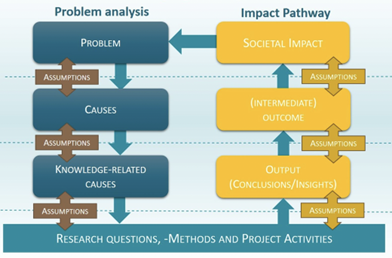
We started off with a presentation on the Impact tool of Erasmus+ Partnerships 999https://www.erasmusplus.nl/en/impacttool-strategicpartnerships which provides a schematic to articulate the difference between output, outcome, and impact in terms of how much it is under direct control or influence from the project activities (see Figure 12). The same tool also provides extensive help in building up a storyline, starting from the impact you want to make, all the way down to the input and activities that are needed for this, and then going the same path back to show how the input and activities make it likely that the impact will indeed occur.

Next, we discussed the impact pathways (see Figure 13) that are currently used to structure many National 101010E.g., for Dutch NWO proposals: https://www.nwo.nl/en/impact-plan-approach and European 111111We discussed how EU grant proposals are typically expected to show expected impact in scientific, societal, as well as economic ways – although in the later exercise we did not address the latter at all. grant proposals. These build up a similar story as the Erasmus+ tool but are a bit more articulate about how impact, outcome, and necessary output are tied together by assumptions about underlying causes for problems and knowledge gaps that prevent us from resolving the underlying cause.
Based on the concepts presented above, all groups worked on articulating an “impact pathway story” about one of their design concepts from the morning session, as reported in the remainder of this chapter.
The remainder of this section presents both the design concepts and their corresponding impact pathways.
References
- [1] Florian Mueller, Damon Young, et al. 10 lenses to design sports-hci. Foundations and Trends® in Human–Computer Interaction, 12(3):172–237, 2018.
7.1 SportsHCI lens: Reverie
Laia Turmo Vidal, Carine Lallemand, Lars Elbæk, Daniel Harrison
License: Creative Commons BY 4.0 International license © Laia Turmo Vidal, Carine Lallemand, Lars Elbæk, Daniel Harrison
After having read about the Reverie lens from the paper, the group summarized what they understood about the concept and the three subfacets (Void, Solitude, and Mini-Holidays). We highlighted in the text a few elements that could act as design triggers to create reverie (e.g., removing stimulation in the environment or adding extra stimulation). Then, each participant shared their own experiences of reverie, in a sport or non-sport context. Void and solitude were often hard to distinguish:
-
Walking in the forest, foraging = safe solitude
-
Cycling to work with a toddler in a cargo bike = co-experience of solitude (alone together)
-
Solo hot air balloon flight = feeling insignificant in the greater scheme of things
-
Rhythm of breathing during a run
-
Slackline, being in one’s bubble despite the audience (note: for some, it is rather the opposite, where the audience is intimidating)
Personal experiences resonating with the mini-holidays sub-facet were:
-
Using swings on children’s playground as an adult.
-
Listening to an audiobook while using an indoor bike trainer
-
Knitting (automatized gestures), wood-turning, pottery
The group tried to identify higher-level concepts within these examples. The ideas of contemplation, patterns/rhythm, craft/material experience, and purposeless activity were emphasized. However, here again, interindividual differences in the appreciation of craft (fear of non-mastery) or purposeless activities emerged.
Besides a general audience, possible target groups of reverie technology were discussed as a means to reach a more concrete level in ideation:
-
Trauma survivors, where vulnerability and fears of specific situations are a challenge
-
Eating disorders, with opposing needs where refraining from compulsive physical activity is a goal
-
Aging population, with the opportunity to reframe solitude as positive
The group identified some opportunities linked to reverie Tech, e.g., overcoming obstacles in exercising related to the security to embrace an activity (yoga class), the body awareness or the threshold to get started.
Roleplay.
The group roleplayed two concepts:
-
Speed down: Contrary to the optimization and HR quantification (high exertion), we tried to slow down movement speed to support the pathway of getting into reverie. That was exemplified by showing, and afterwards, everyone successfully tried the “Beat Saver” slowing down exercise.
-
Proprioceptive sonified gym ball: A gym ball that would turn the attention of the user inward through sonified feedback related to the propriocepsis of moving the ball along one’s own body.

Impact pathway.
Burnout and stress are on the rise, negatively impacting mental health. Research shows that physical activity is a key factor in preventing burnout and stress, and improving mental health in overall. Yet, people experiencing burnout or stress often face a set of barriers (e.g. feeling not good enough to engage in PA, feeling tired due to the burnout, feeling they have no time because they are stressed, etc). Hence, these people who would benefit significantly from PA are not doing so enough. Reverie technologies could offer a solution in that regard. Building on principles of positive solitude, feeling void and experiencing mini-holidays, reverie technologies promote light physical activity, which can be done with little equipment and alone, and that is intrinsically motivating. It can help reframe solitude as a positive feeling. The fact that it is quite opposed to the current narrative around sports is revolutionary and is an ideal entrance point for people to engage with movement. Yet, there is a need to understand exactly how these technologies can be designed to address different people/different contexts, what are the triggers of reverie and how to design for the right balance in order to reach positive reverie experiences. A second design challenge related to the use of technology in reverie experiences, as those are usually low-tech or even purposively done to disengage with the stress and fast pace of life attached to the use of technology.

The group brainstormed two alternative entry points/problem statements that could justify Reverie Sports technology.
-
The first one was simply to start from the observation that people do not reach the recommended levels of physical activity Individual sports are easier and have a lower threshold to start (walking and running are the most popular options) Despite this low threshold, people start running or walking but do not manage to sustain this practice due to several barriers Reverie Technology as a solution.
-
The second one took a complete different approach, with a problem statement outside of the realm of sports. There is an urgency to take action to combat climate change and adopt more sustainable lifestyles Connection with nature can be a driver for individual behavior change Reverie technology can be used to raise awareness for nature.
7.2 SportsHCI lens: Pleasure
Regina Bernhaupt, Maria Fernanda Montoya Vega, Perttu Hämäläinen, Vincent van Rheden
License: Creative Commons BY 4.0 International license © Regina Bernhaupt, Maria Fernanda Montoya Vega, Perttu Hämäläinen, Vincent van Rheden
First, the group spent time reading the description of the pleasure lens from the paper. Then, we discussed our understanding about the lenses and how we conceive the definition of pleasure in different ways than the ones provided by the paper. Next, we provide our first person experiences about the pleasure we encounter from physical activity, such as intense exertion through sports like cycling and crossfit, very similar to the discomfort subcategory in the paper. On the contrary, we also discussed the pleasure we get from less intense exertion but more expressive physical activity, such as dance, which is not described in the paper. We then discussed how this last one is less explored in our field and then we brainstormed in which scenarios we encounter pleasure from dance and music. Finally, we came out with the case of a work office environment in which workers are seated all day and are under great amounts of stress. Most of the time these workers don’t have the chance to have active breaks, sometimes because they don’t have access to facilities that allowed them to have a physical active break, or sometimes they don’t have the time. Therefore it would be useful to provide and active break through dance, allowing them to get rid of the stress while performing bodily movements following the music. We also imagined a system, for example VR, that allows the worker to switch off the external work environmental and encourage them to move however they want avoiding feeling judged by others.
Roleplay.
The group roleplayed a concept where a boring and stressful moment in the life of an office working suddenly gets transformed into an inspiring, enthusiasm-eliciting, physically active episode through the use of immersive VR.
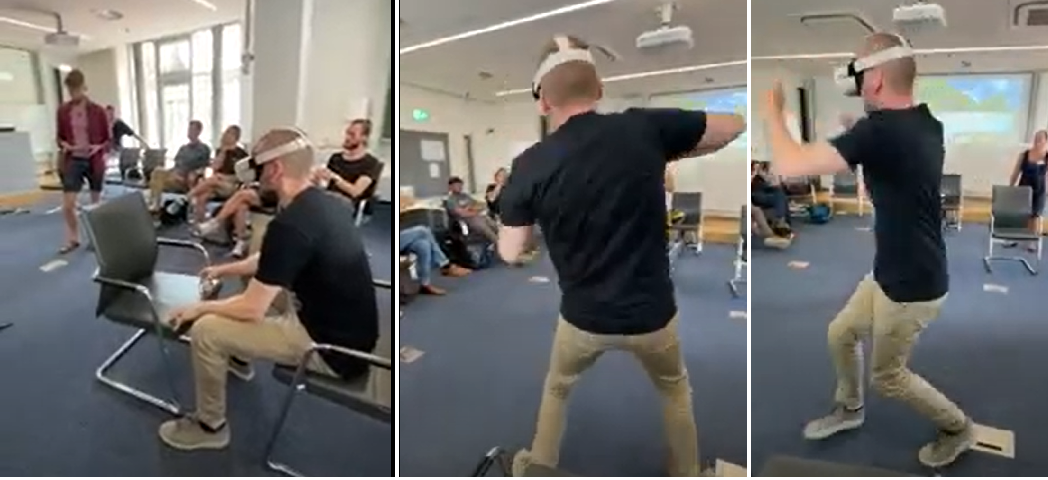
Impact pathway.
Work environments are known for be stressful. Moreover, in work environments, jobs proliferate that involve sedentary behaviors such as computer-based work where workers have to remain seated most of the time. Although the promotion of physical activity to tackle stress and sendentarity is a worldwide concern, workplaces have not yet profited from physical activity during working hours, where adults spend an average of 7.9 hours per day. Barriers to perform physical activity while in work include low access to outdoor spaces, low access to specialized physical activity spaces, overload of work, poor engaging alternatives such as “active breaks”. However, there are opportunities to support more active work environments through the use of interactive technologies, while providing opportunities for workers to express themselves and engage in fun activities. Particularly, interactive technologies that encourage the pleasure from physical activity, such as the pleasure from exertion and the pleasure from being recognized by others when doing physical activity, present great potential for this. Therefore, there is a need to understand how to design more active work environments using interactive technologies such as virtual and augmented reality, what are the suitable physical activities that workers will consider more engaging during working hours, and when to promote the development of these physical activities.
To begin building this understanding, we propose a research through design methodology involving workers and managers of a company’s office space. Through this design process we aim to gain insights of the feasibility of interactive technologies to be adapted in a working space and the perceptions of workers towards them. The final design should help workers to reduce their stress through physical activity during working hours, influence their productivity and their willingness to develop more physically intense breaks. Ultimately, this proposal aims to impact the health of workers during their jobs, and inspire HCI researchers to design interactive systems to encourage physical activity in workplaces.
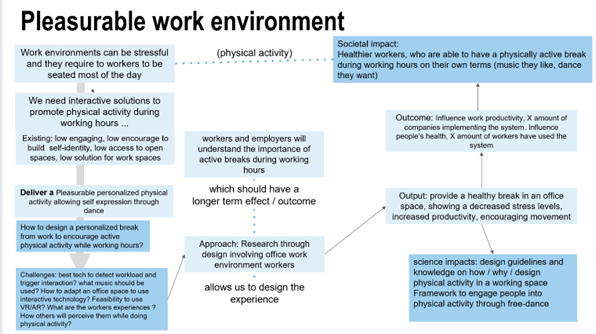
7.3 SportsHCI lens: Beauty in movement – Multi-equality spaces in sports
Dennis Reidsma, Andrii Matviienko, Xipei Ren, Paolo Buono
License: Creative Commons BY 4.0 International license © Dennis Reidsma, Andrii Matviienko, Xipei Ren, Paolo Buono
First, we spent time reading 2.5 pages about the beauty lens from the paper. Second, we freely associated and reflected on the main aspects of beauty such as rhythm, expressed our opinions about them, and proposed possible extensions, such as a timely unfolding of a sports performance and the beauty of time in sports. Then, we did solitary ideation: keeping the lens and those extra associations in mind, what ideas come up to design for beauty? We spent five minutes writing down our ideas about how technology can possibly facilitate beauty in sport activities and ended up with six ideas. The descriptions of the lens and sub-facets and the concrete design suggestions in the paper provided an entry point to start thinking about design ideas once we identified a goal besides the “beauty”. In addition, the associative concepts that we came up with, made the design possibilities feel more nuanced and detailed. Once we had a number of concepts, we presented them to each other and shortly discussed and extended them. Afterward, we briefly discussed which of these ideas can be clearly presented via a pantomime or a bodily representation. In the end, we decided to pick an idea that would fit the best for bodily representation and would be easy for an audience to understand.
Associative concepts.
tension, development of tension in movement; expressive range of movement; internal appreciation of beauty and external appreciation of beauty; synchronization and harmony: alternating between making and breaking the harmony (especially in certain antagonistic sports, but also in dance or music); time speeding up and slowing down as expressive parameter; repetitive or patterned movement without sticking strictly to fixed beats; virtuosity and mastery; shared beauty in the interaction between people; buildup, tension, climax – unfolding time in the beauty of sports and movement.
Ideas.
Xipei Ren. (1) Outdoor running; Augmenting the outdoor experience of wind, birds, and other beautiful environmental factors through feedback technologies; using this to adjust pace of runner. Andrii Matviienko. (2) EMS system that amplifies your movements so you can consciously experience the space of dynamic tension in movement. Once you are familiar with the feeling you will be more able to use that yourself in expressive movement, thanks to the earlier EMS-enhanced experience. (3) Symbiosis between athlete and fan: sensors on athlete allow fans to co-experience the dynamic tension in the virtuoso movements of the athlete. Feedback of the audience’s appreciation to the athlete (embodied/haptic/tactile feedback?). (4) Appreciating the beauty of doing sports movements, for non-athletes: first-person enhanced multimodal replay of movements that were previously measured on an athlete. Dennis Reidsma. (5) Movement mapping for equal participation in sports. Given that some people struggle to express conventional beauty in movement (e.g., spasm, paralysis, etc.), measure the movements they can make within their own range/space of expressive movement; similarly measure the movement through the expressive range of other people; re-create the movement in a mapped audiovisual space that is the same for both people by having unique personal mappings; this allows co-equal participation in joint movement expressed in the mapped space. Both participants can together enjoy the unfolding, dynamic, joint movement while acting from within their own movement capacity. Paolo Buono. (6) Starting from the premise that without experience, it is hard to perceive (let alone appreciate) the beauty in certain sports (or music, or dance…). Measure and detect the patterns in expressive activity; then use multimodal representation to reveal and augment / highlight the patterns so it is easier for audience to see and appreciate the beauty of complex expressive movement activities.
Role play.
We picked the equal participation idea and titled it “multi-equality spaces”. The role play was as follows: Two people (picture right) represent the “athletes” or human interactors. They make the same movement, which could conceivably be part of a dance or sports movement. One of the athletes has a much wider range of flexibility and control of motion than the other, who has only a very limited range of hand and arm motion due to e.g. spasm (bottom right). Two other people in the role-play (left in the picture) represent the computer’s interpretation of these movements in an equality space in which the movements of the two people become comparable. This is presumably done by calibrating the space of movement of each, and then mapping these spaces to equivalent equal movement expression. On that mapping, one could then conceivably build a sport or other movement activity in which the two athletes could equally participate on their own movement terms and characteristics while becoming comparable in “effectivities”.

Impact pathway.
Sport is good for maintaining health and other beneficial outcomes but is not equally accessible for all. People do not have the same capabilities to move expressively and competently in the same manner and amount. Existing solutions typically involve people with different needs or capabilities being put apart in their own sports category, e.g., paralympic games, gender-specific competition, age clusters in competition, etc. Thus, athletes cannot meaningfully interact with all others in meaningful expressive sports movement, on their own terms. This is the core of our Golden Product Opportunity: making a system that allows people with different capabilities to compare/compete/interact with each other in sports and expressive movement. The system normalizes the movement space of people by measuring movement in a person’s range of motion, and mapping it to a common multi-equality space, generating audiovisual and other multimodal output in that multi-equality space, after which interaction between people’s movements happens in that equality space. Although the idea would allow for equalized interaction between differently-bodied people, this product cannot yet be delivered because (1) we don’t know how to measure, map, and model a person’s movements in their unique movement space, (2) we don’t know how to translate the mapped movements to a “target space” in audio and visuals, and (3) we don’t know how to have (what kind of) meaningful interactions within that target space.
To address these challenges we work on four distinct science problems.
- Machine Learning to model personal movement:
-
Before we can model and analyze personalized movement spaces, we address the lack of datasets with different, personal and idiosyncratic ranges of sport movements. We collect and model different types of movements. This will yield a fair data set with a range of idiosyncratic expressive movements.
- Algorithms to map movement to a multi-equality space:
-
Even when we can measure expressive movement within a personalized range of capabilities, there is a lack of novel models and approaches to map these movements to a joint multi-equality space in which the movements of differently capable people become comparable. We will address this by developing models that provide mappings and weight coefficients of different types of sports movements, which will also yield new data analytics methods and approaches for normalizing multi-equality spaces in sports.
- Multimodal environment for expressing movement in the multi-equality space:
-
Provided that, through the previous step, we can map users’ movements to a shared and equal space, we do not yet know well enough what kind of multimodal output form should be generated from the mapped movements, such that it generates a meaningful embodied experience of dynamic expression for all types of participants, and such that it allows for meaningful back-and-forth interaction between different users. We will address this through movement-based and participatory design methods. This will lead to a multi-person, multimodal expressive environment for meaningful interaction, as well as a new theory about expressive visualization of movement for interaction.
- Evaluation of the impact on embodied participatory sensemaking in sports:
-
Once theplatform is available, we must evaluate the effects of interacting in that environment on users’ physical, emotional, and social experiences. Building on insights from the earlier codesign stage, we will carry out empirical studies with our system. This leads not only to insights about the appreciation and feasibility of our system, but will also contribute to more generalizable insights about challenges and opportunities in movement-based interaction between differently capable people.

The above-described work will have a scientific impact: The datasets, models, and algorithms can be used by other researchers to advance the state of the art in personalized movement modeling in various domains. The multimodal expressive output generation can be re-used and extended for a wide range of interaction domains including dance, music, sports, and social relationship building. Finally, the insights about movement-based interaction between differently capable people provide inspiration for new directions of inclusive movement-based design.
The above described will also yield, through its output, societal impact. Given the output of measurements, algorithms, models, and interactive systems, the outcome of our work is that we will have built this new co-equal sports and movement experience, and shown that it leads to a sense of being jointly engaged in coordinated, equalized, and harmonic sports movement. Through our codesign, evaluation, and dissemination activities, <unspecified number> of users will have experienced the possibilities of our system, and <unspecified number> of organizations will have encountered our new technology through participating in the research and dissemination (or even already incorporated the new technology in their organizational environment). This will lead to a growing impact on differently capable people who will fundamentally be more able to experience sports together in meaningful interaction, on their own terms, in equal interaction with all others – no matter body capability, gender, sportiness, skill level, or possible disabilities.
7.4 SportsHCI lens: Pain in sports
Michael Jones, Fabio Zambetta, Armağan Karahanoğlu, Don Samitha Elvitigala
License: Creative Commons BY 4.0 International license © Michael Jones, Fabio Zambetta, Armağan Karahanoğlu, Don Samitha Elvitigala
The group first reviewed the section on “pain” as a lens in the Sports HCI Lenses paper. We discussed the meaning of the word pain as constructed in that paper as well as in another paper Mike is working on. We focused on the concept that pain is a voluntary experience in sports.
-
We reflected on our personal experiences in sport which included table tennis and running.
-
We reflected on our experiences with parents and children in sport. This included some experiences with our own children and some experiences we’d seen involving other children.
-
We generated several ideas about how to generate pain in several contexts.
Tug of war concept.
We settled on “Tug of war” as the key inspiration, extending the game, as such:
-
Two teams pulling the rope (could be 1 v 1)
-
Players know that there will be pain, but don’t know how we will distribute it.
-
EMG sensors could be used to identify which muscle is working the most and direct a punch there.
-
The pain is distributed equally across the groups.
-
The order of pain stimuli is assigned randomly and is not known ahead of time. In addition, we envisage that the system implementing the gamified embodiment of pain will possess the following characteristics: (a) pain recalibration of pain (e.g., if after the first punch pain is 4/10, then the next may be stronger), (b) a recording system to relive the pain, as well as analysing where pain was inflicted more objectively.

A key outcome of our system is triggering reflection on pain, what that pain means and whether one’s sports goals are worth achieving. While participants may feel and internalise their own pain, they would not know how do that for others. We believe our system is geared towards someone who is already engaged in sport. Interesting additional questions included “How do you metabolise the loss or the win?”.
Impact pathway.
Pain is likely to occur in sports training and competitions. Child-athletes often give up when they encounter pain in sports, especially if their parents and/or coaches are not able to manage the adverse effects of pain, and rather push them to their physical or psychological limits. A holistic view of pain that involves perspectives from psychology, sports and technology is needed to prevent the emergence of such negative behaviour. In this project, we set out to normalise pain in sport, by delivering a holistic experience for embracing and reflecting on pain via a gamified embodied experience. In this experience, pain is delivered in a game with two teams through an exogenous process so that the pain cannot be directly related to the game and the pain is delivered equally to both the winning and losing teams. Participants and their parents reflect on the experience after the game ends. We do not yet understand pain in this context because we do not know: (1) the minimal amount of pain to administer in order to trigger reflection, and (2) the impact of pain in this setting. We will conduct studies to calibrate pain “dosage” per individual participant and to understand the experience of playing the game from both the child-athlete and parent (or coaches) perspectives. These studies will result in quantitative data about the physiological perception of pain in this context and qualitative data about the experience of pain in sports, for children, coaches and parents.
This project allows us to present pain in a balanced and constructive way to parents, child-athletes, and coaches. This presentation will help them better understand pain in a sports context. Our work may lead to improving environments for child-athletes so while they may experience pain in sports, this will not have an adverse effect on participation in sports. Furthermore, this work may contribute to insights into how to develop more healthy and less toxic coaching environments generally.
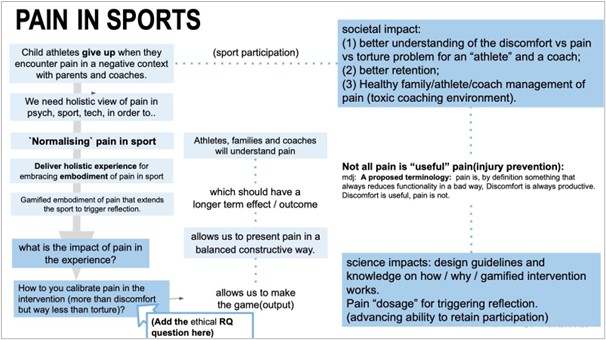
7.5 SportsHCI lens: Humility in sports
Florian Daiber, Floyd ‘Floyd’ Mueller, Dees Postma, Robby van Delden
License: Creative Commons BY 4.0 International license © Florian Daiber, Floyd ‘Floyd’ Mueller, Dees Postma, Robby van Delden
We discussed what the lens of humility was about and went through the three types, mostly directly in relation to some of the examples given in the paper. We reiterated that the big mountain in front of you brings a sense of humility, talked about the humility from competing against someone who is expert or better, only later more as a side note for completion we briefly mentioned but not really discussed trying again. Instead, we did discuss trash talk and bluffing in relation to humility. There is a difference of knowing your skills/cards (e.g. in poker you might exactly know what you have in the last round), versus not yet knowing your current capabilities of that day before going all out. The trash talks was also a picture in one of the slides shown after it was mentioned in the discussion, we related this also to the current sports event of the Tour de France. For instance, the coach sort of coaxing by saying “you can do it!” to Pogačar who was already completely beat. We later mentioned exemplars from media/every day use and own experiences. This led to the focus on experiencing actual parts of being a pro, which interestingly enough is also in the paper but more as a almost comparison rather than a more complete feeling of humility. Through the generation of the design space we saw a variation in first person experiences of pro sports which might make one humbled. After the discussion we wondered how other theoretical contributions or theory would play a role, or could help to shape the design space. Here, Newell’s theory of constraints, phenomenology, and remediation/ post-phenemonology were mentioned but not discussed in too much depth.
Reflecting on the process, we see a recall and sharing of exemplar 1st/2nd/3rd person experiences, some focusing on the somaesthetic qualities (e.g., going a ridiculous speed in real or virtual life). There is a back and forth of ideas that would be interesting to experience humility, ideas that inspire a direct transformation of that idea into something related (e.g., from wavelight to seeing someone descend in the Tour de France), then talking these and associated ideas through we see other examples that already exist (e.g. cycling at higher speed due to wrong weight setting, experiencing downhill footage in connection to simulator) which we can build on but require and instigate a transformation of the last proposed own idea into something new (e.g., camera-based system currently not keeping up if you don’t break downhill, rather than seeing the pace align the pace changing you with your “known” speed). This thus naturally transitions between inspiration, associated idea generation, to converging or actually taking steps sideways, see Figure below.
Concept.
We identified that systems that allow you to compare your athletic performance to a professional athlete can facilitate humility. They are emerging (examples: wavelight, …) and span a new design space. By allowing to compare yourself to a professional athlete, facilitating humility, we can help society appreciate the achievements, efforts and investments of professional athletes more, supporting a more empathetic culture.

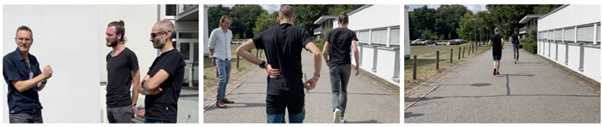
Impact pathway.
We mostly worked on furthering the design space. This also led to a remark about current Dutch grants on researching the value of elite sports for society/trickling down to amateur/grassroots sports. Building on the existing framework explained by Dennis, we see top right Sports is a human right and then counterclockwise:
-
people are in bad shape (see papers on skills going down, lack of moving and interrelated issues, alternatively “not enough people experience the joy of moving often enough”)
-
One powerful experience could be to see the pro athletes enjoyment/experience as a possible goal to work towards. It might be bringing a feeling of humility, triggering one to attempt it again and again.
-
Technology is used to map or remediation between what the bodily experience/capabilities of the pro-athlete are versus what those bodily experiences/capabilities of the novice athlete are.
-
These mappings are however initiated only sporadically for some sports and without a clear experiential framework and wider accessibility. So the scientific challenge becomes what can we remediate of the pro-athletes experiences, and how should we map these remediations?
-
If we answer these in positive ways (where our related work/exemplars already show some opportunities) we offer a framework and set of experiences to more fully appreciate the pro athlete’s experience of pro-ness.
-
This in turn we expect will lead to a wider uptake of such experiences, potentially instigating people’s interest in sports, and fulfilling our fundamental right to experience sports and moving (cf. IOC’s view and UN goals).
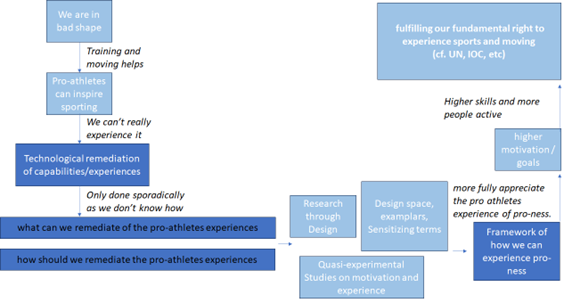
8 Acknowledgements
We thank Dagstuhl for their extensive support and all the participants who contributed to this report as part of a collective effort. A particular thank you to Maria Fernanda ’Mafe’ Montoya Vega for volunteering first to help and supporting the organizers in finalizing the report.
Dennis Reidsma: “As an organiser, I felt we could really focus on the content and participate in the work, thanks to the smooth facilitation by the Dagstuhl team from the start of the application all the way through the actual seminar.”
Andrii Matviienko: “This is the best summer camp for nerds I’ve ever attended!”
Carine Lallemand: “Dagstuhl seminars are a truly unique format in academia. Magic happens when bringing together top researchers in a field and allowing them to truly focus and network during 5 days.”
Laia Turmo Vidal: “I truly enjoyed the format of focused work in such a pleasant and nice environment! I will treasure the Dagstuhl experience and I am looking forward to great things coming out of it.”
Lars Elbæk: “The Dagstuhl seminar will bring my cross-field of technology and interaction design in my primary field of sports science further in my future research. This was a highly experienced expert group that brings in-depth and a wide variety of knowledge into sports science will lightly influence future sports science. On the contrary, sports science will probably also affect future SportsHCI, I believe.”
Mike Jones: “A perfect combination of academic discussions and informal activities. This was a great place to both imagine new research directions and build collaborative relationships with colleagues. It became clear to me that while competition is a key part of sports, other aspects of the sports experience such as enjoyment and discomfort are also a key part of the sports experience. By the end of the week, it was clear that experience and competition, enjoyment and discomfort have complicated relationships that need further study. It was valuable to wrestle with these concepts with a group of experts in sports and human-computer interaction.”
Armağan Karahanoğlu: “Dagstuhl provided a fantastic natural sports opportunity to contemplate the future of SportsHCI. It was a great place to discuss the research opportunities to bridge sports science, HCI and human-centred design.”
Vincent van Rheden: “Dagstuhl felt like a retreat for researchers, helping to deepen topics, connect with fellow researchers, create a feeling of community, being situated in a beautiful location away from the hectic of normal life. SportsHCI is where sports and interactive technology come together to create motivating, inspiring, and innovative work to help people move, grow, and enjoy sports and exertion activities.”
9 Participants
-
Regina Bernhaupt – TU Eindhoven, NL
-
Paolo Buono – University of Bari, IT
-
Lisa Anneke Burr – Paris Lodron Universität Salzburg, AT
-
Florian Daiber – DFKI – Saarbrücken, DE
-
Lars Elbaek – University of Southern Denmark – Odense, DK
-
Don Samitha Elvitigala – Monash University – Clayton, AU
-
Perttu Hämäläinen – Aalto University, FI
-
Daniel Harrison – University of Northumbria – Newcastle, GB
-
Michael Jones – Brigham Young Univ. – Provo, US
-
Armagan Karahanoglu – University of Twente, NL
-
Carine Lallemand – University of Luxembourg, LU
-
Andrii Matviienko – KTH Royal Institute of Technology – Stockholm, SE
-
Maria Fernanda Montoya Vega – Monash University – Clayton, AU
-
Florian ‘Floyd’ Mueller – Monash University – Clayton, AU
-
Dees Postma – University of Twente, NL
-
Dennis Reidsma – University of Twente – Enschede, NL
-
Xipei Ren – Beijing Institute of Technology, CN
-
Laia Turmo Vidal – Carlos III University of Madrid, ES
-
Robby van Delden – University of Twente – Enschede, NL
-
Elise van den Hoven – University of Technology – Sydney, AU
-
Vincent van Rheden – Paris Lodron Universität Salzburg, AT
-
Fabio Zambetta – RMIT University – Melbourne, AU
![[Uncaptioned image]](x3.jpg)