Designing Computers’ Control Over Our Bodies
Abstract
The classical human-computer interaction (HCI) model characterised interactions as predominantly user-directed, with the computer acting as a responder to human commands. This paradigm had been foundational, yet contemporary research pivoted towards more reciprocal roles, where the machine not only responded but also asserted control. This emerging domain, characterised by technologies such as electrical muscle stimulation, galvanic vestibular stimulation, and exoskeletons, introduced a new dynamic – computational control over the human body. Such technologies offered significant benefits, like enhanced safety in autonomous vehicles and increased mobility through autonomous exoskeletons. However, these advancements also ushered in ethical, psychological, and physical concerns, paralleling earlier fears associated with technologies that aimed to control human psychology.
The absence of a structured theoretical framework to articulate and evaluate the experiences of being controlled by a machine was evident, as was a comprehensive understanding of how to design such interactions responsibly. This Dagstuhl Seminar sought to bridge these gaps by convening experts from academia and industry. The seminar explored multidisciplinary approaches to the design challenges and societal implications of computational control over the human body. Through collaborative discourse, the event aimed to foster a deeper understanding of this complex interaction paradigm, contributing towards a more humane technological future by integrating diverse insights and expertise.
Keywords and phrases:
Body, Control, Human-Computer Integration, Human-Computer Interaction, HCI, Computational Control, Electrical Muscle Stimulation, Galvanic Vestibular Stimulation, Exoskeletons, Ethics, Design FrameworkSeminar:
June 2–7, 2024 – https://www.dagstuhl.de/242322012 ACM Subject Classification:
Human-centered computing Human computer interaction (HCI) ; Human-centered computing Interaction paradigmsCopyright and License:
![[Uncaptioned image]](x1.png) Except where otherwise noted, content of this report is licensed under a
Creative Commons BY 4.0 International license
Except where otherwise noted, content of this report is licensed under a
Creative Commons BY 4.0 International license
1 Executive Summary
Nadia Bianchi-Berthouze
Mar Gonzalez-Franco
Florian ‘Floyd’ Mueller
Misha Sra
License: ![[Uncaptioned image]](x2.png) Creative Commons BY 4.0 International license © Nadia Bianchi-Berthouze, Mar Gonzalez-Franco, Florian ‘Floyd’ Mueller, and Misha Sra
Creative Commons BY 4.0 International license © Nadia Bianchi-Berthouze, Mar Gonzalez-Franco, Florian ‘Floyd’ Mueller, and Misha Sra
The Dagstuhl Seminar 24232, titled “Designing Computers’ Control Over Our Bodies”, was held from June 2 to June 7, 2024, at Schloss Dagstuhl – Leibniz-Zentrum für Informatik, Germany. This seminar brought together leading experts from diverse fields to explore a new paradigm in human-computer interaction (HCI) where technologies such as electrical muscle stimulation, galvanic vestibular stimulation, and exoskeletons enable computers to exert direct control over the human body [1, 2, 3, 4, 5]. The seminar addressed both the opportunities and challenges of this emerging domain, which extends beyond the traditional model of user-directed interaction to consider reciprocal roles where machines also assert control [3, 6, 7].
Over the course of five days, participants engaged in a variety of activities designed to foster interdisciplinary collaboration and develop a comprehensive understanding of this complex interaction paradigm. The seminar’s objectives included the following:
Identifying Theoretical Gaps.
Participants explored the absence of a structured theoretical framework for articulating and evaluating experiences of being controlled by a machine. Discussions focused on such interactions’ ethical, psychological, and physical dimensions, highlighting the need for a multidisciplinary approach to understand and design for these new dynamics [8, 9, 10].
Design Challenges and Opportunities.
The seminar investigated the design challenges associated with computational control over the human body, considering both the benefits, such as enhanced safety in autonomous systems and increased mobility, and the concerns, including issues of user agency, consent, and trust [11]. Hands-on sessions enabled participants to prototype and critique design concepts that address these complexities.
Societal Implications.
The discussions extended to the societal impact of these technologies, examining potential applications and unintended consequences. Ethical considerations, particularly around the autonomy of users and the transparency of machine actions, were central to these debates [12]. The seminar aimed to outline guidelines for the responsible development and deployment of such technologies in various contexts, from healthcare to entertainment.
Envisioning Future Directions.
A key focus of the seminar was envisioning the future landscape of HCI where computational control technologies become more prevalent. Speculative design sessions invited participants to imagine both utopian and dystopian scenarios for the year 2050, facilitating discussions on the potential trajectories of these technologies with- and without-AI, and their integration into daily life.
Developing a Research Agenda.
The seminar concluded with the development of a research agenda to guide future work in this field. This agenda included key questions to address, potential methodologies for study, and proposals for new theoretical frameworks. Working groups were established to continue collaborative efforts beyond the seminar.
The seminar’s key outcomes included identifying several grand challenges in this emerging field, formulating initial design frameworks, and establishing a network of researchers and practitioners committed to advancing knowledge and practice in computational control technologies. The seminar highlighted the importance of interdisciplinary approaches to understanding and designing for these new interaction paradigms, which blend the digital and physical realms where the computer can control the human body.
The seminar’s findings will contribute to the ongoing discourse on the future of HCI, particularly in areas where control dynamics between humans and machines are increasingly blurred. Moving forward, the insights gained from this event will help shape a more humane technological future, ensuring that innovations in computational control are aligned with ethical and societal values.
References
- [1] Rakesh Patibanda, Chris Hill, Aryan Saini, Xiang Li, Yuzheng Chen, Andrii Matviienko, Jarrod Knibbe, Elise Van Den Hoven, and Florian ‘Floyd’ Mueller. Auto-paizo games: Towards understanding the design of games that aim to unify a player’s physical body and the virtual world. Proceedings of the ACM on Human-Computer Interaction, 7(CHI PLAY):893–918, 2023.
- [2] Pedro Lopes, Sijing You, Lung-Pan Cheng, Sebastian Marwecki, and Patrick Baudisch. Providing haptics to walls & heavy objects in virtual reality by means of electrical muscle stimulation. In Proceedings of the 2017 CHI Conference on Human Factors in Computing Systems, pages 1471–1482, 2017.
- [3] Florian Floyd Mueller, Pedro Lopes, Paul Strohmeier, Wendy Ju, Caitlyn Seim, Martin Weigel, Suranga Nanayakkara, Marianna Obrist, Zhuying Li, Joseph Delfa, Jun Nishida, Elizabeth M. Gerber, Dag Svanaes, Jonathan Grudin, Stefan Greuter, Kai Kunze, Thomas Erickson, Steven Greenspan, Masahiko Inami, Joe Marshall, Harald Reiterer, Katrin Wolf, Jochen Meyer, Thecla Schiphorst, Dakuo Wang, and Pattie Maes. Next steps for human-computer integration. In Proceedings of the 2020 CHI Conference on Human Factors in Computing Systems, CHI ’20, page 1–15, New York, NY, USA, 2020. Association for Computing Machinery.
- [4] Romain Nith, Yun Ho, and Pedro Lopes. Splitbody: Reducing mental workload while multitasking via muscle stimulation. In Proceedings of the CHI Conference on Human Factors in Computing Systems, CHI ’24, New York, NY, USA, 2024. Association for Computing Machinery.
- [5] Rakesh Patibanda, Elise Van Den Hoven, and Florian ‘Floyd’ Mueller. Towards understanding the design of body-actuated play. In Extended Abstracts of the 2022 Annual Symposium on Computer-Human Interaction in Play, CHI PLAY ’22, page 388–391, New York, NY, USA, November 2022. Association for Computing Machinery.
- [6] Eun-Soo Jung, Suh-Yeon Dong, and Soo-Young Lee. Neural correlates of variations in human trust in human-like machines during non-reciprocal interactions. Scientific Reports, 9, 2019.
- [7] Steve Benford, Richard Ramchurn, Joe Marshall, Max L. Wilson, Matthew Pike, Sarah Martindale, Adrian Hazzard, Chris Greenhalgh, Maria Kallionpää, Paul Tennent, and Brendan Walker. Contesting control: journeys through surrender, self-awareness and looseness of control in embodied interaction. Human–Computer Interaction, 36(5-6):361–389, 2021.
- [8] Pedro Lopes, Lewis L. Chuang, and Pattie Maes. Physiological i/o. In Extended Abstracts of the 2021 CHI Conference on Human Factors in Computing Systems, CHI EA ’21, New York, NY, USA, 2021. Association for Computing Machinery.
- [9] Rakesh Patibanda, Aryan Saini, Nathalie Overdevest, Maria F. Montoya, Xiang Li, Yuzheng Chen, Shreyas Nisal, Josh Andres, Jarrod Knibbe, Elise van den Hoven, and Florian ‘Floyd’ Mueller. Fused spectatorship: Designing bodily experiences where spectators become players. Proc. ACM Hum.-Comput. Interact., 7(CHI PLAY), oct 2023.
- [10] Rakesh Patibanda, Nathalie Overdevest, Shreyas Nisal, Aryan Saini, Don Samitha Elvitigala, Jarrod Knibbe, Elise Van Den Hoven, and Florian ‘Floyd’ Mueller. Shared bodily fusion: Leveraging inter-body electrical muscle stimulation for social play. In Proceedings of the 2024 ACM Designing Interactive Systems Conference, DIS ’24, page 2088–2106, New York, NY, USA, July 2024. Association for Computing Machinery.
- [11] Florian ‘Floyd’ Mueller, Nathan Semertzidis, Josh Andres, Joe Marshall, Steve Benford, Xiang Li, Louise Matjeka, and Yash Mehta. Toward understanding the design of intertwined human–computer integrations. ACM Trans. Comput.-Hum. Interact., 30(5), sep 2023.
- [12] Saul Greenberg, Sebastian Boring, Jo Vermeulen, and Jakub Dostal. Dark patterns in proxemic interactions: a critical perspective. In Proceedings of the 2014 Conference on Designing Interactive Systems, DIS ’14, page 523–532, New York, NY, USA, 2014. Association for Computing Machinery.
2 Table of Contents
3 Introduction
The Dagstuhl Seminar, “Designing Computers’ Control Over Our Bodies”, gathered leading experts from academia and industry to explore the emerging paradigm of human-computer interaction (HCI) characterised by computational control over the human body. The participant pool included 6 PhD candidates, 1 postdoctoral researcher, 3 industry professionals, 4 assistant professors, 2 associate professors, and 8 full professors (Figure 1). This seminar marked a departure from the classical HCI model, which traditionally positioned the human as the sole director and the computer as a passive responder. Instead, the discussions focused on a more dynamic, reciprocal interaction model where technologies such as electrical muscle stimulation, galvanic vestibular stimulation, and exoskeletons allow computers to assert direct control over human actions and movements.

The seminar was structured over five intensive days, each with a distinct thematic focus, ranging from theoretical foundations to practical design implications and future visions. The participants engaged in a mix of presentations, interactive sessions, group discussions, and collaborative design activities to foster a comprehensive understanding of the new dynamics in HCI.
3.1 Day 1: Theory Day
The seminar began with an introductory session led by the organisers, where participants were welcomed and introduced to the seminar’s goals and structure. The day continued with a series of “PechaKucha” presentations, where each participant had five minutes to present their work and perspectives on computational control technologies. This fast-paced format helped set the stage for a deeper exploration of the grand challenges and opportunities that these emerging technologies present. The day ended with a group activity where participants identified and categorised key challenges, which were then organised into broader themes of grand challenges to be addressed throughout the seminar.
3.2 Day 2: Design Day
Building on the theoretical discussions from Day 1, Day 2 was dedicated to exploring the design challenges associated with computational control over the human body. Participants were invited to bring prototypes or share design concepts during hands-on sessions. These sessions facilitated a deeper understanding of how to create responsible and ethical design frameworks that accommodate the complexities of machine control over human bodies. The day also included further PechaKucha presentations, followed by group activities to synthesise insights from both the theoretical and practical design perspectives.
3.3 Day 3: Theory Meets Design
Day 3 bridged the gap between theory and practice, focusing on the integration of theoretical frameworks with practical design approaches. Participants worked in breakout groups to align their individual seminar goals with the continued process of identifying grand challenges. This day featured extensive discussions on how to merge theoretical insights with design principles to create holistic approaches to computational control technologies. The morning session included collaborative group work, and the afternoon focused on presenting and critiquing the developed ideas.
3.4 Day 4: Day of Envisioning
On Day 4, the seminar shifted towards envisioning future directions for research and development in this field. Participants engaged in speculative design sessions to imagine scenarios where computational control technologies (controlled by AI or otherwise) are fully integrated into daily life by 2050. These speculative exercises aimed to identify utopian and dystopian possibilities, encouraging participants to consider such technologies’ ethical, social, and psychological implications. The day concluded with a plenary session where groups reported on their envisioned futures and debated their desirability and feasibility.
3.5 Day 5: What’s Next?
The final day was dedicated to synthesising the seminar’s outcomes and identifying tangible next steps, particularly directed at writing an article on the grand challenges that surfaced in this area throughout this seminar. Participants worked on drafting concrete outputs, including research papers, frameworks, and guidelines that could serve as foundational documents for this emerging field. The day also included reflective sessions where participants shared their experiences, insights, and ideas for future collaboration. The seminar ended with a discussion on the formation of working groups to continue the momentum generated during the week.
This structured and intensive programme allowed participants to explore the complexities of computational control technologies from multiple perspectives, paving the way for future research and collaboration in designing humane and ethical interactions where computers assert control over the human body.
4 PechaKutchas
The seminar featured a series of dynamic PechaKucha sessions, a presentation format where each speaker had five minutes to present their slides and three minutes for questions from the audience. This format allowed for fast-paced and engaging presentations that succinctly conveyed key ideas. These sessions provided a platform for participants to share their latest research, insights, and reflections on the seminar’s central theme: designing computers’ control over the human body. They played a crucial role in setting the stage for broader discussions and stimulating dialogue around foundational concepts and emerging ideas.
Participants covered a diverse range of topics that spanned the theoretical, practical, and experiential dimensions of computational control technologies. Some presentations focused on novel technological approaches, such as “TickleFoot” [4], which explored how unconventional stimuli could create playful and positive bodily experiences under computer control. This work highlighted the potential of playful interactions to ease into the complex topic of shared control between humans and machines.
Other sessions explored the more conceptual and philosophical aspects of control. For example, the presentation on “If control is here, how is it?” [20] investigated the nuanced and often ambiguous nature of control in systems where humans and machines function symbiotically [2, 26]. Meanwhile, “Losing Control” examined what it means to relinquish control to a machine, not just from a functional perspective but as a transformative playful experience that challenges existing notions of autonomy and agency in HCI and game design [12, 2].
Presentations like “Charting the Landscape of Body Control Techniques” provided an overview of current research in body control technologies, mapping out various methods, from closed-loop to open-loop systems, and identifying areas for future exploration [1]. Talks such as “Control in HCI” and “Closed-loop and Open-loop Control” offered insights into how different control mechanisms impact user experiences and highlighted these approaches’ ethical and practical implications [8, 7, 38, 5].
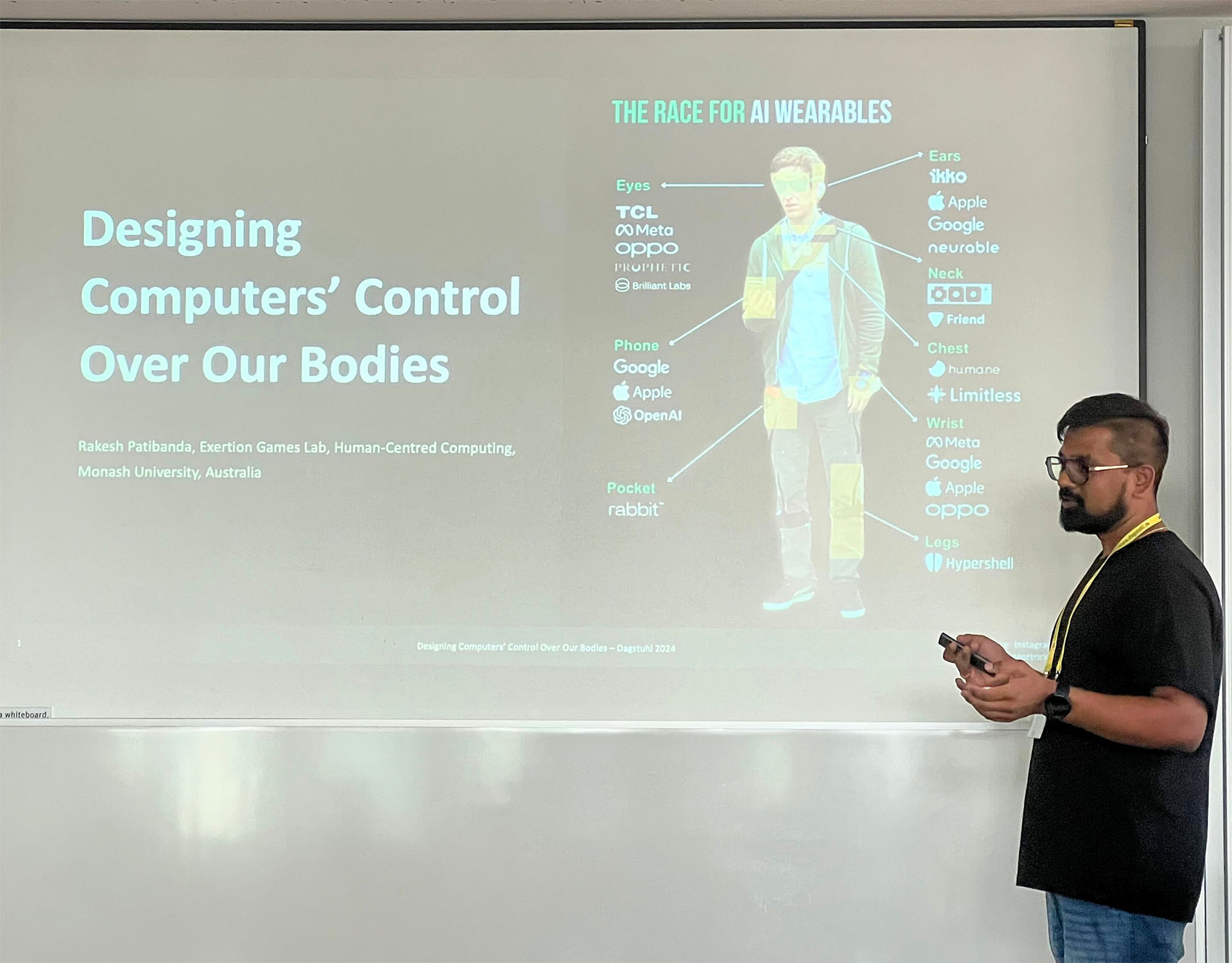
The theme of playfulness was a recurrent topic, as seen in the presentation “Playing by Sharing Bodily Control with Computers.” This talk explored how shared control dynamics could create playful and engaging interactions, emphasising the potential benefits of designing experiences where computers and users co-navigate control [28] (Figure 2). By treating the body as both a controller and a site of play, this approach illustrated how playful designs could create novel forms of engagement and enjoyment in contrast to traditional HCI paradigms [21, 26, 24, 23, 22, 27].
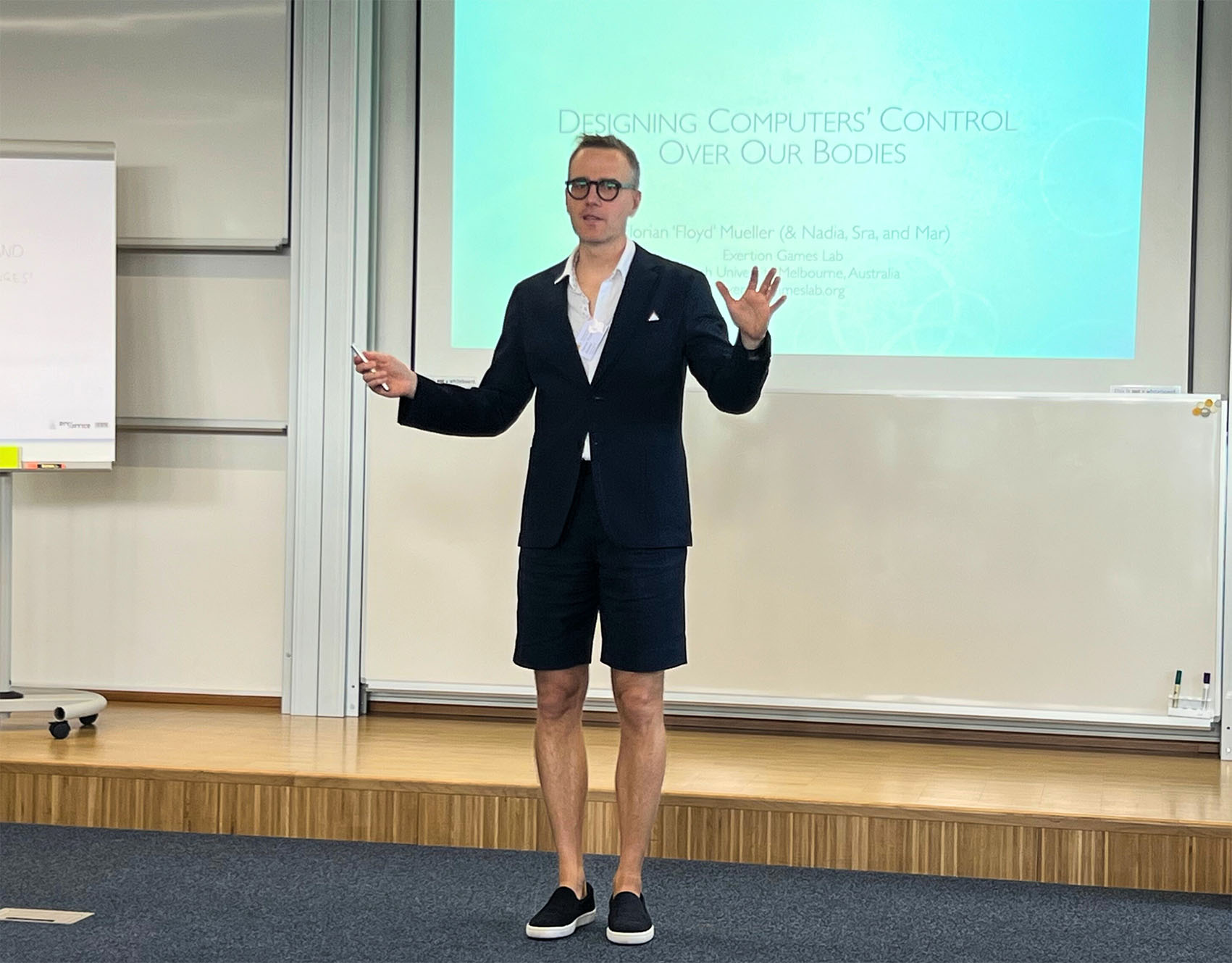
Similarly, sessions like “Sharing Bodily Control with Computers” and “Designing Computers’ Control over the Body that centres around Bodily Play” (Figure 3) emphasised the value of integrating play into design frameworks. These presentations argued that allowing users to share control with computers opens up new possibilities for creativity, spontaneity, and user agency, ultimately enriching the user experience [16, 18, 15, 13].
A number of talks, such as “Negotiating Augmented Bodies” [29, 30] and “Designing Bodily Extensions,” [32, 31] examined the interface between humans and technology, focusing on how digital and physical extensions of the body can be designed to respect bodily autonomy while allowing for innovative forms of interaction. These discussions were complemented by presentations like “Haptic Experiences and Bodily Control,” [33] which explored the sensory aspects of control technologies, demonstrating how haptic feedback can be used to create more immersive and nuanced control experiences.
These technologies’ social and embodied dimensions were also a focal point, with sessions like “Social and Embodied Perspectives” [6, 14] exploring how body control technologies intersect with social norms and behaviours. These presentations emphasised the importance of designing technically feasible, socially and ethically responsible technologies, fostering acceptance and trust among users.
Some participants were happy to share their presentations for everyone to view, while others chose to keep their content exclusive to the seminar, reflecting the sensitive and pioneering nature of some of the presented research.
Overall, the PechaKucha sessions set the tone for the seminar by providing a plethora of perspectives and ideas, ranging from the playful and provocative to the deeply theoretical and critical. They accelerated discussions that would continue throughout the seminar, laying a foundation for developing new frameworks, methodologies, and collaborative efforts in the field of designing computers’ control over the human body.
4.1 Emergent themes of discussion from Day 1

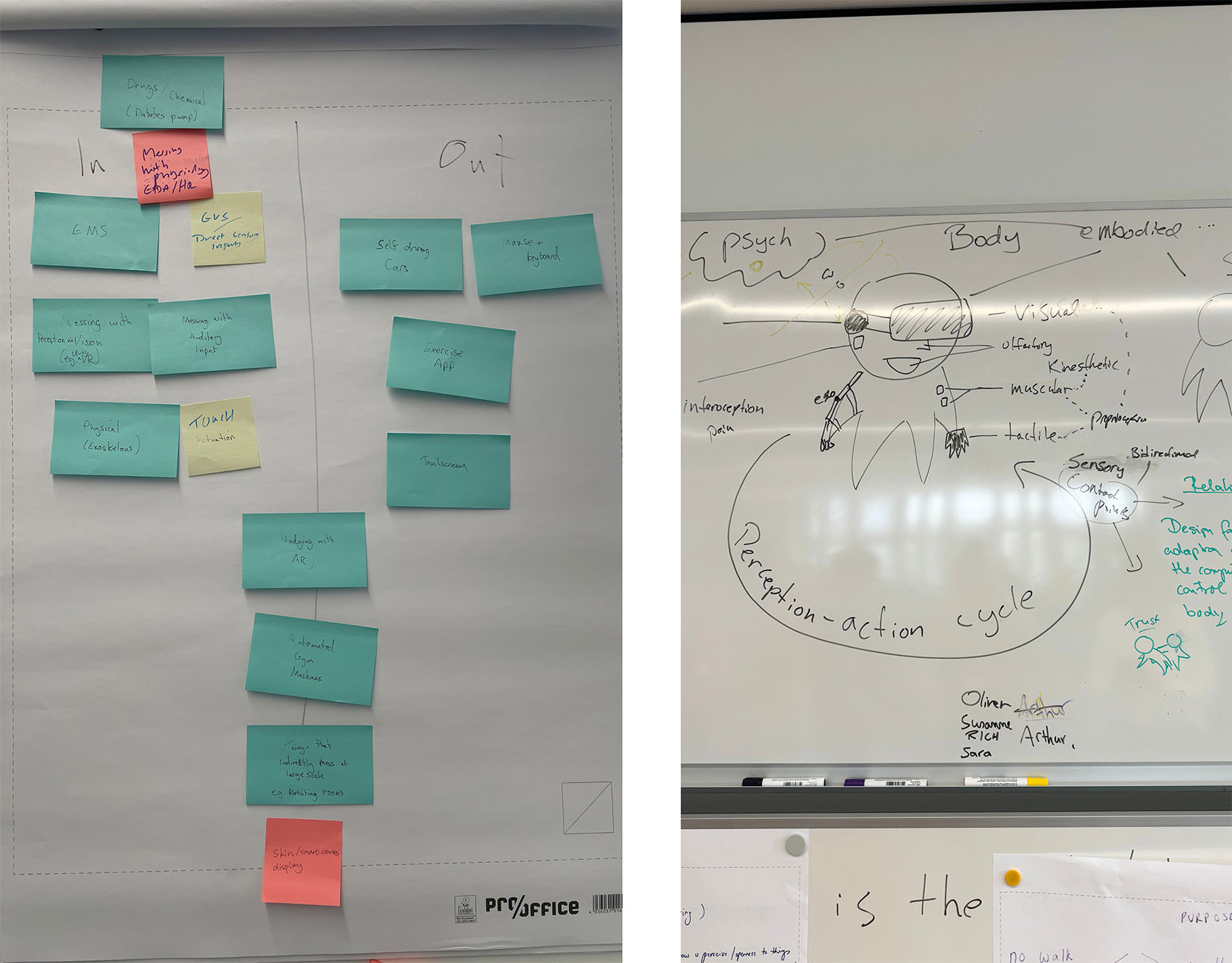
From Day 1, several key themes emerged as participants discussed the grand challenges related to computational control over the human body (Figure 4). These themes were documented in the notes taken during and after the presentation sessions:
-
1.
Control and agency:
-
A significant theme centred around the relationship between control and agency. Participants debated how computational systems could either enhance or diminish a user’s sense of agency. Discussions included both implicit control (where control is seamlessly integrated and less noticeable to the user) and explicit control (where the user is fully aware of and potentially directing the control dynamics).
-
Questions emerged regarding how control should be designed to balance these dynamics, ensuring transparency and maintaining a user’s feeling of autonomy.
-
-
2.
Implicit vs. explicit control:
-
The balance between implicit and explicit control was identified as a critical design consideration. Participants explored how different forms of control might affect the user’s experience, comfort, and acceptance of such technologies. For example, while explicit control allows for more transparency and user awareness, implicit control might lead to smoother, less intrusive experiences but could also raise concerns about trust and manipulation.
-
-
3.
Designing for sensory and perceptual experiences:
-
Discussions highlighted the importance of designing technologies that consider sensory and perceptual aspects, such as visual augmentations to the body or face, haptic feedback, and other multisensory experiences. Themes like the Proteus Effect (how a user’s self-perception changes through interaction with technology) and the placebo effect were discussed, pointing to the need for careful consideration of how sensory augmentations might alter user experiences and perceptions.
-
-
4.
Adaptivity and personalisation:
-
Another theme focused on the need for adaptive systems that can adjust to individual user differences, such as age, physical ability, and cognitive load. Participants raised questions about how these systems could dynamically modify their behaviours or outputs to better suit the user’s evolving needs, thereby enhancing usability and user satisfaction.
-
-
5.
Negotiation of control:
-
The notion of negotiating control between the human and the machine was a recurring topic. This included discussions on collaboration vs. automation and how users and systems can share or shift control in various contexts. The concept of “negotiation” in this space addresses how to design interactions that are flexible, adaptable, and responsive to changes in user intent or environmental conditions.
-
-
6.
Ethical considerations and dark patterns:
-
Ethical issues such as transparency, informed consent, and avoiding manipulative “dark patterns” were heavily discussed. The theme of responsible design emerged, focusing on creating technologies that respect user autonomy and ensure ethical standards are upheld. This theme underscored the importance of designing systems that can communicate their intentions clearly to users and provide meaningful choices regarding control dynamics.
-
-
7.
Social and embodied perspectives:
-
Participants explored the social implications of these technologies, examining how control over the body might affect social norms, behaviours, and interactions. Themes related to the social environment, the effect of such technologies on shared experiences, and how they could either enhance or disrupt existing social practices were identified.
-
-
8.
Awareness and performance:
-
The role of awareness, both in terms of a user’s self-awareness and their understanding of the system’s behaviour, was another key theme. Discussions also touched on performance metrics, questioning how these technologies could optimise human performance without compromising ethical standards or user comfort.
-
-
9.
Future design directions:
-
Participants speculated on future directions for design, asking how to create systems that balance autonomy, adaptability, and user comfort. They considered what frameworks could guide the ethical development of technologies that exert control over the human body and how to align these technologies with human values and needs.
-
These themes reflect a broad and deep engagement with the challenges and opportunities presented by emerging control technologies, highlighting the complexities involved in designing systems that can control the human body.
5 Group Activities on Day 2 and Day 3

During Days 2 and 3 of the seminar, participants engaged in several group activities designed to deepen their understanding of computational control over the human body. The activities were structured around five distinct groups, each focused on a specific aspect of the seminar’s theme. These groups collaborated to explore definitions, perspectives, challenges, and implications associated with control, synthesising ideas that emerged from the PechaKucha sessions and other discussions.
-
1.
Defining control:
-
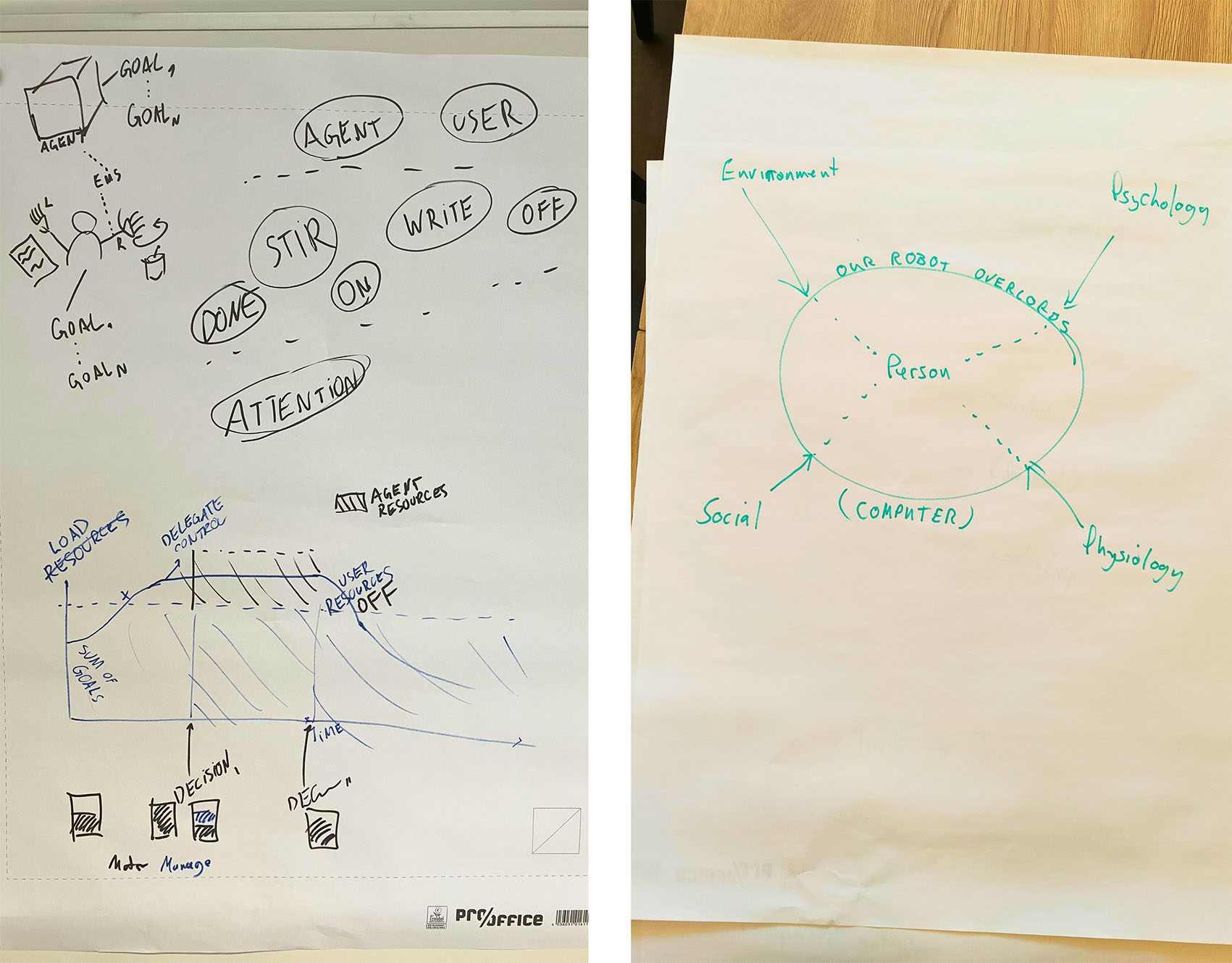
One group concentrated on developing a comprehensive definition of “control” within the context of human-computer interaction. They debated the nuances of control, such as its various forms (implicit versus explicit), its dynamic nature, and how control is negotiated between humans and machines (Figure 5). Their discussions aimed to articulate a shared understanding that could serve as a foundation for further research and design frameworks.
-
-
2.
Exploring perspectives on control:
-
Another group sought to map the diverse perspectives of control, scoping the topic across different dimensions, including psychological, social, physiological, and environmental contexts. This group discussed how control can be experienced differently by individuals and how these differences could be accounted for in designing systems that assert control over the human body. Their goal was to establish a multidimensional framework that reflects the complex, layered nature of control in human-computer interactions.
-
-
3.
Social and ethical implications:
-
A third group focused on control technologies’ social and ethical implications. They examined how these technologies might affect social norms, interpersonal relationships, and individual autonomy (Figure 6). Topics such as user consent, data privacy, and the avoidance of dark patterns were central to their discussions. The group aimed to identify ethical guidelines and best practices for designing and deploying control technologies in ways that respect user rights and societal values.
-
-
4.
Synthesising challenges:
-
This group aimed to synthesise the grand challenges identified during the PechaKucha sessions and the first two days of discussions. They reviewed the notes and flipcharts created throughout the sessions, looking for common themes, gaps, and emerging questions. Their objective was to produce a coherent set of challenges that encapsulate the key issues facing researchers and practitioners in the field, providing a roadmap for future research and development.
-
-
5.
Engineering perspectives on control:
-
The fifth group explored the engineering side of control technologies. They focused on technical challenges such as calibration, measurement, and benchmarking methods, and the need for robust, adaptable algorithms that can dynamically adjust to user needs and contexts. This group also examined how to design for user confidence and trust, ensuring that control mechanisms are reliable, transparent, and predictable. They looked into how engineering solutions could support both explicit and implicit control forms, aligning with broader ethical and social considerations.
-
5.1 Key Outcomes from Group Activities
-
Shared understanding: By the end of Day 3, there was a clearer shared understanding of the core concept of control and its complexities within human-computer interactions. This was marked by a convergence of ideas on the need for new frameworks and models that account for the diverse experiences and expectations of control.
-
Framework for future research: The synthesis of challenges led to the creation of a preliminary framework outlining the key areas for future research. This included ethical guidelines, design principles, and technical requirements that would guide the responsible development of control technologies.
-
Interdisciplinary collaboration: The discussions highlighted the importance of interdisciplinary collaboration, bringing together perspectives from psychology, engineering, ethics, and design to address the multifaceted nature of control technologies. Participants identified potential collaboration opportunities and established working groups to continue exploring these themes beyond the seminar.
-
Engineering challenges: The group focusing on engineering challenges provided insights into the technical constraints and possibilities of implementing control technologies. They emphasised the importance of rigorous testing, user feedback loops, and iterative design processes to ensure these technologies are both effective and aligned with user needs.
These group activities set the stage for subsequent discussions and sessions, creating a collaborative environment where participants could further refine their ideas and contribute to the development of a comprehensive understanding of computational control over the human body.
6 Hiking Activity at Saar-Hunsrück-Steig
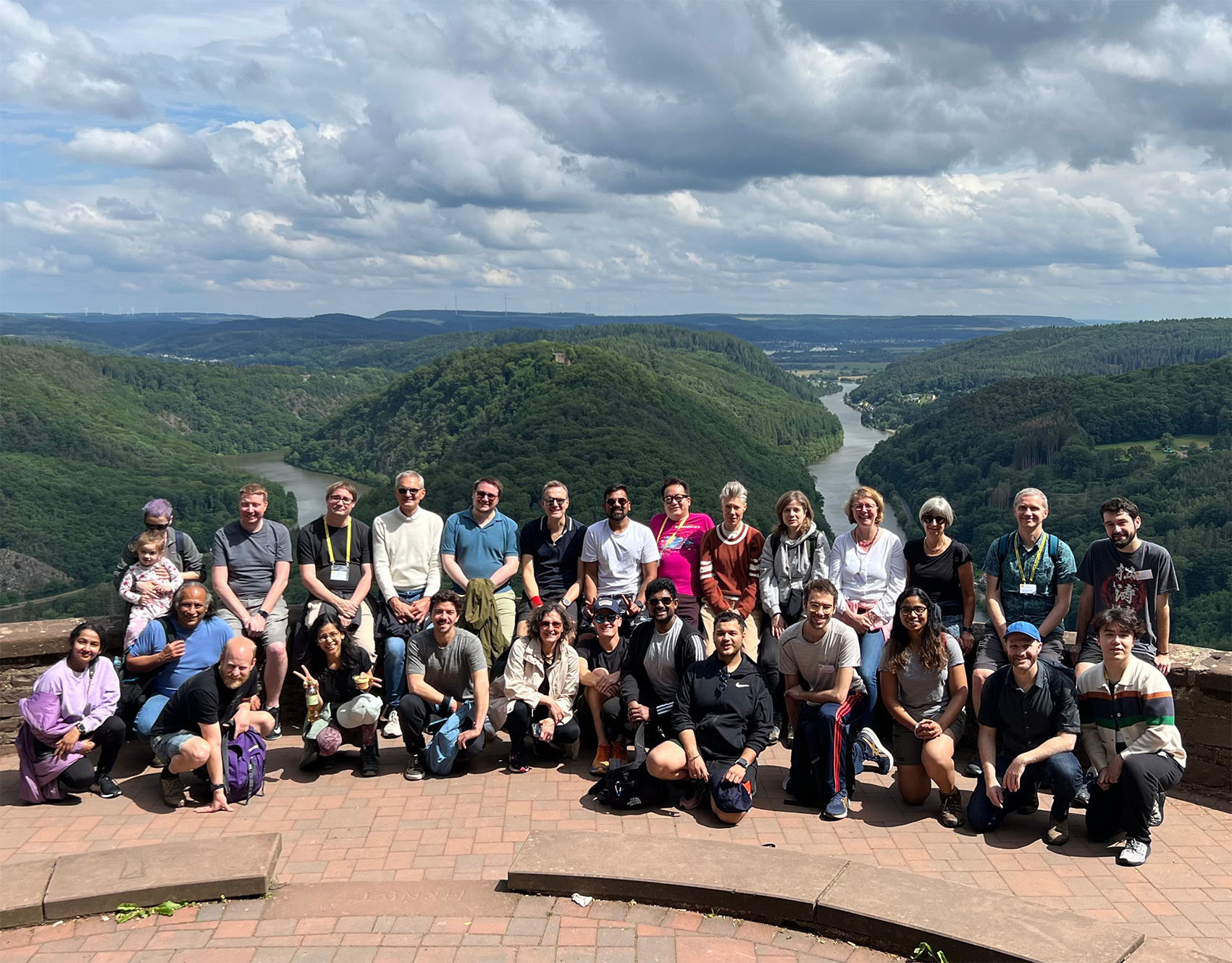
On the afternoon of Day 3, participants took a break from the intense seminar discussions and embarked on a hiking tour along the scenic Saar-Hunsrück-Steig trail (Figure 8). The hike provided a unique opportunity for informal networking and reflection in a more relaxed and natural setting. Scheduled to start at 1:30 PM, the activity was designed for leisure and as a platform for meaningful career development and peer exchange.
6.1 Career Advice in Motion
The hiking tour incorporated a dedicated career advice session where participants could seek guidance and share insights about professional growth and development. Senior academics and experienced researchers walked alongside early-career participants, facilitating open and candid conversations about navigating the complexities of academic and research careers.
Participants were encouraged to switch groupings periodically, allowing them to interact with a variety of peers and mentors. This dynamic format fostered an environment where advice could be exchanged freely, and participants could gain diverse perspectives on topics such as:
-
Building a research profile and securing funding.
-
Balancing academic responsibilities with personal life.
-
Navigating interdisciplinary collaborations.
-
Strategies for publishing in high-impact journals.
-
Leveraging professional networks for career advancement.
Many participants found this informal setting particularly conducive to discussing challenges and aspirations they might not typically share in more formal seminar settings.
6.2 Ending the Hike with a Group Dinner
After the hike, the participants reconvened for a group dinner, where they continued their conversations and reflected on the day’s experiences. The dinner provided an additional networking opportunity, solidifying new connections made during the hike and sharing reflections on the seminar’s themes.
The combination of physical activity, career-focused discussions, and social interaction helped deepen the sense of community among participants, enhancing the collaborative spirit developing throughout the seminar.
Overall, the hiking activity was a refreshing and productive break that enriched the seminar experience, offering personal and professional growth opportunities.
7 Thinking Through Writing
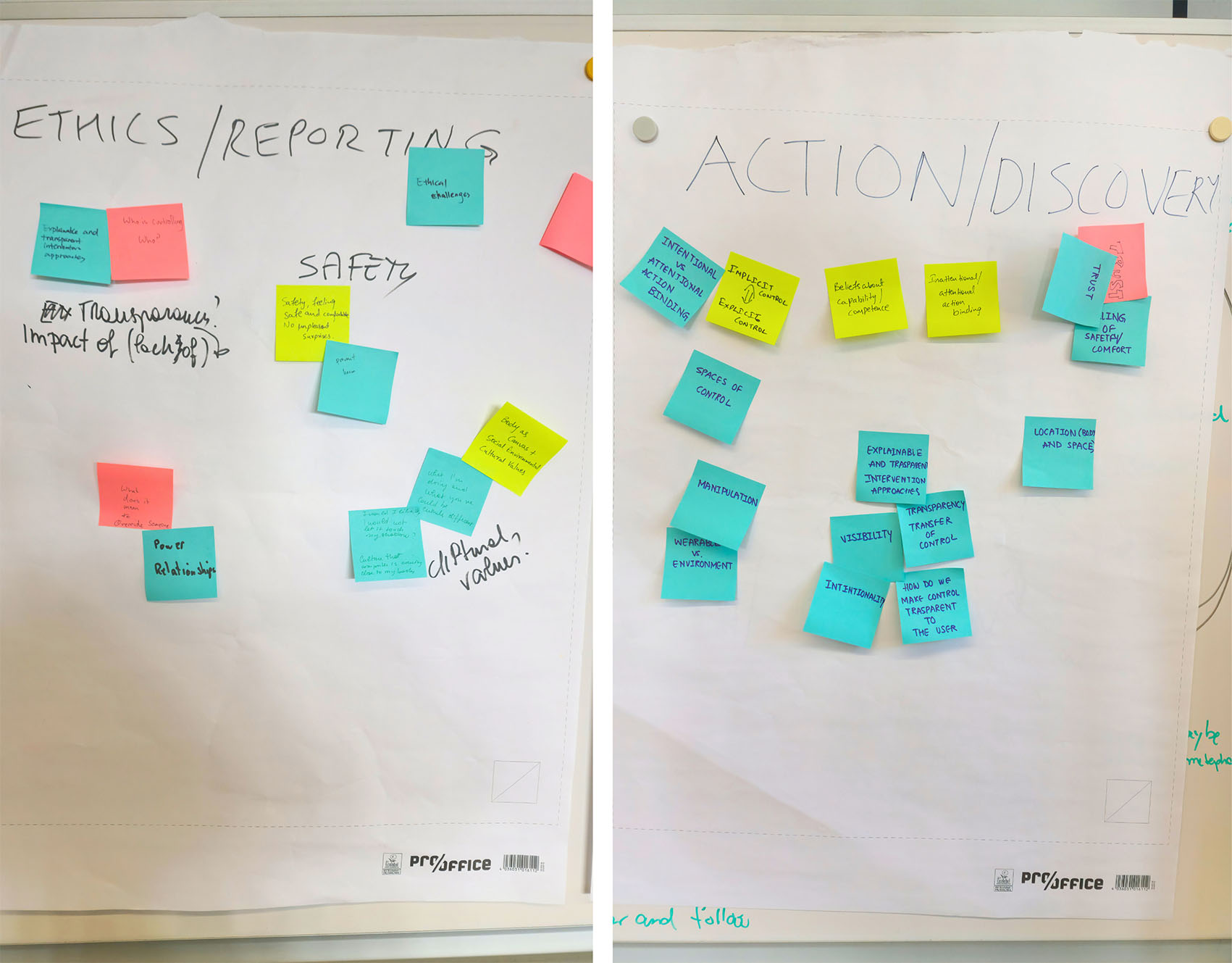
On Day 4, participants engaged in a group activity titled “Thinking Through Writing,” where they collaboratively organised all discussion points gathered over the first three days of the seminar. The process began by thematically categorising the diverse ideas, questions, and insights that were documented on sticky notes and flipcharts throughout the seminar. These discussions ranged across multiple topics, including control mechanisms, ethical considerations, user agency, social implications, and technical challenges.
Participants worked in small groups to cluster these points into higher-level themes that could encapsulate the broad spectrum of ideas that had surfaced. These groupings allowed for a deeper examination of the emergent themes and helped identify connections between seemingly disparate points. For example, discussions on “Calibration” and “Measurement/Benchmarking” were grouped under technical challenges, while topics like “Ethics/Reporting,” “Social Transparency,” and “Power Dynamics” were clustered under social and ethical considerations (Figure 9).
This thematic organisation was dynamic, involving active debate and negotiation among participants to reach a consensus on which points should be grouped together and what overarching themes they represented. The result was a refined set of grand challenges that captured the core issues and opportunities in designing computers’ control over human bodies.
These themes were then visually represented on new flipcharts, providing a more coherent framework for understanding the various dimensions of the seminar’s central topic. This framework became a reference point for further discussion and reflection.
8 Writing the Grand Challenges
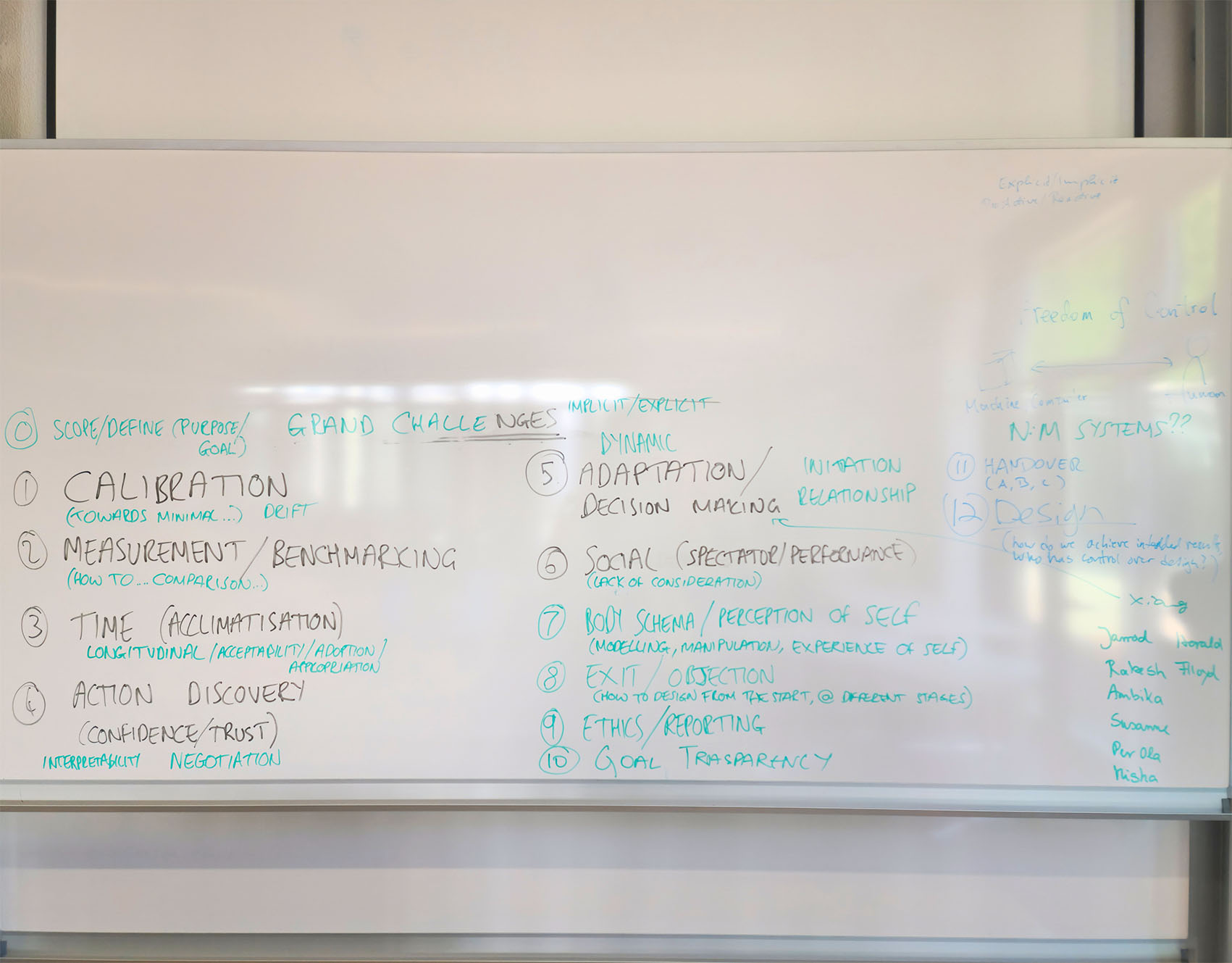
On Day 5, the seminar shifted focus towards drafting a collective article that synthesised the grand challenges identified through the previous day’s thematic grouping activity (Figure 10). Using the flipcharts as a guide, participants worked in their respective groups to flesh out the key elements of each challenge, drawing on the rich discussions and insights generated throughout the seminar.
The writing process was collaborative and iterative, with participants contributing their expertise to different sections of the article. Each group focused on elaborating their assigned themes, providing detailed explanations, relevant examples, and proposing potential research directions or solutions. For instance, the group handling the “Action Discovery” theme expanded on how confidence and trust play a crucial role in user acceptance of control technologies, while those working on “Ethics/Reporting” outlined guidelines for ethical transparency and user safety.
The aim was to produce a comprehensive document that not only summarised the seminar’s key findings but also provided a roadmap for future research and practice in the field of human-computer interaction involving bodily control. Throughout the day, participants engaged in discussions to refine their sections, ensuring that the article was coherent and aligned with the seminar’s goals.
By the end of Day 5, the draft article was completed, capturing the collective knowledge and perspectives of all participants. It represented a significant outcome of the seminar, encapsulating the core challenges and opportunities identified over the five days. This article is intended to be a starting point for ongoing dialogue and collaboration in the field, fostering a shared understanding of how to design for and navigate the complex interplay between human autonomy and computational control.
9 Overview of Talks
9.1 Digital Vertigo Games
Richard James Byrne (Made Tech – Bristol, GB)
License: Creative Commons BY 4.0 International license © Richard James Byrne
Many people enjoy “vertigo” sensations caused by intense, playful bodily activities such as riding fairground rides. Game scholar Caillois calls such experiences “vertigo play”, elucidating that these enjoyable activities result from confusion between sensory channels.
In HCI, designers are often cautious to avoid deliberately causing sensory confusion in players, but we believe there is an opportunity to transition and extend Caillois’ thinking to the digital realm, allowing designers to create novel and intriguing digital bodily experiences inspired by traditional vertigo play activities, through exploring methods of allowing computers varying degrees of control over one’s body.
The Digital Vertigo Experience framework is derived from four case studies and the development of three different digital vertigo experiences. This framework aims to bring the excitement of traditional vertigo play experiences to the digital world, allowing designers to create novel body-based games and providing players with more possibilities to enjoy exciting play experiences [3].
9.2 Charting the Landscape of Body Control Techniques
Arthur Caetano (University of California – Santa Barbara, US)
License: Creative Commons BY 4.0 International license © Arthur Caetano
Body control techniques, such as Electric Muscle Stimulation (EMS), Galvanic Vestibular Stimulation (GVS), and Exoskeletons, enable computational agents to act on the user’s body. These techniques can offload control of voluntary movements to assist in physical tasks, stimulate body functions for rehabilitation, and redirect walking and reaching movements in virtual reality applications. Despite promising applications, more work is needed to outline the design space of body control techniques. Mapping out the available methods from the perspective of body entry points and targets for control signals can help researchers identify opportunities for enabling more comprehensive body control. What signal entry points could be used to control a specific body part? Which body parts can be controlled through the same entry point? Which control modalities can be combined with which sensing modalities without interference? What are the modalities most resilient to the user’s resistant attitude? Synthesizing this landscape will support design decisions in body control applications.
9.3 TickleFoot: Design, Development and Evaluation of a Novel Foot-Tickling Mechanism That Can Evoke Laughter
Don Samitha Elvitigala (Monash University – Clayton, AU)
License: Creative Commons BY 4.0 International license © Don Samitha Elvitigala
Joint work of: Don Samitha Elvitigala, Roger Boldu, Suranga Nanayakkara, Denys J. C. Matthies
Tickling is a type of sensation that is associated with laughter, smiling or other similar reactions. Psychology research has shown that tickling and laughter can significantly relieve stress. Although several tickling artifacts have been suggested in prior work, limited knowledge is available if those artifacts could evoke laughter. In this article, we aim at filling this gap by designing and developing a novel foot-tickling mechanism that can evoke laughter. We first developed an actuator that can create tickling sensations along the sole of the foot utilising magnet-driven brushes. Then, we conducted two studies to identify the most ticklish locations of the foot’s sole and stimulation patterns that can evoke laughter. In a follow-up study with a new set of participants, we confirmed that the identified stimuli could evoke laughter. From the participants’ feedback, we derived several applications that such a simulation could be useful. Finally, we embedded our actuators into a flexible insole, demonstrating the potential of a wearable tickling insole [4].
9.4 Control in HCI
Jarrod Knibbe (University of Queensland – Brisbane, AU)
License: Creative Commons BY 4.0 International license © Jarrod Knibbe
Joint work of: Jarrod Knibbe, Rachel Freire, Marion Koelle, Paul Strohmeier
Control in HCI is poorly understood. We lack a systematic approach to modelling, predicting, and benchmarking control. At the same time, however, control is arguably the central challenge of interaction design: controlling a system towards a goal. Across its diverse history, HCI has adopted two primary levels for studying control, implicit control and explicit control. Implicit control concerns itself with the low-level study of control perception. To study this, we have adopted neuroscience methods, primarily relying on intentional binding and the Libet clock, but the demands of these methods make them hard to apply for interaction design, and the results appear to have limited links with our subjective feeling of control (our feelings of explicit control). Explicit control methods are primarily “qualitative”, effectively asking “do you feel in control?” I posit that this question is broadly unanswerable and the data it yields almost arbitrary. We need better methods [5].
9.5 Closed-loop and open-loop control
Per Ola Kristensson (University of Cambridge, GB)
License: Creative Commons BY 4.0 International license © Per Ola Kristensson
Bestowing computer systems with control can amplify people’s ability to input information into systems. Gesture keyboard systems enable users to write using touchscreen and other input media by sliding a finger across a keyboard. Serial single-finger typing is a closed-loop control task with performance limited by visual attention. Using a gesture keyboard, prolonged use results in motor memory consolidation of frequently used gestures for words. This allows users to transition to open-loop direct recall from motor memory, which is faster. However, for this to be possible the system has to interpret imprecise open-loop articulation using a decoder. In effect, the user gains efficiency by transitioning from precise closed-loop to imprecise open-loop and this transition is only possible because a decoder interprets the imprecise input. Effectively, control is shifted towards the computer system in exchange for efficiency. The same principle can be exploited in other applications, such as dwell-free eye typing, which removes the time-consuming and fatiguing dwell timeouts of regular eye typing by interpreting eye gaze data using a decoder. Other examples include typing in thin air and automatic activation of virtual tools in virtual reality by the user simply articulating the tool motion to trigger the tool, removing the need for the user to first select the tool. However, bestowing a computer system with this additional control may also come with a cost. It is possible to empirically measure a user’s sense of agency and we can demonstrate that, in at least one instance, at a certain point increased computer assistance results in a dramatic reduction in the user’s sense of agency.
9.6 Swarm Bodily Interfaces in Virtual Environments
Xiang Li (University of Cambridge, GB)
License: Creative Commons BY 4.0 International license © Xiang Li
Our bodies, serving as intermediaries between physical and virtual realities, play a crucial role in transmitting our perceptions and presenting our behaviors. Previous research primarily focused on creating one-to-one replicas of the real world as avatars in virtual environments or utilizing real-world on-body interactions to enhance immersion. This approach, however, has not fully exploited the potential of bodily interfaces. For example, if our bodies were composed of swarm particles with a fluid and liquid form in virtual reality, how would our perception adapt to such a dynamic state? Would our viewpoint fluctuate with the liquid’s movements, and how could we exert control over such a form? Future research should aim to design diverse bodily interfaces to investigate the implications for agency, ownership, perception, affordance, and interaction. This exploration is essential to comprehensively understand and enhance our presence and interaction within virtual environments [9].
9.7 Sharing Bodily Control with Computers
Zhuying Li (Southeast University – Nanjing, CN)
License: Creative Commons BY 4.0 International license © Zhuying Li
In this talk, I first introduced several examples of my work related to sharing control with computers, exploring the interplay between human autonomy and technological influence. The first part focuses on ingestible play, a game based on sensors. In these games, participants swallow a digital sensor that monitors bodily information to serve as a game controller. However, control over the sensor is limited as participants cannot direct its movement within the body. In some cases, players can influence it indirectly, for example, by consuming coffee or bananas to affect digestion speed. Also, it would be hard to control the data the technology captured, as we don’t have direct control over our interior body. These kinds of play make people aware that we have limited control over our body as the invisible part of it. The second work I shared in this talk involves sharing bodily control with an intelligent exoskeleton in body games. This exoskeleton is designed to predict and actuate optimal movements during gameplay. We developed three modes for this system. In the first one, the exoskeleton autonomously moves the player’s body to compete against a computer-controlled opponent. In the second mode, one arm controlled by the exoskeleton competes against the player’s other free arm. With the last one, the exoskeleton controls one arm while the player decides whether to move the other arm to align with the AI’s predictions to play. Both projects aim to augment human capabilities – whether to enhance gaming performance or to increase self-awareness. However, these augmentations also raise important questions about how much we should allow machines to influence or determine human actions and whether we should let machines decide what is good for humans [10, 11, 17].
9.8 Losing Control
Joe Marshall (University of Nottingham, GB)
License: Creative Commons BY 4.0 International license © Joe Marshall
Joint work of: Steve Benford, Christopher Greenhalgh, Gabriella Giannachi, Brendan Walker, Joe Marshall, Tom Rodden
Our work on uncomfortable interactions explored technology interactions in which people deliberately expose themselves to discomfort. Experiences such as rollercoasters, theatre shows, and horror films have in common the requirement that people gradually surrender control to technology over the experience. Two examples: In Bronocomatic, a bucking bronco ride is controlled by the rider’s breathing. Initially, this means the rider is fully in control of the ride movement, but as the movement becomes more extreme, riders are no longer able to control their breathing, and control shifts to the machine. Teslasuit uses electrical muscle stimulation to create a range of sensations in the wearer. At the lowest stimulation, it is like a gentle touch, and users stay fully in control. As the stimulation gets more intense, the wearer becomes less in control of their body until, at full strength, the intensity is such that wearers fall to the ground and cannot control their muscles.
9.9 Designing computers’ control over the body that centres around bodily play
Louise Petersen Matjeka (Copenhagen, DK)
License: Creative Commons BY 4.0 International license © Louise Petersen Matjeka
Joint work of: Louise Petersen Matjeka, Dag Svanæs, Alf Inge Wang
My focus for designing computers’ control over the body centers around bodily play and to answer the following question: How can we design for bodily playfulness? A key element in my work with bodily play is movement – and making (game) moves. I have developed two games, each of which manipulates the player to move and not move in specific ways. The first game, Space Agent, used an interactive binaural soundscape to drive the players to twist and turn. The other game, Move Maker, explored different ways of restraining the body as it had to move around playing with the game’s paraphernalia as the surrounding conditions for movement. My recommended reading is about the latter game. My work merges my background as a PhD in game and interaction design (Norwegian University of Science and Technology) and a Music and Movement Teacher (Rhythmic Music Conservatory, Copenhagen).
9.10 Sharing control over our bodies with computers
Florian ‘Floyd’ Mueller (Monash University – Clayton, AU)
License: Creative Commons BY 4.0 International license © Florian ‘Floyd’ Mueller
Sharing control over our bodies with computers benefits from the integration of the human body and interactive technology. We demonstrate this through a series of research design works around sharing control experiences, including eBike integrations, Wifi integration and emotion-EMS integration. The results of these works suggest interesting ways forward for control in HCI research, in particular, how the design of integrated systems can consider experiential aspects, facilitating playful control experiences. Ultimately, with our work, we want to enhance our knowledge around the design of integrated control experiences to help people understand who they are, who they want to become, and how to get there [19].
9.11 If control is here, how is it? Engendering subtleties of “control” observable in symbiotic systems through an enactive approach
Minna Nygren (University College London, GB)
License: Creative Commons BY 4.0 International license © Minna Nygren
Since the emergence of the notion of body-machine couplings dating back to the 1950s (e.g., Clynes and Kline, 1960), interface design and engineering has increasingly explored developing systems with varying levels of human control (e.g., full, partial) and machine control (e.g., autonomous, partial) (e.g., Casado, 2013). Enactivist perspective to cognition (e.g., Thompson and Varela, 2001) can open a window into exploring the notion of control in subtle processes of situated interaction, perception and action (e.g., Rowlands, 2010). Methodologically, this approach may engender microinteractional dimensions of “computers” control over our bodies’ observable, and develop our understanding of the details about where, and how, the control is. This may offer insights about how “control” is perceived and acted upon in care contexts applying tactile robotics (e.g., Parviainen et al., 2019), or mirroring digital environments (e.g., Nygren, 2023).
9.12 Playing by Sharing Bodily Control with Computers
Rakesh Patibanda (Monash University – Clayton, AU)
License: Creative Commons BY 4.0 International license © Rakesh Patibanda
Traditional digital games predominantly treat the human body as an input mechanism, overlooking its potential as an output medium. This oversight limits the depth of interaction and experiential richness possible in human-computer interaction (HCI). Body-Actuating Play (BAP) [21, 26], discussed in this seminar, is a concept where bodily control is shared between the player and the computer, enabling a novel form of play where the body is both an input and output medium. This novel concept transforms the user’s role from a mere operator to a collaborator with the computer, shifting their role to that of both influencer and responder.
As body-actuating technologies like electrical muscle stimulation and exoskeletons begin to control and augment human actions, we find ourselves at a pivotal moment in redefining the relationship between humans and technology. The potential for shared bodily control in BAP challenges our traditional notions of autonomy and control in digital play, provoking deeper reflection on the nature of the control we have over our bodies and the ethics of machine intervention in our physical selves [25].
Crucially, the exploration of BAP compels us to consider the psychological impact of sharing bodily control with such technologies. What does it mean for our sense of self when a machine can respond to our movements and direct them? How do we reconcile the benefits of enhanced physical capabilities with the potential loss of personal control over our bodies? While BAP is an exciting concept to explore, the ethical landscape of these innovations must be navigated with care, ensuring that the design of these technologies prioritises user consent, safety, and well-being.
Ultimately, BAP invites us to envision a future where humans and machines are intertwined in a seamless, symbiotic relationship, pushing the boundaries of what is possible in digital play experiences. This paradigm shift calls for a re-evaluation of traditional design frameworks within the HCI community, embracing the body as a central component of digital play. By designing future BAP experiences, we can create technologies that entertain and enrich and expand the human experience in previously unimaginable ways.
9.13 Negotiating Augmented Bodies
Henning Pohl (Aalborg University, DK)
License: Creative Commons BY 4.0 International license © Henning Pohl
Our appearance and our interactions with the world around us are closely intertwined. How we dress, how we do our hair, and what makeup we put on signals something about who we are to others. Currently, more and more facets of our appearance are becoming adaptive and changeable through computational processes. Physically, this includes shape- and colour-changing clothing and accessories, as well as electronic tattoos, beauty products, and jewellery. Virtually, many more changes are possible, such as beautification filters, digital fashion, or blurring out of tattoos. Control over such body augmentations right now is mostly in the hands of the person themselves. However, such control might well transfer to others or to computational systems. For example, we can envision a future cocktail party setting where I put virtual name tags on people (i.e., I have control over their appearance), wear glasses that can turn heart-shaped on their own (i.e., I delegated control to a system and asked it to accentuate my flirting), or everybody relinquishes control over their looks (i.e., a central party AI takes charge to maybe ensure the party is eventful). Thus, as our appearance becomes interactively malleable, we also have to negotiate how much control is retained or delegated [29, 30].
9.14 Social and Embodied Perspectives
Sara Price (University College London, GB)
License: Creative Commons BY 4.0 International license © Sara Price
Our bodies are intimate and personal: social, embodied, and physiological. This demands considerations for design – beyond the flesh – of computer “control” on our bodily engagement, raising 3 key questions: what do we mean by “bodies”, what do we mean by “control”, and what methods can foster important social design considerations? Bodies are not just fleshy entities; they are complex sensorial systems embedded in societal, community, and individual lived experiences, cultures and contexts, emotions, histories, etiquettes, and practices. Computers can exert control on our bodies explicitly (e.g., exoskeletons), but also implicitly, in less recognised ways. Research shows how a haptic baby sensing monitor changes parent-baby bodily interaction/communication practices: is this control? Socially oriented methodologies, such as socio-technical imaginaries/speculations, draw attention to these broader aspects of bodily engagement, to the body’s socially shaped and interpreted sensorial experiences, foregrounding dystopian/utopian discourses, changing practices, power relationships, privacy, and ethical implications.
9.15 “Best Buddy”: AI & XR-Enhanced Human
Harald Reiterer (Universität Konstanz, DE)
License: Creative Commons BY 4.0 International license © Harald Reiterer
My research focus involves developing interaction techniques for Extended Reality (XR) Applications. Building on my previous research on cross-reality interaction, we combine different input devices (e.g., tabletops, tablets, smartphones) with Extended Reality devices (e.g., Head-Mounted Displays), harnessing their complementary strengths. We refer to these as Complementary Interfaces (Zagermann et al., 2022) and utilise them for various Visual Computing scenarios (e.g., Immersive Analytics, Situated Analytics). In my talk, I introduced the vision of a “Best” Buddy, an AI- and XR-enhanced Human. “Best Buddy” consists of an ecosystem of devices and technologies that, while promising, also raise significant ethical concerns. The ecosystem comprises in-ear headphones or hearing aids, Augmented Reality (AR) contact lenses or AR glasses, and a smartphone. All devices are connected to a cloud service that uses AI technology (e.g., LLM like GPT-4o), leading to intertwined human-computer integration. In real-time, the LLM gets input from the lenses and in-ear headphones, empowering the human user with relevant information and giving hints on how to behave in specific situations. But who is in control? What are this vision’s potential Dark or Deceptive Patterns of an intertwined human-computer integration? How is “Best Buddy” positioned in the design space of intertwined systems (Butler, Angel, Influencer, Adversary)? [16]
9.16 Designing Bodily Extensions
Aryan Saini (Monash University – Clayton, AU)
License: Creative Commons BY 4.0 International license © Aryan Saini
HCI researchers have increasingly investigated bodily augmentations due to the associated benefits, such as accessibility, offering novel input space, and sensing environment. Most of these investigations have adopted a utilitarian perspective, providing impairment, mobility, and rehabilitation support. However, more recently, a subset called bodily extensions has emerged that appears to also embrace experiential aspects. These bodily extensions extend the human body beyond traditional sensing and accessibility perspectives. Initial designs were mostly rigid, focusing on short-term use, missing out on the opportunities for these bodily extensions to be integrated into everyday life. While the adoption of the same will become more prevalent owing to technological advances in the near future, there is limited knowledge on how to cater to controlling these bodily extensions with respect to the human body. In my work, I build soft pneumatic-based bodily extensions that users can incorporate into their everyday lives. I detail the design and rationale behind these bodily extensions, along with the novel scenarios they enable. Finally, I share my insights from creating these systems and the associated user experiences from our field study, hoping to better understand control over bodily extensions physically, physiologically, and psychologically [32, 31].
9.17 Haptic Experiences and Bodily Control
Oliver Schneider (University of Waterloo, CA)
License: Creative Commons BY 4.0 International license © Oliver Schneider
Haptics and physical interaction let us engage with digital systems in a variety of ways. Typically, this is structured as a system we use as a tool. However, increasing understanding of what haptic experiences are, new types of haptic devices, and capabilities for participatory design may influence our decisions about who controls what with our bodies. I will discuss how we can conceptualize haptic experiences, employ interaction modalities like implicit interaction in autonomous vehicles and intermittent interaction with fabrication devices, and then report on efforts for participatory design that give creators control over their haptic experiences and threats to bodily autonomy from touch.
9.18 Technology Acceptance of Electrical Muscle Stimulation
Ambika Shahu (TU Wien, AT)
License: Creative Commons BY 4.0 International license © Ambika Shahu
Joint work of: Ambika Shah, Sonja Dorfbauer, Philipp Wintersberger, Florian Michahelles
Electrical muscle stimulation (EMS) has many potential applications in many fields, but the parameters necessary for EMS acceptance are poorly understood. We investigated a wide range of characteristics to gain a better understanding of EMS user acceptance. We created four scenarios on the basis of a literature review, assessed the technology acceptance of participants in an online survey with the help of the TAM model, and conducted in-depth interviews. Our results suggest that the use of EMS to enhance a VR experience is supported by a good attitude towards it and the intention to use it. We recommend that researchers and designers focus their efforts on keeping users in control of their activities rather than forcing them through EMS. We advise researchers to design systems that circumvent the involuntary nature of the system and allow the user to feel controlled. We found that the use of EMS to speed up learning was not widely accepted and that the desire to maintain control outweighed the desire to learn faster [34, 36, 35].
9.19 Exploring Control: Galvanic Vestibular Stimulation and Bodily Autonomy in Human-Computer Interaction
Misha Sra (University of California – Santa Barbara, US)
License: Creative Commons BY 4.0 International license © Misha Sra
Galvanic Vestibular Stimulation (GVS) has been a known technique for over a century, yet its potential in Human-Computer Interaction (HCI) remains largely untapped and poorly understood. Despite its long history, there is a notable absence of systematic approaches to modeling, predicting, and calibrating GVS-based systems designed for end-user applications. This gap in methodology has limited the widespread adoption of GVS in HCI applications, despite its potential for reducing cybersickness in virtual reality (VR), enhancing balance rehabilitation, or developing novel experiences.
In parallel to GVS control of the body, I am also interested in the questions of control in situations where individuals experience a loss or lack of control over their physical self. These situations range from medical conditions like paralysis, neuromuscular diseases, or amputation, to the temporary disorientation or diminished bodily sensation experienced when transitioning from VR back to physical reality. This prompts a fundamental question: When there’s no sense of body, what does bodily control mean?
Understanding and addressing control in these contexts could help develop more accessible, inclusive, and empowering experiences. Both GVS applications and control-related challenges in HCI necessitate interdisciplinary research, combining insights from neuroscience, engineering, design, and HCI [37].
References
- [1] Alejandro Aponte, Arthur Caetano, Yunhao Luo, and Misha Sra. Grav: Grasp volume data for the design of one-handed XR interfaces. In Anna Vallgårda, Li Jönsson, Jonas Fritsch, Sarah Fdili Alaoui, and Christopher A. Le Dantec, editors, Designing Interactive Systems Conference, DIS 2024, IT University of Copenhagen, Denmark, July 1-5, 2024. ACM, 2024.
- [2] Steve Benford, Richard Ramchurn, Joe Marshall, Max L. Wilson, Matthew Pike, Sarah Martindale, Adrian Hazzard, Chris Greenhalgh, Maria Kallionpää, Paul Tennent, and Brendan Walker. Contesting control: journeys through surrender, self-awareness and looseness of control in embodied interaction. Human–Computer Interaction, 36(5-6):361–389, 2021.
- [3] Richard Byrne, Joe Marshall, and Florian ‘Floyd’ Mueller. Designing digital vertigo experiences. ACM Trans. Comput.-Hum. Interact., 27(3), may 2020.
- [4] Don Samitha Elvitigala, Roger Boldu, Suranga Nanayakkara, and Denys J. C. Matthies. Ticklefoot: Design, development and evaluation of a novel foot-tickling mechanism that can evoke laughter. ACM Trans. Comput.-Hum. Interact., 29(3), jan 2022.
- [5] Graeme Gange and Jarrod Knibbe. Optimising automatic calibration of electric muscle stimulation. Proceedings of the AAAI Conference on Artificial Intelligence, 35(5):3759–3767, May 2021.
- [6] Carey Jewitt, Sara Price, Kerstin Leder Mackley, Nikoleta Yiannoutsou, Douglas Atkinson, Carey Jewitt, Sara Price, Kerstin Leder Mackley, Nikoleta Yiannoutsou, and Douglas Atkinson. Social norms of touch. Interdisciplinary insights for digital touch communication, pages 57–72, 2020.
- [7] Jarrod Knibbe, Rachel Freire, Marion Koelle, and Paul Strohmeier. Skill-sleeves: Designing electrode garments for wearability. In Proceedings of the Fifteenth International Conference on Tangible, Embedded, and Embodied Interaction, TEI ’21, New York, NY, USA, 2021. Association for Computing Machinery.
- [8] Jarrod Knibbe, Paul Strohmeier, Sebastian Boring, and Kasper Hornbæk. Automatic calibration of high density electric muscle stimulation. Proc. ACM Interact. Mob. Wearable Ubiquitous Technol., 1(3), sep 2017.
- [9] Xiang Li, Jin-Du Wang, John J. Dudley, and Per Ola Kristensson. Swarm manipulation in virtual reality. In Proceedings of the 2023 ACM Symposium on Spatial User Interaction, SUI ’23, New York, NY, USA, 2023. Association for Computing Machinery.
- [10] Zhuying Li, Tianze Huang, Rakesh Patibanda, and Florian Mueller. Ai in the shell: Towards an understanding of integrated embodiment. In Extended Abstracts of the 2023 CHI Conference on Human Factors in Computing Systems, CHI EA ’23, page 1–7, New York, NY, USA, April 2023. Association for Computing Machinery.
- [11] Zhuying Li, Rakesh Patibanda, Felix Brandmueller, Wei Wang, Kyle Berean, Stefan Greuter, and Florian ‘Floyd’ Mueller. The guts game: Towards designing ingestible games. In Proceedings of the 2018 Annual Symposium on Computer-Human Interaction in Play, CHI PLAY ’18, page 271–283, New York, NY, USA, October 2018. Association for Computing Machinery.
- [12] Joe Marshall, Duncan Rowland, Stefan Rennick Egglestone, Steve Benford, Brendan Walker, and Derek McAuley. Breath control of amusement rides. In Proceedings of the SIGCHI Conference on Human Factors in Computing Systems, CHI ’11, page 73–82, New York, NY, USA, 2011. Association for Computing Machinery.
- [13] Louise Petersen Matjeka, Dag Svanæs, and Alf Inge Wang. Turning eight family homes into interactive, pervasive playgrounds during the COVID-19 pandemic lockdown. Frontiers Comput. Sci., 4:822337, 2022.
- [14] Nygren Minna, Thomas Rhiannon, and Sara Price. Designing for embodied proximity. Visitor Studies, 2024.
- [15] Florian Mueller, Marianne Graves Petersen, and Zhuying Li. Technology futures: Towards understanding how to design awe-inspiring futures. International Journal of Human-Computer Studies, 170:102961, 2023.
- [16] Florian Floyd Mueller, Pedro Lopes, Paul Strohmeier, Wendy Ju, Caitlyn Seim, Martin Weigel, Suranga Nanayakkara, Marianna Obrist, Zhuying Li, Joseph Delfa, Jun Nishida, Elizabeth M. Gerber, Dag Svanaes, Jonathan Grudin, Stefan Greuter, Kai Kunze, Thomas Erickson, Steven Greenspan, Masahiko Inami, Joe Marshall, Harald Reiterer, Katrin Wolf, Jochen Meyer, Thecla Schiphorst, Dakuo Wang, and Pattie Maes. Next steps for human-computer integration. In Proceedings of the 2020 CHI Conference on Human Factors in Computing Systems, CHI ’20, page 1–15, New York, NY, USA, 2020. Association for Computing Machinery.
- [17] Florian ‘Floyd’ Mueller, Pedro Lopes, Josh Andres, Richard Byrne, Nathan Semertzidis, Zhuying Li, Jarrod Knibbe, and Stefan Greuter. Towards understanding the design of bodily integration. International Journal of Human-Computer Studies, 152:102643, 2021.
- [18] Florian ‘Floyd’ Mueller, Nathan Semertzidis, Josh Andres, Joe Marshall, Steve Benford, Xiang Li, Louise Matjeka, and Yash Mehta. Toward understanding the design of intertwined human–computer integrations. ACM Trans. Comput.-Hum. Interact., 30(5), sep 2023.
- [19] Florian ‘Floyd’ Mueller, Nathan Semertzidis, Josh Andres, Martin Weigel, Suranga Nanayakkara, Rakesh Patibanda, Zhuying Li, Paul Strohmeier, Jarrod Knibbe, Stefan Greuter, Marianna Obrist, Pattie Maes, Dakuo Wang, Katrin Wolf, Liz Gerber, Joe Marshall, Kai Kunze, Jonathan Grudin, Harald Reiterer, and Richard Byrne. Human–computer integration: Towards integrating the human body with the computational machine. Foundations and Trends® in Human-Computer Interaction, 16(1):1–64, October 2022.
- [20] Minna O. Nygren, Sara Price, and Rhiannon Thomas Jha. The role of embodied scaffolding in revealing “enactive potentialities” in intergenerational science exploration. Science Education, 108(2):495–523, 2024.
- [21] Rakesh Patibanda, Chris Hill, Aryan Saini, Xiang Li, Yuzheng Chen, Andrii Matviienko, Jarrod Knibbe, Elise Van Den Hoven, and Florian ‘Floyd’ Mueller. Auto-paizo games: Towards understanding the design of games that aim to unify a player’s physical body and the virtual world. Proceedings of the ACM on Human-Computer Interaction, 7(CHI PLAY):893–918, 2023.
- [22] Rakesh Patibanda, Chris Hill, Aryan Saini, Xiang Li, Yuzheng Chen, Andrii Matviienko, Jarrod Knibbe, Elise van den Hoven, and Florian ‘Floyd’ Mueller. Auto-paizo games: Towards understanding the design of games that aim to unify a player’s physical body and the virtual world. Proceedings of the ACM on Human-Computer Interaction, 7(CHI PLAY):408:893–408:918, October 2023.
- [23] Rakesh Patibanda, Xiang Li, Yuzheng Chen, Aryan Saini, Christian N Hill, Elise van den Hoven, and Florian Floyd Mueller. Actuating myself: Designing hand-games incorporating electrical muscle stimulation. In Extended Abstracts of the 2021 Annual Symposium on Computer-Human Interaction in Play, CHI PLAY ’21, page 228–235, New York, NY, USA, October 2021. Association for Computing Machinery.
- [24] Rakesh Patibanda, Nathalie Overdevest, Shreyas Nisal, Aryan Saini, Don Samitha Elvitigala, Jarrod Knibbe, Elise Van Den Hoven, and Florian ‘Floyd’ Mueller. Shared bodily fusion: Leveraging inter-body electrical muscle stimulation for social play. In Proceedings of the 2024 ACM Designing Interactive Systems Conference, DIS ’24, page 2088–2106, New York, NY, USA, July 2024. Association for Computing Machinery.
- [25] Rakesh Patibanda, Nathalie Overdevest, Aryan Saini, Zhuying Li, Josh Andres, Jarrod Knibbe, Elise van den Hoven, and Florian ‘Floyd’ Mueller. Exploring shared bodily control: Designing augmented human systems for intra- and inter-corporeality. In Proceedings of the Augmented Humans International Conference 2024, AHs ’24, page 318–323, New York, NY, USA, 2024. Association for Computing Machinery.
- [26] Rakesh Patibanda, Aryan Saini, Nathalie Overdevest, Maria F. Montoya, Xiang Li, Yuzheng Chen, Shreyas Nisal, Josh Andres, Jarrod Knibbe, Elise van den Hoven, and Florian ‘Floyd’ Mueller. Fused spectatorship: Designing bodily experiences where spectators become players. Proc. ACM Hum.-Comput. Interact., 7(CHI PLAY), oct 2023.
- [27] Rakesh Patibanda, Nathan Arthur Semertzidis, Michaela Scary, Joseph Nathan La Delfa, Josh Andres, Mehmet Aydin Baytaş, Anna Lisa Martin-Niedecken, Paul Strohmeier, Bruno Fruchard, Sang-won Leigh, Elisa D. Mekler, Suranga Nanayakkara, Josef Wiemeyer, Nadia Berthouze, Kai Kunze, Thanassis Rikakis, Aisling Kelliher, Kevin Warwick, Elise van den Hoven, Florian Floyd Mueller, and Steve Mann. Motor memory in hci. page 1–8, April 2020.
- [28] Rakesh Patibanda, Elise Van Den Hoven, and Florian ‘Floyd’ Mueller. Towards understanding the design of body-actuated play. In Extended Abstracts of the 2022 Annual Symposium on Computer-Human Interaction in Play, CHI PLAY ’22, page 388–391, New York, NY, USA, November 2022. Association for Computing Machinery.
- [29] Henning Pohl, Tor-Salve Dalsgaard, Vesa Krasniqi, and Kasper Hornbæk. Body layars: A toolkit for body-based augmented reality. In 26th ACM Symposium on Virtual Reality Software and Technology, VRST ’20, New York, NY, USA, 2020. Association for Computing Machinery.
- [30] Henning Pohl, Kasper Hornbæk, and Jarrod Knibbe. Wanding through space: Interactive calibration for electric muscle stimulation. In Proceedings of the 9th Augmented Human International Conference, AH ’18, New York, NY, USA, 2018. Association for Computing Machinery.
- [31] Aryan Saini, Haotian Huang, Rakesh Patibanda, Nathalie Overdevest, Elise Van Den Hoven, and Florian Floyd Mueller. Somaflatables: Supporting embodied cognition through pneumatic bladders. In Adjunct Proceedings of the 35th Annual ACM Symposium on User Interface Software and Technology, UIST ’22 Adjunct, page 1–4, New York, NY, USA, October 2022. Association for Computing Machinery.
- [32] Aryan Saini, Rakesh Patibanda, Nathalie Overdevest, Elise Van Den Hoven, and Florian ‘Floyd’ Mueller. Pneuma: Designing pneumatic bodily extensions for supporting movement in everyday life. In Proceedings of the Eighteenth International Conference on Tangible, Embedded, and Embodied Interaction, TEI ’24, New York, NY, USA, 2024. Association for Computing Machinery.
- [33] Oliver Schneider, Karon MacLean, Colin Swindells, and Kellogg Booth. Haptic experience design: What hapticians do and where they need help. International Journal of Human-Computer Studies, 107:5–21, 2017. Citation Key: SCHNEIDER20175.
- [34] Ambika Shahu, Sonja Dorfbauer, Philipp Wintersberger, and Florian Michahelles. Skillab – a multimodal augmented reality environment for learning manual tasks. In José Abdelnour Nocera, Marta Kristín Lárusdóttir, Helen Petrie, Antonio Piccinno, and Marco Winckler, editors, Human-Computer Interaction – INTERACT 2023, pages 588–607, Cham, 2023. Springer Nature Switzerland.
- [35] Ambika Shahu, Kahled Kassem, Leonhard Zehetgruber, Philipp Winterberger, and Florian Michahelles. Electrifying obstacle avoidance: Enhancing teleoperation of robots with ems-assisted obstacle avoidance. In HHAI 2023: Augmenting Human Intellect, pages 224–233. IOS Press, 2023.
- [36] Ambika Shahu, Philipp Wintersberger, and Florian Michahelles. Would users accept electric muscle stimulation controlling their body? insights from a scenario-based investigation. In Extended Abstracts of the 2022 CHI Conference on Human Factors in Computing Systems, CHI EA ’22, New York, NY, USA, 2022. Association for Computing Machinery.
- [37] Misha Sra, Abhinandan Jain, and Pattie Maes. Adding proprioceptive feedback to virtual reality experiences using galvanic vestibular stimulation. In Proceedings of the 2019 CHI Conference on Human Factors in Computing Systems, CHI ’19, page 1–14, New York, NY, USA, 2019. Association for Computing Machinery.
- [38] Dennis Wolf, John J. Dudley, and Per Ola Kristensson. Performance envelopes of in-air direct and smartwatch indirect control for head-mounted augmented reality. In Kiyoshi Kiyokawa, Frank Steinicke, Bruce H. Thomas, and Greg Welch, editors, 2018 IEEE Conference on Virtual Reality and 3D User Interfaces, VR 2018, Tuebingen/Reutlingen, Germany, 18-22 March 2018, pages 347–354. IEEE Computer Society, 2018.
10 Participants
-
Nadia Bianchi-Berthouze – University College London, GB
-
Susanne Boll – Universität Oldenburg, DE
-
Richard James Byrne – Made Tech – Bristol, GB
-
Arthur Caetano – University of California – Santa Barbara, US
-
Don Samitha Elvitigala – Monash University – Clayton, AU
-
Masahiko Inami – University of Tokyo, JP
-
Jarrod Knibbe – University of Queensland – Brisbane, AU
-
Per Ola Kristensson – University of Cambridge, GB
-
Xiang Li – University of Cambridge, GB
-
Zhuying Li – Southeast University – Nanjing, CN
-
Joe Marshall – University of Nottingham, GB
-
Louise Petersen Matjeka – Copenhagen, DK
-
Florian ‘Floyd’ Mueller – Monash University – Clayton, AU
-
Minna Nygren – University College London, GB
-
Rakesh Patibanda – Monash University – Clayton, AU
-
Henning Pohl – Aalborg University, DK
-
Sara Price – University College London, GB
-
Harald Reiterer – Universität Konstanz, DE
-
Aryan Saini – Monash University – Clayton, AU
-
Oliver Schneider – University of Waterloo, CA
-
Ambika Shahu – TU Wien, AT
-
Misha Sra – University of California – Santa Barbara, US
-
Jürgen Steimle – Universität des Saarlandes, DE
11 Remote Participants
-
Mar Gonzalez-Franco – Google – Seattle, US
