Automated Machine Learning For Computational Mechanics
Abstract
Machine learning (ML) has achieved undeniable success in computational mechanics, an ever-growing discipline that impacts all areas of engineering, from structural and fluid dynamics to solid mechanics and vehicle simulation. Computational mechanics uses numerical models and time- and resource-consuming simulations to reproduce physical phenomena, usually with the goal of optimizing the parameter configuration of the model with respect to the desired properties of the system. ML algorithms enable the construction of surrogate models that approximate the outcome of the simulations, allowing faster identification of well-performing configurations. However, determining the best ML approach for a given task is not straightforward and depends on human experts. Automated machine learning (AutoML) aims to reduce the need for experts to obtain effective ML pipelines. It provides off-the-shelf solutions that can be used without prior knowledge of ML, allowing engineers to spend more time on domain-specific tasks. AutoML is underutilized in computational mechanics; there is almost no communication between the two communities, and engineers spend unnecessary effort selecting and configuring ML algorithms. Our Dagstuhl Seminar aimed to (i) raise awareness of AutoML in the computational mechanics community, (ii) discover strengths and challenges for applying AutoML in practice, and (iii) create a bilateral exchange so that researchers can mutually benefit from their complementary goals and needs.
Keywords and phrases:
automated algorithm design; computational mechanics; engineering applications of AI; black-box optimization; physics-informed machine learningSeminar:
July 7–12, 2024 – https://www.dagstuhl.de/242822012 ACM Subject Classification:
Computing methodologies Instance-based learning ; Applied computing Computer-aided design ; Computing methodologies Interactive simulation ; Computing methodologies Search methodologiesCopyright and License:
![[Uncaptioned image]](x1.png) Except where otherwise noted, content of this report is licensed under a
Creative Commons BY 4.0 International license
Except where otherwise noted, content of this report is licensed under a
Creative Commons BY 4.0 International license
1 Executive Summary
Elena Raponi (Leiden Institute of Advanced Computer Science, Leiden University, NL)
Lars Kotthoff (University of Wyoming, Laramie, US)
Hyunsun Alicia Kim (University of California, San Diego, US)
Marius Lindauer (Leibniz University Hannover, DE)
License: ![[Uncaptioned image]](x2.png) Creative Commons BY 4.0 International license © Elena Raponi, Lars Kotthoff, Hyunsun Alicia Kim, and Marius Lindauer
Creative Commons BY 4.0 International license © Elena Raponi, Lars Kotthoff, Hyunsun Alicia Kim, and Marius Lindauer
The Dagstuhl Seminar 24282 was organized with the objective of bringing together the automated machine learning (AutoML) community with the computational mechanics (CoMe) community and finding new ways the two communities could help each other. More specifically, this seminar was trying to answer two questions:
-
1.
What are the problems the CoMe community encounters when applying machine learning (ML) methodologies, and how can the AutoML community help overcome them?
-
2.
What characteristics of CoMe benchmarks are currently not well supported by AutoML, and what limitations of AutoML tools are holding back their application in CoMe?
-
3.
How can applications in CoMe inform research directions in AutoML?
To search for an answer to these questions, the seminar was structured with a mixture of talks and group sessions. On one hand, the talks provided an overview of AutoML methodologies that could be valuable to the CoMe community, as well as examples of CoMe applications where ML methods have been applied to address common research questions and challenges. On the other hand, the group sessions offered the opportunity to delve into specific topics, either within individual communities or through cross-disciplinary discussions. The topics selected for the group discussions were intended to identify the barriers preventing the AutoML community from addressing common practical challenges in CoMe test cases, and, conversely, the obstacles hindering the adoption of AutoML methodologies by the CoMe community. More specifically, the topics discussed in groups were:
-
1.
Features and Problem Characterization;
-
2.
Optimization;
-
3.
Integration of Physics;
-
4.
Explainability;
-
5.
Benchmarks and constraints handling.
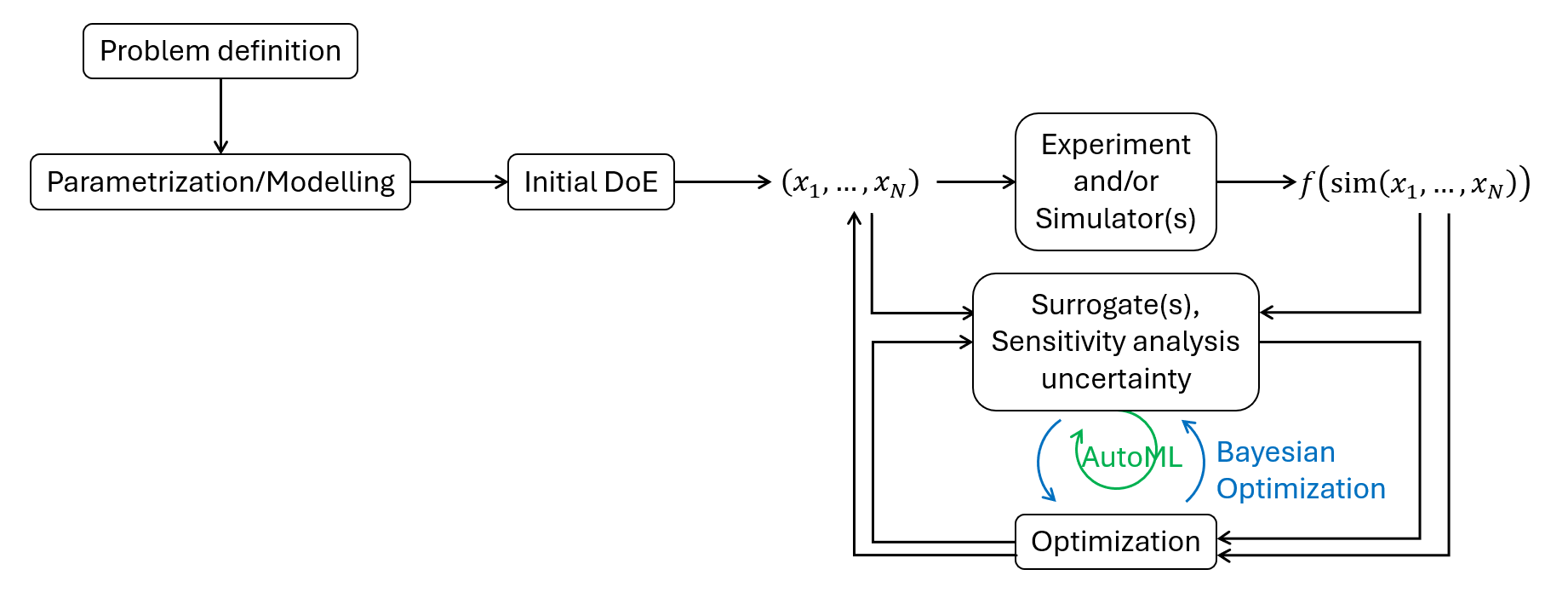
The seminar was then concluded by a plenary discussion on the outcomes of the given talks and group discussions. During this discussion, we were able to identify a general CoMe workflow that includes and exploits AutoML tools, see Figure 1. Moreover, we agreed that there are already many CoMe test cases the AutoML community can use to test their new methodologies, but these are badly disseminated. Therefore, in addition to the newly established collaborations between researchers belonging to the two different fields, one of the major outcomes of the seminar was the recognition that, to bridge the gap between AutoML and CoMe, the first crucial step would be to publish a review paper that compiles and categorizes the currently available datasets and benchmarks.
Organization of the Seminar
This small Dagstuhl Seminar brought together 23 researchers from both engineering and machine learning/optimization, representing both academia and industry. The group included a mix of senior and junior researchers, creating a diverse and collaborative environment.
Over the course of five days, the mornings featured 14 short presentations, each lasting 15 to 20 minutes. The rest of the seminar was organized in a dynamic and flexible manner, with activities ranging from scientific speed-dating and two-way surveys to the traditional trekking, as well as plenary and parallel discussions on topics chosen by the participants (see the complete seminar schedule in Fig. 2). This flexible structure allowed for a more engaging and relaxed schedule, which was appreciated by all attendees. Discussions that began during the day often extended into the evening, where the cozy atmosphere of the Dagstuhl castle played a key role in making everyone feel comfortable during both work-related exchanges and more informal moments.
Outcome
Based on the survey results, the seminar was widely considered a great success by both the organizers and participants. Despite the participants needing some initial time to get used to the languages of the two different research communities, the seminar successfully bridged the gap between the machine learning and computational mechanics communities, fostering valuable cross-disciplinary dialogue. The event provided a platform for sharing cutting-edge research and insights, while also addressing the practical challenges faced when integrating automated machine learning (AutoML) into computational mechanics workflows.
The presentations were thought-provoking and initiated lively discussions throughout the seminar. The collaborative spirit extended beyond the formal sessions, with participants engaging in productive breakout sessions and working groups. These dynamic exchanges not only explored the current state of research but also laid the groundwork for potential future collaborations.
The event demonstrated the clear potential for synergy between these fields, and it is expected that the connections made during the seminar will continue to grow and lead to impactful advances. The organizers extend their sincere thanks to the Scientific Directorate and the Dagstuhl Center administration and staff for their precious support, which was instrumental in the seminar’s smooth execution and success.
2 Table of Contents
3 Overview of talks
3.1 Physics-based machine learning for computational fracture mechanics across scales
Fadi Aldakheel (Leibniz Universität Hannover, DE)
License: Creative Commons BY 4.0 International license © Fadi Aldakheel
Physics-based machine learning leverages the strengths of both physics-based numerical simulation and data-driven approaches. By combining the flexibility and efficiency of state-of-the-art machine learning (ML) such as deep learning with the rigor of classical continuum mechanical and thermodynamically models and numerical methods, accurate and fast predictions can be obtained in a reliable and robust manner. This hybrid approach opens up great potential for solving the current challenges in computational solid mechanics. The current work introduces feed-forward neural networks that enforce physics in a strong form to tackle computational fracture mechanics problems. Our proposed model undergoes training with various load sequences and is then evaluated for its capacity in both interpolation and extrapolation. This study is the first to explore combining physics-based models and machine learning to address brittle and ductile fracture.
3.2 An Introduction to AutoML
Frank Hutter (Ellis Institute Tübingen Universität Freiburg, DE)
License: Creative Commons BY 4.0 International license © Frank Hutter
In this tutorial-like presentation, I will motivate AutoML and provide an overview over the major areas inside of AutoML: hyperparameter optimization, neural architecture search, multi-objective optimization, AutoML systems and meta-learning. I will put some focus on Bayesian optimization and the meta-learning of new algortihms in the prior-fitter networks (PFN) framework.
3.3 Optimization and AutoML for Engineering Design: Examples amd Challenges
Thomas Bäck (Leiden University, NL)
License: Creative Commons BY 4.0 International license © Thomas Bäck
The talk focuses on engineering design optimization problems in industry and the application of AutoML, Hyperparameter Optimization, and Algorithm Selection for solving and handling such tasks. Structural mechanics problems in the automotive industry, such as in car body crash optimization, are discussed as one of the key examples in this application domain. Direct optimization using variants of Evolutionary Strategies and AutoML for response surface modeling, one-shot optimization, and fast, interactive proxies for simulation models are discussed. As computational effort of simulations is a key bottleneck for optimizer selection and configuration, we also present an idea towards using evolutionary landscape analysis features for finding fast proxy functions that can be used for both tasks instead of the original problem. Showing that AutoML can be used for generating response surface models automatically, and proxy functions can be used for algorithm selection and configuration, the key questions really are: How can AutoML be used in practice to support structural mechanics and other engineering design tasks and how can we tackle computationally expensive real-world problems, extract knowledge, and learn from the data generated?
3.4 Boosting solid mechanics simulations with deep learning for computational cost reduction and stability improvement
Gokhan Serhat (Katholieke Universiteit Leuven – Bruges, BE)
License: Creative Commons BY 4.0 International license © Gokhan Serhat
Simulating the deformation of solids is essential to understand the behavior of complex structures and attain competent designs. Accordingly, computational techniques such as the finite element method have shown significant progress over the last decades. However, there are remaining associated challenges such as high computational cost and poor stability. In this talk, I would like to touch on the applicability and usefulness of machine learning (ML) approaches for improving the efficiency and robustness of simulation methods. I will demonstrate different problems where we use ML models trained on either pure computational or hybrid computational-experimental data. I will conclude by discussing the potential future directions for the use of ML in computational mechanics and the actions that can foster the connection between these two fields.
3.5 Symplectic Accelerated Optimization and Geometric Adjoint Analysis
Melvin Leok (University of California – San Diego, US)
License: Creative Commons BY 4.0 International license © Melvin Leok
Geometric integrators are numerical integration schemes that preserve geometric invariants of the associated continuous time flow. Accelerated optimization algorithms can be constructed from the geometric discretization of the Bregman Hamiltonian flow which outperform the Nesterov accelerated gradient algorithm at comparable computational cost. Adjoint systems are widely used to inform control, optimization, and design in systems described by ordinary differential equations or differential-algebraic equations. We briefly describe how geometric integrators can be used to discretize such adjoint systems while preserving a quadratic conservation law that is critical to adjoint sensitivity analysis. Such geometric adjoint techniques can be used to train neural ODEs without the need for backpropagation or automatic differentiation.
3.6 Explainable AI for Computational Mechanics
Niki van Stein (Leiden University, NL)
License: Creative Commons BY 4.0 International license © Niki van Stein
This presentation explores the application of Explainable AI (XAI) in Computational Mechanics (CM) and in the AutoML pipeline, highlighting its importance in enhancing transparency and understanding of AI models. We discuss key industry applications such as predictive maintenance and engineering design optimization, showcasing how XAI can provide valuable insights, debug models, and mitigate biases. Different forms of explanations are examined for their effectiveness in various scenarios. The talk also addresses challenges in benchmarking XAI methods and handling complex interactions. We introduce GSA report, a global sensitivity analysis tool that can help in understanding variable importance and interactions for many kinds of applications. We encouraged audience engagement to consider how XAI can address their specific CM needs.
3.7 Uniformly distributed point sets (for DoEs, AutoML, and beyond)
Carola Doerr (Sorbonne University – Paris, FR)
License: Creative Commons BY 4.0 International license © Carola Doerr
The question how to place n points in a given space such that they are as uniformly distributed as possible is an intensively studied one. Well-distributed points are needed for various applications, including design of experiments (DoEs) and hyper-parameter optimization. However, all of the well-known constructions such as those of Sobol’, Halton, etc. are designed with asymptotic error guarantees in mind. In this presentation, I will show the tremendous advantage that one can achieve when shifting the focus to the much more relevant non-asymptotic case. I will also show that we can satisfy a number of symmetry conditions at negligible loss in terms of the uniformity criterion. We conjecture that the so-obtained point sets are much more suitable for typical applications in engineering and AutoML. With this presentation, I hope to find participants willing to challenge this conjecture.
The presentation is based on joint work with François Clément (Sorbonne University), Kathrin Klamroth (University of Wuppertal), and Luís Paquete (University of Coimbra). Parts of it are available at https://arxiv.org/abs/2311.17463.
3.8 Bayesian Experimental Design
Roman Garnett (Washington University – St. Louis, US)
License: Creative Commons BY 4.0 International license © Roman Garnett
I gave a high-level introduction to Bayesian optimization / experimental design and discussed a few ideas from the ML community that may be of interest to the computational mechanics community:
-
optimization of iterative procedures (“freeze/thaw”)
-
generating high-quality and diverse designs
-
Bayesian local optimization
I also discussed the grand challenge of generating software platforms that are useful for non-experts and provided some thoughts for how tools from AutoML might play a role to this end. Finally, I led a – quite lively – open-ended conversation with the group on these topics.
3.9 Bayesian optimization of cooperative components for multi-stage aero-structural compressor blade design
Lisa Pretsch (Technical University of Munich, DE)
License: Creative Commons BY 4.0 International license © Lisa Pretsch
In aircraft engine design, detailed multi-stage aero-structural compressor blade optimizations are desirable for increased engine performance. They present a challenge with a high number of design variables (>100), many constraints (>20), and long simulation times (>1h). Combining ideas of distributed multidisciplinary optimization approaches and cooperative efficient global optimization, we propose a cooperative components Bayesian optimization (CC-BO). It solves component, here stage, BO subproblems in random sequence and cooperatively connected by so-called context vectors. This reduces not only the design space dimension, but also the number of aero-structural constraints per subproblem. First results indicate that CC-BO is an effective way of introducing high-level problem structure information in a basic BO. It can enable a higher convergence rate and better designs than state-of-the-art constrained high-dimensional BO approaches.
3.10 An application of constrained Bayesian optimization for crash
Paolo Ascia (Technical University of Munich, DE)
License: Creative Commons BY 4.0 International license © Paolo Ascia
Combining the solution space methodology with a parametric optimization has been a challenge since the introductin of the Solution Space methodology itself. In this work, we focus on a crashworthiness optimization to maximize the specific energy absorption of a set of components in the frontal area of a car. To optimize each component indipendetly of the others, we use the solution space method to define a set of constraints to guarantee the overall crashworthiness. In a first trial, we use constrained Bayesian optimization to solve the problem. Of the seven components in the set, this approach solves only 5 components. The two remaining components present a feasible area so small that the product between Expected Improviment and Probability of feasibility does not yeild sampling in the feasible area of the design space. We the tried again with the Scalable Constrained Bayesian Optimization algorithm. This algorithm shows promising results, hinting at the possibility of solving the challenge of coupling the Solution Space methodology with the crashworthiness optimization.
3.11 Topology Optimization and Engineering Design
Alicia Kim (University of California – San Diego, US)
License: Creative Commons BY 4.0 International license © Alicia Kim
Digital transformation is revolutionizing engineering of all complex systems (e.g. aerospace, automotive, building, multiscale material systems). One key challenge in digital engineering is integration of high-fidelity computational mechanics methods. In the context of computational mechanics, topology optimization is a design optimization method that searches the highest design space and has been able to provide unintuitive designs that an engineer has not been able to think of. Of course, this value proposition is meaningful when the optimum solution is unintuitive, e.g. the physics space is highly nonlinear, coupled multiphysics, multiscale, emergent behavior, uncertain, discontinuous, and/or extremely large. Therefore, TO for these complex problems are currently active research areas. This presentation will highlight a few challenges observed in our current research efforts with the aim to spark ideas for collaborations with autoML.
One challenge area is topology with fluid-structure interaction. In order to enable this functionality, we have implemented a fixed regular grid for simple laminar steady state flow (with low Reynolds numbers 1 – 1000) and a particle based mesh free linear elasticity method (Reproducing Kernel Particle Method). This represents a simplest physics problem of this class which focuses the challenges in optimization for the coupling behaviour. The open challenges here is the more complex flow and nonlinear structures with large deformation, which influences the flow characteristics. The governing equations and parameters can change during optimization and the forward simulation solvers are not reliable. Another class of challenges is topology optimization with uncertainties – where there are uncertainties in the material properties and the optimum design is formulated to be robust to the uncertainties (treated as a single scale problem), using a multifidelity approach to Monte Carlo using the optimum number of samples from each fidelity models, thus reducing the solution time. The third problem is a highly multiphysics design problem (Electro-chemo-thermo-mechanics) designing multiscale battery systems with, where TO is one component of the design methods. The last problem attempts to utilize GAN to doing TO for a multiphysics problem but using the TO results for training only.
3.12 Modeling the Composite Cathode of Solid State Batteries
Charles Mish (University of California – San Diego, US)
License: Creative Commons BY 4.0 International license © Charles Mish
The presentation begins by introducing the audience to an overview of solid-state batteries, specifically the challenges in both modeling and optimizing the composite cathode region for high energy density. Constraints for performance, such as the effective ionic conductivity, maximum allowable tortuosity, proper contact, and connectivity between materials are explained as well as the bounds of our design variables. Some preliminary results of the model show surprisingly promising results compared with experimental values for the aforementioned quantities of interest. From the verified results, minor perturbations (to ensure model accuracy) are made in mix ratios and particle size distributions to further explore the design space, which shows both the importance of reaching critical applied stress in the manufacturing process and that different particle size ratios may behave well (or relatively poorly) depending upon the necessary C-rate.
3.13 Automated Response Surface Modelling for Engineering Applications
Peter Krause (Divis intelligent solutions – Dortmund, DE)
License: Creative Commons BY 4.0 International license © Peter Krause
One common question in industry is how to integrate AutoML into existing working environments. The presentation shows different tasks and the corresponding challenges. The examples have been analysed in the project newAIDE (founded by the European union / BMWK). The conclusion is that there is a need for a mostly automated pipeline with respect to the number of models needed to be trained and time constraints.
3.14 Structural Optimization & AutoML – Where To Use?
Niels Aege (Technical University of Denmark – Lyngby, DK)
License: Creative Commons BY 4.0 International license © Niels Aege
This presentation provides an overview of the computational methods necessary in order to perform efficient gradient-based structural optimization. This includes discussion of discrete vs. continuous design representations, adjoint approaches for sensitivity analysis, first order convex optimization methods employed to solve such problems and remarks on gradient free / genetic algorithms. Through a careful discussion of the standard computational flowchart for standard structural optimization solvers, a number of computational bottlenecks are identified in relation to the possible application of AutoML. This includes preconditioner construction, optimal use of mixed precision and issues with highly sensitive problems such as fracture mechanics. Finally, the concept of de-homogenization is introduced and potential paths for inclusion of AutoML are presented.
4 Group discussions
The group discussions were spread over two afternoons. The first three discussions ran in parallel on the second afternoon, while the final two parallel discussions took place on the fourth afternoon.
4.1 Features and Problem Characterization
Participants: Niels Aage, Paolo Ascia, Carola Doerr, Olaf Mersmann, Marc Zöller, Elena Raponi
The discussion focused primarily on Exploratory Landscape Analysis (ELA). While the extraction of ELA features provides valuable insights into function properties, there are inherent limitations when evaluating these features in real-world problems compared to synthetic benchmarks or analytical functions. The importance of ELA was highlighted, particularly in showing that a small set of relevant features can correlate with performance, which may also be applicable to computational mechanics. In computational mechanics, the approach often involves using approximations or simplifications to achieve characteristics that can be optimized.
Another key topic was preconditioning for specific problems, where certain classes have shown optimality for specific preconditioning methods. Additional considerations included the time dependency of characteristics, hierarchical algorithm selection, and the limited number of solvers available in computational mechanics compared to those used in ELA. Other significant points of discussion included the potential of transfer learning within a medium-dimensional characteristic space (e.g., 20 dimensions) and the comparison between deep ELA features and manually designed ones. For design problems, standardized benchmarks – such as those used in automotive crash tests – were identified as essential. The role of human-machine interaction was also emphasized, particularly in delivering optimal solutions, ensuring diversity, and maintaining interactivity.
The discussion also addressed the optimization of benchmarks and the scarcity of real-world data and functions, raising important questions about the design and future implications of benchmarks. In terms of geometric features, the importance of voxel-based representation was underscored, along with the transformation of these into vector representations with minimal parameters.
4.2 Optimization
Participants: Thomas Bäck, Monica Capretti, Frank Hutter, Melvin Leok, Niki van Stein
The session emphasized the practical aspects of deploying machine learning models in engineering applications, focusing on efficiency, adaptability, and the integration of advanced optimization techniques. More specifically, the following points have been addressed:
-
1.
Integration into Production Pipelines:
-
Emphasis was placed on integrating algorithms into production pipelines to provide quick and efficient solutions, contrasting with the academic approach that focuses on achieving the best possible result regardless of time constraints.
-
-
2.
Neural Architecture Search (NAS):
-
Discussion on the potential and challenges of NAS, including the importance of defining proxies to optimize the search process.
-
Mention of a benchmark conducted with Google on NAS and other NAS benchmarks.
-
-
3.
Meta-models for Optimization:
-
The utility of meta-models for algorithm development and selection was highlighted, with potential applications across different domains like crash and composite materials.
-
-
4.
Efficient Model Configuration:
-
The session covered methods for building and configuring meta-models, leveraging machine learning to handle various problem characteristics.
-
-
5.
Hardware Considerations:
-
The role of hardware in optimizing neural networks, including techniques like pruning and quantization to reduce computational costs and improve efficiency.
-
-
6.
Bayesian Optimization:
-
Exploration of Bayesian optimization approaches for parallel evaluations, emphasizing its efficiency in handling expensive data evaluations.
-
-
7.
Dimensionality Reduction:
-
Techniques to reduce dimensionality, such as using auto-encoders and PCA, were discussed to speed up the optimization process (BO approach).
-
-
8.
Generative Models for Data Simulation:
-
The potential of using generative models to simulate datasets that reflect real-world data, including the importance of considering physical constraints and causal relationships in data generation.
-
-
9.
Learning and Updating Models:
-
The session delved into the concepts of learning from prior data, updating models with new data, and the use of pre-trained models for inference.
-
-
10.
Future Directions:
-
Participants discussed the future of optimization methods, including leveraging transformer models for basic inference and exploring general large language models for optimization tasks.
-
4.3 Integration of Physics
Participants: Fadi Aldakheel, Elsayed Saber Elsayed Ibrahiem Elsayed, Helen Fairclough, Roman Garnett, Alicia Kim, Lars Kotthoff, Peter Krause, Charles Mish, Markus Olhofer, Lisa Pretsch, Thiago Rios, Gokhan Serhat
When AutoML tools are applied to solve a CoMe problem, known equations and experimental results must be formatted appropriately for AutoML. While the CoMe community can easily recognize similarities between tasks, AutoML is particularly valuable in unfamiliar situations. However, AutoML should not be used when an efficient solution is already known. In unfamiliar cases, AutoML tools could benefit from being more interactive, leveraging the knowledge from CoMe to reduce computational time, narrow the search space, and enhance overall performance.
While the CoMe community has a strong understanding of the physical properties of a system, it lacks familiarity with the properties of AutoML tools. As a result, practictioners and users of AutoML tools often struggle to grasp the issues related to the quality of the data provided, how to account for imprecisions in collected data, and how different features are utilized by AutoML tools. Additionally, the CoMe community remains uncertain about which AutoML tools to use under specific conditions and how to properly format the data. In conclusion, both sides acknowledged a clear lack of communication and highlighted that bridging the gap between domain-specific knowledge and automated tools requires close collaboration between researchers from the two fields.
4.4 Explainability
Participants: Niels Aage, Fadi Aldakheel, Carola Doerr, Elsayed Saber Elsayed Ibrahiem Elsayed, Helen Fairclough, Roman Garnett, Frank Hutter, Alicia Kim, Lars Kotthoff, Peter Krause, Melvin Leok, Olaf Mersmann, Charles Mish, Markus Olhofer, Gokhan Serhat, Niki van Stein, Marc Zöller
The session on explainability focused on how AutoML can be leveraged to help the CoMe community better understand their datasets and features. From this perspective, the AutoML community inquired about what the CoMe community is most interested in discovering within their datasets. It was suggested that while AutoML tools cannot independently evaluate the quality of a solution or the problem formulation, they can provide valuable insights into:
-
Sensitivity;
-
Active constraints;
-
Uncertainty;
-
Model quality;
-
Solution reliability;
-
Internal relationship between constraints and variables;
-
Contrastive explanation based on what ML considered;
-
Visualized data;
-
Landscape of the optimization problem;
-
Similarity between different solutions;
-
Feasible spaces when the ML model is trained on both feasible and nonfeasible points;
-
Aggregation of multiple explanations belonging to different model parts.
4.5 Benchmarks and constraints handling
Participants: Paolo Ascia, Thomas Bäck, Monica Capretti, Lisa Pretsch, Elena Raponi, Thiago Rios
In this discussion, the participants agreed on the properties a CoMe benchmark for the AutoML community should look like. These are:
-
A benchmark should be fast to evaluate without the need for any commercial solver;
-
The optimal solution for the benchmark should be known and clearly documented for comparison purposes;
-
To facilitate rapid testing, the benchmark should include both the computational model and a response-surface-based approximation for quicker assessments;
-
The problem posed by the benchmark should meet the following criteria:
-
–
High dimensionality to reflect real-world complexity;
-
–
The ability to include constraints, allowing for more realistic and practical scenarios;
-
–
A non-linear/multimodal/discontinuous landscape to represent typical challenges encountered in computational mechanics;
-
–
Flexibility to handle either static or dynamic load cases, as required by the context;
-
–
It should belong to at least the domain of solid mechanics and/or fluid dynamics;
-
–
-
The benchmark problem should be fully characterized, providing all necessary details for reproducibility and analysis;
-
Each benchmark should clearly specify its intended target audience, ensuring it is relevant to the appropriate users;
-
Ideally, the benchmark should be derived from well-known simulation software tutorials, as these are familiar and widely recognized by the CoMe community.
5 Plenary session
During the two-way survey session, where researchers from the two communities met separately, the topics from the group discussions were used as a springboard for broader conversations. The goal was to define the key questions, challenges, and concerns the AutoML community faces when developing methods to solve CoMe problems, and, conversely, to identify the issues and questions the CoMe community encounters when using ML-based tools.
Question from the AutoML community.
-
How is the reproducibility of the results guaranteed?
-
How can AutoML improve the quality of the solutions?
-
To what extent can your design choices be configured automatically?
-
Are generalizations across different problems/instances interesting?
-
What is meant by low-fidelity in CoMe applications?
-
Is it useful to be able to detect a wrong simulation before it finishes?
Question from the CoMe community.
-
How should the problem be defined for ML-based tools?
-
When to use ML tools and when is it better to use physics-based models?
-
How to perform proper verification and validation of the ML-based models?
-
Is it possible to solve interdisciplinary problems?
-
Can cross-compatibility between software be guaranteed?
-
Is there a GUI and/or an API? Can these be integrated into commercial software?
6 Open problems
From the plenary session, the group recognized that the answers to these questions are neither simple nor unique. Often, the answers depend on the specific application being considered. However, numerous datasets and benchmarks already exist that are accessible to both communities and cover a wide range of scenarios. As a result, the group agreed that it would be highly beneficial to collect these datasets and benchmarks, along with clearly defining the type of CoMe problems they address. This would allow users to find and apply benchmarks that closely align with their specific applications. A starting point for this collection includes the following benchmarks, datasets, and ML-based tools:
-
Response surface-based benchmarks:
-
–
MOPTA problems https://coral.ise.lehigh.edu/˜mopta/moptas
-
–
Honda Car Hood data set – tabular data https://datadryad.org/stash/dataset/doi:10.5061/dryad.2fqz612pt
-
–
SimJEB data set – tabular data https://paperswithcode.com/dataset/simjeb
-
–
-
Multi-fidelity Bayesian optimization tools:
- –
- –
-
–
BO python library: https://github.com/wangronin/Bayesian-Optimization
7 Main outcome
This seminar made it clear that improved communication is essential to promote the integration of AutoML with CoMe. A potential first step would be a publication that reviews and puts together a broad collection of datasets, benchmarks, and ML tools, providing both communities with resources to test new ML methodologies and discover more efficient solutions for CoMe applications. Beyond this publication, there is a need for deeper understanding between the two communities to ensure that ML tools are both understandable and tailored to the specific requirements of CoMe applications. Bringing the two communities closer together can help bridge the knowledge gaps that are limiting the adoption of AutoML within the CoMe community and the consideration of practical engineering challenges in the development of AutoML tools. The advantages of strengthening this relationship are evident in the success of various joint discussions and future potential projects. One fun achievement from the seminar was being the first group to find all the Ghosts hidden in the Dagstuhl Schloss.
8 Participants
-
Niels Aage – Technical University of Denmark – Lyngby, DK
-
Fadi Aldakheel – Leibniz Universität Hannover, DE
-
Paolo Ascia – TU München, DE
-
Thomas Bäck – Leiden University, NL
-
Monica Capretti – University of Camerino, IT
-
Carola Doerr – Sorbonne University – Paris, FR
-
Elsayed Saber Elsayed Ibrahiem Elsayed – Leibniz Universität Hannover, DE
-
Helen Fairclough – University of Sheffield, GB
-
Roman Garnett – Washington University – St. Louis, US
-
Frank Hutter – Universität Freiburg, DE
-
Hyunsun Alicia Kim – UC – San Diego, US
-
Lars Kotthoff – University of Wyoming – Laramie, US
-
Peter Krause – divis intelligent solutions – Dortmund, DE
-
Melvin Leok – University of California – San Diego, US
-
Olaf Mersmann – HS Bund f. Öffentl. Verwaltung – Brühl, DE
-
Charles Mish – UC – San Diego, US
-
Markus Olhofer – HONDA Research Institute Europe GmbH – Offenbach, DE
-
Lisa Pretsch – TU München, DE
-
Elena Raponi – Leiden University, NL
-
Thiago Rios – HONDA Research Institute Europe GmbH – Offenbach, DE
-
Gokhan Serhat – KU Leuven – Bruges, BE
-
Niki van Stein – Leiden University, NL
-
Marc Zöller – USU GmbH – Karlsruhe, DE
![[Uncaptioned image]](x3.jpg)