Visualizing Data on Non-Flat, Non-Rectangular Displays
Abstract
Experiences with data, visualization, and computing more broadly are mediated via flat, rectangular displays. However, an exciting range of new display technologies, including flexible, spherical, physical, and even robotic and drone-based displays, have recently emerged and are increasingly commercially available. These novel types of displays offer new ways to represent, explore, communicate, and share data, yet there is very little understanding of how to best utilize these novel form factors for data visualizations. This Dagstuhl Seminar aimed to escape from the display flatland that characterizes research in visualization, and to create a roadmap for future research on interactive non-flat displays. Bringing together researchers from data visualization, human-computer interaction, ubiquitous computing, tangible interaction, mobile and wearable technologies, and design, we surveyed the landscape of emerging technologies, ideated future opportunities for visualization on non-flat displays, and outlined a common research agenda for this emerging area.
Keywords and phrases:
data visualization, design and evaluation, human-computer interaction, non-flat non-rectangular displays, visualizations beyond the desktopSeminar:
February 16–21, 2025 – https://www.dagstuhl.de/250822012 ACM Subject Classification:
Human-centered computing Human computer interaction (HCI) ; Human-centered computing Visualization ; Hardware Emerging technologiesCopyright and License:
![[Uncaptioned image]](x1.png) Except where otherwise noted, content of this report is licensed under a
Creative Commons BY 4.0 International license
Except where otherwise noted, content of this report is licensed under a
Creative Commons BY 4.0 International license
1 Executive Summary
Anastasia Bezerianos (Université Paris-Saclay, INRIA, CNRS, FR)
Raimund Dachselt (Technische Universität Dresden, DE)
Wesley J. Willett (University of Calgary, CA)
License: ![[Uncaptioned image]](x2.png) Creative Commons BY 4.0 International license © Anastasia Bezerianos, Raimund Dachselt, and Wesley J. Willett
Creative Commons BY 4.0 International license © Anastasia Bezerianos, Raimund Dachselt, and Wesley J. Willett
The physical screens that we consider when creating visualizations for representing data, making decisions with this data, and learning about our environment – mobile phones and tablets, desktops, or even large wall or table displays – are predominantly flat and rectangular. Nevertheless, technology companies are actively pursuing a wide range of new display technologies, including curved displays, bendable displays, spherical displays, light field displays, cube displays, physical pin-based displays, foldable phones, and even robotic and drone displays. Yet to date, visualization researchers and practitioners have not deeply considered the true potential for these new form factors, nor their challenges when it comes to communicating data.
This Dagstuhl Seminar brought together a diverse set of visualization and human-computer interaction researchers to outline an agenda for visualization on interactive non-flat displays and prepare the visualization research community for a future in which data displays become richer, more interactive, and more deeply embedded in environments. To that end, the seminar paired state-of-the-art talks and show-and-tell activities designed to build familiarity with a wider range of novel display technologies with ideation and design futuring sessions focused on envisioning their visualization potential.
Initial presentations included overviews of a range of new enabling technologies, including light field displays, shape-changing surfaces, and robotic displays, along with late-breaking work in situated visualization and data physicalization. Show-and-tell sessions also featured a diversity of physical and digital display types, with participants demonstrating novel research prototypes and commercial displays that push the limits of current display technologies. To push our vision of possible non-flat visualizations further, seminar participants then engaged in a series of design futuring activities, using both traditional sketching and generative AI tools to envision and elaborate possible future displays, visualizations, and scenarios. Building upon these generative activities, participants then worked together to identify and connect key research opportunities and challenges for visualization on non-flat displays, laying the groundwork for a research agenda for the field and also identifying a variety of targeted follow-up projects.
2 Table of Contents
3 Structure of the Seminar
3.1 Week at a Glance
Anastasia Bezerianos (Université Paris-Saclay, INRIA, CNRS, FR)
Raimund Dachselt (Technische Universität Dresden, DE)
Wesley J. Willett (University of Calgary, CA)
Monday
The seminar was opened by the organizers with an introduction to the topic of data visualization on non-flat non-rectangular displays (NFNRD), by presenting objectives and potential outcomes, and by providing organizational information. This was followed by a fast-paced self-introduction of all participants, where each person was giving a lightning talk about their background, relation to the seminar’s topic, and expectations from the seminar.
An important activity to connect people and to foster collaboration was the research speed-dating conducted before and after lunch in two rounds. One half of the seminar participants was seated, while the half rotated in five minute time-slots to quickly brainstorm and discuss potential joint research. This activity helped bring together people in a fast-paced and focused fashion while also seeding follow-up paper activities.
Altogether, we scheduled five invited overview talks at the first three days to introduce a particular related topic area from the perspective of one expert participant. In the afternoon, Emmanuel Pietriga started with the first talk on the topic “An overview of (Wearable) Light Field Displays” (see Sec. 4.1).
The final scheduled activity of the day was a group activity elicitating the state-of-the-art of visualization beyond flat, rectangular display from four different topic lenses:
Tuesday
The second day of the seminar was started with the second overview talk given by Nathalie Bressa on the topic “Situated Visualization & Physicalization” (see Sec. 4.2). Afterwards, all state-of-the-art groups from the previous day reported back on their findings and informed all other seminar participants about the key research contributions, advances, publications, research venues, and community activities in the respective area.
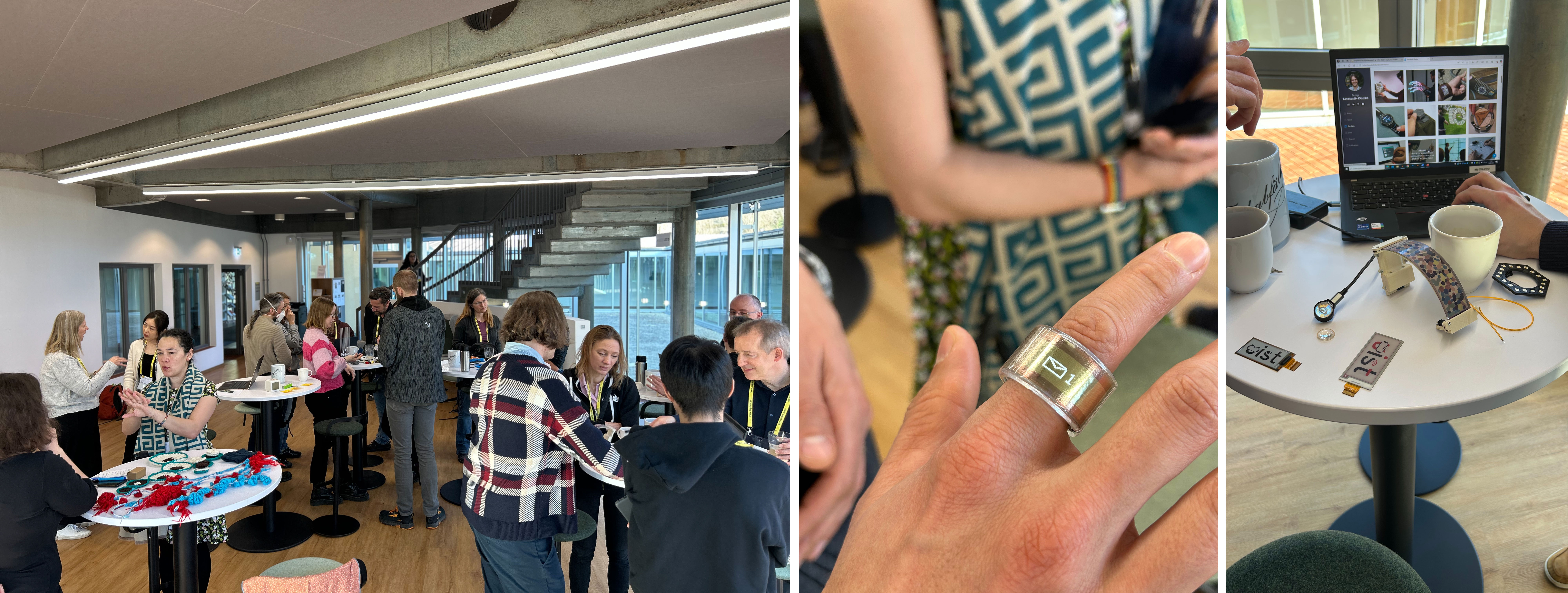
An important activity central to the seminar’s core objective of creating innovative designs and envisioning novel visualization approaches was the show-and-tell session conducted in two rounds before lunch. Many participants brought their own demos, early research prototypes, videos, material probes, and sketches to let others experience and discuss inspiring research ideas (see Fig. 1).
After lunch, Wesley Willett gave the third overview talk on “Visualization Futures” (see Sec. 4.3). This was intended as a starting point for the following afternoon group activities, two design futuring sessions. Here, participants split into six smaller groups and used the card-based sketching game “Vis Futures”555https://dataexperience.cpsc.ucalgary.ca/visfutures/, where players think critically (and playfully) about the future of data and visualization. Using sketches, AI-generated images, videos, and small physical prototypes, a series of innovative design ideas was developed and presented in a plenary to all seminar participants. Groups explored diverse concepts ranging from visualization on deformable shape-changing displays to vegetable bio-displays, textile and garment displays, foldable displays, and water displays.
Wednesday
The first part of the morning was spent on two more overview talks concluding the series. First, Aluna Everitt talked about “Democratizing the Design and Development of Emerging Technologies” (see Sec. 4.4), followed by a surveying talk on the topic of “AR x Human-Robot Interaction” given by Ryo Suzuki (see Sec. 4.5). Of course, we also followed the great tradition of a group picture on the castle’s staircase (see p. 125).
To generate breakout groups for discussing the grand challenges of visualization for NFNRD, all attendees spent the remaining time before lunch brainstormed critical topics, challenges, and technologies. We then used affinity diagramming and clustering to consolidate these ideas (see Fig. 2, middle, for some of the resulting post-it groups).
After assigning people to six breakout groups based on the emergent themes from the clustering exercise, we enjoyed lunch followed by a social activity with many research-related and personal discussions, a bus trip to the city of Trier. There, we participated in a guided tour of the historic city and had a Roman-inspired dinner at the restaurant “Zum Domstein”, which enabled new bonds to be forged between the participants.
Thursday
This day saw intense and deep scientific discussions across several breakout group work sessions. Spread over the whole day and with reporting-back sessions in between (see, for example, Fig. 2), the discussion centered around the following topics:
-
What is the scope of visualization on NFNRD? (11 participants, see Sec. 6.1)
-
Display and input technologies (6 participants, see Sec. 6.2)
-
Applications: What is the benefit of visualizing data on NFNRD? (6 part., see Sec. 6.3)
-
Relationship between data and displays (7 participants, see Sec. 6.4)
-
Designing visualizations for NFNRD (6 participants, see Sec. 6.5)
-
Evaluating visualizations on NFNRD (5 participants, see Sec. 6.6)
Some groups discussed the same topics across several sessions, but with shifting group members. The summaries provided in Sec. 6 provide an aggregated overview of the major findings that, taken together, lay the foundations for a research agenda with challenges and opportunities.

Friday
The entire morning was spent wrapping up the seminar. First, six concrete research projects and publication ideas that emerged during the past days were openly discussed among participants, along with potential publication venues, such as IEEE VIS, ACM CHI, IEEE TVCG, and others. Second, a bigger joint publication on the challenges of data visualization on non-flat, non-rectangular displays was discussed and sketched in its structure. We agreed on further steps and publication venues. Especially with this second effort, we aim to outline a comprehensive research agenda for data visualization on these emerging display types. This shall enable other researchers and practitioners in the fields of visualization, HCI and visual design to develop future data visualization solutions for these new form factors – thereby going beyond display flatland.
4 Overview of Talks
4.1 An Overview of Light Field Displays
Emmanuel Pietriga (INRIA Saclay – Orsay, FR)
License: Creative Commons BY 4.0 International license © Emmanuel Pietriga
I presented an overview of light field displays by first introducing light field photography. Light field displays enable virtual content to be rendered at different focal depths simultaneously and are particularly interesting for Augmented Reality. They enable blending virtual content with the physical world, as the light from virtual elements behaves similar to the light from the physical environment. It also has the potential to solve the vergence accommodation conflict. Virtual content is not limited to a single focal plane and can also be rendered much closer to the user’s eyes. Light field displays are still in their infancy, and I talked about the visual perception studies we are running to better understand their potential benefits.
4.2 Situated Visualization & Physicalization
Nathalie Bressa (Télécom Paris, FR)
License: Creative Commons BY 4.0 International license © Nathalie Bressa
Situated visualization is an area within information visualization that focuses on placing data visualizations in physical places to display contextually relevant information that can be related to people, places, or objects. Physicalizations, on the other hand, are physical artifacts that encode data through their geometry or material properties. In this talk, I provided an overview of these two concepts and highlighted their connections and overlap. By discussing a diverse set of examples of situated visualizations and physicalizations, I aimed to inspire new ideas for visualization on non-flat, non-rectangular displays.
4.3 Visualization Futures
Wesley J. Willett (University of Calgary, CA)
License: Creative Commons BY 4.0 International license © Wesley J. Willett
Together, let’s consider visualization futures — imagining possible and probable future technologies, probing their implications, and using them as inspiration for visualization research. This talk highlights the potential for design futuring to (1) draw ideas from existing science fiction and speculative media, (2) craft new future visions that explore, provoke, and critique, and (3) articulate new trajectories, frameworks, and theories for data visualization as a field. Using the Vis Futures card deck, plus a range of generative and manual design tools, we’ll also ideate and elaborate new visualizations for a variety of novel display platforms.
4.4 Democratizing the Design and Development of Emerging Technologies
Aluna Everitt (University of Canterbury – Christchurch, NZ)
License: Creative Commons BY 4.0 International license © Aluna Everitt
My research focuses on democratizing the development of emerging technologies. More specifically, by establishing accessible approaches for designing and building emerging technologies such as robotics, wearables, and shape-changing interfaces. To advance the field, my research focuses not only on understanding these technologies (e.g., their design), but also how to build them (e.g., engineer them), and how to innovate with them (e.g., application). In this talk, I will go over some of the projects I have worked on around this topic across the fields of HCI, Design, and Engineering.
4.5 AR Human-Robot Interaction
Ryo Suzuki (University of Colorado – Boulder, US Tohoku University – Sendai, JP)
License: Creative Commons BY 4.0 International license © Ryo Suzuki
In this talk, I gave an overview of research examples and a taxonomy of augmented reality and robotics based on my CHI 2022 paper. Augmented and mixed reality (AR/MR) have emerged as a new way to enhance human-robot interaction (HRI) and robotic interfaces (e.g., actuated and shape-changing interfaces). Recently, an increasing number of studies in HCI, HRI, and robotics have demonstrated how AR enables better interactions between people and robots. However, often research remains focused on individual explorations and key design strategies, and research questions are rarely analyzed systematically. In this paper, we synthesize and categorize this research field in the following dimensions: 1) approaches to augmenting reality; 2) characteristics of robots; 3) purposes and benefits; 4) classification of presented information; 5) design components and strategies for visual augmentation; 6) interaction techniques and modalities; 7) application domains; and 8) evaluation strategies. We formulate key challenges and opportunities to guide and inform future research in AR and robotics.
5 State-of-the-Art Groups
5.1 Interaction & HCI
Caroline Appert (University Paris-Saclay – Orsay, FR), Raimund Dachselt (Technische Universität Dresden, DE), Ricardo Langner (Technische Universität Dresden, DE), and Can Liu (City University – Hong Kong, HK)
License: Creative Commons BY 4.0 International license © Caroline Appert, Raimund Dachselt, Ricardo Langner, and Can Liu
This working group conducted a quick survey of the current state of the art for interacting with visualizations. Looking from an HCI perspective on what has been researched in the past, we first identified several interaction modalities, including, but not limited to, mouse and keyboard, touch and multitouch, pen, tangibles, eye gaze, mid-air gestures (hand), spatial interaction and device gestures, embodied interaction, speech, twisting, bending, deformation, proxemic interaction, and any multimodal combination thereof. Many of these modalities have already been applied in visualization research, especially in the past 15 years, with an increasing number of papers devoted to natural interaction or Post-WIMP interaction for visualization, sometimes characterized as visualization beyond the desktop. We provided several examples from the literature for each category, identified gaps, and discussed the potential. Touch input on arbitrarily shaped surfaces is still not easy, pen interaction has rarely been applied to curved surfaces, speech and multimodal interaction including speech would be a good candidate for interacting with unusual displays, and twisting, bending, deformation, etc. are still very underexplored in vis research. This situation will likely change with non-flat, non-rectangular displays being increasingly used for data visualization.
5.2 Perception, Design, and Vis
Lyn Bartram (Simon Fraser University – Surrey, CA), Anastasia Bezerianos (Université Paris-Saclay, INRIA, CNRS, FR), Tanja Blascheck (Universität Stuttgart, DE), Pierre Dragicevic (INRIA – Bordeaux, FR), Petra Isenberg (INRIA Saclay – Orsay, FR), and Bongshin Lee (Yonsei University – Seoul, KR)
License: Creative Commons BY 4.0 International license © Lyn Bartram, Anastasia Bezerianos, Tanja Blascheck, Pierre Dragicevic, Petra Isenberg, and Bongshin Lee
This group presented trends in visualization on “atypical” display forms, and atypical use (atypical for visualization research and design) to inform participants from outside the visualization community about relevant work related to the seminar. We noted existing visual perception work on very large displays (walls) and very small ones (smartwatches) that can be applied to study novel form factors for visualization. However, we also highlighted atypical “use”,including aspects that go beyond classic visualization tasks, designs, and evaluation methodologies, such as affective responses not only due to the visual encoding but also due to the display form and context of visualization use; aspects related to glanceability (mostly from work on smartwatches), etc. We additionally summarized situations in which visualizations have appeared on atypical “forms.” Some are extensions of classic displays, like combining mobile phones and tablets or combining them with digital tables to create new forms and configurations for data visualization, adding flexible displays as bands on smartwatches and extending the visualization surfaces, etc. Others are forms rarely used for visualization, such as drone displays that can fly, spherical displays (from big room installations to small hand-size spheres), flexible or pin-array displays used to visualize data, ambient displays embedded in the environment, and more generally situated visualizations.
5.3 Data Physicalization & Shape-Changing Displays
Lora Oehlberg (University of Calgary, CA), Nathalie Bressa (Télécom Paris, FR), Aluna Everitt (University of Canterbury – Christchurch, NZ), Yvonne Jansen (CNRS – Talence, FR), Konstantin Klamka (Barkhausen Institut – Dresden, DE), Charles Perin (University of Victoria, CA), Kim Sauvé (University of the West of England – Bristol, GB), and Miriam Sturdee (University of St Andrews, GB)
License: Creative Commons BY 4.0 International license © Lora Oehlberg, Nathalie Bressa, Aluna Everitt, Yvonne Jansen, Konstantin Klamka, Charles Perin, Kim Sauvé, and Miriam Sturdee
We presented a summary of relevant resources on data physicalizations and shape-changing displays. Data physicalizations (DP) are physical representations of data; shape-changing displays (SCD) are dynamic physical displays that can represent varying types of data or information. We summarized research venues that approach these topics from the perspectives of visualization, human-computer interaction, and enabling technologies (systems engineering). We also highlight communities beyond academia that apply or practice data physicalization or shape-changing displays within their domain. We then discussed relevant research publications that address key research questions, including: what the design space of DP and SCD looks like; how to design and build DP and SCD; what are the “platforms” that designers use to define data physically; how we encode data physically; how people interact with physical properties; what is the role of the audience of a DP or SCD. Finally, we discussed example systems and enabling technologies that make data physicalizations and shape-changing displays possible, including digital fabrication approaches and meta-materials.
5.4 AR/MR/XR Visualization
Tobias Isenberg (INRIA Saclay – Orsay, FR), Emmanuel Pietriga (INRIA Saclay – Orsay, FR), Ryo Suzuki (University of Colorado – Boulder, US Tohoku University – Sendai, JP), Wesley J. Willett (University of Calgary, CA), and Julie Williamson (University of Glasgow, GB)
License: Creative Commons BY 4.0 International license © Tobias Isenberg, Emmanuel Pietriga, Ryo Suzuki, Wesley J. Willett, and Julie Williamson
This group presented a summary of related work on mixed/augmented/extended reality (XR) visualization approaches and enabling technologies. We first summarized the visualization, immersive technology, and computer graphics venues around which this research is centered. Next we outlined a slate of recent innovations in XR hardware that have substantially reduced barriers to creating rich, complex and usable XR visualization systems, including: (1) untethered headsets, (2) table tracking in real-world settings, (3) high-resolution video passthrough, (4) fine-grained hand tracking, and (5) live environment mapping. We then highlighted a variety of recent design spaces and example systems that represent the state-of-the-art in XR visualization.
6 Grand Challenges Working Groups
Identifying grand-challenges in emerging research topics, such as visualization on non-flat displays, is crucial to help identify and articulate the most pressing questions and guide future research efforts. To inspire discussions and reflection, we first conducted a series of design futuring exercises, using an established ideation methodology (Vis Future Cards). These produced a suite of novel designs for visualizations built for shape-changing, evolving, wearable, and natural material displays; as well as discussions around opportunities such displays provide for data communication, sharing, and engaging with data. Inspired by these reflections and the prior work, the seminar participants then conducted a series of brainstorming sessions about challenges, opportunities and open research questions. We then thematically analyzed the resulting ideas and grouped them in categories that represent the major challenges in the domain. Breakout working groups explored these topics and started creating an analysis that we plan to publish as a grand challenges / research agenda report. In the following sections, we provide abstracts for these working groups.
These include: determining the scope of research on the domain; exploring display technologies and interaction techniques that may fit the display form forms; identifying what visualizations and tasks such displays will be best used for (application contexts); considering the tight relationship between data and display and how they can each influence the other; adapting existing visualization design and prototyping methodologies for displays that are non-flat and whose form may need to fit the environment; and finally evaluation challenges and opportunities to determine how we read but also how we engage with visualizations on them given that these displays do not only encode data but also need to fit their environment.
6.1 What is the scope of visualization on non-flat non-rectangular displays (NFNRD)?
Julie Williamson (University of Glasgow, GB), Nathalie Bressa (Télécom Paris, FR), Pierre Dragicevic (INRIA – Bordeaux, FR), Yvonne Jansen (CNRS – Talence, FR), Konstantin Klamka (Barkhausen Institut – Dresden, DE), Lora Oehlberg (University of Calgary, CA), Emmanuel Pietriga (INRIA Saclay – Orsay, FR), Kim Sauvé (University of the West of England – Bristol, GB), Miriam Sturdee (University of St Andrews, GB), Ryo Suzuki (University of Colorado – Boulder, US Tohoku University – Sendai, JP), and Wesley J. Willett (University of Calgary, CA)
License: Creative Commons BY 4.0 International license © Julie Williamson, Nathalie Bressa, Pierre Dragicevic, Yvonne Jansen, Konstantin Klamka, Lora Oehlberg, Emmanuel Pietriga, Kim Sauvé, Miriam Sturdee, Ryo Suzuki, and Wesley J. Willett
Recent years have seen an increase of visualization research that goes beyond desktop displays, this include visualization on mobile devices, physicalization, and immersive visualization using augmented reality technology. We focused on articulating the difference of the work targeted in this seminar from that prior work. Our focus targets dynamic and interactive visualizations, on physical displays that are not flat but rather have forms that integrate / fit their environment. These characteristics suggest that such displays allow embedding data in context (for example, in locations where the data is relevant) and can support more expressive, immediate, and powerful interactions. And they allow experiencing data in person rather than via a window into another place, as is the case of flat displays. Other work groups elaborated on the benefits of such displays as well as open challenges and opportunities. After defining the nature of these displays and visualizations built for them, we then considered the challenges they pose. These include how to promote displays and visualization use cases that minimize material and other resources (specialized material which may limit their life-cycle, energy use, sustainability, development cost), as well as ethical considerations (for example, ensuring equity, access, privacy, etc.).
6.2 Display and input technologies
Caroline Appert (University Paris-Saclay – Orsay, FR), Pierre Dragicevic (INRIA – Bordeaux, FR), Tobias Isenberg (INRIA Saclay – Orsay, FR), Ricardo Langner (Technische Universität Dresden, DE), Can Liu (City University – Hong Kong, HK), and Ryo Suzuki (University of Colorado – Boulder, US Tohoku University – Sendai, JP)
License: Creative Commons BY 4.0 International license © Caroline Appert, Pierre Dragicevic, Tobias Isenberg, Ricardo Langner, Can Liu, and Ryo Suzuki
We identified possible broad categories of displays that fit our scope of non-flat non-rectangular displays. These include real 3D displays (such as volumetric systems or 3D LED arrays), non-deformable [non-flat or non-rectangular] displays, deformable displays (including actuated, bendable, and foldable variants), modular (compound) displays made up of several components that can be rearranged, wearable or fabric displays, as well as everyday objects as displays. In addition to these form factors, we consider challenges related to materials, resolution, durability and energy consumption. The interactions appropriate for these displays are very much an open research topic. We have identified several input technologies that either exist or can be envisioned for such displays, such as on-surface input (via touch or tools) or off-surface input (mid-air gestures, speech, or proxemics). A first open research question is categorizing these possible inputs and studying good matches between input and type of display. Nevertheless, the details of how input is going to be translated to “interactions” (the words or commands that target and manipulate visualizations) depends on the type of visualizations and data presented on them.
6.3 Applications: What is the benefit of visualizing data on NFNRD?
Tanja Blascheck (Universität Stuttgart, DE), Caroline Appert (University Paris-Saclay – Orsay, FR), Aluna Everitt (University of Canterbury – Christchurch, NZ), Petra Isenberg (INRIA Saclay – Orsay, FR), Tobias Isenberg (INRIA Saclay – Orsay, FR), and Can Liu (City University – Hong Kong, HK)
License: Creative Commons BY 4.0 International license © Tanja Blascheck, Caroline Appert, Aluna Everitt, Petra Isenberg, Tobias Isenberg, and Can Liu
As NFNRDs can vary greatly in form and size, identifying when data visualization on NFNRDs makes sense (and what benefits it might provide) requires taking a step back and considering the possible contexts of use. We considered several dimensions that define this context of use: application types (public / private, stationary /mobile), audience (data specialists / general public, single person / collaborative use), tasks (ambient / focus), etc. Clearly not all display types (identified in the previous working group) fit all contexts of use. We considered possible matches and identified a grand challenge focued on the interplay between application (purpose and context of the visualization), data, and displays.
6.4 Relationship between data and displays
Anastasia Bezerianos (Université Paris-Saclay, INRIA, CNRS, FR), Lyn Bartram (Simon Fraser University – Surrey, CA), Raimund Dachselt (Technische Universität Dresden, DE), Konstantin Klamka (Barkhausen Institut – Dresden, DE), Ricardo Langner (Technische Universität Dresden, DE), Charles Perin (University of Victoria, CA), and Julie Williamson (University of Glasgow, GB)
License: Creative Commons BY 4.0 International license © Anastasia Bezerianos, Lyn Bartram, Raimund Dachselt, Konstantin Klamka, Ricardo Langner, Charles Perin, and Julie Williamson
Having access to displays that can be of diverse forms and sizes raises several research questions around how to display data on them. These start from visualization mapping and resolution questions – what we call “how the data follows the display”. For example, how can visualizations designed for a flat rectangular screen be rendered on other types of displays, such as a sphere or a cylinder? More generally, can we render any visualization on any display form and, if not, what are the limits we encounter (resolution, occlusion, etc)? Other questions relate to how the nature of the data can influence the display, or “how the display follows the data”. These observations highlight how designers might allow data to shape the form of actuated or shape-changing displays. We articulated the connection between data and displays and collected a set of opportunities and research challenges on this topic.
6.5 Design approaches for NFNRD visualizations
Kim Sauvé (University of the West of England – Bristol, GB), Nathalie Bressa (Télécom Paris, FR), Raimund Dachselt (Technische Universität Dresden, DE), Lora Oehlberg (University of Calgary, CA), Charles Perin (University of Victoria, CA), and Miriam Sturdee (University of St Andrews, GB)
License: Creative Commons BY 4.0 International license © Kim Sauvé, Nathalie Bressa, Raimund Dachselt, Lora Oehlberg, Charles Perin, and Miriam Sturdee
But how do we go about designing visualizations for such displays? Traditional sketching and paper prototyping methods are not enough, as they do not capture the subtleties of displaying information on forms that may distort visuals (see also subsection 6.6) or may be hard to envision on a two dimensional medium such as paper. We collected factors that make NFNRD hard to design for and considered different existing design methods, such as physical prototyping, and how these could be adapted for creating initial designs. We additionally reflected on the use of these displays, as their purpose is to be more integrated than flat displays, exploring how they could be perceived in their intended context of use is important. And thus how our design methods could ensure the context of use is taken into account even at the early stages.
6.6 Evaluating visualizations on NFNRD
Lyn Bartram (Simon Fraser University – Surrey, CA), Anastasia Bezerianos (Université Paris-Saclay, INRIA, CNRS, FR), Tanja Blascheck (Universität Stuttgart, DE), Petra Isenberg (INRIA Saclay – Orsay, FR), and Emmanuel Pietriga (INRIA Saclay – Orsay, FR)
License: Creative Commons BY 4.0 International license © Lyn Bartram, Anastasia Bezerianos, Tanja Blascheck, Petra Isenberg, and Emmanuel Pietriga
Given the diverse and unpredictable form factors and sizes of NFNRD, it is important to evaluate how visualizations are read on them. The topic of evaluation is challenging as there are several factors that need to be considered – including the form of the display and the context of use. The form needs to be considered from a readability / perception perspective, in other words we need to validate if information can be correctly read and understood, as aspects like curvature, angle, etc. may affect visualization reading. Traditional user-study methods will likely be enough in these instances. But we additionally need to consider evaluating the context of use and of display placement. It is possible that data engagement will be higher with displays of unusual form factors or form factors that have forms fitting the environment. Investigating and evaluating engagement and affective responses requires different study methods, such as longitudinal observation studies or controlled studies that capture measures beyond time and error. Our group listed a set of relevant study methods, measures, and logistics
7 Outlook and Conclusion
Throughout the week, our group grappled with the vast scale, potential, and implications for visualization as new display technologies allow us to escape the narrow confines and constraints of 2D screens. The diversity and heterogeneity of future display technologies that might support data visualization is vast and complex – to the extent that they simple generalizations. Yet within this rich space, our seminar succeeded in identifying not only a range of clear challenges and opportunities for the visualization research community, but also a set of promising near-term research projects (which smaller teams of attendees intend to pursue going forward). We look forward to a set of inspired new publications and research grants which trace their genesis to this seminar, and extend a gracious thank you to Dagstuhl for providing the support and organization that allowed us to convene it.
8 Participants
-
Caroline Appert – University Paris-Saclay – Orsay, FR
-
Lyn Bartram – Simon Fraser University – Surrey, CA
-
Anastasia Bezerianos – Université Paris-Saclay, INRIA, CNRS, FR
-
Tanja Blascheck – Universität Stuttgart, DE
-
Nathalie Bressa – Télécom Paris, FR
-
Raimund Dachselt – TU Dresden, DE
-
Pierre Dragicevic – INRIA – Bordeaux, FR
-
Aluna Everitt – University of Canterbury – Christchurch, NZ
-
Petra Isenberg – INRIA Saclay – Orsay, FR
-
Tobias Isenberg – INRIA Saclay – Orsay, FR
-
Yvonne Jansen – CNRS – Talence, FR
-
Konstantin Klamka – Barkhausen Institut – Dresden, DE
-
Ricardo Langner – TU Dresden, DE
-
Bongshin Lee – Yonsei University – Seoul, KR
-
Can Liu – City University – Hong Kong, HK
-
Lora Oehlberg – University of Calgary, CA
-
Charles Perin – University of Victoria, CA
-
Emmanuel Pietriga – INRIA Saclay – Orsay, FR
-
Kim Sauvé – University of the West of England – Bristol, GB
-
Miriam Sturdee – University of St Andrews, GB
-
Ryo Suzuki – University of Colorado – Boulder, US & Tohoku University – Sendai, JP
-
Wesley J. Willett – University of Calgary, CA
-
Julie Williamson – University of Glasgow, GB
![[Uncaptioned image]](x3.jpg)