New Frontiers in AI for Game Design
Abstract
Game design has often influenced, and been influenced by, computer science research. In recent decades researchers and designers have sought to bring these two fields even closer together: to find new ways to think about the game design process; new ways to drive innovation in computer science through playful exploration; and ultimately find new ways to play, design and think about games through computational lenses. AI is impacting the creative industries in more ways than ever before, some welcome, others less so. It is important to find ways for both researchers and practitioners to come together to map out possible futures for this space, to understand where research can contribute, what it can learn from game design in return, and how we can enrich the creative practice of everyone involved.
This report covers Dagstuhl Seminar 25292: New Frontiers for AI in Game Design. It outlines the motivations for organising the seminar, summarises many of the working groups that took place, and disseminates some of the games, theories and other materials created during the seminar. The report offers theoretical frameworks, working prototypes and exploratory discussions that present many possible futures for both the creative practice of game design, and the academic field of games research. None of these futures are singularly correct, and many more remain out there to be found; this document merely charts out some possible paths into the unknown that we found exciting to consider.
Keywords and phrases:
artificial intelligence, Computational Creativity, Game Design, Human-Centred Computing, Procedural Content GenerationSeminar:
July 13–18, 2025 – https://www.dagstuhl.de/252922012 ACM Subject Classification:
Applied computing Computer games ; Computing methodologies Artificial intelligence ; Human-centered computing Human computer interaction (HCI) ; Applied computing Personal computers and PC applicationsCopyright and License:
![[Uncaptioned image]](x1.png) Except where otherwise noted, content of this report is licensed under a
Creative Commons BY 4.0 International license
Except where otherwise noted, content of this report is licensed under a
Creative Commons BY 4.0 International license
1 Executive Summary
Michael Cook (King’s College London, GB)
M Charity (University of Richmond, US)
Nicolaas Vas (Billund, DK)
License: ![[Uncaptioned image]](x2.png) Creative Commons BY 4.0 International license © Michael Cook, M Charity, and Nicolaas Vas
Creative Commons BY 4.0 International license © Michael Cook, M Charity, and Nicolaas Vas
The relationship between games research and game design is as old as it is complicated. If we track back through the history of research in and around games, we find many researchers were also designers, and research touching on games was often playful in nature. Similarly, game design is an exploratory creative practice that often asks new questions about technology and art, and in turn drives innovations elsewhere. Today, the overlapping space in between these two spaces is richer than ever, with many game designers also working as researchers, and vice versa. On a community scale, however, many barriers and gaps remain. Does a researcher have to become a practitioner to impact game design? Does a game designer have to know all the literature and theory to engage with research? How does one start out learning to make games, or understanding how to make sense of existing research?
As a creative practice, game design itself is richer, and more important, than ever. Games are a vast cultural space that has spilled out of consoles and mobile phones into museums, cinemas and schools, and their economic, artistic and social importance has never been clearer. Game design is thus not simply of relevance to a few hundred people working as professionals in large commercial companies, but a skill that is important to tens of thousands of independent creators and artists, and millions of hobbyists all around the world. Roblox, the most popular videogame with young people in America, is a game design toolbox at its core, a many of its millions of players use it for exactly this purpose. As of mid-2025, when this seminar took place, it is estimated that Roblox alone contained nearly 50,000,000 games and interactive experiences – the majority of which have been designed by its younger players.
Games and game design has always been a rapidly-changing and tumultuous space, particularly in the area of digital games. Major technological shifts have transformed the industry almost every decade, from the shift away from arcades, the introduction of personal computers, the transition to 3D graphics, the wider availability of the Internet, the expansion of digital storefronts, and the broadening access to game development tools. One factor that, as we write this, has an unclear future impact on game design is the advent of “generative AI”. AI as a general field has a long and rich history with games, and games are one of the key domains that shaped the history of AI into what it is today. The impact of generative AI on design remains unclear, but the split opinions over the technology and its uses also provides a reason for us to re-examine how research and technology in general are used to shape creative fields like game design – what is useful, what is harmful, and how can we include the people most affected in the research process?
All of this brings us to the motivation for this seminar, tentatively titled New Frontiers in AI for Game Design. Inspired by some of the past seminars focusing on games research, we wanted to create a week of big ideas, bold experiments and lots of rich discussion and plan-making. Given the practical nature of our chosen topic, however, we also wanted to explore a more practical approach to a Dagstuhl Seminar, centred around play, exploration and application. Our invitee list included a wide variety of backgrounds, including award-winning independent game designers, industry-leading experts on play and creativity, and world-class researchers. Most of our attendees had some experience making games, whether that be physical or digital, alone or in groups, as a commercial product or a freely distributed project. Our hope was that by bringing people with so many distinct – but overlapping – perspectives on design and play, we could explore not only new frontiers for game design, but also new frontiers for how research and practice can talk, share ideas, collaborate and grow closer.
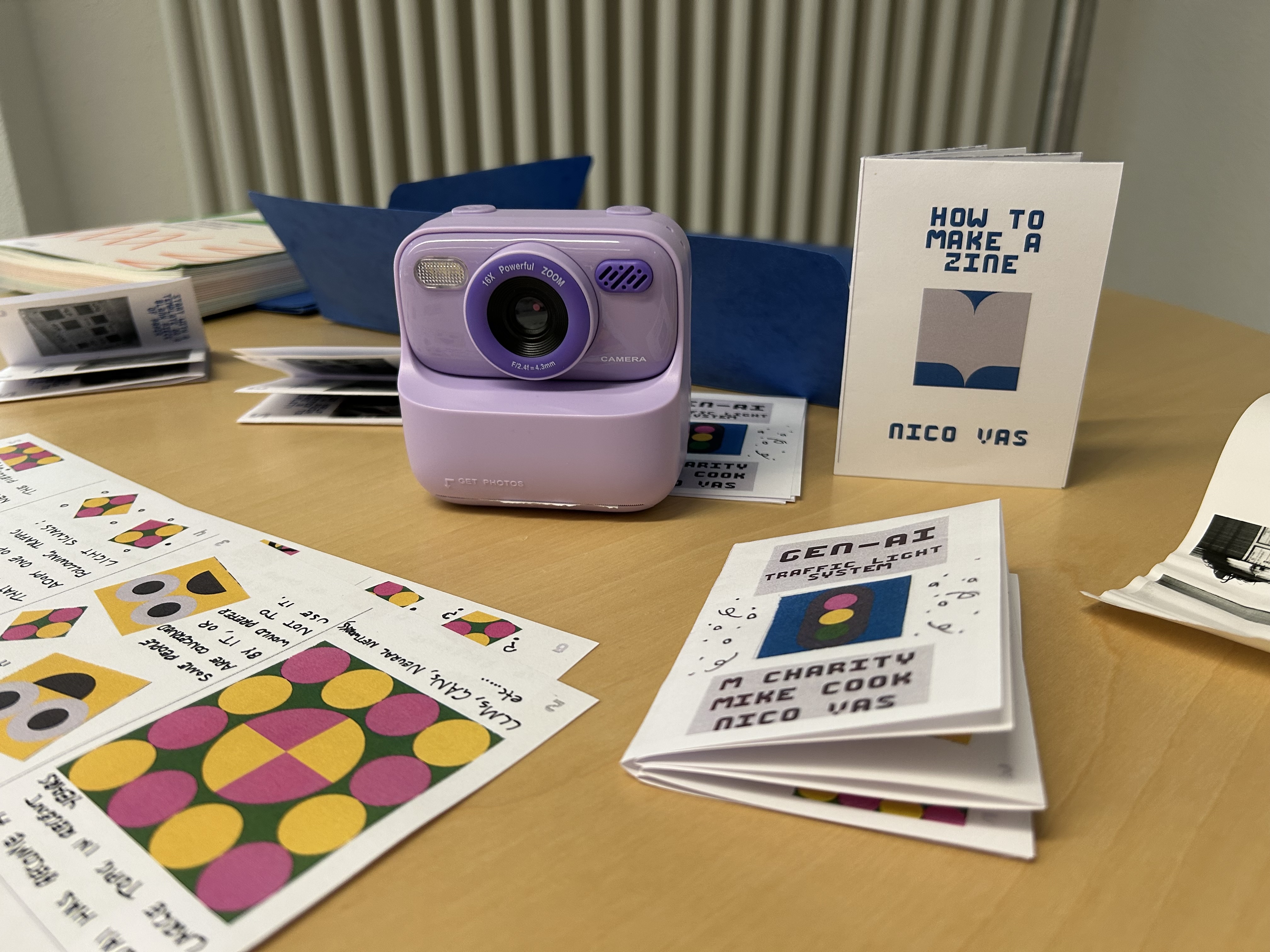
Bringing people together with different backgrounds, experiences and ways of working always presents challenges. It can also be daunting to turn up to a new community and be sure that your contributions will be accepted, or that you will be able to understand your peers’ perspectives. We took some steps to help set the tone for the seminar. Nicolaas, one of the organising team, meticulously designed a wonderful icebreaking session where invitees helped each other make their own alternative physical nametags. As part of this, they also got a taste of Dagstyle, a creativity system designed by Nicolaas for use during the week, as an inspiration and a source of things to hack and repurpose during the week of workshops. Dagstyle is a visual language of sorts, that can be used for many things. An abstract later in this report provides an overview of the system, should any future Dagstuhl Seminar want to use it in their own work. Most of our working groups used Dagstyle in some form or another, with one of the most prominent uses of it in Section 3.2, where it is used as a prototype for a visual programming language.
During the week, we followed the traditions of the previous games research seminars held at Dagstuhl, by inviting working group proposals at the start of each day and allowing people to self-organise into groups. Each group would then report at the end of the day on their work. The reports you will see later in this document record many of the working groups that took place during the seminar, covering topics such as a design language for gameplay curves (Sec. 3.5), an examination of design intent (Sec. 3.6) and a study of generative AI in the context of rapid prototyping (Sec. 3.8).
Generative AI’s impact on discourse in both computer science research and on the games industry was impossible to ignore in 2025, and we wanted to ensure people were able to explore and experiment freely during the week, without being trapped in projects they didn’t want to be a part of. To fit this, we instituted a “traffic light” system, suggested by Florence Smith Nicholls, which allowed working group organisers to label their group and how they planned to use generative AI for their project, if they chose to use it at all.
A project labeled as “green” meant that generative AI would be the focus or core of the project design. The projects proposed under this category often focused on the use of large language models, text-to-image generation, or other commercial or open-sourced generative AI models as part of the final prototype or in the design process.
A project labeled as “red” meant that the use of generative AI would be avoided entirely for the project design. Many of the projects proposed under this category focused on more analog forms of game design and content creation or the conceptual practice of game design and around user intent and social dynamics of games.
A project labeled as “yellow” meant that the use of generative AI would not necessarily be the focus and could be used agnostically. Many of the projects proposed and completed for working groups during this seminar fell under this category. By defining these clear categories for the directions of the projects proposed, seminar attendees were able to understand which projects they were interested in joining and comfortably set boundaries before committing to a working group.
One of the great joys of bringing together so many creative, generous and kind people is that a community almost instantly forms, and unexpected things emerge from it. In addition to our working groups during the day, our attendees put on a wide variety of social activities in the evening which helped attendees get to know one another better, and to play. Our thanks to Tiago Machado for organising a tango lesson, to Mike Cook and Gillian Smith for leading a livecoding workshop, to Emily Short for running a collaborative game writing night about AI fear, and to Claus Aranha for ending the week by putting together a night of Slideshow Karaoke.
We encouraged our participants to think broadly and explore what they were passionate about during the week, particularly as it was an opportunity to work with a unique combination of people and skillsets. However, we welcomed working groups that were centred around prototypes and small working examples, where it made sense for the questions being considered. We were delighted to see many prototypes and interactive projects emerge from the week, including almost a dozen playable games, some of which have already been archived online. Parallel to this, we provided plentiful crafting materials and support for making zines in conjunction with working group outputs. Zines are small booklets, traditionally made using cut-and-paste techniques and photocopiers. We encouraged the use of Nathalie Lawhead’s Electric Zine Maker, and several participants made zines as part of their participation – notably as a key part of the output for the working group on Keepsake Games in Section 3.12. Many of the zines made during the seminar are included as part of this report, including Nicolaas’ Dagstyle zine on making zines, which we presented at the beginning of the week.

Dagstuhl Seminars often have an otherworldly quality to them – a gathering of people that often seems impossible or improbable, in a beautiful, isolated setting, where all the traditional rules for how we work are thrown out of the window for a few days. Our stated aim was to explore how AI and related technologies might impact game design, and vice versa. Our working groups embraced this challenge in various ways: thinking about new ways to integrate design and theory; finding new applications for established approaches; testing the limits of, and our assumptions about, new technology; and much more besides. The seminar has already given rise to new international collaborations, game projects and funding plans. On a meta-level, though, the seminar itself was also an exploration of how research and design can meet in the same place and find play there. It was a week about play that was also playful, where people from different fields, industries and backgrounds could find new ways to communicate, share and collaborate through games and creativity. As organisers, we are incredibly grateful for everyone who came and gave their time, their ideas and their energy to the impromptu community we built over the course of the week.
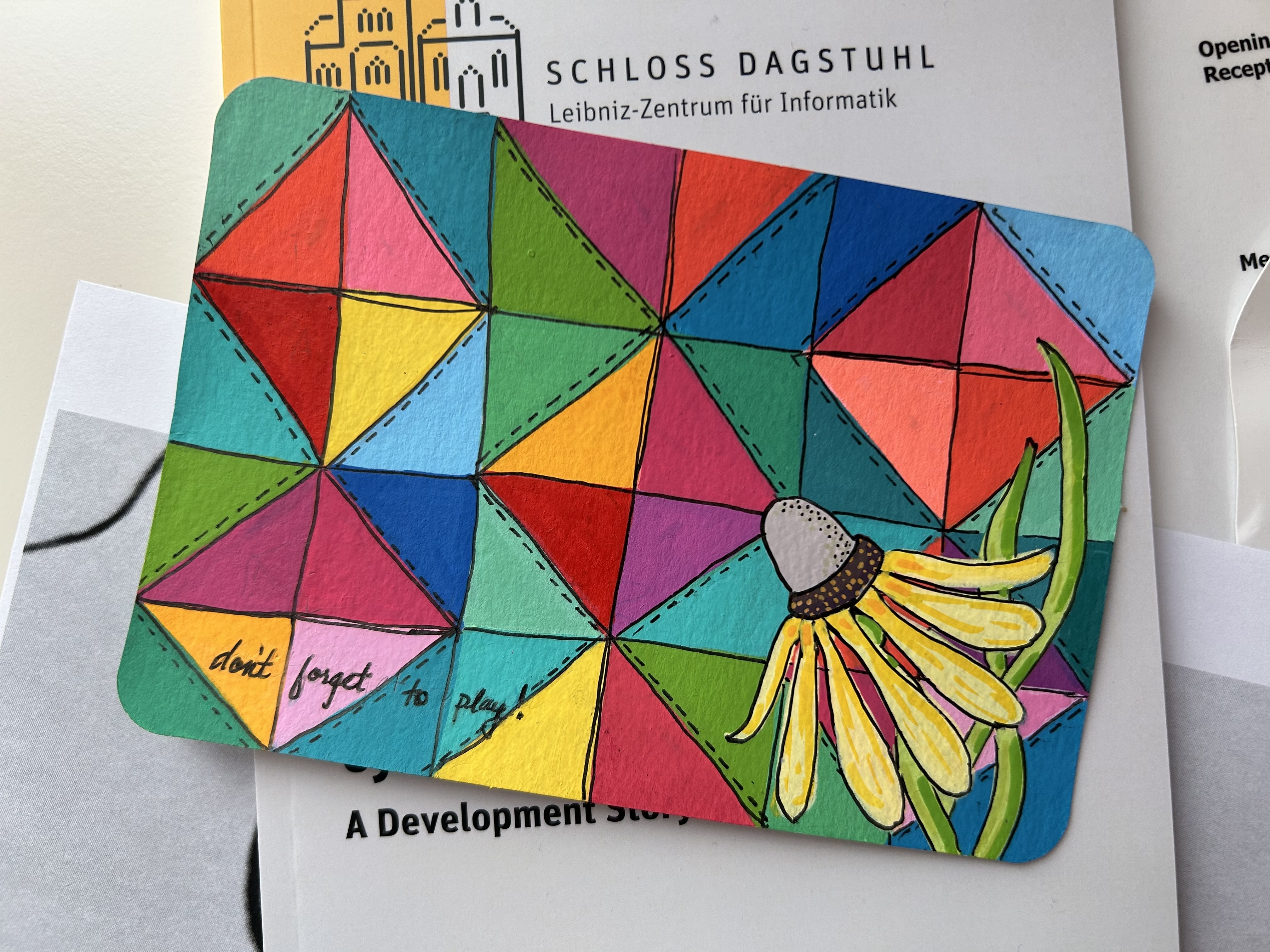
One of the games created during the week was by Anne Sullivan. Anne brought a wide variety of painting supplies to the seminar, encouraging everyone to use them both for work and play. As part of the working group on Keepsake Games, Anne designed a keepsake game specifically for playing while at a Dagstuhl Seminar. The player is randomly given, or chooses, a series of creative prompts and then designs a postcard to give to another attendee at the seminar. The prompts provide suggestions for what to put on the postcard (for example: something representing a working group), and who to give the postcard to (for example: someone new you met at the seminar). We concluded the week by inviting all attendees to create postcards using Anne’s game, using the leftover crafting supplies and Anne’s brush pens, and exchange them with other attendees before leaving. It was a brilliant opportunity for reflection at the end of the week, and for strengthening the community ties that had been created over the preceding days.
The rest of this report is dedicated to individual reports from working group leaders and others who contributed to the week’s activities. There are many attachments in the report in the form of PDFs for items such as zines. Currently, Dagstuhl has no way to officially archive or preserve interactive works, however at the time of writing there are several digital and physical games produced during this seminar which can be accessed online at http://playdagstuhl.itch.io. We will endeavour to keep these projects accessible at this URL for as long as possible, and will encourage their authors to upload archival versions to other locations (such as the Internet Archive) as well. We hope you enjoy reading this report, and look forward to returning to Dagstuhl one day to play again.
References
-
[1]
The Experimental Gameplay Workshop.
Online: https://www.experimentalgameworkshop.org
2 Table of Contents
3 Working groups
3.1 New Frontiers in Tamagochi
Claus Aranha (University of Tsukuba, JP), Duygu Cakmak (Creative Assembly – Horsham, GB), Alena Denisova (University of York, GB), Matthew J. Guzdial (University of Alberta – Edmonton, CA), Florence Smith Nicholls (Queen Mary University of London, GB), Yuqian Sun (Royal College of Art – London, GB), and Sabine Wieluch (Universität Ulm, DE)
License: Creative Commons BY 4.0 International license © Claus Aranha, Duygu Cakmak, Alena Denisova, Matthew J. Guzdial, Florence Smith Nicholls, Yuqian Sun, and Sabine Wieluch
Digital Pets are a unique form of digital game, blurring the barriers between the physical and digital, the in-game world and the real world. Bandai’s “Tamagochi”, released over 30 years ago, is probably the most representative among digital pets.
Taking care of make-pretend creatures is a form of play that goes all the way back to the first human children taking care of dolls. The original Tamagochi toy used its hardware and programming to simulate how often it wanted to be fed, to display random events like sickness and boredom, and to give the user feedback about its internal state. As technologies advance, we ask ourselves what new twists they can bring to this very old form of play.
Recently, advances in the hardware and machine learning technologies has led to a revolution in fields such as Artificial Life. Yearly competitions on virtual creatures are held, where computer programs simulate forms of life, including their capacity for reproduction, tending to their base needs, and eventual evolution into new life forms [1].
In this context, we proposed this workshop to discuss how research advances in Artificial Life and Artificial Intelligence could interact with the concept, design and implementation of Digital Pets. And, in the opposite direction, what the experiences of the interactions between humans and digital pets could inform to the research of Artificial Life forms.
In practice, the workshop was divided in two parts: during the morning, the group discussed our experiences with digital pets: What are representative and unique examples; what are their characteristics; what are their design principles. The discussion evolved into forming a loose taxonomy of digital pets, and a conversation about what new directions could be taken in their design. During the afternoon, the group separated into teams to design and prototype new digital pets, based on the discussion in the morning, as well as experiences from past working groups in this seminar.
3.1.1 Discussion on Digital Pets
The first activity of the working group was a brainstorming exercise where the participants came up with representative examples of digital pets. These examples included traditional digital pets such as Desktop Companions, Nintendogs, Digimon Virtual Pet, and Furby; games that included digital pets as extra content, such as Sonic Adventures Chaos Garden; Non-interactive “aquarium” games where the player only observes the digital pet, such as Tabikaeru and Neko Atsume, non-game devices that were inspired by digital pets such as Pwnagochi and Scanner; and non-eletronic “toys” such as Seamonkey kits.
During this brainstorming exercise, the working group listed the kinds of experiences of play that were associated with the idea of digital pets. To start with, digital pets are expected to have needs that must be tended to by the player, such as food and play. By tending to these needs, it is expected that interacting with the digital pet becomes part of and parallel to the player’s life. In this sense, the digital pet has an independent life that interacts with the player’s life, and this allows the player a window into a different world, where they can explore themes of change, growth and death.
From this concept of “independent, parallel life”, we defined the design goal of a digital pet as the creation of a personal connection with the player. This aligns with characteristics seen in most of the digital pets discussed, such as cuteness and helplessness, which contribute to create this sense of dependency in the player. In this sense, digital pets that include a physical component, such as Tamagochi, can have an enhanced sense of permanence, in that they continue existing even if the digital creature dies. Although it is possible to reset a dead Tamagochi, this sense of connection has led people to perform rituals such as burials on their dead digital pets.
As the discussion came to a close around the idea of attachment between human and digital creature, the working group formed two teams to create prototypes of digital pets. Two projects were proposed: “Dagochi”, with the idea to use undirected learning to create life-like digital pets, and “Rocking with Charisma”, focused on ideas of physicality and attachment.
3.1.2 Project 1: Dagochi
Dagochi arose from a desire to convert Reinforcement Learning (RL) agents into Tamagochi-like beings. We began by creating a small grid world directly inspired by Little Learning Machines [2]. In this grid world, agents could move over land to try to collect crystals and avoid fire. Collecting all crystals was considered a terminal state, which would grant a large positive reward. Stepping into fire was another terminal state. We implemented a simple tabular Q-learning agent for this environment. While the environment is small enough to perfectly calculate optimal paths, we specifically wanted to engage with the learning process.
To the simple RL environment described above we iteratively added the following features in an attempt to make it more digital pet-like. We added the ability for humans to create their own maps, defined as text files, with “-” representing ground, “C” representing a crystal, “F” representing fire, and “A” representing an agent’s starting location. We felt this would allow for more interactivity in terms of humans in-essence metaphorically feeding environments to the RL agents.
We added a population of agents with five initial agents nicknamed: Sally, Brandon, Peach, Dawn, and Don. We called these agents “dagochi”. Each rollout would select a single agent, and have that agent attempt to solve a single randomly selected map. We also added print messages to express the RL agent’s Q-table as a metaphor for its emotional state. A Q-table with mostly negative values would mean the dagochi was depressed, so even winning the map would leave them saying “Of course it went badly” through a print statement.
We next added the ability for dagochi to breed, with a small chance of this happening if two dagochi in a row ended up on the same randomly selected map. We wrote a simple script to combine the parent names to create a child name, leading to names like “DSally” for the child of Dawn and Sally. Similarly, we added a small chance of one dagochi killing another, which would delete that dagochi’s Q-table.
Overall, we found these small additional features surprisingly effective at making the RL agents feel characterful. Figure 4 includes an example output from the system in terms of a screenshot of the terminal running it. In this example we can see one dagochi first have a child with another dagochi before killing them, then exclaiming “Oh wow I did great!”. These sorts of easily narrativized moments happened repeatedly while watching the simulation. It felt not unlike watching an aquarium or other collection of pets interacting. Based on this experience, we think there’s a real potential in making reinforcement learning more approachable and/or developing novel play experience by continuing to investigate the intersection of RL agents and digital pets. Dagochi can be accessed through a github repository444https://github.com/mguzdial3/Dagochi.
3.1.3 Project 2: Rocking with Charisma
Our main design aim was to create an analogue virtual pet game. We were drawn to the idea of using a found object, as this would allow a player to use a mundane thing and imbue it with life. Inspired by the proliferation of pebbles around Dagstuhl, we settled on the familiar concept of a “pet rock,” designing a new solo TTRPG around caring for it.
The game “Rocking with Charisma” has two main phases. The “Becoming” phase involves choosing a rock, attaching (or drawing) an eye for it, and then calculating its two main stats, health and charisma. Any rock starts out with a charisma of 1, but health is determined by rolling a d6 + 2. In the “Care” phase, each carer must perform a daily action to maintain it so that it doesn’t lose health. We wanted our game to be a collaborative game, so there can be multiple carers; this means that more carers means there is more opportunity to lose health, however the more people involved, the greater the chance of gaining charisma. This is because at the end of each day, you roll a d20 + n in which n is the number of carers. If you roll 10 or higher the pet rock gains 1 charisma. Each time it gains charisma, it also gains an eye. At max 5 charisma, a rock can have its own pet rock (Fig.5), and the cycle continues.

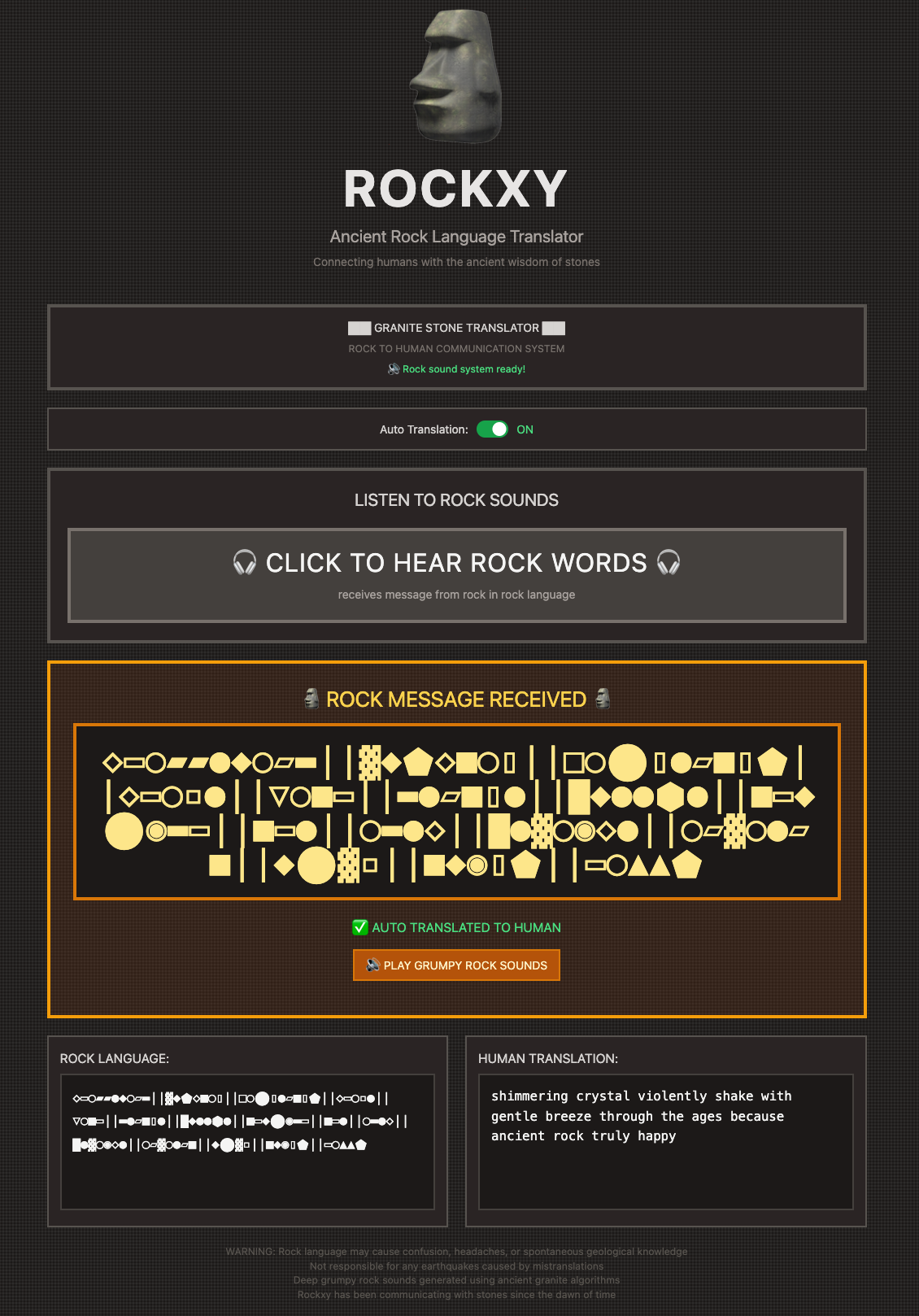
Possible daily actions with the rock include, but are not limited to: taking the rock for a walk, decorating your rock, doing a Tarot reading for your rock and designing a passport for your rock. If a rock reaches 0 health it dies, and you should return it to the world. In addition to the analogue game, Yuqian Sun also produced a digital Rock Language Translator 555https://github.com/sunyuqian1997/Rock-Language-Translator that could be accessed by scanning an NFC sticker. This translator produced “grumpy rock sounds” driven by Animalese.js666https://acedio.github.io/animalese.js/, which could then be translated through a fictional granite symbol language, as a way of communicating with your rock. The system maps each letter to unique geometric symbols (vowels as circles, consonants as blocks and shapes), creating a visual cipher that transforms human text into “ancient stone script.” Users can either input text to generate rock sounds and symbols, or “listen” to randomly generated rock messages that appear as cryptic symbol sequences.
This prototype is clearly somewhat irreverent in tone, however we believe it provides an interesting provocation on the nature of virtual pets. The original pet rock fad in the 1970s precedes the Tamagochi fad. The selling point was that the rock did not require care or maintenance, even to the extent that it is now used as a metaphor for preserving static websites in contemporary digital archiving research [3]. Rocking with Charisma thus imposes the Tamagochi logic onto an earlier, analogue toy.
3.1.4 Conclusions
The working group discussions, prototype development, and subsequent play and presentation, injected an air of creativity around the ideas of “Tamagochi”. Although digital pets are not the first thing that comes to mind when we think of computer games, we think that the play around making connections with make-pretend life form speaks to something fundamental in human nature. This may be at the core not only of digital pets like Tamagochis, but maybe even in our dreams of artificial life forms in fiction and research.
References
- [1] Sam Kriegman. Why virtual creatures matter. Nature Machine Intelligence, Vol 1, page 492, 2019
- [2] Dante Camarena, Nick Counter, Daniil Markelov, Pietro Gagliano, Don Nguyen, Rhys Becker, Fiano Firby, Zina Rahman, Richard Rosenbaum, Liam A. Clarke and Maria Skibinski. Little Learning Machines: Real-Time Deep Reinforcement Learning as a Casual Creativity Game. Proceedings of Experimental AI in Games Workshop, 2023 (EXAG)
- [3] Martin Holmes and Joey Takeda. From Tamagotchis to Pet Rocks: On Learning to Love Simplicity through the Endings Principles. DHQ: Digital Humanities Quarterly 17.1, 2023 (DHQ)
3.2 Visual Representation for Video Game Description Language (V-VGDL)
June Bhartia (Télécom Paris, FR), Michael Cook (King’s College London, GB), and Nicolaas Vas (Billund, DK)
License: Creative Commons BY 4.0 International license © June Bhartia, Michael Cook, and Nicolaas Vas
The Video Game Description Language (VGDL) [1] is a high-level formalism for rapidly creating complete video games from concise textual descriptions. Originally developed in a previous Dagstuhl Seminar , VGDL enables designers to specify sprites, interactions, and level layouts using symbolic rules, making it a powerful tool for procedural content generation and experimentation. However, its text-based format remains largely inaccessible to non-programmers and those unfamiliar with formal languages.
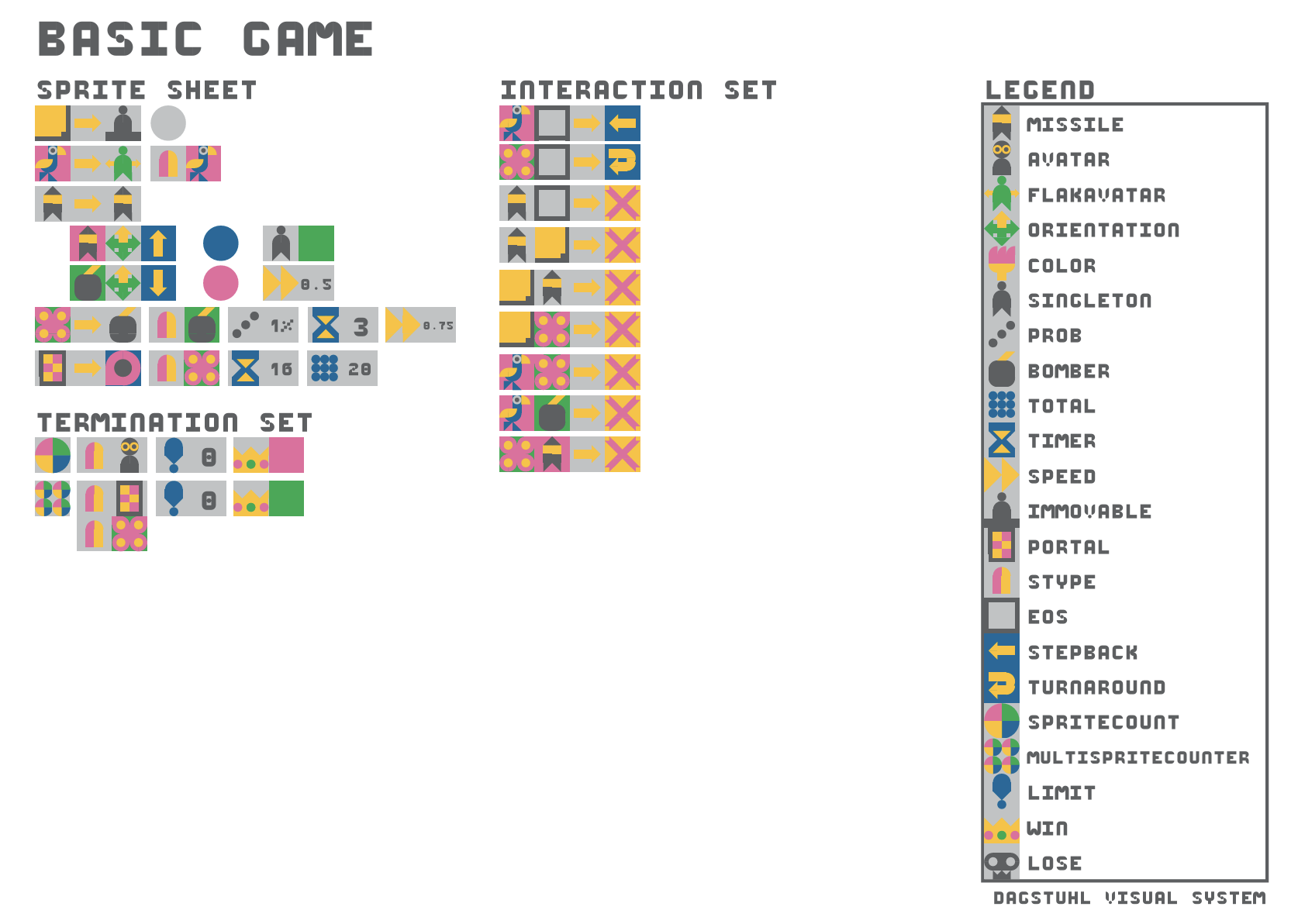
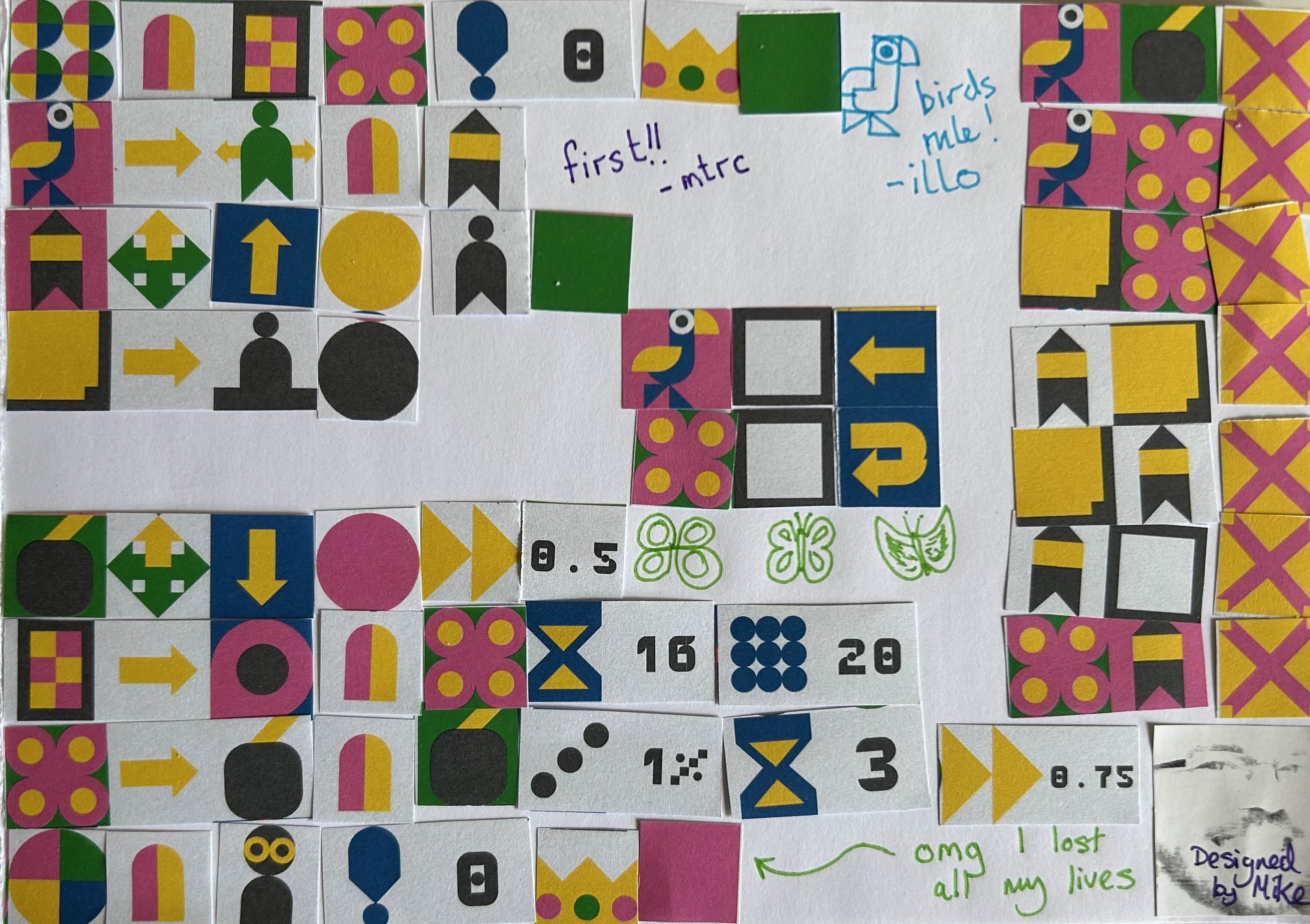
In this work, we explore a visual extension of VGDL, transforming textual keywords into icons and arranging them spatially to create a more accessible and expressive design medium. By representing VGDL rules, mechanics, and levels through composable images, we aim to lower the barrier to entry for game design while simultaneously introducing new possibilities for creativity, collaboration, and interpretation.

3.2.1 Approach
Our approach began with a direct one-to-one visual translation of an existing VGDL game: Aliens, into a set of icons. Each keyword in the VGDL source was assigned a corresponding image, and these were arranged according to the original code’s structure. Figure 7 shows this initial mapping. This prototype allowed us to evaluate readability, expressivity, and compression potential. The translation raised several interesting design questions:
-
1. Compression vs. readability: How much of the original syntax could be omitted while maintaining intelligibility?
-
2. Layout affordances: Could spatial arrangements (e.g. crossword-like layouts, scattered clusters) improve memorability or efficiency compared to linear text?
-
3. Expressive gaps: How might empty space, annotations, or decorations function as part of the design medium?
To answer these questions we attempted to make another prototype using cut up paper icons. We tried to compress it to the size of a postcard and took some liberties with the syntax of VGDL. This prototype is shown in Figure 9.

3.2.2 Discussion and Potentials
Several interesting insights and potentials emerged from our exploration:
-
1.
Collaborative and Community Play: A visual system lends itself naturally to physical artifacts that can be shared, such as postcards, magnets, or cards. These could enable community-created games where rules are tangible, remixable, and collectively modified.
-
2.
Tags, Variables, and Modularity: Inspired by modular sprite systems, we considered tag-like extensions (e.g. small polymorphic icons) to represent properties and attributes.
-
3.
Spatial Memory and Arrangement: The two-dimensional arrangement of icons introduces new cognitive affordances. Crossword-like layouts may enhance recall through spatial memory, though at the cost of efficient space usage. This reflects a trade-off between memory and efficiency.
-
4.
Cultural Encodings and Localisation: Visual symbols are not universally interpreted. Cultural context shapes how icons are read, suggesting the need for localisation strategies or multiple representational layers.
-
5.
Material Affordances: Unlike text, physical or visual arrangements invite shuffling, cutting, enlarging, or remixing.
-
6.
Live Coding and Debugging: Since each visual token has a direct mapping to mechanics visible in gameplay, it becomes possible to highlight active rules in real-time. This creates opportunities for live coding experiences, teaching tools, and interactive debugging.
3.2.3 Future Work
There are many things to still explore around this idea. We have already made a small prototype that can recognize full lines of VGDL from arranged icons. Besides making a digital version of the paper prototype we made during the seminar, there are plenty of directions in which to go, such as live debugging, tangible icons, and exploring automated game design through this.
References
- [1] Tom Schaul. A video game description language for model-based or interactive learning. Proceedings of the 2013 IEEE Conference on Computational Intelligence in Games (CIG), pages 1–8, 2013. doi:10.1109/CIG.2013.6633610
3.3 A Better Mario Kart World
M Charity (University of Richmond, US), In-Chang Baek (Gwangju Institute of Science & Technology, KR), Brian Bucklew (Freehold Games – Walkerton, US), Kate Compton (Vejle, DK), and Matthew J. Guzdial (University of Alberta – Edmonton, CA)
License: Creative Commons BY 4.0 International license © M Charity, In-Chang Baek, Brian Bucklew, Kate Compton, and Matthew J. Guzdial
This report details the development of a prototype online multiplayer kart racing game. The focus of this prototype was to create a exploratory and unique kart racer with social multiplayer interaction in an open-world environment via procedural content generation. This work was done by M Charity, Kate Compton, Brian Bucklew, In-Chang Baek, and Matthew Guzdial.
3.3.1 Premise
Mario Kart World (MKW) was released by Nintendo as a launch title for the Nintendo Switch 2 on June 5, 2025[1]. The gameplay – like previous iterations in the Mario Kart series – involves Super Mario characters participating in go-kart races. The tracks include items that can be used against other characters or power-ups such as a speed boost for the kart racer. However, unlike prior iterations, Mario Kart World included a new mechanic of open-world driving and navigation. MKW allowed players to freely roam between tracks on the “world map” area and complete minigames or small quests in addition to the traditional track racing.
While the open-world navigation introduced an innovative mechanic for the series – the authors felt the new mechanic did not meet certain expectations of an open world – such as exploration, discovery, and player camaraderie that can be created from spontaneous multiplayer interactions [2]. We developed a prototype multiplayer racing game in 8 hours at Dagstuhl Seminar 25292 in an attempt to explore these missing experiences from MKW.
3.3.2 Development Process
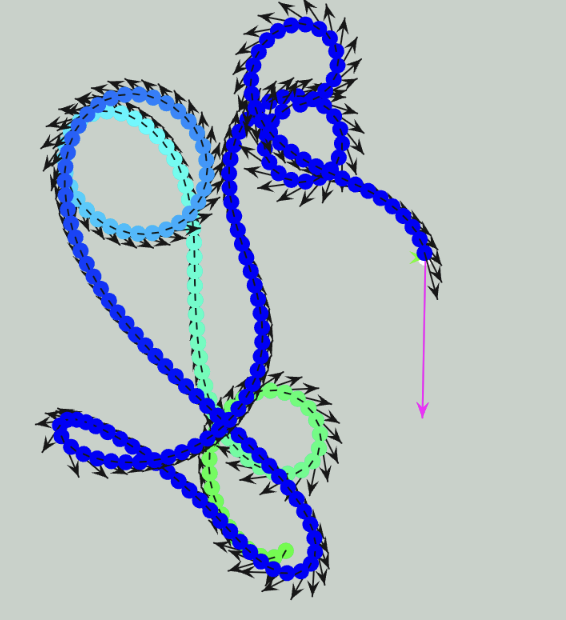
The prototype was originally intended to be a 2.5D billboard style multiplayer game using Mode7 graphics (taking inspiration from the first Mario Kart game on the Super Nintendo system.) The tracks would also be procedurally generated instead of the manually designed tracks used in Mario Kart games. This could allow for more diverse and unique experiences for the player as they drove on the track. See Figure 11 for an example of the procedurally made “Karticle” tracks developed for the prototype.
For the multiplayer capabilities, P5.js777https://p5js.org/ and Vue.js888https://vuejs.org/ were used to handle server and client connections as well as display the graphics via an HTML5 capable browser. We used the p5party multiplayer framework, hosting client relays heroku, and launched the demo publically using ngrok. This demo was made completely free and available to play. When a player connected to the game, they were given a randomly assigned car color and a randomly assigned emoji to represent their character. There were a possible 375 different emojis available for the player – 7 times more characters than the character roster in Mario Kart World. Players had the ability to “honk” at other players connected to the server which would play an audio clip on all players’ browsers. This would allow for more direct social connection with other players while they were playing the game.
3.3.3 Live Demo
While the Mode7 rendering was unsuccessful for the demo, the top-down view of the track still allowed players to drive and follow the procedurally made track. The server allowed the entire seminar group to connect to the game. With a session size of 30 people this was more than the maximum multiplayer limit of 24 players in Mario Kart World. The prototype did not include power-ups or quests like MKW. In terms of social interactions players could only honk at one another in the game, but playing with everyone in the same room afforded spontaneous interactions external in the game. As such, while we did not accomplish our original objective, we felt that we presented an innovative social player experience in a procedural racing game.
References
- [1] Mario Kart™ World for Nintendo Switch 2 – Nintendo Official Site. Nintendo. 2025
- [2] Nathan Gerard Jayy Hughes. Understanding specific gaming experiences: the case of open world games. Diss. University of York, 2023.
- [3] Brian Shea. Nintendo Says Mario Kart World’s ’Value’ Justifies Its $80 Price. GameInformer. April 2025
- [4] J Brodie Shirey. Mario Kart World Devs Explain Lack Of Non-Mario Characters. GameRant. June 23, 2025
3.4 Social Games that You Can Play with Massive Content
Kate Compton (Vejle, DK), June Bhartia (Télécom Paris, FR), Duygu Cakmak (Creative Assembly – Horsham, GB), M Charity (University of Richmond, US), Antonios Liapis (University of Malta – Msida, MT), Tiago Machado (IBM Research – Sao Paulo, BR), Dipika Rajesh (University of California at Santa Cruz, US), and Anne Sullivan (York University – Toronto, CA)
License: Creative Commons BY 4.0 International license © Kate Compton, June Bhartia, Duygu Cakmak, M Charity, Antonios Liapis, Tiago Machado, Dipika Rajesh, and Anne Sullivan
This report details the findings, including a zine and prototype, by June Bhartia, Duygu Cakmak, M Charity, Kate Compton, Antonios Liapis, Tiago Machado, Dipika Rajesh, and Anne Sullivan.
3.4.1 Premise
Like dragons sitting on vast hoards of data, we enjoy an unprecedented wealth of content today.
We have access to cultural content – every historical object from the world’s museums, all the posts on Wikipedia, all the assets on Itch.io, or all the slow-burn romances of Archive of Our Own.
We have amassed decades of personal content, a mountain of unsorted photos, social media threads, and algorithmically recorded logbooks of our relationships, playlists, physical locations, GitHub checkins, and heartbeat.
We have generative algorithms, large and small, that create new content on demand. We can create new game maps, text snippets, poems, images, novels, and films, at the press of a button.
Massive data is an important new technology – but humans love to invent new games to play with new technology! So what games can you play with massive content? And why do so many of them involve other people? 999For this paper, we use “games” loosely in the “playful experiences” sense used by game philosophers like Bernie De Koven. So for this paper, Pinterest is a game, as is making a mix-tape for your best friend.
In this Dagstuhl working group, we looked at many social experiences that use massive content sources, and we’ve discovered that they have many common design patterns. Below, we will explain a few of these patterns, and examine them in use cases. This paper is far from exhaustive – we believe there is more to be discovered.
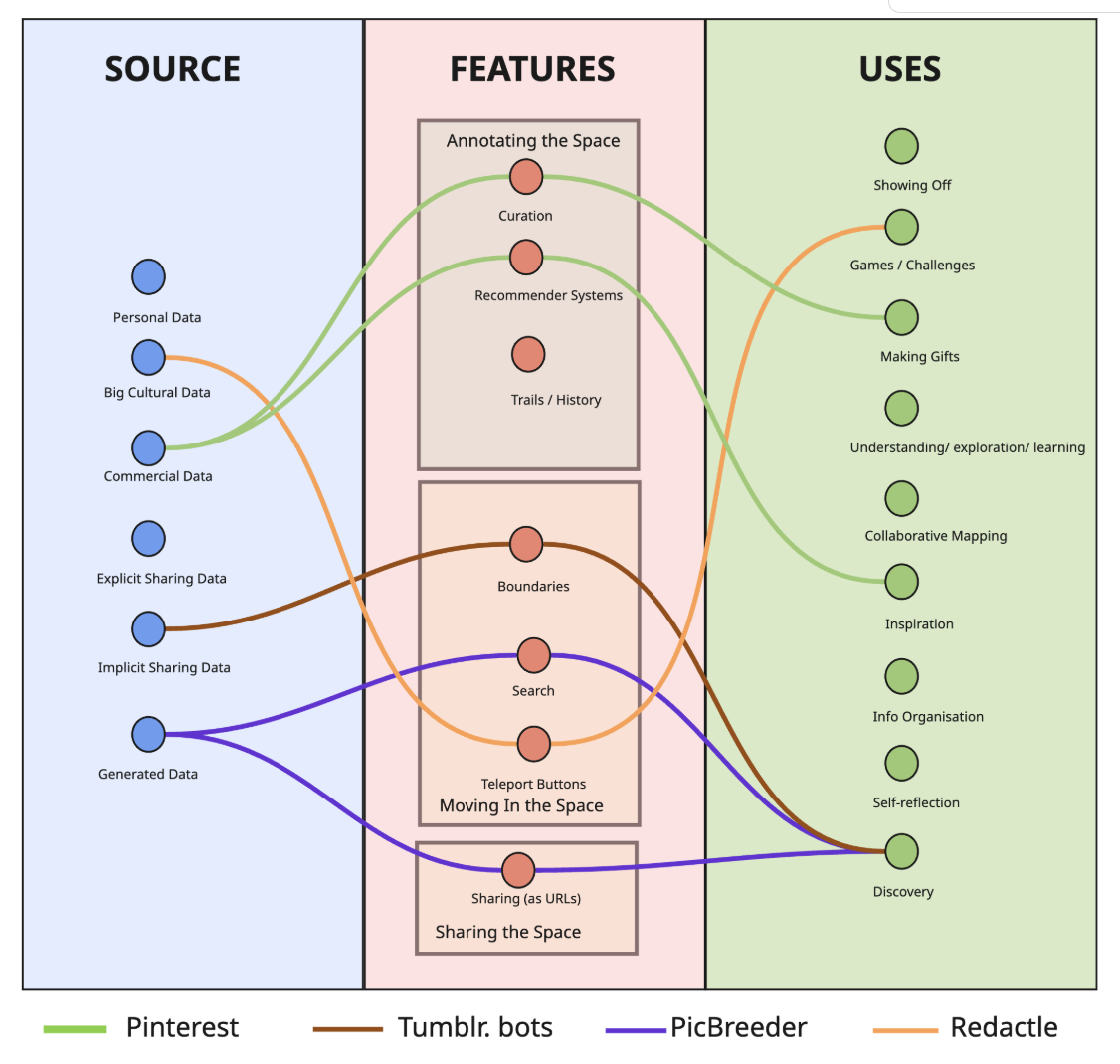
3.4.2 Sources, Features, and Uses
To create a playful user experience with massive content, one needs three things:
-
Sources – you’ll need a massive source of content
-
Features – interaction design patterns for what the users will do with the content, like surfing, annotating, or sharing it with others
-
Uses – why is interacting with this content meaningful? Are we motivated by the content, or about our journeys and exploration, or is the content just a tool to socialize with each other?
For example, the Library of Babel101010https://libraryofbabel.info/ is a site where every possible book exists, as a reference to the Borges story [3]. Its source is a generator that can create any “possible combination of 1,312,000 characters” on demand. Its primary feature is that each book is represented by a unique URL. Of course, most are random character combinations. There is a small Reddit forum111111https://www.reddit.com/r/BabelForum/ dedicated to finding and sharing occasional discoveries within it, partly as appreciation, and partly for humorous absurdity.
Sources fall into several categories:
-
Personal data: Anything we produce in our daily lives, from emails, to photos, personal notes to shopping lists, the music or the crafts we created
-
Shared data: where people collectively and intentionally create large amounts of data, for the shared good
-
Cultural-collections data: (Museum images, literature) Museums are full of art, digitalized, amazing poems, to literature feasts
-
Commercial data: data that is either gathered commercially or scraped from commercial enterprises
-
The social data we share explicitly – to be consumed by others in the void – Itch.io
-
The social data we share implicitly – the comments to your friends’ posts, or some blog that you share for bookkeeping
-
Algorithmic generators: data which doesn’t exist until the moment that it is created
None of these categories presuppose the relationship between the owner or creator of the source and the creator of the game, and the players of the game may have any possible relation to each other. One could make a game for oneself out of one’s own data, or be paid by a big-data owner to make a game for others (a common form of digital humanities grant from museums)[4]. Some games are made with data that was not intended (or allowed) to be used for play, which can be a source of both conflict[6] and transgressive power.
Features are the interaction, interface, gameplay, visualization, or sharing features that enable different kinds of exploration and social interactions.
For example, Max Bittker’s “River”[1] is a page where players can explore images that people have posted to Are.na. Exploration is done by clicking on one image among many, which causes the page to refresh with other images that are closest to that one in a vector embedding space (more similar). When this happens, the URL changes to the ID of the clicked image. So, if a player finds a favorite “region” of the content, they can share it with others.121212Example regions: https://river.maxbittker.com/?id=1747330, https://river.maxbittker.com/?id=2878636
We found many such features, and many were common across multiple experiences.
Some features enable or disable ways to navigate through the content. For example, River does not allow searching, to instead encourage serendipitous discovery by proximal exploration. Exploration can be implemented by many different algorithms and heuristics – similarity-based, curiosity-based, or collaborative filtering. We can direct players to parts of the space near things they like, or direct them to places they have not explored, or to places that no other user has explored yet. We can even leave footprints to tell them how many other players have been here,131313https://www.whatbeatsrock.com/ or give small UI prizes for discovering new parts of the space.141414https://neal.fun/infinite-craft/
We can consider each unique page with its “central” image to be a landmark that we can share via URL, but it also offers landmarks as collectibles and boundaries (“Obama eating ice cream,” “Heavy Metal Lettering”) that players can try to discover. This simple feature (it is just a text suggestion) turns the free-form browsing into a seeking game instead. Landmarks in a large generative space can enable navigation, social conversations, or gameplay challenges.[7][8]
Other features enable players to understand their movement through the space or create paths and trails for others to follow. Trails can serve as a memory of how someone has moved through a space or record a path to guide someone else. In River, when M Charity achieved the nearly-impossible feat of navigating to “Obama eating ice cream” they were able to use the browser’s back button to demonstrate the path they took, image by image. In experiences like Spotify, we see users curating and sharing unique paths as a new form of content itself, sometimes to take the listener on an unexpected sonic journey and sometimes to make art out of the titles.151515https://www.reddit.com/r/weirdspotifyplaylists/
We expect curation sports to emerge as their own form of play, as users discover particularly interesting spots or become famous as guides or expert-explorers in the space [9]. We also speculated about heuristic curation pets as a feature – not monolithic algorithms to create the “best” choices, but “characters” with viewpoints on how to move through the space, like the Tumblr bots mentioned in the case studies below. Could you make a mix tape for a friend? Could you make a mix-tape-making pet to give them instead?
Trails, landmarks, heuristics and more can be reified into content themselves. Often these are by URL, but can also be embedded in a PNG (as the creatures in the game Spore). This lets the feature engage in the technological ecosystem in any way a URL or image does: A landmark in a generative space could be hidden as a QR code or NFC chip on a sticker or trading card, and physically gifted, swapped, or hidden in a castle!
The final component is the uses of these experiences. An experience can have any number of features and choose many kinds of content to explore. But what communities and social interactions arise from those choices? What external or artificial structures give them different meanings? We found many such emergent behaviors and social phenomena: showing off, games and challenges, surfing, making gifts, intellectual advancement (understanding/exploration/learning), collaborative mapping, inspiration, creating organized information and annotation (the urge to tidy up a space), self-reflection, and discovery.
When we looked at social experiences, we found two common kinds:
-
Collective Experience (sharing the experience) – You go through the experience individually, but share the outcomes with others.
-
Collaborative Experience (sharing the space) – You work together in the same environment, creating and contributing to a shared outcome.
3.4.3 Case Studies
Pinterest Boards – June and her friends have developed an annual tradition where they curate Pinterest boards for each other. These carefully crafted collections serve as gifts that keep giving: recipients discover new recommendations and inspirations based on their friends’ thoughtful curation choices.
Redactle – This daily word-guessing game presents players with a randomly selected Wikipedia article that has been completely redacted (blacked out). Players must uncover the content by guessing words, gradually revealing the hidden article. The shared daily challenge creates natural conversation points, as friends compare their strategies and discuss the surprising topics they have collectively uncovered.
Tumblr Bots – Automated accounts scan Tumblr posts to identify text strings that correspond to DNA sequences, then post about the organisms they represent. This creates an unexpected treasure hunt where the community celebrates rare biological discoveries hidden within everyday social media content. Users take pride in finding particularly unusual organisms embedded in casual posts.
PicBreeder – This evolutionary art platform demonstrates a complete cycle of generative content interaction:
-
1.
Generated Data: AI networks called CPPNs create diverse images
-
2.
Search: Users browse and select favorites from random assortments
-
3.
Discovery: The algorithm evolves new images by combining and mutating user selections
-
4.
Sharing: Each creation has a unique URL, allowing users to share both final images and the complete evolutionary lineage that produced them
When Antonios opens PicBreeder, he encounters a random collection of AI-generated images. By selecting his favorites, he guides an artificial evolution process that produces new images similar to his choices. This allows him to both discover the algorithm’s capabilities and share his creative journey with others through the platform’s URL-based sharing system.
3.4.4 Further Work
As we discussed these areas, we found example after example that were relevant, each having a different set of features and emerging uses. During the seminar, we also created a zine and an experimental prototype161616https://github.com/MasterMilkX/zoras-river to use the patterns in River for exploring Itch.io games. We hope that this will provide a starting point for others to explore this rich design space.
References
- [1] Max Bittker. River Notes. https://maxbittker.com/river-notes, September 20, 2023.
- [2] Kate Compton. Liquid Art – A Different Perspective on Generative Art. TEDxNorthwesternU, May 14, 2013.
- [3] Jorge Luis Borges. “The Library of Babel.” In Collected Fictions, 1941.
- [4] Mia Ridge. Playing with Difficult Objects – Game Designs to Improve Museum Collections. Museums and the Web 2011, Science Museum, United Kingdom, 2011.
- [5] Katherine Compton. Casual Creators: Defining a Genre of Autotelic Creativity Support Systems. Ph.D. Dissertation, University of California, Santa Cruz, 2019. https://www.proquest.com/dissertations-theses/casual-creators-defining-genre-autotelic/docview/2300563742/se-2
- [6] Megan McCluskey. Holocaust Museum Asks Guests to Stop Playing Pokémon Go There. Time Magazine, July 12, 2016.
- [7] S. Risi, J. Lehman, D. B. D’Ambrosio, R. Hall and K. O. Stanley. “Petalz: Search-Based Procedural Content Generation for the Casual Gamer.” IEEE Transactions on Computational Intelligence and AI in Games, vol. 8, no. 3, pp. 244-255, September 2016.
- [8] J. Talton, D. Gibson, P. Hanrahan, and V. Koltun. Collaborative mapping of a parametric design space. Technical report, Citeseer, 2008.
- [9] Iarfhlaith Dempsey. GeoGuessr World Championship 2025 breaks viewership records with waves of community support. https://escharts.com/news/geoguessr-world-championship-2025-viewership, September 1, 2025.
3.5 Dagnamics Description Language
Rémy Devaux (Punkcake Délicieux – Cenon, FR), Claus Aranha (University of Tsukuba, JP), Rafael Bidarra (TU Delft, NL), Emily Halina (University of Alberta – Edmonton, CA), and Gillian Smith (Worcester Polytechnic Institute, US)
License: Creative Commons BY 4.0 International license © Rémy Devaux, Claus Aranha, Rafael Bidarra, Emily Halina, and Gillian Smith
Originally setting out to draw out the connection between game mechanic elements and the emotions they inspire, we ended up creating a language which delineates the intended emotional fingerprint of a game. This language can be used to analyse an existing game, or to design a new game.
3.5.1 Introduction
Games make us feel certain ways when we play them. But why? What in a game’s mechanics, or in the relations between the mechanics, makes a game feel the way it feels? Can we draw direct connections between mechanics, combinations of mechanics, and emotions, and formulate them in a language? What happens if we then use that language to make a game intended to feel a certain way? These were the questions we had set out to tackle in the workgroup originally titled Expressive Game Mechanics Building Blocks Language.
3.5.2 Moving away from mechanics to get closer to dynamics
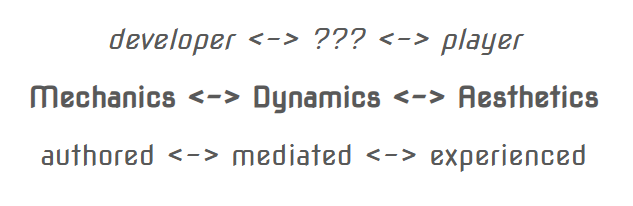
While discussing our objectives, it became clear that we were particularly interested in the effects of gameplay on the player’s emotions, as the gameplay is happening. In the context of the Mechanics, Dynamics, and Aesthetics framework, this means we wanted to concern ourselves with the Dynamics of games. This felt particularly compelling because there are already plenty of tools and methodologies around game mechanics, whereas dynamics are more of a grey area, yet also the gateway to aesthetics, meaning here, broadly speaking, the general impression of the player of a game. Besides, the MDA framework is often criticized for being too mechanically focused, but this may be in part because no-one knows precisely what “dynamics” is, and what happens there. Indeed, the Design, Dynamics, Experience model, which attempts to improve on the MDA framework, also features Dynamics, and leaves them as loosely defined as in the first framework. What definition there is tells us that dynamics are made of the interactions between the game and the player. While playing a game, players experience emotions over time, in reaction to what happens in the game, and in acting on the game through inputs, both, in theory, as designed by the game’s designer. To build off of this, to simplify our approach, and to delineate a helpful methodology, we will assume that players experience games in uninterrupted sessions with no other external stimuli.
3.5.3 Charting dynamics as analysis
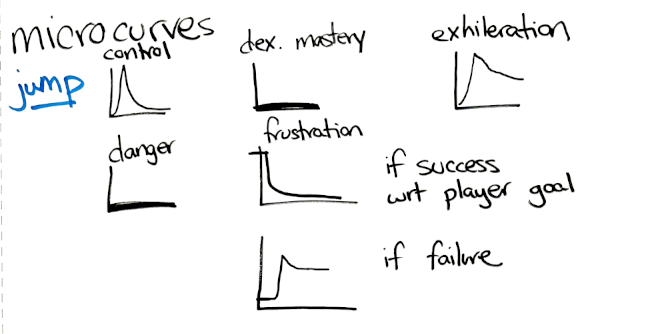
Since players’ emotions vary over time, it makes sense to draw 2D graphs showing the intensity of an emotion over time as a curve, with different curves for different emotions. These graphs would need to use different scales to provide a complete idea of how the dynamics evolve over the course of a game. We started by deciding on a micro scale, designating the moment-to-moment, like when a player presses a button or is presented with a new information, and a macro scale, representing the duration of the whole game. But we also felt the need for a middleground, and so we decided to also use a meso scale, which designates a short succession of events. For these different scales, we would draw curves for the emotions that seem the most relevant for the game. For example, in Tetris, emotions like anxiety and orderliness might be considered, whereas for a Sonic game, exhilaration and frustration may be more appropriate.
Naturally, playing a game involves more than just two emotions, and so when using the model experimentally to analyse the dynamics of Sonic, we started out with 5 different emotions: control, danger, mastery, frustration, and exhilaration. But when starting by analyzing the micro-scale dynamics of the game, we found that the sense of control followed the same trajectory as exhilaration. And indeed, in Sonic, the two feelings are interlinked, as playing well will usually mean getting a more exhilarating experience. Furthermore, we also found that the senses of danger and mastery did not evolve at all on the moment-to-moment scale. These higher scale notions could in fact be mapped to exhilaration and to the sense of control respectively, only over a wider slice of time. And so we continued our analysis on the meso-scale and macro-scale only considering exhilaration and frustration, and found this to be enough to efficiently pin down the broad dynamics of Sonic.
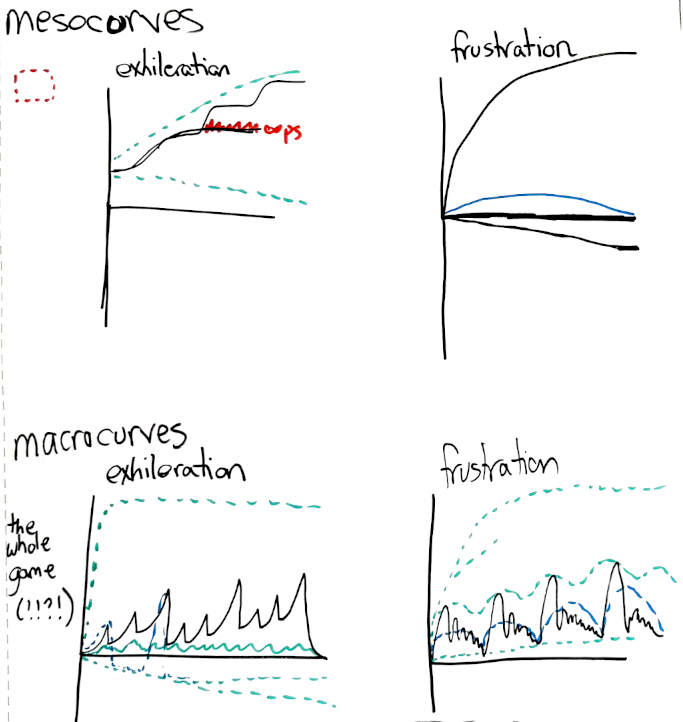
Additionally, while defining the emotion curves for the meso-scale and the macro-scale, we found it helpful to draw envelopes defining the space in which it would be acceptable for the designers that the player emotions would distance themselves from the emotion curves. For example, a player who is struggling with Sonic’s difficulty might get more frustration, but ideally only to a point, while their exhilaration may drop down to boredom occasionally to frequently. Conversely, a speedrunner might get little frustration, but would get a sustained high level of exhilaration.
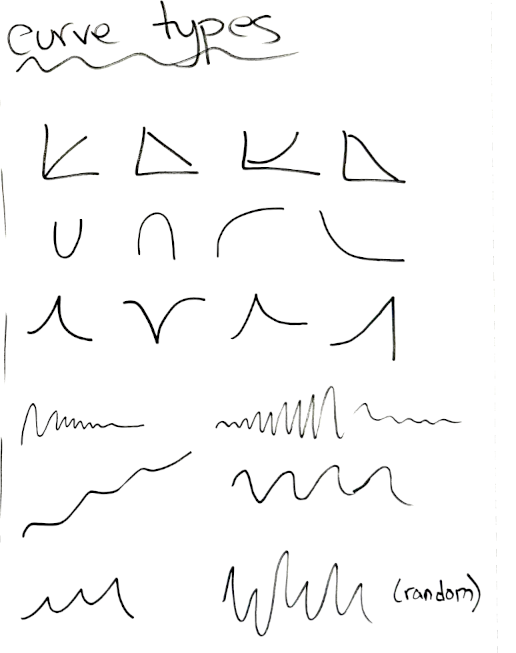
Finally, while drawing all these curves, patterns emerged and we could note a variety of simple shapes coming again and again, and combining in ways that felt expressive. So we established a curve library that could be drawn upon.
3.5.4 Charting dynamics as creative process
Having successfully devised and used a graph-based language to express an existing game’s dynamics, we set out to use it in the opposite way, laying out a theoretical game’s dynamics, and then making a game that would meet those dynamics. To use the language, we first needed to come up with two emotions around which the game’s dynamics would revolve. We felt that those two emotions should contradict in an indirect way to produce interesting dynamics. We came up with playfulness and relaxation.
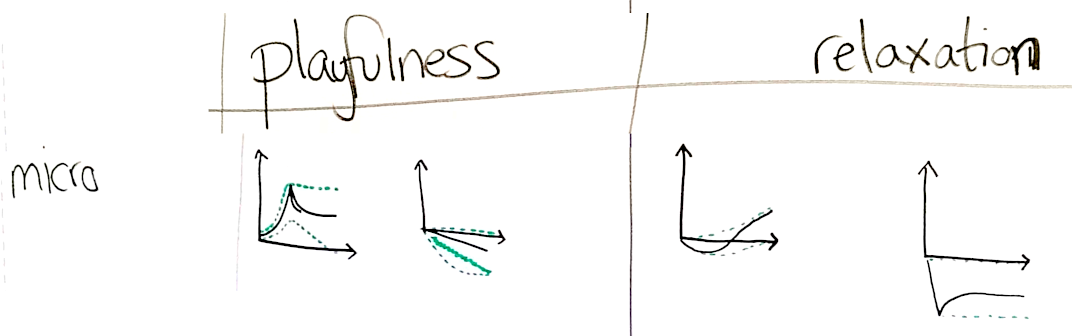
Trying to decide which curves we should try to draw first, it felt simpler to start with the micro curves for both emotions, and then the envelopes for those same curves. These describe the emotional evolutions that we would want to occur in moments of things happening: for example a player taking action, or a player observing an action taking place, or information being revealed. Even though we didn’t yet know what those things would be, we drew two curves for each emotion. We also didn’t shy away from going into the negatives in our graphs, especially for relaxation, on the understanding that this would translate to the opposite of relaxation: excitement.
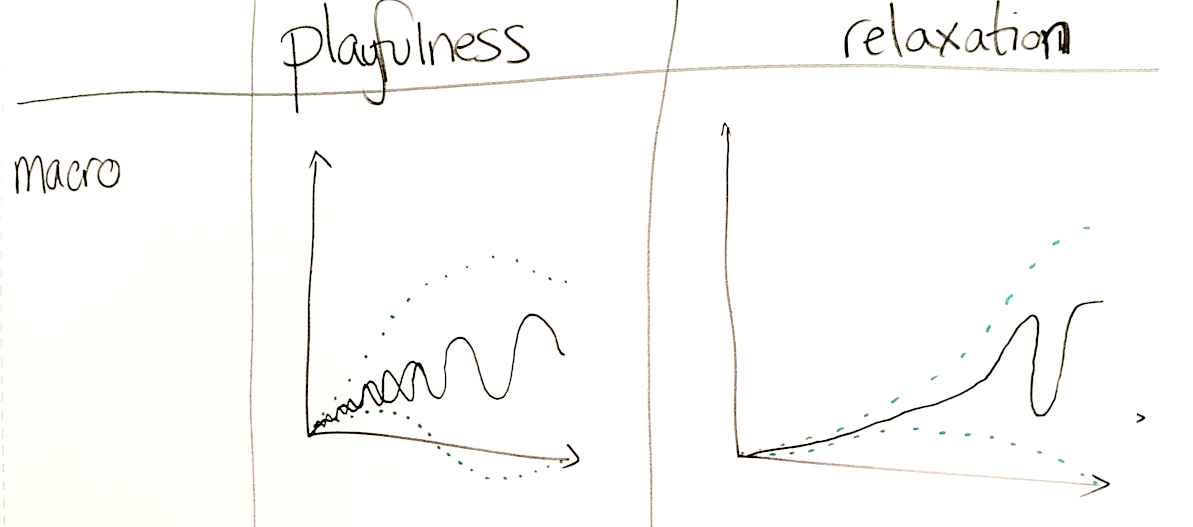
After this we drew the envelopes for the macro curves, and then the curves themselves. It felt safer to establish envelopes first, and thus define our desired emotional space, before committing to a more precise emotional experience.
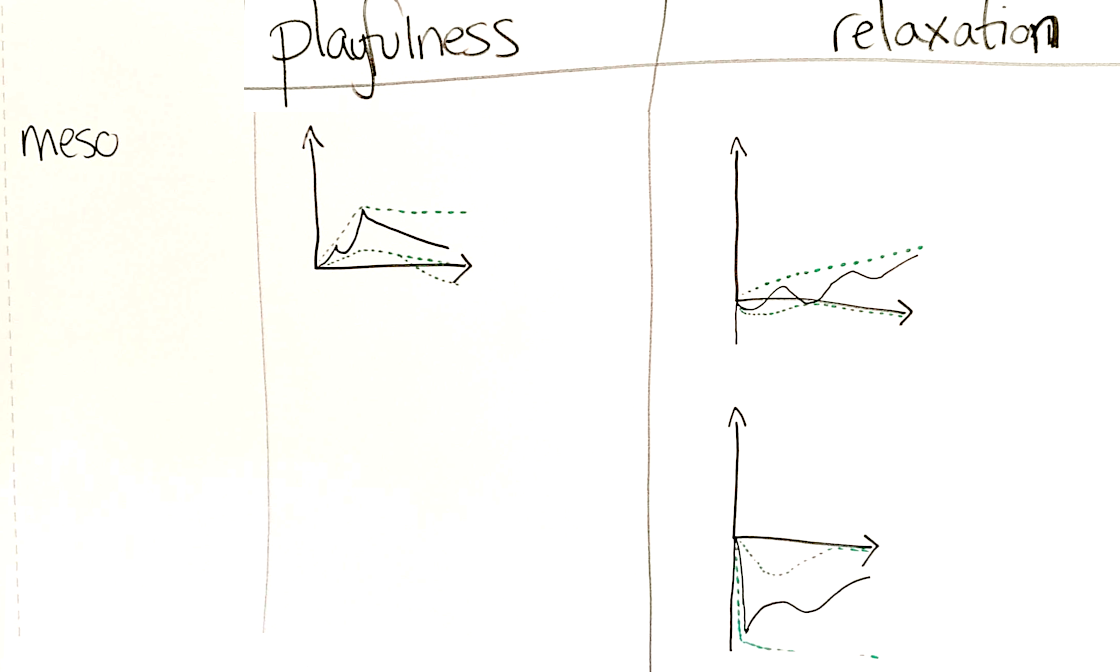
Then all that remained was the meso scale. Here we went back to drawing curves first and then envelopes. Doing this part last was very interesting because for the whole thing to make sense, the meso curves had to be built off of the micro curves, but also had to describe progressions that would allow us to build the macro curves off of them. Essentially we were making bigger puzzle pieces with our smaller puzzle pieces, with the constraint that the bigger puzzle pieces had to be usable to build the full puzzle.
With our curves all drawn out, it was finally time to design the actual game that would meet them. To make things easier for ourselves, we decided to make an analog game that could be played by two players with what we had on hand. As it happens, we had some coloured pencils and paper, and the emotions we had chosen at the start – playfulness and relaxation – inspired us to make a game with drawing-based mechanics and breathing-based mechanics.
Trying to match the different curves we had drawn, we progressively wrote up a set of game rules, imagining how the game would play out as we went and filling in zones of uncertainty with new rules or changes of rules. Eventually we played the game for ourselves and made additional refinements as we played.

The resulting game is called Breath Checkers and it is a drawing and breathing game where players take turns drawing in gridcells while always taking inspiration from the last thing the other player drew and respecting a checkered pattern in the distribution of grid cells between the players. Playing the game ourselves and observing other people play it, we felt that Breath Checkers managed to match our curves and envelopes fairly accurately, but we were likely biased, since we had just designed the game with that goal in mind. But, perhaps more importantly, we did manage to design a game starting from its dynamics, and the game itself felt novel and fun.
3.5.5 Conclusions and further development
We’re very happy to report that this workgroup was successful in creating a new language which bridges game design to player emotions. This language does not establish a direct relation between a game mechanic and the emotions it provokes as originally intended, but it does help analyse and think about how a game impacts its players’ emotions, and it also helps laying out strong and workable intentions for creating a game that impacts its players’ emotions in a desired way. Additionally, using the language to create a game from scratch was unexpectedly easy. With at least some game design experience, it is fairly easy to intuit what game mechanics might match certain curves. So perhaps drawing a direct link between a mechanic and the emotion it evokes is not quite as interesting anyway.
Designing a game using the language was very inspiring. Interestingly, it felt like we could have come up with a different game with the same emotion curves and this theoretical other game would have had a similar emotional fingerprint. Designing the emotional fingerprint itself was a fun puzzle and surprisingly intuitive. Starting from the micro, meso or macro curve may result in different decisions with the other curves. The starting choice of the emotions one wants to work with is also critical. Finally, this group may not have had much to do with AI, but we believe it did open up possibilities to explore new design space by combining this new language and AI. For example a game prompt generator could use this language, or possibly a new playtesting workflow could be established where players might record their own emotional evolution and an AI tool might do the work or mapping their reported evolution to the correct micro, meso and macro curves. Either way, this language is an exciting new tool for making games.
References
- [1] Hunicke, R., Leblanc, M. & Zubek, R. (2004). MDA: A Formal Approach to Game Design and Game Research. In Proceedings of the AAAI Workshop on Challenges in Game AI. Available from http://www.cs.northwestern.edu/˜hunicke/MDA.pdf
- [2] Walk, W., Görlich, D., Barrett, M. (2017) Design, Dynamics, Experience (DDE): An Advancement of the MDA Framework for Game Design. Available from https://www.researchgate.net/publication/315854140_Design_Dynamics_Experience_DDE_An_Advancement_of_the_MDA_Framework_for_Game_Design
- [3] Devaux, R., Smith, G. (2025) Breath Checkers. Available from https://trasevol-dog.itch.io/breath-checkers
3.6 Intent: What the heck is it, and how do we measure it?
Emily Halina (University of Alberta – Edmonton, CA), Rafael Bidarra (TU Delft, NL), and Max Kreminski (Midjourney – Santa Clara, US)
License: Creative Commons BY 4.0 International license © Emily Halina, Rafael Bidarra, and Max Kreminski
Design intent is a topic of increasing interest in the field of games research, with many applications including co-creativity and generative systems. However, our current definitions of design intent are unclear, and vary from author to author. This presents a problem when communicating about or designing systems that incorporate a notion of designer intent, or arguably any co-creative system. In this working group, we set out to better establish potential definitions and ways of measuring intent through observation. After establishing potential definitions of intent through discussion, we ran an informal pilot study observing and interviewing another working group. We present the findings of our pilot study, which indicate the challenges of relying on narrative recollection to determine intent, and give insight into the influence of intent on group working dynamics in a creative context.
3.6.1 Defining Intent
Our working group began with a discussion around potential definitions for design intent. We discussed many definitions, including intent as a realization of a higher level goal, intent as a hierarchical, tree-like structure, and intent as simply “just messing around and finding out.” In the end, we settled on a couple of core analogies which helped us to discuss and define intent for the purposes of our pilot study. We consider intent to be an unknown (even to the creator) “guiding force” which drags a designer towards their goal like the pull of a magnetic field. We discussed in depth the “dark matter” of creativity, the off-task activities which actively contribute to the creative process, and how it is closely related to the unknowable true intent we wanted to get closer to measuring.
3.6.2 Measuring Intent
In order to get closer to measuring a notion of true intent, we came up with two potential avenues of measurement. The first is the discernment of intention through interaction directly. This would entail the design of a system intended to elicit intent, then change the underlying system based on a modeling of this intent gradually over time. The second was the discernment of intention through observation. In particular, this entailed a combination of observation and semi-structured, post-hoc interviews with either individuals or members of a group working on a creative project. The hope is that through a combination of both observation, think-alouds, and post-hoc clarification, we could somehow piece together an accurate portrait of a group member’s intention behind their creative decisions. While the first approach seemed promising to the group members, we decided that due to time constraints we would settle on the second for the remainder of the day.
3.6.3 Pilot Study Setup
For our pilot study, we decided to embed ourselves (with permission) into another group for the afternoon. In particular, we chose to collaborate with the New Frontiers in Tamagochi group, as they were just beginning multiple creative projects at the start of the afternoon when we joined. We split into two subgroups: one observing the Dagochi group creating a multi-agent reinforcement learning environment, and the other observing the creation of the Rocking with Charisma TTRPG. For more details on the contents of these projects, please see the New Frontiers in Tamagochi section.
We observed each of these groups for roughly 90 minutes through their creative processes, then proceeded to conduct semi-structured interviews with each group member to ask follow-up questions about the reasoning behind certain decisions. After this interview process, our group re-convened to discuss our findings, and determine if the groups shared any characteristics.
3.6.4 Findings and Takeaways
The major finding of our analysis was that it is very difficult to intuit intention from just observation alone. In fact, it could be argued that we learned more about creative group dynamics than about the ability to discern any notion of intention behind each group member’s actions. In particular, we identified three major takeaways from our observations of the two groups.
The first is that aspects of each member’s initial intent were hidden to other group members. While group members each came into the project hoping to achieve something specific from the afternoon of creative work, those intentions were not necessarily communicated or shared among the entire group. For example, one group member who was particularly technically focused had a technically focused retelling, which matched their initial intent. The second is that ideas from group members tend to recombine in different, unexpected ways. For example, different mechanics in the Dagochi project such as breeding and killing emerged from group members’ preconceived notion of which mechanics were “obvious” given the multi-agent nature of the environment. The third is that chronology becomes fuzzy and unreliable throughout narrative recollection of events. This was very apparent in the Dagochi project, where each group member gave a different point in time regarding the inception of certain mechanics.
We believe there is still a lot of work to be done toward understanding, interpreting, and measuring intent. While this working group represents a very small step towards that understanding, we believe this problem is increasing relevant towards the design and analysis of co-creative systems and the co-creative process.
3.7 The World Needs Expressive Range Analysis!
Max Kreminski (Midjourney – Santa Clara, US), In-Chang Baek (Gwangju Institute of Science & Technology, KR), Rafael Bidarra (TU Delft, NL), Alexander Dockhorn (University of Southern Denmark – Odense, DK), Emily Short (Oxford, GB), Gillian Smith (Worcester Polytechnic Institute, US), Nicolaas Vas (Billund, DK), and Sabine Wieluch (Universität Ulm, DE)
License: Creative Commons BY 4.0 International license © Max Kreminski, In-Chang Baek, Rafael Bidarra, Alexander Dockhorn, Emily Short, Gillian Smith, Nicolaas Vas, and Sabine Wieluch
Generative AI is often presented as something wholly new: a radical break from tradition that introduces opportunities and difficulties unlike any reckoned with before. However, to researchers who study procedural content generation (PCG), many of the difficulties surrounding present-day generative AI appear rather familiar.
These common problems of generativity faced both by users of traditional PCG pipelines and large pretrained generative models are many and varied. Users may struggle to wrap their heads around a generative system’s tendency to produce noticeably homogenous outputs [1, 5], or its inability to produce certain kinds of outputs at all [3]. They may immediately accept the system’s first passable output as “good enough” instead of continuing to strive for a better outcome [20], or feel artificially constrained by system capabilities [12]. The impacts of specific parameter adjustments on system outputs may be difficult for users to anticipate [15, 19]. And the difficulty of drawing reliable conclusions about a generative system as a whole from a small number of concrete outputs may lead users to treat these systems as magic [7], rather than as biased cultural artifacts shaped by data curation processes or algorithmic materials with a particular characteristic grain.
We argue that many of the problems of generativity stem from the fact that generative systems instantiate a (frequently vast) expressive range of possible outputs, but an individual user will generally only be able to formulate their view of a system in light of a relatively small number of individual artifacts sampled from this range. To mitigate these difficulties, PCG researchers have long made use of expressive range analysis (ERA) [15]: a family of techniques used to visualize, reflect on, and make sense of a generative system’s entire expressive range. However, several of the assumptions made by traditional PCG research about generative pipelines do not apply neatly to the large pretrained generative models of the current genAI boom [2]. As a result, ERA has not yet seen much application to the problems of generativity in their newly and greatly expanded form.
We convened this working group to identify new potential application areas for ERA; survey recently proposed expansions to ERA as a method; characterize the pain points limiting adoption of ERA in new contexts; and set out a preliminary agenda for translational research intended to broaden ERA’s applicability.
3.7.1 What is ERA?

Expressive range analysis in its usual form involves the generation of a very large number of output artifacts from a single generative pipeline; the characterization of each generated artifact in terms of a set of domain-specific, computationally assessable metrics; and the visualization of the distribution of generated artifacts as a set of two-dimensional heatmaps, with each heatmap showing the distribution of generated artifacts in terms of a particular metric pair. The example output of a typical ERA process can be seen in Figure 21. Several extensions of ERA have also been proposed, for instance to support analysis of interaction dynamics in PCG-based mixed-initiative co-creation [11] and to improve the utility of the generator fingerprints captured by ERA in various ways [17].
Despite ERA’s broad uptake within PCG research, the question of how to define or select appropriate metrics for a particular class of artifacts remains an open problem [18]. Additionally, although some attempts have been made to integrate ERA directly into graphical game creation tools like Unity [6], few existing interfaces allow users to employ ERA without reimplementing all of the necessary components themselves.
3.7.2 Who needs ERA?
We envision several potential user archetypes that might benefit from application of ERA:
-
The computational author, who aims to craft a generative pipeline that achieves an envisioned output distribution or aesthetic outcome.
-
The analytical researcher, who aims to better understand the expressive range of other people’s generators (e.g., to assess biases in large pretrained generative AI models).
-
The educator, who seeks to broaden public understanding of generative pipelines as opinionated and probabilistic rather than unbiased and oracular.
-
The exploratory tool user, who plays with generative pipelines in an exploratory or process-focused way but is not directly motivated by the desire to achieve a comprehensive understanding of a particular possibility space.
-
The outcome-attached tool user, who attempts to use generative pipelines to achieve specific types of desired output but is only instrumentally interested in what the pipeline as a whole is capable of producing.
The boundaries between our envisioned user archetypes are not firmly fixed: people may gradually slide from one category to the next as their interests and needs evolve. For instance, an outcome-attached tool user may become more interested in making tool outputs that stand out from what they’ve generated before; an analytical researcher may try to address weaknesses they’ve previously identified in existing generative pipelines by developing new ones; and a computational author may decide to assert more direct curatorial control by selecting and publishing only a few specific artifacts from their generative pipeline’s full expressive range.
3.7.3 What do they need from it?
One of the main bottlenecks preventing broader application of ERA is the limited availability of appropriate, computationally assessable metrics that can be used to characterize artifacts in specific creative domains. This has manifested in the past in several important ways:
-
Over-indexing in the published literature on narrow sets of metrics defined in prior work (e.g., linearity and leniency for game level generation)
-
Non-extension of ERA to new artifact domains, due to the difficulty of coming up with an initial set of domain-specific metrics for a totally novel domain
-
Overreliance on metrics that are easy to computationally define, rather than those that capture key aesthetic properties of relevant domains
-
Non-application of ERA by potential users other than computer science researchers, due to the difficulty of encoding intuitively salient metrics as procedural code
Notably, many of our envisioned user archetypes will not necessarily have a strong sense of what metrics they’re interested in before interacting with a generative pipeline; some of them may not know how to code; and even those who both know what metrics they’re initially interested in and know how to code may struggle to meaningfully formalize the metrics they care about. How can we support these users?
We believe the answer may take the form of an approachable workbench for conducting expressive range analyses, with built-in support for the definition and iterative revision of “sketchy” example-based metrics, as well as the publication, retrieval, and adaptation of metrics defined by the community of workbench users. Such a workbench might be modeled on Wekinator [8], an approachable toolkit for the example-based definition of simple domain-specific classifiers and other machine learning models for artistic use cases (e.g., novel musical instrument design). Metrics might initially be defined in terms of “general-purpose” embedding or language models (as in, e.g., Luminate [16] or Patchview [4]); refined through the specification of additional examples; and perhaps translated into a more domain-specific ML model or explicit procedural function as the user develops a more specific sense of what they want their metric to capture.
3.7.4 Case studies
Our working group attempted to apply ERA in several new contexts: to the outputs of a pre-existing textual expansion grammar, with new candidate metrics defined in terms of LLM queries rather than procedural code; to a character generator building on the Dagstyle visual language introduced earlier in the seminar; to a large number of Dungeons & Dragons oneshot scenario concepts generated by the large language model Claude Sonnet 4; and to an automatically generated space of possible playthroughs of the storylet-based interactive narrative Bee [14]. In each case, we encountered new difficulties that might need to be addressed in the extension of ERA.
3.7.4.1 LLM-based metrics for traditional procedural text
The easiest ERA metrics to implement for any given class of artifacts tend to be syntactic: focused on surface-level details of the artifact’s structure, such as a poem’s length in words or the percentage of tiles in a game level that are walls. However, the artifact properties that are most interesting to a human observer tend to be semantic: focused on aspects of an artifact’s deeper meaning, such as a poem’s engagement with a particular theme or a game level’s difficulty. To aid the implementation of semantic metrics, we wanted to assess whether LLMs or other open-domain interpretive models might perform well at characterizing flexible aspects of artifact semantics in new domains. As a pilot of this approach, we defined LLM prompts to assess two different dimensions of interest in the outputs of a textual generative grammar for fictional travel guide entries (evocativeness and absurdity) and employed these prompts as metrics to conduct an ERA of the grammar under inspection.
We found that the LLM did in fact produce seemingly reasonable values for the example outputs we sampled. However, the relatively high computational cost of a single LLM call makes LLM-based metrics harder to apply at very large scales than many traditional ERA metrics, and LLM nondeterminism means that the same prompt may yield a different assessment of the same input artifact on subsequent runs, adding uncertainty to ERA outcomes. These difficulties may become priorities for future work.
3.7.4.2 Image content metrics for Dagstyle characters

Beyond using LLMs to assess the semantics of text, we also wanted to experiment with using open-domain models to assess the semantics of visual content – e.g., representational character icons in the seminar’s Dagstyle visual language (Figure 22). Because important aspects of visual experience are sometimes hard to express linguistically, and because vision language models tend to be even more computationally expensive than their LLM counterparts, we decided to pursue an example-based approach to specifying metrics via embedding similarity in a joint text/image embedding space (e.g., SigLIP [21] embeddings). Under this approach, we decided to initially define the semantic characteristics we believed we were interested in as text alone; embed the resulting text strings, and the generated characters we were interested in characterizing; use embedding similarity measures to initially visualize the expressive range of the character generator in terms of our candidate metrics; and then refine the specification of our semantic metrics by redefining the anchor embeddings that defined each metric in terms of specific exemplary generator outputs.
In practice, we couldn’t get SigLIP working for crossmodal comparisons in the limited amount of time we had during the working group. This initial failure accentuates the importance of putting together a streamlined workflow for these kinds of comparisons, so that setting up a Python environment capable of running moderately complicated ML models isn’t a hard requirement blocking deployments of semantic ERA. Ultimately, we were still able to conduct an ERA of our character generator via purely syntactic metrics (e.g., involving pixel color ratios), but – as expected – these syntactic metrics did not help us make much sense of whether our generator was succeeding or failing at generating a wide range of perceptually different representational icons.
3.7.4.3 LLM-generated D&D oneshots
Next we turned to the use of ERA to characterize the outputs of genAI models – e.g., Dungeons & Dragons oneshot concepts generated by Claude Sonnet 4. Since many users are already making use of LLMs for ideation in a tabletop roleplaying context [1], and since oneshot concepts are individually relatively small, we felt that this might be a good test domain to probe LLM biases and gauge how homogenous an LLM’s attempts at creativity might be in a realistic usage scenario.
However, we rapidly ran into a major problem with this approach: when using a single fixed prompt to generate oneshot concepts one at a time, the specifics of the resulting concepts turned out to be so similar that almost no meaningful semantic variation between them was apparent. Prompting the model to generate an entire batch of concepts all at once yielded better within-batch variation, but across multiple batches, the same ideas – down to specific character and location names – continued to show up again and again.
The most promising solution that we could identify to this problem involved the deliberate permutation of the input prompt used for scenario generation: rather than generating each batch of oneshots with the same prompt, we could first instruct the model to generate a wide range of different ways to ask for a batch of oneshot ideas (e.g., with different phrasing or different implied user personas), then generate a batch of responses using each of these different prompts. This yielded enough semantic variation to merit study, but presents a further conceptual problem by blurring the boundaries of the generative system under evaluation. When using ERA to evaluate an LLM, the input prompt provided to the LLM can be viewed as part of the generative pipeline; treated as an extraneous parameter; or varied lightly to represent a class of prompts that might reasonably be employed in a particular usage context – but none of these approaches are obviously, categorically correct in our eyes.
3.7.4.4 Interactive narrative playthroughs
Although interactive narratives have sometimes been framed as generative systems [10] instantiating a “story volume” of possible valid storylines [9], it has so far proven difficult to effectively apply ERA to the analysis of spaces of possible interactive narrative playthroughs. Playthroughs tend to be individually complex, making each one hard to usefully summarize as a small number of easy-to-calculate syntactic metric values. Moreover, the temporal structure that makes playthroughs easy to visualize as individual storylines also complicates the simultaneous visualization of many playthroughs at once, as the storylines tend to become visibly “tangled”.
Our workgroup explored several possible approaches to playthrough visualization. The most immediately promising approach involved the simulation of many possible playthroughs of the storylet-based interactive narrative Bee. These playthroughs could then be annotated according to the values of certain especially important story state variables at key moments (e.g., the playthrough’s end) and visualized on a two-dimensional plane via UMAP dimensionality reduction [13], with the visualization highlighting clusters of similar potential player experiences. Questions we encountered in the process included whether to treat entire playthroughs or individual moments from these playthroughs as the artifacts under ERA; whether to use explicitly tracked story state variables, syntactic playthrough properties (e.g., how many times a given storylet has been revisited) or semantic playthrough properties (e.g., the protagonist’s inferred level of emotional well-being) as metrics; and how to handle the time dimension of playthroughs in visualization.
References
- [1] Barrett R Anderson, Jash Hemant Shah, and Max Kreminski. Homogenization effects of large language models on human creative ideation. In Proceedings of the 16th Conference on Creativity & Cognition, pages 413–425, 2024.
- [2] Josiah Boucher, Gillian Smith, and Yunus Doğan Telliel. Axes of characterizing generative systems: A taxonomy of approaches to expressive range analysis. In Proceedings of the 11th Experimental Artificial Intelligence in Games (EXAG 2024) Workshop, 2024.
- [3] Daniel Buschek, Lukas Mecke, Florian Lehmann, and Hai Dang. Nine potential pitfalls when designing human-AI co-creative systems. arXiv preprint arXiv:2104.00358, 2021.
- [4] John Joon Young Chung and Max Kreminski. Patchview: LLM-powered worldbuilding with generative dust and magnet visualization. In Proceedings of the 37th Annual ACM Symposium on User Interface Software and Technology, 2024.
- [5] Kate Compton. So you want to build a generator. https://galaxykate0.tumblr.com/post/139774965871/so-you-want-to-build-a-generator, 2016. Accessed: 2025-09-24.
- [6] Michael Cook, Jeremy Gow, Gillian Smith, and Simon Colton. Danesh: Interactive tools for understanding procedural content generators. IEEE Transactions on Games, 14(3):329–338, 2021.
- [7] Shipi Dhanorkar, Christine T Wolf, Kun Qian, Anbang Xu, Lucian Popa, and Yunyao Li. Who needs to know what, when?: Broadening the explainable AI (XAI) design space by looking at explanations across the AI lifecycle. In Proceedings of the 2021 ACM Designing Interactive Systems Conference, pages 1591–1602, 2021.
- [8] Rebecca Fiebrink, Dan Trueman, and Perry R Cook. A meta-instrument for interactive, on-the-fly machine learning. In Proceedings of the International Conference on New Interfaces for Musical Expression, 2009.
- [9] Jason Grinblat. Emergent narratives and story volumes. In Procedural Generation in Game Design, pages 199–207. AK Peters/CRC Press, 2017.
- [10] Matthew Guzdial, Devi Acharya, Max Kreminski, Michael Cook, Mirjam Eladhari, Antonios Liapis, and Anne Sullivan. Tabletop roleplaying games as procedural content generators. In Proceedings of the 15th International Conference on the Foundations of Digital Games, 2020.
- [11] Max Kreminski, Isaac Karth, Michael Mateas, and Noah Wardrip-Fruin. Evaluating mixed-initiative creative interfaces via expressive range coverage analysis. In IUI Workshops, pages 34–45, 2022.
- [12] Jingyi Li, Eric Rawn, Jacob Ritchie, Jasper Tran O’Leary, and Sean Follmer. Beyond the artifact: power as a lens for creativity support tools. In Proceedings of the 36th Annual ACM Symposium on User Interface Software and Technology, 2023.
- [13] Leland McInnes, John Healy, and James Melville. UMAP: Uniform manifold approximation and projection for dimension reduction. arXiv preprint arXiv:1802.03426, 2018.
- [14] Emily Short. Bee. https://inthewalls.itch.io/bee.
- [15] Gillian Smith and Jim Whitehead. Analyzing the expressive range of a level generator. In Proceedings of the 2010 Workshop on Procedural Content Generation in Games, 2010.
- [16] Sangho Suh, Meng Chen, Bryan Min, Toby Jia-Jun Li, and Haijun Xia. Luminate: Structured generation and exploration of design space with large language models for human-AI co-creation. In Proceedings of the 2024 CHI Conference on Human Factors in Computing Systems, 2024.
- [17] Adam Summerville. Expanding expressive range: Evaluation methodologies for procedural content generation. In Proceedings of the AAAI Conference on Artificial Intelligence and Interactive Digital Entertainment, volume 14, pages 116–122, 2018.
- [18] Oliver Withington and Laurissa Tokarchuk. The right variety: Improving expressive range analysis with metric selection methods. In Proceedings of the 18th International Conference on the Foundations of Digital Games, 2023.
- [19] JD Zamfirescu-Pereira, Richmond Y Wong, Bjoern Hartmann, and Qian Yang. Why Johnny can’t prompt: how non-AI experts try (and fail) to design LLM prompts. In Proceedings of the 2023 CHI Conference on Human Factors in Computing Systems, 2023.
- [20] Irene Zanardi, Shana Dedò, and Monica Landoni. On the good-enough effect: Children reflect on their AI-generated portraits. In Proceedings of the 24th Interaction Design and Children, pages 154–167. 2025.
- [21] Xiaohua Zhai, Basil Mustafa, Alexander Kolesnikov, and Lucas Beyer. Sigmoid loss for language image pre-training. In Proceedings of the IEEE/CVF International Conference on Computer Vision, pages 11975–11986, 2023.
3.8 A Game in a Day
Antonios Liapis (University of Malta – Msida, MT), Maren Awiszus (Viscom AG – Hannover, DE), Alexander Dockhorn (University of Southern Denmark – Odense, DK), and Timothy Merino (NYU – New York, US)
License: Creative Commons BY 4.0 International license © Antonios Liapis, Maren Awiszus, Alexander Dockhorn, and Timothy Merino
While the generation of game content and even complete games [3, 11] has been well-established in academia [15] and practice [16], the now-ubiquitous techno-optimism of data-driven Generative AI or GenAI171717We primarily consider GenAI to cover Large Language Models (LLMs) and Text-To-Image Models trained on massive amounts of data, often as black-box models owned by corporations. raises timely and critical questions. It is easy to dismiss claims made on creators’ blogs [1] and social media about GenAI’s ease-of-use in creating game code or assets; similar claims on nearly every type of work (creative or not) abound. It is arguably easy to dismiss academic research in (partial) game generation via GenAI [14, 17] as proof-of-concept without general applications. And yet, AI-generated content is increasingly popular in published games: almost 20% of all games released on Steam in 2025 have disclosed use of “AI Generated Content”, eight times as many as in 2024 [8]. The implications of GenAI in game development practice can not be ignored.
This working group identified several questions around the technical feasibility of GenAI-based games, and their implications in terms of ethics, ownership, and (human) creativity. The main questions investigated were:
-
How does GenAI handle the creative decision points of game development, and what does this mean for the creativity of a human developer working with it?
-
How closely can GenAI replicate an existing game without access to its codebase, and what are the implications for Intellectual Property protection?
-
How “in control” does a human designer with a clear idea for the game feel when implementing it via GenAI?
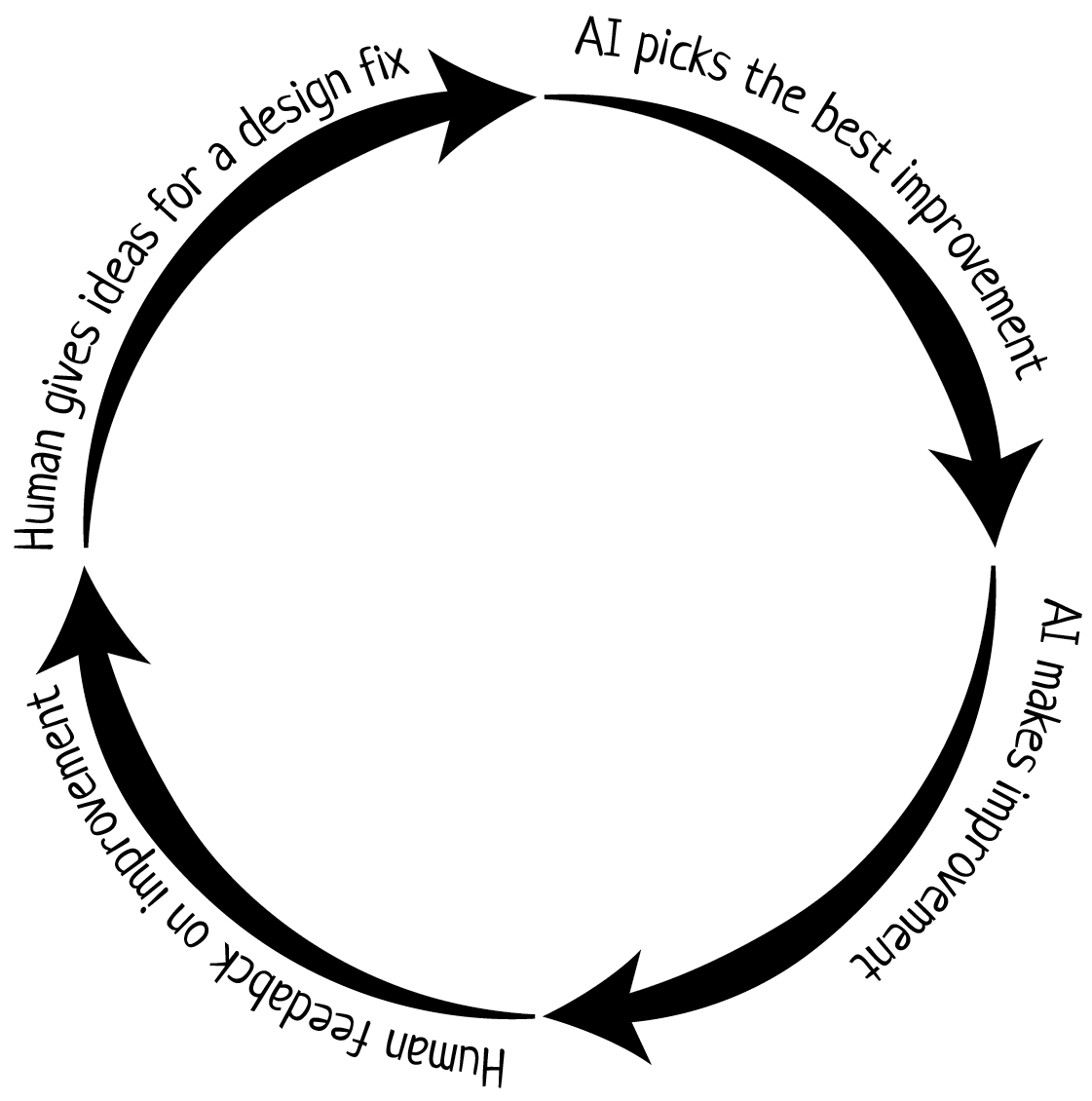
Primarily, the working group took the challenge of creating fully functional games in a day or less, using as little human input as possible. The practical activities revolved around an iterative loop of the human giving ideas for fixes and improvements to the work-in-progress game, the AI picking the best improvement and implementing it in the game, then the human giving feedback on the improvement (see Fig. 23). The process followed is a special case of vibe-coding [5], which is the dominant approach for using LLMs for coding tasks. The practical game development tasks described above were complemented with ad-hoc points of reflection, discussing with the group how the human “creator” was feeling – especially in terms of ownership, creativity, and control over the process and the product [6].
3.8.1 Case 1: GenAI handling [most] creative decisions
For Case 1, we wanted to leave the maximum creative freedom to the AI, focusing only on our subjective comments about the game’s playability rather than about the creative decisions. To maximize the end-to-end ideation, we followed a game jam format [7] and generated one theme using an online (non-LLM) theme generator: the resulting theme was “islands”. After this, we relied on Anthropic’s Claude as our LLM of choice for all concept and code generation phases.
Using the generated theme “islands”, we prompted Claude for game ideas for this theme “that will wow the other participants”, which returned 6 game ideas. We then asked Claude to rank these ideas on which “will generate the most buzz”; the response ranked Island Genesis first, which we then used for the rest of the game generation pipeline. The original description of Island Genesis in Claude’s first response for Case 1 was:
A reverse city-builder where you play as a volcanic island that’s slowly sinking. You must strategically grow land masses and guide the last inhabitants to safety before you’re completely submerged. Time pressure with emotional storytelling.
Following this description, we followed the iterative cycle of Fig. 23 to produce a game using first the PICO-8 [9] engine and then the Godot [12] game engine.
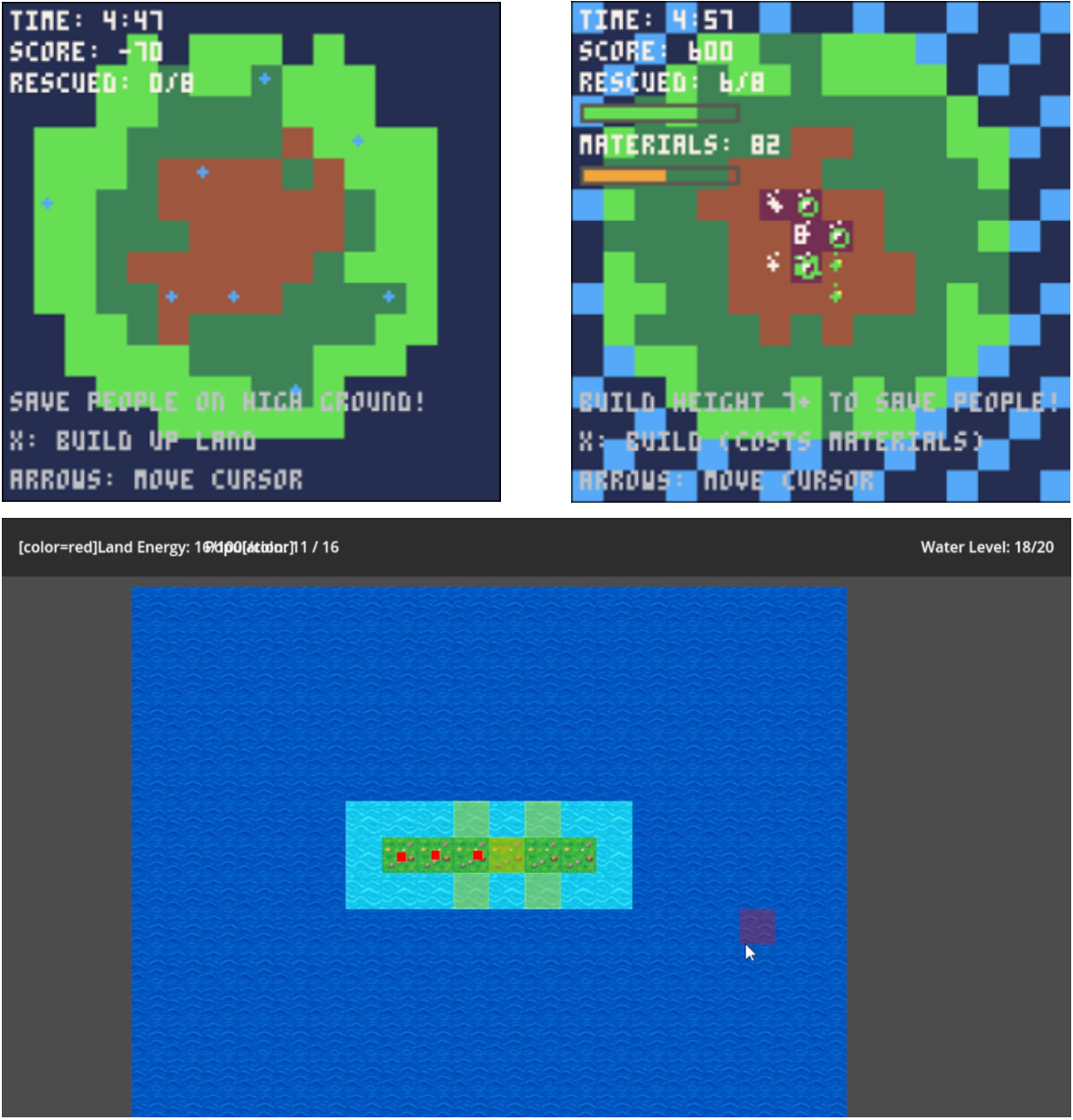
Using the PICO-8 engine, the first LLM response already added the very basics of the game (see Fig. 24; top left): a visualization of an island, the people to be saved, and a basic game state display; the island also already slowly sinks. However, cursor interaction did not work and the game was unplayable. Follow-up iterations involve a human playing the game and producing feedback, with Claude listing possible improvements and then picking the (LLM-perceived) best one to work on. Improvements over ten iterations, lasting around 2 hours, resulted in visual polish (e.g. particle effects, progress bars) and game design additions (e.g. better villager pathfinding, slowly renewing materials used for growing land). The resulting game is playable (see Fig. 24; top right) and, at times, even engaging. The visuals are polished enough for a PICO-8 game.
Following the relative success of the PICO-8 Island Genesis, we tried replicating the process (with the same high-level description) with the Godot [12] game engine, which is more complex. Given the same time and effort, the resulting game (see Fig. 24; bottom) is much worse than the PICO-8 game. Likely reasons include the more complex visuals (high-resolution textures) and complex file structures (compared to the single script used in PICO-8). The former increases the expectation for visual quality and increases the challenge of image generation, while the latter poses challenges for the LLM to process (given limited context length) and to create responses for (which takes far more time than for PICO-8). This suggests that a game with a much larger scope – regardless if that scope comes from more complex software or more complex game mechanics – will result in worse results using only GenAI planning and programming.
3.8.2 Case 2: GenAI reproducing an existing game
While the other two cases explored the balance of creative decisions between LLM and human co-creators, Case 2 explores how this game development process works when neither human nor LLM have creative agency. All creative decisions are already taken in advance, by someone else: in our case, the creator of an existing game. Another benefit of this approach is that we already have available the description, screenshots, and access to the original game to play and assess intended gameplay when giving feedback to the LLM. This is unlike the other two cases where, to use the creative journey as a metaphor, neither LLM nor human know the destination (instead, they explore together) and it is unclear what constitutes the end of the journey.
Given the success of Claude at generating PICO-8 games in Case 1 (see Section 3.8.1), we browsed recent high-ranking PICO-8 games on itch.io and chose the game SuperHotRoids181818https://ghettobastler.itch.io/superhotroids to replicate. Among our selection criteria, we considered that the game’s recent release would make it less likely that the LLM is trained on information about the actual game. SuperHotRoids mixes up the mechanics of Superhot191919https://superhotgame.com/ and Asteroids202020https://en.wikipedia.org/wiki/Asteroids_(video_game): a spaceship attempts to shoot down asteroids while time slows when the player does not interact with the game’s controls. We will use the title SuperHotRoids to refer to our own GenAI-made game in Case 2, since we try to replicate it in full.
Given an initial description of the game mechanics and screenshots from the original game, we prompted OpenAI’s GPT-4o to reproduce the game. The returned code was entered into PICO-8, and feedback was given to the LLM. Such feedback contained information on missing mechanics, misrepresented graphics, balancing constraints, or errors in the returned code. Over the course of 30 queries, the basic game loop, as well as a main menu and a high-score screen, had been replicated. We show snapshots of the process in Fig. 25. The overall process took about 3 hours. While the final product looks similar to the original game, it still needs polish in balancing and mechanics.

This case raises several ethical considerations regarding the reproduction of an existing game. We doubt that the LLM had prior access to the SuperHotRoids game code; the reproduction was based solely on textual descriptions and screenshots provided by us. However, the resulting game is very much a derivative of the original. We therefore refrain from publishing the resulting game so as not to infringe on the game developers’ copyright of SuperHotRoids. While this experiment demonstrates technical feasibility, similar methods could be misused to clone or imitate original works without consent, thus undermining the value of human creative labor.
3.8.3 Case 3: GenAI following a human creator

For Case 3, we followed a more traditional pipeline for co-creative tools: a human creator taking the initiative and the AI following [10]. We consider Case 3 a closer approximation of how GenAI will be used by indie developers, novices and students [4]. Specifically, the game was produced with entirely human game design decisions, and entirely AI-authored code. Using this process, we created a simple camera-based game (named Webcam Island Builder by the human author) connected to the “islands” theme of Case 1 (see Section 3.8.1). The LLM of choice was Google’s Gemini 2.5 Flash via Cursor, and the game engine was Pygame (with Pymunk for physics).
The game concept revolves around webcam tracking: real-time footage of the player is used to physically interact with the game world. The player uses their hands, which act as rigid bodies in the game’s physics, to guide randomly selected shapes onto a moving platform before time runs out. At the end, the player sees the “island” they created (see Fig. 26). The application is more of a toy, with no scoring or losing conditions.
This high-level concept was decided before engaging at all with GenAI systems. While first prompts were exploratory (e.g. to list appropriate libraries for game physics and webcam tracking), subsequent prompts were much more specific (e.g. “implement a timer that ends the game after 60 seconds”). A point was made to not allow creative decisions or design changes from the LLM. All prompts were designed to limit the LLMs’ contributions to purely implementing clearly outlined functions.
The game was functional within an hour of this process, and only minor adjustments were needed after this. Overall, the game (while simple in terms of game logic) does what the designer expected and thus satisfies the – human – brief. Micro-adjustments were made after testing the game, on a minor scale (e.g. move speed of platforms), but they always followed the human designer’s intuition and preferences.
3.8.4 Conclusions
Abiding by the intents of this working group, four games were created within a day212121Technically, each game took a couple of hours to make., all with some degree of playability. We explored how three different LLMs handle game development tasks, and used three different game engines to make the games.
In terms of technical feasibility, PICO-8 seemed better suited for the LLM of choice (Claude) to design for, compared to Godot. We hypothesize on the reasons for this disparity in Section 3.8.1. More broadly, however, we can argue that lower-fidelity games with limited assets (graphics, audio, logic, interface, narrative) are easier for GenAI to produce. Such types of games are most often generated by a single indie developer over the course of a couple of days. This could suggest that GenAI can assist novices (who do not have a team or technical skills) to make a game faster, during a game jam. On the other hand, such indie developers are most vulnerable to GenAI misuse as “simple” games such as SuperHotRoids (see Section 3.8.2) can be easily reproduced causing Intellectual Property theft.
In terms of perceived creator agency, it was observed that engaging even superficially with the work-in-progress game and suggesting feedback to the LLM did increase the sense of ownership on the part of the human co-creator. However, we hypothesize that this sense of ownership is not how a game developer feels about their game; rather, it’s closer to how a Quality Assurance tester (or fan) whose feedback has been heard feels about a product that is ultimately not theirs. Ethical issues of creativity, authorship [13], and intellectual property (especially regarding Case 2) remain critical in this new era of GenAI. Moreover, it was surprising to find out that games made in a day seemed to us222222We chose purposefully game development tools in which we were unskilled in. to be “good enough”. It is as exciting as it is worrying to speculate on what “good enough” will be perceived as in a year or a decade from now, and whether this shift will be due to a leap in Artificial Intelligence or due to a stagnation in human skill, appreciation and imagination [2].
References
-
[1]
Bartek Bogacki.
Building a working game in an hour: My experience with vibe coding.
https://medium.com/agileinsider/building-a-working-game-in-a-single-
afternoon-my-experience-with-vibe-coding-8a5a02ddcabd, 2025. Accessed August 2025. - [2] Simon Colton. Creativity versus the perception of creativity in computational systems. In Proceedings of the AAAI Symposium on Creative Intelligent Systems, 2008.
- [3] Michael Cook, Simon Colton, and Jeremy Gow. The ANGELINA videogame design system – Part I. IEEE Transactions on Games, 9(2):192–203, 2016.
- [4] Daniel Cox, John Murray, and Anastasia Salter. Routine, twisty, and queer: Pasts and futures of games programming pedagogy with no and low code tools. In Proceedings of the 20th International Conference on the Foundations of Digital Games, 2025.
- [5] Benj Edwards. Will the future of software development run on vibes? https://arstechnica.com/ai/2025/03/is-vibe-coding-with-ai-gnarly-or-reckless-maybe-some-of-both/, 2025. Accessed 21 Sep 2025.
- [6] Anna Jordanous. Four PPPPerspectives on computational creativity. In Proceedings of the Second International Symposium on Computational Creativity, 2015.
- [7] Anakaisa Kultima. Defining game jam. In Proceedings of the Foundations of Digital Games Conference, 2015.
- [8] Ichiro Lambe. The new surprising number of Steam games that use GenAI. https://www.totallyhuman.io/blog/the-surprising-new-number-of-genai-games-on-steam, 2025. Accessed August 2025.
- [9] Lexaloffle Games. PICO-8: A fantasy console. https://www.lexaloffle.com/pico-8.php, 2023. Accessed August 2025.
- [10] Antonios Liapis, Gillian Smith, and Noor Shaker. Mixed-initiative content creation. In Noor Shaker, Julian Togelius, and Mark J. Nelson, editors, Procedural Content Generation in Games: A Textbook and an Overview of Current Research, pages 195–214. Springer, 2016.
- [11] Antonios Liapis, Georgios N. Yannakakis, Mark J. Nelson, Mike Preuss, and Rafael Bidarra. Orchestrating game generation. IEEE Transactions on Games, 11(1):48–68, 2019.
- [12] Juan Linietsky, Ariel Manzur, and the Godot community. Godot game engine. https://godotengine.org/, 2014. Accessed August 2025.
- [13] Jon McCormack, Toby Gifford, and Patrick Hutchings. Autonomy, authenticity, authorship and intention in computer generated art. In Proceedings of the AAAI Symposium on Creative Intelligent Systems, 2019.
- [14] Tim Merino, Sam Earle, Ryan Sudhakaran, Shyam Sudhakaran, and Julian Togelius. Making new connections: Llms as puzzle generators for the new york times’ connections word game. arXiv preprint arXiv:2407.11240, 2024.
- [15] Noor Shaker, Julian Togelius, and Mark J. Nelson. Procedural Content Generation in Games: A Textbook and an Overview of Current Research. Springer, 2016.
- [16] Tanya Short and Tarn Adams. Procedural Generation in Game Design. CRC Press, 2017.
- [17] Marvin Zammit, Antonios Liapis, and Georgios N. Yannakakis. CrawLLM: Theming games with Large Language Models. In Proceedings of the IEEE Conference on Games, 2024.
3.9 Leveraging Jank
Timothy Merino (NYU – New York, US), Alena Denisova (University of York, GB), Antonios Liapis (University of Malta – Msida, MT), Adam M. Smith (University of California – Santa Cruz, US), and Yuqian Sun (Royal College of Art – London, GB)
License: Creative Commons BY 4.0 International license © Timothy Merino, Alena Denisova, Antonios Liapis, Adam M. Smith, and Yuqian Sun
3.9.1 Introduction
As Generative AI has surged in both popularity and cultural relevance, the various flaws of GenAI systems has also been dragged into the limelight. While various terms can describe these failures of generative systems, we adopt well known term from the gaming community, “Jank”, to describe a certain subclass of erroneous outputs. In our working group, we first seek to examine what makes certain outputs entertaining, and then explore potential ways we can leverage these typically discarded janky creations in order to create something entertaining.
In the midst of widespread adoption of AI-generated content, as well as culutral opposition to “AI slop”, there arises a form of nostalgia for the janky outputs of early image generation models. Legendary musician Brian Eno once said “Whatever you now find weird, ugly, uncomfortable and nasty about a new medium will surely become its signature. CD distortion, the jitteriness of digital video, the crap sound of 8-bit – all of these will be cherished and emulated as soon as they can be avoided”[1].
Our study of Jank serves to both categorize the emerging medium of “good Jank”, as well as an attempt at intentionally leveraging it to create a game-like experience where Jank serves as the core mechanic.
3.9.2 Examples of Jank
Janky outputs exist in nearly every modality that Generative AI is applied to: text, image, video, etc. Funny examples are often widely spread on social media. For example, Apple’s AI text summary feature made headlines due to it’s humerous misinterpretations of text messages. For example, one summary reads “Multiple emergencies including house break-in, fire, and losing a Fornite match.”
Google’s AI integration with search has also produced notable and widely-shared fails. One search for “cheese won’t stick to pizza” results in Google’s LLM assistant suggesting the user mix some Elmer’s glue into their cheese to add tackiness.
Jank is not exclusive to generative AI, and is a well known concept in video games, where it typically refers to frequently buggy game systems. Some games lean into janky game systems for comedic effect. A notable example is Goat Simulator, published in 2014 by Coffee Stain Studios. Described as a “chaotic sandbox”, the buggy physics engine is the central component of the game loop, with players being encouraged to epxloid physics glitches to accomplish goals.
3.9.3 Defining Jank
AI Jank comes in as many forms as there are modalities for Generative AI, and we faced difficulty trying to assign a single canonical definition to the phenomenon. Our working group focused on identifying key properties of a generated output that Jank must have.
As a basis, a janky output is a (somehow) incorrect output of a system. The challenge comes in differentiating Jank from a typical error that may arise from insufficient training, lack of generalization, or a misconfigured system.
We identified five properties that help distinguish Jank from typical errors:
-
Unintended: The viewer has some sense of what the intended, non-janky output of the system would have been like.
-
Unreproducible: The system doesn’t always produce Jank, it might do something like that again.
-
Inhuman: It doesn’t feel like you, as a human, could figure out how to practically reproduce the behavior even if it was your intention.
-
In-group specificity: It is plausible that general audiences would not notice what’s going wrong with the output.
-
Provocative: The output is remarkable in some way, and evokes some emotional response in the viewer.
These properties aim to distinguish the type of Jank that may be fun and potentially useful, rather than simple failures of a generative system. When combining all of these features, we find that Jank first requires a capable and understandable generative model, where janky outputs are a subversion of the expected quality and subject matter of the typical output.
Because the janky behavior is unreproducible, you often experience it through a reliably captured recording of the original behavior. If the original intent is not obvious, people may not perceive it as a satisfactory Jank. Once we find ways to humanly reproduce it on purpose, even the original example of the Jank becomes less remarkable.
3.9.4 Project
We attempted to further explore how Jank can be leveraged for entertainment, creating a humorous look at the failures of text-to-image generation.
We first captured real world images of the rooms at Dagstuhl, as well as an image of the floorplan. Our goal is to create an alternate “Jank-dimension” version of the space we occupied.
First, we utilize the “recursive ChatGPT image” method to introduce spelling errors and layour errors in the image of the floorplan. After 10 iterations, we obtained some interesting mis-spellings of existing rooms to serve as the map for our exploration game.
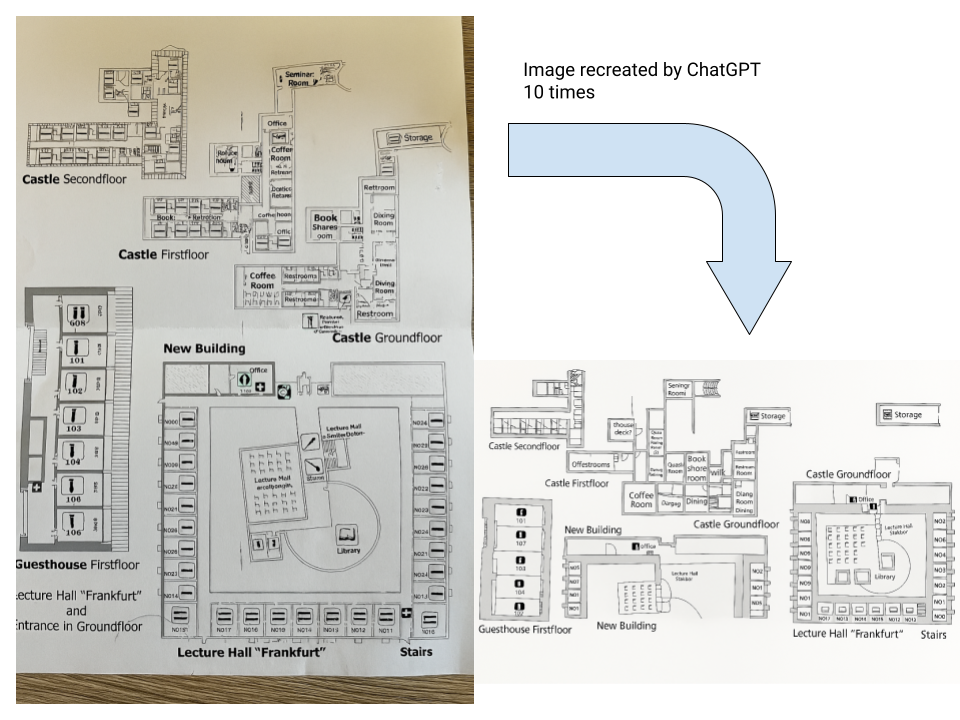
Then, we tried to match the hallucinated room titles to their original rooms, selecting a picture to use as the basis for each room. We then used Midjourney’s image editing feature to generate Jank variations of each image based on the room name.
We chose Midjourney as our image model because of the optional “chaos” parameter they expose in the interface, a scalar value that can be set when generating or editing an image. This parameter “lets you add more variety to the image results you get from each prompt”, though they warn “higher values mean the images can be quite different and may not stick as closely to your prompt, giving you unpredictable results”. We find that this approximately serves as a Jank parameter, with higher values often resulting in bizarre and hilarious results.
For each room, we masked out certain regions of the source image to replace using the model, and provided the text prompt “A group of researchers at the New Frontiers in AI for Game Design seminar at Schloss Dagstuhl. A big sign on the wall says “<room name>””. We set the chaos parameter to 100 each time, and continued generation until we got an image met our Provocative criteria.

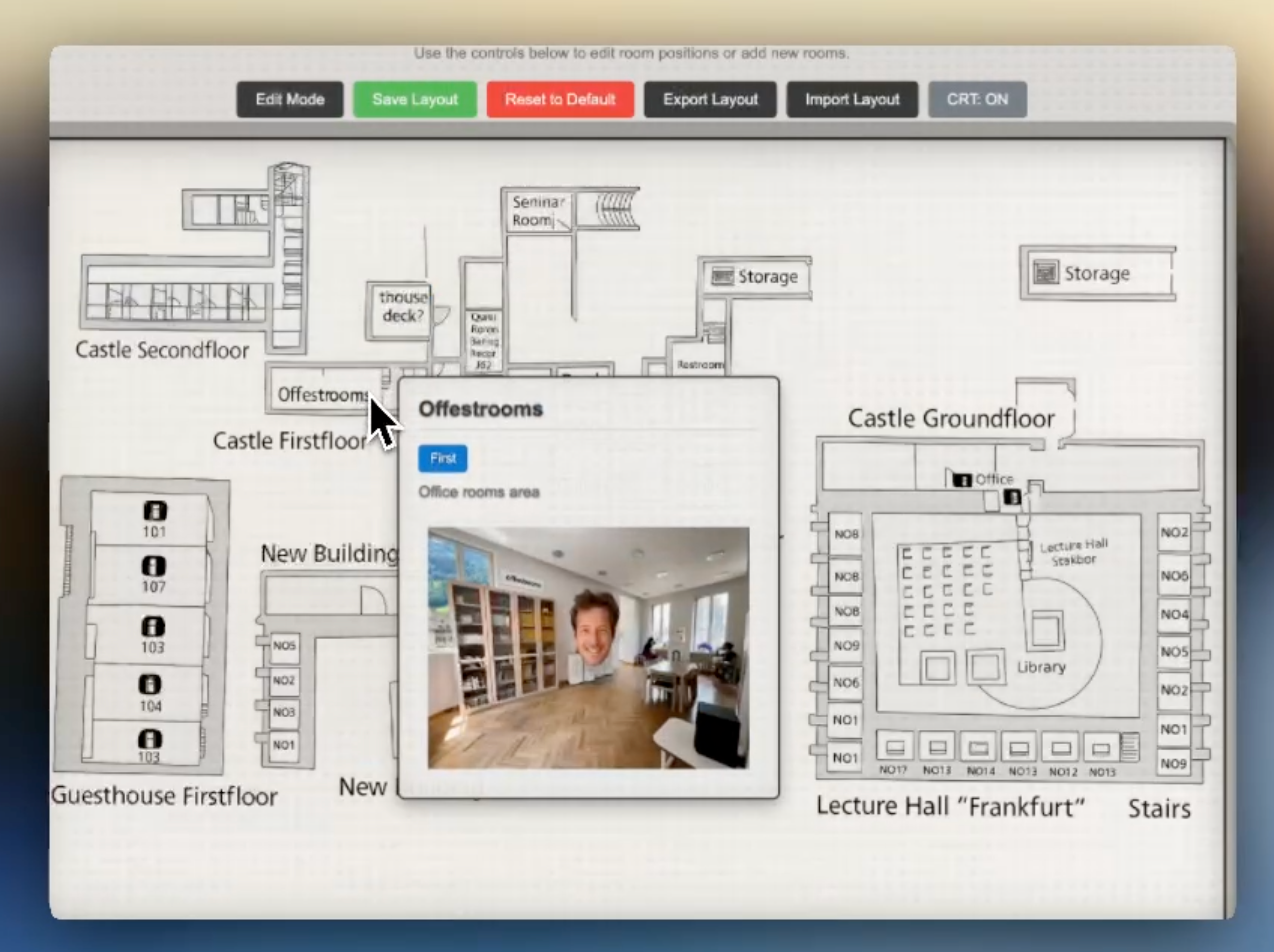
3.9.5 Conclusion
We have identified five key properties that distinguish entertaining “jank” from simple errors in generative AI: unintended, unreproducible, inhuman, in-group specific, and provocative outputs. Our experimental project – creating a jank-dimension Dagstuhl using Midjourney’s chaos parameter – demonstrates that these typically discarded outputs can be leveraged as a creative resource. Rather than viewing jank as failure, we propose embracing it as an emerging aesthetic that, as Eno predicted, may become a cherished signature of early generative AI. Future work could explore tools specifically designed to produce controlled jank or investigate how audiences’ perception of these artifacts evolves as AI systems mature.
References
- [1] Brian Eno. A year with swollen appendices: Brian Eno’s Diary. Faber & Faber, 2020
3.10 Handmade Blaseball
Younès Rabii (Queen Mary University of London, GB), Claus Aranha (University of Tsukuba, JP), Brian Bucklew (Freehold Games – Walkerton, US), Michael Cook (King’s College London, GB), Rémy Devaux (Punkcake Délicieux – Cenon, FR), Matthew J. Guzdial (University of Alberta – Edmonton, CA), Florence Smith Nicholls (Queen Mary University of London, GB), and Yuqian Sun (Royal College of Art – London, GB)
License: Creative Commons BY 4.0 International license © Younès Rabii, Claus Aranha, Brian Bucklew, Michael Cook, Rémy Devaux, Matthew J. Guzdial, Florence Smith Nicholls, and Yuqian Sun
This Dagstuhl report details the results of a session entitled “Handmade Blaseball”. The focus of the session was on discussing analogue procedural content generation. This session’s members were Brian Bucklew, Claus Aranha, Florence Smith Nicholls, Matthew Guzdial, Michael Cook, Rémy Devaux, Younès Rabii, and Yuqian Sun.

3.10.1 Framing
Our initial motivation for this working group was to explore how we could recreate the process of Automated Game Design without involving any computers. Many of us were motivated by a sense of disillusionment with the trajectory of games AI, and analogue prototyping offered a way to foster surprise, emergence, and playfulness outside of computational constraints. Our guiding reference was Blaseball: a cryptic simulation video game which left a lot of room for audience participation and, like an improvised performance, constantly felt like it could truly go anywhere. Some of the reasons why Blaseball had to be brought to an end were the increasing logistical and technical costs of maintaining this setup at that scale. The question we set to investigate was: What can we do in that design space, at a local scale and with little to no computation?
3.10.2 Process
Not all members of the session were familiar with Blaseball and similar community-driven games [1]. As such, we began by overviewing the area to ensure all members of the discussion were on the same page. Due in no small part to the makeup of the group, the conversation quickly shifted to automated game design and how one could accomplish this in an analogue (i.e., non-digital) fashion.
We quickly proposed an initial version with very simple rules, namely:
-
Assumptions: board, pieces, turns
-
Step 0: Lines, veils, wishes for game design
-
Step 1: Come up with number of players collaboratively
-
Step 2: Assign 1+ to each player:
-
–
Board gen rules (give 1 example board)
-
–
Piece gen rules (give 1 example piece)
-
–
Piece defining rules (give n example teams)
-
–
Piece placement on board rules (give 1 example board with pieces)
-
–
-
Step 3: Generating your game.
-
Step 4: Assign 1+ to each remaining player:
-
–
Win conditions
-
–
Turn start
-
–
Turn end
-
–
Arbitration
-
–
We nicknamed this “Four G’s” or “Four Gees” as it was a Game Generator Generator Game. The idea was that some parts of the game would happen in secret (Step 2) but each person would give some information (a specific output from their generative rules) to allow for cohesion. We played an initial narrative-driven chess-like game that we collaboratively created and then reflected on this process.
After playing the chess-like game, we reflected on the experience, with each member having different takeaways. Some members wanted more iterations on the design, others felt that iteration was a trap. Some wanted more simplicity, others wanted more chaos. As such, we split up and each member created their own variants independently.
3.10.3 Results
We lack the space to fully overview all of the seven game creation variants. Many were simple variations on the initial game described above, such as adding more explicit instructions [2] naming every game component or picking an explicit theme.
We focus our attention on three variants that were more strenuously tested at Dagstuhl, Michael Cook’s “Blank Page Boogie-Woogie” [4], Claus Aranha’s “Variation 5” [3] and Rémy Devaux’s unnamed variant.
For “Blank Page Boogie-Woogie” the aim was to develop a process that felt very easy to follow, almost like a folk game that you could describe to someone verbally and pass on that way too. The game required the use of pens and paper, along with the optional inclusion of other objects. The game included an explicit ‘fix the design’ phase in order to lessen the concerns of producing something playable initially. Based on the playtesting this seemed very effective.
“Variation 5” was more explicitly inspired by the author’s prior experience with Role Playing games and Board Games. Thus it ended up with explicit turn taking rules, and explicit separation of responsibility between the players, to try to make sure that all players have a fair chance to contribute to the design, even if they are unfamiliar with this kind of exercise. It also included a more abstract rule about “naming” the rules previously described, both to add a touch of whimsy to the process, as well as to allow a chance to review the final design.
In Rémy’s variant, all assumptions in the game were chosen collaboratively, with rules designed simultaneously due to card draws. Finally at the end, the game permitted two changes to the design as an explicit reflection.
After presenting all seven games to one another, we selected the three variants above to playtest, using Variation 5 twice and the others once to create a total of four games. With Variation 5 we produced “Fruits”, a physical game about getting a piece of fruit as high as possible and “Heaven or Hell”, a game about playing out Christian theology. With Blank Page Boogie-Woogie we created an unnamed game about rolling dice and drawing ghosts. With Rémy’s variant we created an analogue game simulating animals escaped from a zoo.
3.10.4 Observations
We found a number of interesting observations when discussing the process of designing the game generators, creating the games, and playing the games. First was the importance of differentiating what we meant in terms of the different roles that people took on in these experiences, whether we meant a designer of a generator, a designer of a game, or a player of a game. We opted to use the term “performer” in several instances due to the ambiguity of “player” in this context.
Second, across these game variations we had a spectrum of information sharing between participants in the game generation process. When participants did not have access to the other designer’s rules, they often trended towards making “game agnostic” rules that could have functioned in any game. In comparison, when rule creation was public, individuals could more easily build on top of one another’s design.
Third, an effect we dubbed the “Ouija Board” effect during the session, but is more closely related to the notion of sensemaking from psychology [5]. In this case we repeatedly found ourselves, apparently by happenstance, having designed a game that had interesting things going on in it, despite the fact that the components of that game were designed independently. We called this the “Ouija Board” effect as it felt as though we had subconsciously manipulated the game together to produce a coherent outcome.
3.10.5 Reflections
In reflection on this session we found that there was definitely something compelling about the process of designing these analogue game generators, designing the specific games collaboratively and performing them in front of an audience. We feel that there are likely connections here to improv, informal game design, dadaist games such as exquisite corpse and folk games. We believe there is potential in encouraging the same group to continue iterating on the same generator over multiple sessions, allowing them to build their own meta-narrative and leaving room for a communal emergent narrative. We think these game generators may also be useful vectors for studying game design processes, and hope that future researchers can more fully investigate this possibility.
References
- [1] Sam Rosenthal. “Welcome to Blaseball.” Blaseball, accessed August 12 (2021).
- [2] Matthew Guzdial. “Game Generator Generator Games.” https://mguzdial.itch.io/game-generator-generator-game, Accessed September 27 (2025).
- [3] Claus Aranha. “Variation 5” https://caranha.itch.io/variation5, Accessed September 27 (2025).
- [4] Michael Cook. “Blank Page Boogie-Woogie” https://illomens.itch.io/blank-page-boogie-woogie, Accessed September 27 (2025).
- [5] Helms Mills, Jean, Amy Thurlow, and Albert J. Mills. “Making sense of sensemaking: the critical sensemaking approach.” Qualitative research in organizations and management: An international journal 5.2 (2010): 182-195.
3.11 “But What About A Secret Third Thing”: Exploring Playful Transgressions In Video Games
Dipika Rajesh (University of California at Santa Cruz, US), Brian Bucklew (Freehold Games – Walkerton, US), Younès Rabii (Queen Mary University of London, GB), M Charity (University of Richmond, US), and Adam M. Smith (University of California – Santa Cruz, US)
License: Creative Commons BY 4.0 International license © Dipika Rajesh, Brian Bucklew, Younès Rabii, M Charity, and Adam M. Smith
When considering the act of playing games, much of the research and design discourse tends to center on canonical forms of play that are aligned with a game’s intended mechanics, rules, or narrative goals. Yet, alternative and subversive forms of engagement such as modding, speedrunning, or adapting “playground rules” represent an underexplored but rich avenue for both AI research and games research more broadly. These practices not only challenge the boundaries of how games are designed to be played but also open new opportunities for computational systems to understand, support, and even generate diverse playstyles.
Modding has long been recognized as an important approach to game development through the community creation of custom extensions and modifications to existing game software. Scacchi [1] emphasizes how modding serves as a form of extension of software, allowing for the adaptation and transformation of game systems beyond their original design. Despite this, there remains relatively little literature in AI or technical research that systematically maps these practices or explores computational systems designed to support them. Recent developments indicate a growing interest in this area: NVIDIA’s RTX Remix platform [2] enables modders to enhance classic games with modern graphics, including AI texture enhancements and ray tracing. However, these advancements are still emerging, and the broader field remains underexplored, particularly in terms of systematic frameworks, user-friendly tools, and community-driven AI applications for modding that integrate playstyles beyond the developer’s intent.
The motivation behind this working group was to better understand the current landscape of subversive playstyles and to ideate ways of supporting them through new tools, frameworks, and collaborations.
3.11.1 The Ontology of Playful Transgressions
During the first part of the morning, the working group focused on surveying the different types of gameplay that can be considered playfully transgressive. This initial mapping produced an expansive list that included speedrunning, ROM hacking, playground rules, modding, game corruptions, the use of cheat codes, and save scumming. Examining these diverse playstyles highlighted the many ways in which players depart from the conventional play patterns anticipated by a game’s design. This discussion immediately raised a critical question: what, precisely, is being subverted or transgressed through these practices? We identified that beyond the formal rules of a game, certain playstyles also transgress its coded affordances, as well as the legal, moral, and even political frameworks that games may inherently embed. Developing this landscape offered a clearer view of the vast potential for new systems and methods to support such unconventional modes of play.
3.11.2 “I Make The Rules Around Here!”: A Theory of Playful Transgressions
We developed a theoretical framework for defining playful transgressions by identifying three key dimensions: Players, Designers, and the Computational Medium. Within this framework, we defined normal play as activity that falls within the intended or allowed range across all three dimensions. Considering only the Player and Designer dimensions, there exist experiences that are acceptable and desirable to both but constrained by technical limitations, such as bandwidth or storage; these are not considered transgressive play. In contrast, when focusing on the Player and Medium dimensions while excluding the Designer, leveraging the medium to create exo-designed experiences, such as mods, hacks, or house rules, constitutes transgressive play. Finally, considering the Designer and Medium dimensions without accounting for the Player highlights practices that manipulate or restrict the player, such as inserting ads or extracting private data. We also stretched the framework by looking at each dimension on its own. To make these ideas more tangible, we created a zine that illustrated the theory and shared it with seminar attendees.
3.11.3 A Game Designers Guide for Enabling Playful Transgressions
We approached the space of playful transgressions from a game designer’s perspective and mapped out ways in which designers could intentionally structure their games and systems to support versatile playstyles. From this exploration, we identified five key considerations and highlighted examples of systems that embody each principle: choice of platform (e.g., Skyrim on PC vs. Xbox), modular and data-driven system design (e.g., Caves of Qud), explicit mod hooks (e.g., Minecraft), documenting the design process (e.g., Balatro), and observing, learning from, and supporting the community (e.g., Stardew Valley). To disseminate these ideas, we designed a zine that encapsulated these concepts and distributed it to the attendees of the remainder of the seminar at the conclusion of the workshop.

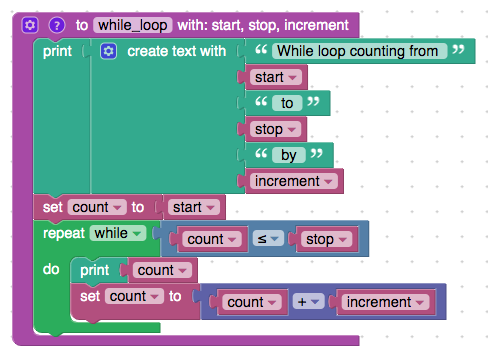
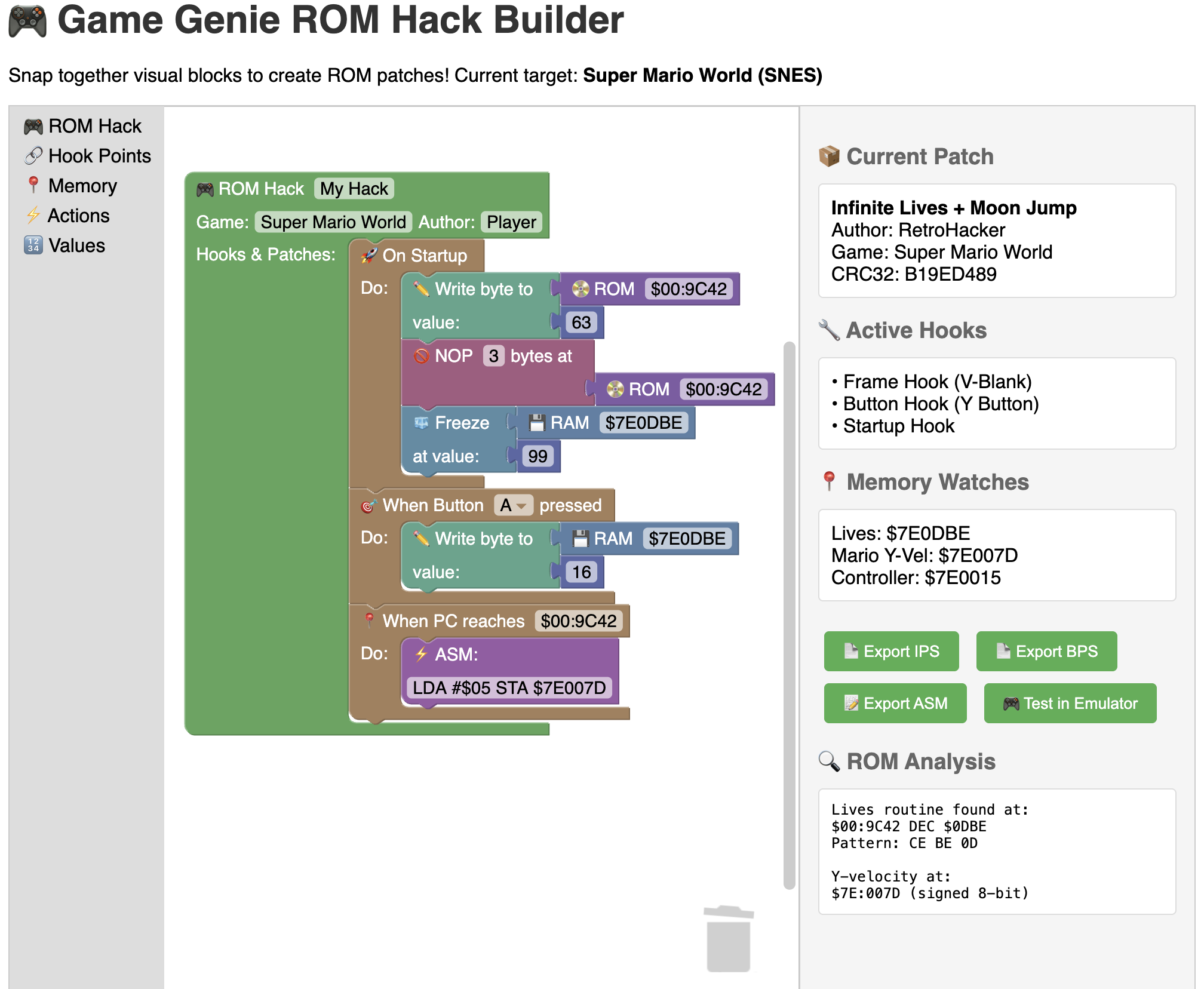
3.11.4 Designing a Prototype System for Supporting ROM Hacks
Game modding and ROM hacking present themselves as spaces where players require substantial programming expertise, as well as significant time or resources to outsource technical work. These barriers restrict access to the creative potential of modifying and reimagining games. In our discussions, we drew inspiration from two important sources: the Game Genie [3] and Blockly [4] (Figure 31). The Game Genie [3], a hardware device popular in the 1990s, exemplified how cheat codes and memory manipulation could offer everyday players accessible ways to alter a game’s behavior without requiring direct interaction with its source code. It made the act of “rewriting” a game approachable, playful, and within reach of a broad audience. Blockly [4], in contrast, demonstrates the power of visual, block-based programming to lower the threshold of entry into computational thinking. Its drag-and-drop interface to construct logic and behavior in intuitive, modular ways. Additionally, many ROMs are thoroughly mapped by fan communities (for example, see [5]), whose documentation makes hidden game structures easier to interpret. These mappings could be valuable for creating accessible tools, since they transform opaque technical details into interpretable knowledge. By combining the accessible nature of Game Genie, the visual programming paradigms of Blockly, and the ROM mapping provided by the community, this UI (Figure 33) design and the potential system powering it could make modding approachable to a wider range of players.
3.11.5 Conclusion and Future Work
This working group highlights the considerable potential for creating more accessible systems that enable a wide range of playful and transgressive gameplay. Future work could involve developing a full prototype of the GUI system for ROM hacking in a single game, or designing an AI-powered tool capable of supporting multiple games and playstyles. Beyond tool creation, there remains substantial research to be done in understanding how players engage in these unconventional forms of play and the rich communities that emerge around them, such as those on Twitch and other social platforms. Exploring these communities and practices more deeply will provide valuable insights into the ways games can be expanded and experienced across a variety of playstyles.
References
- [1] Scacchi, W. (2011, October). Modding as an open source approach to extending computer game systems. In IFIP International Conference on Open Source Systems (pp. 62-74). Berlin, Heidelberg: Springer Berlin Heidelberg.
- [2] Usmani, N. (2025, March 13). Breathing New Life Into Games With RTX Remix. NVIDIA Blog. https://blogs.nvidia.com/blog/rtx-ai-garage-rtx-remix/
- [3] NES World. Game Genie – The video game enhancer. Retrieved from https://www.nesworld.com/
- [4] N. Fraser, “Ten things we’ve learned from Blockly,” in 2015 IEEE Blocks and Beyond Workshop (Blocks and Beyond), 2015, pp. 49–50.
- [5] Data Crystal, “The Legend of Zelda ROM map.” Available: https://datacrystal.tcrf.net/wiki/The_Legend_of_Zelda/ROM_map
- [6] Nathalie Lawhead. Electric Zine Maker. https://alienmelon.itch.io/electric-zine-maker
3.12 PCG for Keepsake Games
Florence Smith Nicholls (Queen Mary University of London, GB), June Bhartia (Télécom Paris, FR), Michael Cook (King’s College London, GB), Younès Rabii (Queen Mary University of London, GB), Dipika Rajesh (University of California at Santa Cruz, US), Anne Sullivan (York University – Toronto, CA), Yuqian Sun (Royal College of Art – London, GB), Nicolaas Vas (Billund, DK), and Sabine Wieluch (Universität Ulm, DE)
License: Creative Commons BY 4.0 International license © Florence Smith Nicholls, June Bhartia, Michael Cook, Younès Rabii, Dipika Rajesh, Anne Sullivan, Yuqian Sun, Nicolaas Vas, and Sabine Wieluch
The term “keepsake game” was coined by Shing Yin Khor in 2021 to refer to “games that produce beautiful, memorable artifacts, through the process of playing the game” [1]. Keepsake games involve creating or modifying an original artifact as part of the gameplay process, guided by prompts as part of the design. Many keepsake games, such as Jeeyon Shim and Shing Yin Khor’s Field Guide to Memory232323https://jeeyonshim.itch.io/field-guide-to-memory, are analogue games. In this Dagstuhl working group, we set out to explore the potential of designing keepsake games that included a digital procedural system to prompt the creation of an analogue keepsake. We discussed a typology of keepsake games, complementary procedural systems and design constraints, before splitting into four subgroups to create prototypes. Through prototyping, members of the working group also explored analogue procedural systems and digital keepsakes, further challenging any strict demarcation in this hybrid design space.
3.12.1 Motivation
There has been limited explicit academic engagement with Khor’s concept of keepsake games. One clear outlier to this is a chapter in The Routledge Handbook of Role-Playing Game Studies within the context of text-based role-playing games [2]. Though the term “keepsake game” was coined recently, arguably games that could fall into this category have a longer history. A 1997 paper published in the Proceedings of the International Conference on Cognitive Technology [3], for example, discusses digital augmentation of “keepsake objects.” Sullivan et al’s Loominary captured narrative choices in a digital Twine game by having players use a loom as a controller, thus producing a physical artefact as part of the gameplay process [4].
Loominary’s hybrid digital/analogue interface was a key inspiration for the session. The first author was interested in exploring the possibility space of such hybrid keepsake games, especially in conjunction with procedural systems. Procedural content generation (hereafter PCG) is, broadly speaking, the generation of content algorithmically. Given that keepsake games often include human-authored algorithms for play through creative prompts, it was theorised that incorporating PCG systems would be complementary. Furthermore, we were interested in exploring how the uncanny poetics and texture of PCG [5] might contribute to keepsake game design.
The first author chose the “no generative AI content” category for this working group.
3.12.2 Designing Procedural Keepsakes
During the first part of the session, we discussed several different aspects of keepsake game design as a group. This discussion is summarised in the three subsections below.
-
Keepsake Typology. In terms of different types of keepsake, we came up with the most examples under the sub-category of “crafted items.” Crafted items are material agnostic, the emphasis is more on the process of physically creating a piece, such as paper weaving and even edible crafts. Crafted keepsakes are complimentary to the idea of keepsakes as a gift, which would be broadly applicable to other personalised keepsakes, such as postcards. We also discussed digital keepsakes, such as character creators and USB drives.
-
Complementary Procedural Systems. We discussed both digital and analogue procedural systems that could be incorporated into keepsake games. In terms of the former, existing digital games with PCG such as Minecraft were suggested. Another system was the Tracery text generation tool. We also had suggestions for analogue PCG, such as dice rolls, Tarot cards and the cut-up method.
-
Design Constraints. Potential design constraints for keepsake games fell mainly under the following areas; theme, material, duration, number of players, location and familiarity. Familiarity was particularly applicable in terms of the aforementioned crafting techniques, as potential players may need to learn a new skill as part of crafting a keepsake. In addition, players might need access to specific craft materials. Though we did not extensively explore this in our discussion, it is important to point out that accessibility is thus a key concern in terms of keepsake design.
3.12.3 Prototypes
In the second part of the session, we split into four subgroups to rapidly prototype keepsake games. Each of these prototypes, and the design considerations that went into them, are summarised below.
3.12.4 A Sending
A Sending242424https://florencesmithnicholls.itch.io/a-sending is a postcard keepsake game (the name riffs on Shing Yin Khor’s keepsake game A Mending252525https://sawdustbear.itch.io/a-mending). Players use an online village generator tool to create the map of a fictional village, are instructed to design a stamp based on it, and write an accompanying postcard with details of their trip to this fantasy place.
Role of PCG.
We decided to use an existing digital map generator tool for ease of prototyping. This is watabou’s Medieval Fantasy City Generator262626https://watabou.itch.io/medieval-fantasy-city-generator, freely available on the itch.io platform, and the developer has stated they are happy for images generated from it to be used in other creative works. Furthermore, the generator can be used in-browser, so it is fairly easy to access.
Design Constraints.
One of the major design constraints was writing the keepsake game with the expressive range of the Medieval Fantasy City Generator in mind. The generator only produces schematic details, as opposed to a large range of distinct, annotated building types, so it was important to keep in mind what would be present in any given map and so would complement any written prompts. In addition, the instructional part of the keepsake game itself was constrained to an 8-page zine.
Reflections on the Design Process.
The zine constraint was useful as it encouraged us to write efficiently, while still allowing a little room for flavour text. Using watabou’s generator was a great starting point for thinking about a game where you are essentially roleplaying as a tourist in a village based on a procedural map. However, making a bespoke generator would have allowed for a more sophisticated relationship between the analogue keepsake creation process and the digital map. We encountered some issues attempting to repurpose watabou’s generator for our needs, partly due to the constraints of modern browsers, all of which are easier to mitigate if building a generator from the ground up. Furthermore, we would have benefitted from a more iterative process in which we had the opportunity to play test the game ourselves.
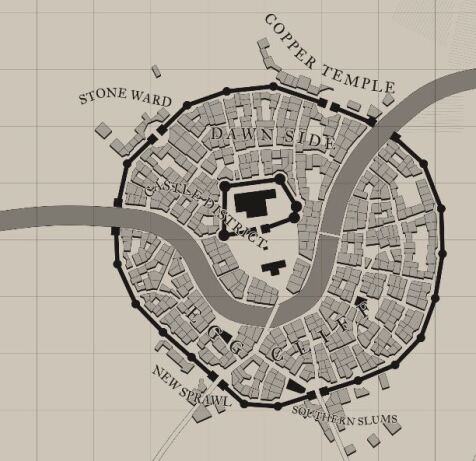
3.12.5 A – Zine
A-Zine (pronounced “A-to-Zine”) is a collection of 26 pocket zines. Each zine has a front-page with a fixed title, an empty square and a field to write the author’s name. Each zine is empty, containing only two words written in red, in different pages. Red words are hyperlinks leading to the zine with that same title. Readers are invited to pick the zine they like, read its short story and follow hyperlinks to other zines. If the zine they opened is empty, they are invited to fill it using its title as an inspiration. They’re invited to include the fixed red words within its content – as part of a text, for example.
Each zine has a title starting with a different letter of the English alphabet. The first one, titled Atlas, explains how to read and fill the zines.
Role of PCG.
PCG wasn’t used for this first prototype, but the system was designed to easily include it in the future. There are two components for which a PCG system would be relevant: picking names for the zines –which often correspond to locations– and generating the “map” i.e. the graph of connections between zines.
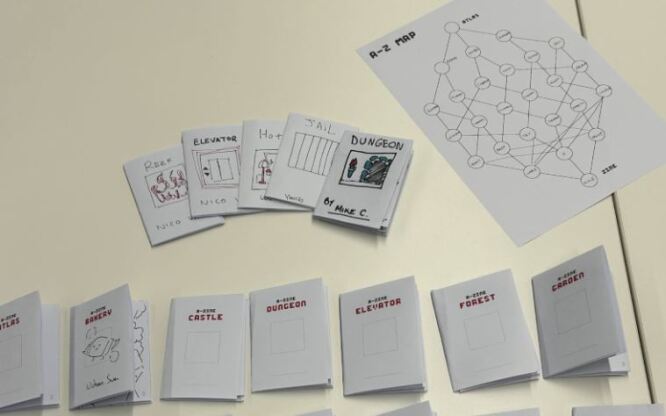
Design Constraints.
Our initial goal was to develop a system akin to a game engine that would support player creativity. Our core examples were platforms such as Twine, Bitsy and Downpour. Development time was limited by the working group’s duration of one day. We quickly settled on two self-imposed constraints that were our design ethos:
-
1.
We wanted players to create zines and
-
2.
We wanted as little friction as possible between the act of stumbling upon the game and being able to play it.
Reflections on the Design Process.
Our initial discussions circled around the idea of letting players create small dungeons, puzzles or escape rooms within a zine. Subsequent players would have to solve the zines by entering a password on a website, which would lead them to another zine. When discussing the infrastructural technology choices to enable this, we realised that it would create a lot of friction: scanning a QR code, needing a phone, needing an internet connection, entering a password, creating an entry on a website, etc. All those actions clashed with our accessibility goal. In the end, we made the choice of removing smartphones and computers as much as possible from our system.
This principle quickly led us to make practical decisions adapted to a physical medium. We needed the zines to be self-contained yet connected, we needed them to be easy to understand on a first glance and offer vast possibilities of self-expression. We ultimately converged on designing a small library of nearly empty but interconnected zine templates.
3.12.6 Color Collector
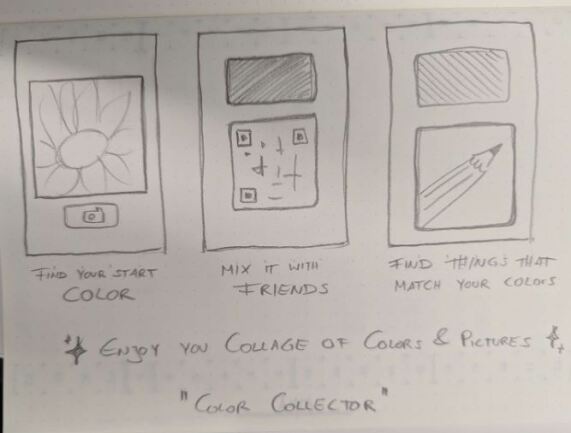
Color Collector is a collage and connection game played with a smartphone. In the beginning, each participant is prompted to photograph an object that has a color they like. This color is extracted from the image and becomes their starter color. From then on, participants can either:
After the event, each participant has created their very own collage of little moments and hopefully has found new friends or connections during the color mixing process.
Role of PCG.
There is no software side of PCG – the participants are in a way the content generators.
Design Constraints.
The goal of this keepsake game was bringing people together (in a setting like a conference or another small event) and giving them a purpose to interact with each other. Another goal was to mix physical and digital interactions. It was important to us that both the physical and digital part of the keepsake game were easily accessible and understandable.
Reflections on the Design Process.
The prior mentioned constraint quickly narrowed the interaction down to a digital interaction via smartphone. We found it very helpful that so many smartphone features, such as the camera, can be accessed via the browser which allowed us to design the game without needing a stand-alone app, which makes it a lot easier to access.
3.12.7 Postcards for Dagstuhl
Postcards for Dagstuhl is a physical game dedicated to the seminars that are held at Dagstuhl, although it could easily be adapted for other gathering spaces. The output of the game is a hand-decorated postcard which reflects something about the player and their time at Dagstuhl. Inspired by instructional art, during the game the player is given three sets of prompts to choose from with instructions on how to decorate their postcard. The first table has prompts which reflect the player’s own research or personality, the second table has prompts about the player’s experience at Dagstuhl, and the final table has prompts about who to give the postcard to when they are done, if they don’t choose to keep it for themselves.
Role of PCG.
As a physical game, computational PCG did not play a part in the process. However, players could use dice in choosing the prompts they responded to, which added some simplified, traditional aspects of PCG.
Design Constraints.
The design was constrained based on wanting the game to be approachable by non-artists and non-gamers, as well as being able to realistically fit into a typical Dagstuhl Seminar experience. To keep the barriers to entry low regardless of a player’s artistic or gaming background, the game rules suggested different options for decorating the postcard beyond traditional forms of art, such as writing, collage, and making graphs. Additionally, the game is primarily solo play, and without competition to make it less intimidating for non-gamers. To help the experience fit into a busy Dagstuhl schedule, the game was made so all the instructions could fit into a one-page zine, and it was designed to take 15-30 minutes.
The prompts for the game were all shaped by these constraints and the goals of the game to deepen community building and encourage reflection. The first set of prompts asks the player to represent themselves or their research, the second to reflect on their time at Dagstuhl, and the third gives the player choices for whom to give their postcard to.
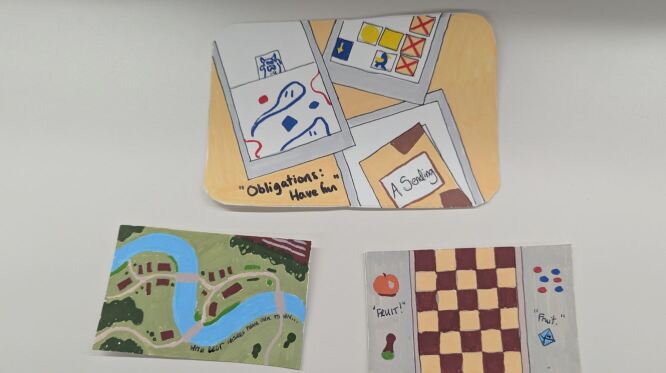
Reflections on the Design Process.
The game went through several iterations, with the prompts getting refined to better fit the design goals. However, the most successful part of the game was the format of the keepsake: postcards.
Using postcards was particularly effective because it provides a small canvas, which is less intimidating than a full piece of paper. It also takes less time to decorate which keeps the game experience shorter. Postcards are also already associated with less serious forms of writing in American culture, and they are also seen as something you give to someone else. These associations fit particularly well with the design goals of the game. Despite the experience not generally taking much time, the hand-made and physical nature still gave players some time to reflect on their experiences. And more importantly, the physical, hand-made nature of the keepsake generally made them feel more special when they were given to someone else.
3.12.8 Conclusion
Four prototype keepsake games were made as part of this working group. While the initial prompt was to create physical keepsakes games that used digital PCG systems in some way, many of the prototypes ended up exploring forms of analogue PCG [6]. Overall, there was a concern for accessibility in terms of both artistic and gaming experience and availability of specific digital platforms. We believe there is great potential for further exploring and experimenting with PCG keepsake games, especially in terms of creating bespoke generators for this purpose.
References
- [1] Shing Yin Khor. on keepsake and connected path games. Patreon. Online: https://www.patreon.com/posts/on-keepsake-and-47599952, 2021
- [2] Jessica Hammer and Paul Czege. “Text-Based Role-Playing Games.” In The Routledge Handbook of Role-Playing Game Studies, pp. 171-184. Routledge, 2024
- [3] J. W. Glos and J. Cassell. “Rosebud: a place for interaction between memory, story, and self.” In Proceedings of the 2nd International Conference on Cognitive Technology, IEEE Computer Society, USA, 88, 1997
- [4] Anne Sullivan, Joshua Allen McCoy, Sarah Hendricks, and Brittany Williams. ”Loominary: crafting tangible artifacts from player narrative.” In Proceedings of the Twelfth International Conference on Tangible, Embedded, and Embodied Interaction, pp. 443-450. 2018.
- [5] Isaac Karth. “Preliminary Poetics of Procedural Generation in Games.” In Transactions of the Digital Games Research Association , 2019.
- [6] Gillian Smith. “An Analog History of Procedural Content Generation.” In Foundations of Digital Games Conference, 2015.
3.13 Dagstyle
Nicolaas Vas (Billund, DK)
License: Creative Commons BY 4.0 International license © Nicolaas Vas
This report details the development of Dagstyle, a visual system created in the months leading up to Dagstuhl Seminar 25292, intended as an inspiration and development tool for attendees of the seminar.
3.13.1 Background
Visual systems are a defined set of rules for creating consistent assets, layouts and designs. They are often used by companies, brands and products to be easily recognized and remembered in the minds of consumers. Visual systems can be thought of as individual components, which are arranged into assemblies, which are finally placed into applications.

Benefits of visual systems include their ease of use, their flexibility to scale across media and audiences, and a tendency for their constraints to cultivate creativity. In a time when Gen AI disrupts the status quo in the pursuit of high fidelity, simple limited systems can also provide a space for all to experiment.
In addition to brand design, visual systems can be found in many places, such as national flags, the pixel art of classic video games, tangrams, Nintendo Miis and even the brickwork in Victorian townhouses. Dr. Martin Lorenz advocates for a move away from logos and towards flexible visual systems that can be easily scaled across different audiences and in different media.
In preparation for the seminar, the author was inspired by the visual language of DROPS272727https://drops.dagstuhl.de/ (The Dagstuhl Research Online Publication Server), which is optimized for text and icons with a pixel and line drawing style. A limited colour palette of four colours allows for clear contrast between white, grey and yellow, with blue for hyperlinks. Could this be extended to allow for a wider expressive range, to create a simple and accessible visual system for the seminar attendees to use and further develop during the week?
3.13.2 Development
Early exploration pushed the limits of the DROPS style, and endeavoured to define the shapes, colours and grid rules that form the foundation of Dagstyle.
Shapes – The allowable shapes were expanded from pixels to include squares, circles, triangles and quadrants.
Colours – The allowable colours were expanded from four to six; White, Grey, Yellow, Blue, Pink and Green. While the four colour map theorem states that only four colours are needed to colour regions so that no adjacent regions share the same colour, the addition of Pink and Green introduce new possibilities to represent nature and more colourful ideas.
Grid – All Dagstyleimages should be limited to placement on 8x8 or 16x16 grids, with the option for layering and shapes to be rotated by 90 degree increments. Assemblies can also be used as Components, allowing for fractal details.
After defining these simple rules, it was then possible to play with the system to create patterns, fonts, flags and 100 interesting things.
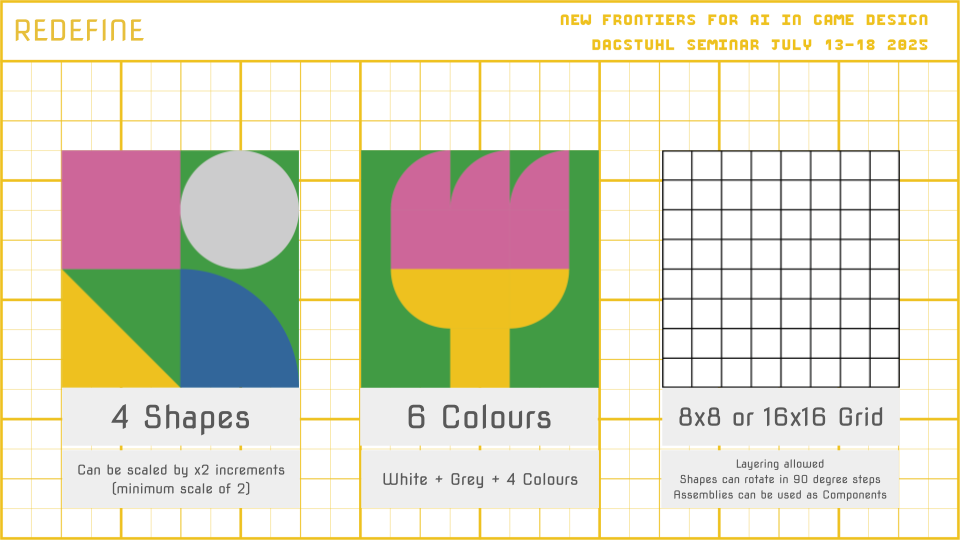
3.13.3 Result
The Dagstyle visual system consisted of the following components, which were provided to seminar attendees as inspiration and use during the seminar.
Dagstamp – A 2D Building system of icons and assets, that could be used in presentations and prototypes. Assembly sheets for hundreds of individual assets were provided, in addition to PNG and SVG images.
Dagslide – A Google Slides presentation template that could be used for sharing the results of workgroups throughout the week.
Dagscript – An OpenType font and writing system.
Dagzine – A self-publication zine template to introduce zine making.
Daggame – An invitation was given to seminar attendees to consider how the Dagstyle visual system and principles could be extended into an interactive video game format.
3.13.4 Name Tag Building System
With the hopes of providing a fun icebreaker activity, assets from Dagstamp and Dagscript were curated into an array of name tag building components. When supplemented by scissors, markers, glue and thermal photo printers, these symbol symbols were transformed by seminar attendees into a dazzling array of colourful name badges. The author was thrilled by the collective creativity and how well everyone worked together, many of whom were meeting each other and attending this seminar for the first time.

3.13.5 Conclusion
The Dagstyle visual system was well received, and served its purpose of inspiring a playful prototyping approach during the seminar. It was used, extended and subverted in numerous instances, and most notably applied as a prototype for a visual programming language in Visual Representation for Video Game Description Language. The author invites any future Dagstuhl Seminar or reader to use it in their own work. Have fun and make it your own!
4 Participants
-
Claus Aranha – University of Tsukuba, JP
-
Maren Awiszus – Viscom AG – Hannover, DE
-
In-Chang Baek – Gwangju Institute of Science & Technology, KR
-
June Bhartia – Télécom Paris, FR
-
Rafael Bidarra – TU Delft, NL
-
Brian Bucklew – Freehold Games – Walkerton, US
-
Duygu Cakmak – Creative Assembly – Horsham, GB
-
M Charity – University of Richmond, US
-
Kate Compton – Vejle, DK
-
Michael Cook – King’s College London, GB
-
Alena Denisova – University of York, GB
-
Rémy Devaux – Punkcake Délicieux – Cenon, FR
-
Alexander Dockhorn – University of Southern Denmark – Odense, DK
-
Matthew J. Guzdial – University of Alberta – Edmonton, CA
-
Emily Halina – University of Alberta – Edmonton, CA
-
Max Kreminski – Midjourney – Santa Clara, US
-
Antonios Liapis – University of Malta – Msida, MT
-
Tiago Machado – IBM Research – Sao Paulo, BR
-
Timothy Merino – NYU – New York, US
-
Younès Rabii – Queen Mary University of London, GB
-
Dipika Rajesh – University of California – Santa Cruz, US
-
Emily Short – Oxford, GB
-
Adam M. Smith – University of California – Santa Cruz, US
-
Gillian Smith – Worcester Polytechnic Institute, US
-
Florence Smith Nicholls – Queen Mary University of London, GB
-
Anne Sullivan – York University – Toronto, CA
-
Yuqian Sun – Royal College of Art – London, GB
-
Nicolaas Vas – Billund, DK
-
Sabine Wieluch – Universität Ulm, DE
![[Uncaptioned image]](x7.jpg)