Creativity, GenAI, and Software Development: A Future Together
Abstract
This report introduces the goals of the Dagstuhl Perspectives Workshop 25412 “Creativity, GenAI, and Software Development: A Future Together”, provides an overview of the workshop and how it was conducted, details the activities that took place to identify significant future themes concerning research in creativity, GenAI, and software development, and foreshadows key outcomes that will be included in the associated Dagstuhl Manifesto.
Keywords and phrases:
Creativity, Generative AI, Software Development, Dagstuhl Perspectives WorkshopSeminar:
October 5–10, 2025 – https://www.dagstuhl.de/254122012 ACM Subject Classification:
Software and its engineering Software development techniques ; Human-centered computing Collaborative and social computingCopyright and License:
![[Uncaptioned image]](x1.png) Except where otherwise noted, content of this report is licensed under a
Creative Commons BY 4.0 International license
Except where otherwise noted, content of this report is licensed under a
Creative Commons BY 4.0 International license
1 Executive Summary
Victoria Jackson (University of Southampton, GB, v.jackson@soton.ac.uk)
Rafael Prikladnicki (Pontifiícia Universidade Católica do Rio Grande do Sul, BR,
rafael.prikladnicki@pucrs.br)
Daniel Russo (Aalborg University, DK, daniel.russo@cs.aau.dk)
Margaret-Anne Storey (University of Victoria, CA mstorey@uvic.ca)
André van der Hoek (University of California, Irvine, US, andre@ics.uci.edu)
License: ![[Uncaptioned image]](x2.png) Creative Commons BY 4.0 International license © Victoria Jackson, Rafael Prikladnicki, Daniel Russo, Margaret-Anne Storey, and André van der Hoek
Creative Commons BY 4.0 International license © Victoria Jackson, Rafael Prikladnicki, Daniel Russo, Margaret-Anne Storey, and André van der Hoek
This Dagstuhl Perspectives Workshop 25412 “Creativity, GenAI, and Software Development: A Future Together” brought together leading researchers and thought leaders from industry to collectively examine the evolving relationship between creativity, Generative AI (GenAI), and software development, and to articulate a forward-looking research agenda at this critical inflection point for the field.
Although much of the discourse, especially in industry, has focused on productivity gains from GenAI, this workshop deliberately shifted attention toward creativity as a central dimension of software development work.
During five days of highly interactive and trust-building activities, participants explored how creativity manifests in software development, how it is shaped by tools, teams, and organizational contexts, and how GenAI can both amplify and erode creative practice. Rather than treating creativity as an abstract or purely individual trait, discussions emphasized its situated, socio-technical, and collective nature, spanning problem framing, exploration, sensemaking, and decision-making throughout the software lifecycle.
A key insight emerging from the workshop is that GenAI, in disrupting software development by reconfiguring who does what and in changing how value is created and assessed, creativity is simultaneously more important than ever and seriously challenged. Participants surfaced optimistic futures, in which GenAI expands creative reach and lowers barriers to exploration, and more cautionary trajectories, where over-automation risks flattening diversity of thought, narrowing solution spaces, or displacing reflective practice. These tensions highlight the need for research that goes beyond tool performance to examine creative quality, meaning, values, and long-term impacts on people and organizations.
The workshop culminated in the identification of five interrelated research directions that form the basis of the forthcoming Dagstuhl Manifesto, provisionally titled “Creativity is the New Productivity.” These directions call for: (1) developing a critical perspective on GenAI and creativity, (2) deeper characterization of creativity in software development; (3) stronger evidence of how creative work generates value; (4) exploration of the design space for GenAI-driven tools and processes that responsibly amplify creativity; and (5) synthesis across fragmented understandings, perspectives, and emergent publications to effectively promote knowledge sharing and generate impact.
Beyond the Manifesto itself, the workshop fostered a shared language, durable collaborations, and a collective commitment to shaping futures in which GenAI supports – not supplants – human creativity in software development. Taken together, the outcomes of this workshop argue for reframing success in software engineering: from efficiency alone toward creative, humane, and value-aligned systems of work.
2 Table of Contents
3 Introduction
The high-level objective of this Perspectives Workshop was to bring together thought leaders from academia and industry to develop a comprehensive research agenda on the intersection of creativity, GenAI, and software development.
Creativity is a bedrock of software development: without it, innovation would stall and the day-to-day problem solving that leads to new features and improvements to existing features would be gravely hampered. Yet, whereas creativity in other disciplines such as arts, engineering, and architecture has been the subject of a vast amount of research, little is known about the nature, importance, and effect of creativity in software development.
The advent of GenAI has thrust the role of creativity in software development to the fore. Some envision a gentle evolution toward GenAI-driven tools that amplify the creative work of developers and make them more effective. Others see a radical near future in which GenAI usurps all rote work, with the sole job left for developers to creatively direct the tools to produce innovative software and features. While a major portion of research, studies, and discussions in the literature and media have concentrated on the impact of GenAI on productivity, this Perspectives Workshop considered that understanding the short-term, medium-term, and long-term impacts of and connections among creativity, GenAI, and software development warrants equal, if not greater, attention.
To discuss, anticipate, and proactively shape the future of creativity augmented by GenAI in software development, this Perspectives Workshop brought together leading academics and practitioner thought leaders to address a range of questions, including: what is the nature of creativity in software development; how might GenAI shape, enhance, and perturb software creativity; what does that mean for the resulting software products; which kinds of novel development tools may be needed; how might organizations and their teams adapt; and what unintended consequences may result?
The workshop had five specific goals:
-
Raise awareness of the important role of creativity in software development and the opportunities and pitfalls that may arise with the advent of GenAI.
-
Articulate different futures in terms of how GenAI may impact creativity in software development, as bracketed by other relevant factors such as value, productivity, and developer experience and wellbeing.
-
Use these futures to develop a comprehensive research agenda that helps shape the future of creativity, GenAI, and software development.
-
Ideate new GenAI driven tools that amplify creativity across different software development activities and tasks in positive ways while minimizing potential risks.
-
Promote an interdisciplinary community of researchers that cares about, understands, and drives how creativity and GenAI will shape future software development.
Participants in the workshop were specifically selected to bring together expertise in a wide range of backgrounds, including creativity, GenAI, innovation, software analytics, productivity, human-AI teams, design and expertise, software tools, problem solving, and human cognition, among others. To effectively exploit this wide variety of expertise for purposes of future agenda setting, the workshop was run in a highly interactive fashion, without any formal presentations. Instead, participants engaged in many different collaborative activities that were carefully structured and sequenced to build trust, collectively take stock and create common ground, generate many different ideas, articulate possible futures out of those ideas, and refine the most promising directions for future research.
The remainder of this document details how the workshop proceeded, and accompanies the Manifesto that is to be published separately in the first half of 2026. Next, we first provide an overview of the workshop’s approach (section 4), followed by a description of each of the workshop’s working sessions (section 5). The report then concludes with a short preview of the Manifesto’s planned contents (section 6).
4 Overview of the Workshop
The workshop’s overarching goal was to discuss, anticipate, and proactively shape the future of research into the intersection of creativity, Generative AI, and software development. To facilitate discussion, including the identification of future research directions, the workshop was purposefully designed to be interactive and fun, incorporating small-group activities. Many of these activities were drawn from Liberating Structures666https://www.liberatingstructures.com/. Liberating Structures are a set of facilitation strategies designed to involve participants in meaningful discussions by breaking conventional patterns, encouraging fresh insights, and collaborative problem-solving. Several of the organizers had prior experience using Liberating Structures in workshops and found them helpful for fostering vibrant discussions for shaping research strategies and directions.
A key output from a Perspectives Workshop such as ours is a Dagstuhl Manifesto. The workshop organizers wished to have an outline of the Manifesto’s contents by the end of the week, which could then be worked on asynchronously by all participants. This required some lightweight structuring of the workshop to move from the many diverse perspectives on creativity among participants to a concrete set of future research directions. The workshop was thus organized with a daily goal, with each day building upon the work and insights from the prior day. The first day’s goal was firmly scene-setting, getting participants to discuss their perspectives on creativity and start thinking about where the future lies. The second day explored the amplification of creative software work through GenAI. The third (short) day began by identifying future research directions, which were subsequently refined on the fourth day, before agreeing on the Manifesto’s contents and starting to contribute to it on the final (short) day.
Table 1 summarizes each of the working sessions that took place during the workshop. As can be seen, there was more structure in the early part of the week, with many sessions to help participants explore the topic. The latter part of the week offered participants an opportunity to provide more details on their preferred research direction.
While the organizers had initially planned the week’s activities, they accepted that the plan might change depending on the outcomes of each day. The organizers met at the end of each day to reflect and decide whether any changes would be required to the upcoming plans. This reflection led to some minor changes, introducing additional Liberating Structures to the planned ones.
On the first day with all the participants, the organizers explained that the workshop was designed to be interactive and stimulating. Liberating Structures were introduced, followed by guidance for participants. Firstly, to create a safe space where participants could openly share their experiences and ideas, the workshop adopted Chatham House rules777https://www.chathamhouse.org/about-us/chatham-house-rule: “Participants are free to use the information received, but neither the identity nor the affiliation of the speaker(s), nor that of any other participant, may be revealed.” Secondly, the participants were encouraged to engage actively as their insights were crucial to the collective success. We thus asked them throughout the week to contribute by sharing freely, listening intently, and building on others’ ideas. Notably, the whole week’s agenda was not shared with participants to allow the organizers to re-plan as needed.
We hope that by sharing the approach taken to facilitate the collective dialogue necessary to produce a Dagstuhl Manifesto, future workshop organizers can learn from our experience when designing their own Dagstuhl Perspectives Workshop.
The next section shares details of each of the working sections shown in Table 1.
| Schedule | Description |
|---|---|
| Mon. am | Celebrity Interview |
| Mon. am | What, So What, Now What |
| Mon. pm | Mad Tea |
| Mon. pm | TRIZ |
| Mon. pm | Shift and Share |
| Tues. am | Share your passion |
| Tues. am | Short Gallery Walk |
| Tues. am | Wise Crowds |
| Tues. am | STAR |
| Tues. am | 15% Solutions: Immediate Amplifiers |
| Tues. pm | Ecocycle Planning |
| Tues. pm | Conversation Café |
| Tues. pm | User-Experience Fishbowl |
| Wed. am | 1-2-4-All |
| Wed. am | Dot voting |
| Wed. am | Open Space |
| Wed. pm | Group trip to Trier |
| Thurs. am | Why, Who, What, How |
| Thurs. pm | Open Space |
| Fri. am | Writing the Dagstuhl Manifesto |
| Fri. am | Wrap up |
5 Working Sessions
This section describes the various working sessions held during the workshop (as listed in Table 1). The majority of the sessions used techniques drawn from Liberating Structures.
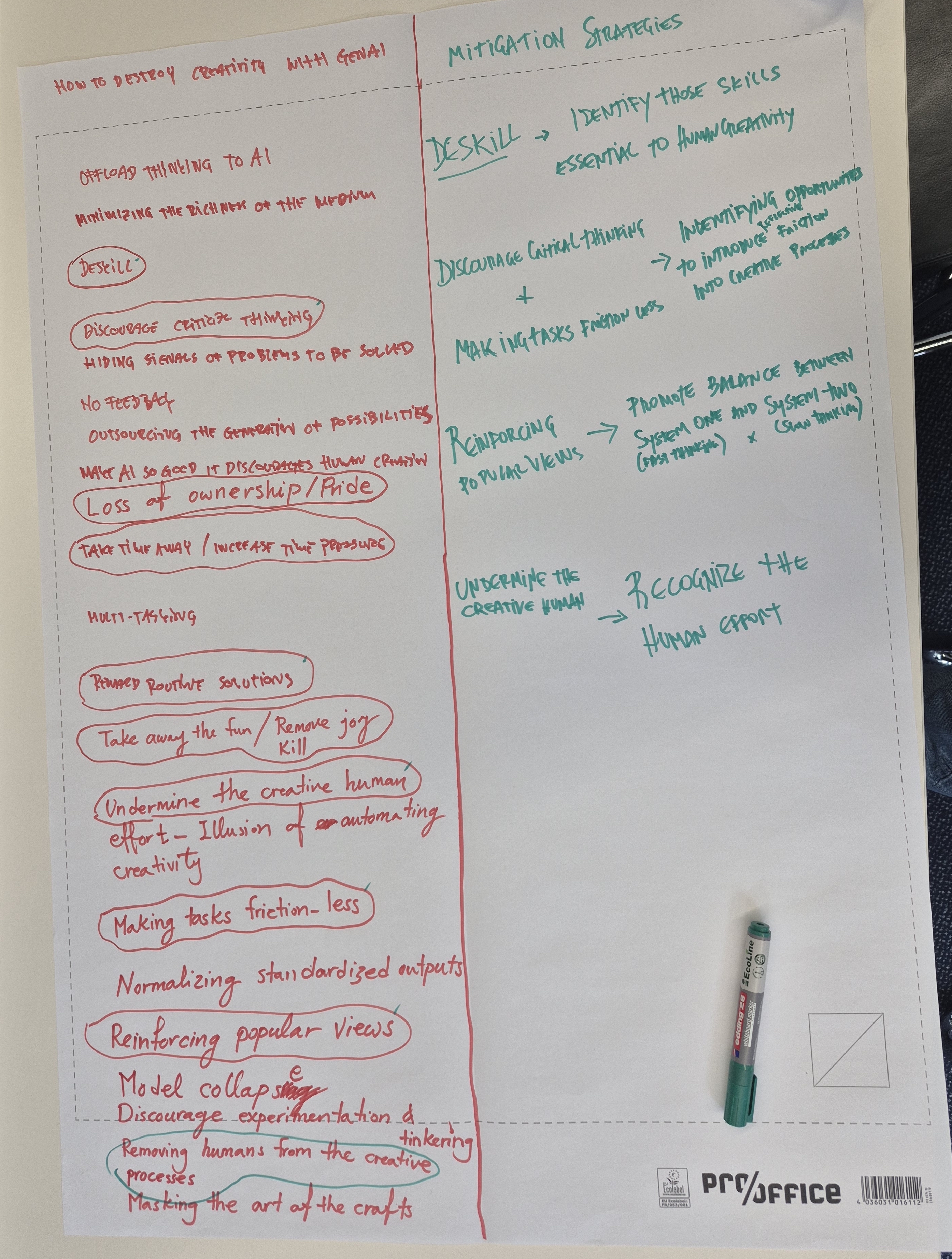
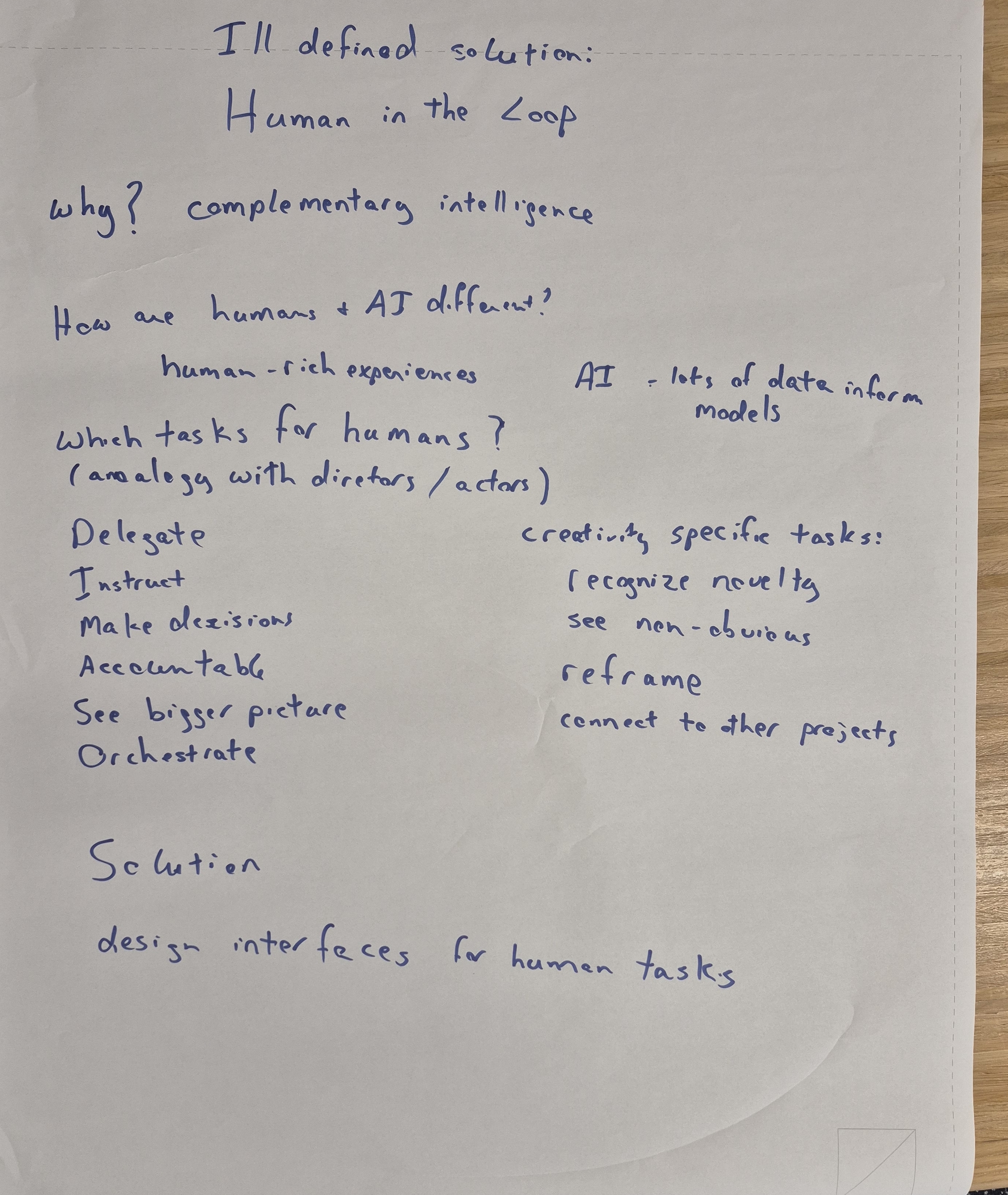
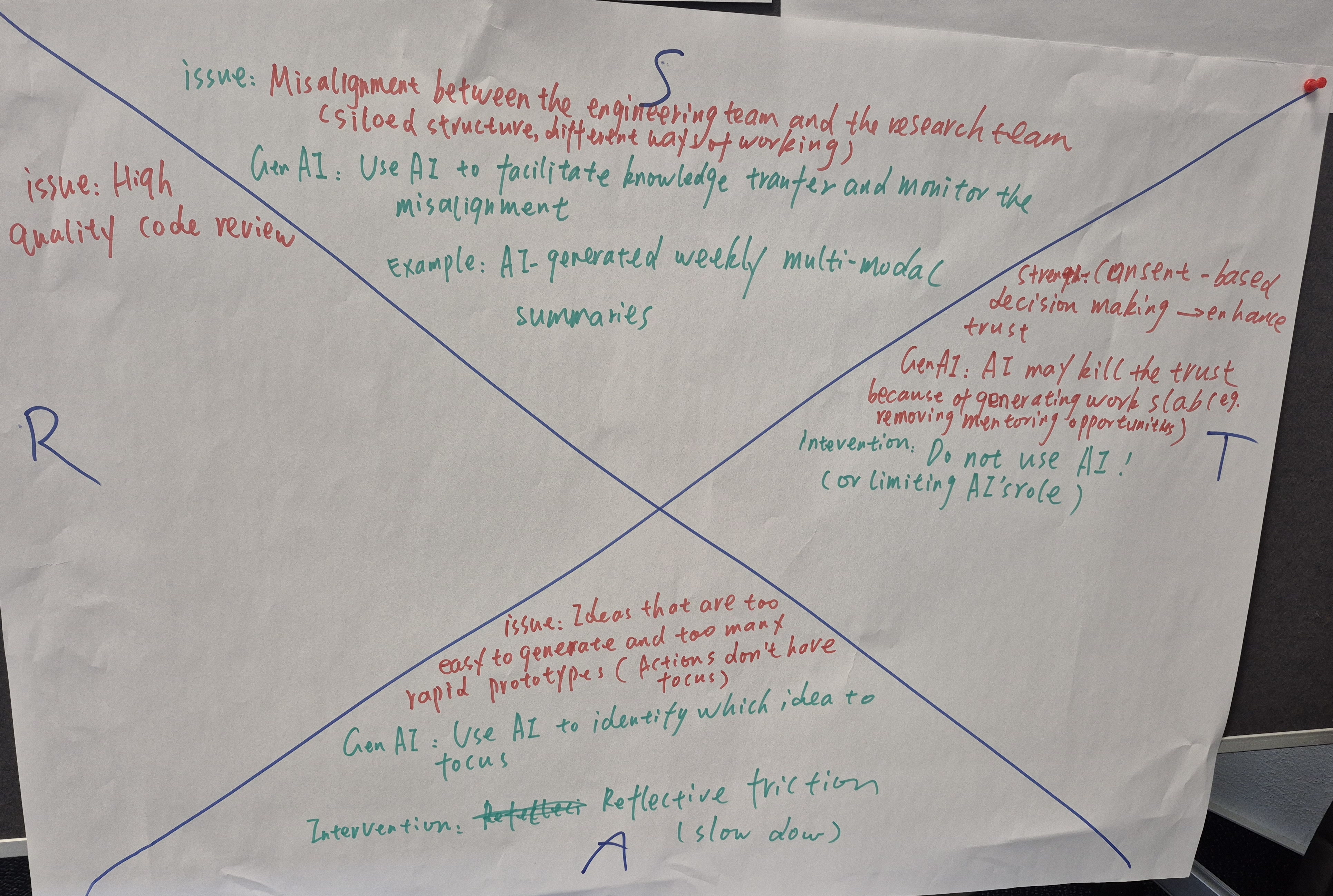
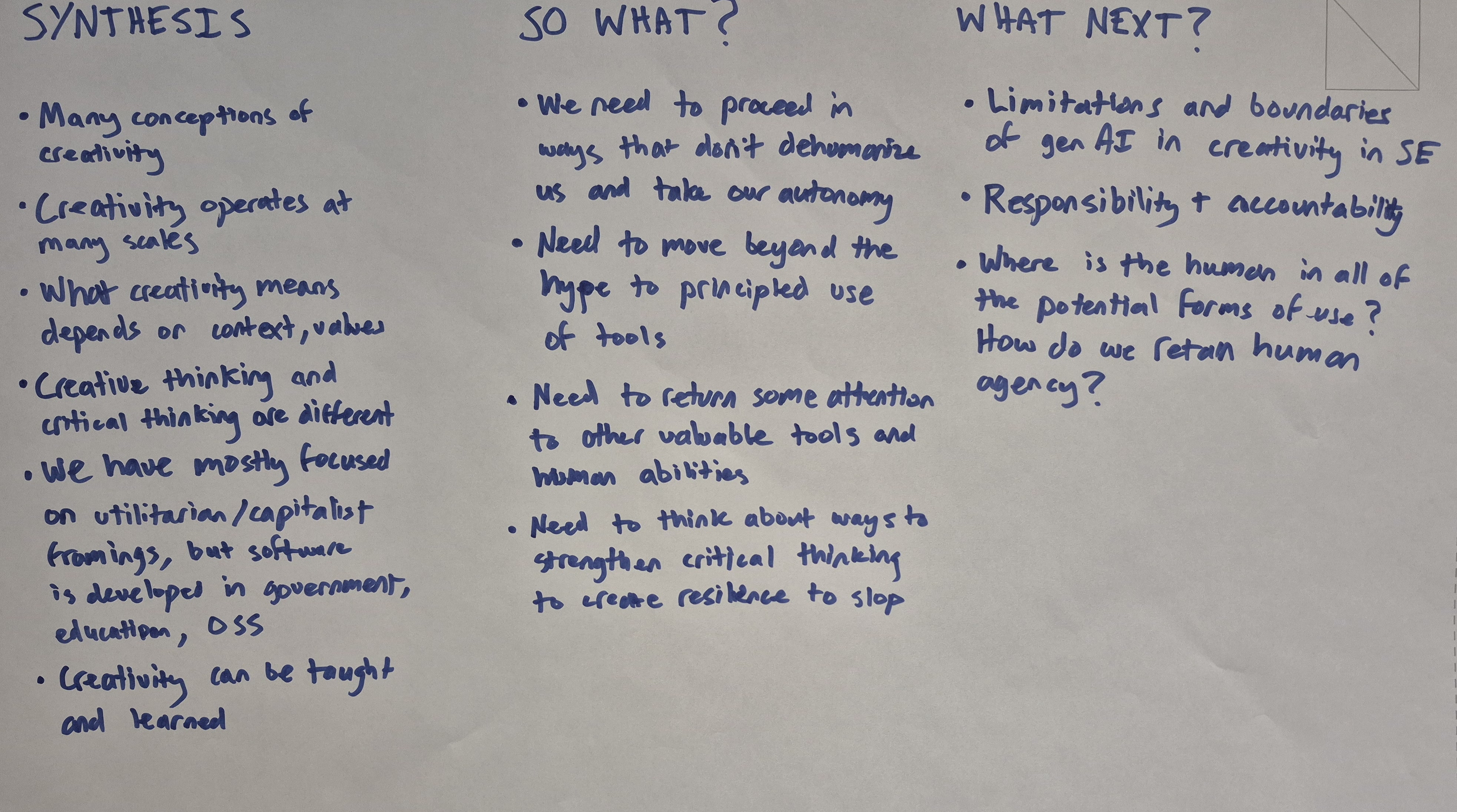
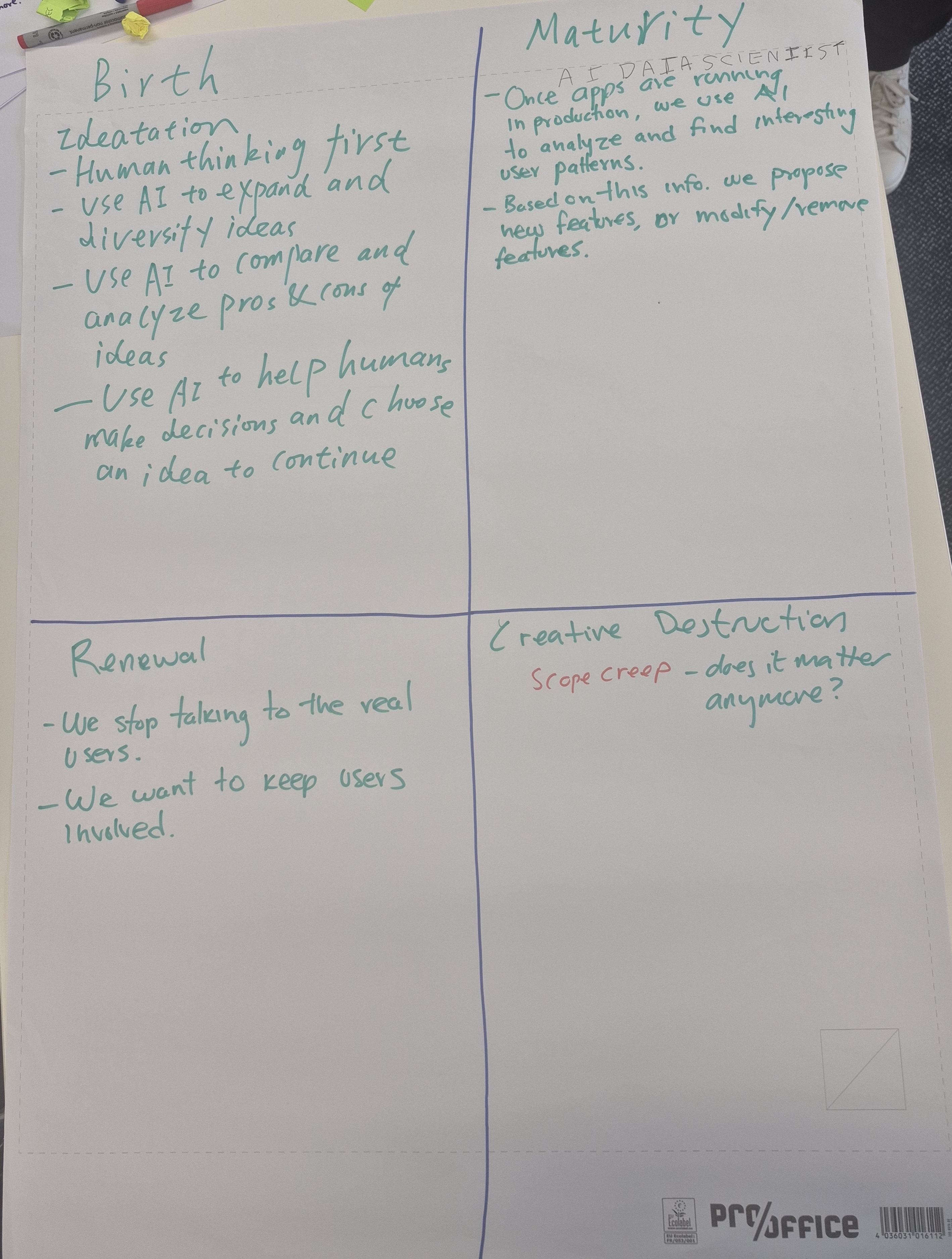
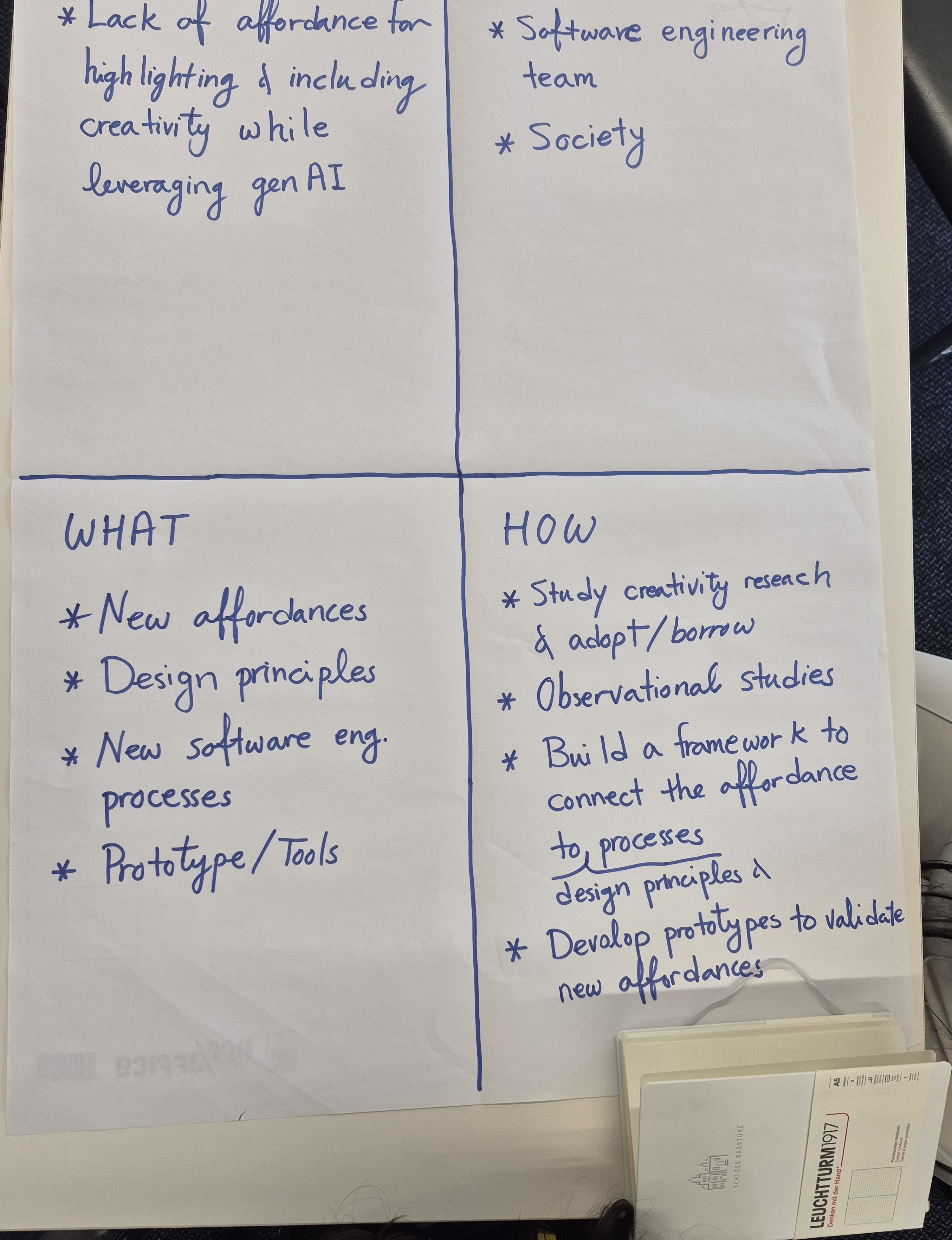
One of the organizers (primarily Daniel Russo) acted as a facilitator to each session. The facilitator introduced the session’s purpose and format, and ensured it stayed within its allotted time. Each session is now described. Accompanying this narrative are images of several artifacts produced during the workshop, as shown in Figure 1.
Importantly, to help grow personal connections and to build positive interactions, each day began with an Impromptu Networking session and ended with a Positive Gossip session. Impromptu Networking asked each participant to pair up and discuss provided questions, such as “What does creativity mean to you?” for several minutes before switching partners to discuss a different question. “Positive Gossip” asked each participant to first reflect on their own upon the day and identify an idea, moment of curiosity, insight, or a personal quality of someone they appreciated. Participants then formed triads to share “positive gossip” about people outside their triad. The whole group then got together to share emerging themes.
5.1 Celebrity Interview
Creativity is multi-faceted and can involve the creative individual, a creative process, a creative product, or an environment that facilitates creativity. To set the scene for creativity and explore these different facets, the first session was held as a celebrity interview. Three celebrities (participants) were asked to sit on stage and discuss what creativity meant to them. To ensure a broad range of perspectives, two of the participants came from industry (Sarah d’Angelo from Google, Olga Lvova from JetBrains) and one from academia (Victoria Jackson, University of Southhampton). The other workshop participants formed five groups and acted as journalists. They listened, took notes, and then each group asked several questions. A lively discussion ensued.
5.2 What, So What, Now What
While the previous session helped to set the scene for what creativity is, this session explored creativity further by asking small groups to answer: “What: Have we surfaced about creativity?”, “So What: Why does it matter right now?” and “Now what: what aspects demands further inquiry?” Each group sat around a table and captured their answers on a poster. Subsequently, the groups came together into a plenary session where each group presented their poster.
5.3 Mad Tea
This session was designed to surface diverse perspectives quickly, using short, provocative prompts in a whole-group circle discussion. Participants formed a circle and took turns responding (briefly) to a set of sentence-starter invitations, including: “Creativity in software engineering means…”, “GenAI helps me think…”, “One concern I have about GenAI in creative work is…”, “Creativity is threatened when…”, and “A tool I wish existed is…”. Contributions were kept concise to maintain momentum and to help the group build shared language around creative practice, risks, and desired tool support.
5.4 TRIZ: How to Destroy Creativity with GenAI
Five groups were formed. Each group was given a poster and asked to create two columns. On the left, they listed all the practices that could be destroyed by AI. They were then asked to circle the ones that they thought would be likely to happen in the next one to two years, and to write mitigation strategies for each circled practice.
5.5 Shift and Share
This session built upon the prior exercise by using the generated posters as input. One person from each table stayed, while the other table members rotated to a different table. The person at the table explained the poster to the newcomers to the table and used sticky notes to capture their feedback. This rotation was repeated three times so that rotating members visited all four tables. This approach enabled people to see perspectives similar to and different from their own. The resulting posters were hung on the room’s walls, ready for the next day, as this activity was the final one for the day.
5.6 Share Your Passion
At the start of Tuesday, this short session allowed participants to raise issues relevant to the workshop topic that had not yet been discussed. Each participant was encouraged to write on a sticky note: (1) any topic they cared dearly about, and/or (2) any piece of knowledge or information they felt was relevant to the topic and should be shared. All these sticky notes were captured on a board and referred to throughout the remainder of the week.
5.7 Short Gallery Walk
All participants walked around the room to review the TRIZ posters from the prior day. They were asked to individually pick one ill-defined solution idea from a poster and either keep it as is or build on it a new solution idea that was dear to them.
5.8 Wise Crowds
With the participants split into five groups, each person took a turn discussing their chosen ill-defined solution idea. The other people in the group asked clarifying questions, shared further ideas, and shared their experiences to help progress the ill-defined solution. The resulting ill-defined solutions and feedback were all captured on a poster.
5.9 STAR – Structure Trust Action Results
The goal of this exercise was to reveal how collaboration structure, trust, and action shape creative amplification in organizations. Working in five groups, each group considered each of the STAR dimensions to identify organizational issues and opportunities for GenAI to amplify creativity or where GenAI may erode creativity, and to identify interventions to help strengthen creativity. These were captured on a poster.
5.10 15% Solutions: Immediate Amplifiers
This exercise encouraged participants to turn insights gained during the workshop into small, actionable steps to nurture creative amplification in their sphere of influence. Each participant was asked to consider the prompt, “What can you do tomorrow to let GenAI amplify creativity in your work? What requires no permission, budget, or policy change?”, and to capture their ideas on a sticky note. Each participant discussed their ideas with another participant to receive and give feedback. The refined ideas were subsequently shared with the wider group by placing them on the “15% wall”.
5.11 Ecocycle Planning
This exercise explored where creativity thrives or stagnates and where GenAI could renew it. To do so, participants reflected on current software development practices and placed them in an ecocycle of birth, maturity, creative destruction, and renewal. Each current practice was briefly described along with its current state and an idea of how GenAI could amplify it. The exercise was first undertaken by a single individual, and then repeated in small groups of five in which the practices were clustered and discussed. Each group then identified two amplification levers to be discussed later.
5.12 Conversation Café
The purpose of this exercise was to encourage reflection on the ethical and human boundaries that sustain meaningful creative amplification. Three rounds of discussion were held in small groups of four to five people. In each round, participants took turns to reflect on the posed question for that round for one minute. The three rounds asked people to consider: (1) Where must human judgment remain central, (2) Where can GenAI genuinely extend creative reach, and (3) What norms of values keep that balance healthy? A fourth round asked for collective synthesis with the shared set of guiding principles for responsible and value-aligned creative amplification captured on a poster.
5.13 User-Experience Fishbowl
This session was an opportunity to ground theory in real-life practices and research. To do so, the industry participants were asked to sit in an inner circle with the academics sitting outside them in an outer circle. The inner circle discussed where GenAI elevated creative quality in their work, when it flattened or distorted creativity instead, and what distinguished the two cases. The people in the outer circle listened to the conversation and, if they had a question or insight, tapped someone in the inner circle on the shoulder to replace them and enter the circle to contribute to the discussion. This created a dynamic of evolving participants and discussion topics.
5.14 1-2-4-All: Generating Research Ideas
Each participant was asked to write one to two bold research questions or project ideas that could meaningfully extend the amplification principles from the prior day. They then shared and discussed these in pairs, and subsequently formed teams of four (by joining another pair) to discuss before placing them on a whiteboard.
All participants then helped to cluster related research questions or project ideas into similar themes.
5.15 Dot Voting
Dot voting was used to prioritize the earlier-identified research ideas. Each participant was given three dots to place on the ideas that resonated most with them. The top five ideas were subsequently refined during the remainder of the workshop to form the basis of the resulting Dagstuhl Manifesto.
5.16 Why, Who, What, How
Each participant chose a research idea to work on and sat with others also interested in that idea. In this activity, which is based upon the research framework proposed by Storey et al.888Margaret-Anne Storey, Neil A. Ernst, Courtney Williams, Eirini Kalliamvakou The who, what, how of software engineering research: a socio-technical framework, Empirical Software Engineering, Volume 25, Issue 5, 4097–4129, 2020, https://doi.org/10.1007/s10664-020-09858-z, the group working on an idea was asked to consider the four points below as they captured their insights on a poster to be hung on the wall and shared more widely for feedback.
-
Why is this research idea important to study (and which phenomena about the selected idea are especially important to study)?
-
Who will benefit from this research (e.g., developers, leaders, researchers, tool designers)?
-
What research contribution will be produced (e.g., descriptive/explanatory/predictive theories, new tools, improved processes)?
-
How can this research best be performed; that is, what are suitable research strategies that align with the research questions and phenomena to be studied?
5.17 Open Space
In an open space, individuals were free to work on any of the five identified research ideas and to contribute to others. This meant forming small clusters of people interested in a research idea to discuss and refine it further. All insights were captured on a poster to be hung in the shared space.
5.18 Outlining the Dagstuhl Manifesto
Offline discussions over the prior days had revealed a consensus that the Manifesto should be titled “Creativity is the new productivity”. This title was deliberately designed to be provocative and to challenge prevailing views that productivity is the be-all and end-all of software development. The workshop participants agreed that the five identified research directions should serve as the basis for the Manifesto and that they would collectively author it. The final working session spanned the entire morning of the last day and enabled the participants to split into the groups responsible for each section to discuss further and to start capturing information pertinent to their selected idea into a shared Google Doc.
5.19 Wrap Up: Commitment Constellation
The final session before the group split up for an early lunch and subsequent departure was to visualize ongoing engagement. Each participant wrote one concrete action they will take related to the workshop content and placed it on the floor, near or far from the center depending on its immediacy. Everyone was able to see the constellation and see each other’s commitments.
6 Manifesto and Next Steps
A key result from the workshop is a Dagstuhl Manifesto detailing future research directions and places these research directions into a larger societal context. The workshop identified five future research directions to form the basis of the Manifesto (to be published in the first half of 2026). This Manifesto will be collectively authored by all of the workshop participants. The Manifesto is important, but equally important are the connections formed during the workshop. These connections led to various participants planning to collaborate on more detailed research ideas that were identified during the week. Indeed, at the time of this writing, some joint papers have already been authored and submitted. Over time, the group plans to stay connected and to continue to discuss and advance research and practice at the intersection of creativity, GenAI, and software development.
The five research directions to be included in the Manifesto are:
-
Critical perspectives: Understanding how to develop a science of critical GenAI use in creative software development where biases are understood, intentional architectures are used, multicultural accounts of creativity are incorporated, sustainability is a design parameter, and organization practices and processes guide developers in appropriate use that limits harm.
-
Characterizing creativity: Understanding what creativity in software engineering looks like for different software development roles and for different aspects of software development, how it plays out in the day-to-day work of software developers as well as at a larger, more organizational scale toward innovation, and how this may differ across individual character traits, team practices, and organizational structures.
-
Evidence of value: Understanding the value that creativity brings to individuals, teams, and organizations in terms of both process and the resulting product, under what conditions it flourishes or may be hampered, and how it can be effectively promoted and practiced.
-
Design space: Developing a design space for GenAI-driven tools and processes that promote creativity in development, together with identifying interaction and other design principles that can guide the design of future novel tools and processes that augment and amplify creativity in software engineering.
-
Synthesize research: How to bring together and package research results and practical knowledge in GenAI, creativity, and software development so to increase the change of widespread impact; this entails effectively synthesizing and communicating emerging results and knowledge in an easily-accessible manner.
7 Acknowledgments
The organizers wish to thank Schloss Dagstuhl, the Leibniz Center for Informatics for hosting and supporting the workshop. Schloss Dagstuhl is a fantastic venue for fostering the lively discussions and collaboration necessary to move research forward. All of the staff was truly awesome in supporting whatever the workshop needed; we are extremely grateful.
8 Participants
-
Aamir Amin – University of Portsmouth, GB
-
Souti Chattopadhyay – USC – Los Angeles, US
-
Sarah D’Angelo – Google – Mountain View, US
-
Peter Dalsgaard – Aarhus University, DK
-
Jeanette Falk – Aalborg University Copenhagen, DK
-
Guo Freeman – Clemson University, US
-
Jonas Frich – Aarhus University, DK
-
Kiev Gama – Federal University of Pernambuco – Recife, BR
-
Cat Hicks – Pluralsight – Draper, US
-
Maliheh Izadi – TU Delft, NL
-
Victoria Jackson – University of Southampton, GB
-
Michael Keeling – Kiavi – San Francisco, US
-
Amy Ko – University of Washington – Seattle, US
-
Raymond Li – ServiceNow – Montreal, CA
-
Olga Lvova – JetBrains – Yerevan, AM
-
Mary Lou Maher – University of North Carolina – Charlotte, US
-
Adriana Meza Soria – MIT-IBM AI Watson Lab – Cambridge, US
-
Gail C. Murphy – University of British Columbia – Vancouver, CA
-
Karim Nakad – Meta Platforms – Bellevue, US
-
Marian Petre – The Open University – Milton Keynes, GB
-
Rafael Prikladnicki – Pontifícia Universidade Católica do Rio Grande do Sul – Porto Alegre, BR
-
Daniel Russo – Aalborg University Copenhagen, DK
-
Zohreh Sharafi – Polytechnique Montréal, CA
-
Mary Shaw – Carnegie Mellon University – Pittsburgh, US
-
Margaret-Anne Storey – University of Victoria, CA
-
André van der Hoek – University of California, Irvine, US
-
Bogdan Vasilescu – Carnegie Mellon University – Pittsburgh, US
![[Uncaptioned image]](x3.jpg)