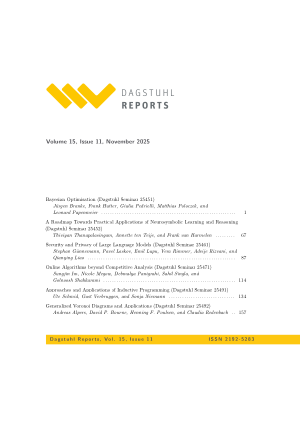
Dagstuhl Reports, Volume 15, Issue 11
-
Part of:
Volume:
Dagstuhl Reports, Volume 15
Journal: Dagstuhl Reports (DagRep)
Event
- Dagstuhl Seminars 25451, 25452, 25461, 25471, 25491, 25492
Publication Details
- published at: 2026-07-28
- Publisher: Schloss Dagstuhl – Leibniz-Zentrum für Informatik
Access Numbers
- Detailed Access Statistics available here
-
Total Accesses (updated on a weekly basis)
0Documents
Documents
Dagstuhl Reports, Volume 15, Issue 11, November 2025, Complete Issue
Abstract
Cite as
Dagstuhl Reports, Volume 15, Issue 11, pp. 1-180, Schloss Dagstuhl – Leibniz-Zentrum für Informatik (2026)
Copy BibTex To Clipboard
@Article{DagRep.15.11,
  title =	{{Dagstuhl Reports, Volume 15, Issue 11, November 2025, Complete Issue}},
  pages =	{1--180},
  journal =	{Dagstuhl Reports},
  ISSN =	{2192-5283},
  year =	{2026},
  volume =	{15},
  number =	{11},
  publisher =	{Schloss Dagstuhl -- Leibniz-Zentrum f{\"u}r Informatik},
  address =	{Dagstuhl, Germany},
  URL =		{https://drops.dagstuhl.de/entities/document/10.4230/DagRep.15.11},
  URN =		{urn:nbn:de:0030-drops-275003},
  doi =		{10.4230/DagRep.15.11},
  annote =	{Keywords: Dagstuhl Reports, Volume 15, Issue 11, November 2025, Complete Issue}
}
Dagstuhl Reports, Table of Contents, Volume 15, Issue 11, 2025
Abstract
Cite as
Dagstuhl Reports, Volume 15, Issue 11, pp. i-ii, Schloss Dagstuhl – Leibniz-Zentrum für Informatik (2026)
Copy BibTex To Clipboard
@Article{DagRep.15.11.i,
  title =	{{Dagstuhl Reports, Table of Contents, Volume 15, Issue 11, 2025}},
  pages =	{i--ii},
  journal =	{Dagstuhl Reports},
  ISSN =	{2192-5283},
  year =	{2026},
  volume =	{15},
  number =	{11},
  publisher =	{Schloss Dagstuhl -- Leibniz-Zentrum f{\"u}r Informatik},
  address =	{Dagstuhl, Germany},
  URL =		{https://drops.dagstuhl.de/entities/document/10.4230/DagRep.15.11.i},
  URN =		{urn:nbn:de:0030-drops-274893},
  doi =		{10.4230/DagRep.15.11.i},
  annote =	{Keywords: Table of Contents, Frontmatter}
}
Bayesian Optimisation (Dagstuhl Seminar 25451)
Abstract
Cite as
Jürgen Branke, Frank Hutter, Giulia Pedrielli, Matthias Poloczek, and Leonard Papenmeier. Bayesian Optimisation (Dagstuhl Seminar 25451). In Dagstuhl Reports, Volume 15, Issue 11, pp. 1-66, Schloss Dagstuhl – Leibniz-Zentrum für Informatik (2026)
Copy BibTex To Clipboard
@Article{branke_et_al:DagRep.15.11.1,
  author =	{Branke, J\"{u}rgen and Hutter, Frank and Pedrielli, Giulia and Poloczek, Matthias and Papenmeier, Leonard},
  title =	{{Bayesian Optimisation (Dagstuhl Seminar 25451)}},
  pages =	{1--66},
  journal =	{Dagstuhl Reports},
  ISSN =	{2192-5283},
  year =	{2026},
  volume =	{15},
  number =	{11},
  editor =	{Branke, J\"{u}rgen and Hutter, Frank and Pedrielli, Giulia and Poloczek, Matthias and Papenmeier, Leonard},
  publisher =	{Schloss Dagstuhl -- Leibniz-Zentrum f{\"u}r Informatik},
  address =	{Dagstuhl, Germany},
  URL =		{https://drops.dagstuhl.de/entities/document/10.4230/DagRep.15.11.1},
  URN =		{urn:nbn:de:0030-drops-274940},
  doi =		{10.4230/DagRep.15.11.1},
  annote =	{Keywords: AutoML, Bayesian optimization, Benchmarking, Gaussian processes}
}
A Roadmap Towards Practical Applications of Neurosymbolic Learning and Reasoning (Dagstuhl Seminar 25452)
Abstract
Cite as
Thiviyan Thanapalasingam, Annette ten Teije, and Frank van Harmelen. A Roadmap Towards Practical Applications of Neurosymbolic Learning and Reasoning (Dagstuhl Seminar 25452). In Dagstuhl Reports, Volume 15, Issue 11, pp. 67-86, Schloss Dagstuhl – Leibniz-Zentrum für Informatik (2026)
Copy BibTex To Clipboard
@Article{thanapalasingam_et_al:DagRep.15.11.67,
  author =	{Thanapalasingam, Thiviyan and Teije, Annette ten and van Harmelen, Frank},
  title =	{{A Roadmap Towards Practical Applications of Neurosymbolic Learning and Reasoning (Dagstuhl Seminar 25452)}},
  pages =	{67--86},
  journal =	{Dagstuhl Reports},
  ISSN =	{2192-5283},
  year =	{2026},
  volume =	{15},
  number =	{11},
  editor =	{Thanapalasingam, Thiviyan and Teije, Annette ten and van Harmelen, Frank},
  publisher =	{Schloss Dagstuhl -- Leibniz-Zentrum f{\"u}r Informatik},
  address =	{Dagstuhl, Germany},
  URL =		{https://drops.dagstuhl.de/entities/document/10.4230/DagRep.15.11.67},
  URN =		{urn:nbn:de:0030-drops-274934},
  doi =		{10.4230/DagRep.15.11.67},
  annote =	{Keywords: Neurosymbolic Artificial Intelligence, Machine Learning, Logic, Knowledge Representation \& Reasoning, Sub-symbolic \& Symbolic Integration}
}
Security and Privacy of Large Language Models (Dagstuhl Seminar 25461)
Abstract
Cite as
Stephan Günnemann, Pavel Laskov, Emil Lupu, Vera Rimmer, Advije Rizvani, and Qianying Liao. Security and Privacy of Large Language Models (Dagstuhl Seminar 25461). In Dagstuhl Reports, Volume 15, Issue 11, pp. 87-113, Schloss Dagstuhl – Leibniz-Zentrum für Informatik (2026)
Copy BibTex To Clipboard
@Article{gunnemann_et_al:DagRep.15.11.87,
  author =	{G\"{u}nnemann, Stephan and Laskov, Pavel and Lupu, Emil and Rimmer, Vera and Rizvani, Advije and Liao, Qianying},
  title =	{{Security and Privacy of Large Language Models (Dagstuhl Seminar 25461)}},
  pages =	{87--113},
  journal =	{Dagstuhl Reports},
  ISSN =	{2192-5283},
  year =	{2026},
  volume =	{15},
  number =	{11},
  editor =	{G\"{u}nnemann, Stephan and Laskov, Pavel and Lupu, Emil and Rimmer, Vera and Rizvani, Advije and Liao, Qianying},
  publisher =	{Schloss Dagstuhl -- Leibniz-Zentrum f{\"u}r Informatik},
  address =	{Dagstuhl, Germany},
  URL =		{https://drops.dagstuhl.de/entities/document/10.4230/DagRep.15.11.87},
  URN =		{urn:nbn:de:0030-drops-274951},
  doi =		{10.4230/DagRep.15.11.87},
  annote =	{Keywords: Large Language Models, Artifician Intelligence, Security and Privacy}
}
Online Algorithms beyond Competitive Analysis (Dagstuhl Seminar 25471)
Abstract
Cite as
Sungjin Im, Nicole Megow, Debmalya Panigrahi, Sahil Singla, and Golnoosh Shahkarami. Online Algorithms beyond Competitive Analysis (Dagstuhl Seminar 25471). In Dagstuhl Reports, Volume 15, Issue 11, pp. 114-133, Schloss Dagstuhl – Leibniz-Zentrum für Informatik (2026)
Copy BibTex To Clipboard
@Article{im_et_al:DagRep.15.11.114,
  author =	{Im, Sungjin and Megow, Nicole and Panigrahi, Debmalya and Singla, Sahil and Shahkarami, Golnoosh},
  title =	{{Online Algorithms beyond Competitive Analysis (Dagstuhl Seminar 25471)}},
  pages =	{114--133},
  journal =	{Dagstuhl Reports},
  ISSN =	{2192-5283},
  year =	{2026},
  volume =	{15},
  number =	{11},
  editor =	{Im, Sungjin and Megow, Nicole and Panigrahi, Debmalya and Singla, Sahil and Shahkarami, Golnoosh},
  publisher =	{Schloss Dagstuhl -- Leibniz-Zentrum f{\"u}r Informatik},
  address =	{Dagstuhl, Germany},
  URL =		{https://drops.dagstuhl.de/entities/document/10.4230/DagRep.15.11.114},
  URN =		{urn:nbn:de:0030-drops-274926},
  doi =		{10.4230/DagRep.15.11.114},
  annote =	{Keywords: algorithms under uncertainty, beyond worst-case algorithm design, online algorithms}
}
Approaches and Applications of Inductive Programming (Dagstuhl Seminar 25491)
Abstract
Cite as
Ute Schmid, Gust Verbruggen, and Sonja Niemann. Approaches and Applications of Inductive Programming (Dagstuhl Seminar 25491). In Dagstuhl Reports, Volume 15, Issue 11, pp. 134-156, Schloss Dagstuhl – Leibniz-Zentrum für Informatik (2026)
Copy BibTex To Clipboard
@Article{schmid_et_al:DagRep.15.11.134,
  author =	{Schmid, Ute and Verbruggen, Gust and Niemann, Sonja},
  title =	{{Approaches and Applications of Inductive Programming (Dagstuhl Seminar 25491)}},
  pages =	{134--156},
  journal =	{Dagstuhl Reports},
  ISSN =	{2192-5283},
  year =	{2026},
  volume =	{15},
  number =	{11},
  editor =	{Schmid, Ute and Verbruggen, Gust and Niemann, Sonja},
  publisher =	{Schloss Dagstuhl -- Leibniz-Zentrum f{\"u}r Informatik},
  address =	{Dagstuhl, Germany},
  URL =		{https://drops.dagstuhl.de/entities/document/10.4230/DagRep.15.11.134},
  URN =		{urn:nbn:de:0030-drops-274912},
  doi =		{10.4230/DagRep.15.11.134},
  annote =	{Keywords: Diffusion Models, Inductive Programming, LLMs, Program Synthesis, Programming by Examples}
}
Generalized Voronoi Diagrams and Applications (Dagstuhl Seminar 25492)
Abstract
Cite as
Andreas Alpers, David P. Bourne, Henning F. Poulsen, and Claudia Redenbach. Generalized Voronoi Diagrams and Applications (Dagstuhl Seminar 25492). In Dagstuhl Reports, Volume 15, Issue 11, pp. 157-178, Schloss Dagstuhl – Leibniz-Zentrum für Informatik (2026)
Copy BibTex To Clipboard
@Article{alpers_et_al:DagRep.15.11.157,
  author =	{Alpers, Andreas and Bourne, David P. and Poulsen, Henning F. and Redenbach, Claudia},
  title =	{{Generalized Voronoi Diagrams and Applications (Dagstuhl Seminar 25492)}},
  pages =	{157--178},
  journal =	{Dagstuhl Reports},
  ISSN =	{2192-5283},
  year =	{2026},
  volume =	{15},
  number =	{11},
  editor =	{Alpers, Andreas and Bourne, David P. and Poulsen, Henning F. and Redenbach, Claudia},
  publisher =	{Schloss Dagstuhl -- Leibniz-Zentrum f{\"u}r Informatik},
  address =	{Dagstuhl, Germany},
  URL =		{https://drops.dagstuhl.de/entities/document/10.4230/DagRep.15.11.157},
  URN =		{urn:nbn:de:0030-drops-274908},
  doi =		{10.4230/DagRep.15.11.157},
  annote =	{Keywords: Laguerre tessellation, generalized balanced power diagram, anisotropic Voronoi diagram, cellular materials, grains, polycrystals}
}