Dagstuhl Reports, Volume 15, Issue 9
-
Part of:
Volume:
Dagstuhl Reports, Volume 15
Journal: Dagstuhl Reports (DagRep)
Event
- Dagstuhl Seminars 25371, 25372, 25381, 25382, 25391, 25392, 25401
Publication Details
- published at: 2026-05-08
- Publisher: Schloss Dagstuhl – Leibniz-Zentrum für Informatik
Access Numbers
- Detailed Access Statistics available here
-
Total Accesses (updated on a weekly basis)
0Documents
Documents
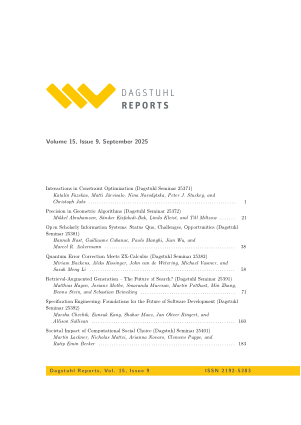
Dagstuhl Reports, Volume 15, Issue 9, September 2025, Complete Issue
Abstract
Cite as
Dagstuhl Reports, Volume 15, Issue 9, pp. 1-202, Schloss Dagstuhl – Leibniz-Zentrum für Informatik (2026)
Copy BibTex To Clipboard
@Article{DagRep.15.9,
  title =	{{Dagstuhl Reports, Volume 15, Issue 9, September 2025, Complete Issue}},
  pages =	{1--202},
  journal =	{Dagstuhl Reports},
  ISSN =	{2192-5283},
  year =	{2026},
  volume =	{15},
  number =	{9},
  publisher =	{Schloss Dagstuhl -- Leibniz-Zentrum f{\"u}r Informatik},
  address =	{Dagstuhl, Germany},
  URL =		{https://drops.dagstuhl.de/entities/document/10.4230/DagRep.15.9},
  URN =		{urn:nbn:de:0030-drops-259155},
  doi =		{10.4230/DagRep.15.9},
  annote =	{Keywords: Dagstuhl Reports, Volume 15, Issue 9, September 2025, Complete Issue}
}
Dagstuhl Reports, Table of Contents, Volume 15, Issue 9, 2025
Abstract
Cite as
Dagstuhl Reports, Volume 15, Issue 9, pp. i-ii, Schloss Dagstuhl – Leibniz-Zentrum für Informatik (2026)
Copy BibTex To Clipboard
@Article{DagRep.15.9.i,
  title =	{{Dagstuhl Reports, Table of Contents, Volume 15, Issue 9, 2025}},
  pages =	{i--ii},
  journal =	{Dagstuhl Reports},
  ISSN =	{2192-5283},
  year =	{2026},
  volume =	{15},
  number =	{9},
  publisher =	{Schloss Dagstuhl -- Leibniz-Zentrum f{\"u}r Informatik},
  address =	{Dagstuhl, Germany},
  URL =		{https://drops.dagstuhl.de/entities/document/10.4230/DagRep.15.9.i},
  URN =		{urn:nbn:de:0030-drops-249743},
  doi =		{10.4230/DagRep.15.9.i},
  annote =	{Keywords: Table of Contents, Frontmatter}
}
Interactions in Constraint Optimization (Dagstuhl Seminar 25371)
Abstract
Cite as
Katalin Fazekas, Matti Järvisalo, Nina Narodytska, Peter J. Stuckey, and Christoph Jabs. Interactions in Constraint Optimization (Dagstuhl Seminar 25371). In Dagstuhl Reports, Volume 15, Issue 9, pp. 1-20, Schloss Dagstuhl – Leibniz-Zentrum für Informatik (2026)
Copy BibTex To Clipboard
@Article{fazekas_et_al:DagRep.15.9.1,
  author =	{Fazekas, Katalin and J\"{a}rvisalo, Matti and Narodytska, Nina and Stuckey, Peter J. and Jabs, Christoph},
  title =	{{Interactions in Constraint Optimization (Dagstuhl Seminar 25371)}},
  pages =	{1--20},
  journal =	{Dagstuhl Reports},
  ISSN =	{2192-5283},
  year =	{2026},
  volume =	{15},
  number =	{9},
  editor =	{Fazekas, Katalin and J\"{a}rvisalo, Matti and Narodytska, Nina and Stuckey, Peter J. and Jabs, Christoph},
  publisher =	{Schloss Dagstuhl -- Leibniz-Zentrum f{\"u}r Informatik},
  address =	{Dagstuhl, Germany},
  URL =		{https://drops.dagstuhl.de/entities/document/10.4230/DagRep.15.9.1},
  URN =		{urn:nbn:de:0030-drops-249811},
  doi =		{10.4230/DagRep.15.9.1},
  annote =	{Keywords: constraint programming, maximum satisfiability, mixed integer linear programming, optimization modulo theories, pseudo-boolean optimization}
}
Precision in Geometric Algorithms (Dagstuhl Seminar 25372)
Abstract
Cite as
Mikkel Abrahamsen, Sándor Kisfaludi-Bak, Linda Kleist, and Till Miltzow. Precision in Geometric Algorithms (Dagstuhl Seminar 25372). In Dagstuhl Reports, Volume 15, Issue 9, pp. 21-37, Schloss Dagstuhl – Leibniz-Zentrum für Informatik (2026)
Copy BibTex To Clipboard
@Article{abrahamsen_et_al:DagRep.15.9.21,
  author =	{Abrahamsen, Mikkel and Kisfaludi-Bak, S\'{a}ndor and Kleist, Linda and Miltzow, Till},
  title =	{{Precision in Geometric Algorithms (Dagstuhl Seminar 25372)}},
  pages =	{21--37},
  journal =	{Dagstuhl Reports},
  ISSN =	{2192-5283},
  year =	{2026},
  volume =	{15},
  number =	{9},
  editor =	{Abrahamsen, Mikkel and Kisfaludi-Bak, S\'{a}ndor and Kleist, Linda and Miltzow, Till},
  publisher =	{Schloss Dagstuhl -- Leibniz-Zentrum f{\"u}r Informatik},
  address =	{Dagstuhl, Germany},
  URL =		{https://drops.dagstuhl.de/entities/document/10.4230/DagRep.15.9.21},
  URN =		{urn:nbn:de:0030-drops-249807},
  doi =		{10.4230/DagRep.15.9.21},
  annote =	{Keywords: Computational Geometry, Real Complexity Theory}
}
Open Scholarly Information Systems: Status Quo, Challenges, Opportunities (Dagstuhl Seminar 25381)
Abstract
Cite as
Hannah Bast, Guillaume Cabanac, Paolo Manghi, Jian Wu, and Marcel R. Ackermann. Open Scholarly Information Systems: Status Quo, Challenges, Opportunities (Dagstuhl Seminar 25381). In Dagstuhl Reports, Volume 15, Issue 9, pp. 38-57, Schloss Dagstuhl – Leibniz-Zentrum für Informatik (2026)
Copy BibTex To Clipboard
@Article{bast_et_al:DagRep.15.9.38,
  author =	{Bast, Hannah and Cabanac, Guillaume and Manghi, Paolo and Wu, Jian and Ackermann, Marcel R.},
  title =	{{Open Scholarly Information Systems: Status Quo, Challenges, Opportunities (Dagstuhl Seminar 25381)}},
  pages =	{38--57},
  journal =	{Dagstuhl Reports},
  ISSN =	{2192-5283},
  year =	{2026},
  volume =	{15},
  number =	{9},
  editor =	{Bast, Hannah and Cabanac, Guillaume and Manghi, Paolo and Wu, Jian and Ackermann, Marcel R.},
  publisher =	{Schloss Dagstuhl -- Leibniz-Zentrum f{\"u}r Informatik},
  address =	{Dagstuhl, Germany},
  URL =		{https://drops.dagstuhl.de/entities/document/10.4230/DagRep.15.9.38},
  URN =		{urn:nbn:de:0030-drops-249797},
  doi =		{10.4230/DagRep.15.9.38},
  annote =	{Keywords: artificial intelligence, knowledge graphs, open infrastructures, scholarly big data, scholarly information systems, semantic search}
}
Quantum Error Correction Meets ZX-Calculus (Dagstuhl Seminar 25382)
Abstract
Cite as
Miriam Backens, Aleks Kissinger, John van de Wetering, Michael Vasmer, and Sarah Meng Li. Quantum Error Correction Meets ZX-Calculus (Dagstuhl Seminar 25382). In Dagstuhl Reports, Volume 15, Issue 9, pp. 58-70, Schloss Dagstuhl – Leibniz-Zentrum für Informatik (2026)
Copy BibTex To Clipboard
@Article{backens_et_al:DagRep.15.9.58,
  author =	{Backens, Miriam and Kissinger, Aleks and van de Wetering, John and Vasmer, Michael and Li, Sarah Meng},
  title =	{{Quantum Error Correction Meets ZX-Calculus (Dagstuhl Seminar 25382)}},
  pages =	{58--70},
  journal =	{Dagstuhl Reports},
  ISSN =	{2192-5283},
  year =	{2026},
  volume =	{15},
  number =	{9},
  editor =	{Backens, Miriam and Kissinger, Aleks and van de Wetering, John and Vasmer, Michael and Li, Sarah Meng},
  publisher =	{Schloss Dagstuhl -- Leibniz-Zentrum f{\"u}r Informatik},
  address =	{Dagstuhl, Germany},
  URL =		{https://drops.dagstuhl.de/entities/document/10.4230/DagRep.15.9.58},
  URN =		{urn:nbn:de:0030-drops-249787},
  doi =		{10.4230/DagRep.15.9.58},
  annote =	{Keywords: fault-tolerance, quantum error correction, ZX-calculus}
}
Retrieval-Augmented Generation - The Future of Search? (Dagstuhl Seminar 25391)
Abstract
Cite as
Matthias Hagen, Josiane Mothe, Smaranda Muresan, Martin Potthast, Min Zhang, Benno Stein, and Sebastian Heineking. Retrieval-Augmented Generation - The Future of Search? (Dagstuhl Seminar 25391). In Dagstuhl Reports, Volume 15, Issue 9, pp. 71-159, Schloss Dagstuhl – Leibniz-Zentrum für Informatik (2026)
Copy BibTex To Clipboard
@Article{hagen_et_al:DagRep.15.9.71,
  author =	{Hagen, Matthias and Mothe, Josiane and Muresan, Smaranda and Potthast, Martin and Zhang, Min and Stein, Benno and Heineking, Sebastian},
  title =	{{Retrieval-Augmented Generation - The Future of Search? (Dagstuhl Seminar 25391)}},
  pages =	{71--159},
  journal =	{Dagstuhl Reports},
  ISSN =	{2192-5283},
  year =	{2026},
  volume =	{15},
  number =	{9},
  editor =	{Hagen, Matthias and Mothe, Josiane and Muresan, Smaranda and Potthast, Martin and Zhang, Min and Stein, Benno and Heineking, Sebastian},
  publisher =	{Schloss Dagstuhl -- Leibniz-Zentrum f{\"u}r Informatik},
  address =	{Dagstuhl, Germany},
  URL =		{https://drops.dagstuhl.de/entities/document/10.4230/DagRep.15.9.71},
  URN =		{urn:nbn:de:0030-drops-249771},
  doi =		{10.4230/DagRep.15.9.71},
  annote =	{Keywords: Retrieval-Augmented Generation, Information Retrieval, Dagstuhl Seminar}
}
Specification Engineering: Foundations for the Future of Software Development (Dagstuhl Seminar 25392)
Abstract
Cite as
Marsha Chechik, Eunsuk Kang, Shahar Maoz, Jan Oliver Ringert, and Allison Sullivan. Specification Engineering: Foundations for the Future of Software Development (Dagstuhl Seminar 25392). In Dagstuhl Reports, Volume 15, Issue 9, pp. 160-182, Schloss Dagstuhl – Leibniz-Zentrum für Informatik (2026)
Copy BibTex To Clipboard
@Article{chechik_et_al:DagRep.15.9.160,
  author =	{Chechik, Marsha and Kang, Eunsuk and Maoz, Shahar and Ringert, Jan Oliver and Sullivan, Allison},
  title =	{{Specification Engineering: Foundations for the Future of Software Development (Dagstuhl Seminar 25392)}},
  pages =	{160--182},
  journal =	{Dagstuhl Reports},
  ISSN =	{2192-5283},
  year =	{2026},
  volume =	{15},
  number =	{9},
  editor =	{Chechik, Marsha and Kang, Eunsuk and Maoz, Shahar and Ringert, Jan Oliver and Sullivan, Allison},
  publisher =	{Schloss Dagstuhl -- Leibniz-Zentrum f{\"u}r Informatik},
  address =	{Dagstuhl, Germany},
  URL =		{https://drops.dagstuhl.de/entities/document/10.4230/DagRep.15.9.160},
  URN =		{urn:nbn:de:0030-drops-249761},
  doi =		{10.4230/DagRep.15.9.160},
  annote =	{Keywords: formal methods, software assurance, software specification, specification engineering}
}
Societal Impact of Computational Social Choice (Dagstuhl Seminar 25401)
Abstract
Cite as
Martin Lackner, Nicholas Mattei, Arianna Novaro, Clemens Puppe, and Ratip Emin Berker. Societal Impact of Computational Social Choice (Dagstuhl Seminar 25401). In Dagstuhl Reports, Volume 15, Issue 9, pp. 183-200, Schloss Dagstuhl – Leibniz-Zentrum für Informatik (2026)
Copy BibTex To Clipboard
@Article{lackner_et_al:DagRep.15.9.183,
  author =	{Lackner, Martin and Mattei, Nicholas and Novaro, Arianna and Puppe, Clemens and Berker, Ratip Emin},
  title =	{{Societal Impact of Computational Social Choice (Dagstuhl Seminar 25401)}},
  pages =	{183--200},
  journal =	{Dagstuhl Reports},
  ISSN =	{2192-5283},
  year =	{2026},
  volume =	{15},
  number =	{9},
  editor =	{Lackner, Martin and Mattei, Nicholas and Novaro, Arianna and Puppe, Clemens and Berker, Ratip Emin},
  publisher =	{Schloss Dagstuhl -- Leibniz-Zentrum f{\"u}r Informatik},
  address =	{Dagstuhl, Germany},
  URL =		{https://drops.dagstuhl.de/entities/document/10.4230/DagRep.15.9.183},
  URN =		{urn:nbn:de:0030-drops-249753},
  doi =		{10.4230/DagRep.15.9.183},
  annote =	{Keywords: computational social choice, data, participation, time}
}