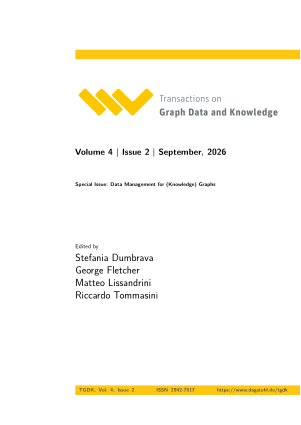
Transactions on Graph Data and Knowledge, Volume 4, Issue 2

TGDK, Volume 4, Issue 2


Thumbnail PDF

Special Issue

Special Issue on Data Management for (Knowledge) Graphs

Editors

Stefania Dumbrava
  • ENSIIE, SAMOVAR, Télécom SudParis, France
  • IRIF, INRIA Paris, France
George Fletcher
  • Eindhoven University of Technology, Netherlands
Matteo Lissandrini
  • University of Verona, Italy
Riccardo Tommasini
  • INSA Lyon, France CNRS LIRIS, Lyon, France

Publication Details

  • published at: 2026-09-03
  • Publisher: Schloss Dagstuhl – Leibniz-Zentrum für Informatik

Access Numbers

Documents

No documents found matching your filter selection.
Document
Complete Issue
TGDK, Volume 4, Issue 2, Complete Issue

Abstract
TGDK, Volume 4, Issue 2, Complete Issue

Cite as

Transactions on Graph Data and Knowledge (TGDK), Volume 4, Issue 2: Special Issue on Data Management for (Knowledge) Graphs, pp. 1-276, Schloss Dagstuhl – Leibniz-Zentrum für Informatik (2026)


Copy BibTex To Clipboard

@Article{TGDK.4.2,
  title =	{{TGDK, Volume 4, Issue 2, Complete Issue}},
  journal =	{Transactions on Graph Data and Knowledge},
  pages =	{1--276},
  ISSN =	{2942-7517},
  year =	{2026},
  volume =	{4},
  number =	{2},
  publisher =	{Schloss Dagstuhl -- Leibniz-Zentrum f{\"u}r Informatik},
  address =	{Dagstuhl, Germany},
  URL =		{https://drops.dagstuhl.de/entities/document/10.4230/TGDK.4.2},
  URN =		{urn:nbn:de:0030-drops-277159},
  doi =		{10.4230/TGDK.4.2},
  annote =	{Keywords: TGDK, Volume 4, Issue 2, Complete Issue}
}
Document
Front Matter
Front Matter, Table of Contents, List of Authors

Abstract
Front Matter, Table of Contents, List of Authors

Cite as

Transactions on Graph Data and Knowledge (TGDK), Volume 4, Issue 2: Special Issue on Data Management for (Knowledge) Graphs, pp. 0:i-0:viii, Schloss Dagstuhl – Leibniz-Zentrum für Informatik (2026)


Copy BibTex To Clipboard

@Article{TGDK.4.2.0,
  title =	{{Front Matter, Table of Contents, List of Authors}},
  journal =	{Transactions on Graph Data and Knowledge},
  pages =	{0:i--0:viii},
  ISSN =	{2942-7517},
  year =	{2026},
  volume =	{4},
  number =	{2},
  publisher =	{Schloss Dagstuhl -- Leibniz-Zentrum f{\"u}r Informatik},
  address =	{Dagstuhl, Germany},
  URL =		{https://drops.dagstuhl.de/entities/document/10.4230/TGDK.4.2.0},
  URN =		{urn:nbn:de:0030-drops-277148},
  doi =		{10.4230/TGDK.4.2.0},
  annote =	{Keywords: Front Matter, Table of Contents, List of Authors}
}
Document
Preface
Data Management for (Knowledge) Graphs

Authors: Stefania Dumbrava, George Fletcher, Matteo Lissandrini, and Riccardo Tommasini


Abstract
In this Special Issue of Transactions on Graph Data and Knowledge, entitled "Data Management for (Knowledge) Graphs", we present eight articles: one position paper, four research papers, and three resource papers. These span graph data querying, transformation, integration, evolution, and evaluation. Their applications include legislative knowledge management, geospatial data access, and knowledge graph construction from heterogeneous sources with large language models.

Cite as

Stefania Dumbrava, George Fletcher, Matteo Lissandrini, and Riccardo Tommasini. Data Management for (Knowledge) Graphs. In Special Issue on Data Management for (Knowledge) Graphs. Transactions on Graph Data and Knowledge (TGDK), Volume 4, Issue 2, pp. 1:1-1:2, Schloss Dagstuhl – Leibniz-Zentrum für Informatik (2026)


Copy BibTex To Clipboard

@Article{dumbrava_et_al:TGDK.4.2.1,
  author =	{Dumbrava, Stefania and Fletcher, George and Lissandrini, Matteo and Tommasini, Riccardo},
  title =	{{Data Management for (Knowledge) Graphs}},
  journal =	{Transactions on Graph Data and Knowledge},
  pages =	{1:1--1:2},
  ISSN =	{2942-7517},
  year =	{2026},
  volume =	{4},
  number =	{2},
  publisher =	{Schloss Dagstuhl -- Leibniz-Zentrum f{\"u}r Informatik},
  address =	{Dagstuhl, Germany},
  URL =		{https://drops.dagstuhl.de/entities/document/10.4230/TGDK.4.2.1},
  URN =		{urn:nbn:de:0030-drops-275828},
  doi =		{10.4230/TGDK.4.2.1},
  annote =	{Keywords: graph data, property graphs, knowledge graphs, RDF, data management}
}
Document
Position
How Human-Centric Are Our Graph Data Abstractions?

Authors: Angela Bonifati, Anastasia Dimou, Stefania Dumbrava, George Fletcher, Katja Hose, George Konstantinidis, Jose Emilio Labra Gayo, Wim Martens, Nina Pardal, Liat Peterfreund, Katherine Thornton, Maria-Esther Vidal, and Hannes Voigt


Abstract
Graph data abstractions are often assumed to be intuitive, but experience shows that they are not equally understandable or usable in practice. In this vision and challenges paper, we examine the human-centricity of contemporary graph data abstractions through four lenses: researchability, usability, teachability, and societal impact. Drawing on diverse real-world use cases, ranging from clinical data and collaborative knowledge bases to biological and pangenomic graphs, we distill insights from database research, human-computer interaction, and education. Based on this analysis, we identify open research challenges that must be addressed to make graph abstractions easier to study, use, learn, and reason about.

Cite as

Angela Bonifati, Anastasia Dimou, Stefania Dumbrava, George Fletcher, Katja Hose, George Konstantinidis, Jose Emilio Labra Gayo, Wim Martens, Nina Pardal, Liat Peterfreund, Katherine Thornton, Maria-Esther Vidal, and Hannes Voigt. How Human-Centric Are Our Graph Data Abstractions?. In Special Issue on Data Management for (Knowledge) Graphs. Transactions on Graph Data and Knowledge (TGDK), Volume 4, Issue 2, pp. 2:1-2:31, Schloss Dagstuhl – Leibniz-Zentrum für Informatik (2026)


Copy BibTex To Clipboard

@Article{bonifati_et_al:TGDK.4.2.2,
  author =	{Bonifati, Angela and Dimou, Anastasia and Dumbrava, Stefania and Fletcher, George and Hose, Katja and Konstantinidis, George and Gayo, Jose Emilio Labra and Martens, Wim and Pardal, Nina and Peterfreund, Liat and Thornton, Katherine and Vidal, Maria-Esther and Voigt, Hannes},
  title =	{{How Human-Centric Are Our Graph Data Abstractions?}},
  journal =	{Transactions on Graph Data and Knowledge},
  pages =	{2:1--2:31},
  ISSN =	{2942-7517},
  year =	{2026},
  volume =	{4},
  number =	{2},
  publisher =	{Schloss Dagstuhl -- Leibniz-Zentrum f{\"u}r Informatik},
  address =	{Dagstuhl, Germany},
  URL =		{https://drops.dagstuhl.de/entities/document/10.4230/TGDK.4.2.2},
  URN =		{urn:nbn:de:0030-drops-275837},
  doi =		{10.4230/TGDK.4.2.2},
  annote =	{Keywords: graph data abstractions, property graphs, RDF, human-centric data management, usability, computing education}
}
Document
Research
Transforming Shape Schemas with Composable Property-Graph Queries

Authors: Philipp Seifer, Daniel Hernández, Ralf Lämmel, and Steffen Staab


Abstract
Property graphs may be constrained by schemas that inform both query engines and human users about the shape of valid data, enforcing a contract between data provider and consumer. Composable property-graph queries transform input graphs into output graphs. Then, the question arises of which schema can be expected after one (or several) transformation steps. We investigate how schema constraints can be inferred given an input schema and a transforming query. Specifically, we propose a reasoning procedure that, given an input schema in ProGS and a query in G-CORE infers an output schema. Since graph updates will happen frequently, our inference procedure does not rely on graph instances, such that the computed output schema applies to all graphs originating from any input graph complying with the input schema. Related work has addressed this problem for SPARQL CONSTRUCT queries, encoding it in Description Logics (DLs) so that the output schema is entailed by axioms inferred from input schema and queries. Property graphs and their queries, however, complicate the matter, as property graphs feature label and property annotations as well as first-class edges. Thus, reification has to be used in one way or another, though available DLs lack the means to encode such features directly. We approach this novel challenge via a family of mappings for i) property graphs reified in RDF, aligned with ii) a mapping from ProGS to SHACL and iii) a mapping from G-CORE to SPARQL CONSTRUCT queries. In this manner, schema inference for property graphs becomes manageable, as we break apart the problem through the extra mapping layer and utilize efficient DL reasoners. We develop the metatheory regarding the soundness of inferred schema constraints and the semantic equivalence of mapped schemas and queries.

Cite as

Philipp Seifer, Daniel Hernández, Ralf Lämmel, and Steffen Staab. Transforming Shape Schemas with Composable Property-Graph Queries. In Special Issue on Data Management for (Knowledge) Graphs. Transactions on Graph Data and Knowledge (TGDK), Volume 4, Issue 2, pp. 3:1-3:29, Schloss Dagstuhl – Leibniz-Zentrum für Informatik (2026)


Copy BibTex To Clipboard

@Article{seifer_et_al:TGDK.4.2.3,
  author =	{Seifer, Philipp and Hern\'{a}ndez, Daniel and L\"{a}mmel, Ralf and Staab, Steffen},
  title =	{{Transforming Shape Schemas with Composable Property-Graph Queries}},
  journal =	{Transactions on Graph Data and Knowledge},
  pages =	{3:1--3:29},
  ISSN =	{2942-7517},
  year =	{2026},
  volume =	{4},
  number =	{2},
  publisher =	{Schloss Dagstuhl -- Leibniz-Zentrum f{\"u}r Informatik},
  address =	{Dagstuhl, Germany},
  URL =		{https://drops.dagstuhl.de/entities/document/10.4230/TGDK.4.2.3},
  URN =		{urn:nbn:de:0030-drops-275843},
  doi =		{10.4230/TGDK.4.2.3},
  annote =	{Keywords: Property Graphs, Validation, Schema Inference, Reification, G-CORE, SPARQL}
}
Document
Research
Multi-Layered Legislative Knowledge Management with Property Graphs

Authors: Andrea Colombo, Francesco Cambria, and Francesco Invernici


Abstract
The sparse nature and intricate set of relationships between legislative acts pose a significant challenge in the choice of the underlying database model, which both allows for performing structured queries and developing intuitive and smooth knowledge management. In this paper, we propose to use Property Graphs as a powerful alternative for managing legislative knowledge. First, we discuss how graph queries are a valid alternative solution to standard legislative knowledge management by showing how our data model fully captures the problem of law versioning (i.e., the existence of many versions for the same law). Then, we analyze, propose and implement innovative ways for monitoring the legislative system using Property Graph tools that have been recently standardized and developed, such as triggers and graph-based association rules, which empower our model of advanced ways of handling legislative data. For instance, we will show how we can use these tools to develop intelligent warning systems that inform stakeholders of critical changes in legislation through active rule reasoning or to detect shifts in graph patterns via continuous monitoring of significant association patterns. Lastly, we will present an approach to expand the Property Graph model to also include laws from an institutional lower layer: regional governments. We then show how this would open new ways to exploit Property Graph tools for legislative knowledge management.

Cite as

Andrea Colombo, Francesco Cambria, and Francesco Invernici. Multi-Layered Legislative Knowledge Management with Property Graphs. In Special Issue on Data Management for (Knowledge) Graphs. Transactions on Graph Data and Knowledge (TGDK), Volume 4, Issue 2, pp. 4:1-4:23, Schloss Dagstuhl – Leibniz-Zentrum für Informatik (2026)


Copy BibTex To Clipboard

@Article{colombo_et_al:TGDK.4.2.4,
  author =	{Colombo, Andrea and Cambria, Francesco and Invernici, Francesco},
  title =	{{Multi-Layered Legislative Knowledge Management with Property Graphs}},
  journal =	{Transactions on Graph Data and Knowledge},
  pages =	{4:1--4:23},
  ISSN =	{2942-7517},
  year =	{2026},
  volume =	{4},
  number =	{2},
  publisher =	{Schloss Dagstuhl -- Leibniz-Zentrum f{\"u}r Informatik},
  address =	{Dagstuhl, Germany},
  URL =		{https://drops.dagstuhl.de/entities/document/10.4230/TGDK.4.2.4},
  URN =		{urn:nbn:de:0030-drops-275856},
  doi =		{10.4230/TGDK.4.2.4},
  annote =	{Keywords: data management, property graphs, triggers, law}
}
Document
Research
Towards a Theory of Façade-X Data Access: Satisfiability of SPARQL Basic Graph Patterns

Authors: Luigi Asprino and Enrico Daga


Abstract
Data integration is the primary use case for knowledge graphs. However, integrated data are not typically graphs but come in different formats, for example, CSV, XML, or a relational database. Façade-X is a recently proposed method for providing direct access to an open-ended set of data formats. The method includes a meta-model that specialises RDF to fit general data structures. This model allows to express SPARQL queries targeting data sources with those structures. Previous work formalised Façade-X and demonstrated how it can theoretically represent any format expressible with a context-free grammar, as well as the relational model. A reference implementation, SPARQL Anything, demonstrates the feasibility of the approach in practice. It is noteworthy that Façade-X utilises a fraction of RDF, and, consequently, not all SPARQL queries yield a solution (i.e. are satisfiable) when evaluated over a Façade-X graph. In this article, we consolidate Façade-X and we study the satisfiability of basic graph patterns. The theory is accompanied by an algorithm for deciding the satisfiability of basic graph patterns on Façade-X data sources. Furthermore, we provide extensive experiments with a proof-of-concept implementation, demonstrating practical feasibility, including with real-world queries. Our results pave the way for studying query execution strategies for Façade-X data access with SPARQL and supporting developers to build more efficient data integration systems for knowledge graphs.

Cite as

Luigi Asprino and Enrico Daga. Towards a Theory of Façade-X Data Access: Satisfiability of SPARQL Basic Graph Patterns. In Special Issue on Data Management for (Knowledge) Graphs. Transactions on Graph Data and Knowledge (TGDK), Volume 4, Issue 2, pp. 5:1-5:46, Schloss Dagstuhl – Leibniz-Zentrum für Informatik (2026)


Copy BibTex To Clipboard

@Article{asprino_et_al:TGDK.4.2.5,
  author =	{Asprino, Luigi and Daga, Enrico},
  title =	{{Towards a Theory of Fa\c{c}ade-X Data Access: Satisfiability of SPARQL Basic Graph Patterns}},
  journal =	{Transactions on Graph Data and Knowledge},
  pages =	{5:1--5:46},
  ISSN =	{2942-7517},
  year =	{2026},
  volume =	{4},
  number =	{2},
  publisher =	{Schloss Dagstuhl -- Leibniz-Zentrum f{\"u}r Informatik},
  address =	{Dagstuhl, Germany},
  URL =		{https://drops.dagstuhl.de/entities/document/10.4230/TGDK.4.2.5},
  URN =		{urn:nbn:de:0030-drops-275869},
  doi =		{10.4230/TGDK.4.2.5},
  annote =	{Keywords: Fa\c{c}ade-X, RDF, SPARQL, Knowledge Graphs, Data Integration}
}
Document
Research
OM4OV: Leveraging Ontology Matching for Ontology Versioning

Authors: Zhangcheng Qiang, Kerry Taylor, and Weiqing Wang


Abstract
Due to the dynamics of the Semantic Web, version control is necessary to manage changes in widely used ontologies. Despite the long-standing recognition of ontology versioning (OV) as a crucial component of efficient ontology management, many approaches treat OV as similar to ontology matching (OM) and directly reuse OM systems for OV tasks. In this study, we systematically analyse similarities and differences between OM and OV and formalise an OM4OV framework to offer more advanced OV support. The framework is implemented and evaluated in the state-of-the-art OM system Agent-OM. The experimental results indicate that OM systems can be effectively reused for OV tasks, but without the necessary extensions, can produce skewed measurements, poor performance in detecting update entities, and limited explanations of false mappings. To tackle these issues, we propose an optimisation method called the cross-reference (CR) mechanism, which builds on existing OM alignments to reduce the number of matching candidates and to improve overall OV performance.

Cite as

Zhangcheng Qiang, Kerry Taylor, and Weiqing Wang. OM4OV: Leveraging Ontology Matching for Ontology Versioning. In Special Issue on Data Management for (Knowledge) Graphs. Transactions on Graph Data and Knowledge (TGDK), Volume 4, Issue 2, pp. 6:1-6:19, Schloss Dagstuhl – Leibniz-Zentrum für Informatik (2026)


Copy BibTex To Clipboard

@Article{qiang_et_al:TGDK.4.2.6,
  author =	{Qiang, Zhangcheng and Taylor, Kerry and Wang, Weiqing},
  title =	{{OM4OV: Leveraging Ontology Matching for Ontology Versioning}},
  journal =	{Transactions on Graph Data and Knowledge},
  pages =	{6:1--6:19},
  ISSN =	{2942-7517},
  year =	{2026},
  volume =	{4},
  number =	{2},
  publisher =	{Schloss Dagstuhl -- Leibniz-Zentrum f{\"u}r Informatik},
  address =	{Dagstuhl, Germany},
  URL =		{https://drops.dagstuhl.de/entities/document/10.4230/TGDK.4.2.6},
  URN =		{urn:nbn:de:0030-drops-275876},
  doi =		{10.4230/TGDK.4.2.6},
  annote =	{Keywords: ontology matching, ontology versioning}
}
Document
Resource
Logica-TGD: Transforming Graph Databases Logically

Authors: Evgeny Skvortsov, Yilin Xia, Bertram Ludäscher, and Shawn Bowers


Abstract
Graph transformations are a powerful computational model for manipulating complex networks, but handling temporal aspects and scalability remain significant challenges. We present a novel approach to implementing graph transformations using Logica, an open-source logic programming language and system that operates over standard database systems including PostgreSQL, DuckDB, and BigQuery. Logica leverages the inherent parallelism of these engines and offers a practical and scalable way to carry out a variety of graph transformations, including complex scenarios such as time-varying graphs. We illustrate Logica’s graph querying and transformation capabilities with several examples, including a declarative program for pathfinding in a dynamic graph and a taxonomic analysis over a full current Wikidata dump. Experimental results compare Logica running on DuckDB engine to the Datalog engines Soufflé and Nemo, and to DuckPGQ, an implementation of SQL/PGQ. We argue that a logic-based declarative syntax, a built-in visualization library, and (plug-and-play) support for large-scale database engines make Logica a convenient and practical tool for a wide range of graph transformation tasks.

Cite as

Evgeny Skvortsov, Yilin Xia, Bertram Ludäscher, and Shawn Bowers. Logica-TGD: Transforming Graph Databases Logically. In Special Issue on Data Management for (Knowledge) Graphs. Transactions on Graph Data and Knowledge (TGDK), Volume 4, Issue 2, pp. 7:1-7:27, Schloss Dagstuhl – Leibniz-Zentrum für Informatik (2026)


Copy BibTex To Clipboard

@Article{skvortsov_et_al:TGDK.4.2.7,
  author =	{Skvortsov, Evgeny and Xia, Yilin and Lud\"{a}scher, Bertram and Bowers, Shawn},
  title =	{{Logica-TGD: Transforming Graph Databases Logically}},
  journal =	{Transactions on Graph Data and Knowledge},
  pages =	{7:1--7:27},
  ISSN =	{2942-7517},
  year =	{2026},
  volume =	{4},
  number =	{2},
  publisher =	{Schloss Dagstuhl -- Leibniz-Zentrum f{\"u}r Informatik},
  address =	{Dagstuhl, Germany},
  URL =		{https://drops.dagstuhl.de/entities/document/10.4230/TGDK.4.2.7},
  URN =		{urn:nbn:de:0030-drops-275889},
  doi =		{10.4230/TGDK.4.2.7},
  annote =	{Keywords: Logic rules, Graph queries, Graph transformations}
}
Document
Resource
GeoSPARQL and SPARQL Benchmarking with GeoRDFBench Framework

Authors: Theofilos Ioannidis, Nikos Mamoulis, and Manolis Koubarakis


Abstract
We present the GeoRDFBench framework, whose purpose is to assist and streamline the benchmarking of geospatial semantic stores. We identify and formally define all benchmark components, extend them to represent their geospatial aspects, allow for the automatic mapping of datasets to graphs, provide a specialization hierarchy of queryset types for micro or macro experimental scenarios, even for modeling dynamically generated queries. Queries may define their expected resultset to enable automatic accuracy verification. Experiment behavior and execution logic is controlled by the execution specification, which dictates the action (run experiment or print ground queries) to take, the number of repetitions per execution type (cold, warm, continuous cold), the query repetition and experiment timeouts, the delay period before clearing caches, the aggregating function for reporting execution times, and the policy to follow upon cold execution time out. We decouple these declarative benchmark specifications from the framework’s execution engine and serialize them as JSON files; this way, we increase their reuse (instantiation through deserialization), experiment reproducibility and dissemination. Furthermore, these JSON specification libraries can be served remotely by a configurable REST API endpoint. We also model the Geospatial RDF store optional application and database server modules and manage their life-cycle (start, stop, restart) during experiment execution to achieve ideal cold cache query executions. In addition, we unify by generalization the repository and connection functionalities of the three most common RDF framework Java APIs offered by RDF stores: OpenRDF Sesame, Eclipse RDF4J and Apache Jena. At the same time GeoRDFBench allows queryset filtering, automatic system-dependent query namespace prefix generation and query rewriting when non GeoSPARQL spatial vocabularies are used. We provide for a quick learning start by implementing several geospatial RDF stores as separate runtime-dependent modules with repository generation and experiment execution scripts. RDF modules include: RDF4J with and without Lucene, GraphDB, Stardog, Strabon, OpenLink Virtuoso and Jena GeoSPARQL.

Cite as

Theofilos Ioannidis, Nikos Mamoulis, and Manolis Koubarakis. GeoSPARQL and SPARQL Benchmarking with GeoRDFBench Framework. In Special Issue on Data Management for (Knowledge) Graphs. Transactions on Graph Data and Knowledge (TGDK), Volume 4, Issue 2, pp. 8:1-8:50, Schloss Dagstuhl – Leibniz-Zentrum für Informatik (2026)


Copy BibTex To Clipboard

@Article{ioannidis_et_al:TGDK.4.2.8,
  author =	{Ioannidis, Theofilos and Mamoulis, Nikos and Koubarakis, Manolis},
  title =	{{GeoSPARQL and SPARQL Benchmarking with GeoRDFBench Framework}},
  journal =	{Transactions on Graph Data and Knowledge},
  pages =	{8:1--8:50},
  ISSN =	{2942-7517},
  year =	{2026},
  volume =	{4},
  number =	{2},
  publisher =	{Schloss Dagstuhl -- Leibniz-Zentrum f{\"u}r Informatik},
  address =	{Dagstuhl, Germany},
  URL =		{https://drops.dagstuhl.de/entities/document/10.4230/TGDK.4.2.8},
  URN =		{urn:nbn:de:0030-drops-275896},
  doi =		{10.4230/TGDK.4.2.8},
  annote =	{Keywords: geospatial, semantic, benchmarking, framework}
}
Document
Resource
BLINKG: A Benchmark for LLM-Integrated Knowledge Graph Generation

Authors: Carla Castedo, Enrique Iglesias, Manuel Lama, Alberto Bugarín-Diz, Maria-Esther Vidal, and David Chaves-Fraga


Abstract
Generating Knowledge Graphs (KGs) remains one of the most time-consuming and labor-intensive tasks for knowledge engineers, as they need to identify semantic equivalences between input data sources and ontology terms. While declarative solutions (e.g., RML, SPARQL-Anything) have helped to generalize this process, aligning input schema elements with ontology terms still involves intricate transformations and requires considerable manual effort. With the advent of Large Language Models (LLMs), there is growing interest in leveraging their capabilities to assist KG engineers. Although some studies have explored using LLMs to automate KG construction, there is still no standardized framework for assessing how effectively they establish correspondences between data schemes and ontology concepts. Therefore, in this paper, we propose BLINKG, a benchmark designed to evaluate the mapping capabilities of LLMs in constructing KGs from heterogeneous data sources. The benchmark includes a set of scenarios with increasing complexity, based on real-world use cases. We conduct an extensive experimental evaluation of several state-of-the-art LLMs using BLINK and observe that they already offer promising solutions. However, their performance remains limited in complex scenarios. Thanks to this benchmark we can already asses the current capabilities of LLMs for KG construction. Additionally, we define a set of requirements for achieving (semi)automated (LLM-driven) KG construction, opening new research lines in this area.

Cite as

Carla Castedo, Enrique Iglesias, Manuel Lama, Alberto Bugarín-Diz, Maria-Esther Vidal, and David Chaves-Fraga. BLINKG: A Benchmark for LLM-Integrated Knowledge Graph Generation. In Special Issue on Data Management for (Knowledge) Graphs. Transactions on Graph Data and Knowledge (TGDK), Volume 4, Issue 2, pp. 9:1-9:35, Schloss Dagstuhl – Leibniz-Zentrum für Informatik (2026)


Copy BibTex To Clipboard

@Article{castedo_et_al:TGDK.4.2.9,
  author =	{Castedo, Carla and Iglesias, Enrique and Lama, Manuel and Bugar{\'\i}n-Diz, Alberto and Vidal, Maria-Esther and Chaves-Fraga, David},
  title =	{{BLINKG: A Benchmark for LLM-Integrated Knowledge Graph Generation}},
  journal =	{Transactions on Graph Data and Knowledge},
  pages =	{9:1--9:35},
  ISSN =	{2942-7517},
  year =	{2026},
  volume =	{4},
  number =	{2},
  publisher =	{Schloss Dagstuhl -- Leibniz-Zentrum f{\"u}r Informatik},
  address =	{Dagstuhl, Germany},
  URL =		{https://drops.dagstuhl.de/entities/document/10.4230/TGDK.4.2.9},
  URN =		{urn:nbn:de:0030-drops-275901},
  doi =		{10.4230/TGDK.4.2.9},
  annote =	{Keywords: Knowledge Graph Construction, Benchmarking, Mapping Languages, Large Language Models}
}

Filters


Any Issues?
X

Feedback on the Current Page

CAPTCHA

Thanks for your feedback!

Feedback submitted to Dagstuhl Publishing

Could not send message

Please try again later or send an E-mail