Dagstuhl Reports, Volume 15, Issue 5
-
Part of:
Volume:
Dagstuhl Reports, Volume 15
Journal: Dagstuhl Reports (DagRep)
Event
- Dagstuhl Seminars 25191, 25192, 25201, 25202, 25211, 25212
Publication Details
- published at: 2025-12-19
- Publisher: Schloss Dagstuhl – Leibniz-Zentrum für Informatik
Access Numbers
- Detailed Access Statistics available here
-
Total Accesses (updated on a weekly basis)
0Documents
Documents
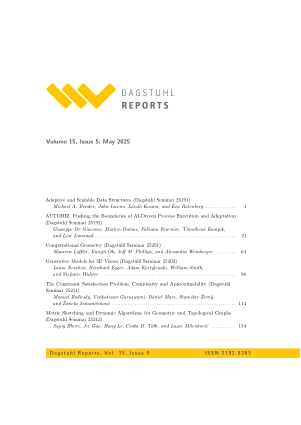
Dagstuhl Reports, Volume 15, Issue 5, May 2025, Complete Issue
Abstract
Cite as
Dagstuhl Reports, Volume 15, Issue 5, pp. 1-159, Schloss Dagstuhl – Leibniz-Zentrum für Informatik (2025)
Copy BibTex To Clipboard
@Article{DagRep.15.5,
  title =	{{Dagstuhl Reports, Volume 15, Issue 5, May 2025, Complete Issue}},
  pages =	{1--159},
  journal =	{Dagstuhl Reports},
  ISSN =	{2192-5283},
  year =	{2025},
  volume =	{15},
  number =	{5},
  publisher =	{Schloss Dagstuhl -- Leibniz-Zentrum f{\"u}r Informatik},
  address =	{Dagstuhl, Germany},
  URL =		{https://drops.dagstuhl.de/entities/document/10.4230/DagRep.15.5},
  URN =		{urn:nbn:de:0030-drops-252813},
  doi =		{10.4230/DagRep.15.5},
  annote =	{Keywords: Dagstuhl Reports, Volume 15, Issue 5, May 2025, Complete Issue}
}
Dagstuhl Reports, Table of Contents, Volume 15, Issue 5, 2025
Abstract
Cite as
Dagstuhl Reports, Volume 15, Issue 5, pp. i-ii, Schloss Dagstuhl – Leibniz-Zentrum für Informatik (2025)
Copy BibTex To Clipboard
@Article{DagRep.15.5.i,
  title =	{{Dagstuhl Reports, Table of Contents, Volume 15, Issue 5, 2025}},
  pages =	{i--ii},
  journal =	{Dagstuhl Reports},
  ISSN =	{2192-5283},
  year =	{2025},
  volume =	{15},
  number =	{5},
  publisher =	{Schloss Dagstuhl -- Leibniz-Zentrum f{\"u}r Informatik},
  address =	{Dagstuhl, Germany},
  URL =		{https://drops.dagstuhl.de/entities/document/10.4230/DagRep.15.5.i},
  URN =		{urn:nbn:de:0030-drops-252741},
  doi =		{10.4230/DagRep.15.5.i},
  annote =	{Keywords: Table of Contents, Frontmatter}
}
Adaptive and Scalable Data Structures (Dagstuhl Seminar 25191)
Abstract
Cite as
Michael A. Bender, John Iacono, László Kozma, Eva Rotenberg, and Justin Dallant. Adaptive and Scalable Data Structures (Dagstuhl Seminar 25191). In Dagstuhl Reports, Volume 15, Issue 5, pp. 1-20, Schloss Dagstuhl – Leibniz-Zentrum für Informatik (2025)
Copy BibTex To Clipboard
@Article{bender_et_al:DagRep.15.5.1,
  author =	{Bender, Michael A. and Iacono, John and Kozma, L\'{a}szl\'{o} and Rotenberg, Eva and Dallant, Justin},
  title =	{{Adaptive and Scalable Data Structures (Dagstuhl Seminar 25191)}},
  pages =	{1--20},
  journal =	{Dagstuhl Reports},
  ISSN =	{2192-5283},
  year =	{2025},
  volume =	{15},
  number =	{5},
  editor =	{Bender, Michael A. and Iacono, John and Kozma, L\'{a}szl\'{o} and Rotenberg, Eva and Dallant, Justin},
  publisher =	{Schloss Dagstuhl -- Leibniz-Zentrum f{\"u}r Informatik},
  address =	{Dagstuhl, Germany},
  URL =		{https://drops.dagstuhl.de/entities/document/10.4230/DagRep.15.5.1},
  URN =		{urn:nbn:de:0030-drops-252802},
  doi =		{10.4230/DagRep.15.5.1},
  annote =	{Keywords: Data structures, Algorithms, Big data, Computational models}
}
AUTOBIZ: Pushing the Boundaries of AI-Driven Process Execution and Adaptation (Dagstuhl Seminar 25192)
Abstract
Cite as
Giuseppe De Giacomo, Marlon Dumas, Fabiana Fournier, Timotheus Kampik, and Lior Limonad. AUTOBIZ: Pushing the Boundaries of AI-Driven Process Execution and Adaptation (Dagstuhl Seminar 25192). In Dagstuhl Reports, Volume 15, Issue 5, pp. 21-63, Schloss Dagstuhl – Leibniz-Zentrum für Informatik (2025)
Copy BibTex To Clipboard
@Article{degiacomo_et_al:DagRep.15.5.21,
  author =	{De Giacomo, Giuseppe and Dumas, Marlon and Fournier, Fabiana and Kampik, Timotheus and Limonad, Lior},
  title =	{{AUTOBIZ: Pushing the Boundaries of AI-Driven Process Execution and Adaptation (Dagstuhl Seminar 25192)}},
  pages =	{21--63},
  journal =	{Dagstuhl Reports},
  ISSN =	{2192-5283},
  year =	{2025},
  volume =	{15},
  number =	{5},
  editor =	{De Giacomo, Giuseppe and Dumas, Marlon and Fournier, Fabiana and Kampik, Timotheus and Limonad, Lior},
  publisher =	{Schloss Dagstuhl -- Leibniz-Zentrum f{\"u}r Informatik},
  address =	{Dagstuhl, Germany},
  URL =		{https://drops.dagstuhl.de/entities/document/10.4230/DagRep.15.5.21},
  URN =		{urn:nbn:de:0030-drops-252799},
  doi =		{10.4230/DagRep.15.5.21},
  annote =	{Keywords: AutoBiz, Artificial Intelligence, Business Process Management, Autonomous Business Processes, Dagstuhl Seminar}
}
Computational Geometry (Dagstuhl Seminar 25201)
Abstract
Cite as
Maarten Löffler, Eunjin Oh, Jeff M. Phillips, and Alexandra Weinberger. Computational Geometry (Dagstuhl Seminar 25201). In Dagstuhl Reports, Volume 15, Issue 5, pp. 64-95, Schloss Dagstuhl – Leibniz-Zentrum für Informatik (2025)
Copy BibTex To Clipboard
@Article{loffler_et_al:DagRep.15.5.64,
  author =	{L\"{o}ffler, Maarten and Oh, Eunjin and Phillips, Jeff M. and Weinberger, Alexandra},
  title =	{{Computational Geometry (Dagstuhl Seminar 25201)}},
  pages =	{64--95},
  journal =	{Dagstuhl Reports},
  ISSN =	{2192-5283},
  year =	{2025},
  volume =	{15},
  number =	{5},
  editor =	{L\"{o}ffler, Maarten and Oh, Eunjin and Phillips, Jeff M. and Weinberger, Alexandra},
  publisher =	{Schloss Dagstuhl -- Leibniz-Zentrum f{\"u}r Informatik},
  address =	{Dagstuhl, Germany},
  URL =		{https://drops.dagstuhl.de/entities/document/10.4230/DagRep.15.5.64},
  URN =		{urn:nbn:de:0030-drops-252780},
  doi =		{10.4230/DagRep.15.5.64},
  annote =	{Keywords: algorithms, combinatorics, complexity, geometric computing, implementation}
}
Generative Models for 3D Vision (Dagstuhl Seminar 25202)
Abstract
Cite as
Laura Neschen, Bernhard Egger, Adam Kortylewski, William Smith, and Stefanie Wuhrer. Generative Models for 3D Vision (Dagstuhl Seminar 25202). In Dagstuhl Reports, Volume 15, Issue 5, pp. 96-113, Schloss Dagstuhl – Leibniz-Zentrum für Informatik (2025)
Copy BibTex To Clipboard
@Article{neschen_et_al:DagRep.15.5.96,
  author =	{Neschen, Laura and Egger, Bernhard and Kortylewski, Adam and Smith, William and Wuhrer, Stefanie},
  title =	{{Generative Models for 3D Vision (Dagstuhl Seminar 25202)}},
  pages =	{96--113},
  journal =	{Dagstuhl Reports},
  ISSN =	{2192-5283},
  year =	{2025},
  volume =	{15},
  number =	{5},
  editor =	{Neschen, Laura and Egger, Bernhard and Kortylewski, Adam and Smith, William and Wuhrer, Stefanie},
  publisher =	{Schloss Dagstuhl -- Leibniz-Zentrum f{\"u}r Informatik},
  address =	{Dagstuhl, Germany},
  URL =		{https://drops.dagstuhl.de/entities/document/10.4230/DagRep.15.5.96},
  URN =		{urn:nbn:de:0030-drops-252774},
  doi =		{10.4230/DagRep.15.5.96},
  annote =	{Keywords: 3D Computer Vision, Computer Graphics, Generative Models, Implicit Representations, Neural Rendering, Statistical Modelling}
}
The Constraint Satisfaction Problem: Complexity and Approximability (Dagstuhl Seminar 25211)
Abstract
Cite as
Manuel Bodirsky, Venkatesan Guruswami, Dániel Marx, Stanislav Živný, and Žaneta Semanišinová. The Constraint Satisfaction Problem: Complexity and Approximability (Dagstuhl Seminar 25211). In Dagstuhl Reports, Volume 15, Issue 5, pp. 114-133, Schloss Dagstuhl – Leibniz-Zentrum für Informatik (2025)
Copy BibTex To Clipboard
@Article{bodirsky_et_al:DagRep.15.5.114,
  author =	{Bodirsky, Manuel and Guruswami, Venkatesan and Marx, D\'{a}niel and \v{Z}ivn\'{y}, Stanislav and Semani\v{s}inov\'{a}, \v{Z}aneta},
  title =	{{The Constraint Satisfaction Problem: Complexity and Approximability (Dagstuhl Seminar 25211)}},
  pages =	{114--133},
  journal =	{Dagstuhl Reports},
  ISSN =	{2192-5283},
  year =	{2025},
  volume =	{15},
  number =	{5},
  editor =	{Bodirsky, Manuel and Guruswami, Venkatesan and Marx, D\'{a}niel and \v{Z}ivn\'{y}, Stanislav and Semani\v{s}inov\'{a}, \v{Z}aneta},
  publisher =	{Schloss Dagstuhl -- Leibniz-Zentrum f{\"u}r Informatik},
  address =	{Dagstuhl, Germany},
  URL =		{https://drops.dagstuhl.de/entities/document/10.4230/DagRep.15.5.114},
  URN =		{urn:nbn:de:0030-drops-252762},
  doi =		{10.4230/DagRep.15.5.114},
  annote =	{Keywords: computational complexity, constraint satisfaction problem, hardness of approximation, parameterized complexity, semidefinite programming}
}
Metric Sketching and Dynamic Algorithms for Geometric and Topological Graphs (Dagstuhl Seminar 25212)
Abstract
Cite as
Sujoy Bhore, Jie Gao, Hung Le, Csaba D. Tóth, and Lazar Milenković. Metric Sketching and Dynamic Algorithms for Geometric and Topological Graphs (Dagstuhl Seminar 25212). In Dagstuhl Reports, Volume 15, Issue 5, pp. 134-157, Schloss Dagstuhl – Leibniz-Zentrum für Informatik (2025)
Copy BibTex To Clipboard
@Article{bhore_et_al:DagRep.15.5.134,
  author =	{Bhore, Sujoy and Gao, Jie and Le, Hung and T\'{o}th, Csaba D. and Milenkovi\'{c}, Lazar},
  title =	{{Metric Sketching and Dynamic Algorithms for Geometric and Topological Graphs (Dagstuhl Seminar 25212)}},
  pages =	{134--157},
  journal =	{Dagstuhl Reports},
  ISSN =	{2192-5283},
  year =	{2025},
  volume =	{15},
  number =	{5},
  editor =	{Bhore, Sujoy and Gao, Jie and Le, Hung and T\'{o}th, Csaba D. and Milenkovi\'{c}, Lazar},
  publisher =	{Schloss Dagstuhl -- Leibniz-Zentrum f{\"u}r Informatik},
  address =	{Dagstuhl, Germany},
  URL =		{https://drops.dagstuhl.de/entities/document/10.4230/DagRep.15.5.134},
  URN =		{urn:nbn:de:0030-drops-252753},
  doi =		{10.4230/DagRep.15.5.134},
  annote =	{Keywords: geometric spanners, geometric intersection graphs, planar metrics, metric covering, computational geometry}
}