Dagstuhl Reports, Volume 15, Issue 8
-
Part of:
Volume:
Dagstuhl Reports, Volume 15
Journal: Dagstuhl Reports (DagRep)
Event
- Dagstuhl Seminars 25341, 25342, 25351, 25361, 25362
Publication Details
- published at: 2026-04-30
- Publisher: Schloss Dagstuhl – Leibniz-Zentrum für Informatik
Access Numbers
- Detailed Access Statistics available here
-
Total Accesses (updated on a weekly basis)
0Documents
Documents
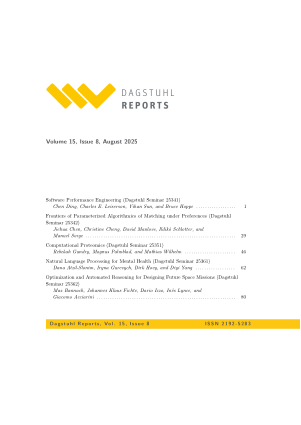
Dagstuhl Reports, Volume 15, Issue 8, August 2025, Complete Issue
Abstract
Cite as
Dagstuhl Reports, Volume 15, Issue 8, pp. 1-96, Schloss Dagstuhl – Leibniz-Zentrum für Informatik (2026)
Copy BibTex To Clipboard
@Article{DagRep.15.8,
  title =	{{Dagstuhl Reports, Volume 15, Issue 8, August 2025, Complete Issue}},
  pages =	{1--96},
  journal =	{Dagstuhl Reports},
  ISSN =	{2192-5283},
  year =	{2026},
  volume =	{15},
  number =	{8},
  publisher =	{Schloss Dagstuhl -- Leibniz-Zentrum f{\"u}r Informatik},
  address =	{Dagstuhl, Germany},
  URL =		{https://drops.dagstuhl.de/entities/document/10.4230/DagRep.15.8},
  URN =		{urn:nbn:de:0030-drops-257763},
  doi =		{10.4230/DagRep.15.8},
  annote =	{Keywords: Dagstuhl Reports, Volume 15, Issue 8, August 2025, Complete Issue}
}
Dagstuhl Reports, Table of Contents, Volume 15, Issue 8, 2025
Abstract
Cite as
Dagstuhl Reports, Volume 15, Issue 8, pp. i-ii, Schloss Dagstuhl – Leibniz-Zentrum für Informatik (2026)
Copy BibTex To Clipboard
@Article{DagRep.15.8.i,
  title =	{{Dagstuhl Reports, Table of Contents, Volume 15, Issue 8, 2025}},
  pages =	{i--ii},
  journal =	{Dagstuhl Reports},
  ISSN =	{2192-5283},
  year =	{2026},
  volume =	{15},
  number =	{8},
  publisher =	{Schloss Dagstuhl -- Leibniz-Zentrum f{\"u}r Informatik},
  address =	{Dagstuhl, Germany},
  URL =		{https://drops.dagstuhl.de/entities/document/10.4230/DagRep.15.8.i},
  URN =		{urn:nbn:de:0030-drops-257724},
  doi =		{10.4230/DagRep.15.8.i},
  annote =	{Keywords: Table of Contents, Frontmatter}
}
Software Performance Engineering (Dagstuhl Seminar 25341)
Abstract
Cite as
Chen Ding, Charles E. Leiserson, Yihan Sun, and Bruce Hoppe. Software Performance Engineering (Dagstuhl Seminar 25341). In Dagstuhl Reports, Volume 15, Issue 8, pp. 1-28, Schloss Dagstuhl – Leibniz-Zentrum für Informatik (2026)
Copy BibTex To Clipboard
@Article{ding_et_al:DagRep.15.8.1,
  author =	{Ding, Chen and Leiserson, Charles E. and Sun, Yihan and Hoppe, Bruce},
  title =	{{Software Performance Engineering (Dagstuhl Seminar 25341)}},
  pages =	{1--28},
  journal =	{Dagstuhl Reports},
  ISSN =	{2192-5283},
  year =	{2026},
  volume =	{15},
  number =	{8},
  editor =	{Ding, Chen and Leiserson, Charles E. and Sun, Yihan and Hoppe, Bruce},
  publisher =	{Schloss Dagstuhl -- Leibniz-Zentrum f{\"u}r Informatik},
  address =	{Dagstuhl, Germany},
  URL =		{https://drops.dagstuhl.de/entities/document/10.4230/DagRep.15.8.1},
  URN =		{urn:nbn:de:0030-drops-257759},
  doi =		{10.4230/DagRep.15.8.1},
  annote =	{Keywords: applications, productivity tools, software performance engineering, theory and practice}
}
Frontiers of Parameterized Algorithmics of Matching under Preferences (Dagstuhl Seminar 25342)
Abstract
Cite as
Jiehua Chen, Christine Cheng, David Manlove, Ildikó Schlotter, and Manuel Sorge. Frontiers of Parameterized Algorithmics of Matching under Preferences (Dagstuhl Seminar 25342). In Dagstuhl Reports, Volume 15, Issue 8, pp. 29-45, Schloss Dagstuhl – Leibniz-Zentrum für Informatik (2026)
Copy BibTex To Clipboard
@Article{chen_et_al:DagRep.15.8.29,
  author =	{Chen, Jiehua and Cheng, Christine and Manlove, David and Schlotter, Ildik\'{o} and Sorge, Manuel},
  title =	{{Frontiers of Parameterized Algorithmics of Matching under Preferences (Dagstuhl Seminar 25342)}},
  pages =	{29--45},
  journal =	{Dagstuhl Reports},
  ISSN =	{2192-5283},
  year =	{2026},
  volume =	{15},
  number =	{8},
  editor =	{Chen, Jiehua and Cheng, Christine and Manlove, David and Schlotter, Ildik\'{o} and Sorge, Manuel},
  publisher =	{Schloss Dagstuhl -- Leibniz-Zentrum f{\"u}r Informatik},
  address =	{Dagstuhl, Germany},
  URL =		{https://drops.dagstuhl.de/entities/document/10.4230/DagRep.15.8.29},
  URN =		{urn:nbn:de:0030-drops-257744},
  doi =		{10.4230/DagRep.15.8.29},
  annote =	{Keywords: Algorithmic design and complexity analysis, Matching markets, Matching theory, Parameterizec complexity analysis}
}
Computational Proteomics (Dagstuhl Seminar 25351)
Abstract
Cite as
Rebekah Gundry, Magnus Palmblad, and Mathias Wilhelm. Computational Proteomics (Dagstuhl Seminar 25351). In Dagstuhl Reports, Volume 15, Issue 8, pp. 46-61, Schloss Dagstuhl – Leibniz-Zentrum für Informatik (2026)
Copy BibTex To Clipboard
@Article{gundry_et_al:DagRep.15.8.46,
  author =	{Gundry, Rebekah and Palmblad, Magnus and Wilhelm, Mathias},
  title =	{{Computational Proteomics (Dagstuhl Seminar 25351)}},
  pages =	{46--61},
  journal =	{Dagstuhl Reports},
  ISSN =	{2192-5283},
  year =	{2026},
  volume =	{15},
  number =	{8},
  editor =	{Gundry, Rebekah and Palmblad, Magnus and Wilhelm, Mathias},
  publisher =	{Schloss Dagstuhl -- Leibniz-Zentrum f{\"u}r Informatik},
  address =	{Dagstuhl, Germany},
  URL =		{https://drops.dagstuhl.de/entities/document/10.4230/DagRep.15.8.46},
  URN =		{urn:nbn:de:0030-drops-257737},
  doi =		{10.4230/DagRep.15.8.46},
  annote =	{Keywords: proteomics, glycomics, glycoproteomics, machine learning, mass spectrometry}
}
Natural Language Processing for Mental Health (Dagstuhl Seminar 25361)
Abstract
Cite as
Dana Atzil-Slonim, Iryna Gurevych, Dirk Hovy, and Diyi Yang. Natural Language Processing for Mental Health (Dagstuhl Seminar 25361). In Dagstuhl Reports, Volume 15, Issue 8, pp. 62-79, Schloss Dagstuhl – Leibniz-Zentrum für Informatik (2026)
Copy BibTex To Clipboard
@Article{atzilslonim_et_al:DagRep.15.8.62,
  author =	{Atzil-Slonim, Dana and Gurevych, Iryna and Hovy, Dirk and Yang, Diyi},
  title =	{{Natural Language Processing for Mental Health (Dagstuhl Seminar 25361)}},
  pages =	{62--79},
  journal =	{Dagstuhl Reports},
  ISSN =	{2192-5283},
  year =	{2026},
  volume =	{15},
  number =	{8},
  editor =	{Atzil-Slonim, Dana and Gurevych, Iryna and Hovy, Dirk and Yang, Diyi},
  publisher =	{Schloss Dagstuhl -- Leibniz-Zentrum f{\"u}r Informatik},
  address =	{Dagstuhl, Germany},
  URL =		{https://drops.dagstuhl.de/entities/document/10.4230/DagRep.15.8.62},
  URN =		{urn:nbn:de:0030-drops-257784},
  doi =		{10.4230/DagRep.15.8.62},
  annote =	{Keywords: Mental Health, NLP, Human-Centered AI, Large Language Models}
}
Optimization and Automated Reasoning for Designing Future Space Missions (Dagstuhl Seminar 25362)
Abstract
Cite as
Max Bannach, Johannes Klaus Fichte, Dario Izzo, Inês Lynce, and Giacomo Acciarini. Optimization and Automated Reasoning for Designing Future Space Missions (Dagstuhl Seminar 25362). In Dagstuhl Reports, Volume 15, Issue 8, pp. 80-94, Schloss Dagstuhl – Leibniz-Zentrum für Informatik (2026)
Copy BibTex To Clipboard
@Article{bannach_et_al:DagRep.15.8.80,
  author =	{Bannach, Max and Fichte, Johannes Klaus and Izzo, Dario and Lynce, In\^{e}s and Acciarini, Giacomo},
  title =	{{Optimization and Automated Reasoning for Designing Future Space Missions (Dagstuhl Seminar 25362)}},
  pages =	{80--94},
  journal =	{Dagstuhl Reports},
  ISSN =	{2192-5283},
  year =	{2026},
  volume =	{15},
  number =	{8},
  editor =	{Bannach, Max and Fichte, Johannes Klaus and Izzo, Dario and Lynce, In\^{e}s and Acciarini, Giacomo},
  publisher =	{Schloss Dagstuhl -- Leibniz-Zentrum f{\"u}r Informatik},
  address =	{Dagstuhl, Germany},
  URL =		{https://drops.dagstuhl.de/entities/document/10.4230/DagRep.15.8.80},
  URN =		{urn:nbn:de:0030-drops-257771},
  doi =		{10.4230/DagRep.15.8.80},
  annote =	{Keywords: Automated Reasoning, Satellite Constellation Design, Space Logistics, Trajectory Optimization, Astrodynamics, Global Trajectory Optimization}
}