Dagstuhl Reports, Volume 15, Issue 7
-
Part of:
Volume:
Dagstuhl Reports, Volume 15
Journal: Dagstuhl Reports (DagRep)
Event
- Dagstuhl Seminars 25281, 25282, 25291, 25292, 25301, 25302, 25311, 25312
Publication Details
- published at: 2026-04-30
- Publisher: Schloss Dagstuhl – Leibniz-Zentrum für Informatik
Access Numbers
- Detailed Access Statistics available here
-
Total Accesses (updated on a weekly basis)
0Documents
Documents
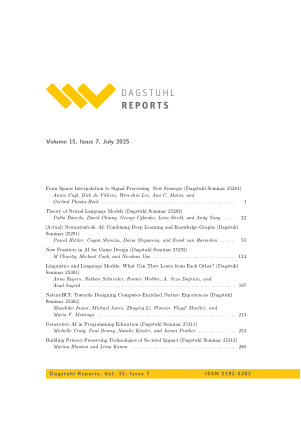
Dagstuhl Reports, Volume 15, Issue 7, July 2025, Complete Issue
Abstract
Cite as
Dagstuhl Reports, Volume 15, Issue 7, pp. 1-304, Schloss Dagstuhl – Leibniz-Zentrum für Informatik (2026)
Copy BibTex To Clipboard
@Article{DagRep.15.7,
  title =	{{Dagstuhl Reports, Volume 15, Issue 7, July 2025, Complete Issue}},
  pages =	{1--304},
  journal =	{Dagstuhl Reports},
  ISSN =	{2192-5283},
  year =	{2026},
  volume =	{15},
  number =	{7},
  publisher =	{Schloss Dagstuhl -- Leibniz-Zentrum f{\"u}r Informatik},
  address =	{Dagstuhl, Germany},
  URL =		{https://drops.dagstuhl.de/entities/document/10.4230/DagRep.15.7},
  URN =		{urn:nbn:de:0030-drops-257703},
  doi =		{10.4230/DagRep.15.7},
  annote =	{Keywords: Dagstuhl Reports, Volume 15, Issue 7, July 2025, Complete Issue}
}
Dagstuhl Reports, Table of Contents, Volume 15, Issue 7, 2025
Abstract
Cite as
Dagstuhl Reports, Volume 15, Issue 7, pp. i-ii, Schloss Dagstuhl – Leibniz-Zentrum für Informatik (2026)
Copy BibTex To Clipboard
@Article{DagRep.15.7.i,
  title =	{{Dagstuhl Reports, Table of Contents, Volume 15, Issue 7, 2025}},
  pages =	{i--ii},
  journal =	{Dagstuhl Reports},
  ISSN =	{2192-5283},
  year =	{2026},
  volume =	{15},
  number =	{7},
  publisher =	{Schloss Dagstuhl -- Leibniz-Zentrum f{\"u}r Informatik},
  address =	{Dagstuhl, Germany},
  URL =		{https://drops.dagstuhl.de/entities/document/10.4230/DagRep.15.7.i},
  URN =		{urn:nbn:de:0030-drops-257617},
  doi =		{10.4230/DagRep.15.7.i},
  annote =	{Keywords: Table of Contents, Frontmatter}
}
From Sparse Interpolation to Signal Processing: New Synergies (Dagstuhl Seminar 25281)
Abstract
Cite as
Annie Cuyt, Dirk de Villiers, Wen-shin Lee, Ana C. Matos, Gerlind Plonka-Hoch, and Ramonika Sengupta. From Sparse Interpolation to Signal Processing: New Synergies (Dagstuhl Seminar 25281). In Dagstuhl Reports, Volume 15, Issue 7, pp. 1-21, Schloss Dagstuhl – Leibniz-Zentrum für Informatik (2026)
Copy BibTex To Clipboard
@Article{cuyt_et_al:DagRep.15.7.1,
  author =	{Cuyt, Annie and de Villiers, Dirk and Lee, Wen-shin and Matos, Ana C. and Plonka-Hoch, Gerlind and Sengupta, Ramonika},
  title =	{{From Sparse Interpolation to Signal Processing: New Synergies (Dagstuhl Seminar 25281)}},
  pages =	{1--21},
  journal =	{Dagstuhl Reports},
  ISSN =	{2192-5283},
  year =	{2026},
  volume =	{15},
  number =	{7},
  editor =	{Cuyt, Annie and de Villiers, Dirk and Lee, Wen-shin and Matos, Ana C. and Plonka-Hoch, Gerlind and Sengupta, Ramonika},
  publisher =	{Schloss Dagstuhl -- Leibniz-Zentrum f{\"u}r Informatik},
  address =	{Dagstuhl, Germany},
  URL =		{https://drops.dagstuhl.de/entities/document/10.4230/DagRep.15.7.1},
  URN =		{urn:nbn:de:0030-drops-257690},
  doi =		{10.4230/DagRep.15.7.1},
  annote =	{Keywords: exponential analysis, structured matrices, quadrature, subdivision, computer algebra, applications}
}
Theory of Neural Language Models (Dagstuhl Seminar 25282)
Abstract
Cite as
Pablo Barcelo, David Chiang, George Cybenko, Lena Strobl, and Andy Yang. Theory of Neural Language Models (Dagstuhl Seminar 25282). In Dagstuhl Reports, Volume 15, Issue 7, pp. 22-52, Schloss Dagstuhl – Leibniz-Zentrum für Informatik (2026)
Copy BibTex To Clipboard
@Article{barcelo_et_al:DagRep.15.7.22,
  author =	{Barcelo, Pablo and Chiang, David and Cybenko, George and Strobl, Lena and Yang, Andy},
  title =	{{Theory of Neural Language Models (Dagstuhl Seminar 25282)}},
  pages =	{22--52},
  journal =	{Dagstuhl Reports},
  ISSN =	{2192-5283},
  year =	{2026},
  volume =	{15},
  number =	{7},
  editor =	{Barcelo, Pablo and Chiang, David and Cybenko, George and Strobl, Lena and Yang, Andy},
  publisher =	{Schloss Dagstuhl -- Leibniz-Zentrum f{\"u}r Informatik},
  address =	{Dagstuhl, Germany},
  URL =		{https://drops.dagstuhl.de/entities/document/10.4230/DagRep.15.7.22},
  URN =		{urn:nbn:de:0030-drops-257689},
  doi =		{10.4230/DagRep.15.7.22},
  annote =	{Keywords: Dagstuhl Seminar, Neural Networks, Language Models, Automata, Logic, Model Theory, Circuit Complexity}
}
(Actual) Neurosymbolic AI: Combining Deep Learning and Knowledge Graphs (Dagstuhl Seminar 25291)
Abstract
Cite as
Pascal Hitzler, Cogan Shimizu, Daria Stepanova, and Frank van Harmelen. (Actual) Neurosymbolic AI: Combining Deep Learning and Knowledge Graphs (Dagstuhl Seminar 25291). In Dagstuhl Reports, Volume 15, Issue 7, pp. 53-123, Schloss Dagstuhl – Leibniz-Zentrum für Informatik (2026)
Copy BibTex To Clipboard
@Article{hitzler_et_al:DagRep.15.7.53,
  author =	{Hitzler, Pascal and Shimizu, Cogan and Stepanova, Daria and van Harmelen, Frank},
  title =	{{(Actual) Neurosymbolic AI: Combining Deep Learning and Knowledge Graphs (Dagstuhl Seminar 25291)}},
  pages =	{53--123},
  journal =	{Dagstuhl Reports},
  ISSN =	{2192-5283},
  year =	{2026},
  volume =	{15},
  number =	{7},
  editor =	{Hitzler, Pascal and Shimizu, Cogan and Stepanova, Daria and van Harmelen, Frank},
  publisher =	{Schloss Dagstuhl -- Leibniz-Zentrum f{\"u}r Informatik},
  address =	{Dagstuhl, Germany},
  URL =		{https://drops.dagstuhl.de/entities/document/10.4230/DagRep.15.7.53},
  URN =		{urn:nbn:de:0030-drops-257675},
  doi =		{10.4230/DagRep.15.7.53},
  annote =	{Keywords: deep learning, knowledge graphs, neurosymbolic ai}
}
New Frontiers in AI for Game Design (Dagstuhl Seminar 25292)
Abstract
Cite as
M Charity, Michael Cook, and Nicolaas Vas. New Frontiers in AI for Game Design (Dagstuhl Seminar 25292). In Dagstuhl Reports, Volume 15, Issue 7, pp. 124-186, Schloss Dagstuhl – Leibniz-Zentrum für Informatik (2026)
Copy BibTex To Clipboard
@Article{charity_et_al:DagRep.15.7.124,
  author =	{Charity, M and Cook, Michael and Vas, Nicolaas},
  title =	{{New Frontiers in AI for Game Design (Dagstuhl Seminar 25292)}},
  pages =	{124--186},
  journal =	{Dagstuhl Reports},
  ISSN =	{2192-5283},
  year =	{2026},
  volume =	{15},
  number =	{7},
  editor =	{Charity, M and Cook, Michael and Vas, Nicolaas},
  publisher =	{Schloss Dagstuhl -- Leibniz-Zentrum f{\"u}r Informatik},
  address =	{Dagstuhl, Germany},
  URL =		{https://drops.dagstuhl.de/entities/document/10.4230/DagRep.15.7.124},
  URN =		{urn:nbn:de:0030-drops-257667},
  doi =		{10.4230/DagRep.15.7.124},
  annote =	{Keywords: artificial intelligence, Computational Creativity, Game Design, Human-Centred Computing, Procedural Content Generation}
}
Linguistics and Language Models: What Can They Learn from Each Other? (Dagstuhl Seminar 25301)
Abstract
Cite as
Anna Rogers, Nathan Schneider, Bonnie Webber, A. Seza Doğruöz, and Asad Sayeed. Linguistics and Language Models: What Can They Learn from Each Other? (Dagstuhl Seminar 25301). In Dagstuhl Reports, Volume 15, Issue 7, pp. 187-212, Schloss Dagstuhl – Leibniz-Zentrum für Informatik (2026)
Copy BibTex To Clipboard
@Article{rogers_et_al:DagRep.15.7.187,
  author =	{Rogers, Anna and Schneider, Nathan and Webber, Bonnie and Do\u{g}ru\"{o}z, A. Seza and Sayeed, Asad},
  title =	{{Linguistics and Language Models: What Can They Learn from Each Other? (Dagstuhl Seminar 25301)}},
  pages =	{187--212},
  journal =	{Dagstuhl Reports},
  ISSN =	{2192-5283},
  year =	{2026},
  volume =	{15},
  number =	{7},
  editor =	{Rogers, Anna and Schneider, Nathan and Webber, Bonnie and Do\u{g}ru\"{o}z, A. Seza and Sayeed, Asad},
  publisher =	{Schloss Dagstuhl -- Leibniz-Zentrum f{\"u}r Informatik},
  address =	{Dagstuhl, Germany},
  URL =		{https://drops.dagstuhl.de/entities/document/10.4230/DagRep.15.7.187},
  URN =		{urn:nbn:de:0030-drops-257652},
  doi =		{10.4230/DagRep.15.7.187},
  annote =	{Keywords: cognitive modelling, language models, linguistic theory}
}
NatureHCI: Towards Designing Computer-Enriched Nature Experiences (Dagstuhl Seminar 25302)
Abstract
Cite as
Masahiko Inami, Michael Jones, Zhuying Li, Florian `Floyd' Mueller, and Maria F. Montoya. NatureHCI: Towards Designing Computer-Enriched Nature Experiences (Dagstuhl Seminar 25302). In Dagstuhl Reports, Volume 15, Issue 7, pp. 213-252, Schloss Dagstuhl – Leibniz-Zentrum für Informatik (2026)
Copy BibTex To Clipboard
@Article{inami_et_al:DagRep.15.7.213,
  author =	{Inami, Masahiko and Jones, Michael and Li, Zhuying and Mueller, Florian `Floyd' and Montoya, Maria F.},
  title =	{{NatureHCI: Towards Designing Computer-Enriched Nature Experiences (Dagstuhl Seminar 25302)}},
  pages =	{213--252},
  journal =	{Dagstuhl Reports},
  ISSN =	{2192-5283},
  year =	{2026},
  volume =	{15},
  number =	{7},
  editor =	{Inami, Masahiko and Jones, Michael and Li, Zhuying and Mueller, Florian `Floyd' and Montoya, Maria F.},
  publisher =	{Schloss Dagstuhl -- Leibniz-Zentrum f{\"u}r Informatik},
  address =	{Dagstuhl, Germany},
  URL =		{https://drops.dagstuhl.de/entities/document/10.4230/DagRep.15.7.213},
  URN =		{urn:nbn:de:0030-drops-257645},
  doi =		{10.4230/DagRep.15.7.213},
  annote =	{Keywords: NatureHCI, Nature Interactions, Wilderness, Technology, Wellbeing, Sustainability, More-Than-Human, Human-Computer Interaction, non-humans, animals, nature}
}
Generative AI in Programming Education (Dagstuhl Seminar 25311)
Abstract
Cite as
Michelle Craig, Paul Denny, Natalie Kiesler, and James Prather. Generative AI in Programming Education (Dagstuhl Seminar 25311). In Dagstuhl Reports, Volume 15, Issue 7, pp. 253-279, Schloss Dagstuhl – Leibniz-Zentrum für Informatik (2026)
Copy BibTex To Clipboard
@Article{craig_et_al:DagRep.15.7.253,
  author =	{Craig, Michelle and Denny, Paul and Kiesler, Natalie and Prather, James},
  title =	{{Generative AI in Programming Education (Dagstuhl Seminar 25311)}},
  pages =	{253--279},
  journal =	{Dagstuhl Reports},
  ISSN =	{2192-5283},
  year =	{2026},
  volume =	{15},
  number =	{7},
  editor =	{Craig, Michelle and Denny, Paul and Kiesler, Natalie and Prather, James},
  publisher =	{Schloss Dagstuhl -- Leibniz-Zentrum f{\"u}r Informatik},
  address =	{Dagstuhl, Germany},
  URL =		{https://drops.dagstuhl.de/entities/document/10.4230/DagRep.15.7.253},
  URN =		{urn:nbn:de:0030-drops-257636},
  doi =		{10.4230/DagRep.15.7.253},
  annote =	{Keywords: artificial intelligence, computer programming, computing education, generative ai, large language models}
}
Building Privacy-Preserving Technologies of Societal Impact (Dagstuhl Seminar 25312)
Abstract
Cite as
Marina Blanton and Liina Kamm. Building Privacy-Preserving Technologies of Societal Impact (Dagstuhl Seminar 25312). In Dagstuhl Reports, Volume 15, Issue 7, pp. 280-302, Schloss Dagstuhl – Leibniz-Zentrum für Informatik (2026)
Copy BibTex To Clipboard
@Article{blanton_et_al:DagRep.15.7.280,
  author =	{Blanton, Marina and Kamm, Liina},
  title =	{{Building Privacy-Preserving Technologies of Societal Impact (Dagstuhl Seminar 25312)}},
  pages =	{280--302},
  journal =	{Dagstuhl Reports},
  ISSN =	{2192-5283},
  year =	{2026},
  volume =	{15},
  number =	{7},
  editor =	{Blanton, Marina and Kamm, Liina},
  publisher =	{Schloss Dagstuhl -- Leibniz-Zentrum f{\"u}r Informatik},
  address =	{Dagstuhl, Germany},
  URL =		{https://drops.dagstuhl.de/entities/document/10.4230/DagRep.15.7.280},
  URN =		{urn:nbn:de:0030-drops-257629},
  doi =		{10.4230/DagRep.15.7.280},
  annote =	{Keywords: Privacy-enhancing technologies, applications, societal impact, secure computation}
}