Dagstuhl Reports, Volume 15, Issue 10
-
Part of:
Volume:
Dagstuhl Reports, Volume 15
Journal: Dagstuhl Reports (DagRep)
Event
- Dagstuhl Seminars 25411, 25412 (Perspectives Workshop), 25421, 25422, 25431, 25432, 25441, 25442
Publication Details
- published at: 2026-06-23
- Publisher: Schloss Dagstuhl – Leibniz-Zentrum für Informatik
Access Numbers
- Detailed Access Statistics available here
-
Total Accesses (updated on a weekly basis)
0Documents
Documents
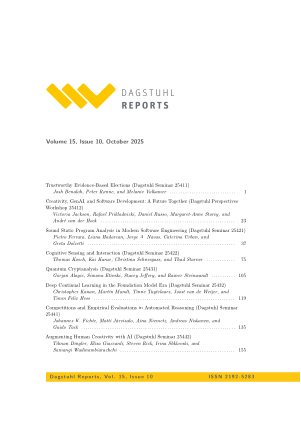
Dagstuhl Reports, Volume 15, Issue 10, October 2025, Complete Issue
Abstract
Cite as
Dagstuhl Reports, Volume 15, Issue 10, pp. 1-174, Schloss Dagstuhl – Leibniz-Zentrum für Informatik (2026)
Copy BibTex To Clipboard
@Article{DagRep.15.10,
  title =	{{Dagstuhl Reports, Volume 15, Issue 10, October 2025, Complete Issue}},
  pages =	{1--174},
  journal =	{Dagstuhl Reports},
  ISSN =	{2192-5283},
  year =	{2026},
  volume =	{15},
  number =	{10},
  publisher =	{Schloss Dagstuhl -- Leibniz-Zentrum f{\"u}r Informatik},
  address =	{Dagstuhl, Germany},
  URL =		{https://drops.dagstuhl.de/entities/document/10.4230/DagRep.15.10},
  URN =		{urn:nbn:de:0030-drops-267854},
  doi =		{10.4230/DagRep.15.10},
  annote =	{Keywords: Dagstuhl Reports, Volume 15, Issue 10, October 2025, Complete Issue}
}
Dagstuhl Reports, Table of Contents, Volume 15, Issue 10, 2025
Abstract
Cite as
Dagstuhl Reports, Volume 15, Issue 10, pp. i-ii, Schloss Dagstuhl – Leibniz-Zentrum für Informatik (2026)
Copy BibTex To Clipboard
@Article{DagRep.15.10.i,
  title =	{{Dagstuhl Reports, Table of Contents, Volume 15, Issue 10, 2025}},
  pages =	{i--ii},
  journal =	{Dagstuhl Reports},
  ISSN =	{2192-5283},
  year =	{2026},
  volume =	{15},
  number =	{10},
  publisher =	{Schloss Dagstuhl -- Leibniz-Zentrum f{\"u}r Informatik},
  address =	{Dagstuhl, Germany},
  URL =		{https://drops.dagstuhl.de/entities/document/10.4230/DagRep.15.10.i},
  URN =		{urn:nbn:de:0030-drops-254097},
  doi =		{10.4230/DagRep.15.10.i},
  annote =	{Keywords: Table of Contents, Frontmatter}
}
Trustworthy Evidence-Based Elections (Dagstuhl Seminar 25411)
Abstract
Cite as
Josh Benaloh, Peter Rønne, and Melanie Volkamer. Trustworthy Evidence-Based Elections (Dagstuhl Seminar 25411). In Dagstuhl Reports, Volume 15, Issue 10, pp. 1-22, Schloss Dagstuhl – Leibniz-Zentrum für Informatik (2026)
Copy BibTex To Clipboard
@Article{benaloh_et_al:DagRep.15.10.1,
  author =	{Benaloh, Josh and R{\o}nne, Peter and Volkamer, Melanie},
  title =	{{Trustworthy Evidence-Based Elections (Dagstuhl Seminar 25411)}},
  pages =	{1--22},
  journal =	{Dagstuhl Reports},
  ISSN =	{2192-5283},
  year =	{2026},
  volume =	{15},
  number =	{10},
  editor =	{Benaloh, Josh and R{\o}nne, Peter and Volkamer, Melanie},
  publisher =	{Schloss Dagstuhl -- Leibniz-Zentrum f{\"u}r Informatik},
  address =	{Dagstuhl, Germany},
  URL =		{https://drops.dagstuhl.de/entities/document/10.4230/DagRep.15.10.1},
  URN =		{urn:nbn:de:0030-drops-254171},
  doi =		{10.4230/DagRep.15.10.1},
  annote =	{Keywords: elections, risk-limiting audits, Trust, usable security, verifiable voting, voting}
}
Creativity, GenAI, and Software Development: A Future Together (Dagstuhl Perspectives Workshop 25412)
Abstract
Cite as
Victoria Jackson, Rafael Prikladnicki, Daniel Russo, Margaret-Anne Storey, and André van der Hoek. Creativity, GenAI, and Software Development: A Future Together (Dagstuhl Perspectives Workshop 25412). In Dagstuhl Reports, Volume 15, Issue 10, pp. 23-36, Schloss Dagstuhl – Leibniz-Zentrum für Informatik (2026)
Copy BibTex To Clipboard
@Article{jackson_et_al:DagRep.15.10.23,
  author =	{Jackson, Victoria and Prikladnicki, Rafael and Russo, Daniel and Storey, Margaret-Anne and van der Hoek, Andr\'{e}},
  title =	{{Creativity, GenAI, and Software Development: A Future Together (Dagstuhl Perspectives Workshop 25412)}},
  pages =	{23--36},
  journal =	{Dagstuhl Reports},
  ISSN =	{2192-5283},
  year =	{2026},
  volume =	{15},
  number =	{10},
  editor =	{Jackson, Victoria and Prikladnicki, Rafael and Russo, Daniel and Storey, Margaret-Anne and van der Hoek, Andr\'{e}},
  publisher =	{Schloss Dagstuhl -- Leibniz-Zentrum f{\"u}r Informatik},
  address =	{Dagstuhl, Germany},
  URL =		{https://drops.dagstuhl.de/entities/document/10.4230/DagRep.15.10.23},
  URN =		{urn:nbn:de:0030-drops-254167},
  doi =		{10.4230/DagRep.15.10.23},
  annote =	{Keywords: Creativity, Generative AI, Software Development, Dagstuhl Perspectives Workshop}
}
Sound Static Program Analysis in Modern Software Engineering (Dagstuhl Seminar 25421)
Abstract
Cite as
Pietro Ferrara, Liana Hadarean, Jorge A. Navas, Caterina Urban, and Greta Dolcetti. Sound Static Program Analysis in Modern Software Engineering (Dagstuhl Seminar 25421). In Dagstuhl Reports, Volume 15, Issue 10, pp. 37-74, Schloss Dagstuhl – Leibniz-Zentrum für Informatik (2026)
Copy BibTex To Clipboard
@Article{ferrara_et_al:DagRep.15.10.37,
  author =	{Ferrara, Pietro and Hadarean, Liana and Navas, Jorge A. and Urban, Caterina and Dolcetti, Greta},
  title =	{{Sound Static Program Analysis in Modern Software Engineering (Dagstuhl Seminar 25421)}},
  pages =	{37--74},
  journal =	{Dagstuhl Reports},
  ISSN =	{2192-5283},
  year =	{2026},
  volume =	{15},
  number =	{10},
  editor =	{Ferrara, Pietro and Hadarean, Liana and Navas, Jorge A. and Urban, Caterina and Dolcetti, Greta},
  publisher =	{Schloss Dagstuhl -- Leibniz-Zentrum f{\"u}r Informatik},
  address =	{Dagstuhl, Germany},
  URL =		{https://drops.dagstuhl.de/entities/document/10.4230/DagRep.15.10.37},
  URN =		{urn:nbn:de:0030-drops-254154},
  doi =		{10.4230/DagRep.15.10.37},
  annote =	{Keywords: Abstract interpretation, Formal methods, Software engineering, Software verification, Sound static program analysis}
}
Cognitive Sensing and Interaction (Dagstuhl Seminar 25422)
Abstract
Cite as
Thomas Kosch, Kai Kunze, Christina Schneegass, and Thad Starner. Cognitive Sensing and Interaction (Dagstuhl Seminar 25422). In Dagstuhl Reports, Volume 15, Issue 10, pp. 75-104, Schloss Dagstuhl – Leibniz-Zentrum für Informatik (2026)
Copy BibTex To Clipboard
@Article{kosch_et_al:DagRep.15.10.75,
  author =	{Kosch, Thomas and Kunze, Kai and Schneegass, Christina and Starner, Thad},
  title =	{{Cognitive Sensing and Interaction (Dagstuhl Seminar 25422)}},
  pages =	{75--104},
  journal =	{Dagstuhl Reports},
  ISSN =	{2192-5283},
  year =	{2026},
  volume =	{15},
  number =	{10},
  editor =	{Kosch, Thomas and Kunze, Kai and Schneegass, Christina and Starner, Thad},
  publisher =	{Schloss Dagstuhl -- Leibniz-Zentrum f{\"u}r Informatik},
  address =	{Dagstuhl, Germany},
  URL =		{https://drops.dagstuhl.de/entities/document/10.4230/DagRep.15.10.75},
  URN =		{urn:nbn:de:0030-drops-254146},
  doi =		{10.4230/DagRep.15.10.75},
  annote =	{Keywords: cognition-awareness, cognitive augmentation, cognitive interaction, physiological interaction, wearable technology}
}
Quantum Cryptanalysis (Dagstuhl Seminar 25431)
Abstract
Cite as
Gorjan Alagic, Simona Etinski, Stacey Jeffery, and Rainer Steinwandt. Quantum Cryptanalysis (Dagstuhl Seminar 25431). In Dagstuhl Reports, Volume 15, Issue 10, pp. 105-118, Schloss Dagstuhl – Leibniz-Zentrum für Informatik (2026)
Copy BibTex To Clipboard
@Article{alagic_et_al:DagRep.15.10.105,
  author =	{Alagic, Gorjan and Etinski, Simona and Jeffery, Stacey and Steinwandt, Rainer},
  title =	{{Quantum Cryptanalysis (Dagstuhl Seminar 25431)}},
  pages =	{105--118},
  journal =	{Dagstuhl Reports},
  ISSN =	{2192-5283},
  year =	{2026},
  volume =	{15},
  number =	{10},
  editor =	{Alagic, Gorjan and Etinski, Simona and Jeffery, Stacey and Steinwandt, Rainer},
  publisher =	{Schloss Dagstuhl -- Leibniz-Zentrum f{\"u}r Informatik},
  address =	{Dagstuhl, Germany},
  URL =		{https://drops.dagstuhl.de/entities/document/10.4230/DagRep.15.10.105},
  URN =		{urn:nbn:de:0030-drops-254138},
  doi =		{10.4230/DagRep.15.10.105},
  annote =	{Keywords: computational algebra, cryptanalysis, post-quantum cryptography, quantum algorithms, quantum resource estimation}
}
Deep Continual Learning in the Foundation Model Era (Dagstuhl Seminar 25432)
Abstract
Cite as
Christopher Kanan, Martin Mundt, Tinne Tuytelaars, Joost van de Weijer, and Timm Felix Hess. Deep Continual Learning in the Foundation Model Era (Dagstuhl Seminar 25432). In Dagstuhl Reports, Volume 15, Issue 10, pp. 119-134, Schloss Dagstuhl – Leibniz-Zentrum für Informatik (2026)
Copy BibTex To Clipboard
@Article{kanan_et_al:DagRep.15.10.119,
  author =	{Kanan, Christopher and Mundt, Martin and Tuytelaars, Tinne and van de Weijer, Joost and Hess, Timm Felix},
  title =	{{Deep Continual Learning in the Foundation Model Era (Dagstuhl Seminar 25432)}},
  pages =	{119--134},
  journal =	{Dagstuhl Reports},
  ISSN =	{2192-5283},
  year =	{2026},
  volume =	{15},
  number =	{10},
  editor =	{Kanan, Christopher and Mundt, Martin and Tuytelaars, Tinne and van de Weijer, Joost and Hess, Timm Felix},
  publisher =	{Schloss Dagstuhl -- Leibniz-Zentrum f{\"u}r Informatik},
  address =	{Dagstuhl, Germany},
  URL =		{https://drops.dagstuhl.de/entities/document/10.4230/DagRep.15.10.119},
  URN =		{urn:nbn:de:0030-drops-254123},
  doi =		{10.4230/DagRep.15.10.119},
  annote =	{Keywords: continual learning, deep learning, foundation models}
}
Competitions and Empirical Evaluations in Automated Reasoning (Dagstuhl Seminar 25441)
Abstract
Cite as
Johannes K. Fichte, Matti Järvisalo, Aina Niemetz, Andreas Niskanen, and Guido Tack. Competitions and Empirical Evaluations in Automated Reasoning (Dagstuhl Seminar 25441). In Dagstuhl Reports, Volume 15, Issue 10, pp. 135-154, Schloss Dagstuhl – Leibniz-Zentrum für Informatik (2026)
Copy BibTex To Clipboard
@Article{fichte_et_al:DagRep.15.10.135,
  author =	{Fichte, Johannes K. and J\"{a}rvisalo, Matti and Niemetz, Aina and Niskanen, Andreas and Tack, Guido},
  title =	{{Competitions and Empirical Evaluations in Automated Reasoning (Dagstuhl Seminar 25441)}},
  pages =	{135--154},
  journal =	{Dagstuhl Reports},
  ISSN =	{2192-5283},
  year =	{2026},
  volume =	{15},
  number =	{10},
  editor =	{Fichte, Johannes K. and J\"{a}rvisalo, Matti and Niemetz, Aina and Niskanen, Andreas and Tack, Guido},
  publisher =	{Schloss Dagstuhl -- Leibniz-Zentrum f{\"u}r Informatik},
  address =	{Dagstuhl, Germany},
  URL =		{https://drops.dagstuhl.de/entities/document/10.4230/DagRep.15.10.135},
  URN =		{urn:nbn:de:0030-drops-254112},
  doi =		{10.4230/DagRep.15.10.135},
  annote =	{Keywords: automated reasoning, competitions, constraint solving, design of empirical experiments, empirical evaluation}
}
Augmenting Human Creativity with AI (Dagstuhl Seminar 25442)
Abstract
Cite as
Tilman Dingler, Elisa Giaccardi, Steven Rick, Irina Shklovski, and Samangi Wadinambiarachchi. Augmenting Human Creativity with AI (Dagstuhl Seminar 25442). In Dagstuhl Reports, Volume 15, Issue 10, pp. 155-172, Schloss Dagstuhl – Leibniz-Zentrum für Informatik (2026)
Copy BibTex To Clipboard
@Article{dingler_et_al:DagRep.15.10.155,
  author =	{Dingler, Tilman and Giaccardi, Elisa and Rick, Steven and Shklovski, Irina and Wadinambiarachchi, Samangi},
  title =	{{Augmenting Human Creativity with AI (Dagstuhl Seminar 25442)}},
  pages =	{155--172},
  journal =	{Dagstuhl Reports},
  ISSN =	{2192-5283},
  year =	{2026},
  volume =	{15},
  number =	{10},
  editor =	{Dingler, Tilman and Giaccardi, Elisa and Rick, Steven and Shklovski, Irina and Wadinambiarachchi, Samangi},
  publisher =	{Schloss Dagstuhl -- Leibniz-Zentrum f{\"u}r Informatik},
  address =	{Dagstuhl, Germany},
  URL =		{https://drops.dagstuhl.de/entities/document/10.4230/DagRep.15.10.155},
  URN =		{urn:nbn:de:0030-drops-254100},
  doi =		{10.4230/DagRep.15.10.155},
  annote =	{Keywords: Design, Generative AI, Human Creativity, Human-AI Interaction}
}